Publisher’s version / Version de l'éditeur:
International Journal of Pavement Engineering, 3, 1, pp. 53-61, 2002
READ THESE TERMS AND CONDITIONS CAREFULLY BEFORE USING THIS WEBSITE. https://nrc-publications.canada.ca/eng/copyright
Vous avez des questions? Nous pouvons vous aider. Pour communiquer directement avec un auteur, consultez la première page de la revue dans laquelle son article a été publié afin de trouver ses coordonnées. Si vous n’arrivez pas à les repérer, communiquez avec nous à [email protected].
Questions? Contact the NRC Publications Archive team at
[email protected]. If you wish to email the authors directly, please see the first page of the publication for their contact information.
NRC Publications Archive
Archives des publications du CNRC
This publication could be one of several versions: author’s original, accepted manuscript or the publisher’s version. / La version de cette publication peut être l’une des suivantes : la version prépublication de l’auteur, la version acceptée du manuscrit ou la version de l’éditeur.
For the publisher’s version, please access the DOI link below./ Pour consulter la version de l’éditeur, utilisez le lien DOI ci-dessous.
https://doi.org/10.1080/10298430290023476
Access and use of this website and the material on it are subject to the Terms and Conditions set forth at
Viscoelastic modeling of straight and modified binders using the
matching function approach
Elseifi, M. A.; Al-Qadi, I. L.; Flinstch, G. W.; Masson, J-F.
https://publications-cnrc.canada.ca/fra/droits
L’accès à ce site Web et l’utilisation de son contenu sont assujettis aux conditions présentées dans le site LISEZ CES CONDITIONS ATTENTIVEMENT AVANT D’UTILISER CE SITE WEB.
NRC Publications Record / Notice d'Archives des publications de CNRC: https://nrc-publications.canada.ca/eng/view/object/?id=027f5b21-59f5-434d-a32b-fb8375d3d6a5 https://publications-cnrc.canada.ca/fra/voir/objet/?id=027f5b21-59f5-434d-a32b-fb8375d3d6a5
Viscoelastic modeling of straight run and modified
binders using the matching function approach
Elseifi, M.A.; Al-Qadi, I.L.; Flinstch, G.W.; Masson,
J-F.
A version of this paper is published in / Une version de ce document se trouve dans: International Journal of Pavement Engineering, 2002, pp. 1-29
www.nrc.ca/irc/ircpubs
NRCC-45406
VISCOELASTIC MODELING OF STRAIGHT RUN AND
MODIFIED BINDERS USING THE MATCHING FUNCTION
APPROACH
Mostafa A. Elseifi Graduate Research Assistant Virginia Tech Transportation Institute
e-mail: [email protected]
Imad L. Al-Qadi* Professor
The Via Department of Civil and Environmental Engineering 200 Patton Hall
Virginia Polytechnic Institute and State University Blacksburg, VA 24061-0105
Tel: 540 231-5262, Fax: 540 231-7532 e-mail: [email protected]
Gerardo W. Flinstch Assistant Professor
Virginia Polytechnic Institute and State University e-mail: [email protected]
J-F. Masson
National Research Council of Canada Ottawa Canada
VIRGINIA TECH TRANSPORTATION INSTITUTE
3500 TRANSPORTATION RESEARCH PLAZA
ABSTRACT
Two models are proposed to describe the rheological behavior of straight run and modified binders in the linear viscoelastic region. These models characterize the absolute value of the complex shear modulus (|G*|) and the phase angle (δ). They allow for the establishment of master curves based on measurements made at a limited number of loading times and temperatures. A matching function approach was used to develop the models, which were validated experimentally by characterizing the dynamic mechanical properties of polymer-modified and straight run binders at intermediate and high service temperatures. There was good agreement between the measured and predicted values for the complex shear modulus. The phase angle model describes unmodified binders with less than 5% error. Although the model does not simulate the plateau region observed for polymer-modified binders, the error in this case was less than 10%. The models were successfully used to estimate other viscoelastic functions such as the storage and loss shear moduli, and the relaxation spectrum.
INTRODUCTION
Asphalt binder is a viscoelastic, thermoplastic material that is characterized by a certain level of rigidity of an elastic solid, but at the same time, flows and dissipates energy by frictional losses as a viscous fluid. As with any viscoelastic material, asphalt’s response to an imposed excitation (stress or strain) is dependent upon both temperature and loading time.
To predict the engineering performance of asphalt binder under the wide spectrum of temperatures and loading conditions encountered in the field, asphalt rheologists have repeatedly tried to describe its viscoelastic behavior using mathematical models. Such models may be used to predict asphalt binder viscoelastic properties over a wide range of loading times and temperatures from measurements made at limited loading times and temperatures (Marasteanu et al, 1996). Since the Van der Poel nomograph (Van der Poel, 1954) was presented in the early 1950s, a variety of one-dimensional competitive models have been used to describe the time and temperature dependency of asphalt binders within the region of linear response. Unfortunately, most of these models suffer from at least one of the following drawbacks:
• Excessive complexity when used in practice (e.g., Jongepier et al, 1969; Dickinson et al, 1974).
• Lack of theoretical rigorousness (e.g., regression-based models).
• Lack of generality required to model modified binders. Most of the available models were developed based only on straight run binder experimental data and did not accurately fit modified binders.
This paper presents two models for predicting the dynamic behavior of straight run and polymer-modified binders at intermediate and high temperatures. These models,
which characterize the absolute value of the complex shear modulus (|G*|) and the phase angle (δ), were developed using a matching function approach (Tschoegl, 1989) and were experimentally validated.
SYSTEM MODELING
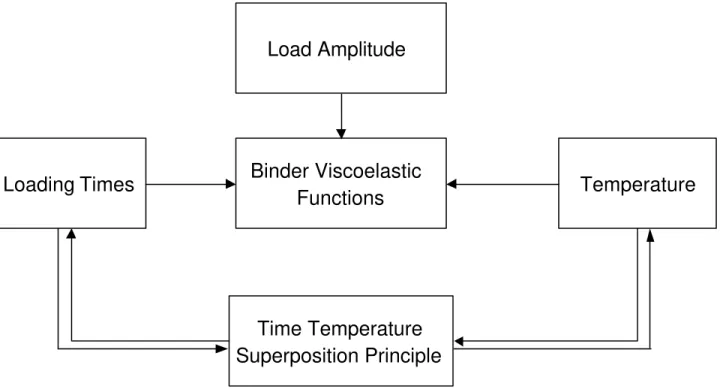
Three factors control the rheological behavior of asphalt binders: loading time (or frequency), load amplitude, and temperature (Figure 1). The traditional approach to dealing with this system is to reduce the three-dimensional problem (affected by temperature and loading time) to a two-dimensional problem (only affected by loading time) using the Time Temperature Superposition Principle. Assuming the validity of the Time Temperature Superposition Principle introduced by Tobolsky (1956) and theoretically validated based on the William-Landel-Ferry (WLF) equation (Ferry, 1980), the system may be modeled with only one control variable: loading time or frequency. Assuming a dynamic description of the problem, the required model may be developed through the following steps:
• Data collection utilizing an experimental program, • Formulating the model,
• Validating the model,
• Analyzing the model performance, and
• Monitoring the system as to calibrate and update the model.
EXPERIMENTAL PROGRAM
Both straight run and polymer-modified asphalt binders were used in the experimental program. This selection was based on two criteria:
• For the polymer-modified binder, only elastomeric modification was considered. This choice was mainly based on the extent to which the polymers are used in the industry. Styrene Butadiene Styrene (SBS) linear block copolymers and Styrene Ethylbutylene Styrene (SEBS) linear block copolymers were selected. Each polymer was mixed with a typical paving grade asphalt (PG 64-22) at three different concentration levels: 3%, 4%, and 5%. In addition, a commercial modified PG 76-22 binder used in the Commonwealth of Virginia was selected for comparison.
• For the straight run binder, the choice was restricted to the binders widely used in the Commonwealth of Virginia (i.e., PG 64-22 and PG 70-22).
The laboratory-prepared polymer-binder blends were prepared in 1995 (Gahvari and Al-Qadi, 1996) and were stored at room temperature in small 88 ml tins for approximately four years with no exposure to aging simulation. For each polymer-binder blend, three aging statuses were considered: unaged, short, and long-term. Short and long-term aging were simulated using the rolling thin film oven (RTFO) test and the pressure-aging vessel (PAV), respectively.
Each polymer-binder is designated by a four-character code. The first character, A, refers to the asphalt type, i.e., Amoco PG 64-22. The second character, U, R, or P, refers to the aging status of the binder: U stands for unaged condition, R refers to the RTFO-aged condition, and P designates the PAV residue (all PAV-aged specimens were RTFO-aged first). The third character denotes the polymer type: D for linear SBS and X for linear SEBS. The last character shows the polymer concentration in
percentage, i.e., 3%, 4%, or 5%. For example, AUD4 denotes a blend of asphalt binder with 4% polymer D (SBS) in an unaged condition.
Five characters were designated for the binders used in Virginia. The first two characters refer to the maximum temperature expected for the binder to perform adequately within the limits set by the SuperPaveTM specifications. The next two characters refer to the minimum temperature expected for the binder to perform adequately within the limits set by the SuperPaveTM specifications. The last character
was used to indicate the aging condition of the binder: U for unaged condition, R for RTFO residue, and P for PAV residue. For example, 76-22P denotes a Performance Grade (PG) 76-22 PAV-aged.
Dynamic mechanical analyses (DMA) were performed using a CS Bohlin stress controlled rheometer with parallel plate configuration at frequencies between 0.01 to 30 Hz and temperatures ranging from 5 to 75°C. Two sample sizes were used depending on the testing temperature. A sample with a 25-mm-diameter and a thickness of 1mm was used at high temperatures (45 to 75°C) and a sample with an 8-mm-diameter and a thickness of 2mm was used at intermediate temperatures (5 to 35°C). This test is used to measure the linear viscoelastic moduli of asphalt binders in a sinusoidal loading mode (Christensen et al, 1992).
Dynamic Mechanical Analysis
Prior to the frequency sweeps, the linear viscoelastic range was determined for each binder-polymer blend by performing strain sweeps over the entire range of temperatures and specified frequencies. Strain sweeps were performed at frequencies of 0.01, 0.15, 1.5, and 10 Hz.
In strain-controlled mode, the linear viscoelastic region is assumed when the complex shear modulus (G*) is above 95% of its initial value at a given frequency and
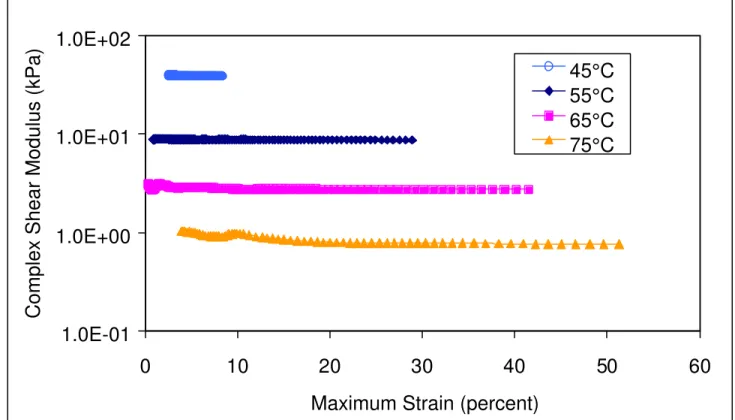
temperature (AASHTO, 1994). A linear viscoelastic material can also be defined as a material in which the stress is proportional to the strain at a given frequency and temperature. Hence, at high service temperatures (45-75°C), modified binders may behave in the linear viscoelastic region even at a high strain (Figure 2).
FIGURE 2
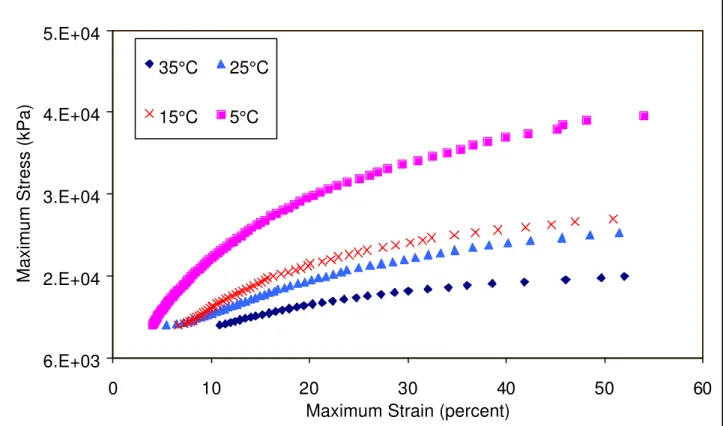
At intermediate temperatures (5-35°C), however, the stress-strain relationship indicates a strong susceptibility to the applied strain (Figure 3). To ensure that measurements are made in the linear viscoelastic region of response, the applied strain at intermediate temperatures was defined in very small values to avoid non-proportionality of the applied strain and resulting stress. Therefore, the target strains for 5, 15, 25, 35, and 45°C were chosen to be 0.8%, 1%, 2%, 3%, and 6.5%, respectively. For temperatures of 55°C and above, the target strain was set at 9%. These values were established to correspond to greater than 95% of the initial complex shear modulus, and they are well within the linear range of response as established by AASHTO TP5 for straight run asphalts.
FIGURE 3
After completing the strain sweeps and establishing the target strains for each temperature, frequency sweeps were performed on all samples in the unaged and aged conditions and over the entire range of temperatures. A total of 34 frequencies were used ranging from 0.01 to 30 Hz.
To develop a viscoelastic model that may describe the rheological behavior of asphalt binder over a wide range of loading times, the experimental data measured at
eight different temperatures were reduced to a reference temperature (25°C) using the Time-Temperature Superposition Principle. Shifting was applied to the complex modulus and its two components simultaneously, resulting in smooth master curves for the three functions. The resulting shift factors were then applied to the phase angle.
MODEL FORMULATION
Based on the theory of linear viscoelasticity, the complex shear modulus can be expressed as a function of the relaxation spectrum H(τ) as follows (Ferry, 1980):
( )
( )
dln t ? t i 1 ? t i t H G ? G* e∫
∞ ∞ − + + = (1) where,G*(ω) is the complex shear modulus at frequency ω; Ge is the equilibrium shear modulus;
H(τ) is the relaxation spectrum; τ is the relaxation time; and
1
i= − .
The main problem associated with this equation is that the relaxation spectrum cannot be directly obtained by any experiment. Using Equation (1), the following dimensionless function, ZH(ω), may be defined (Tschoegl, 1989):
( )
( ) ( )
( )
∫
∫
∞ ∞ − ∞ ∞ −=
t
ln
d
?
H
t
ln
d
t
? ,
k
t
H
?
Z
H (2)where k(ω,τ) is the kernel function.
Using Equation (2), the following relation can be validated:
( )
s
G
[G
G
]
Z
( )
?
Q
=
g−
g−
e H (3)where
Q
(
s
)
is the relaxance in the Laplace domain.The main advantage of the relaxance, which is a ratio of polynomials in the transform variable ‘s’, is that any function of interest (e.g., complex shear modulus, phase angle, etc.) can be directly obtained using well-defined relations. For instance, the complex shear modulus (G*) may be obtained from the relaxance using the following substitution:
( )
? [Q(s)] Q(i? ) *G = s=i? = (4)
As the corresponding kernel function, the function ZH(ω) (also called Z function)
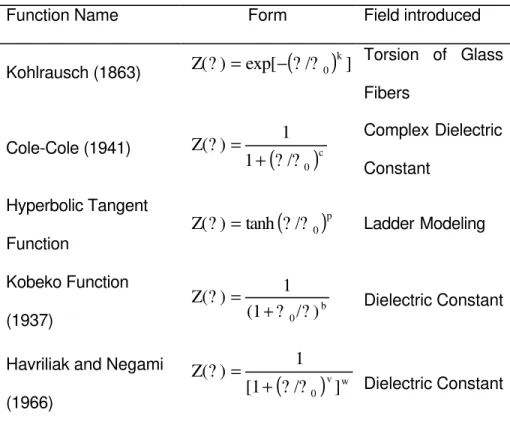
should range between 1 ≥ ZH(ω) ≥ 0. As defined by Tschoegl (1989), this function
should be a monotone, non-increasing function of its arguments. A suitable Z function must have at least two parameters, one for locating it along the time or frequency axis, and another to regulate its spread. Table 1 presents some valid forms for this function.
In this table, the parameter that controls the location along the frequency axis is denoted by the same symbol, ω0. In each model, all other parameters govern the spread of the
function along the frequency axis (i.e., k, c, p, b, and v).
TABLE 1
At the limits of its domain, a suitable Z function should satisfy the following two limits:
1 ) ? Z( lim 0 ?→ = and ?lim→∞Z(?) =0 (5)
Combining Equations (3) and (4), the following equation results:
) ? (i Z ] G [G G ) ? ( * G = g − g − e H (6)
The equilibrium shear modulus (Ge) for asphalt binder is equal to zero since it has no
preferred undeformed state (viscoelastic liquid). Therefore, Equation (6) can be rewritten as follows: )] ? (i Z 1 [ G ) ? ( * G = g − H (7)
Complex Shear Modulus Model
Based on equation (7), the model development is then reduced to the selection of a suitable mathematical function ZH(iω) that fulfills the previous set of conditions and
derived from their corresponding kernel functions (e.g., Cole-Cole function). Surprisingly, this approach has been used successfully in fields ranging from ladder modeling to dielectric constant modeling. One function of particular interest in the rest of this formulation is the Havriliak and Negami model, which takes the following form (Havriliak et al, 1966):
( )
v w o * H ] ) ? ? / i ( 1 [ 1 ? Z + = (8) where, ) ( Z*H ω is a dimensionless complex function that takes a value between zero and one;
ω is the reduced frequency;
v and w are model parameters; and
ωo is a reduced frequency value that defines the location along the x-axis.
Figure 4 presents the behavior of this function over a wide range of frequencies. It can be seen that this function satisfies the boundary conditions previously stated in Equation (5).
FIGURE 4
Combining Equations (7) and (8), G*(ω) can be written as follows:
( )
] ] ) ? /? i ( 1 [ 1 1 [ G ? * G v w o g + − = (9)The functions resulting from separating the real and imaginary parts of the complex shear modulus are not entirely practical due to the mathematical complexity of the equations (Elseifi, 1999). Moreover, the complex mathematical equations for the real and imaginary parts have not resulted in a statistically robust modeling due to the excessive accumulation of truncation errors. Consequently, the assumption that |G*| is a response function that might be formulated similarly results in the following equation by omitting the complex factor, i, from Equation (9):
( )
+
−
=
v w 0 g]
)
?
?
(
1
[
1
1
G
|
?
*
G
|
(10)Direct modeling of the absolute value of the complex shear modulus does not affect the main assumptions in the formulation as long as the rules for the Z dimensionless function are validated. The parameters of this model are as follows:
• v (0-1) that controls the spreading of the model along the x-axis (dimensionless); • ω0 that defines the location along the x-axis with unity of frequency (rad/sec); and
• w (greater than zero) that defines the location along the y-axis (dimensionless).
Other Z functions were tested (e.g., Cole-Cole function, Kobeko function), but the Havriliak and Negami function showed the best results for the evaluated problem.
Phase Angle Model
The formulation of the phase angle also uses the previously introduced Z function (the Havriliak and Negami model), which ranges between zero and unity. If this function is multiplied by a scaling factor, 90°, the resulting model ranges between zero and 90°,
which is the searched range for the phase angle. The resulting equation takes the following form (Elseifi, 1999):
w v 0
?
?
1
90
)
degrees
d(
+
=
(11)EVALUATION AND VALIDATION OF PROPOSED MODELS
The model parameters were obtained using a non-linear regression method. This was accomplished using the SAS (version 6.12) software package (SAS, 1988). The manipulation of the complex shear modulus, which varies over several orders of magnitude (10 – 109 Pa), often results in an excessive accumulation of the error components and an overflow in computations. To avoid these problems, the model was dealt with in the logarithmic domain, resulting in the following model:
(
)
[
]
+ − + = v w 0 g * ? /? 1 1 1 log G log G log (12)Estimates of the models’ parameters were obtained for all binders in the three aging stages in order to minimize the Mean Square Error (MSE). Approximately 250 measurements were available for each fit. As previously explained, these measurements were obtained at eight different temperatures and shifted to a 25°C reference temperature, resulting in a smooth master curve for the complex shear modulus (|G*|) and phase angle (δ). Although defined to be in the order of 109 Pa for most polymeric materials, the glassy shear modulus (Gg) was not kept constant. A wide
range of frequencies was used in this study; however, it was not feasible to reach the glassy region, which is defined as a temperature ranging from –15 to –30°C for most asphalt binders (Lesueur et al, 1997). Such temperatures could not be reached with a dynamic shear rheometer that uses a water bath.
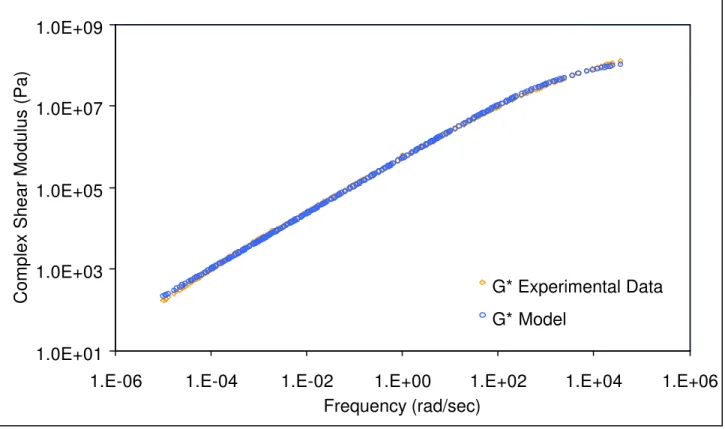
Table 2 summarizes the results of the non-linear regression analysis for the complex shear modulus. The obtained values for the glassy shear modulus were relatively close to the expected value (109 Pa). The parameter v ranged from zero to unity and tended
to decrease with aging for all binders. The parameter’s values were not significantly different due to polymer modification. The statistical soundness of the fitted models, the coefficient of determination (R2), and MSE are presented in Table 2.
TABLE 2
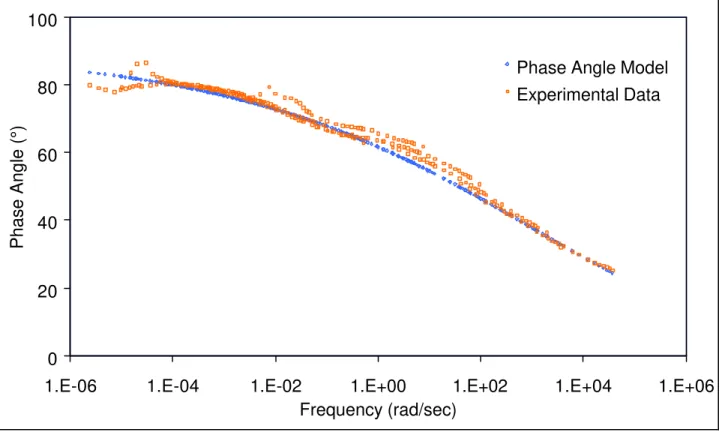
Figures 5 and 6 present the comparison between the measured and fitted complex shear modulus and phase angle, respectively, for the AUX3 unaged binder.
FIGURE 5 FIGURE 6
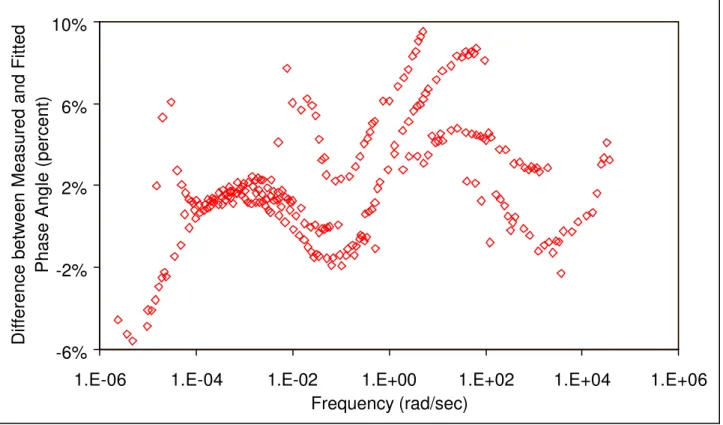
The proposed model could not accurately simulate the small plateau region observed in the phase angle master curves of the polymer-modified binders. However, the difference between the model prediction and the experimental results of this case was less than 10%, which is within the range of the expected experimental error in such tests. This difference is presented in Figure 7 as a percentage of the measured values for AUX3.
FIGURE 7 Storage and Loss Moduli Prediction
The developed models were also used to estimate the storage and loss moduli based on the following equations:
G' = |G*| cos(δ) (13)
G" = |G*| sin(δ) (14)
As an example, Figure 8 presents the comparison between measured and predicted storage shear moduli (G’) computed using the proposed models for the AUX3 binder. This approach indicates that the proposed models can be successfully combined to estimate other viscoelastic functions (e.g., G’ and G”) with reasonable accuracy.
FIGURE 8
Relaxation Spectrum Prediction
As a final step in the validation of the models, Booij and Palmen’s approximation was used to evaluate the relaxation spectrum, H(τ) (Booij et al, 1982):
( )
( )
? 1/t * d] 2 sin | ? G [| p 1 t H ≈ = (15)This approximation was selected because it has proven to be accurate for polymer melts when only a small window of relaxation times is sufficient to describe the material rheological behavior. When the full relaxation spectrum is needed to describe the material rheological behavior, a more complex approximation should be used, such as
the one introduced by Ninomiya and Ferry (1959). In Figure 9, a comparison is made between the relaxation spectrum obtained from the experimental data and the one obtained from the proposed models for AUX3. As shown in this figure, the proposed models estimate the relaxation spectrum with reasonable accuracy.
FIGURE 9
PRACTICAL IMPLICATIONS OF THE DEVELOPED MODELS
The developed models can be used to construct master curves for any viscoelastic function of interest (e.g., complex shear modulus, phase angle, etc.) based on a limited number of experiments at a few frequencies and/or temperatures. These master curves can then be used to predict the binder’s viscoelastic behavior over a wide range of temperatures and loading times. Estimates of the model parameters were determined for commonly used binders in the US (e.g. PG 64-22 and PG 70-22), and may be considered as guidelines for similar binders. For other binders, the model parameters can be determined based on a limited number of tests results.
CONCLUSIONS
This study presents the development of two models to describe the behavior of straight run and polymer-modified binders in the thermal-rheological simple linear viscoelastic region. These models, which characterize the absolute value of the complex shear modulus (|G*|) and the phase angle (δ), are valid as long as the considered binder obeys the time-temperature superposition principle. The models were derived based on the matching function approach and validated by comparing their predictions to actual
experimental data. The presented models are useful when describing the linear viscoelastic behavior by a small, easily manageable number of parameters. The developed models are based on the theory of viscoelasticity; however, the introduction of the Z function may provide some empiricism to the models. Thus, if one of these mathematical models adequately describes the response of a linear viscoelastic material to a given excitation, it may not be used to describe another type of excitation. For example, if a model accurately describes the response to a shear excitation, the same model may not describe a normal excitation. In applications such as asphalt rheology, in which interconvertibility is not a major issue, the simplicity and accuracy at a given excitation of these models justify their applications. Based on the model formulation and the validation steps, the following conclusions can be drawn:
• The proposed model for the complex shear modulus is adequate to describe the linear viscoelastic behavior of asphalt binders.
• The phase angle model is found to adequately describe unmodified binders with a small percentage of errors (less than 5%). Although, the model is unable to accurately simulate the plateau region found in polymer-modified binders, the error in this case is relatively small (less than 10%).
• The two models performed well together; their ability to estimate other viscoelastic functions (e.g., storage and loss shear moduli, relaxation spectrum) is adequate.
Acknowledgments
References
AASHTO Provisional Standards. (1994) AASHTO TP5, Standard Test Method for Determining the Rheological Properties of Asphalt Binder Using a Dynamic Shear Rheometer (DSR). Washington, D.C.
Booij, H.C. and Palmen, J.H.M. (1982) Some Aspects of Linear and Nonlinear Viscoelastic Behavior of Polymer Melts in Shear. Rhelogica Acta, Volume 21, pp 376-387.
Christensen, D.W. and Anderson, D.A. (1992) Interpretation of Dynamic Mechanical Test Data for Paving Grade Asphalt Cements. Proceedings of the Association of Asphalt Paving Technologists, Volume 61, pp 67-116.
Dickinson, E.J. and Witt, H.P. (1974) The Dynamic Shear Modulus of Paving Asphalts as a Function of Frequency. Transactions of the Society of Rheology, Volume 18, No4, pp 591-606.
Elseifi, M.A. (1999) Viscoelastic Modeling of Straight and Modified Binders at Intermediate and high Temperatures. M.S. Thesis, Virginia Tech.
Ferry, J.D. (1980) Viscoelastic Properties of Polymers. John Wiley and Sons, Inc., New York. Third Edition.
Gahvari, F. and Al-Qadi, I. L. (1996) Dynamic Mechanical Properties of SBR Modified Asphalt. 4th Materials Engineering Conference, Materials for the New Millennium, K. P. Chong, Ed., Washington DC, pp. 133-143.
Havriliak, S. and Negami, S. (1966) A Complex Plane Analysis of α-Dispersions in Some Polymer Systems. Journal of Polymer Science, Part C, No. 14, pp 99-117.
Jongepier, R. and Kuilman, B. (1969) Characteristics of the Rheology of Bitumens. Proceedings of the Association of Asphalt Paving Technologists, Volume 38, pp 98-122.
Lesueur, D., Gerard, J.F., Claudy, P., Letoffe, J.M., Planche, J.P., and Martin, D. (1997) Relationships Between the Structure and the Mechanical Properties of Paving Grade Asphalt Cements. Proceedings of the Association of Asphalt Paving Technologists, Volume 66, pp 486-519.
Marasteanu, M., and Anderson, D. (1996) Time-Temperature Dependency of Asphalt Binders-An Improved Model. Proceedings of the Association of Asphalt Paving Technologists, Volume 65, pp 408-448.
Ninomiya, K. and Ferry, J.D. (1959) Some Approximate Equations Useful in the Phenomenological Treatment of Linear Viscoelastic Data, Journal of Colloid Science, Volume 14, pp 36-48.
SAS Institute Inc. (1988) SAS/STAT User's Guide, Release 6.03 Edition. Cary, NC: SAS Institute Inc. 1028.
Tobolosky, A.V. (1956) Stress Relaxation Studies of the Viscoelastic Properties of Polymers. Journal of Applied Physics, Volume 27, No. 7, pp 673-685.
Tschoegl, N. W. (1989) The phenomenological Theory of Linear Viscoelastic Behavior. III: Representation of Linear Viscoelastic Behavior by Series-Parallel Models. Berlin: Springer-Verlag.
Van der Poel, C. (1954) A General System Describing the Viscoelastic Properties of Bitumens and its Relations to Routine Test Data. Journal of Applied Chemistry, Volume 4, pp 221.
TABLE 1 Matching functions of the Z-type
Function Name Form Field introduced
Kohlrausch (1863)
Z(
?
)
exp[
(
? /?
)
]
k 0−
=
Torsion of Glass Fibers Cole-Cole (1941)(
)
c 0? /?
1
1
)
?
Z(
+
=
Complex Dielectric Constant Hyperbolic Tangent Function(
)
p 0? /?
tanh
)
?
Z(
=
Ladder Modeling Kobeko Function (1937) b 0/?) ? (1 1 ) ? Z( + = Dielectric ConstantHavriliak and Negami
(1966)
(
)
w v 0]
? /?
[1
1
)
?
Z(
+
=
Dielectric ConstantTABLE 2 Estimated parameters for the complex shear modulus from least square analysis Binder v w ω0 (r/s) Log (Gg) R2 MSEb SSEa AUD3 0.83 0.008 31.65 9.0459 0.99 0.0092 2.3274 AUD4 0.80 0.001 55.42 9.6332 0.99 0.0076 1.9119 AUD5 0.76 0.002 54.49 9.7103 0.99 0.0066 1.5921 ARD3 0.79 0.005 19.91 9.0871 0.99 0.0078 1.9302 ARD4 0.74 0.009 27.41 8.9909 0.99 0.0078 1.8733 ARD5 0.70 0.014 35.00 8.9466 0.99 0.0045 1.0498 APD3 0.59 0.017 10.44 9.0362 0.99 0.0039 0.8504 APD4 0.65 0.015 14.55 9.0059 0.99 0.0045 1.0484 APD5 0.62 0.016 17.85 8.9699 0.99 0.0040 0.9482 64-22U 0.91 0.002 100.3 9.6105 0.99 0.0059 1.4954 70-22U 0.84 0.009 58.66 8.9411 0.99 0.0093 2.3249 76-22U 0.72 0.010 524.4 9.3732 0.99 0.0020 0.5163 64-22R 0.87 0.009 40.96 9.0852 0.99 0.007 1.8939 70-22R 0.78 0.009 32.45 9.0809 0.99 0.0096 2.2341 76-22R 0.67 0.010 504.3 9.5259 0.99 0.0008 0.1948 64-22P 0.76 0.008 10.45 9.2060 0.99 0.0090 2.1018 70-22P 0.91 0.019 103.7 8.7341 0.99 0.0045 1.1401 76-22P 0.59 0.008 173.4 9.5880 0.99 0.0006 0.1610 a
SSE: Sum square errors of Log(|G*|)
b
Binder Viscoelastic
Functions
Loading Times
Temperature
Time Temperature
Superposition Principle
Load Amplitude
1.0E-01
1.0E+00
1.0E+01
1.0E+02
0
10
20
30
40
50
60
Maximum Strain (percent)
Complex Shear Modulus (kPa)
45°C
55°C
65°C
75°C
FIGURE 2 Strain sweep of unaged binder with 3 percent SBS modifier at high temperatures (1.5 Hz)
6.E+03 2.E+04 3.E+04 4.E+04 5.E+04 0 10 20 30 40 50 60
Maximum Strain (percent)
Maximum Stress (kPa)
35°C 25°C
15°C 5°C
FIGURE 3 Stress-strain relationship for unaged binder with 3 percent SBS modifier at intermediate temperatures (1.5 Hz)
0 0.2 0.4 0.6 0.8 1 1.2
1.E-06 1.E-03 1.E+00 1.E+03 1.E+06 1.E+09 1.E+12 1.E+15
Frequency (rad/sec) Z(w)
1.0E+01 1.0E+03 1.0E+05 1.0E+07 1.0E+09
1.E-06 1.E-04 1.E-02 1.E+00 1.E+02 1.E+04 1.E+06
Frequency (rad/sec)
Complex Shear Modulus (Pa) G* Experimental Data
G* Model
FIGURE 5 Comparison between the measured complex shear modulus for AUX3 and results of the proposed model
0 20 40 60 80 100
1.E-06 1.E-04 1.E-02 1.E+00 1.E+02 1.E+04 1.E+06
Frequency (rad/sec)
Phase Angle (°)
Phase Angle Model Experimental Data
FIGURE 6 Comparison between the measured phase angle for AUX3 and the proposed model
-6% -2% 2% 6% 10%
1.E-06 1.E-04 1.E-02 1.E+00 1.E+02 1.E+04 1.E+06
Frequency (rad/sec)
Difference between Measured and Fitted
Phase Angle (percent)
FIGURE 7 Percentage difference between the measured and fitted phase angle for AUX3
1.E+00
1.E+03
1.E+06
1.E+09
1.E-05
1.E-03
1.E-01
1.E+01
1.E+03
1.E+05
Frequency (rad/sec)
Storage Shear Modulus (Pa)
Experimental DataProposed Models
FIGURE 8 Comparison between the measured storage shear modulus and predicted values of the proposed models for AUX3
1.E+00
1.E+02
1.E+04
1.E+06
1.E+08
1.E-05
1.E-03
1.E-01
1.E+01
1.E+03
1.E+05
Relaxation Time (sec)
Relaxation Spectrum (Pa)
Experimental Data Proposed Models
FIGURE 9 Comparison between the relaxation spectrums obtained from the experimental data and from the proposed models for AUX3