HAL Id: hal-01100926
https://hal.archives-ouvertes.fr/hal-01100926
Preprint submitted on 7 Jan 2015
HAL is a multi-disciplinary open access
archive for the deposit and dissemination of
sci-entific research documents, whether they are
pub-lished or not. The documents may come from
teaching and research institutions in France or
abroad, or from public or private research centers.
L’archive ouverte pluridisciplinaire HAL, est
destinée au dépôt et à la diffusion de documents
scientifiques de niveau recherche, publiés ou non,
émanant des établissements d’enseignement et de
recherche français ou étrangers, des laboratoires
publics ou privés.
A robust coarse space for Optimized Schwarz methods
SORAS-GenEO-2
Ryadh Haferssas, Pierre Jolivet, Frédéric Nataf
To cite this version:
Ryadh Haferssas, Pierre Jolivet, Frédéric Nataf. A robust coarse space for Optimized Schwarz methods
SORAS-GenEO-2. 2015. �hal-01100926�
A robust coarse space for Optimized Schwarz methods
SORAS-GenEO-2
Ryadh Haferssas
aPierre Jolivet
a, Fr´
ed´
eric Nataf
a,
aLaboratoire Jacques-Louis Lions, CNRS UMR 7598, Universit´e Pierre et Marie Curie, 75252 Paris
and INRIA Rocquencourt, Alpines, BP 105, 78153 Le Chesnay Cedex, France Received *****; accepted after revision +++++
Presented by
Abstract
Optimized Schwarz methods (OSM) are very popular methods which were introduced in [11] for elliptic problems and in [3] for propagative wave phenomena. We build here a coarse space for which the convergence rate of the two-level method is guaranteed regardless of the regularity of the coefficients. We do this by introducing a symmetrized variant of the ORAS (Optimized Restricted Additive Schwarz) algorithm [17] and by identifying the problematic modes using two different generalized eigenvalue problems instead of only one as in [16,15] for the ASM (Additive Schwarz method), BDD (balancing domain decomposition [12]) or FETI (finite element tearing and interconnection [6]) methods.
To cite this article: , C. R. Acad. Sci. Paris, Ser. I +++++ (+++++). R´esum´e
Les m´ethodes de Schwarz optimis´ees sont des m´ethodes tr`es populaires qui ont ´et´e introduites dans [11] pour des probl`emes elliptiques et dans [3] pour des ph´enom`enes de propagation d’ondes. Nous construisons ici un espace grossier pour lequel le taux de convergence de la m´ethode `a deux niveaux peut ˆetre prescrit `a l’avance sans hypoth`ese sur la r´egularit´e des coefficients. Ceci est rendu possible par l’introduction d’une version sym´etris´ee de la m´ethode ORAS (Optimized Restricted Additive Schwarz) [17] ainsi que par l’identification des modes probl´ematiques via deux probl`emes aux valeurs propres g´en´eralis´ees au lieu d’un seul comme dans [16,15] pour les m´ethodes ASM (Additive Schwarz method), BDD (balancing domain decomposition [12]) ou FETI (finite element tearing and interconnection [6]).
Pour citer cet article : , C. R. Acad. Sci. Paris, Ser. I +++++ (+++++).
Email addresses: [email protected] (Ryadh Haferssas), [email protected] (Pierre Jolivet), [email protected] (Fr´ed´eric Nataf).
1. Introduction
Substructuring algorithms such as BNN or FETI are defined for non overlapping domain decompositions but not for overlapping subdomains. Schwarz method [14] is defined only for overlapping subdomains. With the help of a coarse space correction, the two-level versions of both type of methods are weakly scalable, see [18] and references therein.
The domain decomposition method introduced by P.L. Lions [11] can be applied to both overlapping and non overlapping subdomains. It is based on improving Schwarz methods by replacing the Dirichlet interface conditions by Robin interface conditions. This algorithm was extended to Helmholtz problem by Despr´es [4]. Robin interface conditions can be replaced by more general interface conditions that can be optimized (Optimized Schwarz methods, OSM) for a better convergence, see [8,7] and references therein. When the domain is decomposed into a large number of subdomains, these methods are, on a practical point of view, scalable if a second level is added to the algorithm via the introduction of a coarse space [10,5,2]. But there is no systematic procedure to build coarse spaces with a provable efficiency.
The purpose of this article is to define a general framework for building adaptive coarse space for OSM methods for decomposition into overlapping subdomains. We prove that we can achieve the same robustness that what was done for Schwarz [15] and FETI-BDD [16] domain decomposition methods with so called GenEO (Generalized Eigenvalue in the Overlap) coarse spaces. Compared to these previous works, we have to introduce a non standard symmetric variant of the ORAS method as well as two generalized eigenvalue problems.
2. Symmetrized ORAS method
The problem to be solved is defined via a variational formulation on a domain Ω ⊂ Rd
for d ∈ N: Find u ∈ V such that : aΩ(u, v) = l(v) , ∀v ∈ V ,
where V is a Hilbert space of functions from Ω with real values. The problem we consider is given through a symmetric positive definite bilinear form that is defined in terms of an integral over any open set ω ⊂ Ω. Typical examples are the Darcy equation (K is a diffusion tensor)
aω(u, v) :=
Z
ω
K ∇u · ∇v dx ,
or the elasticity system (C is the fourth-order stiffness tensor and ε(u) is the strain tensor of a displace-ment field u):
aω(u, v) :=
Z
ω
C : ε(u) : ε(v) dx .
The problem is discretized by a finite element method. Let N denote the set of degrees of freedom and (φk)k∈N be a finite element basis on a mesh Th. Let A ∈ R#N ×#N be the associated finite element
matrix, Akl := aΩ(φl, φk), k, l ∈ N . For some given right hand side F ∈ R#N, we have to solve a linear
system in U of the form
AU = F .
Domain Ω is decomposed into N overlapping subdomains (Ωi)1≤i≤N so that all subdomains are a union
of cells of the mesh Th. This decomposition induces a natural decomposition of the set of indices N into
N subsets of indices (Ni)1≤i≤N:
Ni:= {k ∈ N | meas(supp(φk) ∩ Ωi) > 0} , 1 ≤ i ≤ N. (1)
For all 1 ≤ i ≤ N , let Ri be the restriction matrix from R#N to the subset R#Ni and Di be a diagonal
matrix of size #Ni× #Ni, so that we have a partition of unity at the algebraic level:
Id= N
X
i=1
RTi DiRi (2)
where Id∈ R#N ×#N is the identity matrix.
For all subdomains 1 ≤ i ≤ N , let Bi be a SPD matrix of size #Ni× #Ni, which comes typically from
the discretization of boundary value local problems using optimized transmission conditions, the ORAS preconditioner [17] is defined as MORAS,1−1 := N X i=1 RTi DiBi−1Ri. (3)
Due to matrices Di, this preconditioner is not symmetric. Note that in the special case Bi = RiA RTi
the ORAS algorithm reduces to the RAS algorithm [1]. The symmetrized variant of RAS is the additive Schwarz method (ASM):
MASM,1−1 :=
N
X
i=1
RiTA−1i Ri
which has been extensively studied and for which various coarse spaces have been analyzed. For the ORAS method considered in this note, it seems at first glance that we should accordingly study the following symmetrized variant: MOAS,1−1 := N X i=1 RTi Bi−1Ri. (4)
For reasons explained in Remark 1, we introduce another non standard variant of the ORAS precondi-tioner (3), the symmetrized ORAS (SORAS) algorithm:
MSORAS,1−1 :=
N
X
i=1
RTiDiB−1i DiRi. (5)
3. Two-level SORAS algorithm
In order to define the two-level SORAS algorithm, we introduce two generalized eigenvalue problems. First, for all subdomains 1 ≤ i ≤ N , we consider the following problem:
D´efinition 3.1
Find (Uik, µik) ∈ R#Ni\ {0} × R such that
DiRiARTi DiUik= µikBiUik .
(6)
Let γ > 0 be a user-defined threshold, we define Zγ
geneo⊂ R#N as the vector space spanned by the family
of vectors (RTiDiUik)µik>γ ,1≤i≤N corresponding to eigenvalues larger than γ.
In order to define the second generalized eigenvalue problem, we introduce for all subdomains 1 ≤ j ≤ N , eAj, the #Nj× #Nj matrix defined by
VjTAejUj:= aΩj X l∈Nj Ujlφl, X l∈Nj Vjlφl , Uj, Vj∈ RNj. (7)
When the bilinear form a results from the variational solve of a Laplace problem, the previous matrix corresponds to the discretization of local Neumann boundary value problems.
D´efinition 3.2 We introduce the generalized eigenvalue problem
Find (Vjk, λjk) ∈ R#Ni\ {0} × R such that
e
AiVik= λikBiVik.
(8)
Let τ > 0 be a user-defined threshold, we define Zgeneoτ ⊂ R#N as the vector space spanned by the family
of vectors (RT
iDiVik)λik<τ ,1≤i≤N corresponding to eigenvalues smaller than τ .
We are now ready to define the SORAS two level preconditioner
D´efinition 3.3 (The SORAS-GenEO-2 preconditioner) Let P0denote the A-orthogonal projection on the
coarse space
ZGenEO-2:= Zgeneoγ
M Zgeneoτ , the two-level SORAS-GenEO-2 preconditioner is defined as follows:
MSORAS,2−1 := P0A−1+ (Id− P0) N
X
i=1
RTiDiB−1i DiRi(Id− P0T) . (9)
Note that this definition is reminiscent of the balancing domain decomposition preconditioner [12] introduced for Schur complement based methods. Note that the coarse space is now defined by two generalized eigenvalue problems instead of one in [15,16] for ASM and FETI-BDD methods. We have the following theorem
Theorem 3.1 (Spectral estimate for the SORAS-GenEO-2 preconditioner) Let k0be the
max-imal multiplicity of the subdomain intersections, γ, τ > 0 be arbitrary constants used in Definitions 3.2 and 3.3 .
Then, the eigenvalues of the two-level preconditioned operator satisfy the following spectral estimate 1
1 +k0 τ
≤ λ(MSORAS,2−1 A) ≤ max(1, k0γ)
where λ(MSORAS,2−1 A) is an eigenvalue of the preconditioned operator. The proof is based on the fictitious space lemma [13].
Remark 1 An analysis of a two-level version of the preconditioner MOAS−1 (4) following the same path yields the following two generalized eigenvalue problems:
Find (Ujk, µjk) ∈ R#Ni\ {0} × R such that
AiUik= µikBiUik,
and
Find (Vjk, λjk) ∈ R#Ni\ {0} × R such that
e
AiVik= λikDiBiDiVik.
.
In the general case for 1 ≤ i ≤ N , matrices Di may have zero entries for boundary degrees of freedom
since they are related to a partition of unity. Moreover very often matrices Bi and Ai differ only by the
interface conditions that is for entries corresponding to boundary degrees of freedom. Therefore, matrix DiBiDi on the right hand side of the last generalized eigenvalue problem is not impacted by the choice of
the interface conditions of the one level optimized Schwarz method. This cannot lead to efficient adaptive coarse spaces.
Figure 1. 2D Elasticity: coefficient distribution of steel and rubber. 4. Nearly Incompressible elasticity
Although our theory does not apply in a straightforward manner to saddle point problems, we use it for these difficult problems for which it is not possible to preserve both symmetry and positivity of the problem. Note that generalized eigenvalue problems (6) and (8) still make sense if A is the matrix of a saddle point problem and matrices Bi and eAi are properly defined for each subdomain 1 ≤ i ≤ N . The
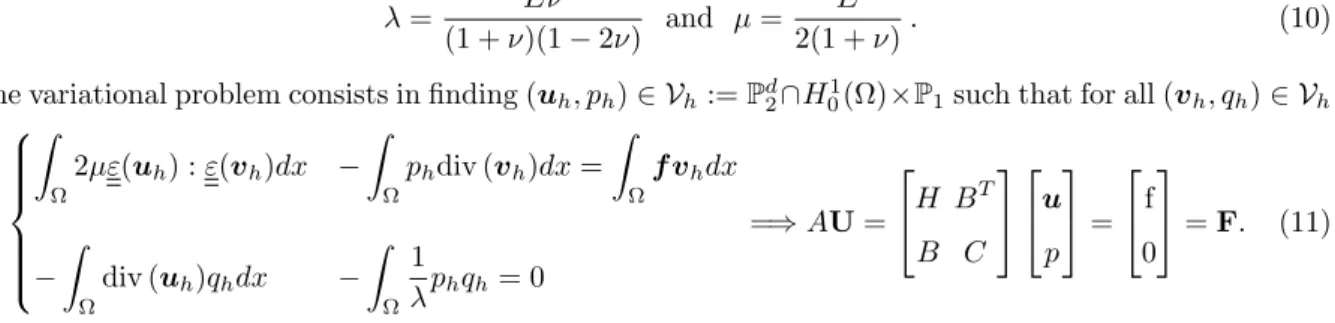
new coarse space was tested quite successfully on Stokes and nearly incompressible elasticity problems with a discretization based on saddle point formulations in order to avoid locking phenomena. We report here results only for the latter case. The mechanical properties of a solid can be characterized by its Young modulus E and Poisson ratio ν or alternatively by its Lam´e coefficients λ and µ. These coefficients relate to each other by the following formulas:
λ = Eν
(1 + ν)(1 − 2ν) and µ = E
2(1 + ν). (10)
The variational problem consists in finding (uh, ph) ∈ Vh:= Pd2∩H01(Ω)×P1such that for all (vh, qh) ∈ Vh
Z Ω 2µε(uh) : ε(vh)dx − Z Ω phdiv (vh)dx = Z Ω f vhdx − Z Ω div (uh)qhdx − Z Ω 1 λphqh= 0 =⇒ AU = H BT B C u p = f 0 = F. (11)
Matrix eAiarises from the variational formulation (11) where the integration over domain Ω is replaced by
the integration over subdomain Ωi and finite element space Vh is restricted to subdomain Ωi. Matrix Bi
corresponds to a Robin problem and is the sum of matrix eAiand of the matrix of the following variational
formulation restricted to the same finite element space: Z
∂Ωi\∂Ω
2αµ(2µ + λ)
λ + 3µ uh· vh with α = 10 in our test.
We test various domain decomposition methods for a heterogeneous beam of eight layers of steel (E1, ν1) =
(210 · 109, 0.3) and rubber (E
2, ν2) = (0.1 · 109, 0.4999), see Figure 1. The beam is clamped on its left
and right sides. Iteration counts for a relative tolerance of 10−6 are given in Table 1. We compare the one level Additive Schwarz (AS) and SORAS methods, the two level AS and SORAS methods with a coarse space consisting of rigid body motions which are zero energy modes (ZEM) and finally AS with a GenEO coarse space and SORAS with the GenEO-2 coarse space defined in Definition 3.3 with τ = 0.4 and γ = 10−3. Columns dim refer to the total size of the coarse space of a two-level method. Eigenvalue problem (8) accounts for roughly 90% of the GenEO-2 coarse space size.
References
[1] Xiao-Chuan Cai and Marcus Sarkis. A restricted additive Schwarz preconditioner for general sparse linear systems. SIAM Journal on Scientific Computing, 21:239–247, 1999.
Table 1
2D Elasticity. GMRES iteration counts for a solid made of steel and rubber. Simulations made with FreeFem++ [9] AS SORAS AS+CS(ZEM) SORAS +CS(ZEM) AS-GenEO SORAS -GenEO-2 Nb DOFs Nb subdom iteration iteration iteration dim iteration dim iteration dim iteration dim
35841 8 150 184 117 24 79 24 110 184 13 145 70590 16 276 337 170 48 144 48 153 400 17 303 141375 32 497 ++1000 261 96 200 96 171 800 22 561 279561 64 ++1000 ++1000 333 192 335 192 496 1600 24 855 561531 128 ++1000 ++1000 329 384 400 384 ++1000 2304 29 1220 1077141 256 ++1000 ++1000 369 768 ++1000 768 ++1000 3840 36 1971 [2] Lea Conen, Victorita Dolean, Rolf Krause, and Fr´ed´eric Nataf. A coarse space for heterogeneous Helmholtz problems
based on the Dirichlet-to-Neumann operator. J. Comput. Appl. Math., 271:83–99, 2014.
[3] Bruno Despr´es. D´ecomposition de domaine et probl`eme de Helmholtz. C.R. Acad. Sci. Paris, 1(6):313–316, 1990. [4] Bruno Despr´es. Domain decomposition method and the Helmholtz problem.II. In Second International Conference on
Mathematical and Numerical Aspects of Wave Propagation (Newark, DE, 1993), Philadelphia, 1993. SIAM.
[5] Charbel Farhat, A. Macedo, and M. Lesoinne. A two-level domain decomposition method for the iterative solution of high-frequency exterior Helmholtz problems. Numer. Math., 85(2):283–303, 2000.
[6] Charbel Farhat and Francois-Xavier Roux. A method of Finite Element Tearing and Interconnecting and its parallel solution algorithm. Int. J. Numer. Meth. Engrg., 32:1205–1227, 1991.
[7] Martin J. Gander. Optimized Schwarz methods. SIAM J. Numer. Anal., 44(2):699–731, 2006.
[8] Martin J. Gander, Fr´ed´eric Magoul`es, and Fr´ed´eric Nataf. Optimized Schwarz methods without overlap for the Helmholtz equation. SIAM J. Sci. Comput., 24(1):38–60, 2002.
[9] F. Hecht. New development in freefem++. J. Numer. Math., 20(3-4):251–265, 2012.
[10] Caroline Japhet, Fr´ed´eric Nataf, and Francois-Xavier Roux. The Optimized Order 2 Method with a coarse grid preconditioner. application to convection-diffusion problems. In P. Bjorstad, M. Espedal, and D. Keyes, editors, Ninth International Conference on Domain Decompositon Methods in Science and Engineering, pages 382–389. John Wiley & Sons, 1998.
[11] Pierre-Louis Lions. On the Schwarz alternating method. III: a variant for nonoverlapping subdomains. In Tony F. Chan, Roland Glowinski, Jacques P´eriaux, and Olof Widlund, editors, Third International Symposium on Domain Decomposition Methods for Partial Differential Equations , held in Houston, Texas, March 20-22, 1989, Philadelphia, PA, 1990. SIAM.
[12] Jan Mandel. Balancing domain decomposition. Comm. on Applied Numerical Methods, 9:233–241, 1992.
[13] Sergey V. Nepomnyaschikh. Mesh theorems of traces, normalizations of function traces and their inversions. Sov. J. Numer. Anal. Math. Modeling, 6:1–25, 1991.
[14] H. A. Schwarz. ¨Uber einen Grenz¨ubergang durch alternierendes Verfahren. Vierteljahrsschrift der Naturforschenden Gesellschaft in Z¨urich, 15:272–286, 1870.
[15] Nicole Spillane, Victorita Dolean, Patrice Hauret, Fr´ed´eric Nataf, Clemens Pechstein, and Robert Scheichl. Abstract robust coarse spaces for systems of PDEs via generalized eigenproblems in the overlaps. Numer. Math., 126(4):741–770, 2014.
[16] Nicole Spillane, Victorita Dolean, Patrice Hauret, Fr´ed´eric Nataf, and Daniel Rixen. Solving generalized eigenvalue problems on the interfaces to build a robust two-level FETI method. C. R. Math. Acad. Sci. Paris, 351(5-6):197–201, 2013.
[17] Amik St-Cyr, Martin J. Gander, and S. J. Thomas. Optimized multiplicative, additive, and restricted additive Schwarz preconditioning. SIAM J. Sci. Comput., 29(6):2402–2425 (electronic), 2007.
[18] Andrea Toselli and Olof Widlund. Domain Decomposition Methods - Algorithms and Theory, volume 34 of Springer Series in Computational Mathematics. Springer, 2005.