HAL Id: hal-00301328
https://hal.archives-ouvertes.fr/hal-00301328
Submitted on 30 Jun 2004HAL is a multi-disciplinary open access archive for the deposit and dissemination of sci-entific research documents, whether they are pub-lished or not. The documents may come from teaching and research institutions in France or abroad, or from public or private research centers.
L’archive ouverte pluridisciplinaire HAL, est destinée au dépôt et à la diffusion de documents scientifiques de niveau recherche, publiés ou non, émanant des établissements d’enseignement et de recherche français ou étrangers, des laboratoires publics ou privés.
Using an extended Kalman filter learning algorithm for
feed-forward neural networks to describe tracer
correlations
D. J. Lary, H. Y. Mussa
To cite this version:
D. J. Lary, H. Y. Mussa. Using an extended Kalman filter learning algorithm for feed-forward neural networks to describe tracer correlations. Atmospheric Chemistry and Physics Discussions, European Geosciences Union, 2004, 4 (3), pp.3653-3667. �hal-00301328�
ACPD
4, 3653–3667, 2004
Neural networks and tracer correlations D. J. Lary and H. Y. Mussa Title Page Abstract Introduction Conclusions References Tables Figures J I J I Back Close
Full Screen / Esc
Print Version Interactive Discussion
© EGU 2004 Atmos. Chem. Phys. Discuss., 4, 3653–3667, 2004
www.atmos-chem-phys.org/acpd/4/3653/ SRef-ID: 1680-7375/acpd/2004-4-3653 © European Geosciences Union 2004
Atmospheric Chemistry and Physics Discussions
Using an extended Kalman filter learning
algorithm for feed-forward neural
networks to describe tracer correlations
D. J. Lary1, 2, 3and H. Y. Mussa31
Global Modelling and Assimilation Office, NASA Goddard Space Flight Center, USA 2
GEST at the University of Maryland Baltimore County, MD, USA 3
Unilever Cambridge Centre, Department of Chemistry, University of Cambridge, United Kingdom
Received: 19 April 2004 – Accepted: 21 June 2004 – Published: 30 June 2004 Correspondence to: D. J. Lary ([email protected])
ACPD
4, 3653–3667, 2004
Neural networks and tracer correlations D. J. Lary and H. Y. Mussa Title Page Abstract Introduction Conclusions References Tables Figures J I J I Back Close
Full Screen / Esc
Print Version Interactive Discussion
© EGU 2004 Abstract
In this study a new extended Kalman filter (EKF) learning algorithm for feed-forward neural networks (FFN) is used. With the EKF approach, the training of the FFN can be seen as state estimation for a non-linear stationary process. The EKF method gives ex-cellent convergence performances provided that there is enough computer core
mem-5
ory and that the machine precision is high. Neural networks are ideally suited to de-scribe the spatial and temporal dependence of tracer-tracer correlations. The neural network performs well even in regions where the correlations are less compact and normally a family of correlation curves would be required. For example, the CH4-N2O correlation can be well described using a neural network trained with the latitude,
pres-10
sure, time of year, and CH4volume mixing ratio (v.m.r.). The neural network was able to reproduce the CH4-N2O correlation with a correlation coefficient between simulated and training values of 0.9997. The neural network Fortran code used is available for download.
1. Introduction
15
Compact correlations between long-lived species are well-observed features in the middle atmosphere, as for example described byFahey et al. (1989); Plumb and Ko (1992); Loewenstein et al. (1993);Elkins et al. (1996); Keim et al. (1997); Michelson et al. (1998);Rinsland et al.(1999);Strahan(1999);Fischer et al.(2000);Muscari et al. (2003). The correlations exist for all long-lived tracers – not just those which are
chem-20
ically related. This is due to their all be transported by the general circulation of the atmosphere. The tight relationships between different constituents have led to many analyses where measurements of one tracer are used to infer the abundance of an-other tracer. These correlations can also be used as a diagnostic of mixing (Schoeberl et al.,1997;Morgenstern et al.,2002) and to distinguish between air-parcels of different
25
ACPD
4, 3653–3667, 2004
Neural networks and tracer correlations D. J. Lary and H. Y. Mussa Title Page Abstract Introduction Conclusions References Tables Figures J I J I Back Close
Full Screen / Esc
Print Version Interactive Discussion
© EGU 2004 dependent correlations are usually achieved by a family of correlations. However, a
single neural network is a natural and effective alternative as shown by our previous study (Lary et al.,2004).
This study uses the same dataset asLary et al.(2004) but uses a quicker and more accurate extended Kalman filter learning algorithm for feed-forward neural networks as
5
described in the next section.
2. Extended Kalman filter as a learning algorithm for feed-forward neural net-work
For a general introduction to neural networks please see the book byBishop(1996). In this study we use a new advanced extended Kalman filter learning algorithm for
feed-10
forward neural network. The algorithm used here gave better results in just 3 training epochs (iterations) than our previous study (Lary et al.,2004) using the “JETNET 3.4” package (Lonnblad et al.,1992;Peterson et al.,1994) achieved in 1 million epochs.
It is well known now that finding the optimal synaptic weights of feed-forward neu-ral networks (FNN) employing gradient descent optimization techniques is plagued by
15
extraordinarily slow convergence rates and misfittings (Shah et al., 1992; Blank and Brown,1994). A number of faster and more accurate methods have been suggested (Blank and Brown,1994;Iiguni et al.,1992;Watrous,1987) at the expense of higher computational cost at each iteration. The extended Kalman filter (EKF) is the best known among them (Singhal and Wu,1989).
20
With the EKF approach, the training of the FFN can be seen as state estimation for a non-linear stationary process (Singhal and Wu,1989). What this means exactly will be explained in details in the following sections. The EKF method gives excellent con-vergence performances provided that there is enough computer core memory and that the machine precision is high. For a large FNN, the storage requirement can become
25
prohibitive. Furthermore, it was noticed (Bierman,1977) that round off errors due to poor computer precision can sometimes make the algorithm numerically unstable.
ACPD
4, 3653–3667, 2004
Neural networks and tracer correlations D. J. Lary and H. Y. Mussa Title Page Abstract Introduction Conclusions References Tables Figures J I J I Back Close
Full Screen / Esc
Print Version Interactive Discussion
© EGU 2004 The storage issue has been addressed by a number of research groups (Shah et al.,
1992;Puskorius and Feldkamp,1994). They attacked the estimation problem (train-ing) by partitioning it into a set of subproblems assuming the existence of mutually independent groups of weights; the numerical stability issue can be overcome by using the square root of the estimate error covariance matrix (background error covariance
5
matrix) instead of propagating the full estimate error covariance matrix (Bierman,1977; Zhang and Li,1999). It should be, however, noted that only the global (full) EKF is de-scribed byBierman(1977);Zhang and Li(1999). We are not aware of anyone who has combined the partitioning approach with the square root scheme. As our work required neural networks of moderate sizes, we employed the global EKF in conjunction with the
10
square root scheme for training the FNN.
In the following section we describe briefly how the EKF can be used as a training technique for the FNN. We also give a comprehensive description of how our training algorithm has been implemented.
2.1. Employment of EKF As FNN training algorithm
15
Singhal and Wu(1989) first suggested to use an extended Kalman filter for training neural networks. Their argument was simple and it can be put as follows
– Multilayer feed-forward neural networks can be viewed as a static non-linear dy-namic system whose state is the vector containing all its synaptic weights. – Therefore the training of the neural networks can be considered as a state
esti-20
mation problem for a stationary non-linear system.
– Furthermore, Kalman filter is known to give an optimal estimate of states of linear dynamic systems. It is also equally well known that an extended version of the Kalman algorithm can be used for estimating the approximate conditional means and covariance of1of the non-linear dynamic systems.
25
1
ACPD
4, 3653–3667, 2004
Neural networks and tracer correlations D. J. Lary and H. Y. Mussa Title Page Abstract Introduction Conclusions References Tables Figures J I J I Back Close
Full Screen / Esc
Print Version Interactive Discussion
© EGU 2004 – Hence, if the neural network is formulated in terms of space-state concepts similar
to those of a static non-linear dynamic system, then the best conditional mean and covariance of the synaptic weight vector can be found by employing an extended Kalman filter.
In state estimation form, mathematically the neural network can be described by these
5
two equations (Shah et al.,1992;Zhang and Li,1999;Haykin,2001).
wj+1= wj + ej (1)
dj = h[wj,xj]+ νj (2)
The first equation is known as the process equation, whereas the second equation is called the observation equation.
10
– j is the iterative index.
– h[wj,xj] is the iterative varying function describing the network; the value of the function is the FNN output.
– dj is the known output (observed, desired, or target) vector. – νj is the measurement noise vector.
15
– xj is the input vector.
– wj is the state (vector elements of which are the synaptic weights) of FNN at j. – ej is the process noise vector.
The assumptions made are:
νj is a white noise with E [νiνTj]= δi jRj covariance matrix.
20
ej is a white noise with E [eieTj]= δi jQj covariance matrix. E [eiνTj]= 0., for all i,j.
ACPD
4, 3653–3667, 2004
Neural networks and tracer correlations D. J. Lary and H. Y. Mussa Title Page Abstract Introduction Conclusions References Tables Figures J I J I Back Close
Full Screen / Esc
Print Version Interactive Discussion
© EGU 2004 2.2. Training procedure using EKF
The training (state estimation) is now a problem of determining ˆw (the state vector) that minimizes the sum of squared prediction errors of all observed data so far.
Givendj,hj,Rj, andQj, the EKF solution to finding ˆw can be obtained by using the following recursion (Haykin,2001)
5 ˆ wj = ˆwj−1+ Kj(dj − ˆyj) (3) Kj = Pj−1Hj Rj+ HTjPj−1Hj (4) Pj = Pj−1− KjHTjPj−1+ Qj (5)
Kj is the Kalman gain matrix at step j ; dj − ˆyj vector contains the prediction errors (innovations); ˆyj is the prediction (=h[wj−1,xj]);Pj is the estimate of conditional mean
10
covariance matrix; Hj is a matrix of derivatives of hj with respect to all elements of ˆ
wj−1
Hj = ∂h[ ˆwj−1,xj]
∂ ˆwj−1 (6)
2.3. Computational aspects
Consider a neural network with an architecture with one input layer containing n nodes
15
plus one offset node, one hidden layer with m number of nodes plus one offset node, and l number of output nodes in the output layer.
In this architecture w is a [m(n+1)+ m+1]×l vector ; x is (n+1) where x(1) is a constant ; P and Q are l[m(n+1)+ m+1]× l[m(n+1)+ m+1] ; R and dj are l×l ; K is [m(n+1)+ m+1]×l ; H is l[m(n+1)+ m+1]×l[m(n+1)+ m+1].
ACPD
4, 3653–3667, 2004
Neural networks and tracer correlations D. J. Lary and H. Y. Mussa Title Page Abstract Introduction Conclusions References Tables Figures J I J I Back Close
Full Screen / Esc
Print Version Interactive Discussion
© EGU 2004 For the training procedure to work, it requires values ofPj,Rj, andQj. Rj is just the
error covariance of the observation ( the known data ) so it is easy to calculate. Qj is usually set to zero. However,P is not known a priori. So it is initialized at the beginning of the training. Alsow is initialized.
The training procedure is implemented as follows
5
1. Initializations
– Choose random values for w0
– Set the offsets (biases) to nonzero constants. – Initialise P0to a small nonzero number.
2. Choose an input training pattern,xj, which is propagated through the network to
10
yield an output. 3. Rj
– If the errors of the input pattern are known, calculate Rj.
– If not, use iteration-varying forgetting factor in its place (Zhang and Li,1999). 4. ComputeHj
15
5. CalculateKj 6. Update
– ˆwj by using the Kalman matrix and the innovations. – Pj as shown in Eq. (5).
7. If the stopping criteria is met, exit. Otherwise go back to step 2.
20
ACPD
4, 3653–3667, 2004
Neural networks and tracer correlations D. J. Lary and H. Y. Mussa Title Page Abstract Introduction Conclusions References Tables Figures J I J I Back Close
Full Screen / Esc
Print Version Interactive Discussion
© EGU 2004 – The FNN had only one output, i.e. dj,Rj, the innovation and the denominator in
Eq. (3) are all scalars.
– ˆyj = h(w, x) = tanh[w(m(n + 1) + 1 : m + 1)Tz(1 : m+ 1)], where z(2 : m + 1) = tanh[w(1 : n+ 1)Tx(1 : n+ 1)] and x(1) and z(1) are the biases in the input and hidden layers respectively
5
– Qj = 0.0
– Rj = Iλj, where λj is a forgetting factor given byZhang and Li(1999):
λj = λ0λj−1+ (1 − λ0) (7)
λ0and λ0are tunable parameters.
– The square root of P was initialised and then propagated. This was done to
10
guarantee the numerical stability of the algorithmBierman(1977).
3. Results: the CH4-N2Ocorrelation
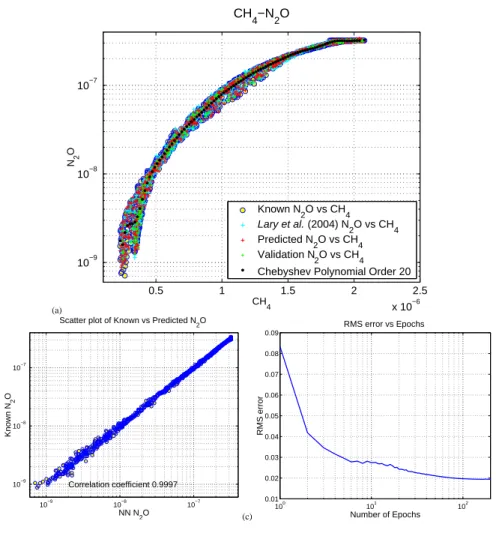
Figure1a shows an example of using the new EKF learning algorithm for feed-forward neural networks for the CH4-N2O correlation from the Cambridge 2D model (Law and Pyle, 1993a,b) (red crosses with validation points as green crosses). The CH4-N2O
15
data is shown by the yellow filled blue circles. The correlation coefficient between the actual solution and the neural network solution was 0.9997 after just 200 iterations (epochs). The same correlation coefficient is obtained after just 3 iterations (epochs). Overlaid on the same panel are the previous results ofLary et al.(2004) (cyan crosses) which used “Quickprop” learning and required 106 iterations to reproduce the CH4
-20
N2O correlation with a correlation coefficient between simulated and training values of 0.9995. So the new algorithm gives better results with much less expense. Figure1b
ACPD
4, 3653–3667, 2004
Neural networks and tracer correlations D. J. Lary and H. Y. Mussa Title Page Abstract Introduction Conclusions References Tables Figures J I J I Back Close
Full Screen / Esc
Print Version Interactive Discussion
© EGU 2004 shows a scatter diagram of the known N2O concentration against the neural network
N2O concentration. Figure1c shows the way the rms error changes with epoch. Both CH4and pressure are strongly correlated with N2O as can be seen in Fig. 1 of Lary et al.(2004). Latitude and time are only weakly correlated with N2O but still play a small role in capturing some of the details of the CH4-N2O correlation in Panel (a).
5
A polynomial or other fit will typically do a good job of describing the CH4-N2O cor-relation for high values of CH4 and N2O. However, for low values of CH4 and N2O there is quite a spread in the relationship which a single curve can not describe. This is the altitude dependent regime where the correlation shows significant variation with altitude (Minschwaner et al., 1996). Figure 1a shows a more conventional fit using
10
a Chebyshev polynomial of order 20 overlaid on the neural network fits. This fit was chosen as giving the best agreement to the CH4-N2O correlation after performing fits using 3667 different equations. Even though this is a good fit the spread of values can not be described by a single curve. However, a neural network trained with the latitude, pressure, time of year, and CH4volume mixing ratio (v.m.r.) (four inputs) is able to well
15
reproduce the N2O v.m.r. (one output), including the spread for low values of CH4and N2O.
3.1. Scaling
Variable scaling often allows neural networks to achieve better results. In this case all variables were scaled to vary between ±1. If the initial range of values was more than
20
an order of magnitude then log scaling was also applied. In the case of time of year the sine of the fractional time of year was used to avoid a step discontinuity at the start of the year.
ACPD
4, 3653–3667, 2004
Neural networks and tracer correlations D. J. Lary and H. Y. Mussa Title Page Abstract Introduction Conclusions References Tables Figures J I J I Back Close
Full Screen / Esc
Print Version Interactive Discussion
© EGU 2004 4. Conclusions
Neural networks are ideally suited to describe the spatial and temporal dependence of tracer-tracer correlations. Even in regions when the correlations are less compact. Us-ing a new extended Kalman filter learnUs-ing algorithm for feed-forward neural networks the correlation coefficient between the actual solution and the neural network solution
5
was 0.9997 after just 200 iterations (epochs). The same correlation coefficient is ob-tained after just 3 iterations (epochs). This can be compared to our previous study (Lary et al.,2004) which used “Quickprop” learning and required 106 iterations to re-produce the CH4-N2O correlation with a correlation coefficient between simulated and training values of 0.9995. So the new algorithm gives better results with much less
10
expense.
Acknowledgements. It is a pleasure to acknowledge: NASA for a distinguished Goddard Fel-lowship in Earth Science; The Royal Society for a Royal Society University Research Fellow-ship; The government of Israel for an Alon FellowFellow-ship; The NERC, EU, and ESA for research support.
15
References
Bierman, G.: Factorization Methods for Discrete Sequential Estimation, Academic Press, 1977.
3655,3656,3660
Bishop, C.: Neural Networks for Pattern Recognition, Oxford University Press, 1996. 3655
Blank, T. B. and Brown, S. D.: Adaptive, global, extended Kalman filters for training feedforward
20
neural networks, Journal of Chemometrics, 8, 391–407, 1994. 3655
Elkins, J. W., Fahey, D. W., Gilligan, J. M., Dutton, G. S., Baring, T. J., Volk, C. M., Dunn, R. E., Myers, R. C., Montzka, S. A., Wamsley, P. R., Hayden, A. H., Butler, J. H., Thompson, T. M., Swanson, T. H., Dlugokencky, E. J., Novelli, P. C., Hurst, D. F., Lobert, J. M., Ciciora, S. J., McLaughlin, R. J., Thompson, T. L., Winkler, R. H., Fraser, P. J., Steele, L. P., and Lucarelli,
25
M. P.: Airborne gas chromatograph for in situ measurements of long-lived species in the upper troposphere and lower stratosphere, Geophys. Res. Lett., 23, 347–350, 1996. 3654
ACPD
4, 3653–3667, 2004
Neural networks and tracer correlations D. J. Lary and H. Y. Mussa Title Page Abstract Introduction Conclusions References Tables Figures J I J I Back Close
Full Screen / Esc
Print Version Interactive Discussion
© EGU 2004
Fahey, D. W., Murphy, D. M., Kelly, K. K., Ko, M. K. W., Proffitt, M. H., Eubank, C. S., Ferry, G. V., Loewenstein, M., and Chan, K. R.: Measurements of nitric-oxide and total reactive nitrogen in the antarctic stratosphere – observations and chemical implications, J. Geophys. Res. (Atmos.), 94, 16 665–16 681, 1989. 3654
Fischer, H., Wienhold, F. G., Hoor, P., Bujok, O., Schiller, C., Siegmund, P., Ambaum, M.,
5
Scheeren, H. A., and Lelieveld, J.: Tracer correlations in the northern high latitude lowermost stratosphere: Influence of cross-tropopause mass exchange, Geophys. Res. Lett., 27, 97– 100, 2000. 3654
Haykin, S.: Kalman Filtering and Neural Networks, Wiley-Interscience, 2001. 3657, 3658,
3659
10
Iiguni, Y., Sakai, H., and Tokumaru, H.: A real-time learning algorithm for a multilayered neural network based on the extended Kalman filter, IEEE Transactions on Signal Processing, 40, 959–966, 1992. 3655
Keim, E. R., Loewenstein, M., Podolske, J. R., Fahey, D. W., Gao, R. S., Woodbridge, E. L., Wamsley, R. C., Donnelly, S. G., DelNegro, L. A., Nevison, C. D., Solomon, S., Rosenlof,
15
K. H., Scott, C. J., Ko, M. K. W., Weisenstein, D., and Chan, K. R.: Measurements of the NOy-N2O correlation in the lower stratosphere: Latitudinal and seasonal changes and model comparisons, J. Geophys. Res. (Atmos.), 102, 13 193–13 212, 1997. 3654
Lary, D. J., Muller, M. D., and Mussa, H. Y.: Using neural networks to describe tracer corre-lations, Atmospheric Chemistry and Physics, 4, 143–146, 2004. 3655, 3660,3661,3662,
20
3667
Law, K. and Pyle, J.: Modeling trace gas budgets in the troposphere .1. O3and odd nitrogen, J. Geophys. Res. (Atmos.), 98, 18 377–18 400, 1993a. 3660
Law, K. and Pyle, J.: Modeling trace gas budgets in the troposphere .2. CH4and CO, J. Geo-phys. Res. (Atmos.), 98, 18 401–18 412, 1993b. 3660
25
Loewenstein, M., Podolske, J. R., Fahey, D. W., Woodbridge, E. L., Tin, P., Weaver, A., New-man, P. A., Strahan, S. E., Kawa, S. R., Schoeberl, M. R., and Lait, L. R.: New observations of the NOy/N2O correlation in the lower stratosphere, Geophys. Res. Lett., 20, 2531–2534, 1993. 3654
Lonnblad, L., Peterson, C., and Rognvaldsson, T.: Pattern-recognition in high-energy physics
30
with artificial neural networks – “JETNET-2.0”, Comp. Phys. Comm., 70, 167–182, 1992.
3655
ACPD
4, 3653–3667, 2004
Neural networks and tracer correlations D. J. Lary and H. Y. Mussa Title Page Abstract Introduction Conclusions References Tables Figures J I J I Back Close
Full Screen / Esc
Print Version Interactive Discussion
© EGU 2004
abundances of NOy, O3, N2O, and CH4 derived from ATMOS measurements, J. Geophys. Res. (Atmos.), 103, 28 347–28 359, 1998. 3654
Minschwaner, K., Dessler, A. E., Elkins, J. W., Volk, C. M., Fahey, D. W., Loewenstein, M., Podolske, J. R., Roche, A. E., and Chan, K. R.: Bulk properties of isentropic mixing into the tropics in the lower stratosphere, J. Geophys. Res. (Atmos.), 101, 9433–9439, 1996. 3661
5
Morgenstern, O., Lee, A. M., and Pyle, J. A., Cumulative mixing inferred from stratospheric tracer relationships, J. Geophys. Res. (Atmos.), 108, 2002. 3654
Muscari, G., de Zafra, R. L., and Smyshlyaev, S.: Evolution of the NOy-N2O correlation in the antarctic stratosphere during 1993 and 1995, J. Geophys. Res. (Atmos.), 108, 2003. 3654
Peterson, C., Rognvaldsson, T., and Lonnblad, L.: “JETNET 3.0” a versatile artificial neural
10
network package, Comp. Phys. Comm., 81, 185–220, 1994. 3655
Plumb, R. A. and Ko, M. K. W.: Interrelationships between mixing ratios of long lived strato-spheric constituents, J. Geophys. Res. (Atmos.), 97, 10 145–10 156, 1992. 3654
Puskorius, G. V. and Feldkamp, L. A.: Neurocontrol of nonlinear dynamical-systems with kalman filter trained recurrent networks, IEEE Transactions on Neural Networks, 5, 279–
15
297, 1994. 3656
Rinsland, C. P., Salawitch, R. J., Gunson, M. R., Solomon, S., Zander, R., Mahieu, E., Goldman, A., Newchurch, M. J., Irion, F. W., and Chang, A. Y.: Polar stratospheric descent of NOy and CO and arctic denitrification during winter 1992-1993, J. Geophys. Res. (Atmos.), 104, 1847–1861, 1999. 3654
20
Schoeberl, M. R., Roche, A. E., Russell, J. M., Ortland, D., Hays, P. B., and Waters, J. W.: An estimation of the dynamical isolation of the tropical lower stratosphere using UARS wind and trace gas observations of the quasibiennial oscillation, Geophys. Res. Lett., 24, 53–56, 1997. 3654
Shah, S., Palmieri, F., and Datum, M.: Optimal filtering algorithms for fast learning in
feedfor-25
ward neural networks, Neural Networks, 5, 779–787, 1992. 3655,3656,3657
Singhal, S. and Wu, L.: Training feedforward networks with extended Kalman filter algorithm, in Proc. Int. Conf. ASSP, pp. 1187–1190, 1989. 3655,3656
Strahan, S. E., Climatologies of lower stratospheric NOy and O3 and correlations with N2O based on in situ observations, J. Geophys. Res. (Atmos.), 104, 30 463–30 480, 1999. 3654
30
Watrous, R.: Learning algorithms for connectionist networks, in Proc. IEEE First Int. Conf. Neural Networks, 2, p. 619, 1987. 3655
Three-ACPD
4, 3653–3667, 2004
Neural networks and tracer correlations D. J. Lary and H. Y. Mussa Title Page Abstract Introduction Conclusions References Tables Figures J I J I Back Close
Full Screen / Esc
Print Version Interactive Discussion
© EGU 2004
dimensional structure and accompanying ozone and olr distributions, J. Atmos. Sci., 60, 637–653, 2003. 3654
Zhang, Y. M. and Li, X. R.: A fast u-d factorization-based learning algorithm with applications to nonlinear system modeling and identification, IEEE Transactions on Neural Networks, 10, 930–938, 1999. 3656,3657,3659,3660
ACPD
4, 3653–3667, 2004
Neural networks and tracer correlations D. J. Lary and H. Y. Mussa Title Page Abstract Introduction Conclusions References Tables Figures J I J I Back Close
Full Screen / Esc
Print Version Interactive Discussion
© EGU 2004
Lary: Neural Networks and Tracer Correlations 3
(a) 0.5 1 1.5 2 2.5 x 10⁻⁶ 10−9 10−8 10−7 CH4−N2O CH 4 N2 O Known N 2O vs CH4 Lary et al. (2004) N 2O vs CH4 Predicted N 2O vs CH4 Validation N 2O vs CH4
Chebyshev Polynomial Order 20
(b)
10−9 10−8 10−7
10−9 10−8
10−7
Scatter plot of Known vs Predicted N2O
NN N 2O Known N 2 O Correlation coefficient 0.9997 (c) 100 101 102 0.01 0.02 0.03 0.04 0.05 0.06 0.07 0.08 0.09 RMS error vs Epochs Number of Epochs RMS error
Fig. 1. The neural network used to produce the CH4-N2O correlation in Panel (a) is our new extended Kalman filter learning algorithm
for feed-forward neural networks (red crosses with validation points as green crosses). The data is shown by the yellow filled blue circles. The correlation coefficient between the actual solution and the neural network solution was 0.9997 after just 200 iterations (epochs). The same correlation coefficient is obtained after just 3 iterations (epochs). Overlaid on the same panel are the previous results of Lary et al. (2004) (cyan crosses) which usedQuickproplearning and required 106iterations to reproduce the CH4-N2O correlation with a correlation coefficient between simulated and training values of 0.9995. A Chebyshev polynomial of order 20 is also shown (small black circles) for the sake of comparison. This fit was chosen as giving the best agreement to the CH4-N2O correlation after performing fits using 3667 different equations. Even though this is a good fit the spread of values can not be described by a single curve. However, a neural network trained with the latitude, pressure, time of year, and CH4volume mixing ratio (v.m.r.) (four inputs) is able to well reproduce the N2O v.m.r. (one output), including the spread for low values of CH4and N2O. Panel (b) shows a scatter diagram of the known N2O concentration against the neural network N2O concentration. Panel (c) shows the way the rms error changes with epoch.
ACPD
4, 3653–3667, 2004
Neural networks and tracer correlations D. J. Lary and H. Y. Mussa Title Page Abstract Introduction Conclusions References Tables Figures J I J I Back Close
Full Screen / Esc
Print Version Interactive Discussion
© EGU 2004
Fig. 1. The neural network used to produce the CH4-N2O correlation in(a) is our new extended
Kalman filter learning algorithm for feed-forward neural networks (red crosses with validation points as green crosses). The data is shown by the yellow filled blue circles. The correlation coefficient between the actual solution and the neural network solution was 0.9997 after just 200 iterations (epochs). The same correlation coefficient is obtained after just 3 iterations (epochs). Overlaid on the same panel are the previous results ofLary et al.(2004) (cyan crosses) which used “Quickprop” learning and required 106 iterations to reproduce the CH4-N2O correlation with a correlation coefficient between simulated and training values of 0.9995. A Chebyshev polynomial of order 20 is also shown (small black circles) for the sake of comparison. This fit was chosen as giving the best agreement to the CH4-N2O correlation after performing fits using 3667 different equations. Even though this is a good fit the spread of values can not be described by a single curve. However, a neural network trained with the latitude, pressure, time of year, and CH4 volume mixing ratio (v.m.r.) (four inputs) is able to well reproduce the N2O v.m.r. (one output), including the spread for low values of CH4 and N2O. (b) shows a scatter
diagram of the known N2O concentration against the neural network N2O concentration. (c)