HAL Id: hal-01199573
https://hal.archives-ouvertes.fr/hal-01199573
Submitted on 15 Sep 2015HAL is a multi-disciplinary open access
archive for the deposit and dissemination of sci-entific research documents, whether they are pub-lished or not. The documents may come from teaching and research institutions in France or abroad, or from public or private research centers.
L’archive ouverte pluridisciplinaire HAL, est destinée au dépôt et à la diffusion de documents scientifiques de niveau recherche, publiés ou non, émanant des établissements d’enseignement et de recherche français ou étrangers, des laboratoires publics ou privés.
Isotopic approach to trace water and nutrient dynamics
in forest soils
A. Poszwa, A. Legout, J.P. Laclau, M. Vennetier, P.J. Hatton, D.L. Achat, L.
Bedel, J. Ranger
To cite this version:
A. Poszwa, A. Legout, J.P. Laclau, M. Vennetier, P.J. Hatton, et al.. Isotopic approach to trace water and nutrient dynamics in forest soils. Revue forestière française, AgroParisTech, 2014, Numéro spécial (2014), 15 p. �10.4267.2042.56265�. �hal-01199573�
ISOTOPIC APPROACH TO TRACE WATER AND NUTRIENT DYNAMICS IN FOREST
SOILS
POSZWA, A., LEGOUT, A., LACLAU, J-‐P., VENNETIER, M., HATTON, P-‐J., ACHAT, D.L., BÉDEL, L.,
RANGER, J.
This paper is the English translation of: «Approche isotopique pour tracer la dynamique de l’eau et des nutriments dans les sols forestiers», by POSZWA, A., LEGOUT, A., LACLAU,J-‐P., VENNETIER, M., HATTON, P-‐J., ACHAT, D-‐L., BEDEL, L., RANGER, J. -‐ Revue forestière française, 4-‐2014.
http://documents.irevues.inist.fr/handle/2042/4752 © AgroParisTech, 2014.
ABSTRACT
Forest soil fertility is generally estimated by studying the water and nutrient cycles essential to living organisms (i.e. biogeochemical cycles). Use of geochemical and/or isotopic tracers is an innovative, complementary approach to more traditional studies. Experimental procedures and results of some recent studies in forest ecosystems using natural tracers (e.g. 18O, 13C, 26Mg) or artificially supplied
tracers (e.g. enrichment in Sr, Rb, 15N, 44Ca, 26Mg, 32P) are presented. Results are discussed in terms
of relevance for using these tools to identify sources, to estimate residence times of water and elements, and to trace nutrient fluxes, of both organic and mineral origins, that are internal or external to the ecosystem.
INTRODUCTION
Forest ecosystems are generally adapted to unfavourable environments, but increasingly encounter considerable constraints, particularly due to climate change, and in certain areas increased biomass removal. Forest soil fertility is traditionally estimated by measuring nutrient pools and water stocks in multiple soil horizons and by quantifying input and output fluxes of elements in the ecosystem (Legout et al, same issue). Functioning of forest ecosystems is characterised by strong and variable interactions over time between physical, chemical and biological processes, which makes it difficult to define the concept of fertility. The in situ monitoring of an ecosystem provides access to net fluxes, in which soil represents a “black box”. This "box" receives influxes (sources) and emits outfluxes (sinks) that conventional methods do not distinguish or explain.
Many research questions about nutrient cycles remain:
(i) What is the contribution of atmospheric deposition (wet and dry deposition, direct foliar absorption)?
(ii) How can we better understand mineral weathering and degradation of soil organic matter? Which organisms are involved? What are the sources? What are the fluxes? How much organic matter is stored in the soil in an available form?
(iii) What is the contribution of processes related to trees (spatial and temporal location of root uptake, allocation and immobilisation in the different compartments)?
The role of biogeochemical cycles is still not well-‐known in the functioning of forest ecosystems, the contribution to soil fertility, their ability to resist certain constraints (natural and anthropogenic) and their capacity to maintain or restore ecosystem quality. Better understanding is needed about water and nutrient dynamics within and between different compartments of the ecosystem. Use of geochemical and/or isotopic tracers is an innovative and complementary approach to more conventional studies, which nonetheless remain necessary for studying biogeochemical cycles. Use of these tools has increased due to the recent development of high-‐performance analytical techniques and the diversification of tracers.
In environmental studies, these tracers are relevant for observing the dispersion of specific elements or groups of elements through the ecosystem and identifying sources that feed the exchangeable compartment of soil, the water and living organisms. Some are helpful in identifying physico-‐ chemical or biological processes.
After an overview of the methodological approaches used in this field, we present results of recent studies that investigated the functioning of forest ecosystems. These examples illustrate the appeal and usefulness of this approach for improving understanding of water and nutrient bioavailability, soil fertility, and mineral and water nutrition of trees.
GENERAL CHARACTERISTICS OF THE METHOD
Definition and principle of the method using isotopic tracers
Each chemical element has several isotopes with the same number of electrons and protons, but a different number of neutrons in the nucleus. Isotopes of an element have almost identical chemical properties, but their mass and nuclear properties may differ: some are radioactive while others are stable. Radioactive isotopes have been used for a long time to date continental environments, with application in soil studies (14C) to estimate the age of soils and quaternary sediments. Radioactive
isotopes, such as 32P or 33P, are used in the laboratory to determine potentially available P-‐reserves in
soils. Various stable isotopes are used as tracers of sources and/or processes. Table 1 presents the stable isotopes of elements used in this study, their abundance and the range of currently known natural isotopic variations.
Table 1: Isotope abundance, isotopic ratios of elements commonly used as tracers in environmental studies
and intervals of natural isotopic variations currently known in the environnement (
δ
notations are calculated in reference to international tracers specific to each element).Element
Symbol
Light Isotope
Abundance
Symbol
Heavy isotope
Abundance
composition
Isotopic
Range
Carbon
12C
98.89%
13C
1.11%
δ
13C
Nitrogen
14N
99.63%
15N
0.37%
δ
15N
Hydrogen
1H
99.98%
2H
0.01%
δ
2H
Oxygen
16O
99.76%
18O
0.20%
δ
13C
Magnesium
24Mg
78.70%
26Mg
11.17%
δ
26Mg
5‰
25
Mg
10.13%
δ
25Mg
Calcium
40Ca
96.97%
44Ca
2.06%
δ
44Ca
5‰
42
Ca
0.64%
43
Ca
0.145
46
Ca
33 × 10
-‐4%
48
Ca
0.18%
Strontium
86Sr
9.86%
87Sr
7.02%
87Sr/
86Sr
85
Sr
0.56%
88
Sr
82.56%
Stable isotopes: tracers of sources and/or processes
One essential condition for considering an isotopic system a suitable tracer of sources is a significant difference in the chemical and/or isotopic compositions of these sources. Their contribution to a mixture can be quantified in various compartments, and their isotopic composition should not be
modified by bio-‐physicochemical reactions. Strontium (Sr) is widely used in this context to study processes on the Earth’s surface, such as soil mineral weathering, soil formation, and the origin and mobility of cations.
Some tracers, such as isotopes of light elements (e.g. nitrogen 15
N, carbon
13C, magnesium
24Mg,
calcium
44Ca, oxygen
18O)
, undergo isotopic fractionation during physico-‐chemical or biological reactions. This means that one isotope, due to its heavier or lighter weight, is preferentialy involved in a reaction. The isotopic composition of the product of this reaction will differ from that of the initial substrate. These tracers highlight biological processes (e.g. tree uptake, plant internal translocations), chemical reactions, interactions between elements, or dynamics of certain elements. In certain contexts, they are useful for tracing element sources.
Determining isotopic composition of natural samples
Analytical methods are not explained in detail here because each isotopic system involves a specific protocol1. Regardless of the tracer used, accurate measurements are always required to identify
small isotopic variations between the soil, water and vegetation compartments (Table 1). The first step is to adequately and representatively sample the compartments2. For solid matter (e.g. soil,
vegetation), samples must be digested and purified to collect the isotopes in the gas phase (e.g. C isotopes) or liquid phase (e.g. Mg or Ca isotopes). Liquids are treated in specific ion-‐exchange resins to purify the studied element before measuring its isotopic composition by mass spectrometry (mass spectrometer or ICP MS multi-‐collection). The principle of the measurement is to separate and detect the elements according to their mass and charge.
Another approach is to provide a known amount of tracer(s) in excess in a compartment, which is called "isotopic enrichment". The concept is to create a strong gradient in isotopic composition, which facilitates monitoring the kinetics of element transfer through the ecosystem. Tracing can be accomplished in or ex situ to study the processes finely. Enrichment does not require such accurate analytical isotopic precision, at least in the initial phase, but the dilution related to redistribution in the long-‐term ecosystem requires sophisticated determinations. The high cost of the tracer often limits its use in experimental systems.
DYNAMICS OF ELEMENTS IN FOREST ECOSYSTEMS
Acidification of soil and water and possible restoration by liming
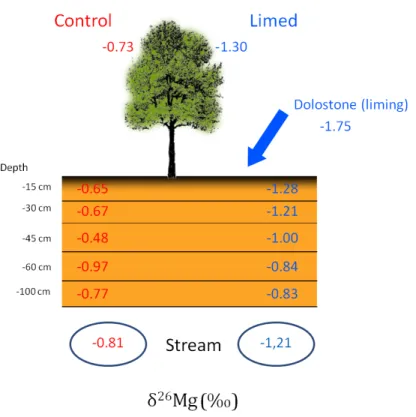
In 2003, small forested catchments with acidic soils developed on granite (Cornimont) and sandstone (Senone) bedrock were amended with limestone, dolostone and gypsum in the Vosges Mountains (France). Since then, soil, water and forest-‐stand quality, as well as animal communities, have been continually monitored. Figure 1 shows results of the Mg-‐cycle of the granitic Cornimont catchment. Isotopic variations measured in the control catchment (not amended) were attributed to key processes causing Mg-‐isotope fractionation (Bolou Bi et al., 2012). The liming material has a negative isotopic signature (
δ
26Mg of -‐1.75‰) compared to other compartments and sources of Mg in the system. In the amended catchment, the negativeδ
26Mg of certain compartments seven years after treatment indicate that the Mg in lime has reached tree leaves, participated in saturation of the soil-‐ exchange complex up to 45 cm deep, and begun to leave the catchment in the streamwater. These results corroborate those from more conventional techniques, which show an increase in Mg concentration in the exchangeable pool of upper soil layers, in tree leaves, and at the outlet of the amended catchment. The isotopic approach demonstrates that the Mg increase after amendement is the dissolution of liming material and not the transfer of pre-‐existing Mg in the ecosystem.____________________________
1for more details, see: http://www-‐pub.iaea.org/MTCD/publications/PDF/TCS-‐32_fr_web.pdf, pp 107-‐136 or
http://stableisotopefacility.ucdavis.edu/)
Figure 1: Mg isotopic composition observed in soil, water and trees (beech) of the Cornimont catchment
(Vosges) seven years after liming. The control catchment is on the left and the limed catchment is on the right (Bolou Bi et al., in press).
Geochemical functioning of soils sensitive to compaction
Intensification of forestry leads to increased traffic of heavy machinery. This increases the risk of degradation of compaction-‐sensitive fine-‐textured soils, which are abundant on the Lorraine plateau (France). Two experimental sites, Clermont-‐en-‐Argonne (Meuse) and Azerailles (Meurthe-‐et-‐ Moselle), were established in Lorraine (Cooperation INRA / ONF). Soils on both sites have similar physical properties, i.e. a 50 cm silty layer resting on a clayey substrate. Both soils are rich in Ca and Mg in the clayey layer, but the silt layer at Clermont-‐en-‐Argonne is more acidic (pH < 4.5) than at Azerailles (pH > 4.5) (Ranger et al., 2012).
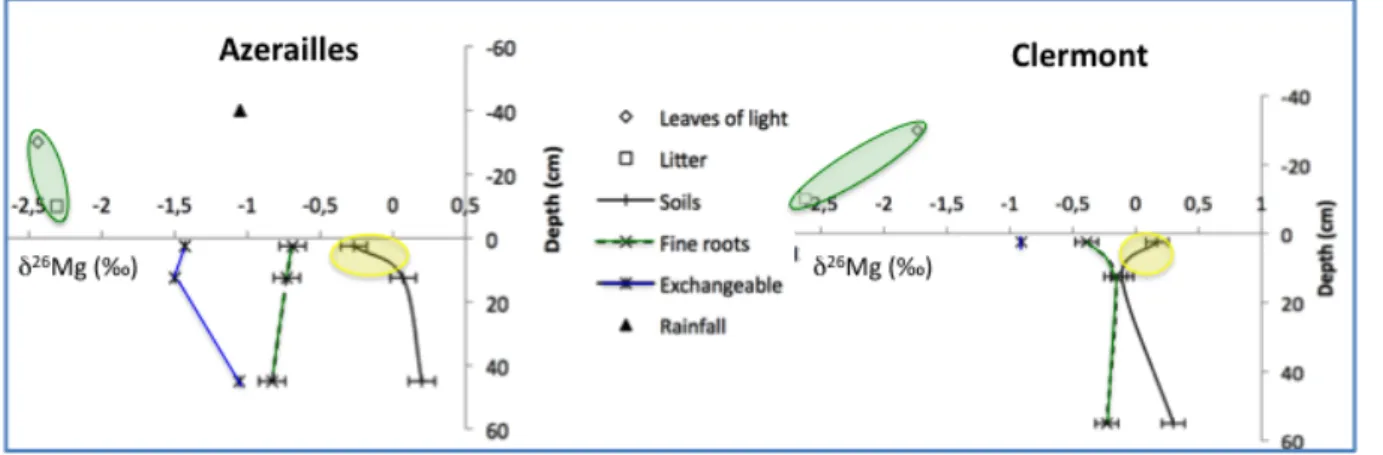
Isotopic analyses of ecosystem compartments were performed to study the Ca and Mg cycles and to link soil chemical properties to soil physical properties, soil susceptibility to compaction and the rate of porosity recovery after compaction. At both sites, soils and trees had similar relative Mg isotopic variations, which confirms significant isotope fractionation by biological or physico-‐chemical processes (Fig. 2). Isotopic fractionation existed between tree leaves and the forest floor only at Clermont-‐en-‐Argonne (δ26Mg of -‐1.7‰ and -‐2.6‰, respectively). This suggests strong Mg
retranslocation before litter fall, which probably resulted from the low Mg availability in the soil of this site. The multi-‐isotope approach (Mg, Ca, Sr) assessed functionality of the physical system, its relation to fertility and the potential impact of compaction.
Figure 2 : Mg isotopic composition measured in soil (bulk and exchangeable stores), rainwater and trees at the
Azerailles and Clermont-‐en-‐Argonne exprimental sites.
Nutrient cycling in forest ecosystems on acid soil
To better understand Ca and Mg cycles, a multi-‐isotope tracing (2H, 26Mg, 44Ca) experiment was
conducted at an experimental site in the Breuil-‐Chenue forest (Nièvre department, France), in a 30-‐ year-‐old beech plantation growing on a soil poor in Ca and Mg (Van der Heijden, 2013). Tracers were sprayed in a soluble form on the soil surface in April 2010. Dynamics of these isotopes in ecosystem compartments were then monitored regularly. Retention of Ca (and to a lesser extent Mg) in humus (the Ol layer) and mineral soil was high (Fig. 3), confirming the important role of organic exchange. Use of these tracers highlights the slow redistribution of Mg and Ca in the ecosystem from the forest floor to the soil and from the roots to the tree canopy. This behaviour is attributed mostly to the affinity of these ions for organic material. This study also confirmed the conservative nature of Mg and Ca cycles, even under highly acidic conditions, as their loss in drainage after two years was zero. The isotopic balance of the ecosystem two years after tracer enrichment was nearly 100%. This demonstrates the great appeal of the isotope-‐tracing approach, especially on sites also using the conventional flux-‐measurement approach, as it provides a more relevant assessment than using only one approach.
Figure 3 : Percentages of applied tracer (
44Ca) in the forest floor and on the exchange
complex in soils at different depths, two years after enrichment (Breuil-‐Chenue experiment,
Nièvre, France).
DEPTH OF WATER AND NUTRIENT UPTAKE BY VEGETATION
Climate change and water reserves in Mediterranean soils
In stands of Aleppo pine in Cyprus, O isotopes were used to understand tree response to drought and drought’s relation with tree mortality (Sarris et al., 2013). Oxygen’s 18O isotope is heavier than its 16O
dominant atom, and water that contains more 18O requires more energy to evaporate. The O isotopic signature (
δ
18O) of rainwater is thus positively correlated with temperature. The isotopic signatureδ
18O measured in tree rings reflects the isotopic composition of the water taken up from the soil by roots during tree-‐ring formation.
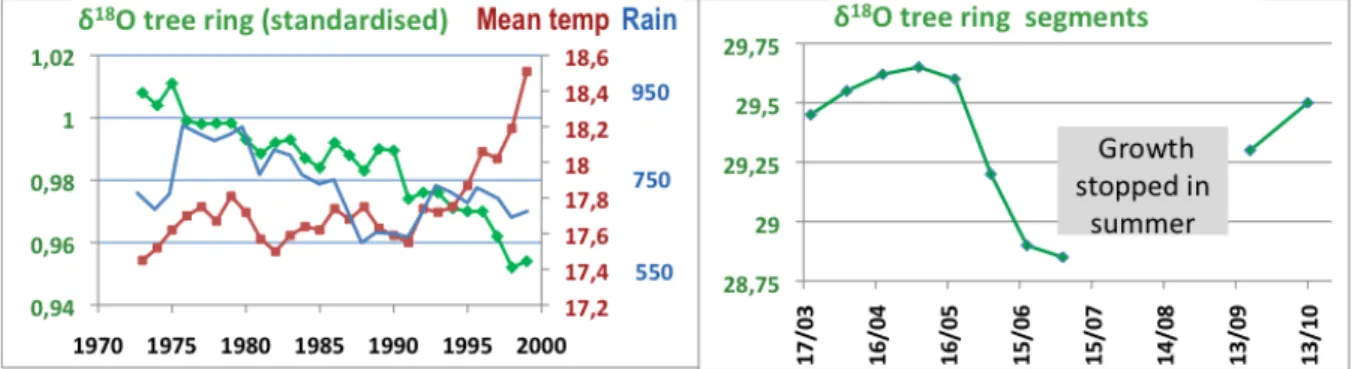
A negative correlation appears between the
δ
18O of tree rings and mean annual temperatures from 1970-‐2000 (Fig. 4a). This contradicts the usual relation betweenδ
18O and temperatures, but it parallels the gradual decrease in rainfall over time. In the Mediterranean region, deep water, low in18O, comes from winter precipitation. Rainfall in late spring and summer, enriched in
δ
18O, is quickly used by vegetation and evaporated, never reaching deep soil layers. The observed trend suggests that trees are using water taken up increasingly deeper by roots, or that their rings were formed earlier in spring and later in autumn (phenological shift linked to climate change).According to intra-‐annual isotopic variations in tree rings, aridity of the climate in May forced trees to tap into deep-‐ water sources poor in 18O (Fig. 4b). The increase in the
δ
18O signal between September and October attests to the gradual return to more superficial water uptake from autumn rains.
Figure 4 : Time-‐series of oxygen isotopic composition (
δ
18O) in tree rings of Aleppo pine (Sarris et al. 2013), on the left from 1972-‐2000 (5-‐year means) with mean annual temperature (°C) and rainfall (mm) and on the right, in micro-‐segments of rings corresponding to wood formed each month during a growing season.
Studies of ring widths in different Mediterranean regions from Cyprus to rural Provençe (France) (data not shown) confirm these results. When aridity increases, annual ring growth is correlated with the climate of the 3-‐5 previous years, which suggests that the available water comes from increasingly deeper soil layers, where the stock depends on several years’ cumulative rainfall.
Depth of nutrient uptake in Brazilian eucalyptus plantations
Eucalyptus plantations were studied to gain insight into uptake by deep roots of water and nutrients leached from upper soil layers. Fertilisation is necessary to maintain the high production of these plantations (around 50 m3 ha-‐1 yr-‐1) and the amount of fertiliser that can be applied while avoiding
deep drainage losses is an important economic issue.
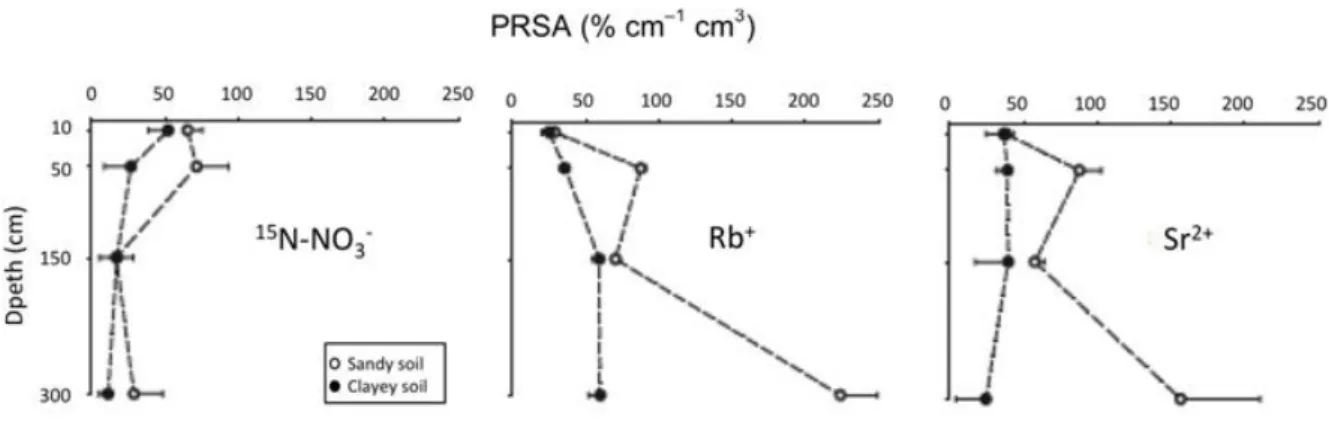
Labelling occurred twice on two soils with contrasting textures (sandy vs clayey). Solutions labelled with 15N-‐enriched nitrate, Rb (K analogue) and Sr (Ca analogue) were applied to the soils using polyethylene pipes at depths of 10, 50, 150 and 300 cm. Care was taken to avoid polluting the upper soil layers. Tracers were applied at least 30 m from each other to decrease the risk that the same
root would take up multiple tracers. A root-‐activity index was calculated for each soil depth from the concentration of each element measured in neighbouring tree leaves 70 days after application. This index was then related to mean root length at the same soil depth to estimate the potential root specific activity, expressed per unit of root length, an indicator of the amount of tracer absorbed at each soil depth (Fig. 5).
Even though 15N, Rb and Sr were applied at the same time and the same place, the ability of fine
roots, calculated per unit length, to take up Rb in the deeper soil layers (and also Sr in the sandy soil), was greater than the ability to take up nitrates, whose uptake was similar at all depths. These results suggest a functional specialisation of deep roots for taking up cations and confirm previous observations of excised roots of beech, oak and Norway spruce. The results of this study and complementary studies that quantified nutrient losses through drainage (Laclau et al., 2010) led to a significant decrease in the amount of fertiliser applied to hundreds of thousands of hectares of eucalyptus plantations in Brazil.
Figure 5: Potential root specific activity (PRSA, indicator of the amount of tracer absorbed at each soil depth,
expressed per unit of root length) 70 days after application of tracers on a eucalyptus plantation at the end of a rotation in Brazil.
Depth of nutrient uptake in a boreal-‐forest ecosystem
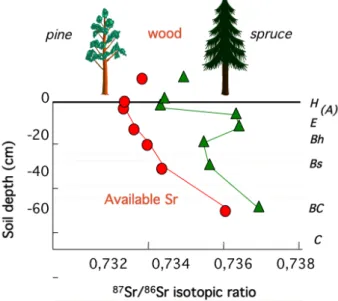
Sr is a trace element analogous to Ca, and the study of natural 87Sr/86Sr isotopic ratios enables estimation of Ca sources in an ecosystem. In a mixed population of pine and spruce trees on podzols in northern Sweden, the K-‐rich rocks have a high 87Sr/86Sr signature (≈ 0.75), whereas the signature of
rain is significantly lower (≈ 0.71). An isotopic gradient that increases with depth exists in the soil due to the decreasing contribution of Sr from rainfall. In this study (Poszwa et al., 2004), the gradients measured under pine and spruce (Fig. 6) were modelled and explained by (i) the greater return of Sr to the soil via the annual fall of spruce needles (more abundant than that from pine trees, with higher Ca and Sr concentrations than pine needles) and (ii) specific weathering under spruce (i.e. a radiogenic peak in the E horizon of the podzol). The Sr isotopic composition in the vegetation reflects the Sr taken from the soil, which makes it possible to estimate the mean depth at which trees take up Sr, and consequently that for Ca. Pines take up Sr and Ca at a depth of approximately 20 cm, whereas spruces take them up at a depth of approximately 10 cm. These results show that mineral uptake in the two species remains relatively shallow but slightly deeper for pines. They supplement a previous study of the same population using O and H isotopes that concluded that pines had deeper water uptake.
Figure 6: Comparison of the isotopic composition of strontium (Sr) (a Ca analogue) in soils and trees (pine and
spruce) in Sweden to estimate the depth of nutrient uptake by roots.
PROCESSES IN SOILS
Fate of nitrogen from labelled litter spread on the forest floor
N is often a limiting nutrient for both tree growth and soil C sequestration. Leaf litter is the main N source for non-‐fertilised forest soils. 15N-‐enriched beech leaves were used to better understand N
cycling in a young beech stand (Ebrach forest experimental site, Germany). Leaf litter was quickly colonised and transformed by both soil fauna and soil fungi. After less than 1 year, fungi had assimilated about 15% of N derived from litter, mainly labile compounds. After the same period, herbivory and soil eating-‐fungi had assimilated about the same amount of these labile compounds. Three years after litter-‐fall, the combined activity of soil fauna and transfer processes led to (i) a small (2-‐4%) but rapid N uptake by trees (mainly as mineral compounds) and (ii) rapid transfer of 55% of N from litter to soil surface layers (Zeller et al., 2001) (Fig. 7). This transfer mainly occurred as litter fragments were preferentially mineralised by soil microorganisms, whose activity increased N bioavailability for trees. Eight years after litter-‐fall, 30% of its N was again taken up by trees and mainly allocated to aboveground tree compartments (Fig. 7). Similarly, forest-‐floor fragments gradually aggregated on contact with soil organo-‐mineral complexes (Hatton et al., 2012). N transfer to stable aggregates prevents its mineralisation by microorganisms, ensuring its own retention and that of the associated C. Monitoring the fate of litter N at the nanoscale highlighted the role of microorganisms in forming and retaining organic matter in the form of organo-‐mineral complexes stable at a decadal scale. This 15N enrichment experiment identified mechanisms of N redistribution
and quantified their fluxes in multiple compartments of contrasting forest ecosystems. In the long-‐ term, this kind of approach will enable development of new management practices, optimise bioavailability of soil N for trees and increase the soil’s ability to stock C.
Figure 7: Distribution of a cohort of 15N in the young beech forest of Ebrach (Germany), 3 and 8 years after the
deposition of 15N-‐enriched leaves to the soil surface. New beech leaf litter was collected after labelling with 15N and replaced by non-‐enriched litter.
Phosphorus availability in forest soils
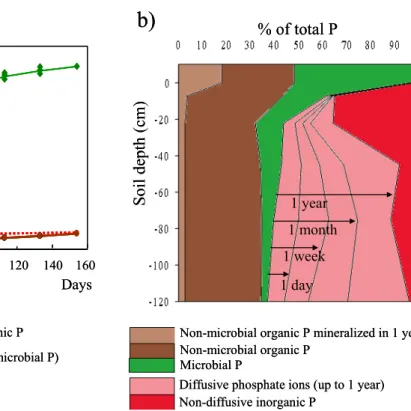
P is a limiting nutrient for forest growth; however, the processes governing P availability remain poorly understood. An experiment used isotopic labelling with 32P and 33P to study P availability in
soils of Landes de Gascogne (France), which are highly P-‐deficient, for maritime pines (Pinus pinaster Sol.) (Fig. 8). Processes that replenish phosphate ions in the soil solution include (i) physico-‐chemical diffusion, which depends on inorganic forms of P, and (ii) microbial processes (mineralisation of organic non-‐microbial P and turnover of P in soil microorganisms). Measuring diffusible P-‐ions in soil suspensions over time describes fast and slow reactions (related to the porosity of the solid phase) (Fig. 8a). These reactions, identified by 32P isotopic dilution, can be predicted from soil physico-‐
chemical properties (Achat et al., 2011). Flux dynamics of organic-‐P mineralisation and re-‐ mineralisation of microbial P can be assessed by combining soil incubation under controlled conditions with 33P labelling (Achat et al., 2009) (Fig. 8a). In the study at Landes de Gascogne, the
contribution of microbiological processes to P availability decreased with soil depth, while that of physico-‐chemical processes (diffusion) increased (Fig. 8b).
Figure 8. (a): Flux of phosphate ions at the solid-‐solution interface in a sample from the soil surface layer (0-‐15
cm), quantified in batch experiments and incubations using 32P and 33P tracers. (b) Contributions of organic-‐
and inorganic-‐P fractions, expressed as a percentage of total P for samples taken at different soil depths (example from pine plantations of Landes de Gascogne, France).
Nutrient substitution in eucalyptus plantations
Eucalyptus plantations in the Congo that responded to potassium (K) fertilisers much less than plantations with similar soil K-‐stocks in other regions led to the hypothesis that sodium (Na) can partially replace K in the physiology of eucalyptus trees (substitution between these elements has been described in the literature for other plant species). An experiment was set up in Brazil to test the hypothesis that high atmospheric deposition of NaCl in coastal areas allows eucalyptus to partially substitute K with Na and thus increase wood production (Almeida et al., 2010). A control treatment without K or Na input was compared to treatments receiving either K or Na, or a mixture of both. All treatments were fertilised with other nutrients to study the specific effect of K and Na. NaCl application increased harvested wood by more than 30 t of dry matter ha-‐1 compared to the
control treatment (Fig. 9). NaCl application increased Na concentrations in above ground biomass but did not change K concentrations. Partial substitution of K with Na in tree physiology may explain this response (Battie-‐Laclau et al., 2014). These results suggest that K fertilisers do not need to be purged of Na. They also explain the relatively high biomass production observed in coastal plantations receiving no fertiliser but high atmospheric deposition of marine aerosols. Experiments are currently underway to explore replacing the current supply of pure KCl fertiliser with a mixture of KCl and NaCl to take advantage of the low cost of NaCl.
Remineralization (mineralization of microbial P) Mineralization of non-microbial organic P
Diffusive phosphate ions
Soil dep th (cm) 0 2 4 6 8 10 12 14 0 20 40 60 80 100 120 140 160 Days Cum ula te d gross amounts (m g kg -1) % of total P Non-microbial organic P
Non-microbial organic P mineralized in 1 year Microbial P
Diffusive phosphate ions (up to 1 year) Non-diffusive inorganic P 1 day 1 week 1 month 1 year
a)
b)
Remineralization (mineralization of microbial P) Mineralization of non-microbial organic P
Diffusive phosphate ions
Soil dep th (cm) 0 2 4 6 8 10 12 14 0 20 40 60 80 100 120 140 160 Days Cum ula te d gross amounts (m g kg -1) % of total P Non-microbial organic P
Non-microbial organic P mineralized in 1 year Microbial P
Diffusive phosphate ions (up to 1 year) Non-diffusive inorganic P 1 day 1 week 1 month 1 year
a)
b)
Figure 9: Wood biomass production over an entire rotation of a eucalyptus plantation in Brazil (harvesting 6
years after planting). Comparison between the control treatment receiving no potassium or sodium (-‐K-‐Na), the treatment fertilised with KCl (+K), and the treatment fertilised with NaCl (+Na, without addition of K).
CONCLUSION
Recent studies illustrate the appeal of using geochemical and isotopic tracers to improve knowledge about bioavailability of water and elements, soil fertility and plant nutrition. Depending on the context and the tracer(s), these approaches define sources, estimate the residence time of water and elements, trace fluxes of nutrients and identify processes that control biogeochemical cycles.
The approaches presented in this article may not completely replace more conventional approaches (e.g. flux measurements, mass balance, input-‐output budgets). These new tools are powerful, but sometimes difficult and expensive to implement; therefore, they should be used only when conventional approaches fail to meet objectives. When sources of nutrients or elements have sufficiently distinct geochemical or natural isotopic compositions, it is possible to exploit these differences. The natural abundance approach assesses fluxes only in systems in equilibrium, where the sources are few (ideally two), and when rigorous flux measurement and modelling are performed. It is not so effective when sources have similar or multiple signatures, or when systems are not in equilibrium. Artificial enrichment is complementary and consists of creating an isotopically enriched pool of element(s) and measuring its isotopic dilution in the ecosystem over time. It is now widely used by the scientific community for N, C, H, O and has progessively increased for other elements such as Mg and Ca.
Combination of approaches of natural and enriched abundance, and the simultaneous use of different isotopic systems (C, N, O, Ca, Mg) and/or geochemical tracers (Li, B) coupled with ex situ and in situ experiments will overcome a number of obstacles in the near future and will respond, at least in part, to the questions raised in the introduction. For example, the d18O signature used to
estimate the depth of water uptake in the Mediterranean region could be used in other regions and consider the phenological shift in growth due to climate change. Mg isotopes may be useful tracers
Monitoring changes in enriched litter through 13C and 15N (or other tracers) will refine understanding
of decomposition and stabilisation of soil C. Use of in situ multi-‐element tracing (13C and 15N) on
eucalyptus plantations in Brazil submitted to artificially limited rainfall will improve understanding of element storage/remobilisation in trees and partition between above or belowground compartments under different environmental conditions. Further studies could be conducted to predict P availability from physico-‐chemical and microbial reactions (described by isotope dilution) and soil physico-‐chemical properties. Isotopic tools are highly useful for understanding soil functioning and identifying sources and dynamics of elements, which is the basic knowledge necessary for sustainable management of soil and forest-‐ecosystem functions.
Anne POSZWA
LIEC UMR 7360 CNRS Université de Lorraine Boulevard des Aiguillettes BP 70 239
F-‐54506 VANDOEUVRE les Nancy anne.poszwa@univ-‐lorraine.fr
Arnaud LEGOUT
Centre INRA de Nancy-‐Lorraine Unité Biogéochimie des écosystèmes forestiers
Route de l’Arboretum
F-‐54280 CHAMPENOUX Cedex
Pierre-‐Joseph HATTON
Centre INRA de Nancy-‐Lorraine
Unité Biogéochimie des écosystèmes forestiers
Route de l’Arboretum
F-‐54280 CHAMPENOUX Cedex
pierre-‐[email protected]
Léa BEDEL
Centre INRA de Nancy-‐Lorraine Unité Biogéochimie des écosystèmes forestiers
Route de l’Arboretum
F-‐54280 CHAMPENOUX Cedex [email protected] Jacques RANGER
Centre INRA de Nancy-‐Lorraine Unité Biogéochimie des écosystèmes forestiers
Route de l’Arboretum
F-‐54280 CHAMPENOUX Cedex [email protected]
Jean-‐Paul LACLAU
CIRAD, UMR Eco&Sols
Ecologie Fonctionnelle & Biogéochimie des Sols & Agro-‐écosystèmes
2 Place Viala
F34060 MONTPELLIER jean-‐[email protected]
Michel VENNETIER
IRSTEA Aix en Provence
Unité Ecosystèmes méditerranéens et risques 3275 Route de Cezanne
CS 40061
F-‐13182 AIX EN PROVENCE Cedex 5 [email protected]
David ACHAT
INRA UMR 1391 ISPA
F-‐33140 VILLENAVE D’ORNON Bordeaux Sciences Agro UMR 1391 ISPA F-‐33170 GRADIGNAN [email protected]
LITERATURE CITED
Achat (D.L.), Augusto (L.), Morel (C.), Bakker (M.R.). -‐ Predicting available phosphate ions from physical-‐chemical soil properties in acidic sandy soils under pine forests -‐ Journal of Soils
and Sediments, 11, 2011, pp 452-‐466.
Achat (D.L.), Bakker (M.R.), Morel (C.). -‐ Process-‐based assessment of phosphorus availability in a low phosphorus sorbing forest soil using isotopic dilution methods -‐ Soil Science Society of
America Journal, 73, 2009, pp 2131-‐2142
Almeida (J.C.R.), Laclau (J.-‐P.), Gonçalves (J.L.M.), Ranger (J.), Saint-‐André (L.). -‐ A positive growth response to NaCl applications in Eucalyptus plantations established on K-‐deficient soils -‐
Forest Ecology and Management, 259, 2010, pp 1786-‐1795.
Battie-‐Laclau (P.), Beri (C.), Mietton (L.), Muniz (M.R.A.), Arenque (B.C.), Piccolo (M.C.), Jordan-‐Meille (L.), Bouillet (J.-‐P.), Nouvellon Y.). -‐ Photosynthetic and anatomical responses of Eucalyptus grandis leaves to potassium and sodium supply in a field experiment -‐ Plant, Cell &
Environment, 37, 2014, pp 70-‐81.
Bolou-‐Bi (E.B)., Vigier (N.), Poszwa (A.), Boudot (J.P.), Dambrine (E.). -‐ Effects of biogeochemical processes on magnesium isotope variations in a forested catchment in the Vosges Mountains; France -‐ Geochimica et Cosmochimica Acta 87, 2012, pp 341–355.
Hatton (P.-‐J.), Kleber (M.), Zeller (B.), Moni (C.), Plante (A.F.), Townsend (K.), Gelhaye (L.), Lajtha (K.), Derrien (D.). -‐ Transfer of litter-‐derived N to soil mineral-‐organic associations: Evidence from decadal N-‐15 tracer experiments -‐ Organic Geochemistry 42, 2012, pp 1489-‐1501. Laclau (J.-‐P.), Ranger (J.), Gonçalves (J.L.M.), Maquère (V.), Krusche (A.V.), M’Bou (A.T.), Nouvellon
(Y.), Saint-‐André (L.), Bouillet (J.-‐P.), Piccolo (C.M.), Deleporte (P). -‐ Biogeochemical cycles of nutrients in tropical Eucalyptus plantations: main features shown by intensive monitoring in Congo and Brazil -‐ Forest Ecology and Management, 259, 2010, pp 1771–1785.
Legout (A.), Hansson (K.), van der Heijden (G.), Laclau (J.P.), Augusto (L.), Ranger (J.). -‐ Fertilité chimique des sols forestiers : concepts de base (same issue).
Poszwa (A.), Ferry (B.), Dambrine (E.), Pollier (B.), Wickman (T.), Loubet (M.), Bishop (K.). -‐ Variation of Ca and Sr concentrations and 87Sr/86Sr isotopic ratio variation in boreal forest ecosystems: Role of biocycling and depth of root uptake -‐ Biogeochemistry 67, 2004, pp 1-‐ 20.
Ranger (J.), Goutal-‐Pousse (N.), Bonnaud (P.). -‐ Effet de la mécanisation des travaux sylvicoles sur la qualité des sols forestiers : dynamique de la restauration naturelle ou assistée de leurs propriétés physiques. 2012. 66 p
Sarris (D.), Siegwolf (R.), Körner (C.). -‐ Inter-‐ and intra-‐annual stable carbon and oxygen isotope signals in response to drought in Mediterranean pines – Agricultural and. Forest
Meteorology, 168, 2013. pp 59-‐68.
Van der Heijden, (G.). -‐ Apport du multi-‐traçage isotopique (26Mg, 44Ca et 2H) à la connaissance des flux d’éléments minéraux dans les écosystèmes forestiers – Doctoral thesis, AgroParisTech, 2013, 277 p
Zeller (B.), Colin-‐Belgrand (M.), Dambrine (E.), Martin (F.). -‐ Fate of nitrogen released from N-‐15-‐ labeled litter in European beech forests -‐ Tree Physiology 21, 2001, pp 153-‐162.