Academic and Research Staff L. D. Braida S. K. Burns H. S. Colburn L. S. Frishkopf J. L. Goldsteint J. J. Guinan, Jr.tf R. G. MarkT W. T. Peaket' Baer L. Benn E. Berliner Cintron Demko, Jr. O. Frost Gaiman Hasan L. Hicks Prof. W. A. Rosenblith** Prof. W. M. Siebert Prof. T. F. Weissf
ftT
Dr. J. S. Barlowtl Mr. N. I. Durlach Dr. R. D. Hall Dr. N. Y. S. Kiangt Dr. E. P. Lindholm Graduate Students J. M. Houtsma W. James H. Johnson W. Kress, Jr. F. Krummenoehl K. Lewis Y-S. Li C. Moxon F. Nedzelnitsky D. W. Altmannt R. M. Brownt F. H. Byerst D. J. Callahan A. H. CristT W. F. Kelley L. H. Seifel S. N. Tandon M. Rabinowitz V. Reed J. Shillman O. Stahl II S. Stephenson L. Sulman P. Tripp, Jr. R. Wolfe YecheskelRESEARCH OBJECTIVES AND SUMMARY OF RESEARCH
The principal scientific research objective of the Communications Biophysics Group is to obtain a better understanding of sensory-neural processes, in particular, of mam-malian hearing. We are also engaged in selected research on other organisms and systems. Our approach combines both electrophysiological and behavioral experimental techniques with machine data processing and analytical methods of communication theory. We have a close working relationship with the Eaton-Peabody Laboratory of Auditory Physiology, which is operated jointly by the Massachusetts Eye and Ear Infirmary and M. I. T. The cooperative arrangement includes sharing of facilities and joint staff appointments.
While our principal objectives are scientific, we are also interested in applications to clinical medicine of our research results and of new technology. Members of our
This work was supported principally by the National Institutes of Health (Grant 5 PO1 GM14940-03), and in part by the National Institutes of Health (Grant 5 TO1 GM01555-03), and the National Aeronautics and Space Administration (Grant NGL 22-009-304).
tAlso at the Eaton-Peabody Laboratory, Massachusetts Eye and Ear Infirmary, Boston, Massachusetts.
lInstructor in Medicine, Harvard Medical School, Boston, Massachusetts.
Professor Rosenblith has assumed the duties of Associate Provost of M. I. T. and during the period of this assignment his activities with the Communications Bio-physics Group will be suspended.
tInstructor
in Preventive Medicine, Harvard Medical School, Boston, Massa-chusetts."Research Affiliate in Communication Sciences from the Neurophysiological Laboratory of the Neurology Service of the Massachusetts General Hospital, Boston, Massachusetts. Prof. Prof. Prof. Prof. Prof. Prof. Prof. Prof.
group have close ties with the Boston City Hospital, Massachusetts General Hospital, Peter Bent Brigham Hospital, and the Harvard Medical School, as well as with the Massachusetts Eye and Ear Infirmary.
Our research program can be divided into five major areas. The programs for each will be discussed individually.
A. Auditory Physiology
The objective of this research is to understand signal transmission and coding of sound stimuli in auditory and related systems. Much of the work in auditory physiology is performed in collaboration with the Eaton-Peabody Laboratory at the Massachusetts Eye and Ear Infirmary.
1. Mechanical Signals in the Middle and Inner Ear
a. Measurement of velocity by means of the M6ssbauer Effect
During the past year we have improved our measurement methods, using fundamen-tally the same technique reported previously by Twickler and Peake. By using a denser CO57 source of gamma rays, we have increased the sensitivity of our velocity detection and thereby decreased the time necessary for making a measurement by approximately a factor of 4. We are modifying the interface with the computer so that with two CO5 7
sources two velocity waveforms in the ear can be computed simultaneously. At the same time the system will be altered to increase the upper frequency limit to -30 kHz.
We have made some preliminary measurements of the velocity of the stapes and the round-window membrane. Although it is commonly assumed that these (volume) veloc-ities are equal, we have found significant differences for frequencies above 1000 Hz. We are now investigating the source of these differences,
b. Measurements of sound pressure in the scalae
In collaboration with Bolt, Beranek, and Newman, Inc. we have developed a small pressure probe with which we shall attempt to measure the sound pressure in the coch-lear scalae. The probe is a small fluid-filled tube (125 im in diameter) coupled by a diaphragm to a piezoelectric transducer. We are developing calibration techniques for the probe and making theoretical calculations to compare them with our measured cali-brations.
During the coming year, we shall attempt to make measurements of sound pressure in the cochlear scalae of cats. In a previous investigation,2 we developed techniques for drilling small holes through the bony wall of the cochlea. Initially, we intend to insert the probe into scala tympani and scala vestibuli of the basal turn through such holes.
2. Transduction Mechanisms in Hair Cell Systems a. Intracellular responses in the lizard inner ear
In order to investigate the transduction process from mechanical to intracellular electric signals in the auditory system, we have performed preliminary experiments, using the inner ear of the lizard. The anatomical simplicity and accessibility of this receptor organ presents advantages as an experimental preparation, and the receptor
cells bear sufficient resemblance to the hair cells in the mammalian inner ear that some of the results will surely be applicable to mammals. Preliminary experiments (on approximately 80 lizards) during the past year have yielded the following results: (i) Methods have been developed for delivering acoustic stimuli to the inner ear 3' 4 both by means of the normal route through the external and middle ear and by applying sound directly to the round window. (ii) Surgical procedures have been developed to enable us to insert microelectrodes into the inner ear from either the scala tympani or the scala vestibuli side. Experiments have shown that surgical exposure of the inner ear can be performed without grossly changing its electric responses to sound. (iii) We have recorded changes in the electric response to sound from individual cells in the inner ear. (iv) We have used a dye, Niagara sky blue, to mark individual cells and developed histological techniques to identify and locate these cells. During the coming year, we expect to obtain systematic data relating intracellular electric potentials to sound stim-uli for various cells in the inner ear of the lizard. These experiments are performed with the collaboration of Dr. Michael J. Mulroy, an anatomist who is a Postdoctoral Fellow in the Eaton-Peabody Laboratory.
b. Transduction in hair cells in the lateral line organ
A laboratory has been set up to investigate the mechanical-to-neural trans-ducer action of hair cell in the lateral line organ of the mudpuppy.5 Facilities to carry out electrophysiological and anatomical studies are being developed for this
investigation.
c. Analy)sis of cochlear potentials in the cat
We have previously obtained data on cochlear potentials by means of microelectrodes inserted into cat cochleae. We have also developed an electric network model for the spatial distribution of cochlear microphonic potentials. The transformation of the input to the cochlea (a displacement of the stapes) which leads to the cochlear microphonic potential is thought to involve three steps: (i) a mechanical transformation relating the displacement of the basilar membrane to the stapes displacement, (ii)a mechano-electric transduction relating the displacement of the basilar membrane to a local electric cur-rent in the organ of Corti, and (iii) a transformation relating the local electric curcur-rent to the potential in the cochlear scalae. We have derived analytical expressions that explicitly involve these three steps. Whenever possible, we have compared theory with experimental results. Results of this investigation have been presented,6 9 and manu-scripts are in preparation for publication.
d. Electromechanical transduction in the cochlea
For some stimulus conditions a sinusoidal current applied directly to the cochlea produces responses in auditory-nerve fibers whose characteristics mimic the responses to acoustic stimulation. Frequency selectivity (tuning curves) and changes in response
as a function of stimulus level are nearly the same for electric and acoustic stimuli. Since this response to electric stimuli is not affected by interruption of the ossicular chain, it seems to be generated in the cochlea itself. Measurements have also shown that sound radiating from the round window in response to electric stimuli can be detected. Although it has been known for many years that there is transduction from mechanical to electric signals in the cochlea (the cochlear microphonic potential), this phenomenon of electromechanical transduction in the cochlea has not been previously
reported.
Present experiments are aimed at determining the mechanism through which electric stimulation produces mechanical signals in the cochlea.
3.
Peripheral Nerve
a. Simultaneous recordings from two
auditory-nerve fibers
We have simultaneously recorded firing patterns from two auditory-nerve fibers.
Computer programs have been written to analyze statistical relations of the firing
pat-terns both for spontaneous activity and for the responses to sound.
Preliminary results
are consistent with the hypothesis that the firing patterns recorded from two fibers are
statistically independent.
This conclusion appears to hold for fibers whose
character-istic frequencies (CF) are very close. It has often been assumed that fibers whose CF
are close innervate nearby regions of the organ of Corti. Thus these results imply that
the source of the spontaneous activity of auditory-nerve fibers is probably introduced
after the mechanical filtering processes in the cochlea.
b.
Auditory-nerve responses to tones:
Stimulus
intensity
Plots of firing rate against stimulus level were obtained for single auditory-nerve
fibers in anesthetized cats. The shape of the rate vs SPL curve for a given fiber varies
considerably with frequency.
For some frequencies, the curves are monotonic; for
others, there is a rise followed by a dip that may go down to the spontaneous rate. Within
a 10-dB range above the dip the response rate rises to a maximum.
Dips have been
found for units over a wide range of characteristic frequency (CF). Although dips can
be found for frequencies at or above a unit's CF, the lowest SPL at which dips occur is
always at frequencies below CF. At high stimulus levels (above 90 dB SPL) where dips
occur, responses of units with low CF show large phase changes relative to the
stim-ulus.10 These results can be interpreted in terms of two mechanisms of excitation of
auditory nerve terminals.
c.
Efferent system to the cochlea
In order to clarify the effects of electric stimulation of the crossed olivocochlear
bundle (OCB) on the responses of single auditory-nerve fibers, we investigated in a
series of experiments the influence of changes in parameters of the electric
stimula-tion.
These and earlier results have been reported in two papers
1 1' 12 that have been
submitted for publication.
Our observations indicate that responses in (almost) all auditory-nerve fibers in the
cat are affected by electric stimulation of the crossed olivocochlear bundle. Anatomical
studies have reported differences in the relative innervation of inner and outer hair
cells by the crossed and uncrossed OCB (see Fex
1 3for a discussion of this issue). In
order to determine the physiological differences or similarities of these two efferent
components, we shall begin to develop the techniques for expanding this work to include
the stimulation of the uncrossed component.
d.
Responses of single auditory-nerve fibers
in cochleae damaged by drugs
In order to investigate the relations between characteristics of auditory-nerve fiber
responses and the anatomy of the fiber terminations on hair cells, we have used an
oto-toxic drug, kanamycin, to destroy groups of hair cells in a series of cats.
Electro-physiological recordings from single auditory-nerve fibers in these animals show three
classes of response characteristics:
(i) some fibers do not respond to acoustic stimuli,
although they do respond to electric stimuli to the cochlea; (ii) some fibers respond to acoustic stimuli but with abnormal characteristics (for example, raised thresholds); and (iii) some fibers respond with characteristics that are normal. From histological examination of these cochleae we can roughly associate three categories with regions in which (i) no hair cells are present; (ii) some hair cells are absent; and (iii) hair cells appear normal. We hope that more detailed comparison of response characteristics with kinds of abnormalities in the hair cell populations will help us understand how the hair cells act on the nerve fibers.
e. Central neural connections from the inner ear of the frog
We are studying the pathways and central connections of the nerve branches from the receptor organs within the inner ear of the frog. In particular, we are interested in synaptic relationships of the terminals of these nerve fibers with respect to second-order neurons in the medulla. The connectivity of fibers from the two peripheral auditory organs, the basilar and amphibian papillae, are relevant to earlier physiological and behavioral studies of this system.1 4 Degeneration techniques have classically been used in such studies and are being employed here.
The application of these techniques is limited, however, to determination of projec-tions of whole nerve trunks rather than individual nerve fibers. In the case of the frog's eighth nerve, it may be possible by these methods to specify only the connectivity of the two main trunks of fibers, each innervating four sensory organs. To obtain more detailed information, other techniques may be required. One possible approach is to record from individual eighth-nerve ganglion cells with an electrode that has been filled with a dye
substance that can be ejected electrophoretically. Recent studies have shown that entire nerve cells may be stained in this way.1 5 It may, therefore, be possible to stain and trace single nerve cells whose receptor origin and encoding properties are known from concurrent electrophysiological recordings.
4. Signal Transformation in Brainstem Nuclei
Our earlier studiesl 6 have demonstrated several categories of response behavior in single cells. Two of these categories of units had well-defined locations in the medial nucleus of the trapezoid body (MNTB). In order to associate these physiological cate-gories with specific kinds of cells, we have been attempting to inject dye into single cells through a micropipette that can also be used for recording. The techniques for ejecting the dye (methyl blue) from the pipette have been established, and the dye has been
recov-ered satisfactorily in the histological sections of the brain stem. We have not yet been able, however, to obtain satisfactory intracellular recordings from MNTB neurons. In
order to improve the mechanical stability of the tissue, we developed a technique that reduced brain pulsation problems. We have also begun work in which we attempt to anti-dromically stimulate MNTB neurons by electric shocks in the lateral lemniscus. Our preliminary results indicate that the axons from some MNTB neurons do go into the lateral lemniscus.
5. Computer System to Control Stimulus and Measure Response Variables
A computer system has been developed1 7, 18 to control the acoustic stimulus to an experimental animal and to measure physiological responses. Data acquired during the calibration procedure at the beginning of each experiment enables the computer to sweep the frequency of a tone so that the sound pressure level at the eardrum is constant and to measure the magnitude and phase of the fundamental component of the response (which
might be the potential recorded by an intracochlear electrode, the voltage output of a pressure transducer or any other voltage-response variable). The frequency response or transfer function (magnitude and phase) are plotted on an incremental plotter and can be stored on magnetic tape for further processing. The sound pressure level can also be swept at constant frequency. The system uses a PDP-8 computer to control the amplitude and frequency of a programmable oscillator that drives the sound source (a condenser earphone) which is the input to the ear of the experimental animal. The response voltage is fed to a narrow-band filter whose output drives a logarithmic con-verter and phase meter. The magnitude (in dB) and phase of the fundamental component
of the response are fed into the computer through a two-channel signal multiplexer and an analog-to-digital converter.
L. S. Frishkopf, J. J. Guinan, Jr., N. Y. S. Kiang, W. T. Peake, T. F. Weiss References
1. B. A. Twickler and W. T. Peake, "Measurement of Velocities in the Middle Ear Using the M6ssbauer Effect," Quarterly Progress Report No. 92, Research Lab-oratory of Electronics, M. I. T. , January 15, 1969, pp. 402-404.
2. D. Altmann, "Drilling and Localizing One-Hundred Micron Holes in the Cat's Coch-lea," S. B. Thesis, Department of Electrical Engineering, M. I. T. , 1968.
3. R. R. Zimmerman, "An Equivalent Stimulus Function for Cochlear Potentials in Gerrhonotus Lizards," S. B. Thesis, Department of Electrical Engineering, M. I. T.,
1969.
4. R. R. Zimmerman and M. J. Mulroy, "Alternate Route for Acoustic Stimulation of a Lizard Inner Ear," Quarterly Progress Report No. 95, Research Laboratory of Electronics, October 15, 1969, pp. 121-122.
5. G. G. Harris, L. S. Frishkopf, and A. Flock, "Receptor Potentials from Hair Cells of the Lateral Line," Science 167, 76-79 (1970).
6. W. T. Peake, H. S. Sohmer, and T. F. Weiss, "Microelectrode Recordings of Intracochlear Potentials," Quarterly Progress Report No. 94, Research Laboratory of Electronics, M. I. T. , July 15, 1969, pp. 293-305.
7. W. T. Peake, H. S. Sohmer, and T. F. Weiss, "Microelectrode Recordings of Intracochlear Potentials," J. Acoust. Soc. Am. 46, 106(A) (1969).
8. T. F. Weiss, W. T. Peake, and H. S. Sohmer, "Intracochlear Responses to Tones, Quarterly Progress Report No. 94, Research Laboratory of Electronics, M. I. T.
July 15, 1969, pp. 305-316.
9. T. F. Weiss, W. T. Peake, and H. S. Sohmer, "Intracochlear Responses to Tones," J. Acoust. Soc. Am. 46, 106(A) (1969).
10. N. Y. S. Kiang, T. Baer, E. M. Marr, and D. Demont, "Discharge Rates of Single Auditory-Nerve Fibers as Functions of Tone Level," J. Acoust. Soc. Am. 46, 106(A)
(1969).
11. M. L. Wiederhold and N. Y. S. Kiang, "The Effects of Electric Stimulation of the Crossed Olivocochlear Bundle on Single Auditory-Nerve Fibers in the Cat" (sub-mitted to J. Acoust. Soc. Am.).
12. M. L. Wiederhold, "Variations in the Effects of Electric Stimulation of the Crossed Olivocochlear Bundle on Cat Single Auditory-Nerve Fiber Responses to Tone Bursts" (submitted to J. Acoust. Soc. Am.).
13. J. Fex, Efferent Inhibition in the Cochlea b y the Olivo-cochlear Bundle in Hearing Mechanisms in Vertebrates (Little, Brown and Company, Boston, 1968).
14. L. S. Frishkopf, R. R. Capranica, and M. H. Goldstein, Jr., "Neural Coding in the Bullfrog's Auditory System - A Teleological Approach," Proc. IEEE 56, 969-980 (1968).
15. A. O. W. Stretton and E. A. Kravitz, "Neuronal Geometry: Determination with a Technique of Intracelullar Dye Injection," Science 162, 79 (1968).
16. J. J. Guinan, Jr. , S. S. Guinan, and B. E. Norris, "Single Auditory Units Recorded in the Medial Nucleus of the Trapezoid Body (MNTB) of Anesthetized Cats," J. Acoust. Soc. Am. 46, 113(A) (1969).
17. G. M. Goldmark, "Computer Control of Stimulus-Response Variables in Auditory Experiments," S. M. Thesis, Department of Electrical Engineering, M. I. T. , 1969. 18. T. F. Weiss, G. M. Goldmark, D. W. Altmann, and R. M. Brown, "Automated
System to Control Stimulus and Measure Response Variables in Experiments on the Auditory System," Quarterly Progress Report No. 95, Research Laboratory of Electronics, M. I. T. , October 15, 1969, pp. 122-127.
B. Auditory Psychophysics
The general goal of this research is to determine and understand the performance of the auditory system, and to apply this understanding to problems in the perception of speech and music, the transmission of information by means of artificial auditory dis-plays, and the diagnosis and treatment of hearing disorders.
In some of our studies, the observed performance appears to be explainable in terms of the physiology of the peripheral auditory system, and there is considerable interaction between our psychophysical and physiological research. In others, the performance
appears to depend strongly on portions of the nervous system about which our knowledge is still relatively limited, and our explanatory models cannot yet be related to the under-lying physiology.
1. Intensity Resolution
We are continuing to develop a general theory of man's ability to resolve sound inten-sity. This theory provides a unified framework for interpreting results obtained in a wide variety of experiments on detection, discrimination, identification, and scaling. It is composed of a decision model, which separates sensitivity from response bias, and an internal noise model, which separates sensory limitations from memory limitations.
During the past year, we completed the preliminary version of the theory (Durlach and Braidal ) and the analysis of an extensive series of experiments designed to test the pre-dictions of the theory for one-interval paradigms (Braida ). In general, the data provide strong support for both the decision-model and internal-noise model components of the theory. For example, the data from identification experiments are consistent with the pre-dictions for the shapes of the receiver-operating characteristics, the dependence of total cumulative sensitivity on the number and range of intensities in the stimulus set, and the dependence of mutual information on the number of intensities and sensitivity. Two sig-nificant discrepancies, however, are the following. First, when the range of inten-sities employed in the experiment is large, the dependence of cumulative sensitivity on intensity (in dB) differs from the linear dependence predicted by the model, in that the slope tends to increase with an increase in intensity and, also, to be greater at the
extremes of the range than in the middle (the "edge effect"). Second, when the range of intensities employed in the experiment is small, the total cumulative sensitivity obtained from magnitude estimation experiments is less than that obtained from identification experiments. In terms of the model, the increase in slope with an increase in intensity constitutes a violation of Weber's law (which was assumed to be valid in the model). In order to explore this problem, an additional experiment was performed to check Weber's law directly. We found that Weber's law was not valid and, moreover, that if the model were revised by replacing the Weber-law assumption with an assumption that was con-sistent with the results of this additional experiment, then the model predicted the
increase in slope quite precisely. To account for the edge effect, a modification is being made in the memory portion of the internal-noise model. Specifically, we are revising the procedure by which the listener is assumed to compare a given intensity with the con-text of intensities used in the experiment. The relatively poor sensitivity obtained in
small-range magnitude-estimation experiments can be interpreted in terms of the model by assuming that the listener uses a fixed context (perhaps the dynamic range) for com-parison, rather than the context generated by the experimental stimuli, and has impor-tant implications for the classical controversies surrounding the usefulness of magnitude estimation for determining loudness scales.
During the coming year, efforts will be focused on continued modification of the internal-noise model (e. g. , modifications relevant to the edge effect, the establishment and decay of context, and the influence of anchors), on performing experiments to test the model's predictions for two-interval paradigms, and on preparing previous results for publication.
2. Binaural Hearing
We are continuing to develop a general theory of binaural hearing based on auditory-nerve data. This theory separates the limitations on performance into two components: those that are due to imperfections in the peripheral encoding, and those that are due to imperfections in the processing performed by the central nervous system.
Theoretical analysis has resulted in a proposed statistic for representing the detailed timing information in the firing patterns on the auditory nerve which is available for more central processing. It has been shown that psychophysical performance predicted from optimum use of this statistic (together with monaural statistics that are insensitive to the detailed timing information) is approximately the same as measured performance for a wide class of binaural experiments. Moreover, in those cases for which predicted performance is unequal to measured performance (notably, interaural time discrimina-tion off the midline), the predicted performance is always better than measured perfor-mance. This last result is significant because the interaural comparisons in the proposed statistic are very restricted. Specifically, it is assumed that firing times from each auditory-nerve fiber are compared with firing times from only one other fiber (with the same frequency selectivity) from the opposite auditory nerve, and that information from each pair is limited to the number of "coincidences" of firings on the two fibers after an interaural delay that is fixed for each pair. In general, our results suggest that a very restricted set of interaural comparisons is sufficient to achieve all of the observed results on binaural interaction, and that even further restrictions are necessary to obtain a model for interaural time discrimination off the midline (Colburn3).
In conjunction with the theoretical analysis, further experiments have been performed on interaural time discrimination (Krummenoehl4)
and on detection with contralateral cueing (Grundfest5). The discrimination experiment has helped clarify the cue-reversal phenomenon discovered in an earlier experiment (Hershkowitz and Durlach6). Also, we discovered during the course of this experiment that a significant amount of variability in the data was being caused by variations in the position and force of application of the
earphones, and that further research and development is required to eliminate this vari-ability. The results of the cueing experiment differ from those recently reported by another laboratory (Taylor and Clarke7,8 and Taylor and Smith, 9 ), in that the presence
of the cue did not lead to substantially improved performance. The causes of this dif-ference are still not understood.
During the coming year, we hope to determine how the interaural comparisons in the proposed binaural statistic must be further restricted to fit the available data on inter-aural time discrimination off the midline, to derive new predictions (and, perhaps, per-form some experiments) for click stimuli, to initiate experiments on the detection of
tones in a background of pseudo-random noise (in order to test certain basic assump-tions in the model concerned with the relative amounts of degradation produced by the random character of the peripheral transduction and the random character of the stim-ulus), and to prepare previous results for publication.
3. Frequency Selectivity
We are continuing to explore the peripheral spectral-filtering process by means of comparative psychophysical and physiological studies. Evidence that the cochlear fil-tering is nonlinear has been obtained from a comparison between combination tones
mea-sured psychophysically in man (Goldstein 0) and physiologically in cats (Goldstein and Kiang11 and Goldsteinl2). Although the physiological study indicated that these com-bination tones are generated in the cochlea, it is impossible, at present, to develop a reliable theory for the cochlear processes that generate combination tones because too little is known about the physics of these processes. The physiological study also helped
13 to clarify psychophysical theory by disproving the classical hypothesis (Hermann ) that psychophysical combination tones support the existence of a time-pitch transformation that contradicts Helmholtz' place-pitch transformation. In general, current evidence indicates that combination tones are not directly relevant to the issue of how the sensa-tion of pitch arises (Goldstein l2).
In another, more recent, comparative study (Stahl 14) it has been demonstrated that (i) psychophysical masking gives an ambiguous measure of auditory filtering because the masking patterns depend systematically on stimulus intensity, and (ii) the intensity
dependence is consistent with the hypothesis suggested by earlier physiological work on two-tone inhibition (Sachs and Kiang1 5 and Sachs 1 6)that psychophysical masking involves at least two kinds of mechanisms: corruption of the signal by the masker (i. e. , the
masker occupies the same channels as the signal), and suppression of the signal by the masker (i. e. , the masker attenuates the transmission of the signal channels).
During the coming year, attempts will be made to obtain more extensive physiological data on two-tone inhibition and more psychophysical data on combination tones as a func-tion of intensity, and to explore possible relafunc-tions between two-tone inhibifunc-tion and some psychophysical critical-band phenomena.
4. Perception of Musical Pitch
In western music, an internationally agreed upon scale of musical sounds (called "notes") has been developed in which the sounds are characterized solely by their fun-damental frequency. A simple musical message consisting of a sequence of notes (mono-phonic music) can be played with instruments that have very different frequency transfer
(formant) characteristics, and yet the same melody is perceived.
We shall attempt to learn how the auditory system encodes the information of fun-damental frequency of a note by examining performance in monophonic melody identi-fication experiments that employ a set of synthetic musical sounds for which there already exists a large body of relevant psychophysical and physiological data.
5. Relation between Intensity and Frequency Discrimination
Some theories predict that there is a simple and direct relation between a listener's ability to discriminate intensity and his ability to discriminate frequency (see, for example, Siebertl7). We are conducting experiments to explore this relation and, simultaneously, to further examine the deviations from Weber's law encountered in the project on intensity resolution.
In a preliminary experiment, the dependence of sensitivity on the differential incre-ment (in both intensity and frequency) was determined for a 1000-Hz tone as a function
of intensity for a common set of listeners. The results of this experiment, which are now being analyzed, suggest that Weber's law is better satisfied at low intensities than at high intensities (contrary to the usual finding), and that the relation between intensity discrimination and frequency discrimination depends on the over-all intensity of the stim-ulus (contrary to theoretical predictions).
We shall analyze the results of the experiment at 1000 Hz, perform experiments at other frequencies, develop a modified form of Weber's law, and explore the implications of the dependence of the relation between intensity discrimination and frequency discrim-ination on over-all intensity.
6. Hearing Impairments
Our previous work in auditory psychophysics has been confined solely to listeners with clinically normal hearing. Preparations are now being made to include listeners with impaired hearing in order to increase our general understanding of the auditory system and to contribute to the development of more efficient audiometry and improved prosthetic devices. These preparations have involved upgrading our laboratory facil-ities (in particular, the acquisition and integration of new computer facilfacil-ities for the control of stimuli and the real-time processing of responses), familiarization with rele-vant previous research, establishment of appropriate contacts and coordination with the Speech Communication Group of the Research Laboratory of Electronics and the Medical Department of M. I. T. , planning of preliminary experiments to help guide the develop-ment of our research strategy, and determination of guidelines and controls for the selection and employment of listeners with impaired hearing.
Research will be focused on a series of preliminary experiments employing listeners with sensorineural hearing losses and on the continued development of facilities for auto-mated audiometry. The preliminary experiments are intended to guide the development of a research program and the preparation of a detailed proposal. These experiments will be concerned with characterizing the degradation of auditory information associated with the impairment, and with estimating the stability of psychophysical data obtained from listeners with impaired hearing relative to the stability of data obtained from lis-teners with normal hearing. In most of these experiments we shall employ traditional psychophysical stimuli (such as tones, tone complexes, clicks, or noise) and focus on detection and discrimination thresholds, or (assuming that the impairment is unilateral) on binaural trading and matching experiments. In addition, however, we are considering, in collaboration with the Speech Communication Group, techniques for extracting infor-mation related to auditory function from a knowledge of confusions among speech or speechlike stimuli, and for correlating this knowledge with the results of experiments with the traditional psychophysical stimuli. The development of facilities for automated audiometry will center on the integration of our recently acquired PDP-12 computer into the audiometric process. Improvements in measurement speed and accuracy are expected to result from the employment of adaptive techniques (i. e. , selection of stimuli on the basis of previous responses) for the evaluation of descriptive parameters (e. g., thresholds and points of subjective equality), and from the ease with which an automated testing scheme can focus on detailed measurements of special interest for the listener's particular impairment.
7. Instrumentation
Instrumentation development has been concentrated on the design and construction of devices for interfacing the new computer facilities with the laboratory. The primary effort has been the redesign of the Remote Computer Interface to accommodate simul-taneous control inputs from the PDP-4 and the PDP-12 computers. The new equipment permits a relatively flexible assignment of the programmable stimulus-generation and
control equipment to either computer. We have also developed circuitry that permits certain peripheral input-output devices to be shared between the PDP-8L and the PDP-12 computers. The capability of sharing these devices enhances the utility of the PDP-8L in simulation and data-analysis applications.
Instrumentation work will comprise further integration of the PDP-8L and PDP-12 computers into the laboratory facilities, the development of earphone configurations for which the variability of the amplitude and phase of the acoustical signal at the eardrum is reduced, and the development of special equipment for the study of hearing impair-ments.
L. D. Braida, H. S. Colburn, N. I. Durlach, J. L. Goldstein, W. M. Siebert, J. E. Berliner, A. F. Krummenoehl, A. J-M. Houtsma, W. M. Rabinowitz, D. O. Stahl, D. J. Callahan, W. F. Kelley
References
1. N. I. Durlach and L. D. Braida, "Intensity Perception. I. Preliminary Theory of Intensity Resolution," J. Acoust. Soc. Am. 46, 372-383 (1969).
2. L. D. Braida, "Intensity Perception in Audition," Ph. D. Thesis, Department of Electrical Engineering, M. I. T. , June 1969.
3. H. S. Colburn, "Some Physiological Limitations on Binaural Performance," Ph. D. Thesis, Department of Electrical Engineering, M. I. T. , September 1969.
4. A. F. Krummenoehl, Jr. , "Auditory Discrimination of Interaural Time Off the Midline," S. M. Thesis, Department of Electrical Engineering, M. I. T. , September
1969.
5. S. F. Grundfest, "Monaural Signal Detection with Contralateral Cueing," S. B. Thesis, Department of Electrical Engineering, M. I. T. , June 1969.
6. R. M. Hershkowitz and N. I. Durlach, "Interaural Time and Amplitude JND's for a 500-Hz Tone" (to appear in J. Acoust. Soc. Am.).
7. M. M. Taylor and D. P. J. Clarke, "Monaural Detection with Contralateral Cue (MDCC): Signal Bandwidth and Frequency," J. Acoust. Soc. Am. 44, 370 (1968). 8. M. M. Taylor and D. P. J. Clarke, "Monaural Detection with Contralateral Cue
(MDCC): Interference between Detection Processes," J. Acoust. Soc. Am. 45, 327 (1969).
9. M. M. Taylor and S. M. Smith, "Monaural Detection with Contralateral Cue (MDCC): Masking the Cue," J. Acoust. Soc. Am. 46, 126 (1969).
10. J. L. Goldstein, "Auditory Nonlinearity," J. Acoust. Soc. Am. 41, 676-689 (1967). 11. J. L. Goldstein and N. Y. S. Kiang, "Neural Correlates of the Aural Combination
Tone 2f -f," Proc. IEEE 56, 981-992 (1968).
12. J. L. Goldstein, "Aural Combination Tones," Symposium on Frequency Analysis and Periodicity Detection in Hearing, Driebergen, Holland, 1969.
13. L. Hermann, "Zur Theorie der Combinationstine," Pfliigers Arch. Physiol. 49,
499-518 (1891).
14. D. O. Stahl II, "Auditory Masking," Quarterly Progress Report No. 94, Research Laboratory of Electronics, M. I. T., July 15, 1969, pp. 291-292.
15. M. B. Sachs and N. Y. S. Kiang, "Two-Tone Inhibition in Auditory-Nerve Fibers," J. Acoust. Soc. Am. 43, 1120-1128 (1968).
16. M. B. Sachs, "Stimulus-Response Relation for Auditory-Nerve Fibers: Two-Tone Stimuli," J. Acoust. Soc. Am. 45, 1025-1036 (1969).
17. W. M. Siebert, "Stimulus Transformations in the Peripheral Auditory System," in Recognizing Patterns - Studies in Living and Automatic Systems, P. A. Kolers and M. Eden (eds.) (The M.I.T. Press, Cambridge, Mass., 1968), Chap. 4, pp. 104-133.
C. Neuroelectric Correlates of Behavior
This program is now devoted completely to the study of eyelid responses in the rat. It is hoped that this concentration of effort will eventually provide a systematic account of the neural mechanisms underlying these relatively simple behaviors, including some of the complex central processes related to learning. Techniques for measuring eyelid responses in the behaving rat have been sufficiently refined so that it is possible to work for many weeks with a single subject and do this with approximately a dozen rats on a daily basis under a wide variety of behavioral conditions. Part of this development during the past year consisted in switching from relay to solid-state control circuitry, the latter being our own relatively inexpensive but very flexible adaptation of Digital Equipment Corporation's K-series modules. With these improvements in techniques we have been able to make some simple, but fundamental, measurements of blinking in the rat. Rates of "spontaneous" blinking, i. e. , any blinking not elicited by experimental stimuli, were determined under several behavioral conditions. Parametric studies of the corneal reflex were begun by measuring eyelid movements elicited by puffs of air presented to the cornea as a function of increasing air pressure. We have also found what appears to be a kind of long-term habituation of this reflex, even with relatively strong stimuli presented at very low rates, e. g. , 0. 25/sec. We are now seeking confirmation of this finding. We have determined the approximate intensity of tone bursts at which the blink component of the startle reflex is elicited because tone bursts are to be used as condi-tional or discriminative stimuli in conditioning studies.
Several physiological studies of eyelid responses have commenced this year, but only one is near completion. It describes habituation of the corneal reflex as measured in macropotentials recorded from the nucleus of the spinal tract of the trigeminal nerve in animals under light barbiturate anesthesia. It appears that this preparation will be suit-able for a more detailed study at the cellular level of mechanisms underlying habitua-tion. It is of interest that the habituation described in this work occurred only with rather high stimulus repetition rates of approximately 1. 0/sec, and thereby differs from the long-term habituation in the awake rat noted above.
Behavioral studies during the coming year will be concerned largely with conditioning. Conditioning studies employing both classical and operant procedures have begun, but the data are too preliminary to permit any firm conclusions now. It appears, however, that the establishment of a conditioned corneal reflex, using stimuli like those frequently
employed with human subjects (tone-burst CS and air-puff UCS) may not be readily achieved in the rat, if at all. A determination of conditions adequate for conditioning the corneal reflex - if they exist - will have high priority.
Physiological studies during the coming year will be largely a continuation of work begun this year. These include the following.
1. Investigation of single motoneurons innervating orbicularis oculi to determine the characteristics of their responses to stimulation of the cornea, their conduction veloc-ities, and other properties that are necessary for a description of the corneal reflex and related eyelid responses has begun.
2. Study of cortical influences on eyelid motoneurons has commenced, and we hope in the coming months to describe the region of the rat's motor cortex involved in the con-trol of eyelid muscles. We shall also examine the responses of cells in this region to
stimuli that are effective in eliciting blinks. Initially this work will make use of the lightly anesthetized rat, but we look for some carry over of techniques to experiments with the behaving animal to be undertaken later.
3. An electromyographic study of orbicularis oculi, recently initiated, will be con-tinued. The principal aim of this study is to determine how our measurements of eyelid position and movement, obtained by measuring the amount of light reflected from the eye, are related to activity in the eyelid muscles. Normative data on EMG latencies, amplitude and form should also prove useful in future research.
In addition to behavioral and physiological work, we are also attempting to obtain more anatomical information about the eyelid muscles and the neural networks involved in their control. We have begun by looking at the eyelids themselves with light micro-scopic techniques in order to obtain a better idea of their structure in the rat. During the coming year we hope to look more clearly at the composition of the branches of the facial nerve that serve orbicularis oculi.
R. D. Hall, E. P. Lindholm
D. General Neurophysiological Research
In addition to the physiological work previously described, research in our laboratory has included and will continue to include other studies of nervous systems. These are
often of a kind that we feel will profit from our general'interest in analytical and com-puter techniques, and they serve to enrich our intellectual environment by exposing both
students and senior personnel to a variety of problems and techniques in the study of the nervous system. Current projects, some of which will continue, are listed here.
1. Electrical Properties of Nerve Membrane
We have compared (Demko and Weissl ) predictions of the dependence of the resting membrane potential of squid axon on ion concentrations for two models of the transport
of ions through membranes: (i) We calculated the resting potential for a set of ion centrations, using the Hodgkin-Huxley equations and assuming that changes in ion con-centrations explicitly affect only the Nernst equilibrium potentials for the ions. (ii) We used the Hodgkin-Huxley equations for normal concentrations of ions, and assumed that
ions obey the equation for independent flow for all concentrations to calculate the resting potential. The two sets of calculations gave similar results and fit the extant
physio-logical data fairly well. The calculations imply, however, that if the conductances in the Hodgkin-Huxley equations are assumed not to be explicit functions of ion concentra-tion, then the two sets of calculations cannot be consistent.
Recent evidence both experimental and theoretical suggests that at least some of the ionic conductances of nerve membrane are strong functions of ion concentration. We pro-pose to systematically investigate this dependence for lobster giant axons under voltage-clamp conditions, using the sucrose gap technique. Initial experiments will be designed to study the potassium system under steady-state conditions. Results of these
experi-ments will be compared with theoretical predictions of both the Hodgkin-Huxley model for nerve membrane and predictions based upon the equations for independent flow of ions.
2. Models of the Behavior of Single Neurons
During the course of a general review of the properties of existing neural models, additions and extensions to the current theories were worked out. Some of these have already been published in progress reports (Siebert2). The rest will become part of a review article, which is still in preparation.
3. Proprioceptive Reflex in the Crayfish Abdomen
A proprioceptive reflex involved in maintaining the abdominal posture of crayfish was studied by extracellular recording from both neural and muscular components. The
observed coupling between an afferent pathway (the stretch-receptor output) and an effer-ent pathway (output of motoneurons to muscles in the same segmeffer-ent), comprises this reflex (Henry and Hasan3). We found that this reflex is sensitive to the general level of tactile arousal of the animal, but no particular tactile afferent pathway has an over-whelming effect.
4. Mammalian Muscle Spindles
We are initiating a study of the electromechanical properties of mammalian mus-cle spindles. We intend to pursue both experiments and theoretical work. Experiments will involve measurement of the responses of spindles in the soleus muscle of the anes-thetized cat to both changes in length of the muscle and electric stimulation of the
y-efferent system. Afferent activity will be recorded from dorsal-root filaments. It is known that there are two kinds of spindle afferents: primary and secondary. For large changes in muscle length, the instantaneous rate of firing of spindle afferents is nonlinearly related to changes in length. Classically (for a review, see Matthews4 ) the
primary afferents respond more to the velocity of the stretch than do the secondary affer-ents and both afferaffer-ents respond to static changes in length. Recently (Matthews and Stein5), it has been shown that for small-amplitude sinusoidal changes in muscle length, the instantaneous rate of firing of spindle afferents is linearly related to length. The
transfer function of both primary and secondary afferents are identical in form, but the primary afferents are more sensitive (have a higher gain) than the secondary afferents. Our problem is to construct a model to fit both of these results and to perform further experiments to test such a model. Preliminary theoretical work is already under way. W. M. Siebert, T. F. Weiss
References
1. P. Demko, Jr. and T. F. Weiss, "Comparison of Two Models Relating the Resting Membrane Potential of Squid Axon to Ion Concentrations," Quarterly Progress Report No. 95, Research Laboratory of Electronics, M. I. T., October 15, 1969, pp. 116-120.
2. W. M. Siebert, "On Stochastic Neural Models of the Diffusion Type," Quarterly Progress Report No. 94, Research Laboratory of Electronics, M. I. T., July 15,
1969, pp. 281-287.
3. R. W. Henry and Z. Hasan, "Control of a Sensory-Motor Reflex in Crayfish," Quar-terly Progress Report No. 94, Research Laboratory of Electronics, M. I. T. , July 15,
1969, pp. 288-290.
4. P. B. C. Matthews, "Muscle Spindles and Their Motor Control," Physiol. Rev. 44, 300 (1964).
5. P. B. C. Matthews and R. G. Stein, "The Sensitivity of Muscle Spindle Afferents to Small Sinusoidal Changes of Length," J. Physiol. 200, 159 (1969).
E. Bioengineering
In broadest terms, our objective is to apply engineering (primarily electrical) tech-nology to practical problems in patient care, health delivery systems, and clinical research. Our activities are not restricted to particular organ systems, although we
have a strong interest in the cardiovascular system. We expect that our research will go beyond the stage of instrument development or model making into actual clinical use. The latter is possible because of our relationship with the Boston City Hospital. At the present time several projects are under way.
1. Ectopic Beat Detection
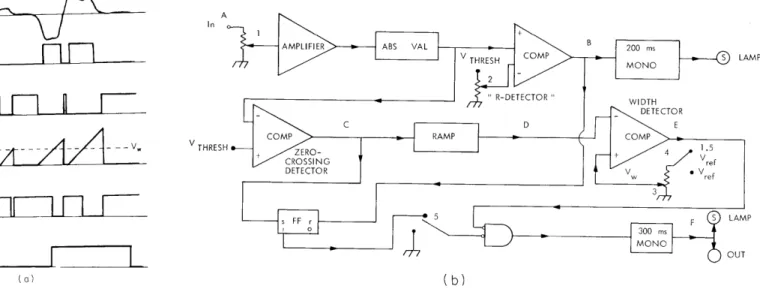
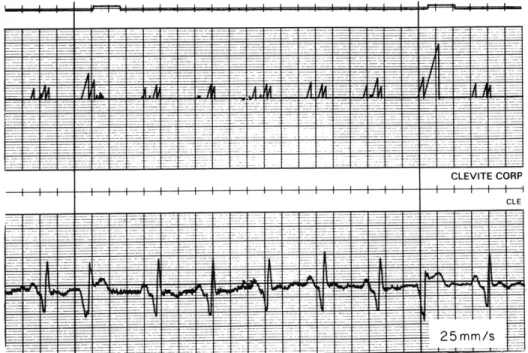
Continuing interest centers around the problem of reliably detecting and categorizing ectopic cardiac activity from EKG recordings. During the past year we developed an ectopic-beat detector based on a simple pulse-duration criterion. This device esti-mates the duration of the widest component in the EKG complex, compares it with a stored reference based on an observably normal beat, and declares abnormal morphol-ogy on the basis of exceeding a specified fraction of this reference. Preliminary evalua-tions suggest that this system works as well as an earlier system which compared the duration of the individual beat with a running average of the previous four normal beats. Our ultimate objective is to devise practical methods for monitoring ectopic activity in both ambulatory and hospitalized patients.
2. EKG Characterization Techniques
a. Apparatus has been constructed which characterizes the electrocardiographic waveforms as a series of straight-line segments. An error criterion is established and new line segments are added to the characterization only as often as is needed to remain within the established error. The apparatus is implemented with 8 linear-integrated circuits and gives promise of economical preprocessing that yields approximately a ten-to-one reduction in data rate.
b. A short-term memory incorporating MOS shift registers and using delta modula-tion has been designed. Such techniques as matched-filtering and temporal pattern rec-ognition can be easily implemented by using such multiple access delay-line memories. These possibilities will be further exploited, although the 200-ms memory was designed principally to allow observation of the P-wave of electrocardiograms while using the much larger QRS complex for purposes of detection.
3. Display Techniques
A resettable sweep system and a continuous position controller have been added to our three-dimensional oscilloscope. This addition allows photographic superposition of many electrocardiographic complexes lasting over periods up to 50 min long. Wave-forms of abnormal morphology are clearly visible when displayed in this manner. Records from hospitalized patients have been scanned for ectopic activity with greater success than is obtainable with human evaluators.
4. Sensory Evoked Potentials as an Aid to Evaluation of CNS State in Hepatic Encephalopathy
Preliminary experiments are being undertaken in cooperation with the Sears Sur-gical Laboratory, at Boston City Hospital, to correlate changes in sensory (both audi-tory and somatosensory) evoked potentials with CNS state in patients with hepatic encephalopathy. Our objective is to achieve a more sensitive measure of CNS state than is possible from ordinary EEG and clinical signs.
5. Ambulatory Blood-Pressure Monitoring
Experiments are being performed to verify correlation of average pulse velocity and mean arterial pressure. Using these data, we shall attempt to design instrumentation
to reliably follow blood pressure in a given individual over prolonged periods of time and during normal daily activities.
6. Magnetic Tape Recording System
A data recording-reproduction system capable of multiplexing 3 low-frequency data channels on a single-voice bandwidth magnetic tape channel has been designed and con-structed. The basic algorithm involves time-multiplexing the three signals in the form of relative pulse positions. While it does not produce truly periodic sampling, the code developed by the device does have a perfectly periodic frame rate and thus allows cor-rection for variations caused by irregularities in tape speed.
7. Analog Interface
The design of an analog input-output interface for our digital data processor has been completed. This interface can accommodate 16 analog output channels; two of the output channels will be used as horizontal and vertical signals to a display and the remaining will be used for waveform simulation. The interface includes multiple buffering and a timing system that permits period sampling irrespective of the activity of the central processor. At present, it is being implemented in terms of medium-scale integrated
(MSI) circuitry.
S. K. Burns, R. G. Mark Selected Publications
J. S. Barlow and L. Ciganek, "Lambda Responses in Relation to Visual Evoked Responses in Man," Electroenceph. clin. Neurophysiol. 26, 183-192 (1969).
A. A. Borb61ly and R. D. Hall, "Effect of Pentobarbital and Chlorpromazine on Acous-tically Evoked Potentials in the Rat" (submitted to Exp. Brain Res.).
L. D. Braida, "Absolute Identification of Sound Intensity: Dependence of Observer Sen-sitivity on Range and Number of Stimuli," J. Acoust. Soc. Am. 45, 326(A) (1969).
L. D. Braida, "Sensitivities in Absolute Identification, Magnitude Estimation, and Cat-egory Scaling," J. Acoust. Soc. Am. 46 (A) (1969).
H. S. Colburn, "Model of Binaural Hearing Based on Auditory Nerve Patterns," J. Acoust. Soc. Am. 46 (A) (1969).
N. I. Durlach and L. D. Braida, "Intensity Perception I. Preliminary Theory of Inten-sity Resolution," J. Acoust. Soc. Am. 46, 372-383 (1969).
O. Franzen and K. Offenloch, "Evoked Response Correlates of Psychophysical Magni-tude Estimates for Tactile Stimulation in Man," Exp. Brain Res. 8, 1-18 (1969). J. A. Freeman, "A Simple Method for Producing, in Quantity, Metal Microelectrodes with a Desired Taper and Impedance," Electroenceph. clin. Neurophysiol. 26, 623-626 (1969).
J. L. Goldstein and N. Y. S. Kiang, "Some Nonlinear Phenomena in Recordings from Single Auditory-Nerve Fibers," J. Acoust. Soc. Am. 45, 305 (A) (1969).
J. J. Guinan, S. S. Guinan, and B. E. Norris, "Single Auditory Units Recorded in the Medial Nucleus of the Trapezoid Body (MNTB) of Anesthetized Cats," J. Acoust. Soc. Am. 46, 113 (A) (1969).
R. D. Hall and A. A. Borbely, " Acoustically Evoked Potentials in the.Rat during Sleep and Waking" (submitted to Exp. Brain Res.).
R. M. Hershkowitz and N. I. Durlach, "An Unsuccessful Attempt to Determine the Trade-ability of Interaural Time and Interaural Intensity" (to appear in J. Acoust. Soc. Am.). R. M. Hershkowitz and N. I. Durlach, "Interaural Time and Amplitude JND's for a
500-Hz Tone" (to appear in J. Acoust. Soc. Am.).
P. G. Katona and G. O. Barnett, "Central Origin of Asymmetry in the Carotid Sinus Reflex," Ann. N.Y. Acad. Sci. 156, 779-786 (1969).
P. G. Katona, J. W. Poitras, and G. O. Barnett, "Asymmetry in the Carotid Sinus Reflex," in Introduction to Biocybernetics (John Wiley and Sons, Inc. , New York, in press).
N. Y. S. Kiang, T. Baer, E. M. Marr, and D. Demont, "Discharge Rates of Single Auditory-Nerve Fibers as Functions of Tone Level," J. Acoust. Soc. Am. 46, 106(A)
(1969).
R. A. Levine, E. C. Moxon, and N. Y. S. Kiang, "Responses of Single Auditory-Nerve Fibers in Cochleas Damaged by Ototoxic Drugs," J. Acoust. Soc. Am. 46, 106(A) (1969). W. T. Peake, H. S. Sohmer, and T. F. Weiss, "Microelectrode Recordings of Intra-cochlear Potentials," J. Acoust. Soc. Am. 46, 106(A) (1969).
D. J. M. Poussart, "Nerve Membrane Current Noise: Direct Measurements under Voltage Clamp" (to appear in Proc. Nat. Acad. Sci. (U. S.)).
M. B. Sachs, "Stimulus-Response Relation for Auditory-Noise Fibers: Two-Tone Stim-uli," J. Acoust. Soc. Am. 45, 1025-1036 (1969).
W. M. Siebert, "The Impact of New Technology on Medical Education" (submitted to Technology Rev.).
W. M. Siebert, "Frequency Discrimination in the Auditory System: Place or Period-icity Mechanisms?" (submitted to Proc. IEEE, Detection Theory issue).
T. F. Weiss, W. T. Peake, and H. S. Sohmer, "Intracochlear Responses to Tones," J. Acoust. Soc. Am. 46, 106(A) (1969).
M. L. Wiederhold, "Variations in the Effects of Electric Stimulation of the Crossed Olivocochlear Bundle on Cat Single Auditory-Nerve Fiber Responses to Tone Bursts" (submitted to J. Acoust. Soc. Am.).
M. L. Wiederhold and N. Y. S. Kiang, "The Effects of Electric Stimulation of the Crossed Olivocochlear Bundle on Single Auditory Nerve Fibers in the Cat" (submitted to J. Acoust. Soc. Am.).
Theses 1969
1. Louis D. Braida, "Intensity Perception in Audition," Ph. D. Thesis, Department of Electrical Engineering, M. I. T.
2. H. Steven Colburn, "Some Physiological Limitations on Binaural Performance," Ph. D. Thesis, Department of Electrical Engineering, M. I. T.
3. George M. Goldmark, "Computer Control of Stimulus-Response Variables in Audi-tory Experiments," S. M. Thesis, Department of Electrical Engineering, M. I. T. 4. Sharon Grundfest, "Binaural Signal Detection with Contralateral Cueing," S. B.
Thesis, Department of Electrical Engineering, M. I. T.
5. Ziaul Hasan, "Neural Control of Proprioceptive Reflex in Crayfish," S. M. Thesis, Department of Electrical Engineering, M. I. T.
6. Gerald R. Ladd, "Solid-State Random-Noise Generator," S. B. Thesis, Department of Electrical Engineering, M. I. T.
7. Richard McPherson, "System Design for Eliciting Instinctional Behavior in Bats," S. B. Thesis, Department of Electrical Engineering, M. I. T.
8. Russell M. Mersereau, "Vagal Activity during Heart Blocks Induced by Blood Pres-sure Reflex," S. M. Thesis, Department of Electrical Engineering, M. I. T.
9. William L. Nuffer, "A Model for Cochlear Potentials," S. B. Thesis, Department of Electrical Engineering, M. I. T.
10. Stephen Poppe, "Phase Effects in Two-Tone Auditory Masking," S. B. Thesis, Department of Electrical Engineering, M. I. T.
11. Edward Seykota, "Design of Digitoxicity Controller," S. B. Thesis, Department of Electrical Engineering, M. I. T.
12. Dale O. Stahl, "Modulation Discrimination," S. B. Thesis, Department of Electrical Engineering, M. I. T.
13. Dale O. Stahl, "Psychophysical Tuning Curves," S. M. Thesis, Department of Elec-trical Engineering, M. I. T.
14. David L. Sulman, "Regulation of Digitalis Administration by Testing for Repetitive Ventricular Disease," S. M. Thesis, Department of Electrical Engineering, M. I. T. 15. James P. Yu, "A Four Quadrant Multiplier," S. B. Thesis, Department of
Elec-trical Engineering, M. I. T.
16. Robert R. Zimmerman, "An Equivalent Stimulus Function for Cochlear Potentials in Gerrhonotus Lizards," S. B. Thesis, Department of Electrical Engineering, M. I. T.
A. SIMPLE MODEL OF THE IMPEDANCE MATCHING PROPERTIES OF THE EXTERNAL EAR
In breaking up the mechanical system of the ear into subsystems for analysis, it is conventional and desirable to select one of the junctions to be in the ear canal just exter-nal to the eardrum. This is an analytically convenient spot primarily because throughout the normal range of auditory frequencies only the lowest acoustic mode will propagate
in the ear canal. Thus both the effective pressure and the velocity in the canal can be described by scalars that are functions of position along the canal only. (The lowest cut-off frequency for a higher mode is approximately 25-30 kHz for a rigid tube of the same radius as the ear canal. If such a mode were excited at, say, 15 kHz, it would be atten-uated to a small fraction of its original strength in a few millimeters. Higher modes are in fact strongly excited by the asymmetric motions of the eardrum at all frequencies, and are more weakly excited by bends and nonuniformities in the ear canal. Indeed, the presence of higher modes may introduce uncertainties of the order of a factor of 2 in the pressures measured with probe tubes close to the drum. But it can readily be argued that the stored energy associated with these modes should be small compared with that stored in other reactive elements of the middle ear for frequencies less than ~10 kHz. Hence, the effective pressures and velocities in the ear canal are those associated with the lowest mode.)
It is generally assumed that an adequate description of the properties of the external ear is given by the magnitude of the ratio of the pressure in the ear canal near the drum to, say, the pressure of the propagating acoustic wave that would be measured at the position of the center of the head if the head were removed. A number of measurements of this pressure ratio have been reported. 1, 2 The ratio is, of course, a function of both the frequency and the orientation of the acoustic wave relative to the head.
Measurements of the extent to which impedances are matched at, say, the eardrum are much more significant, however, for an assessment of the function of the external ear than measurements of pressure ratios. To assert that there is at a certain fre-quency a 15-dB pressure gain means little unless it is compared with the changes in impedance level or with the maximum possible pressure gain that could be realized with an "optimum" external ear design. To assert, however, that the reflection coefficient at a certain frequency at the eardrum is 0. 3 is to make a much more complete statement about the efficiency of the external ear, as the following argument shows.
Suppose the acoustic wave in the absence of the head is a plane wave with (rms) pres-sure P, wavelength X, and angles, 0 and
4.
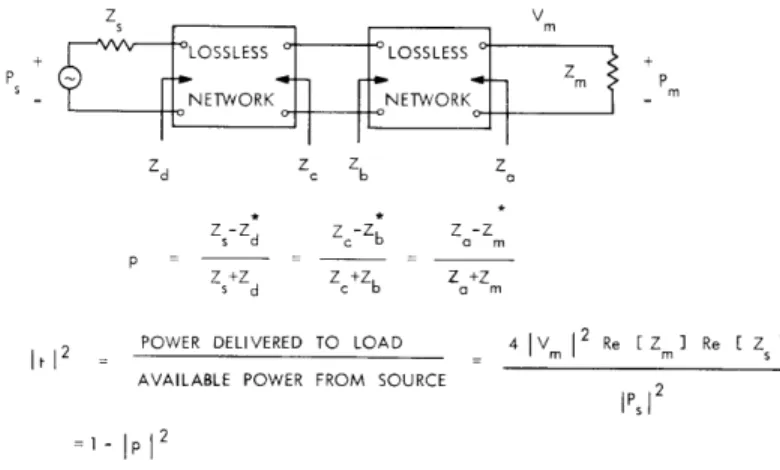
(To be definite, take 0 = 0 overhead and= 0 ahead.) Then we may represent the situation in the ear canal just external to the eardrum by the electrical equivalent circuit (pressure-voltage analogy) shown in Fig. XXVII-1. Here Z m is the acoustic impedance (fundamental mode) looking into the
middle ear from a point just external to the eardrum; V is the corresponding fundamen-Z
a tal mode volume velocity; Za and the
pres-sure source Pg(0,
4)
represent the Th6venin equivalent circuit looking outward into the+Z ear canal; g(0,
4)
is closely related to thePg (
9,
) m effective acoustic cross section of the ear and head, which depends, of course, on the Vangle of arrival of the acoustic wave; and Za, Zm , and g(6,
4)
are in general complex Fig. XXVII-1. functions of frequency or wavelength.Equivalent circuit in the ear canal just Z and g(0, ) are not entirely indepen-external to the eardrum. dent. In fact, it follows rather directly
from the reciprocity principle that the integrated available power from all directions is a constant for any acoustic structure, provided only that the structure is essentially lossless. That is,
2i i g(,
4)
2_ 2