HAL Id: tel-02143993
https://tel.archives-ouvertes.fr/tel-02143993
Submitted on 29 May 2019HAL is a multi-disciplinary open access
archive for the deposit and dissemination of sci-entific research documents, whether they are pub-lished or not. The documents may come from teaching and research institutions in France or abroad, or from public or private research centers.
L’archive ouverte pluridisciplinaire HAL, est destinée au dépôt et à la diffusion de documents scientifiques de niveau recherche, publiés ou non, émanant des établissements d’enseignement et de recherche français ou étrangers, des laboratoires publics ou privés.
Predictive position coding : attentional account of
motion-induced position shifts
Nika Adamian
To cite this version:
Nika Adamian. Predictive position coding : attentional account of motion-induced position shifts. Cognitive Sciences. Université Sorbonne Paris Cité, 2017. English. �NNT : 2017USPCB164�. �tel-02143993�
Abstract
Localizing objects in space is one of the central functions of the visual system. When an observer or a target is moving, the motion of the eye or the object can be taken into account to compute the current object locations. It has been shown many times that visual motion can strongly influence the perceived position of an object. For example, a stationary patch containing moving texture (De Valois & De Valois, 1991; Ramachandran & Anstis, 1990), a flash presented on (Cavanagh & Anstis, 2013) or next to (Whitney & Cavanagh, 2000) a moving texture, and even the onset and offset positions of the moving targets (Fröhlich, 1923; Freyd & Finke, 1984) are perceived as shifted in the direction of motion. In this thesis we explore the
relationship between these motion-induced position shifts and visual attention in the following forms: 1) transient spatial attention, 2) global and local attention 2) sustained spatial attention, and 3) object-based attention.
In the first series of experiments we looked at whether and how attention modulates the localization of motion onset. When an object suddenly appears in motion, its initial position is perceived as being shifted in the direction of its motion (Fröhlich effect). In Experiment 1 we measured Fröhlich effect under different cueing conditions (valid, invalid or neutral) and established that invalid cues produced larger perceptual shifts, although the Fröhlich effect was still present for valid and neutral cues. In Experiment 2 we found that the Fröhlich effect increased when the valid cue arrived more than 100 ms after the start of motion, suggesting again that a delay in attention’s arrival shifted the location of the perceived motion onset. In Experiment 3 we compare the motion-induced shifts when the subjects attended to a set of moving stimuli as a group and when they attended to an orientation singleton. We showed that the Fröhlich effect was only present when the target was individuated and disappeared when the stimulus was perceived globally. Thus, the Fröhlich effect appeared to be both produced and modulated by focal attention.
Having established that temporal delays of attention increase motion-induced position shifts, the next study explored if spatial distribution of attention has a similar effect. In this study we used the flash-grab effect — an illusory position shift seen when a target is briefly flashed on top of a moving background that abruptly changes direction (Cavanagh & Anstis, 2013). We created a new variation of the flash-grab
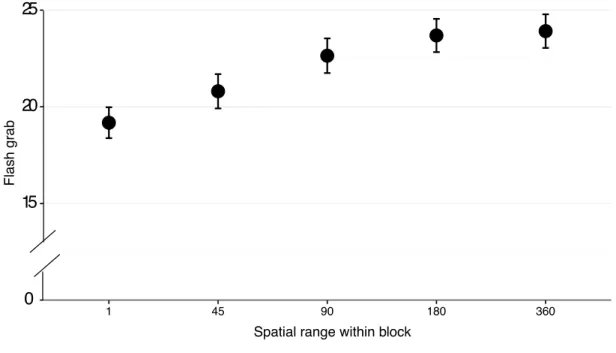
stimulus that allowed us to produce even larger position shifts (15 times bigger than the size of the target) and to increase the spatial uncertainty of the target. Trials were presented in blocks and before each spatial block a cue indicated a range of possible target locations (0°, 45°, 90°, 180° or 360°). We found that the flash-grab effect was reduced if the spatial distribution of targets within a block was limited to a range of 90° or less. Cuing a narrow range would allow attention to reach the target sooner whereas cuing a larger range would delay the arrival of focal attention to the moving target. The result here is therefore in agreement with the results of the previous project, in that delayed attention increases the position shift.
The final study asked whether motion shifts the perceived position of an object as a whole or alternatively if separate features of a single object are shifted
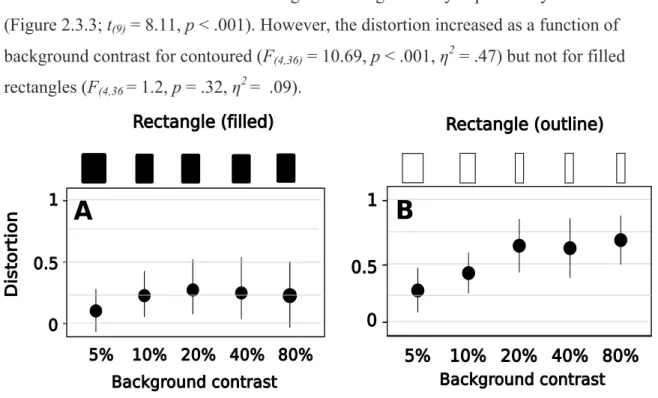
independently. To test this we used the flash-grab paradigm and briefly presented a shape on top of a moving background at the moment it changed direction. In this study we were interested not only in the position of this shape, but also in its appearance. We tested five different objects, both outlines and filled shapes, at different levels of background contrast, and asked subjects to adjust these shapes to match a symmetrical reference. For instance, for the “T”, subjects shifted the vertical stem until it appeared aligned to the center of the horizontal bar. For the “circle”, participants adjusted its left and right curvature until it appeared circular. The results showed that the features of the target that were orthogonal to the background motion were shifted most, whereas the features parallel to the motion were less shifted, distorting the appearance of the briefly presented shape. This suggests that motion interacts with the position of the object’s features (and focal attention selects them) before they are bound together into an object.
In conclusion, we applied a variety of attentional manipulations to motion-induced position shifts, and examined the link between the strength of the illusion and the characteristics of attention used in a particular task. First, we found that motion-induced position shifts require focused attention and the possibility to track an individual motion trajectory. Second, we showed that allowing attention to be
allocated more efficiently in space reduces the illusion. Finally, we found that motion-induced shifts operate on the feature-based and not object-based level.
Résumé
La localisation des objets dans l'espace est une des fonctions centrales du système visuel. Lorsqu'un observateur ou une cible est en mouvement, le mouvement de l'œil ou de l'objet peut être pris en compte pour calculer la position de l’objet à n’importe quel moment. Il a été démontré à plusieurs reprises que le mouvement visuel peut fortement influencer la position perçue d'un objet. Par exemple, un patch stationnaire contenant une texture en mouvement (De Valois & De Valois, 1991; Ramachandran & Anstis, 1990), un flash présenté sur (Cavanagh & Anstis, 2013) ou à côté (Whitney & Cavanagh, 2000) d’une texture en mouvement, et même les
positions de départ et d’arrivé des cibles en mouvement (Fröhlich, 1923) sont perçus comme étant déplacés dans la direction du mouvement. Dans cette thèse, nous
explorons la relation entre ces déplacements de position provoqués par le mouvement et l'attention visuelle sous les formes suivantes: 1) l'attention spatiale transitoire, 2) l'attention globale et locale, 3) l’attention spatiale soutenue, et 4) l'attention basée sur les objets.
Dans la première série d'expériences, nous avons examiné si et comment l'attention module le déplacement de la localisation au début du mouvement (effet Fröhlich). Dans les Expériences 1 et 2, nous avons mesuré l'effet Fröhlich sous des différentes conditions de cueing et nous avons établi que les indices invalides ou tardifs produisent de plus grands déplacements perceptifs. Dans l'Expérience 3, nous comparons les déplacements provoqués par le mouvement lorsque les sujets portaient leur attention sur un ensemble de stimuli en mouvement qui formaient un groupe comparé à quand il n’y avait qu’un seul stimulus avec l'orientation recherché. Nous avons montré que l'effet Fröhlich était présent lorsque la cible était individué et disparaissait lorsque le stimulus était perçu au niveau global. Ainsi, l'effet de Fröhlich semble être à la fois produit et modulé par l'attention focale.
Ayant établi que les délais temporels de l'attention augmentent les
déplacements de position provoqués par le mouvement, la prochaine étude explorait si la distribution spatiale de l'attention a un effet similaire. Dans cette étude, nous avons utilisé le flash-grab - un changement de position illusoire aperçu quand une cible est
brièvement flashé sur un fond en mouvement qui change soudainement de direction (Cavanagh & Anstis, 2013). Les essais étaient présentés en blocs et avant chaque bloc un indice indiquait une plage d'emplacements de cible possibles. Nous avons constaté que le flash-grab était réduit quand la distribution spatiale des cibles était limitée à une plage de 90° ou moins.
La dernière étude demandait si le mouvement déplace la position perçue d'un objet dans son ensemble ou si les caractéristiques distinctes d'un même objet sont déplacées indépendamment. Pour tester cela nous avons utilisé le paradigme flash-grab et brièvement présenté une forme au-dessus d'un fond en mouvement au moment où il a changé de direction. Les résultats montrent que les caractéristiques de la cible qui étaient orthogonale au mouvement du fond étaient déplacées, alors que les caractéristiques parallèles au mouvement étaient intactes. Ceci suggère que le mouvement interagit avec la position des caractéristiques de l'objet (et l'attention focale les sélectionne) avant qu'elles ne soient liés ensemble dans un objet.
En conclusion, nous avons appliqué une variété de manipulations
attentionnelles à des changements de position provoqués par le mouvement, et nous avons examiné le lien entre la force de l'illusion et les caractéristiques de l'attention utilisées dans une tâche particulière. Nous avons constaté que 1) les changements de position provoqué par le mouvement nécessitent une attention ciblée et la possibilité de suivre une trajectoire de mouvement individuelle; 2) quand l’attention est réparti plus efficacement dans l'espace l'illusion est réduite; et 3) les décalages provoqués par le mouvement fonctionnent au niveau des caractéristiques et non au niveau des objets.
Acknowledgements
I would like to extend my sincere gratitude to my friends, family and
colleagues for the continuous support of my studies. This dissertation could not have been completed without your help, encouragement and patience.
I am most deeply grateful to Patrick for letting me join this journey with the rest of the team, offering amazing opportunities throughout the way and teaching me how to be a scientist.
I thank Thérèse for being a role model and an inspiration, and all the members of the Vision group, past and present, for the amazing atmosphere in the lab. I
particularly thank my officemates, Marianne, Margaux, Sergiu, Louis, Florian, Romain, Solene, Daphne, for maintaining a healthy work—Internet balance in the room and sharing so many great moments with me. I would also like to thank all the members of the StackOverflow and CrossValidated communities for their invaluable help in my research.
I am grateful to the members of the jury for the time and effort spent to evaluate this work.
Finally, I would like to dedicate this thesis to my father who always supported me in my ventures.
Table of contents
ABSTRACT ... 3 RESUME ... 5 ACKNOWLEDGEMENTS ... 7 TABLE OF CONTENTS ... 8 PART I. INTRODUCTION ... 10 1.1 PROCESSING OF MOTION IN THE VISUAL SYSTEM ... 11 1.2 LOW-LEVEL AND HIGH-LEVEL (ATTENTIONAL) MOTION ... 17 1.3 MOTION-INDUCED POSITION SHIFTS: THEORIES AND ILLUSIONS ... 19 1.4 NEURAL CORRELATES OF MOTION-INDUCED POSITION SHIFTS ... 28 1.5 ATTENTION AND MOTION-INDUCED POSITION SHIFTS ... 30 1.6 OVERVIEW OF THE EXPERIMENTAL CONTRIBUTIONS ... 37 PART II. EXPERIMENTS ... 39 2.1 FRÖHLICH EFFECT AND DELAYS OF VISUAL ATTENTION ... 39 ABSTRACT ... 39 2.1.1 INTRODUCTION ... 39 2.1.2 EXPERIMENT 1. ... 42 2.1.3 EXPERIMENT 2 ... 48 2.1.4 EXPERIMENT 3 ... 54 2.1.5 GENERAL DISCUSSION ... 60 2.1.6 CONCLUSION ... 63 2.2 SPATIAL PREDICTABILITY REDUCES THE FLASH GRAB SHIFT ... 64 ABSTRACT ... 64 2.2.2 EXPERIMENT 1. ... 66 2.2.3 EXPERIMENT 2A. ... 72 2.2.4 EXPERIMENT 2B ... 78 2.2.5 EXPERIMENT 3 ... 81 2.2.6 GENERAL DISCUSSION ... 85 2.3 MOTION INDUCED DISTORTION OF SHAPES ... 87 ABSTRACT ... 87 2.3.1 INTRODUCTION ... 88 2.3.2 METHOD ... 89 2.3.3 RESULTS ... 92 2.3.4 DISCUSSION ... 95 PART III. GENERAL DISCUSSION ... 98 3.1 SHIFTS OF ATTENTION ... 98 3.2 ATTENTIONAL TRACKING ... 99 3.3 STAGE OF PROCESSING ... 101 SUPPLEMENTARY TABLE 1. ... 103 SUPPLEMENTARY DEMONSTRATIONS ... 105 REFERENCES ... 106Part I. Introduction
Encoding of positional information is vital for successful interaction with the environment. We need to know where something is before we can move our eyes to examine it more closely, reach out our hand to grab it, or decide to run away from it. Even more basic visual functions such as binding visual features into objects
(Treisman & Gelade, 1980) depend on the accurate representation of spatial proximity.
From the moment that light enters the eye, the spatial organization of the image is carefully maintained in the visual brain. The idea that the cortex represents an orderly map of the visual features was supported by the neurophysiological findings already in the 19th century (Henschen, 1893), and was preceded by the detailed studies of the optics of the eye by 16th century physiologists (Popple, Levi, 2005). The theories of local sign and labeled lines were put forward to account for the encoding of position (Hering, 1899; Lotze, 1886, von Helmholtz, 1962). Despite the differences in the exact proposed mechanisms, these theories shared the basic idea that each receptor of the retina is connected to the retinotopically organised brain by a dedicated nerve fiber, meaning that this unique neural pathway is by itself an indicator of the precise location of the light on the retina. Modern neuroimaging studies
confirm that a series of topographic maps in the brain organise visual information through all its transformations. Sixteen or more retinotopic maps have been described in the human cortex (Wandell, Dumoulin, & Brewer, 2007), with many more located subcortically (Schneider, Richter, & Kastner, 2004; Kastner et al., 2004). However, there are many circumstances in which factors other than retinal information influence the perceived location, challenging the labeled line approach. Eye movements (Cai, Pouget, Schlag-Rey, & Schlag, 1997; Ross, Morrone, & Burr, 1997, Ross, Morrone, Goldberg, & Burr, 2001), frames of reference (Roelofs, 1935; Bridgeman, Peery, & Anand, 1997), attention (Suzuki & Cavanagh, 1997; Kerzel, 2004; Kosovicheva, Fortenbaugh, & Robertson, 2010), memory (Sheth & Shimojo, 2001) and adaptation (Whitaker, McGraw, & Levi, 1997) are among the factors contributing to the
dissociation between the physical and the perceived position of an object. The focus of the present work is a group of pronounced perceptual mislocalizations resulting
from visual motion (Fröhlich, 1923; Whitney, 2002; Cavanagh & Anstis, 2013). Before describing these perceptual effects in more detail, I would like to briefly review the neural substrate of motion perception.
1.1 Processing of motion in the visual system
The visual system infers motion from the changing pattern of light on the retina. Visual motion signals are encoded and processed in a network of subcortical and cortical structures. Most of our knowledge about the motion processing systems comes from the single cell studies in nonhuman primates and cats.1.1.1 The retino-geniculo-striate pathway
Retina
The analysis of visual motion starts in the retina. The retina comprises three functional layers: rods and cones, bipolar cells, and ganglion cells. Ganglion cells, located in the innermost part of the retina, receive their input from photoreceptors via bipolar cells, convert the visual information into the nerve spikes and transfer it to the thalamus. There are two major and well-studied types of ganglion cells, although many more are described in the literature (Sanes & Masland, 2015). Midget retinal ganglion cells (70–80% of the ganglion cells) have small bodies and small receptive fields. Their responses are relatively slow and they are sensitive to higher contrast. Parasol retinal ganglion cells (10% of the ganglion cells) are much bigger in size and have larger receptive fields comprising many photoreceptors. They have faster conduction velocity and sensitivity to low-contrast stimuli.
Barlow & Levick (1965) describe a subset of direction-selective ganglion cells in the rabbit retina. Direction-selectivity means that if a stimulus presented to the receptive field of a cell moves in its preferred direction, the spiking rate of the cell increases above spontaneous activity. Usually, if the stimulus moves in the opposite direction, the firing rate decreases below spontaneous activity. In the primate retina, however, these cells are rarely encountered (Schiller & Malpeli 1977; DeMonasterio, 1978).
LGN
Lateral geniculate nucleus (LGN) is located in the dorsal part of the thalamus and acts as a relay between the retina and the cortex. Midget and parasol ganglion cells project to the different layers of the LGN, preserving pathway specificity. Parasol cells send their axons to the innermost layers (1-2) of the LGN, known as magnocellular layers. Midget cells are connected to the layers 3-6 of the LGN, or parvocellular layers. Magnocellular cells have large receptive fields and show fast transient responses with high temporal resolution. In contrast, parvocellular cells have small receptive fields, low temporal resolution, and show slow sustained responses. Relying on these characteristics, parvo system is optimal for conveying information about static form, while magno system carries information about motion (DeYoe & Van Essen, 1988; Livingstone & Hubel, 1988). Both magnocellular and parvocellular units respond to moving stimuli, some of them showing direction selectivity. In the parvo system, the cells are more broadly tuned to velocity (Lee, Creutzfeldt, & Elepfandt, 1979).
There is also a third route connecting the retina to the V1 – the koniocellular pathway. This pathway originates in a small heterogeneous group of ganglion cells (Schiller & Malpeli, 1977; Perry & Cowey, 1984; Perry, Oehler, & Cowey, 1984). In LGN, koniocellular layers are located ventrally to the magno and parvocellular layers. This pathway has been mostly implicated in color processing (Martin et al., 2007; Reid et al., 1997), however, it is often associated with motion processing due to the presence of the direction-selective cells (Casagrande, 1994) and its projections to motion-processing cortical areas (Seidemann et al., 1999; Wandell et al. 1999).
Primary visual cortex
V1, also known as Brodmann’s area 17 or striate cortex, is the first cortical destination of the visual signal. Magno, parvo and konio cells send their input to the different layers of V1, but the signal are merged in the subsequent areas. At least 30% of the V1 cells, especially the complex cells, are direction selective (Hubel & Wiesel 1959, 1968; Figure 1.1). Further studies showed that many of these cells have broad speed tuning (Wurtz, 1969). These motion-selective cells are often considered to be the basic units of motion processing (Livingstone & Hubel, 1988), and they are more likely to project to motion-specialised area MT/V5 than to other extrastriate areas
(Movshon & Newsome, 1996). Essentially, V1 neurons filter the image in space and time, computing the motion of small oriented elements (Adelson & Bergen, 1985).
<Content removed due to copyright restrictions> Figure 1.1. V1 direction selectivity.
Data from Hubel and Wiesel's early experiments on V1. The dashed rectangles on the left indicate a V1 neuron's receptive field. The superimposed lines are the
stimuli that were used, and their direction of motion. The arrows above each recording indicate the direction of motion. This V1 neuron responds best to the
up-right motion but not at all to down-left motion.
1.1.2 Extrageniculate pathway
The geniculostriate pathway connecting the retina to the cortex via LGN is followed by 80%-90% of retinal ganglion cells. In addition, there is a direct route from the retina to superior colliculus (SC), which then sends information to the pulvinar nucleus of the thalamus (Harting, Huerta, Frankfurter, Strominger, & Royce, 1980; Berman & Wurtz, 2010) and terminates in the visual cortex bypassing V1. This extrageniculate system is dominated by the magnocellular output, and thus is
important for the analysis of motion and location. Functionally, it contributes to the shifts of visual attention, facilitates saccades and head movements (Krauzlis et al., 2004; Kato, Takaura, Ikeda, Yoshida, & Isa, 2011).
Superior colliculus
SC is a part of the “roof” of the midbrain. The colliculi have a laminated structure, where superficial layers receive visual inputs (both from the retina and from the cortex), and deeper layers contain auditory and somatosensory information
(Wallace, Meredith, & Stain, 1998). About 10% of ganglion cells project in the SC (Hubel et al., 1975). Collicular cells receiving retinal input have very small response latencies, broad speed tuning, and respond more strongly to stimuli oriented
orthogonally to their motion direction. The sensory input of SC appears to be particularly important for the guiding of orienting movements (Horwitz, Batista, & Newsome, 2004).
Pulvinar
Pulvinar is a part of the thalamus well connected to visual and associative structures of the brain. This region is often associated with visuospatial attention and visually guided actions (Robinson & Petersen, 1992; Guillery, 1995; Chalupa, Coyle, & Lindsley, 1976). Cells in lateral posterior pulvinar have been found to encode velocity and direction of motion, as well as the relative motion between the stimulus and its background (Casanova & Savard, 1996). Moreover, pulvinar is able to integrate local motion signals into a coherent moving percept (Merabet, Desautels, Minville, & Casanova, 1998).
1.1.3 Extrastriate visual cortex
Areas V2, V3, V4
A small percentage (around 15%) of V2 cells are direction selective (Zeki, 1978). These cells are located within the orientation-selective zones or thick/pale stripes of V2 (Lu, Chen, Tonigawa, & Roe, 2010), and, as most of the direction-selective cells in the other areas, respond strongest to the stimuli oriented orthogonally to their preferred direction. Area V3 has about 40% of direction-selective cells (Gegenfurtner, Kiper, & Levitt, 1997). Some of these cells respond to the motion of a pattern rather than to the motion of its individual components. This form of higher-motion processing seems to originate in V3, as it appears there for the first time in cortical processing pathways. Overall, area V3 is important for dynamic form analysis (Zeki, 1993). Area V4 is mostly implicated in object perception and colour analysis. However, a number of studies show considerable direction selectivity in V4 (reviewed in Roe et al., 2012), ranging from 5% to 30% of cells depending on the recording method. According to an influential hypothesis (Braddick, 1993; Zhou et al., 2000) this motion signal is used for figure-ground segregation of the moving object. While motion integration is required to combine local motion signals into a coherent percept, motion differentiation, possibly taking place in V4, helps to identify the borders of the moving object and segregate tt from its background.
Area MT (or V5) is considered to be the hub of motion processing. Almost all MT neurons (90%) are direction-selective, and many of them are also sensitive to the speed of visual stimulation (Zeki, 1974; Orban, 2008). Although MT receives most of its input through areas V1-V3, there are at least two pathways bypassing this main route through direct LGN to MT or V1 to MT projections (Sincich, Park,
Wohlgemuth, & Horton, 2004; Nassi, Lyon & Callaway, 2006). Importantly, MT combines and interprets motion signals coming from the earlier visual areas. It is not a trivial task, since early motion signals are inconclusive about the direction of motion. This ‘aperture problem’ is resolved by MT neurons, resulting in a coherent response to global motion (Pack & Born, 2001).
A number of studies have shown a direct link between MT neural activity and psychophysical performance in a motion discrimination task (Britten, Shadlen, Newsome, & Movshon 1992; Salzman, Murasugi, Britten, & Newsome, 1992; Newsome, Shadlen, Zohary, Britten, & Movshon, 1995). Motion discrimination and speed discrimination, but not color perception or visual acuity, are largely impaired after a lesion in MT (Newsome & Pare, 1988; Cowey & Marcar, 1992; Schiller, 1993). In humans, damage to the posterior parietal and occipital regions of the brain can lead to the inability to perceive motion (cases reviewed in Zeki, 1993). The most studied case was first presented by Zihl, Von Cramon, & Mai (1983). The patient, L.M. could not perceive the direction and speed of motion, although her color and depth perception as well as letter and object recognition were intact. Moreover, she could judge the tactile or auditory motion -- the deficit was only visual.
Medial temporal superior area and superior
temporal sulcus
The role of areas beyond MT is less understood (Rokszin et al., 2010). Cells in the areas MST (medial superior temporal area) and STS (superior temporal sulcus) receive strong input from MT and are likely to analyze information about self-motion and optic flow (Britten & Van Wezel, 2002; Warren, 2008). Dorsal part of MST hosts cells responding to complex moving patterns, such as rotation in a particular direction, contraction or expansion (Tanaka & Saito, 1989; Duffy & Wurtz, 1991). These cells respond better to large fields of moving dots. In contrast, neurons in lateral MST respond more strongly to small moving patterns, suggesting that this area performs
figure-ground segmentation (Tanaka et al., 1993). In addition, STS is implicated in integrating multisensory information (Beauchamp et al., 2008) and perception of biological motion (Beauchamp et al., 2003; Pelphrey & Morris, 2006).
The cortical areas processing visual information are thought to form two relatively independent streams: ventral (“what”, perceptual pathway) and dorsal (“where”/ “how” / action pathway). The ventral pathway comprises certain structures within areas V1 and V2 as well as area V4 and inferior temporal cortex. It receives both magnocellular and parvocellular input and responds selectively to the
information relevant for object identification, such as shape and color. The dorsal pathway starts from the other parts of V1 and V2 and includes areas V3, V3a, MT, MST as well as inferior parietal cortex. This pathway receives predominantly magnocellular input and is associated with movement for action and processing of spatial aspects of objects, such as direction and speed of motion (Ungerleider & Haxby, 1994; Milner & Goodale, 2008). However, as outlined above, even areas belonging to the ventral pathway (such as V4) include direction-selective cells, which suggests they do play a role in motion perception (Ferrera, Rudolph, & Maunsell, 1994; Gilaie-Dotan et al., 2013). This indicates that the specialization of the
processing streams and of the separate areas is rather relative and not fully understood yet.
It is also worth noting here that in addition to the feedforward processing, the visual system is rich in horizontal and feedback projections. This abundance of connections leads to the possibility that some anatomically more high-level areas receive information faster than areas located earlier in the processing hierarchy
(Lamme & Roelfsema, 2000). For instance, and importantly for the present work, area MT has very short response latency. Lamme and Roelfsema (2000) report that cells in macaque area MT respond on average in 76 ms, with the earliest activation detected 39 ms after stimulus onset. This is not dramatically later than the response of area V1 (mean latency 72 ms, earliest response at 35 ms). In context of motion-position interactions this could allow motion information to enter the primary visual cortex via MT (i.e. from higher areas) around the same time as the information about the other features of the object coming from the anatomically earlier stages of processing.
1.2 Low-level and high-level
(attention-based) motion
Motion processing as described above requires the stimulation of directionally selective neurons or other local motion detectors. However, this is not the only
situation when motion is perceived. For instance, if a stimulus presented at one location alternates with another stimulus presented at a different location within an appropriate temporal and spatial interval, we perceive a single stimulus moving back and forth rather than two separate flickering objects (Wertheimer, 1912; Anstis, 1970, 1980; Kolers, 1972). This phenomenon is termed apparent motion, emphasising that the percept of motion here doesn’t come from the summation of “real”, velocity-based local motion signals. Instead, the object is identified and matched at a different
locations across the time interval1 (Anstis, 1980; Braddick, 1980).Cavanagh (1992) masked a drifting luminance grating with a superimposed color grating moving in the opposite direction. The bars of the luminance grating could not be perceived because of the masking, however, its motion signal was registered and it determined the perceived rotation of the entire stimulus. On the other hand, when the observers paid attention to the color grating, the perceived direction of motion followed the drift of the color bars. This stimulus convincingly demonstrated that low-level motion can be separated from attentive tracking.
Thus, motion can be classified as low-level if it is based on local motion detectors (Anstis, 1980; Braddick, 1980; Cavanagh & Mather, 1989; Julesz, 1971), or high-level if it is based on the tracking of the object’s changing position (Cavanagh, 1992; Lu & Sperling, 1995; Seiffert & Cavanagh, 1998). Importantly, the low-level system does not need to know what is moving; it works directly with the motion signal. The high-level system, however, uses form and position as inputs, thus it is thought to emerge later in the processing. It has been argued that attention is the key for this tracking process (Wertheimer, 1912; Verstraten, Cavanagh & Labianca 2000). This is supported by neuropsychological data: patients with right parietal damage experience, among a variety of attentional difficulties, a large loss in the perception of
1
Apparent motion stimuli taking small steps relative to their size can still drive low-level detectors, however, at least a subset of apparent motion stimuli are supported by a higher-level mechanism (Verstraten, Cavanagh, & Labianca, 2000).
apparent motion (Battelli et al., 2001). Similarly, neurophysiological investigations show the involvement of higher parietal cortex in the representation of subjective motion percepts (Williams, Elfar, Eskandar, Toth & Assad, 2003).
High-level motion or attentive tracking is an independent system and not just an accumulator of low-level motion signals. In a way, attentive tracking is similar to smooth pursuit. When we lock our gaze on the target and follow it with our eyes the target has very little motion on the retina, however, we see it move. This perception of motion is provided by the signal responsible for the eye movement (the efference copy). Attentive tracking can be thought of as a “covert efference copy”, providing the perception of motion when the eyes are not moving but attention is (Cavanagh, 1992; Cavanagh, Battelli, & Holcombe, 2014). A contrast sensitivity probe placed along the tracking path reveals smooth shift of sensitivity peak that accompanies attention-based motion, supporting smooth displacements of attention (Shioiri, Yamamoto, Kageyama, & Yaguchi, 2002). In fact, targets can be tracked even if they do not drive low-level motion signal.
Most moving stimuli engage both low-level and high-level motion systems. However, certain stimuli produce predominantly motion of one type. For instance, if the stimulus moves too fast and too unpredictably to be tracked, high-level motion processes are impaired (Verstraten et al., 2000; Murakami, 2001; Fukiage, Whitney, & Murakami, 2011). On the other hand, to test high-level motion perception while controlling for low-level motion, ambiguous stimuli are typically used, with the perceived direction of motion depending on the focus of attention (Shim & Cavanagh, 2005; Tse, Whitney, Anstis, & Cavanagh, 2011).
To conclude, motion processing is a complex process that involves a number of cortical and subcortical structures. Some of them are more specialised for motion, like MT, and some represent motion information despite being mostly involved in the processing of other features (like V4). Motion can also be perceived without the direct stimulation of local motion detectors with the help of an independent system: high-level motion or attentive tracking.
1.3 Motion-induced position shifts: theories
and illusions
In this subsection I would like to introduce the family of motion-induced position illusions, discuss their main characteristics and potential explanations.
1.3.1 Fröhlich effect
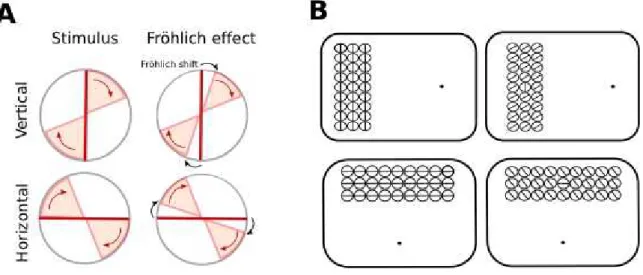
In 1894, the Norwegian astronomer O. Pihl noticed that the initial percept of a moving target appearing in a window is not adjacent to the edge of the window, but instead is considerably displaced in the direction of motion. Later this effect was systematically studied by F. W. Fröhlich (1923). The illusion was originally used as a measure of “sensation time” – the delay between the physical presentation of the stimulus and the moment of its perception. Fröhlich reported multiple experiments, some of which presage more recent discoveries (reviewed in Kerzel, 2010).
Fröhlich effect has been described as a consequence of metacontrast masking (Pieron, 1935), cumulative lateral inhibition (Geer & Schmidt, 2006), attention shifts (Müsseler & Aschersleben, 1998), or a combination of metacontrast and attention (Kirschfield & Kammer, 1999). The pure metacontrast explanation suggests that each position of the moving stimulus entering the visual field is suppressed by the
subsequent position of the same stimulus as it moves. The problem of this hypothesis is that it does not explain how the stimulus recovers from masking and becomes visible. Indeed, if masking were the only cause, the stimulus would only become visible at its offset, when it is no longer followed by the next position. To overcome this problem, Kirschfield & Kammer (1999) suggested that the motion onset triggered a shift of spatial attention, and the stimulus was only masked before this shift was completed. A similar explanation, not involving masking, was proposed by Müsseler and Aschersleben (1998). In their version of the attention-shifting explanation, the shift of focal attention is required for the stimulus to reach conscious awareness. Therefore, while the attention shift is under way, the stimulus isn’t perceived. Both these accounts have a common problem: the Fröhlich effect is reduced but not eliminated even if attention is fully allocated to the onset position (Whitney & Cavanagh, 2000; Kerzel & Müsseler, 2002), and it is not clear what explains the remaining illusion. This problem will be discussed in more detail in section 2.1.
A less studied but related effect is onset repulsion. It was first described by Thornton (2002), and reported in a number of studies since then (Actis-Grosso & Stucchi, 2003; Kerzel, 2002; Kerzel & Gegenfurtner, 2004). Onset repulsion is the exact reversal of the Fröhlich effect: the onset position of the moving object is mislocalized opposite the direction of motion. This illusory shift is also smaller in size. Onset repulsion often replaces the Fröhlich effect when the uncertainty about the position of the upcoming target is high (Müsseler & Kerzel, 2004). This, and the fact that unlike the Fröhlich effect, onset repulsion is stable across target velocities, led to the conclusion that onset repulsion is a cognitive bias rather than a perceptual illusion. According to Kerzel (2010), in highly uncertain conditions observers retrospectively extrapolate the path of the suddenly appearing object, which leads to position errors in the opposite direction.
1.3.2 Displacement by internal motion
The Fröhlich effect is a transient illusion and can only be observed
momentarily. However, some motion induced position shifts are stable displacements. Ramachandran and Anstis (1990) reported that random dots moving within a
stationary window shift the edges of the window in the direction of motion. This effect is the strongest if textures within and outside the window are equiluminant, and if the window is observed as a “figure” rather than the “ground”. Similarly, De Valois and De Valois (1991) reported that a grating drifting behind a stationary window appears shifted in the direction of the drift (Figure 1.2). Both illusions depend on the temporal and spatial frequencies of the stimuli, but are very pronounced in all the cases. They are detectable even at short motion durations (as short as 53 ms) and increase as a function of motion duration until a steady state is reached (Arnold, Thompson, & Johnston, 2007; Chung, Patel, Bedell, & Yilmaz, 2007).
There are other, probably related, cases where internal motion induces a position shift. For instance, radial internal motion influences the size of the object – internally contracting stimuli appear smaller than internally expanding ones
(Whitaker, McGraw, & Pearson, 1999). In the stereoscopic world, motion towards the observer brings objects perceptually closer, and motion away from the observer makes them appear further away (Edwards & Badcock, 2003; Tsui, Khuu, & Hayes, 2007).
<Content removed due to copyright restrictions>
Figure 1.2 Illusory displacement by internal motion. Left column shows physical positions of three Gabor patches, they are vertically aligned. Arrows represent the
direction of the internal drift. Right column shows the perceived positions. The envelopes are shifted and are no longer perceived as aligned. Adapted from De
Valois & De Valois (1991)
Two main hypotheses were put forward as possible explanations. First, the displacement could be caused by the anticipatory shift of the receptive fields of V1 neurons (Fu, Shen, Gao, & Dan, 2004). However, this is at odds with the finding that the illusion can be produced by global motion, which implies a later stage of
processing (Mather & Pavan, 2009). Another hypothesis suggests that motion changes relative contrast such that the leading edge of the stimulus appears to be of higher contrast compared to the trailing edge. This change of contrast affects the visibility of the trailing part, creating an apparent position shift (Arnold et al., 2007; Tsui, Khuu, & Hayes, 2007). However, the contrast modulation might be too small to account for the full magnitude of the perceptual shift (Hisakata & Murakami, 2009).
1.3.3 Representational momentum
This example of the illusory position shift concerns the offset position of a moving stimulus. In the original paradigm of Freyd and Finke (1982) the observers viewed three discrete instances of a rotating rectangle, implying rotation in a
consistent direction. After a brief retention interval, the fourth image appeared, which served as a probe. The observers had to judge whether the probe was the same
orientation as the third inducer rectangle, and they were found to be biased in the direction of rotation (Figure 1.3). In other words, they remembered the offset position beyond the physical vanishing point. The same tendency was observed with the smooth motion (Hubbard & Bharucha, 1988). The representational momentum was found to be modulated by a number of factors including but not limited to velocity and direction of motion (Freyd & Finke, 1985; Hubbard & Bharucha, 1988),
2006) implied weight of the target (Hubbard, 1997), presence of landmarks (Hubbard & Ruppel, 1999), and the distribution of attention (Hayes & Freyd, 2002; Joordens et al., 2004; Munger & Owens, 2004). As the name of the illusion suggests, the
mislocalization was attributed to the internalization of the physical principle of
momentum (Finke, Freyd & Shyi, 1986). More recent theories include spatiotemporal coherence (Freyd, 1993) and anticipatory eye movements (Kerzel, 2005), however, all the existing explanations only partly account for the effect. It is important to note the representational momentum reflects the shift of the remembered position, and thus might not be fully a perceptual illusion.
<Content removed due to copyright restrictions>
Figure 1.3 The original paradigm used in Freyd & Finke (1982). Observers are likely to choose probe B when asked about the offset position of the stimulus.
1.3.4 Flash-lag
The flash-lag illusion is perhaps the most known and the most extensively studied example of motion-position interaction. It can be produced using a variety of stimuli with a common theme: a briefly presented stationary object (flash) appears to lag behind a continuously moving stimulus (Figure 1.4). The illusion was first described by Metzger (1932) and was rediscovered by MacKay (1958), who
demonstrated, among many other versions of the effect, that under a strobe light, the glowing tip of the moving cigarette appears to float ahead of its base. Many years later, Nijhawan (1994) reinterpreted the illusion, starting a new wave of flash-lag research. Over the years a number of theories have tried to explain the mechanism behind the illusion. However, most of them fail to fully account for the rich phenomenology of the flash-lag illusion. Below I will briefly describe the main explanations and their shortcomings.
Motion extrapolation
Nijhawan (1994) proposed that the flash-lag reflects predictions made by the visual system in order to overcome processing delays. Indeed, it takes up to 100 ms to process a visual stimulus, and in case of a moving object such a delay would lead to a considerable lag in the perceived position. Thus, it is necessary to extrapolate the
motion trajectory and predict the future position of the object using its prior trajectory. Since the position of the moving object is extrapolated, and the position of the
stationary flash is not, they are perceived in misalignment. However, the data showed that if the motion is abruptly stopped right after the presentation of the flash (flash-terminated cycle, Eagleman & Sejnowski, 2000; Khurana & Nijhawan, 1995), the flash-lag is not observed. This doesn’t fit the motion extrapolation hypothesis, since the target trajectory did not extrapolate beyond the vanishing point. By contrast, in the flash-initiated cycle (when motion onset coincides with the presentation of the flash) the illusion is observed (Eagleman & Sejnowski, 2000; Nijhawan et al, 2004), although motion extrapolation is not expected. Finally, if the moving target reverses direction at the time of the flash, it appears shifted in the post-flash direction, and not in the pre-flash direction as motion extrapolation theory would predict. Burr and Thompson (2011) suggest that if flash-lag was linked to neural delays, its magnitude would likely scale with latency. However, with low-luminance stimuli that have increased processing latencies (Purushothaman, Patel, Bedell, & Ogmen, 1998), the effect diminishes, which contradicts the prediction (Krekelberg & Lappe, 1999).
<Content removed due to copyright restrictions>
Figure 1.4 Different flash-lag inducing displays. The left column shows the physical position of objects, and the right column - their perceived positions. In all cases, the flashed object appears to lag behind the continuously moving one. A. The target is the rotating bar, and the dashed lines flash when they are aligned
with the bar. B. The target is an annulus moving along a circular path. The disk is flashed inside the annulus. C. The target is a bar moving along a linear trajectory.
A similar bar is flashed next to the target when the two are aligned. D. Two vertically aligned bars move together, the third bar is flashed between them.
Figure from Hubbard (2014).
More recently, the motion extrapolation theory was updated to accommodate the effects produced in the flash-initiated and flash-terminated cycles. For instance, Nijhawan (2008) proposed that the strong offset transient in the flash-terminated cycle masks the predictive extrapolation of the moving target. This hypothesis was
supported by a number of studies showing that the reduced salience of the motion offset leads to forward shifts of motion endpoints (Maus & Nijhawan, 2006). Thus,
motion extrapolation theory is still considered, however, it needs a number of additional conditions and processes to account for the flash-lag data.
Differential latencies
An alternative theory proposed that flash-lag occurs because the moving object is processed faster than the flashed object. According to this theory, the position of the moving object is not actively predicted, but its representation is more up-to-date at any given moment due to faster neuronal latency (Whitney & Cavanagh, 2000; Whitney & Murakami, 1998; Purushothaman, Patel, Bedell, & Öğmen, 1998). The differential latency explanation accommodates some of the findings that were troublesome for the motion extrapolation account. It is consistent with the lack of overshoot when the moving stimulus abruptly reverses direction (Whitney &
Murakami, 1998) and with the scaling of the flash-lag with the relative luminance of the moving object (Purushothaman et al., 1998). However, studies of temporal order judgement on flashed and moving stimuli revealed that flashes may in fact have a processing advantage (Nijhawan, Watanabe, Khurana, & Shimojo, 2004) or at least are processed equally fast (Eagleman & Sejnowski, 2000). Physiological data exist supporting both hypotheses. Neurons in macaque MT respond faster to transient stimuli (Raiguel, Lagae, Gulyàs, & Orban, 1989), whereas population activity in the cat primary cortex showed 30% reduction in processing time for the moving objects. Additionally, it is known that perceptual grouping (Watanabe, 2004) or semantic context (Nagai & Yagi, 2001) influence the flash-lag effect, which is hard to reconcile with simple latency. In sum, differential latency account has advantages over the simple motion extrapolation hypothesis; however, this difference in latencies might be more flexible than it was initially suggested.
Attention shifting
The attentional account of flash-lag effect (Baldo & Klein, 1995) is not dissimilar from the attention shifting explanation of the Fröhlich effect (Müsseler & Aschersleben, 1998). It is based on the assumption that attention is focused on the moving target, and upon the presentation of the flash an attention shift is initiated. While the shift is under way, the target continues to move. By the time attention lands on the flashed stimulus and it reaches awareness, the target has already travelled some
distance, which causes the perceived misalignment. Baldo and Klein (1995) supported this theory with a number of experiments that varied the distance between the moving object and flash. They found that when the initial focus of attention is farther away from the flash, larger flash-lag is perceived, presumably because attention shift took more time. In accord with this explanation, when the position of the flash is cued so that attention is directed to it before the flash is presented, the illusion is reduced (Baldo, Kihara, Namba, & Klein, 2002; Namba & Baldo, 2004; Chappell, Hine, Acworth, & Hardwick, 2006; Sarich, Chappell, & Burgess, 2007, although see also Khurana, Watanabe, & Nijhawan, 2000). However, without additional assumptions attention shifting explanation fails to account for the flash-lag in flash-initiated displays, where a shift from the motion to the flash is not required.
Temporal integration and postdiction
Temporal integration (also known as position integration) theory suggests that the current position of an object is estimated based on the positions it occupied over some period of time. For the flashed object the only position that counts is its actual position, whereas for the moving object the estimate also includes the positions it occupied after the flash, shifting the average ahead of the location of the flashed object (Krekelberg & Lappe, 1999, 2000; Krekelberg, 2001). Postdiction is a special case of temporal integration theory, which emphasises that the flash “resets” position integration, so that only the post-flash events account for the perceived target position. Once post-flash position averaging is complete, the information is used to “post-dict” the target position at the moment of the flash. This term reflects the fact that this proposed process is the opposite of motion prediction, since none of the pre-stimulus information is used, and the result of the motion processing is attributed backwards in time. More recently, Eagelman & Sejnowski (2007) updated the theory to the include not only flash-lag but also other motion-induced position shifts, and gave it the new name -- motion-averaging model. However, these theories too make predictions that are not observed in the data. For instance, Whitney and Cavanagh (2000) suggested that if the flash resets motion integration, a continuously moving objects accompanied by a repeatedly presented flash would never be perceived. Furthermore, as Nijhawan (2008) noted, given the identical processing delay of the moving object and the flash, for both objects to reach awareness simultaneously and appear misaligned, the moving object would need to perceptually speed up around the time of the flash, and
this is not observed in the data. Finally, temporal integration approach doesn’t account for the forward displacements produced in the absence of the flashed stimulus (Fu, Shen, & Dan, 2001; Maus & Nijhawan, 2006; Shi & Nijhawan, 2012).
An interesting flash-lag related illusion occurs when instead of moving in physical space the target moves through the feature dimensions such as color,
luminance or spatial frequency. For instance, when one disc is continuously changing color and another color-matched disc is briefly flashed nearby, the observers judge the color of the flashed disc to lag behind the color of the continuously changing item (Sheth, Nijhawah, Shimojo, 2000). A similar effect is observed with the streams of changing letters (Bachmann, Luiga, Poder, & Kalev, 2003).
To sum up, currently there is no universal agreement on the mechanism of the flash-lag effect. As Burr and Thompson (2011) conclude, the flash-lag effect possibly opened more questions than it has solved. However, this debate helped to shape major approaches to motion-induced mislocalizations and produced an abundance of
empirical facts that a good theory of motion-induced shifts should be able to explain. A major drawback of this illusion is that the position judgment is necessarily relative between the stationary and the moving part of the stimulus, making the effects harder to interpret. More recently discovered motion-induced position shifts offer a more straightforward way to measure illusory displacements.
1.3.5 Flash-drag
In the illusions described above, motion shifted the perceived locations of objects directly concerned with this motion: containing it (displacement of kinetic edges) or producing it (Fröhlich effect, representational momentum). Whitney and Cavanagh (2000) showed for the first time that motion can shift the location of a distant object (Figure 1.5B). In their original paradigm a pair of lines was flashed on both sides of a rotating grating. These lines appeared misaligned in the direction consistent with the direction of rotation. This effect was observed even when the lines were quite far away from the moving stimulus (up to 35 degrees of visual angle). Note that the direction of flash-drag is opposite than that of flash-lag. In fact, the two shifts may even influence the position judgement simultaneously, with flash-drag diluting flash-lag (Whitney & Cavanagh, 2000; Eagleman & Sejnowski, 2007). Interestingly,
the largest flash-lag is observed not when the flash is spatiotemporally closest to motion, but when it is has a slight temporal lead (Durant & Johnston, 2004;
Watanabe, Sato, & Shimojo, 2003; Watanabe, 2005). Whitney and Cavanagh (2000) suggested that flash-drag is a result of motion distorting visual space, and that the position of any object in the visual field takes into account dominant motion signal over a large area of space. Cai and Schlag (2002) suggested an alternative explanation whereby a flash is interpreted as an extension of the moving object itself. Overall, the discovery of the flash-drag effect shifted the theoretical focus behind the studies of motion-induced position shifts from “What is the difference between the coding of a stationary and a moving object” to “How does motion influence the localization of both stationary and moving objects”.
<Content removed due to copyright restrictions>
Figure 1.5. Stimuli configurations producing flash-lag, flash-drag and flash-grab illusions. Adopted from Kohler (2014)
1.3.6 Flash-jump
If a moving object suddenly changes one of its features, for instance its color, the location of the feature change is perceptually shifted in the direction of motion, or jumped ahead of its physical position (Cai & Schlag, 2001). Originally this was explained by asynchronous feature binding. The color change takes time to be processed and is eventually assigned to a later position of the moving stimulus. However, Eagleman and Sejnowski (2007) suggested that the position of the object at the moment of the change is dragged in the direction of motion because the transient of the change triggers the position averaging mechanism.
This illusion has interesting implications for the interpretation of the Fröhlich effect. If a feature change happens right after motion onset, within the portion of the
trajectory normally covered by the Fröhlich effect, this feature change is nevertheless perceived, although shifted ahead to the start of the visible motion path. This means that the initial positions of the moving stimulus are not masked early in the processing stream.
1.3.7 Flash-grab
Flash-grab illusion occurs when an object is briefly presented on top of the moving background just as it reverses direction (Figure 1.5C). This illusion has two components: the shortened trajectory of the moving object and the perceptually shifted flash. Sinico et al. (2009) first demonstrated that when an object follows a linear or a circular trajectory in a repeating back and forth motion, the observers significantly underestimate the apparent extent of this trajectory. At the speed of 8°/s this underestimation reaches 35% of the total trajectory length. Cavanagh and Anstis (2013) showed that when a flash is presented at the location and at the time of the reversal, it is grabbed to the perceived location of the reversal (Figure 1.6). This illusory shift is larger than any of the effects described above; the flash can be shifted up to several degrees of visual angle and multiple times its size. Cavanagh and Anstis (2013) compare this illusion to the flash-drag effect and notice a few differences, the most important being that the flash-grab has sharp temporal tuning around the time of the reversal, whereas the flash-drag shows broad temporal tuning.
<Content removed due to copyright restrictions>
Figure 1.6 Illusory trajectory shortening and the flash-grab illusion. Green dot represents a moving object. Red dots represents flashes presented at the endpoints of the trajectory. Black arrows represent the direction of motion, grey arrows – the direction of the illusory shift. Figure from Cavanagh & Anstis (2013)
1.4 Neural correlates of motion-induced
position shifts
An important question about motion-induced position shifts is when and where in the brain the physical position of objects is altered by the motion signal. A number of physiological and neuroimaging studies addressed the time course and the locus of this interaction.
Some studies demonstrated motion-position interactions at the very early stages of visual processing. Berry et al. (1999) found that a moving wave of spiking activity in the population of rabbit retinal ganglion cells travels near the leading edge
of the moving stimulus, effectively anticipating its future positions. Spatiotemporal predictive mechanisms were also found on the retinal level in salamanders and mice (Schwartz, Harris, Shrom, & Berry, 2007). This anticipatory mechanism shifts the receptive fields of the neurons in early visual cortex along the motion trajectory (Fu, Shen, Gao, & Dan, 2004), possibly explaining shorter latencies for moving compared to the flashed stationary stimuli (Jancke, Erlhagen, Shöner, & Dinse, 2004;
Subramaniyan et al., 2015). Hogendoorn et al. (2015) applied multivariate pattern classification to electroencephalography recordings in order to reveal the time course of the motion-position interaction in flash-grab effect. The results showed that the direction of the illusory shift is evident in the very first cortical response to the stimulus, suggesting very fast interaction.
Another group of studies suggests that key events responsible for motion-induced position shifts happen further along the processing pathway. In an fMRI experiment Maus et al. (2013) compared patterns of activity produced by flash-drag stimuli and by physically shifted flashes in the absence of motion. They demonstrated a motion-induced change in areas MT and V3A but not in V1-V3, suggesting a
relatively late locus of interaction (Figure 1.7). As previously shown, area V3A is also involved in predictive processing of motion. Activation in this area is higher for motion toward the region of interest than for the motion away from it, indicating a predictive shift in the representation of the moving object (Maus, Weigelt, Nijhawan, & Muckli, 2010). Additionally, disrupting processing in area MT by the means of transcranial magnetic stimulation (TMS) reduces the size of motion-induced position shifts, whereas applying TMS to V1 does not affect the illusion (McGraw, Walsh, & Barrett, 2004; Maus, Ward, Nijhawan, & Whitney, 2013).
<Content removed due to copyright restrictions>
<Content removed due to copyright restrictions>
Figure 1.7. Correlations between the neural representations of the motion-induced shift and the neural representation of the physically shifted flash. High correlation values indicate that the neural representation is biased in the direction
It is not always clear whether and how motion-induced changes in neural activity correspond to the perceptual effects. For instance, motion-induced position shift can affect the location of tilt aftereffect, a process known to be driven by V1 cells (Kosovicheva et al., 2012). However, this shift, although reliable, is much smaller than the corresponding perceptual mislocalization. Sundberg et al. (2006) reported a shift in the receptive field of V4 neurons associated with the flash-jump illusion. However, this shift was present even in the flash-terminated condition, where the position of the flash is perceived veridically. Finally, position shifts driven by internal motion (De Valois & De Valois, 1991) produce systematic displacements in the retinotopic representation of stimuli seen in fMRI activation patterns, however, the direction of these shifts is opposite that of internal motion (Whitney et al., 2003).
Overall, the train of neural events leading to motion-induced position illusions remains a mystery. Although the early anticipatory mechanisms have been explored in more detail, they do not seem to correspond to the perceptually observed effects. On the other hand, the evidence for the involvement of areas MT and V3A is abundant, but the time course of this interaction and whether the motion signal is a part of the feedforward or the feedback stage of processing (Lamme & Roelfsema, 2002) remains unclear.
1.5 Attention and motion-induced position
shifts
The role of attention in illusory displacements has been discussed almost as long as the illusions themselves. There are two main lines of research using
attentional manipulations to uncover the mechanisms of motion--position interactions. The first, historically earlier, idea is that at least some of the motion-induced position shifts are created by the shifts of spatial attention. This explanation is purely temporal, implying that the shifts of attention delay perception, which, given a dynamic scene, results in a dissociation between the physical and the perceived position of the attention-grabbing object. As mentioned in the previous section, attention-shifting explanations have been explicitly proposed for the Fröhlich effect (Müsseler & Aschersleben, 1998) and the flash-lag illusion (Baldo & Klein, 1995). Besides, attention shifts could be a driving mechanism behind more general processes
underlying, for instance, the differential latency hypothesis (Whitney, 2013). The second line of attention-related research is concerned with the contribution of attentional tracking to the motion-induced shifts. In these studies, the illusions are measured either under the conditions where attention tracking is unavailable, or, conversely, where it is the only possible source of the displacement (i.e. in the
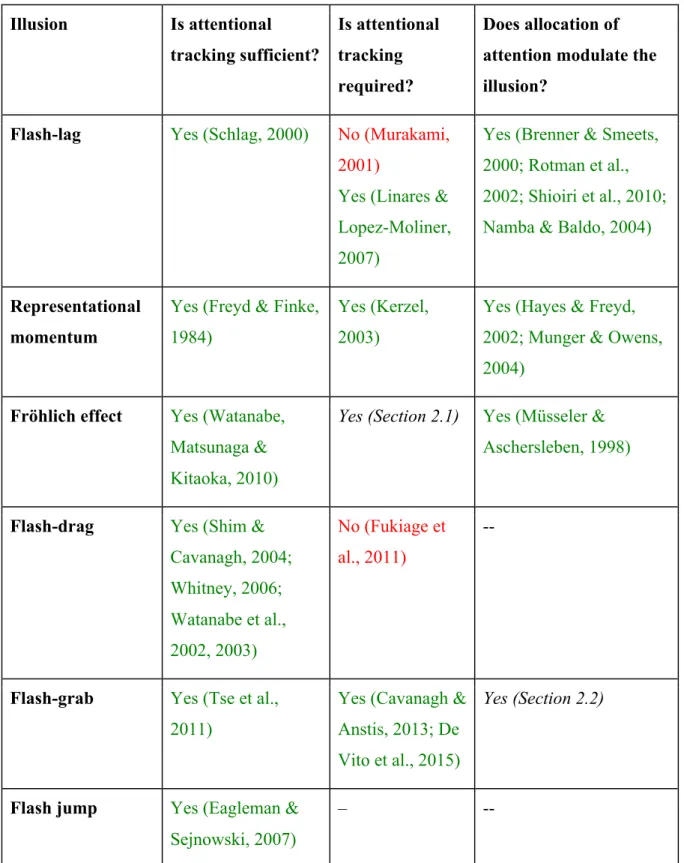
absence of low-level motion). The underlying motivation here is to link the illusion to the high-level or the low-level motion and infer the origin of the effect based on the involvement of attention. These two definitions of attentional influence produced largely non-overlapping sets of studies. The main findings related to both of them are reviewed below and summarized in Table 1.1
1.5.1 Are motion-induced position displacements caused
by the shifts of attention?
The ability to orient in space is an important feature of attention, allowing us to efficiently distribute limited attentional resources throughout the visual space. There are several metaphors describing the focus of visual attention: spotlight (Posner, 1980), zoom lens (Eriksen & Yeh, 1985), Gaussian gradient (Downing & Pinker, 1985). Although different metaphors highlight different features of attention, there is a general agreement that attention enhances processing of stimuli within its scope, and that the focus of attention can flexibly change its location and size (Carrasco, 2011). The shifts of attention can be active/voluntary or
passive/involuntary. The explanations of motion-induced position illusions depend on involuntary (or exogenous) shifts triggered by a salient object, in this case, a flash. Exogenous attention is characterised by the fast deployment towards the target and quick decay, with a peak of enhancement at around 100 ms after stimulus onset (Muller & Rabbitt, 1989; Johnston, & Yantis, 1992).
In order to estimate the contribution of attention shifts to motion-induced mislocalizations, a number of studies used paradigms that force attention to predictively relocate towards the future position of the target. This can be
accomplished either by presenting cues that reveal the location of interest before the onset of motion, or by using highly predictable stimuli and always showing targets where they are expected to be. The idea is that if attention is already shifted to the area where the target will appear, the attentional delay and the resulting
mislocalization will be minimised. To preview, in the majority of studies these procedures indeed result in the reduction of motion-induced position shifts.
Namba and Baldo (2004) measured the flash-lag effect in three probability conditions: when the target was always presented at the same location, when it alternated between the two locations in a predictable way, or when it appeared at random positions. The results showed that in the two former conditions the flash-lag was smaller than in the latter. In the next experiment a cue indicated with 80% validity the hemifield where the target would subsequently appear. The flash-lag effect was smaller following the valid compared to the invalid cue. Similar pattern of results was demonstrated in a number of different flash-lag stimuli (Brenner & Smeets, 2000; Rotman et al., 2002; Shioiri et al., 2010). Müsseler and Aschersleben (1998) tested the attention-shift component of the Fröhlich effect by cueing the hemifield where the motion onset should be expected. They found that the apparent shift of the motion onset was equally large in the conditions where the cue was invalid and where no cue was presented. However, when the cue indicated the correct
hemifield, the illusion was reduced. Another argument in favor of the attention-shifting explanation is that flash-lag increases with the distance between the moving stimulus and the target, suggesting that longer shifts result in larger illusion (Baldo & Klein, 1995; Baldo, Kihara, Namba, & Klein, 2002; Kanai et al., 2004).
In a related group of studies attention is manipulated in a different way:
instead of misdirection, attention resources are limited by adding distracting stimuli or tasks. Representational momentum increases in the presence of irrelevant distractors (Hayes & Freyd, 2002; Munger & Owens, 2004). Similarly, flash-lag effect is larger when subjects perform multiple tasks or attend to multiple targets (Sarich et al., 2007; Shioiri et al., 2010). The modulation by attention load suggests that accurate
localization is not automatic and requires allocaton of processing resources. Overall, these studies suggest that delayed attention shifts result in larger position illusions, as predicted by attention-shifting explanation. However, there is an important caveat: valid cues or predictability reduce the illusions but do not eliminate them completely. Both flash-lag and Fröhlich effect are observed even when the need for attentional shift is minimised. Of course, there could always be a corrective attention shift or an additional time-consuming reallocation process explaining the residual illusion, however, it is not clear whether attention shifts are the primary cause of perceptual shifts, or if they just modulate the illusions.
1.5.2 Do motion-induced position shifts require
attention?
As discussed in the previous section, attentional tracking is an independent mechanism responsible for the selection and individuation of targets. Attentional tracking maintains the representation of objects while they change and move around (Pylyshyn, 1989; Cavanagh, Hunt, Afraz, & Rolfs, 2010). Multiple targets can be tracked together (Pylyshyn & Storm, 1988), however, there are limits on the number of targets as well as on their speed (Alvarez & Franconeri 2007). The temporal limit of tracking is about 4-8 Hz (Verstraten, Cavanagh, & Labianca, 2000).
Studies measuring separate contributions of low-level and high-level / attentional motion to the illusory displacements fall into two categories. The first group of studies is testing whether the illusions require low-level motion, or the high-level motion can produce them on its own. For instance, Watanabe, Nijhawan, and Shimojo (2002) demonstrated that an object moving behind a narrow, one pixel wide, slit, could produce the flash-drag effect. Watanabe, Sato, and Shimojo (2003) reported flash-drag induced by a moving object completely invisible behind an occluder. Flash-drag also occurs during apparent motion (Shim & Cavanagh, 2004) or transformational apparent motion (Whitney, 2006). In all these cases the low-level motion signal is minimized, and attentional tracking predominantly drives the illusion. Importantly, when the direction of motion is ambiguous, the illusory shift follows the attentively selected direction. This was demonstrated using a bistable apparent motion (Shim & Cavanagh, 2005) and a stimulus containing superimposed transparent
textures rotating in opposing directions (Tse, Whitney, Anstis, & Cavanagh, 2011, Figure 1.8).
The second group of studies asks a complementary question: whether the motion-induced position shifts require attentional tracking, or they can happen
preattentively. Murakami (2001) was the first one to use random motion sequence for answering this question. In the random motion stimulus, moving bars are displaced randomly and at a very rapid rate, thus the direction and the velocity of motion are completely unpredictable and impossible to track or attend to. Without attentional tracking, random motion can produce a flash-lag effect (Murakami, 2001) as well as a flash-drag effect (Fukiage, Whitney, & Murakami, 2011).
<Content removed due to copyright restrictions>
Figure 1.8. Flash-grab produced by voluntary attentional tracking. (a) Two transparent textures are superimposed and rotate in the opposite directions, observers track either white or black spots. (b) Physical position of the target
flashes. (c) Perceived position of the targets if black spots were tracked. (d) Perceived position of the targets if white spots were tracked.
Linares and Lopez-Moliner (2007) measured flash-lag in a display containing a large number of dot pairs where half of the dots were moving continuously, and half of the dots were flashed. When the observers were asked to judge the global structure of the stimulus, flash-lag was not observed, whereas judging the structure of local dot pairs led to illusory displacement. This result contradicts the findings of Murakami (2011) and Fukiage et al. (2011), by suggesting that the presence of motion is not sufficient for producing position shifts. Similarly, Cavanagh and Anstis (2013) found that motion-induced shifts observed for individual motion trajectories are larger than those seen when multiple trajectories are presented together. Their interpretation was that position shifts require attention: when the individual trajectories cannot be tracked, the illusion disappears. Finally, de Vito et al. (2015) studied the flash-grab illusion in visual neglect patients. These patients demonstrate attention deficit in the left visual field. When the flash-grab stimulus was presented in their top, right or bottom hemifield, neglect patients experienced illusion of the same size as controls. However, in their affected, left hemifield the flash was perceived at its veridical location, suggesting that attention is crucial in generating motion-induced position shifts.
Overall, the majority of studies agree that preallocation of attention to the target reduces the motion-induced position shifts, and that attentional tracking is capable of producing the mislocalizations even in the absence of real directional motion. However, the extent of attentional contribution to the motion-induced position shifts remains controversial. Some studies suggest that attention is a requirement, and without it the displacements are not perceived. Other studies demonstrate the illusions even under the conditions where attentional involvement is impossible. The present work attempted to a) evaluate the contribution of attention to
motion-induced attention shifts and b) examine the relationship between attention-shifting and attentional tracking.