Publisher’s version / Version de l'éditeur:
Bulletin of the Seismological Society of America, 55, 2, pp. 487-500, 1965-04-01
READ THESE TERMS AND CONDITIONS CAREFULLY BEFORE USING THIS WEBSITE. https://nrc-publications.canada.ca/eng/copyright
Vous avez des questions? Nous pouvons vous aider. Pour communiquer directement avec un auteur, consultez la première page de la revue dans laquelle son article a été publié afin de trouver ses coordonnées. Si vous n’arrivez pas à les repérer, communiquez avec nous à [email protected].
Questions? Contact the NRC Publications Archive team at
[email protected]. If you wish to email the authors directly, please see the first page of the publication for their contact information.
NRC Publications Archive
Archives des publications du CNRC
This publication could be one of several versions: author’s original, accepted manuscript or the publisher’s version. / La version de cette publication peut être l’une des suivantes : la version prépublication de l’auteur, la version acceptée du manuscrit ou la version de l’éditeur.
Access and use of this website and the material on it are subject to the Terms and Conditions set forth at
Computer simulation of multi-storey structures subjected to ground
motion
Ward, H. S.
https://publications-cnrc.canada.ca/fra/droits
L’accès à ce site Web et l’utilisation de son contenu sont assujettis aux conditions présentées dans le site LISEZ CES CONDITIONS ATTENTIVEMENT AVANT D’UTILISER CE SITE WEB.
NRC Publications Record / Notice d'Archives des publications de CNRC:
https://nrc-publications.canada.ca/eng/view/object/?id=0ae32c62-a7f2-4f24-b681-b2f4cc1a7d19 https://publications-cnrc.canada.ca/fra/voir/objet/?id=0ae32c62-a7f2-4f24-b681-b2f4cc1a7d19Bulletin of the Seismological Society of America. Vol. 55, No. 2, pp. 487-500. April, 1965
COI\Il'UTElt SIL\ll-1,rlTIOS 01'
I\
I I-],TI-STOItl;'l\- STRUCT17RES ST;UJli',CTICD TO G l I O I - S D 3 I OTIONBY I-I. S. Warto
;\BSTI',ACJT
Irybritl computer sj-stel11 11:ls been used to sirllulatc some five-storcy struc:turcs cscitctl hy g r o u ~ ~ d 11rot i o ~ ~ . Five types of builtli~lgs werc il~vestig:ltetl to fi~rd the effect of sorile structur:~l 1,:ir:lmeters 011 the clyl~:)nlic response of the b u i l d i ~ ~ g s . Tile fnct:ors tlrnt Ii21ve bee11 coilsitlcretl
are the tlistribut ioli of stil'l'r~ess a r ~ t l nrass ill l l ~ e st ruct urc, tlre type of Soul~tl:~t ioii c o ~ ~ d i t iou, n~icl th e :lctio~i o f viscous d : ~ r ~ l p i ~ ~ g .
T h e results illtlic:lte tlmt it 1n:1y I)e reaso11al)lo to c:llcul:~te tlre I):~se she:^^ fortscs, creatctl I)y
g r o u ~ ~ t l lnotiou, a s u f u ~ l c t i o ~ ~ of the fu~l(l:r~lrel~t:ll periotl of the huildil~g. IIL (;he c:lse of lightly d:~nlped structures, Irowever, tlie tlistrihutiol~ of forccs t l ~ r o u g h tllc Ilciglit of tlic s t r u c t u r e is nlso s11on.1~ to be d e p e l ~ d e ~ i t : OIL thc otlter ( I ~ I I : L I I I ~ C c11:~ra~tcristics of tllc l ~ l i i l d i ~ ~ g , :LS well :rs the frecluei~cy collte~it; of t l ~ c g r o l ~ i ~ t l mot ioli.
\ ' i s c o ~ ~ s tl:~mpii~g cto~~sidernl)ly retluces llie forccs :~cting 011 :L st ructurc, : L I I ~ i ~ l s o tel~tls l o climirl:~te modes of v i l ) ~ . ~ r t i o ~ ~ other I ~ I ~ I I tlic fu~ldalnclllal. h p i ~ l ~ ~ e d - e ~ ~ t l f o u l ~ d a t i o ~ ~ c o ~ ~ t l i t i o ~ l is :~lso show11 t o retluce tlie forces :lct.ilig 011 the Ir)\\.el storeys of :L b u i l c l i ~ ~ g eo111~~:rrc(1 i v i l l ~ the
fisccl-e~~tl colidit i o l ~ .
The i~iost hasic problem iiivolvcd ill carthcluakc c1esig11 is the rclat io11 l)c.t\vce~l
tllc fi.ccluclicy coiltclit of the grouud illotioil and t he frccluci~cy rcspoilsc of a st lxc- tu1.c. I-Ioiisl~cr (1) has studied this prohlcin for siuglc-dcgrcc-of-hccdonl ~ y s t ( ~ ~ n s , n~lcl C:lough (2) has consitlercd tllc cstcusioil of illis work to tllc case oC 111ult i- degree-of-frccdo~~i systcX~ils. Clougll co~lsidcrcd each of t llc 111oc1cs of vihrat ioil ot a st ructurc could be c.scii cd iiidcpciidcil tl y , alicl t llc11 assillllccl t he respoilsc ol' t llc struct urc was cclual to tllc sulllll~at ion of thrsc. i~iclividual rcspoilscs.
Tllc \vork rcpor(cc1 Ilcrc describes an i~lvcst igat i o ~ i i~it o cxcrt ail) habic factors that iufluc~icc t lie rcspoilsc of multi-clcgrcc-of-Erccclolu st ructtwcs t llat ale subject ccl to grou~~cl ~ilotio~l excitation. Thc st ~,t~cturcs i~ivcstigatccl co~isist of five-st,orcy builtl- iugs, o ~ i c bay \vide, fotuldctl 011 a rigid base. Tllc lactors i~lvcstigatcd arc t 1 ~ dis-
i r i b r ~ t i o ~ l of stiffiicss and illass tl~lrough t he structtu.c, tllc act ion of viscous claillpiug, t he ci'fcct of tllc support coliclit ion at tllc fouudat ion, a ~ l d t\vo t ypcs ol g~,oii~ld inotio~l.
Bot 11 t he st ~,ucturcs and tho grotuitl not ion \vci.c siilltllat cd oil an annloguc coin- putcr. TTsc was also 11ladc of a hybrid n~ialoguc-digital systcill to facilitate data rcductioil. The 1lyb1.id coinputcr systc~ll provides a illcthotl of ohtaiili~ig useful st at is( ical iliforniat ion about the forccs act i ~ i g 011 st ruct urcs cliuii~g ally ypc of
grotuid accclcrnt iori cscil at ioil. Tllc st ruct u r ~ s t hat have beell aiialysccl llcrc arc col~~parat,ively sinlplc, but t llc tcchiliquc call hc applied to larger arid iilorc co~llplcs sl rut( 111,cs.
l'o\\rcr spcci i.uill aiialyscs of the buildiiig rcspo~iscs wcrc iliadc, and this iilt'or~ua- tioii gives all insighl irito the bclla\~ioui of' rigid-fi.aillcd sll.uct urcs tlrldcr the cly- ilalllic act ioil of groluld nlotioii. I t appears tlzat t he fui~daiilcnt a1 mode ol' vibrat ion prcdomiiiatcs ill tlzc upper sloreys and higlzcr illodes of vibration appear in t,lx l o \ ~ c l - storeys.
488 UULLETIS OF TrIE SEIS\IOLOGICAI, SOCIETY O F . L ~ I E I I I C A
The gcncral co~lfig~irat ion of t hc framccl st ructurc that was invest igatcd is s11o\v11 in Fig. l a . Througllout this 1vol.k it is assuulcd that thcrc is no coupling aillorlg
W, is the weight of the total load at the nt?loor Ibn is the 2"'moment of area of the beam at the n ' 9 1 o o r I,
,, is the 2"moment of area of the column between the nL%nd (n-1)"floor (a) General configuration of the rigid-framed structure
To other floor networks Integrating Summing Coefficient
Amplifier Amplifier Potentiometer
(b) Analogue s ~ m u l a t ~ o n of one floor (the f ~ f t h )
FIG. I. T h e slructure :11rc1 the n11:llogue sirnl~lalio~~ of ol~c floor (!tote 11',,/q = I T L , , ) .
the lateral, vertical a ~ l d torsio~lal ~llodcs of v i b r a t i o ~ ~ . Tllc ~ ~ ~ u a ~ i o ~ l s of ~llotioll for the five-storey s t r u c t u ~ c subjcctcd to a ground accclcration, .r,,
,
arewhcrc n = 1, 2, 3, 4 a 1 ~ 1 5 . 111 ( I ) , g is tlw accclcratioll due to gravity; fi rcprc3~1~ts the anlount of viscous dn~llpillg ~ ' ~ f c r r e d t o the filllda~llc~ltal I ~ C ~ L L I C I ~ C Y , J'; t,hc l i , , ' ~
arc elemcnts of t11c st ifiucss mat ]*is of tllc st i~uctui~c; .r is tllc defor~natioil of the st ructurc with rcspcct to tllc foundatio~l.
Altogctllcr five diffcl.cilt struct~ucs, dcsigiiated A, I3, C, D aiid 13, were iilvcsti- gated. 111 structure X all coluiii~i ant1 hcaill stifi'iiesscs n-erc ccjual. Icor structure
B all coluill~i st iffiicsscs ~ c r c cqual aiid finite, aiid t he bcain st iffiicsscs were i~ifi~lit c (shcar-t ype st ruct urc)
.
I n pract ice coluiil~l st iffilcsses will vary through thc hcight of t hc structure ant1 structure C rcprcscnts t his cllaractcrist ic. If the valuc of the stiff~icss for thc top storey coluillil is take11 to be one, the11 thc stifillesscs of tlic rcinaiiiillg iilc~nbers in structure C arc as follo~vs: I, , / h , = 1.00, I,:,/h3 = 1.34,IL2/hg = 1.807, I , ~ / J L ~ = 2.00, I b j / l b = 1.506, I b l / l l , = 1.26.5, Il,:r/lt, = 1.263, Il,t/lb =
1.263, I b l / l b = 1.807.
Structures A, I3 and C were all assuillcd to have a fixed-ended fou~ldatioll coil- ditioii. The inc~nbcrs for structure D liave the saillc stifiliess as structure C but the foundation coilditio~l was pill-ended. F'i~ially, struct urc E had the same colu~llll stiffilesscs as structure C but all beanis wcrc of infinitc stiff~lcss; the fouildatioll condit iorl was fixed-c~idcd.
CALCUI,AT~OX~ O F T H E SATURAL ~ 7 ASL) 1 1 0 1 ) ~ s ~ O F TTIBRA'PION ~ & ~ ~ ~ ~ ~ ~ ~
The riatural frcquclicies arld inodes of u~ldaiilped fl-cc vibrations are obtairicd fro111 ( I ) 1vllc11 p,, a ~ i d n, are zero, and thc displacenicnts, x,,
,
are defirlcd byx,, = A,, sill wt. (2)
If it is assuillcd that the structures arc coristructcd in stecl and a ~vorkiiig strcss of 10 tons/sq in. is choscn, then thc order of TV,,/pg is 0.01, ~vllcrc p is ecjual to GEI,~/(~L~)"(E is 'l'oullg's iuodulus). With W,,/pg = 0.01 arid all thc W,, equal,
the inodcs aiid frcrlucncy of vibration of structures A, B, C, D and 142 were calcu- lated; thc furldaillciital frecjuencics for structures X to E nrcrc 0.575 cps, 0.910 cps, 0.703 cps, 0.515 cps and 1.11 cps, respectively. If any other value of W,,/pg is to bc used tllc frcclucllcies arc iilultiplicd by
&
d p g / 1 ~ , ,,
and the illode shapes arc urialt ered.The basic circuit, diagram used for the siiilulatioil of tllc structures is sho~vn in Fig. l b . The silllulatio~l of each floor requires five operatiolial amplificrs. If the velocities and displace~llcilts only are of intcrcst it is possiblc to rcducc this require- illellt to four amplificrs.
For this circuit to be stable thc pot entionlct cr settings rcpresc~ltillg the st iff~less coefficients inust bc s d up accurately. Thc critical scttirigs are the coefficic~lts Idij and Ic,
,.
If k,, f li,, then the struct urc docs 1101 obey AIax~rcll's la111 of reciprocaldeflections. I11 t his case ally slllall amount of iioise in the systcln produccs large oscillatioils in the anlplificrs. Adequate accuracy call be obtai~lcd fro111 thc coilipo- neiits of thc analogue computcln i l l nrhich thc potciilionlders coulcl bc s d to four
significant digits.
I t was possible to cllangc the time scalc of the siniulation by altcri~lg thc gains
400 BULI,ETIS OF THE SEISLIOLOGIC'AL SOCIETY OF ALIEIIICA
11iost of the a~lalogue si~iiulation ~ v a s ill rcal tiuie, but lhc hybrid computer ~ v o r k \\-as carried out five times slower tllal~ real t i n ~ e .
Thc e\pcrinmltal work (*ail be divided illlo ~II-o illajor parts. Thc firs1 set of esperin~eiltal rcsults conc~crned the avcragc ~ n a x i i ~ l u ~ n clisplaccinc~lts that occur at eacll floor of the structu~~cs, duc to g r o u ~ ~ d i~loliol~s that have so111c of the char- actcrist ics of cart hquakcs.
Thc results were obtai~icd by subjcding the s t r u d ~ ~ r c s to %-sec bursts of the siiiiulat ccl ground i~lotiol~ and rccordiilg the rcsulting displacciilcilts. For cach burst the inasiultuil displac~c~~iei~t of each floor \\.as take11 to rcprcsci~t thc rcspollsc of the structure. il three-chal111c1 freque11c'y-nlod~11atcd tape rccordcr was uscd to rc- cord soiilc of the output vollagcs fro111 tllc a~lalogue co~nputer, so that po~vcr spedl.uin dcilsity arialyscs of tllese oulputs could be pcrfor~~icd. Xilalyscs were iliadc of the c l i ~ p l a ( ~ c ~ i ~ c ~ ~ ~ ~ at t he fifth, thi~.cl, and first floors to give a represciitatio11 of 11-11at llappeils t llrough the height of the structure.
Tllc sccol~cl part of tllc cxpcril~~cl~tal work was conccrnecl wit11 dcler~llii~iilg tllc \\lay ill 11-hich forces \\-ere clislributcd through tlic height of a structure a t particulal. iiisial~ts oi tii~ic. This pllasc of the work n a s pcrfornlcd through the use of a hybrid s y s t c ~ ~ ~ co~isisti~lg of a I'acc aiialoguc colllputer aucl a Bciidix G1.5 digital couiputer, couplccl togcther by lllcaiis of a digital-analogue c o ~ ~ v c r t e r . The coilverter clialigcs a~lalogue vollagcs to digital i ~ ~ f o r l i i a t i o ~ ~ or vicsc versa ulider co~itrol of the G13 or an acw.watc (.lock. Eight tracks of i~ifor~llatio~l car1 be sanipled siniultaneously.
The operat ions perforl~led by the hybrid syst cln were as fol1011-s. First thc pro- grani I I - ~ S loadccl illto thc digital c*onlputcr, after ~vhich the allalogt~c ~ v a s autoiua-
t ically put illto tlle "hold1' lliodc aiid the tilniug circuit was rcsct. The computer
11011- waits for the typc-in of thc iiiass and height above grouiicl lcvcl of cach floor.
Tlle progranl was ~\rritlcn for a n ~ a s i n ~ u ~ n of eight floors, so for the case of t h c five-storey buildings TITc
,
lVi,
arld IVx ere cntcrcd as zcros.Alfter the entry of thc last llcigllt tllc arialoguc coinputcr is put first illto the "rcsct" l~lode arld tlic~l thc "operate" moclc. This switches on the si~llulatcd ground i l l o t i o ~ ~ , and pcr~liits the sil~lulated struciurc to vibrate.
The prograln iio\\- coiltrols all analogue-to-digital c~ollversio~i. The voltages t h a t were saiilplcd rcprcsc~ltcd the absolutc ac~cclcratioiis of each floor. Because of tllc lilliitcd space ill tllc illelllory of thc G l j it mas possible to take only 60 sal~lplcs of each of the eight c>halu~cl outpuls fro111 tllc ailaloguc conlputcr. 1 1 sa~llplillg interval of 2 sec. ~ v a s dictated by the csecutio~l time rccluircd by the G13 lo per- for111 the necessaq operations, but by running the silllulatio~l 3 times slo~vcr tlla~l rcal tiille an effective sanlpling illterval of 0.4 scc was obtained. Thus in real tinlc (j0 sanlples, at 0.4 sec ii~tcrvals, \\-ere obtai~led for a ground disturbance oi 24 sec duration. This is taken to be the length of a typical stroi~g-nlotion earthcluakc.
A1 cac.11 saillpliilg tinle, eight absolutc acc~clcratioils wcrc sa~ilpled and the digital infornlation ~ v a s stored in inc~nory. After GO sa~ilples the ailaloguc is put into thc "hold" nlodc which locks all the amplifier outputs. The GI3 11011~ operates on the
stored infornlation ill lncluory. I t takes tllc first sa~llple and illultiplies the accclcra- t i o ~ ~ s of each floor by its nlass. The rcsulting force at each floor is tllerl typed out.
492 UULLETIS O F TI-IE SEISAIOI>OGICrlL S O C I E T Y O F AAIEI1IC:i
noise, and the analysis was perfonncd with a baud width of approsilnatcly
+
cps. Although the vcl.tical scales in fig. 2 arc iiot absolute values, siilce the signal 011the tape recorclc~ had to be attenuated to avoid overloading thc allalysis equip- nlent, tllc same attenuation \\-as applicd to each signal so fig. 2 gives a relative indicat ion of t 11c cilci3gy i l l the displaccnlents as a fuilction of the frcgueucy.
I t call be secil that t11ci.c is oilly otlc peak in the ailalysis of t hc f i f t 11 and third floor displacclnents, but five distiilct peaks occur in the first f l o o ~ analysis. The cllcrgy in the sccoild illodc of vibralioil a1 the first floor is, ho~vcvcr, oilly
&
of that; in the first iuodc. It seciiicd reasonable to assulnc that thc avcragc niaximuii~ dis- placcllleilts duc to thc ml~itc noise excitat,ioli occurred siinultaneously and ill phase.T A B L E I
~ ) I s ~ ' ~ , . \ c E ~ I E N ' L ' RESUI,TS FOR S'I'RI:CTURE A .\SD WIII'L'I~> ~ O I S E ESCI'I'.\'L'ION Floor Xumber
Displacerner\t ( f t )
lV,,/pg = 1 . 0 X lo-?, B,, = 0
Stauciarcl I l e v i a l i o ~ ~ of I>isplncen~en L (fL)
Funclame~lt:ll Mode Sh:~pe I>lsplncerne~lt ( f t ) lP,,/pg = 0 . 5 X lo-?, B , = 0 I)isplncemerrt ( f t ) TiT,,/pq = 0 . 2 X 10⁻², B,, = 0 1)ispl:~cernenl (ft ) T.V,,/pq = 0 14 X B,, = 0 I)isplacerrrellt ( f t ) lV,,/pq = 0 08 X 1 0 - 5 B,, = 0 I)lsplacernellt (f l ) lV,,/pq = 1 .O X lo-?, B,, = 0 20 1)isplacement ( f t ) lV,,/pg = 1 0 X 10-5 BP. = 0 50 1)ispl:~cernenL ( f t ) Il7,,/pg = 1 0 X 10-2, B,, = 1 .oo
T h e aver:lge r n : ~ s i n ~ u ~ n ground accelernt~on was 7.00 ft/sec2, s t n ~ ~ d a r d tlevinlion 0.815 ft/sec2- 011 this assuiliptioil the displaceilieilt results were used t,o calculate the lateral
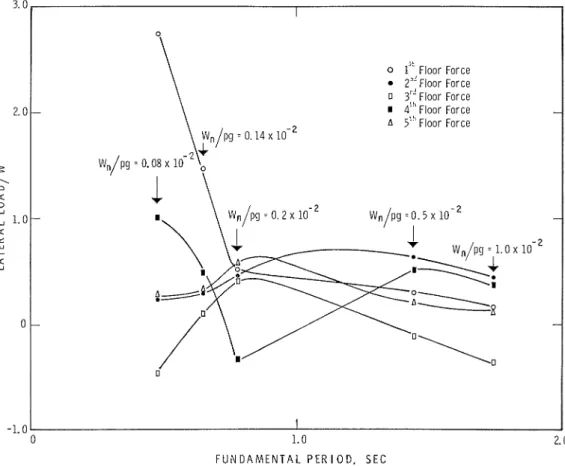
forces actiiig a t each floor level assun~iug that the weight of each floor was W lb. Five different values of W,,/pg for structure A were simulated; fig. 3 sho~vs t h e results of thc latcral forces acting at; cach flooib level for the case of no claii~piilg.
The displaccmeut res~ilts for structures A, B, arid C have bccil coridellsed irit,o fig. 4 nrhich prcsents tlic base shear as a fuiictio~l of the fundainental period of vibrat:ion. The dol.ted line indicates the base shear that. would occur if a rigid struc- turc of ~veighl, SH' were subjected to a ground acceleraLioii of 7 ft/sec2. Because,
i1i illally buildirigs heavy service ccyuipnieilt. is placed a t the top of the structul.c,
a few expcrinient~s were coliducted ~ v i t h the lilass of the fifth floor twice that of t h e other floors. Pig. 4 shows that the base shear lies on the ct~rve representirig the case for all floors of equal mcight. 13xccssive vibrations of service floors are uiilikely to
occur i l l practical sti~uctu~~c.; s i ~ ~ c e they rccluirc a co~iibiriatioi~ of largc loads and
iiiadccluat e s t i f f ~ ~ r s s of st rrict ural iiicnihers.
The o u t c o ~ ~ i c of applyirig viscous danlpirlg to o r ~ c of the stl.uctures is indicated ill fig. 5 . I'owcr spect r11111 i.csults shon-ed thal viscous d a ~ l l p i ~ i g cliilli~lat cd illodes higher t ha11 the furidaiilcntal.
fl
C P S
0 1 2 3 4 5 0 1 2 3 4 5 0 1 2 3 4 5 0
F R E Q U E N C Y , C P S F R E Q U E N C Y , C P S F R E Q U E N C Y , C P S
I'rc. 2. I'oner speclrn :~~lalyscs for s(ruc,turc "A" subjcclctl to tnro grou~ltl motior~s.
l ~ i s p l a c e ~ ~ z e n l Responses to Secontl T y p e oj ( ~ ~ I ~ ~ z L T L ~ Alolion
The ground illotiorl due to an c a r t l ~ l u a k c is iufluericcd by several paranlctcl~6. F'orci~~os(, ailloilg lhcsc is distance froiu tllc cpiccntrc and lllc typc of geological forillat iori through ~vhich t llc n-avcs arc t r a u s l ~ ~ i l t cd. At poilit s soillc dist ancc. frolil thc epiccntrc, In-o dist.inct phases of ground ~ l ~ o t i o r ~ call bc distiiiguishcd, the P
494 BULLETITi O F TI-IIC SEISJIOLOGICAL SOCIETY O F AlIEItIC.4
iiiotioii, producecl hy rccordiiig on all 1?lT tape rccorclcr the output f1,onl a saw- tooth gciierator. Thc amplitude and frequeiicy of the gcncm(or were varied during the rccordiiig to sinlulate the changes in charad cr that occur in typical cartllquakes. Six such silnulatiorls were inadc. The spcctrunl of one of these is rcprcscntcd by the solid line curve of fig. 6. The broken line rcprescuts the power specbtrulil ob-
t aiiicd fro111 ail approxiillat ion to one of t he coillpoileilts of the Olyiiipia, IVnshiiig- tio, carthcyuake of 13 April 1'319. (Fig. G rcprcscilts the rclativc valucs oiily of t,hc gi.ounc1 accelerations.) The higher frccl~~cnc~y peak of the siillulatcd groulicl iliotioil
-1.0 I
0 1.0 2.0
F U N D A M E N T A L P E R I O D . S E C
FIG. 3. Distributioll of 1:~ter:~l f o r ~ c s For sf ruct11r~ ''rl" e ~ c i t , c t l h y wllitc ~loisc. 3.0 2.0- 3
>
4 0 .J 1.0- 4 [r W + 4 0is laigcr than ill this particular earthquake, but for the structures ilivcstigatccl here grouncl lllotioii frccluclicics above 5 cps will 1101 he very sigilificailt .
l<ach of the six rcc~orcliligs mas used to illvest igatc sti~ucturcs of lypc -1 with five diffcrcilt \~alucs of TV,,/pg aiid P,, = 0. The results of the avciq,c iiiariilluin
clcflcctions for each floor arc give11 ill table 11. I11 the sccoiid type of grouild iilotioii
the rcsponsc was not rlcccssarily ill the fundalncntal nlodc. This is illustrated by the power spectruln ailalyscs for the case ~vhcn W,,/pg = 1.0 X 10-Qshon-n i11
iig. 2 by the dotted liiic curves. I t call be sccil that the third nlodc precloii~inatcs on the bottom floor; this occurs since the natural frcqucilcy of the third n ~ o d e is
I
0
0 lit Floor Force
2 " ' ~ l o o r Force 0 3' Floor Force I 4'"loor Force
-
A 5''' Floor Force bv,,/pq = 0.14 x - -CO~II'UTER S I L I U L ~ ~ T I O S O F BUILI)ISC; VIBRATIOS 49;
I'rc. 4. Base shear forces due to white noise excitation. 5.0 1.0 I 1 I I 0.8 ; -
I
3 ~ t r u c t u r e Y d :w,,/~~
= L O X 10 -2 --
-
0 \o%~ I I 0 I I 0 0.2 0.4 0.6 0.8 1.0 D A M P I N G C O E F F I C I E N T , /3,,FIG. 5. l<ccluctiol~ ill base slle:~r clue t,o viscous d:ampillg. 4.0
nearcst to the peak ill tllc powm spcctrunl for this typc of ~ l l o t i o ~ l (scc fig. 6). At; tllc uppcr floors, l l o ~ ~ ~ e v c r , the fundame~ltal lliodc bcco~llcs clolninant again.
I
-
Hgbrirl Co//ipzsle/~ Results
Csc of thc hybrid co~llputcr ~llcalil tllat tllc si~llulatio~l had to be opcratcd a t one-fifth of rcal tiillc. The cffcdivc hand width of Ihc sccoild lypc of ground motiorl jras the sanlc for the hybrid conlputer results as for thc displaccnlcnt results. At
Case A 0 (Flexural structure) -
Case A Mass at top storey twice that of other storeys
iz Case B Mass at top storey twice that of other storeys
--
Case B 1 (Shear structure)Ir3.0 - -
a Case C A (Flexural structure)
Y I w l Y
2
2.0 - - m --- - ---- -----\--
- - - 1.0 - I-0 0 0 1.0 2.0 F U N D A M E N T A L P E R I O D , SEC I I-..the timc of thc cspcriinciits thcrc was 110 mcaiis ~ n x l i l y available to limit t hc hand \vidth of thc whitc iioisc g ~ ~ ~ c l . a t o r . .IS a ( A ~ i i ~ e ( l ~ ~ ( ~ ~ ~ ~ c (Ilc cfl'cctivc haild \vitlth of thc gcncratoi* was cxtc~idccl to l7T, cps. The iiic.i.c.asc of I~aiid width for thc white iioisc ge~icrator produccd a dccrcasc ill tllc displarciiiciit rcspoilsc of thc structures by as ~llueh as '75 %,, for thc saiilc rins illput,.
Thc forccs calculated from the displacenicnt rcsults \Irere bascd on the assump- tion that thc average nlaximum dcflec~tioiis ocrurrcd sililultancously and were in phase. 111 actual fact, lligllcr modes of vihratioli arise and thus it is possihlc t h a t a morc cl.itical loading inight occur. I t would hc tcclious to calculate forccs as a function ot tiillc froill graphical records hut thc Ilybrid colilputel. provides 60 sucll sanlples wit 11 very lit tie lahour.
Somc of tllc res~llts foi st ruct~irc C, \vhcn FIT,, l p g = 1.0 X lo-', P,, = 0, and the
grourld cxcitatioli is of the scrolld type, arc sho\vii ill lahlc 111. Thc rcsults are based 011 thc assumptio~i that cach floor has a mass of 1000 lh aiid each storey
licight is 10 ft. 0. 70 0.40 0.30 0.20 - - - - 0 10 20 F R E Q U E N C Y , C P S
Fro. fi. Power s p e c t r t ~ m of secol~d type o f g r o u ~ ~ d motion. I Power S p e c t r u m of o n e of t h e six - - - r e c o r d i n g s r e p r e s e n t ~ n g t h e second - r type of g r o u n d r n o t ~ o n I \
---
,
I
Power S p e c t r u m of a slrnulated version of t h e S 86 W - N 86 E -1 1 accelerograph r e c o r d for t h e
I I Olyrnp~a. Washington, Earthquake -
I
I
of 13 April, 1949Tlle first lint of figures ill table I11 rcprcsctils t,he fol.c.cs, basc shcar, and ovcr-
turuiug ~nomeilts act iiig 011 the stl.uchturc 0.4 scc. aftcr the ground inot ion slartcd.
this liille lhc: force a t tllc first floor is cclual lo 1684 lb-11-1, or in other \ I - O I ~ S
t hc absolute ac~c.clcral ion of t hc first floor is 1.684 ftlscc'. At 5.2 scc aftcr t Ilc inot ion
1~ispl:~rerncril ( f t ) W,,/pg = 1 . 0 X lo-" P,, = 0 1)ispl:lcernerit ( f t ) IIr,,/1~g = 0 . 5 X lo-', P,, = 0 I)~spl:~cerncnt (ft) IV,,/pg = 0 . 2 X 10⁻⁵ P,, = 0 I)isl)laceme~lt ( f l ) 1P,,lpg = 0.14 X lo-', P,, = 0 I)isl)l:~rernel~l (ft) ITr,,//~y = 0 . 0 8 X lo-?, P,, = 0 -
T h e :Lver:lge rnnsirn~lnl g r o u l ~ d acceler:~t iori w:~s 8.00 fl/scc?, st:~utlartl tlevl:~tiou 0 ft/scc2.
T i m c f r o m Start of liarthquakc,
scc
I'orcc ;lt 1st ' I'orcc i l t 2 n d Floor, Ib-\vt Floor, 111-wt
I:o~cc a t 3rd Floor, Ib-wt - -- 1 , ,742 - 1 , !I77 - 1,953 5,053
-
la(;-
(is3 9,155 -9,814 10,010 927 29,315 -12,2;31 I'orcc i r t 5 t h I'loor. Ib-uztstartcd thc ullaxii~uliil grouiltl ac.c*clcratiou of 8 ft/sec.? occaurred; at 14.8 scc the i~lasiuluun basc shcar of all the 60 saijlplcs oc.csurrcd a i d at 20.4 scc tllc largest, n~casurcd lalcral forcc arosc a1 tllc third floor. The 1.csults in table I11 show thal inodes of vibration highcr than Ihe fundainc~~tal can bc respoi~sihlc for largc forces at a givcii floor, c.g., the force a t thc third floor after 50.4 scc of ground inotiol~,
r i go r c r i c I c e h i c r : ~ g c I'nrrc i r c r a g c
1
iivcragc I : yerage uasC a t Lst Floor, a t 2nd I'ioor, / a t 3rd Floor, I Forcc a t 4111 i I'nrcc :it 5 t h1
kllcar,
Ib-,,,tIb-\rt ! I h - ~ v t 1 11)-~rt I Floor, I11-1vt I l'lonr, lb-wt I
A i m f i e Ovcr- t u r n i n g AIomcnt,
I b - i t
. ~. ~ ~p - . . . p . - . . . .
498 BULLETIN O F T H E SEISJIOLOGICAL SOCIETY O F AJIEIIICA
Siilcc the nature of an earthcluakc cannot bc predicted beforelland the most reasonable approach for dcternlining carthquakc loads lllust bc based on sonlc statistical proccss. The conlple(c set of 1-esults of rvllicll tablc I11 arc a part can bc used to plot statistical information conc~ernilig thc basc shear. Thus, for cxamplc, olic can determine thc frequency of occ,urrence of basc sllcars within a given in- terval and the probability of basc shcar excccding a givcn valuc. I n this paper,
TABLE I V
HYBRID C o a r r ~ v ~ ~ n R ~ s u r , ~ r s FOR TEE SECONI) TYPE OF GROGXI) MOTIOS
howcver, Ihc remaining results are presented in terms of the avcrage forces at each lcvel, the avcrage base shear, and tlle overturning moment.
The information for the sccond typc of ground nlotioil is sllowll in tablc IV. Thc results apply for structures C, D , and E, subjected to a ground nlotion with an averagc nlaxinlunl valuc of 8 ft/scc2. Thc nlost critical conditioll appears wllcli thc frequency of the sccond lllode coincides with the peak frequency of the ground lllotion. This is illustrated by thc results for case C,
P,,
= 0, W,,/pg = 0.005 andcase D ,
P,,
= 0, TlV?,/pg = 0.0033. Tlle pin-ended conditioli has the expected con-Overturning 'loment' Ib-it 262 ,800 286,040 700,410 244,660 249,980 287,650 319,500 399,840 922,050 l'loor Kumber.. . . . . . . . . S l r u c t u r e C, P. = 0, W,,/pg = 0.01 S t r u c t u r e C, P,, = 0, W,,/pg = 0.005 S t r u c t u r e C, p,, = 0, Uf,,/pg = 0.0033 S t r u c t u r e C, P,, = 0.284, W,,/pg = 0 . 0 1 S t r u c t u r e C, P. = 0.20, VV,,/pg = 0.005 S t r u c t u r e C, P,, = 0.164, lV,,/pg = 0.0033 S l r ~ c t ~ u r e 11, p,, = 0, W,,/pg = 0.01 S t r u c t u r e D, p,, = 0, VV,,/pg = 0.005 S t r u c t u r e I), p,, = 0, FV,, / p g = 0.0033 S t r u c t u r e E, p,, = 0, I.if,,/pg = 0.01 S t r u c t u r e l':, p,, = 0, I.V,,/pg = 0.005 S t r u c t u r e 15, p,, = 0, bV,,/pg = 0.0033 T h e average m a x i m u m ground i f t / s c c 2 . 3rd ~~~~~ Lateral iorce, Ib-wt 6,054 32,282 7,633 3,004 7,499 1,647 5,352 4,670 15,991 1st
/
Lateral iorce, Ib-wt 4,901 26,220 7,813 1,232 4,707 1,418 3,005 3,406 29,782 2nd Lateral iorce, Ib-wt / 4,505 38,392 3,065 1,939 8,285 1,443 3,407 4,380 33,164 16,382 18,203 4,406 24,474 13,728 6,210 w a s 8 28,901 20,282 2,878 :~ccelcratioll Base 10,374 46,983 18,701 7,888 13,975 7,018 10,437 13,032 31,524 5th j t l lI
Lateral iorce, Ib-wt 5,706 7,327 0,180 2,650 2,170 3,025 3,SCii 2,907 14,02(i Lateral iorce, Ib-mt i 4,291 30,125 10,698 1,357 5,203 3,419 3,347 3,469 35,(j86 3,572 8,390 7,065 ft,/sec2 w i t h 26,F(i7 9 , 875 7,208 a. stnndnrtl 40,757 i 288,870 20,477 17,717 940,740 683,400 d e v i a t i o n of 0COJIPUTER SLJIULBTION O F BU1LI)IXG VIBlthTION 499
scquence of reducing the lateral load a t the first floor in comparison to the fised- cilded coildition. Tllc results for thc shear-type building, strucelurc E, do riot sho~v such a sharply resolla111 conditioil as the flexural type buildiiigs, C and D. I t call bc secn that viscous damping sigriificarltly rcduces thc structrual respolisc but it docs not prevent thc secaolid mode from being excited for structurc C whcil Iir,,/py =
0.00.3.
$'or the structures investigated here, both white noise aiid thc secorld type of ground inotioil caused sigiiificant excitation of the higher illodcs of vibration; this is particularly true of the displaceilleilts oil the lo~rer floors. The white noise cxcaita- ti011 probably conlaills too large a high-frequency content to give a true i.cprcscrita- tion of an earthquakc, other thari irl epicclit~al regions; the second type of ground inotion, eveii though it is contrived, probably gives a inorc realistic rcpl,escntation of the frequency content of a distailt earthquake. Viscous daillping of thc order of 10 to 20 per ceiit of critical danlping coiisiderably reduces thc s t ~ u c t u r a l rcsponsc arid also rcduces tllc eficct of higher inodes of vibration.
The results sho~vn in fig. 4 indicate that it nlay bc reasonable to c.alculatc the base shcar of a multi-degree-of-freedom systein as a fuilction of its fundanlental period. The results of fig. 3, ho\vever, sho~v that for uiidaiilped systeills this basc shear is riot necessarily distributed through the structure as a f u n d i o ~ i of its funda- illerital mode. The nianncr ill ~vhich thc forces are distributed is deperldent iilai~lly on the dynaillic characteristics of the structure and the frequency contcrlt of the ground motioii. I t secins probablc that the hybrid computer systeln could be uscd to iilvestigatc these factors for larger and 111orc cboinples structures than thosc con- sidcred in this paper.
Icor ~vllite noise escilatioil the average base shcar acting on structures with a furidanlenlal period less than a secoild is greater than that predicted oil thc as- sumption that thc structure is absolutely rigid. I11 the case of the secoild typc of
ground motioii the basc shear exc,eeds this pledicted valuc or~ly ~vllen one of thc riatural freque~icies of the structurc coiilcidcs wit11 the peak frccluc~icy of the gi~ound iilot ion.
Structures C and D n-ere iilvestigatcd to obtain sollle idea of the effect on the structural respoiise of the supporl co~lditioil a t thc fou~ldation. The results sho~red t h a t the over-all forces were not sig~lifica~ltly different, but the lateral load a t thc first flool- was s~ualler for {he pin-ended condition.
This paper is a contributioil from the 1)ivision of Building Itesearch, National Researrh Council, Canada, mld is published with Lhe approval of the Director of the 1)ivision.
1. IIousner, G. W., "Limit Design of Structures to Wilhstand Earlhqunkes". Proc. 1st World Conference on Earlhquake Engineering, San Fr:~ncisco, California, June 195(j.
2. Clough, R . W., "Earthqualie Analysis by I<esponse Spectrunl Superposition". Bulletin Seismological Society of America. Vol. 52, No. 3, 1962.
,joo
BULLETIS O F T I I E SEISAIOLOGICAI, S O C I E T Y O F AJIEIZICA:;. Bycroft, C ; . N . , "White Noise I l e p r e s e r ~ t a l l o ~ l of E:lrih(lu:rlccs". l'roc. Am. Soc. C.E., \-01. S(i, No. EMZ, April lO(j0.