Publisher’s version / Version de l'éditeur:
Vous avez des questions? Nous pouvons vous aider. Pour communiquer directement avec un auteur, consultez la
première page de la revue dans laquelle son article a été publié afin de trouver ses coordonnées. Si vous n’arrivez pas à les repérer, communiquez avec nous à [email protected].
Questions? Contact the NRC Publications Archive team at
[email protected]. If you wish to email the authors directly, please see the first page of the publication for their contact information.
https://publications-cnrc.canada.ca/fra/droits
L’accès à ce site Web et l’utilisation de son contenu sont assujettis aux conditions présentées dans le site LISEZ CES CONDITIONS ATTENTIVEMENT AVANT D’UTILISER CE SITE WEB.
Workshop on Fire Suppression Technologies [Proceedings], pp. 1-3, 2003-02-27
READ THESE TERMS AND CONDITIONS CAREFULLY BEFORE USING THIS WEBSITE. https://nrc-publications.canada.ca/eng/copyright
NRC Publications Archive Record / Notice des Archives des publications du CNRC : https://nrc-publications.canada.ca/eng/view/object/?id=ec2e849d-7512-468a-a547-96f4ddf7ffd4 https://publications-cnrc.canada.ca/fra/voir/objet/?id=ec2e849d-7512-468a-a547-96f4ddf7ffd4
NRC Publications Archive
Archives des publications du CNRC
This publication could be one of several versions: author’s original, accepted manuscript or the publisher’s version. / La version de cette publication peut être l’une des suivantes : la version prépublication de l’auteur, la version acceptée du manuscrit ou la version de l’éditeur.
Access and use of this website and the material on it are subject to the Terms and Conditions set forth at
A Portable water mist fire extinguisher for multi-purpose applications
Liu, Z. G.; Kim, A. K.; Carpenter, D. W.; Yen, P. L.
A Portable water mist fire extinguisher for
multi-purpose applications
Liu, Z.G.; Kim, A.K.; Carpenter, D.
A version of this document is published in / Une version de ce document se trouve dans : Workshop on Fire Suppression Technologies, Mobile, AL., Feb. 24-27, 2003, pp. 1-3
www.nrc.ca/irc/ircpubs
A Portable Water Mist Fire Extinguisher for Multi-Purpose Applications
Zhigang Liu, Andrew K. Kim and Don Carpenter
Fire Risk Management Program, National Research Council of Canada, Ottawa, Canada,
Telephone: 1-613-990-5075, Email: [email protected]
Ping-Li Yen
Fountain Fire Protection Inc., San Gaberiel, CA 91776, USA
Statistics show that almost 80 percent of fires are extinguished without the intervention of the fire service and within that 80 percent, portable fire extinguishers play a crucial role in
limiting fire losses. However, some of the currently available extinguishers create clean-up and environmental problems and often their use is limited to specific types of fires. In addition, they may generate toxic or corrosive combustion by-products during fire suppression, and thus are not suitable for use in some applications, such as medical centres, telecommunication facilities, industrial clean rooms and food processing plants.
Fixed water mist systems have already demonstrated their capability in providing protection in a wide range of applications. However, there is limited research on the application of portable water mist extinguisher. Recently, the National Research Council of Canada, with Fountain Fire Protection Inc., has carried out a research project to study the use of portable water mist extinguishers and had developed a prototype water mist fire extinguisher for multi-purpose applications, including extinguishing fires associated with cooking oils (Class K), wood crib (Class A), flammable liquids (Class B) and electrical equipment (Class C).
Portable Water Mist Extinguisher and Testing Conditions
The effect of water mist characteristics (e.g., spray angle and pattern, droplet size, water flow rate, momentum), and discharge techniques (e.g., discharge angle and approach) on the performance of the water mist extinguisher was studied. The testing conditions included discharge pressure varying from 8.5 to 15.5 bar; droplet sizes from Dv0.9=190 to 320 microns;
flow rate from 8.2 to 16.8 L/min; spray angle from 60 to 120 degree. The cylinder of the extinguisher had a capacity of 9.4 L of water.
For cooking oil fire experiments (Class K), a commercial deep fat fryer with a frying area of 0.457 m x 0.457 m, and a 0.153 m drip board was used. The fryer contained 42 L of vegetable cooking oil (a mix of canola and soyabean oils) that was heated continuously to its auto-ignition temperature. The fire was left to burn freely with the heating source remaining on for 60 s before water mist discharge.
For the experiments involving heptane and diesel fuel fires (Class 1-B), a 0.47 x 0.47 x 0.3 m high steel pan was used. The surface of the liquid fuel layer was 0.15 m below the top edge of the pan, so that the fire could not be blown away by water mist. Again, the fire was left to burn freely for 60 s before water mist discharge.
For the experiments involving wood crib fire (Class 2-A), the cribs were made of 0.038 x 0.038 x 0.635 m long pine sticks in 16 layers and was approximately 0.635 m x 0.635 m x 0.608 m high. A pan with 2 L of n-heptane was placed centrally beneath the crib and acted as an ignition source.
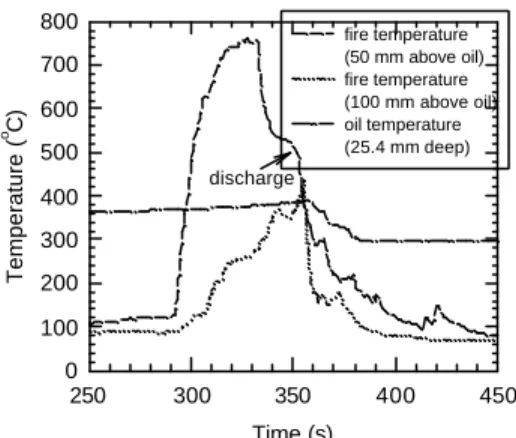
Time (s) 250 300 350 400 450 Temperature ( o C) 0 100 200 300 400 500 600 700 800 fire temperature (50 mm above oil) fire temperature (100 mm above oil) oil temperature (25.4 mm deep) discharge
Figure 1 Cooking oil and fire temperatures
time (s) 0 30 60 90 120 150 Temperature ( o C) 0 100 200 300 400 500 600 700 800 900 fuel temperature (20 mm deep) fire temperature (40 mm above fuel) fire temperature (30 mm above fuel) discharge
To evaluate the suitability of the portable water mist fire extinguisher for use on Class C fires, a 60 Hz transformer (GE Electric) rated at 50 kV was used to supply the high voltage to determine if the discharge of water mist could produce a shock hazard to the user. The nozzle tip of the electrically charged extinguisher was connected to the high voltage secondary of the test transformer and placed 0.38 m from the centre of a circular copper target that had a diameter of 0.25 m. During the tests, the voltage was turned on and increased in steps of 5 kV with 10 s at each step until 47.5 kV. The current in the primary winding of the transformer, as well as the leakage current were measured at each step. To increase the electric field or voltage between the nozzle and the circular electrode, their distance was reduced to 0.19 m.
Results and Discussion
The pool fires involving cooking oil, heptane and diesel fuels are diffusion flames. Their flame height, shape and heat release rate are mainly determined by fuel property and the rate of mixing of the fuel vapour with the surrounding air/oxidant. To extinguish a pool fire by using water mist, spray coverage area, water flow rate and droplet momentum are identified as the critical factors.
Experimental results showed that the use of the portable water mist extinguisher effectively extinguished cooking oil fire once its spray was able to reach and cover the entire oil surface. The
extinguishing times in the experiments varied from 3 to 19 seconds, depending on the discharge pressure and water flow rate. After the fire was extinguished, a large amount of steam was produced as fine water droplets were continuously discharged, directly reached the hot oil and quickly evaporated. The cooking oil temperature was quickly cooled down from 396oC to 300oC after a short period of water mist discharge (see Figure 1). No burning or hot oil droplets were dispersed outside the fryer during the experiments, because fine water droplets did not have enough momentum to splash oil and they quickly evaporated once they reached the hot oil.
For the heptane fire, its flame height was much higher than the cooking oil fire after 60 s of free burning period. The operator, standing 1.1 m away from the fire, activated the water mist extinguisher to extinguish the heptane fire at 3 to 4 seconds. The amount of water used in extinguishing the fire varied from 1.2 to 2.1 L in the experiments. The extinguishing process could be divided into three phases based on observations from the video images (30 image frames in a second). In phase I, the flame height was reduced at the beginning of the discharge but then the fire size increased and became bigger than the initial fire as the fresh air was brought into the
increase in the heat release rate. In phase II, with continuous water mist discharge, the flame plume was separated from the fuel surface and a large fireball was formed in the air as the substantial amount of fuel/air mixture that suspended in the air burned and expanded rapidly. In phase III, the water mist that covered the entire fuel surface effectively
prevented the flame from the fireball to re-ignite the fuel bed and extinguished the fire. Compared to the cooking oil fire, much less steam was produced during the suppression due to its lower fuel temperature. The variations of heptane fuel and fire temperatures in the experiment are shown in Figure 2.
Compared to the heptane fire with the same size fuel pan, the diesel fire was much easier to extinguish using the water mist extinguisher, because the diesel fuel has higher flash point (FP = 60oC) and lower heat release rate than heptane fuel. The fire flare-up generated in the experiment was smaller than that generated in extinguishing heptane fires. The diesel fire was extinguished at 2 s after water mist discharge.
For wood crib fire experiments, the crib was allowed to burn until its mass was reduced to 55 percent of its original mass before starting water mist discharge. When water mist was discharged, no fire flare-up was generated, and the crib fire was quickly controlled. The fine water mist discharged from the extinguisher was able to penetrate into the centre of the crib. However, with limited water supply, extinguishing performance of the water mist extinguisher was strongly dependent on how water mist was discharged onto the crib fire. With random discharge, it was difficult to extinguish the crib fire. However, with side by side discharge, the water mist extinguisher effectively extinguished the crib fire at 51 s with 9 L of water.
For the experiments involving Class C fires, testing results showed that there was no breakdown in the air/water mist gap between the nozzle tip and the energized target when water mist was discharged toward the energized target for the full discharge duration. The leakage current between the nozzle tip and the energized target was increased with increasing applied voltages, and reduced with increasing distance between the nozzle tip and the energized target. The leakage current was not sensitive to the changes in the droplet size ranging from Dv0.9=190 to
Dv0.9=320 microns. The maximum leakage current measured in the experiments was
approximately 150 µA when the nozzle tip was located 0.38 m away from the energized target, and it increased to 250 µA when the distance between the nozzle tip and the energized target was reduced to 0.19 m. They were below the threshold value of involuntary startle reaction (500 µA) for electric current through the human body, indicating that the use of the water mist extinguisher will not produce a shock hazard to the user.
Conclusion
A portable water mist fire extinguisher was developed for use on cooking oil fires (Class K), wood crib fires (Class 2-A), flammable liquid fires (Class 1-B), and fires associated with electrical equipment (Class C). The extinguisher was able to provide protection for a wide range of applications, such as medical centres, telecommunication facilities, industrial ‘clean rooms’, and commercial cooking areas.