HAL Id: hal-01252167
https://hal.inria.fr/hal-01252167
Submitted on 7 Jan 2016
HAL is a multi-disciplinary open access
archive for the deposit and dissemination of
sci-entific research documents, whether they are
pub-lished or not. The documents may come from
teaching and research institutions in France or
L’archive ouverte pluridisciplinaire HAL, est
destinée au dépôt et à la diffusion de documents
scientifiques de niveau recherche, publiés ou non,
émanant des établissements d’enseignement et de
recherche français ou étrangers, des laboratoires
Fast and Portable Locking for Multicore Architectures
Jean-Pierre Lozi, Florian David, Gaël Thomas, Julia Lawall, Gilles Muller
To cite this version:
Jean-Pierre Lozi, Florian David, Gaël Thomas, Julia Lawall, Gilles Muller. Fast and Portable Locking
for Multicore Architectures. ACM Transactions on Computer Systems, Association for Computing
Machinery, 2016, �10.1145/2845079�. �hal-01252167�
Fast and Portable Locking for Multicore Architectures
JEAN-PIERRE LOZI, Université Nice Sophia Antipolis, CNRS, I3S, UMR 7271 FLORIAN DAVID, Sorbonne Universités, Inria, CNRS, UPMC Univ Paris 06, LIP6 GAËL THOMAS, SAMOVAR, CNRS, Télécom ParisSud, Université Paris-Saclay JULIA LAWALL, Sorbonne Universités, Inria, CNRS, UPMC Univ Paris 06, LIP6 GILLES MULLER, Sorbonne Universités, Inria, CNRS, UPMC Univ Paris 06, LIP6The scalability of multithreaded applications on current multicore systems is hampered by the performance of lock algorithms, due to the costs of access contention and cache misses. The main contribution presented in this article is a new locking technique, Remote Core Locking (RCL), that aims to accelerate the execu-tion of critical secexecu-tions in legacy applicaexecu-tions on multicore architectures. The idea of RCL is to replace lock acquisitions by optimized remote procedure calls to a dedicated server hardware thread. RCL limits the per-formance collapse observed with other lock algorithms when many threads try to acquire a lock concurrently and removes the need to transfer lock-protected shared data to the hardware thread acquiring the lock, be-cause such data can typically remain in the server’s cache. Other contributions presented in this article include a profiler that identifies the locks that are the bottlenecks in multithreaded applications and that can thus benefit from RCL, and a reengineering tool that transforms POSIX lock acquisitions into RCL locks. Eighteen applications were used to evaluate RCL: the nine applications of the SPLASH-2 benchmark suite, the seven applications of the Phoenix 2 benchmark suite, Memcached, and Berkeley DB with a TPC-C client. Eight of these applications are unable to scale because of locks and benefit from RCL on an x86 machine with four AMD Opteron processors and 48 hardware threads. By using RCL instead of Linux POSIX locks, performance is improved by up to 2.5 times on Memcached, and up to 11.6 times on Berkeley DB with the TPC-C client. On a SPARC machine with two Sun Ultrasparc T2+ processors and 128 hardware threads, three applications benefit from RCL. In particular, performance is improved by up to 1.3 times with respect to Solaris POSIX locks on Memcached, and up to 7.9 times on Berkeley DB with the TPC-C client. Categories and Subject Descriptors: D.4.1 [Operating Systems]: Process Management—Mutual exclusion General Terms: Design, Algorithms, Performance
Additional Key Words and Phrases: Multicore, synchronization, locks, RPC, locality, busy-waiting, memory contention, profiling, reengineering
ACM Reference Format:
Jean-Pierre Lozi, Florian David, Gaël Thomas, Julia Lawall, Gilles Muller, 2014. Remote Core Locking: Mi-grating Critical-Section Execution to Improve the Performance of Multithreaded Applications ACM Trans. Comput. Syst. V, N, Article A (January YYYY), 62 pages.
DOI:http://dx.doi.org/10.1145/0000000.0000000
Permission to make digital or hard copies of part or all of this work for personal or classroom use is granted without fee provided that copies are not made or distributed for profit or commercial advantage and that copies show this notice on the first page or initial screen of a display along with the full citation. Copyrights for components of this work owned by others than ACM must be honored. Abstracting with credit is per-mitted. To copy otherwise, to republish, to post on servers, to redistribute to lists, or to use any component of this work in other works requires prior specific permission and/or a fee. Permissions may be requested from Publications Dept., ACM, Inc., 2 Penn Plaza, Suite 701, New York, NY 10121-0701 USA, fax +1 (212) 869-0481, or [email protected].
c
YYYY ACM 0734-2071/YYYY/01-ARTA $15.00 DOI:http://dx.doi.org/10.1145/0000000.0000000
1. INTRODUCTION
Over the past decades up to the early 2000’s, the performance of Central Processing Units (CPUs) was steadily improving thanks to rising hardware clock frequencies and improved superscalar, pipelined designs. However, due to physical limitations, CPU manufacturers have now found it impossible to keep increasing clock frequencies, and the performance improvements obtained by pipelining and superscalar designs has peaked. Consequently, manufacturers now mainly focus on embedding many execution units into the same CPU instead to improve performance: the number of hardware threads in consumer CPUs keeps increasing in all computing devices, from servers to mobile phones. It is not uncommon for multiprocessor servers to include more than a hundred hardware threads nowadays.
In order to take advantage of these available hardware threads, programs have to be parallelized, i.e., they have to define multiple threads to perform the processing concurrently. However, most programs cannot be fully parallelized because accesses to shared data structures have to be synchronized in order to ensure that they remain consistent [Herlihy and Shavit 2008]. One of the most commonly used techniques to synchronize accesses to shared data structures consists of defining critical sections, i.e., sections of code that are executed in mutual exclusion. Current mechanisms used to implement critical sections [Mellor-Crummey and Scott 1991a; He et al. 2005a; Hendler et al. 2010a; Fatourou and Kallimanis 2012], however, use many costly oper-ations that access remote data on the critical path of the execution. These operoper-ations include atomic instructions or read and write operations on shared variables, and they involve costly communication schemes that are handled by the cache-coherency proto-col, such as cache line invalidations or cache misses. As stated by Amdahl’s Law [Am-dahl 1967], the critical path ends up being the limiting factor for performance as the number of threads increases, because the time spent in the parallel portion of the code decreases until it becomes negligible as compared to the critical path. As a result, costly communication schemes end up consuming a large part of the execution time of the application as the number of hardware threads increases. We have observed that the costly operations that access remote data on the critical path by current mecha-nisms used to implement critical sections can be classified in two categories:
— Lock management. Mutual exclusion is implemented with locks, i.e., objects that can only be held by a single thread at any given time: a thread needs to hold a lock in or-der to execute a critical section. Locks are implemented with shared data structures, such as queues or boolean variables. Acquiring or releasing a lock typically requires inter-core communication to write to these shared data structures in order to change the state of the lock and to maintain their consistency.
— Accessing shared variables. A critical section is typically used to ensure mutual ex-clusion on a resource, which is often represented by a shared data structure. When different threads that are scheduled on different hardware threads execute the crit-ical section, the cache lines that hold the shared data structure bounce between the hardware threads, causing cache misses.
In this paper, we propose a new locking mechanism, Remote Core Locking (RCL), that aims to improve the performance of legacy multithreaded applications on multi-core hardware by decreasing the amount of inter-multi-core communication on the critical path triggered by the execution of critical sections.1The principle of RCL is to reserve
1RCL was initially presented in the paper “Remote Core Locking: Migrating Critical-Section Execu-tion to Improve the Performance of Multithreaded ApplicaExecu-tions”, which was published at USENIX ATC 2012 [Lozi et al. 2012]. Beyond the contents of the USENIX ATC paper, this article includes extended eval-uation results, including results on two different architectures instead of one, more evaluated lock
algo-a halgo-ardwalgo-are threalgo-ad, calgo-alled the server, to execute algo-all the criticalgo-al sections algo-associalgo-ated with a lock. When an application thread, called a client, has to execute a critical section, it posts a message to the server, which subsequently executes the critical section and signals the client when the critical section has been executed. RCL naturally ensures mutual exclusion, since the execution of critical sections is serialized on the server. RCL reduces the cost of lock management because its message-based communication between the client and server uses less inter-core communication on the critical path than existing lock implementations. RCL also optimizes data locality because shared data structures protected by the lock remain in the caches of the hardware thread of the server, which reduces the amount of cache misses on the critical path.
Replacing locks of legacy C applications by RCL, however, raises two issues. First, RCL artificially serializes the critical sections associated with different locks managed by the same server hardware thread: transforming many locks into RCLs on a smaller number of servers can induce false serialization, which decreases parallelism. There-fore, the programmer must first decide which locks should be transformed into RCLs and on which hardware thread(s) to run the server(s). For this, we have designed a profiler to identify which locks are frequently used by the application and how much time is spent on locking. Based on this information, we propose a set of simple heuris-tics to help the programmer decide which locks should be transformed into RCLs, and a methodology to identify on which hardware thread to run each such lock’s server. Second, in legacy C applications, the code of the critical sections, lock acquisitions in-cluded, is often embedded inside a longer function. As the control flow has to migrate to a server and then return to the client during the execution of the critical section, the code of each critical section that is associated with a lock transformed into a RCL has to be extracted as a function. To facilitate this transformation, we have designed an automated reengineering tool for C programs to transform the code of each critical section so that it can be executed as a remote procedure call on the server hardware thread: the code within the critical section is extracted as a function and any vari-ables referenced or updated by the critical section that are declared by the function containing the critical section code are sent as arguments, amounting to a context, to the server hardware thread.
We have developed a runtime for both Linux and Solaris that is compatible with POSIX threads, and that supports a mixture of RCL and POSIX locks in a sin-gle application. Based on this runtime, we have evaluated RCL on two machines: (i) Magnycours-48, an x86 machine with four AMD Opteron CPUs and 48 hardware threads running Linux 3.9.7, and (ii) Niagara2-128, a SPARC machine with two Ul-trasparc T2 CPUs and 128 hardware threads running Solaris 10. We compare the per-formance of RCL to that of other locks using a custom microbenchmark that measures the execution time of critical sections that access a varying number of shared memory locations. Furthermore, based on the results of our profiler, three applications from the SPLASH-2 suite [University of Delaware 2007; Singh et al. 1992], three applica-tions in the Phoenix 2 suite [Stanford University 2011; Talbot et al. 2011; Yoo et al. 2009; Ranger et al. 2007], Memcached [Danga Interactive 2003; Fitzpatrick 2004], and Berkeley DB [Oracle Corporation 2004; Olson et al. 1999] with a TPC-C benchmark developed at Simon Fraser University were identified as applications that could ben-efit from RCL. For each of these applications, we compare RCL against the standard system implementation of the POSIX lock, MCS [Mellor-Crummey and Scott 1991a], Flat Combining [Hendler et al. 2010a], CC-Synch [Fatourou and Kallimanis 2012] and DSM-Synch [Fatourou and Kallimanis 2012]. Comparisons are made for a same num-rithms (including the recently proposed CC-Synch and DSM-Synch lock algonum-rithms [Fatourou and Kallima-nis 2012]), and additional experiments.
ber of hardware threads, which means that there are fewer application threads in the RCL case, since one or more hardware threads are dedicated to RCL servers.
Key highlights of our results are:
— On our custom microbenchmark, under high contention, RCL is faster than all other evaluated lock algorithms: on Magnycours-48 (resp. Niagara2-128), RCL is 3.2 (resp. 1.8) times faster than the second best approach, CC-Synch, and 5.0 (resp. 7.2) times faster than the operating system’s POSIX lock.
— On application benchmarks, contexts are small, and thus the need to pass a context to the server has only a marginal performance impact.
— On most benchmarks, only one lock is frequently used and therefore only one RCL server is needed. The only exception is Berkeley DB with the TPC-C client, which requires two or three RCL servers to reach optimal performance by reducing false serialization.
— On Magnycours-48 (resp. Niagara2-128), RCL performs better on five (resp. one) ap-plication(s) from the SPLASH-2 and Phoenix 2 benchmark than all other evaluated locks.
— For Memcached with Set requests, on Magnycours-48 (resp. Niagara2-128), RCL yields a speedup of 2.5 (resp. 1.3) times over the operating system’s POSIX lock, 1.9 (resp. 1.2) times over the basic spinlock and 2.0 (resp. 1.2) times over MCS. The num-ber of cache misses in critical sections is divided by 2.9 (resp. 2.3) by RCL, which shows that it can greatly improve locality. Flat Combining, CC-Synch and DSM-Synch were not evaluated in this experiment because they do not implement con-dition variables, which are used by Memcached.
— For Berkeley DB with the TPC-C client, when using Stock Level transactions, on Magnycours-48 (resp. Niagara2-128), RCL yields a speedup of up to 11.6 (resp. 7.6) times over the original Berkeley DB locks for 48 (resp. 384) simultaneous clients. RCL resists better than other locks when the number of simultaneous clients increases. In particular, RCL performs much better than other locks when the application uses more client threads than there are available hardware threads on the machine, even when other locks are modified to yield the processor in their busy-wait loops.
The article is structured as follows. Section 2 describes existing lock algorithms. Section 3 presents our main contribution, RCL. Section 4 presents the profiler and the reengineering tool that are provided with RCL to facilitate its use in legacy applica-tions. Section 5 evaluates the performance of RCL and compares its performance to that of existing lock algorithms. Finally, Section 6 concludes.
2. RELATED WORK
The lock, one of the oldest synchronization mechanisms [Dijkstra 1965; Hoare 1974], is still extensively used in modern applications. A lock makes it possible for multiple threads to execute sections of code in mutual exclusion in order to ensure exclusive access to shared resources. In this section, we study several lock algorithms, focusing on the following five criteria:
— Cost of lock management. The cost of acquiring and releasing the lock on the critical path, i.e., lock management operations that are serialized with the critical sections protected by the lock.
— Data locality. The cost, in terms of number of cache misses, of accessing the shared data protected by the lock.
— Performance with many threads. How well the lock algorithm performs when more threads use the lock than there are hardware threads on the machine. The perfor-mance of some lock algorithms collapses in this scenario.
— Support for condition variables. Not all lock algorithms provide support for condition variables, and supporting them is not always trivial (notably with combining locks, as will be explained in Section 2.3). Supporting condition variables is crucial for legacy support, since they are very commonly used in existing applications. For instance, roughly half of the multithreaded applications that use POSIX locks in Debian 6.0.3 also use them.
— Fairness. The ability of a lock algorithm to ensure that all threads make progress. In the rest of this section we provide an in-depth analysis of the families of locks used in most of our evaluation in Section 5, with examples. We then present other notable lock algorithms that will be evaluated in Section 5.6.
2.1. Centralized locks
With centralized locks, the ownership of a lock is determined by a single boolean vari-able that we refer to as the lock varivari-able. The thread that is vari-able to change the lock variable from false to true with a compare-and-swap instruction becomes the owner of the lock. The compare-and-swap instruction ensures that a variable is atomically set to a new value if and only if it was equal to a given value. The lock is released by setting the lock variable to false using a regular assignment instruction. We now describe and analyze the properties of two widely used variants of centralized locks: spinlocks and blocking locks.
2.1.1. Spinlocks.With spinlocks [Herlihy and Shavit 2008], a thread continuously
tries to set the lock variable to true in a busy-wait loop, until it manages to acquire the lock. Some variants use various policies to yield the processor in the busy-wait loop in order to improve resistance to contention and save energy, as will be seen in Section 2.4. In this paper, we refer to the spinlock algorithm that never yields the processor as the basic spinlock.
2.1.2. Blocking locks.With blocking locks, when a thread fails to acquire a lock, it
sleeps via a system call, such as futex_wait() on Linux. When the lock holder releases the lock, it not only sets the lock variable to false, but also wakes up the threads wait-ing for the lock. On mainstream POSIX operatwait-ing systems, such as Linux or Solaris, the POSIX lock is implemented with a blocking lock.
2.1.3. Analysis.We now analyze the properties of centralized locks.
Cost of lock management. With basic spinlocks, when many threads try to acquire the lock concurrently by repeatedly applying compare-and-swap instructions to the lock variable, the processor interconnect gets saturated by messages from the cache-coherence protocol. As will be shown in Section 5.1, the result is that even executing a single one of these compare-and-swap instructions takes a lot of time. Consequently, the critical path, which includes setting the lock variable to true at the beginning of a critical section and setting the lock variable to false at the end, becomes very long.
Blocking locks are also relatively inefficient under high contention, because threads sleep while they are waiting for the lock. Consequently, two lengthy lock management operations take place on the critical path before a thread can reacquire the lock: (i) a system call to unblock the thread, and (ii) a context switch to schedule that thread.
Data locality. As stated in the introduction, when a thread executes a critical section that was last executed on another hardware thread, the shared data protected by the critical section has to be loaded when it is accessed, which results in cache misses.
Performance with many threads. If the lock holder is preempted, none of the threads that are waiting for the lock can acquire it, consequently, no progress is made on the critical path. This is a major issue with the basic spinlock when there are more threads
that use the lock than there are hardware threads on the machine: if all threads are busy (either busy-waiting or executing a critical section), the operating system’s sched-uler will have to preempt some of these threads without knowing which thread is exe-cuting a critical section and therefore progressing on the critical path.
Blocking locks, however, can perform much better than spinlocks when there are more threads that use the lock than there are hardware threads on the machine. This is due to the fact that threads sleep while they are waiting for the lock, which reduces the need for the scheduler to preempt threads in applications where many threads are waiting on locks: the scheduler never preempts the lock holder in order to run a busy-waiting thread on the same hardware thread.
Support for condition variables. Blocking locks are provided by all mainstream op-erating systems through standard lock implementations, such as the POSIX lock im-plementations on Linux and Solaris. These imim-plementations also provide primitives to handle condition variables. Support for condition variables for spinlocks can trivially be implemented using the aforementioned primitives.
Fairness. None of the centralized locks presented in this section guarantee progress. A thread that tries to enter a critical section can indefinitely be delayed by other threads that succeed in acquiring the lock.
2.2. Queue locks
Queue locks define the lock variable as a pointer to the tail of a queue of nodes, with one node for each thread that is either waiting for the lock or executing a critical section. Each node contains a synchronization variable named wait and a pointer to another node. A thread that waits for the lock busy-waits on one of the wait variables, and enters the critical section when the wait variable is set to false. Two variants of queue locks exist: CLH [Craig 2003; Magnussen et al. 1994] and MCS [Mellor-Crummey and Scott 1991b]. In both algorithms, each thread initially owns a pre-allocated node.2
2.2.1. CLH.In CLH, each node contains a pointer to its predecessor. The queue is
never empty: it initially contains a dummy node whose wait variable is set to false. In order to acquire the lock, a thread sets the wait variable of its node to true and atomically enqueues its node at the end of the list. It then waits for the lock variable of its predecessor to be equal to false to enter the critical section. A lock owner sets the wait variable of its node to false to pass lock ownership to its successor in the list. It then takes ownership of its predecessor’s node as its new node.
2.2.2. MCS.In MCS, a node contains a pointer to its successor. The queue does not
contain a dummy node. When the queue is empty, the lock is free, and a thread acquires the lock by enqueueing its node at the head of the list. Otherwise, the lock is not free. In that case, the thread sets its node’s wait variable to false and enqueues it at the end of the list. It then busy-waits on the wait variable of its newly-enqueued node, instead of the previous node as is the case with CLH. To release the lock, the lock holder sets the wait variable of its successor, if it exists, to true. If no successor exists, the lock holder sets the tail pointer to null. As compared to CLH, MCS may have better memory locality on NUMA and non-cache-coherent architectures because a thread always busy-waits on the same node, and that node is allocated locally.
2.2.3. Analysis.We now analyze the properties of queue locks.
Lock management. If a waiting thread does not get preempted, the node on which it busy-waits remains in the local cache until its predecessor releases the lock. No other
2In practice, in order to allow for nested critical sections, each thread needs to own one node per lock. To simplify the presentation, we do not consider this case in this section.
thread busy-waits on the same variable. Consequently, queue locks are not subject to the processor interconnect saturation issue that centralized locks suffer from. At high contention, on the critical path, between each critical section, the only overhead is the cost of the previous lock holder writing to the corresponding wait variable (invalida-tion), and the new lock holder fetching the new value of that variable (cache miss).
Data locality. Like with centralized locks, shared variables protected by the lock have to be loaded in the cache of the lock holder.
Performance with many threads. Like with centralized locks, when there are more threads that use the lock than there are hardware threads on the machine, the sched-uler is likely to preempt the lock holder. Consequently, threads waiting for the lock waste resources while no progress is made on the critical path because no critical sec-tion can be executed.
Another reason why queue locks perform poorly when more threads try to acquire a lock than there are hardware threads on the machine is the convoy effect [Koufaty et al. 2010]: the FIFO (First-In-First-Out) ordering of lock acquisitions and the FIFO scheduling policy of the operating system interact in such a way that critical sections take one or several of the scheduler’s time quanta to be executed. To illustrate the
problem, suppose we have a machine with two hardware threads and three threads, T1,
T2and T3. We also suppose that both the queue of the lock and the queue of the system
scheduler are T1 ← T2 ← T3. During the first quantum, T1 and T2 are scheduled. T1
acquires the lock since it is the first element of the lock queue. At the end of its critical section, it releases the lock and likewise enqueues itself at the end of the lock queue to execute a new critical section. T2then acquires the lock, executes the critical section,
and enqueues itself at the end of the lock queue. At this point, T1 and T2 are still
scheduled, but are unable to progress because T1waits for T3to release the lock and T2
waits for T1to release the lock. At the end of the quantum, both the lock queue and the
scheduling queue are T3 ← T1 ← T2. In the same manner, during the next quantum,
only T3and T1are able to execute a critical section: after the execution of their critical
sections, they have to wait for T2to release the lock. As a result, during each quantum,
only two critical sections are executed, leading to extremely low performance in the very likely case where executing two critical sections is orders of magnitudes faster than a time quantum.
Time-published locks [He et al. 2005a] (MCS-TP) are modified versions of the MCS and CLH locks that aim to prevent the issues caused by preemption. They use a timestamp-based heuristic to solve the problems caused by interactions with the system scheduler. Each thread periodically writes the current system time (a high-resolution timestamp) in its node. If a thread fails to acquire the lock for a long amount of time, it checks the timestamp of the lock holder, and if that timestamp has not been recently updated, it assumes that the lock holder has been preempted. In this case, it yields the processor in order to increase the probability for the lock holder to be scheduled again: this technique helps solve the problem of a preempted lock owner. Moreover, if a thread waiting for the lock observes that the timestamp counter of its successor has not been recently updated, the thread assumes that its successor has been preempted, consequently, it removes it from the queue. This technique removes convoys, because it deschedules threads that needlessly busy-wait for the lock, leav-ing a chance for the lock holder to be scheduled again. However, time-published locks have a significant overhead relative to standard queue locks when fewer threads try to acquire a lock than there are hardware threads, due to the additional timestamp management operations on the critical path.
Support for condition variables. Like with spinlocks, support for condition variables for queue locks can trivially be implemented using the primitives that the operating system provides to manage condition variables in blocking locks.
Fairness. Queue locks are naturally fair: when a thread fails to acquire a lock, it enqueues itself in a FIFO queue, which also ensures that critical sections are executed in FIFO order. Time-publishing locks may be slightly less fair because a thread can be removed from the lock queue in order to avoid convoys.
2.3. Combining locks
A combining lock [Oyama et al. 1999; Hendler et al. 2010a; Fatourou and Kallimanis 2012] is a lock algorithm that sometimes also aims to merge operations on a shared object in a way that decreases algorithmic complexity. Conceptually, each thread owns a node that contains a pointer to a function that encapsulates a critical section which can be executed remotely by another thread. A thread adds its node in a linked list (stack, queue, or unordered list) to request the execution of a critical section. One of the threads is designed as the combiner thread and will execute some of these oper-ations, if possible merging them using an algorithm that is able to execute several critical sections together faster than if they were executed individually (such an al-gorithm does not always exist). A combining lock can also be used as a traditional lock algorithm if operations are not merged, but simply executed sequentially by the combiner: this is the only use of combining locks we consider in this paper.
We describe three variants of combining locks: the Oyama lock [Oyama et al. 1999] (the oldest of the combining locks; its authors did not propose to merge operations), Flat Combining [Hendler et al. 2010a] and CC-Synch along with its variant for non-cache coherent architectures, DSM-Synch [Fatourou and Kallimanis 2012].
2.3.1. The Oyama lock. The Oyama lock [Oyama et al. 1999] (simply referred to as
“Oyama” in the rest of this article) uses a synchronization variable that can take three values: (i) FREE, which means that the lock is free, (ii) LOCKED, which means that a crit-ical section is being executed, but no other critcrit-ical section needs to be executed after that, or (iii) a pointer to a stack, i.e. a linked list that ensures LIFO (Last-In-First-Out) order. When a thread t needs to execute a critical section, it tries to atomically switch the value of the synchronization variable from FREE to LOCKED. In case of failure, an-other thread is executing a critical section. Consequently, t writes the address of the function that encapsulates it into its node, and pushes its node atomically onto the stack. Otherwise, if t succeeds in switching the value of the synchronization variable from FREE to LOCKED, it owns the lock and executes its critical section. It then tries to release the lock using a compare-and-swap instruction to switch its value from LOCKED to FREE. This operation can fail if other threads have pushed their nodes on the stack during the execution of the critical section. In this case, t becomes a combiner: it atom-ically detaches the stack, sets the value of the synchronization variable to LOCKED, and executes all critical sections from the stack. Thread t then tries to release the lock atomically again, and in case of failure, continues to act as a combiner.
2.3.2. Flat Combining. Flat Combining [Hendler et al. 2010a] uses a basic spinlock and
an unordered linked list. Nodes can either be active or inactive. To execute a critical section, a node writes the address of the function that encapsulates it into its node and checks whether the node is active. If the node is inactive, it activates it and inserts it into the linked list, otherwise, no insertion is needed because the node was placed in the linked list for the execution of a previous critical section and has not yet been removed.
The thread then busy-waits until either (i) a combiner has executed its request, or (ii) the spinlock is free. In the latter case, the thread acquires the spinlock, becomes a combiner and executes all critical sections in the linked list before releasing the spin-lock. After having executed a critical section, the combiner sets the critical section’s address to null in the node, which (i) indicates to the thread that owns the node that
ALGORITHM 1: CC-Synch
1 structures:
2 node_t { request_t req, ret_val_t ret, boolean wait, boolean completed, node_t *next };
// ‘lock’ represents the lock. It is the tail of a shared queue that initially contains a dummy node with the values // {null, null, false, false, null}. ‘node’ initially points to a thread-local node with the values {null, null, false, false, // null}.
3 function execute_cs(request_t req, node_t ∗ ∗lock, node_t ∗ ∗node) : ret_val_t
4 var node_t *next_node, *cur_node, *tmp_node, *tmp_node_next;
5 var int counter := 0;
6 next_node := ∗node; // The current thread uses a (possibly recycled) node
7 next_node → next :=null;
8 next_node → wait :=true;
9 next_node → completed :=false;
10 cur_node := atomic_swap(∗lock, next_node); // ‘cur_node’ is assigned to the current thread
11 cur_node → req := req; // The current thread announces its request
12 cur_node → next := next_node;
13 ∗node := cur_node;
14 while cur_node → wait do // The current thread busy-waits until it is unlocked
15 pause();
16 if cur_node → completed then
17 return cur_node → ret; // If the request is already applied, return its value
18 tmp_node := cur_node; // The current thread is the combiner
19 while tmp_node → next 6=null and counter < MAX_COMBINER_OPERATIONS do
20 counter++;
21 tmp_node_next := tmp_node → next;
Critical section:
22 <apply tmp_node → req to object’s state and store the return value to tmp_node → ret>
23 tmp_node → completed :=true; // tmp_node’s req is applied
24 tmp_node → wait :=false; // Signal the client thread
25 tmp_node := tmp_node_next; // Proceed to the next node
26 tmp_node → wait :=false;
27 return cur_node → ret;
Acquire fence Release fence
its critical section has been executed, and (ii) indicates to the next combiner that the node does not contain a pending request to execute a critical section.
Flat Combining performs linked list cleanup operations, which incurs a significant overhead: nodes that have not been used to execute critical sections in a long time are removed from the linked list regularly in order to ensure that the combiner will not traverse too many inactive nodes. Constants have to be tuned by the developer to determine (i) how long a node is allowed to stay in the list without requesting the execution of a critical section and (ii) how often the cleanup operation takes place.
2.3.3. CC-Synch and DSM-Synch. CC-Synch and DSM-Synch [Fatourou and
Kallima-nis 2012] use a queue instead of an unordered list. Nodes contain the address of the function that encapsulates the critical section, a completed boolean variable that indi-cates whether the critical section has been executed, and a wait boolean variable that indicates whether a thread should wait for the execution of its critical section.
The algorithm of CC-Synch is shown in Algorithm 1.3 The queue initially contains
a dummy node whose variables wait and completed are both set to false (line 2). To
3The memory fences in Algorithms 1, 2 and 4 are not required on architectures that ensure Total Store Order (TSO), but may be needed for weaker memory models. The x86 and SPARC machines we used in the evaluation (Section 5) ensure TSO.
execute a critical section (lines 6-13), a thread sets its wait and completed variables to true and false, respectively. The thread then exchanges its node with the dummy node, which is always located at the end of the list: as a result, the thread’s old node becomes the new dummy node. Finally, the thread writes the address of the function that encapsulates the critical section into its new node and makes it point to its old node (it may not be the dummy node anymore at that point), which ensures that its node has been enqueued in the list. Note that because the first thread that enqueues itself has both its completed and wait variables set to false, it will become a combiner (its critical section is not completed, but it will not wait for another combiner, therefore, it must become one).
Once a thread has enqueued its node in the list, it busy-waits while its wait variable equals true (lines 14-15). After this step, it checks whether its completed variable is set to true (lines 16-17): if so, the critical section has been executed by a combiner. Otherwise, the thread becomes a combiner, and goes through the queue, executing each critical section and setting the completed and wait flags of the corresponding node to true and false, respectively, afterwards (lines 19-25). When the thread reaches the last element in the queue, or when it has executed a bounded number of critical sections, it sets the wait variable of the current element in the queue to false, and leaves the value of its completed variable as false (line 26). As the latter node will have both its completed and wait variables set to false, (i) the corresponding thread becomes the next combiner if the node belongs to a thread or (ii) the initial state of the dummy node is restored as the list contains a single node.
DSM-Synch is a variant of CC-Synch that aims to improve its memory locality. With CC-Synch, nodes are continuously exchanged between threads. Consequently, a thread’s current node is allocated by another thread most of the time, and is therefore likely to be located on a remote memory bank on NUMA or non-cache-coherent archi-tectures. DSM-Synch adds some complexity to ensure that a thread always reuses the same node. The result is that threads always busy-wait on variables from nodes that can be allocated in a local memory bank, which may improve memory locality at the price of a few more more atomic instructions on the critical path.
2.3.4. Analysis.We now analyze the properties of combining locks.
Lock management. Combining locks have a shorter critical path than queue locks if combiners manage to execute long enough sequence of critical sections: a combiner can execute critical sections one after the other without synchronization between threads, as long as the hardware prefetcher manages to bring nodes to the local caches before they are accessed (otherwise cache misses may occur). Oyama, however, has signif-icant additional overhead on the critical path, because all threads access the global synchronization variable concurrently, often using costly atomic instructions. More-over, the combiner has to detach the stack regularly to execute a long sequence of critical sections if new threads keep enqueueing themselves while critical sections are being executed. For Flat Combining, when the combiner reaches the head of the linked list, it releases the lock, which is acquired again by a new thread that becomes the new combiner when there are still threads waiting on the lock (the fact that the combiner has reached the head of the linked list does not mean that there are no more pend-ing critical sections because threads enqueue themselves at the tail). Releaspend-ing and acquiring this lock also slows down the critical path. Moreover, the cleanup operations also take place on the critical path because the combiner has to have exclusive access to the linked list in order to clean it up. For CC-Synch and DSM-Synch, if nodes are prefetched correctly, the only overhead on the critical path takes place when the role of
combiner is handed over from one thread to the next, which results in an invalidation
and a cache miss.4
Data locality. Combining locks improve data locality: critical sections that are pro-tected by a given lock often perform operations on the same set of shared variables and executing several of them consecutively on the same hardware thread makes it possible for these variables to remain in that hardware thread’s caches. As a result, fewer cache misses occur on the critical path and performance is improved.
Performance with many threads. While Oyama and Flat Combining perform well when there are more threads that use the lock than there are hardware threads on the machine, CC-Synch and DSM-Synch do not, because of a design flaw in their algorithm that we illustrate with CC-Synch. Suppose that a thread t is preempted between lines 10 and 12 of Algorithm 1. The current combiner will only be able to execute critical sec-tions up to that node and will hand over the role of combiner to the preempted thread t, because the list is split in two parts until the next pointer of t’s cur_node is set. No progress will be made on the critical path until t wakes up. This issue occurs frequently when there are more threads that try to acquire the lock than there are hardware threads. It causes performance to collapse, as will be shown in Section 5.4.5.b.
Support for condition variables. Condition variables cannot easily be implemented for combining locks because by making the combiner sleep, they prevent it from exe-cuting the remaining critical sections in the queue. Moreover, since server threads are normal application threads, waiting on condition variables of other threads prevents them from making progress, which can cause undesirable unexpected effects such as deadlocks.
Fairness. Oyama uses a stack (LIFO order), which makes it especially unfair be-cause a node’s request can always be delayed by a more recent node insertion. Flat Combining uses an unordered linked list, which makes the algorithm more fair. CC-Synch and DSM-CC-Synch, like queue locks, use a queue (FIFO order), which makes them perfectly fair.
2.4. Other lock algorithms
We have described the main families of locks and presented members of each family that were either notable due to their widespread use (spinlocks, blocking locks), histor-ical reasons (CLH and Oyama were the first of their kind), or their efficiency (all other presented lock algorithms). We now give an overview of other existing lock algorithms. Backoff locks improve on the basic spinlock, with the objective of achieving better performance when many threads perform concurrent lock acquisition attempts. The main idea of backoff locks is to make threads sleep for a backoff delay in the busy-wait loop. Doing so reduces contention and also has the advantage of saving power and CPU time. The delay typically increases at each iteration, often linearly (linear backoff lock) or exponentially (exponential backoff lock). According to Anderson [1990], increasing the delay exponentially is the most efficient strategy. The ticket lock [Reed and Kan-odia 1979] also aims to improve the performance of spinlocks under high contention. It uses two shared counters: one containing the number of lock acquisition requests, and the other one containing the number of times the lock has been released. In order to acquire the lock, a thread reads and increments the value of the first counter with an atomic fetch-and-add instruction and busy-waits until the second counter is equal to the value it has read from the first counter. The advantage the ticket lock has over the basic spinlock or backoff locks is that threads busy-wait on the second counter using
4We consider that when tmp_node→wait is set false, the corresponding cache line is invalidated and the thread that is busy waiting on that synchronization variable must fetch it again. The actual low-level behavior may differ depending on the cache-coherency protocol used.
an instruction that only reads the corresponding cache line instead of an instruction that attempts to write to it (e.g., a compare-and-swap instruction). Mellor-Crummey and Scott [1991b] show that both backoff locks and the ticket lock are slower than MCS under high contention. However, David et al. [2013] show that the ticket lock performs better than a wide range of other locks under low contention, and, given its small memory footprint, they recommend its use over more complex lock algorithms unless it is sure that a specific lock will be very highly contended.
Abellán et al. [2011] propose GLocks in order to provide fast, contention-resistant locking for multicore and manycore architectures. The key idea of GLocks is to use a token-based message passing protocol that uses a dedicated on-chip network imple-mented in hardware instead of the cache hierarchy. Since the resources needed to build this network grow with the number of supported GLocks, Abellán et al. recommend to only use them for the most contended locks and to use spinlocks otherwise. The main drawback of GLocks is that they require specific hardware support not provided by current machines.
Finally, given the large number of proposed lock algorithms, choosing one is not al-ways a simple task. Smartlocks [Eastep et al. 2010] aims to solve this issue by dynam-ically switching between existing lock algorithms in order to choose the most appro-priate one at runtime. They use heuristics and machine learning in order to optimize towards a user-defined goal which may relate to performance or problem-specific crite-ria. In particular, on heterogeneous architectures, Smartlocks is able to optimize which waiter will get the lock next for the best long-term effect when multiple threads are busy-waiting for a lock. Since Smartlocks relies on a set of lock algorithms, however, it does not remove the need for designing efficient lock algorithms in the first place.
Hierarchical locks trade fairness for throughput by executing several critical sec-tions consecutively on the same cluster of hardware threads (core, die, CPU, or NUMA bank). Doing so allows for better throughput, since synchronization local to a cluster is faster than global synchronization, for two reasons: (i) critical sections executed on the same cluster can reuse shared variables that are stored in their common caches, and (ii) the synchronization variables used for busy-waiting are allocated on a local NUMA node, which may reduce the overhead of busy-waiting, as will be shown in Section 5.1. The Hierarchical Backoff Lock (HBO) [Radovic and Hagersten 2003] is a backoff lock algorithm with an adaptive delay that favors hardware threads of the same cluster: these threads are granted shorter backoff times, whereas remote hardware threads are granted longer backoff times. The Hierarchical CLH lock (H-CLH) [Luchangco et al. 2006] creates a CLH-style queue for each cluster, and the thread at the head of each lo-cal queue occasionally splices the lolo-cal queue into a global queue. Critilo-cal sections are executed following the global queue, as if it were a traditional CLH queue. However, given the way the global queue is built, nodes from the same cluster are neighbors in the global queue and their critical sections are executed consecutively.
Another example of a hierarchical lock has been proposed by Dice et al. [2011], using a combination of Flat Combining and MCS. Each cluster uses one instance of Flat Combining that efficiently creates local MCS queues of threads, and merges them into a global MCS queue. The lock is handed over in the MCS queue exactly like with a MCS lock, except the global queue created by the combiners is ordered by clusters, like with H-CLH. However, Dice et al.’s approach is more efficient than H-CLH because with H-CLH, all threads need to enqueue themselves by using an atomic instruction that is applied to the global tail of the queue, which can cause bottlenecks. Moreover, with H-CLH, threads must know which thread is the master of their local cluster, which complicates their busy-waiting semantics.
Finally, Dice et al. [2012] propose Lock Cohorting, a general technique that makes it possible to build hierarchical locks from any two non-hierarchical lock algorithms
G and S, as long as these lock algorithms satisfy certain (widespread) properties. The general idea is to use one instance of S per cluster, and one global instance of G. The first thread to acquire a lock acquires both G and S, and then releases only S if other threads from the same cluster are waiting for the lock (these threads will only have to acquire S to own the lock), otherwise, it releases both G and S to let threads from other clusters acquire the lock. Dice et al. use Lock Cohorting to build new hierarchical locks by choosing either a backoff lock, the ticket lock, MCS, or CLH for G and for S. They show that some of the resulting combinations outperform both HBO and H-CLH.
While hierarchical locks offer good performance, they are generally based on tradi-tional lock algorithms. Consequently, they are a powerful optimization for lock algo-rithms, but do not replace them.
3. REMOTE CORE LOCKING
In order to improve the performance of applications on multicore architectures, we present Remote Core Locking (RCL), a lock mechanism whose main idea is to dedicate a server hardware thread to the execution of critical sections. RCL has two main advan-tages. First, it reduces synchronization overhead, because the client threads and the server communicate using a fast client/server cache-aligned messaging scheme that is similar to the one used in Barrelfish [Baumann et al. 2009]. And second, RCL improves data locality, because the shared variables that the critical sections protect are all ac-cessed from the same dedicated server hardware thread, where no application thread can be scheduled. Therefore, the shared variables are more likely to always remain in that hardware thread’s cache hierarchy. RCL has additional advantages. In particu-lar, the fact that the server hardware thread is dedicated to the execution of critical sections ensures that the server can never be preempted by application threads: it al-ways makes progress on a critical path. Furthermore, the fact that critical sections are not implemented by application threads makes it possible for RCL to implement condition variables.
This section first gives an overview of RCL, by describing how it works in simple cases. We then focus on the RCL runtime: we describe implementation details, includ-ing how the runtime handles complex situations such as blockinclud-ing in critical sections, nested critical sections, and waiting on condition variables. We then describe statistics that are gathered by the RCL runtime. Finally, we compare RCL with other locks.
3.1. Overview
With RCL, each critical section is replaced by a remote procedure call to a server that executes the code of the critical section. Communication between the client and server threads uses an array of mailboxes that store requests for the execution of critical sections. The following paragraphs describe the request array and how it is used by client and server threads to implement fast remote procedure calls.
Request array. The request array is illustrated in Figure 1. It contains C elements of size L. C is a large number, typically much higher than the number of hardware
threads.5 Each element of the array stores a mailbox req
i that is used for the
com-munication of client ci with the server. In order to make communication as efficient
as possible, (i) C is cache-aligned and L is chosen to be the hardware cache line size in order to avoid false sharing (if the underlying hardware uses multiple cache line sizes, the least common multiple is used), and (ii) on NUMA architectures, the array
5To be more precise, in order to avoid the need to reallocate the request array when new client threads are created, its size is fixed and chosen to be very large (256 KB), and a client identifier allocator implements an adaptive long-lived renaming algorithm [Brodsky et al. 2006] that keeps track of the highest client iden-tifier and tries to reallocate smaller ones.
req0 req1 req2 reqc Context 0xc0d54800 0xf479ea00 0x2368dac0 ... Server loo p
Hardware cache line size (L)
&lock2 &lock1 &lock1 Lock Function null null &foo 0x812ab5c0 &lock2 null
Fig. 1: The request array
of mailboxes is allocated on the NUMA bank of the server to avoid unnecessary com-munication to an external node during client-server comcom-munication.
The first three machine words of each mailbox reqi contain respectively: (i) the
ad-dress of the lock associated with the critical section, (ii) the adad-dress of a structure encapsulating the context, i.e., the variables referenced or updated by the critical sec-tion that are declared by the funcsec-tion containing the critical secsec-tion code, and (iii) the address of a function that encapsulates the critical section for which the client ci has
requested the execution,6or null if no critical section execution is requested.
Client side. In order to execute a critical section, a client cifirst writes the address of
the lock into the first word of its structure reqi, then writes the address of the context
structure into the second word, and finally writes the address of the function that encapsulates the code of the critical section into the third word. The client then busy-waits for the third word of reqito be reset to null, which indicates that the server has executed the critical section. Busy-waiting can be considered too energy demanding in some contexts: to address this issue, on some architectures, it is possible to write an energy-aware version of RCL where cores wait in power-saving mode instead of busy-waiting, as will be explained in Section 5.5.3. Alternatively, the busy-wait loop of the client may yield the processor at each iteration, as will be discussed in Section 5.4.5.c. Server side. A servicing thread iterates over the mailboxes, waiting for one of the mailboxes to contain a non-null value in its third word. When such a value is found, the servicing thread acquires the lock7and executes the critical section using the
func-tion pointer and the context. When the servicing thread is done executing the critical section, it resets the third word to null, and resumes iterating over the request array. Issues raised by RCL. If more than one lock is used by the application, the RCL server can handle the critical sections of several locks, but doing may result in false serialization, i.e., the unnecessary serialization of independent critical sections. To al-leviate this issue, more servers can be used, each of them executing the critical sections of one or several locks. In practice, it is not necessary to use a lot of servers to improve performance, because RCL is not meant to be used for all locks: since RCL’s strongest point is its high performance under high contention, and the lock algorithms used for uncontended locks have negligible impact on performance, RCL should only be used for heavily contended locks. As shown in Section 5.4.1, the number of contended locks
6Since RCL relies on function pointers to ship the code of critical sections from client to server threads, it cannot be used for inter-process mutual exclusion in its current form.
7Since a server executes all critical sections for a given lock, the lock is always free when it tries to acquire it, except in the case of nested critical sections.
in the applications used in the evaluation is low enough that less than three servers are needed to reach optimal performance. Since modern multicore architectures pro-vide dozens of hardware threads whose processing power cannot always be harvested efficiently because applications lack scalability, many hardware threads are often left unused by applications: these hardware threads can be used for RCL servers in order to improve performance.
3.2. Implementation of the RCL runtime
The core algorithm, described in Section 3.1, only refers to a single servicing thread, and thus requires that this thread is never blocked at the operating system level and never busy-waits. We want to ensure that RCL works seamlessly and efficiently (i) with legacy applications, which may use blocking or busy-waiting inside critical sections, and (ii) on existing operating systems, which were not designed with exotic synchro-nization schemes in mind. Because of these two constraints, the RCL implementation has to rely on some low-level tricks, such as using POSIX FIFO scheduling in a non-standard way.
In this section, we describe how the RCL runtime extends the core algorithm to always ensure liveness and responsiveness in legacy applications on mainstream op-erating systems, and we present the pseudo-code of key parts of the RCL runtime. We later describe statistics that are gathered by the RCL runtime and that can be used to help optimize the placement of locks on servers.
3.2.1. Ensuring liveness and responsiveness. Three kinds of situations may induce
live-ness or responsivelive-ness issues if the server uses a single servicing thread. First, the servicing thread may be blocked at the operating system level. This can happen when a critical section tries to acquire a blocking lock (e.g. a POSIX lock on Linux or Solaris) that is already held, performs I/O, or waits on a condition variable, for instance. Sec-ond, the servicing thread may enter a busy-wait loop if a critical section tries to acquire a nested RCL or a lock that uses busy-waiting, or if it uses some other form of ad hoc synchronization [Xiong et al. 2010]. Finally, the servicing thread may be preempted at the operating system level, either because its timeslice expires [Ousterhout 1982] or because of a page fault. Blocking and waiting within a critical section may cause a deadlock, because the servicing thread is unable to execute critical sections associated with other locks, even when doing so may be necessary to allow the blocked critical section to unblock. Additionally, blocking, of any form, including waiting and preemp-tion, degrades the responsiveness of the server because a blocked thread is unable to serve other locks managed by the same server. In order to solve these issues, RCL uses a pool of servicing threads on each server to ensure liveness and responsiveness, as is described below.
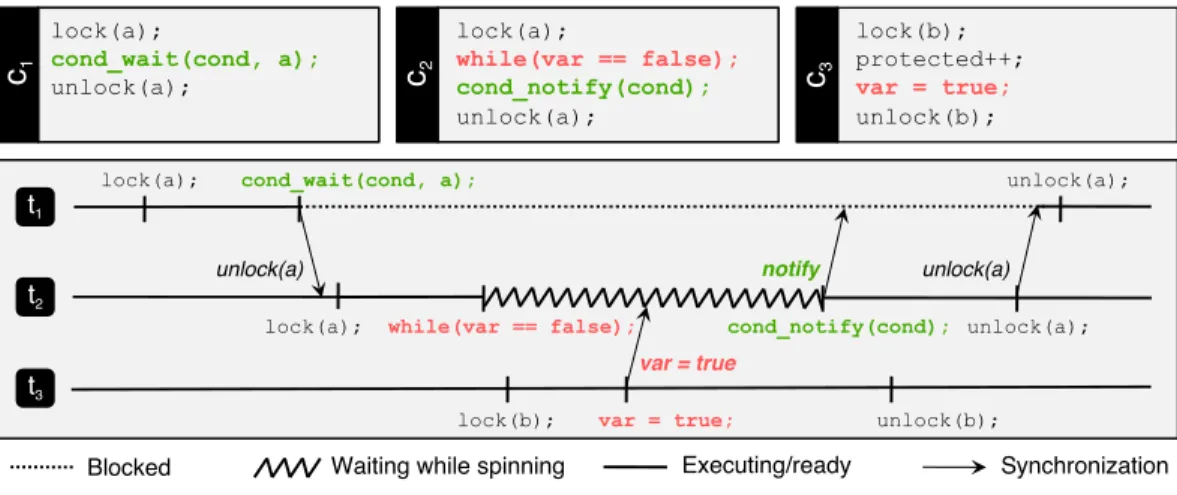
Ensuring liveness. Blocking and waiting within a critical section raise a problem of liveness, because a blocked servicing thread cannot execute critical sections associated with other locks, even when doing so may be necessary to allow the blocked critical section to unblock. A pathological case happens when the servicing thread busy-waits in a critical section while waiting for a variable to be set by another critical section that is handled by the same server but is protected by a different lock: this situation is illustrated by clients c2 and c3 in Figure 2. To ensure liveness, a pool of servicing
threads is maintained on each server to ensure that when a servicing thread blocks or waits, there is always at least one other free servicing thread that is not currently executing a critical section, and that this servicing thread will eventually be sched-uled. To ensure the existence of a free servicing thread, the RCL runtime provides a management thread, which is activated regularly at each expiration of a timeout (set to the operating system’s timeslice value) and runs at highest priority. When activated,
the management thread checks that at least one of the servicing threads has made progress since the last activation of the management thread, using a server-global flag is_alive. The management thread clears this flag just before sleeping, and any ser-vicing thread that enters a critical section sets it. If the management thread observes that is_alive is cleared when it wakes up, it suspects that all servicing threads are either blocked or waiting. In this case, it checks that no free thread indeed exists in the pool of servicing threads and if so, it adds a new one.
Ensuring responsiveness. Blocking, of any form, including waiting and preemption, degrades the responsiveness of the server because a blocked servicing thread is unable to serve other locks managed by the same server. The RCL runtime implements a number of strategies to improve responsiveness issues introduced by the underlying operating system and by RCL design decisions.
As was explained in Section 2, a well-known problem in the use of locks is the risk that the operating system will preempt a thread at the expiration of a timeslice while it is executing a critical section, thereby extending the duration of the critical section and increasing contention [Ousterhout 1982]. RCL dedicates a pool of threads on each dedicated server hardware thread to the execution of critical sections, which makes it possible to manage these threads according to a scheduling policy that does not use preemption. The POSIX FIFO scheduling policy is used, because it both respects priorities, as is needed to ensure liveness, and allows threads to remain scheduled until they are blocked or manually yield the processor. The use of the FIFO policy, however, raises a liveness issue: if a servicing thread is executing a busy-wait loop, it will never be preempted by the operating system, and a free thread will never be scheduled. To solve this, when the manager thread detects no progress, it makes sure a servicing thread is scheduled by first decrementing and then incrementing the priorities of the other threads, effectively moving them to the end of the FIFO queue. The use of the FIFO policy also implies that when a servicing thread unblocks after blocking in a critical section, it is placed at the end of the FIFO queue. If there are many servicing threads, there may be a long delay before the unblocked thread is rescheduled. To minimize this delay, the RCL runtime tries to always minimize the number of servicing threads: each servicing thread regularly checks that there are no other free servicing threads, and if there are, it leaves the pool, since another thread will be able to handle requests.
The RCL management thread ensures the liveness of the server but only reacts after a timeout. When all servicing threads are blocked in the operating system, the operating system’s scheduler is exploited to schedule a new free thread immediately. Concretely, the RCL runtime maintains a backup thread that runs at a lower priority than all servicing threads. The FIFO scheduling policy never schedules a lower priority thread when a higher priority thread that is not blocked exists, and thus the backup thread is only scheduled when all servicing threads are blocked. When the backup thread is scheduled, it adds a new servicing thread, which immediately preempts the backup thread and can service the next request.
Finally, when a critical section needs to execute a nested RCL managed by the same hardware thread and the lock is already owned by another servicing thread, the ser-vicing thread yields the processor in order to allow the lock owner to release it.
Example. Figure 2 presents a complete example of ad hoc synchronization in a crit-ical section that illustrates liveness and responsiveness issues. Initially, thread t1 is
the only servicing thread, and it handles a critical section of client c1. That critical
section tries to acquire a condition variable (cond_wait() function call), causing t1
to block at the operating system level. At that point, there is no more runnable ser-vicing thread. Therefore, the operating system’s scheduler immediately schedules the
Fig. 2: Ad hoc synchronization example
backup thread, which adds a new free servicing thread t2 that immediately preempts
the backup thread. Thread t2 executes c2’s request. Client c2’s critical section causes
t2to busy-wait on the variable var. At some point, the management thread awakens,
and clears the server-global is_alive flag. Then, at the management thread’s next ac-tivation, since t1is blocked in the operating system and t2is busy-waiting, no servicing
thread has been able to set is_alive. Since there is no free servicing thread at that
point, the management thread creates a new servicing thread, t3, and schedules it, as
it is now the only servicing thread that has not recently been scheduled. Therefore, at that point, the server has three servicing threads, t1, t2and t3, one of which, t3, is free.
When t3executes the request from c3, it modifies the value of var.
After executing client c3’s request, thread t3 detects that it is not the only free
ser-vicing thread in the pool: while t1 is blocked at the operating system level, t2 is free,
therefore, t3 yields the processor in order to let t2 be scheduled and make progress.
Since the critical section executed by t3 has set var, thread t2 can exit its busy-wait
loop and unblock the condition variable, causing t1 to awaken. Client c2’s critical
sec-tion ends, and t2detects that the server has two free servicing threads: itself and t3.
Consequently, thread t2 leaves the servicing pool. Thread t3 is then scheduled, but it
notices that there is no pending critical section. Furthermore, since it notices that an-other servicing thread is in the servicing pool and that thread is not free, it yields the
processor to let it make progress. Thread t1 is therefore scheduled, and it completes
client c1’s request, before noticing that two servicing threads are free, itself and t3.
Consequently, it leaves the pool of servicing threads: the server is back to its initial state, except its only servicing thread is now t3.
3.2.2. Detailed implementation.We now present the pseudo-code of key parts of the RCL
runtime. Algorithms 2 and 3 show the functions that can be used by clients to execute critical sections with RCL. Algorithm 4 show the pseudo-code of the servicing threads, and Algorithm 5 shows the pseudo-code of the manager and backup threads.
Executing a critical section. We provide a function named execute_cs_lock() that executes a critical section using RCL. When a client thread runs the execute_cs_-lock()function, it submits its request by filling the lock, context, and function fields of its request structure (the mailbox) in the requests array, as seen in lines 14-20 of Algorithm 2. On a RCL server, it is possible that during the execution of a critical section on a servicing thread, the execution of a nested critical section is requested,
ALGORITHM 2: Executing a critical section, “lock” mode (client)
1 thread-local variables:
2 int client_index; // An integer value that identifies this thread
3 boolean is_server_thread; // Is this thread a servicing thread, i.e., not a client thread?
4 server_t *my_server; // If this thread is a servicing thread, a pointer to the corresponding server
5 function execute_cs_lock(lock_t ∗lock, function_t ∗f unction, void ∗context)
6 var int real_me; // The identifier of the client thread from which the critical section originates
7 var request_t *request // A pointer to the mailbox that will be used to execute the critical section
8 request := &lock→server→requests[client_index];
9 if¬is_server_thread then
10 real_me := client_index
11 else
12 real_me := my_server→requests[client_index]→real_me
13 if¬is_server_thread or my_server 6= lock→server then // RCL to a remote hardware thread
14 request→lock := lock;
15 request→context := context;
16 request→real_me := real_me;
17 request→f unction := f unction;
18 while request→f unction 6=null do
19 pause();
20 return;
21 else // Local nested lock
22 while local_compare_and_swap(&lock→holder, NONE, real_me) = real_me do
23 yield(); // Give a chance to other thread to release lock
24 context := f unction(context); // Execute the critical section
25 lock→holder := NONE;
26 return;
Acquire fence Release fence
either (i) on the local RCL server if the lock of the nested critical section is handled by the same RCL server as the lock of the outer critical section, or (ii) on a remote RCL server, if the two locks are handled by distinct RCL servers. Servicing threads use the same method as clients to request the execution of a critical section that is managed by a remote RCL server. However, in order to request the execution of a critical section that is managed by the local RCL server, a servicing thread must ensure that the lock is free, and, if not, wait until it is free. In order to give a chance to the servicing thread that owns the lock to finish executing its critical section, the thread repetitively yields the processor (lines 22-23) while it busy-waits for the lock.
“Trylock” mode. While the execute_cs_lock() function can be used instead of traditional lock() and unlock() operations to execute a critical section using RCL, the execute_cs_trylock() function can be used instead of a traditional try-lock() operation, such as pthread_mutex_trytry-lock() on POSIX systems. The pseudo-code of execute_cs_trylock() is shown in Algorithm 3. Like execute_cs_lock(),
execute_cs_trylock() takes three parameters: a lock, a function, and a context
ob-ject. The first byte of the context object must be reserved since it will store a boolean value that is equivalent to the return value of a traditional trylock() operation.
The execute_cs_trylock() function first checks whether the lock is taken; if so, it stores the value false into the first byte of the context object to signal the client thread that the lock was not acquired (line 15), and it runs the function locally (line 16). If the lock was free, however, execute_cs_trylock() stores true into the first byte of the context object (line 18) and executes the critical section using RCL through a call to execute_cs_lock() (line 19). The execute_cs_trylock() function
ALGORITHM 3: Executing a critical section, “trylock” mode (client)
1 thread-local variables:
2 int client_index; // An integer value that identifies this thread
3 boolean is_server_thread; // Is this thread a servicing thread, i.e., not a client thread?
4 server_t *my_server; // If this thread is a servicing thread, a pointer to the corresponding server
5 function execute_cs_trylock(lock_t ∗lock, function_t ∗f unction, void ∗context)
6 var int real_me; // The identifier of the client thread from which the critical section originates
7 if¬is_server_thread then
8 real_me := client_index
9 else
10 real_me := my_server→requests[client_index]→real_me
11 if lock→holder then
12 if lock→is_recursive and lock→holder = real_me then
13 ((char∗)context)[0] =true; // Recursive lock already acquired by me : trylock success
14 else
15 ((char∗)context)[0] =false; // Lock already acquired: trylock failure
16 context := f unction(context); // Execute function, lock may not have been acquired
17 else
18 ((char∗)context)[0] =true;
19 execute_cs(lock, f unction, context); // Lock seems free, acquire (may busy wait)
also handles recursive locks, in a similar way to pthread_mutex_trylock() used with a PTHREAD_MUTEX_RECURSIVE POSIX lock: if the lock’s is_recursive field is set to
true and the lock has already be acquired previously in a parent critical section,
execute_cs_trylock() will store true in the first byte of the context object and run
the new critical section locally (line 16).
Note that while execute_cs_trylock() is useful to support legacy applications that use calls to pthread_mutex_trylock(), its behavior differs from a traditional trylock: a client c that calls execute_cs_trylock() may have to wait for a significant amount of time before its critical section is executed, since the server may execute other critical sections before c’s.
Servicing threads. Algorithm 4 shows the pseudo-code of servicing threads. Only the fast path (lines 12-25) is executed when the pool of servicing threads contains a single thread. A slow path (lines 26-33) is executed when the pool contains several servicing threads.
Lines 12-23 of the fast path implement the RCL server loop described in Sec-tion 3.1. Note that even though a large memory block is allocated for the request array (256 KB), we only poll its first elements as was explained in Section 3.1 (the last element we poll corresponds the client thread with the highest identifier, and identifiers are reused to remain low). The servicing thread indicates that it is not free while it is executing the server loop by decrementing (line 14) and incre-menting (line 25) number_of_free_threads. Because the thread may be preempted due to a page fault, all operations on variables shared between the threads, includ-ing number_of_free_threads, must be atomic. However, since servicinclud-ing threads of a RCL server are all bound to that server’s dedicated hardware thread, the atomic instructions that only use server-local data only need to be executed atomically in the context of the threads running on the local hardware thread. Therefore we use hardware-thread-local versions of the atomic operations that do not request machine-wide ownership of the cache lines they are working on (local_fetch_and_add() and
local_compare_and_swap() in the pseudo-code). In x86 assembly, this is done by