Publisher’s version / Version de l'éditeur:
Vous avez des questions? Nous pouvons vous aider. Pour communiquer directement avec un auteur, consultez la première page de la revue dans laquelle son article a été publié afin de trouver ses coordonnées. Si vous n’arrivez pas à les repérer, communiquez avec nous à [email protected].
Questions? Contact the NRC Publications Archive team at
[email protected]. If you wish to email the authors directly, please see the first page of the publication for their contact information.
https://publications-cnrc.canada.ca/fra/droits
L’accès à ce site Web et l’utilisation de son contenu sont assujettis aux conditions présentées dans le site LISEZ CES CONDITIONS ATTENTIVEMENT AVANT D’UTILISER CE SITE WEB.
Research Paper (National Research Council of Canada. Division of Building
Research), 1977
READ THESE TERMS AND CONDITIONS CAREFULLY BEFORE USING THIS WEBSITE. https://nrc-publications.canada.ca/eng/copyright
NRC Publications Archive Record / Notice des Archives des publications du CNRC :
https://nrc-publications.canada.ca/eng/view/object/?id=a41633ad-7943-45f2-9d38-31d10215340f
https://publications-cnrc.canada.ca/fra/voir/objet/?id=a41633ad-7943-45f2-9d38-31d10215340f
NRC Publications Archive
Archives des publications du CNRC
This publication could be one of several versions: author’s original, accepted manuscript or the publisher’s version. / La version de cette publication peut être l’une des suivantes : la version prépublication de l’auteur, la version acceptée du manuscrit ou la version de l’éditeur.
For the publisher’s version, please access the DOI link below./ Pour consulter la version de l’éditeur, utilisez le lien DOI ci-dessous.
https://doi.org/10.4224/40000448
Access and use of this website and the material on it are subject to the Terms and Conditions set forth at
Movement of people in building evacuations
Ser
TH1
N21d
no.
736
c . 2
1
*
National Research
Conseil national
Council Canada
de recherches Canada
BLDG
ANAL'
MOVEMENT OF PEOPLE IN BUILDING EVACUATIONS
by
J.L.
Pauls
CReprinted, with permission, from
Human Response to Tall Buildings
6-4-38
Chapter 21, p. 281
-
292
D.
J.
Conway,
ed.,
Dowden, Hutchinson and Ross
Stroudsburg,
Pa.
Community Development Series, Vol.
34, 197
7
DBR
Paper No.
736
Division of Building Research
T - - - - - --
SOMMAIRE
Le mouvement d e s p e r s o n n e s d a n s l e s e s c a l i e r s d e s o r t i e
e t a u t r e s i s s u e s a 6t6 6tudi6 d a n s d e s e x e r c i s e s d16vacuation
d e s t o u r s de b u r e a u x e t a u c o u r s d e s o r t i e s n o r m a l e s d a n s
d l a u t r e s 6difices. L 1 a u t e u r d 6 c r i t l e n o m b r e de p e r s o n n e s ,
l e s v i t e s s e s et l e s mouvements.
L e s r 6 s u l t a t s soul'event
d e s q u e s t i o n s
auant
aux id&-h==rL=L=+i
de c a l c u l p r 6 -
c i s e s
d
et
l e s guides
actuels
us r 6 a l i s t e s
du ter
our r 6 u s s i r
d'autrr
~ i l
f a u t con-
s i d 6 r q
- - - -- -b f i c e s e t l e s
modzd
/ur
l e be s o i n
d e r s
bnt
humain.
1I
21
INTRODUCTION AND OBJECTIVESA N ~ ~ ~ z ~ D
Facilities for the movement of people are a major concern in building and firc codes, particularly in situations where rapid egress i s required for occupant
Movement of
safety in emergencies. Fire i s usually considered the most probable reason for rapid evacuation of all orPeople in Building
part of a building; however, other emergency condi- tions, such as bomb threats, tornadoes, or loss of elec- tric power might lead to evacuation in certain typesEvacuations
of buildings. The problem of fire in high-rise buildings has re- ceived much attention recently in the popular and technical literature, including building and fire codesj.
L.
Pauls
[ 1-91 .
Although difficulties in evacuation in high-riseNational Research Council o f Canada
fires are frequently mentioned (along with problemsof smoke movement and firc department access), little original research has been done on this subject
[ l o - I S ] .
The limi~ed recorded rationale for present- day exit rcquircments in codes i s often based on a few, very limited dnd datcd studies of movement in buildings[16-22].
The literature on cvdcudtion i s largcly based on studics of thc movcmcnt of pcople in contexts not pcrccivcd as genuinc firc cmcrgcncics. Information, cspccially quantitative informdtion, about how peo- plc move in buildings during actual fires is difficult to bbtain. A few rescarchers have cxamincd in detail thc bchavior of persons in fires; a much larger research effort, however, has been on their behavior in large- scale cmcrgency situations, c.g., natural disasters
123-273.
(A paper in press reviews these areas in slightly more detail[28].)
Such studies indicate that,contrary to popular belief, panic
is
relatively rare in I these situations; in general, people cope remarkablywell not only with fire emergencies but also with a wide variety of disaster situations.
Research on behavior in a range of circumstances should assist greatly in the transition from findings about movement in nonemergency or drill situations This chapter is a contribution of the Division of Building Re- search, National Research Council of Canada, and is pub- lished with the approval of the director of the division. 28
1
3
4W.236
to hypotheses about evacuation in cases of actual fire in buildings. I t should be noted that communication systems, increasingly being provided in high-rise buildings for use in fire emergencies, have a consider- able influence on how people perceive an emergency or a drill situation. This is one of the factors that may influence people to construe a drill situation as an actual emergency or conversely an actual emergency
as a drill[l41. Therefore it seems reasonable to assume that the findings reported below, although based on observations of drills and normal egress, are generally applicable to many evacuation situations.
These introductory comments indicate not only the need for more detailed information about occu- pant movement in high-rise building fires but also the potential validity of developing such information in nonfire situdtions, such as drills. Studies o f crowd egrcss in high-rise office buildings and in buildings with public assembly occupancies have been con- ducted during the last six years in Canada. The objec- tive of these studies of movement of people was to develop largely empirical information which would contribute to improved design and operation of buildings, both through direct communication with designers and others in practice and through the medium of building codes[14,29J.
STUDY METHODS
In 1969 the duthor was invited to take part in ob- servations of a test cvacuation of Vancouver's twenty- [wo story 0. C. Hydro office building. Working with a tcdm of >eventeen observers, an attempt was made to rccord key events and conditions during the phased cvacuation of about 1,000 people (with a fire floor and lower floors cleared first). The reportll2j based on these observations describes the building and its occupancy; evacuation planning, organization, and procedure; key events during the drill (shown on a time scale); the speeds, flows, and densities o f people on the exit stairs; environmental conditions in the stairs; and some findings of a questionnaire given to evacuation-control personnel in the building.
As a result of this study the author was invited by Canada's Dominion Fire Commissioner t o conduct observations of a variety of evacuation exercises usually held in buildings occupied by the federal gov- ernment in Ottawa. Between 1970 and 1974 some forty test evacuations were observed in office build- ings ranging between eight and twenty-nine stories in height.
The majority of these evacuations were total evacuations (in which all occupants attempt to leave the building more or less simultaneously by way of exit stairs). The chief goal in observations of such total evacuations was the collecti@n of data describing crowd movement down exit stairs.
Other observed evacuations in the larger buildings used more selective procedures in which particular floors of buildings were cleared in a predetermined sequence (floors in the assumed fire areas, then the top floors, and then perhaps the other floors in descending order). In addition to documenting crowd movement down stairs, observations were made of the use of communication systems and the super- vision of evacuation by fire wardens.
Observation techniques included equipping between two and fifteen observers with portable cas- sette recorders operating continuously to register all observations and background sounds. These observa- tions, plus tape recordings of communication systems used in the evacuations, supplemented by visual rccords provided by slide photography and video tape recording, could all be played back in the correct time scale. For example, the time at which each photograph was taken was readily recorded by attach- ing a cassette recorder microphone directly to each camera so that the shutter operation, the camera operator's comments, and the background soundtrack were recorded automatically.
Using these techniques, each evacuation drill could be rerun for detailed analysis. Such a large amount of raw data was produced in some drill observations that the processing is not yet complete. A good example of how extensive such observations could be occurred in a twenty-one-story office building from which over 2,000 people were evacuated without prior warning
I
Movement o f People in Building Evacuations 283according to a phased procedure requiring nearly thirty minutes to complete. Nearly twenty channels of audio recording were made at both fixed and mov- ing observation positions. As in other drills, observers moving with the evacuees from floor areas to the building exterior were able to record information about many behavioral variables, often without attracting the attention of people only a few feet away.
Questionnaires were distributed to about 10 per- cent of the population of two buildings immediately following evacuation drills. Results revealed that some evacuees interpreted these surprise evacuation drills as genuine emergencies. Other results described the evacuees'normal use of exit stairs, their capability with stairs, their perceived speeds and densities during the evacuation, etc. The questionnaire included nearly forty items, many of which provided insights not otherwise quickly obtainable.
Aside from the challenges of recording human behavior under field conditions, i t is difficult to manip- ulate and display data so as to provide useful informa- tion about the complex phenomena being studied. These difficulties are made more acute by the almost total lack of precedents for movement studies, either in high-rise office buildings or in public-assembly buildings. For this reason, charts such as shown in Figures 21-1 and 21-2 require more than a quick glance to appreciate their meaning and potential usefulness. (Similar charts have been used by Pred- tetschenski and Milinski [20]
.)
Figures 21-1 and 21-2 show, in graphical form, two basic procedures that can be used to evacuate some or all occupants from a high-rise building in case o f fire. In both charts the vertical scale is a spatial dimension, effectively the egress path provided by the exit stairs serving each story o f a building. The horizontal scale i s time, measured from the initiation of a fire alarm which begins the evacuation. Each line on the chart i s a movement trace indicating where a particular evacuee i s in the exit stair at a particular time. Such traces usually record the observers' move- ment down the stairs with evacuees.
The slopes of the
lines indicate speeds o f movement.Figure 21 -1
Total evacuation of fifteen-story office building.
Figure 21 -1 displays movement traces characteris- tic of total evacuations, the conventional procedure where all building occupants attempt to leave the building at the same time. Illustrated i s the total evacuation of a fifteen-story office building with with two 44-in. (1.12 m) wide exit stairs. Each story is assumed to contain seventy persons at the tlme the evacuation begins. Applying somewhat optimistic but still realistic evacuation-initiation and flow asssump-
1% -
1
' t t ,
C - , I V L C U & l l , ) M O f I L I lI ' L K S O N I H I I I ' I l U K I
O O P N 1 x 1 1 S I A I K
Figure 21-2
tions, it can be predicted that such a building will be cleared of all people, by means of the stairs, in just under nine minutes.
Figure 21-2 shows movement traces characteristic of phased, partial evacuations in which both the need to evacuate particular floors and the priority of such evacuations are determined by trained staff in the building or by fire department personnel. Communi- cation systems are used to help make decisions and give directions regarding such an evacuation. In Figure 21-2 the fifteen-story building i s assumed to have a fire on the tenth story. Only the top half of the build- ing i s evacuated and people from the upper floors may be directed to seek refuge on certain lower floors or they may be moved to the building exterior at ground level. In any event, because of the time re- quired to control an evacuation using a phased pro- cedure, nearly nine minutes are required merely to move half the building population to below the fire area.
Charts such as shown in Figures 21-1 and 21-2 can be used to illustrate a variety of procedures as well as particular events (e.g., movement up stairs by fire department personnel, and smoke contamination of portions of exits). Graphical simulations using such formdts are also very useful. Rather than de- scribing this in detail, a report will be given of somc study findings that must be understood to give such chdrts proper dimensions and make reasonable quan- titative predictions about crowd movement on stairs.
FINDINGS PERTAINING TO TOTAL EVACUATIONS
Observations
of thirty total euacua~ion drills dealt almost entirelv wilh movement of crowds down exit stairs. The observations were made in office buldings ranging between eight and twenty stories in height w i t h evacuation populations ranging betwecn 130 and 1.500 persons. Elevators and voice camrnunicati~n systems were not used in these evacuations. Important variables and factors such as density, personal space,crowd configuration, speed, flow, and evacuation time are described below with a brief report of pre- liminary findings.
Density and personal space
Density, or number of persons occupying a certain space, i s influenced not only by the number of per- sons who must use the stairs during an evacuation but also by individual psychological desire for space and interpersonal separation. In the total evacuation drills most evacuees chose to occupy a space requiring an average of about two stair treads, of a typical 44-in. (1 .l2-m) wide exit stair (Figure 21-3). In terms of density, the inverse of unit area, the average density in total evacuations was about 0.14 persons per square foot (1.5 persons per square meter). Further discussion of density and movement, not necessarily in evacuation situations, is given by Fruin in his book on pedestrian planning[21]
).
The space that evacuees regard as acceptable while they are i n the exit depends on many factors including speed o f movement, type of clothing worn, relation- ship to people sharing the exit space, and individual emotional state. The limited information about the space a person tries to maintain around himself sug- gests that in situations perceived as real emergencies a larger personal space i s desired[301. This could lead to lower densities in exits or, alternatively, i f more space were not available, to increased discomfort, per- haps even extreme anxiety regarding personal safety.
Crowd configurations
Evacuees did not walk in a highly regimented fashion, shoulder to shoulder, or even in regular stag- gered files. Side-to-side body sway, individual concern for interpersonal separation, varying needs for hand- rail support, and concern about not rubbing against sometimes rough walls, all influence
the
configuration of evacuees on exit stairs. Thus the traditional assump-Figure 21 -3
Frequency distribution of unit area (stairway area per person) i n seventeen stairways during evacuations o f high office buildings.
tion about units of exit width or regular lanes of egress movement[16,22] i s to be questioned. Further discussion of the questionable validity of the tradi- tional unit of exit width concept i s given below in dis- cussing flow rates.
Speed of descent
Speeds of descent on exit stairs varied according to density (Figure 21-4). Widely separated individuals could move at speeds up to about eight stories per minute. At the apparently comfortable density of about one evacuee on every two treads of a typical 44-in. (1.12-m) wide stair, the descent speed was about four stories per minute, the equivalent of about 100 ft. per minute (30 m per minute) along the slope of the stairs. With three evacuees on every two treads, the descent speed approached zero.
Flow
D E N S I T Y I N S T A I R W A Y . P E K S O N l S O F T .
Figure 21 -4
Effect o f density on speed down exit stairways in evacuations of high office buildings.
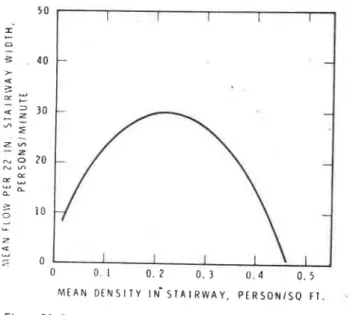
21-5 shows this relation, calculated using the equa- tion for flow as the product of density, speed, and stair width.
Several things should be noted in Figure 21-5. First, the mean flow i s stated in terms of 22 in. (0.56 m) of stairway width simply to make the graph more easily understood by designers and officials who normally work with this unit of exit width concept. Second, the mean flows actually measured in total evacuation drills almost invariably fell below the curve plotted in this figure. Thus, this curve should be used only to make the most optimistic predictions of mean flows to be expected in total evacuations. I t can be reported that, in general, the mean flows for all observed total evacuations averaged only twenty- four persons per minute per 22 in. (0.56 m) of stair width. During a total evacuation in mid-winter, when evacuees wore bulky clothing, mean flows were only about twenty persons per minute per 22 in. (0.56
m)
MEAN DENSITY I N - S T A I R W A Y , PERSONISQ FT. . Figure 21 -5
Effect of density on flow down exit stairways in evacuations of high office buildings.
somewhat greater than the density that evacuees may regard as most acceptable in terms of comfort.
Possibly the most striking feature o f such flows i s that they are much lower than the conventionally assumed flow figure of forty-five persons per minute per 22 in. (0.56 m) of stair width. This figure i s often assumed in exit design regulationsl22). An examina- tion of highly influential reports such as that pub- lished in 1935[ 161 suggests that a figure of forty-five persons pcr minute i s based on somewhat drtificial
test results that are not good indicators of what can be achieved by typical building occupants in a total evacudtion. Tests performed by the duthor as well as other earlier tests reported in the literature[ 171 con- firm that very high flows down stairs can be achieved only in very contrived situations involving specially motivated groups of individuals who temporarily dis- regard the normal need for personal space. Figure 21-6 shows that higher flows, even in total evacua- tions, dre only sustdined for very brief periods o f time ~ n d should not be used in predicting mean flows in totdl evacudtions.
Figure 21-6 dlso shows thdt, when other factors
+ 0, 1 5 0
t
b S U S l A l l J 1 U FOR P t K l O D +.- + OF A T L ! , l 5 T 3 h l l N U T t S-
31
E X I T S T A I R W A Y W I D T H . F E E T , Figure 21-6Effect o f exit stairway width on flows in evacuations o f high office buildings.
affecting flow are controlled, flows on stairs are pro- .
portional to stair width, at least in the range o f stair widths observed. Counts o f flows on stairs having widths of 36, 42, 44, 45, 47, 48, 56 and 60 in. (0.91 m to 1.52 m) suggest that the conventional unit of exit width concept, which recognizes only 22-in. and 12-in. (0.56-m and 0.31-m) increments in crediting exit width, is unreasonable. In other words, flow plotted against stair width i s a ramp function rather than a step function, as assumed in building codes [ 2 2 ] . With increasing use of performance require- ments dnd also with the impending conversion to metric, use o f an exit-design formula based on a mean flow of about four to five persons per minute per 0.10 m (4 in.) of stair width appears more realistic and flexible than the traditional 22-in. (0.56-m) unit o f exit width formula.
A minor constriction in the width o f the egress path does not significantly reduce egress flow. For example, a crowd descending a stair 48 in. (1.22 m) wide can move through a 36-in. (0.91-m) doorway without reducing the flow below the fifty to sixty persons per minute sustained on the stair alone. Ob-
t 1 1 1 1 1 l f l be aware that some simplifying assumptions have m 30
- ...
been made in developing Figure 21-7. For example, i tY 30 STOR l ES
+
-
is assumed that evacuees take with them only the3 2 0 STORIES
z
-
clothing normally worn at their work place. I f cloth--
zi
--
-
10 STORIES ing intended for protection from rain or moderatelyd20
-
cool outdoor conditions i s worn or carried, evacua-s
-
C
tion time will probably be increased by roughly 15
z
-
i percent. If, for mid-winter cold weather conditions,0
-
C evacuees prepare for more than a few minutes of out-
-
door exposure by putting on or carrying bulky out- door clothing, the evacuation time will be increased-
by roughly 25 percent.The information in Figure 21-7 is based on the
0 ~ 1 1 1 1 1 1 1 1 1
o
500 1000 following assumptions: (1) the evacuees are typicaloffice workers with some previous experience of R U l l D l N G POPULATION PER 22- I N . STAIRWAY W I D T H total evacuation drills in high-rise office buildings,
Figure 21 -7 (2) the evacuees will not be aware of the reason for Predicted total evacuation times of tall office buildings using although most may believe that the dlarm
exit stairways. has not been activdted by a serious emergency, (3) there i s some trained supervision on each office floor, servations also indicate that crowd flow is not greatly i.e., evacuation of confused or reluctant occupants I
I
affected by minor constrictions caused by an occa- will begin within a minute or two of the alarm's beingsional person stopping at one side on the stair nor by sounded.
having a few fire fighters walk up the stairs against Even in situations where these assumptions are the descending flow of evacuees. true, there will be a range of actual evacuation times. For the particular conditions described, perhaps 90 percent of the actual evacuation times will be within Evacuation time
+
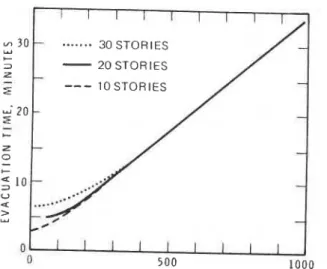
20 percent of the times predicted. During those evacuation drills in office buildings in Ottawa, which Based on empirically derived density, speed, and were held under fair weather conditions (i.e., no spe- flow relations and partially validated by observed cial outdoor clothing requirements), the actual evacu- total evacuation times, Figure 21-7 shows that the ation times for thirty-eight exit stairs were, overall, time required to complete the total evacuation of an only about3
percent longer than the time predicted office building i s mainly dependent on actual building in Figure 21-7. (Almost all these buildings had fewer population and available stair width. Buildings with than 200 evacuees per22
in. of exit stair width.) small populations will have reduced densities and The total evacuation times predicted in Figure 21-
flows in the exit stairs, and thus the graph is nonlinear 7 are about 50 percent longer than the times sug- at the left. At the extreme left side of Figure 21 -7 gested in previously published predictions[l 1
1.
Total the predicted evacuation time is the time taken by a evacuations in mid-winter could take twice the time single individual to react t o an alarm and descend the suggested in previously published predictions. stairs. Thus, for this condition, evacuation time is Typical populations of general-purpose office almost entirely determined by building height. buildings appear to be about half as great as i s often I n predicting evacuation times in office buildings assumed in building codes (i.e., one person for every with a variety of occupancy conditions, one should100
sq. ft. of gross rentable area). Thus, errors causedby previous optimistic predictions of evacuation flows and times may fortunately be offset by the use of very conservative population assumptions. Now that a better appreciation of evacuation flow i s avail- able, i t i s important that factors, in addition to popu- lation, be more carefully examined so that evacuation time predictions and other expectations will have greater validity. Such factors include normal stair use, evacuee experience with previous drills, the manage- ment aspects of high-rise evacuations, and evacuees' physical abilities (discussed below).
An improved ability to predict total evacuation times i s somewhat academic unless the factors that affect the acceptability of the times are considered. For example, when a serious fire occurs, how much time is available before floor areas become smoke logged[l,S] and for what period of time can exit stairs be used by crowds of evacuees before smoke be- comes psychologically or physiologically unaccept- able [25,31
]
? Will the use of an exit stair for fire de- partment access and firefighting operations rule out the use by evacuees of one or more exit stairs after five, ten, or fifteen minutes? Traditionally, seven to ten minutes has been considered acceptable as a workable total evacuation time, but this criterion, like many others, i s now in need of reexamination. At somc set of building and occupancy conditions (height, number of stories, construction, population, occupant characteristics, etc.) other approaches to coping with life safety in high-rise fires become more appropriate. Figures 21 -1 and 21 -2 give some indica- tion of the limiting conditions that might be consid- cred in choosing between the total evacuations already described and the selective, phased, partial evacuations now to be described.FINDINGS PERTAINING TO SELECTIVE EVACUATIONS
In phased evacuations, exit stairs are generally re- served during initial stages of evacuation for people on the fire floor and adjacent floors (Figure 21-2).
The ten-phased evacuation drills observed in high-rise buildings in Ottawa included sequential evacuation of occupants on some or all o f the other floors, starting from the top. The upper floors could become unten- able before most o f the lower floors because o f smoke movement due to stack effect during cold weather[l,S]
.
In buildings having zoned air-handling systems for groups o f floors, th priority with which floors are to be evacuated could differ.Movement characteristics
In the drills observed in Ottawa the phasing or se- quencing of evacuation usually resulted in much lower overall evacuee densities and flows but higher descent speeds than was the case with total evacua- tions. The following example illustrates these and other features o f the observed nontraditional, evacua- tion procedures.
I n a phased, partial evacuation of a twenty-two- story office building 195 people from floors 14, 15, 13, and 22 walked, in that sequence to the ground floor, following instructions communicated on the building's public address system. The average flows on the two 38-in. (0.97-m) exit stairs, from the time the first evacuee reached the ground to some nine minutes later when the last evacuee reached the ground, were about twelve persons per minute or about seven persons per minute per 22 in. (0.56 m) of stair width. Flows were somewhat intermittent; peak flows, sustained for periods of at least 15 seconds, reached forty-eight persons per minute or twenty- eight persons per minute per 22 in. (0.56 m) of stair width. This compares with average peak flows of thirty-two persons per minute per 22 in. (0.56 m) of stair width in total evacuations. Even during peak flows the density on the stairs only reached 0.1 7 per- son per square foot (1.8 persons per square meter) or approximately two stair treads per evacuee. On the average, each evacuee occupied nearly four stair treads of area. Speeds of descent ranged from 3-112 to 6 stories per minute.
Movement of People in Building Evacuatiom 289
This example i s typical of phased, partial evacua- tion drills observed in Ottawa office buildings. By comparison, the hypothetical phased, partial evacua- tion of 490 people illustrated in Figure 21-2 assumes similar density and speed conditions; however the flow i s assumed to be less intermittent (with the mean flow assumed to be twice as great as described in the example above).
Time required
Optimistic, perhaps unrealistic, assumptions are made in Figure 21-2 regarding the time required for the building's fire-emergency personnel to ascertain the fire location and severity, make decisions about needed evacuation, and direct occupants with appro- priate public address announcements. In the above example of the phased evacuation of a twenty-two- story building, about five minutes of the twelve min- utes elapsing between the initial alarm and the arrival of the last evacuee at the ground floor was taken up with such management aspects of the selec- tive evacuation procedure. In other words, the effi- cient use of exit facilities is not only dependent on the evacuee's movement down stairs but i s also greatly influenced by management of the evacuation, either by building fire-emergency personnel or by fire department personnel.
Communications
Selective evacuation procedures require that pub- lic address and telephone systems be provided and maintained, and that trained, experienced persons are present to supervise the evacuation. The training of personnel to operate fire emergency communication systems before fire department personnel arrive or, under fire department supervision, after their arrival is a major concern of the Dominion fire commissioner in Canada. I n has been found, for example, that many people selected from among those working in a build-
ing cannot cope with the stress and responsibility of operating communication systems even in a training and practice context where a variety of emergencies are merely simuIated[32,33]
.
Preprogrammed, recorded public address an- nouncements, although they have some advantages over live announcements[2,34], may cause difficul- ties when activated by false alarms or by legitimate alarms registered on a floor above or below the fire floor. There i s thus still a need for competent person- nel to operate communication equipment to over- ride, on occasion, automatic systems.
Refuge behavior
Selective approaches to high-rise evacuation are made possible by the provision and proper operation of systems for fire and smoke control and for com- munication. Aside from the problems of making such systems work, there are a number of other difficul- ties, including occupant-behavior, that are not yet re- solved. For example, i t is not clear whether people who are aware of a fire in a high-rise building will tolerate remaining in probably safe refuge areas, lo- cated perhaps above the fire floor. In addition to asking the question "Are refuge areas safe?" one must also ask "Are refuge areas perceived to be safe by those who have to use them?"
Information on the behavior of people in fires is
extremely limited. What information we do have in- dicates that people cope remarkably well in fire emergencies[25]. Behavior that may appear to be excited and disorganized i s often quite reasonable. Unfortunately, the information that does exist on this subject pertains almost entirely to situations where people have the opportunity of evacuating or escaping to the perceived safety of the outdoors rela- tively easily (in contrast to what might be the case in a large high-rise building). To accomplish this, people will even move considerable distances through smoke- contaminated spaces[25]. What i s needed now i s in- formation on such factors as how people will behave
in a perceived refuge situation, what messages should be directed to them, what supervision should be pro- vided, and what activities they should undertake to reduce anxiety and the desire to escape.
I t i s not surprising, therefore, that many large high-rise buildings are being designed and operated in
a far more sophisticated manner than was the case even a decade ago. I f these measurcs prove reliable, fire in a high-rise office building will be far less dis- ruptive, with occupants carrying on their normal activities, perhaps oblivious of the fire. This seems to be common in high-rise apartment buildings. Unfor- tunately, it will be some time before this i s generally
the casc in office buildings and thus the ability of
building occupants to move quickly in case of firc i s still importdnt.
MOVEMENT ABILITY AND SAFETY
Brief mcntion should be made of the capability of typicdl officc workers to cvacuatc to refuge spdccs or to the outdoors by means of stairs. I f the officc workers obscrvcd in thc Canadidn officc building cvacudtlon5 drc rcprescntdtivc, as they .ippedr to be, it
IS c\tim'tted thdt about 3 pcrccnt of the pcrsons
usudlly prcscnl in high-rise officc buildings cJnnot or 5hould not dttcmpt to cvacudtc by mcdns of crowded stairs. In 'idd~iion to those with obvious physical dis- ~bilitics, this minority includes people with heart disorders and convalescents from rcccnt illncss, w r - gcry or c~ccident. Movcmcnt of thcsc individudls to d
pldcc of sdfety will require additiondl pldnning dnd dssi5tdncc from other occupants. This could include thcir dcsccnding thc stairs behind able-bodied occu- pants, be~ng cdrricd by othcrs down thc >tdirs, or having clcvator5, operatcd by firc dcpdrtmcnt person- nel, t,~l\c them to sdfcty.
Evdcuces who responded to d qucstionndire after
the complete cvdcuation of d twenty-one-story office
bullding judgcd thcir capabilities of dcsccnding stairs "without stopping, at d normdl speed, and without
,issist,~~icc from others" ds follows 97 pcrccnt felt
capable o f at least three stories of stairs and 64 per- cent felt capable of descending at least twenty stories. Only 27 percent reported ever having descended twenty stories at one time before the evacuation was held[l4]. Nine percent, mostly from the upper half of the building, did not feel capable of descending all the stairs from their normal work floor. (The ques- tionnaire also dealt with normal use of the exit stairs. Currently, the Division of Building Research at the National Research Council of Canada i s attempt- ing, through field observations in Ottawa office build- ings, to document such normal use which, aside from having economic implications, is relevant to people's ability to use those stairs in emergencies.)
Although people's belicfs about their stair move- ment capability are important, their actual perfor- mance i s a more immediate concern in afire-emergency evacuation. Observing crowds move down stairs, both in officc building evacuations and in other situations,
onc i s oftcn impressed by how well people manage,
including people with obvious disabilities. I t is note- worthy, in this regard, that no injury-causing accidents were reported in the observed evacuation drills in Ottawa, cvcn with obscrved total stair use exceeding 75,000 pcrson-stories.
Equally noteworthy are some preliminary findings from currcnt Canadian studics of crowd egress from grandstands and other buildings with public assembly occupdncles~35). In thc cdsc of a new 17,000 seat triple-tier grandstand in Cdlgary, the people using the building's 200 flights of stairs had a greater variety of dgcs and dbilitics than normally found in officc build- ings. Even though totally unfamiliar with thc build- ing, they used thc stdirs effcctively (a mean flow of twenty-three persons pcr minute per 22 in. of stair width) dnd surprisingly safely, particularly in situa- tions whcre stdirs were crowded.
Although thcsc studics suggest a degree of stair sdfety, they must bc regarded with caution. More de- tailed observations of egress flow by crowds on stairs are needed to assess risk of dccidcnt properly and to understand better thc factors that cduse accidents. In addition to thc on-going crowd egress studies by the
Movement of People in Building Evacuations 297 Division of Building Research, stair design and safety
studies recently done in the United States are proving very useful and should be considered in the design, regulation, and operation of buildings[36-381.
CONCLUDING REMARKS
As the studies reported here deal largely with crowd movement in buildings, the information gained i s particularly applicable to traditional total evacua- tion procedures and facilities. Findings provide an im- proved basis for making predictions of total evacua- tion time of tall office buildings and for designing the exit stairs used for total evacuations. This informa- tion comes at a time when, increasingly, high-rise buildings are being designed in a more sophisticated manner to reduce the hazards of fire and obviate the need for total evacuation in case of fire. Nontradi- tional evacuation procedures, some using facilities other than stairs, are being proposed and in some cases adopted[4,13,27,39]. Their testing under field conditions is, however, very limited. Thus, as was the case with total evacuation procedures, overoptimistic assumptions may be made, leading to a false sense of security about their efficacy. For example, the re- ported observations of evacuation drills using nontra- ditional procedures indicate that effective fire- emergency organizations, occupant training, and communications are needed to carry out selective evacuation. Currently, aside from government- and institution-occupied buildings, most tall buildings do not have fire-emergency organizations[40] and their occupants are largely unaware of fire-safety facilities and their use in emergencies. Some emergency com- munication systems, now being installed without adequate standards for either design or maintenance, may fail to function as expected even if trained per- sonnel are available to use them.
In general, neither basic knowledge regarding fire emergency measures, including evacuation, nor related building design and operating practices have kept pace with society's propensity and ability to
construct large buildings. More research i s needed and the preliminary studies of evacuation reported herein should only be considered part of an initial phase of such research.
REFERENCES
1. Wilson, A. G., and Shorter, G. W. "Fire and High Build- ings." Fire Technology 6, 22 (Nov. 1970):220-49. 2. General Services Administration. "International Confer-
ence on Fire-safety in High-Rise Buildings." Warrenton, Va., 1971. Washington, D.C.: U.S. Government Printing Office, 1971.
3. National Fire Protection Association. "High-Rise Building Fires and Fire Safety." NFPA No. SPP-18, Boston, 1972. 4. Associate Committee on the National Building Code. "Measures for Fire Safety in High Buildings." National Research Council of Canada, Ottawa, 1973.
5. ASHRAE Handbook and Products Directory: 1973 Sys- tems Volume, Chapter 41, "Fire and Smoke Control." New York: American Society of Heating, Refrigerating and Air-Conditioning Engineers, Inc., 1973.
6. City of New York, Local Law No. 5, "Fire Safety Re- quirements and Controls." The City Record. New York, 1973.
7. America Burning: The Report of the National Commis- sion on Fire Prevention and Control. Washington, D.C.: U.S. Government Printing Office, 1973.
8. Degenkolb, G. "The Evolution of High-Rise Fire Protec- tion." Building Official ond Code Administrator, Sept. 1974, pp. 26-32; Oct. 1974, pp. 20-31.
9. Harrison, G. A. "The High-Rise Fire Problem." CRC Critical Reviews in Environmental Control 4, 4 (Oct. 1974):483-505.
10. Galbreath, M. "A Survey of Exit Facilities in High Office Buildings." National Research Council of Canada, Division of Building Research, Ottawa, Building Research Note No. 64, Sept. 1968.
11. Galbreath, M. "Time of Evacuation by Stairs in High Buildings." Fire Fighting in Canada, Feb. 1969.
12. Pauls, J. L. "Evacuation Drill Held in the B.C. Hydro Building, June 26, 1969." National Research Council of Canada, Division o f Building Research, Ottawa, Building
Research Note No. 80, Sept. 1971.
13. Bazjanac, V. "Another Way Out?" Progressive Architec- ture, April 1974, pp. 88-89.
14. Pauls, J . L. "Building Evacuation and Other Fire Safety Measures: Some Research Results and Their Application to Building Design, Operation, and Regulation." I n EDRA
292
j.L.
Pauls5, Man-Environment Interactions: Evaluation and Appli- cations. The State o f the Art i n Environmental Design Research-1974, Part 4, p. 147-168. Published by Envi- ronmental Design Research Association, Inc. (School o f Architecture, University o f Wisconsin). (Reprinted as N RCC 14708.)
15. Pauls, J. L. "Evacuation and Other Fire Safety Measures i n High-Rise Buildings." ASHRAE Transactions 81, part 1 (1975). (Reprinted as NRCC 14808.)
16. National Bureau o f Standards. "Design and Construction o f Building Exits." National Bureau o f Standards, Depart- ment o f Commerce, Washington, D.C., Miscellaneous Publication M 151, 1935.
17. joint Committee on Fire Grading of Buildings, Post War Building Study No. 29. "Fire Grading o f Buildings (Part
3, Personal Safety)." London: Her Malesty's Stationery Office, 1952.
18. Togawa, K. "Study o f Fire Escapes Basing on the Obser- vation of Multiple Currents." Building Research Institute, Japan, Report No. 14, Feb. 1955.
19. London Transport Board. "Second Report of the Opera- tional Research Team on the Capacity of Footways." London Transport Board, London, Research Report No. 95, 1958.
20. Predtetschenski, W. M. and Milinski, A. I. Personen- strome i n gebauden. Rudolf Muller, Koln-Braunsfeld,
1971.
21. Fruln,
1 .
I .
Pedestrian Planning and Design. New York: Metropolitan Association o f Urban Designers and Envi- ronmental Planners, Inc., 1971.22. National Fire Protection Association, Life Safety Code, Appendix A-5. National Fire Protection Association, Bos- ton, NFPA No. 101, 1973.
23. Bryan.
I .
L. " A Study of the Survivors' Reports on the Panic in the Fire at Arundel Park Hall in Brooklyn, Mary- land, on january 29, 1956." Unpublished paper, Firc Pro- tection Curriculum, University o f Maryland.24 Baker, G . W., and Chapman. 0 . W. (eds.). Man andSoci-
ety i n Disaster. New York: Basic Books, 1962.
25. Wood, P. G. "The Behaviour of People in Fires." Great Britain, Fire Research Station, Fire Research Note No. 953, Nov. 1972.
26. Quarantelli, E. L. "Human Behavior i n Disaster." Paper presented at Conference, Designing t o Survive Disaster, I I T Research Institute, Chicago, Nov. 1973.
27. Rubin, A. I., and Cohen, A. "Occupant Behavior i n Build- ing Fires." National Bureau o f Standards, U.S. Depart-
ment o f Commerce, Washington, D.C., NBS Technical Note 81 8, Feb. 1974.
28. Pauls, J. L. "Fire Safety and Related Man-Environment Studies." Man-Environment Systems 5, 6 (Nov. 1975): 386-394.
29. Henning, D. N., and Pauls, 1. L. "Building Use Studies t o Solve Building Regulation Problems: Some Canadian Examples." Sixth Congress of CIB, Budapest, 3-10 Oct. 1974. (Reprinted as NRCC 14745.)
30. Evans, G. W. "Personal Space: Research Review and Bibliography." Man-Environment Systems 3, 4 (July 1975):203-215.
31. Phillips, A. W. "The Physiological and Psychological Ef- fects o f Fires in High-Rise Buildings." Factory Mutual Record, May-June 1973, pp. 8-10.
32. Hornby, E. S. "Voice Communications Systems in High- Rise Buildings." Paper presented at the Building Design and Communications Seminar, Calgary, Alberta, Sept. 9-1 1, 1974.
33. Hornby, E. S. "Volunteer Fire Safety Programs Pay High Dividends for Government Officials." Canadian Consult- ing Engineer 1 6 , l l (Nov. 1974):30-31.
34. Loftus, E. F., and Keating, J. P. "The Psychology o f Emergency Communications." Presented at the Interna- tional Conference on Firesafety in High-Rise Buildings, Seattle, Wash., Nov. 1974, General Services Administra- tion, Public Building Service.
35. National Research Council o f Canada, Division o f Building Research. "Crowd Egress from Grandstands." Building Research News 52 (Oct. 1974):l-3.
36. BOSTI. "Increasing Residential Safety through Perfor- mance-based Design-Phase 11." Buffalo Organization for Social and Technological Innovation, Inc., 1974.
37. Templer, j. A. "Stair Shape and Human Movement." Ph.D. dissertation,Columbia University, New York, 1974. 38. Archea, J. Personal communication. Center for Building Technology, National Bureau of Standards, Washington, D.C.
39. Stahl, F. I. "Behavior Based Fire Safety Performance Cri- teria for Tall Buildings." Paper presented at 6th Annual Conference, Environmental Design Research Association, University o f Kansas, April 20-23, 1975.
40. Crossman, E. R. F. W., and W~rth, I. "Fire-Safety Orga- nization of Highrise Building Occupancies." Fire Research Group, University o f California, Berkeley, Report No. UCB-FRG 74-15, Aug. 1974.