HAL Id: hal-02044273
https://hal.archives-ouvertes.fr/hal-02044273
Submitted on 4 Mar 2019HAL is a multi-disciplinary open access archive for the deposit and dissemination of sci-entific research documents, whether they are pub-lished or not. The documents may come from
L’archive ouverte pluridisciplinaire HAL, est destinée au dépôt et à la diffusion de documents scientifiques de niveau recherche, publiés ou non, émanant des établissements d’enseignement et de
for the offshore wind technology
Juan Gabriel Rueda-Bayona, Andres Guzmán, Juan José Cabello Eras,
Rodolfo Silva-Casarín, Emilio Bastidas-Arteaga, José Horrillo-Caraballo
To cite this version:
Juan Gabriel Rueda-Bayona, Andres Guzmán, Juan José Cabello Eras, Rodolfo Silva-Casarín, Emilio Bastidas-Arteaga, et al.. Renewables energies in Colombia and the opportunity for the offshore wind technology. Journal of Cleaner Production, Elsevier, 2019, 220, pp.529-543. �10.1016/j.jclepro.2019.02.174�. �hal-02044273�
1 2 3 4 5 6 7 8 9 10 11 12 13 14 15 16 17 18 19 20 21 22 23 24 25 26 27 28 29 30 31 32 33 34 35 36 37 38 39 40 41 42 43 44 45 46 47 48 49 50 51 52 53 54 55 56 57 58 59 60 61
Renewables energies in Colombia and the opportunity for the offshore wind
technology
Juan Gabriel Rueda-Bayonaa, Andres Guzmánb, Juan José Cabello Erasc Rodolfo Silva-Casarínd, Emilio Bastidas-Arteagae, José Horrillo-Caraballof.
a
Universidad Militar Nueva Granada. Engineering Faculty. Civil Engineering. Water and Energy (AyE) Research Group, Colombia, [email protected] , [email protected]
b Universidad del Norte. Department of Civil and Environmental Engineering, IDS Institute for sustainable development, Barranquilla, Colombia, [email protected]
c
Universidad de la Costa. Energy Department, Barranquilla. Colombia, [email protected]
d Universidad Nacional Autónoma de México. Instituto de Ingeniería, Ciudad de México, México.
Université de Nantes, Institut de Recherche en Génie Civil et Mécanique, Nantes, Francia, [email protected]
f
Swansea University, Zienkiewicz Centre for Computational Engineering, Swansea, United Kingdom, [email protected]
Corresponding Author Juan Gabriel Rueda-Bayona
Universidad Militar Nueva Granada
Engineering Faculty. Civil Engineering Program. Cr 11 #101 80.
Bogotá, Colombia, South America.
E-mail: [email protected], [email protected]
Abstract
Global offshore wind technology shows increasing progress evidenced in the recent reports of wind power capacity, expectations of market expansion and international research projects. Colombia is privileged with several types of natural resources (e.g. wind, sun, water) but there is not a clear legal context to regulate sustainable and safe exploitation of the offshore wind energy considered non-conventional. The development of offshore wind technology in Colombia could attend the energy demand when the hydroelectric system presents low electricity generation during dry hydrological conditions and El Niño – South Oscillations events. This paper analyses international actions that have motivated different countries to establish strategies to reduce CO2, and their advances and challenges in implementing offshore wind technology. The review of the administrative framework of renewable energy in Colombia proved the lack of information for implementing offshore wind
Rueda-Bayona JG, Guzmán- Guerrero A, Cabello Eras J, Silva-Casarín R, Bastidas-Arteaga E, Horrillo-Caraballo J, (2019). Renewables energies in Colombia and the opportunity for the offshore wind technology. Journal of Cleaner Production https://doi.org/10.1016/j.jclepro.2019.02.174
3 4 5 6 7 8 9 10 11 12 13 14 15 16 17 18 19 20 21 22 23 24 25 26 27 28 29 30 31 32 33 34 35 36 37 38 39 40 41 42 43 44 45 46 47 48 49 50 51 52 53 54 55 56 57 58 59 60 61
technology. Furthermore, the analysis of several studies of marine energies showed the need to increase the knowledge of offshore wind energy.
The local applying projects to generate electricity from non-conventional renewable energies are not considering offshore wind energy projects. Hence, this research analysed wind speed and calculated wind power density at different height levels, what evidenced magnitudes and positive trends what justify to increase the research in offshore wind energy in Colombia. As a result, the present document compiles technical, economic, administrative and legal information of the renewable energies in Colombia that may be used for taking decisions of different stakeholders and evidences the potential implementing offshore wind farms in areas near to the Colombian Caribbean coast. Colombia has great resources to implement offshore wind energy technologies, reducing the dependence on fossil fuels and substituting other systems when they cannot guarantee the energy offer.
Keywords: wind energy, offshore, renewable energy, Colombia, wind turbines.
1. Introduction
Nowadays, climate change is one of the major environmental problems which most of it has been generated by anthropogenic greenhouse gas (GHG) emissions. According to Meyer et al. (2015), electricity, heat production, agriculture, industry, and transport account together for over 80 % of the GHG. The Paris agreement (United Nations Climate Change, 2017) to limit GHG was adopted by 169 out of 197 countries (the United States withdrew from it). Several countries recognised their responsibility for the GHG. Therefore, they emitted and set its compromises to limit it (Burch, 2010). The massive implementation of Renewable Energy Sources (RES) to electricity generation is one of the main strategies to do it, and the European Union have a target of 45 % electricity from RES in 2030 (Resch et al., 2014), while the United States forecasts 10 % to 27 %. Ahuja and Tatsutani (2009) suggested in their study that developing countries have the challenge to supply electricity access for millions of people while moving its energy paradigms towards clean, low-carbon energy systems implementing RES.
Latin America and the Caribbean have a large extension and variety of renewables energies (Hoogwijk and Graus, 2008). Excluding hydroelectric energy, the other energy sources have not achieved an important extraction development. The potential in the region is higher than 78 000 TW.h (Flavin et al., 2014). The study presented by the Colombian Mining Energy Planning Department (UPME, Unidad de Planeación Minero Energética) reported the countries with the most representative wind energy capacities installed by 2014 in Latin America: Peru (148 MW), Panama (220 MW), Chile (836 MW), Mexico (2.3 GW), and Brazil (5.9 GW). Colombia produces 19.5 MW, an amount that compared with the listed nations is not competitive. Since 2003, the capacity in Colombia has not increased (UPME, 2015a).
3 4 5 6 7 8 9 10 11 12 13 14 15 16 17 18 19 20 21 22 23 24 25 26 27 28 29 30 31 32 33 34 35 36 37 38 39 40 41 42 43 44 45 46 47 48 49 50 51 52 53 54 55 56 57 58 59 60 61
The onshore wind energy potential in Colombia has been studied throughout the country (IDEAM, 2018) and there are in specialized literature several researches at the local level (Álvarez Castañeda et al., 2013; Ordóñez et al., 2014; Perdomo Delgado et al., 2014; Realpe Jimenez et al., 2012). Specifically to Caribbean region, Pabón Hernández (2018) assessed wind potential applying georeferential technology, and Mejía et al. (2006) evaluated wind potential in La Guajira, the most promising locality. However, the offshore wind potential has been less researched, only averaged wind speed (IDEAM, 2018) and offshore extreme wind speed (Devis-Morales et al., 2017). Offshore wind energy shows several advantages respect to the onshore wind energy (Breton and Moe, 2009; Perveen et al., 2014). One of the main advantages is that in the ocean, the wind speed is higher and less unstable due to the roughness of the sea surface, which is smaller than land (continental) surfaces. The main disadvantages of offshore wind energy are the construction and maintenance costs wherein these offshore turbines require an efficient structural design (Cheng, 2002). Weaver (2012) analysed the commercial appeal of the wind energy market and pointed considerations about financial values of the life cycle of a wind farm. The research concluded that CAPital EXpenditures
(CapEx) could be an objective tool to reduce the cost of energy.
The offshore wind projects generate economic benefits but present risks associated with the industry. Gatzert and Kosub (2016) reviewed the risks and solutions of renewable energy projects. They discussed the risks of onshore and offshore projects from the investor perspective and the solutions for risk handling of the European energy market. They concluded that constructive risks would be reduced with technological development. In addition, to ensure sustainable development of renewable energy market, it is necessary to guarantee the stability of policies and regulations. The improvement of the international cooperation, for instance, the World Bank, offers guarantees of partial risks in some risk policies.
This research shows the possible scenarios of renewable energies that Colombia could face according to the World Energy Council approach, and the highlights of the recent energy trilemma index results. Additionally, the research presents different experiences and projects about offshore wind energy and estimations of wind power density in four offshore locations in Colombia. Section 1 presents the motivation of several countries to reduce carbon emissions and the general advantages of offshore wind technology. Section 2, devoted to the methodology, shows the literature review approach and the database and equations used for the wind speed and wind power energy analysis. Section 3 shows the approach of the World Energy Council to diversify the energy matrix through the co-generation among renewable and non-renewable energies. In Section 4 of this study, the official organisations and the administrative framework of the renewable energies in Colombia are presented. The Renewable Energy policy framework and the guidelines and methodologies for the associated activities to produce Non-conventional sources of renewable energy in Colombia are depicted in Section 5. Section 6 shows the offshore wind energy potential in Colombia for the locations with the highest wind speeds and presents a preliminary suggestion of types of offshore wind turbines to be used. Section 7 presents several studies that show the potential of marine renewable energies in Colombia and Section 8 shows the needs and challenges that Colombia has to overcome for taking advantage of the potential of renewable energies. Finally, Section 9 denotes the
3 4 5 6 7 8 9 10 11 12 13 14 15 16 17 18 19 20 21 22 23 24 25 26 27 28 29 30 31 32 33 34 35 36 37 38 39 40 41 42 43 44 45 46 47 48 49 50 51 52 53 54 55 56 57 58 59 60 61
limitations of the study and future research directions associated with the offshore wind energy technology.
The research significance of this paper relies on the updated quantitative characterisation of the offshore wind potential in Colombia, evidencing the feasibility to implement the OWE technology due to the identified wind power densities and the positive wind-speed trends. Also, the literature review allowed recognising the limitations and future developments that Colombia must face, considering the past, present and futures international and national events.
2. Methodology
This study was performed using online scientific databases such as Science Direct, Research Gate and official databases of the Colombia government: Ministry of Mines and Energy, Planning Unit Energy Mining, Superintendence of Public Utilities, Superintendence of Industry and Trade, Institute of Planning and Promotion of Energy Solutions for non-interconnected zones, Ministry of Environment and Sustainable Development, and Institute of Hydrology, Meteorology and Environmental Studies (IDEAM). In addition, we examined online books and proceedings related to the renewables energies in Colombia and overseas through the Google search engine.
The keywords considered for the literature search (English and Spanish) were the following: offshore wind energy, renewable energy, marine energy, Colombia, Colombian Caribbean, energy policy framework, energy regulations and energy progress. The Science direct database showed 1987 articles related to offshore wind energy, 188 394 for renewable energy, 189 674 for marine energy, Colombia, 8631 for Colombian Caribbean, 114 921 for energy policy framework, 448 732 for energy regulations, and 642 491 for energy progress. Due to the massive number of results, this study only selected papers related to the main experiences and the progress of the energy industry of several locations in Europe, China, United States, Latin America, Middle East, and Asia.
Moreover, this research used the Reanalysis database of NARR project (NOAA, 2016) to estimate the wind power density for 4 locations along the Colombian Caribbean coast: Cartagena (10.511342° N, 75.531002° W), Barranquilla (11.101637° N, 74.767269° W), Santa Marta (11.264067° N, 74.223011° W) and La Guajira (12.446068° N, 71.720533° W). The data has been collected from the 1st of January 1979 up to the present with a spatial resolution of 0.3 degrees (approximately 32 km), every three hours of time interval. Previous research has shown that the quality of the Reanalysis data allowed to analyse the wind speed information for the study areas properly (Rueda-Bayona et al., 2016). Fig. 1 shows an example of the extraction of wind speed (m/s) from Reanalysis database.
3 4 5 6 7 8 9 10 11 12 13 14 15 16 17 18 19 20 21 22 23 24 25 26 27 28 29 30 31 32 33 34 35 36 37 38 39 40 41 42 43 44 45 46 47 48 49 50 51 52 53 54 55 56 57 58 59 60 61
Fig. 1. Extraction of wind speed (m/s) from Reanalysis database for the study areas. The magenta polygon highlights the extracted pixel data that covers a specific study area (e.g. Cartagena city); the white line shows the coastline.
To estimate the wind power density (W/m2), this research applied the same equation (1) used by IDEAM (2018): 3 1 2 P V A (1) Where: P = power density (W/m2) = air density (kg/m3) A = area (m2)
We generated the density data using the ideal gas law equation (2) (White, 2002):
atm
P R T (2)
Where:
atm
P = atmospheric pressure (N/m2). R = ideal gas constant (286.8 Nm /kg K) T = air temperature (K).
This research utilised the air pressure and temperature Reanalysis data of 10 m, 110.8 m, and 323.2 m, to calculate the air density (2) at those levels, required by the wind power density equation (1).
3 4 5 6 7 8 9 10 11 12 13 14 15 16 17 18 19 20 21 22 23 24 25 26 27 28 29 30 31 32 33 34 35 36 37 38 39 40 41 42 43 44 45 46 47 48 49 50 51 52 53 54 55 56 57 58 59 60 61
The World Energy Council proposed three possible scenarios for the energy market for the year 2050: Modern Jazz, Unfinished Symphony and Hard Rock (World Energy Council, 2016). Modern Jazz is a focused approach to achieve individual access and accessibility to energy through economic development. This approach considers creating new market mechanisms, generate technology innovation and open access to energy for everyone. The Unfinished Symphony is a government-led policy to achieve sustainability through coordinated practices and international policies. The approach mentioned above is characterised by strong policies, long-term planning, andconcerted climate action. The Hard Rock approach is considered as a fragmented approach motivated by the desire for energy security in a world with low global cooperation. Therefore, their policies or strategies have a local perspective.
Considering the three scenarios of renewable energies in the world (Table 1), the Unfinished Symphony scenario allows the highest development of renewable energy (RE) production to 2030, being the wind energy the most developed in the four scenarios.
Table 1. Growth of the renewable energies in the World considering the three approaches.
Electricity generation (TW.h) 2013 2030 Modern Jazz 2030 Unfinished Symphony 2030 Hard Rock TW.h % TW.h % TW.h % TW.h % Coal 9595 41.17 8960 27.85 7741 25.09 9684 31.64 Coal (with CCS) 0 0.00 20 0.06 95 0.31 0 0.00 Oil 1048 4.50 560 1.74 381 1.23 733 2.40 Gas 5081 21.80 9292 28.88 7014 22.73 7740 25.29 Gas (with CCS) 0 0.00 0 0.00 82 0.27 0 0.00 Nuclear 2478 10.63 3327 10.34 4367 14.15 3864 12.62 Hydro 3790 16.26 4816 14.97 5109 16.56 4825 15.76 Biomass 461 1.98 1069 3.32 1187 3.85 844 2.76 Biomass (with CCS) 0 0.00 0 0.00 0 0.00 0 0.00 Wind 635 2.72 2540 7.90 2918 9.46 1983 6.48 Solar 145 0.62 1369 4.26 1694 5.49 793 2.59 Geothermal 72 0.31 210 0.65 262 0.85 133 0.43 Other 3 0.01 8 0.03 5 0.01 8 0.03 Total Renewables 851 4.00 4120 13.00 4874 16.00 2908 10.00 Total 23 307 100 32 171 100 30 854 100 30 605 100 Adapted from Vargas (2017)
According to the Intergovernmental Panel on Climate Change (IPCC), from the year 2030 is expected that annual emission of carbon decreases to avoid the 2ºC of global temperature increment. Then, the three approaches consider decreasing the CO2 emissions from 31 GTon to 13 GTon through the
3 4 5 6 7 8 9 10 11 12 13 14 15 16 17 18 19 20 21 22 23 24 25 26 27 28 29 30 31 32 33 34 35 36 37 38 39 40 41 42 43 44 45 46 47 48 49 50 51 52 53 54 55 56 57 58 59 60 61
Unfinished Symphony, from 36 GTon to 23 GTon through Modern Jazz and from 37 GTon to 34 GTon through Hard Rock (Vargas, 2017).
The three approaches applied to the Latin America and the Caribbean showed that the wind energy is the greatest contributor to the renewable electricity generation. In 2014, the wind energy generated 19 TW.h with 1.47 % of participation in the energy market, the solar energy produced 1 TW.h with 0.08 % of participation, geothermal produced 4 TW.h with 0.31 % of the contribution, and others technologies generated 1 TW.h with 0.08 % of participation. The Unfinished Symphony approach is identified as the most effective strategy compared to the other approaches, which would produce 191 TW.h in 2030, being the 11.00 % of participation in the energy market (Vargas, 2017).
The world energy council published in 2016 a list of the top 10 countries in the energy trilemma index (environmental sustainability, energy equity, and energy security) (World Energy Council, 2016). The report mentioned that Denmark, Switzerland, and Sweden top the index where Denmark stands out due to the efforts in energy security. Luxembourg was not in the top 10 but showed progress in energy equity (affordable and accessible), and the Philippines is leading the environmental sustainability dimension of the trilemma. Uruguay has the highest rank in Latin America, Israel in the Middle East, Mauritius in Sub-Saharan Africa and New Zealand kept in the top 10 considered as a regional leader.
The top three countries in the environmental sustainability dimension of the trilemma were Philippines, Iceland, and Colombia. Although these three countries have high geothermal or hydropower capacities, they have an important challenge to diversify their energy systems. In addition, they must strengthen the institutional framework that motivates the creation and implementation of policies through research (World Energy Council, 2016).
4. Progress and challenges in the offshore wind industry
Due to the high offshore wind energy potential for exploitation, several countries in Europe performed technical and economic consultancies for setting the extraction and distribution feasibility of this renewable energy in their States (Rodrigues et al., 2015). According to the review of the situation and projection of the offshore wind energy in Europe carried out by the same author, the installed yearly capacity grew 36.1 % from the construction in 2011 of the first offshore wind project. By 2015, the installed capacity was 7748 MW and 3198 MW of construction capacity.
The European Wind Energy Association informed in 2015 that 3230 turbines had been installed in Europe, distributed in 84 offshore wind farms. It was reported a generation of 11 027 MW of total capacity, an average water-depth installation of 27.2 m and a mean average distance to the coastline of 43.3 km (Ho et al., 2016).
According to Rodrigues et al. (2015), is expected that, shortly, Germany and UK remain as the leaders of the offshore wind industry in the world. Germany in 2015 reported a 10.5 GW installed capacity
3 4 5 6 7 8 9 10 11 12 13 14 15 16 17 18 19 20 21 22 23 24 25 26 27 28 29 30 31 32 33 34 35 36 37 38 39 40 41 42 43 44 45 46 47 48 49 50 51 52 53 54 55 56 57 58 59 60 61
and UK from 2008 begun its offshore development program to increase the total capacity to 28.9 GW.
UK is considered as a world leader in the offshore wind energy extraction. Kota et al. (2015) compared the installed capacity and potential of the offshore wind industry, and their conclusions mentioned that the UK to 2016 had more than twice the installed capacity of any country in the world.
Ireland in 2002 through a consultancy study established the costs and benefits that could generate the offshore wind energy (OWE). The study evidenced the political barriers and financial restraints in that year. Ireland wanted to reduce the annual emission of 2400 Ton of CO2 and the import of fossil fuel up to 100 000 euros implementing OWE technology. The consultancy report recommended a demonstrative or pilot program, which would improve the confidence of investors, financial creditors, and technology developers (SEI, 2002).
The Netherlands in 1972 suffered the first oil crisis, what motivated this country to diversify its technologies and industries of energy extraction. Verhees et al. (2015) presented details about the actions taken by the Netherlands in 1986 to expand the energy industry. The research pointed several events related to the initiative of the country to promote the OWE. As a result, the Netherlands achieved through an energy company to build the first offshore wind farm in the North Sea, with an installed capacity of 100 MW. The report presented by the Netherlands Enterprise Agency in 2015 showed that the Netherlands has an installed capacity for OWE of 1000 MW, and is working to increment the capacity to 4000 MW for the 2023 (Netherlands Enterprise Agency, 2015). In 2012, it was estimated an installed capacity of 4 GW of OWE in the marine zones in the north of Europe and was planned to increment the installed capacity to 40 GW in 2020 and 150 GW in 2030. The projections of installed capacity of tides and waves energy by 2020 are 2 GW, what shows the priority of OWE regarding others marine renewable energies (VLIZ, 2015).
The European Union between 2012 and 2016 carried out the MERMAID project, which tried to develop the next generation of multipurpose offshore platforms for marine energy extraction and mariculture. The project was integrated by 11 universities, 8 research centres, 5 large companies and 4 small and medium-sized enterprises (SMEs). Several projects had relation to MERMAID and were the followings: SI OCEAN, MARINET, SOWFIA, TROPOS, H2OCEAN, DEMOWFLOAT, MARINA platform, HiPRWind Project, UPWIND Project, PolyWEC project, ORECCA, SAFEWIND, 7MW-WEC-BY-11, NORSEWIND, PROTEST, RELIAWIND, TOPFARM, WAVEPORT, SEANERGY 2020 (VLIZ, 2015).
In Spain, there are not energy policies that guarantee a stable regulation frame that protects the interests of the investors, leading to a low motivation to develop the OWE technology. Contrary, the syndicate of renewable energies in France try to generate 15 GW for 2030 through offshore wind turbines (Colmenar-Santos et al., 2016).
The French Government committed to Europe to generate 6000 MW of OWE by 2020. In 2013, France produced 3000 MW of OWE, but according to the inspection of the established projection in 2013, the expectation will not be achieved in 2020. As a result, France decided to extend the
3 4 5 6 7 8 9 10 11 12 13 14 15 16 17 18 19 20 21 22 23 24 25 26 27 28 29 30 31 32 33 34 35 36 37 38 39 40 41 42 43 44 45 46 47 48 49 50 51 52 53 54 55 56 57 58 59 60 61
accomplishment of the objective to 2030, to increase the OWE production to 15 000 MW and to create 30 000 new job positions (Syndicat des énergies renouvables, 2013).
Turkey shows an annual increase of 8 % of energy demand. Therefore, this country had to import the 72 % of its energy. While the energy potential was 48 000 MW, the installed capacity for exploitation to 2014 was 2959 MW (Kaplan, 2015). It has been identified that the complexity and slowness of government administrative processes have limited the development of OWE technology in Turkey. However, the Turkish Wind Energy Association (TWEA) commits to producing 20 GW by 2023 through the improvement of the national energy network (GWEC, 2016).
The US Department of Energy reported that in 2030 the country would attend the 20 % of the domestic demand, through the development of the installed capacity of the wind energy industry. The wind energy potential that will attend the future demand is 251 GW, which 54 GW will come from offshore wind farms in shallow waters (U.S. Department of Energy, 2008).
The fast growth of China has increased the domestic energy demand. Thus, the Chinese government has to face the pressure of the economic development and the environmental deterioration due to the fossil fuel utilisation (D. Zhang et al., 2017). D. Zhang et al. (2017) presented the development status of renewable energies to 2017 in China and made a preliminary prediction of the renewable energies in the next decades. The researchers concluded that the only way to manage the problem of economic growth and high dependence of oil-gas energy would depend on the government initiatives to encourage the construction of hydroelectric and wind farms in the short-term. Despite the high wind energy potential and the social acceptance in some regions of China (Yuan et al., 2015), the Chinese government recommends in the long-term to promote the solar, biomass and geothermic energy (D. Zhang et al., 2017); the marine energies were not considered in the short or mid-term due to the technology for exploitation requires more development.
Due to the coastal wind farms are more energy efficient, China plans to shift the energy extraction from inland to offshore. Therefore, the country must promote a moderated long-term growth of the offshore wind power (J. Zhang et al., 2017).
In the southwest coast of Younggwang region, South Korea plans to install the first offshore wind farm by 2019. The project is located 15 km from the coast, and there were measured winds between 6.9-7.5 m/s and an average water depth of 20 m. The project is supported by public and private resources, with 92.7 billion dollars (USD) available to generate 2500 MW of energy (Lee et al., 2013). Nesamalar et al. (2017) analysed the status, barriers, and potential of renewable energies in the Tamilnadu state (India), and showed that the state planned to generate 10.65 GW of renewable energy by 2023, which 127 428 MW are associated to OWE (WISE, 2012).
Morocco is considered as one of the pioneer countries in the exploitation of renewable energy in the Arab nations. Morocco plans to install 42 % of the national capacity for renewable energy extraction by 2020 and a 52 % by 2030 (IRENA, 2014). The program was widely supported because the country imports 96 % of the energy, and it is estimated that by 2030 the domestic energy demand will triple (MEM, 2011; NRF, 2012).
3 4 5 6 7 8 9 10 11 12 13 14 15 16 17 18 19 20 21 22 23 24 25 26 27 28 29 30 31 32 33 34 35 36 37 38 39 40 41 42 43 44 45 46 47 48 49 50 51 52 53 54 55 56 57 58 59 60 61
In 2013, Azerbaijan established the goal in the short-term to produce 2500 MW where 800 MW were associated with wind energy (Vidadili et al., 2017). As a result, in 2010 were installed the first two offshore wind turbines by the Caspian Technology Company (CTC) in the waters of the Caspian Sea. The project reported a 1.7 MW of installed capacity and avoided the utilisation of 2.5 mln m3 of natural-gas (Baker and Safarzade, 2009).
Mexico has an onshore installed capacity that extracts 2621 MW of wind energy. By 2024 expects to attend the 35 % of the domestic demand, 40 % by 2035, and 50 % by 2050 through the renewable energies (solar, wind, biomass, geothermic, hydroelectric) (Pérez-Denicia et al., 2017).
Brazil has an offshore wind energy potential of 1.3 TW in marine areas with water-depth of 50 m. The offshore wind energy availability in Brazil is complementary to the availability of hydropower accounting for 61.2 % of the national generation capacity (GWEC, 2016). Also, nowadays Brazil has the challenge to reduce the costs of development of his offshore wind industry (Green and Vasilakos, 2011).
Considering the experiences of every country mentioned above is remarkable the development of OWE in Europe. The latest reports of installed offshore wind power capacity (MW) showed that the United Kingdom led worldwide, followed by Germany and China (Statista, 2018; Wind Europe, 2018). Examples of the increasing interest to develop OWE is evidenced in the increment of 10 % of global offshore capacity in 2017 (Richard, 2017), the start in 2019 of the offshore wind research centre funded by United Kingdom and China (Richard, 2018), and the expectation of expansion of global OWE market up to USD $60 billion by 2024 (Froese, 2018).
Colombia is lagging in the development of wind energy onshore compared to other Latin American countries. According to the wind projects in progress, non-notable increases are foreseen in the coming year, so it is understandable a latency on OWE technologies arrival. While other Latin American countries such as Brazil and Mexico have a significant wind installed generation capacity, and the USA, China and European countries are investing in the OWE technology, there is no plan to develop the OWE technology in Colombia (UPME, 2015b). Hence, we should give special attention to prior experiences of developed and developing international OWE projects to reduce this development gap.
5. The Renewable Energy policy framework in Colombia
In Colombia, six entities regulate, control and incentivize the energy market. MINMINAS (Ministerio de Minas y Energía) manages the mineral and energy resources and guarantees the execution of energy projects to attend the energy demand (MINMINAS, 2018). The Colombian Commission for the Regulation of Energy and Gas (CREG) regulates and promotes a sustained development of the provision of public utilities for electric energy, gas fuel and public liquid fuel services (CREG, 2018a). The UPME is a special administrative unit of the national order with technical nature, attached to MINMINAS, which plans and supports the formulation of public policy and coordinates information
3 4 5 6 7 8 9 10 11 12 13 14 15 16 17 18 19 20 21 22 23 24 25 26 27 28 29 30 31 32 33 34 35 36 37 38 39 40 41 42 43 44 45 46 47 48 49 50 51 52 53 54 55 56 57 58 59 60 61
with sector agents and stakeholders (UPME, 2018). The Superintendence of Public Utilities monitor, watches and controls the entities and utility companies, including the energy sector (Superservicios, 2018). The Superintendence of Industry and Trade protects the rights of the consumers, and the free and healthy competition (Superintendencia de Industria y Comercio, 2018). The Institute of Planning and Promotion of Energy Solutions for non-interconnected zones (IPSE, Instituto de Planificación y Promoción de Soluciones Energéticas para las Zonas No Interconectadas), is an office ruled by MINMINAS. Its mission consists to improving the living conditions of communities, through the identification, development, promotion and operation of projects to bring energy to the localities that do not receive energy or where the service is limited (IPSE, 2018). These six institutions attend the energy demand and manage the energy market through their specific functions.
The CREG has created and integrated several guidelines to regulate the Non-conventional renewable energy sources, NCES (FNCER, Fuentes No Convencionales de Energía Renovable en Colombia) as seen in Table 2.
Table 2. Guidelines and methodologies for the associated activities to produce Non-conventional sources of renewable energy in Colombia.
Guideline/Methodology Description Resolution CREG 85 (CREG, 1996),
and 005 (CREG, 2010)
About surplus sales of co-generation.
Resolution CREG 153 (CREG, 2013) About fuel supply contracts of agricultural origin for the reliability charge.
Resolution CREG 132 (CREG, 2014a) Methodology to estimate the maximum electricity that can produce a generation plant permanently during low hydrologic conditions in one year (ENFICC, Energía Firme para el Cargo por Confiabilidad) for geothermal plants. Decree 2469 (CREG, 2014b) Self-generation for big scale.
Resolution CREG 024 (CREG, 2015a) Self-generation for big scale.
Resolution CREG 061 (CREG, 2015b) Methodology ENFICC for wind plants. Resolution UPME 0281 (UPME,
2015c)
Power limit for self-generation in small scale
Resolution CREG 243 (CREG, 2016a) Methodology ENFICC for solar plants.
Resolution CREG 026 (CREG, 2016b) Transient dispositions to adapt the entrance of new generation plants to the system.
3 4 5 6 7 8 9 10 11 12 13 14 15 16 17 18 19 20 21 22 23 24 25 26 27 28 29 30 31 32 33 34 35 36 37 38 39 40 41 42 43 44 45 46 47 48 49 50 51 52 53 54 55 56 57 58 59 60 61 Guideline/Methodology Description
Document CREG 161 (CREG, 2016c) Regulatory alternatives for the NCES. Decree 348 (MINMINAS, 2017) Self-generation for a small scale.
Report 013 (CREG, 2017) About market proposals for short-term, contract market and reliability charge (CxC, Cargo por Confiabilidad) and their implications over NCES. Resolution CREG 015 (CREG, 2018b) Establishment of a methodology for
reimbursement of distribution activity of energy to the Interconnected National System.
Source: CREG (2018a)
To reduce the CO2 emissions, Colombia improved the national economic development avoiding the increment of the GHG emissions (Prias Caicedo, 2010a). Then, between 2013 and 2015 the Ministry of Environment and Sustainable Development (MADS, Ministerio de Ambiente y Desarrollo Sostenible), created the Sectorial Action Plans (PAS, Planes de Acción Sectorial de Mitigación para el Cambio Climático), to integrate the other Ministries into the guidelines of MADS. In 2015, the PAS were approved through the law 1753 of 2015 for the period 2014-2018 (Senado de la República de Colombia, 2015); the Green Growth chapter gives the authorisation to the other Ministries to generate the implementation plan of PAS and the sectorial adaptation plans. In the COP21 held in Paris, Colombia was committed to reducing 20 % of GHG emissions (67 million Ton of CO2) by 2030. Later, in February 2016, the National System of Climate Change (SISCLIMA, Sistema Nacional de Cambio Climático) was created, to manage the climate change in Colombia. As a result, SISCLIMA through the Intersectoral Commission on Climate Change (CICC, Comisión Intersectorial de Cambio Climático), planned the strategies to achieve the agreement of Paris (Murillo, 2017).
The authorisation of projects to generate energy from Non-Conventional Energy Sources (NCES) is given by two entities of MADS in Colombia: The National Agency of Environmental Licenses (ANLA, Autoridad Nacional de Licencias Ambientales) and the Regional Environmental Corporation (CAR, Corporación Autónoma Regional). The ANLA controls the exploration and generation projects of NCES with an installed capacity equal or higher than 100 MW. The CAR controls projects with an installed capacity equal or higher than 10 MW and less than 100 MW (Murillo, 2017).
Colombia established the action plan 2010-2015 of the Rational and Efficient Use of Energy and Non-Conventional Sources (PROURE, Programa de Uso Racional y Eficiente de Energía y Fuentes No Convencionales), to consolidate the culture of sustainable management of natural resources along the energetic chain (Prias Caicedo, 2010b). The plan pretended to generate economic, technical and regulatory conditions to encourage the energy market in Colombia and strengthen the national institutions and private organisations to develop subprograms and execute renewable energy projects.
3 4 5 6 7 8 9 10 11 12 13 14 15 16 17 18 19 20 21 22 23 24 25 26 27 28 29 30 31 32 33 34 35 36 37 38 39 40 41 42 43 44 45 46 47 48 49 50 51 52 53 54 55 56 57 58 59 60 61
After the UPME presented the "Expansion Generation Plan 2015-2029", to guarantee the energy reliability, which pretends to install the new hydroelectric capacity and the growth projection of minor plants, integrating conventional technologies such as the thermic and hydroelectric plants with non-conventional renewable energies (wind, geothermic, biomass and solar). The plan tries to motivate the generation of 1.2 GW from wind energy in La Guajira region. Additionally, the plan analysed the distribution of new 3.12 GW of wind energy in La Guajira region through integrating new technologies (UPME, 2016a).
Since the enactment of Law 697 of 2001 the use of renewable energy sources in Colombia have gained legislative status; the development programs to encourage and promote companies that import or produce parts or equipment that use the renewable energies was established as a duty of the National Government. The Ministry of Energy and Mines plans guidelines for policies, strategies, and instruments for the promotion of non-conventional sources of energy (Senado de la República de Colombia, 2001). After 17 years, the impact of the Law 697 has been limited, due to that Colombia barely reached the 2 % of the installed capacity and the 1.2 % of electricity generation of non-conventional renewable energy by 2017.
The establishment of a policy that would allow the design of guidelines to implementing non-conventional renewable energy projects, with attractive incentives for the Colombian companies included in the national energy market became a reality until 2014. Accordingly, the Law 1715 was promulgated to "promote the development and use of non-conventional sources of energy, mainly those of a renewable nature, in the national energy system, through its integration into the electricity market, its participation in non-interconnected areas and other energy uses” (Senado de la República de Colombia, 2014). This legislation incorporates into the environmental policies, the criteria of NCES, and the mechanism of generation and efficient management of the energy for its development in Colombia. Additionally, the law establishes the environmental parameters for the development of projects, and support to the MADS to regulate the CO2 emissions.
The Law 1715 was a milestone for the development of the renewable non-conventional energy sources projects. The proposed incentives in that law are: a) annual reduction of income in projects to promote research, development and investment in the field of the production and use of energy from NCES, as well as the efficient management of energy, b) exclusion of the Value Added Tax (VAT) to encourage the use of energy from NCES, c) exemption from payment of Tariff Rights for new investments in new NCES projects and d) accelerated depreciation of assets for the generation activity from non-conventional energy sources (Gaona et al., 2015). The foreseeable impact of these incentives has been assessed by Castillo-Ramírez et al. (2017) as a very positive. However, Olaya et al. (2016) pointed out that some incentives that have been successful in other countries have been ignored. Up to 2017, 221 NCES application projects have been certified, with an estimated generation capacity of 1240.88 MW, which are in different stages of execution (Valencia, 2017).
Although Law 1715 is an important step forward in the development of the application of the non-conventional energy sources in Colombia and its insertion in the Interconnected National System, Pereira Blanco (2015) considered a limited scope in the Law 1715 because only promotes activities to
3 4 5 6 7 8 9 10 11 12 13 14 15 16 17 18 19 20 21 22 23 24 25 26 27 28 29 30 31 32 33 34 35 36 37 38 39 40 41 42 43 44 45 46 47 48 49 50 51 52 53 54 55 56 57 58 59 60 61
the application of the no conventional energy sources in Colombia. Also, Olaya et al. (2016), mentioned that the law does not indicate mechanisms for implementing the NCES projects.
Since 2006 it has been pointed out the deficiencies in the regulation and the lack of adequate tariffs (Ruiz and Rodríguez-Padilla, 2006), a situation that still is maintained (Edsand, 2017; Román et al., 2018). There is uncertainty regarding the implementation of non-conventional renewable sources because the lack of regulations for the rate of adoption, prices, and problems of security of supply in the Colombian energy market (Jimenez et al., 2016). The lack of a methodology and rules to calculate the contribution of wind and other energy sources limited the estimation of reliability payments in energy auctions (Botero B et al., 2010). Olaya et al. (2016) has also criticised that Law 1715 leaves unresolved structural problems of the electricity market that lead non-conventional renewable energy sources to compete under disadvantageous conditions against conventional energy sources. Although there is a national indicative plan (UPME, 2016b), which establishes the actions and sectorial measures for the fulfilment of the goals in the energy sector by 2022, in the case of the non-conventional renewable sources, there are no mandatory compliance targets established. Then, Roman et al. (2018) strongly recommend following the example of countries such as Chile, Mexico and Argentina that have established by law the goal of 10 % of electricity generation from non-conventional energy sources. The UPME (2015c) showed that the use of the non-non-conventional energy sources in Colombia is in a primary state. Also, the technical developments, capacity and experience have not been achieved, what may delay the implementation of Law 1715.
6. Offshore wind energy potential in Colombia
The World Bank in 2010 pointed out that the dynamics of the wind energy availability in Colombia is complementary to the hydroelectrical energy regime. It means that during dry seasons, Colombia presents maximum wind speeds. According to the report, wind speed reaches 9 m/s [32 km/h] at the height of 50 m (Dudhia et al., 2004), generating possibilities to wind energy exploitation (ESMAP, 2010). Colombia has a wind potential of 18 GW just in La Guajira onshore areas, with the capacity to attend twice the domestic energy demand (Pérez Bedoya and Osorio Osorio, 2002). The annual mean wind speed map at surface level in Colombia was recently updated, where it is possible to identify velocities about 15 m/s close in the coastal and offshore areas of the Caribbean region (Fig. 2) (IDEAM, 2018).
3 4 5 6 7 8 9 10 11 12 13 14 15 16 17 18 19 20 21 22 23 24 25 26 27 28 29 30 31 32 33 34 35 36 37 38 39 40 41 42 43 44 45 46 47 48 49 50 51 52 53 54 55 56 57 58 59 60 61
Fig. 2. Distribution of annual mean wind speed (m/s) in Colombia. Black dots represent the climate stations used for the analysis, and contour colours are blended data with WRF modelled results (www.wrf-model.org). Modified from: IDEAM (2018).
The IDEAM (2018) also published the study of annual wind energy power density in Colombia at 80 m of elevation, and reported values about 1728 W/m2 in Barranquilla and Santa Marta and La Guajira region (Fig. 1), and 1000 W/m2 to 1331 W/m2 for Cartagena. For the calculation of the wind energy power density the study extrapolated to 80 m of elevation the wind speed from 10 m using the logarithmic wind profile equation, the air pressure and temperature using the equations of (Dudhia et al., 2004). As a result, the assumptions stated by IDEAM in its research could have overestimated the wind power density in the study areas.
In order to verify the offshore wind energy potential of Colombia in the locations with the highest records of wind speed (Fig. 2), this research used the reanalysis database (NOAA, 2016) and extracted the wind, air temperature and air pressure data of 10 m, 110.8 m (1000 hPa) and 323.2 m (975 hPa) levels from 1979 to 2015 years.
The monthly variation of wind speed (m/s) in the study areas (Fig. 3) evidenced that the wind speed increase with an annual increment of 0.043 m/s for Barranquilla, 0.037 m/s for La Guajira, 0.036 m/s for Santa Marta, and 0.013 m/s for Cartagena. The wind rose of the study areas (Fig. 4) showed predominant winds from northeast in Barranquilla, Cartagena and Santa Marta cities, and winds from east in La Guajira location.
3 4 5 6 7 8 9 10 11 12 13 14 15 16 17 18 19 20 21 22 23 24 25 26 27 28 29 30 31 32 33 34 35 36 37 38 39 40 41 42 43 44 45 46 47 48 49 50 51 52 53 54 55 56 57 58 59 60 61
Fig. 3. Monthly variation of wind speed (m/s) in the study areas from January 1979 to June 2015: a) Barranquilla, b) Santa Marta, c) La Guajira and d) Cartagena. The red line represents the linear trend.
a) Barranquilla b) Cartagena
c) Santa Marta d) La Guajira
Fig. 4. Wind rose (m/s) of the study areas from January 1979 to June 2015.
The monthly mean of wind speed at 10 m in the study areas evidenced that the annual climate variability is bimodal in magnitude (Fig. 5), with the highest wind speed records in February and July for all the locations, and the lowest wind velocities occurred in October. During the December-April
3 4 5 6 7 8 9 10 11 12 13 14 15 16 17 18 19 20 21 22 23 24 25 26 27 28 29 30 31 32 33 34 35 36 37 38 39 40 41 42 43 44 45 46 47 48 49 50 51 52 53 54 55 56 57 58 59 60 61
period the maximum wind speeds are presented in the Colombian Caribbean region (Ricaurte-Villota and Bastidas Salamanca, 2017). In the months of June and July, the winds are reactivated due to the local climate event known as the veranillo de San Juan (Andrade and Barton, 2000). Finally, during the months of October and November the winds weaken, what generate the highest rainfall of the year due to the positioning of the Intertropical Convergence Zone (ITCZ) in the northern of the Colombian Caribbean coast (CIOH, 2010).
Fig. 5. Monthly mean of wind speed at 10 m in the study areas (derived from 1979 to 2015).
The mean annual wind speed of 7 m/s in the study areas and the maximum wind speeds of 11.5 m/s in Barranquilla and Santa Marta (Fig. 5), showed a wind power class 7 according to the Wind Energy Resource Atlas (Elliott et al., 1987). The projects for commercial wind power extraction become feasible about wind power class 4.
In addition, considering the classification of wind power of the International Electrotechnical Commission (British Standard, 2006), it is possible to state that Barranquilla and Santa Marta are classified I (High wind) from December to April. Also, the annual mean wind speeds of Barranquilla (7.2 m/s), Santa Marta (7.3 m/s) and La Guajira (7.0 m/s) locations and their trend of increment evidenced in Fig. 3 allow a classification of III (Low wind), which suggest a high feasibility to develop wind energy projects.
A wind class III requires installing turbines with extra-large rotor (100 m to 150 m of diameter) to capture as much energy as possible. Furthemore, turbines of class III rarely needs wind monitoring because the expected wind loads will not affect the structural stability. Wind class II are the most commons turbines designed for sites with annual mean velocities up to 8.5 m/s, and wind class I are designed to work with velocities above 8.5 m/s. The class I turbines are the smallest type, heavier-duty in design, with short blades to reduce the effect of wind loads over the structure (Renewables First, 2018).
3 4 5 6 7 8 9 10 11 12 13 14 15 16 17 18 19 20 21 22 23 24 25 26 27 28 29 30 31 32 33 34 35 36 37 38 39 40 41 42 43 44 45 46 47 48 49 50 51 52 53 54 55 56 57 58 59 60 61
The monthly mean of wind power density at 10 m of elevation (Fig. 6) evidenced that La Guajira showed values close to 200 W/m2 during the year, except from September to November when the ITCZ is located over the study area. Santa Marta has the highest wind power density at 10 m, evidenced in the period from December to April with 658 W/m2 in February.
Fig. 6. Monthly mean of wind power density at 10 m of elevation in the study areas (derived from 1979 to 2015).
La Guajira, regarding the monthly mean of wind power density at 110.8 m of elevation (Fig. 7), increased the power density up to 482 W/m2. It is the location with the highest power density values of the study areas.
3 4 5 6 7 8 9 10 11 12 13 14 15 16 17 18 19 20 21 22 23 24 25 26 27 28 29 30 31 32 33 34 35 36 37 38 39 40 41 42 43 44 45 46 47 48 49 50 51 52 53 54 55 56 57 58 59 60 61
Fig. 7. Monthly mean of wind power density at 110.8 m of elevation in the study areas (derived from 1979 to 2015).
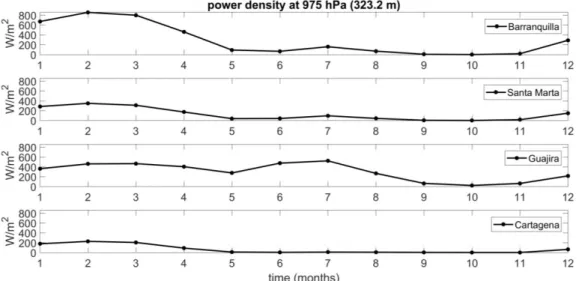
Interestingly, Barranquilla reported the highest monthly mean of wind power density at 323.2 m of elevation (Fig. 8) with 857 W/m2 in February. La Guajira area showed values over the 200 W/m2 during the year except for the period from September to November, where wind speed decrease due to the effect of ITCZ mentioned above.
Fig. 8. Monthly mean of wind power density at 323.2 m of elevation in the study areas (derived from 1979 to 2015).
Considering the wind speed and the wind power density of the four study areas, is possible to state that Barranquilla, Santa Marta and La Guajira have potential to implementing offshore wind farms. For La Guajira, is feasible to generate energy with offshore wind turbines class I, II or III with hub heights at 30 m, 50 m 100 or 300 m over the mean sea water level (MSWL); the lower is the power density, the higher should be the rotor diameter. Barranquilla has the highest power density at 323.2 m (Fig. 8), which could be utilised through wind turbines class I with 300 m of height and rotor diameter less than 100 m.
The wind speed at 10 m (Fig. 5) showed that Barranquilla, Santa Marta and La Guajira locations are feasible to implementing offshore wind turbines class III, which can generate energy with rotor diameter about 100 m and hub heights over the 70 m. Actually, the GE Renewable Energy company develops the project Haliade-X 12 MW, with a hub height of 260 m and 220 m of rotor diameter becomes the tallest offshore wind turbine class I in the world (GE Renewable Energy, 2018).
The offshore wind farms in the study areas could provide the maximum amount of energy to the Colombian energy system, from December to April and from June to August, mainly when hydroelectric plants are in low production. During the period of September to November when the wind speed is low, the increment of rainfalls due to the positioning of the ITCZ over Colombia
3 4 5 6 7 8 9 10 11 12 13 14 15 16 17 18 19 20 21 22 23 24 25 26 27 28 29 30 31 32 33 34 35 36 37 38 39 40 41 42 43 44 45 46 47 48 49 50 51 52 53 54 55 56 57 58 59 60 61
contributes to increase the capacity of energy generation of the hydroelectric plants. This complementary generation system will reduce the risk of energy availability in Colombia, and could open opportunities to export energy to the Latin American and the Caribbean regions.
7. Marine renewable energies in Colombia
The marine renewable energy potential for Colombia (waves, tides, currents, winds and thermohaline gradients) had been studied thoroughly in the last decade. In this sense, the potential of marine waters in Colombia to generate energy through OTEC (Ocean Thermal Energy Conversion) was presented in 2014. The research concluded that the San Andrés Island is ideal to implementing the OTEC technology (Devis-Morales et al., 2014).
Ortega-Arango (2010) reported the possible technologies for wave energy extraction; the study area was the Isla Fuerte Island in the Colombian Caribbean. The research recommended the Sea based Wave Energy Converter, because it works in very shallow waters, the simplicity of its components and the energy generation mechanisms. The results of the research were not conclusive for the energy extraction, due to the lack of technical information of the energy converter and the scarce wave in situ data, limited to establish recommendations for feasibility projects in the study area.
Alvarez-Silva and Osorio (2015) showed that in Colombia the energy potential of the saline gradient in the Magdalena River mouth is 15 157 MW and 187 MW for the León River in the Urabá Gulf, concluding that both study areas are ideal for energy extraction.
Realpe-Jiménez et al. (2012) evaluated the wind energy potential in the Colombian islands. Through numerical modelling, they estimated that the most wind energy potential was in the Island of San Andrés (North West of Colombia, near Nicaragua), with 5106 MWh/year at 70 m of height.
A research was carried out in 2016 to estimate wave energy potential in several places in Colombia (Osorio et al., 2016). The researchers calculated the energy potential of currents, waves, tides and thermohaline gradients. The study mentioned that there are different points or distributed zones in Colombia according to the energy source. For the Caribbean coast, they identified five points for energy saline gradient extraction and one point for wave energy; in the San Andrés Island, they report one point for temperature gradient. In the Pacific coast, they recommend three points for wave energy and three points for tide energy.
The study mentioned above has shown relevant information about marine renewable energy in Colombia, mainly currents, waves, tides and thermohaline gradients. This study recommended improving the knowledge about the availability and quality of the mentioned renewable sources and the technical and economic availability for exploitation. However, there are no public evidence about detailed offshore wind energy information for specific places, or technical, or financial feasibility studies for installation, extraction, and operation of offshore wind farms in Colombia.
3 4 5 6 7 8 9 10 11 12 13 14 15 16 17 18 19 20 21 22 23 24 25 26 27 28 29 30 31 32 33 34 35 36 37 38 39 40 41 42 43 44 45 46 47 48 49 50 51 52 53 54 55 56 57 58 59 60 61
8. Needs, challenges, and opportunities for Colombia
The high availability of hydric resources allows Colombia to have an electric system highly reliable and competitive. According to the World Energy Council (2014), the Colombian electric system is vulnerable to climatic phenomena that can decrease water availability. The El Niño - South Oscillation (ENSO) phenomenon has generated droughts during the periods 1991-1992, 2002-2003 and recently during 2015-2016. The report published by IDEAM mentioned that the most intense period led to Colombia to an energy saving regime, to avoid an imminent electrical rationing. Low water levels of dams during El Niño (2015-2016), the limited gas offer, and the high oil prices put at risk the Colombian electric system in 2016 (Dinero, 2015)
The transition of Colombia to renewable energies has begun, and it is evidenced in recent decisions taken by the public and private sectors (CREG, 2018b). Contreras and Rodríguez (2016) developed a proposal to improve the policies of the renewable energy management, through mechanisms of articulation, distribution, and financing of private sectors with public participation. They consider that private sector must facilitate resources for the execution of the project, and the public sector must acquire the responsibility of regulating and distributing the energy service.
As stated by Botero et al. (2010) and Vergara et al. (2013), some incentive mechanisms are needed to increase wind power implementation; tax exemptions is one way but not the most efficient. In this regard, the reform proposed by Contreras and Rodriguez (2016) considers incentives that generate interest to develop renewable energy projects. The main recommendations given in the reform are:
Definition of the distributed generation as part of the power supply chain.
Definition of the mechanisms to incentive renewable energy uses according to the characteristics of the country where potential menaces to wind energy project can be mitigated.
Franco-Cardona et al. (2015) presented the energetic trilemma to develop the energy market, which guarantees the environment protection, the energy supply, and the economic sustainability. They pointed out that to study the economic effect generated by implementing non-conventional renewable energies, it is necessary to analyse the effect of the cost reduction in the energy rates through subventions. Additionally, they concluded that different policies in Colombia could be implemented for reducing the Carbon emissions, motivate the renewable energy industry, and guarantee the energy supply keeping the balance between offer and demand.
The reduction of hydroelectric energy during El Niño (2015-2016) and the elevated costs of oil fuel in that period (Dinero, 2015) motivated to increment and diversify the domestic energy offer. The recent decisions taken by the Colombian government evidence the interest to incentive the renewable energy exploitation.
Castro Ferreira (2017) showed that the guarantee of an efficient and sufficient electricity offer requires a reliable infrastructure, and the expansion of NCES. Then, to enhance the offer are necessary administrative mechanisms through contracts as "Take or Pay," "Energy Purchase
3 4 5 6 7 8 9 10 11 12 13 14 15 16 17 18 19 20 21 22 23 24 25 26 27 28 29 30 31 32 33 34 35 36 37 38 39 40 41 42 43 44 45 46 47 48 49 50 51 52 53 54 55 56 57 58 59 60 61
Agreements (EPAs), "Pay the generated" and "Green Bonus." Zuluaga and Dyner (2007) analysed simulations of the Colombian market and concluded that direct subsidies have a major effect on the renewable energy technology diffusion than initiatives such as fiscal policies (tax exemptions). Ortiz (2017) specified that the development of NCES requires the retribution of self-generation surpluses, the improvement of information about NCES potential and availability, the definition of additional mechanisms to diversify the electric matrix, the adjustments of market mechanisms (bilateral contracts, reliability charge, auctions), and a normative for the exploitation of geothermal resources. Additionally, some challenges to overcome were identified for the NCES development: integration of climate change policy to the energy policy, coordination of licensing processes for generation and transmission, intermittency of NCES, and development of projects to expand the NCES.
The association of Renewables Energies (Ser Colombia, Asociación de energías renovables Colombia) sent several communications to the MADS and ANLA, about the environmental licensing requirements for NCES and Thermal (Fossil fuel) in Colombia. The communications pointed out that requirements for NCES could be reduced or modified due to the low environmental and social impact compared to thermal plants. Ávila (2017) highlighted examples of the mentioned modifications suggested by Ser-Colombia:
Location: General and not detailed with planimetry and altimetry.
Characterisation for structural elements: it is not required such a detailed characterization like fails, minor discontinuities, and others. These projects just require excavations of 1.5 m of depth or less and less than 0.3 m of diameter.
Aquifer vulnerability: It is only necessary an evaluation of aquifer vulnerability to contamination if the NCES project requires water.
Do not demand studies for local meteorology and wind modelling, due to the contaminant emissions during the construction phase are low.
The UPME reported 160 projects applying for benefits in February 2017, where 136 correspond to solar energy, 8 to hydroelectric, 8 to biomass, 6 to wind, 2 for geothermal energy; about these projects, 94 were approved, 46 under review, 25 in registering, and 4 rejected. The applying projects represent a total capacity of 1,214 MW, which 560 MW are for biomass, 376 MW for Eolic, 195 MW for geothermal energy, 63 MW for solar, and 12 MW for hydroelectric energy (Valencia, 2017). The possible events of the distribution of generated additional capacity and associated cost reported by Valencia (2017), evidenced that condition 3 showed the lowest investment costs from all the scenarios (Table 3). The condition 2 suggests more additional expansion for wind energy and no additional expansion of coal, and condition 3 suggests more additional expansion for solar and geothermal energy and zero additional expansion for coal.
Table 3. Present and future scenarios according to conditions base installed capacity (MW) and additional expansion (MW).
3 4 5 6 7 8 9 10 11 12 13 14 15 16 17 18 19 20 21 22 23 24 25 26 27 28 29 30 31 32 33 34 35 36 37 38 39 40 41 42 43 44 45 46 47 48 49 50 51 52 53 54 55 56 57 58 59 60 61 Source Base Ad d iti o n al exp an si on To ta l Ad d iti o n al exp an si on To ta l Ad d iti o n al exp an si on To ta l Ad d iti o n al exp an si on To ta l Ad d iti o n al exp an si on To ta l Hydro (over 10 MW) 10 890 1427 13 517 1824 13 914 1824 13 914 1878 13 969 1824 13914 Gas 3509 147 3656 147 3656 147 3656 147 3656 147 3656 Coal 1344 970 2564 859 2453 0 1594 0 1594 1080 2674 Hydro (under 10 MW) 745 793 1539 793 1539 793 1539 793 1539 793 1539 Cogeneration 117 285 402 285 402 285 402 285 402 331 448 Wind 0 1456 1456 727 727 1456 1456 727 727 1456 1456 Solar 0 234 234 130 130 64 64 210 210 130 130 Geothermal 0 50 50 0 0 0 0 50 50 0 0 Others 0 0 88 0 88 0 88 0 88 0 88 Total 16 606 5362 23 506 4765 22 909 4569 22 713 4091 22 235 5761 23 904 Source: Valencia (2017)
The OWE technology is still not considered as an interesting alternative for the NCES projects. This technology requires a continuous research to reduce the associated costs and requires a specific research to evaluate the OWE potential to increment the domestic offer in Colombia. Accordingly, it is necessary a specialised personnel (interdisciplinary professionals and technicians) that support the research and development of the OWE industry.
Despite the authors has developed three studies carried out in Colombia related to the design of offshore wind turbines (Rueda Bayona, 2015, 2017; Rueda-Bayona et al., 2019) there are limitations to wind energy diffusion as referred by Edsand (2017). Even though there are advances in the offshore engineering, it is necessary that the Colombian government promotes and strengths the academic, research and development programs that lead to specialised personnel training, and through them, the country can take decisions that support the execution of offshore energy projects.
9. Limitations of the study and future research directions
Colombia has a tremendous opportunity to increase all the legal context and public policies to motivate investments related to non-conventional sources of renewable energies (NCES). Since the main source for power comes from water resources, Colombia is one country considered as
3 4 5 6 7 8 9 10 11 12 13 14 15 16 17 18 19 20 21 22 23 24 25 26 27 28 29 30 31 32 33 34 35 36 37 38 39 40 41 42 43 44 45 46 47 48 49 50 51 52 53 54 55 56 57 58 59 60 61
privileged regarding this resource. There is not enough interest to develop opportunities and technologies. This lack of interest is represented in limited data to evaluate the oceanographic and maritime climate conditions for research and the design of offshore wind farms. It is expected that this study and further ones increase the interest in this area and encourage the private sector to explore alternative and renewable sources of energy for non-connected areas (i.e. rural regions) or as an alternative for dry seasons.
To advance into the offshore wind exploitation in Colombia, it is required a more detailed study to identify the best locations to install wind farms according to the energy potential. Hence, it is essential to evaluate the feasibility to install the appropriated technology according to the topography and soil mechanics of the seabed, the building materials performance and the identification of the social and environmental potential impacts that could be generated, through quantitative methods such as Life Cycle Assessment (LCA).
There is an upcoming initiative led by the Nueva Granada Military University (www.umng.edu.co) starting at 2019 focussed in pre-design the first offshore wind turbine in Colombia through the research project INV-ING-2985. The Project will analyse the hydromechanics, structural dynamics, fatigue, materials, foundations and the environmental and economic considerations considering the United Nations Sustainable Development Goals.
10. Conclusions
The transition to renewable energies requires a series of actions and events that guarantee its sustainability. The Colombian government must keep developing public policies that motivate the exploitation of marine renewable energies. Likewise, Colombia must increase the knowledge of the availability of renewable sources and the technical and economic feasibility of marine renewable projects. Additionally, Colombia needs to identify the potential effects due to the non-transition to clean energies and the costs of implementing offshore renewable technologies.
The onshore wind energy at present is dominated by Europe, where the land availability is scarce, and some communities do not accept the installation of these structures easily. As a result, the wind energy sector is increasing the number of offshore wind projects, not only by land restrictions but also because the offshore wind energy is abundant and a good quality source.
The knowledge of the availability of offshore renewable energies requires enhancing the acquisition of primary data through in situ techniques, and the improvement of policies to access to national databases. The measurement of currents, waves, winds, temperature, and salinity in the ocean require higher temporal and spatial resolutions.
The technical and economic feasibility of offshore energy projects need specialised personnel, then, Colombia must define an integrated industry-academia policy. Colombia can consider the experiences of Europe about the strategies of private sector investments for the execution of offshore wind energy projects. Colombia can establish tax incentives and financial alternatives to the