1 SOME INFLUENCES OF COMPETITIONS ON STRUCTURAL ISSUES
The authors are partners of the Brussels's based architectural firm AgwA. AgwA is involved in a large amount of architecture competitions, mainly for public buildings addressing the com-munity. These competition projects are developed in multidisciplinary teams. In the work of AgwA, structure plays a central role in the architectural designs and their spatiality. The con-text of an architecture competition has important consequences on the way architects can ap-proach the issue of structure.
A first striking example is the sharp timing of the competition. For architectural assignments (not bridges or roofs), the structural dimensions is often approached briefly, in the form of structural schemes and sketches. Calculations are often bypassed to concentrate on the prin-ciples. Another example, from the designer's point of view, could be the intention to keep a cer-tain flexibility towards the future, anticipating the evolution of the project in the process lead-ing possibly to the buildlead-ing site.
2 FRAMING A DIALOGUE BETWEEN ARCHITECTURE AND STRUCTURE
In order to frame correctly the examples analyzed below, it is important to be aware of the “hid-den agenda” of the office regarding the relationships between architecture and structure. AgwA attempts to avoid a beslaving relationship of structure towards architecture, in which the struc-ture is a mere technical issue to solve to make thing stand. This could be considered the way Semper looked at structure. In the other way, AgwA also wants to avoid the opposite attitude, in which architecture is the mere result of structural and constructive aspects, which could be considered the way Viollet-le-Duc approached architecture. What AgwA is looking for, is a dialogue between space and constructive aspects of the project. In order to achieve this dia-logue, the office attempts to set the “rules” or “principles” that frame the relationships between both.
On the one hand, we propose to analyze how the structural dimensions are addressed in this very preliminary phase, in order to unveil recurrent structural strategies. Three families of
ap-AgwA architecture office : addressing structure in architecture
competitions
Harold Fallon
LUCA School of Arts - Sint-Lucas School of Architecture, Brussels-Ghent, Belgium AgwA architecture office, Brussels, Belgium
Benoît Vandenbulcke
Civil engineer architect, founder & partner of AgwA architecture office, Brussels Teacher and researcher at LOCI, Université Catholique de Louvain, Belgium PhD student at LOCI, Université Catholique de Louvain, Belgium
“Il faudrait non point une rhétorique par auteur mais une rhétorique par poême” What we need, is not a rethoric for each author, but rather a rethoric for each poem.
«Raisons de vivre heureux», Francis Ponge, Proêmes, t I, Paris, Gallimard, 1965, p 190 (dated 1928-1929)
ABSTRACT: Architecture competitions are being generalized in the attribution of architecture contract. The sharp timing and the anticipation of a further design process are two factors of in-fluence on the relationship between architecture and structure in projects subjected to competi-tions. AgwA is a Brussels based architecture office involved in a large amount of competicompeti-tions. Through a series of case studies, three different approaches are made explicit. Through a last case study, the evolution of the structural solutions is examined from competition to realization.
proaches are distinguished. These approaches are probably not meant as an exhaustive list, and they certainly are not excluding categories. They overlap and can be combined. Our intention here is the point out design attitudes that allow to address the structural aspect of projects in-side an easy and flexible framework. It is important to mention that the projects analyzed are strictly speaking architecture projects, addressing buildings, and not infrastructure of special structures, which may imply another kind of relationship between architecture and structure. On the other hand, we will explore the structural aspect of the Péronnes project in detail, through its successive phases (competition, sketch project, preliminary design, definitive pro-ject), in order to discover in which way the structural proposal was maintained, evolved and partially switched though time.
3 IMPOSED GLOBAL TYPOLOGIES
In these projects, the architectural design suggests a structural principle, which is simultan-eously strong enough to support the project's identity, and flexible enough to be adapted to real-ity. These principles are always project-specific. In this case, the principle is discussed with the engineers to check the feasibility. The dialogue happens then at the level of the shape of the structure. This can address the form itself of structural principles, or the density, type and amount of structural elements.
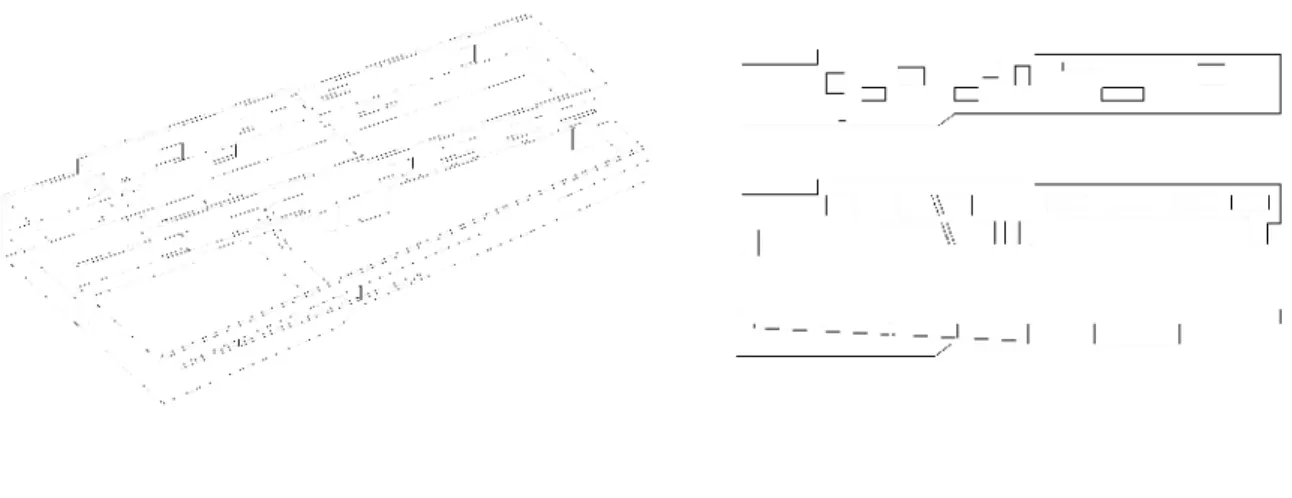
Figure 1. Crossing (AgwA – Ferrière 2012), structural schemes (AgwA)
For the two-levels multifunctional building Crossing, the structure consists of three main struc-tural axis, with different shapes. The south axis is a masonry wall with irregular, but rather small openings. The central axis is a poured concrete wall over two levels allowing large spans free of columns, and the north axis is a masonry upon concrete beams and columns. This kind of simple hypotheses allow great flexibility, as is shown in the figure below and yet, it provides a strong backup to the expression of the building.
For a library in Morlanwelz (Belgium), we pro-posed a layered building.
First, a set of differentiated levels structure space. Second, a functional stroke is provided on the street side. Third, a structure of wooden beams inside wooden frames is supported by wooden columns, which are irregularly placed on the edge between functional zones. The line between the functional stroke and the library is filled with a dense series of column, wich serves a support for shelves. Last, an arched wall defines the edges of the building.
Although this principle seems very defined at a competition level, it remains quite flexible. The precise location of the columns and the size of the rectangular zones can be almost freely ad-apted. This will allow to follow possible pro-grammatic evolutions during the design process after the competition.
Figure 3. Morlanwelz, exploded axonometric view (AgwA 2012)
The Massart pavilion project in Brussels consists of two slightly rotated squares, united by a single roof. The structural principle is a dense set of columns on the periphery of the building, corresponding the distance between beams of the roof, in order to avoid secondary structures. Once this is formulated, any adaptation is possible, as long a these adaptation do not contradict the principle itself. Distances between columns can be modified or columns suppressed for the entrances. Roofs can cantilever. Beam sections can be modified where necessary.
Figure 4. Massart, exploded axonometric view (AgwA 2012)
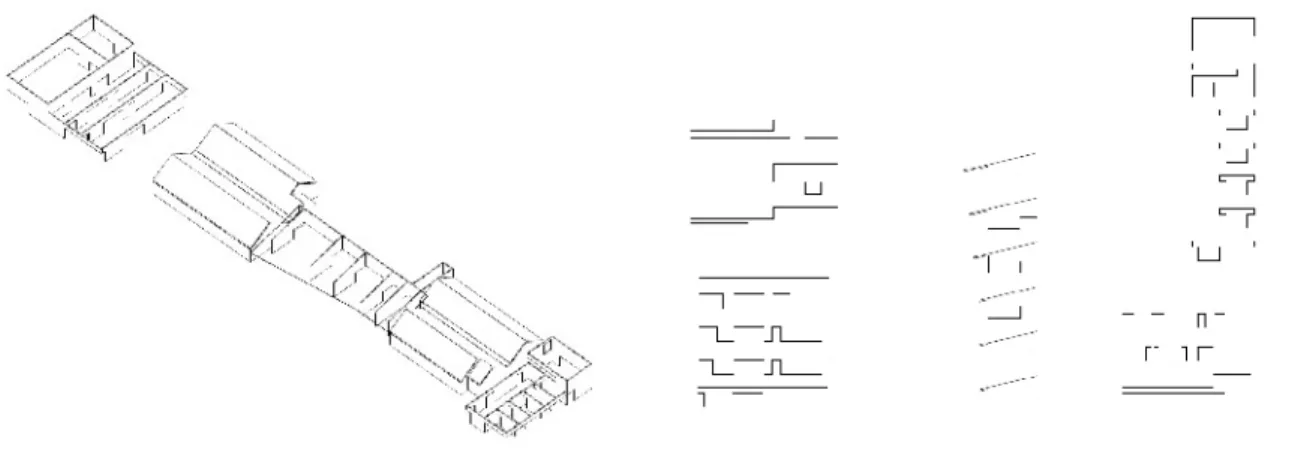
Deinze Cultural Center is an hybrid case. There is not one principle, but rather three, corres-ponding three spatial units of the program. First, the theater itself consists of large concrete frames, which shape is free. Second, a technical core is constructed in a traditional way, as spans are small and walls mostly continue. Third, the public social spaces develop over three levels. Crossed views needed to be achieved from space to space. The structure is conceived as a cardboard game of perpendicular rectangular walls stacked upon each other. This formed the base for the negociation with the engineers of Studieburo Mouton, who needed to ensure suffi-cient continuity between the different rectangles.
In the figures below, it is interesting to note that AgwA conceived the structure as three separ-ated elements, but that Studieburo Mouton modelled it as one coherent whole. Yet, the concep-tual model of three separate terms allows to simplify the scheme and to understand what is the architectural value of the structure, and to guide the search for a definitive shape
Figure 4. Deinze, exploded axonometric view (AgwA 2012)
Figure 5. Deinze (AgwA 2012), structural model (studieburo Mouton) 4 MULTIDISCIPLINARY DISCOVERY PROCESS
In this kind of projects, we notice that structure doesn't seem to be a sensible factor at first. No hypothesis is forumated a priori. The search for the structural principle as formulated above does not proceed from an architectural point of view. Rather, it is developed during a discus-sion with the structural partner who looks for a structural solution. During the discusdiscus-sion, AgwA attempts to grasp the elements that can confer a global coherence to the project, which then can influence the architectural design in return.
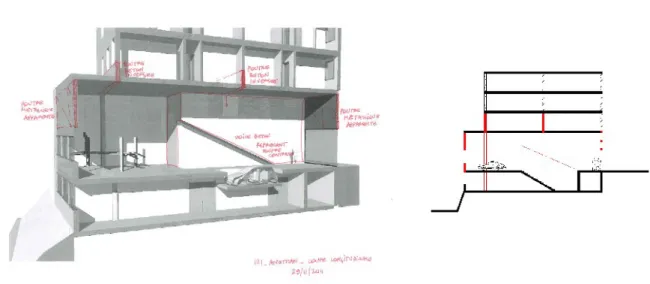
For the Anethan project, consisting of a large open car workshop on the ground floor and hous-ing on the upper levels, AgwA wanted to turn the dwellhous-ings 90° to the street to provide south oriented terraces, and wanted to avoid imposing structural elements inside the workshop. Four structural axis appeared. Two of them are steel trusses and correspond to the elevations, acquiring an architectural expression. The two other axis are inverted concrete beams. Inside the dwellings, they disappear in walls. On the terraces, they become separations between dwell-ings and acquire a functional role. To confer more coherence to the rear elevation, the steel truss was replaced by a concrete wall.
Figure 6. Anethan (AgwA 2011), commented perspective (AgwA – JZH & partners) Figure 7. Anethan, resulting structural scheme (AgwA 2011)
5 PRODUCT OR REFERENCE APPROACH
Some other projects are subjected to a choice for a structural material or product that imposes its rules. There are variations possible in this kind of approach. For a sports hall in Froid-chapelle, we decided together with Bureau d'études Weinand to explore the potential of folded origami-like structures in massive timber.
Figure 8. StLoup Chapel, Localarchitecture & Danilo Mondada, structure IBOIS H. Buri, Y. Weinand
This of course does not proceed from any programmatic or contextual consideration, and can be considered as an additional layer to the design process. For AgwA, the issue becomes then how to conciliate such expressive structure and shape with functional rationality, spatial articulation, contextual sensitivity, in order to blend the different dimensions of the project into a single ob-ject.First, there was a set of pure experimentation with the form, in order to understand well its mechanics.
Figure 9. Froidchapelle, formal experimentations (AgwA + Weinand, 2009)
Then a shape was defined. It was a minimal use of the origami structure to obtain structural sti-fness, to solve water drainage, propose symbolical value (sails), and acoustic comfort through the shape. The extremities were adapted to functional and contextual features.
6 PERONNES FROM COMPETITION TO REALIZATION
Here, we will analyse the structural solutions for a sports center in Péronnes (Belgium). The project addresses the re-construction of a sports center, including a sports hall to be refur-bished, a boarding school including a restaurant and offices, and a sail house.
At the competition stage, the three parts of the projects were identified by differentiated struc-tural solutions. The sports hall would be extended in concrete. The boarding school would be extended by a steel constructions, and the sail house would be a wooden construction. The aim was to create recognizable identities for each programmatic subset.
Figure 11. Péronnes (AgwA + Artgineering), structural schemes competition stage (2010) During the design process, the search for the skin's materiality led us to opt for concrete blocks for the sports hall and the boarding school. As a result, the architectural shapes of the boarding school evolved drastically, and so the structural principles, but without real incidence on the functional aspects of the project. From this point, we will focus on the boarding school, the evolutions of which have been more marked and covers the topics at stake in the other build-ings.
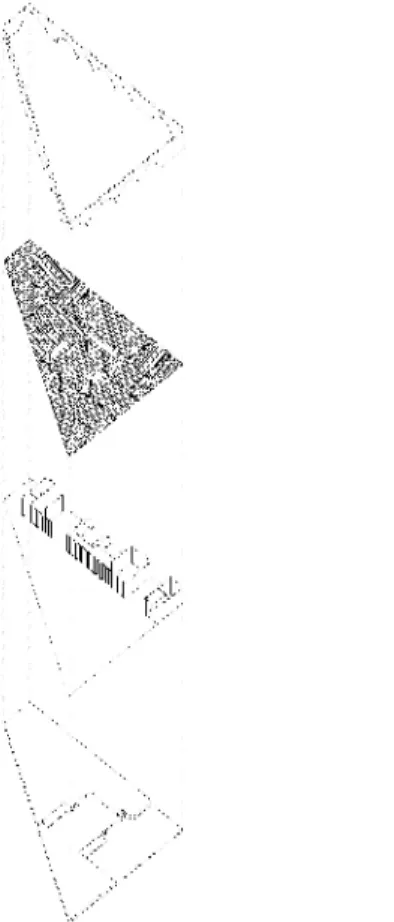
Figure 12. Péronnes (AgwA + Artgineering), competition vs preliminary design stage (2010) As a consequence, the structure of the boarding school evolved towards concrete and masonry. In order to solve this, the exterior roof is separated from the buildings and is kept as a steel structure (we will not develop this). Regarding the buildings, the same principle as the sports hall is applied : long horizontal windows on the ground level are solved by steel frames doub-ling the windows.
Soon, it appeared that steel structures would difficultly be allowed by the client's supervisor on security due to fire resistance issues. If we changed the steel frames by concrete columns, this would be a real problem for the conceptual strength of the project : one of it's quality resides in the panoramic openings on the landscape.
We proposed to make use of the internal structure to provide cantilever beams to support the el-evations. This had impact on the internalstructure, but allowed to suppress all columns in the elevations, in steel or in concrete.
Figure 13. Péronnes (AgwA + Artgineering), structural proposal (AgwA, 2010)
At this point, the principle illustrated in fig 13 can be considered equivalent to the competition principles evoked in the first part of the paper. After some amendments and discussions with structural engineer Ney & Partners, the structure was fixed at the third stage of the design pro-cess (competition, sketch phase, preliminary design). The principle of concrete walls with can-tilevers sustaining concrete beam in the facades can freely be morphed in order to fit all kinds of constraints. This shows that in some cases, the structural principles developed in the compet-itions can be completely revised during the process, due to external factors (in this case, secur-ity and skin materialsecur-ity). In this case, the process can start over again, with identical objectives and consequences. In other cases, the structural principle developed in the competition can simply be kept or slightly adapted to follow the evolution of the project.
Figure 14. Péronnes (AgwA + Artgineering), structural schemes, morphing potential of the wall elements (AgwA, 2010)