ÉCOLE DE TECHNOLOGIE SUPÉRIEURE UNIVERSITÉ DU QUÉBEC
THESIS PRESENTED TO
ÉCOLE DE TECHNOLOGIE SUPÉRIEURE
IN PARTIAL FULFILLMENT OF THE REQUIREMENTS FOR A MASTER'S DEGREE WITH THESIS IN SOFTWARE ENGINEERING
M.A.Sc.
BY Sana MAKI
SYSTEMATIC REVIEW OF RECOMMENDATION SYSTEMS IN SOFTWARE ENGINEERING
MONTREAL, JULY 27, 2016 © Copyright Sana Maki, 2016 All rights reserved
© Copyright
Reproduction, saving or sharing of the content of this document, in whole or in part, is prohibited. A reader who wishes to print this document or save it on any medium must first obtain the author’s permission.
BOARD OF EXAMINERS
THIS THESIS HAS BEEN EVALUATED BY THE FOLLOWING BOARD OF EXAMINERS
Mr. Sègla Kpodjedo, Thesis Supervisor
Department of Software and IT Engineering at École de technologie supérieure
Mrs. Ghizlane El Boussaidi, Thesis Co-supervisor
Department of Software and IT Engineering at École de technologie supérieure
Mr. Christian Desrosiers, President of the Board of Examiners
Department of Software and IT Engineering at École de technologie supérieure
Mrs. Latifa Guerrouj, Member of the jury
Department of Software and IT Engineering at École de technologie supérieure
THIS THESIS WAS PRENSENTED AND DEFENDED
IN THE PRESENCE OF A BOARD OF EXAMINERS AND THE PUBLIC ON JULY 15, 2016
ACKNOWLEDGMENTS
I would like to thank my supervisors, Professor Sègla Kpodjedo and Professor Ghizlane El Boussaidi, for the opportunity to work on this research project and for their great help and guidance throughout this thesis. I would also like to thank my colleagues at LASI laboratory for their outstanding support and advices, and my welcoming friends in Montreal for the fun environment and the great source of energy they created.
I would also like to thank the jury members for accepting to review my work, for their brilliant feedback and relevant remarks.
I dedicate this work to my father who passed away, he will always be my biggest inspiration and my role model. I would like to thank my mother, my source of strength and wisdom, and my brothers for their endless support and kindness.
Finally, I would like to thank every person who supported me and encouraged me to achieve this project efficiently.
ÉTUDE SYSTÉMATIQUE DES SYSTÈMES DE RECOMMANDATION EN GÉNIE LOGICIEL
Sana MAKI RÉSUMÉ
Les systèmes de recommandation en génie logiciel représentent un domaine de recherche intéressant pour l'évolution et la maintenance des systèmes logiciels, puisqu'ils aident les développeurs dans leurs tâches en suggérant des informations qui peuvent être pertinentes au contexte de la tâche en cours. Ces suggestions peuvent être des fragments de code réutilisables extraits à partir des versions précédentes d'un projet, des invocations de méthodes de bibliothèques externes, des solutions extraites des rapports de bugs, etc.
Dans la littérature, les systèmes de recommandation en génie logiciel existants se présentent sous différentes formes et soutiennent divers objectifs. Ils partagent de nombreuses caractéristiques et nécessitent souvent les mêmes étapes. Cependant, quelques travaux mettent en évidence les étapes fondamentales pour construire un système de recommandation. En essayant d'analyser quelques systèmes de recommandation, nous avons remarqué de nombreuses ambiguïtés dans quelques aspects de ces étapes. D'où vient le besoin de considérer une approche différente afin de clarifier les différents aspects de ces étapes.
Dans ce mémoire, nous présentons une revue de littérature systématique qui identifie les différentes caractéristiques des composants fondamentaux dont on a besoin pour implémenter un système de recommandation en génie logiciel. Pour ce faire, nous avons analysé un échantillon de 46 outils de recommandation. D'abord, nous avons analysé le processus d'extraction de contexte qui permet de récupérer les informations contextuelles de la tâche de programmation en cours. le contexte peut être éventuellement traitées et rendues sous la forme d'une sortie qui va être utilisé par le moteur de recommandation. Ce dernier récupère des cas similaires au contexte extrait à partir d'un corpus de données, afin de générer un ensemble de recommandations qui peut être filtré avant d'être présenté au développeur.
Cette analyse nous a permis de proposer un modèle de fonctionnalités qui représente des caractéristiques importantes de chaque composant, illustrées à travers les systèmes de recommandation analysés et d'identifier certains problèmes.
SYSTEMATIC REVIEW OF RECOMMENDATION SYSTEMS IN SOFTWARE ENGINEERING
Sana MAKI ABSTRACT
Recommendation Systems in Software Engineering (RSSE) represent a promising research area in software evolution and maintenance, as they assist developers in their tasks by providing information items that can be relevant to the context of the task at hand. These information items can be reusable code snippets retrieved from previous versions of a project, method invocations from external libraries, solutions extracted from bug reports, etc. In literature, existing RSSEs come in different shapes and support various goals. Yet, they share many features and often require the same steps. A handful works highlights the basic keys to build a RSSE. However, these key steps ran into many ambiguities when we tried to analyze some RSSEs. These ambiguities leaded us to consider a different approach in order to clarify different aspects of these key steps.
In this thesis, we conduct a systematic literature review that identifies various features characterizing basic components we need to implement RSSE. To do so, we analyze a sample of 46 RSSEs. First, we analyzed the context extraction component which retrieves the contextual information of the programming task at hand that can be possibly treated and rendered as an output to the second component. This component is the recommendation engine which matches the extracted context with data stored in a corpus in order to generate a set of recommendations that can be filtered before being presented to the developer.
This analysis led us to propose a feature model that represents important characteristics of each component illustrated through the analyzed RSSEs and identify some open issues.
TABLE OF CONTENTS
Page
INTRODUCTION ...1
CHAPTER 1 LITERATURE REVIEW ...1
1.1 Basic concepts ...1
1.1.1 Recommendation System (RS) ... 1
1.1.2 Recommendation System in Software Engineering (RSSE) ... 2
1.2 RS surveys ...2
1.3 Relevant RSSE works ...8
1.3.1 RSSE surveys ... 8
1.3.2 Building RSSE works ... 10
1.3.3 Evaluating RSSE works ... 14
1.4 Limitations of existing works ...17
CHAPTER 2 RESEARCH METHODOLOGY ...19
2.1 Planning of the study ...19
2.1.1 Research questions ... 19
2.1.2 Search strategy ... 20
2.1.3 Selection criteria ... 22
2.1.4 Data extraction strategy ... 22
CHAPTER 3 EXECUTION OF THE STUDY ...25
3.1 RSSEs supporting developers in change tasks...25
3.2 RSSEs supporting developers in API usage ...29
3.3 RSSEs supporting developers in refactoring tasks ...32
3.4 RSSEs supporting developers in solving exception failures, bugs, conflicts and testing tasks...34
3.5 RSSEs recommending reusable software components and components' design ...37
3.6 RSSEs assisting developers in exploring local codebases and visited source locations39 3.7 Other RSSEs ...41
3.7.1 RSSE assisting developers in software prototyping activities ... 41
3.7.2 RSSE assisting developers in tagging software artifacts ... 42
3.7.3 RSSE recommending experts ... 43
3.8 Conclusion ...44
CHAPTER 4 RESULTS ANALYSIS ...45
4.1 Context Extraction ...45
4.1.1 What is context in RSSE ? ... 45
4.1.2 Context Extraction: An overview ... 46
4.1.3 Trigger... 46
4.1.4 Context input ... 48
XII
4.1.4.2 Specific Elements to extract... 49
4.1.5 Treatment ... 50
4.1.6 Output ... 52
4.2 Recommendation Engine ...53
4.2.1 Recommendation Engine: An overview ... 53
4.2.2 Corpus ... 54 4.2.2.1 Raw Data ... 55 4.2.2.2 Treatment ... 56 4.2.2.3 Processed Data ... 57 4.2.3 Recommendation ... 58 4.2.3.1 Treatment ... 59 4.2.3.2 Filtering / Ranking ... 60 4.2.3.3 Recommendations Nature ... 61 CHAPTER 5 DISCUSSION ...63 5.1 Results Synthesis ...63
5.1.1 Context extraction process ... 63
5.1.2 Recommendation engine ... 65
5.2 Validity threats ...68
5.2.1 External validity ... 68
5.2.2 Internal validity ... 69
CONCLUSION ...71
ANNEX I RSSE DESCRIPTION ...73
ANNEX II RSSE ANALYSIS: CONTEXT EXTRACTION PROCESS ...81
ANNEX III RSSE ANALYSIS: RECOMMENDATION ENGINE ...87
LIST OF TABLES
Page
Table 1.1 Summary of techniques' descriptions ...6
Table 1.2 Summary of recommendation techniques in each application domain ...7
Table 1.3 Recommendation landscape...9
Table 1.4 RSSE design dimensions ...11
Table 1.5 Kinds of development decisions to be taken when building a SCoReS ....12
Table 1.6 Detailed development decisions of a SCoReS ...13
Table 1.7 Categorization of dimensions ...15
Table 1.8 Summary of metrics ...15
LIST OF FIGURES
Page
Figure 0.1 Building steps of an RSSE ...2
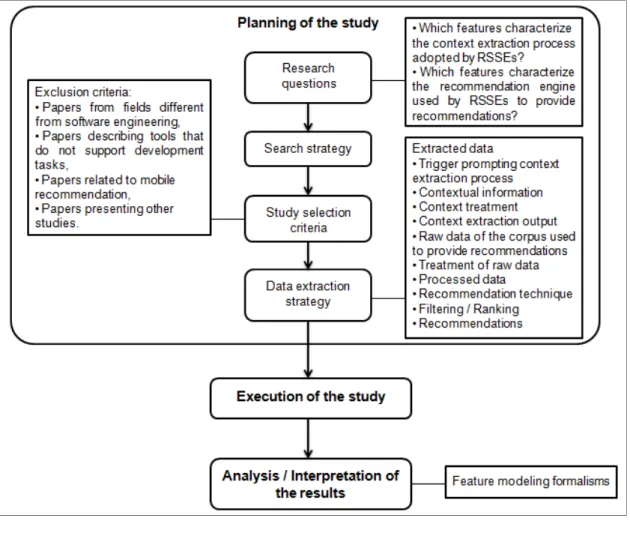
Figure 2.1 Research methodology ...20
Figure 2.2 Filtering approach ...21
Figure 2.3 Context extraction phase ...23
Figure 2.4 Recommendation Engine ...23
Figure 3.1 An example that shows the files programmers view and edit while performing tasks. This example is simplified from the actual interaction traces of bug reports #124039, #176690, #204358, and #290505 in the Eclipse Bugzilla system ...28
Figure 3.2 Augmented access graph. e, f, g, g0, h represent functions, x, y, z, w represent data, and A represents a composite type ...30
Figure 3.3 Example ...31
Figure 3.4 Sample user-item database ...38
Figure 4.1 A Feature Model for context extraction in RSSEs ...47
Figure 4.2 Features of the trigger ...48
Figure 4.3 Features of the input scope ...49
Figure 4.4 Features of the specific element to extract ...50
Figure 4.5 Features of the input treatment ...51
Figure 4.6 Features of the output...53
Figure 4.7 A Feature Model for the recommendation engine in RSSEs ...54
Figure 4.8 Features of the raw data ...55
Figure 4.9 Features of the raw data treatment ...57
XVI
Figure 4.11 Features of the recommendation treatment ...60 Figure 4.12 Features of the filtering and ranking ...61 Figure 4.13 Features of the recommendations nature ...62
LIST OF ABREVIATIONS API Application Programming Interface AST Abstract Syntax Tree
BoW Bag of Words
CBF Content-Based Filtering
CF Collaborative Filtering
CI Computational Intelligence
CR Change Request
CVS Control Version System DAG Direct Acyclic Graph
DCL Dependency Constraint Language DOI Degree Of Interest
GA Genetic Algorithm
IDE Integrated Development Environment
KBF Knowledge-Based Filtering
LSI Latent Semantic Indexing
MIS Method Invoking Sequence NLP Natural Language Processing
NN Nearest Neighbors
QA Question / Answer
RS Recommendation System
XVIII
SCoReS Source Code-based Recommendation System SLR Systematic Literature Review
INTRODUCTION Research Context and Problematic
As software systems evolve, their information resource including source code, external libraries and other documents (e.g. design documents) grow considerably as well. This diversity of information makes software systems’ evolution and maintenance a challenging task. For instance, developers may encounter challenges in searching for relevant artifacts related to a given feature request or for source code examples and in adapting them to the programming task at hand. In some cases, documentation can be obsolete or not available which makes developers ask questions to more experienced developers who may be too busy to answer and then developers spend considerable time to get the desired information.
In this perspective, various information retrieval and research tools, usually based on regular expressions, have been developed to help developers locating information in which they are interested, but such tools are context-independent. So developers need to select interesting components according to the task at hand, which is usually a time consuming and an error-prone task. Therefore, Recommendation Systems in Software Engineering (RSSE) appear as interesting tools that consider the context of the developer's task in order to provide relevant information which ranges from project artifacts of the project under development (Cubranic et al., 2005) to components retrieved from the web (Sawadsky et al., 2013).
In literature, existing RSSEs come in different shapes and support various goals like recommending API method invocations (Long et al., 2009), reusable software components (McCarey et al., 2005), etc. However, they share many features and often require the same steps. A couple of surveys were conducted to analyze existing RSSEs (e.g. (Happel and Maalej, 2008), (Mohebzada et al., 2012)). Most of them focused on identifying when and what to recommend, while others tried to outline different recommendation techniques.
2
Also a handful works tried to highlight steps that are basic keys to implement RSSEs (e.g. (Robillard et al., 2010), (Mens and Lozano, 2014)). This process typically starts with the extraction of the context of the programming task at hand and provides an input to the recommendation engine which generates a set of recommendations that can be filtered before being presented to developers and maintainers. Figure 0.1 shows the basic components in RSSE.
In view of the aforementioned, we were interested to conduct a systematic review in order to deeply analyze a sample of existing RSSEs and to identify various features characterizing each component we need to build an RSSE.
Figure 0.1 Building steps of an RSSE Adapted from Maki et al. (2015, p.151)
Research objectives
The main goal of this research work is to examine the basic components for implementing RSSE tools and to identify their different design and implementation choices. In particular, we limit our study to RSSE tools supporting developers in maintenance and evolution tasks including refactoring, debugging, change tasks, etc.
3
To this end, the objectives specific to this thesis are:
• Identification of the main characteristics of the context extraction component
• Identification of the main characteristics of the recommendation engine component including its subcomponents: corpus, recommendation technique and filtering.
Thesis structure
The remainder of this thesis is organized as follows. The first chapter presents a literature review of relevant existing works on recommendation systems in general and in software engineering in particular. Chapter two describes the planning of our study by presenting our research questions and the selection criteria taken to answer these questions. Chapter three presents the description of the analyzed sample of RSSEs. The results of this analysis are presented in chapter four, and discussed in chapter five. Finally, we conclude our thesis and we present some future works.
CHAPTER 1 LITERATURE REVIEW
In this chapter, we present an overview of existing RS and RSSE surveys, and some relevant research works about RSSE building process and its evaluation. Finally, we identify the limitations that will be addressed by our review.
1.1 Basic concepts
In this section, we define the notion of recommendation systems in general. Then, we introduce the same concept in software engineering.
1.1.1 Recommendation System (RS)
An RS is a software tool providing useful suggestions about a particular item in order to help the user making a decision, for instance which book to buy or what music to listen to (Ricci et al., 2011). The need for RSs emerged especially with the introduction of e-commerce web sites and the explosive growth of information available on the web. In this perspective, an item denotes what the RS recommends to a user which can be a CD, a book, a movie, and so on. There are two types of recommendations: (1) personalized and (2) non-personalized recommendations (Ricci et al., 2011).
Personalized recommendations are usually presented as a ranked list of items. This ranking can be defined as a prediction of the most useful items. It is computed based on the user preferences. These preferences can be expressed:
• explicitly, e.g. as ratings assigned by the user for a particular item; or
• implicitly which are usually inferred by interpreting users' actions, e.g. visiting a particular item's page can be considered as an implicit sign of preference for that item.
Non-personalized recommendations are simpler to produce and are often used in magazines and newspapers, for instance, suggesting the top ten selections of magazines. This type of recommendations is not typically addressed by RS researches.
1.1.2 Recommendation System in Software Engineering (RSSE)
In software engineering, software development and maintenance activities present many information navigation issues and challenges. As software systems evolve, their information resources tend to keep growing (e.g. source code, change history, bug reports, discussion forums) and to depend on an ever-increasing set of external libraries.
Developers and maintainers usually tend to invoke existing source code components, e.g. reusable code snippets from project histories or methods from external libraries, rather than writing code from scratch. Thus, they may encounter two main challenges: (1) retrieving the suitable information from the various information resources, (2) learning its correct usage and adapting it to the programming task at hand. Therefore, this dynamicity and overwhelming diversity of information resources motivate the development of RSSE in order to support developers. Robillard et al. (2010) defined RSSE as « ... a software application that provides information items estimated to be valuable for a software engineering task in a given context. » (Robillard et al., 2010).
1.2 RS surveys
Many RS reviews have been conducted in order to present an overview of different existing recommendation techniques and to identify their drawbacks. In this section, we report some relevant RS reviews.
3
Adomavicius and Tuzhilin (2005) conducted a survey analyzing a sample of recommendation approaches in order to identify various limitations and to propose possible extensions. The analyzed approaches are classified into three categories: Content-Based Filtering (CBF), Collaborative Filtering (CF) and hybrid recommendation approaches.
CBF approach recommends items similar to the ones liked by the user in the past, based on his preferences and personal interests. These preferences can be presented as a set of keywords or categories. They are usually extracted from items descriptions which contain textual information, for instance, in a movies RS, preferences can be genres, lead actors, directors. A weighted measure can be affected to each keyword in order to determine its relevance in the textual description, e.g. Term Frequency - Inverse Document Frequency (TF-IDF) which is a weight assigned to every term according to its importance (frequency) to a document in a corpus or a collection of documents. In order to compute similarity, the recommendation techniques used can be based on heuristics, e.g. cosine similarity measure, or based on models using machine learning techniques, e.g. artificial neural networks. Adomavicius and Tuzhilin (2005) identified three main limitations in CBF approach:
• limited content analysis which is usually performed by a computer in the case of a textual content, otherwise it is performed manually which is often time-consuming;
• overspecialization as the recommended items are limited to items similar to those liked by the user and may include the same information; and
• new user problem as the new user did not yet rate items so the content-based approach would not be able to understand his preferences and, thus, to recommend relevant items.
CF approach recommends items which are most liked by users with similar preferences as the active user. For instance, in order to recommend a movie, CF approach tries to identify users with movies preferences similar to the ones of the active user and then recommends the movies which are most liked by the similar users previously identified. Similarity algorithms used by CF approaches are classified in two main categories: heuristic-based, e.g. Nearest Neighbors (NN) algorithm, and model-based algorithms, e.g. clustering. Adomavicius and Tuzhilin (2005) discussed the three following limitations in CF approach:
4
• new user problem which is identified in CBF limitations;
• new item problem as the new item cannot be recommended until it is rated by some users; and
• rating sparsity as the items that have been rated by few users would be rarely recommended. The same goes for users with different preferences; compared to the rest of users; who would not be able to have similar users and thus to get relevant recommendations. A possible solution to address this limitation is to use information incorporated in user profile in similarity computing.
Hybrid approach combines the CBF and CF approaches in order to address some of their limitations. This combination can be performed in four different ways:
• implementing CBF and CF techniques separately and then combining the two recommenders by combining their ratings into one final rating;
• adding some CBF characteristics to CF approach, for instance maintaining content-based users profiles in CF approach allows to address the ratings sparsity limitation as an unrated item could be recommended if it matches the user preferences;
• adding some CF characteristics to CBF approach, for instance performing the collaborative approach on a set of user profiles;
• implementing a single recommendation approach that incorporates CBF and CF characteristics.
Adomavicius and Tuzhilin (2005) proposed some extensions in order to avoid the limitations identified such as:
• better comprehension of users and items by using more advanced profiling techniques, e.g. data mining rules, instead of traditional techniques, e.g. keywords;
• incorporating multi-criteria ratings, e.g. restaurants recommendations may consider food, service and decor ratings;
• using implicit ratings, e.g. time spent visiting an item web page; and
• considering contextual information such as time (e.g. season, month, year), place, and companion in proposing travel-related recommendations.
5
The limitation of discarding contextual information has been addressed a couple years later by the same authors in (Adomavicius and Tuzhilin, 2011) where they discussed the concept of context in RSs and proposed three major approaches to incorporate context into the recommendation process. Adopting the representational view proposed by Dourish in (Dourish, 2004), Adomavicius and Tuzhilin (2011) considered context as a set of predefined information that doesn't change significantly over a short time period. This contextual information can be obtained in three different ways: (1) explicitly by asking questions, e.g. filling out a web form, (2) implicitly, e.g. the location of the user that can be detected by a mobile phone, or (3) by inferring, i.e. using data mining techniques. Adomavicius and Tuzhilin (2011) proposed the following three main paradigms to incorporate context in recommenders:
• pre-filtering that adds contextual information to the recommendation input, i.e. data is selected and constructed according to that specific context;
• post-filtering which adds contextual information to the recommendation output, i.e. ratings are computed on the entire data and then recommendations are filtered according to the contextual information of each user; and
• contextual modeling which adds contextual information to the recommendation function, i.e. context is used directly to compute ratings prediction.
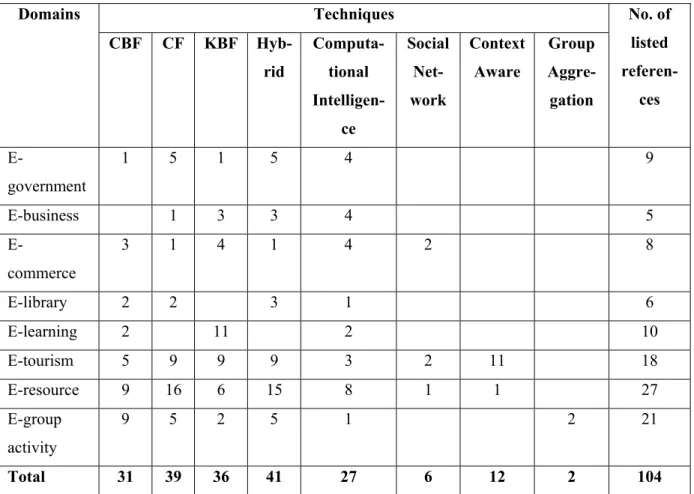
In (Lu et al., 2015), the authors conducted a review of the latest RSs. The analyzed papers are classified into two main types: (1) papers on recommendation techniques, i.e. approaches and methods, and (2) papers on RS applications, i.e. software, which are clustered according to the application domains into eight main categories: tourism, business, government, e-commerce/e-shopping, e-learning, e-library, e-group activities and e-resource services. The reviewed recommendation techniques in (Lu et al., 2015) includes traditional techniques, e.g. CF and CBF (previously presented), Knowledge-Based Filtering (KBF), hybrid methods, and advanced techniques, e.g. Computational Intelligence (CI), social network-based, context awareness-based and group aggregation recommendation approaches. A short description of each of these techniques is presented in Table 1.1.
6
The review conducted in (Lu et al., 2015) shows that traditional recommendation techniques are still frequently used, in particular hybrid techniques which aim to avoid the limitations of using a single traditional recommendation technique, i.e. CF, CBF, KBF. Regarding advanced recommendation techniques, context aware and social network-based recommendation techniques are popular, and CI techniques are applied in all application domains. Yet, some open research topics have been identified in this review such as mobile-based context-sensitive and real time context awareness-mobile-based recommendation techniques. A summary of the reviewed RS applications in (Lu et al., 2015) is presented in Table 1.2.
Table 1.1 Summary of techniques' descriptions Adapted from (Lu et al., 2015)
Approach Description
KBF This approach recommends items based on a deep knowledge about items (semantic knowledge, e.g. ontology). Depending on the user's preferences, KBF approach uses a set of constraints to describe which item has to be recommended
CI This approach includes clustering techniques, artificial neural networks (ANN) and genetic algorithms. Clustering techniques gather similar items into one cluster and are usually used to find k-nearest neighbors. ANN technique is a weighted graph that links a set of inter-connected nodes. It is inspired by the architecture of the biological brain and it has been used to construct movies and TV recommender systems. Genetic algorithm (GA) is a stochastic search technique which is used often to address optimization problems.
Social network-based approaches
These approaches have emerged with the explosive growth of social networking tools. They help to overcome sparse data sets problem which is one of CF limitations (i.e. inability to find sufficient similar neighbors). They also improve the user's trust as the active user would be more influenced by suggestions from his friends than by website advertising.
7 Approach Description Context awareness-based approaches
These approaches use contextual information that could be relevant to recommend useful items in specific circumstances such as place, time, etc. Context is defined as « any information that can be used to characterize the situation of an entity. An entity could be a person, a place, or an object that is considered relevant to the interaction between a user and an application, including the user and the application themselves. » (Dey et al., 2001). Group
aggregation approaches
These approaches, known also as e-group activity, recommend a group of user suggestions when preferences of group members are unclear. They are applied in movies, music, events and travel plans recommendation.
Table 1.2 Summary of recommendation techniques in each application domain Extracted from Lu et al. (2015, p.27)
Domains Techniques No. of
listed referen-ces CBF CF KBF Hyb-rid Computa-tional Intelligen-ce Social Net-work Context Aware Group Aggre-gation E-government 1 5 1 5 4 9 E-business 1 3 3 4 5 E-commerce 3 1 4 1 4 2 8 E-library 2 2 3 1 6 E-learning 2 11 2 10 E-tourism 5 9 9 9 3 2 11 18 E-resource 9 16 6 15 8 1 1 27 E-group activity 9 5 2 5 1 2 21 Total 31 39 36 41 27 6 12 2 104
8
1.3 Relevant RSSE works
In this section, we present an overview of relevant works on RSSEs including surveys and other works that focus on building and evaluating RSSEs.
1.3.1 RSSE surveys
Compared to RS works, only a handful reviews have been conducted on RSSE. In this section, we report relevant RSSE reviews published in the last decade.
In (Happel and Maalej, 2008), the authors conducted a survey of the papers that were published between 2003 and 2008 (six RSSEs). This survey aims to identify potentials and limitations of the analyzed RSSEs with a particular focus on their architecture (e.g. client/ server, web application), their trigger events (proactive or reactive) and the type of recommended information (e.g. methods, project artifacts). Happel and Maalej (2008) outlined a recommendation landscape following two main dimensions:
• when to recommend, i.e. recommendation process is triggered proactively ("Propose") or reactively ("Ask to share"); and
• what to recommend, i.e. information to recommend which is classified into development information (e.g. code, project artifacts) and collaboration information (e.g. people to contact).
Table 1.3 summarizes the outlined recommendation landscape. Then, the authors identified some limitations such as: (1) the non-flexible architecture (e.g. standalone applications), and (2) the disregard of contextual information of the programming task at hand, or simply its restriction to the file level.
In the same perspective, the authors in (Mohebzada et al., 2012) attempted to identify research gaps in RSSE by providing an overview of recommendation systems for requirements engineering.
9
This study used a systematic mapping that included 23 publications between 2004 and 2011. The authors outlined the following characteristics of recommendation systems for requirements engineering:
• recommendation techniques (e.g. CF, CBF, etc.);
• types of recommended items (e.g. stakeholders of a project, software project planning, etc.);
• recommendation modes (i.e. proactive or reactive) and the output form (e.g. web page); • cross-dimensional features (e.g. user's feedback, rationale behind recommendations, etc.); • recommender architecture (e.g. web-based tool, standalone desktop application ,etc.).
Table 1.3 Recommendation landscape Extracted from Happel and Maalej (2008, p.13)
What When Information Access Propose... Information Provision Ask to share...
Development
Code Auto completion, code examples, methods to use
Ways of reusing APIs, used documentations
Artifacts Related, useful artifacts Artifacts used for solving a specific problem
Quality measures
Problematic change, Patterns to improve quality
How problems have been solved, new patterns
Tools Not used features, How-to automate specific tasks
Experience reports on using new tools
Collaboration
People Experts to contact Associations of people with expertise areas
Awareness measures
Ad-hoc collaboration Collaboration artifacts (mail, chat, decision rationale)
Status Priorities
Open related issues, Risks New priorities
Status, open issues
10
The analysis of Mohebzada et al. (2012) revealed some limitations of recommendation systems for requirements engineering such as:
• non-integrated recommenders in existing work environments of requirements engineering which could be addressed by plug-ins architecture;
• limited "explainability features" like rationale behind recommendations; and • limited number of proactive recommenders.
More recently, in (Pakdeetrakulwong et al., 2014), the authors analyzed a sample of 25 RSSEs that were published between 2006 et 2014. The reviewed papers were classified according to the software development life cycle phases as follows: (1) nine requirements, gathering and analysis recommenders, (2) three design recommenders, (3) eleven implementation recommenders, and only (4) two testing recommenders. This study outlined the different recommendation techniques and the knowledge representation used (e.g. semantic representation) according to recommender goals and identified benefits and issues of the existing RSSEs. The authors noticed that the analyzed recommenders were developed to improve software productivity only for one software development phase and in particular the implementation phase. Thus, it would be of great help if recommenders help software teams in more than one phase of software life cycle. Regarding recommendation techniques and knowledge representations, the traditional representations based on structured or semi-structured format of data and the syntactic matching operations are the most used ones. These features can be improved by leveraging semantic ontologies.
1.3.2 Building RSSE works
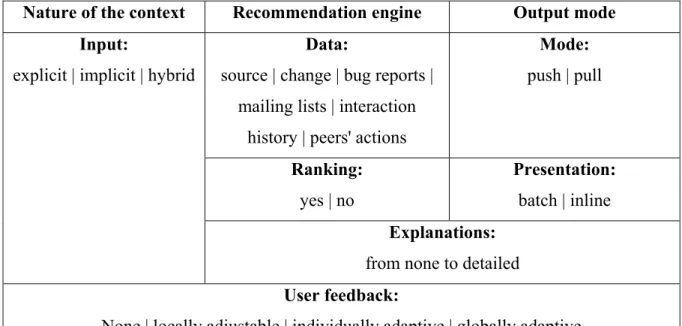
In (Robillard et al., 2010), the authors presented an overview of some relevant recommenders focusing on how RSSEs can help developers. Also they outlined some design dimensions, potentials and gaps of existing RSSEs. In this study, the main dimensions identified (summarized in Table 1.4) involve:
11
• a data context collection process which can be implicit or explicit and mainly involve information like the user's past interactions (e.g. browsed components, etc.) and the current task (e.g. debugging, adding new feature, etc.);
• a recommendation engine that analyze additional data to generate recommendations using ranking techniques; and
• a user interface that triggers the recommendation process implicitly or explicitly (i.e. proactive and reactive modes) and presents results to the user.
This overview revealed some RSSE benefits like proactive mode which delivers automatically relevant information to developers rather than waiting for an explicit request. However, many limitations have been identified such as: “cold-start problem” of a project that could be addressed by leveraging data from other similar projects, and the output form which is presented as a list of recommendations in most of RSSEs so there are a limited explanation features.
Table 1.4 RSSE design dimensions Extracted from Robillard et al. (2010, p.85)
Nature of the context Recommendation engine Output mode Input:
explicit | implicit | hybrid
Data:
source | change | bug reports | mailing lists | interaction
history | peers' actions
Mode: push | pull Ranking: yes | no Presentation: batch | inline Explanations:
from none to detailed User feedback:
12
In the same perspective, the authors in (Robillard and Walker, 2014) reviewed the various software information sources that could be relevant to generate recommendations (e.g. project history, external libraries, user interaction traces, etc.), and presented a more detailed overview of RSSEs aspects. These aspects are:
• data preprocessing such as parsing source code or analyzing commits;
• capturing context by gathering all information about the current development task;
• generating recommendations by performing a recommendation technique that takes as an input the processed data and the captured context; and
• presenting recommendations to the developer.
This general overview has been detailed by Mens and Lozano particularly for Source Code-based Recommendation System (SCoReS) in (Mens and Lozano, 2014) in order to outline relevant decisions to build a SCoReS. First, the authors presented an overview of a handful of existing recommenders, and then tackled important development choices of a SCoReS. These choices were classified according to the phase of the development cycle into two main categories: (1) decisions related to the recommendation approach, and (2) decisions related to the user interactions with the recommender. Table 1.5 summarizes these decisions. Also, the authors tried to answer these key decisions by going through a sample of SCoRes and discussing the development choices taken.
Table 1.5 Kinds of development decisions to be taken when building a SCoReS Extracted from Mens and Lozano (2014, p.103)
Requirements Design Implementation Validation Approach 1. Intent 3. Corpus 5. Method 7. Support
User interaction 2. HCI 4. General I/O 6. Detailed I/O 8. Interaction
In table 1.6, we detail the proposed decisions related to the approach and to the user interaction in each development cycle phase.
Table 1.6 Detailed development decisions of a SCoReS Adapted from Mens and Lozano (2014, p.120-121)
Requirements Design Implementation Validation Approach 1. Intent: • Intended user • Supported task • Cognitive support • Proposed information 3. Corpus • Program code • Complementary information • Correlated information 5. Method • Data selection • Type of analysis • Data requirements • Intermediate representation • Analysis technique • Filtering 7. Support • Empirical validation • Usefulness • Correctness
User interaction 2. HCI (Human Computer Interaction)
• Type of the system • Type of recommender • User involvement 4. General Input/Output • Input mechanism • Nature of input • Response triggers • Nature of output • Type of output 6. Detailed Input/Output • Type of input • Multiplicity of output 8. Interaction • Usability • System availability • Data availability 13
More recently in (Proksch et al., 2015), the authors outline the different steps that should be taken to build a RSSE using some examples of recommenders that assist developers in API usage. The identified steps are described as follows:
1. Framing the problem to solve by determining the task (i.e. the goal), the context (i.e. information and tool environment) and the target user (e.g. novice developers);
2. Determining the inputs, i.e. data available to provide recommendations (e.g. open-source repositories, QA websites, etc.);
3. Building the recommender, i.e. mechanisms used to generate recommendations using inputs, including traditional techniques (e.g. collaborative filtering), data mining and machine learning(e.g. association rule mining);
4. Delivering recommendations which includes the recommendation mode (reactive or proactive) and the presentation of the provided recommendations; and
5. Evaluating the recommender including the evaluation of the proposals presentation (e.g. creating mock-ups in early design stages) and the recommendation engine (e.g. user studies, automated experiments, etc.).
1.3.3 Evaluating RSSE works
As evaluation is an important step to complete the building process of any software tool, we present an overview of some relevant works on approaches and metrics to evaluate RSSEs.
In (Avazpour et al., 2014), the authors review a range of evaluation metrics, measures and commonly used approaches to evaluate RSSEs. As a first step, the authors investigate a set of dimensions that can be relevant to assess RSSE quality. These dimensions are grouped into four main categories (summarized in Table 1.7):
• Recommendation-centric dimensions which evaluate the generated recommendations; • User-centric dimensions assess the degree to which RSSE fulfills the user needs; • System-centric dimensions evaluate the recommendation system itself; and
• Delivery-centric dimensions gauge the recommendation system in the context of use. 14
15
Table 1.7 Categorization of dimensions Extracted from Avazpour et al. (2014, p.247)
Recommendation-centric User-centric System-centric Delivery-centric
Correctness Trustworthiness Robustness Usability
Coverage Novelty Learning rate User preference
Diversity Serendipity Scalability Recommender confidence Utility Stability
Risk Privacy
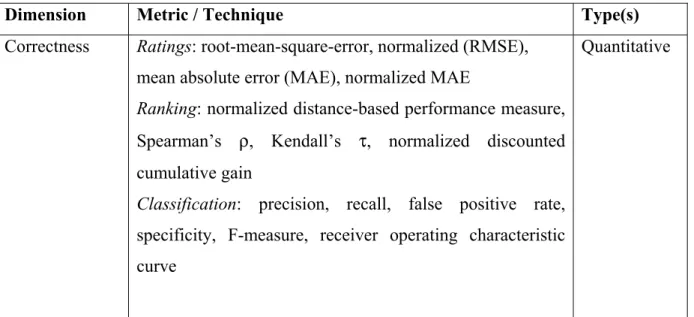
For each dimension, the authors outline the most commonly used metrics. For instance, correctness which evaluates how close the provided recommendations are to users' interests, can be differently measured depending on the type of the generated recommendations (e.g. predicting user ratings, ranking items, etc). For instance, to recommend interesting items, classification metrics such as precision, recall, accuracy and specificity are the most commonly used metrics. Table 1.8 summarizes the identified metrics and techniques.
Table 1.8 Summary of metrics Extracted from Avazpour et al. (2014, p.267)
Dimension Metric / Technique Type(s)
Correctness Ratings: root-mean-square-error, normalized (RMSE), mean absolute error (MAE), normalized MAE
Ranking: normalized distance-based performance measure, Spearman’s ρ, Kendall’s τ, normalized discounted cumulative gain
Classification: precision, recall, false positive rate, specificity, F-measure, receiver operating characteristic curve
16
Dimension Metric / Technique Type(s)
Coverage catalog coverage, weighted catalog coverage, prediction coverage, weighted prediction coverage
Quantitative
Diversity diversity measure, relative diversity, precision–diversity curve, Q-statistics, set theoretic difference of recommendation lists
Quantitative
Trustworthiness user studies Qualitative
Confidence neighborhood-aware similarity model, similarity indicators Qualitative / Quantitative Novelty comparison of recommendation lists and user profiles,
counting popular items
Qualitative / Quantitative Serendipity comparison of recommendation lists and user profiles,
ratability
Qualitative / Quantitative Utility profit-based utility function, study user intention, user
studies
Qualitative / Quantitative Risk depends on application and user preference Qualitative Robustness prediction shift, average hit ratio, average rank Quantitative
Learning rate correctness over time Quantitative
Usability user studies (survey, observation, monitoring) Qualitative / Quantitative Scalability training time, recommendation throughput Quantitative
Stability prediction shift Quantitative
Privacy differential privacy, RMSE vs. differential privacy curve Qualitative / Quantitative
User preference user studies Qualitative /
Quantitative
As an example of evaluation techniques, the authors in (Said et al., 2014) outline the concepts of benchmarking process for evaluating RSSEs and present a multi-dimensional approach.
17
Benchmarking is an evaluation methodology used to assess the quality of a tool in comparison with other tools, and its process follows four main steps: (1) target specification, (2) data collection, (3) evaluation and analysis, and (4) implementation. Traditional benchmarking techniques usually evaluate one dimension (e.g. accuracy) and neglect business and technical aspects. The proposed multi-dimensional approach is composed of three main aspects:
1. User aspects which are related to the impact on the user's attitude (e.g. persuasiveness, trustworthiness) and aim to identify interesting items and to reduce the time of the decision-making process;
2. Business aspects which are related to business requirements such as increased user retention and user loyalty and can be measured using metrics like click through-rate (the ratio of recommendation selected by the user per the total number of recommendations) and average page views per visit in case of websites; and
3. Technical aspects which consider technical constraints including data, system (hardware and software limitations), reactivity (ability to provide relevant recommendations in real-time), scalability (ability to provide relevant recommendations independently of the dataset size), robustness, etc.
1.4 Limitations of existing works
In this section, we summarize the limitations identified in both RSSE surveys and works that build RSSEs.
Regarding RSSE surveys, we noticed that existing surveys aim to identify potentials and gaps of RSSE with a particular focus on some features like the recommender’s architecture (plug-ins, web applications, etc.), its mode (reactive or proactive), the recommendation techniques and the nature of information presented to the developer. However, these surveys did not discuss the input nature, i.e. information to be extracted that can be relevant to the task at hand, and the data used to provide recommendations, and whether this data is processed before being used to generate recommendations.
18
The same features (i.e. recommender modes, recommendation technique and output) were considered by works that build RSSEs. In particular, the work by Mens and Lozano highlights more features to consider in each development life cycle phase of building source code-based recommenders. However, we tried to use their classification on some RSSEs with inputs different from source code (e.g. queries, project artifacts, etc.) and it ran into many ambiguities, such as:
• the ambiguity of recommender types which was defined as advisor, finder or validator; • the user involvement and the input mechanism can be considered as one decision that
explain how the input should be entered.
We noticed also that the input type which requires whether an additional information has to be selected or not, is requested in the implementation phase in the development cycle. However, it should be considered in earlier phases. These ambiguities forced us to consider a different approach.
In particular, we concluded that there was a need to clarify the key steps and to characterize the basic components of an RSSE regardless of the input type and the supporting goal. However, we do not focus on RSSE evaluation means in this survey.
CHAPTER 2
RESEARCH METHODOLOGY
To conduct our systematic literature review, we adopted the approach proposed in (Kitchenham, 2004). This approach is used to identify and evaluate available research in a particular field and includes three main phases:
• Planning of the study by developing a review protocol that includes the research questions, the search strategy, the selection criteria and the data extraction strategy; • Executing the study includes the collection of data addressing the research questions;
and
• Analyzing / interpreting the results of the study.
In this chapter, we detail the first step to conduct systematic literature review. The other steps are covered by the following chapters.
2.1 Planning of the study
In this section, we present the planning of the study we used to identify the set of papers and to filter out papers we consider relevant to our research questions. Figure 2.1 depicts our research methodology and details in particular the planning of our study.
2.1.1 Research questions
In this study, we formulated the following research questions:
• (Q1) : Which features characterize the context extraction process adopted by RSSEs ? • (Q2) : Which features characterize the recommendation engine used by RSSEs to
provide recommendations ?
In order to answer these research questions, we selected a sample of RSSE papers published in scientific conferences and journals within the last decade.
20
Figure 2.1 Research methodology
2.1.2 Search strategy
To select a sample of papers published in scientific conferences and journals within the last decade, we queried the research engine Compendex, known also as Engineering Village, which is an engineering bibliographic database providing a searchable index of the scientific literature. We performed the following query:
• (("recommendation system" OR "recommendation tool" OR "recommender") AND ("software engineering" OR "software development" OR "software maintenance" OR "software evolution" OR "software project")).
21
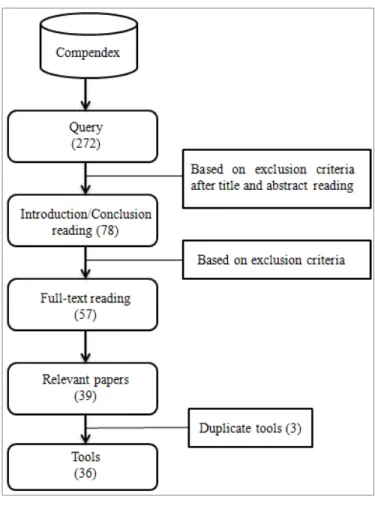
The search related to this query returned 272 results on which we performed a preliminary screening based on papers’ title and abstract. Based on our selection criteria, described in the next subsection, we retained 78 publications that contain three duplicate tools (two different papers of Rascal and NavClus). We performed a second screening based on papers’ introduction and conclusion and we filtered out 21 paper. After reading the rest of papers, we kept 36 relevant papers. Figure 2.2 summarizes the filtering approach.
To enlarge our study, we selected RSSEs that were analyzed in (Mens and Lozano, 2014). We kept papers that are published within the last decade and we filtered out those that were found by our query (Mendel (Lozano et al., 2011), Hipikat (Cubranic et al., 2005), Strathcona (Holmes et al., 2006)). We retained a sample of 10 publications. The final sample of the analyzed RSSEs is composed of 46 relevant papers.
22
2.1.3 Selection criteria
We were interested only in the publications presenting recommendation systems in software engineering, particularly the ones related to software development. To do so, we defined the following exclusion criteria:
i. Papers from fields other than software engineering, e.g. commerce, tourism, e-business, e-learning, health-care, etc.
ii. Papers presenting tools that do not support software development tasks, e.g. tools supporting requirements elicitation, works management (e.g. helping managers building their teams), or evaluation of recommendation systems.
iii. Papers presenting other studies which were discussed in the previous chapter (e.g. literature reviews).
2.1.4 Data extraction strategy
We prepared tables to accurately record any information that can be relevant to answer our research questions. To do so, we followed two main steps in order to extract the following data categories:
1. Context extraction phase which is usually prompted by a triggering event to collect the contextual information (i.e. input) that may be treated in order to generate an output. The context input has to be retrieved within a given scope and possibly involves the extraction of specific elements. Figure 2.3 shows an overview of this phase.
2. The recommendation engine takes as an input the context extraction output and then performs a treatment in order to generate recommendations which can be filtered or ranked before being presented to the developer. The recommendation engine possibly involves a corpus which is a set of raw data that can be treated in order to generate an output (processed data) used to recommend items. An overview of this phase is shown in Figure 2.4.
23
Figure 2.3 Context extraction phase
CHAPTER 3
EXECUTION OF THE STUDY
In this chapter, we present the sample of RSSEs analyzed. We cluster these tools according to the supported goal into seven main categories. Table 3.1 presents an overview of this categorization.
Table 3.1 Categorization of analyzed tools
Supported goal Number of papers
Change tasks 12
API usage 6
Refactoring 4 Debugging and testing 11
Reusable software components 5 Exploring codebases 5 Others: Prototyping Tagging Recommending experts 1 1 1
In some categories, we describe a sample of the selected tools. The remaining recommenders are described in ANNEX I.
3.1 RSSEs supporting developers in change tasks
Software developers, especially newcomers, often encounter difficulties in their change tasks. They usually have to understand the existing code, implementing the required modifications without breaking something in the process.
26
Thus, they need assistance to accomplish their first tasks. However, allocating an experienced member to assist newcomers could be expensive and not always possible for a long time period. And even for experienced members, locating the software artifacts relevant to the changing task at hand could be an error-prone and a time consuming task. In this perspective, RSSEs can be helpful by providing useful software artifacts. In the following, we describe some of the selected tools supporting these goals.
Mentor (Malheiros et al., 2012) assists newcomers in the realization of their first tasks by recommending solved change requests and their related source files. The process is triggered explicitly by developer's request. It starts with an open change request composed of different fields (summary, description and developers’ comments) written in a natural language text. Those fields are concatenated and compared to a set of solved change requests stored in a database which are processed beforehand into an advanced statistical model. The tool analyzes every stored change request and version control files in order to identify and store the associated relations (i.e. by scanning the commit messages). To do so, a heuristic based on regular expressions is used. To identify change requests similar to the open one, a comparison is performed using an entropy measure. The entropy of the open change request is calculated using the advanced statistical model of every stored change request. The similar changes are then classified according to their entropy scores and presented to the developer. Clicking on a recommended change request, the tool shows the associated revisions and source files.
Hipikat (Cubranic et al., 2005) is a similar RSSE which assists newcomers by recommending artifacts from the current project. A project memory is formed implicitly by all the artifacts of the project under development and links between those artifacts (e.g. file revisions which implemented a particular change request). An artifact could be: (1) a change task artifact (e.g. feature request and bug report), (2) a source file version stored in Control Version System (CVS), (3) a message (e.g. emails and forums), or (4) an other document (e.g. design documents). The links between project artifacts are inferred by Hipikat using different heuristics such as:
27
• clustering (e.g. clustering change task requests that have been fixed within the same time window);
• regular expression based heuristics for instance used to match change requests with the related file versions, etc.
The project memory is built and updated automatically, and the recommendations can be generated as soon as any part of the memory is formed. The recommendation process is triggered explicitly by the developer, selecting an artifact from the project under development and sending a request from a contextual menu. The selected artifact is tokenized, converted into a Bag of Words (BoW) which is processed to form a weighted vector and projected into a semantic space using Latent Semantic Indexing (LSI) which is an advanced Natural Language Processing (NLP) technique. Artifacts similar to the selected one are identified for two main situations: (1) either the selected artifact already exists in the project memory and Hipikat recommends the related artifacts based on the links stored in the project memory, or (2) the text similarity of two weighted vectors is performed using a cosine similarity measure. The similar artifacts identified are classified and ordered according to the similarity confidence which could be numeric (i.e. text similarity score) or descriptive (e.g. "high-checked in within the last five minutes"). Artifacts are clustered according to their types (e.g. CVS files) and each presented artifact provides a reason (e.g. check in to bug resolution).
The other RSSEs in this category work more closely with source code in order to recommend useful source code artifacts or elements. For instance, MI (Lee and Kim, 2015) recommends files to edit by leveraging developer interaction histories (i.e. viewed and edited files). The goal of the proposed tool is to help developers even before editing a file. The key idea is that the recommender monitors the last viewed (and edited if exist) files in a sliding window (referred as viewed-edited-sized sliding window) and looks for previous tasks with similar viewed files in a corpus formed of interaction traces. These interactions are stored as a pair of sets (viewed files, edited files) associated to a given task (e.g. bug fixing tasks). Based on association rules, the tool recommends the files edited in the identified similar tasks.
28
Once the developer edits a file from those recommended, the edited file is then considered in the new context with the viewed files to recommend other files to edit. For instance, Figure 3.1 shows an example in which developers have performed three tasks T0, T1 and T2, and a developer is performing a task T3. As the current viewed files (d, b, c) have been viewed in the task T0, MI then recommends the files that were edited in T0 (c, e).
Figure 3.1 An example that shows the files programmers view and edit while performing tasks. This example is simplified from the actual interaction traces of bug reports #124039,
#176690, #204358, and #290505 in the Eclipse Bugzilla system Extracted from Lee and Kim (2015, p.316)
Mendel (Lozano et al., 2011) is a similar RSSE which assists developers in their change tasks. The tool detects what is missing in an entity (e.g. method, class) by analyzing related entities based on inheritance dependencies and identifying the most common properties. For instance, the family set of a class is composed of the direct superclass and its direct subclasses (i.e. siblings, nephews / nieces). In order to identify the common traits (dominant and recessive) in a family, Mendel sets two threshold measures. The identified traits (i.e. structural properties: types, naming or structural conventions) are thus recommended to be considered by the entity under development.
Other recommenders may help developers in planning complex modification tasks such as pragmatic reuse activities.
29
For instance, the recommender proposed in (Holmes et al., 2009) assists developers in planning their reuse tasks based on the structural relevance and the reuse cost of an element (e.g. class or method). The tool is an extension of Suade which is a topology analyzer of software dependencies, merged with Gilligan which is an environment for planning pragmatic reuse tasks. The proposed approach automatically recommends software elements that can be reused when a developer is triaging elements in the reuse plan. The tool extracts methods and fields of the triaged elements in Gilligan and analyzes the topology of the structural dependency graph built by Suade in order to identify their structural neighbors (e.g. callers of each method in the triaged elements). A degree of interest and a reuse cost measure are assigned to the identified neighbors based on their structural relevance (specificity and reinforcement) and the number of their descendants. The weighted elements are then ranked before being presented to the user.
3.2 RSSEs supporting developers in API usage
To improve their productivity, developers often tend to reuse existing libraries instead of writing the code from scratch. However, they may encounter difficulties in instantiating a particular object or in invoking related API methods which are usually complex to use and not well documented. In this perspective, RSSEs can be of great help to get familiar with API methods usage.
Altair (Long et al., 2009) recommends API methods based on structural information. The developer sends a query that contains an API method signature. The tool analyzes the query and extracts the data accessed by the given method that will be used to compute pair-wise overlap with API methods stored in a corpus. An API in the corpus is represented as a bipartite access graph where there are two types of vertices: functions and data, and edges represent access relations. Some heuristics are used to extend this graph into an augmented access graph (Figure 3.2 shows an example of augmented access graph). API methods identified by the overlap treatment are ranked and only the top ten results are selected. They are then clustered according to their purpose before being presented to the developer.
30
Figure 3.2 Augmented access graph. e, f, g, g0, h represent functions, x, y, z, w represent data, and A represents a composite type
Extracted from Long et al.(2009, p.205)
Other RSSEs in this category assist developers in API usage by suggesting code snippets. For instance, MAPO (Zhong at al., 2009) recommends API usage patterns and their related code snippets. The developer selects an API method name from the body of the method under development and sends a request from the contextual menu. Methods and class names are extracted and sent as a query to a corpus containing API patterns. The corpus is formed of open source projects invoking API methods. A code analyzer is used to retrieve API method call sequences that will be clustered into patterns according to similarity of methods and classes' names computed by Levenshtein distance. The patterns and its associated sequences are presented to the developer as links which lead, when clicked, to the related code snippets.
Strathcona (Holmes et al., 2006) is another RSSE that recommends relevant API usage examples of source code according to the context of the task at hand. These examples are generated from a repository of existing applications that use the API. The developer selects a code snippet in the file under development and sends a request from the contextual menu. The tool extracts the structural context from the selected source code snippet. The structural context is a set of syntactic elements (e.g., the method signatures, the names of the types that declare those methods, etc.). Strathcona uses a set of heuristics based on structural facts similarity, e.g. a CALLS heuristic mines the repository to retrieve code snippets that make the same method calls as the structural context.
31
The repository of source code is indexed by the structural facts which are extracted in the same manner as the context. The similar code snippets identified are then ranked and only top ten results are presented to the developer as an example of usage with an illustrative graphical view and the rationale for selecting each example.
APISynth (Lv et al., 2014) assists developers in correctly instantiating API objects by providing a set of API Method Invoking Sequences (MISs). The developer sends a query that contains source and destination types and the tool returns a sequence of code statements that instantiate a new object of the second type starting from an object of the first type. To recommend these sequences, a repository of existing projects using the API is presented as a Direct Acyclic Graph (DAG); called also Weighted API Graph (WAG). DAG is a connected graph where nodes represent API methods and edges are built if the output type of an API method matches an input type of another API method (an example is shown in Figure 3.3). The tool uses the Key-Path based Loose algorithm to identify DAGs appropriate to the given query. The identified paths are ranked according to some criteria such as the path length, i.e. the shortest path represents the higher rank.
Figure 3.3 Example Extracted from Lv et al. (2014, p.596)
32
3.3 RSSEs supporting developers in refactoring tasks
Software refactoring aims to maintain and understand software systems by restructuring the existing source code. However, selecting the appropriate refactoring operation that could be relevant to the current project is a challenging task due to the lack of documentation and large code bases. In this perspective, RSSEs can be helpful by providing relevant refactoring opportunities.
In (Bavota et al., 2014), the authors proposed an approach that recommends refactoring opportunities based on team development activity. The basic assumption of this approach is that code entities (e.g. methods or classes) modified by the same team could be extracted and grouped together in a separate module (e.g. class or package). A team is defined as a group of developers who has worked on the same source code entities. A code analyzer is used to parse the source code of a project and to extract its change history and the associated authors within a specified time window. The retrieved changes (e.g. methods added, removed or updated) are tokenized and rendered into a BoW. A clustering technique is used to group developers working on same code entities into teams. The output of this technique is a tree, called dendrogram, where the leafs represent developers and the remaining nodes are the possible clusters (i.e. teams). In order to recommend refactoring opportunities, a detection algorithm is used, for instance the algorithm detects methods edited by the same team, if the number of these methods is superior to a threshold then those methods can be extracted to form a separate class. Thus, the approach recommends code entities to be extracted (e.g. methods, classes).
Thies and Roth in (Thies and Roth, 2010) proposed another approach to support refactoring tasks by providing rename refactoring opportunities. Based on variable assignments, the key idea of this approach is that a variable assigned to another usually points to the same object and if both variables are declared with the same type, they are likely used for the same purpose. The recommender analyzes the source code of a project and extracts variable assignments' statements in order to build an assignment graph.
33
Using this graph, the tool detects the assignment of two variables having the same type but different names. In order to identify the variable name to recommend, some techniques are used such as misspelled names, synonyms names, etc.
DCLFix (Terra et al., 2012) is another recommender that assists developers and maintainers in refactoring tasks by recommending refactoring guidelines. The tool provides recommendations to remove violations detected by constraints defined using the Dependency Constraint Language (DCL). These constraints are checked using a companion tool DCLCheck. The recommendation process is triggered implicitly when an architectural violation is detected. DCLFix then extracts statements from the source code where the constraint has been violated. To generate recommendations, some preconditions have to be validated, for instance, to extract a method that will be moved to another class, the tool should find an appropriate class for the extracted method. To do so, the tool computes the similarity between the method and the class using the Jaccard similarity coefficient and returns the class with the highest value of similarity coefficient.
Other recommenders may help developers in repairing programs affected by evolution and refactoring modifications such as SemDiff (Dagenais and Robillard, 2008). This tool captures adaptive changes (e.g. method additions and deletions) and recommends similar adaptations (e.g. replacement methods). The proposed approach is based on the assumption that « ... calls to deleted methods will be replaced in the same change set by one or more calls to methods that provide a similar functionality. » (Dagenais and Robillard, 2008, p. 482). The developer selects a method call that no longer exists in the source code of the project or the framework and sends a request to a corpus containing changes' sets. The corpus is formed of log files which are preprocessed using clustering and mining heuristics to retrieve change sets. These files are clustered according to log entries that occur in the same given time window and share the same user and log message. To find a replacement for the method selected by the developer, the tool looks for all the methods where a call to the selected method was deleted and gathers all the added method calls in these methods.