Research Action 4.4.1
Preliminary interviews with occupiers
University of Liege – Belgium
J.-M. Halleux
1, N. Mairy
2Under the supervision of B. Mérenne – Schoumaker
3January 2008
1
Maître de conférence, department of Geography (SEGEFA), University of Liege, [email protected]
2
Research attaché, department of Geography (SEGEFA), University of Liege
3
Professor, Head of the Department of Geography (SEGEFA), University of Liege, B.Mé[email protected]
Creating a Setting for Investment (CSI) is an international collaborative research programme aiming to demonstrate the impact of environmental improvements on economic growth. The project explores the links between the quality of the landscape, the value of land at commercial property development locations and the location decisions of investors and occupiers. The project partners are:
• South Yorkshire Forest Partnership, Sheffield City Council (UK)
• Services Promotion Initiatives en province de Liège (SPI+), Belgium
• Université de Liège, Belgium
• Institut fur Landes und Stadtentwicklungsforschung GmbH (ILS), Germany
• Montan-Grundstucksgesellschaft mbH (MGG), Germany
• University of Sheffield, UK
CSI is funded by Interreg IIIB North-West Europe, with match funding provided by Yorkshire Forward (the Regional Development Agency for Yorkshire & the Humber), the UK Department for Communities and Local Government, the Walloon Region of Belgium, MGG and ILS .
Abstract
The overall aim of the research action 4.4, of which this research 4.4.1 is part, is to explore the impact of landscape quality on investment and development decisions and on occupiers’ choices. The main aim of the preliminary interviews undertaken in 4.4.1 is to identify the key elements that contribute to occupiers’ perception of landscape quality in their working environment to provide focus and information for the subsequent 4.4 research actions.
The process to carry out preliminary interviews has been realised in the three partners regions: England, Wallonia and North-Rhine-Wesphalia. In this report, we present the work carried out by SEGEFA-ULg, with a survey of occupiers established in Wallonia. Our work is based on a methodology developed by our partners from the University of Sheffield. Therefore, we recommend to read the University of Sheffield report before the present one. Despite the relatively limited number of interviews, which makes that no conclusive findings can be made, different observations can be underlined:
- There are no major differences between our results and the main conclusions in the partners regions. Therefore, key elements that contribute to occupiers’ perception of landscape quality seem to be rather similar in England, Wallonia and North-Rhine-Wesphalia.
- An exception to this first observation is, compared to the UK situation, the stronger “brownfield stigma” observed in Wallonia.
- Buildings characteristics as well as external spaces are important for many interviewed firms, as it reflects the values, the image and the identity of the business activity.
- The maintenance of external spaces is a major concern for many companies.
- Although working in a high landscape quality environment can be considered as an “extra”, the working physical environment is not taken into account when employees apply for a job. - The security issue is important and relates to different landscape characteristics (the open spaces, the sufficient lighting and the fences which could be covered by vegetation).
Key words
1. Research aims and objectives
The overall aim of the research action 4.4, of which this research 4.4.1 is part, is to explore the impact of landscape quality on investment and development decisions and on occupiers’ choices. The main aim of the preliminary interviews undertaken in 4.4.1 is to identify the key elements that contribute to occupiers’ perception of landscape quality in their working environment to provide focus and information for the subsequent 4.4 research actions. In this perspective, four specific objectives can be specified:
a) To identify the key factors/elements that contribute to occupiers’ perception of landscape quality, make the site more attractive to them and influence their decisions about site location in a positive or negative way.
b) To compare the occupiers and the “professional” perception and description of landscape quality. To devise a landscape quality evaluation framework based on professional evaluation criteria to be used to explore whether the occupiers describe the same themes and elements as representative of landscape quality.
c) To identify aspects of landscape quality which are most important to different types of occupiers working in different activities and in different types of locations.
d) To identify the main themes to explore in further 4.4 steps carried out in the partner regions to include in the required visualisations. This is to provide a focus for the subsequent 4.4 research actions and inform the design of the methodologies.
The process to carry out preliminary interviews has been realised in the three partners regions: England, Wallonia and North-Rhine-Wesphalia. In this report, we present the work carried out by SEGEFA-ULg, with a survey of occupiers established in Wallonia.
2. Methodology
The applied methodology has been developed by our partners from the University of Sheffield. Therefore, it is not useful to develop it in-depths, as the interested reader can make reference to the report written by our English colleagues. Although, some details related to some specificities can be underlined.
2.1. Identifying the firms
As proposed in the general methodology, thirty interviews were realised, with six firms meet in the five following sectors: business activities, research and development (R&D), manufacture/assembly, storage and distribution, retail. Initially, we planned to interview firms located on former brownfields. Unfortunately, due to the very limited number of brownfield sites regenerated into economic estates, we had to select companies located on economic estates develop on former greenfields.
We had the objective to interview firms in both, the Liege region and the province of Walloon Brabant. This orientation was taken in order to study two different kinds of economic contexts. On the one hand, the Liege region is still suffering from its tradition in the field of heavy industries. On the other hand, the Walloon Brabant is characterised by a rather strong economic development related to its integration into the Brussels metropolitan dynamics. 2.2. Contacting the firms
We usually established the first contact on the basis of the general phone number of the firms, and generally got in touch with a secretary or the central operator. Without in-depth informations about the internal organisation of the company, we then tried to reach the main manager, or one of his (her) main close collaborator. In most of the interviewees, we met a
manager in charge of domains such as environment, security, or cleanliness and hygiene. Concerning the objective to interview employees as well as employers, it was unfortunately impossible to achieve it. Indeed, despite numerous attempts, it was impossible to organise separate meetings with both, a main manager and an employee representative. In fact, the people we usually meet were somehow both at the same time: employee of the firm and department manager. Out of the 32 interviewees (from 30 interviews), 4 were chief managers, 2 were directors and 4 were administrators. The majority of the 32 interviewees were managers of a specific department (16) or just employees (6).
It appeared that the interviews were more difficult to organise than expected. A very important number of phone calls had to be given and, unfortunately, many firms have refused to meet us. The main refusal reason was that the managers hardly saw the interest of the research theme. Through the phone call, it was often stated that the landscape issue was too far from their preoccupations. Many companies did not see any concrete link between the landscape issue and their business activity. On the other hand, some other persons immediately understood the opportunity to meet us in order to beneficiate from new ideas as regards their working environment. Even if their core business does not require a very high landscape quality, these persons were convinced that this topic is important for the image of the company, as well as for the quality of their working environment. In this perspective, it is important to stress the fact that the persons and the firms we met are not perfectly representative. Indeed, their interest for the landscape issue is, the characteristics of the firms being equal, more developed that the interest of the people and the firms that did not accept to participate to the research.
It is worth mentioning that most of the SME have refused to participate to the interviews. The main explanation is the limited number of employees, with the fact that an interview lasting one hour is too time consuming for a small companies with very few employees. Concerning the differentiation between the Walloon Brabant and the Liege region, we can underline the fact that it was even much more difficult to achieve an appointment in Walloon Brabant than in the Liege area. The explanation could be that Liege’s firms are much more used to collaborate with the University of Liege, and, therefore, more easily disposed to participate to a research carried out by researchers from this institution. Moreover, the SEGEFA is quiet well-know in this area. Another explanation could be that the Liege area is more severely affected by the decline of industries and, therefore, more severely affected by the browfield problem. Therefore, Liege firms can be more sensitive to the need of an environmental and landscape regeneration of the urban fabrics.
2.3. Realising the interviews
The questionnaire we used is available on Annex 1. This questionnaire is made of a first identification sheet, in order for the researcher to collect information about the company. The questionnaire is also made of several sections related to open questions on the following themes:
- The physical environment (importance of the cleanliness, of the greening, etc.).
- The image and identity of the external spaces (importance of the external elements for the image, the identity and the security issue).
- The accessibility and connectivity (importance of the site accessibility by public transport, cycle path, food path, and connectivity with services).
- The economic aspects of the external spaces.
- The social aspects (the importance of the amenities proposed by the external spaces for the employees and the neighborhood).
- The maintenance aspect (importance of the level of maintenance, reference to sustainable management methods).
It was decided that the same researcher would have to realise the whole of the interviews. This decision was taken in order to minimize the perception differences. Concerning the realisation of the interviews, it is also worth mentioning that it was sometimes difficult to remain focus on the landscape issue. Despite the preamble stressing the idea to remain focus on it, the discussion often slips on two others connected subjects:
• the building(s) and the inside working facilities, i.e. the envelope and the internal spaces;
• other environmental issues such as air pollution, soil contamination or noise nuisances. Visualisations were used during the interviews. For this research, we used the same images as our Sheffield colleagues. Therefore, these images were sometimes marked by a British “flavour”. In fact, the main elements that lead to this British appearance are the typical red bricks. One of the interviewee who works for an international company also active in the UK clearly mentioned that the proposed images look like England. This observation implies that this British appearance should be limited in the next research actions.
Concerning the realisation of the interview, we can also mention the fact that some interviewees were not native French speakers. This happened mostly in Walloon Brabant, where many Flemish firms are established. Therefore, the main managers were in fact native Dutch speakers. Although these persons have a very good level in usual French, the subtleties of the questions were sometimes difficult to comprehend.
3. Results
3.1. General observations on the landscape issue
The firms and people that have accepted to meet us are usually concerned by the landscape issue. Most of them are located in a rather green environment (see the pictures below) and are convinced about the interest of such kind of location. Therefore, as mentioned above in the methodology section, it is important to state that they might not be perfectly representative of their economic sector or activity branch. For many interviewed persons, the company building(s) and the green spaces around are very important for the image of the firm. In fact, it reflects the company’s identity and gives an image of the values within the organisation (professionalism, well-managed, quality of work, serious…), especially in services or R&D, where the production is immaterial.
The general observations on the landscape issue are actually very similar to the observations made by our colleague from England or Germany. A first observation is related to the differences between the five investigated sectors. It is for business services and R&D that the landscape issue is the most important. This is not surprising and it is well-known (see the scoping study) that these economic sectors are looking for rather high quality environments (level 4 as regards the landscape quality tool developed by the University of Sheffield). In quantitative terms, the landscape aspirations of retail companies seem to be close to those of business services and R&D (level 3-4), as their site must be enjoyable for the shoppers. Manufacture or storage/distribution firms are looking for a less high quality environment (around level 3), but their close environment must be clean. The importance of the “nice and tidy” aspect has also been stressed by our British and German colleagues. Concerning the manufacture activities, it was also stated that it is important for the firms to be accepted by the local populations (which implies to limit the nuisance related to the production activities).
Another general observation that confirms our colleagues’ conclusions is the fact that there are differences between, on the one hand, the firm’s views on landscape and, on the other hand, the professionals-experts visions. In fact, the factors stressed by the interviewees are
Figure 1: Environment of some questioned firms
EVS (Liege) – R&D Eurogentec (Liege) – R&D
Lhoist (Louvain-la-Neuve) – Business services
Skechers (Milmort) – Storage/distribution
Armasteel (Wavre) – Manufacture/assembly Air Liquide (Milmort) – Manufacture/assembly Author: SEGEFA, ULg, 2006
mainly visuals. By contrast, other environmental themes that can be high on the professional agenda (such as sustainability or biodiversity) were hardly mentioned by the interviewees. As mentioned in the methodology section, we were not able to obtain specific appointments with employers and employees of the same companies. Despite this methodological limit, our interviews have confirmed that the landscape environment of the working place is not an important factor on the labour market. For instance, our result cannot lead to the conclusion that workers – even skilled workers – consider the working environment as an important factor when they chose to apply for a job. This observation has to be related with the fact that Wallonia is still suffering from a high unemployment rate. In fact, even for a qualified person, the key motivations on the labour market are the remuneration levels, the stability of the job, and also the possibility to be employed close to his (her) place of residence.
Our observations related to the theme “access and linkage” are also very similar to the observations made in England and Germany. The first is the importance of car-access and parking, which are nowadays the main factors in terms of location choices. Beside the importance of car mobility, we can note that the interviewed persons are somehow interested in alternative mobility means (public transport, cycling or pedestrian networks). Although, this theme is not a priority at all. Most of the interviewees are not opposed to the presence of walkers or bikers inside the economic estates. On the one hand, this presence could limit the security problems, but, on the other hand, it could reinforce the maintenance needs (for instance because of fly tipping).
Concerning the general observations on the landscape issue, we can also mention that no significant difference could be noticed between firms located in Liege and in Walloon Brabant. It is also worth mentioning an observation stressed by two firms active in the food industry. On the basis of these interviews, it appeared that, by contrast to what we initially supposed, such economic sector is not so interested by a “green” landscape. Although such companies considers that a “green” environment can be good for their image, they also explained that hygiene rules and the fight against vermins requires very simple sites with few vegetation, even if the setting can be green. For such firms, an ideal location could be a green setting with a building surrounded by artificial areas (concrete, tarmac…).
3.2. Repulsive factors and the security issue
It results from the interview that firms active in R&D or business services can be very sensitive to some repulsive factors, even if they are not so spectacular. For instance, a R&D firm located close to a parcel that is wooded but looks derelict explains that many visitors ask frequently about what is happening on this site (see figure 2)
Another example is the case of a pharmaceutical development centre located close to a former rubbish dump (well-know in Wallonia for its soil contamination). The people we met explained that this problem has almost leaded to a different location choice. Before this installation, the company had to achieve analyses to check if the soil pollution could migrate towards its plot. In the present case, for evident commercial reasons, the pharmaceutical company also wanted to avoid being accused of polluting the environment. This illustrates the fact that firms – in particular pharmaceutical company or, more generally, firms that rely on a good image – want to avoid being associated with any kind of pollution.
Our interviews also showed that a location on a former brownfield can easily be associated with a “bad image”. This observation can be related with the idea that it is rather easy for the Walloon firms to locate on new economic estates developed on greenfield. In fact, there is here a difference with the UK context, where, due to the strict containment policies, it is more
difficult to invest on greenfields. In such a context, where almost “everybody” has to invest on browfield, the “brownfield stigma” is therefore less important.
Figure 2. Derelict land next to a R&D firm
Author: SEGEFA, ULg, 2006
The problems of maintenance are also related to the repulsive factor issue. In fact, the maintenance of both, the site as well as the setting, seems to be a major concern. This is true for services and R&D firms, but also for industries and firms active in the logistic sector. Our interviews leaded to the idea that it is not worthwhile spending money to improve external or/and public spaces if a correct maintenance is not managed thereafter. In fact, in some cases, it is better to create less sophisticated external spaces if the maintenance can be easier.
For many interviewees, too much planting can lead to insecurity problems, in particular if views on buildings and car park are obstructed. A dense vegetation can increase the insecurity perception in period of darkness (evenings or early mornings), and it can also facilitate vandalism and robberies. In this perspective, there is a consensus that the outdoor spaces should not look like a wood (only trees), but be kept like private gardens around houses, with for instance a mix of trees, shrubs, grass hedges and meadows. As regards the security issue, the lighting equipment is a very important infrastructure, which should ensure a good visibility.
Concerning the security fences, the interviewed persons usually expressed a mix feeling. On the one hand, fences can be useful against vandalism and robberies. Although, on the other hand, they are very unaesthetic. Different persons we met observed that their fences were installed after a theft, but that it is not always necessary to enclose the whole plot; some enclosed sides were enough. Another reflection is that the fences could be hidden by some vegetation, or even completely replaced by thorny planting.
3.3. General trend on tenure and management cost of external spaces
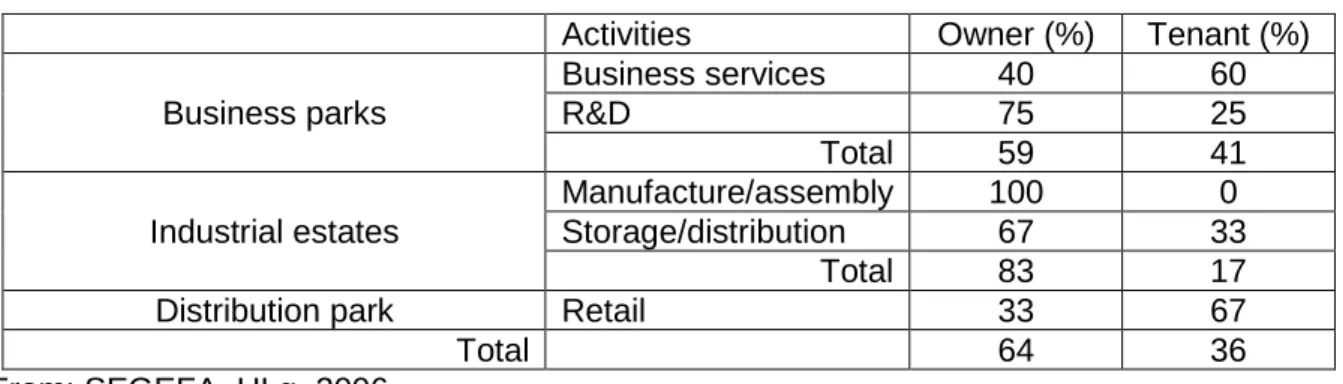
Most of the interviewed firms are owner of the occupied properties: 64% are owner-occupiers and 36% are tenants. As regards the general trend on tenure, there are important differences between economic sectors. In fact, the result of our survey illustrates the fact that the
homogeneity of the property product determines the choice on tenure. We see, with the table 1, that office and shop occupiers are usually renters. On the contrary, economic activities that rely on more specific installations are usually owner-occupiers, for instance in the R&D or manufacture-assembly sectors.
Table 1. Owners versus tenants
Activities Owner (%) Tenant (%)
Business parks Business services 40 60 R&D 75 25 Total 59 41 Industrial estates Manufacture/assembly 100 0 Storage/distribution 67 33 Total 83 17
Distribution park Retail 33 67
Total 64 36
From: SEGEFA, ULg, 2006
The firms we met dispose from a specific budget for the maintenance of their external green spaces. In fact, renters as well as owner-occupiers pay for it. The green spaces are usually maintained by subcontractors (90%), but the maintenance can also be strictly internal (3% or 1 firm) or related to a mix between internal and external (7% or 2 firms). Out of the 30 firms we met, 20 were able to give precise informations on their maintenance costs (table 2). Surprisingly, they are quiet high (the annual median cost is 3,000 €), which tends to show that, despite the common ideas that firms are not easily disposed to pay for their external spaces, they actually do. The annual management cost underlines the fact that occupiers of retail parks accept higher costs (500 €/job) than those on business parks (119 €/job) or on industrial estates (100 €/job).
Table 2. Management costs for 20 companies
Annual cost (€) Annual cost/job (€)
Average Median Average Median
Business park 8,295 4,350 117 119
Industrial estates 3,514 1,950 175 100
Retail park 1,917 1,750 569 500
Total 5,642 3,000 143 119
From: SEGEFA, ULg, 2006
Concerning the maintenance costs, many interviewed persons are aware that flowers are extremely expensive. Many people like the colours brought by flowers, but most of them also consider that the related management costs are too important. Many interviewees also made a link between the cost issue and the topic of sustainable management methods. In fact, they agree on the interest of this approach, if it does not increase the budgets.
3.4. Ideal landscape quality of work places
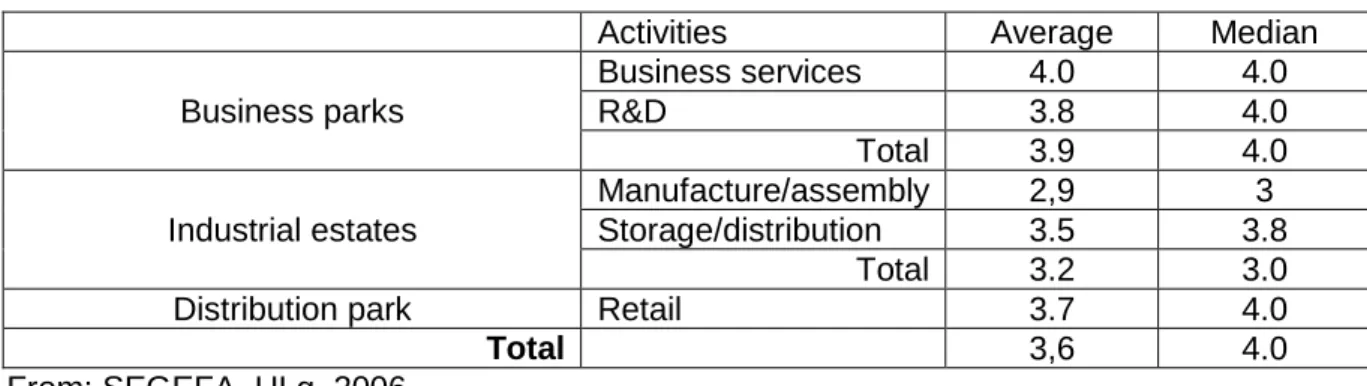
The use of computer modified images has allowed to evaluate the ideal landscape quality for the firms that have participated to the interviews. On the basis of the 30 interviews, the average is 3.6 and the median is 4.0. Out of the 30 interviews, it also appeared that 10 firms are satisfied with the current quality of their site (which also means that 20 are not perfectly satisfied).
The highest expectations were observed in business parks locations, with an average of 3.9 and a median of 4.0. Inside this group, all business companies have chosen the level 4. Concerning the R&D firms, 5 interviewees chose also the level 4, and one interviewee chose the level 3.
The average (3.2) and the median (3.0) are lower for firms located in industrial estates. In this kind of location, there seems to be a difference between the manufacture/assembly sector (mean and median of 2.9 and 3) and the storage/distribution sector (higher mean and median of 3.5 and 3.8). These results differ from what we initially excepted as we thought that firms located in industrial estates (including firms active in storage or distribution) could be satisfied with a level between 2 and 3.
According to interviewees, retail activities also need a high level of quality (average = 3.7 and median = 4.0). This high level was also quiet unexpected, as the interviewed firms (who are in fact located in economic estates) sell “heavy” goods (furniture, DIY…).
Table 5. Ideal landscape quality
Activities Average Median
Business parks Business services 4.0 4.0 R&D 3.8 4.0 Total 3.9 4.0 Industrial estates Manufacture/assembly 2,9 3 Storage/distribution 3.5 3.8 Total 3.2 3.0
Distribution park Retail 3.7 4.0
Total 3,6 4.0
From: SEGEFA, ULg, 2006 3.6. Local facilities
Our interviews also dealt with the theme of the facilities around the workplace. On this topic, there is almost a consensus about the need of services (bank, post office, sports equipment, day nursery…), shops (café, restaurant, grocery, supermarket…) and outdoor social spaces for employees. The following requirements were formulated:
• cafés and restaurants for both, the lunch of employees and the reception of visitors or clients;
• sport activities facilities. Practicing sport during lunch times is becoming more and more popular. Moreover, such equipments are places where it is possible to meet people from other companies and possibly come into contact with them;
• outdoor social spaces. As sport facilities, outdoor social spaces could also lead to new contacts. However, some companies have such infrastructures inside their plot and they note that they are rarely used, except sometimes in summer (for instance for barbecues);
4. Discussion and conclusions
Despite the relatively limited number of interviews, which makes that no conclusive findings can be made, some final results can be underlined. A first general observation is related with the fact that there are no strong differences between our key results and the conclusions in the partners regions. In fact, we can state that the key elements that contribute to occupiers’ perception of landscape quality are rather similar in England, Wallonia and North-Rhine-Wesphalia.
First of all, differences of perception between different kinds of activities are clearly observed in the three regions. As regards Wallonia, our interviews have confirmed that business services and R&D have the highest landscape expectations. As the site must be enjoyable for shoppers, the aspirations of retail companies are also quiet high. Our interviews show that manufacture or storage/distribution firms look for a lower quality environment. Although, it is important for this environment to be “clean and tidy”.
For many firms, the outdoor and/or neighbouring spaces are extremely important for the image of the company. This idea is particularly relevant when the economic activity is related to an immaterial production. Nevertheless, the landscape factors which are stressed by the companies are mainly visuals. Other landscape themes such as sustainability or biodiversity are not (yet) part of the factors that the firms want to stress as regards their image and identity.
On the basis of the landscape quality tool developed by the University of Sheffield, the landscape requirements attain the level 4 for business services and R&D. For manufacture or storage/distribution firms, the required level is 3. These results differ from what we initially excepted. Indeed, we thought that firms located in industrial estates could be satisfied with a level between 2 and 3. The rather high expectations of the industrial-logistics firms can be related with the “browfield stigma” observed in Wallonia. Compared to other observations, this statement is probably rather specific to the Walloon context. In the UK for instance, the “brownfield stigma” seems less marked, as the rather strict planning policies lead to locate more investments on former brownfields.
Nowadays, the importance of car-access and parking facilities are the main factors in terms of location choices. Although the interviewed persons have some interest in public transport and cycling-pedestrian networks, the issue of alternative transport means is not high on the firms’ agenda. In fact, car accessibility and parking facilities are much more important as the vast majority of workers drive to their workplace.
Considering the management cost of external spaces, two elements can be putted forward. Firstly, the interviews show that green spaces are generally maintained by subcontractors. Secondly, the maintenance costs are surprisingly high. Our interviews also show that the management cost depends on the activity type. Occupiers of retail parks are prepared to pay much higher costs than occupiers of industrial estates or even occupiers of business parks. Concerning the maintenance issue, the interviews also showed that it is not worthwhile spending money for improving external and/or public spaces if there is a risk that the maintenance level can be insufficient.
Although most of the interviewed persons are convinced about the interest of working in a high landscape quality environment, most of the questioned employees stated that they did not take the external space quality of the firm into account when they applied for the job. For employees, an enjoyable environment seems to be just considered as an “extra”. Considering the employee’s needs on local facilities, there seems to be a general unfulfilled
need for services and shops. The interviewees particularly stressed the need of cafés and restaurants, day nursery, sport activities facilities and outdoor social spaces.
Different elements of the external spaces also influence the security aspect. On this topic, it is clear for many interviewees that the insecurity feeling as well as the risks of theft will increase if the vegetation is too dense. Another major factor of security is the lighting infrastructure. The quality of lighting ensures a good visibility and, thanks to this, maximise security. The fences are also considered to be useful for the security. As they are often unaesthetic, it can be useful to hide them with adequate greening.
5. Word count 4,680 words
Appendices
Appendix 1: Interview questionnaire
QUALITE PAYSAGERE – INTERVIEWS PRELIMINAIRES
Identification
Interviewé N°: Date:
Nom: Fonction: Société:
Activité – code NACE : Activité :
Type d’activité: Business services R&D Manufacture/assemblage Entreposage et distribution Commerce
Echelle d’activité: National Régional Local Statut: Privé Public
Date de création de la société:
Date à laquelle la société à emménager dans le parc: Nb d’employés:
Nom du parc:
Région: Liège Brabant wallon Localisation:
Type de localisation: urbain non-urbain Taille du parc:
Date de création du parc: Montant de l’investissement: Type de gestion de la parcelle: Coût de gestion de la parcelle: Durée de l’interview:
Lieu de l’interview: bureau privé salle de réunion Autres informations intéressantes:
QUALITE PAYSAGERE – INTERVIEWS PRELIMINAIRES Questions
1/ Questions générales:
• Qu’est-ce que vous aimez dans l’environnement extérieur de votre lieu de travail? Pourquoi?
• Qu’est-ce que vous n’aimez pas dans cet environnement extérieur? Pourquoi?
• Quel serait le paysage/cadre idéal pour un lieu de travail?
• Quels éléments de l’environnement extérieur ont eu un influence positive sur votre décision de (re)localiser votre entreprises/d’accepter ce nouvel emploi?
• Quels éléments de l’environnement extérieur ont eu un influence négative sur votre décision de (re)localiser votre entreprises/d’accepter ce nouvel emploi?
2/ Questions précises
La première série de questions concerne l’environnement physique
• Quelle importance accordez-vous à la propreté/au niveau de pollution des espaces extérieurs et à l’environnement en général? (Cela peut inclure la pollution de l’air/sonore due au trafic par exemple, les décharges sauvages, etc…) Pourquoi?
• La qualité et la quantité des plantations vous sont-elles importantes? Pourquoi?
• Selon vous, quel type de plantations (arbres, arbustes, plantes vivaces, herbe) apportent une plus-value à l’environnement extérieur? Pourquoi?
• Attachez-vous de l’importance à la vie sauvage et à d’autres préoccupations environnementale telles que la biodiversité, l’absorption du CO2 et la gestion durable des eaux de ruissellement? Pourquoi?
Nous allons maintenant nous focaliser sur l’image et l’identité des espaces extérieurs
• Quelle est l’importance de l’image véhiculée par des espaces extérieurs? Pourquoi?
• Quels sont les éléments des espaces extérieurs qui véhicule un sentiment d’identité envers votre environnement de travail et cela vous semble-t-il important? Pourquoi?
• Quels sont les éléments des espaces extérieurs qui vous font sentir en sécurité? Pourquoi?
La prochaine série de questions explore les thèmes en lien avec l’accessibilité et la connectivité
• Quelle importance attachez-vous à la connexion de votre site aux transports en commun, au réseau de pistes cyclables, aux sentiers? Pourquoi?
• Quelle est votre opinion sur le fait de rendre le site sûr et agréable pour les piétons et les cyclistes? Pourquoi?
• Jugez-vous important d’avoir accès à des équipements tels que des cafés, magasins, etc? Pourquoi?
La série suivante concerne les aspects économiques
• Quels facteurs de l’environnement extérieur vous feraient penser qu’un site va connaître un succès économique à long terme?
• Quels types de modification pensez-vous que les espaces extérieurs d’un site pourraient subir pour qu’il reste compétitif dans un marché en constante évolution? Les questions suivantes se penchant sur les aspects sociaux
• Est-ce important de rendre le parc accueillant et accessible à tous, y compris au voisinage, à n’importe quelle heure? Pourquoi?
• Pensez-vous qu’il est nécessaire d’avoir des espaces de sociabilité pour les employés/visiteurs puissent s’asseoir, se rencontrer, parler et/ou pratiquer un sport en plein air? Pourquoi?
• Est-ce que le développement du site doit apporter un bénéfice au voisinage? Pourquoi?
• (si oui) Quels types de bénéfice les espaces extérieurs du site pourraient-il apporter au voisinage?
Les dernières questions sont en lien avec les aspects de gestion
• Quelle importance attachez-vous au niveau et à la qualité de la maintenance des espaces extérieurs? Pourquoi?
• Quelle est votre opinion à propos de méthodes plus durables de gestion des paysages par exemple, demandant moins input (plantation extensive demandant moins de maintenance que pour semis organisés, moins de tontes, etc.)?
Intérêt futur dans le projet CSI
Seriez-vous intéressé par… Oui Non
• Une participation aux futurs travaux du projet – exemples de possibles travaux pertinent
• Etre tenu informé des progrès et résultats du projet
• Recevoir une information sur les futurs séminaires
• Recevoir une copie du rapport final du projet
[Accord de confidentialité]
Les éléments récoltés durant cette interview grâce aux notes et/ou à l’enregistrement resteront confidentiels. Les données seront analysées et présenté dans le projet de telle manière à respecter les désirs de l’interviewé. Des citations relatives aux vues et opinions des interviewés pourront être reproduite aux niveaux suivants:
Cochez, SVP Veuillez spécifier si cela est différent de propos ci-avant
1 Nom Fonction Anonymat 2 Nom de la société Statut Anonymat 3 Autres requêts Signature de l’interviewé Date Signature de l’intervieweur Date