HAL Id: hal-02317124
https://hal.archives-ouvertes.fr/hal-02317124
Submitted on 15 Oct 2019
HAL is a multi-disciplinary open access
archive for the deposit and dissemination of
sci-entific research documents, whether they are
pub-lished or not. The documents may come from
teaching and research institutions in France or
abroad, or from public or private research centers.
L’archive ouverte pluridisciplinaire HAL, est
destinée au dépôt et à la diffusion de documents
scientifiques de niveau recherche, publiés ou non,
émanant des établissements d’enseignement et de
recherche français ou étrangers, des laboratoires
publics ou privés.
New List Skeletons for the Python Skeleton Library
Frédéric Loulergue, Jolan Philippe
To cite this version:
Frédéric Loulergue, Jolan Philippe. New List Skeletons for the Python Skeleton Library. 20th
Interna-tional Conference on Parallel and Distributed Computing, Applications and Technologies (PDCAT),
Dec 2019, Gold Coast, Australia. �hal-02317124�
New List Skeletons for the Python Skeleton Library
Fr´ed´eric Loulergue
∗†, Jolan Philippe
‡§∗School of Informatics Computing and Cyber Systems, Northern Arizona University, USA
†IMT Atlantique, Inria, LS2N, UMR CNRS 6004, F-44307 Nantes, France
‡[email protected],§[email protected]
Abstract—Algorithmic skeletons are patterns of parallel com-putations. Skeletal parallel programming eases parallel program-ming: a program is merely a composition of such patterns. Data-parallel skeletons operate on Data-parallel data-structures that have often sequential counterparts. In algorithmic skeleton approaches that offer a global view of programs, a parallel program has therefore a structure similar to a sequential program but operates on parallel data-structures. PySke is such an algorithmic skeleton library for Python to program shared or distributed memory parallel architectures in a simple way. This paper presents an extension to PySke: new algorithmic skeletons on parallel lists. This extension is evaluated on an application.
Index Terms—high-level parallel programming, structured parallelism, algorithmic skeleton, Python, lists.
I. INTRODUCTION
Parallel architectures are now everywhere, from smart-phones to super-computers. But while parallel architectures are mainstream, it is not the case for parallel programming and skilled parallel programmers. Python is a language more and more popular: in popularity rankings (based on internet search queries) and in lines of code in public repositories it is ranked as one of the first three programming languages in 2019. It is also more and more popular as an introductory teaching language, both in computer science curricula [1] but also in informatics curricula. A recent survey of the Python
Software Foundation and JetBrains 1 also shows that in 2018
58% of developers used Python for data analysis (from 50% in 2017). This ratio is even higher for the 84% of developers who use Python as their main programming language.
As the size of data to analyze grows, it is necessary to provide the programmers who are not expert in parallel pro-gramming, and often not computer scientists, ways to leverage the parallel architectures they have for data analysis in Python. In the various approaches for high-level parallel program-ming, algorithmic skeletons [2], [3], [4] are quite popular even though the most popular frameworks belonging to this family of approaches are not presented as skeletal parallelism frameworks. Basically, an algorithmic skeleton is a pattern of parallel computation. There are task- and data-parallel skeletons. Often data-parallel skeletons operate on parallel data-structures that have sequential counterparts, and therefore the skeletons themselves have sequential counterparts. For example the map skeleton is often a skeleton that applies a sequential function to all the elements of a parallel collection
1https://www.jetbrains.com/research/python-developers-survey-2018
and it is also a function on sequential lists in functional pro-gramming languages. The most popular skeleton framework is Google’s MapReduce [5] although the skeletons it provides differ from more traditional map and reduce skeletons.
PySke [6] is a library of algorithmic skeletons for Python, on parallel lists and parallel trees. PySke provides a global view of programs, i.e. a PySke program is written as a sequential program but it operates on parallel data-structures. It is simpler than the Single Program Multiple Data (SPMD) style of most MPI programs. When possible (it is not possible for all skeletons on trees), PySke provides the same methods for both a sequential and a parallel data-structure.
The contributions of the present paper are:
• new expressive algorithmic skeletons on lists,
• evaluation of the new skeletons on applications.
The remaining of the paper is organized as follows. We discuss related work in Section V. Section II gives an overview of PySke both from the user and implementer perspectives. In Section III, we present new skeletons on the parallel list data-structure. We experiment with these new skeletons in Section IV and conclude in Section VI.
II. ANOVERVIEW OFPYSKE
A. A User’s Perspective
PySke is a library for Python currently implemented on top of MPI and mpi4py [7]. However, PySke’s programming model is independent of the communication library.
PySke offers a global view of programs. A PySke program is written and read as a sequential program but operates on parallel data structures. This aspect is very different from the SPMD paradigm of MPI where most of the time a program is actually parametrized by the process identifier (returned by the method Get_rank in mpi4py). The global parallel MPI program should be understood as the parallel composition of instantiations – for all possible process identifiers – of this parametrized sequential program. This “par of seq” structure is more complicated to deal with than the “seq of par” structure that global view offers [8].
For readers familiar with MPI, PySke can be thought as a library of collectives. Nevertheless there is a major difference between MPI and PySke. Arguments to MPI collectives have regular C types but the collection all the values of these sequential types may be thought as a parallel data structure whereas in PySke there are classes dedicated to parallel data structures. In PySke, the sequential/parallel nature of values is
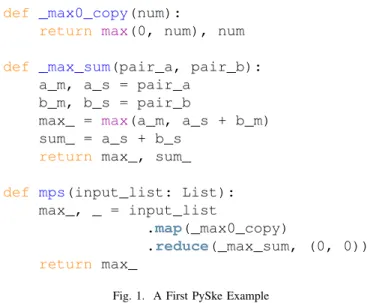
def _max0_copy(num):
return max(0, num), num
def _max_sum(pair_a, pair_b): a_m, a_s = pair_a
b_m, b_s = pair_b
max_ = max(a_m, a_s + b_m)
sum_ = a_s + b_s
return max_, sum_
def mps(input_list: List): max_, _ = input_list
.map(_max0_copy)
.reduce(_max_sum, (0, 0))
return max_
Fig. 1. A First PySke Example
therefore visible in their types. No parallel type exists in MPI, and it may be difficult (and it is an undecidable problem in general) to know whether a value is sequential or should be thought as being part of a distributed data structure.
PySke contains two main kinds of data structures: lists and trees. We refer to [6] for a presentation of the tree data structures. In the present paper, we focus on list data structures. With respect to the first version of PySke, we know have an interface List that contains the documentation for all the methods on lists. It also features detailed type hints that we
consider to be very useful documentation items. BothSList,
the class of sequential lists, andPList, the class of parallel
lists, implement this interface. In the remaining, a method on a sequential data structure is called a primitive, while it is called an algorithmic skeleton, or skeleton, on a parallel data
structure. It is important to notice that PListare immutable
data structures. All skeletons and primitives return new lists or scalar values. For each primitive we provide a skeleton, and vice versa. This allows for the rapid prototype of PySke
applications, even without mpi4py installed. While SListis
strictly speaking not an immutable data structure, because it
inherits from list for convenience, the recommended style
is to use it as an immutable data structure.
The program example of Figure 1 illustrates the polymor-phic nature of PySke. The variable input_list can be
eitherSListorPList. In the former case, the execution can
be sequential only. In the later case, it uses MPI for parallel processing.
mpsreturns the largest sum of all the sums of the prefixes of
the input list. For example, the prefix list returning the largest
sum, is [6, -3, 0, 4] in the following execution2:
>>> mps(PList.from_seq([6, -3, 0, 4, -4])) 7
from_seqbuilds a parallel list from a sequential list.
2We present the code and results as given in the Python interpreter, omitting
imports.>>>represents the prompt.
Global View [0, 2, 4, 6, 8, 10, 12, 14, 16] SPMD View processor 0 1 2 3 content [0, 2, 4] [6, 8] [10, 12] [14, 16] global size 9 9 9 9 local size 3 2 2 2 start index 0 3 5 7 distribution [3, 2, 2, 2] [3, 2, 2, 2] [3, 2, 2, 2] [3, 2, 2, 2]
Fig. 2. Parallel Lists: API View vs. Implementation View
mpsis implemented as a composition ofmapandreduce.
Simpler examples of application of both skeletons follows:
>>> SList([1, 2, 3]).map(lambda x: x + 1) [2, 3, 4]
>>> SList([1, 2, 3]).reduce(add, 0) 6
>>> SList([]).reduce(add, 0) 0
Basically, to compute the maximum prefix sum, we compute a pair containing the maximum prefix sum and the sum. The intuition behind the definition of _max0_copy is that if we consider an element as a singleton list. The maximum prefix sum for this list is either 0 if the element is negative (the prefix is then the empty list), or the element itself. _max_sum is defined as follows: pair_a represents the maximum prefix sum (a_m) and the sum (a_s) of a list a, and pair_b the same for a list b. To compute the maximum prefix sum of the list obtained by concatenating a and b, we need to take the maximum of the maximum prefix sum for a and the maximum prefix for a followed by b. The maximum prefix sum value for this second list is a_s + b_m.
There are several variants of themapskeleton:
1) mapi where the function argument to mapi is applied
to each index and associated value in the list,
2) map2that takes two arguments in addition to the current
object: a function and a list, and applies the function to elements of both lists; these two lists should have the same distribution (as explained in the next section);
map2iis a variant ofmap2,
3) zipcreates a list of pairs from two lists having the same
distribution.
There are several variants of the prefix sum skeletonscanl.
An example ofscanlfollows:
>>> par_list = PList.init(str, 4)
>>> par_list.scanl(concat, '').to_seq()
['', '0', '01', '012']
init is the main way to build parallel list in PySke. It
takes as argument a function used to initialize the values of
the list, and the size of the list. to_seq() transforms a
parallel list into a sequential list. par_list.to_seq() is
B. An Implementer’s Perspective
Users can think about their PList in a global way, i.e.
as a sequential list of type SList. However these lists can
be indeed distributed on different machines, in a transparent machine. The underlying implementation of PySke follows the SPMD paradigm and is currently implemented using MPI.
For an example list, Figure 2 shows both the global view presented to the user of the library, and the way this view is re-alized following the SPMD paradigm (for 4 processors). Each row in the SPMD view corresponds to a private attribute in the Python implementation. Names in italic represent attributes that contain the same values on all processors. “content” is specific to each processor and contains the specific part of the global list that this given processor has. Note that the type of
this attribute inSList. “start index” is the index in the global
size of the first element of the local list. In the global list, the value 6 has index 3. But this value is the first element of the local list at processor 1. Therefore the value of “start index” at processor 1 is 3. The “distribution” attribute contains the list of all local sizes.
init builds an evenly distributed list, i.e. a list where the
local sizes differ at most by 1, and the possibly larger local lists are on processors of low identifier. The list presented in
Figure 2 is such an evenly distributed list. from_seq does
not build an evenly distributed list: all the elements at are processor 0.
map, scanl and their variants return lists that have the
same distribution as their input. When a PySke skeleton manipulates more that one list, all these lists should have the same distribution.
C. Distribution Changing Skeletons
Some skeletons exist to change the distribution of a list.
get_partition makes the distribution of the lists
visi-ble in the structure itself. For example, get_partition
on the list of type PList in Figure 2 yields the PList
[[0, 2, 4], [6, 8], [10, 12], [14, 16]] (global view). Now each pro-cessor contains only one element (local size 1), but this element is a list. The distribution of this new list is [1, 1, 1, 1].
flatten is the inverse operation of get_partition.
Communications are needed to compute the new values of all the attributes but “content”.
Thefilterskeleton that filters out elements in a list that
does not satisfy the given predicate can easily be implemented using these skeletons:
def filter(self, predicate):
return self.get_partition()
.map(lambda l: l.filter(predicate))
.flatten()
Note that filter is not recursive: this code is the method
of PList, while in the application of map, filter is
the sequential filter of class SList. Also the distribution
of the list returned by filter may be unbalanced: all the
elements of one processor may have been filtered out while the other processors keep their contents. One very important
feature offilteris that it is implemented only using other
PySke skeletons. We call such skeletons, derived skeletons. They are skeletons that PySke users could define. Most other
skeleton libraries require skeletons such as filter to be
defined at the implementer’s level. Having a set of skeletons expressive enough to be able to define derived skeletons makes PySke more maintainable than other libraries. It also allows to have intermediate level users who do not need to know the implementation details of PySke but can still provide derived skeletons to less skilled users.
An example of use follows:
>>> par_list = PList.init(lambda x: x, 10)
>>> par_list.filter(is_even).to_seq() [0, 2, 4, 6, 8]
The balance skeleton simply makes a list evenly
dis-tributed. This skeleton perform communications to exchange content between processors.
III. NEWLISTSKELETONS
This section present new list skeletons for PySke. A. The distribute Skeleton
The distribute skeleton is a generalization of the
balanceskeleton. Thebalanceskeleton assumes that the
target distribution is the default distribution when parallel lists are created: each processor contains at most one more value than each other processor. However, such a distribution may not be appropriate.
First, the size of the elements in the parallel list may be different (for example if we have a list of matrices of different sizes) and/or the computational resources needed to deal with the elements in the list depends on the values or on the size of each element. In this case a non evenly distribution of data may lead to more balanced computations.
Second, some skeletons that are applied to both the current parallel list object and an additional parallel list object require that the distributions of the parallel lists are identical. Rather than balancing both parallel list, it may be more efficient to redistribute one of the lists so its distribution matches the distribution of the other list.
The skeletondistributetakes an argument: a sequential
list that represents the target distribution. This list should have a length equal to the number of processors, the values contained in this list should be positive (possibly zero), and the sum of these values should be equal to the global size of
the parallel list the distributemethod is applied to.
This skeleton proceeds as follows: first it computes the global indices of the first and last element for each processor, both in the source distribution and in the target distribution. This gives either an interval of indices, or the empty interval ∅. Then each processor intersects its source global interval with the target global intervals of all processors (including itself). These global intervals are offset to local intervals using the start index of the source parallel list. Finally these intervals are used to get the slices of the local contents of the parallel list to send to other processors. After a call to the MPI
Source start index [0, ⊥, 10, 20]
Source distribution [10, 0, 10, 15]
Target distribution [5, 10, 10, 10]
Source global intervals [(0, 9), ∅, (10, 19), (20, 34)]
Target global intervals [(0, 4), (5, 14), (15, 24), (25, 34)]
Global intervals to send
[(0, 4), (5, 9), ∅, ∅] [∅, ∅, ∅, ∅]
[∅, (10, 14), (15, 19), ∅] [∅, ∅, (20, 24), (25, 34)]
Local intervals to send
[(0, 4), (5, 9), ∅, ∅] [∅, ∅, ∅, ∅] [∅, (0, 4), (5, 9), ∅] [∅, ∅, (0, 4), (5, 14)]
Fig. 3. Example of Execution of the distribute Skeleton
alltoall function, the resulting list of lists is flattened to
a list. This gives the content of the local lists, the other fields of the parallel list are easily computed. The global size is the global size of the input parallel list. The distribution and the
local sizes are given by the argument to distribute. The
start index is obtained by computing the scanlof the target
distribution. Figure 3 shows some of the intermediate values for an example parallel list of size 15 on 4 processors. B. New Derived Skeletons
The distribute skeleton allows to implement
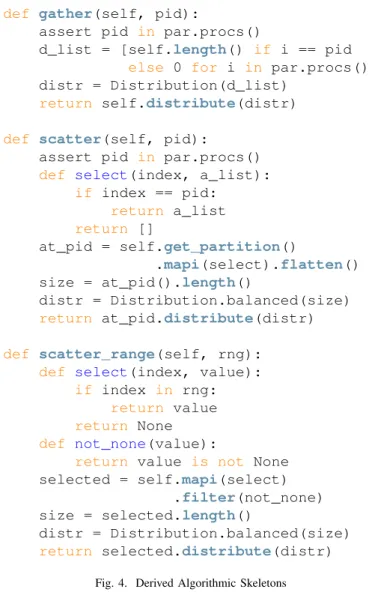
commu-nication oriented derived skeletons as shown in Figure III-B. Such skeletons are often present in other libraries, but there are implemented at a low level: in SPMD using directly MPI calls. In our case, the implementation of these derived skeletons could have been written by a PySke user without knowing the implementation details of PySke. This has two main advantages:
• the implementation is more maintainable,
• the PySke implementation is also more portable. As
we mentioned earlier, the programming model of PySke is not tied to MPI. For example, a shared memory implementation of PySke is possible. With a high-level
implementation of scatter and gather, it is not
necessary to re-implement them for the shared memory version of PySke. The implementations of Figure III-B would work with any new implementation of the non-derived algorithmic skeletons.
Informally,gathergathers all the elements of the current
list to the given processor. scatterscatters all the elements
hold by the specified processor to all processors. The returned
list is evenly distributed. scatter_range is a variant of
scatter. Instead of specify a processor identifier as the
source of the elements to scatter, these elements are specified by their indices in the list, as a range.
The code of Figure III-B only uses already described skeletons. The distribution information is actually defined as an object of Distribution. This class inherits from ’list’, and it provides the static method balanced that creates an evenly distributed distribution for a list of the given size.
def gather(self, pid):
assert pid in par.procs()
d_list = [self.length() if i == pid
else 0 for i in par.procs()]
distr = Distribution(d_list)
return self.distribute(distr)
def scatter(self, pid):
assert pid in par.procs()
def select(index, a_list):
if index == pid:
return a_list
return []
at_pid = self.get_partition()
.mapi(select).flatten()
size = at_pid().length()
distr = Distribution.balanced(size)
return at_pid.distribute(distr)
def scatter_range(self, rng):
def select(index, value):
if index in rng:
return value
return None
def not_none(value):
return value is not None
selected = self.mapi(select)
.filter(not_none)
size = selected.length()
distr = Distribution.balanced(size)
return selected.distribute(distr)
Fig. 4. Derived Algorithmic Skeletons
par.procs()is not a skeleton but is part of a small set (in
module par) of utility functions. procs() simply returns the list of available processors.
C. The permute Skeleton
Thepermuteskeleton aims at reordering the elements of
a list without changing its distribution. It takes as argument a bijective function on the set of the list indices.
For example:
>>> SList([1, 2, 3]).permute(lambda x: 2-x) [3, 2, 1]
The implementation of permute on PList proceeds as
follows: First, each element in the local lists are tupled with their new index in the global list, and the processor that holds this index, Then, all these tuples are then grouped by processor of destination. The obtained lists of pairs (new index, value) are exchanged using MPI alltoall. Finally, the local contents are updated using these lists of pairs.
The steps manipulating lists are implemented usingSList
1 def fft(input_list: PList[float]) -> PList[complex]:
2 size, nprocs = len(input_list), len(par.procs())
3 log2_s, log2_p = int(math.log2(size)), int(math.log2(nprocs))
4 result = input_list.map(complex)
5 for j in range(0, log2_p):
6 permutation = result.get_partition()\
7 .permute(partial(_bit_complement, log2_p - j - 1))\
8 .flatten()
9 result = permutation.map2i(partial(_combine, size, log2_s, j), result)
10 for j in range(log2_p, log2_s):
11 permutation = result.get_partition()\
12 .map(lambda l: l.permute(partial(_bit_complement, log2_s - j - 1)))\
13 .flatten()
14 result = permutation.map2i(partial(_combine, size, log2_s j), result)
15 return result
Fig. 5. Fast Fourier Transform
To compute the processor that holds an index, it is first
necessary to compute thescanrvariant of the prefix sum of
the distribution of the parallel list. In this variant, the result list has the same length as the input list, but its first element
is the first element of the initial list. scanr takes only one
argument in addition to the input list: a binary operation. For example, if we consider the list of Figure 2, the prefix
sumscanrreturns the list [3, 5, 7, 9]. Then for a given index
i, we search the value v in this list such that i is smaller than v and i is greater or equal to the value preceding v in the list. For example, for index 6, this value is 7. The index of 7 in the list being 2, the processor holding the index 6 is processor 2.
IV. EXPERIMENTS
We experiment on a PySke parallel implementation of the Fast Fourier Transform (Figure 5). The algorithm needs log n steps to complete, where n is the size of the input list. Both the number of processors and n should be a power of two. Basically, the computation needs to combine successively elements at indexes that correspond to a butterfly network. As the list is distributed on processors, the algorithm has therefore two main phases. In the first phase (lines 5–9), it is necessary to permute whole partitions of the current parallel list. In the second phase (lines 10–14), it is necessary to permute elements only in the same local partition. As PySke provides the same skeletons for both parallel lists and sequential lists, and that in a parallel list the local partitions are sequential lists, both phases are actually very similar. _bit_complement computes the correct indices that correspond to the butterfly network. _combine actually computes the new complex number based on two complex numbers that are linked in the butterfly network, and a complex number on the unit circle that only depends on the size of the input list, and the indexes of both complex numbers.
The experiments have be conducted on a shared memory machine with two Intel Xeon E5-2683 v4 processors each
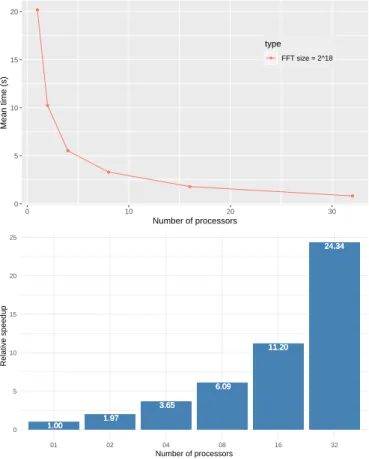
● ● ● ● ● ● ● ● ● ● ● ● ● ● ● ● ● ● ● ● ● ● ● ● 0 5 10 15 20 0 10 20 30 Number of processors Mean time (s) type ● FFT size = 2^18 1.00 1.97 3.65 6.09 11.20 24.34 1.00 1.97 3.65 6.09 11.20 24.34 1.00 1.97 3.65 6.09 11.20 24.34 1.00 1.97 3.65 6.09 11.20 24.34 0 5 10 15 20 25 01 02 04 08 16 32 Number of processors Relativ e speedup
Fig. 6. FFT Timing and Speed-up
having 16 cores at 2.10 GHz, and a memory of 256 GB. The machine was running CentOS 7. We used Python 3.6.3, OpenMPI 4.0.1, and mpi4py 3.0.2. Each point on Figure 6 is the mean of a series of 30 measures. The size of the input
list was 218floating point numbers. The speed-up is a relative
speed-up with respect to the timing for 1 processor. PySke achieves a good relative speed-up in this case.
V. RELATED WORK
Algorithmic skeletons are, of course, naturally combined with functional languages. In this context, an algorithmic skeleton is simply a higher-order function implemented in par-allel. There are several skeleton approaches available for func-tional programming languages. For OCaml, OCamlP3L [9] and its successor Sklml offer a set of a small set data and task parallel skeletons. Both rely on imperative features of OCaml. parmap [10] is a lightweight skeleton library that provides only parallel map and reduce on shared memory machines. Algorithmic skeletons for OCaml have also been implemented using the Bulk Synchronous Parallel ML library [11]. The proposed library is similar to PySke, but PySke has a much richer set of skeletons. For Haskell, Accelerate is a skeleton library that targets GPUs only. The initial proposal [12] featured classical data parallel skeletons (map and variants, reduce, scan and permutation skeletons) on multi-dimensional arrays. Both these languages are statically typed languages, more difficult to learn, and less used than Python.
PySke is related to SkeTo [13], [14], OSL [15], [16], and Muesli [17], [18], [19]. All these libraries are C++ libraries. They are, of course, more efficient than PySke, but using them is less flexible, and requires a higher level of expertise. PySke contains all the skeletons of OSL but the BSP homomorphism skeleton [15] and the exception forwarding skeleton [20]. However, now that base infrastructure of PySke is solid, adding these two skeletons will not be a complex task. PySke contains additional skeletons on lists with respect to OSL.
Muesli provides a permutePartition skeleton on ar-rays that is limited to permuting whole partitions. The
permute skeleton of PySke is more fine grained but used
in combination with get_partition, it can implement
the same behavior than Muesli’s permutePartition as shown by the FFT example. Muesli also offers gathering and scattering skeletons: they are not derived skeletons as our
scatterandgatherskeletons are.
Both compared to OSL and Muesli, PySke has the advan-tage of providing skeletons on trees. This is a feature shared with earlier versions of SkeTo, but not with recent ones. PySke is therefore unique in this respect. SkeTo and Muesli provide skeletons on 2D matrices in addition to 1D arrays.
VI. CONCLUSION ANDFUTUREWORK
Programming with algorithmic skeletons is a productive way of writing parallel programs. PySke is a simple library for non-expert programmers, but thanks to its rich set of skeletons, it is very expressive. Experiments shows performances are scalable.
We plan to continue adding new skeletons for the existing PySke data-structures, and new data structures such as multi-dimensional arrays.
As the set of skeletons offered by PySke grows, PySke users may find it difficult to choose the right skeleton, and to rightly compose them. In order to ease the work of PySke users, we plan to design and implement a mechanism for skeleton composition optimization by program transformation.
This mechanism will be based on concepts of term rewriting systems [21], and will be performed at runtime. Preliminary results on non-automatic transformations showed the potential of such an approach [6].
REFERENCES
[1] P. Guo, “Python is now the most popular introductory teaching language at top u.s. universities,” BLOG@CACM, July 2014. [Online]. Available: https://cacm.acm.org/blogs/blog-cacm/176450
[2] M. Cole, Algorithmic Skeletons: Structured Management of Parallel Computation. MIT Press, 1989.
[3] S. Pelagatti, Structured Development of Parallel Programs. Taylor & Francis, 1998.
[4] H. Gonz´alez-V´elez and M. Leyton, “A survey of algorithmic skeleton frameworks: high-level structured parallel programming enablers,” Soft-ware, Practrice & Experience, vol. 40, no. 12, pp. 1135–1160, 2010. [5] J. Dean and S. Ghemawat, “MapReduce: Simplified Data Processing on
Large Clusters,” in OSDI. USENIX Association, 2004, pp. 137–150. [6] J. Philippe and F. Loulergue, “PySke: Algorithmic skeletons for Python,”
in International Conference on High Performance Computing and Sim-ulation (HPCS). Dublin, Ireland: IEEE, 2019.
[7] L. D. Dalcin, R. R. Paz, P. A. Kler, and A. Cosimo, “Parallel distributed computing using Python,” Advances in Water Resources, vol. 34, no. 9, pp. 1124 – 1139, 2011, new Computational Methods and Software Tools. [8] L. Boug´e, The data parallel programming model: A semantic perspec-tive. Berlin, Heidelberg: Springer Berlin Heidelberg, 1996, pp. 4–26. [9] R. D. Cosmo, Z. Li, S. Pelagatti, and P. Weis, “Skeletal Parallel
Programming with OcamlP3l 2.0,” Parallel Processing Letters, vol. 18, no. 1, pp. 149–164, 2008.
[10] R. Di Cosmo and M. Danelutto, “A “minimal disruption” skeleton exper-iment: seamless map & reduce embedding in OCaml,” in International Conference on Computational Science (ICCS), vol. 9. Elsevier, 2012, pp. 1837–1846.
[11] F. Loulergue, “Implementing Algorithmic Skeletons with Bulk Syn-chronous Parallel ML,” in Parallel and Distributed Computing, Appli-cations and Technologies (PDCAT). IEEE, 2017, pp. 461–468. [12] M. M. T. Chakravarty, G. Keller, S. Lee, T. L. McDonell, and V. Grover,
“Accelerating Haskell array codes with multicore GPUs,” in Proceedings of the POPL 2011 Workshop on Declarative Aspects of Multicore Programming, DAMP 2011, Austin, TX, USA, January 23, 2011, 2011, pp. 3–14.
[13] K. Matsuzaki, H. Iwasaki, K. Emoto, and Z. Hu, “A Library of Constructive Skeletons for Sequential Style of Parallel Programming,” in InfoScale’06: Proceedings of the 1st international conference on scalable information systems. ACM, 2006.
[14] K. Emoto and K. Matsuzaki, “An Automatic Fusion Mechanism for Variable-Length List Skeletons in SkeTo,” Int J Parallel Prog, 2013. [15] J. L´egaux, F. Loulergue, and S. Jubertie, “Managing Arbitrary
Distribu-tions of Arrays in Orl´eans Skeleton Library,” in International Conference on High Performance Computing and Simulation (HPCS). Helsinki, Finland: IEEE, 2013, pp. 437–444.
[16] J. L´egaux, S. Jubertie, and F. Loulergue, “Development Effort and Performance Trade-off in High-Level Parallel Programming,” in Inter-national Conference on High Performance Computing and Simulation (HPCS). Bologna, Italy: IEEE, 2014, pp. 162–169.
[17] P. Ciechanowicz, M. Poldner, and H. Kuchen, “The M¨unster Skeleton Library Muesli – A Comprenhensive Overview,” European Research Center for Information Systems, University of M¨unster, Germany, Tech. Rep. Working Paper No. 7, 2009.
[18] P. Ciechanowicz and H. Kuchen, “Enhancing Muesli’s Data Parallel Skeletons for Multi-core Computer Architectures,” in IEEE International Conference on High Performance Computing and Communications (HPCC), 2010, pp. 108–113.
[19] F. Wrede, B. A. De Melo Menezes, and H. Kuchen, “Fish school search with algorithmic skeletons,” International Journal of Parallel Programming, vol. 47, no. 2, pp. 234–252, 2019.
[20] J. L´egaux, F. Loulergue, and S. Jubertie, “OSL: an algorithmic skeleton library with exceptions,” in International Conference on Computational Science (ICCS). Barcelona, Spain: Elsevier, 2013, pp. 260–269. [21] Terese, Term Rewriting Systems. Cambridge University Press, 2003.