INTROVERTED AND EXTROVERTED INNOVATORS,
INFORMATION VALUE AND THE GEOGRAPHY OF INNOVATION
Richard SHEARMUR
Inédit / Working paper, no 2013-03
INTROVERTED AND EXTROVERTED INNOVATORS,
INFORMATION VALUE AND THE GEOGRAPHY OF INNOVATION
Richard SHEARMUR
Institut national de la recherche scientifique Centre - Urbanisation Culture Société
Montreal
Richard Shearmur
McGill School of Urban Planning [email protected]
Centre - Urbanisation Culture Société Institut national de la recherche scientifique 385, Sherbrooke Street East
Montreal (Quebec) H2X 1E3 Phone : (514) 499-4000 Fax : (514) 499-4065 www.ucs.inrs.ca
This document can be downloaded without cost at:
www.ucs.inrs.ca/sites/default/files/centre_ucs/pdf/Inedit03-13.pdf
Abstract
This paper briefly summarises what we know about the geography of innovation, and overviews some recent developments in the field. It then focuses on a recurrent premise, i.e. that firms innovate in an open fashion and that a key determinant of innovation is ease of access to information – itself supported by various types of proximity. One aspect of information transmission that has rarely been emphasised is the way in which the value of information to innovators changes over time and space. If the value of information changes in this way then it follows that innovators will factor it into their location decisions, and/or that particular places will generate innovations that rely on information of value that is relatively more abundant there. Introverted innovators – less reliant on fast decaying information and more reliant on localised information and on internal capacities - are able to operate in relative isolation, whereas extroverted innovators will tend to be found in clusters and cities. This paper sketches a conceptual framework in support of these ideas.
Key Words:
Introverted innovators; information value; isolated regions; geography of innovation
Résumé
Cet article résume rapidement ce que nous connaissons au sujet de la géographie de l’innovation, et survol quelques avancées récentes dans le domaine. Il se penche ensuite sur une idée récurrente, que les entreprises innovent de façon ouverte et qu’un déterminant de leur innovation est la facilité d’accès à l’information. Un aspect de la transmission d’informations qui a rarement été souligné est la manière dont sa valeur (pour l’innovateur) varie avec le temps et l’espace. Si la valeur de l’information change selon où on est ou selon quand elle est reçue, il en découle que certains innovateurs incorporeront cette donne à leurs décisions de localisation, et que les localités différentes produiront des innovateurs qui se servent d’informations de valeur qu’on y trouve. Les innovateurs introvertis – moins dépendants d’informations dont la valeur s’amenuise avec le temps, et plus dépendants d’informations localisées ou internes à l’entreprise – peuvent opérer de façon relativement isolée. Par contre, les innovateurs extravertis se retrouveront au sein de villes ou de clusters. Cet article dresse un cadre conceptuel qui étaye ces idées.
Mots clés :
INTRODUCTION
Much has been written about the geography of innovation. A starting point for this literature is that establishments innovate in an open fashion (Chesborough, 2003) and that proximity between actors – a proximity that enables information exchange and collaboration – is key (Boschma, 2005; Carrincazeaux & Coris, 2011). By extension, the geography of innovation has often been interpreted as the geography of proximities that enable information and knowledge exchange: these proximities can be geographic, but can also be social, organisational or cultural, and they can also be temporary (Torre and Rallet, 2005; Cooke & Asheim, 2011). The geography of innovation becomes the geography of the networks that support these proximities, and there is a growing body of work that focuses upon the ways in which internet (Moriset & Malecki, 2009), travel (Bathelt, 2011) or intra-organisational international networks (Glucker, 2011) enable non-geographic proximities to contribute to information exchange and innovation. A general conclusion that is drawn from this type of work is that innovation occurs in clusters, often in urban areas (Crevoisier & Camagni, 2000; Wolfe, 2009) since these places are transport and communication nodes, thereby facilitating non-geographic proximities (Castells, 1996; Bathelt et al, 2004), and since they also generate internal dynamics of knowledge exchange (Lucas, 1988), chance encounters (Jacobs, 1969) and specialised knowledge spillovers (Porter, 2003).
In parallel to this, however, is research that points to innovation in places that are not particularly well connected (Knox & Mayer, 2009; Fitzjar & Rodriguez-Pose, 2011; Petrov, 2011; Cooke, 2011; MacPherson, 2008; Shearmur, 2012). Explanations for this are varied: these more isolated places may replace buzz and geographic proximity by various types of social proximity, may rely on local knowledge that is difficult to communicate, may be closely connected with local resources or may innovate in certain areas (environmental sustainability, for instances) overlooked by large-city protagonists. In any case, these examples seem to stand as anomalies when set against the ideas and processes that focus upon clusters, urban areas, connectivity and buzz as facilitators of information exchange, and hence innovation.
In this paper I consider some of the reasons why firm-level innovation may be feasible in remote locations and for firms that are not highly connected to networks, or to buzzing milieus where ideas are bounced around. In particular I focus upon the various types of information and knowledge1 that a firm may require. To do this I focus not on whether information is generated
1 The distinction between information and knowledge is an important one, but is not clear-cut (Cowan et al, 2000). Knowledge has a
synthetic quality, is produced from information, and is applied to something or has a purpose: it can be argued that knowledge is the state of a person who has acquired and synthesised information with an end in view (Cowan et al, 2000). Once knowledge has been produced by particular actors and for a particular end it can become information for others. The terms are used
interchangeably since the distinction does not appear relevant to the question of value, which can apply to both information and knowledge. This does not imply that knowledge and information are equivalent, only that the questions of transmission and variation in value broached in this paper apply to both information and to knowledge.
in particular places or on whether it can be transmitted, but on whether the value of this information to potential innovators varies over time and space.
The paper is structured as follows. In the two following sections I briefly review the literature on the geography of innovation, then consider the innovation process itself, drawing a distinction between the initial stage of entrepreneurial innovation (that leads up to a new product or process being successfully introduced), and the subsequent stage of innovation refinement (marketing and firm expansion). The third section examines the role of a firm’s internal capacities: following Malecki & Poehling (1999) I distinguish two types of innovator, introverted ones (relying more on internal capacities – and therefore able to operate away from clusters and cities) and extroverted ones. Building on these ideas, the fourth section introduces the notion that the value of information decays over time, but that some types of information (particularly market oriented information) decay faster than others (such as technical information): introverted innovators relying on slow-decaying information are able to operate in more isolated locations than extroverted ones reacting to market signals. In the fifth section the distance-decay of information value is discussed: this is different from time decay in that I identify a category of information that is tied to place – not because it cannot be transmitted but because it has value in particular locations and none in others. Innovations exploiting place-specific information – usually combined with more generic technical or market information - will only occur in specific places. In conclusion I discuss how these ideas are not only compatible with the existence and growth of clusters and innovative cities, but how they are also commensurate with empirical results emphasising the relevance of external contacts to innovation. The particular contribution of the paper is to sketch out a framework – based upon the idea that the value of information varies over time and space and that there are two stages to the development of an innovation - for understanding how innovation can occur in isolated places (and in relatively isolated firms) whilst also accounting for the existence of clusters and of dynamic innovation processes in cities.
THE GEOGRAPHY OF INNOVATION
Where does innovation take place? If one focusses on the intra-national scale, as opposed to the global one (Malecki, 2013), research that addresses this question can be divided into two broad categories. The first category focusses upon the link between innovation processes and territory. A variety of ideas have been put forward – local milieu (Maillat, 1992), learning regions (Florida, 1995; Asheim, 2012), clusters (Porter, 2003), regional innovation systems (Cooke et al, 2004; Asheim & Isaksen, 2002). Although these all point to different processes, and emphasise different actors, they have in common that they stress the importance of local dynamics to the innovation process (Moulaert & Sekia, 2003). Certain localities - by virtue of their capacity to gather and use information, of their ability to interact with outside agents, of their institutional framework, of the
local industrial culture and traditions of collaboration and competition between establishments – generate conditions propitious to innovation. These conditions all relate to the rapid acquisition of wide varieties of information and to their effective use. For the purpose of this paper, an important implication of these approaches is that establishments which are isolated from such localities will be less able to innovate. Although nothing in these approaches suggests that innovation can only occur in a particular type of region (Asheim & Isaksen, 2002; Cooke et al, 2004) many empirical examples of successful innovative milieu tend to be in proximity to larger urban areas (Silicon Valley, Route 128, Baden-Württemberg, M4 corridor – see Crevoisier & Camagni, 2000; Wolfe, 2009).
The second category encompasses work that states more explicitly that innovation takes place in creative urban areas (Florida, 2002), often in the larger metropolitan areas (Glaeser, 2011). Cultural industries, which both instigate and thrive upon innovation, develop in cities (Currid, 2007), high-technology industries tend to cluster in their vicinity (Spencer et al, 2010), and there is overwhelming evidence that patents and new products are more likely to be introduced in large urban locations (Audrestch & Feldman, 1996; Acs et al, 2002). Indeed, if innovation is defined as world-firsts, as the introduction of market-changing products, or as the birth of new industries, then evidence seems to point towards larger, well-connected cities as their source.
There are a number of reasons to question these views of innovation’s geography. First, they tend to conflate the marketing, or world-wide launch, of a product with its first introduction. Notwithstanding the work just reviewed, evidence from innovation surveys suggests that innovation – i.e. an establishment introducing a new product or process – takes place in all types of location (Freel, 2003; Shearmur, 2012): such surveys are usually not well suited to distinguish between radical innovations and smaller-scale ones, but they do reveal that innovative activity is not restricted to large cities or to buzzing milieu. Furthermore, Huber (2012) recently presented a detailed case study of the Cambridge Information Technology Cluster – echoing Massey et al’s (1992) study of twenty years earlier - questioning whether clustering enhances localized knowledge spillover and collaboration as often supposed. There are therefore reasons to doubt that innovation is as tightly associated with cities or clusters as sometimes thought – yet it is undeniable that clusters and cities exist and seem to gather concentrations of successful and fast-growing firms.
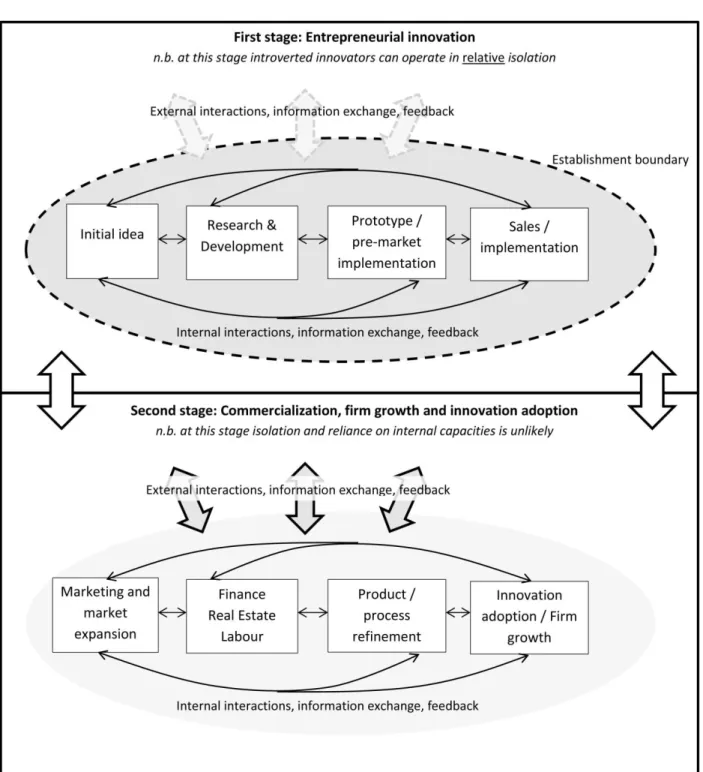
This apparent contradiction can be resolved if one conceptualises innovation as a two stage process (Figure 1 – see next section), the first being the introduction of an innovation by an entrepreneur – which can be a low-key event, occurring anywhere – the second being the stage at which the innovation takes off and when labour, finance and marketing expertise are required. Even if clusters and cities do not enhance the initial low-key innovation, unless an innovator moves towards a city where these resources can be accessed (Malecki, 2011; Shearmur &
Bonnet, 2011)2, innovation will tend to remain parochial, only uncovered in some surveys and case studies. From this perspective cities are not necessarily the site of innovation (if by that we mean the introduction of a new product or process), but are places where innovations are developed and refined, providing material support (labour, suppliers, real-estate) for innovative firms to grow. As such cities play a key role in the economics of innovation, not necessarily in its initial stages (which can occur in a wide variety of locations), but in the refinement, marketing and growth stages (Figure 1, stages 1 and 2). The idea that knowledge and interaction requirements evolve during the course of the innovation process has been noted by Moodysson and Jonsson (2007) in their paper on bio-tech companies: ‘The earliest exploration phases are typically characterized by a high degree of individual knowledge, while later phases of development often involve more collective knowledge’. This observation - focussing as it does on innovation in a cutting-edge research-based industry - nevertheless suggests a move from reliance on internal capacities towards more collaboration.
A second and related problem with the idea that cities3 are key generators of innovation is that it often relies upon evidence from patent data (Breschi & Lissoni, 2001; Malecki, 2013): however, a patent is not an innovation, merely the registeration of a new idea. This registration may lead to an innovation (the elaboration of a new product usually), but may also serve to block competitors from using the idea, or may correspond to a marginal alteration of an existing patent (Heller, 2008; Jaffe & Lerner, 2007). There may also be an urban bias in patenting because many firms rely on secrecy rather than patents to protect their innovations (Fu, 2008; Cohen et al, 2000) – secrecy being more effective for isolated firms. Furthermore, smaller establishments, and those that operate in more traditional industries – two characteristics of firms in more remote areas – have a lower propensity to patent their innovations (Brower & Kleinknecht, 1999).
A third reason for re-evaluating the connection between cities and innovation is that even if it is conceded that radically new products emerge in cities, lower profile product, process, managerial, marketing and design innovations, all of which are more difficult to measure and to assess, occur in other types of place as well. Both McCann (2007) and Duranton & Puga (2001) make this point: whilst recognising that certain types of innovation indeed require the networking and information exchange possibilities of large cities, both argue that other types of innovation (those requiring less frequent interactions or those operating in more stable markets) do not require presence in the large cities.
2 An alternative process that can also occur if an innovative establishment outgrows its milieu is to seek collaborators outside, and/or
to open subsidiaries in other places (Asheim & Isaksen, 2002). Very often the collaborators or subsidiary operation will be located close-to or in major cities, because they possess the material, scientific and labour inputs required for development and
expansion. Malecki (2011), writing specifically about technology clusters, highlights the role of labour and access to capital – but in these clusters he argues that knowledge spillovers remain an important factor.
3
Given the fact that most clusters are located in, or close to, cities, I will not always distinguish between clusters and cities: for the purposes of this paper they share the characteristic of density, and are usually assumed to be interaction-rich environments, Huber (2012) notwithstanding.
The geography of innovation is therefore not straightforward, particularly if innovation is understood to extend beyond cutting-edge new technologies, high-risk emerging industries, and highly visible fashion and cultural artifacts. Cities and clusters certainly play an important role, in particular as nodes in global networks and as centres in which the resources for firm growth (labour, real-estate, finance, services) can be easily accessed (Malecki, 2013). However, this role is not clearly associated with the first stages of innovation (Figure 1, stage 1) – rather, it seems to be associated with certain types of innovation and with certain stages of the firm development process, those which are interaction-intensive.
As mentioned above, a smaller number of studies suggest that innovation is indeed possible for establishments located away from cities or other interaction-intensive locales. McCann (2007) has argued that some innovators require less frequent interactions with their interlocutors than others: the former can locate outside of cities or of interaction-intensive localities. Petrov (2011) reveals how innovation occurs in sparse and isolated regions of Canada. Shearmur & Doloreux (2009) – also working in Canada - show that high-order service innovation is not dependent upon the region in which establishments are located, and that in some cases isolation and poor local markets seem a spur to innovation rather than obstacles. Cooke (2011) shows that certain types of innovation are intimately bound with localised resources and culture – and can therefore only occur in certain places, irrespective of their connectivity.
In short, the geography of innovation may be more intriguing than suggested by the idea that, whatever else may spur it on, intensive interactions – often, but not necessarily, localised (Cooke & Asheim, 2011) – are a key factor. Some researchers are now opening up the possibility that (relative) isolation may not always be detrimental to innovation – at least not to all types of innovation. The rest of this paper will focus upon two factors – internal capacities and the value of information – and provides some elements for understanding the conditions under which innovation can take place in (relative) isolation.
These elements are complementary to existing understandings of the geography of innovation in the sense that they do not undermine what has been done on the way local knowledge bases, social proximities, interactions and networking can foster information exchange and innovation. Rather, the ideas presented below aim at understanding how innovation can occur far from the madding crowd – at the periphery of networks and proximities – and at outlining some mechanisms that may explain how innovation does occur there.
INNOVATION AND INFORMATION
Before proceeding further it is necessary to state what type of innovation is being discussed: it is establishment-level innovation, the introduction by an establishment, firm or entrepreneur of a new product, process, service or organizational procedure (whether management, marketing, logistics or other). This definition of innovation follows that of the Oslo Manual (OECD, 2005), and is therefore similar to the concept that underpins most innovation surveys. Furthermore, it mirrors Schumpeter’s (1936) definition.
Broadly speaking it is accepted in the geographic literature that innovation is an open process (Chesborough, 2003): innovation does not occur within the confines of establishments. Rather, it occurs when an establishment’s employees are confronted with information derived from external actors – be they competitors, clients, people met whilst travelling or people met by chance (Malecki, 2013). These confrontations lead to the generation of new ideas, which are then implemented – and which themselves become informational inputs to other establishments. This characterisation of innovation takes into account the establishments’ internal capacities (Lichtenthaler & Lichtenthaler, 2009), its interaction with the outside environment (Amara & Landry, 2005), and the way in which they combine to generate innovation (Malecki, 1997), is outlined in Figure 1 (stage 1).
Given this process of innovation, it is then argued – as discussed above - that establishments in cities or clusters, those that are most highly networked, or those that enjoy other types of proximity, will be those most likely to innovate since they benefit from the highest volume and variety of external stimuli (Glaeser, 2011; Jacobs, 1969; Carrincazeaux & Coris, 2011)4. Likewise, certain types of local institution are more conducive to openness and information exchange than others (Cooke et al, 2004; Fontan et al, 2005), and it is localities with such institutions – even if they are not always urban – that will house more innovative establishments.
A number of elements of the open innovation paradigm are elided in this geographic narrative. First, whilst much emphasis is placed in the geographic literature upon the ways establishments interact with outside agents, little attention is paid to the establishment’s internal capacities. These are of course recognised as an innovation factor, but are considered to be of little relevance to the geography of innovation since they are endogenous to the establishment: just as an individual’s human capital is an attribute of the person, so an establishment’s internal capacities characterise the establishment. However, an establishment’s internal capacities may be connected
4
This paper focusses on the geography of innovation: geographically, high-interaction environments are cities and clusters, and low-interaction environments are rural or isolated. However, the ideas are also applicable to other types of isolation – such as social isolation or location on the periphery of networks – which limit the volume of interactions.
to geography in a variety of ways. For instance, the degree to which an establishment relies on its internal capacities may vary with location: establishments may adapt to their environment and compensate for reduced external interaction with more, or more effective, use of internal capacities. Alternatively firms which have decided to rely on internal capacities – for reasons of secrecy, for instance – may seek out isolated locations. Thus, in Figure 1 (stage 1), it is feasible that certain establishments operate more within their boundaries, whereas others operate more across them, and that the propensity to do one or the other varies with the nature of the external environment. As Malecki & Poheling (1999, p264) suggest in conclusion to their study, ‘there are hints that extroverted behaviour is more common within a localised cluster’.
A second item present in debates surrounding the geography of innovation is the nature of information exchanged. There are numerous ways of categorizing information and knowledge (Malecki, 2013), three being more prominent in the geographic literature. First, the distinction between codifiable and tacit knowledge is used to explain why some information may not be transmissible over distance, and hence why industrial districts, local milieu, and local innovation systems emerge (Cowan et al, 2000; Gertler, 2003). This distinction also underpins the recent focus upon travel and temporary face-to-face contact (Torre & Rallet, 2005; Bathelt, 2011) – travel to fairs, conferences or for temporary projects enables the transmission of tacit knowledge, and also the building of social ties which then facilitate knowledge exchange over distance (Carrincazeaux & Coris, 2011). From this perspective certain types of information can only be transmitted by example, by trial and error, or by doing, whilst other information can be broken down into codified instructions. If the individuals detaining tacit information are all in one area – and this is the case in localised industrial clusters and milieu – then this will reinforce that area’s competitive advantage and innovative capacity. Even if tacit information can be transmitted by way of travel and temporary contact, being located at the source of this information can provide advantages, if only in the more rapid acquisition of the information (Maskell et al, 1998).
The second distinction is between different types of local knowledge base: Asheim (2012) argues that not all local knowledge bases are similar, and distinguishes three broad types that combine in different ways: i) analytic (science based); ii) synthetic (engineering based); and iii) symbolic (arts based). He argues these types of knowledge characterise certain regions more than others, and that the type of learning process – and innovation – that will occur in any specific region will depend upon its knowledge characteristics. Spencer (2011) applies this concept to Canadian cities and shows that ‘different local environments seem to be conducive to different kinds of knowledge production’ (p61), and attract different types of innovative industry.
The third distinction is between knowledge that is embodied in particular individuals and knowledge which is more ubiquitous (Cowan et al, 2000; Asheim & Isaksen, 2002). This is not the same as the tacit-codified distinction, since embodied knowledge may be codified or easily
codifiable. Embodied knowledge, whatever its position along the tacit-codified continuum, does not travel easily since it is associated with particular individuals. This type of knowledge is ‘sticky’ – it is attached to place and characterises certain local innovation systems. Asheim & Isaksen (2002) show how some of the knowledge in Norwegian ship-building clusters, although it is systematic (and hence codifiable), is detained by certain individuals or groups, thereby giving an advantage to those clusters. They also point out that this advantage can turn into a disadvantage if the locally detained knowledge loses its relevance yet is still relied upon: this leads to negative lock-in effects.
An argument made in this paper – that will be further elaborated below - is that the way in which information and knowledge are characterised can be further refined with geography in mind. First, time-decay is important. Information can be characterised by its ‘half-life’5: information whose value deteriorates rapidly has different geographic consequences from that which deteriorates more slowly. Second, certain types of information which may be key to innovative activity are tied to place, not because they cannot be transmitted (whether because they are tacit or embodied), and not because they enter one of Asheim’s (2012) categories, but simply because they have no value outside of particular locations or contexts6: in other words, to the time-decay in information’s value can also be added an element of distance-decay.
Internal capacities and the geography of innovation
The value of any particular type of information to an innovator is dependent on the innovator’s capacity to use it (Lichtenthaler & Lichtenthaler, 2009) – so if the degree to which establishments rely on internal capacities varies with geography, then this is one way in which the value of information to innovators may varies across space.
However, if the internal capacities of establishments – be they formal R&D capacities, or less easily identifiable trust between employees, time spent by management thinking through production processess, or reliance on learning-by-doing – are considered wholly endogenous to the establishment, then there should be no connection between these and the dynamic external factors that lead to innovation. An establishment in any location can theoretically build up its internal capacities to whatever level it wants – therefore differences in propensity to innovate that have geographic structure should be independent of internal capacities.
5 This concept is borrowed from physics, where radioactive elements lose their radioactivity in a negative exponential fashion: thus, if
element X has a half-life of 10 days, then it’s radioactivity will be 50% after 10 days, 25% after twenty, 12.5% after 30 and so on. The metaphor is used to suggest that whereas some information may lose its value very quickly – say its value may be divided by 2 after a single day – other information may lose value far more slowly. Of course, there is no reason to believe that all information follows the same time-decay pattern - the key point being that some information loses value fast and some far more slowly
6
For example I may know how to dive off high cliffs, and I may have information on the frequency and depth of waves. If I want to develop a new cliff-diving technique, such knowledge and information have no value outside of the locality where cliff-diving is practised.
Empirical analysis based upon surveys has shown that establishments innovate in almost all types of location and that, though certain types of innovation – such as radical product innovations – are more frequent in high-interaction locales, establishments are quite capable of introducing them in other locations too. Indeed, Suarez-Villa and Walrod (1997) and Freel (2003) show that certain establishments innovate when they locate away from clusters or concentrations of economic actors. Therefore, although location in a high-interaction locale is not a disadvantage in terms of innovation, neither is it the systematic advantage one may expect.
An element that may explain these results is that innovators are more or less introverted (Malecki & Poehling, 1999). Some innovative establishments indeed thrive on external interactions, whilst others develop their innovations by applying their experience and knowledge to new information within the establishment (de Jong & Freel, 2010).
This suggests two distinct processes: first, mobile innovators may choose to locate in more isolated places if they rely more on internal resources for their innovative activity. This choice may be driven by cost considerations, lifestyle choices or considerations of secrecy and confidentiality. Second, locally embedded firms that emerge and survive in isolated locations may implement innovation processes that are more introverted than those implemented by similar firms located in clusters or to cities. Indeed, isolated firms may survive because their innovation processes rely more on internal than on external resources. As de Jong & Freel (2010, p53) argue, from a policy perspective:
Policies should also aim to develop in firms the capabilities needed to search for, recognize, evaluate, assimilate and exploit geographically distant knowledge. This is likely to be particularly important in areas where innovation resources are relatively scarce, such as non-urban settings.
This suggests bi-directional causation between interaction-intensity and innovation. It is not only because firms in clusters and cities have access to intensive interactions that they innovate: their
innovation processes are interaction-intensive because they are in a cluster or a city. Firms
located outside of cities and clusters also innovate, but in a more introverted way – reaching further for external interaction and relying more on internal capacities.
These ideas resonate with others currently being elaborated in different fields. A book titled
Quiet: The Power of Introverts in a World That Can’t Stop Talking (Cain, 2012) makes this point
regarding individuals, showing that introverts – who feel awkward in collaborative interaction-intensive environments - may be as creative as extroverts, only going about it in a different way. In a similar fashion, Mors (2010) shows that managers in some firms suffer from too much information, and that the optimal amount of information depends as much on the manager as on the functions being undertaken. Furthermore, though Cain (2012) acknowledges that introversion
and extroversion are individual characteristics, she also suggests that they can be culturally determined: an individual’s introversion – just like a firm’s – is not wholly endogenous, but partly attributable to context.
Information half-life: the time-decay of information
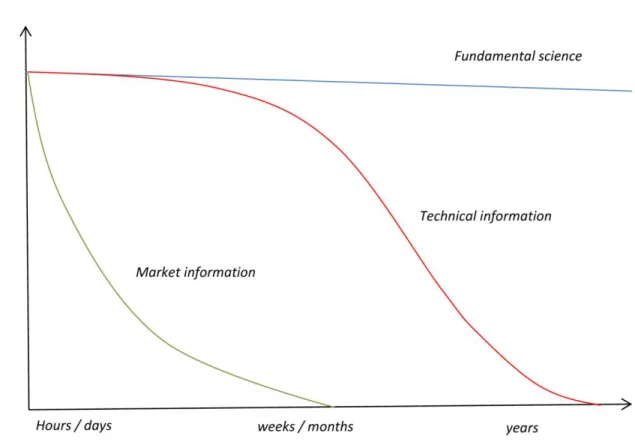
An establishment located in an interaction-sparse environment will – almost out of necessity - innovate in a more introverted way than one located in an interaction-intensive environment (de Jong & Freel, 2010). The question then arises as to how an isolated firm can obtain information of sufficient quality to enable innovation to occur. Surely any information that reaches a relatively isolated establishment will also have reached more connected ones. In this section I focus upon the idea that some information loses value quickly, whereas other information retains value months or even years after it is first imparted: if this is the case, then innovations relying on rapid-decay information will tend to arise in well- connected places, whereas innovations relying on slow-decay information will be more evenly spread out across space, or may even be crowded out of interaction-intensive environments (McCann, 2007).
The idea is illustrated in Figure 2, in which three examples of the time-decay of information value are represented. The first example is market information – for example information on the latest trends in teenage fashion. As Currid (2007) illustrates, success in fashion rests on the rapidity with which new trends can be identified, validated, and translated into clothes that can be sold. Designers need to be in the thick of a major metropolis in order to pick-up disparate and rapidly decaying information. Given the short time periods involved, proximity to people able to translate designs into products, and to people able to mock-up the designs before they enter production, is key. Then, depending upon the market segment being targeted, designs can be sent off to manufacturers elsewhere, or if this is high-end fashion where time-lines are even more pressing, sent to clothing manufacturers within the same fashion milieu.
The time-decay of information is even more pronounced in some industries: Wojcik (2011) reports that large traders in London are moving their computers because trading algorithms have a competitive advantage if buy or sell signals are received by the London Stock Exchange servers a nano-second earlier than competitors’:
‘As the speed of message transmission approaches the speed of light, there is demand from the trading firms to locate their order-generating computers as close as possible to the matching engines of exchanges, referred to as co-location services or proximity to liquidity’ (p 132).
This points towards a general proposal – that information which is closely tied to market signals, and by extension innovations that are closely tied to this type of information, require the advantages that clustering and co-location provide. Market signals are unpredictable, frequent,
and need to be acted upon fast – innovators reacting to these signals require every edge they can obtain, geographic proximity being one of them. Similarly establishments operating in areas of rapidly changing market-driven technology, such as electronic gadgets, will also benefit from clustering7.
The second type of information given as an example in figure 2 is technical information. This may relate, for example, to fabrication processes, new materials or to new software solutions. There are, for example, producers in textiles and clothing industry that are less focussed on rapid-decay market information than the fashion industry and more so on slower rapid-decaying technical information. A maker of high performance sports gear – such as mountaineering harnesses or parachutes - will not be reacting to short-term market signals. Whilst there are fashions in these industries, the key market signals are fairly constant: safer, tougher and more appropriate equipment for a harsh environment. It is not the manufacturer who changes design first that will prevail, but the manufacturer who builds a reputation for reliability and for innovations that truly respond to the needs and requirements of dangerous sports. Such an innovator has no pressing need to be located in proximity to a cluster.
Neither is there much requirement to be in proximity to the materials engineers or alloy manufacturers called upon to produce the sports equipment once the design is perfected: the information that these external actors impart – scientific and production information that is valid one month to the next – has slow time-decay. The innovative establishment in this field can therefore locate anywhere that a building, an internet connection (Moriset & Malecki, 2009), and a cadre of designers and engineers can be gathered (which may of course be in a city, but not necessarily so). To generalize from this illustrative example, if the information upon which an innovator relies is valid for long periods – and this is often the case for technical information which rarely evolves in such a way that a couple of weeks or even a couple of months invalidates it – then the geography of innovation derived from the idea that local buzz and interactions are of primary importance may be less relevant. This does not mean that face-to-face interactions and information gathering are not required, only that they are less time-critical and therefore less location-critical too8.
The final example in Figure 2 is scientific information of a fundamental nature: innovators relying on this type of information often only have a few interlocutors world-wide (Moodysson and Jonsson, 2007). This type of information is usually valid for periods of months or years, and
7
This argument is different from the one made by Knox & Mayer (2009), though is in some respects related: they point out that smaller towns and cities have distinguished themselves by introducing slow innovations. These are usually innovations in governance, institutions and design focussed on a more sustainable lifestyle: they can do this because smaller towns and cities are removed from the market buzz of major metropolitan areas.
8
Macpherson (2008) describes how scientific equipment manufacturers in upstate New York are just as innovative as those located closer to New York city – relying on electronic contact with interlocutors and intermittent face-to-face contact.
it is the capacity of engineers and scientists within R&D departments to process this information and turn it into a marketable product or process that will determine whether or not an establishment innovates. The archetype of this is Los Alamos – an isolated ranch where scientists were gathered by the US government in the early 1940s to develop the atom bomb – and LaFlamme (2011) documents a variety of science-based facilities which are currently operating in isolated places. The key problem he identifies is not the inherent capacity of isolated facilities to generate innovation, but the difficulty of attracting and retaining scientists to isolated places. This limitation will reduce the number of science-based innovators who choose to locate in more isolated areas, but does not have any impact on their capacity to innovate should they choose to locate there (Huber, 2012). Thus it is not isolation (or lack of proximity to networks) that impacts on the capacity of this type of innovator to innovate.
An extension to the idea of regional absorptive capacities: the distance-decay of information
For the time being we have assumed that the value of information is potentially the same everywhere, and that if all information were instantaneously available then there would be no distinction between localities in terms of innovative potential. To return to the example of financial institutions, the reason for co-locating computers is to reduce the time between sending and receiving buy or sell signals: if tomorrow the speed of light were no longer a limit (!), then such co-location would not be necessary.
In this section I suggest that the value of information is sometimes dependent on context. Specifically, some information can be a valuable input to innovation in some places but of little use in others. This is connected with the idea of regional absorptive capacities, which posits that whatever the amount of information and knowledge to which a region has access, innovation within the region is dependent on its capacity to absorb it – and by this is generally meant a qualified workforce and institutions (such as universities) capable of putting the information to good use (Roper & Love, 2006; Fu, 2008),
From this perspective, information and knowledge is mobile, and will be of value in regions that have the capacity to absorb it. All regions have the potential – at least in principle - to augment their absorptive capacity, and there exist a variety of regions across the world where appropriate absorptive capacities exist. However, it is generally larger cities which possess the qualified labour and institutions that enable information to be absorbed: so once more we find that urban areas, or clusters large enough to generate institutions and absorptive capacity, are those where innovation will occur.
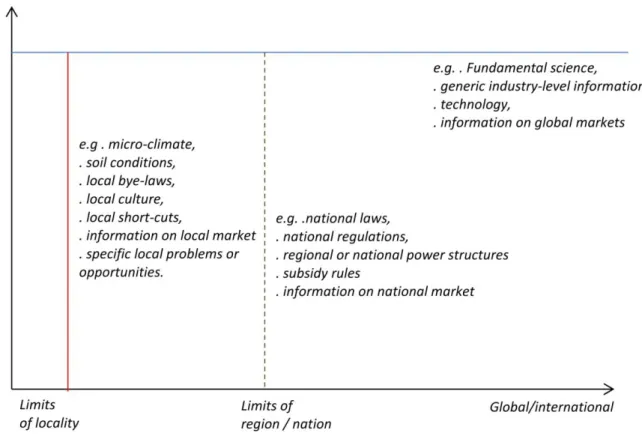
The idea of regional absorptive capacity can be extended, though, to accommodate the empirical fact of innovation in isolated regions that do not seem to possess the qualified workforce or institutions necessary for absorbing mobile information. In Figure 3 I illustrate the way in which particular types of information may lose value as they move across space. The loss of value is abrupt, not a function of distance, because the essence of the argument is that some information has no value when it is not associated with particular places or types of place, i.e. for instance when it is an integral part of a terroir (Knox & Mayer, 2009).
An example of this comes from a recent study of the wine industry in Canada (Doloreux et al, 2013). In this study it is shown that innovation is dependent on two types of knowledge. The first type is technical knowledge about vinification techniques, harvesting and processing. Such technical information – which decays slowly over time - is gathered from a wide variety of sources, both local and distant. The second type of knowledge concerns the specifics of each locality’s micro-climates, soils, and slopes. This type of knowledge has no value outside of the locality because it is knowledge about the locality. An innovative wine-grower requires both types of knowledge to introduce new flavours, wines or grapes – and the second type of information is entirely without value to innovative wine-growers in other regions. Thus, innovation can occur in remote rural areas, and in relatively isolated vineyards, not because there is intense local buzz, but because there exists exclusive local knowledge that is only applicable in (or to) the area. This argument relates to Cooke’s (2011) in which he, too, argues that innovations can emerge from rural areas when they draw upon information and knowledge that is specific to local cultures: using the concept proposed in this section, it could be said that this locally specific knowledge only has value to innovators in the locality where it is generated. The innovations described by Cooke (2011) can be copied elsewhere – which is not the case for those described by Doloreux et al (2013) - but the innovation emerges from a specific locality.
Another example – further removed from the idea of terroir - is knowledge of local law and regulations – local bye-laws, state-level legislation or national law, for example. For instance consultants may be highly innovative in their use (and abuse?) of local regulatory systems. Similarly, entrepreneurs may be able to leverage knowledge of local rules and regulations into resources (such as subsidies, labour, assistance in knowledge and information gathering). Knowledge of regulations can easily be codified and transmitted, but is of no value outside of certain places.
A final example – more generic, and hence associated with a type of place and not with a specific place – would be information and knowledge on how to perform certain tasks in forestry or farming. This information could only lead to innovation in locations where the activities take
place – i.e. in remote or rural areas where the problems or opportunities that can be addressed by detaining the information are recognised and understood, and where the knowledge for applying the information is rooted.
These examples point to the fact – as indeed does the idea of regional absorptive capacities – that information only has value to regions (and to potential innovators in these regions) capable of using the information. Such regions are not necessarily high-skilled or institution rich: they are regions in which the specific problems or opportunities to which the information can be applied are recognised and understood. It is thus the combination of information from external sources with information or know-how specific to a locality that generates innovation. Few people would expect problems or opportunities in urban transportation to be addressed by innovators in remote rural areas: in the same way no one should assume that problems or opportunities associated with field drainage, soil erosion, oil exploration, traversing long distances over snow9, or wine-making will be addressed in cities. Many of the latter are addressed and solved by innovators who have intimate knowledge of the question (i.e. who are located in the remote areas where the problems or opportunities arise), as well as access to scientific or technical information from outside (which decays slowly over time).
Discussion and conclusion
The purpose of this conceptual paper is not to question the validity of research that shows how clusters and cities generate interactions and institutional arrangements that are conducive to innovation. Rather, its purpose is to propose a framework for understanding apparently anomalous empirical results showing, in a disparate but recurrent fashion, that firm-level innovation occurs in all types of places, not just in clusters and cities.
Summary of main argument
The first part of the argument revolves around distinguishing the initial stages of innovation from commercialisation and growth (Figure 1). Evidence showing that innovation occurs in all types of place is present in a number of case-studies and survey reports. This work identifies establishments that introduce innovations, but has not often assessed the degree to which establishments grow and expand under the innovations’ impetus. The distinction between initial innovation and subsequent expansion is therefore important, and the paper focusses on the first stage of innovation (Figure 1, stage 1), recognising that a variety of factors associated with labour markets, real-estate and access to clients mean that growing firms will tend to subsequently relocate towards urban areas.
9
Bombardier, the international aeroplane manufacturer now based in Montreal, began as a small company in the rural village of Valcourt, 100km east of Montréal. Mr.Bombardier designed and produced the first commercially viable snowmobile.
It is then suggested that the degree to which firms are introverted or extroverted innovators is conditioned by their geographic environment: introverted innovators, those relying more on internal capacities, will be over-represented in more remote regions for two reasons. First, innovators that are local to remote regions will almost of necessity have more reliance on their internal capacities. Second, introverted innovators who are this way by choice may move to remote locations for reasons of cost, secrecy, or preference.
Since all firms – even introverted ones – rely on external information to innovate, the question then arises as to how introverted innovators can function in remote locations. Two separate but related mechanisms are suggested, both based upon the way in which the value of information varies. The first mechanism relates to the way different types of information or knowledge lose value over time. Certain types, particularly those related to markets, taste and fashion – are diffuse, lose value rapidly, and need to be quickly acted upon in order for innovation to occur. Innovations based upon this type of information will tend to occur in cities where there is a high volume of exchange, much redundant information, but where skilled innovators can identify and act upon relevant information (Currid, 2007). Other types of information, such as technical and scientific information, have more specific sources and do not lose value over time (at least not rapidly): their value is closely dependent upon each firm’s ability to bring to bear requisite internal capacities. This type of innovation can occur just as easily in remote as in high-interaction regions – of course innovators of this sort need to be networked, need to travel occasionally, and need to monitor advances in knowledge, but this can be achieved from most locations (de Jong & Freel, 2010).
The second mechanism is a variant upon the idea of regional absorptive capacities. Whereas this concept is usually applied in a generic way – regions require skilled labour and institutions capable of absorbing and using information – in this paper it is extended to encompass any regional specificities that allow actors in the region to use certain types of information not necessarily useable elsewhere. Innovation stems from identifying a problem or opportunity specific to a region (or type of region) and applying information and knowledge in order to find a solution: to the extent that certain problems or opportunities – and the capacity to identify and understand them – are specific to certain localities or types of locality, then certain information is only of value to innovators in these localities. Innovators that address these localised questions usually associate location-specific knowledge with generic technical or scientific information whose value does not decay over time or space. There is thus a connection between information with localised value (rapid distance-decay) and information’s time-decay, but the two are distinct. The time-decay of information applies to information that is potentially valuable wherever it is held, whereas information with rapid distance-decay simply has no value outside of particular locations.
Positioning of the argument relative to the literature
It could be objected that this paper’s basic premise – that innovation does not necessarily emerge in clusters or cities – contradicts much of the literature on metropolitan expansion (Glaeser, 2011) and on the importance of clusters (Wolfe, 2009; Porter, 2003). This contradiction is more apparent than real. No claim has been made that clusters and cities are not key locations for certain innovation processes. Indeed, some types of innovation – those relying on information with a short half-life – are probably specific to these places, as are those that draw upon the specificities of each city or cluster (it is not only remote areas that generate information that loses its value when delocalised). Furthermore, a process has been suggested that accounts for the strengthening of cities and clusters over the long term. It is not because innovations necessarily occur there: rather, it is because once an innovation is introduced these environments provide the material support (finance, labour, real-estate, suppliers) and the rapid-decay information (particularly on markets) necessary for expansion and wide diffusion of the innovation (Huber, 2012). Hence the importance of conceptualising the innovation process as occurring in two stages (Figure 1): even if stage 1 can occur anywhere, stage 2 often takes place in clusters or cities.
Another possible objection to the thrust of the argument in this paper is that it is regularly shown, by analysing survey results, that firms with more external sources of information and collaboration tend to be more innovative (Amara & Landry, 2005; Nieto & Sanatamaria, 2007; Leiponen & Helfat, 2010). Although this seems incompatible with the ‘introverted innovator’ concept, three points can be made. First, surveys following the Oslo Manual (2005) ask firms to identify different sources of information and types of collaborator: it is the variety of sources of information that is identified as a factor of innovation, not frequency or total number of contacts. Introverted innovators are relatively less dependent on outside interactions – which does not necessarily imply that they have lower variety of external contacts. Second, survey analyses rarely introduce detailed controls for geographic context, and when they do, they rarely look for interactions between context and variety of external contacts. Therefore, the fact that, within a population of establishments, innovators tend to have a wider variety of external contacts does not preclude the possibility that innovators from remote or rural areas may be introverted: since representative surveys are necessarily dominated by observations in clusters and cities10 the results are driven by establishments in this type of environment. A final point concerns what is
not measured in innovation surveys: the surveys do not measure noise, i.e. the quantity of false
information, useless knowledge and failed collaborations, presumably far higher in interaction-intensive environments. Thus, even if all innovators have a wide variety of external sources of information and collaboration, it may still be the case that innovators in interaction-rich
environments are more extroverted, processing more dead-ends, rumours and false leads than the more focussed introverted innovators. Duranton & Puga (2003), who suggest that metropolitan environments attract innovators who proceed by trial and error, whereas smaller cities attract innovators operating in a more stable environment, make a similar point.
Finally, whilst it is important to acknowledge the similarities between the proposed framework and McCann’s (2007), it is useful to highlight the differences. McCann, starting from observations similar to those that introduce this paper (i.e. that many innovators are located outside of clusters and cities), proposes a model that accounts for this based upon differences in frequency of face-to-face contacts: innovators requiring fewer face-to-face contacts (not only in terms of variety but in in terms of frequency) will be crowded out of central location , but are able to innovate whilst located in remote regions by virtue of their lower contact requirements. However, McCann does not investigate why some innovators require more or less frequent interactions: by calling upon the distinction between introverted and extroverted innovators, and by introducing the idea that the value of information may decay over time and space, this paper suggests a framework for understanding the circumstances under which higher and lower frequencies of interaction may be required. Thus, this paper can be read as an extension of McCann’s (2007) sketch.
CONCLUSION
Central to this paper is the idea that information and knowledge have different value for different innovators depending on the innovators’ internal capacities, on the way they combine with location-specific knowledge, and on how fast the relevance of information or knowledge decays over time. The concept of value that is marshalled is one of use-value, not of market value: information or knowledge has value to an innovator if it can be used in the innovation process, not if it can fetch a particular market price. Mobile information or knowledge – however transmitted - combines with the innovator and with locally specific knowledge to produce innovation. There is no reason to suppose that remote areas and isolated (or introverted) innovators are not, in certain circumstances, better able to exploit particular information than interaction-intensive places and extroverted innovators.
The paper provides a framework for understanding how innovation can take place outside of clusters and cities: however, it does not explore how the concepts may apply differently to information and knowledge, or indeed to different types of knowledge or information. Time and distance decay no doubt occur differently for different sorts of knowledge and information – and future elaboration of these ideas will require these interactions to be more fully explored.
From a policy perspective, and in the light of the proposed framework, the development challenge for isolated and rural areas is not necessarily one of generating innovation – at least no more than it is for clusters and cities. The challenge for these regions lies in providing an environment that can take innovators to the next stage – that of expansion and growth: unfortunately the framework provides no indication of how that can be done. However, by clarifying where the problem lies – i.e. by suggesting that innovation is not the main issue – the paper may assist in framing future policy research. It may also help in identifying which types of innovation are likely to succeed or fail in different sorts of region.
REFERENCES
ACS, Z., ANSELIN, L., & VARGA, A., 2002, Patents and innovation counts as measures of regional production of new knowledge, Research Policy, 31, 1069–85
AMARA, N. and R. LANDRY, 2005, Sources of Information as Determinants of Novelty of Innovation in Manufacturing Firms: Evidence from the 1999 Statistics Canada Innovation Survey, Technovation, 25, 245-59
ASHEIM, B., 2012, The Changing Role of Learning Regions in the Globalizing Knowledge Economy: A Theoretical Examination, Regional Studies, 46.8, 993-1004
ASHEIM, B. and A. ISAKSEN, 2002, The Integration of Regional ‘Sticky’ and Global ‘Ubiquitous’ Knowledge, Journal of Technology Transfer, 27, 77-86
AUDRETSCH, D. and M. FELDMAN, 1996, R&D Spillovers and the Geography of Innovation and Production, American Economic Review, 86.3, 630–640.
BATHELT, H., 2011, Innovation, learning and knowledge creation in co-localised and distant contexts. In A. Pike, A. Rodriguez-Pose, and J. Tomaney (eds.), Handbook of Local and Regional Development, London: Routledge, 149-161
BATHELT, H., MALMBERG, A., and MASKELL, P., 2004, Clusters and knowledge: Local buzz, global pipelines and the process of knowledge creation, Progress in Human Geography, 28.1, 31–56
BOSCHMA, R., 2005, Proximity and Innovation: A Critical Assessment, Regional Studies, 39.1, 61–74 BRESCHI, S., and D. LISSONI, 2001, Knowledge spillovers and local innovation: A Critical Survey,
Industrial and Corporate Change, 10.4, 975–1005
BROUWER, E. and A. KLEINECHT, 1999, Innovative Output, and a Firm’s Propensity to Patent. An Exploration of CIS Micro Data, Research Policy, 28, 615–24
CAIN, S., 2012, Quiet: The Power of Introverts in a World that Can’t Stop Talking, New York: Broadway Books
CARRINCAZEAUX, C., and M. CORIS, 2011, Proximity and Innovation, in COOKE, P., B. ASHEIM, R. BOSCHMA, R. MARTIN, and D. SCHWARTZ (eds.), Handbook of Regional Innovation and Growth, Cheltenham: Edward Elgar, 269–281
CHESBOROUGH, H., 2003, Open Innovation: the New Imperative for Creating and Profiting from
Technology, Cambridge (Mass): Harvard Business Press
COHEN, W., R. NELSON and J. WALSH, 2000, Protecting their Intellectual Assets: Appropriability
Conditions and why U.S.Manufacturing Firms Patent (or not), Cambridge (MA): National Bureau of
Economic Research, working paper 7552
COOKE, P., M. HEIDENREICH and H-J. BRACZYK (eds), 2004, Regional Systems of Innovation: The
Role of Governance in a Globalized World, London: Routledge.
COOKE, P. and B. ASHEIM, 2011, Proximity and Innovation, in COOKE, P, B. ASHEIM, R. BOSCHMA, R. MARTIN, D. SCHWARTZ, and F. TÖDTLING (eds), Handbook of Regional Innovation and Growth, Cheltenham: Edward Elgar, 265-268
COOKE, P., 2011, Food Geography and the Organic Empire: Modern Quests for Cultural-creative Related Variety, in BATHELT, H., M. FELDMAN, and D. KOGLER (eds), Beyond Territory: Dynamic
Geographies of Knowledge Creation, Diffusion and Innovation, London: Routledge, 149–167
COWAN, R., P. DAVID and D. FORAY, 2000, The Explicit Economics of Knowledge Codification and Tacitness, Industrial and Corporate Change, 9.2, 211-53
CREVOISIER, O. and R. CAMAGNI (eds), 2000, Les Milieux Urbains: Innovation, Systèmes de
Production et Ancrage, Neuchatel: Institut de Recherches Économiques et Régionales
CURRID, E., 2007, The Warhol Economy: How Fashion and Music Drive New York City, Princeton: Princeton University Press
DOLOREUX, D., R. SHEARMUR and R. GUILLAUME, 2013, Collaboration, (Transferable and Non-transferable) Knowledge and Innovation: a Study of Cool Climate Wine Industry (Canada), Growth &
Change (forthcoming)
DURANTON, G. and D. PUGA, 2001, Nursery Cities: Urban Diversity, Process Innovation, and the Life-cycle of Products, The American Economic Review, 91.5, 1454–77
FITJAR, R. and A. RODRIGUEZ-POSE, 2011, Innovating in the Periphery: Firms, Values and Innovation in Southwest Norway, European Planning Studies, 19.4, 555–74
FLORIDA, R., 1995, Toward the Learning Region, Futures, 27.5, 527-36 FLORIDA, R., 2002, The Rise of the Creative Class, New York: Basic Books
FONTAN, J.-M., J-L. KLEIN and D-G. TREMBLAY, 2005, Innovation socioterritoriale et reconversion
économique: Le cas de Montréal, Paris: Harmattan
FREEL, M., 2003, Sectoral Patterns of Small Firm Innovation, Networking and Proximity, Research Policy, 32, 751–70
FU, X., 2008, Foreign Direct Investment, Absorptive Capacity and Regional Innovation Capabilities: Evidence from China, Oxford Development Studies, 36.1, 89-110
GERTLER, M., 2003, Tacit Knowledge and the Economic Geography of Context, or the Undefinable Tacitness of Being (There), Journal of Economic Geography, 3, 75–99.
GLAESER, E., 2011, The Triumph of the City: How our Greatest Invention Makes us Richer, Smarter,
GLÜCKER, J., 2011, Islands of Expertise: Global Knowledge Transfer in a Technology Service Firm, in Bathelt, H., M.Feldmann and D.Kogler (eds), Beyond Territory, London: Routledge, 207-26
HELLER, M., 2008, The Gridlock Economy, New York: Basic Books
HUBER, F., 2012, Do Clusters Really Matter for Innovation Practices in Information Technology? Questioning the Significance of Technological Knowledge Spillovers, Journal of Economic Geography, 12.1, 107–26
JACOBS, J., 1969, The Economy of Cities, New York: Random House
JAFFE, A. and J. LERNER, 2007, Innovation and its Discontents: How Our Broken Patent System is
Endangering Innovation and Progress, and What to Do About it, Princeton: Princeton University Press
DE JONG, J., and M. FREEL, 2010, Absorptive Capacity and the Reach of Collaboration in High Technology Small Firms, Research Policy, 39, 47-54
KNOX, P. and H. MAYER, 2009, Small Town Sustainability: Economic, Social and Environmental Innovation, Basel: Springer Verlag
LAFLAMME, M., 2011, Agglomeration vs. Isolation for Science Based Economic Development,
Newgeography.com, http://www.newgeography.com/content/001996-agglomeration-vs-isolation-science-based-economic-development (consulted on 28th August 2013)
LICHTENTHALER, U. and LICHTENTHALER, E. 2009, A Capability-based Framework for Open Innovation: Complementing Absorptive Capacity, Journal of Management Studies, 46.8, 1315–38 LEIPONEN, A. and C. HEIFAT, Innovation Objectives, Knowledge Sources, and the Benefits of Breadth,
Strategic Management Journal, 31, 224-36
LUCAS, R., 1988, On the Mechanics of Economic Development, Journal of Monetary Economics, 22, 3-42 MACPHERSON, A., 2008, Producer Service Linkage and Industrial Innovation: Results of a Twelve Year
Tracking Study of New York State Manufacturers, Growth and Change, 39.1, 1-23.
MAILLAT, D., 1992, Milieux et Dynamiques Territoriales de l’Innovation, Canadian Journal of Regional
Science, 15.2, 199-218
MALECKI, E., 1997, Technology and Economic Development: The Dynamics of Local, Regional and
National Competitiveness, London: Routledge
MALECKI, E., 2011, Technology Clusters, in Cooke, P, B.Asheim, R.Boschma, R.Martin, D.Schwartz, and F.Tödtling (eds), Handbook of Regional Innovation and Growth, Cheltenham: Edward Elgar, 315-32 MALECKI, E., 2013, The Geography of Innovation, in FISCHER, M., and P. NIJKAMP (eds), Handbook of
Regional Science, DOI 10.1007/978-3-642-23430-9_22, Berlin Heidelberg: Springer-Verlag, 375-89
MALECKI, E. and R. POEHLING, 1999, Extroverts and introverts: small manufacturers and their information sources, Entrepreneurship and Regional Development, 11, 247-68
MASKELL, P., H. ESKEBINEN, I. HANNIBALSSON, A. MALMBERG and E. VATNE, 1998,
Competitiveness, Localised Learning and Regional Development. Specialisation and Prosperity in Small Open Economies, London: Routledge
MOODYSSON, J. and O. JONSSON, 2007, Knowledge collaboration and proximity: the spatial organization of biotech innovation projects. European Urban and Regional Studies 14.2, 115–31 MORISET, B. and E. MALECKI, 2009, Organization versus Space: The Paradoxical Geographies of the
Digital Divide, Geography Compass, 3.1, 256-74.
MORS, M., 2010, Innovation in a Global Consulting Firm: When the Problem is Too Much Diversity,
Strategic Management Journal, 31.8, 841-72
MOULAERT, F. and F. SEKIA, 2003, Territorial Innovation Models: a Critical Survey, Regional Studies, 37, 289-302
MCCANN, P., 2007, Sketching out a Model of Innovation, Face-to-face Interaction and Economic Geography, Spatial Economic Analysis, 2, 117–34
NIETO, M. and L. SANTAMARIA, 2007, The Importance of Diverse Collaborative Networks for the Novelty of Product Innovation, Technovation, 27, 367-77
OECD, 2005, Oslo Manual: The Measurement of Scientific and Technological Activities, Paris: Organisation for Economic Co-operation and Development
PETROV, A., 2011, Beyond Spillovers: Interrogating Innovation and Creativity in the Peripheries, in Bathelt, H., M. Feldman and D. Kogler (eds), Beyond Territory, London: Routledge, 168-90
PORTER, M., 2003, The Economic Performance of Regions, Regional Studies, 37, 549-78
ROPER, S. and J. LOVE, 2006, Innovation and Regional Absorptive Capacity: the Labour Market Dimension, Annals of Regional Science, 40, 437-47
SCHUMPETER, J., 1936, The Theory of Economic Development, Cambridge (MA): Harvard University Press (first German edition published in 1911)
SHEARMUR, R., 2012, Not Being There: Why Local Innovation is not (Always) Related to Local Factors, in K. Westeren, K., (ed), Foundations of the Knowledge Economy, Cheltenham: Edward Elgar, 117-38 SHEARMUR, R., and N. BONNET, 2011, Does Local Technological Innovation Lead to Local
Development? Regional Science Policy and Practice, 3.3, 250-70
SHEARMUR, R., and D. DOLOREUX, 2009, Place, Space and Distance: Towards a Geography of Knowledge Intensive Business Services Innovation, Industry and Innovation, 16.1, 79-102
SPENCER, G., 2011, Local Diversity and Creative Economic Activity in Canadian City-regions, in BATHELT, H., M. FELDMANN and D. KOGLER (eds), Beyond Territory, London: Routledge, 46-63 SPENCER, G., T. VINODRAI , M. GERTLER and D. WOLFE, 2010, Do Clusters Make a Difference?
Defining and Assessing their Economic Performance, Regional Studies, 44.6, 697-715
SUAREZ-VILLA, L., and W. WALROD, 1997, Operational Strategy, R&D and Intrametropolitan Clustering in a Polycentric Structure. The Advanced Electronic Industries of the Los Angeles Basin, Urban
Studies, 34.9, 1343-80
TORRE, A. and A. RALLET, 2005, Proximity and Localization, Regional Studies, 39.1, 47-59
WOJCIK, D., 2011, The Global Stock Market: Issuers, Investors and Intermediaries in an Uneven World, Oxford: Oxford University Press