doi:10.5194/bg-8-1-2011
© Author(s) 2011. CC Attribution 3.0 License.
Thermal adaptation of net ecosystem exchange
W. Yuan1,2, Y. Luo2, S. Liang1,3, G. Yu4, S. Niu5,2, P. Stoy6, J. Chen7, A. R. Desai8, A. Lindroth9, C. M. Gough10, R. Ceulemans11, A. Arain12, C. Bernhofer13, B. Cook14, D. R. Cook15, D. Dragoni16, B. Gielen11, I. Janssens11, B. Longdoz17, H. Liu18, M. Lund19, G. Matteucci20, E. Moors21, R. L. Scott22, G. Seufert23, and R. Varner24
1College of Global Change and Earth System Science, Beijing Normal University, Beijing 100875, China 2Department of Botany and Microbiology, University of Oklahoma, Norman, OK 73019, USA
3Department of Geography, University of Maryland, College Park, MD 20742, USA
4Key Laboratory of Ecosystem Network Observation and Modeling, Synthesis Research Center of Chinese Ecosystem Research Network, Institute of Geographic Sciences and Natural Resources Research, Chinese Academy of Sciences, Beijing 100101, China
5State Key Laboratory of Vegetation and Environmental Change, Institute of Botany, Chinese Academy of Sciences, Xiangshan, Beijing 100093, China
6Department of Land Resources and Environmental Sciences, Montana State University, Bozeman, MT 59717-3120, USA 7Department of Environmental Sciences, University of Toledo, Toledo, OH 43606-3390, USA
8Atmospheric and Oceanic Sciences Department, University of Wisconsin – Madison, Madison, WI 53706, USA 9Department of Physical Geography and Ecosystem Analysis, Lund University, Sölvegatan 12, 223 62, Sweden 10Department of Biology, Virginia Commonwealth University, Richmond, VA 23284-2012, USA
11Department of Biology, University of Antwerp, Universiteitsplein 1, 2610 Wilrijk, Belgium
12School of Geography and Earth Sciences, and McMaster Centre for Climate Change, McMaster University, 1280 Main Street West, Hamilton, ON, L8S 4K1, Canada
13Institute of Hydrology and Meteorology, Technische Universität Dresden, 01737 Tharandt, Germany 14Department of Forest Resources, University of Minnesota, Saint Paul, MN 55108, USA
15Climate Research Section, Environmental Science Division, Argonne Nat. Lab., Lemont, IL 60439, USA 16Atmospheric Science Program, Geography Department, Indiana University, Bloomington, IN 47405-7100, USA 17INRA, UMR1137 Ecologie et Ecophysiologie Forestière, Centre de Nancy, 54280 Champenoux, France
18Laboratory for Atmospheric Research, Department of Civil and Environmental Engineering, Washington State University, Pullman, WA 99164-2910, USA
19Department of Arctic Environment, National Environmental Research Institute, Aarhus University, Frederiksborgvej, 4000 Roskilde, Denmark
20Institute for Agricultural and Forestry Systems in the Mediterranean, Via Cavour, Rende 4-6, 87036, Italy 21ESS-CC, Alterra Wageningen UR, 6700 AA Wageningen, The Netherlands
22Southwest Watershed Research Center, USDA-ARS, Tucson, AZ 85719, USA
23Institute for Environment and Sustainability, Joint Research Centre – European Commission, Via E. Fermi, 2749 – TP 050, 21027 Ispra, Italy
24Institute for the Study of Earth, Oceans and Space and Earth Sciences, University of New Hampshire, Durham, NH 03824, USA
Received: 21 December 2010 – Published in Biogeosciences Discuss.: 7 February 2011 Revised: 11 April 2011 – Accepted: 15 April 2011 – Published:
Abstract. Thermal adaptation of gross primary production
and ecosystem respiration has been well documented over broad thermal gradients. However, no study has examined
Correspondence to: W. Yuan ([email protected])
their interaction as a function of temperature, i.e. the ther-mal responses of net ecosystem exchange of carbon (NEE). In this study, we constructed temperature response curves of NEE against temperature using 380 site-years of eddy covari-ance data at 72 forest, grassland and shrubland ecosystems located at latitudes ranging from ∼29◦N to 64◦N. The re-sponse curves were used to define two critical temperatures:
transition temperature (Tb) at which ecosystem transferring from carbon source to sink and optimal temperature (To) at which carbon uptake is maximized. Tb was strongly corre-lated with annual mean air temperature. Towas strongly cor-related with mean temperature during the net carbon uptake period across the study ecosystems. Our results imply that the net ecosystem exchange of carbon adapt to the temper-ature across the geographical range due to intrinsic connec-tions between vegetation primary production and ecosystem respiration.
1 Introduction
Temperature is considered the most important extrinsic fac-tor influencing biological systems across the scales from the kinetics of biochemical reactions to ecosystem biogeochemi-cal processes including carbon cycling (Johnson et al., 1974). Both photosynthetic carbon assimilation (i.e. gross primary production, GPP) and ecosystem respiration (Re), the two largest fluxes determining the net ecosystem exchange (NEE) of CO2 in terrestrial ecosystem, are temperature sensitive. A number of studies have shown significant thermal adapta-tions of GPP and Rein ecosystems (Luo et al., 2001; Melillo et al., 2002; Galmés et al., 2005; Eliasson et al., 2005; Wright et al., 2006; Angiletta, 2009; Bradford et al., 2009). For ex-ample, Baldocchi et al. (2001) examined a variety of ecosys-tem types and suggested that the ecosys-temperature optimum for ecosystem GPP is a function of mean summer temperature. Plant autotrophic respiration also represents the adaptation to the prevailing ambient temperature by adjustment of enzyme activity and substrate availability (Atkin and Tjoelker, 2003). Thermal adaptation of GPP and Re, however, has mostly been studied individually, with relatively little known about their interaction as a function of temperature, i.e. the thermal responses of NEE. When considering the combined thermal responses of GPP and Re, some studies conducted within individual sites demonstrated thermal adaptation of the net ecosystem exchange of CO2(Luyssaert et al., 2007; Way and Sage, 2008). For example, a high-elevation forest ecosys-tem was found to adapt to low ecosys-temperatures; while high ecosys- tem-peratures in the midsummer constrained photosynthesis and stimulated respiration, causing a greater reduction in carbon sequestration strength (Huxman et al., 2003).
Different functions are used to describe the responses of GPP and Reto temperature among the models for predicting ecosystem responses to global change at global or regional scales (Running and Coughlan, 1988; Running and Gower, 1991; Potter et al., 1993; Woodward et al., 1995; Foley et al., 1996; Wang et al., 2010 Is it 2011?). These
mod-els tend to represent GPP and Re as separate functions de-spite recent findings that these opposing carbon fluxes are strongly coupled (Ekblad and Hogberg, 2001; Högberg et al., 2001; Bhupinderpal-Singh et al., 2003). Thermal
proper-ties of NEE, if consistent across a broad geographic range, may result in a simple whole-ecosystem understanding of ecosystem carbon metabolism (Baldocchi et al., 2005) that will both be useful for modeling studies while stimulating research on how ecosystems respond to and adjust to shifting thermal constraints.
From the standpoint of ecosystem carbon balance regu-lation and prediction, one can define temperature threshold points. We study Tb, the temperature at which NEE changes from carbon source to sink and Tothe optimal temperature for carbon uptake. Tb is related to the length of carbon up-take period, which is the primary determinant of annual NEE (Baldocchi et al., 2001; Churkina et al., 2003; Jia et al., 2010
Not mentioned in the ref. list?), and Tocorresponds with the maximum NEE, which is a signature for the poten-tial carbon sequestration capacity of ecosystem (Falge et al., 2002). Our overarching goal of this study is to investigate the thermal adaptation of ecosystems on NEE by examining the value of Tband Toof ecosystems across a broad geographic range.
2 Data and methods
We used eddy covariance (EC) data from the AmeriFlux (http://public.ornl.gov/ameriflux) and CarbonEuropeIP (http://gaia.agraria.unitus.it/database/carboeuropeip/) con-sortia. We selected the non-crop sites which include at least two years measurements. Eventually, direct flux measure-ments of CO2 based on eddy covariance technology from 72 sites consisting of 380 site-years of data were included in this study to explore the changes of Tband To, including five major terrestrial biomes: deciduous broadleaf forests (DBF), evergreen needleleaf forests (ENF), mixed forests of deciduous broadleaf and evergreen needleleaf species (MIX), shrublands (SHR) and grasslands (GRS) (Table 1). Supplementary information on the vegetation, climate, and soil of each site are available online.
Half-hourly or hourly averaged global radiation (Rg), pho-tosynthetically active radiation (PAR), air temperature (Ta), and friction velocity (u∗)were used in conjunction with eddy covariance fluxes of CO2(Fc). When available, datasets gap-filled by site investigators were used for this study. For other sites, data filtering and gap-filling were conducted according to the following procedures. An outlier (“spike”) detection technique was applied, and the spikes were removed, follow-ing Papale et al. (2006). Because nighttime CO2flux can be underestimated by eddy covariance measurements under sta-ble conditions (Falge et al., 2001 Not mentioned in the ref. list?), nighttime data with nonturbulent conditions were
removed based on a u∗-threshold criterion (site-specific 99 % threshold criterion following Papale et al., 2006, and Reich-stein et al., 2005).
Nonlinear regression methods were used to fill Fc data gaps (Falge et al., 2001), and the correlation measured fluxes
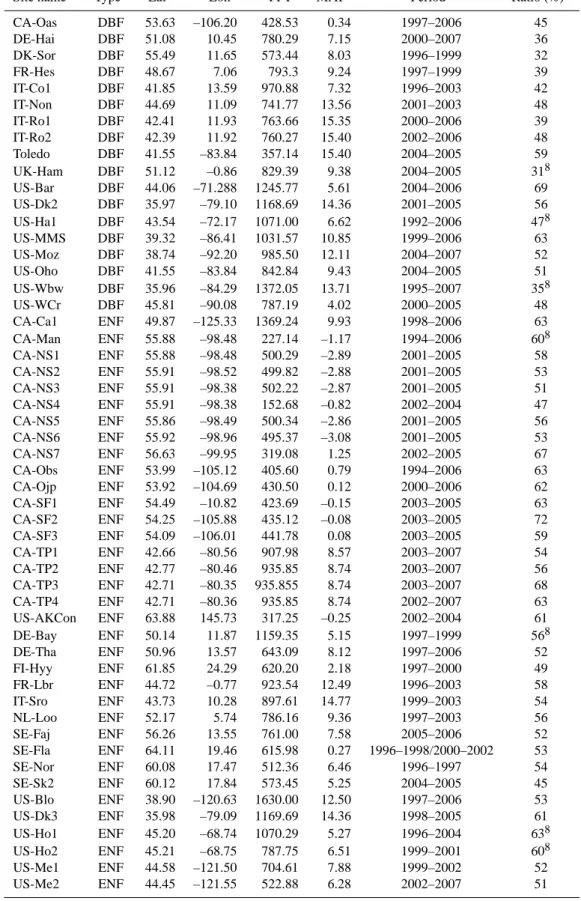
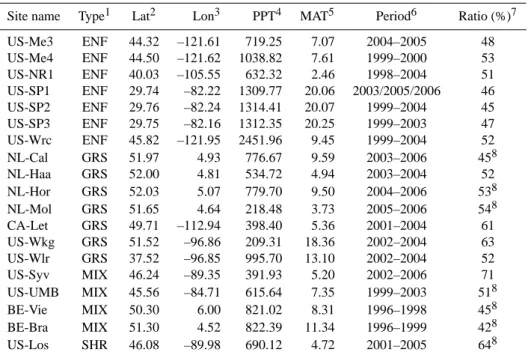
Table 1. The FLUXNET sites used in this study arranged according to ecosystem type.
Site name Type1 Lat2 Lon3 PPT4 MAT5 Period6 Ratio (%)7
CA-Oas DBF 53.63 –106.20 428.53 0.34 1997–2006 45 DE-Hai DBF 51.08 10.45 780.29 7.15 2000–2007 36 DK-Sor DBF 55.49 11.65 573.44 8.03 1996–1999 32 FR-Hes DBF 48.67 7.06 793.3 9.24 1997–1999 39 IT-Co1 DBF 41.85 13.59 970.88 7.32 1996–2003 42 IT-Non DBF 44.69 11.09 741.77 13.56 2001–2003 48 IT-Ro1 DBF 42.41 11.93 763.66 15.35 2000–2006 39 IT-Ro2 DBF 42.39 11.92 760.27 15.40 2002–2006 48 Toledo DBF 41.55 –83.84 357.14 15.40 2004–2005 59 UK-Ham DBF 51.12 –0.86 829.39 9.38 2004–2005 318 US-Bar DBF 44.06 –71.288 1245.77 5.61 2004–2006 69 US-Dk2 DBF 35.97 –79.10 1168.69 14.36 2001–2005 56 US-Ha1 DBF 43.54 –72.17 1071.00 6.62 1992–2006 478 US-MMS DBF 39.32 –86.41 1031.57 10.85 1999–2006 63 US-Moz DBF 38.74 –92.20 985.50 12.11 2004–2007 52 US-Oho DBF 41.55 –83.84 842.84 9.43 2004–2005 51 US-Wbw DBF 35.96 –84.29 1372.05 13.71 1995–2007 358 US-WCr DBF 45.81 –90.08 787.19 4.02 2000–2005 48 CA-Ca1 ENF 49.87 –125.33 1369.24 9.93 1998–2006 63 CA-Man ENF 55.88 –98.48 227.14 –1.17 1994–2006 608 CA-NS1 ENF 55.88 –98.48 500.29 –2.89 2001–2005 58 CA-NS2 ENF 55.91 –98.52 499.82 –2.88 2001–2005 53 CA-NS3 ENF 55.91 –98.38 502.22 –2.87 2001–2005 51 CA-NS4 ENF 55.91 –98.38 152.68 –0.82 2002–2004 47 CA-NS5 ENF 55.86 –98.49 500.34 –2.86 2001–2005 56 CA-NS6 ENF 55.92 –98.96 495.37 –3.08 2001–2005 53 CA-NS7 ENF 56.63 –99.95 319.08 1.25 2002–2005 67 CA-Obs ENF 53.99 –105.12 405.60 0.79 1994–2006 63 CA-Ojp ENF 53.92 –104.69 430.50 0.12 2000–2006 62 CA-SF1 ENF 54.49 –10.82 423.69 –0.15 2003–2005 63 CA-SF2 ENF 54.25 –105.88 435.12 –0.08 2003–2005 72 CA-SF3 ENF 54.09 –106.01 441.78 0.08 2003–2005 59 CA-TP1 ENF 42.66 –80.56 907.98 8.57 2003–2007 54 CA-TP2 ENF 42.77 –80.46 935.85 8.74 2003–2007 56 CA-TP3 ENF 42.71 –80.35 935.855 8.74 2003–2007 68 CA-TP4 ENF 42.71 –80.36 935.85 8.74 2002–2007 63 US-AKCon ENF 63.88 145.73 317.25 –0.25 2002–2004 61 DE-Bay ENF 50.14 11.87 1159.35 5.15 1997–1999 568 DE-Tha ENF 50.96 13.57 643.09 8.12 1997–2006 52 FI-Hyy ENF 61.85 24.29 620.20 2.18 1997–2000 49 FR-Lbr ENF 44.72 –0.77 923.54 12.49 1996–2003 58 IT-Sro ENF 43.73 10.28 897.61 14.77 1999–2003 54 NL-Loo ENF 52.17 5.74 786.16 9.36 1997–2003 56 SE-Faj ENF 56.26 13.55 761.00 7.58 2005–2006 52 SE-Fla ENF 64.11 19.46 615.98 0.27 1996–1998/2000–2002 53 SE-Nor ENF 60.08 17.47 512.36 6.46 1996–1997 54 SE-Sk2 ENF 60.12 17.84 573.45 5.25 2004–2005 45 US-Blo ENF 38.90 –120.63 1630.00 12.50 1997–2006 53 US-Dk3 ENF 35.98 –79.09 1169.69 14.36 1998–2005 61 US-Ho1 ENF 45.20 –68.74 1070.29 5.27 1996–2004 638 US-Ho2 ENF 45.21 –68.75 787.75 6.51 1999–2001 608 US-Me1 ENF 44.58 –121.50 704.61 7.88 1999–2002 52 US-Me2 ENF 44.45 –121.55 522.88 6.28 2002–2007 51
Table 1. Continued.
Site name Type1 Lat2 Lon3 PPT4 MAT5 Period6 Ratio (%)7
US-Me3 ENF 44.32 –121.61 719.25 7.07 2004–2005 48 US-Me4 ENF 44.50 –121.62 1038.82 7.61 1999–2000 53 US-NR1 ENF 40.03 –105.55 632.32 2.46 1998–2004 51 US-SP1 ENF 29.74 –82.22 1309.77 20.06 2003/2005/2006 46 US-SP2 ENF 29.76 –82.24 1314.41 20.07 1999–2004 45 US-SP3 ENF 29.75 –82.16 1312.35 20.25 1999–2003 47 US-Wrc ENF 45.82 –121.95 2451.96 9.45 1999–2004 52 NL-Cal GRS 51.97 4.93 776.67 9.59 2003–2006 458 NL-Haa GRS 52.00 4.81 534.72 4.94 2003–2004 52 NL-Hor GRS 52.03 5.07 779.70 9.50 2004–2006 538 NL-Mol GRS 51.65 4.64 218.48 3.73 2005–2006 548 CA-Let GRS 49.71 –112.94 398.40 5.36 2001–2004 61 US-Wkg GRS 51.52 –96.86 209.31 18.36 2002–2004 63 US-Wlr GRS 37.52 –96.85 995.70 13.10 2002–2004 52 US-Syv MIX 46.24 –89.35 391.93 5.20 2002–2006 71 US-UMB MIX 45.56 –84.71 615.64 7.35 1999–2003 518 BE-Vie MIX 50.30 6.00 821.02 8.31 1996–1998 458 BE-Bra MIX 51.30 4.52 822.39 11.34 1996–1999 428 US-Los SHR 46.08 –89.98 690.12 4.72 2001–2005 648
1Ecosystem type, DBF: deciduous broadleaf forest; ENF: evergreen needleleaf forest; GRS: grassland; SHR: shrub wetland; MIX: mixed deciduous and evergreen needleleaf forest. 2Positive value indicates north latitude.
3Negative value indicates west longitude, positive value indicates east longitude. 4PPT: mean annual precipitation (mm yr−1).
5MAT: mean annual temperature (◦).
6Available years.
7The percent of measurements that were used in this analysis.
8These sites do not measure the soil moisture, so all measurements are used in these sites.
and controlling environmental variables were fit using a 15-day moving window. The van’t Hoff (see Lloyd and Taylor, 1994) equation was used to fill the missing nighttime fluxes (Fc,night):
Fc,night=Ae(BTa) (1)
where, A and B are estimated model coefficients, and Tais air temperature. A Michaelis-Menten light response equation was used to fill the missing daytime fluxes (Fc,day)(Falge et al., 2001):
Fc,day=
α ·PAR · FGPP,sat
FGPP,sat+α ·PAR
−FRE,day (2)
where FGPP,sat(GPP at saturating light) and α (initial slope of the light response function) are empirically-estimated coeffi-cients, and FRE,day(daytime Re)was estimated by extrapola-tion of Eq. (1) using the daytime air temperature. Daily mete-orological and flux variables values were synthesized based on half-hourly or hourly values, and the daily values were indicated as missing when missing hourly values exceeded 20 % of potential observations during each day.
The decreased solar radiation during cloudy days signif-icantly restricts GPP more than Re, resulting in a reduced NEE. To exclude the influence of clouds on NEE and thus
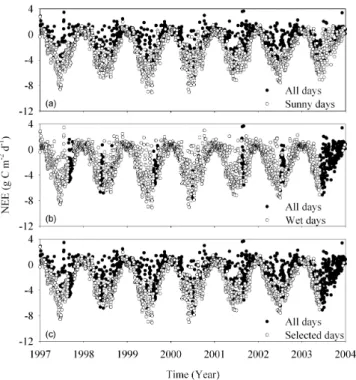
isolate the temperature response, the cloudy days were ex-cluded from our analysis (Fig. 1a). Cloudiness was defined by using a clearness index (CI), defined as periods when the ratio of the global solar radiation received on the surface to the extraterrestrial solar radiation exceeded 0.5. On average, 35 % of days were removed which were defined as the cloudy days. The amount of cloudy days excluded varied among sites and ranged from 45 % (US-MMS) to 23 % (SE-Nor). Moreover, the effects of drought on NEE during the growing season were accounted for in a simplified way. A water stress index (WSI) was calculated as:
WSI = SW − SWW SWF−SWW
(3) where SW is the observed soil moisture content (m3m−3). SWW is wilting point of soil (m3m−3), and SWF is water field capacity of soil (m3m−3). They were set to the max-imum and minmax-imum soil moisture content during the ing season. Measurements when the WSI during the grow-ing season (April to September) were less than 15 % were excluded from this analysis. The excluding measurements made under water-stressed conditions resulted in the exclu-sion of 16 % of measurements ranging from 13 % at US-Bar to 28 % at US-Wkg. In total, 53 % of available measurements
Fig. 1. Comparison on net ecosystem exchange (NEE) between all days and sunny days (a) and wet days (b) and selected days ex-cluding both cloudy and drought days (c) at DE-Tha site. Negative values on y-axes indicate that carbon is absorbed by the ecosystem, while positive values indicate that that carbon is released by the ecosystem to the atmosphere.
were used in this analysis ranging from 31 % at UK-Ham to 72 % at CA-SF2.
From −30◦to its maximum, temperature categories were set every 1◦increments. Air temperature and NEE for each site were averaged within each increment over the study years in order to examine the changes of NEE with tem-perature to determine Tband To(Fig. 2). The start and end dates of carbon uptake were identified as the day when daily NEE shifted signs (Falge et al., 2002). To deduce these dates objectively, an 11-day running mean was calculated and the onset date of carbon uptake was determined when consecu-tive foregoing days acted as a net carbon source to the atmo-sphere, and subsequent days represented a net carbon sink.
3 Results
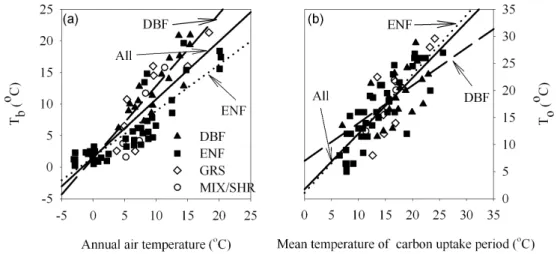
Our analysis shows that Tb and To decreased significantly with latitude, which co-varies strongly with temperature (data not shown). Tb was strongly correlated with an-nual mean air temperature across a broad geographic range (Fig. 3a). Specifically, Tb under the same thermal condi-tions was higher in deciduous broadleaf forests than in other ecosystem types, though the regression curve of Tbto mean annual temperature in the deciduous broadleaf forests did not
Fig. 2. Typical example of response curve of net ecosystem ex-change (NEE) with temperature at DE-Tha site. Negative values at y-axes indicate that carbon is absorbed by the ecosystem, while positive values indicate that carbon is released by the ecosystem to the atmosphere. The curve of “all days” was derived from all mea-surements without any data filting; the curve of “sunny days” was derived after excluding the cloudy days; the curve of “wet days” was generated based on the measurements excluding the drought days; and the curve of “selected days” was derived from the mea-surements excluding the cloudy and drought days, and which was used to determine the Tb(the transition temperature from ecosys-tem carbon source to sink) and To(the optimal temperature for net carbon uptake).
show a significant difference among all sites. In contrast, we observed a significant difference of regression curve in ev-ergreen needleleaf forests from the overall mean of all sites, with a lower Tbin evergreen needleleaf forests (Fig. 3a). To for carbon uptake was strongly correlated with mean air tem-peratures during the carbon uptake period across the broad spatial scale examined (Fig. 3b).
We compared the temperature curves of NEE among ad-jacent ecosystems to investigate the impacts of stand age on temperature thresholds of NEE. Comparison of seven adja-cent boreal forest sites showed a constant Tband Toamong ecosystems comprising stand ages between 30 and 160 yr (Fig. 4). Significantly higher Tband To were found at 20-and 12-yr st20-ands (i.e. CA-NS6 20-and CA-NS7).
4 Discussion
A set of data selection criterion was used to remove the ef-fects from other environmental factors when characterizing the temperature curves of NEE. Two critical environmen-tal limitation of low radiation at cloudy days and drought, which can significantly reduce NEE, were considered in this analysis. We used clearness index (CI), defined as the ratio of the global solar radiation received on the surface to the extraterrestrial solar radiation, to exclude the cloudy days
Fig. 3. The relationship between annual mean air temperature vs. Tb (a) and mean temperature of carbon uptake period vs. To(b) in deciduous broadleaf forests (DBF), evergreen needleleaf forests (ENF), grasslands (GRS), mixed forests (MIX) and Shurblands (SHR) as well as all ecosystems. Tb: the transition temperature from ecosystem carbon source to sink; To: the optimal temperature for net carbon uptake. In panel (a), the regression lines are: y = 1.15x + 1.41, R2=0.81, P < 0.01 (DBF); y = 0.92x + 1.57, R2=0.73, P < 0.01 (All);
y =0.73x +1.59, R2=0.77, P < 0.01 (ENF). At (b), y = 0.69x +7.02, R2=0.32, P < 0.05 (DBF); y = 1.02x +1.76, R2=0.64, P < 0.01 (All); y = 1.09x + 1.09, R2=0.71, P < 0.01 (ENF).
Fig. 4. Temperature response curves of NEE at seven adjacent ev-ergreen needleleaf forests in Canada shown at Table 1. Negative values at y-axes indicate that carbon is absorbed by the ecosystem, while positive values indicate that carbon is released by the ecosys-tem to the atmosphere.
(Gu et al., 1999, 2003). Numerous of field observations have shown that the highest rate of forest net ecosystem ex-changes (NEE) of CO2often occurs on cloudy rather than on sunny days (Price and Black, 1990; Hollinger et al., 1994). Several mechanisms have been postulated to explain such observations. They include increases in diffuse radiation (Price and Black, 1990; Hollinger et al., 1994; Fan et al., 1998), decreases in the respiration of sunlit leaves (Baldoc-chi, 1997), and stomatal dynamics associated with light fluc-tuations (Sakai et al., 1996). Gu et al. (1999) examined the influences of clouds on forest carbon uptake at a boreal as-pen forest and a temperate mixed deciduous forest in Canada,
and found that both forests can tolerate exceedingly large re-ductions of solar radiation (CI of 0.53 for the aspen forest and 0.46 for the mixed forest) caused by increases in cloudi-ness without lowering their capacities of carbon uptake. We examined the threshold of CI when NEE significantly de-creased over other study sites, and found the threshold val-ues were close to 0.5 (Data not shown). So, in this study, we excluded the cloudy days when the ratio was less than 0.5. Figure 1a showed the significant decreases of NEE due to lower solar radiation of cloudy days at demonstrated site (i.e. DE-Tha).
It has been well known that NEE is strongly influenced by water availability in terrestrial ecosystems (Meyers, 2001; Granier et al., 2000, 2007). For example, Europe experi-enced a particularly extreme climate anomaly during 2003, with July temperatures up to 6.8◦ above long-term means, and annual precipitation deficits up to 300 mm yr−1, 50 % be-low the average (Ciais et al., 2005). The net ecosystem pro-duction decreased with increasing water stress at almost all of investigated 12 forest sites (Granier et al., 2007). There-fore, it is necessary to characterize temperature curve of NEE using the potential NEE measurements given no water or ra-diation limitation. In this analysis, a simple water stress in-dex was used to quantify the impacts of drought on NEE. The results showed that WSI can effectively ascertain the drought effects (Fig. 1b). At the DE-Tha site, decreased measure-ments of NEE resulted from water stress were excluded, and especially at 2003, more than half of measurements were ex-cluded due to severe drought.
Temperature curves of NEE under the different data se-lection criterion showed the considerable differences (Fig. 2) at the demonstrated DE-Tha site. In generally, ecosystem
carbon uptake after excluding drought and cloudy days were higher than those at the other three conditions (Fig. 2). Especially, low radiation at cloudy days substantially de-creased the carbon uptake, and drought influenced NEE at the high temperature periods. The transition temperature points (i.e. Tband To)showed the prominent differences among the temperature curves under the different data filting criterion. For example, at the demonstrated site, there are the differ-ences of 5◦between the curves derived from original mea-surements and meamea-surements excluding cloudy and drought days. Therefore, it is necessary to characterize temperature curve of NEE using the potential NEE measurements given no water or radiation limitation.
It would not otherwise be expected that ecosystem thermal optima track so closely with average temperatures by chance; significant correlations between ecosystem Tb and annual mean air temperature, as well as Toand mean temperature during the carbon uptake period, suggests that ecosystem-level thermal adaptation of NEE took place. Previous studies have demonstrated strong thermal adaptation of photosyn-thesis and respiration independently at the ecosystem level (Baldocchi, 2008 Changed. OK?), while the scientific
investigations on thermal properties of NEE are examined in this study. NEE is the balance between the carbon uptake by photosynthetic carbon uptake and plant and microbial respi-ratory losses, suggesting that the coupling of two thermally-dependent processes should be further examined to evaluate the mechanisms driving thermal adaptation of ecosystems. The variation of soil respiration and its temperature sensitiv-ity are both strongly correlated with GPP at diurnal, seasonal and annual scales (Janssens et al., 2001; Tang et al., 2005; Sampson et al., 2007; Ma et al., 2007). An increasing num-ber of evidences further show that this complex influence on plant growth rate also determines the microbial processing of carbon in the soil (Christopher and Lal, 2007; Fornara and Tilman, 2008; Cable et al., 2009). Chemical properties that promote high physiological activity and growth in plants and low lignin content also promote rapid decomposition (Hob-bie, 1992). The quality of leaf litter, as often measured by litter C:N ratio and carbon quality, correlates strongly with corresponding plant production parameters in living leaves (Aerts and Chapin III., 2000). Furthermore, the quantity of litter input provides a second critical link between CO2 up-take and decomposition because plant growth governs the quantity of organic matter inputs to decomposers (Deforest et al., 2009).
At a given mean annual temperature, Tb of evergreen needleleaf forests is lower than that in deciduous broadleaf forests (Fig. 4). Rapid induction of spring photosynthesis and the low soil respiration compared to assimilation due to low spring temperature, and the evergreen habit of these forests, likely resulted in earlier transition from ecosystem carbon source to uptake in evergreen needleleaf forests (Black et al., 2000; Falge et al., 2002; Welp et al., 2007). Our observa-tion of delayed Tbin deciduous broadleaf forests was
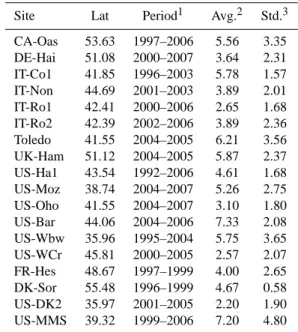
consis-Table 2. Delayed days of soil temperature equals to mean an-nual temperature compared with air temperature in the deciduous broadleaf ecosystems (Table 1).
Site Lat Period1 Avg.2 Std.3 CA-Oas 53.63 1997–2006 5.56 3.35 DE-Hai 51.08 2000–2007 3.64 2.31 IT-Co1 41.85 1996–2003 5.78 1.57 IT-Non 44.69 2001–2003 3.89 2.01 IT-Ro1 42.41 2000–2006 2.65 1.68 IT-Ro2 42.39 2002–2006 3.89 2.36 Toledo 41.55 2004–2005 6.21 3.56 UK-Ham 51.12 2004–2005 5.87 2.37 US-Ha1 43.54 1992–2006 4.61 1.68 US-Moz 38.74 2004–2007 5.26 2.75 US-Oho 41.55 2004–2007 3.10 1.80 US-Bar 44.06 2004–2006 7.33 2.08 US-Wbw 35.96 1995–2004 5.75 3.65 US-WCr 45.81 2000–2005 2.57 2.07 FR-Hes 48.67 1997–1999 4.00 2.65 DK-Sor 55.48 1996–1999 4.67 0.58 US-DK2 35.97 2001–2005 2.20 1.90 US-MMS 39.32 1999–2006 7.20 4.80 1Available years.
2Averaged delayed days when soil temperature equals to the mean annual temperature
compared with air temperature.
3Standard deviation.
tent with a previous study by Baldocchi et al. (2005), which showed that net carbon uptake occurs at the period when the mean daily soil temperature equals the mean annual air tem-perature. We found that Tbwas often delayed past the day when soil temperature equaled mean annual air temperature, with 18 deciduous broadleaf forests showing an average de-lays of 4.67 days (Table 2).
We investigated the impacts of stand age on the ther-mal response of NEE within seven adjacent forest stands comprising a fire chronosequence to ascertain whether cli-mate or stand characteristics were responsible for the tim-ing of Tb and To (Fig. 4). Our results did not show dif-ferences of Tb and To among 30 to 160 yr-old stands, sug-gesting that the thermal environment may be more impor-tant than successional stage in determining thermal optima. The two youngest sites showed higher Tband To partly be-cause the vegetation was dominated by deciduous broadleaf seedlings and grasses, which have slightly different tem-perature/thermal optima relationships than evergreen needle-leaf forests (Fig. 3). Previous studies have shown that for-est development following stand-replacing disturbance influ-ences a variety of ecosystem processes including carbon ex-change with the atmosphere (Law et al., 2003). The mag-nitude of NEE differed dramatically among stands of differ-ent ages (Fig. 4a, b, c), suggesting, along with the spatially-distributed results (Fig. 3), that thermal adaptation is inde-pendent of flux magnitude.
All Global Dynamic Vegetation Models (GDVM) for pre-dicting NEE at global or regional scales use separate func-tions to describe the temperature relafunc-tionship of GPP and Re with substantial variations among these functions (Running and Coughlan, 1988; Running and Gower, 1991; Potter et al., 1993; Woodward et al., 1995; Foley et al., 1996). How-ever, no study has been conducted to evaluate the accuracy of these independent temperature functions across models. Temperature functions of GPP and Re in these models are often poorly constrained because the thermal adaptation of GPP and Re, and its aggregate flux, NEE, are poorly un-derstood, posing limitations in simulation certainty. In this study, the thermal adaptation of ecosystem on NEE across latitudes suggests the intrinsic physiological connections be-tween thermal responses of GPP and Re, which will be very useful to constrain ecosystem models.
5 Conclusions
Investigating the thermal adaptation of ecosystems on NEE will improve our ability to model regional and global car-bon balance both in the present and in the future. This study adds to an existing empirical basis of thermal adaptation of NEE that we anticipate will form a foundation for mechanis-tic, process-based studies on the response of GPP and Re to temperature. In this study, Tband Toshowed significantly de-creasing trends with latitude and adapted to the mean temper-ature during the whole year and growing season separately across 72 study sites with a wide geographic distribution. Thermal response of Tband Toprovides a promising phys-iological rule that can be implemented in regional carbon balance models constraining presently separated temperature functions of GPP and Re.
Acknowledgements. This research was financially supported
by National Key Basic Research and Development Plan of China (2010CB833504), US National Science Foundation (NSF) under DEB 0444518, and the Terrestrial Carbon Program at the Office of Science, US Department of Energy, Grants No.: DE-FG02-006ER64317. Research at the University of Antwerp was financially supported by the Research Center of Excellence ECO. We acknowledge the work of principal investigators and collaborators in EC sites, who provided the eddy covariance flux measurements.
Edited by: J. Kesselmeier
References
Aerts, R. and Chapin III., F. S. : The mineral nutrition of wild plants revisited: a re-evaluation of processes and patterns, Adv. Ecol. Res., 30, 1–67, 2000.
Angiletta, M. J.: Thermal Adaptation: a Theoretical and Empirical Analysis, Oxford University Press, New York, 2009.
Atkin, O. K. and Tjoelker, M. G.: Thermal acclimation and the dy-namic response of plant respiration to temperature, Trends Plant Sci., 8, 343–351, 2003.
Aubinet, M., Chermanne, B., Vandenhaute, M., Longdoz, B., Yer-naux, M., and Laitat, E.: Long term carbon dioxide exchange above a mixed forest in the Belgian Ardennes, Agr. Forest Mete-orol., 108, 293–315, 2001. Not mentioned in the text? Baldocchi, D. D: Measuring and modelling carbon dioxide and
wa-ter vapour exchange over a temperate broad-leaved forest during the 1995 summer drought, Plant Cell Environ., 20, 1108–1122, 1997.
Baldocchi, D. D.: “Breathing” of the Terrestrial Biosphere: Lessons Learned from a Global Network of Carbon Dioxide Flux Mea-surement Systems, Aust. J. Bot., 56, 1–26, 2008.
Baldocchi, D. D., Falge, Eva., Gu, L., Olson, R., Hollinger, D., Running, S., Anthoni, P., Bernhofer, C., Davis, K., Evans, R., Fuentes, J., Goldstein, A., Katul, G., Law, B., Lee, X., Malhi, Y., Meyers, T., Munger, W., Oechel, W., Paw, K. T., Pilegaard, K., Schmid, H. P., Valentini, R., Verma, S., Vesala, T., Wilson, K., and Wofsy, S.: FLUXNET: a new tool to study the temporal and spatial variability of ecosystem scale carbon dioxide, wa-ter vapor, and energy flux densities, B. Am. Meteorol. Soc., 82, 2415–2434, 2001.
Baldocchi, D. D., Black, T. A., Curtis, P. S., Falge, E., Fuentes, J. D., Granier, A., Gu, L., Knohl, A., Pilegaard, K., Schmid, H. P., Valentini, R., Wilson, K., Wofsy, S., Xu, L., and Yamanoto, S.: Predicting the onset of net carbon uptake by deciduous forests with soil temperature and climate data: a synthesis of FLUXNET data, Int. J. Biometeorol., 49, 377–387, 2005.
Bhupinderpal-Singh Initital(s)?, Nordgren, A., Löfvenius, M. O., Högberg, M. N., Mellander, P. E., and Högberg, P.: Tree root and soil heterotrophic respiration as revealed by girdling of boreal Scots pine forest: extending observations beyond the first year, Plant Cell Environ., 26, 1287–1296, 2003.
Black, T. A., Chen, W. J., Barr, A. G., Arain, M. A., Chen, Z., Nesic, Z., Hogg, E. H., Neumann, H. H., and Yang, P. C.: Increased carbon sequestration by a boreal deciduous forest in years with a warm spring, Geophys. Res. Lett., 27, 1271–1274, 2000. Bolstad, P. V., Davis, K. J., Martin, J. M., Cook, B. D., and Wang,
W.: Component and whole-system respiration fluxes in northern deciduous forests, Tree Physiol., 24, 493–504, 2004. Not mentioned in the text?
Bradford, M. A., Watts, B. W., and Davies, C. A.: Thermal adap-tation of heterotrophic soil respiration in laboratory microcosms, Glob. Change Biol., 16, 1576–1588, 2009.
Cable, J. M., Ogle, K., Tyler, A. P., Pavao-Zuckerman, M. A., and Huxman, T. E.: Woody plant encroachment impacts on soil carbon and microbial processes: results from a hierarchical Bayesian analysis of soil incubation data, Plant Soil, 320, 153– 167, 2009.
Carrara, A., Kowalski, A. S., Neirynck, J., Janssens, I. A., Yuste, J. C., and Ceulemans, R.: Net ecosystem CO2exchange of mixed forest in Belgium over 5 years, Agr. Forest Meteorol., 119, 209– 227, 2003. Not mentioned in the text?
Chmielewski, F. M. and Rötzer, T.: Response of tree phenology to climate change across Europe, Agr. Forest Meteorol., 108, 101– 112, 2001. Not mentioned in the text?
Christopher, S. F. and Lal, R.: Nitrogen management affects carbon sequestration in North American cropland soils, CRC Cr. Rev.
Plant Sci., 26, 45–64, 2007.
Churkina, G., Tenhunen, J., Thornton, P. E., Falge, E. M., Elbers, J. A., Erhard, M., Grünwald, T., Kowalski, A. S., Rannik, ü, and Sprinz, D.: Analyzing the ecosystem carbon dynamics of four European coniferous forest using a biogeochemistry model, Ecosystems, 6, 168–184, 2003.
Ciais, P. H., Reichstein, M., Viovy, N., Granier, A., Ogée, J., Al-lard, V., Aubinet, M., Buchmann, N., Bernhofer, Chr., Carrara, A., Chvallier, F., Noblet, N. D., Friend, A. D., Friedlingstein, P., Grünwald, T., Heinesch, B., Keronen, P., Knohl, A., Krinner, G., Loustau, D., Manca, G., Matteucci, G., Miglietta, F., Ourcival, J. M., Papale, D., Pilegaard, K., Rambal, S., Seufert, G., Sous-sana, J. F., Sanz, M. J., Schulze, E. D., Vesala, T., and Valentini, R.: Europe-wide reduction in primary productivity caused by the heat and drought in 2003, Nature, 437, 529–533, 2005.
Curtis, P. S., Vogel, C. S., Gough, C. M., Schmid, H. P., Su, H. B., and Bovard, B. D.: Respiratory carbon losses and the carbon use efficiency of a northern hardwood forest, 1999–2003, New Phytol., 167, 437–456, 2005. Not mentioned in the text? Davis, K. J., Bakwin, P. S., Yi, C. X., Berger, B. W., Zhao, C., Teclaw, R. W., and Isebrands, J. G.: The annual cycles of CO2 and H2O exchange over a northern mixed forest as observed from a very tall tower, Glob. Change Biol., 9, 1278–1293, 2003.
Not mentioned in the text?
DeForest, J. L., Noormets, A., McNulty, S. G., Sun, G., Teeney, G., and Chen, J.: Phenophases alter the soil respiration-temperature relationship in an oak-dominated forest, Int. J. Biometeorol., 51, 135–144, 2006. Not mentioned in the text?
DeForest, J. L., Chen, J., and McNulty, S. G.: Leaf litter is an im-portant mediator of soil respiration in an oak-dominated forest, Int. J. Biometeorol., 53, 127–134, 2009.
Desai, A. R., Bolstad, P. V., Cook, B. D., Davis, K. J., and Carey, E. V.: Comparing net ecosystem exchange of carbon dioxide be-tween an old-growth and mature forest in the upper Midwest, USA, Ecol. Appl., 14, S22–S32, 2005. Not mentioned in the text?
Dolman, A. J., Moors, E. J., and Elbers, J. A.: The carbon uptake of a mid latitude pine forest growing on sandy soil, Agr. For-est Meteorol., 111, 157–170, 2002. Not mentioned in the text?
Ekblad, A. and Hogberg, P.: Natural abundance of 13C reveals speed of link between tree photosynthesis and root respiration, Oecologia, 127, 305–308, 2001.
Eliasson, P. E., McMurtrie, R. E., Pepper, D. A., Strömgren, M., Linder, S., and Ågren, G. I.: The response of heterotrophic CO2 -flux to soil warming, Glob. Change Biol., 11, 167–181, 2005. Falge, E., Tenhunen, J., Baldocchi, D., Aubinet, M., Bakwin, P.,
Berbigier, P., Bernhofer, C., Bonnefound, J. M., Clement, R., Davis, K. J., Elbers, J. A., Falk, M., Goldstein, A. H., Grelle, A., Granier, A., Grünwald, T., Guðmundsson, J., Hollinger, D., Janssens, I. A., Keronen, P., Kowalskim, A. S., Katul, G., Lawo, B. E., Malhi, Y., Meyers, T., Monson, R. K., Moors, E., Mungert, J. W., Oechel, W., Paw, K. T. U., Pilegaard, K., Ran-nikw, Ü., Rebmannx, C., Suyker, A., Thorgeirsson, H., Tirone, G., Turnipseed, A., Wilson, K., and Wofsy, S.: Phase and ampli-tude of ecosystem carbon release and uptake potentials as derived from FLUXNET measurements, Agr. Forest Meteorol., 113, 75– 95, 2002.
Fan, S., Gloor, M., Mahlman, J., Pacala, S., Sarminento, J.,
Taka-hashi, T., and Tans, P.: A large terrestrial carbon sink in North America implied by atmospheric and oceanic carbon dioxide data and models, Science, 282, 442–446, 1998.
Flanagan, L. B. and Johnson, B. G.: Interacting effects of temper-ature, soil moisture and plant biomass production on ecosystem respiration in a northern temperate grassland, Agr. Forest Mete-orol., 130, 237–253, 2005. Not mentioned in the text? Foley, J. A., Prentice, I. C., Ramankutty, N., Levis, S., Pollard, D.,
Sitch, S., and Haxeltine, A.: An integrated biosphere model of land surface processes, terrestrial carbon balance, and vegetation dynamics, Global Biogeochem. Cy., 10, 603–628, 1996. Fornara, D. A. and Tilman, D.: Plant functional composition
influ-ences rates of soil carbon and nitrogen accumulation, J. Ecol., 96, 314–322, 2008.
Galmés, J., Flexas, J., Keys, A. J., Cifre, J., Mitchell, R. A. C., Madgwick, P. J., Haslam, R. P., Medrano, H., and Parry, M. A. J.: Rubisco specificity factor tends to be larger in plant species from drier habitats and in species with persistent leaves, Plant Cell environ., 28, 571–579, 2005.
Goulden, M. L., Winston, G. C., McMillan, A. M. S., Litvak, M. E., Read, E. L., Rocha, A. V., and Elliot, J. R.: An eddy covariance mesonet to measure the effect of forest age on land-atmosphere exchange, Glob. Change Biol., 12, 2146–2162, 2006. Not mentioned in the text?
Granier, A., Bréda, N., and Loustau, D.: A generic model of forest canopy conductance dependent on climate, soil water availability and leaf area index, Ann. For. Sci., 57, 755–765, 2000.
Granier, A., Reichstein, M., and Breda, N.: Evidence for soil water control on carbon and water dynamics in european forests during the extremely dry year: 2003, Agr. Forest Meteorol., 143, 123– 145, 2007.
Grünwald, T. and Berhofer, C.: A decade of carbon, water and en-ergy flux measurements of an old spruce forest at the Anchor Station Tharandt, Tellus, 59B, 387–396, 2007. Not men-tioned in the text?
Gu, L. H., Fuentes, J. D., Shugart, H. H., Staebler, R. M., and Black, T. A.: Responses of net ecosystem exchanges of carbon dioxide to changes in cloudiness: Results from two North American de-ciduous forests, J. Geophys. Res., 104, 31421–31434, 1999. Gu, L. H., Baldocchi, D. D., Wofsy, S. C., Munger, J. W.,
Michal-sky, J. J., Urbanski, S. P., and Boden, T. A.: Response of a de-ciduous forest to the Mount Pinatubo eruption: Enhanced photo-synthesis, Science, 299, 2035–2038, 2003.
Hobbie, S. E.: Effects of plant species on nutrient cycling, Trends Ecol. Evol., 7, 336–339, 1992.
Högberg, P., Nordgren, A., Buchmann, N., Taylor, A. F. S., Ekblad, A., Högberg, M. N., Nyberg, G., Ottosson-Löfvenius, M., and Read, D. J.: Large-scale forest girdling shows that current pho-tosynthesis drives soil respiration, Nature, 411, 789–792, 2001. Hollinger, D. Y., Kelliher, F. M., Byers, J. N., Hunt, J. E.,
McSev-eny, T. M., and Weir, P. L.: Carbon dioxide exchange between an undisturbed old-growth temperate forest and the atmosphere, Ecology, 75, 134–150, 1994.
Hollinger, D. Y., Aber, J., Dail, B., Davidson, E. A., Goltz, S. M., Hughes, H., Leclerc, M. Y., Lee, J. T., Richardson, A. D., Ro-drigues, C., Scott, N. A., Achuatavarier, D., and Walsh, J.: Spa-tial and temporal variability in forest-atmosphere CO2exchange, Glob. Change Biol., 10, 1689–1706, 2004. Not mentioned in the text?
Hopkins, A. D.: Bioclimatics: A science of life and climate rela-tions, Ecology, 20, 413–416, 1939. Not mentioned in the text?
Hu, J., Moore, D. J. P., Burns, S. P., and Monson, R. K.: Longer growing seasons lead to less carbon sequestration by a subalpine forest, Glob. Change Biol., 16, 771–783, 2010. Not men-tioned in the text?
Hui, D. F., Luo, Y. Q., and Katul, G.: Partitioning interannual vari-ability in net ecosystem exchange into climatic varivari-ability and functional change, Tree Physiol., 23, 433–442, 2003. Not mentioned in the text?
Huxman, T. E., Turnipseed, A. A., Sparks, J. P., Harley, P. C., and Monson, R. K.: Temperature as a control over ecosystem CO2 fluxes in a high-elevation, subalpine forest, Oecologia, 134, 537– 546, 2003.
Janssens, I. A., Lankreijer, H., Matteucci, G., Kowalski, A. S., Buchmann, N., Epron, D., Pilegaard, K., Kutsch, W., Long-doz, B., Grünwald, T., Montagnani, L., Dore, S., Rebmann, C., Moors, E. J., Grelle, A., Rannik, Ü., Morgenstern, K., Oltchev, S., Clement, R., Guðmundsson, J., Minerbi, S., Berbigier, P., Ibrom, A., Moncrieff, J., Aubinet, M., Bernhofer, C., Jensen, N. O., Vesala, T., Granier, A., Schulze, E. D, Lindroth, A., Dolman, A. J., Jarvis, P. G., Ceulemans, R., and Valentini, R.: Productiv-ity overshadows temperature in determining soil and ecosystem respiration across European forests, Glob. Change Biol., 7, 269– 278, 2001.
Johnson, F. H., Eyring, H., and Stover, B. J.: The Theory of Rate Processes in Biology and Medicine, John Wiley and Sons, New York, NY, 1974.
Kurc, S. A. and Small, E. E.: Dynamics of evapotranspiration in semiarid grassland and shrubland ecosystems during the summer monsoon season, central New Mexico, Water Resour. Res., 40, W09305, doi:10.1029/2004WR003068, 2004. Not men-tioned in the text?
Law, B. E., Sun, O., Campbell, J., Van, T. J., and Thornton, P.: Changes in carbon storage and fluxes in a chronosequence of ponderosa pine, Glob. Change Biol., 9, 510–524, 2003. Lindroth, A., Grelle, A., and Morén, A. S.: Long-term
measure-ments of boreal forest carbon balance reveal large temperature sensitivity, Glob. Change Biol., 4, 443–450, 1998. Not mentioned in the text?
Liu, H. P., Randerson, J. T., Lindfors, J., and Chapin III., F. S.: Changes in the surface energy budget after fire in boreal ecosystems of interior Alaska: an annual perspective, J. Geo-phys. Res., 110, D13101, doi:10.1029/2004JD005158, 2005.
Not mentioned in the text?
Lloyd, J. and Taylor, J. A.: On the temperature dependence of soil respiration, Funct. Ecol., 8, 315–323, 1994.
Luo, Y. Q.: Terrestrial carbon cycle feedback to climate warming, Annu. Rev. Ecol. Evol. S., 38, 683–712, 2007. Not men-tioned in the text?
Luo, Y. Q., Wan, S., Hui, D. F., and Wallace, L. L: Acclimatization of soil respiration to warming in a tall grass prairie, Nature, 413, 622–625, 2001.
Luyssaert, S., Janssens, I. A., Sulkava, M., Papales, D., Dolman, A. J., Reichstein, M., Hollmen, J., Martin, J. G., Suni, T., Vesala, T., Loustau, D., Law, B. E., and Moors, E. J.: Photoshynthe-sis drives anomalies in net carbon-exchange of pine forests at different latitudes, Glob. Change Biol., 13, 2110–2127, 2007.
Not mentioned in the text?
Ma, S. Y., Baldocchi, D. D., Xu, L. K., and Hehn, T.: Interannual variability in carbon exchange of an oak/grass savanna and an annual grassland in California, Agr. Forest Meteorol., 147, 157– 171, 2007.
Melillo, J. M., Steudler, P. A., Aber, J. D., Newkirk, K., Lux, H., Bowles, F. P., Catricala, C., Maglill, A., Ahrens, T., and Morris-seau, S.: Soil warming and carbon-cycle feedbacks to the climate system, Science, 298, 2173–2175, 2002.
Meyers, T. P.: A comparison of summertime water and CO2fluxes over rangeland for well watered and drought conditions, Agr. Forest Meteorol., 106, 205–214, 2001.
Monson, R. K., Sparks, J. P., Rosenstiel, T. N., Scott-Denton, L. E., Huxman, T. E., Harley, P. C., Turnipseed, A. A., Burns, S. P., Backlund, B., and Hu, J.: Climatic influences on net ecosys-tem CO2exchange during the transition from wintertime carbon source to springtime carbon sink in a high-elevation, subalpine forest, Oecologia, 146, 130–147, 2005. Not mentioned in the text?
Papale, D., Reichstein, M., Aubinet, M., Canfora, E., Bernhofer, C., Kutsch, W., Longdoz, B., Rambal, S., Valentini, R., Vesala, T., and Yakir, D.: Towards a standardized processing of Net Ecosys-tem Exchange measured with eddy covariance technique: algo-rithms and uncertainty estimation, Biogeosciences, 3, 571–583, doi:10.5194/bg-3-571-2006, 2006.
Pataki, D. E. and Oren, R.: Species differences in stomatal control of water loss at the canopy scale in a mature bottomland decidu-ous forest, Adv. Water Resour., 26, 1267–1278, 2003. Not mentioned in the text?
Pilegaard, K., Hummelshoj, P., Jensen, N. O., and Chen, Z.: Two years of continuous CO2eddy-flux measurements over a Danish beech forest, Agr. Forest Meteorol., 107, 29–41, 2001. Not mentioned in the text?
Potter, C. B., Randerson, J. T., Field, C. B., Matson, P. A., Vitousek, P. M., Mooney, H. A., and Klooster, S. A.: Terrestrial ecosystem production: a process model based on global satellite and surface data, Global Biogeochem. Cy., 7, 811–841, 1993.
Price, D. T. and Black, T. A.: Effects of short-term variation in weather on diurnal canopy CO2flux and evapotranspiration of a juvenile Douglas-Fir stand, Agr. Forest Meteorol., 50, 139–158, 1999 Is it 1990 or false in the text?.
Reichstein, M., Falge, E., Baldocchi, D., Papale, D., Aubinet, M., Berbigier, P., Bernhofer, C., Buchmann, N., Gilmanov, T., Granier, A., Grünwald, T., Havránková, K., Ilvesniemi, H., Janous, D., Knohl, A., Laurila, T., Lohila, A., Loustau, D., Mat-teucci, G., Meyers, T., Miglietta, F., Ourcival, J. M., Pumpanen, J., Rambal, S., Rotenberg, E., Sanz, M., Tenhunen, J., Seufert, G., Vaccari, F., Vesala, T., Yakir, D., and Valentini, R.: On the separation of net ecosystem exchange into assimilation and ecosystem respiration: review and improved algorithm, Glob. Change Biol., 11, 1–16, 2005.
Richardson, A. D., Hollinger, D. Y., Aber, J. D., Ollinger, S. V., and Braswell, B. H.: Environmental variation is directly responsible for short- but not long-term variation in forest-atmosphere car-bon exchange, Glob. Change Biol., 13, 1–16, 2007. Not mentioned in the text?
Running, S. W. and Coughlan, J. C.: A general model of forest ecosystem processes for regional applications, I. Hydrologic bal-ance, canopy gas exchange and primary production processes.
Ecol. Model., 42, 125–154, 1988.
Running, S. W. and Gower, S. T.: FOREST-BGC, a general model of forest ecosystem processes for regional applications, II. Dy-namic carbon allocation and nitrogen budgets, Tree Physiol., 9, 147–160, 1991.
Sakai, R. K., Fitzjarrald, D. R., Moore, K. E., and Freedman, J. M.: How do forest surface fluxes depend on fluctuating light level?, in: Preprints of 22nd Conference on Agricultural and Forest Me-teorology, Atlanta, Georgia, USA, 28 January–2 February, 90– 93, 1996.
Sampson, D. A., Janssens, I. A., Curiel-Yuste, J., and Ceulemans, R.: Basal rates of soil respiration are correlated with photosyn-thesis in a mixed temperate forest, Glob. Change Biol., 13, 2008– 2017, 2007.
Schmid, H. P., Grimmond, C. S. B., Cropley, F., Offerle, B., and Su, H. B.: Measurements of CO2and energy fluxes over a mixed hardwood forest in the mid-western United States, Agr. Forest Meteorol., 103, 357–374, 2000. Not mentioned in the text?
Schwartz, M. D.: Phenology: an integrative environmental science, Kluwer Academic Publishers, Boston, Dordrecht, London, 15 pp., 2003. Not mentioned in the text?
Song, J., Liao, K., Coulter, R. L., and Lesht, B. M.: Climatology of the low-level jet at the southern Great Plains atmospheric Bound-ary Layer Experiments site, J. Appl. Meteorol., 44, 1593–1606, 2005. Not mentioned in the text?
Suni, T., Rinne, J., Reissel, A., Altimir, N., Keronen, P., Rannik, Ü., Dal Maso, M., Kulmala, M., and Vesala, T.: Long-term mea-surements of surface fluxes above a Scots pine forest in Hyytiälä, southern Finland, 1996–2001, Boreal Environ. Res., 4, 287–301, 2003. Not mentioned in the text?
Suyker, A. E. and Verma, S. B.: Year-round observations of the net ecosystem exchange of carbon dioxide in a native tallgrass prairie, Glob. Change Biol., 7, 279–289, 2001. Not men-tioned in the text?
Tang, J., Baldocchi, D. D., and Xu, L.: Tree photosynthesis modu-lates soil respiration on a diurnal time scale, Glob. Change Biol., 11, 1298–1304, 2005.
Urbanski, S., Barford, C., Wofsy, S., Kucharik, C., Pyle, E., Bud-ney, J., McKain, K., Fitzjarrald, D., Czikowsky, M., and Munger, J. W.: Factors controlling CO2 exchange on timescales from hourly to decadal at Harvard Forest, J. Geophys. Res.-Biogeo., 112, G02020, doi:10.1029/2006JG000293, 2007. Not mentioned in the text?
Valentini, R., Matteucci, G., Dolman, A. J., Schulze, E. D., Reb-mann, C., Moors, E. J., Granier, A., Gross, P., Jensen, N. O., Pile-gaard, K., Lindroth, A., Grelle, A., Bernhofer, C., Grünwald, T., Aubinet, T. M., Ceulemans, R., Kowalski, A. S., Vesala, T., Ran-nik, ü., Berbigier, P., Loustau, D., Guðmundsson, J., Thorgeirs-son, H., Ibrom, A., Morgenstern, K., Clement, R., Moncrieff, J., Montagnani, L., Minerbi, S., and Jarvis, P. G.: Respiration as the main determinant of carbon balance in European forests, Nature, 404, 861–865, 2000. Not mentioned in the text? Wang, W. L., Dungan, J., Hashimoto, H., Michaelis, A. R., Milesi,
C. A., Ichii, K., and Nemani, R. R: Diagnosing and assessing un-certainties of terrestrial ecosystem models in a multi-model en-semble experiment: 1. Primary production, Glob. Change Biol., 17, 1350–1366, 2011.
Way, D. A. and Sage, R. F.: Elevated growth temperatures reduce the carbon gain of black spruce [Picea mariana (Mill.) B.S.P], Glob. Change Biol., 14, 624–636, 2008.
Welp, L. R., Randerson, J. T., and Liu, H. P.: The sensitivity of carbon fluxes to spring warming and summer drought depends on plant functional type in boreal forest ecosystems, Agr. Forest Meteorol., 147, 172–185, 2007.
Wilson, K. B. and Baldocchi, D. D.: Seasonal and interannual vari-ability of energy fluxes over a broadleaved temperate decidu-ous forest in North American, Agr. Forest Meteorol., 100, 1–18, 2000. Not mentioned in the text?
Woodward, F. I., Smith, T. M., and Emanuel, W. R.: A global land primary productivity and phytogeography model, Global Bio-geochem. Cy., 9, 471–490, 1995.
Wright, I. J., Riech, P. B., Atkin, O. K., Lusk, C. H., Tjoelker, M. G., and Westoby, M.: Irradiance, temperature and rainfall influence leaf dark respiration in woody plants: evidence from compar-isons across 20 sites, Plant Cell Environ., 169, 309–319. Is it 2006?
Yuan, W., Liu, S., Zhou, G., Zhou, G., Tieszen, L. L., Baldocchi, D., Bernhofer, C., Gholz, H., Goldstein, A. H., Goulden, M. L., Hollinger, D. Y., Hu, Y., Law, B. E., Stoy, P. C., Vesala, T., and Wofsy, S. C.: Deriving a light use efficiency model from eddy covariance flux data for predicting daily gross primary produc-tion across biomes, Agr. Forest Meteorol., 143, 189–207, 2007.
Not mentioned in the text?
Zhang, Y. Q., Liu, C. M., Yu, Q., Shen, Y., Kendy, E., Kondoh, A., Tang, C., and Sun, H.: Energy fluxes and the Priestley-Taylor parameter over winter wheat and maize in the North China Plain, Hydrol. Process, 18, 2235–2246, 2004. Not mentioned in the text?