I Nerja Cave Geology Symposium
Tracing technique as a contribution to karstology:
past expériences, new directions
Ph. Meus
(1)(2)and C.Ek
(2)(1) Geologica, rue Phocas Lejeune 4, B-5032 Gembloux, Belgium, e-mail: PhMeus@compuserve,com (2) Department of Geomorphology and Quaternary Geology, Bl 1, University of Liège, Sart Tilman,
B-4000 Liège, Belgium
SUMMARY
This paper is an attempt to review thé use of artificial tracers in karst environments since thé early beginning of its history until nowadays. During a long period, tracer tests aimed exclusively to define water catchment areas in karst basins or to localize thé highest transmissive channels. Rallier récent developments in tne metnodoiogy or m tne technique itself hâve largely increased thé potentialities of understanding karst flow mechanisms. Among thèse developments we can find: thé use of boreholes as injection or measuring points thrôugh which a wider range of permeabilities could be investigated, thé progress in tracer sélection and détection, thé introduction of continuons monitoring, thé improvement of conceptualization in karst modelling, or thé application of tracers in thé vadose zone. The rôle that karstic cavities hâve played is almost obvious since those cavities can be associated to fundamental parts of thé drainage structure of a given aquifer, such as drains or annex-to-drain Systems in thé saturated karst, or as part of thé infiltration zone. Thrôugh several examples, this paper will emphasize thé parallelism between thé évolution of thé tracing technique and thé knowledge of karst. More ambitiously, it will try, to answer thé question of what can be thé next future for this method in karst studies regarding thé présent environmental context. Key-words: tracing, tracer test, history of tracing, karst, applications of tracers, monitoring
RESUMEN
Este articule repasa el uso de los trazadores artificiales en los medios kârsticos desde el principio de su existencia hasta la actualidad. Durante muchos aftos, los ensayos tenian como ûnica finalidad définir las zonas de toma de agua en las cuencas kârsticas o localizar los conductos de alta transmisividad. Nuevos desarrollos en la metodologia o en las técnicas mismas han aumentado el potential de entendimiento de los mécanismes de la circulaci kârstica. Gracias a ellos, hemos llegado a utilizar los sondeos como puntos de inyecciôn y de dosificaciôn donde se puede investigar, en un âmplio rango de permeabilidades, el avance en la selecciôn del trazador, la modelizaciôn kârstica o la aplicacion de los trazadores en zonas vadosas. El papel desempeftado por las cavidades kârsticas es évidente ya que estas pueden ser asociadas a partes fondamentales de la estructura de drenaje de un acuffero, como colector de drenaje o bien como sistema de drenaje anejo en karsts saturados o bien como parte de una zona de infiltraciôn. A través de algunos ejemplos, este artfculo subraya el paralelismo entre la evoluciôn de la técnica de trazamiento y el conocimiento del karst. Mas ambicioso sera intentar contestar a la pregunta de cual sera el porvenir de este método en el estudio del karst en el présente contexte medio-ambiental.
Palabras claves: trazadores, ensayos con trazadores, historia del trazado, karst, aplicaciones de los trazadores, monitoring
INTRODUCTION
One karstologist had on his visiting card « Une well-designed dye-trace, properly donc, is worth 1000 experts opinions...or 100 computer simulations or groundwater flow ». This assertion seems thé most pertinent when speaking about karst aquifers whose behaviour is by nature unpredictable. However, it took around a century of practice before a complète synthesis dedicated to thé subject of tracing technique was be published by Kâss (1992, 1998). Even if speleologists were thé flrst intensive users of this attractîng tool, essentially for orienting explorations, one can say that précise ideas about thé hydrogeological behaviour of a gréât deal of karst Systems could be gained through tracer tests. The results of tracer tests are well known as an idéal complément to other methods SUch as hydrodynarnics or thé interprétation of naturel tracers (chemicals or isotopes), In this way, it contributed largely to thé différent conceptual models of karst aquifers encountered today.
l.ABRIEFHISTORY
If we do not consider very old tracer tests which can be considered as accidentai or exceptional, thé fîrst real experiments were conducted near thé end of thé nineteenth century. The first quantitative test was by Knop (cited in Kâss, 1992) with sait in 1877. It was between thé Danube sinks and thé Aach spring whose connection was previously known. The same author also used for thé first time uranine (sodium fluorescein). Since that, fluorescein had a growing success to such a point that a « Fluorescein Commitee » was started in 1904 under thé impulsion of thé belgian geologist E. Van den Broeck (Van den Broeck et al, 1910).
Until thé second world war, tracing was rather used as a qualitative or semi-quantitative way to détermine catchment areas of karst springs. The introduction in hydrology of thé theory of thé « distribution of résidence time » developped by chemical engineers (Danckwerts, 1953) as well as thé improvements in isotope techniques (Guizerix
et al., 197'4, Guizerix and Margrita, 1976) gave a new impulse to thé method. A quantitative
interprétation was more and more used (Jamier, 1976) while Molinari (1976), Mangin et al. (1976), Atkinson and Smart (1979), and later Lepiller and Mondain (1986) or Gaspar and Oraseanu (1987) published good synthèses on thé application of natural or artificial tracers in karst waters. The technique was also described in classical books on speleology (Bôgli, 1980). The increasing number of tracers used in thé seventies -not only for multitracing but also for other applications in non karstic aquifers- also led to a very good review by Davis
et al. (1980). The first practical guidebook on thé use of tracers was edited by Parriaux et al (1988). Without doubt, this latest made thé technique more accessible to a wider range
of scientists. During thé following décade, what led to a better understanding of thé relations between capacitive and transmissive parts of thé karst aquifer is undoubtedly thé more and more fréquent use of boreholes in tracer tests (Meus, 1993, Meus et al., 1996). Actualized synthesis on tracing methodology (Guizerix, 1990, Guizerix et al., 1990, Barker
et al, 1995) or on their contribution to thé knowledge of karst (Meus, 1995, Meus and
Bakalowicz, 1997) are now available at thé dawn of thé next century. In thé following chapter, we will go more into détails about some spécifie points of this long évolution.
2. SOME ASPECTS OF THE DEVELOPMENTS IN TRACING
The tracer itself can be considered at thé origin of thé technological breakthrough of this powerful method. As seen before, uranine was synthetized a long tlme ago and it is still often choosed in karst research nowadays. While fluorescent tracers were only used at thé beginning for their characteristic colour, thé property of fluorescence made them by far more interesting because they can be detected in concentrations sometimes more thaï! 10000 times lower compared to thé naked eye. The improvement of optical instruments (e.g. spectrofluorometers) and thé constant effort in analytics (Charrière, 1974, Kàss, 1992 and 1998) were also favourable. Moreover différent fluorescent dyes can be detected during thé same experiment -what is particularly interesting for multitracing- using either their différences in wavelength or sophisticated chcmical séparations (Rocnat et al., 1975, Smart and Laidlaw, 1977, Laidlaw and Smart, 1982). Organic non-dying fluorescent products were also progressively introduced such as optical brighteners (Smart and Laidlaw, 1977, Muhr et al, 1998) or naphtionate (Leibundgut and Wernli, 1986). Derivative of uranine were recently developped (Hadi, 1997). Fluorescent dyes can also be
inCOIpOratCd in dlift tracers SUCh as spores or microspheres (Kass and Hôtel, is>88), «*
family of tracers which is essentially devoted to karst tracing because of their size (from 1 to several hundred um) and whose analytics is very spécifie (Schaber, 1993). Biological tracers also found their applications in karst studies, mainly phages (Aragno and Millier,
1982) and to a less extent crustaceans (Moeschler, 1982).
The active charcoal method appeared in thé sixties (Lallemand and Paloc, 1964). From thé uranine at thé beginning, it was also later applied to red fluorescent dyes (Wittwen et al, 1971). Its aim was more to allow thé détection of thé dye in areas where sampling was particularly difficult but many people tried to use it for semi-quantitative interprétation. A lack of rigour can probably explain thé fréquent misunderstanding by people using this method without thé control of a spectrofluorometer.
Parriaux et al (1988) also raised thé problem of thé persistence of thé tracers, especially fluorescent dyes which could be used in huge quantities by people ignoring thé performance of spectrofluorometry.
Even if thé toxicity of fluorescent dyes was soon evaluated in so far as organics, their use in groundwater required a new évaluation in considération of their fréquent appearance in water supplies. A total of 17 tracers were investigated (Toxikologische Bewertung von Tracern, 1997).
We will close this discussion on tracers by an example illustrating thé problem of background fluorescence. Figure 1 shows two spectra of thé same karst spring taken at two différent periods of one experiment. The first spectrum is at thé beginning of winter (December) around one week after thé injection of thé uranine in a swallow hole, during thé recession of thé breakthrough curve. The second one is in January after an intense period of recharge when only traces of uranine could be identified. Compared to thé first one, thé second spectrum exhibits higher intensities which can lead to an erroneously high évaluation of thé concentration if thé background is not taken into account. According to thé situation, thé background can be due either to turbidity, to thé présence of natural or pollutant fluorescent compounds, or as seen above, to thé persistence of tracers used in preceding tests.
Another development which is worth mentioning concerns how dispersion and tailing effects of thé breakthrough curves were progressively taken into account in karst
studies. Some authors (Van de Broeck et a/., 1910) sensed very soon that a différence may exist between thé transit time of water and that of thé tracer itself.
January 1998
450 470 490 510 630 550 570 590 610
Wavelength (nm)
Fig. 1. Effect of natural background fluorescence on irie specira or iwo sampies iaKen at différent periods in thé same spring.
They discovered that during a tracer test along thé underground Lesse river thé fluorescein injected had a retardation effect, compared with flow velocity. It is well known today that most of this retardation may corne from thé diffusion towards immobile water (Meus, 1993). Maloszewski and Zuber (1985) first introduced thé quantitative effect of porous matrix and microfissured limestones outside of thé karstic network, especially for long term experiments (Zuber and Motyka, 1994).
They tried to adapt their theory to short term experiments in fissured rocks (Maloszewski and Zuber, 1990) as well as in karst Systems (Maloszewski et al., 1994).
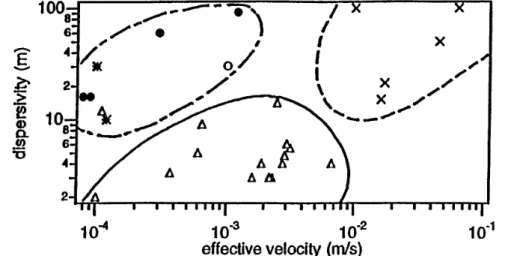
The problem of thé expérimental évaluation of dispersion effects (dispersivities) is also a common problem in hydrogeology (Gelhar et al, 1992). A higher heterogeneity in space (Jeannin and Maréchal, 1997) and in time (see chapter 3), as well as a possible non-linearity of karstic Systems, are undoubtedly thé cause of many difficulties encountered in this approach. Figure 2 illustrâtes that point.
10"3 10'
effective velocity (m/s)
Fig. 2. Variations of dispersivities estimated by tracer tests according to thé structure of thé aquifer (triangles = tests between boreholes in Cretaceous chalk, crosses = tests in natural flow in Carboniferous limestones, other symbols = tests involving boreholes in Carboniferous limestones).
It shows thé wide range of dispersivities which can be classifïed according to thé kind of connection between injection and restitution points. That is probably why a systemic approach (Rossier and Fisch, 1991, Meus and Kâss, 1992, Doerfliger, 1996) waD often preferred.
Due to thé complexity of karst flows as well as to technical limitations, until now
very few experiments were carried out in thé vadose zone (Guyot, 1985, Alexander et al,
1986, Kogovsek, 1997)) except through speleological networks,
Tracer tests may also be helpful when combined with other methods of identification of thé réservoir such as geophysics (Doerfliger, 1992) or morphostructural analysis (Bracq étal, 1996).
Nevertheless, thé principal application of tracer tests has always been to détermine régional flows in karst basins. Many publications in thé speleological or hydrological fîeld refer to this kind of investigation (Lepiller, 1976, Jeannin and Wacker, 1984, Maurin,
1988, Kâss, 1991, Meus, 1992, Hàusselmann and Otz, 1997).
3. RECENT IMPROVEMENTS AND APPLICATIONS
Technological, methodological or conceptual developments in tracing hâve recently given a new impulse to karst research. Several works are listed below but most of them hâve not yet been published.
From a technological and methodological point of view, we will note thé gréât interest for in situ continuous measurement of fluorescence (Smart and Zabo, 1977, Meus
et al., 1997). Barczewski and Marschall (1992) first developped a lightfîbre fluorometer
suitable for continuous measurement of fluorescence in boreholes, whose interest has been proved by différent applications of tracing (Barczewski et al, 1996). Since mat, two other apparatus without lightfîbre were developped by Schnegg either for measuring in boreholes (Schnegg and Kennedy, in press) -width of probe is only 74 mm- or for continuous measurement in surface flow (Schnegg and Doerfliger, 1997). If we except commercialized instruments (e.g.Turner Design or Data Link), several other compact fluorometers based on thé same objective of monitoring springs were also developped by différent authors. One example of application is given in thé next chapter.
Conceptually, thé need for continuous measurement came from thé fact that tracing in karst could not be treated as in stationary Systems any more. This problem was first dealed theoretically by Niemi (1977) while it was first experimented in karst Systems by Stanton and Smart (1981) who repeated tracer tests on a same System and more recently by Werner et al (in press) who interpreted a high discharge tracer test. Later Zuber (1986) improved thé theory and Dzikowski (1992 and 1995) proposed a simplified formulation that could be applied in tracer tests. The example in chapter 4 will also deal with this problem.
Another practical aspect is thé opportunity to use tracer tests to assess thé vulnerability (Doerfliger, 1996) or to set up protection zones around water supplies (Lallemand-Barrès and Roux, 1989, Compère and Biron, 1997, Ek et al, in press). This approach is now in complète adaptation because in karst areas thé results of tracer tests are often thé only concrète indications to design a protection scheme.
One step beyond considering thé interactions of thé tracer with thé aquifer is to consider also thé interactions with an eventual second fluid phase, for instance non
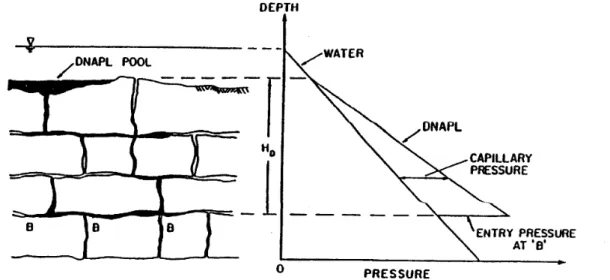
miscible organic pollutants. Karstic aquifers are indeed highly susceptible to this kind of pollution which is usually very difficult to localize and remediate. Figure 3 shows how deep thé pénétration of NAPL (non aqueous phase liquid) can be in fraotut-ed rocks depending on thé aperture of thé fissures. Tracers thaï are supposed to interact with an organic phase are called « parlitioning » tracers, a sort of intelligent tracer. Uranine was used in such an environment (Kâss and Schweisfurth, 1989) but generally compounds with higher retardation factors such as alcohols or surfactants are preferred.
OEPTH WATER ONAPL CAPILLARY PRESSURE PRESSURE
Fig. 3. Pénétration of NAPL in fractured rocks (after Kueper and McWhorter, 1991). Quantitative parameters which can be obtained are thé saturation of thé organic phase in thé aquifer or thé NAPL-water interfacial area (Jin et al, 1995, Aimable et al., 1998). Radon was also used as a natural tracer for characterization of diesel fuel contamination (Hunkeler et al, 1997).
4. EXAMPLE: CONTINUOUS TRACER TEST IN THE BAGET SYSTEM
The Baget is an expérimental karst basin situated on thé north flank of thé Pyrénées (Ariège, France). It was investigated since a long time by thé CNRS (Underground Laboratory of Moulis) and was used as a référence for conceptual models of karst aquifers (Bakalowicz et al., 1994). A continuons tracer test was performed between thé Peyrère cave and thé main outlet of thé System with thé objective to study thé variations of thé response of a tracer with changing hydrological conditions. A schematic représentation of thé tracing installation is shown on figure 4. One of thé compact fluorometers described in thé previous chapter was used for monitoring thé breakthrough curve of uranine each 10 minutes. The discharge as well as thé water table in thé cave were also monitored. The injection of thé tracer was executed from a 3 m3 tank through a membrane pump (50
ml/min) during about six months.
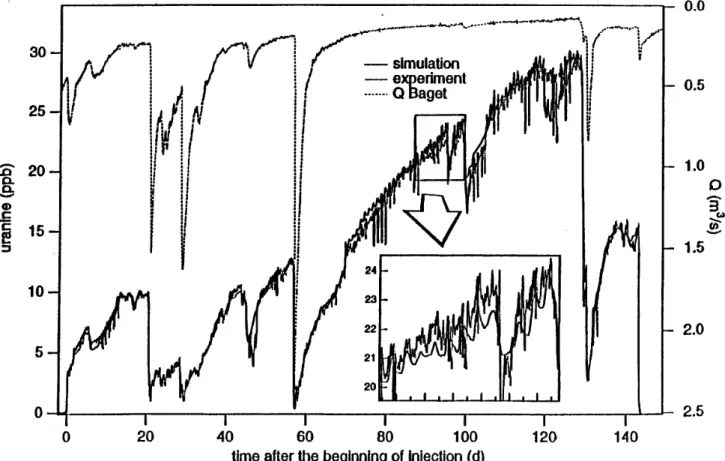
The breakthrough curve of uranine is shown on figure 5, with discharge on an inverse scale. A very good inverse corrélation between discharge and tracer concentration is évident, demonstrating that dilution is thé prédominant process in this case. The curve can be compared to thé curve computed by thé software CONVOX (Dzikowski and Delay, 1992). With a simple référence tracer test, this model can calculate thé breakthrough, whatever thé discharge and whatever thé injection, by using a convolution which takes into
account thé variation of thé impulse response. Until now, this model was only used for simulations of naturel tracers (Dzikowski et al., 1995). In thé présent simulation, each impulsion of thé artifîcial tracer takes place each half an hour.
Peyrere tracer test
température régulation ~" photomultiplier excitation source (diode) flow-through cell memory (16384 data RAM) uranine 3g/L tank Peyrèra cave externat battery membrane pump 50ml/mn) pressure régulation' (3 bar)
Baget spring (ait. 498 m)
\r table
gaugmg pump station
Fig. 4. Installation during thé continuons tracer test on thé Baget karst system.
30-
25-
20-<D simulation experiment Q Baget 15- 10-0.0 i- 0.5 L- 1.0 D I I I 40 60 80time after thé beginning of injection (d)
- 1.5
- 2.0
- 2.5
Fig. 5. Breakthrough curve of uranine at thé Baget spring compared with discharge and simulation with thé CONVOX model.
With thé model so "calibrated", it is also interesting to see what would hâve been thé possible variations of transport parameters between thé higher and thé lower discharge, if interpreted by classical analytical solutions. Two breakthrough curves for instantancous injections were thus computed again using CONVOX for both a maximum discharge of 10,9 mVs and a minimum discharge of 0,039 nWs.
Then they were adjusted using thé software TRACI for Windows (Werner et al, in press). The most adapted analytical solution in this case was thé SFDM (Single Fissure Dispersion Model). Surprisingly, both simulations gave nearly thé same values for dispersivities (5,5 m in thé first case against 5 m in thé second case) but thé parameter a Ça charateristic of matrix diffusion) is much higher for thé highest discharge (a = 0,18) than for thé lowest (a = 0,01). This could be a good validation of thé use of calculated dispersivities for simulations in karst aquifer. However this assumption has to be confirmed for other tracing Systems, not only those concerned by a dilution process along a drain but also those where reserves can cause a higher retardation effect.
CONCLUSIONS
During thé past twenty years thé tracing technique seems to hâve entered its quantitative era thanks to spectacular improvements in thé tracer technology as well as in thé methodology and thé mathematical interprétation. Nevertheless, karst remains essentially an heterogeneous and chaotic object which will never be completely put into équations. For this reason, in thé future, a priority will be given to those tracing methods which will investigate as fînely as possible thé différent parts of thé aquifer. But care must be taken to make thé good choice among thé growing number of parameters, in order to quantify correctly only those that will be effectively useful to predict thé behaviour of thé System. Otherwise, a lot of energy will be irremediably lost. Surely, future experiments in thé karst will also hâve to deal with thé behaviour of contemporary pollutants such as organics, metals or radioactive isotopes which were not so worrying in thé past.
REFERENCES
Alexander E., Davis M. and Dalgleish J, (1986): Dye tracing through thick unsaturated zones. Proceedings of
thé 5th International Symposium on Underground Water Tracing, Athens, 181-188.
Annable M.D., Jawitz J.W., Rao P.S.C., Dai O.P., Kim H. and Wood A.L. (1998): Field évaluation of interfacial and partitioning tracers for characterization of effective NAPL-water contact areas. Ground
Water, 36, 3: 495-502.
Aragno M. and Millier I. (1982): Premières expériences de traçages des eaux souterraines dans le karst du Jura neuchâtelois (Suisse) à l'aide de bactériophages. Bull. Centre d'Hydrogéologie, 4: 59-81.
Atkinson T.C. and Smart P.L. (1979): Traceurs artificiels en hydrogéologie. Bull, du B.R.G.M., 2ème série, section III, 3:365-380.
Bakalowicz M., Crochet P., D'Hulst D., Mangin A., Marsaud B., Ricard J. and Rouch R. (1994): High
discharge pumping in a vertical cave: fundamental and applied results. In: Basic and Appied Hydrogeological Research in French Karstic Areas, Cost 65 Action, Hydrogeological Aspects of
Groundwater Protection in Karstic Areas, European Commission, Crampon & Bakalowicz éd., 93-110. Barczewski B., Kass W., Schmid G. and Werner A. (1996): Neue Môglichkeiten und Anwendungen der Grundwassermarkierungstechnik. Wasserwirtschaft, 86: 20-24.
Barczewski B. and Marschall P. (1992): Development and application of a lightfibre fluorometer for tracer tests. Tracer Hydrology, Proceedings of thé 6th International Symposium on Water Tracing, Karlsruhc, Germany, Hôtzl & Werner éd., 33-39.
Barker J.A., Williams A.T. and Ward R.S. (1995): Groundwater tracer studies. Intérim Report 587/2JS British Geological Survey, 121 p.
Bôgli A. (1980): Karsthydrologyandphysicalspeleology. Springer-Verlag, 284 p.
Bracq P., Crampon N., Leboulanger Th., Hanich L., Maqsoud A. and Dzikowski M. (1996) : Traçage en milieu crayeux fracturé ou karstifié aux Andelys (Eure, France) : apports de l'analyse morphostructurale.
Hydrogéologie, 1: 15-24.
Charrière R. (1974): Perfectionnements à la mesure de traceurs fluorescents, applications à l'hydrogéologie, Thèse de Sème cycle, Université Scientifique et Médicale de Grenoble, 197 p.
Compère J.M. and Biron J.P. (1997): Protection des eaux souterraines en Région Wallonne. La détermination des zones de prévention. Tribune de l'eau, 585/1: 63-80.
Danckwerts P.V. (1953): Continuous flow Systems - Distribution of résidence time. Chemical Engineering
Science (Génie Chimique), 2, 1: 1-13.
Davis S.N., Thompson G.M., Bentley H.W. and Stiles G. (1980): Ground-water tracer* - a ek«rt ,«„;=„,_
GroundWater, 18, 1: 14-23.
Doerfliger N. (1992): Etude géophysique et multitraçage au bois de l'Halle (Jura Neuchâtelois, Suisse). Bull,
du Centre d'Hydrogéologie de Neuchâtel, 11: 17-29.
Doerfliger N. (1996): Advances in karst groundwater protection strategy using artificial tracer tests analysis
and multiattribute vulnerability mapping (EPlKmethod). PhD, University of Neuchâtel, 308 p.
Dzikowski M. (1992): L'analyse des systèmes-traçages à débit variable et volume constant. Possibilités
d'application en milieu karstique. Thèse, Université des Sciences et Techniques de Lille, 156 p.
Dzikowski M. (1995): Convolution à débit variable à partir de réponses de traçages artificiels dans les milieux poreux ou karstiques; théorie et modèle. Journal of Hydrology, 164: 287-303.
Dzikowski M. and Delay F. (1992): Simulation algorithm of time-dependent tracer test Systems in hydrogeology. Computers & Geosciences, 18, 6: 697-705.
Dzikowski M., Delay F., Sauty J.P., Crampon N. and de Marsily G. (1995): Convolution à débit variable à partir de réponses de traçages artificiels dans les milieux poreux ou karstiques; application à un système karstique (Causse de Gramat, Lot, France). Journal of Hydrology, 164: 305-324.
Ek C., Meus Ph. and Michel G. (in press): Le traçage: un outil contribuant à l'établissement des zones de surveillance des captages en terrain karstique. L'exemple de Hastière (Province de Namur). Bull. Soc. Géogr.
de Liège.
Gaspar E. and Oraseanu I. (1987): Natural and artificial tracers in thé study of thé hydrodynamics of karst.
Theoretical and applied karstology, 3: 32-107.
Gelhar L.W., Welty C. and Rehfeldt K.R. (1992): A critical review of data on field-scale dispersion in aquifers. Water Resources Research, 28, 7: 1955-1974.
Guizerix J. (1990): Tracer and Systems analysis. In: Guidebook on radioisotope tracers in industry, Technical reports séries n°316,1.A.E.A, Vienna, 39-60.
Guizerix J. and Margrita R. (1976): Méthodologie d'étude par traceur des transferts de masses. La Houille
Blanche, 3/4: 187-196.
Guizerix J., Margrita R., Gaillard B., Corompt P. and Alquier M. (1974): Analyses des informations fournies par les traceurs naturels ou artificiels dans l'étude des systèmes aquifères en hydrogéologie. Isotopes
Techniques in Groundwater Hydrology, Proc. Symp. Vienna, vol. 2, IAEA, 377-381.
Guizerix J., Margrita R. and Niemi A. (1990): Tracer methodology. In: Guidebook on Radioisotope Tracers
Guyot J.-L. (1985): Le karst superficiel: étude des écoulements hypodermiques sur un site expérimental, Corconne (Gard). Karstologia, 6: 15-20.
Hadi S. (1997): New hydrological tracers - synthesis and investigation. PhD, Univorsity of Frçibuig, 191 n Hausselmann Ph. and Otz M. (1997): Wasserfàrbung im Gebiet Gemmenalp - Sieben Hengste: Ziele und Resultate. Proceedings of thé 12th International Congress of Speleology, 6th Conférence on Limestone
Hydrology and Fissured Media, La Chaux-de-Fonds, Switzerland, 2, 31-34.
Hunkeler D., Hoehn E., Hôhener P. and Zeyer J. (1997): 222Rn as a partitioning tracer to detect diesel fuel
contamination in aquifers: laboratory study and field observations. Env. Science and Technolosv 3l 11:3180-3187. ' Jamier D. (1976): Interprétation des essais de traçage des eaux karstiques. Deuxième colloque d'hydrologie en pays calcaire. Ann. Scient. Université de Besançon, Géologie, Fasc.25, Sème série, 229-240.
Jeannin P. Y and Maréchal J.C. (1997): Dispersion and tailing of tracer plumes in a karstic System (Milandre, JU, Switzerland). Proceedings of thé 12th International Congress of Speleology, 6th Conférence on Limestone Hydrology and Fissured Media, La Chaux-de-Fonds, Switzerland, 2,149-152.
Jeannin P.Y. and Wacker C. (1984): Coloration à la baume de la Roguine. Un remarquable exemple de diffluence dans le Jura plissé. Cavernes (Neuchâtel), 1:3-11.
Jin M., Delshad M., Dwarakanath V., McKinney D.C., Pope G.A., Sepehrnoori K., Tilburg C.E. and Jackson R.E. (1995): Partitioning tracer test for détection, estimation, and remediation performance assessment of subsurface nonaqueous phase liquids. Water Resources Research, 31,5: 1201-1211.
Kass W. (1991): Entwicklung der karsthydrologischen Forschung in Deutschland - unter besonder Berucksichtigung der Marierungstechnik. Karst undHôhle, 1989/90: 131-149.
Kâss W. (1992): Geohydrologische Markierungstechnik, Lehrbuch der Hydrogeologie Band 9. Gebriider Borntraeger-Berlin-Stuttgart, 519p.
Kâss W. (1998): Tracing Technique in Geohydrology. Balkema, 581 p.
Kass W. and Hôtzl H. (1988): Fluorescent spores for karstwater tracing - Fluorescent microspheres as a further drifting tracer. Poster présentation, IAH 21st Congress, Guilin-China.
Kass W., Lôhnert E.P. and Werner A. (1996): Der jUngste Markierungsversuch im Karst von Paderborn (Nordhein-Westphalen). Grundwasser, Heft2, Band 1: 83-89.
Kass W. and Schweisfurth R. (1989): Beobachtungen beim Abbau von Mineralôlkohlenwasserstoffen bei Schadensfâllen. Steirische Beitrage zur Hydrogeologie, B.40: 93-102.
Kogovsek J. (1997): Water tracing tests in vadose zone. Tracer Hydrology 97, Proceedings of thé 7th international symposium on water tracing, Portoroz, Slovenia, 167-172.
Kueper B.H. and McWhorter D.B. (1991): The behavior of dense, nonaqueous phase liquids in fractured clay and rock. Ground Water, 29, 5: 716-728.
Laidlaw I.M.S. and Smart P.L. (1982): An évaluation of some orange fluorescent dyes. Beitrage zur
Géologie der Schweiz, Hydrologie, Bd. 28 I: 113-117.
Lallemand A. and Paloc H. (1964): La méthode de détection au charbon actif pour les opérations de traçage à la fluorescéine. Quelques exemples d'application. BRGMDS 64 A47, 1-15.
Lallemand-Barrès A. and Roux J.-C. (1989): Guide méthodologique d'établissement des périmètres de
protection des copiages d'eau souterraine destinée à la consommation humaine. Manuels et Méthodes
no. 19, Éditions du B.R.G.M., 218p.
Leibundgut Ch. and Wernli H.R. (1986): Naphtionate - another fluorescent dye. Proceedings of thé 5th
International Symposium on Underground Water Tracing, Athens, 167-177.
Lepiller M. (1976): Résultats et interprétation de cinq opérations de traçages effectuées sur les massifs karstiques du Semnoz et de la montagne de Bange - Bois de Prépoulain (massif subalpin des Bauges, Savoie et Haute-Savoie, France). Deuxième Colloque d'Hydrologie en Pays Calcaire, Ann. Se. de l'Université de Besançon, Géologie, fasc 25, 3ème série, 251-262.
Lepiller M. and Mondain P.-H. (1986): Les traçages artificiels en hydrogéologie karstique. Mise en oeuvre et interprétation. Hydrogéologie, 1: 33-52.
Maloszewski P., Benischke R., Harum T. and Zojer H. (1994): Estimation of soluté transport paramctcrs in heterogen groundwater System of a karstic aquifer using artificial tracer experiments Water Down UnJer
'94, Adélaïde, Australia, 105-111.
Maloszewski P. and Zuber A. (1985): On thé theory of tracer experiments in fissured rocks with a porous matrix. Journal ofHydrology, 79: 333-358.
Maloszewski P. and Zuber A. (1990): Mathematical modeling of tracer behavior in short term experiments in fissured rocks. Water Resources Research, 26,7: 1517-1528.
Mangin A., Molinari J. and Paloc H. (1976): Les traceurs en hydrogéologie karstique, leur apport à la connaissance des réservoirs aquifères calcaires. La Houille Blanche, 3/4: 261-266.
Maurin Y. (1988): Synoptique des opérations de traçage réalisées sur le Causse Méjean (Lozère) Spelunca 29: 24-28.
Meus Ph. (1992): Le drainage karstique des plis déversés du massif de Ger (Eaux-Bonnes, Pyrénées Atlantiques) à partir des résultats d'expériences de traçage. Cinquième Colloque d'Hydrologie en Pays
Calcaire et en Milieu Fissuré, Neuchâtel. Ann. Se. de l'Université de Besançon, Géologie - Mémoire Hors
Série, 11,35-42.
Meus Ph. (1993): Hydrogéologie d'un aquifère karstique dans les calcaires carbonifères (Néblon-Anthisnes,
Belgique). Apport des traçages à la connaissance des milieux fissurés et karstiques. Thèse de doctorat.
Université de Liège, 323 p.
Meus Ph. (1995): Quelques aspects de la mise en oeuvre et de l'interprétation des traçages artificiels utilisés
pour la protection des eaux souterraines karstiques. In: Atlas du Karst Wallon. Province de Hainaut (partie orientale). Commission Wallonne d'Etude et de Protection des Sites Souterrains, 37-46.
Meus Ph. (1997): Méthode d'évaluation de la vulnérabilité des aquifères karstiques utilisant le traçage en continu. La Géologie de l'Ingénieur et l'Eau, Colloque National CBGI, Leuven, 22/1-22/10.
Meus Ph. and Bakalowicz M. (1997): Les traçages artificiels, outils de reconnaissance et d'étude des aquifères karstiques. Hydrogéologie, 3: 43-50.
Meus Ph., Bakalowicz M., Kâss W., Barczewski B. and Schmid G. (1997): Perspectives offertes par la mesure en continu des traceurs fluorescents dans le karst. Proceedings ofthe 12th International Congress of
Speleology, 6th Conférence on Limestone Hydrology and Fissured Media, La Chaux-de-Fonds, Switzerland,
2,55.
Meus Ph. and Kâss W. (1992): Tracer tests in small karst Systems of thé Carboniferous limestones in Belgium. Tracer Hydrology, Proceedings of thé 6th international symposium on water tracing, Karlsruhe, Hôtzl & Werner éd., 271-275.
Meus Ph., Kâss W. and Mangin A. (1996): Tracer tests involving boreholes in karst aquifers: representativity and applications to groundwater protection. International Conférence on Karst-fractured aquifers,
Vulnerabîlity andSustainability, Katowice-Ustron, Poland, 128-140.
Moeschler P. (1982): Traçage des eaux souterraines dans le karst neuchâtelois à l'aide d'éléments aquatiques d'origine épigée. Bull. Centre d'Hydrogéologie, 4: 41-57
Molinari J. (1976): Perspectives offertes par l'utilisation rationnelle des traceurs naturels et artificiels en hydrologie karstique. Commentaires de nombreux exemples récents de multitraçages. Deuxième Colloque
d'Hydrologie en Pays Calcaire, Ann. Scient, de l'Université de Besançon, Géologie, fasc. 25, 3ème série,
275-306.
Muhr H., Leclerc J.P., David R., Bossoutrot J.M. and Garcia F. (1998): Le colorant U.V.: un traceur particulièrement bien adapté à la détermination de distributions de temps de séjour dans des réacteurs industriels de grande dimension. Traceurs et Méthodes de traçage, Récents progrès en génie des procédés,
Niemi A.J. (1977): Résidence time distributions of variable flow processes. Int. Journal of Applied Radiation
and Isotopes, 28: 855-860.
Parriaux A., Dubois J.-D. and Mandia Y. (1990): Persistance des traceurs fluorescents dans les nappes d'CuUA souterraines. Hydrogéologie, 3: 183-194.
Parriaux A., Liszkay M., Mûller I. and Délia Valle G. (1988): Guide pratique pour l'usage des traceurs
artificiels en hydrogéologie. Société Géologique Suisse, Groupe Suisse des Hydrogéologues, 51 p.
Rochat J., Alary J., Molinari J. and Charrière R. (1975): Séparations physicochimiques de colorants xanthéniques utilisés comme traceurs en hydrologie. Journal ofHydrology, 26:277-293.
ROSC P.E. and McPhCrSOn P.A. (in preSS): New fluorescent tracers for «se in geotUerrnnl réservoirs.
Rossier Y. and Fisch H. (1991): Modélisation du transport de matière par l'utilisation d'un modèle « boîte
noire ». Bull. Centre d'hydrogéologie de l'Université de Neuchâtel, 10: 63-72.Sabatini D. S. and Austin T. A. (1991): Characteristics of rhodamine WT and fluorescein as adsorbing ground-water tracers. Ground Water 29,3: 341-349.
Schaber J. (1993): Markierungversuche mit Fluoreszierenden Mikropartikeln. Diplomarbeit, Institut ftir Physische Géographie, Albert-Ludwigs-Uiversitât Freiburg i. Brsg., 107 p.
Schnegg P.A. and Doerfligcr N. (1997): An incxpcnsivc flow-througli flcid nuoromctci. rruutœumgs oj me
I2th International Congress ofSpeleology, 6th Conférence on Limestone Hydrology and Fissured Media, La
Chaux-de-Fonds, Switzerland, 2, 47-50.
Schnegg P.A. and Kennedy K. (in press): A new borehole fluorometer for double tracer tests. Mass transport
infractured aquifers and aquitards. Geoscience Center Copenhagen.
Smart C.C. and Zabo L. (1997): Some developments in fluorometric tracing of ground water. The
Engineering Geology and Hydrogeology of Karst Terranes, Proceedings of thé Sixth Multidisciplitiary
Conférence on Sinkholes and thé Engineering and Environmental Impacts of Karst, Springfield, Missouri, Beck & Stephenson éd., 213-224.
Smart P. L. and Laidlaw I. M. S. (1977): An évaluation of some fluorescent dyes for water tracing. Water
Resources Research, 13, 1: 15-33.
Stanton W. I. and Smart P. L. (1981): Repeated dye traces of underground streams in thé Mendip Hills, Somerset. Proc. Univ., Bristol Spelaeol. Soc. 16 (1): 47-58.
Toxikologische Bewertung von Tracern (1997): Human und ôkotoxikologische Bewertung von Markierungsmitteln in Gewâssern. Grundwasser, 2 (2): 61-64.
Van den Broeck E., Martel E.A. and Rahir E. (1910): Les cavernes et les rivières souterraines de la
Belgique. Bruxelles, 2 vol., 1586 p.
Werner A., Hôtzl H. and Kàss W. (in press): The interprétation of a high water tracer test in thé Danube-Aach System (Western Swabian Alb, Germany). Bull. d'Hydrogéologie 16, 6th Conférence on Limestone Hydrology and Fissured Aquifers : Modelling in karst Systems.
Wittwen R., Waser H. and Mathey B. (1971): Essai de fixation de la sulforhodamine B et de la sulforhodamine G extra sur charbon actif. Actes du 4ème Congrès suisse de Spéléologie, Neuchâtel, 78-83. Zuber A. (1986): On thé interprétation of tracer data in variable flow Systems. Journal of Hydrology, 86: 45-57.
Zuber A. and Motyka J. (1994): Matrix porosity as thé most important parameter of fissured rocks for soluté transport at large scales. Journal ofHydrology, 158: 19-46.