THE TROPICAL AGRICULTURE RESEARCH AND HIGHER EDUCATION CENTER (CATIE)
2001-2002
Panama City, Panama
IICA/JIA/Doc.278 (03) Original: Spanish 13 November 2003
Table of contents
1. INTRODUCTION...3
2. EXECUTIVE SUMMARY...3
3. ACHIEVEMENTS AND PROGRESS...5
UPPER MANAGEMENT...5
Governing Council ...5
Board of Directors...5
Office of the Director General...6
Administration and Finances...7
Strategic Planning ...12
External Cooperation ...14
4. PROGRESS AND ACHIEVEMENTS IN THE GENERATION AND TRANSFER OF KNOWLEDGE...15
EDUCATION PROGRAM FOR DEVELOPMENT AND CONSERVATION...15
RESEARCH PROGRAM...20
Line 1: Improvement and conservation of agricultural and forestry species germplasm...24
Line 2. Integrated pest management in agricultural agroforestry and forestry systems. ...25
Line 3. Tropical agroforestry systems on hillsides, agricultural frontiers and degraded lands ...26
Line 4. Development of technologies for sustainable forest and biodiversity management. ....29
Line 5. Socioeconomic analysis and evaluation of environmental policies goods and services from tropical ecosystems. ...31
OUTREACH PROGRAM...34
Internal management of the NTOs...36
Formulation and negotiation of proposals for technical assistance projects/activities...36
Implementation of development and research projects in the member countries ...37
Training ...40
Management and dissemination of technical/scientific information...41
5. CONCLUSIONS ...43
ACRONYMS ...44
ANNEX 1. GOVERNING AUTHORITIES ...47
ANNEX 2. CATIE´S TECHNICAL STAFF, DECEMBER 2002. ...48
ANNEX 3. PUBLICATIONS CATIE 2001 – 2002. ...50
Publications 2001 ...50
1. INTRODUCTION
The Tropical Agricultural Research and Higher Education Center is a civil non-profit institution created in 1973 through an agreement between the Inter-American Institute for Cooperation on Agriculture (IICA) and the Costa Rican government.
CATIE is a regional organization with a recognized history dedicated to research, education and the execution of development projects in agriculture, and natural resource management in tropical America. The Center’s headquarters is located in Turrialba, Costa Rica and it has the following regular members: Belize, Bolivia, Colombia, Costa Rica, El Salvador, Guatemala, Honduras, Mexico, Nicaragua, Panama, the Dominican Republic, Venezuela and the Inter-American Institute for Cooperation on Agriculture (IICA). In addition, CATIE has 7 subscriber members. As of December of 2002, these included: the Puerto Rican Department of Natural Resources, PALMAVEN (Venezuela), the Costa Rican Electricity Institute (ICE), American Cocoa Institute (ACRI) and the Municipality of Zamora (Ecuador), The State of Chiapas (Mexico), the National Forestry Commission (Mexico) and Spain as an Affiliated Member Country.
CATIE’s long term vision for its Region of mandate is that:
“The rural sector be consolidated as a key element in the process toward sustainable development, contributing to social equity and the improvement of the quality of life in Tropical America.”
To accomplish this, CATIE has organized its activities into two technical departments: “Agriculture and Agroforestry” and “Environment and Natural Resources.” Each of these departments comprises various theme groups which develop research, graduate-level instruction and outreach activities.
The institution is directed by the Inter-American Board of Agriculture (JIA) which has the role of Constituting Assembly; the Council of Ministers which is comprised of the Ministries of Agriculture of the CATIE Member Countries; and the Board of Directors that includes representatives from the private education, financial and scientific sectors. Their guidelines are applied by the Director General with the help of personnel who specialize in the different areas and themes that this international organization develops.
This report, in accordance with Article Nine of CATIE’s Constitutive Contract, presents the Center’s most relevant achievements during the biennial period from 2001-2002.
2. EXECUTIVE SUMMARY
This report summarizes the main activities and achievements of the Governing Bodies (the Board of Directors and the Council of Ministers) during 2001 and 2002, as well as the technical, administrative and financial management of the General Directorate as related to CATIE’s internal management and External Cooperation, the Strategic Planning Program, and the Research, Teaching and Outreach Programs.
During 2001 and 2002, CATIE’s governing bodies implemented important institutional changes in light of: i) recommendations suggested by the External Review conducted in 2001; ii) proposals made by CATIE managers and employees after intense participatory processes; and, iii) the proposed new strategic plan for 2003-2012 and consultations made in 2001 at different levels in CATIE member countries.
The Center made important progress in the implementation of a regionally networked research program, involving more than 50 regional research collaborating institutions in Tropical America. In addition, CATIE, in a joint effort made with IICA, is playing an important role in strengthening SICTA, the Central America Regional Board for research, and in FONTAGRO, a regional Latin American forum for the same purpose.
The execution of regional research and development programs that link research, development and policy analysis, aiming at achieving a balanced level of decentralization with strong links to core activities have been the focus of CATIE´s efforts in the member countries. Some example of those programs are FOCUENCAS, a watershed management program in Honduras and Nicaragua (with funding from SIDA); Environmental services in silvopastoral systems (GEF-WB) working in Colombia, Costa Rica and Nicaragua; Rehabilitation of degraded pastures (NORAD) working in Guatemala, Honduras and Nicaragua; and Organic Cacao (GEF-WB and OAS) working in Costa Rica and Bolivia respectively.
New research topics and reinforcement of some research and development areas have been introduced to complement and modernize CATIE´s research agenda. Some of those new lines of priorities are related to silvopastoral systems, environmental economics, competitiveness of eco-enterprises, organic agriculture, climate change, environmental policy and watershed management oriented towards reduction of risk and vulnerability.
The enrollment in the Masters Programs now stands at 130. Additionally 25 students are enrolled in the Doctoral Programs developed in partnership with the Universities from Idaho, Purdue, Wales and Luisiana State University (LSU). This represent a 25% increase in the enrollment of the Graduate School. During the period considered, important improvements in the administration as well as in strengthening the Alumni Association and in financial support to the Programs were made. In particular, CATIE and the University of Idaho were successful in a highly competitive program with the National Science Foundation of the United States in obtaining significant funding for scholarships.
The 2001 and 2002 were historic record years in terms of number of publication in scientific referred journals. This peak in scientific output was due, in particular, to the extraordinary effort of the agroforestry group.
CATIE´s offices in most of the countries have been strengthened, despite the fact that the allocation of core funding continued to be very limited. Innovative mechanisms to link CATIE´s Research and Development projects activities to additional technical assistance and training services to attend national demands were developed. The portfolio of projects and activities generated directly by the Technical Offices increased. Efforts put on planning, monitoring and evaluation of the National Offices led to a clear definition of these offices to technical activities as
well as positioning CATIE as a highly qualified institution linking the environment with development.
3. ACHIEVEMENTS AND PROGRESS Upper Management
Governing Council
During 2001 and 2002, CATIE’s Governing Council held two regular meetings and one extraordinary one. The following were the main products of these meetings:
• An analysis of the institutional situation of the Strategic Planning and Financial Programs • An analysis of the proposed new Strategic Plan for 2003-2012
• An analysis of the Research, Education and Outreach Programs
• Ratification of the Center’s budget for 2001 and 2002 approved by the Board of Directors • Admission of the Costa Rican Electricity Institute (ICE), PALMAVEN (Venezuela), American
Cocoa Institute (ACRI) and the Municipality of Zamora (Ecuador) as Affiliated Member Institutions and Spain as an Affiliated Member Country
• Support of IICA’s new Director General, Dr. Chelston W.D. Brathwaite
• Insistence that CATIE plan a joint meeting with the Ministers of Agriculture and the Environment
• Ratification of CATIE’s elected Board of Directors Board of Directors
During 2001 and 2002, CATIE’s Board of Directors and its committees met on four occasions, with the purpose of analyzing the different activities of the three major institutional programs. The main results generated at these meetings are listed below:
• Regular membership of Bolivia.
• Approval of the affiliated membership to CATIE of the Costa Rican Electricity Institute (ICE), PALMAVEN (of Venezuela), American Cocoa Institute (ACRI), the Municipality of Zamora (Ecuador), the Mexican State of Chiapas and the National Forest Commission of Mexico (CONAFOR) as Affiliated Member Institutions (jointly with the Governing Council).
• Approval of the 2001 and 2002 Budget Programs, submitted afterwards to the Governing Council for ratification.
• Strong encouragement that the member countries of CATIE become current with their membership fees.
• Approval of the following By–laws: Affiliated Members, Election of Board members, Consultancies, Institutional Awards, and Election or Re-election of CATIE’s Director General.
• Suggestions and support for the elaboration of the new Strategic Plan.
• Support and suggestions for the elaboration of the CATIE-IICA Cooperation Agreement. • Approval of CATIE’s new institutional structure.
• Authorization for the Director General to sign agreements with NORAD, the World Bank and the Inter-American Development Bank for projects exceeding US$500,000.
Office of the Director General
Strategic Leadership. The elaboration of the new Strategic Plan 2003 – 2012 was concluded and
the document was presented to the Board of Directors and Council of Ministers during the 2002 meetings. A Medium Term Plan was written and distributed to the Board and all the staff of CATIE. The elaboration of the new Plan was based on an extensive analysis of regional demands and consultations at country level.
During 2001, an independent external evaluation for the period 1996-2000 took place. In addition, specific Nordic consultancies completed the institutional and financial analysis of CATIE, in order to adjust its strategies and structure. Some of the most important recommendations referred to:
• The institutional structure, definition of core, fund raising and outsourcing: in particular the External review recommended that the structure should be revised, simplified and made more effective.
• The policy to incorporate affiliated member organizations and other countries of the Americas as full members
• The conformation of a consortium for agricultural and natural resources R&D between IICA and CATIE as equal partners
• Efforts to introduce a more open and participatory management system
• Modernization of graduate courses’ modalities, including the following elements: development of joint (graduate) programs through strategic alliances with universities
• Strategic adjustments in the research priorities: in particular engaging and strengthening the following thematic areas: tropical fruit trees and integrated livestock management. A specific recommendation also refers to the need for strengthening conservation, improvement and management of genetic resources.
During the 2001 – 2002 period, efforts were made to implement substantial changes, mostly based on the External Review recommendations. Some of them are:
• A new management and team building was introduced. Discussion groups made recommendations to the DG to redefine the Center´s structure, fund raising as well as outsourcing strategy.
• A strategic Directorate was created and additional responsibilities related to Outreach were assigned to this Directorate. A new Directorate of regional Technical Services was created in 2002. This Office is considered as CATIE´s main instrument to participate in bids and tenders at a regional level, a function of importance because of CATIE’s increasing dependence on funding that originates in multilateral agencies.
• CATIE´s Council of Ministers has been strengthened: in particular, an initiative to include the Ministers of Environment was approved; also, joint meetings of CCAD (Ministers of Environment of Central America) and CAC (Ministers of Agriculture of Central America) are being planned.
• Improvement of relations between IICA and CATIE: a concept paper analyzing the opportunities for joint cooperation between the two institutions, and efforts at a national level to define a joint agenda and working plans were developed. The objective is to build a joint future of cooperation and mutual understanding. In fact a very positive partnership has been developed toward strengthening SICTA, as well as increasing CATIE´s involvement in FORAGRO.
• The portfolio of membership has been enlarged. Outstanding progress was experienced . Bolivia and Paraguay are part of the group of Regular Member countries. Spain became a new affiliated member; this is an important result as cooperation between Spain and CATIE´s member countries can be improved in the area of science and technology as well as in the area of high education and outreach activities.
Membership. Bolivia joined CATIE as a new regular member, and Spain and CONAFOR-México
were accepted as a new affiliated members. Switzerland was invited to join CATIE as an affiliated member taking into account previous contributions to the Center’s endowment funds.
Administration and Finances
CATIE has areas and units responsible for offering logistical, administrative and financial services to support CATIE’s activities. These areas and units can be classified into three types: those dedicated to the administration of human and financial resources; those in charge of generating resources to support the core budget; and those dedicated to supporting logistics and infrastructure.
Administration of Human and Financial Resources
Productive Activities Logistical/Legal Support and Infrastructure
• Accounting and Finances Area
• Human Resources Area
• Farms • Housing • Transport • General Services • Computer Center • Maintenance • Legal Advice
Finances. CATIE’s activities are financed through five funds managed separately according to origin and application of resources.
• Core Fund: Is funded by the member countries’ annual membership dues (13 countries in 2001 and 2002, US$ 50.000/country); the regular contribution from IICA (US$1.000.000/year); and incomes from teaching activities; sale of goods and services (project overhead, journals, books, and income from productive activities); and core fund contributions from the honorable governments of Sweden, Denmark, Norway and Finland (See Table 1).
• Productive Activities Fund: This fund is made-up of the income earned from agricultural, and animal husbandry activities and infrastructure (housing and vehicles), that provide income for the core budget and cover operational costs. These provided US$352.606 and US$246.405 net funds to the core budget in 2001 and 2002 respectively.
• Managed Funds: These are small funds managed by CATIE to support research and graduate scholarships. These are managed independently since they require greater accounting agility and transparency. These funds are classified under the headings “education”, “institutional” and “specific” (see Table 2).
• Project and Agreement Funds: These are restricted funds that have specific conditions defined and established by signed agreements and projects. During 2001, US$ 9.366.842 corresponding to 69 projects, was managed in this fund. During 2002, US$ 7.680.559 corresponding to 81 projects was managed.
• Institutional Funds: This is an accounting register that allows the administration to control and record institutional assets.
Table 1. Specific contributions to the core fund. 2001 2002 IICA 1.000.000 1.000.000 Norway 400.000 300.000 Sweden 1.202.648 976.342 Finland 313.713 144.569 Denmark 200.283 106.451 TOTAL US$ 3.116.644 2.527.362
Table 2. Distribution of managed funds.
2001 2002
Education 904.496 854.874 Institutional 113.501 231.369 Specifics 1.362.437 1.742.783 TOTAL US $ 380.434 2.829.026
CATIE is audited annually by an internationally-recognized, prestigious external auditing firm. This firm is chosen by the Inter-American Board of Agriculture (JIA) through an external bidding process to audit the financial statements of both CATIE and IICA. In addition, CATIE’s agreements and special projects are audited periodically by other external firms contracted by the donors.
In addition, CATIE has an Internal Auditing Department which reports directly to the CATIE Board of Directors, and which reviews the institution’s management of funds, project expenditures, institutional accounts and control procedures.
Tables 3 and 4 present CATIE’s financial statements for 2001 and 2002 as indicated in the auditing statements for those years.
Table 3 shows the balance of funds for the years indicated. It can be seen that there was a significant increase in assets, mainly through investments in buildings, laboratory equipment, and from growth in CATIE’s support to the trust fund for the Cátedra Latinoamericana de Bosques. These are important investments that CATIE has made to strengthen and support the Center’s research and educational activities and create trusts that ensure CATIE’s sustainability. The increase in cash corresponds mainly to resources from new agreements and contracts.
Table 3. Assets, liabilities and combined fund balance for 2001 and 2002 ($US)
2001 2002 ASSETS
Circulating Assets:
Cash 3.880.610,00 4.914.586,00
Negotiable bonds 251.837,00 70.423,00
Accounts and Invoices
CATIE Partners 1.413.989,35 1.754.152,44
Other parties 2.076.867,65 1.815.187,56
Total accounts to be charged 3.490.857,00 3.569.340,00
Inventory 180.765,00 203.925,00
Total circulating assets 7.804.069,00 8.758.274,00 Buildings, machinery and equipment 3.395.024,00 6.307.338,00
Other assets 18.404,00 296.826,00
Funds in trust 450.000,00 600.000,00
TOTAL ASSETS 11.667.497,00 15.962.438,00
LIABILITIES AND FUND BALANCE Circulating liabilities:
Accounts payable and accumulated expenditures 1.520.052,00 1.707.289,00
Managed funds 1.192.992,00 1.529.127,00
Donors - agreements and contracts 2.294.630,00 2.728.694,00 Differed Income and other Liabilities 177.057,00 417.519,00 Total circulating liabilities 5.184.731,00 6.382.629,00 TOTAL LIABILITIES
FUNDS BALANCE 6.482.766,00 9.579.809,00
Regarding Table 4, it is important to indicate that at the close of the 2001 fiscal year there was a deficit of US$261,488 owing to the fact that less income was generated than had been predicted. In addition, there was a loss precipitated by the currency exchange difference caused by the devaluation of the Swiss crown with respect to the US dollar.
To prevent this type of situation from reoccurring, a more conservative budget was calculated for 2002 and the income and expenditure budgets were monitored more closely. Consequently, there was a surplus at the end of the 2002 fiscal year.
Budget Distribution. Table 5 presents an overview of the distribution of expenditures organized under the most important headings in which the funds were invested.
Table 4. Balance of Income and Expenditures of the Core Project Budget for 2001 and 2002 2001 2002 INCOME
PARTNERS’ DUES 1.678.123,00 1.650.000,00
Technical Support Services 220.510,00 228.045,00
Donor Activities 652.683,00 718.886,00
Productive Activities 1.906.994,00 1.358.941,00
Administrative and Logistical Support 756.749,00 516.235,00
Exchange rate difference - 149.214,14 2.618,70
Other income 198.226,14 51.601,30
Donations and Specific Contributions 2.531.480,00 1.831.740,00
Subtotal 7.795.551,00 6.358.067,00
Income from Agreement and Contract Funds 9.366.842,00 7.680.559,00
Income from Managed Funds 2.380.434,00 2.829.026,00
TOTAL INCOME 19.542.827,00 16.867.652,00
EXPENDITURES
General Directorate and Governing Bodies 643.281,00 748.112,00
Administration and Services 983.582,00 1.231.678,00
Technical Programs 4.624.763,00 3.143.404,00
Productive Activities 1.805.413,00 1.110.580,00
Subtotal 8.057.039,00 6.233.774,00
Expenditures from Agreement and Contract Funds 9.366.842,00 7.680.559,00 Expenditures from Agreement and Contract Funds 2.380.434,00 2.829.026,00
TOTAL EXPENDITURES 19.804.315,00 16.743.359,00
Surplus of Income over Expenditures ( 261.488,00) 124.293,00
Table 5. Budget distribution for 2001 and 2002
DEPARTAMENT 2001 % 2002 %
Governing Bodies 497.614 3 535.861 3
Support Programs (STR(1) and Internal
Auditing) 310.588 2 212.249 1
Administration and Finances (2) 960.161 5 1.231.678 7
Technical Programs 2.320.717 12 2.139.791 13
Regional Outreach and Strategic Planning (3) 1.859.748 9 497.606 3
Education Program (4) 444.300 2 506.009 3
Productive Activities 1.663.913 8 1.110.580 7
Projects 9.366.842 47 7.680.559 46
Managed Funds 2.380.434 12 2.829.026 17
TOTALS 19.804.317 100 16.743.359 100
(1) Technical Regional Services (SRT)
(2) In 2002 it was transferred to the Computer Center under the Administration and Finances Department
(3) In 2002 some offices were reclassified that had been included under the supervisión of this Department. The institutional development project (SIMO) and the Monitoring and Evaluation project financed by DANIDA ended. Affiliate members were moved to the project heading. The Planning Departments and the Technical Offices remained in the countries.
(4) It is important to underscore that the amount indicated here corresponds basically to the costs of administration and management of the Graduate School. That corresponding to professors is distributed among the Technical Programs and Projects headings.
Strategic Planning
During 2001-2002, and for the first time in CATIE’s history, efforts were directed towards elaborating a complete set of planning tools including:
9 The Strategic Plan for the period 2003-2012, based on an analysis of regional tendencies and demands, which included consultation with more than 700 persons and a number of stakeholders in CATIE's member countries and abroad (from the governmental sector and civil society).
9 an institutional Medium-Term Plan, which is expected to be refined during 2003; as well as medium-term plans for the Departments. Formal working sessions were carried out with technical areas and with high level committees.
9 logical frameworks with monitoring plans for several units and new R&D projects negotiated recently.
Didactic materials for PM&E have been elaborated based on systematization of case studies (mainly CATIE’s projects). Also a graduate course in Planning, Monitoring and Evaluation of conservation and development projects was taught.
In 2001 the Human Resources Area was assigned to the Planning Department and in 2002 it was transferred to the Administration and Finance Department. In addition, the responsibility of the National Technical Offices and the Training Area was assigned to the Strategic Planning Department which was renamed the Regional Outreach and Planning Department. Nevertheless, for reasons of clarity, the achievements of the Strategic Planning Department and the Regional Outreach departments are presented separately and in detail below.
Two projects key to CATIE’s institutional strengthening process ended in 2002: “Monitoring and Evaluation” and “SIMO”. Both were financed by the Danish Cooperation Agency. The Planning Department has continued its planning process strengthening activities, though at a lower level of intensity.
During 2001-2002, and for the first time in CATIE’s history, efforts were directed towards elaborating a complete set of planning tools including:
9 The Strategic Plan for the period 2003-2012, based on an analysis of regional tendencies and demands, which included consultation with more than 700 persons and a number of stakeholders in CATIE's member countries and abroad (from the governmental sector and civil society).
9 an institutional Medium-Term Plan, which is expected to be refined during 2003; as well as medium-term plans for the Departments. Formal working sessions were carried out with technical areas and with high level committees.
9 logical frameworks with monitoring plans for several units and new R&D projects were negotiated recently.
Didactic materials for PM&E have been elaborated based on systematization of case studies (mainly CATIE’s projects). Also a graduate course in Planning, Monitoring and Evaluation of conservation and development projects was taught.
Products. Following its work thrusts, the Regional Outreach and Strategic Planning Department produced the following products:
(a) Planning policies and methodologies
• Published and distributed a PME policy document approved by the CATIE Board of Directors
• Medium-Term Standard Plans made public
• Trainers and facilitators from CATIE’s operative entities (technicians from CATIE and their counterparts) were given training in the use of logical frameworks and M&E tools.
(b) Strategic planning process
• Draft of CATIE’s 2003-2012 Strategic Plan
• Demand Analyses to more than 700 participants from the CATIE member countries particularly in the different sectors (public, private, NGO’s and Academic); analysis of the priorities of CATIE’s technicians, researchers, and administrative personnel, donors and other CATIE partners.
(c) Medium and short-term planning
• Medium-term plans for the different Technical Areas in the Training Area and the National Technical Offices
• Support to the new project and Unit planning Training to agroforestry network members (Nicaragua, Honduras, Guatemala and El Salvador) and projects executed by CATIE partners (in particular Nicaragua and Guatemala)
• Technical assistance and follow-up to CATIE operative entities
(d) Monitoring and Evaluation of performance and impact
• M&E system for small projects (PROFOR and IPM and FOCUENCAS) • M&E system for promising initiatives (ProManejo, Brazil)
• Publication of M&E results PROSEFOR
• Creation and dissemination of didactic materials for training and graduate courses in planning, monitoring and evaluation
(e) Human Resources policy and management
• Creation and adjustment of Human Resources management tools (Human Resources procedures manual, adjustments to the Regulations for International Professional Personnel and the Regulations for outside consultants approved
(f) Support to other CATIE entities
In addition to the support given to the Research and Teaching programs in the region (FORAGRO, SICTA, Universities, etc.) the administration supported the General Directorate in the following areas:
• Revised, published and distributed an Institutional Development Plan
• Proposal for tightening the CATIE structure; leadership of the ad-hoc group and presentation of recommendations to the Director General
• External evaluation of CATIE and technical assistance missions in administration and finances to CATIE: support to the missions; synthesis, dissemination and facilitation to discuss the recommendations
• Helped design CATIE science week • Helped prepare and define budgets External Cooperation
Donations from more than 44 organizations were received which represented approximately US$18.039.486 (See Table 6).
Table 6. Contributions to CATIE’s research and educational activities for 2001 and 2002 (US $). country / institution 2001 2002 Bolivia (FORCIAT) 9.030 Brazil (Sunny) 27.090 Denmark (DANIDA) 178.204 1.063.682
Dominican Republic (Plan Sierra) 9.030 7.700
Ecuador (PROMSA) 7.700
-France (CIRAD-INCO-IRD, INIBAP) 405.446 203.603
Germany (GTZ, DDA KFW) 419.982 776.482
Guatemala (MAGA-AID) 36.120
Honduras (PNUD/PAAR) 297.013 498.630
Japan (ITTO) 9.030
Nicaragua (PROFOR, INTA Y POSAF) 7.700 104.727
Costa Rica (ICAFE, LA PACIFICA, Río Lajas) 108.746 44.648 The Netherlands (Fundecooperation, CIPAV) 100.891 38.179
Norway (NORAD) 1.867.642 2.341.919
FUNDATROPICOS 239.943 271.002
México Nayarit State, FIDA, CONACYT 52.120 115.034
Panama (IDIAP) 82.320 30.800
Sweden (SIDA) 1.587.135 1.515.861
Switzerland (COSUDE) 620.859 638.974
United Kingdom (NRI,OXFORD,CABI) 133.411 101.318
Belgium (CASFOR) 83.058 8.191
United States of America (USAID, USDA, OAS) 265.120 703.447
Venezuela (FUNDAYACUCHO) - 9.030
Other institutions (CIFOR, WWF, IPGRI, CIAT, IDB ACRI, WB,
etc.) 1.726.209 1.292.460
Total 8.192.529,93 9.846.957
Source: Audited financial statements. These figures do not include contributions to the Center’s core budget.
4. PROGRESS AND ACHIEVEMENTS IN THE GENERATION AND TRANSFER OF KNOWLEDGE
Education Program for Development and Conservation
The CATIE Graduate School has offered coursework leading to a Master’s degree since 1942 and Doctoral-level coursework since 1996, in fields related to agriculture and the conservation and sustainable management of natural resources. The school’s objective is to create professionals who are committed to sustainable development and possessing of the knowledge and skills necessary to effectively and efficiently perform their roles as agents of change for the productive use and conservation of natural resources and the protection of the environment. The institution offers two options for study: master (two years), and doctorate (three years). The main achievements during this period have been:
The masters program. In 2001 the admissions procedure was changed in order to facilitate the paperwork while maintaining the same high standards. This procedure was based on the analysis of the candidates’ academic performance and CV, as well as exams in English and the candidates’ field of interest. In 2002, the academic council agreed on a series of changes to be implemented in 2003, to adapt the program to the current educational needs in the region; such as improving the efficiency of resource use at the graduate school. Some of the changes are: the transition to a modular course structure (some courses offered in 6-week modules); to offer some courses in English; to update the content of several courses; and the development of new interdisciplinary courses.
The Doctoral (PhD) Program. The PhD program at CATIE continues improving. Under the program, we now have students under the joint programs between CATIE and the universities of Wales (UK) and Idaho (US). Discussions about joint Ph.D. programs and joint research between CATIE and Purdue University and the University of Minnesota have been held. Students come not only from countries that have traditionally fed into CATIE but also from the USA, United Kingdom, Japan, and Surinam, creating a truly international environment.
Under the National Science Foundation program called IGERT, CATIE continued to have (fully funded) student growth involving up to 15 additional doctoral students under this program alone over a three year period. The program operates under the joint doctoral program with University of Idaho.
The graduate Council adopted a publication policy for all doctoral research which, among others, requires publication in international professional journals.
The graduate Council adopted a publication policy for all doctoral research which, among others, requires publication in international professional journals.
Scholarship/loan program for CATIE graduate students. In follow-up to the Board of Director’s resolution in 2001, a scholarship/loan program was put in operation. The fund is designed to complement the students’ budget and specifically cover the costs of courses and related expenses. This will allow for a rotating fund that will make it possible to support other students in the medium term. Sixty-three scholarships of this type have already been awarded. Other funding sources During the report period, the graduate school received financial support from several national and international agencies including: OAS, IDB, World Bank, Ford Foundation ASDI (through the Cuencas and Focuencas project), Danida, NORAD, GTZ, JICA, AID, USDA, DAAD (Germany), CONACYT (Mexico), FundAyacucho (Venezuela), CORPOICA (Colombia), FONACIT (Venezuela), IDIAP (Panama), Fundatropics, Avina Foundation, and the British Embassy. Their support confirms the importance of creating human capital in sustainable agricultural development and natural resource and the environmental management.
Cooperation with Regional Institutions: CATIE in cooperation with ANAM, is teaching a joint program with the University of Panama involving 19 students of ANAM. The four modules in this program are divided equally between the University of Panama and CATIE. Graduate credits are to be given to students by both the University of Panama and CATIE in accordance with current policies and regulations of each institution. Also, in partnership with EARTH and
develop, in a participative way, a project proposal to strengthen institutions of higher learning in Honduras and Nicaragua.
Research-Graduate Education Integration. It is now more than ever clear that graduate students carry the bulk of the research being carried out at CATIE. At the end of 2002, there where 56 projects completed in a number of countries in our region. In addition to Masters students, the doctoral students will be contributing to the completion of research at a higher level.
General Improvements continued: CATIE continued to make many smaller but important improvements designed to bring the operations to international standards. For example, the new web site, in both Spanish and English, is now available on line. The site permits on-line filing of applications and provides up to date information. In addition, the listing of our courses, forms required by the graduate school, etc. are now all available on line for use by our current students. The Program continues to enhance the bilingual capabilities of the School by providing opportunities to staff who need enhancement of their language skills. In addition, the English program at CATIE continues to expand and adjust services for TOEFL preparation, more effective scientific presentation (in English), etc. We continue to enhance efficiently by combining the office of Admissions with the Office of Alumni Affairs thereby reducing staff. Alumni Association. During this period the rules for an Alumni Federation were developed. More than 1,700 names have been listed. The first alumni reunion is planned for 2003.
Students
Masters Program. In the 2001-2002 period 119 students were graduated, there come from 19 countries in the Americas and from Japan. There was about 20% growth in the number of students in this program compared to 2000. In 2002 70 students were admitted for the 2003-2004 academic year. Tables 7 and 8 show the distribution of the masters students according to field and country of origin.
Table 7. Classification of the masters students according to emphasis. class
2000-01 2001 – 02 2002 - 03
I Ecological Agriculture 9 14 12
Phytogenetic and Biotecnology Resources 7 11
Sustainable Tropical Agriculture 2 3
II Tropical Agroforestry 11 13 11
III Watershed Management 11 14 16
IV Management and Conservation of Tropical Forests and Biodiversity
13 10 19
Forestry Production Systems Management 5 6
Biodiversity Conservation 8 4
V Environmental Socioeconomics 14 10 11
Administration and Management 13 9
Environmental Economics and Sociology 1 1
Doctoral Program. In 2002 x students graduated from the Doctoral Program which is a joint program with several North American and European universities. At the end of 2002, the program had 21 students from 13 countries. See tables Z and V for a detailed breakdown.
Table 8. Masters students by country (2000-2002). country 00-01 01-02 02-03 Argentina 1 0 0 Belize 1 0 0 Bolivia 1 2 3 Brazil 9 1 1 Colombia 3 7 10 Costa Rica 7 5 8 Ecuador 1 4 7 El Salvador 4 1 2 Guatemala 7 4 5 Haiti 0 1 0 Honduras 6 8 4 Japan 0 0 1 México 5 3 2 Nicaragua 4 12 12 Panama 1 8 8 Paraguay 1 0 0 Peru 0 2 5 Dominican Republic 1 2 1 Venezuela 3 1 0 Total 55 61 69
Table 9. Country of origin of doctoral students, as of December, 2002 Country of origin students
Bolivia 1 Colombia 1 Dominican Republic 1 El Salvador 1 Guatemala 1 Honduras 1 Japan 1 México 5 Panama 1 Paraguay 1 Suriname 1 USA 3 Venezuela 3 Total 21
Table 10. Distribution of doctoral students by field and cooperating institution, as of December 2002.
Area of Study/Topic Universit
y of Idaho Universit y of Florida Purdue Universit y U Wales Luisiana State U Total Biodiversity 1 1 Ecological Agriculture 2 1 3 Entomology 1 1 Environmental and Rural Development 1 1 GIS 1 1 Sociology and Environmental Economics 1 1
Tropical Forest Science 1 1
Tropical Agroforestry 1 1 1 7 1 11
Tropical Forest Sciences 1 1
TOTAL 8 3 2 7 1 21
Research Program
This program has two purposes: i) to generate knowledge about the biophysical, ecological and socioeconomic processes for different production systems and their components; ii) to generate integrated technologies, and sustainable agriculture and natural resource management systems; and iii) to produce information, scenarios and options for development based on agricultural and natural resource management at various levels (germplasm, production systems, ecosystems). Management issues. CATIE´s Scientific Committee consists of eight members: Deputy Director General (President), Director General, Director of the Education Program, and five coordinators of the research lines.
During 2001, each coordinator, together with the researchers in the respective research line, updated the research activities into sub-lines and research projects. These research projects (on-going and planned) form the basic unit for research at CATIE. During 2002 the most important point analyzed was the allocation of research grants (CATIE’s Research Fund) to collaborative projects and future research strategies. Other importan activities of the Scientific Committee during 2001, were the organization of the V Science Week in August 2001 and the preparation of comments to the External Review Report.
Following the new structure initiated on January 2002, the majority of research, education and outreach activities are being carried out by the four new Departments. In addition, CATIE's laboratories, collections and some research/education support units are grouped under the UTA (Technical Support Unit). Theme groups are being created under the Departments. The idea is to replace a rather cumbersome structure with small, flexible administrative “units” consisting of a number of theme, interdisciplinary (and also interdepartmental) theme groups.
The 2001 and 2002 were record years in terms of number of publications in refereed journals, where historic maximum numbers of publications were attained.
Fund raising. Finnish support to the core budget for research was secured for the 2002-2003 period. The amount of support negotiated was approximately 400,000 USD. Part of this support is directed to small research projects selected after a call for proposals, and involving national institutions. These small research projects are carried out jointly with partners in the region. To date, 16 small projects have been executed or are currently on-going. They involve a total of 37 different partners in 9 member countries (approximately 120,000 USD/year). During 2002, from 24 proposals submitted, the Scientific Committee decided to fund 8 projects. Important R&D programs were negotiated. GEF-WB financed a proposal (5 MM USD) for the study of environmental services of silvopastoral systems to be jointly executed with NITLAPAN (Nicaragua) and CIPAV (Colombia). Also NORAD financed an R&D proposal that will address the recovery of degraded pastures. Work will be done in Nicaragua, Honduras and Guatemala. A joint IPGRI-CATIE proposal was presented to Bioseed, a Dutch seed company, for the molecular characterization of CATIE’s collections of Capsicum and tomatoes. A concept note to analyze the application of environmental policies on the agricultural frontier was presented to Tinker Foundation and received positive reactions. A full proposal is now being developed. SDC(COSUDE) and FINNIDA are interested in financing climate change research.
In 2002, CATIE was a partner in 13 on-going INCO-DC and 6 FONTAGRO funded research projects (total funding to CATIE: app. 1 million USD). All of them are carried out in cooperation with partners in the region, and in the case in INCO-DC, with partners from Europe.
New initiatives, new collaboration. CATIE-CIAT created a strategic alliance in research and higher education. This includes joint research and other projects, the participation of CIAT scientists in CATIE’s Ph.D. and M.Sc. programs etc. USDA has agreed to support CATIE’s research activities and conservation of genetic resources. Cooperation with Mexico and Venezuela in research has been promoted through various visits of CATIE staff to Mexico and Venezuela. Cooperation agreements with the CONACYT (Mexico) and Fundación Ayacucho and CONICIT (Venezuela) are prepared. CATIE staff, together with the Swedish Biodiversity Center and the Swedish Agricultural Agency prepared a proposal on a joint project and a joint masters program on biodiversity issues.
Scientific and technical congresses and workshops.
The Fifth Scientific Week (Semana Científica) was held August 22-24, 2001, with co-funding
from the USDA. It consisted of four fora (i. Sostenibilidad en el medio rural y certificación, ii. Conservación y utilización de la biodiversidad tropical, iii. Vulnerabilidad humana en Centroamérica, and iv. Manejo adaptativo y participativo de recursos naturales). Four invited speakers were invited: Dr. Albert Schram (Universidad de Costa Rica), Dr. D. Williams (IPGRI, Colombia), Dr. P. Girot (IUCN, Costa Rica), and Dr. M. Altieri (University of California – Berkeley, USA). A research-planning workshop was organized during the week.
In November 2001, CATIE hosted a meeting of SICTA in which the Directors of the National Research Centers from Central America participated. CATIE and IICA in a joint effort, organized the meeting to support the strengthening of this key regional integration organization. One of the topics discussed related to research and development priorities in the Region.
Through an agreement between CATIE and the United States Department of Agriculture, Agricultural Research Service (USDA-ARS) the Henry A. Wallace Inter-American Scientific
Conference Series was founded in November, 2000. The inaugural conference titled
“Globalization of Agriculture”, was held February 25 – 27, 2002, in Turrialba, Costa Rica, and attracted 120 participants from 17 countries. The aim of the conference was to encourage and enhance mutual interests in the Latin American and Caribbean region through information exchange on issues relating to tropical agriculture research and development activities. It was also an opportunity for CATIE to markedly enhance its contributions to research and higher education in the region. Speakers and participants discussed research priorities, globalization of agriculture in the American tropics and developed joint strategies. Summaries of these discussions were distributed as Conference Proceedings and were made available to all participants. The conference was also privileged to have Nobel Peace Prize Winner, Dr. Norman Borlaug, attend.
CATIE participated in the World Summit on Sustainable Development. Deputy Director General M. Kanninen participated in various events and held several discussions with partner institutions and donor agencies during the Summit. In general, the participation was very positive from the point of the view of improving CATIE’s image and presence at international level.
Research activities. Through the end of 2002, the Program concentrated its efforts on 5 lines of research through different research projects:
• Improvement and conservation of the genetic resources of select agricultural and forest species
• Integrated pest management in agricultural, agroforestry and forestry systems • Tropical agroforestry systems on hillsides, agricultural frontiers and degraded lands • Development of technologies for sustainable forest and biodiversity management
• Socioeconomic analysis and assessment of environmental policies and goods and services from tropical ecosystems
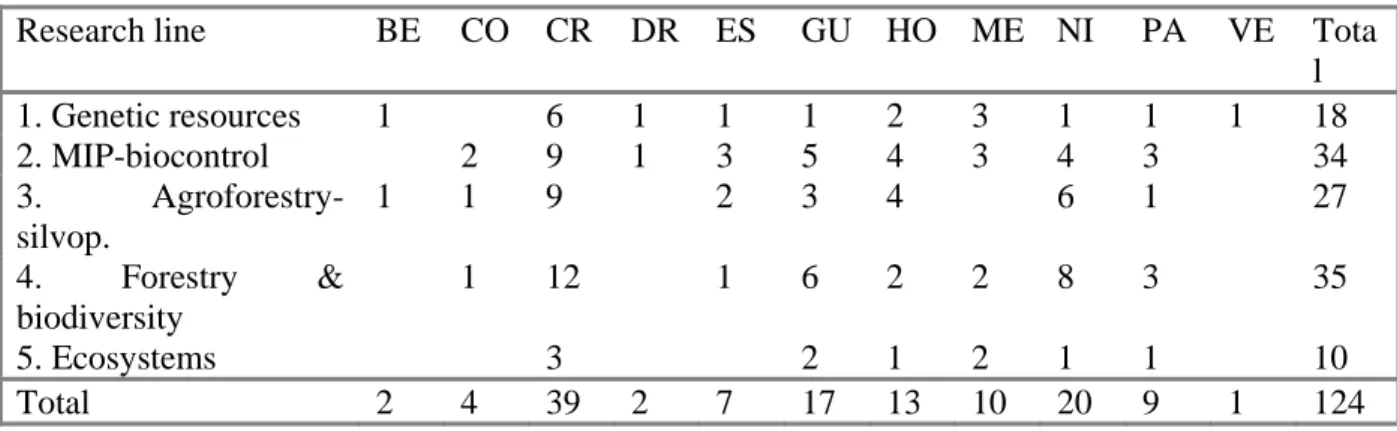
According to CATIE's database, more than 70 different partner institutions from member countries are involved in research projects. In addition to that, several European partners are involved in CATIE´s research through various projects under the INCO program as shown in the following tables.
Table 11. CATIE’s on-going research activities in member countries (2001 – 2002)
Research line BE CO CR DR ES GU HO ME NI PA VE Tota l 1. Genetic resources 1 6 1 1 1 2 3 1 1 1 18 2. MIP-biocontrol 2 9 1 3 5 4 3 4 3 34 3. Agroforestry- silvop. 1 1 9 2 3 4 6 1 27 4. Forestry & biodiversity 1 12 1 6 2 2 8 3 35 5. Ecosystems 3 2 1 2 1 1 10 Total 2 4 39 2 7 17 13 10 20 9 1 124
Table 12. Research partners in CATIE’s member countries (2001 – 2002). Partner BE CO CR DR ES GU HO ME NI PA VE Tota l Ministry 1 2 1 1 1 1 1 8 University 3 3 1 1 2 2 4 16 Research institute 1 1 1 1 2 1 1 1 9 NGO 1 3 1 3 1 1 2 12 Private company 4 1 1 1 7 Producers’ org. 1 6 1 1 2 11 International org. 2 3 1 6 Total 2 7 22 2 4 7 5 4 10 5 1 69
Table 13. CATIE’s international research partners (2001 – 2002).
Partner Lat. America
*
Europe USA Africa Asia Tota
l University 1 14 3 18 Research institute 3 9 2 14 Regional center 1 1 International center 1 1 CG-center 1 1 1 1 4 NGO 2 2 Total 7 25 5 1 2 38 * Non-member nations.
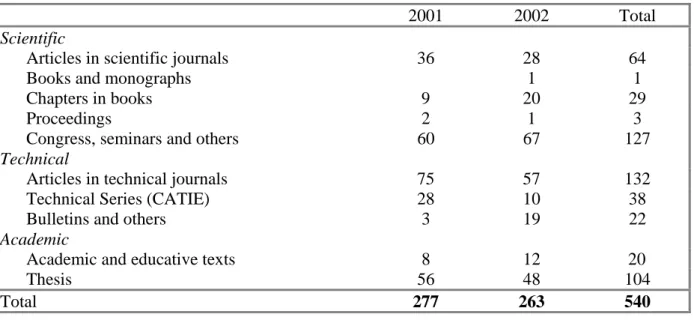
Between 2001 and 2002, the CATIE technicians published xxx articles in regional and international publications (journals, books, conferences, proceedings, presentations, etc.). See the table in Appendix 3 for a detailed list of publications.
Table 14. Publications and presentations (2001 - 2002).
2001 2002 Total
Scientific
Articles in scientific journals 36 28 64
Books and monographs 1 1
Chapters in books 9 20 29
Proceedings 2 1 3
Congress, seminars and others 60 67 127
Technical
Articles in technical journals 75 57 132
Technical Series (CATIE) 28 10 38
Bulletins and others 3 19 22
Academic
Academic and educative texts 8 12 20
Thesis 56 48 104
Total 277 263 540
Line 1: Improvement and conservation of agricultural and forestry species germplasm CATIE has prioritized agricultural and forestry species of economic and social importance in the region among which banana and coffee stand out followed by mahogany. Some results and relevant progress made in the report period are presented below.
• Cocoa: Renovation of the international cocoa collection / international recognition of the importance of CATIE’s work on breeding and selection of cocoa varieties with resistance/tolerance to monilia and black pod disease as well as with high yield potential
• Coffee: Mass propagation of 19 improved coffee hybrids under an agreement with ICAFE for participatory selection and validation by farmers under different agro ecological conditions in Costa Rica. Identification of molecular markers linked to resistance to the coffee nematode Meloidogyne exigua as well as genetic and molecular studies of male sterility to make F1 hybrids available through seeds
• Banana & plantain: Mass propagation of varieties of commercial interest and field evaluation of regenerated plantlets; use of the cell suspension system as basis for the transfer of interesting genes through non-conventional plant breeding. Results were disseminated through an International Congress on “Biodiversidad, biotecnología y bioseguridad, un enfoque hacia Mesoamérica y el Caribe” July 3-5, 2002 (94 participants from 19 countries). • Study of genetic diversity in natural populations of Pinus oocarpa in Honduras. This
work has indicated that genetically distinct individuals respond differently to environmental modifications and population changes caused by fragmentation and deforestation.
• The Sustainable Management of Neotropical Tree Genetic Resources Project has made important strides in determining the distribution of genetic diversity of important tree species and is beginning to generate management recommendations to favor the maintenance of this diversity. Nine species have been studied to date to determine whether their DNA is easy to extract and analyze.
Line 2. Integrated pest management in agricultural agroforestry and forestry systems. The IPM practices provide advantages which conserve the environment and biodiversity, reducing the risks for farmers, the rural population and consumers alike, and contribute to the sustainability of traditional agriculture and forestry production systems. Information about the projects conducted in 2001 and 2002 is presented below.
Plant protection (Integrated pest management in agricultural and agroforestry systems) • Low input agricultural technologies for tomato production on hillsides, that also reduce
erosion, have been successfully developed in Costa Rica. Benign control methods of whitefly, that gave greater production and lower costs, were validated in participatory projects with groups of producers (including groups of women) and have contributed to community organization as well as to promoting organic agriculture.
• Information on the dispersion, ecology and effects of micro-climate on pests and diseases of coffee, cacao, horticultural crops, maize and beans, as well as on their natural control agents (bacteria and fungi), are contributing to the identification and development of specific biocontrol agents. A critical mass of experts and knowledge in CATIE gives the institution an important opportunity to provide technical assistance and training in this area of growing importance, in particular for the development of organic agricultural options for the region. • Principally through the GTZ funded project to promote biopesticides, the IPM-AF NORAD
funded project, the Whitefly/Geminvirus network (now 21 countries) and CATIE´s Journal “Integrated Pest Management and Agroecology” (66 issues in 16 years; 700 scientific articles), the group has been able to make significant contributions to national institutions,
NGO´s, private sector, Universities, etc, both within and outside of CATIE´s mandate region. These include web sites (e.g. www.bioplaguicidas.org and www.catie.ac.cr/moscablanca), proposals to national and regional authorities (e.g. to OIRSA), documents of very different kinds for a diverse group of users (e.g. IPM-AF NORAD project for farmers to politicians). • The IPM-AF NORAD funded project helped 50 institutions in Nicaragua, as well as CATIE,
ICTA (Guatemala) and DINADERS (Honduras) staff to develop and submit proposals for new projects to continue the participatory farm family and extensionist training initiatives that have been successfully validated by this project. Widespread acceptance and incorporation of these concepts/approaches have been achieved and the project is highly evaluated, both by the donor and by collaborators.
Line 3. Tropical agroforestry systems on hillsides, agricultural frontiers and degraded lands
Agroforestry systems have a great potential for contributing to the sustainability of the production and conservation of natural resources. Information about the projects conducted in 2001 and 2002 is presented below.
Coffee quality, profitability and diversification
• A new group of activities (funding from the UK, Finland, CATIE) to validate organic coffee management has been established in Costa Rica. In addition to contributing to this new focus in CATIE's program, activities have lead to a much closer relationship with neighboring farmers in the Turrialba region.
• Timber shade tree management for coffee system diversification is another line of activities of this group. It consisted of: i) long-term collaborative coffee system trials, where management and research is shared with national universities, mainly in Nicaragua and Costa Rica; and ii) a research network with the national coffee institutions of Central America has been set up with evaluation plots in each country. Both of the above initiatives have a strong focus on developing methodologies and training.
• Excessive shade promotes broca (Hypothenemus hampei), but managed shade does not; in addition, bio-control with Beauveria bassiana is more effective with managed shade. Predation of the coffee bean borer by ants does not appear to be an effective control option. Possible hyper-parasites or antagonists to the coffee diseases (Roya – Hemileia vastatrix) and
Mycena citricolor have been identified (Verticillium lecanii and Trichoderma sp,
respectively).
• Excessive shade promotes broca (Hypothenemus hampei), but managed shade does not; in addition, bio-control with Beauveria bassiana is more effective with managed shade. Predation of the coffee bean borer by ants does not appear to be an effective control option. Possible hyper-parasites or antagonists to the coffee diseases (Roya – Hemileia vastatrix) and
Mycena citricolor have been identified (Verticillium lecanii and Trichoderma sp,
• The consequences of replacing the traditional leguminous shade trees in coffee plantations by fast growing timber trees is being studied within an EU INCO project. Several CATIE M.Sc students and one Ph.D student have contributed to the evaluations which show that
Terminalia ivorensis not only competes with the coffee for light but also for water and that Eucalyptus deglupta is a better choice though the slow rate of decomposition of litter of this
latter species limits nutrient return; also, mixtures with trees that provide rapidly decomposing litter, such as Erythrina poeppigiana, are preferable.
Modernization and competitiveness of Latin American cacao management
• In Costa Rica and Bolivia, successful involvement of indigenous peoples organizations (ADITIBRI, ADITICA), producers organizations (APPTA, El Ceibo) and local promoters (selected by their own organizations/communities) in the establishment, participatory management and monitoring (e.g. biodiversity) of development projects on their farms and in their region.
• Integration of research, education and development programs in the same projects. Students from many institutions (UK, France, Costa Rica, Bolivia, Colombia and CATIE's Higher Education Program) disseminate their results on themes, chosen with the project partners, to producers, local authorities and leaders, technical teams and to the international scientific community in both written and verbal forms.
• Quantification of the impact of different land use options (e.g. natural forest vs banana plantation vs agroforestry cacao plantation) on biodiversity conservation in buffer zones, effects of hunting, certification and marketing options, biological control of cacao diseases and the availability of useful plant species on indigenous farms (250 identified; 60 are being propagated and re-introduced, including 6 of the principal native timber species).
• A CATIE M.Sc. thesis on the productivity of naturally regenerated Cordia alliodora timber from indigenous farms showed that extraction rate could be at least doubled without affecting sustainability of this species. This study is now the basis for discussions, involving indigenous organizations and Costa Rica's Ministry of Environment, about possible changes to regulations that would improve local and commercial timber use options for indigenous farmers.
Ecological livestock management
• Much of the work focused on the development and dissemination, to collaborating organizations and students, of research methodologies to quantify and value environmental services (C, biodiversity conservation) and socio-economic variables in different livestock models. For example, although conversion of silvopastoral plots to secondary forest will increase carbon storage, a large reduction in contracted labor occurs with negative impacts on the poorest people. When compared with forest plantation activities, the opportunity cost to increase C storage by 1 tC/ha varied from US$13 to US$22 depending on the type of farm.
• Two new projects were initiated (GEF-WB and Dutch funding) in Nicaragua, Costa Rica and Colombia, and a third initiative was approved (NORAD), establishing the silvo pastoral
group as the fastest growing and possibly the most highly funded in CATIE (approximately $13 million for the next 5 years). It also could serve as a model to other CATIE theme groups on how to establish a regional program (already from Columbia to Guatemala), working through and with national institutions. This group coordinates research, training and dissemination activities (e.g. electronic platform managed with FAO) with national, regional and in some cases global coverage for a very diverse range of clients; e.g. different workshops have been organized for policy makers, scientists, extensionists and farmers. One of the principal products offered by this group are research methodologies that collaborating organizations and students can use.
• This group has already had a significant impact on decision makers in major multi-lateral agencies (e.g. World Bank), ministries (e.g. the president of CCAD sent a letter of support to NORAD) and national organizations (e.g. collaboration with the national agroforestry commission of Costa Rica to draft a new decree for environmental services [already approved, N° 30962-MINAE]). Decision support tools are being developed; e.g. to evaluate greenhouse gas emissions from livestock systems or for sustainable management, in fragmented pasture dominated landscapes, of trees which contribute to farm productivity and to biodiversity conservation (EU-INCO funded “Fragment” project).
• Innovative methods involving remote sensing, aerial photos, GIS and methods to integrate information provided by both farmers and scientists, referring to different levels of scale (from plot to landscape), are being developed to evaluate silvo-pastoral systems and the trade-offs and synergies between production and conservation goals.
Line 4. Development of technologies for sustainable forest and biodiversity management. The principal objective of this line of research is to develop strategies and technologies that contribute to the sustainable and diversified management of humid neotropical forests. To accomplish this, research, validation and transfer activities were conducted with the goal of reducing the rate of conversion of natural forests to other uses, as well as to increase the area under sustainable management regimens in Tropical America. The results and progress made in some of the most relevant research projects conducted in this line of work are presented below. Chair of Ecology in tropical forest management
A summary of the results achieved for each most important topics is described bellow:
• Sustainable Forest Management and Forest Certification (collaboration with WWF-Central America and Oregon State University). A draft guide for ecological monitoring for forest certification was completed, incorporating inputs from Mesoamerican Biological Corridor personnel, Guatemalan professionals and the Wildlife Conservation Society, as well as the results of field-testing and validation.
• Sustainable Management of Neotropical Tree Genetic Resources (INCO). Several studies of the dynamics of genetic diversity of Vochysia ferruginea in human-impacted ecosystems have been implemented.
• Ecological elements for the management and sustainable use of biodiversity in anthropogenic
landscapes. The second phase of fieldwork completed; the results of the first phase have been
published in regional journal, including recommendations for silviculture and restoration of logged and fragmented forests.
• Information and Human resources for the Sustainable Management of Forests in
Mesoamerica. A proposal was approved by CATIE/Finnida Research Fund.
Chair of diversified management of tropical forests
• Forest certification and criteria and indicators for sustainability: CATIE has strengthened its role as a scientific leader in this subject; several research theses have been developed and national processes have been supported, including participation as a member of the Costa Rican National Forest Certification Commission (established by Law). A Presidential Decree was signed and officially published which includes the new standard for natural forest management in Costa Rica. A research project was developed and started to assess the environmental performance of two forest policies: forest certification and payment for environmental services. Support in the establishment of an inter-institutional alliance for forest certification (with U.N. University for Peace, WWF, Organization for Tropical Studies, and Tropical Science Center).
• A discussion paper was prepared in collaboration with CIFOR, for GEF for the Forestry Roundtable held in conjunction with the United Nation Forum on Forests UNFF in New
York, in March 2002. A Spanish version was launched and presented as keynote address at the First International Seminar “Forests and Environmental Services; challenges and opportunities for investment” held in Lima, in December 2002.
• Illegal logging control in Costa Rica: a report on illegal logging in Costa Rica has been widely distributed getting the attention of several institutions outside Costa Rica. It has served as the basis for the Costa Rican National Strategy of Illegal Logging Control (top priority for the Government). The draft of a project to be executed jointly with Environment and Energy Ministry (MINAE) was developed.
• Central American Forestry Journal: support was provided to broaden the scope and geographic coverage and update the approach of our international journal. Five papers were published as well as a special issue with the proceedings of the IUFRO International Workshop on Forest Policy and Science Interface.
• Villa Mills Experimental and Demonstration Area: general running and maintenance of this strategic Area was provided in coordination with the Ministry of Environment of Costa Rica, including discussions about its future as part of an eventual Model Forest.
• Landscape Management and Ecosystem Approach: an intensive analysis was held about CATIE's positioning and future action regarding the Convention of Biological Diversity’s Ecosystem Approach and landscape management. A concept note of the Reventazon Model Forest has been developed in coordination with MINAE and ICE and in close collaboration with the Latin American and Caribbean Center for Model Forests. Minister Rodriguez committed initial support. Three research projects were developed and started: a methodology for a participatory planning process of the Model Forest; native tree species selection for ecological landscape restoration in the Model Forest; and evaluation of the impact, processes and conditions of a case study of forest landscape restoration.
• Development and sustainable management of Smilax spp. Project: The project duration was extended one more year in order to allow for wider dissemination of results. Main studies have concluded, including identification of main species with commercial value and main bioassays to assess extracts' biological activity. Reproduction assays and pilot plantations were established. A draft taxonomic manual for Smilax genus is being reviewed. The edition of a final book based on project results has started. Results were presented to Latin American medicinal plant scientists and producers during “Jornadas Iberoamericanas de Agrotecnología de Plantas Medicinales”, in August in Guatemala.
• The growth of Quassia amara shrub was monitored in nine long-term research plots. Trends were analyzed this year to formulate recommendation for plantations pruning.
• A doctoral research was initiated about management of xate, a non-timber forest product in the Selva Maya (Petén, Yucatán and Belize). Preliminary discussions have started to develop a project for the sustainable production and commercialization of xate in collaboration with the University of Minnesota.
• Bamboo Project. An inventory of “guaduales” in an area exceeding one million hectares was carried out in Colombia using innovative tools: expert knowledge, GIS and aerial photos. An
efficient sampling scheme was developed. A census of bamboo plantations was carried out in Costa Rica. Information was obtained from key informants in institutions like MINAE, CNP and MAG. A literature review of bamboo in Costa Rica was conducted. This information will be included in an information system.
• CATIE´s Forest Farm. 60 hectares of plantations of native species were established on the CATIE farm for research and commercial purpose.
• Forest Seed Bank. CATIE's Forest Seed Bank has been and continues to be a leader in the management, collection and conservation of germplasm of tree species in Central America. The Bank continues to work with a wide host of partners in these activities, even after funding for the Danish financed PROSEFOR project came to an end.
• Protected areas and biodiversity. Several products were achieved of which the most important ones are:
• Successful negotiation of an eight-month project to manage the protected areas of Montecristo and San Diego La Barra in El Salvador. This project will end in March 2003. • An analysis for the redesign of the national system of protected areas in Paraguay (GEF
support).
• The development of a web-based information management system on biodiversity initiated jointloy with CATIE’s agroforestry specialists.
• An agreement was signed with the Network of Private Nature Reserves in Costa Rica to provide support to this important group.
• The 24th edition of the “International Course on the Management of Protected Areas” with an emphasis on the payment of environmental services was held.
• Research on the potential of bird populations within the local biodiversity in the buffer zone of the Tapanti-Macizo de la Muerte National Park was concluded. Information and results served as a basis for the publication of a bird-watchers manual and to develop an eco-tourism project proposal to support community development.
Line 5. Socioeconomic analysis and evaluation of environmental policies goods and services from tropical ecosystems.
Results from some of the projects developed in the 2001 and 2002 biennial period are presented below.
Economic valuation of forest goods and environmental services The most relevant products are:
• Organization and coordination of the international course entitled: Topics in Environmental Economics, CATIE, December 2002-January 2003, with invited lecturers from the Environmental Economics Unit at Gothenburg University and the Beijer Institute.
• Organization of the Regional Symposium on Environmental Socio-economics at CATIE, 2-4 December.