HAL Id: tel-01239854
https://tel.archives-ouvertes.fr/tel-01239854
Submitted on 8 Dec 2015HAL is a multi-disciplinary open access archive for the deposit and dissemination of sci-entific research documents, whether they are pub-lished or not. The documents may come from teaching and research institutions in France or abroad, or from public or private research centers.
L’archive ouverte pluridisciplinaire HAL, est destinée au dépôt et à la diffusion de documents scientifiques de niveau recherche, publiés ou non, émanant des établissements d’enseignement et de recherche français ou étrangers, des laboratoires publics ou privés.
and algorithms
Haoyi Xiong
To cite this version:
Haoyi Xiong. Near-optimal mobile crowdsensing : design framework and algorithms. Networking and Internet Architecture [cs.NI]. Institut National des Télécommunications, 2015. English. �NNT : 2015TELE0005�. �tel-01239854�
THESEDEDOCTORATTELECOM SUDPARIS Specialite:Informatique
Ecoledoctoraleinformatique,telecommunicationsetelectronique Presenteepar
Haoy
iX
iong
Pourobtenirlegradede DOCTEURDETelecomSudParis
Quas
i-Op
tima
l Mob
i
leC
rowdsens
ing
:
CadredeConcep
tione
t A
lgo
r
i
thmes
Soutenuele22/Jan/2015 devantlejurycomposede: Directeurdethese:
Mme. MoniqueBecker ProfesseurHDR,TELECOMSudParis,France Rapporteurs:
M. HerveRivano ChargedeRecherchesHDR,INRIA,France M. StephaneGalland ProfesseurHDR,UTBM,France
Examinateurs:
M. PierreSens ProfesseurHDR,UniversitedeParis6,France Mme.VeroniqueVecque ProfesseurHDR,Supelec,France
M. StevenMartin ProfesseurHDR,UniversitedeParis11,France
Mme.LilaBoukhatem Ma^tredeconferencesHDR,UniversitedeParis11,France(Invite) M. DaqingZhang Professeur,TELECOMSudParis,France(Encadrant)
M. Vincent Gauthier Ma^tredeconferences,TELECOMSudParis,France(Encadrant) Thesenumero:2015n2015TELE0005
Specialization: ComputerScienceandEngineering Presentedby
Haoy
iX
iong
Submittedforthepartialrequirementof DoctorofPhilosophy
from
TELECOM SudParis
Nea
r-Op
tima
l Mob
i
leC
rowdsens
ing
:
DesignF
ramewo
rkandA
lgo
r
i
thms
Defenseat22/Jan/2015 Jury Members:
DirectorofThesis:
Ms. MoniqueBecker ProfesseurHDR,TELECOMSudParis,France Reporters:
M. HerveRivano ChargedeRecherchesHDR,INRIA,France M. StephaneGalland ProfesseurHDR,UTBM,France
Examiners:
M. PierreSens ProfesseurHDR,UniversitedeParis6,France Mme.VeroniqueVecque ProfesseurHDR,Supelec,France
M. StevenMartin ProfesseurHDR,UniversitedeParis11,France
Mme.LilaBoukhatem Ma^tredeconferencesHDR,UniversitedeParis11,France(Invite) Mr. DaqingZhang Professeur,TELECOMSudParis,France(Encadrant)
Mr. Vincent Gauthier Ma^tredeconferences,TELECOMSudParis,France(Encadrant) Thesenumero:2015n2015TELE0005
Abs
trac
t
Nowadays,thereisanincreasingdemandtoprovidereal-timeenvironmentinforma -tionsuchasairquality,noiselevel,traccondition,etc.tocitizensinurbanareasfor variouspurposes. Theproliferationofsensor-equippedsmartphonesandthemobi l-ityofpeoplearemaking MobileCrowdsensing(MCS)aneectivewaytosenseand collectinformationatalowdeploymentcost.In MCS,insteadofdeployingstatic sensorsinurbanareas,peoplewith mobiledevicesplaytheroleof mobilesensors tosensetheinformationoftheirsurroundingsandthecommunicationnetwork(3G, WiFi,etc.)isusedtotransferdatafor MCSapplications.
Typically,an MCSapplication(ortask)notonlyrequireseachparticipant'smo -biledevicetopossessthecapabilityofreceivingsensingtasks,performingsensingand returningsensedresultstoacentralserver,italsorequirestorecruitparticipants,as -signsensingtaskstoparticipants,andcollectsensedresultsthat wellrepresentsthe characteristicsofthetargetsensingregion.Inordertorecruitsu cientparticipants, theorganizeroftheMCStaskshouldconsiderenergyconsumptioncausedby MCS applicationsforeachindividualparticipantandtheprivacyissues,furthertheorga -nizershouldgiveeachparticipantacertainamountofincentivesasencouragement. Further,inordertocollectsensedresultswellrepresentingthetargetregion,theorga -nizerneedstoensurethesensingdataqualityofthesensedresults,e.g.,theaccuracy andthespatial-temporalcoverageofthesensedresults.
Withtheenergyconsumption,privacy,incentives,andsensingdataqualityin mind,inthisthesiswehavestudiedfouroptimizationproblemsof mobilecrowdsens -ingandconductedfollowingfourresearchworks:
• EEMC- Inthiswork,the MCStaskissplittedintoasequenceofsensing cycles, weassumeeachparticipantisgivenanequalamountofincentivefor joiningineachsensingcycle;further,giventhetargetregionoftheMCStask, theMCStaskaimsatcollectinganexpectednumberofsensedresultsfromthe targetregionineachsensingcycle.Thus,inordertominimizethetotalincentive paymentsandthetotalenergyconsumptionoftheMCStaskwhilemeetingthe predeneddatacollectiongoal, weproposeEEMC whichintendstoselecta minimalnumberofanonymousparticipantstojoinineachsensingcycleofthe MCStaskwhileensuringan minimumnumberofparticipantsreturningsensed results.
• EMC3-Inthiswork,wefollowthesamesensingcyclesandincentivesas
sump-tions/settingsfromEEMC;however,givenatargetregionconsistingofasetof subareas,theMCStaskinthisworkaimsatcollectingsensedresultscovering eachsubareaofthetargetregionineachsensingcycle(namelyfullcoverage constraint). Thus,inorderto minimizethetotalincentivepaymentsandthe totalenergyconsumptionoftheMCStaskunderthefullcoverageconstraint, weproposeEMC3whichintendstoselecta minimalnumberofanonymous
participantstojoinineachsensingcycleofthe MCStask whileensuringat leastoneparticipantreturningsensedresultsfromeachsubarea.
• CrowdRecruiter- Inthiswork, weassumeeachparticipantisgivenan equalamountofincentiveforjoininginallsensingcyclesofthe MCStask; further,givenatargetregionconsistingofasetofsubareas,the MCStask aimsatcollectingsensedresultsfromapredenedpercentageofsubareasin eachsensingcycle(namelyprobabilisticcoverageconstraint). Thus,inorder tominimizethetotalincentivepaymentstheprobabilisticcoverageconstraint, weproposeCrowdRecruiter whichintendstorecruita minimalnumberof participantsforthewhole MCStask whileensuringtheselectedparticipants returningsensedresultsfromatleastapredenedpercentageofsubareasin eachsensingcycle.
• CrowdTasker- Inthiswork, weassumeeachparticipantisgivenavaried amountofincentives,accordingtothenumberofsensingcyclesthatthepa r-ticipantjoinsin;further wedeneanovelsensingdataquality metricsbased onboththenumberofsubareascoveredbysensedresultsandthenumberof sensedresultsineachsubarea(namelyoverallcoveragequality).Thus,inorder tomaximizetheoverallcoveragequalitywithaxedamountofbudgetfo rin-centivepayment,weproposeCrowdTasker whichintendstooptimallyrecruit asetofparticipantsanddetermineinwhichsensingcycleseachselectedpartic -ipantcanjoinintheMCStaskwhileensuringthetotalincentivepaymentnot exceedingthebudget.
Eachaboveworkintendstostudyonepracticaloptimizationproblemofmobilec rowd-sensingwithspecicincentive,energyconsumption,privacyandsensingdataqua l-itysettings/objectives. Evaluationswithalarge-scalereal-worlddatasetshowthat ourproposedEEMC EMC3,CrowdRecruiterandCrowdTaskeroutperformheuristic
Resume
Aujourd'hui,ilyaunedemandecroissantedefournirlesinformationsd'environnement entempsreeltelsquelaqualitedel'air,leniveaudebruit,etatdutrac,etc.pour lescitoyensdansleszonesurbainesades nsdiverses.Laproliferationdescapteurs desmartphonesetlamobilitedelapopulationfontdesMobileCrowdsensing(MCS) un moyene cacededetecteretderecueillirdesinformationsaunco^utfaiblede deploiement.EnMCS,aulieudedeployercapteursstatiquesdansleszonesurbaines, lesutilisateursavecdesperipheriquesmobilesjouentler^oledescapteursdemobilesa capturerlesinformationsdeleursenvironement,etlereseaudecommunication(3G, WiFi,etc.)pourletransfertdesdonneespour MCSapplications.
Engeneral,l'application MCS(out^ache)nonseulementexigequechaquepa r-ticipant deperipherique mobiledepossederlacapacitedereception missionsde teledetection,deteledetectionetderenvoidetecteresultatsversunserveurcentral, ilexigeegalementderecruterdesparticipants,attribuerdeteledetectiont^achesaux participants,etcollecterlesresultatsobtenuesparteledetectionainsiquerepresente lescaracteristiquesdelaciblezonededetection.A nderecruterunnombresu sant departicipants,l'organisateurd'uneMCSt^achedevraitconsidererlaconsommation energetiquecauseepar MCSapplicationspourchaqueparticipantetlesquestions deprotectiondanslavieprivee,l'organisateurdoitdonnerachaqueparticipantun certainmontantdesincitationscommeunencouragement.Enoutre,anderecueillir lesresultatsobtenuesparteledetectionetrepresentantlaregioncible,l'organisateur doits'assurerquelesdonneesdeteledetectionqualitedesresultatsobtenuespar teledetection,p. ex.,laprecisionetlaspatio-temporellelacouverturedesresultats obtenuesparteledetection.
Aveclaconsommationd'energie,laprotectiondelavieprivee,lesmesuresd'incitation, deteledetectionetqualitedesdonneesal'esprit,danscettethesenousavonsetudie quatreproblemesd'optimisationde mobilecrowdsensinget meneesapresquatre travauxderecherche:
• EEMC-danslecadredecetravail,lat^achedeMCSestdiviseenunesequence decyclesdedetection,noussupposonsquechaqueparticipantestdonneeune quantiteegaledestimulantpourrejoindredanschaquecycledeteledetection; deplus,etantdonnelaregioncibledu MCSt^ache,lat^achedeMCSviseare -cueillirlenombreprevudeteledetectionresultatsdelaregioncibledanschaque cycledeteledetection.Ainsi,andereduireau minimumlestotauxpaiements d'incitationetlaconsommationtotaled'energiedelat^achede MCStouten reunionlesdonneespredeniescollectionobjectif,nousproposonsEEMCqui al'intentiondeselectionnerunnombreminimaldeparticipantsanonymesde sejoindreachaquecyclededetectiondela MCSt^achetoutenassurantun nombreminimaldeparticipantsretourresultatsdetectee.
• EMC3-danslecadredecetravail,nousavonssuiviles m^emescyclesde 5
detectionetdesincitationshypotheses/parametresdeEEMC;toutefois,etant donneuneregionciblecomposeed'unensembledesous-zones,lat^achedeMCS danscetravailviseacollecterdetecteresultatscouvrantchaquesous-zonedela regioncibledanschaquecyclededetection(asavoirlapleinecouve rturecon-trainte).Ainsi,andereduireauminimumlestotauxpaiementsd'incitationet laconsommationtotaled'energiedelat^achedeMCSsouslacouverturetotale contrainte,nousproposonsEMC3quial'intentiondeselectionnerunnombre minimaldeparticipantsanonymesasejoindreachaquecyclededetectiondu MCSt^achetoutenassurantaumoinsunparticipantretourdetectelesresultats dechaquesous-zone.
• CrowdRecruiter-danslecadredecetravail,noussupposonsquechaquepa r-ticipantestdonneeunequantiteegaledestimulerpourrejoindredanstousles cyclesdedetectiondubacderamassaget^ache;deplus,etantdonneuneregion ciblecomposed'unensembledesous-zones,lat^achedeMCSvisearecueillir desresultatsdetecteeparunpourcentagepredenidesous-zonesdanschaque cyclededetection(asavoirlacouvertureprobabilistecontrainte).Ainsi,ande reduirelestotauxpaiementsd'incitationlacouvertureprobabilistecontrainte, nousproposonsCrowdRecruiterquienvisagederecruterunnombre minimal departicipantspourl'ensemblet^achedeMCStoutenassurantlesparticipants selectionnesretourdetecteresultatsd'au moinsunpourcentagepredenide sous-zonesdanschaquecycledeteledetection.
• CrowdTasker-danslecadredecetravail,noussupposonsquechaquepartic i-pantestdonneeunequantitevariabled'incitations,enfonctiondunombrede cyclesdedetectionqueleparticipantsejoignea;deplus,nousnousdenirun romandedetectiondesdonneesmetriquesdequalitereposealafo issurlenom-bredesous-zonescouvertesparteledetectionresultatsetlenombrederesultats detecteedanschaquesous-zone(c-a-dcouvertureglobalequalite). Ainsi,an de maximiserlacouvertureglobaledequaliteavecun montant xedebud-get depaiementincitatif,nousproposonsCrowdTaskerquial'intentionde recruterdefaconoptimalel'ensembledesparticipantsetdedetermineraqui lateledetectioncycleschaqueparticipantselectionnepeutsejoindreau MCS t^achetoutenassurantletotalpaiementincitatifdepassantpaslebudget. Chaquetravailci-dessusseproposed'etudierunepratiqueproblemed'optimisationde mobilecrowdsensingavecincitationspeci ques,delaconsommationd'energie,lapro -tectiondelaviepriveeetdesdonneesdeteledetectionparametresqualite/objectifs. Lesevaluationsavecunegrandeechellele mondereeldataset montrentquenotre projetEEMCEMC3,CrowdRecruiterCrowdTaskeretsurpasserlesmethodesheuris -tiquesetd'autresapprochesdebase.
Acknow
ledge
Towhomit mayconcern,
Manythanksforpayingattentiontomythesis. DoingaPhDisalongandwonderful journeyof mine,whereI movedtoFranceandleft mydadandmom,whereI met my wifeandturned myselffromanaiveboytoa(maybestillnaive)husband,whereI graduallyturned myselffromanengineertoaresearcher.Allthesestu simpact my life.
Firstofall,IgratefullythankfollowingpersonswhohelpedmeduringmyPhD| mysupervisorProf. DaqingZhang, mythesisdirectorProf. MoniqueBecker, myco -advisorProf. Vincent Gauthier,thesecretaryofourdepartment MadameFrancoise Abad,and my(former)colleaguesincludingMr. DingqiYang, Mr.Leye Wang, Miss XiaoHan,Prof. ChaoChen,Dr. LinSun, Mr. LongbiaoChen,andDr. Xiaoping Che. Allhelpfromthemisvaluableandshouldbehighlyappreciated. Moreover,I wouldliketoappreciatethecollaboratorsof myresearchincludingProf. Guanling ChenfromUniversityof MassachusettsatLowell,Dr.JieZhuatIntel Corporation SantaClara,andProf. HakimaChaouchi Prof. J.Paul GibsonatInsitut Mines -TelecomSudParis.Furthermore,I wouldliketoappreciatethejury membersof my PhDdefensecommitteeincludingProf. VeroniqueVeque,Prof. LilaBoukhatem, Prof. RivanoHerve,Prof. StephaneGalland,Prof. PierreSens,andProf. Steve Martin,whoallocatemeasliceoftheirbusyhourssoastohelpmevalidatemyPhD research.
Personally,Ibelievemythesisislargelycontributedby myfamily. Myfather Mr. ChunjieXiongoneofthechiefelectricalengineers(professor-rank)at China Meta l-lurgical GroupCorporationwith30year'sexperienceindesigningsensorsystemsfor automatedfactoriestaught meprogrammingwhenI wastwelve. My Mom Madame MingLiacerti catedcostappraiserandinvestmentcontrolengineertaught mealot inbudgetplanningandhowto makeadecision. Alltheirprofessionalsbrought me fundamentalsofdoingresearchincomputerscienceandelectricalengineering. More important,fromour rstglanceatLilleEuropeGareto mydefensetoday, mywife SijiaYangisalwaysby myside.From my rstpaperacceptedtomythesiswritten up, Shehadgiven mewhatevershecouldgivetosupport myPhDresearch,take careof mylife,andbalancemylife-workstyle.Ihopewecouldloveandbetogether forever.
Finally,IamprettysurethatI misssomeimportantpeopleIshouldthank.Thus, I wouldliketosay\ThankYou!"toallpeoplesurroundingmeorhavingcontacted me.It mustbetheLORDwholeadsmehereortheretoknowyouandgethelpfrom you.ThankYou!
Yoursfaithfully, HaoyiXIONG 7
Tab
leo
fcon
ten
ts
1 Introduction 17
1.1 Background... 17
1.2 Research MotivationsandContributions... 19
1.3 OrganizationofthisThesis... 23
2 StateoftheArts 25 2.1 MCSApplicationsandFrameworks... 25
2.2 MCSEnergyConsumption ... 26
2.3 MCSEnergy-savingStrategies... 27
2.4 MCSIncentiveModels... 27
2.5 MCSSensingDataQuality Metrics... 28
2.6 MCSParticipantSelectionandTaskAssignment... 28
2.7 Human MobilityPredictionfor MCS... 29
3 EEMC: Energy E cient Mobile Crowdsensing with Anonymous Participants 31 3.1 Introduction... 32
3.1.1 ProposedResearch:Assumptions,ObjectivesandtheExample 32 3.1.2 ResearchChallengesandOurContributions... 35
3.1.3 ComparisonwiththeMost Related Work... 37
3.2 ProblemFormulation... 38
3.3 EEMCFrameworkandSkeletonAlgorithm... 39
3.3.1 PhaseI-CandidateUserIdenti cationbasedonCallPrediction 39 3.3.2 PhaseII-Two-stepDecisionMakingProcessforTaskAssignment 40 3.4 Next-CallPrediction ModelbasedonAccumulatedCallTraces.... 42
3.4.1 ProbabilsiticModelofPhoneCalls... 43
3.4.2 ParameterEstimationusingAccumulatedTraces... 43
3.5 AdaptivePaceControllerforTaskAssignment ... 44
3.5.1 AdaptivePaceControlforTaskAssignment... 44
3.5.2 ProbabilityEstimationforAdaptivePaceControl ... 44
3.6 Near-OptimalDecision MakerforTaskAssignment... 45
3.6.1 IdentifyingFuture-surer Candidates ... 45
3.6.2 Estimatingifthe Missing Numberof Sensed Resultscanbe returnedfromFuture-surerCandidatesandPotentialReturners 46 3.6.3 Near-optimalTaskAssignment Decision Making... 47
3.7 ExperimentalSetups... 47
3.7.1 BaselineMethodsandParameterSettings... 47
3.7.2 DatasetandExperimentSetups... 48
3.8 EvaluationResults... 49 9
3.8.1 PerformanceComparison ... 50
3.8.2 Cold-startPerformance... 51
3.8.3 CaseStudyandAnalysis ... 52
3.8.4 EnergyConservationComparison... 53
3.9 Discussion... 54
4 EMC3: EnergyE cient DataTransferfor MobileCrowdsens ingun-derFull CoverageConstraint 57 4.1 Introduction... 58
4.2 ProblemStatement... 61
4.3 EMC3FrameworkandCoreAlgorithms... 62
4.3.1 Call/MobilityPrediction... 63
4.3.2 OverallTaskAssignmentPaceControl... 64
4.3.3 Sub-optimalTaskAssignment Decision Making... 66
4.4 Evaluation... 68
4.4.1 BaselineMethodsandParameterSettings... 69
4.4.2 DatasetandExperimentSetups... 69
4.4.3 PerformanceEvaluation... 72
4.4.4 EnergyConservationComparison... 75
4.4.5 Real-timePerformanceAnalysis ... 77
4.5 Discussion... 79
5 CrowdRecruiter: Selecting Participantsfor Piggyback Crowdsens -ingunder ProbabilisticCoverageConstraint 81 5.1 Introduction... 82
5.2 CrowdRecruiter:SystemOverview... 85
5.2.1 ParticipantSelectionProbleminCrowdRecruiter... 85
5.2.2 OverallDesignofCrowdRecuiter... 86
5.3 CoreAlgorithmsofCrowdRecruiter ... 88
5.3.1 Call/MobilityPrediction... 88
5.3.2 UtilityCalculationofEachCombinedSet... 88
5.3.3 CoverageProbabilityVectorCalculation... 89
5.3.4 AlgorithmAnalysis... 89
5.4 Evaluation... 91
5.4.1 BaselineMethods... 91
5.4.2 DatasetandExperimentSetups... 92
5.4.3 NumberofParticipantsComparison... 94
5.4.4 SelectionProcessComparison... 94
5.4.5 ParticipantSelectionOverlaps... 94
5.4.6 PerformanceEvaluationandComparison ... 95
5.4.7 CombineParticipantsfromEachCycle... 97
Tableofcontents 11 6 CrowdTasker: Maximizing Coverage Qualityunde
rIncentiveBud-getConstraint 101
6.1 Introduction... 102
6.2 CrowdTaskerSystemOverview... 107
6.2.1 TaskAllocationProbleminCrowdTasker... 107
6.2.2 OverallDesignofCrowdTasker... 108
6.3 CoreAlgorithmsandAnalysis... 110
6.3.1 Call/MobilityPrediction... 110
6.3.2 UtilityCalculation... 110
6.3.3 CoverageQualityEstimation... 111
6.3.4 AlgorithmAnalysis... 112
6.4 Evaluation... 114
6.4.1 BaselinesforEvaluation... 114
6.4.2 DatasetforEvaluation... 114
6.4.3 CoverageQualityComparisonunderBudget Constraint.... 115
6.4.4 SpatialDistributionoftheSensorReadings... 116
6.4.5 ComputationTimeofCrowdTasker ... 116
6.5 Discussion... 117
7 Conclusion 119 7.1 Summary... 119
7.1.1 SummaryofEEMC ... 120
7.1.2 SummaryofEMC3... 120
7.1.3 SummaryofCrowdRecruiter ... 120
7.1.4 SummaryofCrowdTasker... 121
7.2 Future Work ... 121
A Low-complexity AlgorithmsandProofs 125 A.1 AlgorithmsandProofsfromChapter3and4... 125
A.1.1 Low-complexityAlgorithmsforPfulfillComputation... 125
A.1.2 Low-complexityAlgorithmforPfulfill ... 126
A.2 AlgorithmsandProofsfromChapter5... 126
A.2.1 Low-complexityAlgorithmsforCOVi(S)Computation... 126
A.2.2 Proof{Utility(S)isansubmodularfunction... 127
A.3 AlgorithmsandProofsfromChapter6... 128
A.3.1 Low-complexityAlgorithmsforCQE(X)Computation... 128
A.3.2 Proof{CQE(X)isansubmodularfunction ... 128
A.3.3 Proof{ThetotalBase/Bonusincentivepaymen tisansubmod-ularfunctionoverX... 129
B Cur r iculum V it ae and R esear ch Publicat ions 131
B.1 Curriculum Vitae . . . 131
B.2 Research Publications . . . 131
B.2.1 Published or Accepted Papers . . . 131
Lis
to
fTab
les
2.1 EnergyCostofSensorsandSensingTasks... 26
2.2 Energy Costof DataTransfer:thespeci cenergyconsumptionde -pendsonthewaitingtime,buersizeorbandwidth ... 26
3.1 SymbolsandDenitions... 38
3.2 VariablesusedinEEMC Algorithms... 42
3.3 DataTransferEnergyConsumptionEstimation... 53
3.4 Energy Consumption Comparison: 3G-basedvsParallel+3G-based (P+3G)vsEEMCvsPacevsGreedy ... 54
4.1 PerformanceComparisonbasedonResidentialDistrictTraces:EMC3 vsPacevsGreedy ... 74
4.2 EnergyConsumptionComputation Models... 76
4.3 Energy Consumption Comparison: 3G-basedvsParallel+3G-based (P+3G)vsEMC3vsPacevsGreedy... 77
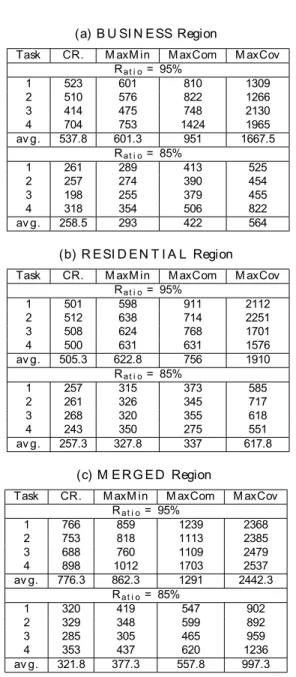
4.4 EMC3AverageResponseTimeandtheEstimatedMaximumThroughput 78 5.1 NumberofSelectedParticipants(CR.referstoCrowdRecruiterinall TablesandFigures) ... 90
5.2 ComputationTimeComparison(inseconds,PhaseI:DataPreparationand User Call/MobilityPro ling,PhaseII:IterativeParticipantSelectionProcess).. 96
5.3 TheCombinedNumberofSelectedParticipantsusingBUSINESS+RESIDENTIAL Datasets... 98
6.1 ComputationTimeComparison(inseconds,B=30000,E=5,ba= 50andbo=1) ... 117
Lis
to
fF
igures
1.1 TheFour-stageLifeCycleof MobileCrowdsensingProcess... 20
3.1 TheUseCaseofAbidjan'sCBDArea... 34
3.2 TheTwo-phaseTaskAssignmentFramework... 36
3.3 AnExample: EstimatingtheParameter withUi'sAccumulatedCall Traces... 43
3.4 TheExampleofPfXk;t(Ak Rk)= NgComputing(Best Viewedin DigitalFormat)... 45
3.5 StatisticsofEvaluationTracesinD4DDataSet... 48
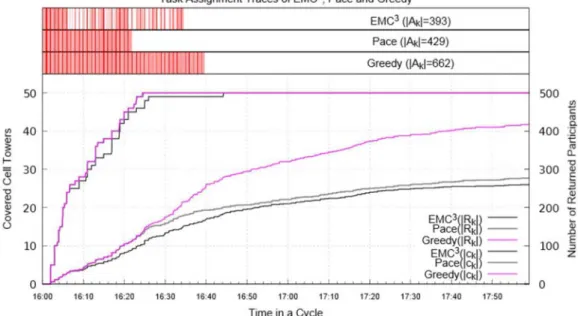
3.6 ComparisonofTaskAssignmentsandReturnedParticipants: EEMC vsPacevsGreedy ... 51
3.7 NumberofTaskAssignmentsandReturnedParticipantsinColdStart Period... 51
3.8 NumberofTaskAssignmentsandReturnedParticipantsvaryingwith TimeintheCycleof10:00 12:00,15Dec2011(Best Viewedin Color)... 52
4.1 CellTowersintheAbidjanCBDArea... 59
4.2 TheEMC3Framework... 62
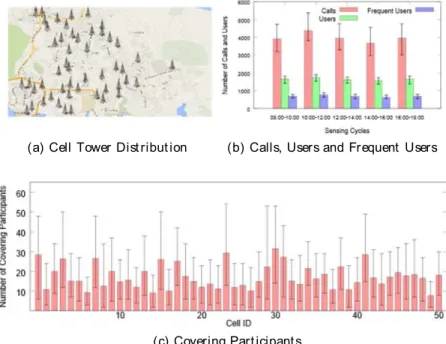
4.3 StatisticsofCBDCallTraces... 69
4.4 StatisticsofAbidjanResidentialDistrict CallTraces(Best Viewedin DigitalForm)... 71
4.5 NumberofTaskAssignmentsandReturnedParticipants(CBDTraces) 71 4.6 NumberofCoveringParticipants(CBDTraces)... 72
4.7 Numberof CoveringParticipants(Residential District Traces, Ne= 250and500) ... 73
4.8 TaskAssignmentProcessintheCaseStudy... 75
5.1 CellTowersintheDowntownofAbidjanCity... 84
5.2 TheCrowdRecruiterFramework ... 86
5.3 Max/Min/AverageCoverageof CellTowersbasedontheThreeRe -gionsandSettings... 93
5.4 SelectionProcess: min0 i<NfCOVi(S)goverjSj... 95
5.5 PercentageofSharedParticipantsamongDi erent Methods(BestViewed inDigitalFormat) ... 96
5.6 Temporal CoverageRatioof CellTowersinBUSINESS, RES IDEN-TIALand MERGEDRegions... 97
6.1 PCSTaskAllocationandExecution... 104
6.2 TargetregionintheDowntownofAbidjanCity... 105 15
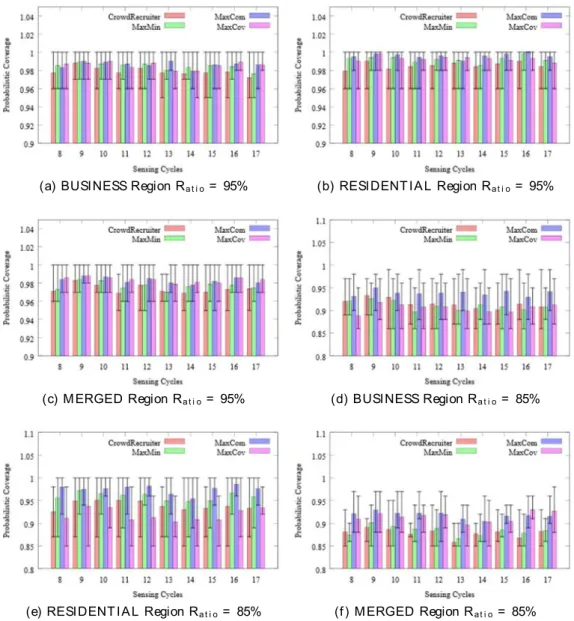
6.3 The CrowdTasker Framework . . . 108 6.4 Coverage Quality Comparison in the BUSINESS and MERGED
Re-gions (Best viewed with 300% zoom-in) . . . 113 6.5 Spatial Distribution of Sensor Readings in three Regions (B = 30000,
Chap
ter 1
In
troduc
tion
Con
ten
ts
1.1 Background... 17 1.2 Research Motivationsand Contributions... 19 1.3 OrganizationofthisThesis... 23
1
.1 Background
MobileCrowdsensing(MCS)| atermcoinedby Gantietal.[1]| isbecom ingin-creasinglypopularasthenumberof mobiledevicesequippedwithsensors(including phones,tablets, mediaplayers,gamesandleisure/sportselectronicdevices)shows dramaticgrowth. Facilitatedbythewidespreadadoptionofsensor-equippedsma rt-phones, MCShasbeensuccessfullyadoptedtoenableanever-increasingnumberof sensingapplications,rangingfromhighwaycongestiondetection[2]tosocialtrend understanding[3]andurbannoisepollution/airquality monitoring[4,5]. A main areaofresearchinthis eldisconcernedwithenablingdistributed monitoringappl i-cationsthatdonotrelyonadedicatedsensornetworkinfrastructure;but wherethe crowdsensingcommunicationisfacilitatedbyanalreadyexistingnetworkbetween devices(e.g., mobilephones)thatareparticipatinginthesensingtasks[6].
MobileCrowdsensingwith MobilePhoneDigitalFootprints-In MCS, therearetwo mainplayers: MCSorganizer whoisthepersonororganizationcoo r-dinatingthesensingtask,and MCSparticipantswhoarethemobileusersinvolved inthesensingtask. Tofacilitatethemobilecrowdsensingwiththesensor-enriched mobilephones,theMCSorganizerusuallyrequireseach MCSparticipantuploading thedigitalfootprintsgeneratedbytheir mobilephones.Forexample,an MCSappl i-cationintendsto monitortheairqualityofabigcity withalargegroupof mobile phoneusers. EveryhourtheMCSapplicationcollectsonesensorreadingfromeach MCSparticipantandalsofetcheseachuser'sreal-timeGPSposition.Aftercollecting thesensedresultandtheGPSdatafromeachMCSparticipant,theapplicationmaps theairqualitysensorreadingtoeachcorrespondingGPSpointontheGooglemap, soastodrawthe\bigpicture"ofairqualityinthecity.Specically,followingthree typesof mobilephonedigitalfootprintshavebeenwidelystudied:
• Sensor Readings- A mainstreamsmartphone mightbecommonlyequipped with multiplesensorsincludingaccelerometers,barometers,compasses,tempe r-aturesensors,and magnetic eldsensors[7,8]. Furthermore,digitalcam -eras[9], microphones[10],ear-phones[4], wirelessantennas[11]andother devicesequippedinthesmartphonecouldbeusedassensorsfor manyc rowd-sensingapplications.Acomprehensivesurveyonmobilephonesensorsandtheir applicationstomobilesensingis[12]
• MobilityTraces- Thecommonly-seensmartphonemobilitytracesincludeGPS trajectories[13],cellulartrajectories[14],calldetailedrecords[15], WiFiac -cesspointandBluetoothcontacttraces[16]. Combiningthemobilitytracesof userswithsensorreadings,MCSapplicationscan mapthesensorreadingsonto thegeographicmapandfutureillustratethespatialcoverageoftheMCSdata collection. Forexample, [4]leveragesalargegroupofparticipantsinorder to monitorthenoisepollutionineachstreetofacity;itcontinouslysenses eachparticipant'ssurroundingnoiseusingtheear-phoneofsmartphonewhile trackingeachparticipant' mobilityusingGPS;further,withtheGPSmobility traces,theapplicationmapseachcollectednoiseresulttostreetwheretheresult iscollected,soastogetthestreet-levelnoisemap.
• SmartphoneAppUsageRecords- SmartphoneApp Usagerecordsincluding phonecalllogs[15],emailsending/receivinglogs[17],Googlemapusagelogs[18], andetc.arefrequentlyusedtounderstandusers'appusagebehavioralpatterns andfurtherpredictusers'futureappusage. Withthepredictedfutureapp usage,[18,19]proposesthepiggybackcrowdsensing mechanismtoreducethe energyconsumptioncausedbytheMCSapplicationsthroughperformingMCS taskinparallelwithusers'smartphoneappusagese.g.,uploadingsensedresults whileauserplacinga3Gcallcouldreduce75%energyconsumptionin MCS datatransfer[20].
The Objectiveof MobileCrowdsensing- Thoughthemost MCSapplica -tionscanbeviewedasaprocessofcollectingdigitalfootprintsfrom mobileusers, theobjectivesofeach MCSapplicationisquitedierent withothers,consideringthe requirementsofspecicsensingapplications.ForeachMCStask,theorganizerneeds tospecifythetargetsensingarea,whichoftenconsistsofasetofsubareas.Theorga -nizeralsoneedstospecifythesensingduration(e.g.10days),whichisusuallydivided intoequal-lengthsensingcycles(e.g.eachcyclelastsforanhour).Theobjectiveof an MCStaskistypicallytocollectcertainenvironmentdatafrom mobilecrowdin thetargetareaineachsensingcycle,withthegoalofcollectinghighqualitysensed resultsandsupportingthespecicenvironmental monitoringapplications.Takinga one-weekurbanairquality monitoringMCStaskasanexample,theMCSorganizer
rstdividesthewholeareainto1km2gridcellsandthensplitstheone-week MCS
sensingtimeintoasequenceofone-hoursensingcycles[21], wheretheapplication aimsatcollectingatleastonesensedresultfromeachgridcellineachsensingcycle.
Research MotivationsandContributions 19 TheProcessof MobileCrowdsensing- Whiletheobjectivesofmobilec rowd-sensing mightbedi erentduetothevariousgoals/settingsfordatacollection,the designof MCSapplicationsusuallyfollowsasimilarparadigm.Ingeneral,amobile crowdsensingapplicationusuallyconsistsofcreatingMCSapplicationsaccordingto therequirements,assigningsensingtaskstoparticipants,executingthetask(sens -ing,computinganduploading)onthemobiledeviceofindividualparticipant,and collectingandprocessingsensedresultsfromparticipants.[22]dividesthelifecycle of mobilecrowdsensingprocessintofourphases: Task Creation,TaskAssignment, IndividualTaskExecutionandCrowdDataIntegration,asshowninFig.1.1. The keyfunctionalitiesofeachphasearedescribedasfollows:
• TaskCreation:TheMCSorganizercreatesanMCStaskthroughprovidingthe participantswiththecorrespondingmobilesensingapplicationsthat wouldbe deployedintheparticipants'smartphoneslater.
• TaskAssignment: AftertheorganizercreatesanMCStaskandtheco rrespond-ingmobiletaskapplications,thenextphaseistaskassignment-recruitingpa r-ticipantsandassigningthemwithindividualsensingtasksthataresupposedto runineachparticipant'smobiledevice.Findingenoughandappropriatecrowd sensingparticipantsisthecoreissueinthisstage.
•IndividualTaskExecution: Oncereceivingtheassignedsensingtask,apartic -ipant wouldtrytonishit withinapre-dened MCStaskdurationinparallel withothertasks.Thisphaseiscalledindividualtaskexecutionstage,whichcan befurtherdividedinto3sub-stages-Sensing,Computing,andDataUploading. • CrowdDataIntegration: Thisstagetakesthedatastreamscollectedfromall
theparticipantsasinput,aggregatesthedataandprovidesenduserswithwhat theyneedintheappropriateformat.
1
.2 Resea
rch Mo
tiva
tionsand Con
tributions
Withrespecttotheaforementionedobjectivesandtheprocessof mobilecrowdsens -ing,ourresearcharebasedonfollowingwell-justiedobservations:
ObservationI. Users' willingnessof MCSparticipation- Itisclearthatuser participationisnecessaryforsuccessful mobilecrowdsensing. However,three main factorsareknowntocompromisetheusers'willingnesstobecomepartofacrowd:
• Privacy- Duetotheprivacyconcerns,auser maynotbewillingtoparticipate inall MCStasksandmaywishtoanonymizeherselfineachMCStaskinwhich herdeviceparticipates.Toensureprivacyand,asaconsequence,toencourage participation,there must beno waytolinkaparticipanttoherrecordsin previousMCStasks.
Figure1.1:TheFour-stageLifeCycleof MobileCrowdsensingProcess
• Energy Consumption- Theenergyconsumptionof MCSon mobiledevices maydrainthebatteryandassuch mightdiscourageuserparticipation. The energyconsumptionofan MCStaskcanbeviewedlocallybyeachindividual crowd member,orgloballyfromthepoint ofviewofthewholecrowd .In-dividual Energy Consumptionisconcerned withtheenergyconsumedbythe MCStaskinthebatteryofeachindividualparticipant'smobiledevice;andthis dependsonthewaythattheMCStaskexecutesonthedevice. TheOverall EnergyConsumptionisconcernedwiththetotalenergyconsumedbyallcrowd members.
•Incentive-Inadditiontoensuring mobileuserstosaveenergyin MCS,one eectivewaytoencouragemobileusers'participationinMCStaskistoprovide incentives(e.g., money,3Ginternetbandwidth,etc.)toeachuser. Typically, eachselectedparticipantisoeredacertainamountof moneyasincentiveand thustheMCSorganizerneedstoprepareabudgetequaltothetotalincentives paidtoallparticipantsineach MCStask.
ObservationII. E ciencyandtheeectivenessof MCStask- Whilethe MCS participantscare moreabouttheenergyconsumedforparticipatingtheMCStask andtheincentivesreceivedfromthetaskparticipation,theMCSorganizerconcerns moreaboutthequalityofdatacollectedfromtheMCStaskandthetotalincentives paidtoallparticipants.
• SensingData Quality- Generally,an MCStask might wanttocollectthe sensingdatathatwellrepresentsthecharacteristicsofthetargetsensingregion. Thus,thesensingdataqualityofan MCStaskcouldbecharacterizedintwo aspects:
Research MotivationsandContributions 21 1.Theaccuracyofsensedresults-Supposingthereexistsnoiseineachind i-vidualsensedresult[23](e.g.,thesensingdeviationofairqualitysensors), it mightneedtocollect multiplesensedresultsfromthetargetregionino r-dertoestimatetheaccurateresults.Forexample,inordertoestimatethe accurateairqualityindexofastreet,an MCSapplicationcollectssensed resultsfromatleast10 MCSparticipantsinthestreeteveryhourand estimatestheaccurateresultbyaveragingallcollectedresults.
2.Thecoverageofthesensedresults- Ratherthantheaccuracyofeach individualsensedresult,the MCSorganizeralsoconcernsifthesensed resultscollectedbytheparticipantscouldfullyorpartiallycoverthetarget regionspatiallyandtemporally. Forexample,anairquality monitoring MCSapplicationneedstocollectairqualitysensordatafromeachstreet ofPariseveryhour,soastomonitortheairqualityofthewholecity. Fromabovetwoaspects,wecanconcludethatthesensingdataqualityofan MCStask mightbeassociatedtothenumberofsensedresultscollectedfrom thetargetregionandthespatial-temporalcoverageofsensedresultsoverthe targetregionandsensingtimeslots.
• TotalIncentivePayment-Itisalsoobviousthatthemoretotalincentivespaid, thehigher MCSsensingdataqualityachieved. Withthesensingdataquality qualityandtotalincentivepaymentissuesin mind,theMCSorganizer might eitheraimto
1. Maximizetheoverall MCSsensingdataquality witha xedamountof incentivebudget,or
2. Minimizethetotalincentivepayment whileensuringthecollectedsensed resultsmeetingapredenedsensingdataquality.
Our Contribution-Intheresearchbeingpresented,wearemotivatedtopropose MCSframeworkwhichaddressestheaforementionedconcernsfromboth MCSorga -nizersand MCSparticipants,throughreductionofenergyconsumptionofindividual crowd members,andeectivelyallocatingincentivestothecrowdswhileoptimizing theMCSsensingdataquality.Further,weaimtoachievethisgoalwithoutsacric -ingtheprivacyrequirement. Withrespecttoaforementioned motivations,thisthesis includesfollowingfourcontributions:
1. EEMC-Inthiscontribution,we rstproposeanenergy-ecient Piggyback CrowdsensingmechanismreducingenergyconsumptionofMCSdatatransferby receivingtaskassignmentandreturningsensedresultsinparallelwithtwo3G calls[20].Further,assumingeachassignedparticipant wouldbepaidanequa l-mountincentive,EEMCassignsMCStaskstoaminimalnumberofanonymous participantswhileensuringapredenednumberofassignedparticipantsre turn-ingsensedresultsinaspecictime-frame,soastoguaranteethedatacollection
froma minimumnumberofparticipantsinthetargetregionalso minimizing overallenergyconsumptionandthetotalincentivepayment.Evaluationswitha large-scalereal-worldphonecalldatasetshowthatourproposedEEMCframe -workoutperformsthebaselineapproaches,anditcanreduceoverallenergy consumptionindatatransferby54%-66%whencomparedtothe3G-based solution.
2. EMC3- WhileEEMCreducesindividualenergyconsumptionand minimizes
overallenergyconsumption/totalincentivepaymentunderasimplesensingdata qualityconstraint(i.e.,theminimumnumberofsensedresultsrequiredineach cycle),thiscontributionaimsatstudyingannovel MCStaskassignmentframe -workunderanmorecomplexdataqualityconstraint|i.e.,fullspatial-temporal coverageconstraint.Inthiscontribution,EMC3reducestheindividualenergy
consumptioncausedby MCSdatatransferbyleveragingthetwo-call-based piggybackcrowdsensingmechanismofEEMC.Further,giventhetargetregion dividedintosubareas,EMC3assignsMCStaskstoaminimalnumberofanony
-mousparticipantswhileensuringatleastonesensedresultbeingreturnedfrom eachsubareainaspeci ctime-frame,inorderto minimizetheoverallenergy consumptionandthetotalincentivepayment underfullcoverageconstraint. Speci cally,EMC3incorporatesnovelpacecontrolanddecision mak
ingmech-anismsfortaskassignment,leveragingparticipants'currentcall,historicalcall recordsaswellaspredictedfuturecallsand mobility,inordertoensurethe expectednumberofparticipantstoreturnsensedresultsandfullycoverthe targetarea,withtheobjectiveofassigningaminimalnumberoftasks.Ex ten-siveevaluationwithalarge-scalereal-worlddatasetshowsthat EMC3assigns
much lesssensingtaskscomparedtobaselineapproaches,itcansave43%-68% energyindatatransfercomparedtothetraditional3G-basedscheme.
3. CrowdRecruiter- WhileEEMCandEMC3intendtoassign MCStaskto
a minimalnumberofparticipantsduringthe MCStask(i.e.,onlinetaskas -signment),thiscontributionstudiesano ineparticipantselectionproblem, wherepriortotheMCStaska minimalnumberofparticipantsare rstlyse -lectedfromvolunteers,thenduringthe MCStaskeachselectedparticipant isrequiredtojoinall MCSsensingcycleswhileensuringthespatialcove r-ageoftheselectedparticipants meetingpredenedcoveragerequirement. In thiscontribution,weintroduceanovelparticipantselectionframework,named CrowdRecruiter. CrowdRecruiteroperatesontopofenergy-e cientPiggyback Crowdsensing(PCS)task modelproposedby[18], minimizestheoveral lincen-tivepaymentsbyselectingasmallnumberofparticipantswhilestillsatisfying probabilisticcoverageconstraint.Inordertoachievetheobjectivewhenp iggy-backingcrowdsensingtaskswithphonecalls,CrowdRecruiter rstpredictsthe callandcoverageprobabilityofeach mobileuserbasedonhistoricalrecords. Itthenecientlycomputesthejointcoverageprobabilityof multipleusersas
OrganizationofthisThesis 23 acombinedsetandselectsthenear-minimalsetofparticipants, which meets coverageratiorequirementineachsensingcycleofthePCStask. Weeva lu-atedCrowdRecruiterextensivelyusingalarge-scalereal-worlddatasetandthe resultsshowthattheproposedsolutionsignicantlyoutperformsthreebaseline algorithmsbyselecting10.0%-73.5%fewerparticipantsonaverageunderthe sameprobabilisticcoverageconstraint.
4. CrowdTasker- WhileCrowdRecruiterintendstoselecta minimalnumber ofparticipantsforjoininginallsensingcyclesoftheMCStaskwhilemeeting theprobabilisticcoverageconstraint,thiscontributionproposesanovel PCS taskallocationframework| CrowdTasker, whichselectsonegroupofpartic i-pantsforeachsensingcycleoftheMCStask,inordertomaximizetheoverall MCSdataqualitywhilesatisfyingtheincentivebudgetconstraint.Inorderto achievethisgoal, CrowdTasker rstpredictsthecalland mobilityof mobile usersbasedontheirhistoricalrecords. Witha exibleincentive modeland thepredictionresults,CrowdTaskerthenselectsasetofusersineachsensing cycleforPCStaskparticipation,sothattheresultingsolutionachievesnea r-maximalcoveragequality withoutexceedingincentivebudget. Weevaluated CrowdTaskerextensivelyusingalarge-scalereal-worlddatasetandtheresults showthatCrowdTaskersignicantlyoutperformedthreebaselineapproachesby achieving3%-60%highercoveragequality.
1
.3 Organ
iza
tiono
fth
isThes
is
Therestofthesisisorganizedas:
• Chapter 2givesacomprehensivesurveyonthestate-of-the-art of mobile crowdsensing,includingtherelated workof(a)recent MCSapplicationsand frameworks,(b)energyconsumption measurementfor MCSapplications,(c) energy-savingstrategiesfor MCSapplications,(d) MCSincentive model,(e) MCSsensingdataquality,(f) MCSparticipantselectionandtaskassignment, and(g) mobilitypredictiontechniquesappliedtoMCS.
• Chapter 3, Chapter 4, Chapter 5and Chapter 6present our workof EEMC,EMC3, CrowdRecruiterand CrowdTaskerrespectively, whe
rewein-troduce(a)the motivatingexampleofeachframeworkandthe mostclosest relatedwork,(b)researchassumptions/objectivesandproblemformulation,(c) detailedframework/algorithmdesigns,and(d)evaluationresultsusingtherea l-worlddatasets.
• Chapter7discussesseveralopenissuesofthefour MCSframewo rksandcon-cludesthisthesis,whereweaddressseveralfuturedirectionsof MCSresearch inourviewpoints.
Chap
ter 2
S
tateo
ftheArts
Con
ten
ts
2.1 MCSApplicationsandFrameworks ... 25 2.2 MCSEnergy Consumption... 26 2.3 MCSEnergy-savingStrategies ... 27 2.4 MCSIncentive Models... 27 2.5 MCSSensingData Quality Metrics ... 28 2.6 MCSParticipant SelectionandTask Assignment ... 28 2.7 Human Mobility Predictionfor MCS ... 29
2
.1 MCSApp
l
ica
tionsandFrameworks
Therehasbeen muchrecentresearchleadingtothedevelopmentof manydierent mobilecrowdsensingapplicationsandservices;forexample:automatedrecognitionof humanactivitiesandcontextusingsensordata[24],automated modelingoflocation characteristics[25]andlinkingsuchlocationsemanticstouserproles[26], mapping networkcellstogeographiclocations[27],socialinteractionandcollectivebehavior sensing[28,29], mobileobjectdiscovery[30]inurbanareas,androadtra c/public transport monitoring[31,32].
Tosupporttheabove-mentionedapplications, manydi erent mobilecrowdsens -ingframeworks[33,34,35,36]havebeenproposed. Forexample,[35]designsa frameworktodeploy MCSapplicationson mobiledevicesinordertoscaletheMCS system;[33]proposesaframeworkselectingthe MCSparticipantsfromvolunteers beforeMCStaskexecution,wheretheparticipantselectionisbasedon mobilitydata miningandreputationmodelingforvolunteers;[36]introducesCAROMM{anMCS datacollectionframeworkbasedon mobiledata mininginordertoreducethedata transmissionforresultsuploading, while maintainingtheaccuracyofcollectedre -sults;and[34]furtherdevelopsCAROMMandprovidesareal-timecontext-aware MCSframeworkdeliveringintegratedsensedresultsto MCSend-users. [37]has presentedarapidprototypingframeworkcalled\Madusa"for mobilecrowdsensing.
Theproposedframeworkstructures mobilecrowdsensingintothreemainstages| \recruiting-sensing-uploading".
2
.2 MCSEne
rgy Consumption
Inthissection, we mainlyintroducetheresearch work measuringtheene rgycon-sumptionof mobilephonefor MCSapplications.Theenergycostforamobiledevice toperformasensingtaskcanbegenerallydividedintothreeparts:forsensing ,com-putationanddatatransfer.Inourresearch weparticularlyfocusesontheenergy consumptioncausedbyfollowingtwoparts:
SensingTask Sensors(frequency,dutycycle) Energy(J) TotalEnergy(J) HumanActivity Monitoring
Accelerometer(160Hz,10%) 0.66
1.43 Microphone(1Hz,50%) 0.755
Compass(1Hz,10%) 0.015 Pressure(1Hz,100%) 0.0006
Environment Monitoring TempeMicrophone(1Hzrature(1Hz,20%,20%)) 0.00120.3 0.3
Table2.1:EnergyCostofSensorsandSensingTasks
Energy Consumptionin MCSSensing- Thepowerofsensors,including accelerometer,pressure,temperature, microphoneandcompasssensors,equippedby themainstreammobilephonesarealsocoveredbyTable2.1.Theinstrumentalresults listedinTable2.1ismeasuredbywork[8,38,39]. Particularly,wetakecareofthe sensorenergyconsumptionundervariousfrequencyanddutycyclessettings,soas tosucceeddierentsensingtasks,e.g.,environmental monitoringandhumanactivity recognition.
Type Connection(J) DataTransfer(mJ/byte) 3G(UTMS) 12.0 0.040.09-0.16down-0.3uploadload
SMS(SS7) 2.0 3.0 WIFI 5.0-12.0 0.01 2G(GSM/GPRS) 4.0 0.036
Table2.2: EnergyCostof DataTransfer:thespeci cenergyconsumptiondepends onthewaitingtime,buersizeorbandwidth
Energy Consumptionin MCSDataTransferring-InTable2.2,wediscuss theenergyconsumptionofdatatransfer,includingthecostofconnectionestabl ish-ment,datauploading/downloading,connection maintenanceandtail,byusingthe networkof2G,3G, WIFIandSMS(SS7). Wetaketheenergyconsumptiontoes -tablish,to maintainandtoendaconnectionintoaccountas\connection"inthe table. Allabove measurementandinstrumentalresultsareinvestigatedfromthe
MCSEnergy-savingStrategies 27 work[17,40,41];andinterestedreadersareencouragedtoseealsointhesepapers. Sincethepayloadofdatauploading/downloadingin MCS,includingdatagramsfor boththecommandwordoftaskassignmentandsensorydataresult,isquitesmall. Therefore,no matter whichdatatransfer methodof3G,GSM, WIFIorSMS(SS7) isemployed,theMCSdatatransferofafewbytes[20,42] mightcost mostenergyin connectionincludingconnectionestablishment, maintenanceandtail.
2
.3 MCSEne
rgy-sav
ingS
tra
teg
ies
Astheenergycostfora mobiledevicetoperformasensingtaskcanbegenerally dividedintothreeparts:forsensing,computationanddatatransfer,wehe rebyin-troducetheMCSenergy-savingstrategiesinfollowingthreecategories:
SavingEnergyin MCSSensing- Toreducetheenergycostforsensing,there aremanyproposalsrangingfromtheadoptionoflowpowersensors[43,10],adaptive sensorschedulers[44],tousingsensingdatapredictors[32,45].
SavingEnergyin MCSComputing- Tosavetheenergycostforcomputing, mobilesensingsystemshaveturnedtowardsusinglowpowerprocessors[46],and reducingcomputationworkloadsbyleveragingenergyecientsensingdataprocessing algorithms[47,48]oro oadingmechanisms[13].
SavingEnergyin MCSDataTransfer- Toreducetheenergycostfordata transfer,threelinesofresearchhavebeenconducted
• Usinglowpower wirelesscommunication[49,50,51]candirectlyreducethe energyconsumptionofdatatransfer.
• Usingmobilenodesasrelays[49,52]tocarryandforwarddatabetweensensing devicesandtheservercansaveenergy,sincemulti-hoprelaying maystillcost lessthanuploadingdatadirectlytotheserver.
• Transferringlesssensingdatacanalsosaveenergy.Thecompressionofsensing data[53]canreducethedatasizedirectly. Further,strategiesexistfor min i-mizingdatatransferbycommunicatingonlyunpredictabledata,whileinferring thepredictabledata[54]. These methods mayconsume moreenergyduring computation;sotheyrequireacarefultrade-o tomakethewholesystemmore energy-e cient.
Finally,energyharvestingmobilesensingsystems[55]havebeenstudiedtofunction withbattery-freeplatforms.
2
.4 MCSIncen
tive Mode
ls
Previousresearchworkabout MCSincentiveshasleveragedgametheoryandauction mechanismstoanalyzetheoptimalpaymenttobeo eredbytheMCSorganizerto
participants,andto ndthebestcompromisebetweenparticipants'andorganizer's prot(i.e.theutilityfunctioningametheory)[56,57]. Asanalternativeto mon-etaryreward,someapproachesoerotherincentivessuchasservicetime[58]and coupons[59].Ingeneral,theseapproachesassumetheusers'costto nishataskto beknowninadvance,andthiscostfollowssomespeci cprobabilitydistributionin theirsimulationexperiments.
2
.5 MCSSens
ingDa
ta Qua
l
ity Me
trics
Thestraight-forwardwayofmeasuringtheMCSsensingdataqualityistousespatia l-temporalcoverage[60,61,62,63,64,65].Theworkofbothfullcoverage[60,61]and partialcoverage[62,63,65]hasbeenstudied.[60,61]usesthefullcoverageasthe constraintofsensingdataqualityfor MCSdatacollection;bothofthemaimtocollect atleastoneresultreturnedfromeachsubareaofthetargetregion.[62]isthe rst toproposetousetheprobabilisticcoverageastheMCSsensingdataquality,where theauthordenestheprobabilisticcoverageasthepercentageofsubareascoveredby thesensedresultsineachsensingcycle.[65]denesanoveltypeofpartialcoverage metrics| opportunisticcoverage,whichusesthedistributionoftimedurationbetween eachtwoconsequentsensedresultsobtainedineachsubareaastheMCSsensingdata quality. Allthesespatial-temporalcoveragemetricsareassociatedtothenumberof sensedresultsobtained,thenumberofsubareacoveredbythesensedresults,andthe numberofsensingcyclesthateachsubareaofthetargetregionarecovered.
Ratherthanusingspatial-temporalcoverageasthe MCSsensingdataquality metrics,Krauseetal.[66,67]proposetousetheobservationcertaintytomeasurethe qualityofsensedresultsobtainedinparticipatorysensing.Authorsassumethenoise existsintheobtainsensordata(namelyobservations)andfurtherassumesuchnoise followscertainstochasticprocess(e.g.,Gaussian)inspatialandtemporaldomain.In thisway,thisworkquantifytheMCSsensingdataqualityastheoverallpredictive variance[67]ofthecollectedsensordata.
2
.6 MCSPa
rtic
ipan
t Se
lec
tionandTaskAss
ignmen
t
WhiletheMCSparticipantscareabouttheenergyconsumedforparticipatingthe MCStaskandtheincentivesreceivedfromthetaskparticipation,theMCSorganizer concernsmoreaboutthesensingcoverageofdatacollectedfromtheMCStaskand thetotalincentivespaidtoallparticipants. Thus, manypreviousworkstudiesthe algorithms/frameworks,selectingparticipantsfromvolunteersandassigning MCS taskstoparticipantssubjecttoenergyconsumption,totalincentivepayment and sensingcoverageobjectives/constraints.
Inordertominimizetheoverallenergyconsumptionofan MCStaskunder MCS dataqualityconstraint,theresearchobjectivebecomeskeepingtheene
rgyconsump-Human MobilityPredictionfor MCS 29 tionofeach mobiledevicelowand ndingtheminimalnumberofparticipantswhile ensuringapredened MCSdataqualitye.g.,fullorpartialcoverageofthetarget region.In[68,69],theauthorsintroducethenotionofvirtualsensorswhichintend tocollaborativelyinfersensingvaluestoreducephysicalandredundantsensing,they proposespatialandtemporalcoveragemetricsforbalancingtheoverallene rgycon-sumptionanddataquality.In[70], Musolesietal. presentseveraltechniquesto optimizetheinformationuploadingprocessforcontinuoussensing,theyalsoconsider thecoverageandoverallenergyconsumptionin MCS.Shengetal.[71]proposea mechanismtoreducetheoverallenergyconsumptionin mobilecrowdsens ingbyop-timizingthescheduleofeachsensingdevice,collaborativelyallthe mobiledevices couldfullycoverthetargetregionwith minimalsensingenergy.
Inorderto maximizetheoverallsensingdataqualityofthe MCStaskunder thetotalincentivepaymentconstraint. Reddyetal.[72,33] rststudytheresearch challengeofparticipantrecruitmentinparticipatorysensing,theyproposeacoverage -basedrecruitmentstrategytoselectapredenednumberofparticipan tssoastomax-imizethespatialcoverage. Morerecently,Singlaetal.[73]proposesanoveladaptive participantselectionmechanismfor maximizingspatialcoverageundertotalincentive constraintincommunitysensingwithrespecttoprivacy.Alsoin[74],Cardoneetal. developaMobileCrowdsensingplatform,whereasimpleparticipantselection mech-anismisproposedtomaximizethespatialcoverageofcrowdsensingwithpredened numberofparticipants.
Whilstaboveworkattemptsat maximizingtheMCSdataqualityunde rthebud-getconstraint,tworecent MCSframeworks[62,75]areproposedtominimizethetotal incentivepaymentswhileensuringtheMCStask meetingthecoverageconstraints. Firstauthorsattempttousea mobility modeltopredict mobileusers'futureloca -tions.Basedonthepredictedresultstheyaimtoselectaminimalnumberof mobile users,expectingtocoveracertainpercentageofthetargetareainthenexttimeslot. However,both[62,75]focusonthemobility modelandcoverageprobabilitypredic -tion.Theyassumethateachuser'shistoricallocationsareknownandthetimeslot for mobilitypredictionisshort,asbothmethodsmakedecisionsineachstepinorder toselectnewusersbasedonthecoverageprobabilityestimation.
2
.7 Human Mob
i
l
ityPred
ic
tionfor MCS
Avarietyofschemesthataddresstheproblemofpredictionofuserlocationhavebeen studied.Ingeneral,theyfallintotheschemesbasedonindividual mobilitypatterns andcollectivemobilitypatterns.
PredictorbasedonIndividual MobilityPatterns- Theseschemestakead-vantageofthetemporalandspatialregularitiesthatareexhibitedintheindividual's mobilitypatterns.Thepredictionschemesbasedon markov models,especiallythose basedonthehigher-order markovian model[76]areconsideredasthestate-of-the-art inthepracticalpredictordesign[77],sinceittakestheprobablelocationsfornext
movementandthetemporalorderof movementsintoaccount.Besides,someofother schemesforeseeuserlocationbydetectingperiodicpatternsinusertraces.Thepre -dictabilityofpredictionschemesbasedonindividual'smobilitypatternsislimited, around90%inthetheoreticalupperbound[78].
Predictorbasedon Collective Mobility Patterns-Inrecentyears, many hybriduserlocationpredictionschemesleveragingthecollective mobilitypatterns havebeenstudied. Theypostulatethatuser movementisdrivenbysocial-tie[79], involvingthesocialcommunityidentication,andthepredic tionbasedonthecom-munityattractiontousers.Asatypicalexample,CMM[80]leverageduserfriendship toclusterusersascommunities,andthendecidedusernextlocationbycommunity attraction. Calabreseetal.[81]introducedthe rstpredictorfusingthecollective behaviorsandindividual mobilitypatternsof mobilephoneusers.Itemploysapre -dictionschemebasedontheperiodicityoftheindividual'smobilitypattern,andthen usesthecollectivegeographicalpreferencestorenethepredictionresult.
Chap
ter 3
EEMC: Ene
rgy E c
ien
t Mob
i
le
Crowdsens
ingw
ithAnonymous
Pa
rtic
ipan
ts
Con
ten
ts
3.1 Introduction ... 32 3.1.1 ProposedResearch:Assumptions,ObjectivesandtheExample.. 32 3.1.2 ResearchChallengesandOurContributions... 35 3.1.3 ComparisonwiththeMost Related Work... 37 3.2 ProblemFormulation... 38 3.3 EEMC FrameworkandSkeletonAlgorithm ... 39 3.3.1 PhaseI-CandidateUserIdenti cationbasedonCallPrediction. 39 3.3.2 PhaseII-Two-stepDecision MakingProcessforTaskAssignment 40 3.4 Next-Call Prediction ModelbasedonAccumulated CallTraces 42 3.4.1 ProbabilsiticModelofPhoneCalls... 43 3.4.2 ParameterEstimationusingAccumulatedTraces... 43 3.5 AdaptivePaceControllerfor Task Assignment ... 44 3.5.1 AdaptivePaceControlforTaskAssignment... 44 3.5.2 ProbabilityEstimationforAdaptivePaceControl ... 44 3.6 Near-Optimal Decision Makerfor Task Assignment... 45 3.6.1 IdentifyingFuture-surer Candidates ... 45 3.6.2 Estimatingifthe MissingNumberof Sensed Resultscanbere
-turnedfromFuture-surerCandidatesandPotentialReturners... 46 3.6.3 Near-optimalTaskAssignment Decision Making... 47 3.7 Experimental Setups ... 47 3.7.1 BaselineMethodsandParameterSettings... 47 3.7.2 DatasetandExperimentSetups... 48 3.8 Evaluation Results... 49 3.8.1 PerformanceComparison ... 50
3.8.2 Cold-startPerformance... 51 3.8.3 CaseStudyandAnalysis ... 52 3.8.4 EnergyConservationComparison... 53 3.9 Discussion... 54
3
.1 In
troduc
tion
Ashasbeenintroducedin Chapter1.2, while MCSparticipantsconcerns moreon individualenergyconsumptioncausedby MCS,privacy,andincentivesreceivedfor theparticipation,theMCSorganizerfocusesmoreonsensingdataqualityandtotal incentivepaymentoftheMCStask. Thus,weintendstostudyan MCSframework reducingenergyconsumptionofeachindividualparticipant, minimizingtheoverall energyconsumptionandincentivepaymentsofthewhole MCStask while meeting thepredenedsensingdataqualitygoals.
Particularly,thisworkstudiesanoveltypeof MCStaskthat aimstocollect sensingresultsfromaspeci ednumberofparticipantsinthetargetregionwithina certaintimeduration. Forexample,theairqualityofthecentralbusinessdistrict inAbidjan Cityis monitoredbyan MCSapplication, whichcollectsfortysamples ofairqualitysensedbydi erentparticipantsinthedistricteverytwohours. Each ofthe MCSparticipantsreceivesasensingtaskassignment,thenexecutesit,and nallyreturnsthesensingresults.Asaconsequence,theairqualityresultsensedby participantsinthemostrecenttwohourperiodcanbeusedtoestimateandupdate theaggregatedairqualityindex.
Withabovesettingsandobjectivesin mind, weare motivatedtoreduceind i-vidualenergyconsumptioncausedby MCSdatatransferleveragingthelow-power datatransfer mechanism, minimizetheoverallenergyconsumption/totalincentive paymentsofthecompleteMCStask,throughtheminimizationofthetotalnumber ofparticipantsassigned withthe MCStask. Further, weaimtoachievethisgoal withoutsacri cingtheanonymityrequirementofparticipants.
3
.1
.1 Proposed Research: Assumptions
, Objec
tivesandtheExam-p
le
Intermsofenergyconservationof MCSapplicationson mobiledevice,three main components| datatransfer[82,83,84,54],sensing[45,13]andcomputation[47, 46]| havebeenthefocusofstudy. Di erentfromtheexistingworkinene rgy-e cient mobilecrowdsensingmechanisms(orframeworks)[75,61,68,43],thiswork aimsat designinganovelenergy-e cient mobilecrowdsensingframework(named EEMC)whichaddressesthreeaspectsoftheprobleminaninnovativemanner.The mechanism will1) minimizeoverallenergyconsumptionduetodatatransfer,2) guaranteethattherequirednumberofsensorresultswillbereturnedduringeach
Introduction 33 cycle,and3) maintaintheanonymityofuserswhohaveparticipatedatanypoint inthelifetimeofthecrowdsensingactivity. Ourresearchisbasedonanumberof well-justi edassumptions:
1. ConnectionSetupCost,andEnergyConservationin MCSDataTransfer- Re -centstudiesonenergyconsumptioninarangeofdi erentdevicesnotethata smartphone,operatingona3Gnetwork,typicallyneedstoconsume\12Joules beforethe rstbytecanbesent"[42,85]. Theenergyconsumptionforsmall datatransfer(lessthan10KB)ismainlyconcernedwithestablishing(andclos -ing)the3Gconnection,andisalsoxedaround12Joules[17].Thisiscoherent withourpreviousstudy[19]onairqualitysensing, whereweobservedthat whentaskassignmentsandtheresultsofthecommonMCStasksarerelatively simpleandthetransferreddataisquitesmall( 10KB),thentheene rgycon-sumptionofdatatransfertoreceiveataskassignmentandreturningtheresult isalsoxedatapproximately12Joules.
2. ParallelTransferandEnergy-e cient MCSDataTransfer-Ifamobilephone receivesthetaskassignmentanduploadsthesensedresultinparallelwiththe user'sregularphonecalls,thentheadditionalenergyconsumedindatatransfer foran MCStaskwouldbesignicantlyreducedthankstoreuseofthealready established3Gconnections[51,19].Thistypeoftechnique| thatpiggybacks dataoverconnectionsestablishedbyvoicecallsorother3Gmobileapplications | isknowncommonlyasParallelTransfer. TakingtheNokiaN95phoneas anexample,a3Gdataconnectiontypicallyconsumesaround12Joules(which isconsistent withour rstassumption), whiletheadditionalenergyincurred whenpiggybackingadatapacketof10KBovera3Gcallisaround2.5Joules (whichcorrespondstoa75%-90%reductioninenergyconsumption). Asan interestingcomparison,sensingthenoisewithamicrophoneinthesamephone requiresabout1Jouleinordertogetavalidsample[39].
3. Receive-Sense-ReturnCyclesandDelay-tolerant MCS- Tosupport MCSappl i-cations, manydi erenttaskassignmentschemes[33,34,35,36,37]havebeen proposed.Alltheseschemesstructuremobilecrowdsensingapplications(onmo -biledevices)intothreemainstages\Receive| Sense| Return"(or\recruiting| sensing| uploading"in[37]).Inthe rststage,themobiledevicereceivestask assignmentfromthecentralserver,thenexecutesthesensingtaskduringthe secondstage,andreturnsthesensedresultsbacktothecentralserverinthe thirdand nalstage.Awiderangeof MCStasks(agoodexampleistheprev i-ously mentionedairqualitysensingapplication)canbecompletedsuccessfully, providedall mobiledevicescangothroughthesethreestageswithinaspeci ed time-frame(delay)foreachsingletask[86].
4.Two-call-based MCS Mechanismfor CyclicSensingTasks- Consideringthe delaytolerantnatureof many MCStasks,itisareasonableassumptionthat
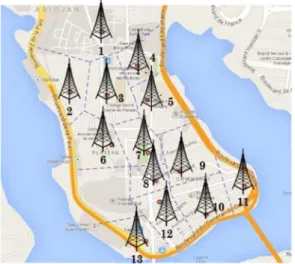
(a) CBDAreaofAbidjan (b)AnExampleofSequentialTaskAssignment
Figure3.1:TheUseCaseofAbidjan'sCBDArea
wecandividean MCStaskintoequal-length(Receive-Sense-Return)cycles.In eachsensingcycle,thecentralserverattemptstocollectsensingresultsfrom arequirednumberofparticipants. Withparalleltransferin mind, wecan signicantlyreduceenergyconsumptionindatatransferofasensingcycleif weareabletoassignsensingtaskstothemobilephoneuserswhowillplace (makeorreceive)twoor morephonecallsinthecycle.Theseusersreceivetask assignmentsandreturntheirsensedresultspiggy-backingthedatatransferon topofthecallsthroughtheparalleltransferapproach.
Insummary,toenableenergyecient mobilecrowdsensingwithTwo-call-basedMCS Mechanism,ourinitialresearch makestheassumptionsthat:
• Each MCStasklastsforalimiteddurationandinvolvesaseriesofsensing cycles;
• Allparticipantsreceivetaskassignmentsandreturnsensingresults,onlywhen theyareinvolvedincalls;
•Ineachcycle,aparticipant willbeassignedwithtasksnomorethanonce; • Duetoprivacyconcerns,allparticipantswillbeanonymizedforeachMCStask
insuchawaythat wecannotlinkanyparticipanttorecordsofherprevious MCStasks.
Basedontheaboveassumptions,ourresearchproposesan MCStaskassignment mechanismwhich meetstwoobjectives:
1.toensuretherequirednumberofparticipantsreturningthesensingresultswithin thecycle,and
Introduction 35 Tofurtherillustratetheproposedresearchassumptionsandobjectives,le tusrecon-sidertheaforementionedairqualitysensingusecase.AnenvironmentalNGOinIvory Coast,withthehelpofalocaltelco,launchesanairquality monitoringMCStaskin AbidjanCity'sCBDregionwhere25celltowersareinstalled(seealsoinFig.6.2). InordertoprovidethetimelyairqualitysensedresultstothecitizensofAbidjan city,theMCStaskisdesignedtoupdatetheairqualityreadingonceevery2hours (i.e.,asensingcyclelastsfor2hours).Inordertoprovidereliable measures,the applicationisdesignedtosecurethedatacollectionfroma minimumnumber(e.g., 80)of mobileusersinthetargetareapersensingcycle.Inordertofacilitatethe taskassignment,asshowninFig.3.1b,EEMCisdeployedonacentralserverwhich continuously monitorsall mobileusers'callsinthetargetregion,analysesthecall activitiesof MCSparticipants,anddecides,foreachincomingcall,ifaparticipant placing(makingorreceiving)thecallshouldbeassignedwithasensingtask.Please notethat,onlywhenaparticipant makes/receivesaphonecallinthetargetregion canshereceivethetaskassignmentorreturnthesensedresult.Inthisway,tasks areassignedinasequential mannerasnewcallsareestablished,tasksassignedand sensedresultsreturned.
3
.1
.2 Research Cha
l
lengesand Our Con
tributions
Inordertoachievetheproposedresearchobjectivesandvalidatethemthrougha realisticusecase,weaddressthefollowingkeytechnicalchallenges:
• Next-callPredictionforthenewarrivalcaller/calleebasedonaccumulatedcall traces-Itisnotpossibletoknowinadvancewhichofthecrowdsensingpa r-ticipantswillbeinvolvedin(two)phonecallsduringaparticularsensingcycle. Thus,weneedaneectivemethodforpredictingpossibleparticipationbased ontheparticipant'spreviouscallhistory. However,duetotheanonymization requirements,wecannotlinkauserwithherphonecallrecordsduringprevious MCStasks.Thus,thereneedstobeamethodtopredictthefuturephonecall patternsofusersusingtheiraccumulatedhistoryrestrictedtothecurrenttask. • Dynamicallydecidewhetherfurthertaskassignmentisneeded- No method
forcallpredictioncanbeperfect. Asaconsequence,tasksmaybeassignedto participants(basedontheirpredictedcallpatterns), whofailtobeinvolved inthe minimum2callsrequiredforthe\receive" and\return" stagesinthe sensorcycle. To mitigatethisproblem,weproposeassigningredundanttasks insuchawaythattherequirednumberofresultswillalwaysbereturnedeven ifindividualparticipant'scallbehaviourisnotaspredicted. Toavoidenergy waste,theredundanttaskassignmentsshouldbeasfewaspossible. Thekey decisionthathastobemadeisconcernedwithhowtoupdatetaskassignments (ifitall)whenanewcallisestablishedduringasinglecycle.
Figure3.2:TheTwo-phaseTaskAssignmentFramework
wouldsuggestthatitisagoodstrategytoassignatasktoanyuserwhohasjust establishedacall(callerorcallee),providedthattheyhavenotalreadybeen assignedataskandprovidedthatfurthertaskassignmentsareneeded. However, thismaynotbeagoodapproachifthisuserhasalowchanceofbeinginvolved inasecondcallbeforethecurrentcycleiscomplete. Thedecisionshouldnot bemadeinalocalmanner| itisbettertocomparetheprobabilityofthe user meetingthe2-callpercyclerequirement withtheglobalprobabilitysetof meetingthesamerequirementforallothercrowdmembers(i.e.,theparticipants havingnotplacedanycallsinthecurrentcyclebut withhigherprobabilitiesof placingtwocallsbeforetheendofthecycle).
Inthiswork,weproposeatwo-phaseapproach(illustratedbytheprocessshown inFigure3.2)inordertoaddresstheabove-mentionedchallenges. Considerthe situation whereauseris makingorreceivingaphonecall,our rstphasequeries andupdatesher mobilephonecalltraces,andidenti eswhethersheisacandidate fortaskassignmentbasedonphonecallprediction.Inthesecondphase,withauser for whomwehaven'tyetassignedanytaskinthecurrentcycle,atwo-stepdecision makingprocessisproposedtodeterminewhetherornot weshouldassignataskto her; wherethe rststep(usingtheAdaptivePaceControllerforTaskAssignment component)decidesiffurthertaskassignmentsareneededbasedontasksalready assignedandtheparticipantshavingalreadyreturnedtheirsensingresults,andthe secondstep(usingNear-Optimal Decision Makerfor TaskAssignment)decidesif thecurrentcaller/calleeshouldreceivethetaskassignmentthroughcomparisonwith potentialcallers/calleesinthetimeremainingofthecurrentcycle. Thedetailed
Introduction 37 contributionsofthisworkare:
1.Firstly,motivatedbysavingenergyindatatransferof MCStasksforbothind i-vidualparticipantsandthewholecrowd,weproposeanovel mobilecrowdsens -ingframeworkEEMCleveragingboththeparalleltransfer mechanismandthe Receive-Sense-Returncyclepattern,whilstalsorespectingtherequirementfor anonymity.Further,weinvestigateandformulatethetechnicalprobleminside EEMC| ataskassignmentdecisionmakingproblem| with minimalnumberof taskassignmentsasthegoalandthepredenednumberofreturnedsensedre -sultsastheconstraint.Tothebestofourknowledge,thisisthe rstworkwhich addressestheissueofenergy-e cient MCSdatatransferintheproposedway. 2. Secondly, wedevelopatwo-stepdecision makingprocess,andalgorithms,to
controlthetaskassignments. Whentheproposedalgorithm makesdecisionon taskassignment,itconsidersfourtypesofparticipants:1)thecallinguser,2) theparticipantsalreadyassignedwithtasks,3)theparticipantshavingalready returnedsensingresults,and4)thefutureuserswhoare(potentially)goingto maketwophonecalls.ThoughthisalgorithmisdesignedforEEMC,other MCS frameworkswithasimilaroptimizationgoal{but whichdonotassumethat eachassignedparticipant willreturnhis/hersensedresult{canalsobenet fromapplicationofthealgorithm.
3.Thirdly,weevaluateEEMContheD4Ddataset[15]containing4-monthcall detailrecordsofIvoryCoastcitizens.TheresultshowsthatEEMCcangua ran-teethattherequirednumberofparticipantsreturntheirsensingresultswhilst makingfewerredundanttaskassignmentsthanthebaselineschemes. When weconsideroverallenergyconsumptionindatatransferfor MCSapplications, suchasairqualityornoisemonitoringattheAbidjanCBDarea,comparedto thetraditional3G-basedschemethereductionisquitesignicant.Inourcase study,EEMCreducesenergyconsumptionindatatransferbyapproximately 75%foraspeci cparticipant, withaglobalreductionof54%-67%forthe wholecrowd.
3
.1
.3 Compa
rison w
iththe Mos
t Re
la
ted Work
Regardthestate-of-the-artdiscussedintheChapter2,wesortthemostrelatedwork ofourstudyintofollowingthreecategories:
1. Usinglowpower wirelesscommunicationasenergy-savingstrategyfor MCS datatransfer- The mostrelated workis[49,50]. Ourresearchfollowsthis approachbyleveragingtheparalleltransferwithvoicecall[51]asalowpower communication method.
2.Taskassignment mechanism minimizingoverallenergyconsumptionandtotal incentivepaymentunderthesensingdataqualityconstraint- Themostrelated
Symbols Denitions
t0 Thestartingtimeofan MCStask;
T Thedurationofasensingcycle;
Ne Theexpectednumberofreturnedparticipants
k Theindexofaspeciccycle;
t Theelapsedtimeduringcyclek,wheret2[t0+(K 1)T;t0+K T);
Ak Thesetofparticipantsalreadyassignedwithtasksinthecyclek;
Rk Thesetofparticipantshavingalreadyreturnedsensingresultsk;
Table3.1:SymbolsandDenitions
workis[33,34,35,36]. Di erentfromallpreviouswork,whichassumesthat eachassignedparticipant wouldreturnsensedresults,EEMCassumesthatas -signedparticipantsmaynotbeabletoreturnsensedresults. Thisisa much morerealisticassumptionasitcan,amongstotherthings,copewithacommon scenarioofaparticipatinguser'sphonebeingturnedo inthemiddleo facy-cle(perhapsduetothebatterylosingcharge).Inorderto managethismore realisticmodelofthecrowdofuserparticipants,amorecomplexallocationa l-gorithmbasedonredundancyneedstobeused. However,redundancyincreases energyconsumption.Thus,theresearchchallengeistohavea\faulttolerant" allocationmechanismwhichattemptstominimizethenumberofredundanttask assignments.
3. ValidationandExperiments- Thevalidationapproachesusedinpreviouspa -persuseeithersmallscalereal-worlddataoralargescalesimulateddataset. We arguethatthereareweaknessesinboththesetypesofevaluationapproaches; andweadoptalarge-scalereal-worldapproachusingthemobilephonedataset D4Dtoverifythee ectivenessofourproposedalgorithms.
3
.2 Prob
lemFormu
la
tion
An MCStaskconsistsofasequenceofsensingcycles| assumedtobeofthesame length/frequency| witheachcyclerequiringapredenednumberofsensingdatato becollected.Thisexpectednumberisthemostimportanttargetindatacollectionas sensingdataprocessingcanbecompromisedifinsu cientupdateddataisavailable. Forsimplicity,weassumethattheexpectednumberofsensingdatarequirementis constantthroughoutthetask,andbetweencycles.
Inthiswork,theMCStasksaretreatedasindependentofeachotherinorderto respecttheprivacyprotectionpolicy.Individualcallinghistoryinformationof mobile usersshouldnotbesharedamongst MCStasks. However,duringanindividual MCS task,thecallinghistoryofadierentgroupofuserscanberecorded,buttherecord
EEMCFrameworkandSkeletonAlgorithm 39 willexpirewhentheMCStaskends.Inordertocollectasetofsensingdatafroma singlemobileuserinonecycleitisnecessaryandsu cientthattheuserbeinvolved intwocalls:onecallforassigningataskfromtheserverandtheotherforreturning sensingdata. Also,no mobileuserinasensingcyclecanbeassignedthetaskof collectingsensingdata morethanasingletime. Withtheseconditionsin mind,we formallyformulatetheproblemasfollows.
Givenan MCStask withstartingtimet0,sensingcycleT,andtheexpected
numberofsensingdata Nefromasensingcycle, werecordthetime-stampsand
participantsmaking/receivingphonecallsfromt0. WedenoteAkasthesetof mobile
userswhohavebeenassignedwithsensingtaskssincethestartofcyclek,andRkas
thesetof mobileuserswhohavereturnedsensingresults,whereRkisalwaysasubset
ofAk. Everytimeaparticipant makes/receivesaphonecallinthesensingcyclek,
ourproblemistodecidewhethertoassignatasktotheparticipant.Thegoaloftask assignmentsisto:
minimizejAkj;subjecttojRkj Ne
bytheendofcyclek.Itshouldbenotedthat,aswecannotknowinadvancewho isgoingtoplaceanothercall, wecannotstaticallyoptimizethetaskassignment process.Therefore,thedynamicdecision makingfortaskassignmentsisbasedona phonecallhistoryandprediction model.Inthisway,ourresearchdecomposesthe originaltaskassignmentproblemintotwosub-problems:phonecallprediction,and thetaskassignmentdecision makingbasedontheprediction.
3
.3 EEMC FrameworkandSke
le
tonAlgorithm
AsshowninFig.3.2, EEMCconsistsoftwo mainphases: CandidateUse rIden-ticationbasedon CallPredictionandTwo-stepDecision MakingProcessforTask Assignment. Thesetwophasesaredesignedtosolvethetwosub-problemsfortask assignmentdecision making,respectively.Intherestofthissection,wewillbriey describeeachofthetwophases.
3
.3
.1 PhaseI- Cand
ida
teUse
rIden
ti ca
tionbasedon Ca
l
lPred
ic-tion
Givenanincomingcall,PhaseI ofEEMC rstchecksifthecallerisinthe MCS participantlist.Ifso,it willupdatethecalltracesofthecurrentcaller,andidentify ifthecurrentcallerisacandidatefortaskassignmentthroughpredictingherfuture calls. PhaseIhasasimpledesigntobeimplementedasasinglecorefunctional module:
• Next-CallPrediction ModelbasedonAccumulatedCallTraces. With historicalcalltracesofthecurrentcallerastheinput,aPredictiveModeles ti-matestheprobabilityoftheuserplacinganotherphonecallintheremaining time(fromthecurrenttimetotheendofcycle).