HAL Id: hal-01839208
https://hal.archives-ouvertes.fr/hal-01839208
Submitted on 31 Jul 2018
HAL is a multi-disciplinary open access
archive for the deposit and dissemination of
sci-entific research documents, whether they are
pub-lished or not. The documents may come from
teaching and research institutions in France or
abroad, or from public or private research centers.
L’archive ouverte pluridisciplinaire HAL, est
destinée au dépôt et à la diffusion de documents
scientifiques de niveau recherche, publiés ou non,
émanant des établissements d’enseignement et de
recherche français ou étrangers, des laboratoires
publics ou privés.
Micro-Ethics for Participatory Design with Marginalised
Children
Katta Spiel, Emeline Brulé, Christopher Frauenberger, Gilles Bailly, Geraldine
Fitzpatrick
To cite this version:
Katta Spiel, Emeline Brulé, Christopher Frauenberger, Gilles Bailly, Geraldine Fitzpatrick.
Micro-Ethics for Participatory Design with Marginalised Children. Participatory Design Conference, 2018,
Hasselt & Genk, Belgium. �10.1145/3210586.3210603�. �hal-01839208�
Children
Katta Spiel
TU Wien Vienna, Austria [email protected]Emeline Brulé
Télécom ParisTech Paris, France [email protected]Christopher Frauenberger
TU Wien Vienna, Austria christopher.frauenberger @tuwien.ac.atGilles Bailly
Sorbonne Université, UPMC Univ Paris, France [email protected]
Geraldine Fitzpatrick
TU Wien Vienna, Austria [email protected]ABSTRACT
Marginalised children are uniquely vulnerable within western soci-eties. Conducting participatory design research with them comes with particular ethical challenges, some of which we illustrate in this paper. Through several examples across two different partic-ipatory design projects (one with autistic children, another with visually impaired children), we reflect on the often overlooked ten-sions on the level of micro-ethics. We argue we are often required to rely on multiple moral frames of references. We discuss issues that the immediate interaction between researchers and marginalised children in participatory projects can bring and offer an under-standing of how micro-ethics manifest in these collaborations. We contribute to a theoretical exploration of ethical encounters based on empirical grounds, which can guide other researchers in their participatory endeavours.
CCS CONCEPTS
• Human-centered computing → Participatory design; Acces-sibility theory, concepts and paradigms; • Social and professional topics → Codes of ethics;
KEYWORDS
Children; Marginalisation; Participatory Research; Ethics ACM Reference format:
Katta Spiel, Emeline Brulé, Christopher Frauenberger, Gilles Bailly, and Geral-dine Fitzpatrick. 2018. Micro-Ethics for Participatory Design with Marginalised Children. In Proceedings of , , ( ), 12 pages.
https://doi.org/
1
INTRODUCTION
Involving children in research, particularly in participatory re-search, comes with specific ethical challenges [30]. Children belong-ing to marginalised groups, such as disabled children, are particu-larly vulnerable. Their social context challenges the assumptions of researchers about ethical conduct in unexpected ways [4, 62]. However, there is broad consensus that involving such groups is essential, both regarding processes and outcomes [42]. It avoids
, , . ACM ISBN . https://doi.org/
basing the design of technologies on the assumptions of develop-ers and designdevelop-ers about the lived experience of their target group, which, in turn, would further contribute to their overall marginalisa-tion [50]. Consequently, it is critical to establish ethical frameworks and guidelines for such research collaborations, as well as foster a culture of continuous discussion and reflection to improve prac-tices [25].
The majority of guidelines tend to focus on deontology, i.e. an-ticipatory ethical principles, expressed as preparatory checklists to go through. They may also underline the importance of the researcher’s virtue and caring skills (e.g., [25]). However, while conducting activities with marginalised children, researchers are required to make judgements on the spot, which either may have been unforeseeable or may create a contradiction to over-arching ethical principles.
The general approach of ethics guidelines systematically over-looks a multitude of situated judgements. We argue that these judge-ments, which often remain tacit and implicit, need to be transpar-ently examined. With this paper, we contribute to existing research on the ethics of researchers-participants collaboration in participa-tory design [50], which so far has rarely focused on marginalised children. First, we illustrate a range of ethical dilemmas we encoun-tered during two different participatory design research projects. We argue that in many occasions ethical guidelines provide inade-quate guidance for researchers to act ethically during the actions in-situ. To address this issue, we delineate a space for discussing tacit, situated ethical judgements, both for research and training purposes. In doing so, we expand existing micro-ethical approaches [34] to the area of participatory design with marginalised children. After reviewing fundamental concepts in ethics and related work in participatory design (PD) with marginalised children, we exam-ine nexam-ine examples which illustrate micro-ethics through our case studies, drawn from two different participatory design projects with disabled children. We unpack their motivations, impacts, and weigh alternative decisions we could have taken. We discuss these examples to flesh out a research agenda on micro-ethics for PD with marginalised children and identify central themes of concern. Fi-nally, we articulate an understanding of micro-ethics in the context of PD with the view to speak to practitioners more generally.
2
BACKGROUND
To contextualise our research, we first present key theoretical con-siderations regarding ethics in research. We then discuss care ethics, the ethical framework used in both research projects. Subsequently, we outline critical aspects of research ethics in participatory de-sign before we go into more detail for the specifics of participatory research with marginalised children.
2.1
Research Ethics
2.1.1 Theory: On normative and applied ethics. Ethics, or moral philosophy, is concerned with the study of what constitutes a good life and, consequently, how we should live [13]. Within this field, normative research ethics focus on determining what general laws should be followed in conducting research activities, and applied ethics look into how we can think ethically about specific issues. Our research projects combined a set of standard deontological guide-lines (e.g., informed consent) with a strong focus on researchers’ virtue, and more specifically their ability to care. Care ethics, which stems from feminist studies, postulate that all beings are interde-pendent. This approach aims at highlighting the often hidden or under-valued relations of care. It emphasises the inter-relationships that constitute society. Care supposes: (1) being attentive to others’ needs, (2) taking responsibility for responding to them, (3) being skilled in providing care, while (4) being mindful of the potential abuses of care and the subjective perspectives of others on the care received [63]. In care ethics, individuals are inclined to care for others.
The balance between interdependence and agency, however, is fragile. Care can pave the way for abuse, both for the care-giver and the care-receiver [7]. If we were to focus only on the needs for care, we might miss occasions to let someone learn to care for oneself. A care-based approach cannot be separated from more general objectives–such as, in the case of participatory design, the aim to support democracy and individual’s empowerment [46].
To sum up, diverse moral frameworks are used in research. For the cases presented in this paper, we adopted a mix of deontological and virtue ethics, which is consistent with recommendations for research with children [2, 25] and with the roots of virtue ethics in participatory design [61]. However, institutionalised ethics focus primarily on deontology and our research leads to challenges that we argue should be examined at a micro-level.
2.1.2 Application: Institutional ethical approval. Institutional ethical approval of research, such as by the Internal Review Boards in the United States of America, often focuses on ensuring that de-ontological rules are respected (autonomy, beneficence, nonmalefi-cence, and justice). However, these boards are not standardised and come with different requirements at each institution [35]. In both our case studies, there was no institutional ethics approval process which required us to go through a formalised review, leaving the ethically sound conduct of said research in our own hands1. On the one hand, this can be a risk. On the other, it provides an opportunity for researchers to more carefully reflect on their practices.
1This remains relatively common in some European contexts to this day, notably
France and Austria, where our research was conducted.
2.1.3 Micro-ethics. Our paper belongs to the domain of applied ethics. More specifically, we focus on micro-ethics, i.e. the ethics of “what happens in every interaction” between individuals[34]. Initially developed for health care contexts, it puts the focus on seemingly mundane, yet ethically charged matters: the presenta-tion of food in hospitals, the language used by doctors etc. It is also dialectic: decisions made by the patient also have ethical signifi-cance. For Komesaroff Komesaroff, prescriptive ethical principles are ineffective, as they are subject to change in situations they could be applied to: there can only be themes and practical cases. In the field of engineering and computing (or in professional ethics in general), “‘microethics’ can be seen to include concern with indi-viduals and the internal relations of the engineering profession” [29]. The concept focuses on professional codes of conduct and responsibilities in technical choices, such as being attentive to the risks embedded in a system’s design [8], and contrasts this with taking responsibilities for the impact of a technology on society.
PD research is historically concerned with building systems with and for people, towards a fairer society [18]. This is consistent with micro-ethics in engineering. PD researchers also care for provid-ing participants with opportunities to develop their creativity, for encountering others or for developing joint inquiry [61]. Those are forms of professional micro-ethics. A PD researcher would be careful about turn-taking in discussion, for instance, because of these guidelines. We want to propose a micro-ethical approach closer to that of Komesaroff [34]. With this article we focus on relationships between researchers and marginalised children as they unfold and create a context for participatory design. We further argue ethics are produced through ‘doing ethics’ or rather making situated judgements that feed back into a larger understanding of what ethical conduct means for a society [38] and for the re-search community. Focusing on cases of micro-ethical decisions requires researchers to explicitly reflect the values underlying their actions, how they understand participants’ values, and the dialectic production of their relationship.
2.2
Ethics in Participatory Design with
Marginalised Children
2.2.1 Ethical Principles and Approaches. Historically, participa-tory design aimed at reinforcing democracy by acknowledging and supporting a diversity of voices [27]. It is often framed as inherently attentive to ethics and caring relationships [61]. Research on ethics in this body of literature take different perspectives around four central questions [50]: Who do we engage as participants? How do we engage with them? How do we represent them2? What can we offer in return? To answer these questions, many approaches co-exist, each at different levels of generality. Some scholars apply ethical theories to participatory design [26]. Others propose frame-works, either anticipatory or updated along the research process [49, 65]. A few have investigated the often implied beneficial effects of participatory design outside of the research project itself (and found them limited) [18]. Further work discusses the researchers themselves, and how their assumptions shape the research process and its outcomes [41].
2We address this specifically for our context in Section 3.1.
More generally, the field of human-computer interaction (HCI) has recognised the limitations of exclusively anticipatory ethics. In a series of workshops at HCI venues, key researchers have argued that the increasingly explorative, contextual and value-driven nature of HCI work requires a more nuanced approach, which they call “situational ethics” [47, 69, 70]. A similar argument is made by Frauenberger et al. who argue the need to complement anticipatory ethics approaches by a reflective design practice that is guided by an individual or collectively negotiated ethos [22]. With reference to Schön’s reflective practitioner [54], they call this “in-action ethics”. Our work builds on this strand of research, but does so by fo-cusing on situated moral judgements made by researchers when working with marginalised children, and on how these influence the research partnership rather than the research outcomes per se. The originality of this paper resides in the micro-scale we use to look at ethics, and the groups we worked with.
2.2.2 The Case of Marginalised Children. Marginalised children come with specific individual circumstances that require careful considerations which become mostly relevant in-situ. Marginali-sations can be vastly different. Examples of marginaliMarginali-sations for children include the experience of seeking asylum, being disabled, living in a low-income household, growing up with adoptive or fos-ter parents, being fat or a person of colour. While not an exhaustive list, it illustrates the diversity through which marginalisation can occur – often in more than one aspect [53].
The experiences of marginalised children (or communities in a broader sense) are often overlooked in research and policies. We de-cided to focus on marginalised children as a way to counterbalance this under-representation [68], which is consistent with the aims of participatory design. However, some scholars have argued that focusing on marginalisation may backfire and essentialise inequali-ties and that marginalised group may oppose such categorisation [44, 48, 67]. Potentially, it can enable resistance–or reinforce biases against marginalised groups. However, this decision required us to explicitly engage with the specific power differences posed by the research [3].
Even when researchers are trying to establish a relationship with the children that aims at minimising the power differences between them, multiple aspects play into any participatory research which inherently leads to ethical complications. Researchers are older than the children and their statements are given more validity within society. Marginalised children are often not directly heard, and their accounts are continuously interpreted and re-framed. As researchers, we need to be aware of these experienced power differences and how they actively shape our collaboration. Further, we need to be especially careful to monitor who is making which decisions [10].
Especially in longer-term collaborations, the children build up trust towards the researchers. It may result in researchers becom-ing aware of private and confidential information, which is of less concern the other way around. Hence, careful management of hi-erarchies and how they might be subverted in the interest of the children becomes paramount (see also, [1]). In particular, we want to emphasise that "children may exploit, appropriate, redirect, contest or refuse participatory techniques" [24]. Such subversive strategies of the children can be identified and then encouraged – especially
with marginalised children as they are often limited in the resistance they can exercise in their daily life.
We now illustrate how we encountered these aspects in two different participatory design research projects with marginalised children.
3
CASE STUDIES
These case studies demonstrate the setting from which our analytic work stems and provide useful examples which illustrate the messy context in which ethical judgements are continuously necessary on multiple levels.
Both participatory design projects were conducted with disabled children. In OutsideTheBox, we co-designed technologies with autis-tic children, whereas, in MapSense, we collaborated with visually impaired children. The projects were conducted by two different research groups without any cross-collaboration before the writing of this article. While these can be seen as two specific contexts, the discrimination faced by the children were often similar: Both groups of children were met with adversarial attitudes by their peers due to their occasionally quirky behaviour and communication modes. In our work with disabled children, we initially did not put the focus on other forms of marginalisation, such as race3or gender identity. Through understanding the children as marginalised, we frame disability as a physical difference as well as a social exclusion [45], hence creating a lens through which we position the children together with the agency over their own life. As an essential aspect of both projects, we focused on the enablement [15] of children, through a participatory design process.
3.1
A Note on Language and Representation
How we represent participants in our research is one key question in participatory design ethics [50] and comprises a case of necessary continuous ethical judgement and reflection. One aspect of this question is how we name and categorise them [37]. When talking about marginalised individuals, there are three main ways in which to formulate a reference:
• identity-first, also called label-first language, in which the descriptor comes before the larger group, e.g., autistic people • person-first, where the larger group comes before the
descrip-tor, e.g., people with visual impairments
• a mix of both, which occurs when a text mixes both forms to acknowledge both versions
Person-first language had been established within a social model of disability to counteract label-first language which was then deemed to be rooted in a medical model [43]. The argument is that by ref-erencing the person before their disability-related descriptor, the person would come into the foreground and the disability would be-come secondary [9]. Louis [36] showed that this hope for a positive change about perspectives on disabilities appears to be unfounded. According to their research, "person-first terminology d[oes] little to lessen negative beliefs and attitudes". Sinclair [55], an autistic self-advocate, goes even further and ridicules person-first language. Their three arguments against using person-first language come down to these:
3Just to be entirely clear: We adhere to a concept of race as a powerful social construct
[72]. 3
• the language detaches the person from their condition as if it would be an additional part and not essential to their identity and being;
• it furthermore plays down the pervasive effects of the condi-tion
• and, lastly, by separating the condition from the person, it becomes something negative, seeing that positive labels such as ’beautiful’ or ’smart’ are not phrased in a way that detaches them from the person they describe
Additionally, Kenny et al. [33] established that identity-first lan-guage is endorsed more by autistic individuals and their social environment (albeit not in a majority) whereas professionals prefer to use person-first language. Similarly, there is an active discussion within the field of Psychology on which type of language is deemed more appropriate to use, with strong proponents for identity-first language [16]. However, when talking about a specific child we col-laborated with, we acknowledge the preferences that were given to us by the child or their social environment to honour their agency on the matter.
In a similar notion, we use ‘allistic person’ to refer to a non-autistic person. This term, as coined by Main [39], stems from the greek άλλος meaning ‘other’ and, hence, references the opposite of αυτός meaning ‘self ’. Similarly, we use the adjective ‘sighted’ for people who are not visually impaired.
3.2
OutsideTheBox
In OutsideTheBox, we co-designed technologies with autistic chil-dren. Each design process was conducted with an individual child to create a unique object which would support the well-being of that particular child instead of trying to make wider claims on in-tervention across the population of autistic children. In total, we had eight case studies over the span of three years. In each case, two adult researchers met with one (or, as partly in one case, two) children every other week resulting in a total of ten to 20 different meetings with each child. We discuss unique issues we encountered that allow us to illustrate a range of ethical judgements we had to make during the participatory design processes. We are deliber-ately not reporting on the design processes [21, 40], the outcomes of the process [23, 59] or our reflection and evaluation within the project [20, 57, 58, 60], but rather concentrate on the situated ethical constraints of each collaboration.
Autism is diagnosed along a triad of characteristics [6]. Autistic people experience difficulties with neurotypical modes of commu-nication, interaction and imagination. Their behaviour is often classified as restricted, repetitive or stereotyped. We follow an un-derstanding of autism as a variation of a neurodiverse spectrum [56].
While the institution in which OutsideTheBox was carried out, does not require any formal ethics approval, we were guided by a collective ethos that was partly articulated, partly implied in our working culture. We recorded this in an extensive document which acknowledged potential issues and benefits for parents, teachers, children and researchers as well as strategies to resolve tensions between stakeholders. The formalised ethics in these documents framed the research activities, but there was also a necessity for eth-ical judgements emerging in-situ and for which the consequences
were not always clear. These are the types of ethical encounters, we describe.
3.2.1 Enabling Experiences. During our first meeting with one of the children, he was eight years old. His use of language was somewhat idiosyncratic and required knowledge of context and interpretation which meant that we as outside researchers had to tread carefully to not override his goals and agency. The child was initially a little reluctant to work with us, but warmed up when we explained that our activities would revolve around drawing and playing. He seemed to enjoy these activities and indicated looking forward to our next meeting.
At the start of the second meeting, we set up the session in the design room, when suddenly the classroom door opened and the child stood there. When he saw us, he yelled: "NO!" and slammed the door shut. His teacher came back and informed us that it might be difficult to conduct a session with him as he had indicated all day that he was not looking forward to the meeting. Five minutes later, she pushed him into the design room. He sat down, but covered his eyes and refused to interact with us. However, the teacher urged us to start the session regardless. Here, we trusted the teacher’s judgement to engage with the child against his stated desires.
What made him eventually warm up to us, was a video camera we had installed in a corner of the room. Once he investigated it, he happily collaborated in all other tasks for this session. We finished by giving him a single-use photo camera with which he could capture things he found interesting until our next meeting. He was quite excited about the flash functionality and indicated pride when his classmates admired him for having it.
At the start of every further meeting, he played hiding games and initially refused to work with us. It became part of a ritual where we had to rebuild the trust to work with us anew every single time. To some extent, this behaviour bothered us, but since he enthusiastically reported to his teacher after every session how fantastic it was to design with us, we continued our work with him. In this collaboration, we had to actively and consciously override the child’s expressed desires at the start of almost every session. While we did so in agreement with his carers, we also went against one of our core ethical guidelines, which dictated that our processes were supposed to be child-led and that the collaboration could be ended at any point by any involved parties. We did so because we weighed the initial refusal against the positive experiences the participatory design processes could offer and which he continued to praise after the fact. However, it could have been, that at some point he would not have regarded a session as a positive experience in which case, our judgement may have caused more harm than good. Trusting the teacher’s judgement and overriding our own virtue ethics eventually led to a positive outcome for the child, the researchers and the participatory design process more generally. However, at each point of engagement, we could not have fore-seen the consequences, which shows how risky these necessary judgements can be.
3.2.2 Child Context. While in all other cases, the collaboration between researchers and children was initiated by schools or men-tors, in one particular instance, a parent had heard of the project and wanted their eight-year-old son to participate. In this case, we
had closer parental involvement than in others. In the first meet-ing with said parent, they informed us about the preferences and dislikes of their son and also mentioned that they were not only seeing themselves as a parent but also as an Applied Behavioural Analysis (ABA) therapist for their child. They also implied that they expected us to follow the structural approach of ABA. However, after close inspection of the principles of this kind of therapy, we felt uncomfortable adhering to it. Seeing that ABA requires the child, to be under a near-constant therapeutic setting (‘intense’ treatments expect 36 hours of therapy per week [19]), we wondered when the children were allowed to follow their interests and be self-guided. We do not intend to go into the details of the contro-versies surrounding the approach [14] but want to illustrate our critical stance towards it. Still, we continued our collaboration with the child as we saw an opportunity to create spaces for self-guided interests through participatory design.
Especially at the beginning of our collaboration, we noticed that the child was quite shy and more trying to find a ‘correct’ answer to a task than expressing himself through it. This behaviour is of limited usefulness when engaging with children in design. It took us four sessions until he started opening up to play activities through which he was able to express ideas and concepts.
When we enquired about the frequency of use of the final object he created, the parent informed us that they used it during ABA and that the child was not playing with the artefact in a self-driven fashion. By connecting the technology to therapeutic activities within the home environment, the child refrained from using it in the playful modes of interaction we had established between us during the design sessions. However, when he was with us, he happily shared his experiences and wanted to engage with us over and with the object. Unfortunately, the object use eventually remained solely within a therapeutic context.
Through our rejection of the dominant therapeutic model, we ended up ignoring a core part of the child’s context and what it meant for the further use of an object once the participatory design cooperation ended. We were not well prepared for a shift in use that would be initiated by his parent and failed to negotiate our values with those coming from the child’s context in a productive way. Hence, we might have missed an opportunity for empowerment.
3.2.3 Bodies in Research. In several of our collaborations, the physicality of our bodies mattered. Children sat in our laps or climbed on us during design workshops, disregarding whether researchers felt comfortable with this interaction or not. However, as long as bodies were used playfully, we were able to establish and negotiate boundaries through play. In one case, though, our physical bodies mattered as signifiers of hierarchy and dominance. When working with two brothers (five and seven years old), we did not meet them in an established school environment, but rather in a section of their parents’ workplace. Hence, the physical space was much more known to the two of them than to us, and that power structures were challenged more strongly than when we had worked with the older one alone at his school. While we encourage these subversive strategies on most occasions, the exploration of so-cial boundaries led to situations in which the researchers could not foresee potential consequences and occasionally even had to fear for the children’s physical safety, for example, when they started
throwing objects in a room with cardboard boxes full of glasses. However, intervening meant here – due to the architecture of the space –, using the larger, stronger body of the researcher to pick up the child and physically move them out of the zone of potential danger.
Ultimately, both children seemed to appreciate us as design part-ners and liked engaging with us, even though we had to assert a more hierarchical position and sometimes manifest it through bodily interactions to keep them safe. Using our bodies to assert dominance in situations where children could be harmed or cause damage to their surroundings was uncomfortable. Our general eth-ical framing had the value that the children should not be exposed to harm, but using one’s body as a tool for setting the children out of potentially dangerous situations also meant counteracting against a child-led process and making power dynamics we tried to tear down in our interactions all the more visible. We deem our judgement of the situation appropriate, but it led to broader ethical implications about the nature of our collaboration with the children than apparent in the moment of execution.
3.2.4 Leaving the Field. Another nine-year-old child we started working with had just recently been diagnosed. She and her parent were still figuring out what the diagnosis meant to them and others. Since one of the researchers had an autistic family member, the par-ent bonded quickly with them and asked for support and strategies she could try out with her daughter. They also sought out advice when the family experienced hardships that were unrelated to our collaboration with the child.
Due to this closeness we were even invited into the family home. Although we realised that this was different from most other col-laborations, we judged this as appropriate within the relationship we had established with the child. Within the home environment, we witnessed complex family dynamics with other members. Af-terwards, we decided to more actively push an agenda of empow-erment not only with the child but also with her parent. Including the child’s social environment made the relationship even more personal than in other collaborations.
We understood the process of ending our relationships as ‘tran-sitional’, in which the needs of multiple stakeholders (parents, chil-dren, researchers) are negotiated [11]. We had been such an es-sential part of their lives that we felt an abrupt ending would be uncalled for. Our strategy was then to phase out the contact slowly by having longer intervals between meetings after our primary design and evaluation processes had ended. In those meetings, we discussed aspects of the child’s life, designed little tokens or re-viewed our work – with longer and longer time spans in between. When designing for the life worlds of marginalised children, researchers cannot avoid becoming part of that life world. We had to negotiate our professionalism with how close we grew with this family. It then became a question not only of which roles we can expect to fill ourselves but also on how we could end our collaboration with the child respectful of everyone’s needs. We had to act carefully and deliberately not to abuse the trust that was put in us as researchers and designers, but also as individuals.
3.2.5 Intersections. Within OutsideTheBox, the child partici-pants were often marginalised in more than one aspect of their lives. For example, several children were not raised by parents of
the same nationality of the country they resided in, and two chil-dren expressed complex issues around their gender identities. For one of the children, the family context had stringent boundaries and expectations when it came to gender preferences and behaviour. In this context, we had to mindfully weigh acknowledging a child’s desires with the consequences they might face in their immediate environment for expressing them.
In the other case, the child’s parents actively sought our advice on how to identify and handle trans identities. Since one of the researchers in the project is non-binary themselves, they had to pay close attention to not bring their agenda into the research, effectively over-interpreting the child’s stated desires. Hence, they consciously did not address any related topics themselves and only reacted to the child if they brought something up (such as the fixa-tion on pink and purple colours in the case of one child which has been assigned male at birth). Even though these marginalisations were not in the focus of our research with the children, it was im-portant to be aware of them and acknowledge them as relevant for productive design partnerships.
Being aware of further aspects of marginalisation in a child’s life could allow co-designers to develop more relevant technology for the children. However, if researchers share a marginalisation, they might be putting too much focus on it. To counter this risk, we shied away from discussing overlapping marginalisations with the children without their explicit input. However, without positive (or in some cases even just any) role models, children might not find ways to express themselves productively in their identity (as has been shown, for example, for boys in primary schools with predominantly female-presenting teaching staff [5]). In choosing to refrain from not bringing up specific topics, we reduced the children again to the marginalisation focused on by the research context (in this case the disabilities) even though we aimed at designing for their holistic life worlds.
3.3
MapSense
In MapSense, we co-designed technologies with visually impaired children (some of them living with additional impairments) and their teachers or therapists (e.g., orientation and mobility therapists). The purpose was to explore how to design technologies for more enjoyable experiences in the classroom for children in primary and secondary school while supporting adults’ educational goals. Often, these youngsters had framed the classroom as an adversarial space in initial interviews. Rather than aiming at validating the usability or educational gains of the prototypes, we aimed at studying how a design process might modify the relationships between children and teachers, and provide design inspiration to others. During this two-year ethnographic study conducted in an organisation provid-ing all required services to this population (educational support, rehabilitation etc.), we designed more than ten different probes and prototypes, used by 15 children.
As with OutsideTheBox, we focus here on specific ethical issues that arose during that process. At the time we began MapSense, our institution did not have an ethics committee or formalised pro-cedures for participatory research projects. We thus developed our own approach, building on the UNICEF’s guidelines for ethics in re-search with children [25], and the literature on care ethics in action
research [71]. Furthermore, we kept a detailed auto-ethnographic diary to reflect continuously on our difficulties (similarly to [41]). While we had conducted a substantial literature review for struc-tural, ethical issues (e.g., how to handle differentials of power be-tween adults and children participants), there were situations that required rapid ethical decisions with unclear consequences at the time.
3.3.1 Preserving the relationship with adult gatekeepers. Though we were very engaged in trying not to constrain the children, this was not the case for the established adults taking care of them (hereby named “carers”). For instance, a carer wanted to observe a child manipulating a probe (a 3D printed tactile globe). While the researcher was interested in the child’s comments and critiques, asking only questions for clarification, the carer wanted to trans-form this activity into a trans-formal learning task. She started asking more restrictive questions or making comments such as “no, you’re wrong”. To not compromise our collaboration with the carers, which was fundamental for collaborating with the children, we retreated from the interaction by slightly moving away and remaining silent. After a few minutes, the child stopped answering and turned away. Such withdrawal from interaction happened at other times as well: when we tried to help a child regulating their emotions, his teacher intervened and told the child to cry somewhere else. In another case, a carer wanted a teenager to demonstrate how to use newly adapted computer software but the teenager refused.
In other words, there were apparent differences between our approach and that of the carers. In these interactions, we had to balance two issues of trust: maintaining the trust of the child, which had taken time to build and maintaining the trust of the carers to be able to work further with children (which in the carers’ views includes “enforcing discipline”, and “making children do what they’re supposed to do”). Additionally, we had to preserve the conditions for the participatory design research. For instance, we did not want to give a child the impression that there were right or wrong answers in the design process.
However, withdrawing from interaction also meant that we did not directly engage carers on the subject of educational norms, even though this might have been beneficial for the children as well as the carers. Furthermore, we let children go through an apparently distressing experiencewithout intervention from our side, which affects the level of trust in the researcher.
3.3.2 Demonstrations of affection. Similar to OutsideTheBox, one issue, arising mainly when working with younger children, or children with multiple impairments, was the physical contact initiated by them. Such interactions involved hugging, haptically exploring the body of the researcher (which can be part of how vi-sually impaired children get to know and engage with people), and activities such as dancing. We did not refuse any of the contacts ini-tiated by the children, as we considered this a form of relationship building. We also found that these activities were an essential part of the development of trust. However, we sometimes felt uncomfort-able, were unsure of how children understood our relationship, and how we could manage it. To protect both, children and researchers, there were always at least two or three adult researchers present.
At stake was the interchange of care: whereas it is accepted for researchers to care for children, it feels somewhat dangerous to
take care of children given the fact that researchers’ presence is very temporary. Furthermore, discussing their expectations was dif-ficult, as this was not something they were used to do. Additionally, children would sometimes forget about previous meetings, while at other times they would not. Judging the appropriateness of this form of engagement and its consequences was thus difficult to fore-see, which also raises the question of how we develop rapport with participants, who do not have a shared mode in which to manage and reflect on social relationships as we do as adults, trained to interact with children.
Our strategy was to adopt a transparent mode of communication, based on the acknowledgement of the exchanges with them and the duration of the study. We informed them every time when we would come back and when we would ultimately leave and re-assured them that the probes and prototypes would stay with them. Indeed, these were framed as gifts, or proofs of interest and affection by the children. However, the adequate distance in our research relationships with the children remains an open question. Additionally, it is unclear to what extent we can ask researchers to actively become comfortable with physical interactions with children.
3.3.3 Confidentiality. In a different instance, during a research interview, a 17-year-old male-presenting teenager asked questions about the romantic life of the (25-year-old) field researcher. When she indicated that such questions were inappropriate, he proposi-tioned her using further inappropriate language. This particular teenager had been described to us as “deviant” by the organisation staff.
Following this, the researcher reminded him that he was a minor and that she was acting in a formalised working setting, which made this interaction inappropriate on two grounds. She also explained that declining to answer his first questions marked the refusal of such interactions, a refusal that should be respected in this and other contexts. She encouraged him to ask questions about roman-tic relationships to an adult he knew and trusted and informed him of an official website, which provides sex education resources and contacts with educators and social workers to teenagers. He replied that this was just something he often attempted with young (female) adults he met. The researcher immediately stopped the interview after this. She then purposefully decreased the frequency of interactions with this teenager. The incident remained isolated. In our opinion, there are three ethical issues at stake here. First, the field researcher was not formally trained or authorised to dis-cuss these topics with a teenager. A professional carer could have had a better strategy to handle this situation. Second, not every family agrees with teenagers receiving sex education. Even though the resources provided were designed by a governmental agency, making this call can be opposed by other carers. Third, we found this behaviour worrisome: the reasons behind it were unclear, and if repeated, the student would have gotten into trouble, especially as he would soon after legally be considered an adult. But we also guaranteed him that everything he said during the research process was confidential. Because this did not happen again, we provided him with resources he could consult and, not wishing to fuel dis-courses labeling him as deviant; we did not report the incident. We
judged this to not fall into the “minor in danger” category, which we would have a legal obligation to report.
3.3.4 Being “other-gendered”. In research with marginalised children, how researchers present themselves and their research to the social environment of the children becomes a concern. An exam-ple from MapSense is about the physicality of the field researcher’s body. Because the field researcher did not fit gender norms (tradi-tionally female first-name, short hair, tradi(tradi-tionally male clothing, deep voice, taller than most women etc.), children would use one or the other pronoun during the interaction. They also sometimes asked why the researcher was different, to which we answered that everyone could wear any clothes and have any haircut. We note that the pronouns used depended on the context, and in particular, on the on-going activity. Reading was associated with ‘she’, while cycling was associated with ‘he’. In design activities, the children used both pronouns. In some occasions, children were told by their carers that they were wrong to use ‘he’ to identify the researcher. Teenagers, on the other hand, insisted on knowing which gender to attribute. As the researchers were often ascribed to different genders (e.g., male, female, non-binary) across multiple contexts, they did not take issue with this.
However, this still posed several problems. The first was that we were unsure about parents’ reactions if they were to learn about this. Indeed, there has been a renewed anti-LGBT movement in France during the last few years4, which opposed discussing, or even mentioning gender issues in schools. Would they have agreed to their children participating in the research if they had known the researcher was gender nonconforming from the start? The second is that no one should be discriminated against based on their gen-der expression and, thus, be barred from conducting participatory research with children. On the other hand, parents are entitled to protect their children from whatever they see as a danger. Third, if children were to ask questions to their parents about gender expression because of this, it could have negative effects for them. Yet, providing a positive identification model to children seems in line with our stance on care ethics. We decided not to discuss gender explicitly with the children, even when they actively enquired. This also means that those who may have needed someone to talk to were not encouraged to do so. Not engaging in such discussion was the most straightforward choice for the research itself, and we hoped that this approach would reduce the perceived importance of gender in social interactions.
4
DISCUSSION
Across the individual case studies, we identified several reoccurring challenges, but our judgements differed according to context and needs. In our discussion, we highlight the consequences of these different judgements which builds the starting point for an under-standing of micro-ethics in participatory design with marginalised children.
4.1
Negotiating Multiple Agendas
While carers play a role in any work with children, in research with marginalised children the carers’ presence is even more prominent.
4hrw.org/news/2017/05/17/struggle-lgbt-rights-france
As social workers, medical personnel, specialised teachers, thera-pists or family members, they set the frame and structure of the children’s life. In our case studies, carers framed the research in unexpected ways. Our strategies in negotiating with carers were manifold, all of them with unforeseeable consequences at the point where they had to be enacted.
• We withdrew ourselves when a co-researcher or other adult acted contrary to our judgement and only discussed our con-cerns afterwards. While this meant that children were poten-tially exposed to negative experiences, this approach seemed more effective in a setting where we would not threaten a carer’s authority as a by-product. As the carers were gate-keepers to the participatory research, we had to partly adhere to their desires as well. This aspect of participatory research with marginalised children inherently complicates virtue ethics proclaiming child-led processes.
• We established alternative approaches to working with the children. In part, this meant excluding or ignoring parts of their context during the design process for the benefit of opening up new spaces in which empowerment and de-sign activities were possible. Together with the withdrawing strategy, however, this potential space becomes fleeting and insecure as it can only happen through precariously balanc-ing the values of carers and researchers alike.
• We carefully navigated the influence of different carers and mediated on topics where there were already existing ten-sions between carers and children. This strategy had several sub-strategies where we would either not bring up a contro-versial issue (or change the topic with reference to external sources) or talk about it in a normalising way to everyone involved. Which one of these sub-strategies was adequate changed according to the context of the situation in which it occurred, as can be seen in how they were differently applied within and between the projects.
These strategies show that even in participatory design research in which we attempt child-led processes, carers play a relevant role in creating the circumstances for our research. As such, their tangen-tial role in participatory processes might be under-conceptualised. In our cases, their presence made us carefully prioritise certain top-ics over others, which meant they had circumstantial influence on the participatory design work and its outcomes. Hence, an analysis of Carer-Children-Researcher relationships through an ethical lens can increase an understanding of how our processes are shaped and which strategies exist in including carers more transparently. That way, caring strategies in research can be negotiated explicitly – appropriate to the level of involvement in the research activities –, which might resolve potential tensions beforehand.
4.2
Being at Risk
When working with marginalised children, risks become at the same time more explicit and more implicit. We have to take care of the marginalised children and ensure that we are not exposing them to harm, but we are also vulnerable ourselves. Our comfort zones are continuously challenged. When children are invited to long-term research collaborations needed for participatory design with disabled children, they are also enabled to build complex personal
relationships with researchers (including, for instance, demonstra-tions of affection). On the one hand, this might allow them to make new experiences and widen their horizons, on the other, the more personal relationships get, the more vulnerable the children and the researchers themselves become.
How to appropriately balance professional conduct and personal relationships is a matter that can only be practically engaged with during the research activities; anticipatory deliberations remain theoretical and speculative (see also [38]). In the case where a par-ticipant displayed inappropriate conduct during a research activity, we had to weigh the risk of the child being impacted disproportion-ately in the future, the risk of the researcher who was unsure how to appropriately handle the situation and who was in a position of liability, and the adherence to the confidentiality of the meeting which has been ensured to participants before they engaged in the research.
Hence, participatory design projects not only pose potential risks to children but also to researchers. These risks are not always physical, but might also affect mental health, the career of people involved, or the development of the children. While researchers might not ever be able to eliminate or foresee all risks, it helps to be aware of them and consider which choices might lead to which potential outcomes and the attached risks for researchers and children or other stakeholders in the participatory processes alike. As a core point of care ethics, all participants in the research – researchers as well as marginalised children – are vulnerable and ‘at-risk’ when they cooperate [63]. It is, ultimately, a matter of our own judgement to limit the risks for people, in a context where the most appropriate procedure is not necessarily clear-cut.
4.3
On being Care-ful
In both our projects, we envisioned the processes as child-led. We understood the children as design partners with equal rights who were not only shaping but leading the design. In practice, however, we had to carefully negotiate with the children about their level of participation. In the most extreme case (see Section 3.2.1), we were initially timid and unsure about how to proceed but over time became more confident in our judgement. We convinced the child to engage with us since they continuously expressed posi-tive experiences after sessions with us. We negotiated different needs: the desire of the child for sameness (which is not fulfilled in progressive participatory design sessions) and the opportunity to make new experiences, expand knowledge and find new ways for self-expression.
Another aspect of caring for the children required us to be mind-ful of the responsibility put on us as researchers not only by the adult environment of marginalised children but ultimately also by the children themselves. They trusted us to keep them safe. Such trust is fundamental for a productive participatory research relationship. At the same time, we created a space in which they should also feel free to express themselves in creative ways and explore the boundaries of what they know – which includes rules. As researchers, we tried to engage with the children at eye-level in a relationship of equal partners. However, situations can occur (like the one where children were about to smash glass) where
researchers need to assert authority to keep everyone safe. In nego-tiating different needs of marginalised children, the design process and the researchers themselves, we need to find a balance between rejecting and embracing responsibility, between equal partnership and care.
4.4
Acknowledging Personal Context
Our work with marginalised children gave us additional insights into the importance of positioning ourselves transparently as re-searchers towards the children and their social environment. Pro-fessional and personal aspects of ourselves played into the par-ticipatory design research. For example, in both case studies, a queer researcher was involved, which led them to be wary of over-interpreting any related issues regarding gender identity or expres-sion – even though there is tentative evidence for this being more prevalent at least with autistic people [32, 51]. However, researchers’ gender expressions (be they traditionally binary or nonconforming) shape participatory research in often unforeseen ways [66]. We judged that it was best to shy away from discussing these issues pro-actively with the children despite the fact they inquired in different ways about them, given the risks we would face if we were identified as activists. Through that, we implicitly adopted a (hetero-)normative discourse, despite personally experiencing it as repressive. This normative discourse builds upon a strictly binary concept of gender and does not enable alternative gender expressions (especially not in French or German).
Another personal aspect we encountered across both case studies was how it mattered who embodied the research. Different bodies invite different modes of interaction. Children engaged with the un-common bodies of both researchers (other-gendered, fat or with an unconventional hairstyle) in curious, playful and exploratory ways. Through the comparatively long collaborations, the engagement with the children built closer relationships. However, researchers were also forced to use their bodies to exert dominance in situations of potential harm. Hence, researchers’ bodies can play ambivalent roles in participatory research with marginalised children: friendly and engaging, but yet with the potential to set firm boundaries.
5
MICRO-ETHICS FOR PARTICIPATORY
DESIGN WITH MARGINALISED CHILDREN
While checklists [49] and rolling ethics approaches [22] have dis-cussed the ethical framing of research more generally, little at-tention has been paid to the concrete situations in which ethical choices arise and researchers have to make in-the-moment judge-ments, nor to how it affects the relationships between all research participants. We argued it is necessary to reflect on micro-ethics and their interaction with other ethical principles (e.g., pre-established research conditions or guidelines). These micro-ethical judgements cannot always be foreseen. They may not seem immediately rele-vant but offer rich insights into the participatory design process – as illustrated by our case studies. Hence, it becomes all the more im-portant to be reflective practitioners [54] during [38] participatory research engagements. The themes above provide starting points for reflection. We now propose an understanding of micro-ethics for participatory design research with marginalised children and offer a few suggestions on how to actualise them in-situ.
5.1
Micro-Ethics as a Lens
While virtue and care ethics provided an overall frame to our re-search that helped orient our actions, actualising them in rere-search relationships is not always straightforward. Micro-ethics provide a lens to look into the seemingly mundane everyday activities that contribute to ethical conduct on a larger scale [34]. When inter-acting with marginalised children in participatory design research, the necessary in-situ judgements might appear contradictory to the broader ethical goals and create tensions with these in their actualisation.
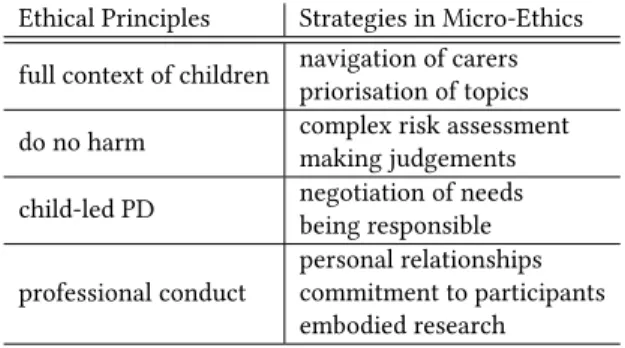
Ethical Principles Strategies in Micro-Ethics full context of children navigation of carers
priorisation of topics do no harm complex risk assessment
making judgements child-led PD negotiation of needs
being responsible professional conduct
personal relationships commitment to participants embodied research
Table 1: Tensions between ethical principles stemming from virtue ethics and strategies used in micro-ethics
In Table 1 we list the four ethical areas discussed in the pre-vious section, together with the micro-ethical strategies we em-ployed encountering similar situations. It illustrates the space of negotiations between different stakeholders. Taking into account the full context required making contestable prioritisations. Doing no harm can only be evaluated as a dynamic in which potentials and risks have to be carefully considered. Child-led PD requires researchers to negotiate between all participants. Finally, codes of professional conduct – that are considered as micro-ethics in engineering[8, 31] – sometimes prevent forms of commitment ben-eficial to the researcher and to the children, whereas the personal position researchers bring into the collaboration remains present and influential to the processes and outcomes—which coincides with the micro-ethics considerations in health care[34, 64].
In other words, micro-ethics is an invitation to focus on relation-ships surrounding PD processes. It requires careful navigation of values that were not initially in focus. For instance, emphasising child-led PD might obfuscate our responsibilities as adults to both protect from harm and encourage the kind of risk-taking that offers positive experiences. Or the values we hold and embody, that shape our professional conduct, sometimes need to be revisited or toned down. This is especially relevant in participatory research where close relationships with participants are crucial for the success of the endeavour.
While these tensions are ever-present in participatory design, they often remain under-reported. Within large parts of the liter-ature, they appear to have no impact the outcome. Yet, reporting on the micro-ethical level of research not only aids researchers in reflecting about their work but also provides an opportunity to discuss ethical conduct in participatory design with marginalised children more generally. Instead of ignoring these tensions, we
suggest critically engaging with them to better understand how ethical principles are enacted micro-ethically and in-situ and how they affect participatory design as a discipline and practice.
5.2
Practical suggestions
For future work, we suggest actively identifying ethically charged situations after each encounter with participants, determining the choices and the judgements made and then reflecting on them with others. Regarding who these ’others’ are, we further recommend that it might be useful to discuss them with people who are not directly involved in the research since shared assumptions within a group might hinder the identification and explicit discussion of some of these choices.
It is also essential to negotiate between what the children can do and the desires they have. With marginalised children, researchers have to pay close attention to the children’s abilities and prefer-ences concerning the high cognitive and sometimes even physical demands that participatory design can require. For example, to avoid overwhelming some children, it might be appropriate to partly include additional children with different characteristics. For example, Ruland et al. conducted participatory design with children with cancer and used groups of children without cancer at some points in the design process to not demand too much from the first group [52]. While this might leave marginalised children out of parts of the design process, which consequently leads to them not having direct influence over those parts, such a procedure might be the appropriate approach in some cases. Agency, participation and what is possible to ask for without ‘tyrannising’ [12] the chil-dren has to be continually conceptualised anew for each research collaboration and, ultimately, each encounter with marginalised children. While this is true for all PD collaborations, we argue that researchers have to be especially careful when aiming for child-led processes with marginalised children as, for example, younger children might not have the same vocabulary or skills to express their ideas and desires as the researchers. This means researchers have to be especially attuned to explicitly making space for the participation of the children on their own terms [60].
The physical presence of all participants – researchers and chil-dren alike – additionally play a role in shaping the power distribu-tion in research contexts. Researchers tend to be taller and larger than the children who are participating. They take up more space, even when they lower themselves to the eye-level of the children. Hence, explicitly reflecting on how researchers’ bodies shape the interaction with the children can provide a useful lens into how power dynamics play out on a more mundane level.
Researchers could also benefit from adopting a growth mindset attuned to kindness and learning [17]. In the situations in which researchers have to make ethical judgements, they often cannot know or assess beforehand whether a decision was right, correct or even just the best available, particularly given the intricacy of multiple ethical strands in the research. Often, it is our task to judge when different choices are available. Without making excuses, we then need to be kind towards ourselves and others, reflect on those choices and discuss them, learn from them and improve our capabilities to make ethically sound judgements in the moment.
6
CONCLUSION
We aimed at shedding light on micro-ethical decisions, how and when they are made, and their potentially far-reaching implications for the research relationships in participatory design. We argue that as a community, we should be aware that such decisions are omnipresent. Though we focus here on participatory design with marginalised children, which comes with specific challenges, we emphasise that most of the examples presented could have occurred with a group of children not belonging to a particularly marginalised group – and, more broadly, in any participatory research. One limitation of this work is that it is based on personal experiences of the key researchers only, instead of emerging from a shared account between researchers, research teams, children participants and their adult gatekeepers.
Future work in this area would benefit from an even deeper the-oretical integration to the field of ethics. In particular, we envision exciting parallels with Haraway’s recent work on ethics in which she advocates for “staying with the trouble”, by which she refers to unresolvable ethical concerns [28]. Our work can also be expanded in the field of design education and training, as this for now, and in our own experience, is something that each new researcher needs to figure out along the way, rather than an established topic of interest or training.
We make two main contributions: the first is pragmatic and resides in the empirical grounding of complex judgements during interactions with marginalised children in participatory research as provided by our detailed examples. The second is the articulation of an approach to ethics which combines normative ethics frameworks and situated moral judgements made over the course of the research through the analytic lens of micro-ethics.
7
ACKNOWLEDGEMENTS
Funding for the OutsideTheBox project was provided by the Aus-trian Science Fund (FWF; P 26281-N23). MapSense received funding from the French National Research Agency (ANR; ANR-14-CE17-0018–Accessimap).
We would like to express our deepest gratitude to all participants in our studies who not only opened their worlds up to us, but also continuously keep on inspiring our work. The authors involved with the OutsideTheBox project owe thanks to our colleague Julia Makhaeva who was involved in making many of our reflective practices. Further, all authors thank the anonymous reviewers of this paper for their constructive feedback, which not only made the contribution of this paper clearer, but also assisted in shaping the theoretical aspects more succinctly.
REFERENCES
[1] Tatek Abebe. 2009. Multiple methods, complex dilemmas: negotiating socio-ethical spaces in participatory research with disadvantaged children. Children’s Geographies 7, 4 (2009), 451–465. https://doi.org/10.1080/14733280903234519 [2] Priscilla Alderson and Virginia Morrow. 2011. The ethics of research with children
and young people: A practical handbook. Sage Publications Ltd, Thousand Oaks, CA, USA.
[3] Alissa Antle. 2017. Crazy Like Us: Design for Vulnerable Populations. In Proceed-ings of the 2017 Conference on Interaction Design and Children (IDC ’17). ACM, New York, NY, USA, 3–4. https://doi.org/10.1145/3078072.3078074
[4] Alissa N. Antle. 2017. The Ethics of Doing Research with Vulnerable Populations. interactions 24, 6 (Oct. 2017), 74–77. https://doi.org/10.1145/3137107