People’s Democratic Republic of Algeria
Ministry of Higher Education and Scientific Research Hamma Lakhdar University of Eloued
Faculty of Arts and Languages
Department of Arts and English Language
The American-Arab Political Relationships:
Cooperation or Domination
Dissertation Submitted in Partial Fulfilment of the Requirements for
Master’s Degree in Literature and Civilization
Submitted By: Supervised by:
Bouthaina BEDADDA Mr. Adel DJERIBIAI
Loubna ROUMANE
Wafa MAIASSI
Board of Examiners:
President: Mr. Mohammed Yacine YOUMBAI University of El-Oued
Supervisor: Mr. Adel DJERIBIAI University of El-Oued
Examiner: Dr. Tarek SAID University of El-Oued
I
Dedication
I dedicate this humble work:
To the candles of my life, my mother “Khadija” and my father “Khaled”, the words cannot express the extent of my pride in you, and my pride for being your daughter, may
Allah protect and save you. My love and gratitude .
To the light of my eyes, my brothers: Ahmed, Mohamed, Abdallah . To my brothers’ wives Ikram and Chaima
To the Man who taught me the first letter in my life, my dear teacher of the Primary School, Mr.Abelwahab DEGHACHI
.
To the light of my heart, my soulmate and my cousin Isra. To my best and dearest friend Assia.
To my wonderful friends Wafa and Loubna whom I shared them all hard and happy moments during our master study
and to all my friends, especially Bouthaina BOUGUESBA. To my Dear friend: Miss Hanane MAROUF
To all my family members who love, help, and support me.
To everyone who stood by my side, and helped me in my study career To all who have even a small piece of love to me.
To all people I love….
II
Dedication
I would like to dedicate this work to My mother and husband, Amelle and Abdeljabar for their endless support, patient and love.
For my little angels Rahaf and Haithem To my little and the only sister Siham
To the soulmates: Wafa and Bouthaina for their love To all my friends and old teachers
To all my family members each one with his name
For all of those people who supported me positively, and encouraging me during my study path…
III
Dedication
I would like to dedicate this work to: My father soul:
Maiassi Lazhar
who taught me to trust and believe in myself, "Your guiding hand on myshoulder will remain with me forever". The light of my life:
My mother Maiassi Nacira for her endless love, support, and encouragement. My dear brothers: Mouldi, Said, Nadjib, Mohammed Nabil, Ali.
My lovely sisters: Zakia, Kaouthar, Khaoula. My cousin: Mahboub Med Abdennour.
My Angels:
Med Bachir, Abd-Ghani, Aymen, Anfal, Rihab, Assil, Lazhar, Nihal, Lojaine, Rital. My dear mates whom I share with them this work:
Bouthaina and Loubna for their encouragement and support. My best teacher in high school: HENKA Majda. All my family members and friends each one with his name.
To all people I love…
IV
Acknowledgments
First and foremost, we are grateful to the Almighty ALLAH for giving us power, patience, and capacity to finish this work.
We would like to thank our supervisor
Mr. Adel DJERIBIAI
for his help, advice And guidance.We would like to express our sincere gratitude and appreciation to our teachers
Mr. Ouahid ATIK ZID
, andDr. Mohamed NAOUA
, for their valuable helps.We would like to acknowledge and thank our teachers throughout the entire course of study for their kindness, and guidance.
We also thank our department for allowing us to conduct our research and providing any assistance requested.
We would also like to address special words of thank to everyone helped us by giving us books, information, or ideas.
We would love to appreciate all those who contributed in one way or another to the achievement of our dream.
Finally, we would like to admit that any mistake, error or omission in this work is exclusively our own.
V
Abstract
The American-Arab relationships are manifested in so many fields such as economic, political, cultural, etc. This research makes an insightful look at the political relationships between Arabs and America. It attempts to reveal some of the strategies and policies that USA adopts in its relations with the Arab world. The research aims to show the real nature of these relations, whether they reflect collaboration or hegemony. The method that has been followed in this research is descriptive-analytical through which a comparison between two variables which are cooperation and domination relationships is held, and analysing some historical events in order to find answers for the research questions and confirm or disconfirm the hypotheses. This research project is very susceptible, and important, because this issue has concerned the public opinion for many decades.
Keywords: American-Arab, Arab world, collaboration, cooperation and domination,
VI
List of Abbreviations
AAI The Arab American InstituteACS The American Community Survey
AS Arab Spring
CNN Cable News Network
DOD The Department of Defense
GCC Gulf Cooperation Council
IS Islamic State
ISIL Islamic State in Iraq and the Levant
ISIS Islamic State in Iraq and Syria
JASTA Justice Against Sponsors of Terrorism Act
MENA Middle East and North Africa
NATO North Atlantic Treaty Organization
OPEC Organization of Petroleum Exporting Countries
UN United Nations
UNSC United Nation Security Council
US United States
USA United States of America
USCB the U.S. Census Bureau
WMD Weapon of Mass Destruction
WWI World War I
VII
List of Figures
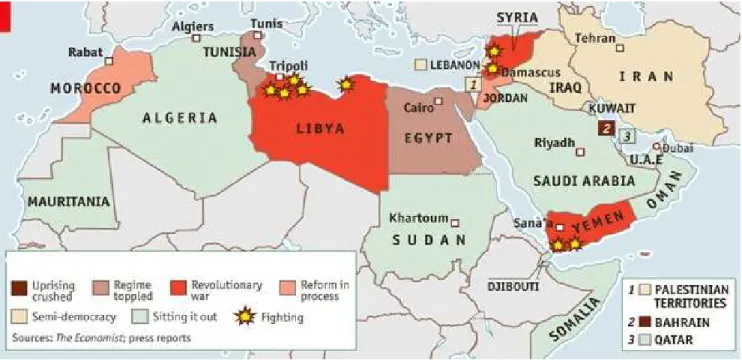
Figure. 1. 1. The Map of the Arab Spring………12 Figure. 2. 1. U.S. Military and intelligence Bases in the Middle East……….30
VIII
List of Tables
IX
Table of Contents
Dedication ... I Acknowledgment ... IV Abstract ... V List of Abbreviations ... VI List of Figures ... VII List of Tables ... VIII Table of contents ... ..IXGeneral Introduction.………...01
1. Research Problem.………..02
2. Research Questions…….………...…...………..02
3. Research Hypotheses………...02
4. Aims of the Study………....03
5. Methodology………03
6. Structure of the Dissertation………...03
Chapter One: Aspects of American-Arab Cooperation
1. Introduction ... 4
2. The History of American-Arab Political Relationships ... 4
3. The Political Cooperation ... 7
3.1. Definition of Cooperation ... 7
X
3.3. American-Arab Cooperation Policy ... 7
3.4. The Strategic Basis for U.S. Arab Military Cooperation ... 8
4. The Political Incorporation of Arab Immigrants’ Groups ... 8
4.1. Political Incorporation ... 8
4.2. The Incorporation of Arab Immigrants in American Politics ... 9
5. The American Strategies for Reforms in the Arab World ... 10
5.1. The US-Arab Relations after the Events of September 11th ... 10
5.1.1. What is September 11th Events ... 10
5.1.2. JASTA Law ... 10
5.2. Support Arab People to Change the Regimes ... 11
5.2.1. The American Involvement in the 2011 Libyan Civil War ... 12
5.2.2. The Role of US in Syrian Civil War ... 13
6. The American Cooperation with Different Arab Countries ... 14
6.1. North African Countries ... 14
6.1.1. The U.S.-Egyptian Relations ... 15
6.1.2. The US. Assistance to Egypt ... 15
6.1.3. Bilateral Economic Relations ... 15
6.1.4. Egypt’s Membership in International Organizations ... 16
6.2. Gulf Cooperation Council (GCC) Countries ... 16
6.2.1. Relations with Saudi Arabia ... 17
6.2.2. US-Saudi Cooperation in the Era of Donald J. Trump ... 19
6.2.2.1. The Murder of the Journalist Jamal Khashoggi... 19
7. Conclusion ... 20
Chapter Two: Aspects of American Domination over Arab Countries
1. Introduction ... 212. US' Foreign Policy ... 21
2.1. Definition of Foreign Policy ... 22
2.2. Definition of the US' Foreign Policy ... 22
XI
2.4. The Objectives of the US' Foreign Policy in the Arab World ... 24
3. Definition of Domination ... 25
4. Understanding of American Domination ... 25
5. Types of American Domination... 26
5.1. Military Domination ... 26
5.1.1. Definition of Military Bases ... 26
5.1.2. Brief History of the Emergence of American Military Bases in the Arab Region. ... 27
5.1.3. The Military Presence in Some Arab Countries ... 27
5.1.4. NATO Alliance... 30
5.1.5. National Security Agency (NSA) ... 31
5.1.6. The American Invasion of Iraq ... 31
5.2. Economic Domination... 32
5.2.1. Security in Exchange for Oil ... 32
5.2.2. OPEC ... 33
5.2.3. The America's Control of the Oil Prices ... 35
5.3. Ideological Domination ... 36
5.3.1. The Meaning of Ideology ... 36
5.3.2. Understanding of the American Ideology ... 36
5.3.3. Dominant Ideology ... 36
5.3.4. American Dominant Ideologies ... 37
6. U.S. Role in the Palestinian-Israeli Conflict ... 38
6.1. The American Recognition of Israel as an Independent State ... 39
6.2. The Israeli Lobby ... 40
7. Conclusion ... 40
Chapter Three: Findings and Discussion
1. Introduction ... 422. The Findings ... 42
2.1. Arab-Israeli’s Conflict (October 1973 War) ... 42
XII
2.2.1. The Announcement of Jerusalem as a Capital of Israel ... 43
2.2.2. Combining the Syrian Golan to Israel ... 44
2.2.3. Jordon Valley (Ghor) ... 44
2.3. The Main Research Results ... 45
3. Discussion ... 45
3.1. Reviewing the Research Problem ... 45
3.2. Response to Research Question 1 ... 46
3.3. Response to Research Question 2 ... 47
4. Conclusion ... 48
General Conclusion ….………....…..50
References……….……….53
ﺺﺨﻠﻤﻟﺍ……….………...……….62
[1]
General Introduction
The American-Arab political relationships were not that evident at least until the mid-1960s, because Arabs as people were not interested in political issues concerning their own countries, therefore they were not interested in the US politics, these relations have had much interest by researchers and historians. The American-Lebanon Professor of Semitic Literature at Princeton University Philip Hitti (1924) stated, "Syrians cut not figure in the political life of this nation. Very few of them interest themselves in politics or aspire to office" (p. 89), he gave an example about the Syrian people as Arabs. These political relationships have had their ups and downs, from the end of World War II until now, each conflict changing the relations. It has varied between friendship and tension, especially after the events of September 11th.
The US used its varied policies to create a sense of cooperation with Arab regimes, and consolidate relations with them aiming to achieve mutual interests, also, as their assumption to spread peace and stability around the world. Its intervention in the Arab region appeared in many issues such as supporting Arab people to change their regimes (AS) and make numerous agreements in different fields.
America implemented different strategies in order to impose its presence in the Arab world; it has made many interventions such as the military intervention in major wars as the Gulf War, all of this was to impose a military presence in the Arab region, and control their properties. US has possessed many military bases in many Arab countries (Saudi Arabia, Emirates, Iraq, etc), in addition to the economic power that allowed it to control the Arab oil and its price in the OPEC. This control over different areas in the Arab region has turned its relationship with the Arabs into domination.
[2]
The last event that was announced by the American president Donald Trump regarding the Palestinian Capital, Jerusalem, and his recognition of it as the capital of Israel is one of the most remarkable events in the history of these relationships.
1. Research Problem
In recent years, the USA has become the ruler of the world, and for sure it has various types of relationships with different countries. The Arab countries and America have established relations in most aspects; the big and obvious ones were and are in politics. In the light of the current situation in the Middle East, and North Africa during the previous decades, it is difficult to decide if there is a collaboration between them, or it is only a form of American control and domination.
2. Research Questions
1. Are the US administrations cooperating with Arab countries in order to achieve stability
and security in the region?
2. Do the policies that the US adopts towards the Arab countries aim to control the Arab
region in different aspects such as military, economic, etc?
3. Research Hypotheses
1. If the US policies establish stability and security in the region, US-Arab relationships
are based on cooperation.
2. If the US policies do not serve the interests of Arab countries, US-Arab relationships
[3]
4. Aims of the Study
The study aims to examine the political relationships between America and the Arab countries. Moreover; it aims to investigate the nature of these relations whether they are cooperation or domination.
5. Methodology
In this work, the descriptive-analytical research design is adopted which relies on qualitative research that is based on the collection of data through reading books, websites essays, Journal articles, governmental, and historical documents, etc. This research methodology is thought to be one of the best ways for this type of research as it highlights the nature of Arab American political relationships through the provision of relevant and pertinent evidence.
6. Structure of the Dissertation
This work is divided into three chapters. The first two chapters are theoretical whereas the last one is a chapter of findings and discussion. The first chapter clarifies the strategies and policies that the US used towards Arab Countries in order to help them to change their regimes and systems under the umbrella of political cooperation. In the second chapter We tend to give information about the American foreign policy, then explaining the meaning of domination as a term and understanding of American domination in addition to the US’s hidden goals and interests in the Arab region and how they seek to control it in many aspects (political, economic, and so forth). While the third chapter aims to answer the research questions (Question1, Question2) by analyzing some data and information from the first two chapters and mentioning some events such as the Deal of the Century and so forth.
Chapter One:
Aspects of American-Arab
Cooperation
Chapter One: Aspects of American-Arab Cooperation
1.Introduction ... 4
2.The History of American-Arab Political Relationships ... 4
3.The Political Cooperation ... 7
3.1.Definition of Cooperation ... 7
3.2.Definition of Political Cooperation ... 7
3.3.American-Arab Cooperation Policy ... 7
3.4.The Strategic Basis for U.S. Arab Military Cooperation ... 8
4.The Political Incorporation of Arab Immigrants’ Groups ... 8
4.1.Political Incorporation ... 8
4.2.The Incorporation of Arab Immigrants in American Politics ... 9
5. The American Strategies for Reforms in the Arab World ... 10
5.1.The US-Arab Relations after the Events of September 11th ... 10
5.1.1.What is September 11th Events ... 10
5.1.2.JASTA Law ... 10
5.2.Support Arab People to Change the Regimes ... 11
5.2.1.The American Involvement in the 2011 Libyan Civil War ... 12
5.2.2.The Role of US in Syrian Civil War ... 13
6. The American Cooperation with Different Arab Countries ... 14
6.1.North African Countries ... 14
6.1.1.The U.S.-Egyptian Relations ... 15
6.1.2. The US. Assistance to Egypt ... 15
6.1.3. Bilateral Economic Relations ... 15
6.1.4. Egypt’s Membership in International Organizations ... 16
6.2. Gulf Cooperation Council (GCC) Countries ... 16
6.2.1. Relations with Saudi Arabia ... 17
6.2.2. US-Saudi Cooperation in the Era of Donald J. Trump ... 19
6.2.2.1. The Murder of the Journalist Jamal Khashoggi... 19
[4] 1. Introduction
The United States and the Arab countries have cooperative relations dating back to
many decades, and this cooperation aims to achieve mutual interests. This chapter explains the nature of cooperative relations between the United States and Arab countries in various fields, including economic, political, etc. Additionally, the effective role that America played in the Arab Spring revolutions by supporting the Arab peoples and providing military and financial assistances in order to spread freedom and democracy in the Arab region. Also, it describes how Arab Americans became part of the American political system. Furthermore, this chapter will tackle the cooperative relations between the United States and North African Countries especially Egypt, since both countries have strong and unique relations compared to neighbouring countries, and this is what qualifies them to conclude many agreements and establish many contracts. This will be followed by the strong relationships between the United States and the Gulf Cooperation Council (GCC) countries in the economic field, especially the Kingdom of Saudi Arabia.
2. The History of American-Arab Political Relationships
The United States’ relationship with the Arab League prior to the Second World War was limited because most Arab countries were colonized. However, the first country to officially recognize the US was Morocco in 1777, they have signed a friendship treaty that is still in force and it is the oldest international treaty in the history of the United States of America. George Washington wrote a letter of thanks to the Moroccan "emperor" (he called him an emperor instead of Sultan), thanking him for it and promising that the United States will be an important ally over the years. The second Arab country with which the United States signed a friendship and trade treaty was the Sultanate of Oman in 1833
[5]
(Elmasry, 2009). Moreover, in comparison to European powers such as Britain and France which had managed to colonize almost all of the Arab World after defeating the Ottoman Empire in 1918, the United States was respected throughout the region. Indeed, Americans were seen as good people and respected by Middle Eastern and North African (MENA) states, untainted by the selfishness and duplicity associated with the Europeans (Fawcett, 2016).
So, what did happen to this strong and good beginning of these relations?
These relationships between Americans and Arabs became enmity rather than friendship, especially after the events of September 11th. A study was conducted by Middle
East Journal before these events, which make a kind of interview asking people to describe Arabs in one or two words, the answers were as the following (Berber, Savage, Hardness, Traitors, terrorists…) (Elmasry, 2009). The same thing in Arab societies, and as a result of these thoughts, two terms have emerged which are Anti-Americanism, and Anti-Arabism.
a) Anti-Americanism: “can be defined as any hostile action or expression that becomes
part and parcel of an undifferentiated attack on the foreign policy, society, culture, and values of the United States” (Rubinstein & Smith, 1988, p. 35).
b) Anti-Arabism: is interlinking forms of prejudice and discrimination that are
prevalent within the United States. These prejudices are like other forms of stereotyping that employ broad cultural and racial generalizations such as the Arabs are terrorists, savages, killers, Berbers, etc. that target a part of the population for disparate treatment on both a personal and collective level (Wolf, n.d.).
[6]
As it is mentioned above, in the political field there were no strong relations between the two sides, it approximately started with the administration of George. H. W. Bush, he faced the Iraqi invasion to Kuwait in August 1990, Bush intervened to end this invasion in 100 hours; therefore, he has built military bases in Saudi Arabia that serves as strategic goals for the US. This war was a big winning for the American military forces ("History of US President George W. Bush", 2018).
After the September 11th attacks in New York and Washington, George. W. Bush
launched the War on Terrorism. In his 2002 State of the Union Address, Bush used the term "axis of evil" consisting of the three enemies of the US including Iraq (Box, 2011) .
Bush and his administration had advertised the war as necessary in order to protect their country and their allies from the weapon of mass destruction (WMD), he considered Iraq as a part of the war on terrorism, therefore; In 2003, he invaded Iraq, searching for those weapons, and this invasion led to the removal of the president Saddam Hussein from power ("Key Points From Bush Speech", 2005).
For Barak Obama, Iraq had been a disastrously mistaken war of choice, on February 27, 2009, Obama announced that the war in Iraq will end, he said: "Let me say this as plainly as I can: by August 31, 2010, our combat mission in Iraq will end" ("Obama's Speech at Camp Lejeune, N.C.", 2009). In his administration, the American troops have been decreased until the end of 2011 (Jones, 2009). As a result of these events, we can say that Obama strived to create good relations with the Arab and Islamic world.
[7]
According to Abdullahi Ayoade Ahmad, and et al (2017), “Donald Trump’s foreign policy has been an issue of observation by various scholars of history and politics as his recent political decision-makings taunted the Muslim world and the Arabs with discrimination and hate” (p. 1713). The foreign policy of Trump towards the Arab world is clearly different from the previous one. The number of the refugees has decreased compared with Obama’s presidency from 110.000 to 50.000, the five Muslim-majority countries (Syria, Libya, Somalia, Sudan, Yemen) faced a 90-day Visa suspension, the priority is only given to the diplomats, and the UN, or to the religious minorities such as Christian(Ahmad, Daoud Balogun, Bin Mohamed, & Salleh, 2017). Donald Trump has created strong relations with Saudi Arabia, Egypt, and he intervened in the Palestinian-Israeli conflict.
3. The Political Cooperation
3.1.
Definition of cooperation: “
is a group of people working together to achieve results or people helping each other out to achieve a common goal” (Corp, 2018).3.2.
Definition of Political Cooperation:
is an act in which countries work together in the political field, in order to achieve their common goals and interests. It can be in different political sides such as military, making decisions, or security.3.3.
American-Arab Cooperation Policy
Us-Arab political cooperation is illustrated in the military collaboration; which aims to help each other in the crisis, in the cases of external interventions, like what happened in the Iraqi invasion of Kuwait in 1990, in the conflicts, or a given threat. Also, there is a cooperation between them to fight and reduce terrorism from the Arab region.
[8]
3.4. The Strategic Basis for U.S. Arab Military Cooperation
The Military cooperation is based on four different sets of common interests:
1) The US has sought to ensure the internal stability of the North African countries, largely against the Islamic extremism. Also, they have sought to protect the two regimes of Tunisia and Morocco.
2) Achieve the stability in the Levant, broadly including Egypt, Israel, Jordon, Lebanon, Palestine, and Syria. The US has sought to use the military collaboration to support the Arab-Israeli Peace Process; in addition to make military alliances with Israel, Egypt, and Jordan.
3) It is about the security of the Gulf. The US provided the military power to secure the southern Gulf countries from the threats that some aggressive regimes in Iran and Iraq posted, and any other threats.
4) The attacks of September 11th have brought a longstanding threat for American power
and interests; therefore, the fourth common interest was related with checking the threat of terrorism, and asymmetric warfare (Cordesman, 2002).
4. The Political Incorporation of Arab Immigrants’ Groups
4.1.
Political Incorporation
“refers to the process through which immigrants and their descendants have come to think of themselves as Americans with political rights and with a voice in politics, should they choose to exercise it” (Srtum, 2006).According to Pieter Bevelander and Mikael Spång the political incorporation is a Sub-group of social integration as it also includes the participation in labour market and access to housing, education, social security, public services, and cultural life (2014).
[9]
4.2. The Incorporation of Arab Immigrants in American Politics
There are many Arabs who live in the United States of America, a lot of them were born there (their ancestors immigrated), and others are immigrants, those are called Arab Americans.
According to statistics of the U.S. Census Bureau (USCB), the Arab Americans in the United States grew from 850,000 in 1990 to 1.2 million in 2000, another estimate was conducted by The American Community Survey (ACS), in which it showed that the Arab American population became around 1.8 million in 2011 (Hoiland, 2015). The Arab American Institute (AAI) counted the U.S. Arab population to be 3.7 million (Harb, 2018), this means that their number has been grown very quickly, and the new generations consider themselves as American citizens.
Despite the fact that Arabs suffer from many issues in the US such as racism, and Islamophobia, most Arab Americans were able to gain American citizenship, and earn high positions in American politics.
Rashida Tlaib is one of the various Arab members in the House of Representative, representing Michigan’s 13th congressional district since January 3rd, 2019. She is a
Palestinian American politician, and a member of the Democratic Socialists of America (DSA) (Kelly, 2018). Rashida became the first Palestinian-American Congresswoman holding national office ("With Primary Win, Rashida Tlaib Set to Become First Palestinian-American Congresswoman", 2018).
[10]
Ilhan Omar is a Somali-American congresswoman, she represents Minnesota’s Congressional District in the US, she was the first Black Arab Woman in the US House of Representative to represent Minnesota (About, n.d.). Rashida Tlaib and Ilhan Omar became the first Muslim and Arab women to serve in Congress. (Connley, 2018).
5. The American Strategies for Reforms in the Arab World
The American strategies toward the Arab World came to make some reforms in the
region, such as changing governments and making new Arab allies, these reforms can be changed from time to time according to the US interests.
5.1. The US-Arab relations after the events of September 11th 5.1.1. What is September 11th Events
They are a series of airplane attacks on September 11th, 2001 targeted two places,
the World Trade Centre/ the Twin Towers in New York City, and the Pentagon outside Washington D.C. They were led by the Islamic extremist group Al Qaeda consists of 19 hijackers, they were from Saudi Arabia and other Arab countries, the organization is headed by the Saudi fugitive Osama Bin Laden. The human losses were about 3000 people who were killed during these terrorist attacks that arouse Major US initiatives to fight terrorism in America, and in the Arab world, since the terrorists were Arab (Editors, 2018).
5.1.2. JASTA Law
The Justice Against Sponsors of Terrorism Act (JASTA) it is a bill created by the families of 9/11 attack victims, to allow them to take legal action toward any member of the Saudi government suspected of playing a role in the attacks.
[11]
In practice, the bill permits civil claims against a foreign state or official for injuries, death, or damages from an act of international terrorism ("What is the 9/11 Bill and Why is it So Controversial?", 2016).
Its Relation with 9/11 Attack
Fifteen of the 19 terrorists who hijacked planes on 9/11 were Saudi nationals, and it has long been supposed that senior Saudi officials were in somehow linked to the attack that is why the victims' families wanted to court any Saudi officials have hands in the incident and to have a financial compensation since the death of their victims was a result of terrorism ("What is the 9/11 Bill and Why is it So Controversial?", 2016).
5.2. Support Arab People to Change the Regimes
In the last decade, many events have taken place in the Arab world under the banner of freedom and democracy in another word ‘’ The Arab Spring ‘’(AS). The US played a major and crucial role in these events by providing financial assistance and pushing the Arab peoples to ride and control their revolutions in order to preserve American interests in the region. After all these events, the US lost some of its allies in the Arab world, but at the same time, it has acquired new allies and friends in Egypt, Libya, Yemen, Tunisia, and others (Salamet, 2014).
[12]
Figure 1.1. The Map of the Arab Spring (Source: https://orientalreview.org )
5.2.1. The American Involvement in the 2011 Libyan Civil War
At the beginning of 2011, the manifestations (demonstrations) that started first in Tunisia, and Egypt led to the collapse of two repressive governments in North Africa. These events inspired the Libyans to protest against the Gaddafi government, these protests began in Tripoli and Benghazi in the early of February, and expanded among the whole country, they focused on some issues like corruption, local concerns, and desire to gain positions in the political system. The Libyan people have been repressed by Gaddafi’s regime, and this repression raised; therefore, on February 18th, 2011 the United States of
America intervened with condemnation of the violence and expressed their support for the democratic reforms and economic openness in Libya, and other countries that were part of the Arab Spring. Because of the Libyan population protests, Gaddafi forces advanced on Benghazi led by his son Saif al-Islam in March 16th, 2011. A day later, the United Nations
[13]
Security Council (UNSC) gave official permission to a no-fly zone over Libya. Two days later, the NATO conducted airstrikes against the Gaddafi forces with the purpose of stopping the advancement in Benghazi, and protect/defend the Libyan population from harm (Cadier, 2016). The NATO campaign against Libyan forces ended with the death of Muammar Gaddafi in October, 2011.
The president Barak Obama said in October 20th,2011, that “the death of dictator
Muammar Gaddafi marks the end of a long and painful chapter for the people of Libya, who now have the opportunity to determine their own destiny in a new and democratic Libya” (Bruce, 2011, para. 1).
5.2.2. The Role of US in the Syrian Civil War
Inspired by the success of popular protest movement in Tunisia and Egypt (FORD, 2019), the Syrian Crisis, which began in March 2011 in Darra as an anti-government protest against the president Bashar-al-Assad (Karim, 2017). The Syrian people began demonstrating across their country in an attempt to demand an end to abuses among the security forces and the government's corruption. The majority of protests were peaceful (FORD, 2019). Nevertheless, president Bashar-al-Assad exercised his authority with high handedness by curbing people's liberties, limiting their political freedoms. The corruption that has occurred in the Syrian government is considered as one of the most important reasons behind these demonstrations. The Syrian government has continued to practice human rights violations such as, arbitrary arrests, exile, torture, and even death (Mahmoud & Javed, 2017).
[14]
The Syrian war has received a lot of international attention, with foreign assistance being provided to both the government of Syria and the rebels (Mariwala, 2014).
President Barack Obama said that Assad should step aside on August 18, 2011, he emphasized that the U.S. would not impose a transition on Syria and would instead leave to the Syrian people the choice of their leaders (FORD, 2019). Since 2011, the Syrian conflict has presented significant policy challenges for the United States' policy toward Syria, since 2014 the US has prioritized counterterrorism operations against the Islamic State (IS, also known as ISIL/ISIS). The United States has directed more than $9.1 billion toward Syria-related humanitarian assistance, and Congress has appropriated more billions for security and stabilization initiatives in Syria and neighboring countries (Humud & Blanchard, 2019).
The Syrian Crisis is present until now and the US still strives to disseminate freedom and democracy and to keep stability and security in Syria.
6. The American Cooperation with Different Arab Countries 6.1. North African Countries
The US policy toward the North African countries is quietly incoherent, some of the African countries have superficial dealings, but others have deep relations compared to the former. In Morocco, the American Capital Washington D.C was dealing with a monarchy with ancient ties to the United States. On the contrary, Algeria has had anxious political relations with the United States since its independence, and in the 1990s was in the grips of a bloody civil war. Tunisia, like Morocco, has enjoyed close political ties with the US, but the difference lies in its republican, this political system presented distinctive
[15]
political challenges. Libya was treated as a rogue state. However, Egypt has strong relations and endless cooperative agreements with the US ("U.S. Policy Towards North Africa: Three Overarching Themes", 2007).
6.1.1. The U.S.-Egyptian Relations
The United States established diplomatic relationships with Egypt in 1922. The US and Egypt have a strong relationship based on mutual interests in Middle East peace and stability, economic opportunity, and regional security. Reinforce a stable, prosperous Egypt, where the government saves the basic rights of its citizens and accomplishes the aspirations of the Egyptian people, will continue to be a central objective of the American policy ("U.S. Relations With Egypt", 2019).
6.1.2. The US. Assistance to Egypt
The U.S. assistance to Egypt has long played a major role to Egypt in different fields and in furthering the strategic partnership and regional stability. Since 1980, the US has supplied Egypt with totals over $40 billion in the military and $30 billion in economic aids ("U.S. Relations With Egypt", 2019).
6.1.3. Bilateral Economic Relations
The cooperation between the United States and Egypt in trade was $7.5 billion in 2018. U.S. exports to Egypt include different products and goods such as wheat and corn, mineral fuel and oil, machinery, aircraft, and iron and steel products as the US provides Egypt with different goods ,the latter also contributes in the American economy by
[16]
providing them with various imports include apparel, natural gas and oil, fertilizers, textiles, and agricultural products.
Egypt and the United States signed a Bilateral Investment Treaty in 1982 to promote and facilitate investment between both countries. Egypt and the United States have signed a trade and investment framework agreement, a step toward creating freer trade and increasing investment influxes. American companies are active in most areas of the Egyptian economy, including oil and gas exploration and production, financial services, manufacturing, construction, telecommunications and information technology, and the restaurant and hospitality industry. The US' direct investment in Egypt was $21.8 billion in 2018 ("U.S. Relations With Egypt", 2019).
6.1.4. Egypt’s Membership in International Organizations
Egypt and the US belong to a number of the same international organizations, including the United Nations, International Monetary Fund, World Bank, and World Trade Organization. Egypt also is a Partner for Cooperation with the Organization for Security and Cooperation in Europe, an observer to the Organization of American States, a partner in the NATO Mediterranean Dialogue, and a non-party state to the International Criminal Court. Egypt is Chair of the African Union until February 2020. Cairo hosts the headquarters of the League of Arab States ("U.S. Relations With Egypt", 2019).
6.2. Gulf Cooperation Council (GCC) Countries
American relationships with the GCC states date back many decades. These relations have developed in line with the broader Gulf’s geopolitical shifts in regional
[17]
power centres over time. Even before the discovery of oil in the region, the Gulf States were strategically valuable allies due to their pivotal location between Europe, Africa, and Asia. The United States deem that the Arab Gulf region is one of the most geo-strategically important locations around the world because it is the home to over half of the world’s oil reserves and approximately a third of its natural gas (El-katiri, 2015).
US-GCC military ties strengthened further because of the Gulf War. Various GCC states signed bilateral defense agreements with the United States, including Bahrain in 1991, Qatar in 1992, and the UAE in 1994. Access agreements for US military forces followed or were renegotiated to tie the American military troops stationed permanently in regional military bases, allowing for the training of local military forces in Saudi Arabia, Bahrain, and the UAE. Since the early-1990s, the GCC states have become a major military pillar for the US' foreign policy not only in the Gulf region, but also far beyond. For instance, the GCC states also provide much of the infrastructure and transit capability essential to the US missions in the wider region, including in Afghanistan. The US' military forces have access to key bases such as Al Dhafra Air Base in the UAE, Camp Arifjan in Kuwait, Al Udeid Air Base in Qatar, and the Naval Support Activity in Bahrain. Kuwait hosts as many as 15,000 US troops; Qatar about 7,300; and the UAE some 3,000 (El-katiri, 2015).
6.2.1. Relations with Saudi Arabia
The United States and Saudi Arabia have long-standing economic and defence ties, such as their working closely to fight terrorism in the Arab region, in addition to other aspects of collaboration between these two allies (Prados, 2003).
[18] a) Oil Production
Oil is the main reason that produces a close and cooperative relationship between the United States and Saudi Arabia in the last decades. Since the award of the first Saudi oil concession to a U.S. company in 1933, both states share the same interests, especially in the marketing and acquisition of Saudi petroleum supplies. Saudi Arabia has the largest proven oil reserves (estimated at 261.7 billion barrels in January 2001), it produced an average of 9.4 million barrels per day (bp\d) of crude oil as of May 2003. Almost 13.46% of U.S. oil imports and 7.85% of total U.S. oil consumption imported from Saudi Arabia during 2002 (Prados, 2003).
b) Counterterrorism Cooperation
Observers and analysts confirm that counterterrorism becomes an increasingly important reason for collaboration between the U.S. and Saudi Arabia. Both countries are willing to ensure that the influx of Saudi oil to international markets stays uninterrupted by terrorist groups, that the Kingdom remains politically stable, and that no more Saudi nationals implement terrorist attacks inside the United States (Derks, 2017). Besides, the US and Saudi Arabia with Italy are co-chairs of the Counter ISIS Finance Group, a broader coalition established in 2015 concentrated on disturbing ISIS finance ("Saudi Arabia And Counterterrorism", 2019). Antiterrorism cooperation is considered as a strategic feature in the relationships between the US and Saudi Arabia since both governments have worked closely together on this issue (Derks, 2017).
[19]
6.2.2. US-Saudi Cooperation in the Era of Donald J. Trump
The relations between the US and Saudi Arabia become stronger than before under the era of US President Donald J. Trump and the crown prince Mohammed Bin Salman (Alyas, 2018). The president Donald J. Trump visits the Kingdom of Saudi Arabia on May 20-22, 2017, the visit aims to consolidate the relations between the two countries, however; this visit succeeded to open a new chapter in US foreign policy towards Saudi Arabia and regional partners. On May 21, 2017, various military and commercial agreements took place between the US and Saudi Arabia that can provide thousands of jobs in both countries and makes national security in the region in a better situation.
These agreements include:
23 new foreign investments export licenses leading to upwards of more than $350 billion of historic direct investment.
Economic agreements to secure Saudi investment in American infrastructure, aerospace, energy, manufacturing…etc ("Saudi Arabia And The Visit Of President Trump", 2017).
6.2.2.1. The Murder of the Journalist Jamal Khashoggi
He was killed at the Saudi consulate in Istanbul in October 2018, the President
Donald J. Trump hinted that he would not take rigorous action against the Kingdom of Saudi Arabia and especially its crown prince Mohammed Bin Salman. Trump said, "If we abandon Saudi it would be a terrible mistake". He means that the Kingdom's influence over oil prices (Gaouette & Collins, 2018).
Even though the strong relationships between the US and Saudi Arabia in different fields, these relations have survived grievous challenges, including the 1973 oil embargo
[20]
and 9/11 attacks, in which fifteen of the nineteen passenger jet hijackers were Saudi citizens. Successive U.S. administrations confirmed that Saudi Arabia is a critical strategic partner in the region (Alyas, 2018).
7. Conclusion
In this chapter, we endeavored to explain the cooperative relations between the United States and Arab Countries. We also clarified how Arab immigrants became a part of the American political system after America granted them political rights despite their Arab origins and identities such as the right to vote, and gain high positions in American Politics, for instance, Rashida Tlaib and Ilhan Omar who are members in the American House of Representative, and both of them are Arab women. Furthermore, we described how America interfered in the revolutions of Arab countries in another word "The Arab Spring", the United States adopted various strategies to help the Arab people to create new systems and spread democracy in the Arab region. At the end, this chapter explained the continuity of US-Arab relations even after the events of 9\11 attacks; the US has made numerous actions and agreements in several fields with different Arab countries like North Africa; especially the American-Egyptian collaboration, and the Gulf countries like the Kingdom of Saudi Arabia.
Chapter Two:
Aspects of American Domination Over
Arab Countries
Chapter Two: Aspects of American Domination over Arab Countries
1.Introduction ... 21 2. US' Foreign Policy ... 21 2.1. Definition of Foreign Policy ... 22 2.2. Definition of the US' Foreign Policy ... 22 2.3. Brief History of American Foreign Policy ... 23 2.4. The Objectives of the US' Foreign Policy in the Arab World ... 24 3. Definition of Domination ... 25 4. Understanding of American Domination ... 25 5. Types of American Domination... 26 5.1. Military Domination ... 26 5.1.1. Definition of Military Bases ... 26 5.1.2. Brief History of the Emergence of American Military Bases in the Arab
Region. ... 27 5.1.3. The Military Presence in Some Arab Countries ... 27 5.1.4. NATO Alliance... 30 5.1.5. National Security Agency (NSA) ... 31 5.1.6. The American Invasion of Iraq ... 31 5.2. Economic Domination... 32 5.2.1. Security in Exchange for Oil ... 32 5.2.2. OPEC ... 33 5.2.3. The America's Control of the Oil Prices ... 35 5.3. Ideological Domination ... 36 5.3.1. The Meaning of Ideology ... 36 5.3.2. Understanding of the American Ideology ... 36 5.3.3. Dominant Ideology ... 36 5.3.4. American Dominant Ideologies ... 37 6. U.S. Role in the Palestinian-Israeli Conflict ... 38 6.1. The American Recognition of Israel as an Independent State ... 39 6.2. The Israeli Lobby ... 40 7. Conclusion ... 40
[21]
1.
IntroductionIt is known that the United States is a strong country with a wide influence on the international community. This power was embodied after the end of the cold war, and the collapse of the Soviet Union. This chapter elucidates the domination aspects of America over the Arab world, this domination appears in different areas (military, economic, and ideological). First, in the military side America attempted to impose its presence through military bases by using NATO and NSA to serve their hegemony. However, the invasion of Iraq was the biggest example and evidence of American domination over the Arab region. Second, in the economic side, the United States used its strategies to get the oil with a low price by providing security in exchange for oil. By using these strategies, America aims to break the high prices of oil and control the oil market. Moreover, this part clarifies the role of OPEC and how the US controls this organization indirectly by its hidden plans. Third, on the ideological side that includes two important elements, which are language and media. America seeks to spread its language and its way of life through media, this side play an important role in American domination over Arabs. Finally, the role of the US in the Palestinian-Israeli conflict is discussed, where it shows its bias to Israel from the beginning of the conflict.
2. US' Foreign Policy
The concept of foreign policy is composed of two terms, foreign and policy; both of these terms have meanings: Foreign implies those territorially sovereign units that exist outside the legal boundaries of a particular state. While the Policy refers to a leader of action or set of actions aimed to realize the objectives of an organization that it has a set for itself which involves a choice to achieve one's goals (Ghosh, 2015).
[22]
2.1. Definition of Foreign Policy
The definition of foreign policy varied from one author to another. Below there are some different definitions:
In his book A Theory of Foreign Policy, George Modelski (1962) defined foreign policy as “a system of activities evolved by communities for changing the behaviour of other states, and for adjusting their own activities to the international environment” (p. 6). In another hand, Vladimir Benko (1997) claimed that ‘‘foreign policy is a process, and a system of activities performed by a state-organized community of people within the international arena’’ (p. 227).
Another definition by Peter Calvert (1986), in which he considered this concept as ‘‘decisions, and activities which largely concern relations between one state to another’’ (p. 1).
All the above definitions share some similarities, though the foreign policy is the activities that one state use for making relations with the other states especially in the Great Countries like the USA.
2.2. Definition of the US' Foreign Policy
“US’ foreign policy is the collection of policies that determine American relations with other nations, and entities. It includes diplomacy, military and security policy, international human rights policies, Economic policies, and Environmental Policy” (Crash Course, 2016).
[23]
In other words, the US' foreign policy is about the way the United States interacts with other nations, and they set different purposes such as building democracy, security, and stability for the purpose of the American people.
2.3. Brief History of American Foreign Policy:
The US' foreign policy has witnessed a big track and development since its independence in 1776. This started from the isolationism phase to the Global domination phase, it passed through four stages which are the following:
Isolationism: after the independence of the United States, the country isolated itself from any political engagement with foreign countries especially European nations.
George Washington was the first president of the United states of America, the first who chose isolationism that helped to build a country which can provide the internal security either economic, military, or political, this stage enable the US to build internal stability and economic power; in addition to strong American Navy.
The Exit of Isolation:
The exit of the US from its isolation was illustrated in their participation in WWI to end the war and reducing the global economic crisis left by the war.
The Cold War Phase:
This stage was like an ideological conflict between the US and the Soviet Union to rule the world. It ends with the collapse of the later, and all nations that support it in Eastern Europe in 1990.
[24] The Global Domination Phase:
The period post-cold war, the United States of America finds itself the only and the greatest powerful country in the world in most aspects, it has started to create a new international system based on American principles which are the center around democracy, liberalism, and capitalism. Then, it imposed this model politically, and economically on all the world.
The events of September 11th made new milestones for the American Foreign Policy,
after these events, the US declared the war against terrorism around the world especially the Arab region since the defendants in that events were Arabs, also get rid of the weapons of mass destruction.
Two factors are controlled the US' foreign policy in all its phases: The Interests and the Character of the President (Al-Shayeb & Nasseri, 2017)
2.4. The Objectives of the US' Foreign Policy in the Arab World
The main purposes and interests of the United States' foreign policy in the Arab region are varied between the securing access to oil with low-cost, supporting and protecting Israel's security, Keeping the military bases in different Arab countries, and defending client-states and friendly regimes (Sarhan, 2017), in addition to combating terrorism or what they call ‘’Islamic extremism‘’ (Fadel, 2016).
In another hand, the character or the personality of the president impacted on the US' foreign policy, each one contributed in the foreign policy decisions (Etheredge, 1978); for instance, George H. W. Bush as we have mentioned in the first chapter, gave more attention to the foreign affairs rather than the domestic one, in which he intervened in the Iraqi
[25]
invasion to Kuwait to end the war conversely he made a military presence in Saudi Arabia that serves as strategic goals for the US.
3. Definition of Domination
“Domination” means total control, it comes from the Latin word “dominus”, which means "master" or "lord." This word conveys the idea not just of leadership, but of absolute, unchallengeable authority (Vocabulary Dictionary, n.d).
Max Weber (1968) defines domination “as the probability that certain specific commands (or all commands) will be obeyed by a given group of persons” (p. 212). So, domination is the authority of one side over another side (less power) by the issuance of laws and decisions in different fields.
4. Understanding of American Domination
After World War II, the United States played the essential vanguard of the Western World, becoming the true nucleus of global hegemony. The western world dominates the world, and the United States controls the western world. Therefore, the United States controls the world ("American Ideology and US’ Claims for Global Domination", 2016). The sudden collapse of the Soviet Union at the end of the Cold War led the US to be the only Power in the world. This period was described as the American Dominance or unipolar world. In fact, this American domination did not appear only after the Cold War, but some aspects of the US' hegemony emerged during WWII in 1945 (Garg, 2019). Since the emergence of the US as a superpower in the late of nineteenth century, it aimed to preserve the US' hegemony in North America and preventing any hostile powers in the three regions outside America that consist of energy resources, Europe, Asia, and the Middle East. In both World Wars, the
[26]
American leaders sought to prevent the domination in other regions through the cooperation of the great powers in a multipolar World, not by the exclusive American hegemony. While after the Cold War, the American leaders have changed this tradition and converted this alliance system that was created in the War into purely and unlimited American domination over the World (Lind, 2006).
5. Types of American Domination
America has many types of hegemony that affect many areas such as the military, economic, and ideological. This hegemony was directly or indirectly. It exploited all sources of power, including weapons, regions, intelligence, and allies in order to dominate and to be the first and only controller in the world, especially Arab countries.
5.1. Military Domination
US military presence is unique since it has a developed force over the world. It has numerous bases and facilities around the Arab world behind that in late 2013, these bases were manned by more than 35,000 troops, including 10,000 forward-deployed soldiers. It owns advanced fighter aircraft, including F-22s, attack helicopters, heavy armor, missile-defense capabilities, and advanced intelligence, and its naval army routinely involving more than 40 ships. The US added a second battle group with the Fifth Fleet, Raleigh-Burke-class guided-missile destroyers, and nuclear-powered guided-missile submarines (Juneau, n.d.).
5.1.1. Definition of Military Bases
A base or group of installations for which a local commander is responsible, consisting of facilities necessary for the support of Army activities including security,
[27]
internal lines of communications, utilities, plants and systems, and real property for which the Army has operating responsibility ("Military base", 2005).
5.1.2. Brief History of the Emergence of American Military Bases in the Arab Region
The history of the US' bases emergence in the Arab World began in January 1983, when the most important military command established in the US air force base by the instruction of Ronald Reagan, it was created to plane and train forces in order to confront the
emergencies that threaten and obstruct the path of American interests in the Arab countries. In 1983, the USA did not have a military bases or additional property in any Arab country,
but by the mid-2000s it has more than 125 military bases in most Arab regions, it began forming military bases through interfering in numerous famous wars during the history to spread peace after the Arab Spring period in many countries such as Syria . It has always been hidden goals under the banner of spreading peace and global security but America has extended its roots in the Arab countries and deployed its military forces to achieve its goals (Morrissey, 2017).
5.1.3. The Military Presence in Some Arab Countries
The American military power is distinguished by being equipped in all respects. The American military properties, and facilities are distributed in many Arab countries such as the UAE, Saudi Arabia, Iraq, and many others. The American military bases and properties appear in three forms: land, sea and air forms.
Land includes all military bases for combat, which housing and training soldiers, also warehouses that are used for storing and repairing military equipment. On the other hand, the
[28]
navy for miss all the ships, navy fleets, battleships, and even military docking ports. The air form is all the bases that control flights, and they contain airports for military aircraft.
Coming to the most important Arab countries that contain US military bases or property are as the following:
a) Egypt: in Egypt, there are no military bases despite the historical cooperation
between the two countries, the only U.S. military facility in Egypt conducts medical research.
Naval Medical Research Unit Three (NAMRU-3): It is located in Cairo; it is for conducting researches and protection, it is the biggest DOD overseas laboratory with advances global specifications.
b) Iraq: Since the removal of US forces in 2011, the US has not maintained permanent
facilities in Iraq, the only presence has appeared in the al-Asad air base.
Al-Asad Air Base: The only American base that works in Iraq's western Anbar province on helping and advising the Iraqi army, it was known as the cap cake army because of its luxury materials.
c) Qatar: it gathered approximately 10,000 U.S. soldiers, at Al Udeid Air Base. It was
as a purpose to be present in the Gulf region after the withdrawal from Saudi Arabia in 2003.
Al Udeid Air Base: it is the biggest American base in the Middle East it is the center of air operations built in 1996.
Camp as Sayliyah: It is an equipment store controlled by the army, also it includes several additional climate-controlled units.
[29]
d) Saudi Arabia: After the Iraqi invasion, America withdrew its forces from Saudi
Arabia in 2003, nowadays the soldiers who work in Saudi Arabia only those who have a military training mission and most of them are in Eskan village near Riyadh.
Eskan Village: It is a luxury village; it works as a hotel for the American soldiers' who have a military training mission and there are no combat operations in it.
e) United Arab Emirates: The strong relationships between the UAE and the US led
to make a defense cooperation agreement to receive American sliders. Even in such wars, the UAE supported America by providing it with facilities and weapons.
Al Dhafra Air Base: It is such a center for the air arms that America used in order to train persons from different nationalities on fighting basics. It was not known as an American base until 2017, it is the controller of flights.
Port of Jebel Ali: It is an American navy port and the largest deep-water harbor in the world that receives the US aircraft.
Fujairah Naval Base: It is situated outside the Persian Gulf before the strait of Hormuz, it works as a land link to Jebel Ali if the strait of Hormuz closed (Wallin, 2018).
[30]
Figure. 2. 1. U.S. Military and Intelligence Bases in the Middle East
(Source: https://www.aljazeera.com/indepth/interactive/2020/01/military-presence-middle-east-afghanistan-200113120612249.html )
5.1.4. NATO Alliance
North Atlantic Treaty Organization (NATO), a military alliance created under the Washington treaty (North Atlantic treaty) on April 4th, 1949 to counter the threat of post-war
communist expansion as the Soviet Union sought to extend its influence in Europe. Its members are Belgium, Canada, Denmark, France, Iceland, Italy, Luxembourg, the Netherlands, Norway, Portugal, the United Kingdom, and the United States. then Greece, Turkey, West Germany, Spain, the Czech Republic, Hungary, and Poland, Bulgaria, Estonia, Latvia, Lithuania, Romania, Slovakia, and Slovenia Albania and Croatia, and Montenegro join to the original members in different years. NATO's alliance used a special system in
[31]
emergency cases of war (in wartime). Member states participate in preparing and building the organization with all necessary equipment, infrastructure, and advanced weapons. They also prepared an early warning force to deal with wars and emergencies (Haglund, 2020).
The NATO alliance acts as a supporter multiplier of America's strength to control and dominate the world. It will serve its future purposes to be a great power and the first dominant over the world specially the Arab countries.
5.1.5. National Security Agency (NSA)
It is an agency responsible for cryptographic, communications intelligence, and security. It established in 1952 by a presidential instruction from Harry. S. Truman in which he specified its work as an organized and controller of American communication intelligence toward other countries to be under its sight and build their foreign policy. NSA is working as the hidden eyes that America uses to control all the world, they believe that communication intelligence is more important than the armed forces and other agencies (Britannica, 2018).
5.1.6. The American Invasion of Iraq
The United States occupied Iraq on 19 March 2003 under the leadership of president George.W. Bush. This invasion is considered as one of the most important events in modern history. George. W. Bush's administration has set several reasons to justify the oppressive war in Iraq, including the existence of a secret relationship between Iraqi President Saddam Hussein and AL Qaeda (support terrorism), the existence of Weapons of Mass Destruction (WMD) in Iraq, changing the political system in Iraq, and removing Saddam Hussein from power because he oppresses Iraqi citizens (Bojang, 2016).
[32]
However, the main hidden reason for this invasion is oil, the later and the strategic location of Iraq are considered as the most important reasons that led the US to occupy it. In this context, Noam Chomsky confirmed in an interview “On the War in Iraq” that the real cause of this invasion is the vast oil resources that Iraq possesses in which the United States is seeking to control. This control would give the United States decisive influence over the Asian and European economies (2005).
5.2. Economic Domination
5.2.1. Security in Exchange for Oil
Oil is a prerequisite for most human activities and is considered as the resource in the economic and military security of countries. Arab countries, especially the Gulf States have the largest oil reserves in the world, which make these countries momentous by some international systems (the great powers) (Institute, 1974). Those great powers provide security to oil producers in exchange for oil, and keep the relations with them friendly, this process is called "Petro-Alignment" (Kim, 2019).
Saudi Arabia
US-Saudi Arabia relations are described as strong historical ties, through which Washington has achieved and continues to achieve many strategic political and economic gains. America has always been keen to mislead public opinion in the Arab region that the Gulf States are surrounded by great danger, especially Saudi Arabia, in order to impose protection on them and to exploit the oil wealth they possess (Al-Hajj, 2017).
The American president Donald Trump told king Salman that he could not last for two weeks without American support. "We protect Saudi Arabia. Would you say they're
[33]
rich? And I love the King, King Salman. But I said 'King - we're protecting you - you might not be there for two weeks without us - you have to pay for your military,'" Trump said to cheers at a rally in Southaven, Mississippi (agencies, 2018, para. 1).
5.2.2. OPEC:
The Organizational of the Petroleum Exporting Countries (OPEC) is a permanent intergovernmental organization, created at the Baghdad conference on September 10-14, 1960 by Iran, Iraq, Kuwait, Saudi Arabia, and Venezuela. OPEC had its headquarters in Geneva, Switzerland in the first five years of its existence. This was moved to Vienna, Austria on September 1st, 1965 ("Brief History", n.d.).
OPEC Members:
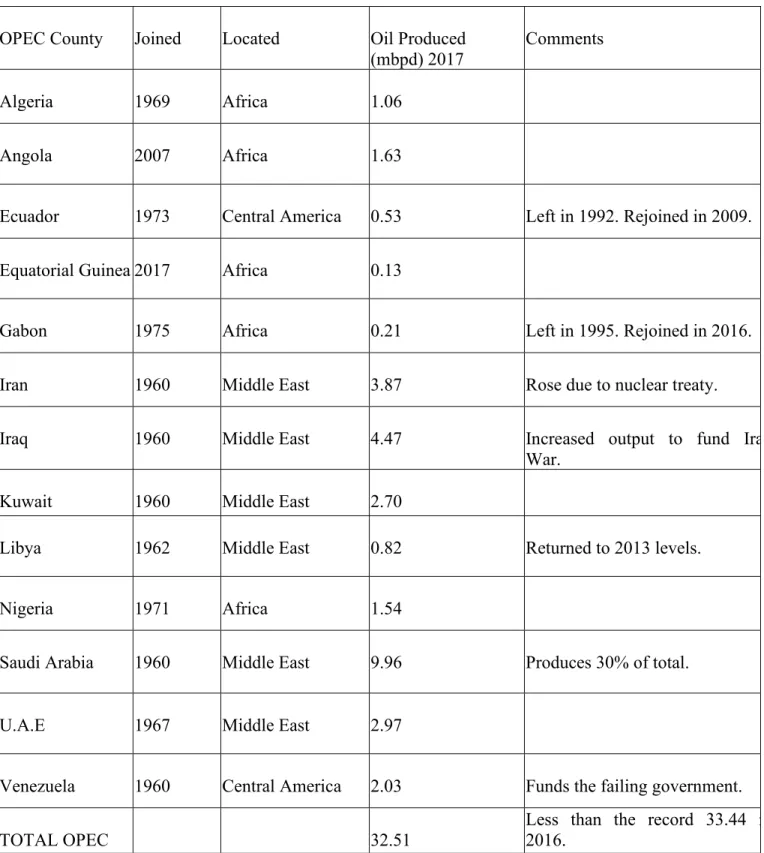
OPEC consists of 13 active members. The Kingdom of Saudi Arabia is by far the largest producer, contributing about a third of total OPEC oil production, and for this reason, it has more power and influence than other countries.
[34]
Table 2.1. The countries that are included in the OPEC Organization
Note: Adapted from https://www.thebalance.com/what-is-opec-its-members-and-history-3305872
OPEC County Joined Located Oil Produced (mbpd) 2017
Comments
Algeria 1969 Africa 1.06 Angola 2007 Africa 1.63
Ecuador 1973 Central America 0.53 Left in 1992. Rejoined in 2009. Equatorial Guinea 2017 Africa 0.13
Gabon 1975 Africa 0.21 Left in 1995. Rejoined in 2016. Iran 1960 Middle East 3.87 Rose due to nuclear treaty.
Iraq 1960 Middle East 4.47 Increased output to fund Iraq War.
Kuwait 1960 Middle East 2.70
Libya 1962 Middle East 0.82 Returned to 2013 levels.
Nigeria 1971 Africa 1.54
Saudi Arabia 1960 Middle East 9.96 Produces 30% of total.
U.A.E 1967 Middle East 2.97
Venezuela 1960 Central America 2.03 Funds the failing government. TOTAL OPEC 32.51 Less than the record 33.44 in 2016.