HAL Id: hal-00747710
https://hal.archives-ouvertes.fr/hal-00747710
Submitted on 1 Nov 2012
HAL is a multi-disciplinary open access
archive for the deposit and dissemination of
sci-entific research documents, whether they are
pub-lished or not. The documents may come from
teaching and research institutions in France or
L’archive ouverte pluridisciplinaire HAL, est
destinée au dépôt et à la diffusion de documents
scientifiques de niveau recherche, publiés ou non,
émanant des établissements d’enseignement et de
recherche français ou étrangers, des laboratoires
Asymmetric Cache Coherency: Policy Modifications to
Improve Multicore Performance
John Shield, Jean-Philippe Diguet, Guy Gogniat
To cite this version:
John Shield, Jean-Philippe Diguet, Guy Gogniat. Asymmetric Cache Coherency: Policy Modifications
to Improve Multicore Performance. ACM Transactions on Reconfigurable Technology and Systems
(TRETS), ACM, 2012, 5 (3), pp.12. �hal-00747710�
Asymmetric Cache Coherency: Policy Modifications to Improve
Multicore Performance
John Shield, Lab-STICC, Universit´e de Bretagne-Sud
Jean-Philippe Diguet, Lab-STICC, Universit´e de Bretagne-Sud
Guy Gogniat, Lab-STICC, Universit´e de Bretagne-Sud
Asymmetric coherency is a new optimisation method for coherency policies to support non-uniform work-loads in multicore processors. Asymmetric coherency assists in load balancing a workload and this is applica-ble to SoC multicores where the applications are not evenly spread among the processors and customization of the coherency is possible. Asymmetric coherency is a policy change, and consequently our designs re-quire little or no additional hardware over an existing system. We explore two different types of asymmetric coherency policies. Our bus based asymmetric coherency policy, generated a 60% coherency cost reduction (reduction of latencies due to coherency messages) for non-shared data. Our directory based asymmetric co-herency policy, showed up to a 5.8% execution time improvement and up to a 22% improvement in average memory latency for the parallel benchmarks Sha, using a statically allocated asymmetry. Dynamically allo-cated asymmetry was found to generate further improvements in access latency, increasing the effectiveness of asymmetric coherency by up to 73.8% when compared to the static asymmetric solution.
Categories and Subject Descriptors: I.7.2 [Processor Architectures]: Other Architecture Styles—Adapt-able Architectures
Additional Key Words and Phrases: Non-Uniform Workload; Cache; Memory Coherency; Multicore Process-ing; Memory Management
1. INTRODUCTION
FPGA multicore systems can allow for custom coherency policies to improve load bal-ancing with methods that are complementary to task distribution and on-chip network arbitration. In multicore systems, the workload is not always evenly distributed. Se-quential operations limit the parallel performance improvement as stated in Amdahl’s Law and this limits the distribution of the workload by the designer and the operating system load balancing. We define the workload as a non-uniform workload (an asym-metric workload), when some cores are idle due to the sequential limitations of the workload. This situation is especially true for embedded multiprocessor architectures. Embedded MPSoC systems are often designed for specialized applications [Wolf et al. 2008], where they can accelerate the critical parts of the system. The possibility of ac-celerating a critical part of the workload is usually a sign of an asymmetric workload that can also benefit from asymmetric coherency.
Memory coherency is necessary to ensure that all cores are using the most recent data values. However, the necessary drawback is there are overheads for
maintain-Authors’ addresses: John Shield, Lab-STICC, Universit´e de Bretagne-Sud, F-56321 Lorient, France; E-mail: [email protected]; Jean-Philippe Diguet, Lab-STICC, Universit´e de Bretagne-Sud, F-56321 Lorient, France; E-mail: [email protected]; Guy Gogniat, Lab-STICC, Universit´e de Bretagne-Sud, F-56321 Lorient, France; E-mail: [email protected]
Permission to make digital or hard copies of part or all of this work for personal or classroom use is granted without fee provided that copies are not made or distributed for profit or commercial advantage and that copies show this notice on the first page or initial screen of a display along with the full citation. Copyrights for components of this work owned by others than ACM must be honored. Abstracting with credit is per-mitted. To copy otherwise, to republish, to post on servers, to redistribute to lists, or to use any component of this work in other works requires prior specific permission and/or a fee. Permissions may be requested from Publications Dept., ACM, Inc., 2 Penn Plaza, Suite 701, New York, NY 10121-0701 USA, fax +1 (212) 869-0481, or [email protected].
c
2012 ACM 1936-7406/2012/04-ART1 $10.00
DOI 10.1145/0000000.0000000 http://doi.acm.org/10.1145/0000000.0000000
ing the memory coherency. Coherency overheads are from the required additional co-herency signals sent on the communication channel.
We present the new concept of asymmetric coherency, the purposeful design of the memory coherency to have different performances for different cores. Our work in asymmetric coherency addresses the non-uniform distribution of the application work-load through modifications in memory coherency. The coherency modifications impact the communication latency and throughput for the memory system. We label the criti-cal core (with the heavy workload) as the primary core and other cores (less important cores) to be secondary cores. We redistribute the coherency overheads to improve the memory latency and throughput of the primary core at the expense of secondary cores. This is approach to workload balancing accelerates parts of the workload and is com-plementary to workload distribution methods.
Asymmetric coherency is a policy change, so our design has low hardware cost and simplicity in implementation. The low cost and good performance shows that our tech-nique is a suitable method for dealing with the asymmetry in multicore workloads.
Our theory of asymmetric coherency is a suitable customisation for MPSoC systems. In this paper, we present two asymmetric coherency policies as a proof of concept for the theory. Our previous work [Shield et al. 2011], was a bus based coherency policy targeted at soft real-time systems or application specific systems, where the core requiring acceleration is known. We also extend our previous work by present-ing a new directory based coherency policy, analyspresent-ing multi-threaded shared memory benchmarks, and using a full system simulator with operating system. The directory coherency is targeted for more general purpose systems MPSoC systems. The asym-metric settings are runtime adjustable and will only activate for shared data.
The remainder of this paper is as follows: Section 2 describes related work; Section 3 explains the theoretical details behind the asymmetric coherency research; Section 4 describes the experimental tools and setup used; Section 5 presents the results that show asymmetric coherency improvements and describe discovered aspects of the be-haviour; Section 6 discusses where asymmetric coherency can be applied, based on our findings; and finally Section 7 concludes this paper and mentions our future work.
2. RELATED WORK
Our previous work [Shield et al. 2011] presented results for a bus based asymmetric coherency, for multi-programming workloads that did not contain shared data. The simulation system was also dependant on recorded cache traces, which limited results to unshared data.
The new work in this paper extends the research by considering multi-threaded workloads that contain shared data. A directory based system is considered for the asymmetric coherency, which is far more scalable than a bus based system. The simu-lation system was changed to GEMS [Martin et al. 2005], which allows for full system simulation with an operating system. This allows us to demonstrate that our work can be complementary to operating system load balancing.
The closest related work in cache coherency has considered custom methods to ad-dress producer consumer or migratory data behaviour [Bennett et al. 1990; Cox and Fowler 1993; Stenstr¨om et al. 1993; Cheng et al. 2007; Martin et al. 2003]. These op-timisations work on the basis of creating special exceptions in the cache coherency to handle fine-grained behaviour within an application. The previous work maintained the underlying cache coherency system and caters for special circumstances generated by the applications. The previous work required significant additional hardware to cater for these special circumstances and does not consider workload asymmetry.
The previous cache coherency research does not address the same problem as our work. Their aim is to improve coherency communications in general, whereas our
co-herency research aims to help solve workload balancing issues. Our proposed solution creates asymmetry in the performance of the cache coherency, which has not been considered before. Furthermore, unlike the previous work, our proposed asymmetric coherency policies are simple to implement.
There are several areas of research that address the problem of Amdahl’s Law: pro-cessor frequency scaling [Annavaram et al. 2005]; heterogeneous propro-cessors [Becchi and Crowley 2006] containing different cache sizes/blocks/associativity; and quality of service (QoS) through bus arbitration [Iyer et al. 2007]. QoS of on-chip network arbitra-tion is the most similar as it is concerned with communicaarbitra-tion. However, on-chip net-work arbitration only changes the priority of messages, while asymmetric coherency changes the quantities and inherent latencies of messages. All of this previous work is complementary as it can be used with asymmetric cache coherency.
An alternative solution to a shared memory coherency system, is to use private mem-ories and message passing. However, a previous study [Chandra et al. 1994] found limited performance differences from using message passing over shared memory co-herency. More recent design trends in reducing time to market in embedded systems emphasises an additional drawback for message passing. Message passing requires that the software explicitly manages the shared data and this raises problems of in-creased design time for software development. However, message passing can be useful for increased system reliability [Kumar et al. 2011], when all the software is designed using message passing.
3. ASYMMETRIC COHERENCY DESIGN
The main theory behind our research concept is that an asymmetric performing cache coherency policy can help to improve the performance of asymmetric workloads by modifying the coherency overheads. In this section, we will present the details of our two asymmetric coherency policies.
3.1. Asymmetric Bus Based Coherency
Our first presented asymmetric coherency policy is based on a bus based system. This system will be used to demonstrate improvement for asymmetric coherency in multi-programming applications. Applications could either be a soft-real-time system that needs the critical code accelerated or an application specific system, where even distri-bution of the workload is not possible due to algorithmic limitations.
3.1.1. Implementation.The asymmetric coherency was developed from a MSI
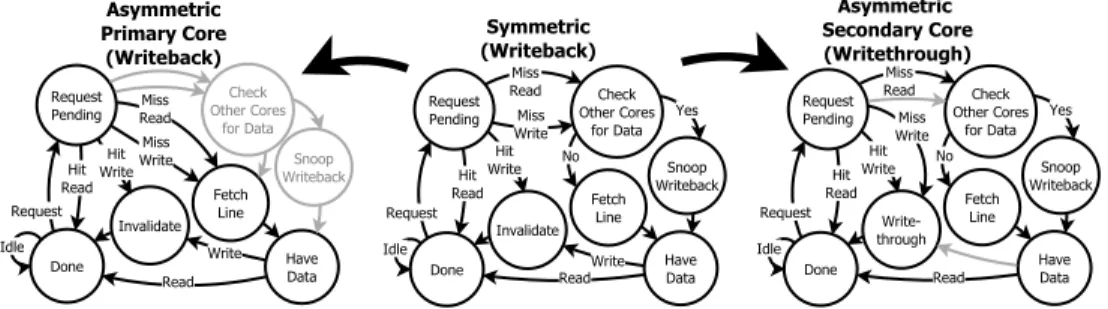
write-back/invalidate coherency and modified to provide writethrough/update operations for secondary cores. The modifications to the state machine are shown in Fig. 1.
Asymmetric Secondary Core (Writethrough)
Write-through
Done HaveData Check Other Cores for Data Fetch Line Request Pending Miss Read Snoop Writeback Miss Write Hit Write Hit Read Idle Read No Yes Request Invalidate
Done HaveData Check Other Cores for Data Fetch Line Request Pending Miss Read Snoop Writeback Miss Write Hit Write Hit Read Idle Read No Yes Request Write Symmetric (Writeback) Asymmetric Primary Core (Writeback) Write Invalidate
Done HaveData Fetch
Line Request
Pending ReadMiss Miss Write Hit Write Request Hit Read Idle Read Check Other Cores for Data Snoop Writeback
Fig. 1. Cache controller state machine changes to implement asymmetric coherency from an initial sym-metric writeback (grey shows removed logic compared to the symsym-metric MSI writeback)
Behaviour Description:
• The primary core does not need to check for modifications as it is always updated. • The secondary cores always updates the primary core with any modifications.
Performance Differences:
• The primary core saves on coherency overhead, because it does not need to fetch the data modifications.
• Secondary cores take on an extra overhead in updating the primary core.
3.1.2. Hardware Costs and Scalability.The bus based asymmetric coherency uses less
hardware than the best performing symmetric system, which is writeback. The slight reduction is due to a simpler cache controller state machine. This asymmetric co-herency is a trivial policy change that only modifies the cache controller state machine and does not require any additional hardware changes. The primary core is fixed at design time, so no interface hardware and no runtime adaptivity is required. A core only needs the reduced infrastructure for either asymmetric writeback or asymmetric writethrough, but not both.
Fig. 1 shows the full extent of the hardware changes required. The implementation of the asymmetric coherency simplifies the original symmetric writeback system.
Bus interconnects are limited in scalability, so the bus based coherency policy was designed with only one primary core. The one primary core limits the scalability of the design to smaller systems. However, this is an acceptable design limitation as the bus interconnect, which this particular coherency policy is based on, already limits the scaling of the system.
3.2. Asymmetric Directory Based Coherency
Our second presented asymmetric coherency policy is designed for a non-bus inter-connect (hierarchical switch), which requires a directory to keep track of coherency. We target general purpose MPSoC systems with this coherency policy. This system will be used to demonstrate improvement for asymmetric coherency in multi-threaded applications.
3.2.1. Implementation.The directory based asymmetric coherency was developed from
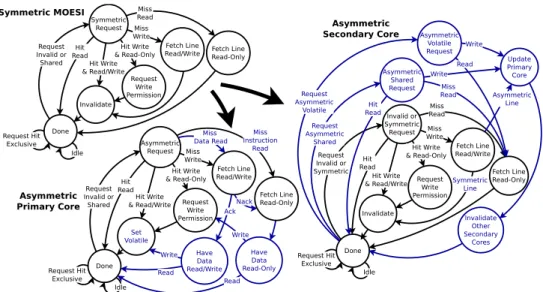
a MOESI directory coherency. The modifications to the state machine from the stan-dard MOESI directory coherency are shown in Fig. 2.
The directory allows for tracking of cache lines that the primary core is sharing. Consequently, asymmetric operations can be restricted to only the shared cache lines of the primary core. The primary core sets the line to be volatile rather than invalidating the secondary cores on writes. Volatile causes secondary cores to read and write to the primary core directly. For all asymmetric cache lines, the secondary cores will always write to the primary core.
Behaviour Description:
• The primary core has additional logic for choosing and setting special asymmetric states. The primary core sets the cache line to be volatile, instead of invalidating, which removes a wait for acknowledgement requirement.
• The secondary cores cater for two new asymmetric states. The asymmetric shared state always updates the primary core for writes, but performs reads locally. The asymmetric volatile state denotes that the primary core has write permission (data is volatile), and both reads and writes are always directed at the primary core. • The other cache line behaviour is unchanged. All the non-shared cache lines and the
cache lines shared between only the secondary cores behave in the same way as the original symmetric MOESI coherency policy.
Asymmetric Secondary Core Done Invalid or Symmetric Request Miss Write Hit Write & Read/Write Request Invalid or Symmetric Hit Read Idle Fetch Line Read-Only Miss Read Invalidate Request Write Permission Hit Write & Read-Only Update Primary Core Asymmetric Shared Request Hit Read Miss Read Invalidate Other Secondary Cores Asymmetric Volatile Request Write Read Fetch Line Read/Write Write Request Asymmetric Shared Request Asymmetric Volatile Done Asymmetric Request Miss Write Hit Write & Read/Write Request Invalid or Shared Hit Read Miss Data Read Set Volatile Request Write Permission Hit Write & Read-Only Fetch Line Read/Write Asymmetric Primary Core Have Data Read/Write Read Write Have Data Read-Only Nack Read Write Miss Instruction Read Fetch Line Read-Only Request Hit Exclusive Idle Request Hit Exclusive Symmetric MOESI Done Symmetric Request Miss Write Hit Write & Read/Write Request Invalid or Shared Hit
Read Fetch LineRead-Only Miss Read Invalidate Request Write Permission Hit Write & Read-Only Fetch Line Read/Write Idle Request Hit Exclusive Ack Asymmetric Line Symmetric Line
Fig. 2. Cache controller state machine changes to implement asymmetric coherency from an initial MOESI symmetric policy (blue shows added logic)
Performance Differences:
• The volatile state removes the acknowledgement time for shared writes in the pri-mary core.
• The additional asymmetric states mean that the primary core is never invalidated by the secondary cores. Consequently, it never needs to refetch invalidated cache lines. • The secondary cores need to perform all the update functions for the shared cache
lines of the primary core.
3.2.2. Hardware Costs and Scalability.To implement the asymmetric directory system,
the following is required: a more complex state machine for the cache controllers (de-scribed in Fig. 2), a single storage bit (to denote asymmetry) for each tag in the di-rectory and the caches, and finally a processor accessible register to control setting of the primary core during runtime. The additional bit is to denote whether a line is an asymmetric cache line. In our experimental setup, the additional memory bit causes a 2% to 3% increase in the cache memory size. These hardware cost increases are trivial compared to the complexity and storage requirements of the original MOESI system.
Unlike the bus based policy, a directory based policy allows for tracking of exclusive cache lines and allows for normal symmetric coherency behaviour between secondary cores. This significantly improves the scalability of the system (compared to the bus based policy) as only data with known asymmetry will be targeted. If the asymmetry is targeted correctly to the data, our directory based policy can always be configured to be equal or better than a standard coherency policy no matter what scaling of the system.
Furthermore, primary core settings for each individual cache line can ensure scala-bility of the performance improvement in much larger systems. Only a single primary core was used in the experiments, but a different primary core for each cache line is possible if a primary core bit is added for each cache tag. This provides very good scala-bility when used with good analysis for setting the asymmetry, because the asymmetry is handled on an individual cache line level.
4. EXPERIMENTAL SETUP
This section explains the two different experiment setups for the multi-programming (previous research [Shield et al. 2011]) and multi-threaded (new research) results. Two different simulation systems were used. The multi-programming results use a faster simulator, which lacks the ability to model the operating system. The multi-threaded results use a much slower full system simulator, which models the operating system behaviour. Section 4.1 describes the simulation system used in the multi-programming experiments. Section 4.2 describes the simulation system used in the multi-threaded experiments.
4.1. Multi-programming Experiment Setup for Asymmetric Bus Based Coherency
MiBench [Guthaus et al. 2001] was used for the multi-programming workload. Mem-ory traces were recorded from the MiBench running on a Virtex 4 FPGA with Microb-laze and uClinux.
A cycle accurate trace driven simulation system [Shield et al. 2007] was upgraded to implement the bus based asymmetric coherency (Section 3.1). The simulator uses memory traces for each core. The modified simulator has the additional ability to sim-ulate a spinlock by simulating the polling of a memory location until the value matches the release signal. The simulator can load different configuration files to change the architecture and policies in the multicore system. It supports up to 16 cores. In the experiments, 1 primary core and 4 secondary cores were given workloads. The private caches used are 4 KBytes in size, 2 way associativity, Pseudo-LRU replacement and a 16 byte line size. The cores are connected to a DRAM main memory through a bus.
The experimental parameters modified were the system type, write policy and bus arbitration policy. Combinations of these parameters created the different systems tested. The details of the parameters are listed below:
• System Type: Single Processor; Multicore Symmetric Coherency; Multicore Asymmetric Co-herency
• Write Policy: Writeback; WritebackOnHit; Writethrough
• Bus Arbitration Policy: Base (Round Robin); Priority (Bus Arbitration by Priority); Cancel (Bus Arbitration by Priority & Cancellation of Low Priority Accesses)
In the symmetric systems, all the cores use the same write policy parameter. In the asymmetric systems, the write policy mentioned only denotes the primary core policy. Writeback or writebackOnHit is used for the primary core and a writethrough policy is always used for the secondary cores.
4.2. Multi-threaded Experiment Setup for Asymmetric Directory Based Coherency
ParMiBench [Iqbal et al. 2010] was used for the multi-threaded workload.
In the multi-threaded experiments, the GEMS Simulator [Martin et al. 2005] was used to provide cycle-accurate full-system simulation results for the asymmetric direc-tory coherency. The asymmetric direcdirec-tory coherency policy and MOESI coherency pol-icy (Section 3.2) were implemented using the SLICC coherency description language in GEMS.
The GEMS configuration settings were: hierarchical switch interconnect; Solaris 8 operating system; 4 UltraSPARC III cores; off-chip main memory; no L2 cache; and private 64 KBytes L1 caches with 4 ways. All other settings are default.
Two enhancements to the GEMS simulator were required to add timing delay in the state machines (to improve accuracy) and to allow write update operations.
Results for static and dynamic allocation of asymmetry were obtained. In the static solution, the asymmetry core is set for the entire execution of the application. In the dynamic solution, the best asymmetric core allocation is chosen periodically.
5. RESULTS
We present the performance results for our two asymmetric coherency policies using multi-programming and multi-threaded workloads.
Section 5.1 presents possible performance improvements for an asymmetric multi-programming workload under asymmetric bus coherency. Section 5.2 describes the possible performance improvements for an asymmetric multi-threaded workload un-der asymmetric directory coherency.
5.1. Asymmetric Multi-programming Workloads
In multi-programming workloads, some applications have a higher priority than others or sometimes soft real-time requirements. However, these applications often cannot run on more than a single core. Asymmetric policies can be used to accelerate a single primary core, while still allowing for secondary cores to continue running.
In this section, we demonstrate that a static setting of the bus based asymmetric coherency can reduce overheads. This is only a small summary of our work with the bus based asymmetric coherency. More detailed results for the bus coherency system can be found in previous research [Shield et al. 2011].
5.1.1. Asymmetric Coherency Improvement. The asymmetric coherency policy alleviates
the cost of the coherency overhead. If the secondary cores are writethrough-always, checking their data is not required. This removes a bus extra cycle for checking whether there is dirty data in the secondary cores, when writeback is used in the secondary cores and the primary core needs to fetch data. This means that the asym-metric policy has an advantage over the symasym-metric policy when there is a read miss. Due to this difference the asymmetric policy reduced non-shared data coherency costs.
Sheet5
Page 1
Blowfis h_dec
Blowfis
h_enc Dijkstra Jpeg_d ec Jpeg_e nc Rijndae l_dec Rijndae l_enc Strings earch Tiff2bw Tiffdith er Ty pese t 0% 5% 10% 15% 20% 25% 30% 35% Sy mmetric (Writeback) Asy mmetric (Writeback) Sy mmetric (WritebackOnHit) Asy mmetric (WritebackOnHit) C o h e re n c y C o s t (% o f M e m o ry A c c e s s T im e )
Fig. 3. Coherency costs of asymmetric and symmetric policies for single core workloads (MiBench applica-tions) placed on a multicore system (Displaying percentage cost relative to memory access time)
Fig. 3 shows the coherency costs for the asymmetric and symmetric policies using both writeback and writebackOnHit under a wider range of MiBench applications. Applications that contained less than 2% system bus usage are not shown due to irrel-evance as they do not access the main memory much.
The difference between the coherency costs for the asymmetric policy and symmetric policy varied between 0.3% (for the application Stringsearch) and 8.7% (for the appli-cation Rijndael Decrypt). For the Stringsearch case, the coherency cost showed minor improvement with only a 2.3% and a 9.3% reduction in costs due to infrequent writes. However, in all the other cases the coherency costs were reduced by 20% to 60%.
5.2. Asymmetric Multi-threaded Workloads
In multi-threaded workloads, asymmetry in the cache coherency can improve perfor-mance by decreasing coherency costs for the sequential parts of algorithms. Thus mit-igating the effects of Amdahl’s law. Decreasing the coherency costs of threads that access shared data more frequently than others can also accelerate the system.
In the multi-threaded experiments, the asymmetric directory-coherency policy was used to test the impact of coherency on shared data. ParMiBench applications are used for the multi-threaded workload.
Multi-programming benchmarks running with the asymmetric directory policy showed no performance difference. The directory allows for tracking of shared cache lines, so asymmetry is designed to only be active for shared data. Consequently, asym-metric directory policy only has different behaviour for shared data.
We first present static allocations of the primary core for the entire application exe-cution. Then we present runtime allocation of the primary core.
5.2.1. Static Allocation of Asymmetric Coherency.In this section, our tests showed that workloads with uniform work distribution experienced a small performance improve-ment that does not come from asymmetry, instead deriving from better cache data retention with our policy. Workloads with non-uniform work distribution were able to achieve a larger improvement or reduction in performance, depending on the primary core setting. Consequently, it is important to set the primary core correctly for non-uniform workloads with shared data. However, non-uniform workloads can obtain a slight improvement without requiring any primary core adjustment.
An initial naive allocation of the primary core was conducted, based on setting the primary core to the parent thread on application startup.
Sha Stringsearch Susan Dijkstra 0.95 0.96 0.97 0.98 0.99 1.00 1.01 1.02 Asymmetric Ex ecutio n T ime (Nor malised to Symm etric)
(a) Execution Time
Sha Stringsearch Susan Dijkstra 0.6 0.7 0.8 0.9 1.0 1.1 1.2 Memory Latency (Nor malised to Symm etric) CPU0 CPU1 CPU2 CPU3 (b) Memory Latency
Sha Stringsearch Susan Dijkstra 0% 10% 20% 30% 40% 50% 60% 70% 80% 90% 100% Cor e Utilisation CPU0 CPU1 CPU2 CPU3 (c) CPU Utilisation Fig. 4. Asymmetric execution time, memory latency and CPU utilisation for ParMiBench applications
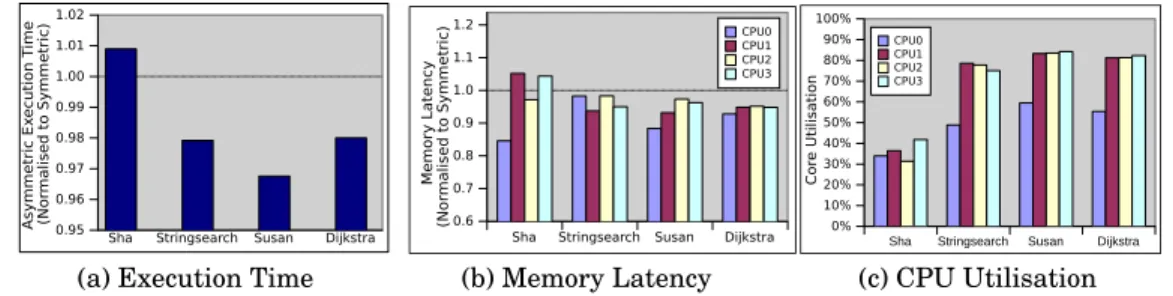
Fig. 4 shows the asymmetric coherency results normalised to the symmetric result for execution time and memory latency, and the CPU utilisation of the applications.
Fig. 4 (c) gives the CPU utilisation of each application, excluding the kernel usage that is mainly found on CPU0. The CPU utilisation is fairly evenly distributed across the cores due to the operating system load balancing. Most of the applications effec-tively utilised the free CPU time on the cores, so they have a good uniform-workload distribution. However, the application Sha (Secure Hash Algorithm) shows that a sig-nificant amount of the time the CPUs are idle. The idle time indicates that the ap-plication has been limited by its sequential operations, so the apap-plication Sha was a non-uniform workload.
Fig. 4 (a) shows a few percent improvement for the uniform-workload ParMiBench applications, when using the asymmetric coherency. However, the memory latency for individual cores, in Fig. 4 (b), indicates the improvement is not caused by shifting coherency overheads to idle cores as the memory latency reduced for all the cores. Asymmetry in the coherency does not appear to impact uniform workloads.
Secondary cores show improvement in many cases. The improvement in the sec-ondary cores can be explained by better retention of data within the caches. Detailed analysis of the secondary cores caches traces showed that the number of external mem-ory misses decreased and misses that result in cache to cache transfers increased. Cache to cache transfers are far less costly than cache to external memory transfers, so more cache to cache transfers improves the performance. The decreased number of external memory misses is due to the reduced amount of invalidation required in the asymmetric coherency. Invalidation reduces the system caches to a single copy of the data, and this one copy can be flushed by the replacement policy before another core tries to access it. The asymmetric cache reduces invalidation and the larger number of copies reduces the likely-hood for all copies of shared data to be flushed back to main memory when it is still needed.
The Sha application was a non-uniform workload, so setting the primary core is im-portant as the primary impacts this type of workload. Further exploration of static primary core allocations was made with Sha, Stringsearch, and Susan, while the other applications were not explored due to the long simulation times required for full sys-tem simulation (Dijsktra took over 4 weeks to simulate once).
CPU0 CPU1 CPU2 CPU3
Asymmetric Primary Core Setting
0.90 0.95 1.00 1.05 1.10 Asymmetric Execution Time (Normalised to Symme
tric) ShaStringsearch
Susan
(a) Execution Time
CPU0 CPU1 CPU2 CPU3
Sha 0.60 0.70 0.80 0.90 1.00 1.10 1.20 Memory Latency (Normalised to Symme tric) CPU0 CPU1 CPU2 CPU3
CPU0 CPU1 CPU2 CPU3
Stringsearch
CPU0 CPU1 CPU2 CPU3
Susan
Asymmetric Primary Core Settings
(b) Memory Latency
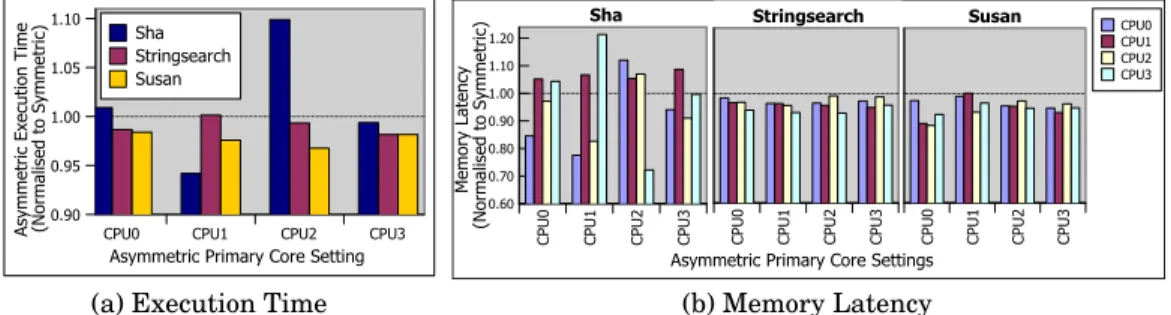
Fig. 5. Static allocation of the primary core for ParMiBench applications (normalised to symmetric results)
Fig. 5 shows the results for the ParMiBench applications, using static allocations of the primary core of the asymmetric policy. For Sha, there was a 9.9% increase in execution time when the primary core was incorrectly allocated to CPU2 and a 5.8% decrease in execution time when the primary core was correctly allocated to CPU1. For Stringsearch, there was a 0% to 1.8% decrease in execution time depending on primary core allocation. For Susan, there was a 1.6% to 3.2% decrease in execution time depending on primary core allocation.
Fig. 5 (b) shows that 5.8% Sha execution time improvement was due to the redis-tribution of coherency overheads. The memory latencies of the four cores varied the most for the correct primary core setting of CPU1. Two cores exhibited higher memory latency with CPU1 as the primary core, while the other two experienced much lower latency. The lower latency for CPU0 and CPU2 (22.5% and 17.4% respectively) sped up sequential portions of the application and overcame the performance decreases found in CPU1 and CPU3 (6.7% and 21.3% decreases respectively). Unlike Sha, the Stringsearch and Susan applications were relatively unaffected by coherency asym-metry, because their workloads were relatively symmetric as shown in Fig. 4 (c). Some improvement was still found in these two applications due to the impact of the better data retention in the caches, which was explained earlier.
5.2.2. Runtime Memory Latency Variation for Asymmetry. The number of shared accesses in an application varies significantly over time as the application performs different func-tions. Consequently, the improvement of asymmetric coherency can vary significantly
over time too. Greater performance improvements in memory latency are possible by fine-tuning the coherency policy during execution time.
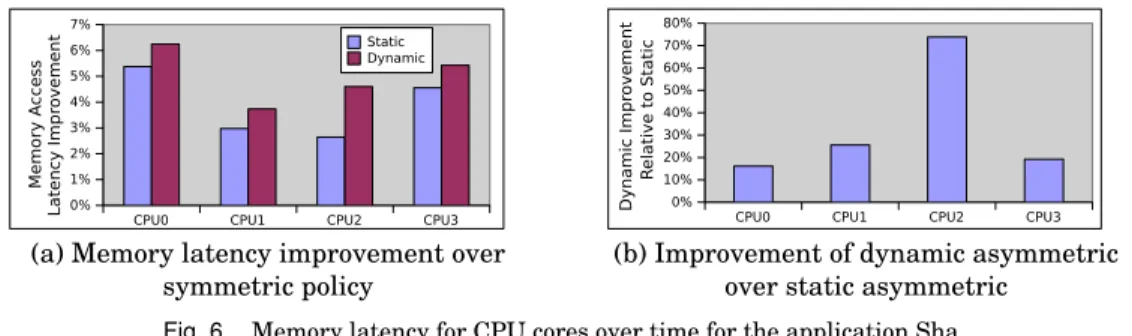
For the dynamic asymmetry experiment, only the first 6% of Sha’s execution was run, due to the long simulation time of full system simulation. Dynamic allocation of the primary core was made every 1 million instructions, using an offline calculation.
CPU0 CPU1 CPU2 CPU3 0% 1% 2% 3% 4% 5% 6% 7% Memory A ccess Latency Impr ovemen t Static Dynamic
(a) Memory latency improvement over symmetric policy
CPU0 CPU1 CPU2 CPU3 0% 10% 20% 30% 40% 50% 60% 70% 80% Dynamic Impr oveme nt R elative to Static
(b) Improvement of dynamic asymmetric over static asymmetric
Fig. 6. Memory latency for CPU cores over time for the application Sha
Fig. 6 shows the asymmetric policy memory-latency improvement for the applica-tion Sha using both static and dynamic allocaapplica-tions of the primary core. Overall the dy-namic solution improves memory access latency between 16.2% to 73.8% compared to the static asymmetric solution. This shows further improvement is possible for asym-metric cache coherency if runtime adaptation is implemented rather than a static al-location for the entire application duration.
6. DISCUSSION OF FINDINGS
Asymmetric coherency was shown to be a method that redistributes coherency costs in a multicore processor system. Two coherency policies were discussed and different experiments with different workloads were conducted: a multiprogramming workload using a bus based coherency system, and a multi-threaded workload using a network on chip with directory based coherency system.
Our bus based asymmetric coherency showed that redistribution of coherency costs can be used to accelerate a single core at the cost of slow down in other cores. Due to the slow down in other cores, this coherency policy is only suitable for customized MPSoC systems where the workload can be profiled and one of the cores is found to limit the performance of the entire system. This could either be a soft-real-time system that needs the critical code accelerated, or an application specific system where even distribution of the workload is not possible due to algorithmic limitations.
Our directory based asymmetric coherency targeted general purpose systems MP-SoC systems. Our results show performance improvements for multi-threaded appli-cations when the application generates idle time on some of the cores in the system (asymmetry in the workload). The idle time can be due to either bad partitioning of the algorithm in the code, or partitioning limitations in the algorithm itself. The ex-pected secondary core slowdown was instead a small improvement in many cases due to better retention of cache data. Consequently, for applications with little asymmetry in the workload, the results still showed some minor improvement due to the better cache data retention.
7. CONCLUSIONS
Our contribution is the concept of asymmetric coherency. The concept is to modify coherency policy to favour part of the workload where a sequential operations limits the performance of the system.
We have designed two examples, one bus based asymmetric coherency policy and one directory based asymmetric coherency policy. Using the bus based system we have demonstrated that asymmetric coherency can reduce the inherent coherency costs of unshared data by 20% to 60% in multi-programming applications. We used the direc-tory based system to look at the impact of shared data in multi-threaded applications. We achieved an overall 5.8% execution time improvement for a parallel Sha application and memory latency reductions for some cores going up to 22%. Analysis of the appli-cation Sha shows that runtime adaptation of the coherency policy can further increase performance improvements. Our results, showing the benefits of runtime adaptation of coherency policy, motivates future work in implementing a decision algorithm for asymmetric-coherency runtime adaptivity.
REFERENCES
ANNAVARAM, M., GROCHOWSKI, E.,ANDSHEN, J. 2005. Mitigating Amdahl’s Law through EPI throttling. SIGARCH Comput. Archit. News 33, 298–309.
BECCHI, M.ANDCROWLEY, P. 2006. Dynamic thread assignment on heterogeneous multiprocessor archi-tectures. In Proceedings of the 3rd conference on Computing frontiers. ACM, New York, USA, 29–40. BENNETT, J., CARTER, J.,AND ZWAENEPOEL, W. 1990. Adaptive software cache management for
dis-tributed shared memory architectures. In Proceedings of the 17th International Symposium on Com-puter Architecture. Seattle, WA, USA, 125–134.
CHANDRA, S., LARUS, J. R.,ANDROGERS, A. 1994. Where is time spent in message-passing and shared-memory programs? In Proceedings of the Sixth International Conference on Architectural Support for Programming Languages and Operating Systems. New York, NY, USA, 61–73.
CHENG, L., CARTER, J. B.,ANDDAI, D. 2007. An adaptive cache coherence protocol optimized for producer-consumer sharing. In Proceedings of the 2007 IEEE 13th International Symposium on High Performance Computer Architecture. Phoenix, Arizona, USA, 328–339.
COX, A. L.AND FOWLER, R. J. 1993. Adaptive cache coherency for detecting migratory shared data. In
Proceedings of the 20th International Symposium on Computer Architecture. San Diego, USA, 98–108. GUTHAUS, M. R., RINGENBERG, J. S., ERNST, D., AUSTIN, T. M., MUDGE, T.,ANDBROWN, R. B. 2001.
MiBench: a free, commercially rep-resentative embedded benchmark suite. In Proceedings in the 2001 IEEE International Workshop on Workload Characterization. Austin, TX, USA, 3–14.
IQBAL, S., LIANG, Y.,ANDGRAHN, H. 2010. Parmibench - an open-source benchmark for embedded
multi-processor systems. Computer Architecture Letters 9, 2, 45 –48.
IYER, R., ZHAO, L., GUO, F., ILLIKKAL, R., MAKINENI, S., NEWELL, D., SOLIHIN, Y., HSU, L.,ANDREIN -HARDT, S. 2007. QoS policies and architecture for cache/memory in CMP platforms. In Proceedings of the 2007 ACM SIGMETRICS International Conference on Measurement and Modeling of Computer Systems. San Diego, CA, USA, 25–36.
KUMAR, R., MATTSON, T. G., POKAM, G.,AND VAN DERWIJNGAAR, R. 2011. A case for message passing
for many-core computing. In Multiprocessor System-on-Chip: Hardware Design and Tool Integration. Springer.
MARTIN, M. M. K., HARPER, P. J., SORIN, D. J., HILL, M. D.,ANDWOOD, D. A. 2003. Using destination-set prediction to improve the latency/bandwidth tradeoff in shared-memory multiprocessors. In Proceedings of the 30th International Symposium on Computer Architecture. San Diego, CA, USA, 206–217. MARTIN, M. M. K., SORIN, D. J., BECKMANN, B. M., MARTY, M. R., XU, M., ALAMELDEEN, A. R., MOORE,
K. E., HILL, M. D.,ANDWOOD, D. A. 2005. Multifacet’s general execution-driven multiprocessor sim-ulator (GEMS) toolset. SIGARCH Comput. Archit. News 33, 92–99.
SHIELD, J., DIGUET, J.-P.,ANDGOGNIAT, G. 2011. Asymmetric cache coherency: Improving multicore per-formance for non-uniform workloads. In 6th International Workshop on Reconfigurable Communication-centric Systems-on-Chip (ReCoSoC). 1 –8.
SHIELD, J., SUTTON, P.,ANDMACHANICK, P. 2007. Analysis of kernel effects on optimisation mismatch in cache reconfiguration. In Proceedings of the 17th International Conference on Field Programmable Logic and Applications. IEEE, Amsterdam, The Netherlands, 625–628.
STENSTROM¨ , P., BRORSSON, M.,ANDSANDBERG, L. 1993. An adaptive cache coherence protocol optimized for migratory sharing. In Proceedings of the 20th International Symposium on Computer Architecture. San Diego, CA, USA, 109–118.
WOLF, W., JERRAYA, A.,ANDMARTIN, G. 2008. Multiprocessor System-on-Chip (MPSoC) technology. IEEE
Transactions on Computer-Aided Design of Integrated Circuits and Systems 27, 10, 1701–1713.