HAL Id: hal-02470935
https://hal.archives-ouvertes.fr/hal-02470935
Submitted on 7 Feb 2020
HAL is a multi-disciplinary open access
archive for the deposit and dissemination of
sci-entific research documents, whether they are
pub-lished or not. The documents may come from
teaching and research institutions in France or
abroad, or from public or private research centers.
L’archive ouverte pluridisciplinaire HAL, est
destinée au dépôt et à la diffusion de documents
scientifiques de niveau recherche, publiés ou non,
émanant des établissements d’enseignement et de
recherche français ou étrangers, des laboratoires
publics ou privés.
Dual-polarization DFB fiber laser stabilized by
frequency- shifted feedback
Marie Guionie, Aurélien Thorette, Marco Romanelli, Emmanuel Pinsard,
Laurent Lablonde, Benoît Cadier, Marc Vallet, Marc Brunel
To cite this version:
Marie Guionie, Aurélien Thorette, Marco Romanelli, Emmanuel Pinsard, Laurent Lablonde, et al..
Dual-polarization DFB fiber laser stabilized by frequency- shifted feedback. Journée du Club Optique
et Micro-ondes (JCOM 2019), Jun 2019, Brest, France. �hal-02470935�
JCOM 2019
ENIB & Lab-STICC
Brest
7 juin 2019
JCOM 2019 ENIB & Lab-STICC Brest 7 juin 2019
Dual-polarization DFB fiber laser stabilized by
frequency-shifted feedback
Marie Guionie1, Aurélien Thorette1, Marco Romanelli1, Emmanuel Pinsard2, Laurent Lablonde2, Benoît Cadier2, Marc Vallet1, Marc Brunel1
1. Univ Rennes, CNRS, Institut FOTON - UMR 6082, F-35000 Rennes, France 2. iXBlue Photonics, Rue Paul Sabatier, 22300 Lannion, France
Distributed-feedback (DFB) fiber lasers can sustain the oscillation of two orthogonal polarizations at different frequencies, due to the fiber Bragg grating UV-induced birefringence [1]. Such dual-frequency fiber lasers (DFFL) are promising as heterodyne sources but, in the context of microwave photonics, the stabilization of the beat frequency becomes necessary. Locking the beat frequency of a dual-frequency laser to a local oscillator by optical dual-frequency-shifted feedback (FSF) has been proved to be efficient [2], and can be applied in principle to any dual-polarization laser. Here we investigate this FSF method to a Er3+- doped DFB fiber laser, resulting in an all-fibered 1.5 μm system emitting a stabilized beat note at 1 GHz.
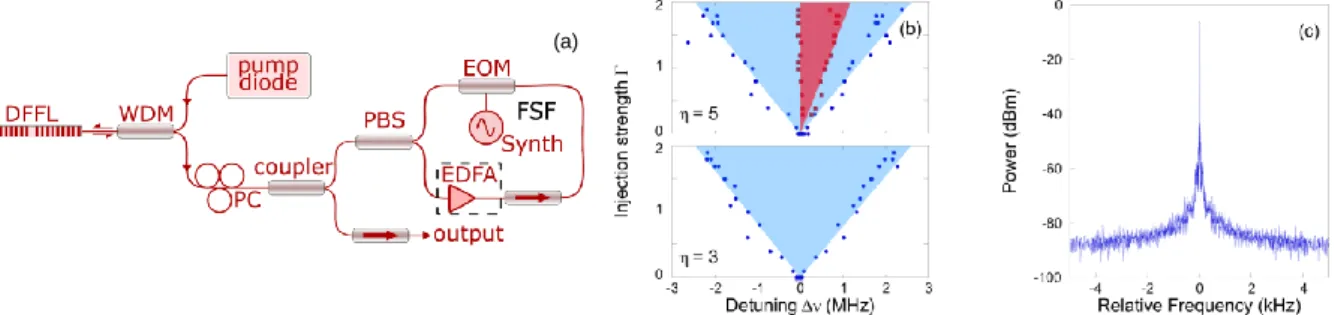
The set-up is depicted in Fig. 1(a). The DFFL is pumped at 976 nm through the WDM and emits at 1547 nm two orthogonal polarizations (with associated frequencies νx and νy). The free-running beat note is around 1 GHz; its line-width is equal to 3 kHz and presents a drift of a few MHz over hours [3]. The polarization-maintaining FSF loop is based on a polarization beam splitter whose output ports are closed on one another after passing through the frequency shifter, here an intensity modulator EOM driven at fLO and an optical isolator. The polarization controller PC permits to select one of the polarization states, say νx (νx < νy), which is re-injected into the laser. The EOM thus generates two sidebands at frequencies νx ± fLO. Hence, for a small detuning Δν = fLO – |νy – νx|, the re-injected field contains an optical sideband resonant with νy. Intracavity coupling can then lead to frequency locking between νy and the νx+fLO component of the reinjected field. This results in the transfer of the spectral purity from fLO to the beat frequency |νy - νx|.
Fig. 1 (a) Experimental scheme. The optional EDFA permits here to control the re-injected power. (b) Normalized injection strength Γ with respect to the detuning Δν at two different excitation ratio η. Colored areas
delimit the different regimes. White: unlocked, blue: locked, red: chaotic. (c) RF Spectrum of the locked DFFL beat frequency.
The observed dynamics depend on both detuning Δν and injection strength Γ. First, we find a frequency locking between the beat note and the synthesizer, delimited by the experimental blue points (see Fig. 1(b)), over a 4 MHz range at maximum injection strength. At large excitation rates, the laser may display a complicated, possibly chaotic dynamics on Δν > 0 side (delimited by the red points). In the locking zones, the stabilized beat frequency exhibits a narrow linewidth, smaller than 1 Hz (see Fig. 1(c)). The associated phase noise is measured to be –100 dBc/Hz at 1 kHz from carrier. The laser remains phase-locked for days in laboratory conditions.
JCOM 2019
ENIB & Lab-STICC
Brest
7 juin 2019
JCOM 2019 ENIB & Lab-STICC Brest 7 juin 2019
Such sources are advantageous in terms of carrier tuning, compactness and integration and could find application such as in radio-over-fiber. From the dynamics point of view, the linewidth enhancement factor of such lasers could be measured using this method [4]. Finally, similar studies on DFL fiber laser at 10 GHz are under investigation.
References
[1] W. H. Loh and R. I. Laming, “1.55 µm phase-shifted distributed feedback fibre laser,” Electron. Lett. 31, 1440-1442 (1995).
[2] L. Kervevan, H. Gilles, S. Girard, and M. Laroche, “Beat-note jitter suppression in a dual-frequency laser using optical feed-back,” Opt. Lett. 32, 1099-1101 (2007).
[3] M. Guionie, L. Frein, A. Carré, G. Loas, F. Bondu, E. Pinsard, L. Lablonde, B. Cadier, M. Alouini, M. Romanelli, M. Vallet and M. Brunel, « Beat note stabilzation in dual-polarization DFB fiber lasers by an optical phase-locked loop,” Opt. Express 26, 3483-3488 (2018).
[4] A. Thorette, M. Romanelli and M. Vallet, “Linewidth enhancement factor measurement based on FM-modulated optical injection: application to rare-earth-doped active medium,” Opt. Lett. 42, 1480-1483 (2017).