HAL Id: hal-01701686
https://hal.archives-ouvertes.fr/hal-01701686
Submitted on 4 Nov 2019
HAL is a multi-disciplinary open access
archive for the deposit and dissemination of sci-entific research documents, whether they are pub-lished or not. The documents may come from teaching and research institutions in France or abroad, or from public or private research centers.
L’archive ouverte pluridisciplinaire HAL, est destinée au dépôt et à la diffusion de documents scientifiques de niveau recherche, publiés ou non, émanant des établissements d’enseignement et de recherche français ou étrangers, des laboratoires publics ou privés.
Scrap tyre pyrolysis: Are the effluents valuable
products?
Alfredo Napoli, Yannick Soudais, Didier Lecomte, S Castillo
To cite this version:
Alfredo Napoli, Yannick Soudais, Didier Lecomte, S Castillo. Scrap tyre pyrolysis: Are the effluents valuable products?. Journal of Analytical and Applied Pyrolysis, Elsevier, 1997, 40-1, pp.373-382. �10.1016/S0165-2370(97)00011-9�. �hal-01701686�
Scrap tyre pyrolysis: Are the effluents valuable products?
Scrap tyrc pyroiysis under nitrogen is studied at atmospheric pressure with tbc aim of producing a solid rcsiduc to be burned simultanc~usly with coal dust in a coal burning power plant. The experimental device maiutaius isotbertnal conditions. The temperatures of trcat- ment are: 380,450 and 550°C. Tbm phases arc &t&cd after pyrolysis: solid, liquid attd gas and their composition is studied in rclatioc to tbc temperature of the tbcrmal treatment. TIK solid phase (char)--approximately 40% weight of the initial sampk (steel free) mostly constituted
of
carbon, also coetains the main r&craI matter initially pivscttt in the used tyrc. The char prod-xcd is brittle and has a high buruing power which makes it suitabk for burning when mixed with coal dust in coa1 burning power plants. Tbc steel weave is easily separated from the solid carbon residue after the thermal treatment and rccovtxcd without physical or chemical change and can be rccyckd. The gas p&ax contains a mixture of tighthydrocarbons. dihydrogen and carbon dioxkk The IRTF spectra of cvoIv#l gases shows a change in the ratio of every gas while the pyrolysis takes plaa. The liquid ~IIZGC iF 3 rv~pkx hydrocarbon mixture iu which some comportcats have been kkntikd. The chemical valoriza-
tion of the liquid phase is an alternative to a thermal valorization. Tttc pyrolysis appears to be a technique which is able to reduce a btiy. high polluting industrial waste. whik producing energy and/or valuable &crnU ~wmpouucls 9 1997 El&r Science B-V. Keyn~dr: Scrapped tyrc pyrolysiz Influena of temperature
1. Introduction
In the developed countries, a large part of the non-metallir waste generated by industrial and domestic activity is represented bq
used car
and truck tyres. This waste material constitutes a potential source of energy and valuable products [IJ. Only 20% of this waste is actually reqcled by various proce$;es; its energetic valorization includes use as supplementaryfuel in
cement kilns, incinerators [2] or in co-combustion with coal [3-71; shredded or powdered tyres can bc used as additives to asphalt in road pavement [8], or in rubber compounding [9], Among the thermal treatment processes, pyrolysis has received increasinginterest as tin
alternative
process to obtain
storable liquid fuels and basic raw materials, A large pyrolysis temperature range and heating rate as wellas
various pressure pyrolysis conditions have been studied at laboratory or pilot scale [!a-171. The solid phase has been mostly investigated for its ability to be converted into activated carbon 118-211 or carbon black for industrial purposes [22.23].An estimated 5GOOOO tons of scrap tyres are generated each year in France; 15 Go0
tons
are produced in our region.Because
of the future legislation concerning waste disposal and transport, particularly for used tyres, it seems to be relevant to solve this waste problem at a regional scale. One way is to produce a solid combustible for burning mixed with powdered coalin
a coaldust
burning power plant.In this paper, the influence of the temperature
pyrolysis on the solid, liquid
andgaq yield and composition has been investigated at a laboratory scale. The thermal treatment temperature was fixed at 380, 450 and 550°C.
2. ExperimentPI
The experimental
device is presented in Fig. I. The reactor glass tube {diameter 30 mm, length SW mm) was heated by anelectric
vertical, tubular furnace with nitrogen asthe carrier
gas. A slichng tube in the inferior part of the leactor immediately allowed the introduction of the sample into the hot are:i for a 15 min thermal treatment.The steel free sample (I
cm
diameter, 3 mm thickness, about I g weight) was taken from the sidewallrubber
of a used tyre. While the pyrolysis takes place, nitrogen sweeps across the reactor tube from the inferior part (flow rate: 0.2 1min -I) and transports the evolved gas IS to refrigerated traps, whsre the heaviest fractions condense. In a prior series of experiments, the pyroly:;is reactor was coupled to an FTIR spectrometer (Perkin Elmer 1760X) equipped with a gas cell (IS cm’ volume, KBR sides, frequency range: 4000-500 cm -I, MCT detector).
Allowing to the evolution
ofthe nature
of the gases versus time of treatment, another series of experiments were conducted: the light gases were collected in four tubular tanks filledup
with a confining liquid for gas analysis [24]. Each tank was filled successively with the evolved gas collected for 3 min of treatment, The pyrolysis gas splitting enables us to anaIyse separately the different fractions bychromdogrupby with a D&i GC 122 device, fitted out tith a
thcrmzkonductivitydetector (injcxtor
anddetector at
2WC) withtwo filled columns: a 5 A, Mb80
mesh molecular sieve column
(3 m, I/S) for &hydrogen analysis and a Hayesep D lOO/ZOO (6 m, l/8)column for the carbon monoxide and tight hydrocarkntr
analysis. The carrier gases
areAr and He, respectively (29 ml min -
’ flowfor the
2cohunns). The furnace tcmpernture is maintained at WC.
The collected oil fractions in the traps were weighed and analysed by gas
chromatography (Chromatograph F’erkhrom; FID detector fitted with a Petrocol
column (100 m x 0.25 mm x Ct.50 pm). The
tanpmturrs cfthe injector and
detector are ;..aintained at 2WC; the flow
of thecarrier gas (He) was 0.9 ml min -
I[split l/100). Tbc oil obtained was fluid enough to bc injected without s~knt. The
furnace temperature was set at 35°C I3r 15 min then raised Lo 100°C (2°C min -I)
and maintained
at this temperaturefor 2 h. A standard mixture of tthylbmzcnc, O-
and p-xylene, 1,5 cyclooctadiene and bmonene (5 pl of each diluted in 1 ml
chloroform) was analysed under the same
conditions. ,After the pyrolysis, the solid residue was weighed. As the char is to be used in
co-combustion with coal in a pulverized coal thermal power plant, comparative
analysis
ofgranulometry, CaIorific power, volatile matter, sufphur and ash content
of
charand coal were conduced. The granulometry test were made after a previous
grinding in the same conditions for char and coal. The calorific powers were
measured with a
calorimetrical bomb.Some pyrolysis experiments were
conducgcl w samples taken from the tread
rubber including the steel weave. This one was easily separated
fromthe char and
Table 1
Tolal ~BSS yield results [wt %) for the tyres samples (steel free) after IS min of pyrolysis Thermal treatment temperature 380°C 450°c 550°C -*
Char Elb 40 35
Liquid 15 19 12
GaP 4 41 53
y Obtained by difference.
b After IS min at 3WC the pyrolysis was unfinished: this temperature wus mointnincd for I h to get 52%wt of char.
observed by Scanning Electroni,: Microscopy to be compared to a reference unpyrolysed sample.
3. Results
The total mass yield for the tyres samples pyrolysed at 380. 450 and 550°C is reported in Table I.
3. I. Gus phase
The IRW spectrometer coupling with the outlet of reactor allows to exhibit qualitative cvoluticn of gas composition during the thermal treatment. In Fig. 2 is presented a series of spectra obtained during tyre pyrolysis at 450°C. The first spectral bands that appeared are those of carbon dioxide (2400 cm- ‘) followed by characteristic bands of aliphatic (2900 cm - ‘) and olefinic compounds (3 100 cm - I). On Fig. 3 are reported the major constituents of the gas against
the
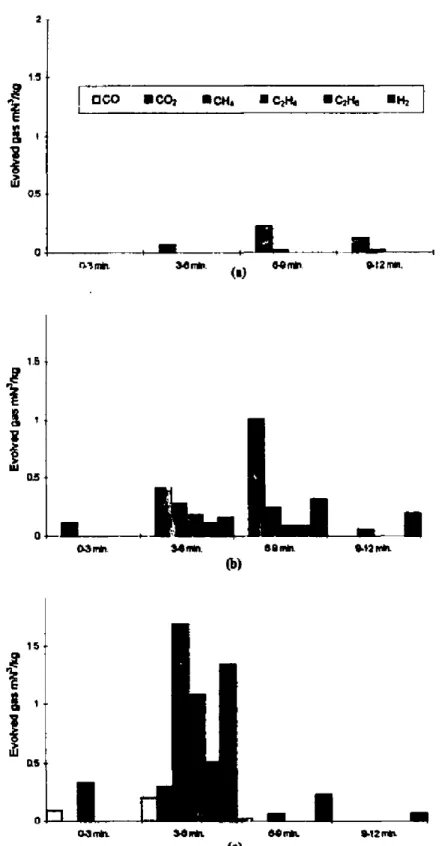
treatment temperature. The gas was collected during time periods: O-3, 3-6, 6-9 and 9-12 min. At 380°C. the gas was constituted of small quantities of carbon dioxyde and methane and the total gas volume did not exceed 0.5 N-m’ kg-‘.At
45O*C, the total gas valme reached 3 N*m3 kg-‘. Carbon dioxyde appeared at the beginning of pyrolysis, and remained the major constituent in the following fractions; the light hydrocarbons (CH,. C2H4, C2Hb) appeared after a few minutes treatment. Their total volume reached about 1 N-m3 kg-‘. The dihydrogen was produced last, its volume wa!, 0.7 N *m3 kg-‘. At XWC, the total gasvolume
evolvedwas about 4.5
N
- m3 kg - I, for the ha!: part constituted by hydrocarbons (mostly methane) and dihydrogen. The gas production is over during the initial stage of the reaction. Dihydrogen and methane increasing against temperature was reported in the literature 113,251 and &tributed to dchydrogenation reactions and structural ar- rangements of gaseous hydrocarbo!ls andoil.
Elemental analysis of the oils fractions obtained are reported in Table 2. The carbon content of the oil increases while the dihydrogcn content dccrcaxs with temperature, corresponding to olefms and/or aromatics hydrocarbon production as
2 min. w
3min’
---VI
Fig. 3. Gas chlomatogram of the pyrolysis gas collected during the thermal treatment, as a function of pyrolysis temperature (a) 380%; (b) 450°C; (c) 550°C.
reported before [13,14]. The calorific value of the oil at 450X was 36.5 MJ kg-‘,
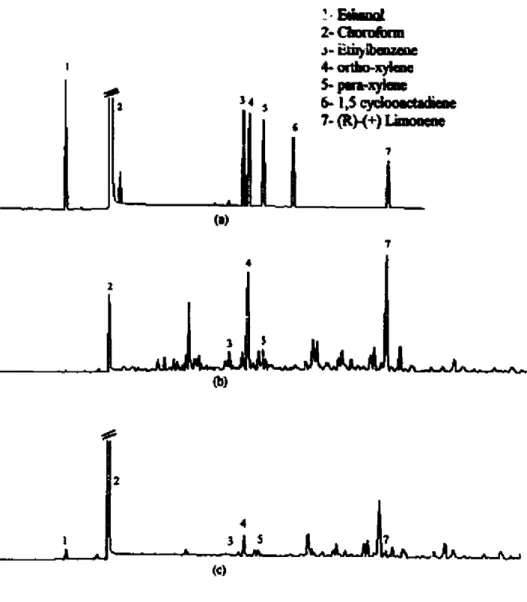
approximately of the same order than previously reported [lo,1 I]. The chro- matogram of a reference mixture and of the oil obtained at 450 and 550°C arc given
Table 2
Ultimate analysis of the oils fractions vs. ~cmprature Ultimate analysis (wt%) - C I-l N s TotaP 38O”c? 4wc 55WC 81.1 83.5 84.9 11.4 II.0 10.3 0.5 0.5 0.8 1.6 2.2 1.8 93.6 97.2 97.8
“Oil obtained alkr 1 h of trcatmcnt. bOxygcn balance to IWO.
Fig. 4. In both case, oil chromaiograms can be related to a very complex mixture in which only a few compounds have been identikd: ethylbenzene, O- and p-xylene and iimonene.
Table 3
Ultimate analysis of lyre. char and coal
Ultimate analysis (WV%) 5 . yre” Char CQill
580°C 45cJ°C 550°c 1.11.. ,-_. -_1- C 872 88.8 88*Q BY,4 71.6 H 7.3 3.8 1.7 0.3 4.9 N - 0.2 0.3 0.1 1.8 S 1.7 1.0 1.1 0.8 0.9 - u wt’/, (steel free). 3.3. Solid residue
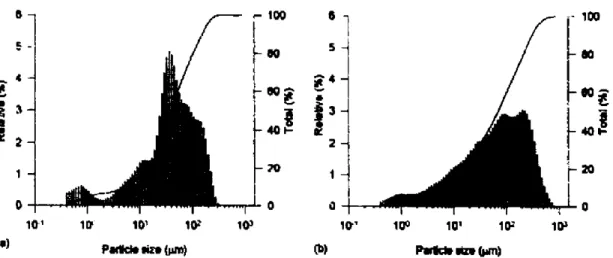
The solid residue obtained after 15 min treatment both al 450 and 55O’C has a brittle aspect; its weight is about 40% of the initial sample (steel free). At 38O”C, the weight loss is less than 20% and the residue has a viscous and plastic aspect, A thermal treatment of 1 h is necessary to get a 50% weight loss residue having a similar aspect to those obtained for higher temperatures. Owing to the aim of producing a solid combustible that can be used in co-combustion with coal, standard coal measurements have been realised on the char; elemental analysis, granulometry. calorific power, volatile matter and ash contents. In Table 3 are report& elemental analysis of the initial tyre, of the char and of the coal actually used in the power plant mentioned above. The combustion properties are given on Table 4. The granulometry was measured on coal and char samples, both ground in similar conditions. The size distribution 2nd the summa&d percent of char and coal particles are represented Fig. 5. The distribution of particle size is in the range 0.4-loo0 pm for coal and in a narrower range for char (0.4-300 pm); 60 and 80% for the coal and char particles, respectively, are smaller than 100 pm. Owing to the high carbon content of the char, its calorific value is greater than those of coal. Percentage sulphur mass values are similar for char and coal and ash content is
lower for the char. The pyrolysis treatment has concentrated in the solid residue, zinc initially present in tyre which can appear to be a disadvantage for the
Table 4
Combustion properties
Char Coal
4s0°c 550°c
Lower calorific value (k.l kg-‘)
Volatile Maler !wt.K) Ash (wt.‘!!) Zn (Wl.%)~ 31400 309lIO 29 DDO I. I 3.5 19.9 8.4 7.7 23.8 3.9 3.1 c0.I
1 V' 1 V 10' 1 c 19 1 0 100 1 0 ' 1 P 1 c
Ial p--II@ Ql --b-m
Fig. 5. Chat and coal size distribution: (a) char, (b) mal.
combustion. Nevertheless, assuming that the whole used tyre feedstock produced in the area (IS000 tons year- *) will be treated by pyrolysis, the result@ char does not reach more than 1% of the coal burned in a coal dust power plant. So, the zinc content stays at a very low level.
After pyrolysis, the steel weave from the tread rubber is recovered unchanged as can be seen by SEM comparison to a reference unpyrolysed sample.
4. coucllrsiorl
Pyrolysis experiments on small used tyre samples are achieved in isothermal conditions. A 4WC thermal treatment temperature for I5 min is suflkient to obtain a good yield of solid product, which can k easily separated from the steel weave and converted into a fine powder. Thermophysical and combustion proper- ties of the char are in good agreement with those of coal dust; so, the ro-combus- tion of coal and char is possible in a coal dust power plant, without any burner modihcation.
The oil phase contains some valuable compounds but their separation from the complex liquid mixture obtained is diflkult. Yet, regarding to its calorik value, the oil valorization as a fuel is always possible.
The gas evolved during thermal treatment are mostly composed of light com- bustible hydrocarbons and can be used as a supplementary heating resource in the pyrolysis process
Referewes
[I] G. G-me, R.A. Elefrilz, F.L. Kay and J.R. taman, Rubber Chcm. Technol., 51 (1978) 577. 121 MA. BarI% W.E. Eleazcr and D.J. Whittk. Waste Managc R-s.. I1 (1993) 963.
[3] D.J. Stopek and A.L. Justice, ACS Symp. Ser.. 515 (1991) I&I [4] J.E. Gillen, Pmt. Am. Power Conf., 53 (1) (1991) 769.
[5] C.R. Mffiowin and E.E. Hughes, ACS Symp. Ser.. 515 (1992) 14. [6] D. DenhoL Solid Waste Power. (1993) 12.
[7l M. Far&u and CM. Smith, Prepr. Pap. Am. Chem. Sot.. Div. Fuel Chem., 37 (1) (1992) 472,
[S] G.C. Page. Asphalt Paving Technol., hl (1992) 446. [9] M.W. Rouse. Rubber World. 206 (3) (Ip92) 25.
[IO] P.T. Williams, S. Besler and D.T Taylor, Fuel, 69 (lm) 1474.
[I I] C. Roy and J. Unswarth. in G.L. Ferero, K. Maniatis, A. Buekens and A.V. Bridgwater [Eds.). Pyrolysis and Gasification, Elmvier, London, 1989, p. 160.
[I21 C. Roy, B. Labrecque and 8. de Ca,lmia. Resources Conservation Recycling, 4 (1990) 203. [I31 R. Cyptis and B. Bettens. Annal. Mines Bzlgiquc, IO (1981) 673.
[I41 R. Cypris and B. Bettens in G.L. Ferero, K. Manintis, A. Buckcnr and A.V. Bridgwater (Eds.), brolysis and Gazification, Elsevier, London, 1989. p. 209.
[15; R. Cypr& Int. Ccnf. Tyre Recycling. Brussels, 20-21 January, t994. [I61 W. Kaminsky and H. Riissler. Chemrech. 22(2) (1992) 108.
[17] P,T. Wil.,ams and D.T. Taylor. in G.L. Ferero, K. Maniatis. A. Buekens and A.V. Bridpwater. Pyrolysis and Gazification. Elsevier Applied Science, London, 1989. 486.
:‘a] H. Teng. M.A. Serio. R. Bassilakis. P.W. Morrison, Jr. and P.R. Solomon. Prepr. Pap. Am. Chem. Sot.. Div. Fuel Chem.. 37(2) (1992) 533.
[l9] El. Bilitewski. G. Hatdtle and K. Marck in G.L. Ferero. K. Maniatis, A. Buekens and A.V. Bridgwater (Eds.), Pyrolysis and Gazification. Elsevier Applied Science, London. 1989, p. 96.
[20] A.A. Merchant and M.A. Petrich, Chem. Eng. Comm. 1 IS (19921) 351.
[:I] A.A. Merchant and M.A. Petrich, AlChE J., 39 (R) (1993) 1370. [22] H. Darmsradt, C. Roy and S. Kaliaguine. Carbon. 33 (IO) (1995) 1449.
[23] B. Sdhouli. S. Blather. F. Rrouers, H. Darmstadt. C. Roy and S. k’aliaguia:. Fuel, 75 (IO) (1996) 1244.
(241 K.A. Kobc and J.S. Williams, Anal. Chem., 46(7) (1935) 37.