Science Arts & Métiers (SAM)
is an open access repository that collects the work of Arts et Métiers Institute of
Technology researchers and makes it freely available over the web where possible.
This is an author-deposited version published in:
https://sam.ensam.eu
Handle ID: .
http://hdl.handle.net/10985/6880
To cite this version :
Nicolas PERRY, François-Xavier KROMM, Stéphane POMPIDOU, Olivier MANTAUX - Design for
recycling problematic : application to composite parts - In: International conference on Innovative
Methods in Product Design, Italy, 2011-06-15 - Proceedings of IMProVe 2011 International :
Conference on Innovative Methods in Product Design - 2011
International conference on Innovative Methods in Product Design June 15th – 17th, 2011, Venice, Italy
Design for recycling problematic: application to composite
parts
Perry Nicolas(a), Kromm François-Xavier(a), Pompidou Stephane(a), Mantaux Olivier(a) (a)I2M – UMR 5295 - Bordeaux University
Article Information
Keywords:Design for recycling Eco-design Composite recycling Design for environment Composites characterisation
Corresponding author: Perry Nicolas
Tel.: (+33) 05 56 84 79 78
e-mail: [email protected] Address: I2M – IUT 15 rue Naudet 33175 Gradignan - France
Abstract
Purpose:The use of composites in industry is ever- increasing. However, in spite of that, end of life solutions for composites are still under development. In this paper, a solution linking design strategies with a recycling process for composite materials will be proposed. The needs and multi-disciplinary skills required for taking recycling possibilities into account in the early stages of product design and the necessity to standardize product recycling capabilities based on design requirements will be discussed.
Result:
The paper highlights the need for designers to take a functional approach including characterization of materials and mechanical behaviour, recycling process limits, constraints and opportunities into consideration. The recovery solution for the thermoset composite is a supercritical water solvolysis process. This paper will show the first lessons learned from experiments with this technique.
1 Introduction
Today, the key focus for the transport industry is to make lighter vehicles. Reduction in weight leads to a decrease in energy consumption and CO2 emissions. Reducing greenhouse gases and pollution is one of our society's main challenges as it strives for sustainable development. Composites provide good opportunities for combining high modulus materials with free definitions of geometry. As a result, their use in industry is increasing. The aerospace and aeronautics sectors have integrated composites at different levels for their products (organic matrix based for cold applications and metallic or ceramic-based composites for hot applications).
Today, in the automotive industry, the limits of the use for the composites are their potential recyclability. Indeed, a global and eco-friendly approach analyzes and takes end of life solutions for systems into account at an early stage of their development process. Moreover, in the case of automotive, regulations imposes a 95% ratio of recycling of an out of use vehicle. The term “de-manufacture” has become more and more common, especially in the electronics industry. It characterizes the process of recycling materials and products, including end of life strategies and logistics in product development [1][2]. Design engineers have to balance safety, energy efficiency and cost. Unfortunately, they rarely get to the point of thinking about what will happen to the product at the end of its useful life [3][4].
However, as time goes by and new materials and technologies are developed, the challenge that recyclers face in safely and economically recycling those products grows ever more difficult [5]. Recycling a product means: (i) have a recycling technology available, (ii) get dismantle solution and access for the product, and (iii), dispose identification plus selection (may be clean or pure) possibilities for the materials. Moreover, the recycling
processes have to balance the technical, economical and environmental aspects of the end of life proposal. Composite applications have opened up a new field of research and development in the domain of new recycling processes. Water under supercritical conditions gives the opportunity to recover composite reinforcements (carbon fibers) and open new opportunities for second life composites.
We are focusing on a research area which aims to integrate recycling constraints in the design stage of composite parts. At the same time, we hope to promote discussion between designers and recyclers in order to innovate in the definition of new recycled composite products. This means that information and skills from both sectors will be shared. However, it also implies that materials and mechanical knowledge have to be developed (for both designers and recyclers). It is, therefore, necessary to include a third party in the discussion: experts in material and mechanical characterization.
The second section of this paper presents an overview of composite recycling possibilities and the technical and economic reasons for its development. The third part will focus on the design for recovery issue and the specificities related to composite design. The fourth section will explain our understanding, in terms of skills, needs and know-how required for addressing this issue. Before concluding, the last section will illustrate some feedback and the first lessons learned regarding eco-design for composites.
2 Composites recycling motivations
and solutions
Future regulatory constraints are pushing industries to develop efficient end of life alternatives based on technical and economic constraints. For carbon and aramide based products, high prices (carbon prepreg:
Perry Nicolas et al. Design for recycling problematic
around 180€/kg, Kevlar©: around 150 €/kg) and the world shortage in raw materials production, are the leitmotiv for finding technical and cost-effective recycling solutions. In such cases, second use of composite fibers will be dedicated to the manufacture of medium or low loaded parts (non-structural in many cases). Indeed, the recycled composites fibers and reprocessed semi-products have to reach the full acceptance and trust of the users (designers) regarding their health and quality. In fact, many stakeholders upon seeing the "recycled" label still tend to think of "low quality". However, as far as recycled carbon fibers are concerned, this is far from the truth. Methods exist today by which carbon fibers and prepreg can be recycled, and the resulting recyclate retains up to 90 percent of the fiber’s mechanical properties. In some cases, the method enhances the electrical properties of the carbon recyclate because the latter can deliver a performance close to or superior to the initial material [6]. So it is necessary to create demand for recycled fiber, by packaging it in a form useful or attractive to end-users. For example, cheap materials with very good properties could find larger applications than composite today. Moreover, this material, from reprocessing path, is more environmental friendly, and has the potential of a new recycling loop.
To make such a recycled product loop viable, the key factors are mainly the waste deposit quantity and availability. In order to ensure the efficiency of the recycle way, collecting and identifying infrastructure must be established in order to guaranty and improving the weighting of the recycled flux. Finally, the end-user must have confidence in the quality of the product in terms of robustness and value. Mechanical, physical, chemical studies must be purchased in order to enrich the recycled material data and confirm the propoerties of recycle fibers, semi-products and structures. These actions have been done successfully in the plastics industry. For example, forms of identification labels were added on plastic parts to facilitate collection and sorting. Most composites manufacturers are already engaged in waste management procedures (pushed by the REACH regulation), and as a result they recycle waste materials on the shop floor, when collection and processing solutions are proposed.
Thermoset matrix based composite designers and manufacturers are currently taking two different directions. On one hand, they are trying to increase the use of green composites or bio-composites. Bio-composites are (i) Bio-composites made with natural fibers (kenaf, flax, hemp, bamboo, coconut stems) as reinforcement and/ plus a petroleum-derived matrix, (ii) biopolymers (PLA or PHA) reinforced with natural fibers, (iii) synthetic fibers reinforced composites (glass, carbon, kevlar©) with a bio-polymers matrix. Natural fibers are being tested to test their reinforcement’s properties. The natural fibers promise to be the future solution for organic matrix composites parts [7][8]. Their mechanical properties can compete easily with glass fibers. Indeed, their specific density ranges from 20 to 45 and their tensile stress ranges from 400 to 1500 MPa. A solution already exists for high-performance mechanical composites, for example by improving the weaving processes [9]. Biopolymers or bio-compound (a combination of biopolymer and petroleum derived polymer) have also been studied [10]. These polymers come from PLA derived from cornstarch or PA11 from castor seeds and its ricin protein. Their carbon footprint is reduced on one hand, by the use of a bio renewable
material and on the other hand, by the increase of the recyclability potential.
In addition, the end of life impact awareness, thelps developing recycling technology. The thermoset matrix can be removed either by burning or grinding technics. It’s cheap but very aggressive for the carbon fibers [11][12]. Complex thermal, chemical and mechanical processes are needed to obtain high quality recycled carbon fibers. Pyrolysis or solvolysis are two of these very promising solutions. However, there are some limitations. For example, it is impossible to recycle different categories of matrix simultaneously. At the same time, specific coatings (metallic cladding for electric behavior, for example) are not compatible with some processes. Thus, specific requirements must come from the recycling stages if they are to be efficient. The most obvious but also important thing is to extract and free all the metallic inserts, even before grinding [13]. Moreover, before recycling, the products have to be dismantled and adapted to the recycling process reactor. These reactors are mainly cylindrical and have long shape versus their radius. Cutting operations are compulsory.
In southwest France, composites recycling will increase in terms of quantity due to the creation two dismantling platforms. (i) TARMAC platforms dedicated to civil aircraft applications in collaboration with Airbus, EADS Sogerma. TARMAC first focuses on the re-use and the certification of replacement parts in aircraft maintenance. (ii) P2P platform (close to Bordeaux) deals with the disassembly of ballistic weapons. In order to manage the end of life of structures, a consortium of rocket manufacturers (EADS Astrium Space Transportation, SNECMA Propulsion Solide, etc …) are working together on the RECCO project (RECCO: French acronym for Composites Recycling). The final goal is to validate an industrial solution and an industrial demonstrator for composite recycling. The solvolyse process is chosen for removing the thermoset matrix. In this technological and industrial background, we promote an early integration of the recycling constrains and possibilities in the design process of carbon composite parts. The next sessions will explain the integration levels we face in order to develop a design for recovery approach.
3 Composite design for recovery
In order to take the end of life information into consideration in the product design phase, we naturally opted for design for “X” approaches. In our case, we worked on design for recovery (instead of recycling) taking common consideration (disassembly in this case) should lead designers to propose solutions for products. In this perspective, all the recycling requirements become input to be taken into account in a product’s functional specifications. In addition, from a semantic point of view, we promote the use of the term recovery instead of recycling, in order to emphasize the second life and second use of the product or material after the recycling phase. We shift from the cradle to grave cycle to the spirit of the cradle to cradle. Thus, even if we are using design for recycling methodology, or using the term “recycling”, we take it as a dynamic state, as e rebirth for future use and not as a static and final goal. That means considering future product design or future second life material at the recycling level. In other words, we are in two dual areas of research. Firstly, design for the end of life can be summarized as design for recovery. Secondly, from recycling to design, the research deals with robust material recycled for design.
Design for recovery challenges aim to protect the environment and create a sustainable means for preserving our resources and reducing energy loss and pollution. It seeks to achieve two very basic goals: the first one is to eliminate or reduce the use of hazardous or toxic materials which may present a serious threat to the environment, or put a recycler's workforce in jeopardy, and the second is to discourage the use of materials that are not recyclable or manufacturing techniques that make a product non-recyclable using current technologies. The best time to address these issues is during the design stage [14]. Addressing a product's end-of-life is essential at the very beginning. Adopting this premise helps to ensure an efficient recycling chain, this goes well beyond the scrap processor to the mill, smelter, or extruder which will take the recycled materials and make them into new materials. Design for recycling is a mindset that all design engineers must embrace if they hope to have their products considered as environmentally friendly. As mentioned before, design for recycling is driven by governmental mandates like the European Union's Waste Electrical and Electronic Equipment directive (WEEE or DEEE) or End-of-Life Vehicle (ELV) directive (in 2015 in Europe, more than 85% weight must be recycled, and more than 95% weight re-use or valorised).
There is more than environmental compliance at stake here. As new materials are developed, such as carbon-based composites, they bring about a new threat in terms of recycling. As these new materials are introduced into products and are replacing materials that have been recyclable for generations, they affect recyclability negatively both practically and financially. Both can have a devastating impact. Even materials that are recyclable can pose a problem when used in combination. Take, for instance, a product that is made from many different types of plastics. Today's recycling technology can only sort two or three different types of polymer materials (using a mechanical solution), at best. Composites effectively become non-recyclable, or at least the plastics fraction of that product will be non-recyclable [15][16].
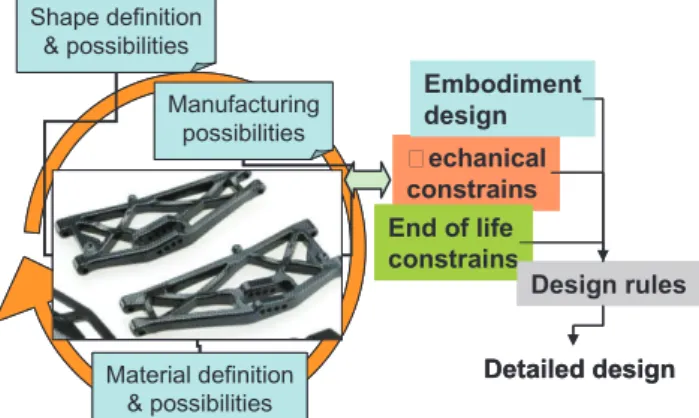
Therefore, in order to address the global problem, we are working on different levels: (i) design teams, (ii) design methods and (iii) design tools, in order to reduce the gap between the existing recycling solutions or bio-composites possibilities, and designer’s today solutions. Not only do engineers have new materials and new product design solutions for eco-responsible products, but there are now also different tools available to help model and evaluate the solutions and the product life impact. This end of life requirements definition, also points out the life needs, in terms of maintenance or parts fixing. Unfortunately, the results of these rating tools depend on the information available. Most of the time, little information is available about the life and end of life of a product in the design stage. Furthermore, in the case of recycling processes under development, it is necessary to anticipate the potentiality of the technologies and their applications. The uncertainty of decisions will therefore be increased. Indeed, design decisions, in terms of end of life consequences, will, no doubt, appear from 5 to 20 years later. Before giving further explanation, it is important to remember that composite design is complex due to the fact that it is necessary to simultaneously define (i) geometry and shape, (ii) materials (fiber and matrix) and the reinforcement orientations, and (iii) manufacturing process. These three topics are linked and inter-dependent in the design and optimization process. For example, laminates selections limits shapes possibilities and depend on manufacturing capability.
Consequently, as illustrated in figure 1, the eco-designer has to juggle with constraints from various sources, in addition to internal constraints and relation-ships of the composite design. Up to now, these additional constraints are not taken into consideration, except for the consequences of the new regulation (Reach) which focuses on manufacturing aspects.
Fig. 1: Design for X constrains in perspective of composite design approach
4 Levels of complexity and integration
to link recovery and design
Integrated design means addressing the recycling process development issue carefully while at the same time, proposing the possibility of including such evolutions in design methodology. We identified three main problems: (i) the first is concerned with recycling physics and scheduling to link and reach design methodologies, (ii) the second is dedicated to the uncertain and non-complete nature of the information available, (iii) the third problem is to do with competencies and skills needed to for the design of robust recovery problems.
4.1 Physics and time-table
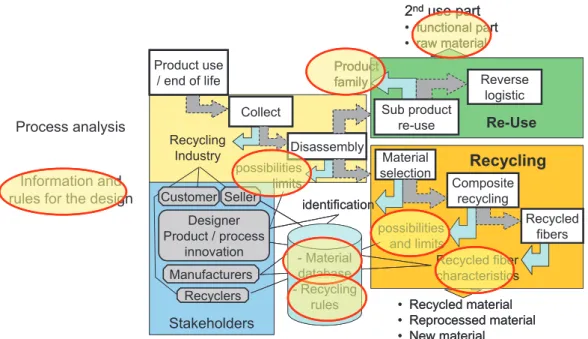
This part has to manage the knowledge integration in design of the recycling process. These processes are most of the time under development, searching for breakthrough innovations and applications. The recycling rules that, must be included in the design process, are still under formalization while designers must take decisions. Furthermore, the decisions taken today affect the product much later. Figure 2 shows the core elements that build the skeleton of a product’s end of life. Each phase of this process has its own limits and constraints to be integrated or overshot. Different stakeholders are included in the loop and should point out the information, expected data and decision rules they apply to switch from one-stage to another. The different schedule between real recycling process and part design increases the integration difficulties. For existing and robust end of life paths, constraints and material re-process and re-use are well known. For new recycling processes, robust validation can take time while designers have to take decisions now. An extreme example is nuclear plants. Built 40 years ago, there is still no efficient end of life solutions and their dismantling will soon begin. Research and development teams are banking on some kind of technological breakthrough to guide developments in recycling. Innovation is needed not only in the recycling phase but also for all the key stages. It is important to improve disassembly techniques (see design for
assembly-Shape definition & possibilities Manufacturing possibilities Material definition & possibilities Shape definition & possibilities Manufacturing possibilities Material definition & possibilities Detailed design Mechanical constrains End of life constrains Embodiment design Design rules Detailed design Mechanical constrains End of life constrains Embodiment design Design rules
Perry Nicolas et al. Design for recycling problematic
disassembly approaches) or selection efficiency [18][19]. At the end of the process, it is essential to develop innovative and valuable uses to compete with virgin raw materials (for similar characteristics) or to find new opportunities, at the very early design of the recycling path.
As far as composites are concerned, new processes enable fibers to be recovered with very little distortion and fracture from the composite part initial disposal. Supercritical fluids give such opportunities [20][21]. However, the problem of alignment and restructuration of the fibers still remains. Competences (knowledge and know-how) and skills on fibers spinning and weaving have been integrated by recycling teams. Other alternatives consist in reprocessing medium size flat rectangular pieces of 1D or 2D carbon fibers. The innovation consists in proposing a patchwork’s part design approach. Moreover, specific works have to identify the mechanical characteristics and efficient strategy for material characterization according to the product design development phase, from the recycled fibers to the final structure [22][23]. This testing pyramid problematic, from the micro to macro behaviour, at all the stages of the product (from the fiber to the structure), must integrate the shifts uncertainty of complex but in real case tests [24][25].
4.2 Information access and result trusts
Figure 2 is also a starting point for identifying the existing information available at each stage of the process. Integrating the different stakeholders, it helps to identify which kind of information is needed or available, and who is the owner or require for this information Errore. L'origine riferimento non è stata trovata.. In the perspective of a classical V cycle of product development, two elements arise. Firstly, the kinds of data, and their certainty, depend on the end of life solution chosen. Indeed, as illustrated in Figure 3, in the case of a re-use of product, the product life information might need to be certified and guaranteed for compliance. The materials database will store all this information, structured for each recycling stage. The designer will use the data stored. Nevertheless, in many cases, the kind of
data required is known, but the real value of the data is unknown or fuzzy or range from to limits. As a result, design evaluation becomes uncertain. Therefore, end of life solutions are not fully defined at an early design stage. Nevertheless, these initial decisions will impact the environmental footprint. In addition, as illustrated in part 4.1, an efficient end of life solution might not have been developed yet. Consequently, end of life evaluations must be used with care, dividing the trust-able results with the uncertain ones. Similar levels of information completeness can compare different solutions. Otherwise, the results should be taken as trends or qualitative comparisons.
Fig.3: V cycle for information exchange
On one hand, we plan to map the design process cycle, with each key decision, regarding the life and end of life impact. The decisions will need data, decision rules, etc. In addition, as started in figure 2, we will capture all the information in detail: requirements and constraints, in order to generate recycling rules. The connection link between the two aspects, identified with the use or the generation of the same data will link designer to recycler.
4.3 Multidisciplinary needs
Section 4.2 explains how we will create the link between recyclers and designers. However, in many
Recycling
Disassembly
Reprocessing
Reuse
Recycling
Disassembly
Reprocessing
Reuse
Requirements
Development
Design
Life
Requirements
Development
Design
Life
End of Life
Material
Recycling
Design rules
Design processMaterial
Recycling
Design rules
Design processMaterial
Recycling
Design rules
Design process Stakeholders possibilities limits Recycling Industry Manufacturers Recyclers Customer Seller Designer Product / process innovation Stakeholders possibilities limits Recycling Industry Manufacturers Recyclers Customer Seller Designer Product / process innovation Disassembly Collect Product use / end of life Disassembly Collect Product use / end of life Re-Use Product family Reverse logistic Sub product re-use 2nduse part • functional part • raw material Re-Use Product family Reverse logistic Sub product re-use 2nduse part • functional part • raw material Material selection identification possibilities and limits Recycled fiber characteristicsRecycling
Recycled fibers Composite recycling • Recycled material • Reprocessed material • New material Material selection identification possibilities and limits Recycled fiber characteristicsRecycling
Recycled fibers Composite recycling • Recycled material • Reprocessed material • New material - Material database - Recycling rules - Material database - Recycling rules Process analysis Information and rules for the designpossibilities limits limits limits limits limits limits Seller possibilities and limits - Material database - Recycling rules database Recycled fiber characteristics Product Product Product Product family family use part use part functional part functional part raw material raw material Information and rules for the design
264
June 15th – 17th, 2011, Venice, Italy Proceedings of the IMProVe 2011
cases, designers need data regarding a specific characteristic (maximum tensile stress for example) and the recyclers are not able to give such information. Inversely, the recyclers have to know about life damage, but the designer can only inform on the use cases employed for the design. Consequently, complementary information arises in this dual relationship. Material and product characterisation is compulsory at different levels. People coming from material, chemical and mechanical field will be able to provide away of translating the requests or the requirements into real data. Indeed, many different characterizations must be carried out before and after the recycling process. For example, identification of the life and assembly consequences on the material, the possible disassembly damage, etc… These data guide the recycling process to minimize variability incidence. In a second stage, the recycled material or re-processed semi-product has to be tested in order to assess its quality and enrich the designer possibility (with a second life or reprocessed material). Figure 4 sums up the interaction between these three required skills.
From the characterization point of view, the key problem is adaptation of scale. The testing pyramid strategy helps to identify sufficient and necessary tests from the elementary sample level to the full system level (see figure 5). In most cases, specific tests have to be developed in order to guarantee relevant and reliable results. This multi level approach is also applied to the development of new recycling processes and their
industrialization.
Fig.5: Summary of the three skills domains interrelation [27]
5 Composite design for recovery: first
lessons
RECCO1 project (in wich we are involved) search industrial solutions to recover (id. es. recycle and re-process) carbon composite wastes. The solvolysis method is developed to recycle thermoset matrix composites. The specificity of this process is its maximal matrix removal with a little carbon fibres degradation. In addition, the solvolysis has minimal water consumption and pollution. After the solvolysis phase, it remains dry carbon fibres, oriented according to the product composite sequence. This process uses supercritical water. The water under supercritical conditions (around 200 bars and 400°C) becomes a solvent for the matrix witch is easily and fully removed. Since, this process is very sensitive to presence of other non organic material such as metal. For example, the solvolysis process oxidized rivets, screws or inserts, and even parts of the solvolysis reactor in some cases. It spreads small metallic particles in and on the carbon fibers. Depending on the whether uni-directional or woven orientation was used for the fibers, the solvolysis liquid flow concentrates this pollution on the outer edge of the fibers or at the cross of the tows.
This pollution has little influence on the dry fibers mechanical strength. It creates bridges and an upper skin that reduces the reprocess-ability (spinning or re-weaving). When sizing and imbue with matrix polymer it
eases mechanical grip and has little effect on mechanical properties. Regarding the physicals properties, this pollution modified the behaviour locally. More tests must be carried out to analyze the solvolysis pollution impact further.
Another feed back has resulted from the analysis of these pollutions. At the edge of the parts, the cutting processes change the properties of the matrix. This cutting come from the adjustments of the parts to the solvolysis reactors sizes. Indeed, the local heat of the cutting burns the matrix. This carbon based layer glues the fibers together at their edges. This thickness of this layer can reach up to 200 microns when hard condition cutting parameters are used. This property can ease the handling of the recyclate. To spin a long tow with short or medium size fibers, this glue reduces the shreds (good for mechanical handle and guide of the fibers). However, at the same time it reduces the spinning efficiency of inter fibers grip.
Up to now, we have improved our competence in textile manufacturing in order to develop the remanufacturing end of the recovery loop. The pilot demonstrator is under development and we are able to transform composite parts to tows or woven of recycled carbon fibers. The mechanical characteristics of these fibers are nearly the same as virgin fibers, except for their length.
1
RECCO is a french consortium gathering composite waste industrials producers (EADS Astrium – Snecma Propulsion Solide – Airbus), supercritical fluid experts and providers (ICMCB – Innoveox), composite remanufacturing (I2M), logistic partner in the field of the chemistry (Gaches Chimie) and the French institution for environment (ADEME).
Design
Material database Performance indicators Material (new) requirements
Characteristics, functions
Design for recycling integration
Design
Material database Performance indicators Material (new) requirements
Characteristics, functions
Design for recycling integration
Recycling Disassembly
Selection and sorting Cleaning Functionalizing Re-processing Recycling process developm ent Recycling Disassembly
Selection and sorting Cleaning Functionalizing Re-processing Recycling process developm ent Characterization Product-material to recycle data performances data : - new product - recycled product Material specification
Specific tests development
Database enrichment Mat.2
Mat.1 Characterization Product-material to recycle data performances data : - new product - recycled product Material specification
Specific tests development
Database enrichment Mat.2
Mat.1 C o n st ra in s a n d o p p o rt u n it ie s C o n st ra in s a n d o p p o rt u n it ie s
Information and process
Disassembly
Selection and sorting Cleaning
Functionalizing Re Material database
Performance indicators Material (new) requirements
Characteristics, Characterization Product-material to recycle data performances data : new product recycled product
Fig.4: Summary of the three skills domains interrelation
Perry Nicolas et al. Design for recycling problematic
6 Conclusion
We were able to recycle carbon-based composites and recover the carbon fibers. This development highlights the fact that recycling possibilities and constraints should be included in the early design stages. Skills and competences (knowledge and know-how) from materials characterization and mechanical characterization are required for providing information about the parts to be recycled, and about the materials or semi-products derived from recycling. For our point of view, the three communities have the skills which must interweave in order to reach the design under recycling constraint objectives and to develop robust recycling processes for second design perspectives. In order to facilitate discussion and communication within the three areas of expertise, we have to work on the requirements definition for the designer, but also take the recycler’s point of view into account. Systematic formalization of requirements and semantic alignment between the different, yet not so distant, communities has to be implemented.
An environmental assessment of the solvolysis recycling process still has to be carried out in order to compare energy and material consumption, pollution, cost etc. for the same quantity of material (new or recycled). The increasing use of composites in industry has brought about the development of end of life solutions. Regulatory constraints and financial perspectives (cost-cutting) will give rise to design for recovery or eco-design approaches.
References
[1] Berry, S.: Design for recycling, Engineering Designer. Vol. 22, no. 4, pp. 8-14. July-Aug. (1996)
[2] Gaustad, G., Olivetti, E., Kirchain, R.: Design for Recycling: Evaluation and Efficient Alloy Modification, Journal of Industrial Ecology, Yale University ©, DOI: 10.1111/j.1530-9290.2010.00229.x, April (2010)
[3] Kriwet, A., Zussman, E., Seliger, G.: Systematic integration of design-for-recycling into product design, International Journal of Production Economics, Volume 38, Issue 1, March 1995, Pages 15-22 (1995)
[4] Vallet, F., Millet, D., Eynard, B.: How ecodesign tools are really used - Requirements list for a context-related ecodesign tool, CIRP Design Conf., April, (2010)
[5] Calcott, P., Walls, M.: Waste, recycling and design for environment: Role of markets and policy instruments, Resource and energy Economics Journ. N°27, pp.287-305 (2005)
[6] Perry N., Kromm F.X., Mantaux O., Pilato A., Composite eco-design, IFIP AMPS 2010 Conference, Como, Italia, (2010)
[7] Feng, L.Y.: The biomaterial for green composites, JEC Composites Magazine, focus on Natural Fibres & Environment n°55, pp.29-30, March (2010)
[8] Mohamad M., Natural fibres for the 3rd millenium, Feature on Natural Fibres & Environment n°55, pp.23-28, March (2010)
[9] Weager, B.: High-performance biocomposites: novel aligned natural fibre reinforcments, Feature on Natural Fibres & Environment n°55, pp.31-35, March (2010) [10] Bourmaud, A., Baley, C.: Rigidity analysis of polypropylen/vegetal fibre composites after recycling, Polymer degradation and stability Journ. 92(6), pp. 1034-1045 (2009)
[11] Mantaux, O., Aymonier, C., Antal, M.: Recycling of carbon fibre reinforced composite materials with super-
critical water dissolution, actes du 16° congrès JNC Toulouse, juin (2009)
[12] Mantaux, O., Chibalon, L., Lorriot, Th., Aurrekoetxea, J., Puerto, A., Arostegi, A., Urrutibeascoa, I.: Recycling study of end of life products made of ABS resin, Journal of Materials and Science & Technology, Vol. 20, Suppl.1 (2004)
[13] Mantaux, O., Barthes, M.L., Dumon, M., Lacoste, E.: Recyclage d'ABS issu de DEEE en mélange avec du PC - DEEE – actes du 14° congrès CNRIUT 2008, Lyon-Villeurbane (2008)
[14] Ferro, P., Amaral, J.: Design for recycling in the automobile industry: new approaches and new tools, Journal of Engineering Design, Volume 17, Issue 5 October 2006, pages 447 – 462 (2006)
[15] Seager, T. P., Theis, T. L, A taxonomy of metrics for testing the industrial ecology hypotheses and application to design of freezer insulation, Journal of Cleaner Production 12, pp.865–875. (2004)
[16] Perry, N., Mantaux, O., Leray, D., Lorriot, T, Composite recycling: design for environment approach requirements, IDMME – Virtual Concept 2010, Bordeaux, France (2010)
[17] Hoffmann, B. Kopacek, P. Kopacek, R. Knoth, "Design for Re-Use and Disassembly," ecodesign, pp.378, 2nd International Symposium on Environmentally Conscious Design and Inverse Manufacturing (EcoDesign'01), 2001
[18] Boothroyd G., L. Alting (1992) Design for Assembly and Disassembly, CIRP Annals - Manufacturing Technology, Volume 41, Issue 2, 1992, Pages 625-636 [19] Aymonier, C., Loppinet-Serani, A.,, Reverón, H., Garrabos, Y., Cansell, F.: Review of supercritical fluids in inorganic materials science, The Journal of Supercritical Fluids, Volume 38, Issue 2, September, Pages 242-251 (2006)
[20] Loppinet-Serani, A., Aymonier, C., Cansell, F. : Supercritical water for environmental technologies, Emerging Technologies, Journal of Chemical Technology & Biotechnology, Volume 85 Issue 5, Pages 583 – 589, DOI 10.1002/jctb.2323 (2010)
[21] Kromm, F. X., T. Lorriot, B. Coutand, R. Harry, J. M. Quenisset, Tensile and creep properties of ultra high molecular weight PE fibres, Polymer Testing, Volume 22, Issue 4, June, Pages 463-470 (2003)
[22] Laurin F., 2005, Approche multiéchelle des mécanismes de ruine progressive des matériaux stratifiés et analyse de la tenue de structures composites, PHD Thesis, Univ de Franche-Comté, Fr
[23] Rollet Y, 2007, Vers une maitrise des incertitudes en calculs des structures composites, PHD Thesis, ONERA - Ecole Polytechnique, Palaiseau, Fr
[24] Dennison A., The Test Pyramid: A Framework for consistent evaluation of RFID tags from design and
manufacture to end use,
www.idspackaging.com/Common/Paper/Paper_256, (june 2010)
[25] Ladevèze P., Puel G., Romeuf T., 2006, Lack of knowledge in structural model validation, Computer methods in applied mechanics and engineering, Vol. 195, pp.4697–4710
[26] A. Bernard, S. Ammar Khodja, N. Perry, F. Laroche (2007), Virtual Engineering based on knowledge integration, Virtual and Physical Prototyping, vol.2, issue 3, , p. 137-154, 2007.
[27] Composite reliability using testing pyramid: www.femto-st.fr