Science Arts & Métiers (SAM)
is an open access repository that collects the work of Arts et Métiers Institute of Technology researchers and makes it freely available over the web where possible.
This is an author-deposited version published in: https://sam.ensam.eu Handle ID: .http://hdl.handle.net/10985/6780
To cite this version :
Stéphanie BUISINE - Quantitative assessment of collaboration - In: Workshop Proceedings of 9th International Conference on the Design of Cooperative Systems, France, 2010-05 - Workshop Proceedings of 9th International Conference on the Design of Cooperative Systems - COOP 2010, Aix-en-Provence, France, May 2010 - 2010
Quantitative assessment of collaboration
Stéphanie Buisine
Arts et Métiers ParisTech, LCPI, 151 bd de l‘Hôpital, 75013 Paris, FRANCE
Abstract. This paper presents a short literature review of a research trend that endeavors to model collaboration by quantifying each group member‟s contribution. In such a view, equity is considered as the ideal collaborative situation. We review some foundational elements of this approach, some methodological aspects, describe a case study applying such concepts and analyses, and present examples of design implications for Computer-Supported Cooperative Work.
1 Equity as a paradigm for collaboration
Our aim in this paper is to present a research trend initially born in Psychology and Management science and later used in Human-Computer Interaction, modeling collaboration through the quantification of each participant‘s contributions. In this approach equity is sought, whatever the quality of contributions. Indeed for tasks involving negotiation, for collaborative learning, and every time it is important for all members to have their say, equity per se is a desirable state (Marshall et al., 2008) regardless of the quality of contributions. Equity also refers to ―democracy‖, in Habermas‘ sense (1984), as a set of ways to ensure the information communicated by the various participants is done so with minimal distortion (as opposed to a repressive communicational framework). There are many professional situations, for example in design, where contributions from multiple participants are expected to speed up exploration of the problem space, and to ensure that decisions are made through integrating multiple points of view (Sommerville et al., 1998; Wolff et al., 2005). Equitable
or democratic decision making should be promoted, except for specific situations such as crisis management, where authoritarian decision making will be considered as more efficient and will be preferred.
Disregarding the quality of contributions (at least at first) to favor equity is also justified in the context of tasks such as creative brainstorming, where a strongly established paradigm points to ―team idea generation‖ as a key element of work. In brainstorming, participants are indeed prompted to produce as many ideas as possible, to rule out criticism and self-censorship, to take each other‘s ideas to combine and improve them (Osborn, 1953). This has two major consequences: the quality of individual contributions cannot be assessed since contributions are merged together so that ideas belong to the group and cannot be attributed to a single member. Secondly, quantity of contributions becomes the only way to assess individual engagement in the task.
The equity paradigm has given rise to the observation of social phenomena such as social loafing and social compensation (Karau & Williams, 1993; Serva & Fuller, 1997): in a group situation, some participants tend to under-contribute with comparison to a situation where they would work alone (which is called social loafing) and other participants tend to over-contribute (social compensation). Social compensators become group leaders and social loafers become followers, which is a frequently-observed but not particularly desirable phenomenon. Indeed, it was shown that social loafing can be moderated by e.g. group cohesiveness (Karau & Hart, 1998), self-evaluation (Harkins & Szymanski, 1988), individual motivation (Brickner et al., 1986; Shepperd, 1993) or by the use of special collaborative devices as will be reported in section 4.
2 Methods for measuring equity in collaboration
Several metrics have been proposed to measure the equity of collaboration:
The standard deviation of interface actions made by individuals (Ringel Morris et al., 2006): the larger the standard deviation, the less equitable the collaboration. A disadvantage of standard deviation is that it varies with both group size and the total number of actions, it is therefore difficult to compare across different study designs (Marshall et al., 2008).
The Gini Coefficient (Fitze, 2006) which has been used to measure the equity of contribution in groupware systems, classroom dialogue, economic income distributions, etc. It varies between 0 (perfect equity) and 1 (perfect inequity: 1 person has all of the income). However, the Gini coefficient in its standard form seems unsuitable for small numbers of participants (Marshall et al., 2008).
For analyzing brainstorming activity, we used the A index of inequity (see Table 1) where N=size of the group, E=the expected proportion of events if each participant contributes equally, and Oi=the observed
proportion of events for each individual (see section 3). A normalized version of such index (see Table 1, Equation B) can also be used (Hiltz et
al., 1989; Marshall et al., 2008) when one intends to compare varying
tasks or contexts or study designs.
A B
Table 1. Inequity indices: Equation A (Buisine et al., submitted) and B (Marshall et al., 2008). N=size of the group, E=the expected proportion of events if each participant contributes equally, and Oi=the observed proportion of events for each individual.
All these metrics can be applied to conversational turns and/or interface actions and/or artifact actions and/or nonverbal communicative behaviors. Furthermore, they can be combined to complementary metrics including questionnaire data to investigate the perceived equity. In this respect, when equity is considered, subjective perception and post-hoc reports can significantly differ from observed ―objective‖ behavioral metrics.
3 Case study
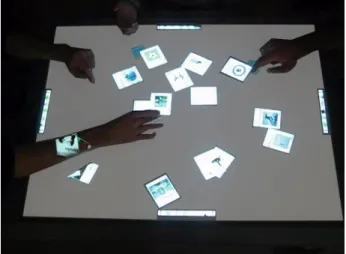
We conducted an experimental study to understand if and how the use of an interactive tabletop system (Scott & Carpendale, 2006; Shen et al., 2006) would improve brainstorming. We compared 4 experimental conditions (Buisine et al., in revision): the reference situation of creativity sessions (pen-and-paper tools in front of a paperboard), pen-and-paper tools around a non-augmented table, and 2 augmented multi-user tabletop systems (see Fig. 1), with more or less innovative interaction styles.
Figure 1. Our interactive tabletop system (Circle twelve DiamondTouch) for brainstorming (4 participants allowed).
Overall, 80 participants were involved in the experiments by groups of 4 people at the same time, and each group performed 2 creativity exercises (within-group experimental design). Three kinds of variables were collected: performance criteria (number of ideas generated, width and depth of production), subjective data (ex: ease of use, effectiveness, pleasantness, motivation), and collaboration as assessed by the inequity index (see Table 1, Equation A). For the calculation of the inequity index we numbered the following behaviors from the video recordings of the sessions: assertions (e.g. giving an idea), information requests (e.g. requesting a clarification about an idea), action requests (e.g. asking a participant to ―send a note over‖), answers to questions, expression of opinions, communicative gestures related to the task, and off-task talk. The ―communicative gestures‖ variable includes for example pointing to an item, moving a note, interrupting someone or requesting a speech turn by a gesture.
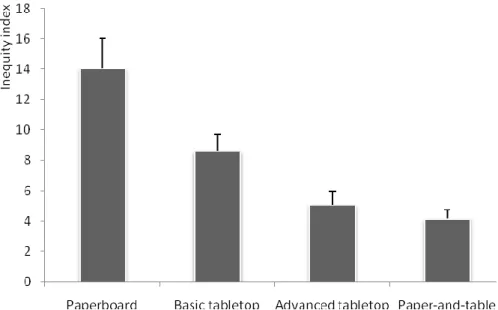
Figure 2. Average inequity in the 4 conditions: Paperboard, Basic digital tabletop, Advanced digital tabletop, and paper-and-table.
The results showed that creative performance increased with the around-the-table spatial configuration (advanced digital around-the-tabletop and paper-and-around-the-table conditions). Moreover, subjective evaluations were globally in favor of the advanced tabletop condition: users preferred this device to pen-and-paper tools, especially because of the pleasant and fun nature of the interface. Our results also show that extrinsic motivation significantly increased in the advanced tabletop condition, which can be attributed to the attractiveness of the device. Regarding the participants‘ collaborative behaviors, we observed that inequity was highest in the paperboard condition, and lowest in both the advanced tabletop and paper-and-table conditions (see Fig. 2). Improved collaboration in paper-and-paper-and-table compared with paperboard can be explained by the around-the-table setup, and improved collaboration in advanced tabletop compared with the basic tabletop condition
may result from improvements in the prototype (ex: interaction styles more adapted to the task).
Overall, we have several results suggesting that the around-the-table setup (either with pen-and-paper tools or with an interactive multi-user device) should be promoted for increasing performance and improving collaboration in brainstorming. Inequity of contributions was lower when the participants brainstormed around a table, which means that social loafing and social compensation were lower, and therefore the emergence of leaders and followers was limited. The underlying phenomenon might be related to an increase of social comparison: when sitting around the same table, participants may have more opportunities to compare their own performance to the others‘. Social comparison was indeed shown to be a source of motivation for brainstorming participants and to improve idea generation (Harkins & Jackson, 1985; Bartis et al., 1988; Paulus & Dzindolet, 1993; Dugosh & Paulus, 2005; Michinov & Primois, 2005).
The fact that performance and collaboration were better with the ―around-the-table‖ configuration is a ground-breaking result for research on creativity processes. The spatial configuration of participants facing the facilitator and generally sitting side by side constitutes a traditional and undisputed paradigm of creativity sessions. Our results suggest this convention should be questioned, even with pen-and-paper tools.
4 Design implications for CSCW
The research and findings about equitable collaboration has provided inspiration for numerous studies in Human-Computer Interaction and Computer-Supported Cooperative Work, since some designs and devices were found to significantly increase equity of collaboration:
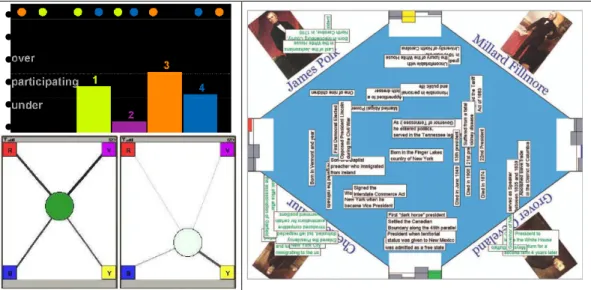
Providing real-time explicit feedback on each member‘s quantity of contributions (see Fig. 3) was shown to favor equity of collaboration (Ringel Morris et al., 2006; Kim et al., 2008).
McKinlay et al. (1999) showed that a remote electronic brainstorming application decreased social compensation with comparison to a co-located brainstorming session, resulting in more equity but also in a an overall decrease of contributions.
Providing multiple entry points or multiple input devices on the collaborative medium, for every member to be directly able to interact with the task material, increases equity of collaboration (Marshall et al., 2008).
As seen in the previous case study, around-the-table spatial configuration also leads to a better balance between participants‘ contributions. This result challenges WYSIWIS (What You See Is What I See) groupware (Stefik et al., 1987; Zhu, 2004). Indeed a founding paradigm in CSCW
was to give priority to sharing the same view on the same data amongst group members. Around-the-table participants are in a rather relaxed-WYSIWIS setting since users‘ views diverge with respect to their position, but group awareness is given a higher priority with close proximity and more opportunities for subtle communication channels (e.g. eye contact, facial expressions or body language). This seems to constitute an efficient tradeoff between information sharing and group dynamics.
Figure 3. Participation feedbacks designed by DiMicco (2004, see top left picture), its tabletop version (Ringel Morris et al., 2006, see right panel) and a design for phone interface (Kim et al., 2008, see bottom left picture).
5 Perspectives
The equity paradigm and the attempt to quantitatively evaluate collaboration have produced valuable findings such as the identification of some social phenomena arising during collaboration and the design of collaborative media influencing these phenomena. However this remains an incomplete approach to collaboration since quality of contributions and collaboration efficiency are disregarded. In this respect interesting research perspectives include the combination of qualitative and quantitative indices in order to draw a more general model of collaborative activities and allow the design of more efficient collaborative media and situations.
6 References
Bartis, S., Szymanski, K., & Harkins, S.G. (1988). Evaluation and performance: A two-edged knife. Personality and Social Psychology Bulletin, 14, pp. 242-251.
Brickner, M.A., Harkins, S.G., & Ostrom, T.M. (1986). Effects of personal involvement: Thought-provoking implications for social loafing. Journal of Personality and Social Psychology, 51, pp. 763-769.
Buisine, S., Besacier, G., Aoussat, A., & Vernier, F. (in revision). How do interactive tabletop systems influence collaboration? International Journal of Human-Computer Studies, pp. Buisine, S., Besacier, G., Aoussat, A., & Vernier, F. (submitted). How do interactive tabletop
systems influence collaboration? International Journal of Human-Computer Studies, pp. DiMicco, J.M., Pandolfo, A., & Bender, W. (2004). Influencing group participation with a shared
display. CSCW'04 International conference on Computer-Supported Cooperative Work, pp. 614-623, ACM Press.
Dugosh, K.L., & Paulus, P.B. (2005). Cognitive and social comparison processes in brainstorming.
Journal of Experimental Social Psychology, 41, pp. 313-320.
Fitze, M. (2006). Discourse and participation in ESL face-to-face and written Electronic Conferences. Language Learning & Technology, 10, pp. 67-86.
Habermas, J. (1984). Theory of communicative action. Boston: Beacon Press.
Harkins, S.G., & Jackson, J.M. (1985). The role of evaluation in eliminating social loafing.
Personality and Social Psychology Bulletin, 11(4), pp. 457-465.
Harkins, S.G., & Szymanski, K. (1988). Social loafing and self-evaluation with an objective standard. Journal of Experimental Social Psychology, 24, pp. 354-365.
Hiltz, S.R., Turoff, M., & Johnson, K. (1989). Experiments in group decision making, 3: Disinhibition, deindividuation, and group process in pen name and real name computer conferences. Journal of Decision Support Systems, 5, pp. 217-232.
Karau, S.J., & Hart, J.W. (1998). Group cohesiveness and social loafing: Effect of a social interaction manipulation on individual motivation within groups. Group Dynamics:
Theory, Research, and Practice, 2, pp. 185-191.
Karau, S.J., & Williams, K.D. (1993). Social loafing: A meta-analytic review and theoretical integration. Journal of Personality and Social Psychology, 65, pp. 681-706. Kim, T., Chang, A., Holland, L., & Sandy Pentland, A. (2008). Meeting mediator: Enhancing
group collaboration using sociometric feedback. CSCW'08 International Conference on Computer Supported Cooperative Work, pp. 457-466, ACM Press.
Marshall, P., Hornecker, E., Morris, R., Dalton, N.S., & Rogers, Y. (2008). When the fingers do the talking: A study of group participation with varying constraints to a tabletop interface. IEEE International Workshop on Horizontal Interactive Human-Computer System, pp. 37-44,
McKinlay, A., Procter, R., & Dunnett, A. (1999). An investigation of social loafing and social compensation in computer-supported cooperative work. GROUP'99, pp. 249-257, ACM Press.
Michinov, N., & Primois, C. (2005). Improving productivity and creativity in online groups through social comparison process: New evidence for asynchronous electronic brainstorming. Computers in Human Behavior, 21, pp. 11-28.
Osborn, A.F. (1953). Applied Imagination. Principles and procedures of creative problem-solving: Charles Scribner's Sons.
Paulus, P.B., & Dzindolet, M.T. (1993). Social influence processes in group brainstorming.
Journal of Personality and Social Psychology, 64(4), pp. 575-586.
Ringel Morris, M., Cassanego, A., Paepcke, A., Winograd, T., Piper, A.M., & Huang, A. (2006). Mediating group dynamics through tabletop interface design. IEEE Computer Graphics
and Applications, pp. 65-73.
Scott, S.D., & Carpendale, S. (Eds.). (2006). Interacting with digital tabletops: Special issue of IEEE Computer Graphics and Applications, vol. 26.
Serva, M.A., & Fuller, M.A. (1997). Preventing social loafing in the collaborative technology classroom. SIGCPR'97, pp. 84-86, ACM Press.
Shen, C., Ryall, K., Forlines, C., Esenther, A., Vernier, F., Everitt, K., Wu, M., Wigdor, D., Ringel Morris, M., Hancock, M., & Tse, E. (2006). Informing the design of direct-touch
tabletops. IEEE Computer Graphics and Applications, pp. 56-66.
Shepperd, J.A. (1993). Productivity loss in performance groups: A motivation analysis.
Psychological Bulletin, 113, pp. 67-81.
Sommerville, I., Sawyer, P., & Viller, S. (1998). Viewpoints for requirements elicitation: A practical approach. ICRE 98 IEEE International Conference on Requirements Engineering,
Stefik, M., Bobrow, D.G., Foster, G., Lanning, S., & Tatar, D. (1987). WYSIWIS revisited: Early experiences with multiuser interfaces. ACM Transactions on Office Information Systems, 5, pp. 147-167.
Wolff, M., Burkhardt, J.M., & de la Garza, C. (2005). Analyse exploratoire de ―points de vue‖: Une contribution pour outiller les processus de conception. Le Travail Humain, 68, pp. 253-286.
Zhu, H. (2004). From WYSIWIS to WYSINWIS: Role-based collaboration. International Conference on Systems, Man and Cybernetics, pp. 5441-5446, IEEE.