HAL Id: hal-00863842
https://hal.archives-ouvertes.fr/hal-00863842
Submitted on 23 Nov 2015HAL is a multi-disciplinary open access archive for the deposit and dissemination of sci-entific research documents, whether they are pub-lished or not. The documents may come from teaching and research institutions in France or abroad, or from public or private research centers.
L’archive ouverte pluridisciplinaire HAL, est destinée au dépôt et à la diffusion de documents scientifiques de niveau recherche, publiés ou non, émanant des établissements d’enseignement et de recherche français ou étrangers, des laboratoires publics ou privés.
Macroporous ceramics of carbonated hydroxyapatite for
bone grafting applications
Nathalie Douard, David Marchat, Coralie Laurent, Didier Bernache-Assollant
To cite this version:
Nathalie Douard, David Marchat, Coralie Laurent, Didier Bernache-Assollant. Macroporous ceramics of carbonated hydroxyapatite for bone grafting applications. 23rd Interdisciplinary Research Confer-ence on Injectable Osteoarticular Biomaterials and Bone Augmentation Procedures - GRIBOI 2013, Prof. Gamal Baroud; Prof. Joshua Hirsch; Prof. Marc Bohner, Apr 2013, Boston, United States. pp.14. �hal-00863842�
Macroporous ceramics of carbonated hydroxyapatite for bone
grafting applications
N Douard, D Marchat, C Laurent, D Bernache-Assollant
Ecole Nationale Supérieure des Mines de Saint-Etienne, CIS-EMSE, CNRS : LGF5307, F-42023
158 Cours Fauriel, Saint-Etienne, France. Fax : +33 477 420 159
INTRODUCTION: Calcium phosphate based materials, specifically hydroxyapatite (HA)
and tricalcium phosphate (TCP), have been extensively used as bone graft substitutes for various applications (e.g. bone augmentation procedure). They temporarily substitute for bone while simultaneously supporting its regeneration. However, they present inappropriate resorption rate. Indeed, ideally a bone substitute should degrade only after the regenerated tissue has been remodelled at least once in the natural remodelling cycle [1]. Thus, the solubility of HA is too slow and that of TCP too fast to foster successful bone re-growth. To further improve the properties of calcium phosphate ceramics, ionic substitutions could be used. One way to modulate their resorption rate would be to substitute carbonate
ions (CO32-) for phosphate ones (PO43-) into the HA structure [2]. Thus, the aim of the present
work was to elaborate interconnected macroporous scaffold of pure carbonated hydroxyapatite (CHA).
METHODS: CHA powders were synthesised by an aqueous precipitation method using
calcium, phosphate and carbonate salts solutions. The amount of reagents was calculated according to the general formula: Ca9.2(PO4)5.2(CO3)0.8(OH)1.2.
Green materials with controlled macroporous architecture were then shaped via a template casting process [3]. The ceramics scaffolds were finally obtained after sintering at 1100°C under controlled atmosphere. To assess the phase composition of the materials, X-Ray Diffraction (XRD) and Fourier Transformed Infra-Red (FTIR) analysis were performed. Calcium, phosphorous and carbonate content of the scaffolds were determined by elemental analyses (e.g. inductively coupled plasma atomic emission spectroscopy). The architecture of the ceramics was also observed by means of Scanning Electron Microscopy (SEM).
RESULTS: The XRD pattern of the sintered material shows only hydroxyapatite diffraction
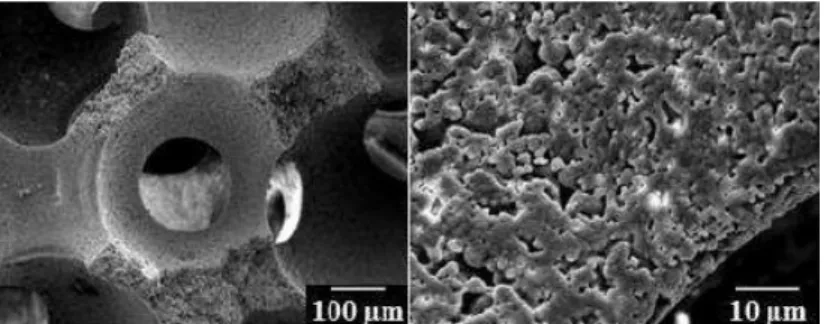
peaks; no secondary crystalline phase is observed (data not shown). The FTIR spectrum of the CHA ceramic is in accordance with the hydroxyapatite structure (data not shown). Moreover, this spectrum exhibits characteristics bands of carbonate groups from both A and B sites. The carbonate content of the material was evaluated at 4.9 wt. %, amount which is very close to the theoretical value of 5.2 wt. %. The architecture of the sintered material (fig. 1) reveals a macroporous interconnected structure with macropores of 400 ± 50 μm and interconnections of 150 ± 30 μm.
Fig. 1: Macroporous architecture of CHA ceramics obtained via a template casting process (left) and detail of the microstructure (right)
DISCUSSION & CONCLUSIONS: The physicchemical analysis of the sintered ceramic
(XRD, FTIR and elemental analysis) confirmed the incorporation of carbonate into the HA structure in B and A sites during, respectively, the precipitation and the heat-treatment. The thermal treatment under controlled atmosphere (pCO2= 1 bar) allowed to prevent undesired
decarbonatation of the material that occurs around 700°C under air atmosphere. With the template casting process adapted to CHA powders, it was possible to control the architecture of the final ceramic. To conclude, interconnected macroporous materials made of carbonated hydroxyapatite free of secondary phase has been successfully manufactured. To fulfil the characterization of this scaffold, solubility product measurements are under progress as well as in vitro and in vivo biological assays.
REFERENCES: 1 M. K. Heljak et al. (2012) Int. J. Numer. Meth. Biomed. Engng. 28:789–
800. 2Y. Doi et al. (1998) J. Biomed. Mater. Res. 39:603- 610. 3M. Descamps et al. (2008) J.