HAL Id: lirmm-00806830
https://hal-lirmm.ccsd.cnrs.fr/lirmm-00806830
Submitted on 2 Apr 2013
HAL is a multi-disciplinary open access
archive for the deposit and dissemination of
sci-entific research documents, whether they are
pub-lished or not. The documents may come from
teaching and research institutions in France or
abroad, or from public or private research centers.
L’archive ouverte pluridisciplinaire HAL, est
destinée au dépôt et à la diffusion de documents
scientifiques de niveau recherche, publiés ou non,
émanant des établissements d’enseignement et de
recherche français ou étrangers, des laboratoires
publics ou privés.
An Inheritance System for Structural & Behavioral
Reuse in Component-based Software Programming
Petr Spacek, Christophe Dony, Chouki Tibermacine, Luc Fabresse
To cite this version:
Petr Spacek, Christophe Dony, Chouki Tibermacine, Luc Fabresse. An Inheritance System for
Struc-tural & Behavioral Reuse in Component-based Software Programming. GPCE: Generative
Program-ming and Component Engineering, Sep 2012, Dresden, Germany. pp.60-69. �lirmm-00806830�
GPCE’12
An Inheritance System for Structural & Behavioral
Reuse in Component-based Software Programming
Petr Spacek, Christophe Dony, Chouki
Tibermacine
LIRMM, CNRS and Montpellier II University 161, rue Ada
34392 Montpellier Cedex 5 France {spacek,dony,tibermacin}@lirmm.fr
Luc Fabresse
Universit´e Lille Nord de France Ecole des Mines de Douai
941 rue Charles Bourseul 59508 DOUAI Cedex France
Abstract
In the context of Component-based Programming, which addresses the implementation stage of a component-based software engineering development process, this paper de-scribes a specification and an operational integration of an inheritance system into a self-contained new component-based programming language named COMPO. Our proposal completes and extends related works by making it possible to apply inheritance to the full description of components, i.e. both to structural (description of provisions and require-ments, of component architecture) and behavioral (full im-plementations of services) parts in component descriptions. Inheritance in COMPOis designed to be used in conjunction with composition to maximize reuse capabilities and expres-sive power. COMPOimplementation proposes a clear opera-tional solution for inheritance and for achieving and testing substitutions.
Categories and Subject Descriptors D.1.0 [Programming techniques]: General—Component based programming technique; D.2.11 [Software Architectures]: Languages— Component Based Programming Language
General Terms Component-based, Programming, Lan-guage
Keywords Programming, Inheritance, Architectures, Sub-stitutability
1.
Introduction
Component-based software is made of off-the-shelf compo-nents, connected together into various kinds of architectures.
[Copyright notice will appear here once ’preprint’ option is removed.]
In this domain, several languages, using the component con-cept as a first class entity in organizing software, have been and are currently designed and prototyped, but some cate-gories have emerged. Architecture Description Languages (ADLs) for models like Fractal [6] or SOFA [15] allow for business-oriented and implementation-independent com-ponents and architectures descriptions. Component-Based-Programming Languages (CBPLs) like ACOEL [19], Arch-Java [1], CLIC [4], ComponentJ [18], Bichon [23], Comp-Java [16] or SCL[8, 9] address the implementation stage of a component-based software engineering development pro-cess; they allow developers to express full descriptions of executable components.
Inheritance has proved to be one major cornerstone of software reuse, first for the ability it gives developers to or-ganize their ideas on the base of concept classification (a list is a kind of collection, such architecture is a kind of visi-tor, ...) which is itself one key of human abstraction power and second for the calculus model that makes it possible to not only reuse but adapt software, by executing an inherited code in a new context (the receiver environment).
Many of the above quoted languages somehow propose inheritance mechanisms but they have various limitations (limitation to the architecture description side, limitation to the implementation side which is frequently not achieved with component-based languages, limitation to some part of components descriptions, etc). More generally, the question of the interest of inheritance-based reuse in the component-based software development context is still discussed and has not yet been explicitly nor fully addressed. This papers aims at contributing to that question by proposing a specifi-cation and an operational integration of an inheritance sys-tem in the context of a component-based programming lan-guages that supports reuse of descriptions of components’ structure and behavior. By “structure”, we mean provided and required ports together with internal architectural de-scription; and by “behavior”, we mean implementations of services that make them executable. Our language, COMPO,
ranges in this category and proposes components as run-time entities, instances of descriptors. We introduce an in-heritance link between descriptors on which we base an op-erational system to reuse, i.e. to inherit, extend and spe-cialize descriptions. Descriptors are texts describing compo-nents’ structure and behavior. Listings 1 and 2 are examples of component descriptors in COMPO.
We address the specific questions of stating what, among port declarations, composition architectures and services definitions, can be inherited, extended or specialized, and how. We notably discuss the rationale and interest of en-abling requirements extension or specialization: we will con-sider various solutions, but will develop an answer to that question which goes in the direction of enabling covariant specialization, because it corresponds to the way human nat-urally think about concept classification [7] and it promotes expressive power. Our solution will thus propose simple sup-port to help programmers achieve correct substitutions.
An alternative for reuse in the component-based software development context is to use sole composition (see [17, 23] and [22] for a good survey) and message redirection (or for-warding; or delegation1); it has the advantage of not intro-ducing any additional mechanism. Our opinion is that com-position and inheritance are complementary and that their combination is significantly more efficient especially when structural reuse is to be considered. The above alternative will be further discussed in the related work section, where we show some examples in which sole composition usage leads to code being too complex and reuse being difficult. Inheritance in COMPO is thus designed to be used in con-junction with composition to maximize software reuse capa-bilities and language expressive power.
The paper is organized as follows. Section 2 proposes an overview of COMPOessential constructions and syntax.
Section 3 is a step-by-step (services definitions, require-ments declarations, internal architecture description) discus-sion and presentation of our inheritance system specification illustrated with various examples. Section 4 gives some ba-sic clues on the COMPO’s implementation. Before conclud-ing and discussconclud-ing the future work, we present in Section 5 the related works.
2.
A support Component-based
programming language
Our proposition for inheritance is demonstrated and vali-dated via its integration into a component-based language named COMPO. Although the language itself is not the sub-ject of this paper, it is needed that we give an overview of its main constructs and syntax. COMPOis an ongoing work that aims at defining in an unified context (1) a
component-1Although delegation in prototype-based language is something different,
we will use for message redirection the terms ”message delegation” and corollary ”delegation connector” and ”service invocation delegation” with semantics as specified in UML [13]
based architecture description and modeling language that includes all standard component architectures concepts and constructs (eg. component, ports, interfaces, connections, constraints, etc) and (2) a component-based programming language making it possible to write executable applications, in which all the above concepts and constructs are available as first-class entities. This language overall goal is to allow standard applications or architecture verification and trans-formations applications to be written in the same language, via an integrated meta-level. COMPO is here used for our operational study on inheritance because, as far as we know, there exists no other language in which component architec-tures and services can be written in the same context and us-ing the same high-level constructs for component-based de-velopment. Many component-based architecture are for ex-ample translated into Java template code and implemented in a world where concepts such as ports do not have a first-class status.
From a concrete point of view, within a component de-scription (see e.g. listing 1), the p r ov i des, r equ i r es, i n t e r na l l y r equ i r es and a r ch i t ec t u r e sections are related to components modeling and architecture descrip-tion. The se r v i ce section is related to services program-ming; this section can be omitted if the architecture is to be generated into another language.
2.1 Component descriptors.
COMPO applies the descriptor/instance dichotomy where components are instances of descriptors. A component de-scriptor is a text describing the structure (ports declarations and architecture description) and the behavior (set of ser-vices definition) of its instances.
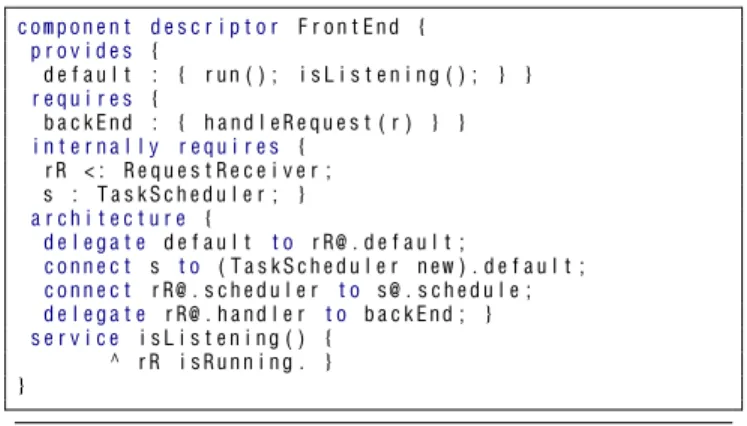
As a first example, Listing 1 shows a version of a F r on t End component descriptor. F r on t End components can be used to build various kind of request servers. This descriptor defines : (1) an external provided port named de f au l t , providing services r un ( ) and i sL i s t en i ng ( ), (2) an external required port named backEnd through which an architect can connect a F r on t End to any other compo-nent providing the hand l eReques t service, (3) two inter-nal required ports to achieve interinter-nal composition with a Reques t Hand l e r and with a TaskSchedu l e r (note that to satisfy requirements internally or externally is an archi-tectural decision that has several possible solutions, any F r on t End in this example will come equipped with its Reques t Rece i ve r and TaskSchedu l e r). (4) the internal architecture of a F r on t End, (5) the public services of a F r on t End, only one ( i sL i s t en i ng ( )) being shown. Con-cepts and syntax used in this example are detailed in the fol-lowing sub-sections also using the description of an HTTP Server (see listing 2) which uses a F r on t End.
2.2 Ports
In COMPO, a port is a connection point (components are con-nected through their ports) and a communication point
(ser-c o m p o n e n t d e s (ser-c r i p t o r F r o n t E n d { p r o v i d e s { d e f a u l t : { r u n ( ) ; i s L i s t e n i n g ( ) ; } } r e q u i r e s { b a c k E n d : { h a n d l e R e q u e s t ( r ) } } i n t e r n a l l y r e q u i r e s { r R < : R e q u e s t R e c e i v e r ; s : T a s k S c h e d u l e r ; } a r c h i t e c t u r e { d e l e g a t e d e f a u l t t o r R@ . d e f a u l t ; c o n n e c t s t o ( T a s k S c h e d u l e r n e w ) . d e f a u l t ; c o n n e c t r R@ . s c h e d u l e r t o s @ . s c h e d u l e ; d e l e g a t e r R@ . h a n d l e r t o b a c k E n d ; } s e r v i c e i s L i s t e n i n g ( ) { ^ r R i s R u n n i n g . } }
Listing 1. The F r on t End descriptor
vices invocations are transmitted via ports). A port is defined by a an owner component, a name, a list of service signa-tures, a visibility (external or internal) and a role (provided or required).
The role of a port is either required or provided with a standard semantics : a provided (resp. required) port lists, the signature of services offered (resp. required) by a com-ponent.
The list of services signatures associated to a provided port can be given :
•as an explicit list (we call such a list an anonymous
interface) (the de f au l t port declaration in Listing 1 is an example).
•via a named interface (see Section 3.3 ),
The list of signature associated to a required port can be given as an explicit list or via a named interface, as above, or via a component descriptor name (e.g. cd); in this case, the list is the list of signatures of services associated to cd’s default provided port (the sched port declaration in Listing 1 is an example).
The visibility of a port is either internal or external (the default is “external”).
•An external port ep of a c component is visible and can
be used by an architect to interconnect c into an englob-ing composition architecture. For example, the external required port backEnd of an instance of F r on t End can be connected to the external provided port de f au l t of an instance of BackEnd as shown in listing 2 and in figure 1 (we are developing both textual and graphical component definition interfaces).
Each component has a default external provided port (named de f au l t ) listing signatures of public services of its owner component, and has a default and unique in-ternal provided port, named se l f (for obvious histori-cal reasons), listing signatures of all services of its owner component and allowing any of its services to invoke an-other one.
•An internal port i p of a c component is a support for
accessing c’s internal composition architecture, i p and the component connected to it (that we call an internal component of c ) are invisible from the outside of c. In Listing 2, it is shown how the two internal required ports of a HTTPSe r ve r are connected to its two internal components : a F r on t End and a BackEnd, allowing it to invoke their services (e.g. f E i sL i s t en i ng in service s t a t us).
•The list of external ports (provided and required) define the external contract of a component.
2.3 Connections
A connection establishes a dual referencing between two ports, making it possible to determine whether a port is con-nected or not and, if true, to which other port it is concon-nected. When we sometimes write, in a somehow misleading but ad-mitted way, that two components are connected, it is meant that one port of the former is connected to one port of the later.
•A regular connection is between a required and a
pro-vided port. We provide two equivalent syntax for connec-tions : ( connec t | de l ega t e ) <po r t > t o <po r t >, or <po r t > = : = <po r t >, where <po r t > is any expres-sion returning a port. An example of an expresexpres-sion establishing a regular connection is : connec t s t o
( TaskSchedu l e r new) . de f au l t ;, (see. Listing 1).
•A delegation connection is between two ports having the same role and is used to delegate a service invocation from an external to an internal via the composite (pro-vided to pro(pro-vided), or from an internal to an external via a composite (required to required). An example of a “pro-vided to pro“pro-vided” delegation connection is de l ega t e de f au l t t o rR@ . de f au l t ; in Listing 1). 2.4 Internal architectures !"#$%&' $()**+,"-."-/"-.01"(/'$'%/23(4 ((#5(0/60/'"7078 ((((0#*-%"9(:(;(<=($>(-%77078<(? ((((0#@$&/"9(:(;(<=($>(/'ABB"!<(? C #5(9(@-A7'57! !"#$%&' E$1F57!-"D)$ E5(9(G$1F57! !"#$%&' -%723H /'$'%/23H -%723H 0/60/'"707823H I$7!&"J"D2I''BJ"D%"/'3H !"#$%#&'()$)*!
Figure 1. HTTPServer, the diagram shows a logical resentation of an instance of the HTTPSe r ve r descriptor pre-sented in Listing 2, after it has been created and initialized.
An internal architecture of a component is the set of its internal components (components connected to its internal required ports) together with their inter-connections. A ponent having internal component is as usual called a com-posite. Initialization (i.e. instantiation and connection) of in-ternal components of a composite c is performed during c’s instantiation if described in the c’s descriptor architecture section.
For example, the internal ports and architecture sections of descriptor HTTPSe r ve r define the following internal ar-chitecture for its instances.
•The internal required port f E is connected to a F r on t End.
•The internal required port bE is connected to a BackEnd. Note that: bE < : BackEnd in the port section is a shortcut to avoid writing the following instruction in the architecture section : connec t bE t o ( Backend new) . de f au l t ).
•The internal required port name is connected to a
S t r i ng. S t r i ng is a predefined component descriptor the role of which is to interface all basic types of the host-ing language so that their elements can be used as stan-dard components. Predefined descriptors expose a single provided port named de f au l t through which procedures or methods of basic types can be called in the form of a service invocation via the COMPOinterpretor or virtual machine.
•a delegation connection is created between the provided port de f au l t and the de f au l t port of the f r on t End.
•a regular connection is created between the required port backEnd of the component connected to the f E inter-nal required port and the port de f au l t of the compo-nent connected to the bE internal required port: connec t
f E@ . backEnd t o bE@ . de f au l t .
This connection is a good example of a situation in which architecture design requires that a refence be made to a component which is not yet created. Here we need to say that we want to connect the port backEnd of the component that will be be connected to port f E. The @ operator makes it possible, for any port p to reference the component that will later on be connected to p and subsequently to specify an architecture before descriptors are instantiated.
2.5 Services & Service invocations
Servicesimplement the behavior of components. A service may have parameters and may return a value.
Components communicate by service invocations made through required ports. A service invocation consists of a port name, a selector (the name of the requested service) and optional arguments. f E i s l i s t en i ng is an example of a service invocation made through the f E port in the context
c o m p o n e n t d e s c r i p t o r HT T P S e r v e r { p r o v i d e s { d e f a u l t : { r u n ( ) ; s t a t u s ( ) } } i n t e r n a l l y r e q u i r e s { f E : F r o n t E n d ; b E < : B a c k E n d ; n a m e < : S t r i n g ; } a r c h i t e c t u r e { f E = : = ( F r o n t E n d n e w ) . d e f a u l t ; d e l e g a t e d e f a u l t t o f E@ . d e f a u l t ; c o n n e c t f E@ . b a c k E n d t o b E@ . d e f a u l t ; } s e r v i c e s t a t u s ( ) { f E i s L i s t e n i n g i f T r u e : [ ^ n a m e p r i n t S t r i n g + ' i s r u n n i n g ' ] i f F a l s e : [ ^ n a m e p r i n t S t r i n g + ' i s s t o p p e d ' ] . } }
Listing 2. The HTTPSe r ve r descriptor.
of the s t a t us ( ) service of component HTTPSe r ve r . When a required port receives an invocation it transmits it to the port it is connected to. The receiving port then transfer the invocation to its owner component which is responsible for handling it (either executing a corresponding service or dele-gating the invocation via a delegation connection, full detail on this can be found in [8]).
3.
Rationale and rules to reuse descriptions
with inheritance
This section presents the rationale and the operational de-scription of our descriptor-level inheritance embedded in our CBPL. Ports declarations, internal architecture definition and initializations, services definitions; and more generally all pieces of code specified at the descriptor level are subjects to inheritance, extension and redefinition.
For the sake of simplicity, we have limited our proposal to single inheritance relationship.
3.1 Descriptors and basic inheritance
Any descriptor can be defined as a sub-descriptor of an ex-isting descriptor (D). In such a case, D’s port declarations, in-ternal architecture and service definitions are inherited. Ev-ery sub-descriptor has, by default, the supe r internal pro-vided port. The port differs from regular propro-vided ports in one small detail: services implementations demanded by ser-vice invocations sent to this port are looked up starting from the super-descriptor of the owning descriptor (not directly from the owning descriptor as it is in the case of regular pro-vided ports).
Listing 3 show the Con t r o l ab l eF r on t End sub-descriptor that extends the F r on t End sub-descriptor (shown in Listing 1) with a new port named con t r o l . Ports declara-tions and internal architecture described in the F r on t End descriptor are inherited by the Con t r o l ab l eF r on t End de-scriptor, this is taken into account when creating an instance of the Con t r o l ab l eF r on t End descriptor whose structure will conform to what is described in the F r on t End descrip-tor.
In Listing 4 we show an another sub-descriptor named (Res t a r t ab l eF r on t End) which extends the Con t r o l ab l eF r on t End descriptor with a new service. Ser-vices defined in the F r on t End and Con t r o l ab l eF r on t End descriptors are inherited by the Res t a r t ab l eF r on t End descriptor. This is taken into account when instances of the Res t a r t ab l eF r on t End descriptor are created and receive services invocations (lookup algorithm).
c o m p o n e n t d e s c r i p t o r Co n t r o l a b l e F r o n t E n d e x t e n d s F r o n t E n d { p r o v i d e s { c o n t r o l : { s t a r t ( ) ; i s R u n n i n g ( ) ; s t o p ( ) } } a r c h i t e c t u r e { d e l e g a t e c o n t r o l t o r R@ . c o n t r o l ; } }
Listing 3. The Con t r o l ab l eF r on t End descriptor. Extends the F r on t End descriptor with a new provided port named con t r o l . c o m p o n e n t d e s c r i p t o r Re s t a r t a b l e F r o n t E n d e x t e n d s Co n t r o l a b l e F r o n t E n d { p r o v i d e s { c o n t r o l : { r e s t a r t ( ) ; } } s e r v i c e r e s t a r t ( ) { r R s t o p . r R s t a r t } s e r v i c e i s L i s t e n i n g ( ) { s u p e r i s L i s t e n i n g i f T r u e : [ ^ 0 ] i f F a l s e : [ ^ 1 ] } }
Listing 4. The Res t a r t ab l eF r on t End descriptor. Spe-cializes the con t r o l port of Con t r o l ab l eF r on t End de-scriptor and service i sL i s t en i ng inherited from F r on t End
3.2 Extension & specialization of services
To be able to inherit, extend and specialize the behavior de-fined by a component descriptor, a sub-descriptor can intro-duce new services and its instances can access and reuse ser-vices defined by its super-descriptor. This gives us ability to define behavior that’s specific to a particular sub-descriptor, i.e. achieve polymorphism of descriptors.
A service can be redefined in a sub-descriptor and can reuse the one it specializes by using the supe r internal provided port. Sending an invocation to supe r states that the service implementation should be looked for in the super-descriptor of the super-descriptor in which the current service in execution has been found.
Listing 4 shows an example of specializa-tion and extension of services, where the descrip-tor Res t a r t ab l eF r on t End extends the descriptor Con t r o l ab l eF r on t End with a new service r es t a r t ( ) and specializes service i sL i s t en i ng ( ) defined in Con t r o l ab l eF r on t End, supe r is used to access Con t r o l ab l eF r on t End’s implementation of the
i sL i s t en i ng ( ) service.
3.3 Extension & specialization of declarations of provided ports
The basic goal here is to be able to introduce a new pro-vided port declaration and be able to specialize a declaration (i.e. a list of service signatures) of an inherited port. This capability leads to a higher expressive power. For example, sub-descriptors are able to export an internal behavior via newly added ports. Such an export does not break the encap-sulation of the internal component, because it exports behav-ior which has already been public. Another use is definition of more viewpoints for a component, where each provided port represents a viewpoint on the component. Specialization of ports introduces more precise modeling possibilities for software architects. An example of extension and special-ization of provided ports is illustrated in Listings 1, 3 and 4, where the Con t r o l ab l eF r on t End descriptor extends orig-inal F r on t End descriptor with a new port named con t r o l . The Res t a r t ab l eF r on t End descriptor specializes the in-herited port con t r o l with a new service signature.
The specialization of port roles makes sense only from the required role to the provided role. Indeed, this kind of role specialization can be performed simply by a delegation of a required port to a provided port of a component. Thus, there is no reason for allowing specialization of the roles of ports.
We extend a set of ports simply by introducing a new port in a sub-descriptor. A name of newly added port cannot clash with existing port names. In Listing 3 we extend the origi-nal F r on t End descriptor with a new port named con t r o l in order to export control behavior offered by the internal component connected to the r R internal required port.
There are two scenarios how to specialize the list of service signatures of an inherited port: (1) a specializa-tion by adding new service signatures to its list of ser-vice signatures (i.e. extending an anonymous inherited in-terface). The Res t a r t ab l eF r on t End example in Listing 4 shows the specialization of the con t r o l port defined by the Con t r o l ab l eF r on t End super-descriptor. The special-ization is used in order to provide the r es t a r t service de-fined by the descriptor Res t a r t ab l eF r on t End. (2) a spe-cialization using a named interface. In this case the set of service signatures defined in the named interface has to be a super-set of the set of service signatures used to describe the original port. A specialization of a port named po r t A looks like: p r ov i des { po r t A : I spec}. In the super-descriptor, po r t A was declared by the statement: p r ov i des { po r t A
: { se r 1 ( ) ; se r 2 ( ) }}. The I spec interface was defined
with the statement i n t e r f ace I spec { se r 1 ( ) ; se r 2 ( ) ;
se r 3 ( ) }. The named interface I spec defines a set of
ser-vice signatures, which is a super-set of a set representing the anonymous interface of the original po r t A port. Therefore it can be used for the specialization.
!"#$$#"%&'()*+!,-.
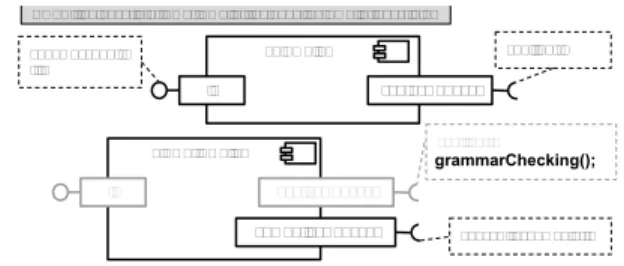
Figure 2. An example of an extension and specialization of required ports. Grayed parts of the figure illustrate inherited parts.
3.4 Extension & specialization of declarations of external required ports
In our inheritance system, we enable adding new declara-tions of required ports to sub-descriptors and we allow for modification of a declaration of an inherited required port. Extension and specialization of required ports are needed to preserve expressive power of our language. For exam-ple, without such a capability, we will not be able to extend the Ema i l e r descriptor shown in Figure 2 with a new re-quired port seman t i csChecke r or specialize its rere-quired port syn t axChecke r with a new required service signature g r amma rCheck i ng( ). Syntactically these operations do not differ from extension and specialization of provided ports.
c o m p o n e n t d e s c r i p t o r Ra n d o mR e q u e s t s Q u e u e e x t e n d s Re q u e s t s Q u e u e { r e q u i r e s { r a n d o mG e n : { g e t N e x t I n t ( ) ; } . . . } c o m p o n e n t d e s c r i p t o r Ra n d o m i z e r { p r o v i d e s { g e n e r a t o r : { g e t N e x t I n t ( ) ; } . . . } s e r v e r : = Q u e u e d S e r v e r n e w . a s s o c P a i r : = ' r a n d o mG e n ' - > ( R a n d o m i z e r n e w ) . r a n d o mQ u e u e : = R a n d o mR e q u e s t s Q u e u e n e wC o m p a t i b l e : ( A r r a y w i t h : a s s o c P a i r ) . s e r v e r r e c o n n e c t : ' q u e u e ' t o: r a n d o mQ u e u e .
Listing 5. An example of unsatisfied required port problem and its solution using the r econnec t and newCompa t i b l e support tools. The RandomReques t sQueue descriptor ex-tends the Reques t Queue descriptor with an additional re-quired port to which an instance of the RandomGene r a t o r descriptor should be connected.
Semantically the extension and specialization of required ports introduce a new issue, it breaks child-parent substi-tutability. In OOPLs, substitutability between sub-classes and super-classes is guaranteed. To be more precise, inter-face compatibility is guaranteed. Behavior compatibility is still not guaranteed, as pointed by [12]. In CBPL with the possibility to extend or specialize super-descriptor’s
require-!"##$%&' $()"'"'*+,,-.'!/'! 0'!/12'(03$3"045(6 ((78(109103'#1#: ((((17,!"';(<(=(>?($@(!"##1#:>(A ((((17B$&0';(<(=(>?($@(03CDD'*>(A E 78(;(B!C#38#* !"##$%&' !'F+$ %8(;(G$2H8#* !'F+$ I$#*&'J'F4I33DJ'F"'035K F"'"'(;(J'F"'030)"'"' 1# I$#*&'J'F4I33DJ'F"'035K C"3 $(J$#*C@J'F"'030)"'"' 1# C"3 !$#*C@L'# :'3M'N3?#345K $3(!"#31@'O(PI'#(QQQQQ(10(0"%0313"3'*(P13I($#( 1#03$#2'(C7(3I'((QQQQQQQQQQQQQQQQQQQQQ( *'02!1D3C!O(3I'(QQQQQQQQQQ(!'F"1!'*(DC!3(I$0( 3C(%'(0$31071'*(@$#"$&&RO(C3I'!P10'($#('!!C!( C22"!0 !"#"# $%&'()$#!"#*+*,"#"# -%&'().#& MS,8.;(3I'(*'02!1D3C!()"'"'+,,-.'!/'!('N3'#*0(3I'(+,,-.'!/'!(*'02!1D3C!(40ICP#(1#(B1:"!'(T5 (((((((((((((((3I'(*'02!1D3C!(J$#*C@J'F"'030)"'"'('N3'#*0(3I'(J'F"'030)"'"'(*'02!1D3C!
Figure 3. Dynamic substitution with a sub-descriptor hav-ing additional required port may lead to unsatisfied require-ment in the architecture. Grayed parts of the figure illustrate inherited parts.
ments creating a potentially non-substitutable sub-descriptor is possible.
Additional required ports may became unsatisfied, when an instance of such a sub-descriptor is used where an in-stance of the super-descriptor is expected. This may break up the system. In other words, adding new required ports (or specializing a required port in a sub-descriptor) violates the Liskov’s substitution principle [11]. These operations change components dependencies and can lead to unspeci-fied behavior. This is illustrated in Figure 3 and Listing 5, where an instance2of the Reques t Queue descriptor is sub-stituted with an instance of the RandomReques t sQueue de-scriptor. The RandomReques t sQueue descriptor extends the Reques t Queue descriptor with an additional required port to which an instance of the RandomGene r a t o r descriptor should be connected. At runtime, when an instance of the Reques t sQueue descriptor is substituted by an instance of the RandomReques t sQueue descriptor, the r andomGen re-quired port may became unsatisfied.
This problem has three possible solutions: (1) forbid tending requirements, but requirements have been made ex-plicit in components and they are considered as important entities to make it possible to introduce new connections. Therefore it is undesirable to limit expressive power of mod-eling by forbidding extension and specialization of require-ments. For example, without possibility to add a required port it is complicated to design the Ema i l e r example shown in Figure 2; (2) constrain substitutions - define a rule saying that an original component can be substituted by a new one, only if the new one provides at least the same and requires at most the same as the original one; (3) allow additional requirements and delegate responsibility for additional
re-2the instance is the internal component connected to the internal required
port queue of an instance of the QueuedSe r ve r descriptor shown in Fig-ure 3 and Listing 6.
quirements satisfaction to the language users, while provid-ing verification support for substitutions.
With COMPO all alternatives are possible, but since the language is oriented toward modeling flexibility, we have experimented with the third alternative. We will thus sup-port covariant specialization if and when needed because it corresponds to the way human naturally think differential description [7]. Our inheritance mechanism does not apply any restrictions to implicitly guarantee substitutability. Sub-stitutions in COMPOare under the developer’s control and responsibility.
We are providing three support methods: (1) the newCom-patiblemethod to return a component compatible with the super-descriptor of the component (the service is automati-cally created for each sub-descriptor which extends its par-ent with additional requirempar-ents); (2) the reconnect method (executed when a substitution is performed) to warn users about unsatisfied additional requirements (by an exception) and (3) the isCompatibleWith method to help developers to check the validity of a substitution. For an example of usage see Listing 5.
The first substitutions support comes in case when a sub-descriptor has an additional required port. Then our in-heritance system automatically generates a method called newCompa t i b l e : The method has a unique parameter, an array of pairs port-component. The method is able to cre-ate an instance, which is substitutable with instances of the super-descriptor. That is all additional requirements are sat-isfied by connections to components given in the array argu-ment.
The second support is the r econnec t : t o : method to achieve substitutions safely. This method takes two ar-guments, the first one is the name of an internal quired port referencing the component which should be re-placed and the second argument is the replacing component. r econnec t : t o : checks for compatibility between the origi-nal and the new component descriptor, i.e. checks if the new component provides and requires at least the same as the original one and checks if all requirements will be satisfied after substitution. If all requirements of the new component are satisfied, the replacement is performed, otherwise an ex-ception is thrown. r econnec t : t o : reconnects all ports of the original component to corresponding ports of the new component and connects the new component to the corre-sponding internal required port of the composite to reference the new component.
For components compatibility checking purposes we pro-vide i sCompa t i b l e method. The i sCompa t i b l e method is able to compare the external contracts of compared compo-nents and answer by true if they are compatible and false otherwise. The method is useful for the r econnec t : t o : method, which warns users in the case of unsatisfied require-ments.
3.5 Extension & specialization of internal architectures
Internal architecture description and initialization is inher-ited by a sub-descriptor and it can be extended and special-ized. When a large and complicated architecture needs to be reused, the language should support such a feature.
In COMPO, a sub-descriptor may extend a set of in-ternal components by introducing a new inin-ternal required port. Usually this action implies extension and specializa-tion of internal connecspecializa-tions. These operaspecializa-tions are illustrated in Figure 3, where the descriptor QueuedHTTPSe r ve r ex-tends the descriptor HTTPSe r ve r with a new internal com-ponent named queue (described by Reques t sQueue). And it specializes the inherited connections in order to assem-ble the queue component into the architecture of its super-descriptor. COMPOcode of QueuedHTTPSe r ve r is given in Listing 6.
Specialization of an inherited internal component in a sub-descriptor can be achieved by modifying the in-terface description of the internal required port asso-ciated with the internal component. The descriptor of Pr i o r i t yQueuedSe r ve r in Listing 6 specializes an inher-ited internal component queue by describing it with the Pr i o r i t yReques t sQueue descriptor .
The specialization of an inherited internal connection can be achieved by the combination of statements hav-ing the followhav-ing syntax: d i sconnec t <po r t - name> f rom
<po r t - name> and connec t <po r t - name> t o <por t -name>
(statements were explained in Section 2.5).
c o m p o n e n t d e s c r i p t o r Qu e u e d H T T P S e r v e r e x t e n d s HT T P S e r v e r { i n t e r n a l l y r e q u i r e s { q u e u e < : R e q u e s t s Q u e u e } a r c h i t e c t u r e { d i s c o n n e c t f E@ . b a c k E n d f r o m b E@ . d e f a u l t ; c o n n e c t f E@ . b a c k E n d t o q u e u e @ . i n ; c o n n e c t q u e u e @ . o u t t o b E@ . d e f a u l t ; } } c o m p o n e n t d e s c r i p t o r Pr i o r i t y Q u e u e d S e r v e r e x t e n d s Qu e u e d H T T P S e r v e r { i n t e r n a l l y r e q u i r e s { q u e u e < : P r i o r i t y R e q u e s t s Q u e u e } }
Listing 6. Specialization and extension of an internal archi-tecture.
4.
Implementation
The current implementation of COMPO is used as a lab-oratory for exploring new ideas and is built in [3] as an extension of the SCL [8, 9] implementation in the context of a global effort towards the development of efficient dy-namic languages.. We have chosen Smalltalk because we are a part of the effort to bring component concept into the Pharo environment. Descriptors and sub-descriptors are im-plemented as subclasses of the CompoComponen t class. The
CompoComponen t class contains the mechanism to store necessary inforation about ports and associated interfaces, internal components and connections. The inheritance mech-anism uses Smalltalk’s meta-model facilities to implement extension and specialization operations for both the struc-ture and behavior of descriptors.
Readers can download a Pharo image of COMPO imple-mentation here:http://www.lirmm.fr/∼spacek/compo/
5.
Related works
CBPLs ADLs
criterium/model ACOEL ArchJava CLIC CompJava COMPOFractal SOFA
Structure inheritance yes yes yes yes yes yes yes
Behavior inheritance yes yes yes no yes no no
Extensions
Provided ports yes yes no yes yes yes yes
Required ports yes yes yes no yes yes yes
Internal components yes yes yes no yes yes yes
Connections yes yes yes no yes yes yes
Specialization
Provided ports yes no yes yes yes yes yes
Required ports yes no yes no yes yes no
Internal components no no yes no yes yes yes
Connections no no yes no yes yes yes
Substitution:
restrictive yes yes yes yes yes yes yes
with addit.reqs. no no yes no yes no no
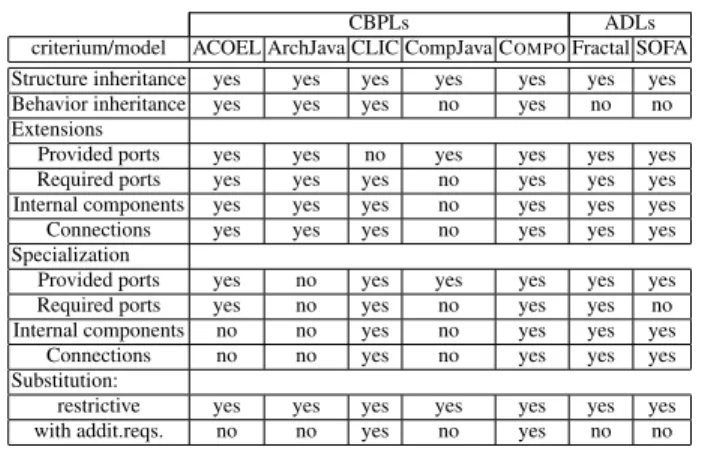
Table 1. Comparative table of inheritance in selected CB-PLs and in Fractal and SOFA models
In this section we give an overview of how inheritance is used in existing Component-based Programming Languages (CBPLs) and ADLs, and compare this with our proposal. We also compare our proposal based on a combination of inheritance and composition with inheritance-free proposal in which all reuse schemes are achieved using sole compo-sition.
It is important to note, that none of these languages we have studied propose a complete specification of inheritance which concerns all main reuse aspects. Our knowledge about the behavior of their inheritance mechanism often had to be extracted from experiments conducted using these lan-guages. The list of related works is not exhaustive; especially ADLs that do not support any form of descriptors inheritance are not included.
5.1 Inheritance in related CBPLs
Here, we compare how related CBPLs integrate inheritance aspects such as: the structure inheritance , the behavior in-heritance and abilities to extend and specialize particular definitions in a component descriptor (i.e. ports, internal components and connections.) As related CBPLs we con-sider ACOEL [19], ArchJava [1], CLIC [4] and CompJava [16], because these languages combine implementation and architecture specification.
Structure inheritance is partially supported in all other languages. We say partially, because CompJava do not al-low the reuse of internal components and connections
spec-ification. Ports declarations can be reused via component type definition. Except that they use a different terminology, the languages define component type as a set of port names including interface references and roles specification. And then a component type can be defined as an extension of an existing component type
Behavior inheritanceis fully supported only in CLIC and ArchJava languages. ACOEL model supports implementa-tion inheritance by the extend statement, but a child cannot access any of the internals (implementation classes, meth-ods) of a parent, except via the input ports of the parent, i.e. t h i s . <po r t name> . <se r v i cename> (composition-like approach). The advantage of this black-box approach is that it preserve encapsulation of parent components. We support white-box approach to be able to specialize services imple-mentations which are not provided by a parent.
Ports specializationis not supported in ArchJava, because adding new provided methods to an existing port might cause ambiguities if these provided methods were required by a connected component, and provided by a different com-ponent. There would then be two components providing the same required method, breaking ArchJava’s connection rules. Adding required methods to an existing port would make the component class non-substitutable for the compo-nent superclass, because connections made to the superclass might not provide the subclass’s required methods. Required methods in a new port are also problematic, because the new port might not be connected at all.
An interesting solution comes with ACOEL model, which uses ports parametrized by mixins [5]. During instan-tiation a mixin can be passed as an argument of a component constructor and a parametrized port is then “decorated” with new behavior. In COMPO, ports are just descriptions of com-munication and connection points. Therefore, they should not carry any implementation of behavior or its specializa-tion.
Ports extensionis well supported. CLIC model does not support additional provided port, because this model allows components to have only one provided port. The idea of a single provided port is based on the observation that devel-opers do not know beforehand, which services will be speci-fied by each required port of a client component. Therefore it is hard to split component functionality over multiple ports. We see this as a unnecessary limitation of modeling power.
On the other hand, in the CompJava, a component type may extend another component type and it inherits all ports. It may extend the interface of inherited provided ports or may add provided ports. Extension of required ports is not allowed due to the substitutability policy of the CompJava model.
Architecture extension and specialization. ACOEL and ArchJava treat internal components as regular instance vari-ables of classes and therefore there is no way to specialize in-herited internal components. CompJava supports inheritance
of component types only. Component types do not involve internal components and connections declarations, therefore architecture cannot be reused.
Substitutions. ACOEL, ArchJava and CompJava define sub-type relation as defined by Liskov [11]. In general, a component type is a sub-type of another one if it provides at least the same and requires at most the same. To ensure ACOEL use a type system checking. CompJava and Arch-Java forbid additional requirements (in inherited types) and then they restrict substitutability by the sub-type relation.
In Table 1, we make a summary of this comparison. 5.2 Inheritance in related ADLs
Structure reuse is a primary inheritance property supported by ADLs [14], which operate mainly at design stage in the development process. They make it possible to design soft-ware using components and then convert them into a com-ponent framework written in OOPLs or other programming languages (but not CBPLs). ADLs generally do not sup-port behavior inheritance, because behavior of components is specified either in programming languages they are im-plemented in, or using some formalisms where there is no inheritance.
For example Fractal and its Fractal ADL allow to ex-tend one component definition with another one, then a sub-definition can add or override elements. It also extends com-ponent type definition with contingency (optional or manda-tory) and cardinality for each port. It is possible to add con-nections but impossible to specialize an inherited connec-tion.
SOFA Component Definition Language (CDL) uses the frame term for component types. One frame can inherit from another frame and then port declarations are reused. To compose several frames, SOFA introduce architecture construct, where an architecture implements a frame and may inherits from an another architecture. In this way, internal components and connections are reused. Ports are specialized using interface redefinition i.e. by the following statement f r ame Componen t Name i nhe r i t s
I nhe r i t edCompName changes I n t e r f ace I ns t ance1 : :
Or i g i na l I n t e r f aceType1 => New I n t e r f aceType1.
Spe-cialization of inherited connections is supported by the statement: newT i e1 , newT i e2 r ep l ac i ng or i g i na l T i e subsume subcomp I ns t Name : i n t I ns t Name t o i n t I ns t Name
exemp t : subcomp I ns t Name : i n t I ns t Name.
Other ADLs do not specify inheritance between descrip-tors, they usually use inheritance uniquely for creation of sub-interfaces. In UML, the component entity inherits from the structured class entity and therefore they can participate in generalization relationship in the same way as classes do. 5.3 Composition as a reuse mechanism
In ComponentJ [18] the authors state that all reuse schemes are achieved using sole composition. By nature, the com-position concept allows only black-box reuse. Therefore it
!"#$%&' $()*+&! ,(-(.$/"0' !"#$%&' !"#$%&' !"#$!%%&'()*+' ,"-"()*+' 1"/2+3"(4567(8(999(: !"#$%&' 1%,"/ %"-".!$&/0 1"/2+3"(4;67(8('*+1(45(: 1"/2+3"(4567(8(999(: !"#$%&' 1"&# 1"/2+3"(4567(8(999(: 4;67< 4567< 4;67< 4567< =>1+0?('*"(+0+'+$&(/"3"+2"/ .>11+@&"(1>&%'+>0 "##"3'+2" +03>//"3'(3$&& !"1+/"! 3>//"3'(3$&& 1"/2+3"(4;67(8((((((((45(: 1"/2+3"(4567(8(999(:1&+2 4;67(!"&"?$'+>0
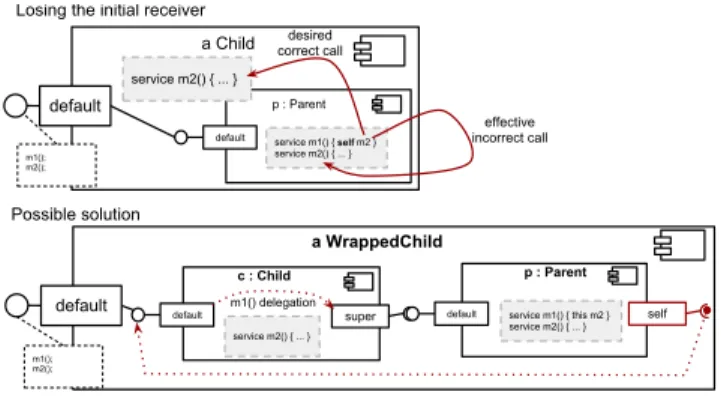
Figure 4. The ”lost of initial receiver” problem, when com-position and invocations forwarding are used. The context pseudo variable se l f does not refer to the original receiver of service invocation when delegations are used. The m2 ( ) service of descriptor Ch i l d is never called
cannot be used when an internal architecture of a descriptor needs to be reused. For example the reuse of a descriptor’s internal architecture shown in Figure 3 cannot be performed with composition.
Achieving behavioral inheritance by using composition and message forwarding raises various issues including the well known ”lost of initial receiver” problem [10]. The con-text reference se l f (or t h i s in some languages) does not refer to the original receiver of service invocation when for-warding is used. The problem and its solution are illustrated in Figure 4, where the m2 ( ) service of descriptor Ch i l d is never called.
ComponentJ proposal describes an operational solution to that problem. The solution is based on a connexion of the ”self” port of the composed-component to the default pro-vided port of the composite and on the service invocations forwarding from the composite to the composed-component (see the dashed arrow in the bottom of Figure 4).
The solution is operational but we argue that inheritance is preferred because it: (1) enables abstract description and conceptual description; (2) does not increases the complex-ity of the system and therefore preserve code maintainabil-ity of large systems, where hierarchical concept modeling is used; (3) copy the structure of an external contract of a super-descriptor (i.e. declaration of provided and required ports) automatically to sub-descriptors.
6.
Conclusions
In this paper, we have proposed an original descriptor-based inheritance system for a component-descriptor-based program-ming language taking into account in the same context the architecture modeling and coding aspects of components. We have motivated and described concrete solutions for cre-ating new component descriptors by extending and special-izing existing ones and for extending or specialspecial-izing all
key primary aspects of component modeling and program-ming: ports declarations, composition (or connection) archi-tectures, services declarations and definitions. These solu-tions are implemented and can be tested with our prototype
(http://www.lirmm.fr/∼spacek/compo/) implemented in Pharo
Smalltalk [3].
Among the various possible specialization options for inheritance, we have applied in our context the covariant-oriented one, by allowing to add requirements on a sub-descriptor, that promotes expressive power and reuse. We have implemented supports to help programmer achieving substitutions. Other well-known approachs can of course be considered. Besides, we have not yet discussed the multiple-inheritance option. Inheritance in component-based devel-opment is useful for both “develdevel-opment-for-reuse” and “development-by-reuse”. It helps, in combination with other composition techniques, in effortless production of new off-the-shelf components or new applications embedding com-plex components architectures.
There are various prospective for this work. The first one is to obviously to gain more experience on using inheritance in this context and to consider its use in designing Compo-nent Design Patterns [2]. Beside, our inheritance extension is currently used to build a reflective version of COMPO, the primary goal of which is, through a first-class repre-sentation of descriptors, components, ports and architec-ture, to write model-driven verifications or transformations of COMPOcomponent-based applications in COMPOitself. We are applying it to constraint-based architecture verifica-tion, extending our earlier works [20, 21] towards constraint-components hierarchies.
References
[1] J. Aldrich, C. Chambers, and D. Notkin. Archjava: connecting software architecture to implementation. In procs. of ICSE, New York, NY, USA, 2002. ACM.
[2] K. Arnout. From patterns to components. ETH Z¨urich, 2004. [3] A. Black, S. Ducasse, O. Nierstrasz, D. Pollet, D. Cassou, and M. Denker. Pharo by Example. Square Bracket Associates, 2009.
[4] N. Bouraqadi and L. Fabresse. Clic: a component model
symbiotic with smalltalk. In procs. of IWST, New York, NY, USA, 2009. ACM.
[5] G. Bracha and W. Cook. Mixin-based inheritance. In Pro-ceedings of OOPSLA and ECOOP. ACM Press, 1990. [6] E. Bruneton, T. Coupaye, M. Leclercq, V. Qu´ema, and J.-B.
Stefani. The fractal component model and its support in java: Experiences with auto-adaptive and reconfigurable systems. Softw. Pract. Exper., September 2006.
[7] R. Ducournau. “real world“ as an argument for covariant
specialization in programming and modeling. In Advances in Object-Oriented Information Systems, Lecture Notes in Computer Science. Springer Berlin / Heidelberg, 2002.
[8] L. Fabresse, C. Dony, and M. Huchard. Foundations of a simple and unified component-oriented language. Comput. Lang. Syst. Struct., July 2008.
[9] L. Fabresse, N. Bouraqadi, C. Dony, and M. Huchard. Filling the Gap between Design and Implementation with Compo-nents. International Journal of Computer Languages, Systems and Structures, Jan. 2012.
[10] H. Lieberman. Using Prototypical Objects to Implement
Shared Behavior in Object Oriented Systems. In procs. of OOPSLA, Portland, Oregon, USA, Nov. 1986. Published as ACM SIGPLAN Notices 21(11).
[11] B. Liskov and S. Zilles. Programming with abstract data
types. In Proceedings of the ACM SIGPLAN symposium on Very high level languages, New York, NY, USA, 1974. ACM. [12] R. C. Martin. Agile Software Development, Principles,
Pat-terns, and Practices. Prentice-Hall, Inc, 2002.
[13] OMG. UML 2.4.1 superstructure specification; document
formal/2011-08-06. Technical report, OMG, August 2011. [14] T. Oplustil. Inheritance in architecture description language.
In procs. of WDS, Prague, Czech Republic, June 2003. Mat-fyzpress.
[15] F. Pl´asil, D. B´alek, and R. Janecek. Sofa/dcup: Architecture for component trading and dynamic updating. In procs. of CDS, Washington, DC, USA, 1998. IEEE Computer Society. [16] H. A. Schmid and M. Pfeifer. Engineering a component
lan-guage: Compjava. In Software and Data Technologies, Com-munications in Computer and Information Science. Springer Berlin Heidelberg, 2008.
[17] J. a. C. Seco and L. Caires. A basic model of typed com-ponents. In procs. of ECOOP, London, UK, 2000. Springer-Verlag.
[18] J. C. Seco, R. Silva, and M. Piriquito. Componentj: A
component-based programming language with dynamic re-configuration. Computer Science and Information Systems, Dec. 2008.
[19] V. C. Sreedhar. Mixin’up components. In procs. of ICSE, New York, NY, USA, 2002. ACM.
[20] C. Tibermacine, R. Fleurquin, and S. Sadou. A family of
languages for architecture constraint specification. In the
Journal of Systems and Software (JSS), Elsevier, 2010. [21] C. Tibermacine, S. Sadou, C. Dony, and L. Fabresse.
Component-based specification of software architecture con-straints. In procs. of CBSE, Boulder, Colorado, USA, June 2011. ACM Press.
[22] W. Weck and C. Szyperski. Do we need inheritance? In procs. of ECOOP, 1996.
[23] L. Xu and Y. Ren. Bichon: A new component-oriented pro-gramming language. Software Engineering, World Congress on, 2010.