Predicting Biomass and Grain Protein Content Using Bayesian Methods
Majdi Mansouria, Benjamin Dumontb, Marie-France Destainb a
Corresponding author, Universit´e de Li´ege (GxABT) D´epartement des Sciences et Technologies de l’Environnement, Gembloux, Belgium,
Tel:+336 58 29 80 79, Fax: +333 25 71 76 47, E-mail: [email protected]
b
Universit´e de Li´ege (GxABT) D´epartement des Sciences et Technologies de l’Environnement, Gembloux, Belgium.
Abstract
This paper deals with the problem of predicting biomass and grain protein content using Improved Particle
Filtering (IPF) based on minimizing Kullback-Leibler divergence. The performances of improved particle
filtering are compared with those of the conventional Particle Filtering (PF) in two comparative studies.
In the first one, we apply IPF and PF at a simple dynamic crop model with the aim to predict a single
state variable, namely the winter wheat biomass, and to estimate several model parameters. Furthermore,
we investigate the effect of measurement noise (e.g., different signal-to-noise ratios) on the performances
of PF and IPF. In the second study, the proposed IPF and the PF are applied to a complex crop model
(AZODYN) able to predict an important winter-wheat quality criterion, namely the grain protein content.
They are also used to estimate the model’s parameters. The results of both comparative studies show that
the IPF provides a significant improvement over the PF because, unlike the PF which depends on the choice
of sampling distribution used to estimate the posterior distribution, the IPF yields an optimum choice of
the sampling distribution, which also accounts for the observed data. The efficiency of IPF is expressed in
terms of estimation accuracy (root mean square error).
Keywords: Crop model; Prediction; Particle filter.
1. Introduction
Crop models such as EPIC [1], WOFOST [2], DAISY[3], STICS [4], and SALUS [5] are non-linear
models that describe the growth and development of a crop interacting with environmental factors (soil
are developed to predict crop yield and quality or to optimize the farming practices in order to satisfy
agricultural objectives, as the reduction of nitrogen lixiviation. More recently, crop models are used to
simulate the effects of climate changes on the agricultural production. Nevertheless, the prediction errors of
these models may be important due to uncertainties in the estimates of initial values of the states, in input
data, in the parameters, and in the equations. The measurements needed to run the model are sometimes
not numerous, whereas the field spatial variability and the climatic temporal fluctuations over the field
may be high. The degree of accuracy is therefore difficult to estimate, apart from numerous repetitions
of measurements. For these reasons, the problem of state/parameter estimation represents a key issue in
such nonlinear and non-Gaussian crop models including a large number of parameters, while measurement
noise exists in the data. For example, it is useful to predict the evolution of variables, such as the biomass
and the grain protein content during the crop lifecycle. State estimation techniques can be of a great value
to solve that problem since they have the potential to estimate simultaneously the variables and several
parameters. As an example, involved parameters are the radiation use efficiency, the maximal value of the
ratio of intercepted to incident radiation, the coefficient of extinction of radiation, the maximal value of the
leaf-area index (LAI). Accurate prediction of state variables is not straightforward in crop models. Indeed,
most of the equations describing the state variables evolution are non-linear approximations of biophysical
processes. For example, the evolution of LAI comprises three phases, growth, stability, and senescence
described by different formalisms according to the models [6].
The estimation problem that is addressed here can be viewed as an optimal filtering problem, in which
the posterior distribution of the unobserved state, given the sequence of observed data and the state
evolu-tion model, is recursively updated [7, 8, 9, 10]. Several state estimaevolu-tion techniques are developed and used
in practice. These techniques include the extended Kalman filter, particle filter, and more recently the
varia-tional filter. The classical Kalman Filter (KF) was developed in the 1960s [11], and is widely used in various
engineering and science applications, including communications, control, machine learning, neuroscience,
and many others. In the case where the model describing the system is assumed to be linear and Gaussian,
Takagi-Sugeno fuzzy systems to handle nonlinear models, which can be described as a convex set of multiple
linear models [13, 14, 15]. It is known that the KF is computationally efficient; however, it is limited by the
non-universal linear and Gaussian modeling assumptions. To relax these assumptions, the extended Kalman
filter (EKF) [7, 8, 16, 17, 18] and the unscented Kalman filter (UKF) [7, 8, 19, 20, 21] are developed and
the ensemble kalman filter (EnKF) [22, 23]. In extended Kalman filtering, the model describing the system
is linearized at every time sample (in order to estimate the mean and covariance matrix of the state vector),
and thus the model is assumed to be differentiable. Unfortunately, for highly nonlinear or complex models,
the EKF does not usually provide a satisfactory performance. On the other hand, instead of linearizing
the model to approximate the mean and covariance matrix of the state vector, the UKF uses the unscented
transformation to improve the approximation of these moments. In the unscented transformation, a set of
samples (called sigma points) are selected and propagated through the nonlinear model, which provides more
accurate approximations of the mean and covariance matrix of the state vector, and thus more accurate
state estimation.
Other state estimation techniques use a Bayesian framework to estimate the state and/or parameter
vector [9]. The Bayesian framework relies on computing the probability distribution of the unobserved state
given a sequence of the observed data in addition to a state evolution model. PF methods offer a number
of significant advantages over other conventional methods. However, since they use the prior distribution
as the importance distribution [24, 25, 26], the latest data observation is not considered and not taken
into account when evaluating the weights of the particles. While the importance sampling distribution has
computational advantages, it can cause filtering divergence. In cases where the likelihood distribution is
too narrow compared to the prior distribution, few particles will have significant weights. Hence, a better
proposal distribution that takes the latest observation data into account is needed. In other words, new
adaptive methods that incorporate better feedback and smoothing in the selection or deletion of particles
and their weights need to be investigated. In case of standard PF, the latest observation is not considered
in the evaluation of the weights of the particles as the importance function is taken to be equal to the
cause filtering divergence. In cases where the likelihood function is too narrow as compared to the prior
function, very few particles will have significant weights. Hence, a better proposal distribution that takes
the latest observation into account is desired. The proposed algorithm consists of a PF based on minimizing
the Kullback-Leibler divergence distance to generate the optimal importance proposal distribution. The
proposed algorithm allows the particle filter to incorporate the latest observations into a prior updating
scheme using the estimator of the posterior distribution that matches the true posterior more closely. We
have proposed to use Kullback-Leibler divergence as criterion to compute the optimal sampling distribution,
since, it has been widely used in information theory and fundamental statistics, and it is characterized as
a symmetric, bounded and always-defined function. From the obtained optimal sampling distribution that
minimizes the Kullback-Leibler divergence distance, the samples/particles are drawn and the importance
weights are evaluated.
The objectives of this paper are threefold. The first objective is to use a new improved Particle
filter-ing (IPF) based on Kullback-Leibler divergence minimization for improvfilter-ing nonlinear and non-Gaussian
crop model predictions. The second objective is to investigate the effects of practical challenges on the
performances of state estimation algorithms PF and IPF. Such practical challenges include (i) the effect of
measurement noise on the estimation performances and (ii) the number of states and parameters to be
esti-mated. The third objective is to apply the proposed state estimation techniques PF and IPF for predicting
and modeling biomass and grain protein content. In a first step, we present an application of the new IPF to
a simple dynamic crop model with the aim to predict a single state variable, namely winter wheat biomass.
In a second step, we apply the new IPF for updating predictions of complex nonlinear crop models in order
to predict protein grain content.
The rest of the paper is organized as follows. In Section 2, a description of proposed improved particle
filtering for nonlinear crop model predictions and modeling is presented. Then, in Section 3, the performances
of the proposed new improved particle filtering are evaluated and compared to the standard particle filtering
2. Description of Standard Particle Filtering and its Improvement
Bayesian state estimation techniques have been developed and used many applications. An important and
a difficult problem in Bayesian inference is the computation of the marginal likelihood, given an observation
model and a prior distribution of the model parameters [6]. This problem has several implications: when
computing the marginal posterior distribution of a component; or the computation of the expectation of
a cost function. The marginal likelihood is a difficult quantity to compute because it requires integrating
over all parameters and latent variables, which is usually a high dimensional and complicated integral that
most simple methods fail to approximate efficiently [6]. However, recent developments in Bayesian inference
allow to deal with this difficulty by: i) approximating the distributions of interest with a set of weighted
random sample (called particles) in the case of the particle filtering technique (presented in section 2.1), or ii)
approximating the posterior distribution by a simpler separable function in the case of the improved particle
filter filtering (presented in section 2.2). Hence, these Bayesian techniques share a common principle, and
therefore, they are presented in a unified way in this section. The main problem when dealing with Bayesian
inference is computing a conditional probability distribution P (x|y, θ) of the unobserved state, given values
of the measurements, y, and the model parameter vector θ. For fixed y, P (y|θ) is an important quantity
known as the marginal likelihood. As is suggested by Eq. (2), the evaluation of the marginal likelihood is
closely related to the calculation of the posterior P (x|y, θ). Indeed, inference algorithms generally produce
the marginal likelihood as a by-product of the calculation of the posterior. Moreover, algorithms that
maximize the marginal likelihood and related quantities require calculating the posterior density function.
In other words, there are two main goals in Bayesian inference: calculating the marginal likelihood and
computing the posterior distribution, which can be used for prediction. Given the parameter vector θ, the
joint probability of the state vector x and the observed data y is,
P (x, y|θ) = P (x0) T Y k=1 P (xk|xk−1) T Y k=1 P (yk|xk). (1)
The posterior probability of the state variables x given y and θ is given by, P (x|y, θ) = P (x, y|θ) P (y|θ) , (2) where P (y|θ) = Z P (x, y|θ)dx. 2.1. Particle Filter
A particle filter is an implementation of a recursive Bayesian estimator [27, 28]. Bayesian estimation
relies on computing the posterior p(zk|y0:k), which is the density function of the unobserved state vector, zk,
given the sequence of the observed data y0:k≡ {y0, y2, · · · , yk}. However, instead of describing the required
posterior distribution in a functional form, in this particle filter scheme, it is represented approximately as
a set of random samples of the posterior distribution. These random samples, which are called the particles
of the filter, are propagated and updated according to the dynamics and measurement models [29, 28]. The
advantage of the PF is that it is not restricted by the linear and Gaussian assumptions, which makes it
applicable in a wide range of applications. The basic form of the PF is simple, but may be computationally
expensive. Thus, the advent of cheap, powerful computers over the last ten years has been a key to the
introduction and utilization of particle filters in various applications.
For a given dynamical system describing the evolution of the states and parameters that we wish to
estimate, the estimation problem can be viewed as an optimal filtering problem [30], in which the posterior
distribution, p(zk|y0:k), is recursively updated. Here, the dynamical system is characterized by a Markov
state evolution model, p(zk|z0:k−1) = p(zk|zk−1), and an observation model, p(yk|zk). In a Bayesian
con-text, the task of state estimation can be formulated as recursively calculating the predictive distribution
p(zk|y0:k−1) and the filtering distribution p(zk|y0:k) as follows,
p(zk|y0:k−1) = Z Rn p(zk|zk−1)p(zk−1|y0:k−1)dzk−1, and p(zk|y0:k) = p(yk|zk)p(zk|y0:k−1) p(yk|y0:k−1) ,
where, the normalizing constant p(yk|y0:k−1) = Z
Rz
p(yk|zk)p(zk|y0:k−1)dzk. (3)
state distribution, p(zk|zk−1). Therefore, Monte Carlo approximation is utilized, where the joint
poste-rior distribution, p(z0:k|y0:k), is approximated by the point-mass distribution of a set of weighted samples
(particles) {z0:k(i), ℓ(i)k }N
i=0, i.e., [29]: ˆ pN(z0:k|y0:k) = N X i=0 ℓ(i)k δz(i) 0:k(d z0:k)/ N X i=0 ℓ(i)k , (4) where δz(i)
0:k(d z0:k) denotes the Dirac function, ℓ
(i)
k are the corresponding importance weights and N is the total number of particles. Based on the same set of particles, the marginal posterior probability of interest,
p(zk|y0:k), can also be approximated as follows[28]:
ˆ pN(zk|y0:k) = N X i=0 ℓ(i)k δz(i) k (d zk)/ N X i=0 ℓ(i)k . (5)
In this Bayesian importance sampling (IS) approach, the particles {z(i)0:k}N
i=0 are sampled from the fol-lowing distribution (called also Importance density) [28],
p(z0:k|y0:k) = p(zk|zk−1) = Z
N (zk|µk, λk)p(µk, λk|zk−1)dµkdλk, (6)
where, µk defines the expectation of the state zk and λk defines the covariance matrix of the state zk.
Resampling is performed whenever the effective sample size Nef f drops below a certain threshold Nthreshold,
where a smaller Nef f means a larger variance for the weights, hence more degeneracy.
Then, the estimate of the augmented state bzk can be approximated by a Monte Carlo scheme as follows [29]: b zk= N X i=0 ℓ(i)k zk(i), (7)
where ℓ(i)k is given by [29]:
ℓ(i)k ∝ p(y0:k|z (i) 0:k)p(z (i) 0:k) p(z0:k(i)|y0:k) . (8)
A common problem with the sequential importance sampling-based particle filter is the degeneracy
phenomenon, where after a few iterations, all but one particle will have negligible weights. It has been shown
[31] that the variance of the importance weights can only increase over time, and thus, it is impossible to
avoid the degeneracy phenomenon. This degeneracy implies that a large computational effort is devoted to
of degeneracy of the algorithm is the estimate effective sample size ˆNef f, which is introduced in [27] and
[32], and is defined as,
ˆ Nef f = 1 PN i=0(ℓ (i) k )2 , (9)
where ℓ(i)k are the normalized weights obtained using (8). The PF algorithm for state/parameter estimation
is summarized in Algorithm 1.
Algorithm 1:Particle Filtering algorithm
Input: yk, µ0, λ0
Output: bzk
fori = 0, 2, . . . do
Importance sampling step:
Sample ez(i)k ∼ p(z(i)k |z0:k−1(i) , y0:k), according the equation (6), and set ez0:k(i)= (z (i) 0:k−1, z
(i) k );
Compute the approximated joint distribution, ˆpN(z0:k|y0:k), using equation (4);
Evaluate importance weights using equation (8); Normalize importance weights:
e ℓ(i)k = ℓ (i) k PN j=1(ℓ (j) k ) Selection step: ifNef f =PN 1 i=0(ℓ (i) k )2 < Nthresholdthen
Resample with replacement N particles {z0:k(i)}N
i=0from the set {ez (i)
0:k}Ni=0according to the normalized
importance weights, ℓ(i)k = eℓ (i) k ;
Compute the estimated state using equation (7); end
end
Return the augmented state estimation bzk.
Particle filtering suffers from one major drawback. Its efficient implementation requires the ability to
sample from p(zk|zk−1), which does not take into account the current observed data, yk, and thus many
particles can be wasted in low likelihood (sparse) areas. This issue is addressed by the proposed improved
2.2. Improved Particle Filter (IPF)
The choice of optimal proposal function is one of the most critical design issues in importance sampling
schemes. In [29], the optimal proposal distribution ˆp(zk|z0:k−1, y0:k) is obtained by minimizing the variance
of the importance weights given the states z0:k−1 and the observations data y0:k. This selection has also
been studied by other researchers. However, this optimal choice suffers from one major drawback. The
particles are sampled from the prior density p(zk|z0:k−1) and the integral over the new state need to be
computed. In the general case, closed form analytic expression of the posterior distribution of the state is
untractable [33]. Therefore, the distribution p(zk|z0:k−1) is the most popular choice of proposal distribution.
One of its advantages is its simplicity in sampling from the prior functions p(zk|z0:k−1) and the evaluation of
weights ℓ(i)k (as presented in the previous section). However, the latest observation is not considered for the
computation of the weights of the particles as the importance density is taken to be equal to the prior density
([34]). The transition prior p(zk|z0:k−1) does not take into account the current observation data yk, and
many particles can be wasted in low likelihood areas. This choice of importance sampling function simplifies
the computational complexity but can cause filtering divergence [34]). In cases where the likelihood density
is too narrow as compared to the prior function, very few particles will have considerable weights. Next, we
present an overview of KLD-based improved particle filter.
2.2.1. Improved Particle Filter based on KLD minimization
The improved particle filtering (IPF) is proposed for approximating intractable integrals arising in
Bayesian statistics. By using a separable approximating distribution ˆq(zk) = ˆq(zk|z0:k−1, y0:k) =Qiq(zˆ ki) to lower bound the marginal likelihood, an analytical approximation to the posterior probability p(zk|y0:k)
is provided by minimizing the Kullback-Leibler divergence (KLD):
DKL(ˆq||p) = Z ˆ q(zk|z0:k−1, y0:k) log ˆ q(zk|z0:k−1, y0:k) p(zk|z0:k−1, y0:k|y0:k)dzk, (10) where q(zˆ k|z0:k−1, y0:k) = Y i ˆ q(zi k|z0:k−1, y0:k) = ˆq(zk)ˆq(µk)ˆq(λk).
Minimizing the KLD subject to the constraint Rq(zˆ k)dzk = QiR q(zˆ ik)dzik = 1, the Lagrange multiplier scheme is used to yield the following approximate distribution [35, 36],
ˆ q(zi k) ∝ exp h E (log p(y0:k, zk))Q j6=iq(zˆ j k) i , (11) where E(.)q(zj
k) denotes the expectation operator relative to the distribution ˆq(z
j
k). Therefore, these de-pendent parameters can be jointly and iteratively updated. Taking into account the separable approximate
distribution ˆq(zk−1) at time k−1, the posterior distribution p(zk|y0:k) is sequentially approximated according
to the following scheme:
p(zk|y0:k) ∝ p(yk|zk)p(zk, λk|µk)qp(µk), (12)
where qp(µk) = Z
p(µk|µk−1)ˆq(µk−1)dµk−1.
Hence, the particles {z(i)0:k}Ni=0 are sampled according to the following optimal function:
ˆ
q(zk|z0:k−1, y0:k) = Z
N (zk|µk, λk)p(µk, λk|zk−1)p(yk|zk)dµkdλk. (13)
The recursive estimate of the importance weights can be derived as follows:
ℓ(i)k = ℓ(i)k−1p(y0:k|z (i) 0:k)p(z (i) 0:k) ˆ q(zk|z0:k−1, y0:k) . (14)
Equation (14) provides a mechanism to sequentially update the importance weights, given an appropriate
choice of proposal distribution, ˆq(zk|z0:k−1, y0:k). Then, the estimate of the augmented state bzk can be approximated by a Monte Carlo scheme as follows:
b zk= N X i=0 ℓ(i)k zk(i). (15)
The improved particle filter which based on minimizing KLD for proposal distribution generation within
Algorithm 2:Improved Particle Filtering algorithm
Input: yk, µ0, λ0
Output: bzk
fori = 0, 2, . . . do
Importance sampling step:
Sample ez(i)k ∼ ˆq(zk(i)|z(i)0:k−1, y0:k), according the equation (13), and set ez0:k(i)= (z (i) 0:k−1, z
(i) k );
Compute the approximated joint distribution, ˆp(z0:k|y0:k), as the equation (12);
Evaluate importance weights, as the equation (14); Normalize importance weights:
e ℓ(i)k = ℓ (i) k PN j=1(ℓ (j) k ) Selection step: ifNef f =PN 1 i=0(ℓ (i) k )2 < Nthresholdthen
Resample with replacement N particles {z0:k(i)}N
i=0from the set {ez (i)
0:k}Ni=0according to the normalized
importance weights, ℓ(i)k = eℓ(i)k ;
Compute the estimated state, as the equation (15); end
end
3. Simulation Results Analysis
3.1. Case 1 : A simple example: a dynamic model simulating wheat biomass
In this section, we describe a simple dynamic crop model that will be used to compare the performances
of PF and IPF. The crop model has a single state variable representing above-ground winter-wheat biomass.
This state variable is simulated on a daily basis in function of the daily temperature and the daily incoming
radiation according to the classical method presented in ([37]). The biomass at time k + 1 is linearly related
to the biomass at time k as follows:
Biomk+1= Biomk+ EbEimax(1 − eKLAIk) + P ARk+ wk, (16)
where k is the day number since sowing, Biomk is the true above-ground plant biomass on day k, P ARk is
the incoming photossynthetically active radiation on day k, LAIk is the leaf-area index on day k and wk is
a random term representing the model error. The crop biomass at sowing is set equal to zero: Biom1= 0.
LAIk is calculated in function of the cumulative degree-days (over a basis of 0oC) from sowing until day k,
noted Tt, as follows ([38]):
LAIk= Lmax(
1
1 + e−A[Tk−Ts1] − e
−B[Tk−Ts2]), (17)
where the parameter Ts2 is set equal to B log(1 + e−A[Tk−Ts1]) in order to have LAI1 = 0. The model includes two input variables Xk = [Tk P ARk]′ and seven parameters (Eb, Eimax, K, Lmax, A, B, Ts1). Eb is
the radiation use efficiency which expresses the biomass produced per unit of intercepted radiation, Eimax
is the maximal value of the ratio of intercepted to incident radiation, K is the coefficient of extinction of
radiation, Lmax is the maximal value of LAI, Ts1 defines a temperature threshold, and A and B are two
additional parameters. At this stage, the parameter values are assumed to be known and obtained from
([38]). We suppose that measurements of biomass, y1, y2, y3, ..., yN , are made at different times before
harvest on the site-year of interest. In practice, values of yk can be derived from plant samples or from
remote-sensing data. We assume that each measurement yk is related to the biomass Biomk by,
0
50
100
150
200
250
300
-0.5
0
0.5
1
1.5
2
2.5
x 10
4
N (days)
Bi
om
a
ss
(kg/
ha
)
True
PF estimate
IPF estimate
Figure 1: Estimation of state variable Biomass (g/m2) versus N (days) using PF and IPF techniques
where vk is a random term representing measurement errors. In the next section we show how such
mea-surements can be used to improve the accuracy of biomass predictions.
3.1.1. Estimation of the biomass
Based on the equation (16), the Biomass is estimated at each date of measurement using both IPF and
PF algorithms (Fig. 1). Table 1 illustrates the Root Mean Square Error (RMSE) using the two algorithms
PF and IPF. Fig. 1 and Table 1 show that IPF outperforms PF, these advantages of the IPF are due to the
fact it provides an optimum choice of the sampling distribution used to approximate the posterior density
function, which also accounts for the observed data.
Table 1: Comparison of State Estimation Techniques
RMSE Execution times
Technique Biomass(kg/ha) t
PF 6.328 1.04
IPF 3.743 1.03
execution times.
3.1.2. Estimation of the biomass and of several parameters
The model (16) assumes that the parameters are fixed and/or have been determined previously. However,
the model involves several parameters that are usually not exactly known, or that have to be estimated.
Estimating these parameters to completely define the model usually requires several experiment setups,
which can be expensive and challenging in practice. Hence, in a second step, we propose to use PF and IPF
to simplify the task of modeling compared to the conventional experimental intensive methods. Here, we
are interested in examining the effect of the number of estimated states and parameters on the estimation
performances of PF and IPF when used to estimate the states and the model parameters. In other words,
the state vector that we wish to estimate, zk, includes the model states, xk, as well as some (or all) of the
model parameters (i.e., Eb, Eimax , K, Lmax, Ts1, A and B) that are assumed to be unknown. Hence, the
following equations are assumed to describe the evolution of model parameters:
Eb,k= Eb,k−1+ γ1k−1, Eimax,k= Eimax,k−1+ γk−12 ,
Kk= Kk−1+ γk−13 , Lmax,k= Lmax,k−1+ γk−14 ,
Ak = Ak−1+ γk−15 , Bk= Bk−1+ γk−16 ,
Ts1,k= Ts1,k−1+ γk−17 ,
(19)
where, γj∈1,...,7j is a process Gaussian noise with zero mean and known variance σ2
γ . Combining (16), (17) and (18), one obtains:
and the leaf-area index LAIk on day k is given by:
LAIk+1= Lmax,k(
1
1 + e−Ak[Tk−Ts1,k] − e
−Bk[Tk−Ts2,k]). (21)
Combining (16) and (19), one obtains:
f1: Biomk= Biomk−1+ Eb,k−1Eimax,k−1(1 − eKk−1LAIk−1) + P ARk−1+ wk−1, f2: Eb,k= Eb,k−1+ γ1k−1, f3: Eimax,k= Eimax,k−1+ γ2k−1,
f4: Kk= Kk−1+ γk−13 , f5: Lmax,k= Lmax,k−1+ γk−14 ,
f6: Ak = Ak−1+ γk−15 , f7: Bk = Bk−1+ γk−16 ,
f8: Ts1,k= Ts1,k−1+ γk−17 ,
(22)
where f{j∈1,...,8} are some nonlinear functions. In other words, we are forming the augmented state: zk =
[xk θk]T which is the vector that we wish to estimate. It can be given by a 8x1 matrix: xk(1, :) − > Biomk θk(1, :) − > Eb, k θk(2, :) − > Eimax,k θk(3, :) − > Kk θk(4, :) − > Lmax,k θk(5, :) − > Ak θk(6, :) − > Bk θk(7, :) − > Ts1,k (23)
The idea here is that, if a dynamic model structure is available, the model parameters can be estimated
using one of state estimation technique, PF and IPF. To characterize the ability of the different approaches
to estimate both the states and the parameters at same time, we have chosen true parameter values and
then tested each technique to see how well it could retrieve these true parameter values given the data.
It was thus possible to calculate the quality of the estimated parameters and the predictive quality of the
adjusted model for each method. It can be seen from the results presented in Table 2 and Table 3 that
obtained in the first comparative study, where only the state variables are estimated. The advantages of
the IPF over the PF can also be seen through its abilities to estimate the model parameters. The results
also show that the number of estimated parameters affect the estimation accuracy of the estimated state
variables. In other words, for all estimation techniques, the estimation RMSE of Biomass increases from the
first comparative study (where only the state variables are estimated) to case 1 (where seven parameters Eb,
Eimax, K, Lmax, Ts1, A and B are estimated). In order to investigate the performance of the PF and IPF
estimation algorithms versus the number of states and parameters to be estimated. Tables 2 and 3 compare
the estimated of the crop model parameters using the two techniques PF and IPF for the different number of
states and parameters to be estimated. For example, for the PF estimation technique, the estimation RMSE
of the Biomass Biomk, increases from the first comparative study (states and parameters to be estimated
= 2) to case (where the number of states and parameters to be estimated = 8). For example, the RMSEs
obtained using PF the Biomass Biomk where the number of states and parameters to be estimated = 2
and = 8 are 6.346, and 6.768, respectively, which increase as the number of states and parameters to be
estimated increases (refer to Table 2). This observation is valid for IPF technique (refer to Table 3).
3.1.3. Presence of a noise in the data
Here, we assume that a Gaussian noise is added to the time profiles of Biomass. In order to show the
performance of the PF and IPF estimation algorithms in the presence of measurement noise, four different
measurements noise values, 10−1, 10−2, 10−3 and 10−4, are considered. The final estimated values of the
crop model parameters are summarized in Tables 4 and 5. The simulation results of estimating the states
Biomass using PF and IPF when the variances noise vary in {10−4, 10−3} are shown in Tables 4 and 5.
In other words, for the PF estimation technique, the estimation RMSE of the Biomass Biomk, increases
from the first comparative study (noise variance = 10−4) to case (where the noise variance = 10−1). For
example, the RMSEs obtained using PF for Biomass where the noise variance=10−4and = 10−1 are 6.248,
and 6.674, respectively, which increase as the noise variance increases (refer to Table 4). This observation
Table 2: PF–estimations of the values of the crop model parameters versus the number of states and parameters to be estimated. Eb Eimax K Lmax Ts1 A B RM SE True parameter 1 0.48 0.52 6.2 1200 0.0032 0.0024 zk= [BiomkEb,k] Estimated 1 6.346 zk= [BiomkEb,k Eimax,k] Estimated 1 0.48 6.394 zk= [BiomkEb,k Eimax,kKk] Estimated 1 0.48 0.52 6.414
zk= [BiomkEb,k Eimax,kKkLmax,k]
Estimated 1 0.48 0.52 6.18 6.459
zk= [BiomkEb,k Eimax,kKkLmax,kTs1,k]
Estimated 1 0.48 0.52 6.175 1198 6.564
zk= [BiomkEb,k Eimax,kKkLmax,kTs1,kAk]
Estimated 1 0.48 0.52 6.178 1197 0.00318 6.621
zk= [BiomkEb,k Eimax,kKkLmax,kTs1,kAkBk]
Table 3: IPF–estimations of the values of the crop model parameters versus the number of states and parameters to be estimated. Eb Eimax K Lmax Ts1 A B RM SE True parameter 1 0.48 0.52 6.2 1200 0.0032 0.0024 zk= [BiomkEb,k] Estimated 1 3.573 zk= [BiomkEb,k Eimax,k] Estimated 1 0.48 3.653 zk= [BiomkEb,k Eimax,kKk] Estimated 1 0.48 0.52 3.765
zk= [BiomkEb,k Eimax,kKkLmax,k]
Estimated 1 0.48 0.52 6.2 3.891
zk= [BiomkEb,k Eimax,kKkLmax,kTs1,k]
Estimated 1 0.48 0.52 6.2 1200 3.927
zk= [BiomkEb,k Eimax,kKkLmax,kTs1,kAk]
Estimated 1 0.48 0.52 6.2 1198 0.00318 3.953
zk= [BiomkEb,k Eimax,kKkLmax,kTs1,kAkBk]
Table 4: PF–estimations of the values of the crop model parameters versus noisy measurement variances
Eb Eimax K Lmax Ts1 A B RM SE
True parameter 1 0.48 0.52 6.2 1200 0.0032 0.0024
PF noisy measurement variance= 10−4
Estimated 0.99 0.479 0.519 6.19 1199 0.00319 0.00238 6.248
PF noisy measurement variance= 10−3
Estimated 0.98 0.475 0.518 6.18 1198 0.00318 0.00236 6.314
PF noisy measurement variance= 10−2
Estimated 0.97 0.469 0.517 6.16 1197 0.00315 0.00231 6.453
PF noisy measurement variance= 10−1
Estimated 0.95 0.46 0.515 6.14 1195 0.00312 0.00223 6.674
Table 5: IPF–estimations of the values of the crop model parameters versus noisy measurement variances
Eb Eimax K Lmax Ts1 A B RM SE
True parameter 1 0.48 0.52 6.2 1200 0.0032 0.0024
PF noisy measurement variance= 10−4
Estimated 1 0.48 0.52 6.2 1200 0.0032 0.0024 3.641
PF noisy measurement variance= 10−3
Estimated 1 0.48 0.52 6.2 1200 0.0032 0.0024 3.683
PF noisy measurement variance= 10−2
Estimated 0.986 0.475 0.5185 6.18 1198 0.00318 0.00236 3.724
PF noisy measurement variance= 10−1
3.2. Case 2 : IPF for complex nonlinear crop models 3.2.1. The overall formalism
Here, the estimation problem of interest is formulated for a general system model. Let a nonlinear
complex crop model be described as follows:
˙x = g(x, u, θ, w),
y = l(x, u, θ, v),
(24)
where x ∈ Rn is a vector of the state variables, u ∈ Rp is a vector of the input variables, θ ∈ Rq is an unknown parameter vector, y ∈ Rmis a vector of the measured variables, w ∈ Rn and v ∈ Rm are process and measurement noise vectors, respectively, and g and l are nonlinear differentiable functions. Discretizing
the state space model (24), the discrete model can be written as follows:
xk = f (xk−1, uk−1, θk−1, wk−1),
yk= h(xk, uk, θk, vk),
(25)
which describes the state variables at some time step (k) in terms of their values at a previous time step
(k − 1). Since we are interested in estimating the state vector, xk, as well as the parameter vector, θk, let’s
assume that the parameter vector is described by the following model:
θk = θk−1+ γk−1, (26)
which means that it corresponds to a stationary process, with an identity transition matrix, driven by white
noise. In order to include the parameter vector θk into the state estimation problem, let’s define a new state
vector zk that augments the state vector xk and the parameter vector θk as follows:
zk = h xk θk i =h f(xk−1, uk−1, wk−1, θk−1) θk−1+ γk−1 i , (27)
where zk∈ Rn+q. Also, defining the augmented noise vector as:
ǫk−1 = h wk−1
γk−1 i
the model (25) can be written as,
zk = F(zk−1, uk−1, ǫk−1), (29)
yk = R(zk, uk, vk), (30)
where F and R are differentiable nonlinear functions. Thus, the objective here is to estimate the augmented
state vector zk, given the measurements vector yk.
3.2.2. Application to a crop model predicting grain protein content
The AZODYN crop model ([39]) is a nonlinear dynamic model simulating winter-wheat crop in function
of environmental variables (characteristics of the crop at the end of winter, soil characteristics, climate)
and of nitrogen fertilization (dates and rates of fertilizer applications). We consider a particular site-year
(2008-2009). This model can be used to predict grain yield, soil mineral nitrogen, and grain protein content
at harvest. AZODYN is a useful tool for studying the effects of nitrogen management on crop yield, grain
quality and risk of pollution by nitrate ([40]). Before flowering, five state variables are simulated each
day by AZODYN: nitrogen uptake (NU), dry matter (DM), nitrogen-nutrition index (NNI), leaf-area index
(LAI), soil mineral nitrogen supply (SNS). We consider chlorophyll-content measurements obtained with a
chlorophyll meter. These measurements are correlated to one of the model state variables, namely nitrogen
uptake, and can be easily performed by farmers, collecting-firm operators, or farmers’ advisors. Here, we
suppose that only one chlorophyll-content measurement is performed at flowering and that this measurement
is linearly related to the model state variables as follows:
ymk = ip + Hxmk+ vmk, (31)
where ymk and xmk are, respectively, the chlorophyll-content measurement and the (5x1) vector of the
true state-variable values at flowering, ip is an intercept parameter, and H is a one-row matrix defined by
H = (α, 0, 0, 0) where α is the slope of the linear equation relating the measurement to nitrogen uptake.
We assume that the error term vmk is Normally distributed, vmk N (O, R) . The IPF is used to update the
0
50
100
150
200
250
30
40
50
60
70
80
90
100
N (days)
G
ra
in Y
ie
ld (kg/
ha
)
True
PF estimate
IPF estimate
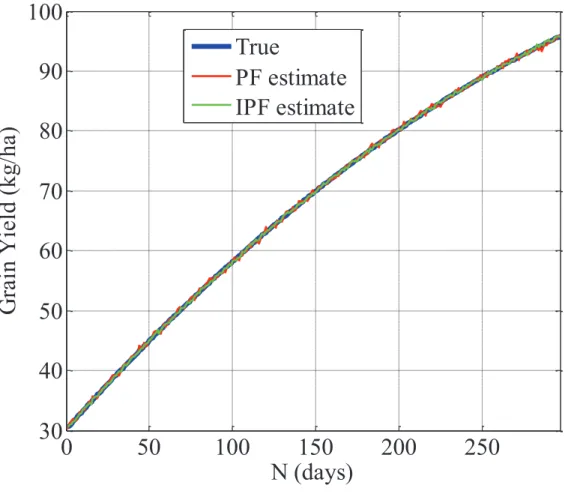
Figure 2: Updated value of grain protein content (kg/ha) versus N (days) using PF and IPF techniques.
(LAI), soil mineral nitrogen supply (SNS) given a single chlorophyll-content measurement ymkperformed at
flowering. Yield and grain protein content at harvest are then estimated from the updated state variables.
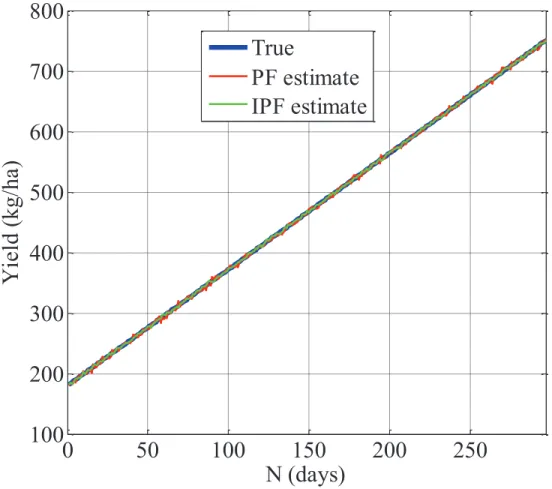
Figures 2, 3 and Table 6 show the estimation of the two states variables Yield and grain protein content
using PF and IPF. The results show the performance of IPF over PF, the efficiency of IPF is due to the
fact it uses the KLD divergence to compute the optimum sampling distribution used to approximate the
posterior density function, which also accounts for the observed data.
Table 6 presents the performance comparison of the state estimation techniques in terms of RMSE and
0
50
100
150
200
250
100
200
300
400
500
600
700
800
N (days)
Y
ie
ld (kg/
ha
)
True
PF estimate
IPF estimate
Figure 3: Updated value of yield (kg/ha) versus N (Days) using PF and IPF techniques.
Table 6: Comparison of State Estimation Techniques
RMSE Execution times
Technique Yield grain protein content t
PF 1.0761 0.0622 1.11
4. Conclusions
In this paper, we developed an improved Particle Filter (IPF) for crop model predictions and modeling.
Specifically, two comparative studies are performed. In the first comparative study, we presented a simple
application of the new IPF to a linear dynamic crop model predicting only one state variable, namely winter
wheat biomass and estimating several model parameters. In the second comparative study, we have used
the proposed IPF for updating predictions of complex nonlinear crop models. In this case, the proposed
IPF is applied to a nonlinear model predicting an important winter-wheat quality criterion, grain protein
content and used also to model parameter estimation. In addition to comparing the performances of the
state estimation techniques; Particle Filter (PF), and improved Particle Filter (IPF), the effect of number
of estimated model parameters on the accuracy and convergence of these techniques are also assessed.
The results of both comparative studies show that the IPF provides a significant improvement over the
PF because, unlike the PF which depends on the choice of sampling distribution used to estimate the
posterior distribution, the IPF yields an optimum choice of the sampling distribution, which also accounts
for the observed data. We have investigated the effects of practical challenges on the performances of
Particle Filter (PF), and improved Particle Filter (IPF). The comparative analysis is conducted to study
the effects of two practical challenges (measurement noise, and the number of states and parameters to be
estimated) on the estimation performances of PF, and IPF. To study the effect of measurement noise on
the estimation performances, several measurement noise contributions (e.g., different signal-to-noise ratios)
are considered. Then, the estimation performances of PF and IPF are compared for different noise levels.
Similarly, to investigate the effect of the number of states and parameters to be estimated on the estimation
performances of PF and IPF, the estimation performance is analyzed for different numbers of estimated
states and parameters. The performance of the proposed method is evaluated on a synthetic example in
Acknowledgement
This work was made possible by Fonds de la Recherche Scientifique (FNRS) grant. The statements made
herein are solely the responsibility of the authors.
References
[1] J. Williams, C. Jones, J. Kiniry, and D. Spanel, “The epic crop growth model,” Trans. ASAE, vol. 32, no. 2, pp. 497–511, 1989.
[2] C. Diepen, J. Wolf, H. Keulen, and C. Rappoldt, “Wofost: a simulation model of crop production,” Soil use and
manage-ment, vol. 5, no. 1, pp. 16–24, 1989.
[3] S. Hansen, H. Jensen, N. Nielsen, and H. Svendsen, NPo-research, A10: DAISY: Soil Plant Atmosphere System Model. Miljøstyrelsen, 1990.
[4] N. Brisson, B. Mary, D. Ripoche, M. Jeuffroy, F. Ruget, B. Nicoullaud, P. Gate, F. Devienne-Barret, R. Antonioletti, C. Durr et al., “Stics: a generic model for the simulation of crops and their water and nitrogen balances. i. theory, and parameterization applied to wheat and corn,” Agronomie, vol. 18, no. 5-6, pp. 311–346, 1998.
[5] B. Basso and J. Ritchie, “Impact of compost, manure and inorganic fertilizer on nitrate leaching and yield for a 6-year maize-alfalfa rotation in michigan,” Agriculture, ecosystems & environment, vol. 108, no. 4, pp. 329–341, 2005.
[6] M. Mansouri, B. Dumont, and M.-F. Destain, “Modeling and prediction of nonlinear environmental system using bayesian methods,” Computers and Electronics in Agriculture, vol. 92, pp. 16–31, 2013.
[7] D. Simon, Optimal State Estimation: Kalman, H∞, and Nonlinear Approaches. John Wiley and Sons, 2006.
[8] M. Grewal and A. Andrews, Kalman Filtering: Theory and Practice using MATLAB. John Wiley and Sons, 2008. [9] M. Mansouri, H. Snoussi, and C. Richard, “A nonlinear estimation for target tracking in wireless sensor networks using
quantized variational filtering,” Proc. 3rd International Conference on Signals, Circuits and Systems, pp. 1–4, 2009. [10] L. Matthies, T. Kanade, and R. Szeliski, “Kalman filter-based algorithms for estimating depth from image sequences,”
International Journal of Computer Vision, vol. 3, no. 3, pp. 209–238, 1989.
[11] R. E. Kalman, “A new approach to linear filtering and prediction problem,” Trans. ASME, Ser. D, J. Basic Eng., vol. 82, pp. 34–45, 1960.
[12] V. Aidala, “Parameter estimation via the kalman filter,” IEEE Trans. on Automatic Control, vol. 22, no. 3, pp. 471–472, 1977.
[13] G. Chen, Q. Xie, and L. Shieh, “Fuzzy kalman filtering,” Journal of Information Science, vol. 109, pp. 197–209, 1998. [14] D. Simon, “Kalman filtering of fuzzy discrete time dynamic systems,” Applied Soft Computing, vol. 3, pp. 191–207, 2003. [15] H. Nounou and M. Nounou, “Multiscale fuzzy kalman filtering,” Engineering Applications of Artificial Intelligence, vol. 19,
[16] S. Julier and J. Uhlmann, “New extension of the kalman filter to nonlinear systems,” Proceedings of SPIE, vol. 3, no. 1, pp. 182–193, 1997.
[17] L. Ljung, “Asymptotic behavior of the extended kalman filter as a parameter estimator for linear systems,” IEEE Trans.
on Automatic Control, vol. 24, no. 1, pp. 36–50, 1979.
[18] Y. Kim, S. Sul, and M. Park, “Speed sensorless vector control of induction motor using extended kalman filter,” IEEE
Trans. on Industrial Applications, vol. 30, no. 5, pp. 1225–1233, 1994.
[19] E. Wan and R. V. D. Merwe, “The unscented kalman filter for nonlinear estimation,” Adaptive Systems for Signal
Processing, Communications, and Control Symposium, pp. 153–158, 2000.
[20] R. V. D. Merwe and E. Wan, “The square-root unscented kalman filter for state and parameter-estimation,” IEEE
International Conference on Acoustics, Speech, and Signal Processing, vol. 6, pp. 3461–3464, 2001.
[21] S. Sarkka, “On unscented kalman filtering for state estimation of continuous-time nonlinear systems,” IEEE Trans.
Automatic Control, vol. 52, no. 9, pp. 1631–1641, 2007.
[22] Q. Shu, M. W. Kemblowski, and M. McKee, “An application of ensemble kalman filter in integral-balance subsurface modeling,” Stochastic Environmental Research and Risk Assessment, vol. 19, no. 5, pp. 361–374, 2005.
[23] A. H. Elsheikh, C. Pain, F. Fang, J. Gomes, and I. Navon, “Parameter estimation of subsurface flow models using iterative regularized ensemble kalman filter,” Stochastic Environmental Research and Risk Assessment, vol. 27, no. 4, pp. 877–897, 2013.
[24] G. Storvik, “Particle filters for state-space models with the presence of unknown static parameters,” IEEE Trans. on
Signal Processing, vol. 50, no. 2, pp. 281–289, 2002.
[25] A. Doucet and V. Tadi´c, “Parameter estimation in general state-space models using particle methods,” Annals of the
institute of Statistical Mathematics, vol. 55, no. 2, pp. 409–422, 2003.
[26] G. Poyiadjis, A. Doucet, and S. Singh, “Maximum likelihood parameter estimation in general state-space models using particle methods,” in Proc of the American Stat. Assoc, 2005.
[27] F. Gustafsson, F. Gunnarsson, N. Bergman, U. Forssell, J. Jansson, R. Karlsson, and P. Nordlund, “Particle filters for positioning, navigation, and tracking,” Signal Processing, IEEE Transactions on, vol. 50, no. 2, pp. 425–437, 2002. [28] M. Arulampalam, S. Maskell, N. Gordon, and T. Clapp, “A tutorial on particle filters for online nonlinear/non-gaussian
bayesian tracking,” Signal Processing, IEEE Transactions on, vol. 50, no. 2, pp. 174–188, 2002.
[29] A. Doucet and A. Johansen, “A tutorial on particle filtering and smoothing: Fifteen years later,” Handbook of Nonlinear
Filtering, pp. 656–704, 2009.
[30] B. Andrews, T. Yi, and P. Iglesias, “Optimal noise filtering in the chemotactic response of escherichia coli,” PLoS
com-putational biology, vol. 2, no. 11, p. e154, 2006.
[31] N. Yang, W. Tian, Z. Jin, and C. Zhang, “Particle filter for sensor fusion in a land vehicle navigation system,” Measurement
[32] J. Liu and R. Chen, “Sequential monte carlo methods for dynamic systems,” Journal of the American statistical
associa-tion, pp. 1032–1044, 1998.
[33] J. Kotecha and P. Djuric, “Gaussian particle filtering,” IEEE Trans. on Signal Processing, vol. 51, no. 10, pp. 2592–2601, 2003.
[34] R. Van Der Merwe, A. Doucet, N. De Freitas, and E. Wan, “The unscented particle filter,” Advances in Neural Information
Processing Systems, pp. 584–590, 2001.
[35] J. Vermaak, N. Lawrence, and P. Perez, “Variational inference for visual tracking,” in Conf. Computer Vision and Pattern
Recognition, Jun. 2003.
[36] A. Corduneanu and C. Bishop, “Variational bayesian model selection for mixture distribution,” in Artificial Intelligence
and Statistics, 2001.
[37] C. Varlet-Grancher, R. Bonhomme, M. Chartier, and P. Artis, “Efficience de la conversion de l’´energie solaire par un couvert v´eg´etal,” Acta Oecologica. Oecologia plantarum, 1982.
[38] F. BARET, “Contribution au suivi radiometrique de cultures de cereales,” Ph.D. dissertation, 1986.
[39] M.-H. Jeuffroy and S. Recous, “Azodyn: a simple model simulating the date of nitrogen deficiency for decision support in wheat fertilization,” European journal of Agronomy, vol. 10, no. 2, pp. 129–144, 1999.
[40] J.-M. Meynard, M. Cerf, L. Guichard, M.-H. Jeuffroy, D. Makowski et al., “Which decision support tools for the environ-mental management of nitrogen?” Agronomie-Sciences des Productions Vegetales et de l’Environnement, vol. 22, no. 7-8, pp. 817–830, 2002.