e-Polymers 2001, no. 009.
Poly(
εε
-caprolactone) layered silicate nanocomposites:
effect of clay surface modifiers on the melt intercalation
process
Nadège Pantoustier1,4, Michaël Alexandre1,4, Philippe Degée1,4, Cédric Calberg2,4,
Robert Jérôme2,4, Catherine Henrist3, Rudi Cloots3, André Rulmont3,
Philippe Dubois1,4 *
1
Laboratory of Polymeric and Composite Materials (SMPC), University of Mons-Hainaut, Place du Parc 20, 7000 Mons, Belgium; Fax +32 (0)65 37 34 84; [email protected]
2
Center for Education and Research on Macromolecules (CERM), University of Liège, Building B6, 4000 Liège, Belgium
3
General Chemistry and Physics Chemistry Department, University of Liège, Building B6, 4000 Liège, Belgium
4
Research Center in Science of Polymeric Materials - CRESMAP, Belgium
(Received: July 11, 2001; published: August 7, 2001)
Abstract: Nanocomposites based on biodegradable poly(ε-caprolactone) (PCL) and layered silicates (montmorillonite) modified by various alkylammonium cations were prepared by melt intercalation. Depending on whether the ammonium cations contain non-functional alkyl chains or chains terminated by carboxylic acid or hydroxyl functions, microcomposites or nanocomposites were recovered as shown by X-ray diffraction and transmission electron microscopy. Mechanical and thermal properties were examined by tensile testing and thermogravimetric analysis. The layered silicate PCL nanocomposites exhibited some improvement of the
mechanical properties (higher Young’s modulus) and increased thermal stability as well as enhanced flame retardant characteristics as result of a charring effect. This communication aims at reporting that the formation of PCL-based nanocomposites strictly depends on the nature of the ammonium cation and its functionality, but also on the selected synthetic route, i.e. melt intercalation vs. in situ intercalative polymerization. Typically, protonated ω-aminododecanoic acid exchanged montmorillonite allowed to intercalate ε−caprolactone monomer and yielded nanocomposites upon in situ polymerization, whereas they exclusively formed microcomposites when blended with preformed PCL chains. In other words, it is shown that the formation of polymer layered silicate nanocomposites is not straightforward and cannot be predicted since it strongly depends on parameters such as ammonium cation type and functionality together with the production procedure, i.e., melt intercalation, solvent evaporation or in situ polymerization. Introduction
Polymer nanocomposites, especially polymer-layered silicate nanocomposites, represent a valuable alternative to conventionally filled polymers. Because of the dispersion of nanometer-size silicate sheets, these nanocomposites exhibit markedly improved properties when compared with pure polymers or conventional
“microcomposites”. Polymer nanocomposites based on layered silicates (i.e., clays such as montmorillonite) are of current interest because of the fundamental questions they address and potential technological applications. This new type of materials can be prepared by various techniques including exfoliation-adsorption, in situ
intercalative polymerization, template synthesis and melt-intercalation (Alexandre et al. [1]). In this paper, layered silicate poly(ε-caprolactone) nanocomposites have been prepared by melt intercalation. In this technique, the layered silicate is mixed with the polymer matrix in the molten state. The clays are usually made hydrophobic by ionic exchange of the sodium interlayer cations with onium cations bearing long alkyl chains. As long as the alkylated surface of the silicate layers is compatible with the polymer, the polymer chains can crawl into the interlayer space and form either an intercalated or an exfoliated nanocomposite. In the intercalated hybrid structure, a single extended polymer chain is intercalated/sandwiched between the silicate sheets, resulting in a well-ordered multilayer of alternating polymer and inorganic sheets. In the exfoliated (or delaminated) hybrid structure, the silicate nanolayers (1 nm thick) are individually dispersed in the polymer matrix. Exfoliation of the silicate layers usually provides the nanocomposite materials with improved properties, such as higher Young’s modulus (namely the material stiffness) and storage modulus, higher thermal stability and flame retardancy, and a more efficient gas barrier
(Alexandre et al. [1]). A wide range of polymeric matrices have been reported to form nanocomposites by melt intercalation, e.g., polystyrene (Vaia et al. [2-4]), nylon-6 (Liu et al. [5]), maleic anhydride grafted polypropylene (Kato et al. [6], Kawasumi et al. [7] and Hasegawa [8]), ethylene-vinyl acetate copolymers (Alexandre et al. [9]), ... Because of unique properties of polymer miscibility, poly(ε-caprolactone) (PCL) is a thermoplastic worth being modified by nanofillers. Indeed, it is miscible with a large variety of polymers and copolymers, e.g., poly(vinyl chloride),
poly(styrene-co-acrylonitrile), poly(acrylonitrile-co-butadiene-co-styrene), bisphenol-A polycarbonate, nitrocellulose and cellulose butyrate. It is also mechanically compatible with
polypropylene, polyethylene, natural rubber, poly(vinyl acetate), ethylene/propylene rubber, etc. (Brode et al. [10] and Pitt et al. [11]). Therefore, surface-organo-modified clays intercalated or exfoliated within PCL by any of the aforementioned techniques could be further melt blended with any of the PCL miscible or compatible
(co)polymers to form new layered silicate polymer nanocomposites (Pantoustier et al. [12]), enlarging the range of application of PCL-based nanocomposites.
Nanocomposites based on poly(ε-caprolactone) (PCL) have already been prepared by in situ intercalative polymerization of ε-caprolactone in the presence of a
protonated ω-amino-acid exchanged montmorillonite (Messersmith et al. [13]). Another synthetic pathway has been recently proposed to produce novel segmented PCL-based polyurethane/clay nanocomposites by step-growth polymerization of diphenylmethane diisocyanate, butanediol and preformed polycaprolactone diol (Chen et al. [14]). The polymerization of ε-caprolactone has been also reported
directly inside a Cr3+-exchanged fluorohectorite (Messersmith et al. [15]). However, to the best of our knowledge, no study has been reported on the preparation of layered silicate PCL nanocomposites by melt intercalation.
This paper reports preliminary results on the preparation of poly(ε -caprolactone)-based nanocomposites by melt intercalation, a very attractive environmentally
friendly process since no solvent is required. Several modified montmorillonites have been studied bearing either non-functional long alkyl chains or chains terminated by carboxylic acid or hydroxyl groups. Depending on the surface-modification of
and thermal properties. More interestingly, it will be shown that the formation of PCL-based nanocomposites depends not only on the ammonium cation and related functionality but also, for the same cation, on the synthetic route by either melt intercalation or in situ intercalative polymerization. Such an observation is not trivial and requires much attention when designing conditions for synthesizing polymer-layered silicate nanocomposites.
Experimental part
Materials and composites preparation
Commercial grade poly(ε-caprolactone) (CAPA®650) was supplied by Solvay Chemicals sector-SBU caprolactones. PCL number-average molecular weight (Mn)
was 49000 with Mw/Mn = 1.4 as determined by size exclusion chromatography (SEC)
in tetrahydrofuran at 35° C (molecular weight and molecular weight distribution were calculated with reference to a universal calibration curve and polystyrene standards –
KPS = 1.25 ⋅ 10-4 dl/g, aPS = 0.707; KPCL = 1.09 ⋅ 10-3 dl/g, aPCL = 0.600 in the [η] =
K ⋅ Ma Mark-Houwink relationship). The unmodified montmorillonite-Na
(Cloisite®Na+) with a cation exchange capacity (CEC) of ca. 90 meq/100 g was kindly supplied by Southern Clay Products, USA. Organophilic clays were prepared by cation-exchange reaction of montmorillonite-Na with selected alkylammonium cations as reported elsewhere (Usuki et al. [16]). The ammonium cations and their content (as determined by thermogravimetric analysis and expressed in weight content of organics) in exchanged montmorillonites are listed in Tab. 1. Typical lengths of studied montmorillonites are in the range of 150 - 500 nm as observed by transmission electron microscopy. The PCL-layered silicate composites were
prepared by mechanical kneading with an Agila two-roll mill at 130oC for 10 min. The collected molten materials were compression molded into 3 mm-thick plates by hot-pressing at 100° C for 10 min under atmosphere pressure, followed by compression under 150 bar for 10 s, then under 30 bar for 10 s, followed by cold pressing at 15° C under 30 bar for 5 min.
Characterization
Morphology of composites was analyzed by X-ray diffraction (XRD) and transmission electron microscopy (TEM). The XRD patterns were collected in a digital form using a Siemens D5000 diffractometer with Cu-Kα radiation (λ = 0.15406 nm) between 1.5 and 30° by steps of 0.04° . TEM observations were performed with a Philips CM100 apparatus using an acceleration voltage of 100 kV. Ultrathin sections of the
composites with a thickness of approximately 80 nm were accordingly cut at -130° C from the 3 mm-thick plates by using a Reichert-Jung Ultracut 3E, FC4E
ultra-cryomicrotome equipped with a diamond knife. Owing to the high electron density difference between silicate layers and polymer matrix, no sample staining was necessary. Thermogravimetric analysis (TGA) was performed under air flow (74 cm3/min) at a heating rate of 20oC/min by using a Hi-Res TGA 2950 from TA Instruments. Tensile tests were performed at 20° C with a Lloyd tensile testing apparatus. Tensile properties were measured at 20° C with a constant deformation rate of 50mm/min with a Lloyd LR 10K tensile tester with dumbbell-shaped
specimens prepared from compression molded samples according to the 638 type V ASTM norm.
Results and discussion
PCL has been melt blended with a two-roll mill at 130° C with a known amount of montmorillonites, either Na+-montmorillonite (Mont-Na) or montmorillonites previously exchanged by ammonium cations bearing long alkyl chains such as quaternized octadecylamine (Mont-C18) and di(hydrogenated tallow) dimethylammonium
(Mont-2C2C18). Ammonium cations containing alkyl chains end-capped by a carboxylic acid
(protonated form of 12-aminododecanoic acid, Mont-COOH) or a hydroxyl group [(bis(2-hydroxyethyl)methyl hydrogenated tallow ammonium, Mont-OH)] have been also studied. The quantity of filler added is such that the final composition of the composites is 3 wt.-% of inorganics (layered aluminosilicates). For this purpose, the organic content of each organo-modified montmorillonite has been determined by TGA (Tab. 1), and the precise amount of the modified fillers to be mixed with PCL has been calculated.
Tab. 1. Type and content of ammonium cations in montmorillonites, and interlayer spacing before and after melt blending with PCL
Code Interlayer spacing (in Å)
Ammonium cation (organic fraction in wt.-%)a in clay in PCL compositeb C1 Mont-Na Na+ (-) 12.1 12.3 C2 Mont-COOH HOOC-C11H22NH3+ (11.2) 13.8 13.7 C3 Mont-C18 C18H37NH3+ (14.1) 18.7 25.6 C4 Mont-2C2C18 (CH3)2N+(C18H37)2 (28.9) 26.0-32.0 (broad) 36.0 C5 Mont-OH (CH3)(C18H37)N+(CH2CH2OH)2 (20.1) 18.4 31.0 a
Determined by TGA (see Exptl. part).
b
PCL composite filled with 3 wt.-% of layered silicates (precluding the organic layer).
The composites have been analyzed by X-ray diffraction (XRD). Part of the organo-modified montmorillonites (C3: Mont-C18, C4: Mont-2C2C18 and C5: Mont-OH) show
a significant increase in the interlayer distance attesting for the effective polymer intercalation (Tab. 1). However, the XRD analysis of natural sodium montmorillonite (C1: Mont-Na) and montmorillonite organically modified by ammonium cations bearing a carboxylic acid function (C2: Mont-COOH) shows that the interlayer spacing remains unchanged and that microcomposites are formed rather than nanocomposites (Tab. 1). These observations call for some comments. Although PCL nanocomposites cannot be prepared by melt intercalation of preformed PCL chains within montmorillonite modified by the protonated form of 12-dodecanoic acid (C2: Mont-COOH), the in situ intercalative polymerization of ε-caprolactone in the same organophilic clay (C2: Mont-COOH) was successful as already reported by Messersmith and Giannelis (Messersmith et al. [13]) and by some of us (Pantoustier et al. [12]). It is thus clear that the nature of the ammonium cation (and the presence
of functional groups on the alkyl chains) used as organic modifier of the silicate layers and the preparation route (in situ intercalative polymerization or melt intercalation) play a key-role in the success of nanocomposite formation. In other words, even if a given organo-modified layered silicate can intercalate a monomer with the formation of an intercalated and/or exfoliated nanocomposite material upon consecutive polymerization, it does not mean that nanocomposites can be generated by directly blending the corresponding polymer and the same organophilic clay. As far as melt intercalation is concerned, the impossibility to form a PCL nanocomposite with a montmorillonite surface-modified by the protonated form of 12-dodecanoic acid (C2: Mont-COOH) cannot be explained by the simple presence of polar functionalities attached onto the cations since nanocomposites can be obtained by mixing PCL with hydroxyl-functionalized clays, i.e., C5: Mont-OH. It comes out that the type and localization of the functional group on the modifying agent have a tremendous effect on the ability to yield nanocomposites as will be reported elsewhere (Pantoustier et al. [12]).
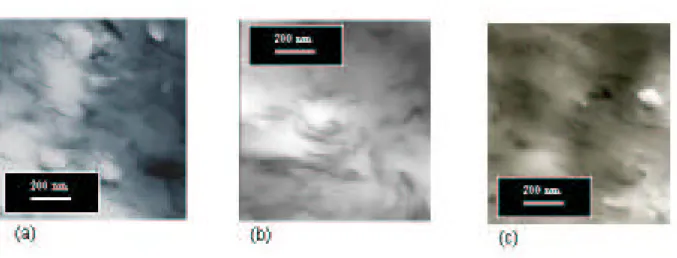
The morphology of the PCL-based composites has been observed by TEM (Fig. 1). As expected, a microcomposite morphology is reported for PCL filled with sodium montmorillonite (C1: Mont-Na) and with montmorillonite surface-modified by the protonated 12-dodecanoic acid (C2: Mont-COOH). In both cases, micron-size clay particles are randomly dispersed in the polyester matrix. Consistently with the XRD analysis, PCL loaded with montmorillonite modified by either the quaternized
octadecylamine (C3: Mont-C18) or the hydroxyl-functionalized ammonium (C5:
Mont-OH) shows the typical morphology of a nanocomposite (Fig. 1a and 1c). In addition to small stacks of intercalated montmorillonite, completely exfoliated silicate sheets are observed, with some preferential orientation perpendicular to the melt compression direction. This type of morphology may be designated as a semi-intercalated/semi-exfoliated structure (Alexandre et al. [1]). Quite a similar structure has been observed for the nanocomposites prepared with C4: Mont-2C2C18, although the orientation of
the silicate sheets appears more random (Fig. 1b). It must be noted that the
Fig. 1. TEM micrographs for nanocomposites based on poly(ε-caprolactone) filled with 3 wt.-% (precluding the organic layer) of (a) Mont-C18 (PCLC3);
exfoliation of the silicate sheets in PCL is never complete since there remain some stacks of silicate layers whatever the alkylammonium cations considered in this study.
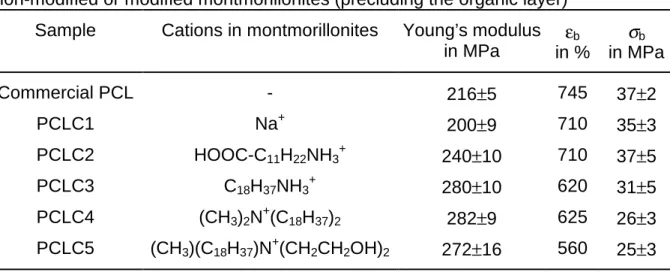
Tensile properties, i.e. Young’s modulus (E), stress at break (σb) and elongation at break (εb), have been measured and are reported in Tab. 2. These data confirm that
PCL is a ductile polymer able to sustain large deformations. Unfortunately, the elastic modulus is rather low making it useless for any application that requires higher
rigidity. Thus, the addition of fillers can contribute to improve its stiffness. The presence of rather a tiny amount of filler, i.e., 3 wt.-% of inorganics, allows for increasing the elastic modulus from 215 MPa for unfilled PCL to 280 MPa as measured for instance in the case of PCL nanocomposite (PCLC3) formed by intercalation/exfoliation by the quaternized octadecylamine-modified clay (C3: Mont-C18). Interestingly enough, the PCLC3 sample shows higher modulus and retains a
good ductility as confirmed by an elongation at break higher than 600%. Very similar observations have been previously reported for nanocomposites based on other thermoplastics, such as polyamides and polyurethanes (Alexandre et al. [1]). It is worth pointing out that increasing the clay content enhances the material stiffness. For instance, an elastic modulus as high as 399 ± 23 MPa has been measured for a PCL nanocomposite filled with 10 wt.-% of C5 (Mont-OH), attesting for an almost two-fold increase of the PCL rigidity. A more complete study about the
physico-mechanical properties will be the subject of a forthcoming paper (Pantoustier et al. [12]).
Tab. 2. Tensile properties of polycaprolactone before and after filling with 3 wt.- % of non-modified or modified montmorillonites (precluding the organic layer)
Sample Cations in montmorillonites Young’s modulus in MPa εb in % σb in MPa Commercial PCL - 216±5 745 37±2 PCLC1 Na+ 200±9 710 35±3 PCLC2 HOOC-C11H22NH3+ 240±10 710 37±5 PCLC3 C18H37NH3+ 280±10 620 31±5 PCLC4 (CH3)2N+(C18H37)2 282±9 625 26±3 PCLC5 (CH3)(C18H37)N+(CH2CH2OH)2 272±16 560 25±3
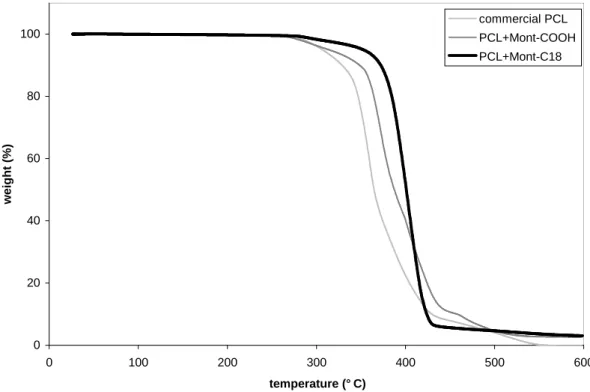
The thermal stability of the PCL-based composites has been also examined by thermogravimetric analysis (TGA) with a heating rate of 20° C/min under air flow. The weight loss due to the formation of volatile degradation products has been monitored as a function of temperature. It has been recently reported that the thermal
degradation of PCL fits a two-step mechanism (Persenaire et al. [17]). There is first a statistical rupture of the polyester chains by pyrolysis of ester groups with release of CO2, H2O and hexenoic acid. In the second step, ε-caprolactone (cyclic monomer) is
formed as a result of an unzipping depolymerization process. Fig. 2 compares the TGA traces for pure PCL, micro- and nanocomposites. The PCL filled with Mont-C18
(PCLC3) shows a substantial improvement of the thermal stability. Indeed, the temperature at which the weight loss is 50 wt.-% is shifted towards higher
temperature by ca. 50° C. In case of the microcomposite (PCL filled with Mont-COOH: PCLC2), the gain in stability is less important compared to the parent nanocomposite. Thus, the increase in thermal stability observed for the nanocomposite is to be
related to the nanodispersion of the silicate. The silicate layers are thought to oppose an effective barrier to the permeation of oxygen and combustion gas (Alexandre et al. [1]). A similar thermal stabilization has been recently reported by some of us for nanocomposites based on ethylene-co-vinyl acetate copolymers (EVA) filled with organo-modified montmorillonites (Alexandre et al. [9]). Furthermore, it has been found that PCL nanocomposites exhibit remarkable flame retardant properties. Although PCL and PCL-based microcomposites (PCL filled with Mont-Na (PCLC1) and Mont-COOH (PCLC2)) continuously release burning drops able to propagate the fire to surrounding materials when they are exposed to a flame, PCL nanocomposites (PCLC3-C5: PCL loaded with Mont-C18, Mont-2C2C18 and
Mont-OH, respectively) show a totally different behavior. No burning drop is formed anymore, rather an intensive charring of these PCL nanocomposites is observed. The fire retardant capacity of the PCL nanocomposites is under current investigation by using cone-calorimetry measurements.
0 20 40 60 80 100 0 100 200 300 400 500 600 temperature (° C) weight (%) commercial PCL PCL+Mont-COOH PCL+Mont-C18
Fig. 2. Thermogravimetric analysis of poly(ε-caprolactone) before and after filling with 3 wt.-% (precluding the organic layer) of Mont-C18 (nanocomposite PCLC3) or
Mont-COOH (microcomposite PCLC2). Conditions: 20° C/min, under air flow
Conclusions
Nanocomposites based on PCL have been directly prepared by melt intercalation using montmorillonites modified by well selected quaternary ammonium cations, in particular quaternized octadecylamine, di(hydrogenated tallow) dimethylammonium and bis(2-hydroxyethyl)methyl hydrogenated tallow ammonium ions. A
analyses. Depending on the type of modifying agent of the organophilic clays, the stiffness of the PCL nanocomposites can be significantly improved compared to pure PCL, even at a filler content as low as 3 wt.-% of inorganic layered silicate. Moreover, the PCL nanocomposites display an improved thermal stability, which is consistent with an effective barrier formed by the silicate sheets against permeation of molecular oxygen and evolved combustion gas. Flame retardancy is remarkable and related to the deposition of an insulating and incombustible char whenever the PCL
nanocomposites are exposed to the flame. In addition to the improved properties that organo-modified montmorillonites can impart to poly(ε-caprolactone), this preliminary study has highlighted the key importance played by the nature of the modifying agent together with the process involved for generating nanocomposites, i.e., melt
intercalation vs. in situ intercalative polymerization. Clearly, it comes out that the formation of a polymer layered silicate nanocomposite, as typically shown for PCL in the present study, is not straightforward and cannot readily predicted per se.
Parameters such as clay surface modifier and preparation procedure are of prime importance as will be reported in a forthcoming detailed study (Pantoustier et al. [12]).
Acknowledgement: The LPCM is much indebted to the Région Wallonne and the
Fonds Social Européen for support in the frame of Objectif 1-Hainaut: Materia Nova.
LPCM and CERM are grateful to the Région Wallonne for support in the frame of the W.D.U. program: TECMAVER, including a grant to N.P. CERM thanks the Services
Fédéraux des Affaires Scientifiques, Techniques et Culturelles for support (PAI
4/11).
[1] Alexandre, M.; Dubois, P.; Mater. Sci. Eng. 2000, R28, 1. [2] Vaia, R.A.; Giannelis, E.P.; Macromolecules. 1997, 30, 8000. [3] Vaia, R.A.; Ishii, H.; Giannelis, E.P.; Chem. Mater. 1993, 5, 1694.
[4] Vaia, R.A.; Jandt, K.D.; Kramer, E.J.; Giannelis, E. P.; Macromolecules. 1995, 28, 8080.
[5] Liu, L.M.; Qi, Z.N.; Zhu, X.G.; J. Appl. Polym. Sci. 1999, 71, 1133. [6] Kato, M.; Usuki, A.; Okada, A.; J. Appl. Polym. Sci. 1997, 66, 1781.
[7] Kawasumi, M.; Hasegawa, N.; Kato, M.; Usuki, A.; Okada, A.; Macromolecules 1997, 30, 6333.
[8] Hasegawa, N.; Kawasumi, M.; Kato, M.; Usuki, A.; Okada, A.; J. Appl. Polym. Sci. 1998, 67, 87.
[9] Alexandre, M.; Beyer, G.; Henrist, C.; Cloots, R.; Rulmont, A.; Jérôme, R.; Dubois, P. ; Macromol. Rapid Commun. 2001, 22, 643.
[10] Brode, C.L.; Koleske, J.V.; J. Macromol. Sci. - Chem. 1972, A6, 1109.
[11] Pitt, C.G.; Marks, T.A.; Schindler, A.; in : Baket, R., editor, “Controlled release of
bioactive materials”, New York, Academic Press 1980, 5, 1064.
[12] Pantoustier, N. ; Alexandre, M.; Degée, P.; Jérôme, R.; Henrist, C.; Cloots, R.; Dubois, P.; in preparation.
[13] Messersmith, P.B.; Giannelis, E.P.; J. Polym. Sci., Part A : Polym. Chem. 1995,
33, 1047.
[14] Chen, T.K.; Tien, Y.I.; Wei, K.H.; J. Polym. Sci., Part A : Polym. Chem. 1999, 37, 2225.
[15] Messersmith, P.B.; Giannelis, E.P.; Chem. Mater. 1993, 5, 1064.
[16] Usuki, A.; Kojima, Y.; Kawasumi, M.; Okada, A.; Fukushima, Y.; Kurauchi, T.; Kamigaito, O.; J. Mater. Res. 1993, 8, 1179.
[17] Persenaire, O.; Alexandre, M.; Degée, P.; Dubois, P.; Biomacromolecules 2001,