
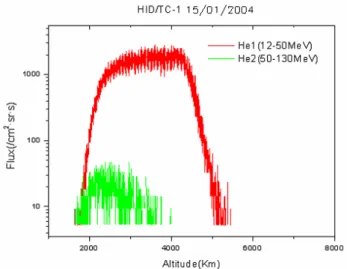
First results of Chinese particle instruments in the Double Star Program
Texte intégral
Figure



Documents relatifs
C + X where A is the incident particle (proton, neutron, Helium) with energy up to several tens of GeV, B is the target (nuclei between Helium and Copper) and C is the produced
In particular, when F ∗ is finite, the particle system converges, uniformly in time, to the conditioned process; hence, if η is distributed by the invariant distribution of the
During the particle tracking process, three situations may occur: (1) the particle leaves the domain without deposition ( Fig. 2 a); (2) the center-to-center distance between the
The SATURN experiment took place from 27 May to 14 June 2002. During this time period new-particle forma- tion events were observed on 8 days. This paper focused on
Using conjugate data from both PROMICS-3 instru- ments we have found dispersion structures above the morningside auroral oval, which occurred simultaneous- ly with isolated
At this time, both space- craft were located within the magnetosphere, TC-1 having recently traversed the low latitude magnetopause from the magnetosheath (where FTEs were
In this paper we present the Chinese ground-based instrumentations in support of the combined Cluster/Double Star satellite measurements, discuss what constraints apply to the
servations at the Melpitz site it was concluded that on 3 June 2002, new particle forma- tion was induced by the break-up of the nocturnal inversion and proceeded throughout
