HAL Id: tel-00869819
https://tel.archives-ouvertes.fr/tel-00869819
Submitted on 9 Oct 2013HAL is a multi-disciplinary open access archive for the deposit and dissemination of sci-entific research documents, whether they are pub-lished or not. The documents may come from teaching and research institutions in France or abroad, or from public or private research centers.
L’archive ouverte pluridisciplinaire HAL, est destinée au dépôt et à la diffusion de documents scientifiques de niveau recherche, publiés ou non, émanant des établissements d’enseignement et de recherche français ou étrangers, des laboratoires publics ou privés.
protocols
Nanxing Chen
To cite this version:
Nanxing Chen. Passive interoperability testing for communication protocols. Other [cs.OH]. Univer-sité Rennes 1, 2013. English. �NNT : 2013REN1S046�. �tel-00869819�
THÈSE / UNIVERSITÉ DE RENNES 1
sous le sceau de lUniversité Européenne de Bretagne
pour le grade de
DOCTEUR DE LUNIVERSITÉ DE RENNES 1
Mention : INFORMATIQUE
Ecole doctorale MATISSE
présentée par
Nanxing Chen
Préparée à lunité de recherche IRISA UMR6074
Institut de Recherche en Informatique et Système Aléatoires
Composante universitaire ISTIC
Passive
Interoperability
Testing for
Communication
Protocols
Thèse soutenue à Rennes le 24.06.2013
devant le jury composé de : Richard CASTANET
Professeur , Labri-ENSEIRB / rapporteur
Gérardo RUBINO
Directeur de recherche, INRIA / examinateur
Stephan MAAG
Maitre de conférences, Telecom Sud-Paris /
examinateur
Xiaohong HUANG
Maitre de conférences, BUPT / examinateur
César VIHO
Professeur, Universtité de Rennes 1 / directeur de
thèse
Yan MA
I would like to express my gratitude to all those who helped me during the thesis.
My deepest gratitude goes first and foremost to my beloved family and my relatives by marriage for their loving considerations and great confidence in me all through these years. Without their constant support and encouragement, this thesis could not have succeeded.
Second, I would like to express my gratitude to Professor César Viho. Due to his guidance and support all along my PhD thesis.
I am also greatly indebted to Anthony Baire, who have instructed and helped me a lot in technical aspects.
Last my thanks would go to my colleagues, who are not only my work partners, but also trustworthy friends.
1 Introduction 5
1.1 Background . . . 5
1.2 Scope, Motivations and Objectives . . . 8
1.3 Organization of the Thesis . . . 10
2 Prerequisites 13 2.1 Introduction to Protocol Testing . . . 13
2.1.1 The Needs of Interoperability Testing . . . 14
2.1.2 Different Testing Techniques . . . 16
2.1.2.1 Testing Techniques According to Accessibility . . 17
2.1.2.2 Testing Techniques According to Controllability . 17 2.2 Interoperability Testing Overview . . . 18
2.2.1 Definition of Interoperability . . . 18
2.2.2 Interoperability Testing Architectures . . . 19
2.2.3 Interoperability Criteria . . . 21
2.2.4 Interoperability Testing Process . . . 22
2.2.4.1 Preliminary: Compatibility of Specifications . . . 22
2.2.4.2 Interoperability Testing Activities . . . 23
2.3 State of the Art of Interoperability Testing . . . 25
2.3.1 Active Interoperability Testing . . . 26
2.3.1.1 Active Interoperability Testing Overview . . . 26
2.3.1.2 Advantages and Drawbacks of Active Testing . . 28
2.3.2 Passive Interoperability Testing . . . 29
2.3.2.1 Passive Testing Techniques . . . 29
2.3.2.2 Advantages and Challenges of Passive Testing . . 31
2.3.2.3 Conclusions . . . 32
2.4 Conclusions . . . 33
3 A Method for Passive Interoperability Testing 35 3.1 Introduction . . . 35
3.2 Testing Architecture . . . 36 i
3.3 Formal Model . . . 37
3.4 Passive Interoperability Testing Method . . . 39
3.4.1 Passive Interoperability Testing Method Overview . . . 39
3.4.1.1 Formalizing Interoperability Test Purpose . . . . 41
3.4.1.2 Interoperability Test Case Generation . . . 42
3.4.1.3 Passive Interoperability Test Case Derivation . . 46
3.4.2 Trace Verification . . . 47
3.4.3 Verdict Assignment . . . 49
3.5 Application on SIP Protocol . . . 52
3.5.1 SIP Protocol Overview . . . 52
3.5.2 Test Execution . . . 55
3.6 Conclusions . . . 56
4 A Passive Interoperability Testing Method for Request-Response Protocols 59 4.1 Introduction . . . 59
4.2 Background and Motivation . . . 60
4.3 Passive Interoperability Testing Method for Request-response Pro-tocols . . . 61
4.3.1 Testing Method Overview . . . 61
4.3.2 Trace Verification . . . 64
4.4 A Passive Interoperability Testing Tool . . . 67
4.4.1 Motivation . . . 67
4.4.1.1 TTCN-3 Overview . . . 68
4.4.1.2 Main Issues . . . 71
4.4.2 Ttproto: A Testing Tool for Passive Interoperability Testing 71 4.4.2.1 Ttproto Overview . . . 71
4.4.2.2 Description . . . 75
4.5 Application to the CoAP Protocol . . . 76
4.5.1 CoAP Interoperability Testing Event . . . 76
4.5.2 CoAP Protocol . . . 78
4.5.2.1 CoAP Protocol Overview . . . 78
4.5.2.2 Test Purposes Selection and Test Cases Generation 79 4.5.3 Application in Industrial Context . . . 85
4.5.3.1 CoAP Plugtest Overview and Testing Architec-ture . . . 85
4.5.3.2 Test Execution with Ttproto . . . 87
4.5.3.3 Results of the CoAP Plugtest . . . 88
5 Conclusions 93
5.1 Summary of Contributions . . . 93
5.2 Future Work . . . 95
5.2.1 Improve Trace Verification by Test Case Grouping . . . 95
5.2.1.1 Motivation . . . 95
5.2.1.2 State of the Art . . . 96
5.2.1.3 Grouping Passive Interoperability Test Cases . . 97
5.2.1.4 Trace Verification . . . 101
5.2.1.5 Results . . . 104
Dans le domaine des réseaux, le test de protocoles de communication est une activité importante afin de valider les protocoles applications avant de les mettre en service. Généralement, les services qu’un protocole doit fournir sont décrits dans sa spécification. Cette spécification est une norme ou un standard défini par des organismes de normalisation tels que l’ISO (International Standards Organi-sation), l’IETF (Internet Engineering Task Force), l’ITU (International Telecom-munication Union), etc. Le but du test est de vérifier que les implémentations du protocole fonctionnent correctement et rendent bien les services prévus.
Pour atteindre cet objectif, différentes méthodes de tests peuvent être util-isées. Parmi eux, le test de conformité vérifie qu’un produit est conforme à sa spécification. Le test de robustesse vérifie les comportements de l’implémentation de protocole face à des événements imprévus. Dans cette thèse, nous nous in-téressons plus particulièrement au test d’interopérabilité, qui vise à vérifier que plusieurs composants réseaux interagissent correctement et fournissent les services prévus.
L’architecture générale de test d’interopérabilité fait intervenir un système sous test (SUT) composé de plusieurs implémentations sous test (IUT). Les ob-jectifs du test d’interopérabilité sont à la fois de vérifier que plusieurs implémenta-tions (basées sur des protocoles conçus pour fonctionner ensemble) sont capables d’interagir et que, lors de leur interaction, elles rendent les services prévus dans leurs spécifications respectives.
En général, les méthodes de test d’interopérabilité peuvent être classées en deux grandes approches: le test actif et le test passif. Le test actif est une technique de validation très populaire, dont l’objectif est essentiellement de tester les implémentations (IUT), en pratiquant une suite de contrôles et d’observations sur celles-ci. Cependant, une caractéristique fondamentale du test actif est que le testeur possède la capacité de contrôler les IUTs. Cela implique que le testeur perturbe le fonctionnement normal du système testé. De ce fait, le test actif n’est pas une technique appropriée pour le test d’interopérabilité, qui est souvent effectué dans les réseaux opérationnels, où il est difficile d’insérer des entrées
arbitraires sans affecter les services ou les fonctionnements normaux des réseaux. A l’inverse, le test passif est une technique se basant uniquement sur les obser-vations. Le testeur n’a pas besoin d’agir sur le SUT notamment en lui envoyant des stimuli. Cela permet au test d’être effectué sans perturber l’environnement normal du système sous test. Le test passif possède également d’autres avantages comme par exemple, pour les systèmes embarqués où le testeur n’a pas d’accès direct, de pourvoir effectuer le test en collectant des traces d’exécution du sys-tème, puis de détecter les éventuelles erreurs ou déviations de ces traces vis-à-vis du comportement du système décrit dans sa spécification. En outre, les tests peu-vent être mises en place sur une longue période, et ainsi à tout moment traiter les anomalies contrairement au test actif qui est généralement limité dans le temps par une campagne de test. De ce fait, cette thèse vise à proposer les méthodes de test basées sur la technique de test passif pour effectuer le test d’interopérabilité.
L’organisation de thèse est suivante:
Le chapitre 1 est l’introduction. Le contexte, les problématiques, les motiva-tions ainsi que le plan de thèse y sont présentés.
Le chapitre 2 présente l’état de l’art du domaine. Les notions générales, les architectures et les critères du test d’interopérabilité y sont décrits. Dans cette thèse, on considère la configuration le plus souvent utilisée: L’architecture dite "one-to-one" où le SUT contient deux IUTs. Chacune de ces IUTs est une boîte noire, dont le comportement n’est connu que par les interactions à travers leurs interfaces. Les différentes méthodes (actives et passives) pour effectuer le test d’interopérabilité sont présentées et comparées. Les motivations pour le choix de la méthode passive sont expliquées.
Les problématiques du test passif sont aussi exposées dans ce chapitre. En effet, malgré le fait que le test passif s’avère être une technique prometteuse, peu de travaux l’ont appliqué dans le domaine d’interopérabilité. Pourtant, il y a un certain nombre de problèmes à résoudre à cause de la non-contrôlabilité du test passif. Par exemple, la vérification de comportement des IUTs (trace), l’émission des verdicts, etc. Pour faire face à ces problématiques, dans les chapitres suivants, plusieurs contributions sont proposées.
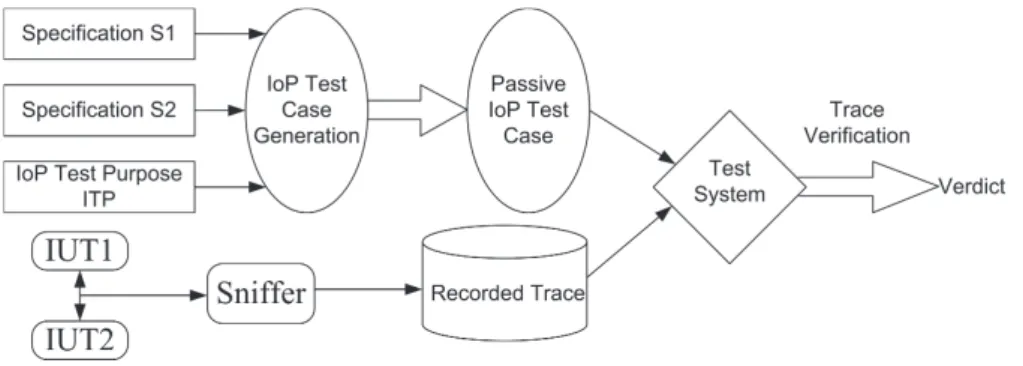
Dans le chapitre 3, une approche pour effectuer le test d’interopérabilité en utilisant la technique du test passif est proposée. Cette méthode est basée sur les modèles formels. Elle commence par le choix d’un ensemble d’objectives de test, qui décrit les propriétés à vérifier lors du test. Puis, pour chaque objectif de test, un cas de test correspondant est généré, décrivant en détail le comportement des IUTs à observer. Le cas de test est généré de la manière automatique avec
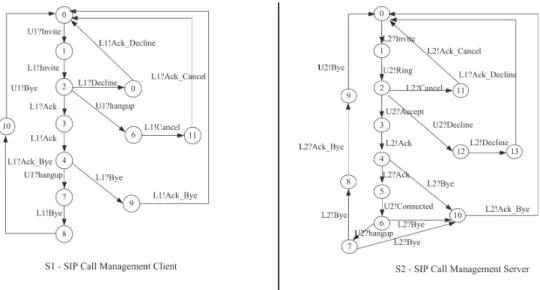
un algorithme de recherche en profondeur, considérant l’interaction asynchrone partielle entre les spécifications par rapport à l’objectif de test. La manipulation des entités considérées lors de la génération de test peut conduire à stocker un nombre d’états trop important par rapport à la capacité des systèmes sur lesquels sont exécutés les algorithmes de génération. Pour éviter le problème classique d’explosion combinatoire des états lors du calcul, chaque objectif de test a des attributs spécifiques pour limiter le calcul de l’interaction asynchrone. Le modèle formel utilisé, les règles de calcul partiel, la dérivation de cas de test passifs sont décrits dans ce chapitre.
Par ailleurs, en test passif, une difficulté est la vérification de trace. Le testeur observe et collecte les messages échangés entre les entités protocolaires. Puis il analyse les informations collectées (traces d’exécution) pour vérifier que les traces sont conformes aux propriétés que l’on souhaite tester. Une problématique est que le système de test n’a pas de connaissance de l’état où le système sous test peut être par rapport au début de la trace. Pour surmonter le problème ci-dessus, un algorithme de vérification a été proposé pour analyser le comportement des IUTs ainsi qu’émettre les verdicts appropriés. L’algorithme vise à rechercher dans la trace les cas de test qui correspondent aux observations contenues dans la trace. Une autre contribution dans ce chapitre est l’émission de verdicts. Respec-tivement, le verdict est Pass si l’objectif de test a été atteint et aucun erreur n’a été observée, Fail si au moins une erreur a été observée, ou Inconclusive si le comportement observé est correct par rapport à la spécification mais ne cor-respond pas à l’objectif visé par le test. A cause de la non-contrôlabilité du test passif, les règles d’attribution de verdicts sont différentes de ceux utilisés pour la méthode active et doivent être assouplis. Dans ce chapitre, les règles d’attribuer des verdicts Pass, Fail ou Inconclusive sont expliqués en détail.
Dans le chapitre 4, une autre approche du test d’interopérabilité passif a été proposée. Ce chapitre se focalise sur les protocoles largement utilisé de type requête/réponse, qui reste incontournable pour réaliser les services Web. Cette approche commence aussi par le choix des objectifs de test. Pour chacun des objectifs de test, un cas de test est généré (manuellement). Pour la vérification de trace, l’idée est d’utiliser le modèle de transactions client-serveur requête/réponse de ce type de protocoles. La stratégie consiste à décomposer la trace en un ensemble de conversations entre le client et le serveur. Une fois que la trace est découpée en une série de conversations, la prochaine étape est d’établir la correspondance entre chaque cas de test et ces conversations. Pour chaque cas de test présent dans la trace, l’algorithme proposé vérifie automatiquement si celui-ci est satisfait et émet un verdict.
été proposé pour automatiser le test pour les protocoles de type requête/réponse. Plus précisément, après qu’une trace est découpée en conversations, l’outil de test commence à exécuter la procédure de vérification. Pour ce faire, l’outil prend en entrée deux fichiers: les cas de test et les conversations. L’étape suivante consiste à analyser la trace capturée à l’aide d’un algorithme de vérification de trace. Cet outil est inspiré de TTCN-3 (Testing and Test Control Notation Version 3), un outil très utilisé dans le domaine de test, initialement conçu pour la méthode active. Ttproto conserve certaines notions utiles de TTCN-3, mais intègre de nouvelles fonctionnalités pour s’adapter au contexte de test passif.
La méthode et l’outil ont étés appliqués sur un protocole réel CoAP (Con-strained Application Protocol) dans les évènements CoAP Plugtest organisés par l’ETSI (European Telecommunications Standards Institute) dans le contexte d’Internet des objets. Ces évènements ont eu lieu à Paris et Sophia Antipolis en 2012. Les résultats lors de leurs applications sont présentés et montrent la validité, la pertience et l’efficacité de cette approche.
Le chapitre 5 propose une synthèse des travaux réalisés, ainsi que des perspec-tives pour des travaux futurs. Particulièrement, on s’intéresse à l’amélioration de la vérification de traces. En effet, les algorithmes de vérifications présentés auparavant fonctionnent de manière séquentielle. Cela implique une durée de vérification potentiellement longue s’il y a beaucoup de cas de test à vérifier, ou si la trace est très longue. Pour y faire face, dans ce chapitre, nous présentons les premiers résultats de travaux visant à regrouper les cas de test. L’objectif du groupement de cas de test est de permet qu’ils puissent être vérifiés en parallèle sur la trace. Nous montrons qu’un cas de test obtenu en utilisant cette approche rend la vérification plus efficace.
Dans ce chapitre, quelques pistes sont données concernant les autres travaux long termes. Les méthodes proposées devront être étendues dans le contexte plus général de l’interaction de plus de deux implémentations. A cause de la non-contrôlabilité du test passif, les verdicts sont souvent Inconclusive. Une solution doit être trouvée pour raffiner les verdicts. Dans le Chapitre 4, on s’intéresse uniquement aux protocoles de type requête/réponse. La méthode et l’outil pro-posés pour ce type de protocole devront être étendus aux autres types de proto-coles plus complexes.
Introduction
1.1
Background
The deregulation of the telecommunication industry has led to the rapid evolu-tion of technologies and know-how in the field of communicaevolu-tion systems. The computer systems attached to a network communicate with each other using a common set of conventions called protocols. In other words, protocols are the rules that govern the communication between the different components within a distributed computer system. In order to organize the complexity of these rules, they are usually partitioned into a hierarchical structure of protocol layers, as ex-emplified by the seven layers of the standardized Open Systems Interconnection (OSI) model [54]. The layering concept was used to divide the communication functions into sets which can be specified separately. This allows independent development and implementation of standards at each layer.
A protocol, in general, is quite complex and takes a considerable effort to implement on a system. The implementation of a protocol is usually derived from a specification standard, which defines the required behavior for a protocol entity, and can lead to several different applications. On one hand, the complex-ity of protocols necessitates the thorough study of the specification, as well as verification, development and testing. On the other hand, with the never-ending changes and improvement of computer technologies, today’s network services and applications are required to be rich, on-time, with high quality. These aspects, consequently, call the needs of ensuring proper functionality of network-enabled products in order to satisfy customer expectations. In this context, testing has steadily become more and more important within the development of software and systems, aiming at solving both new challenges imposed by the advancement in various areas of computer science and long-standing problems.
To increase confidence in protocol products implemented according to inter-5
national standards, various protocol testing methodologies have been developed and applied for different purposes. They can be generally classified into two categories, Stress and Reliability Tests and Functional Tests (c.f. Fig.1.1).
Stress and reliability tests addresse the ability of a system or component to perform its required functions under stated conditions for a specified period of time. Typical stress and reliability tests are for example:
• Performance testing, which is conducted to evaluate the compliance of a system or component with specified performance requirements.
• Stress testing, which is conducted to evaluate a system or component at or beyond the limits of its specified requirements.
• Robustness testing determines the degree to which a system operates cor-rectly in the presence of exceptional inputs or stressful environmental con-ditions. etc.
Different from stress and reliability tests, functional tests focus on verifying whether a system meets external requirements and achieve goals. Typical func-tional tests include conformance testing and interoperability testing, etc., among which interoperability testing is the topic of this thesis.
Figure 1.1: Protocol Testing
There is a close relationship between conformance testing and interoperabil-ity testing. Conformance testing, as one of the most fundamental one, checks whether an implementation is correct with respect to its relevant specifications. The importance of conformance testing lies in: equipments from different vendors conforming to the same standards have a higher likelihood of interoperability. In
other words, protocol implementations are tested against the protocol specifica-tion in order to assure compatibility with other implementaspecifica-tions based on the same protocol. It is important for both equipment suppliers and buyers that, different vendors can independently implement standards with higher assurance of product interoperability. Also, equipment buyers can have confidence that the purchased equipments from different suppliers interoperate.
However, although the ISO 9646 standard [1] mentions that conformance test-ing can increase the probability of interoperability, it cannot guarantee the suc-cessful interaction between different implementations. It must be noted that conformance testing is a necessary step to insure interoperability but it is not enough. It is a known fact that, even following the same standards, two proto-col implementations from different suppliers may still fail to interoperate due to various reasons: lack of clarity of standards, poorly specified protocol options, incompleteness of specifications, incoherence of protocol implementations, etc. Nevertheless, on one hand, customer needs are growing and manufacturers per-manently develop new equipments with improved quality of service. On the other hand, these services must be very quickly validated so that the proposed solu-tions are reliable and ready to work. Therefore, in parallel, efficient techniques in communication systems engineering must be developed in order to reduce the time-to-market. In this context, interoperability testing is holding a strategic po-sition in the design of new technologies. Its role is to determine whether several interconnected products from different product lines interoperate correctly and provide the expected services. Indeed, conformance testing improves the chances of interoperability while interoperability testing checks at a user level if interop-erability has been achieved.
Despite its importance, contrary to conformance testing, much less atten-tion has been paid to interoperability testing. Currently, interoperability testing has not yet standardized. Moreover, test automation and reusability is difficult. Therefore, this thesis focuses on interoperability testing, aiming at researching methods and solutions to improve interoperability testing.
Looking into the literature, throughout the past twenty years or so, vari-ous research works have been proposed to carry out interoperability testing ( [19, 36, 6, 18], etc. ) So far, the conventional method is to generate a sequence of tests from the specifications of the interconnected network equipments under test. Then these tests will be run against the network equipments to check if they work together properly. Generally, the tester has the ability to stimulate the equipments and verify whether the outputs obtained for each test message are as expected according to the specifications. This method is usually called
we mean injecting test messages into the network. Although widely used, ac-tive testing has some drawbacks. Its biggest drawback is that the tester has to interact directly with the network components, which disturbs inevitably their normal operations. Therefore, active testing does not fit certain situations such as operational networks, where inserting arbitrary inputs disturbs the environment and could in the worst case even provoke the crash of the services. Also, this approach requires to deploy a specific testing environment to execute test cases and to observe implementations reactions. Moreover, active testing may not be always be applied due to the complexity of systems, for example, when the tester is not provided with a direct interface to interact with the equipments.
Different from active testing, passive testing ([2], [3], [4], etc.) represents another interesting alternative. It is a technique based only on observing the behaviors of the system to be tested. The tester collects the interactive messages of network equipments and analyzes them to draw a conclusion of interoperabil-ity. Compared with active testing, the main advantage of passive testing is its non-intrusive nature. It does not disturb the normal operation of the protocol implementations, thus is suitable for interoperability testing in operational envi-ronment. Also, passive testing has other advantages: by using passive testing, no extra testing traffic overhead is introduced into the networks; no direct access interface to control the system is required, etc. For these reasons, we feel that passive testing is worth investigating, and consider in this thesis to use it for interoperability testing.
1.2
Scope, Motivations and Objectives
The work described in this thesis pertains to the interoperability testing of com-munication protocols, and by using passive testing technique in particular. Two main reasons account for the scope of the thesis: First, contrary to conformance testing which has been formalized in [1], interoperability testing, despite its im-portance, remains informal and has many open issues to be solved. Second, we find that the non-intrusive nature of passive testing makes it a suitable technique to perform interoperability testing (as stated in Section1.1). As interoperability focuses on the interworking of several protocol entities, verifying their behavior without disturbing their interaction is necessary.
The notion of passive testing can trace its history to several decades. For example it can be found in the early 70’s to test integrated circuit. But not until the recent decade, the needs of network management [2] changes its research into a hot topic. The authors of [38] proposed some basic principles and methods of testing finite state machines using passive testing and presented a fault detection
algorithm in [3]. [40] adopted the model of communication finite state machine (CFSM) for passive testing and did some research on the problem of fault location. Later, passive testing is further applied in other areas such as network security [39], communication protocol testing [4, 5], etc.
Though passive testing is sometimes mentioned as an alternative to active testing, looking into the literature of interoperability testing, only few works [6] consider using passive testing techniques. Currently, the field of interoperability testing is dominated by active testing ([18, 19, 36], etc.). However, with the rapid advancement of computer science and technology, there are needs of more effi-cient and accurate testing procedure to help telecommunications suppliers achieve faster time-to-market. This, consequently, requires that the interoperability of protocol implementations be tested in operational environment. Different from in isolated environment, equipments that are running in operational networks cannot be shutdown or interrupted for a long period of time, and therefore call for the needs of passive testing.
Moreover, most existing research works are not based on a rigorous defini-tion of interoperability and leave many unsolved issues and challenges: First of all, as interoperability testing involves at least two protocol implementations, therefore the joint behavior of implementations under test should be taken into account. But the calculation of the joint behavior often encounters the state
explosion[55], amounts to exploring in a systematic manner the complete state
space of a system. As a result, the number of generated global states is usually “large”, making it difficult for practical use. Also, the non-controllable nature of passive testing makes the verification of observed behavior complex. Indeed, the tester has no idea about the state at which the implementations are when a trace is produced. This factor may cause interoperability verdicts error-prone. More-over, as passive testing is often carried out in operational networks, therefore the conventional testing assumption of reliable testing environment (where there is no packet loss), is more or less no longer suitable. Last but not least, currently most interoperability testing is still carried out manually (test case generation and verification), which is time consuming and error prone. Due to this reason, interoperability testing is known to be costly, which calls a strong requirement for test automation.
Our contributions, in response to the above issues, intend to give improve-ments for more rigorous and better passive interoperability testing methods.
1.3
Organization of the Thesis
The thesis is organized in five chapters. The remainder of this thesis is as follows: Chapter 2 presents the necessary prerequisites. It begins with the introduction of the basic concepts of protocol testing activities, and in particular interoperability testing. Then the state of the art of interoperability testing, including different testing methods, i.e., active and passive testing, as well as their advantages and drawbacks are elaborated. In this chapter, we draw a conclusion on the needs of using passive technique to test interoperability. Also, the issues and challenges of passive interoperability testing are stated.
Chapter 3 proposes a formal specification-based approach for passive inter-operability testing. Given the formal specifications of network equipments to be tested and a test purpose, a passive test case is derived by partial asynchronous interaction calculation to avoid unnecessary reachability analysis. In addition, a trace analysis algorithm is proposed to check a recorded execution trace against the passive test case in order to determine their interoperability relationship. Moreover in this chapter, the verdict assignment issue is discussed. Different from active testing, due to the uncontrollable nature of passive testing, verdict attributed to each test case must be prudent.
In Chapter 4, a passive testing approach is proposed for request-response protocols, which are widely used in the context of transactional communications. According to the interaction pattern of request-response protocols, the observed interaction between network components (trace) can be considered as a set of conversations made between network components. Then, a procedure to map each test case into the conversations is carried out in order to verify its occurrence, as well as whether it is respected. This approach was successfully put into operation during two CoAP Plugtest events in the context of the Internet of Things [22]. The results of case studies are also presented.
Moreover, Chapter 4 also presents the automation of passive interoperability by using a new testing tool called ttproto. It is inspired from the widely used tool Testing and Test Control Notation Version 3 (TTCN-3) [56] in the field of testing. However, TTCN-3 is not adapted for passive testing for several reasons: strong controllability, tedious templates, etc. To solve these problems, in ttproto, we have developed new features that do not exist in TTCN-3 and make the automation of passive interoperability testing feasible.
In the last chapter we draw a conclusion of the whole thesis and give perspec-tives for future works. We classify the future work into short term and long term work. Short term future work concerns mainly improving passive verification. We will give the first results of improving trace verification by grouping test cases
that share some common prefix. In this way, passive verification ( which often involves a large number of traces to verify ) can become more efficient. At the end, long term future work will also be presented.
Prerequisites
This chapter aims at presenting the necessary prerequisites concerning the work presented in this thesis.
The organization of the chapter is as follows: Section 2.1 presents the general concept of protocol testing, including different testing methodologies and testing techniques. The importance of interoperability is also underlined in this section. Section 2.2 introduces the overview of interoperability testing, including the im-portant elements, different testing architectures and testing process. In section 2.3, the state of the art of interoperability testing is described. As interoperabil-ity testing can be performed in both active and passive way, in this section we compare these two testing methods and develop in detail their advantages and drawbacks. Finally, we draw the conclusion of the needs of passive testing, as well as the various challenges and issues that might be encountered and to be solved.
2.1
Introduction to Protocol Testing
Communication protocols are the rules that govern the communication between the different components within a distributed computer system. Generally, a protocol defines the syntax, semantics, synchronization of communication, as well as specified behavior, which is independent of how it is to be implemented. Based on protocols, network equipments exchange messages within a communication system. In other words, protocols provide a reference for cooperation among network components of a system.
In order to guarantee successful communication, first of all the design of pro-tocols must be checked for logical correctness. Then, as a protocol can lead to a variety of equipments, these implementations must be checked for
ance with the protocol standard. Moreover, the last decade in the history of networking witnesses increasing heterogeneity, as existing networks evolved from analog voice networks to digital voice networks, from circuit-switched to packed-switched networks, from wire-line to wireless networks, from electronic to optical networks. New technologies introduce heterogeneity and complexity. In conse-quence, modern networks contain both legacy equipments and equipments based on state-of-art technology. They typically come from dozens of vendors. In this context, correct coordination and communication between different devices us-ing a multitude of protocols are often problematic. As a result, implementations are usually also tested for other properties such as interoperability, robustness, performance, etc.
2.1.1
The Needs of Interoperability Testing
As introduced in Chapter 1, protocol testing can be classified into functional tests and stress and reliability tests. In this thesis, we focus on functional tests, more specifically interoperability testing.
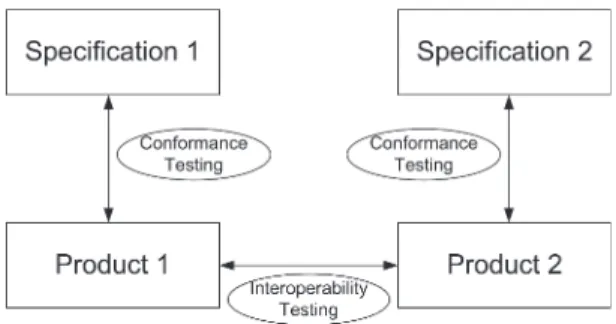
Functional tests include typically conformance testing and interoperability testing. The relation between conformance testing and interoperability testing is illustrated in Fig.2.1. Compared to conformance testing that checks whether an implementation conforms to its specification, interoperability testing is in check-ing correct operation of multiple interconnected equipments.
Figure 2.1: Conformance testing and interoperability testing
Conformance testing [1] for computer networking protocols is defined in ISO / IEC 9646-1:1994(E) as "testing both the capabilities and behavior of an
imple-mentation, and checking what is observed against the conformance requirements in the relevant International standards." Its main objective is to verify whether
a network component conforms to its specification. A specification is a detailed document describing the required behavior, as well as interfaces and mechanism of protocol entities. It is often defined by standards organizations such as ISO
(In-ternational Standards Organization)1
, IETF (Internet Engineering Task Force)2 , ITU (International Telecommunication Union)3
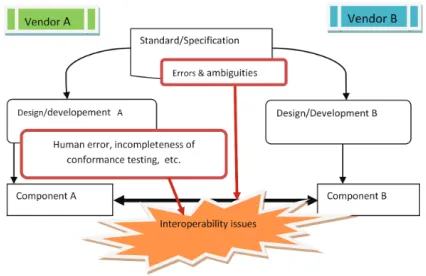
, etc. It is an important step to ensure compatibility of implementations. Nevertheless, it is widely agreed that conformance testing has limitation in ensuring interoperability [35, 36]. Even following the same standard, two different implementations might not be inter-operable. In fact, since service provider networks may contain elements from different vendors, it is possible that errors are introduced by differences in im-plementations. Therefore, although much work in the standards arena has been done to ensure interoperability, non-interoperation can still be caused by a variety of reasons. For example, they may come from the following aspects (cf.Fig.2.2):
• Specifications. The specification of a protocol standard is in general, a detailed document describing the expected behavior of the protocol enti-ties. If the description technique used is not formal, it is possible that the specification is ambiguous itself in some sense. The presence of ambiguities can lead to different interpretations and consequently different implemen-tations. Such implementations may fail to interoperate. Also, the different options provided in a specification can be incompatible so that they defeat interoperation.
• Implementations. It involves for example human errors, e.g. programmer errors, different interpretations of the standard or different choice of options allowed by the standard. Also, sometimes a new service will enter the market before any standard exists for it, and the protocols involved may not necessarily be formally specified.
• Incompleteness of conformance testing. Conformance test suites are not complete so that they do not guarantee conformance to protocol standards. In fact, they just detect non-conformance that may appear during the test execution.
• Besides technical reasons, there are also business reasons that can account for non-interoperability. For instance, businesses sometimes view features that defeat interoperation as a competitive advantage, as it can lead to monopoly in the market.
1 http://www.iso.org/iso 2 http://www.ietf.org/ 3 http://www.itu.int/en/pages/default.aspx
To conclude, due to a variety of reasons, independently developed network protocol entities may be different enough to communicate with each other. Or sometimes they can communicate, but may not collaborate to provide the desired services.
Figure 2.2: Needs of interoperability testing
However, poor interoperability can be expensive. Non-interoperability does not only affect the reputation of vendors, but also bring annoyance to the end cus-tomer, even cause the loss of investor confidence. Indeed, in a world of converging diverse technologies, complex network systems must communicate and inter-work on all levels in a multi-vendor, multi-network and multi-service environment. In-teroperability ensures that users have a much greater choice of products and that manufacturers benefit from the economies of scale that a wider market brings. Interoperability testing is therefore a crucial factor in the success of modern tech-nologies. This is one of our motivation in this thesis to suggest solutions that can improve interoperability testing.
A detailed description of interoperability testing can be found in Section 2.2.
2.1.2
Different Testing Techniques
In order to perform protocol testing, overtime the IT industry and the testing discipline have developed several techniques for analyzing and testing protocol applications. In this thesis, these techniques are classified according to the acces-sibility and controllability. Respectively, accesacces-sibility refers to whether the tester has access to the internal structure of the protocol applications, while control-lability means whether the tester can stimulate the components to be tested or
not.
2.1.2.1 Testing Techniques According to Accessibility
Black-box Testing also known as input/output driven it is an important test-ing strategy. Black-box testtest-ing technique treats the system as a "black-box", i.e., in stead of explicitly using knowledge of the internal structure, it focuses on test-ing functional requirements by only accesstest-ing to the interfaces of the system. Applying this approach, test data are derived only from the specifications.
White-box Testing allows the tester to access the internal code of a system, and focuses specifically on using internal knowledge of the software to guide the selection of test data. It is a method that tests internal structures or workings of an application, as opposed to its functionality (i.e. black-box testing). In white-box testing an internal perspective of the system, as well as programming skills, are used to design test cases. The tester chooses inputs to exercise paths through the code and determine the appropriate outputs.
Gray-box Testing is a combination of white-box testing and black-box test-ing. It involves having knowledge of internal data structures and algorithms for purposes of designing tests, while executing those tests at the user, or black-box level. The tester is not required to have full access to the software’s source code.
2.1.2.2 Testing Techniques According to Controllability
Active Testing is often done by applying a series of control and observation on the applications under test. Usually, the tester carries out the test in specific test environment, sends carefully designed inputs to the applications, receives what it responds and makes a conclusion.
Passive Testing consists in observing the input and output events of an implementation in run-time. It should not disturb the natural run-time of a protocol or service, that is why it is called passive testing. It is sometimes also referred to as monitoring. The record of the event observation is called an event trace. This event trace will be analyzed in order to determine the properties to be verified.
In this thesis, we consider the black-box testing context, which is generally used to perform functional tests. Moreover, we argue for the use of passive testing technique. The reasons about this choice are explained in Section 2.3.
2.2
Interoperability Testing Overview
2.2.1
Definition of Interoperability
Generally speaking, interoperability testing (iop for short in the sequel), assesses the end-to-end service provision across two or more products from different ven-dors. But when taking a closer look, interoperability testing can mean different things to different people. A number of statements can be found:
the IEEE Glossary defines interoperability as the ability of two or more
sys-tems or components to exchange information and to use the information that has been exchanged [47].
At ETSI, interoperability is defined as the ability of two systems to interoperate
using the same communication protocol, the ability of equipment from different manufacturers (or different systems) to communicate together [48].
The definition of interoperability provided by Wikipedia is a property of a
product or system, whose interfaces are completely understood, to work with other products or systems, present or future, without any restricted access or implemen-tation.4
In [42], interoperability involves testing both, the capabilities and the behavior of an implementation in an interconnected environment and checking whether an implementation can communicate with another implementation of the same or of a different type.
In [41], different definitions of interoperability are also provided from differ-ent views of the product and the supplier network, and that of the user. The general definition of interoperability is “the ability of two or more applications
to communicate using a specific mechanism in a known environment, in order to achieve the objectives of the user.”
Many other different definitions of interoperability may still be found in a number of research works. However, no matter what the definition is, the common points between them have given several objectives, which are:
1. The ability of systems to communicate with each other. 2. The ability to render the services requested by users.
To sum up, interoperability testing aims at ensuring that two or more network products communicate correctly while providing the required services.
4
2.2.2
Interoperability Testing Architectures
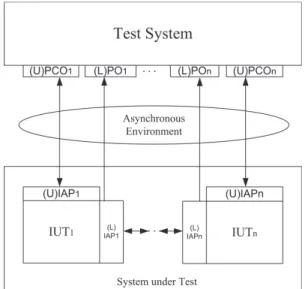
Fig.2.3 illustrates the elements that compose the general architecture of interop-erability testing. They are:
1. A Test System (TS) contains one or more test components that control or observe the behavior of the implementations under test.
2. A System Under Test (SUT) composed of at least two interconnected Pro-tocol Implementations Under Test (IUT) from different manufacturers or product lines. Each IUT has interfaces name as Implementation Access Points (IAP) to communicate with the environment or with other IUTs. 3. The interfaces between an IUT and its adjacent layers within the SUT are
referred to as points of control and observation (PCO). As the name sug-gests, at these points the behavior of the IUT in performing communication tasks can be controlled and observed. If an interface is only observable, it is then called Points of Observation (PO). Information gathered from these interfaces will be analyzed for verdict emission, which reveal the degree of interoperability of the IUTs.
Figure 2.3: General interoperability testing architecture
According to the number of IUTs, interoperability testing can be done in either of the following context [19]:
• Multi-Component context where SUT has n (n > 2) IUTs. In this setting, an IUT is supposed to communicate simultaneously with several real open systems. A network of application relays, for instance, maintains commu-nication links with several peers at the same time.
• One-to-One context where the test focuses particularly on the interoperabil-ity between exactly two IUTs. It is the most common context in practice, ei-ther by testing the interoperability of exactly two protocol implementations, or by testing the interoperability between one protocol implementation and a system already in proper operation composed of n implementations. For this reason, in this thesis we focus mainly on this context. In the sequel, the interoperability is by default one-to-one.
As IUTs communicate with other testing entities through interfaces, two kinds of interfaces can be further classified as follows. In Fig.2.3, the direction of an arrow represents the direction of messages transmission.
1. The lower interface LIAPi (i = 1, ...n, LIi for short in the sequel) is only
used for the interaction between two IUT. It is only observable but not controllable. A tester connected to such interface through interface LP Oi
(LPi for short in the sequel) can only observe the input/output events on
that interface but not send any message to it. Indeed, any message sent to lower interfaces will disturb the normal operation of the IUTs.
2. The upper interface U IAPi (U Ii for short in the sequel) are the interfaces
through which IUT communicates with its upper layer to provide the re-quired services. In some testing architecture where upper interfaces are accessible, they can be used to both observe and control the corresponding IUT through interface U P COi (U Pi for short in the sequel).
According to different situations, it is possible that the test system does not have the access to all interfaces of IUTs. In [19], different interoperability testing architectures with respect to the accessibility to different interfaces are classified. Respectively, an interoperability testing architecture is called:
• Lower architecture if TS has only access to the lower interfaces of the IUT(s). This architecture is possible in case where the upper interfaces of IUT(s) are embedded in its upper layer protocol. For example, in the test of IP protocol in operational TCP/IP protocol stack, the test system does
not have access to the upper interfaces of IP, which are indeed encapsu-lated in TCP. However, the lower IP interfaces can be observed by using some network analysis tools, for instance, one of the most common tools Wireshark5
.
• Upper architecture if TS has only access to the upper interfaces of the IUT(s). This situation is often encountered when the lower layer protocol prevents the display of messages transmitted to it.
• Total architecture if TS can access to both lower and upper interfaces. It is the most commonly used configuration in practice.
• Unilateral architecture if TS has only access to one of the IUTs. This situation is possible for example one of the IUTs is embedded in a system to which the tester does not have access. It can also be encountered for reasons of confidentiality: sometimes a manufacturer does not allow access to the interfaces of its implementation.
• Global architecture if TS has access to all the IUTs in a synchronous way.
• Bilateral architecture if TS has access to the IUTs but not in a syn-chronous way.
2.2.3
Interoperability Criteria
Before giving the definition of interoperability criteria we first underline the ob-jectives of interoperability testing, which state that: n (n ≥ 2) protocol imple-mentations must communicate properly while rendering services specified in the corresponding specifications. Therefore, interoperability testing involves the fol-lowing two aspects:
1. Verification of interaction: n implementations must communicate properly. i.e., the outputs sent by all the network components must be correct w.r.t the their specifications, and the messages sent by one network component to the corresponding receivers must be correctly received by the latter.
5
2. Verification of service: the messages sent by the network components to their upper layer must match the services described in the corresponding specifications.
Based on the objectives, depending on different testing architectures, different
interoperability criteria are used to give formal definitions of the interoperability.
As we assume that interoperability testing is done in the context of black-box, the tester has no knowledge of the inner structure of the SUT. Therefore, interoper-ability can be only verified regarding the events produced by the IUT(s) from the interfaces. According to different architectures, different iop criteria can be de-fined [19]. Here we list the criteria of the most widely used testing architectures, lower iop criterion and global iop criterion. Respectively:
• The lower iop criterion consider the events produced from the lower inter-face(s) of the IUT(s) (according to the accessibility of the number of the IUTs). It says that: at any moment, the observed outputs produced from the lower interface(s) of the IUT(s) must be foreseen in the specification(s). Also, the IUT(s) must correctly receive the packets sent to it via the lower interface(s).
• The global iop criterion compares events executed by the IUTs during their interaction with the events described in the interaction of their specifica-tions. It says that: two IUTs are considered interoperable iff, at any mo-ment, all outputs observed during the interaction of the implementations are foreseen in the interaction of their specifications. Also, both IUTs must correctly receive the packets sent to them.
2.2.4
Interoperability Testing Process
2.2.4.1 Preliminary: Compatibility of Specifications
As they are developed, protocols must be described for many purposes. Early descriptions provide a reference for cooperation among designers of different parts of a protocol system. Moreover, as interoperability is black-box testing, this implies that a precise reference specification must be provided, which is the basis for the derivation of the test cases and the analysis of the test results.
Besides, one of the aims of communications standardization is to ensure that implementations of a single standard (or set of standards) will interoperate with-out the need for complex proprietary interfacing equipment. In order to achieve
this goal, it is necessary to consider interoperability right from the start. It re-quires that the specifications must be checked for logical correctness. Also, they must anticipate all of the likely scenarios which could arise from the interchange of commands and data between two implementations from different manufacturers. In this sense, before any activity of interoperability testing, one preparatory work is to check the specifications in order to get rid of incompatibility problems. As described in [19], this property is called iop-compatibility. It aims to check that the options implemented by one IUT are compatible with the ones implemented by those IUTs interconnected to it in the used topology. For example, it is no use testing a functionality if the client implements an option while the server does not.
Another preparatory work requires the examination of both specifications and ICS (Implementation Conformance Statement): The ICS stipulates the features of the specification effectively implemented by the IUT. This step guarantees that an IUT is conform to its standard according to some specific context of conformance testing, which is considered a pre-requist for interoperability.
2.2.4.2 Interoperability Testing Activities
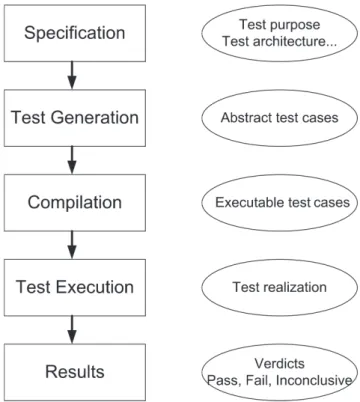
After the preparatory work, the test of the interoperability can be performed. In the sequel, we present the different stages of testing activities and corresponding objectives (c.f. Fig.2.4). They are:
1. The specification of the System Under Test SUT, which may be composed of one or more implementations. This phase includes the specification of one or more systems to be tested, the testing architecture, the description of the objectives of the test, etc. Respectively, the testing architecture represents the functional configuration in which the testing experiment will be undertaken. Note that it does not provide information for a concrete design of interfaces. This aspect is left to test laboratory and test execution concern.
An objective of the test, also called interoperability test purpose (ITP) is de-rived from the requirements stated in one or more base specifications that define the implementation. It provides an essential abstraction of a test that specifies what is to be tested without going into the details of how a test is to be implemented. Test purposes are not test steps. They usually describe a sequence of actions (not necessarily consecutive) to be observed during the test run. Test purposes are written using the language and ter-minology of the base specification(s) and are independent of any particular
programming language, test system or platform on which corresponding tests might eventually be executed. They need to be developed, discussed and stabilized prior to any test case specification.
2. Generation of abstract Interoperability Test Cases (ITC). For each interop-erability test purpose, an abstract test case is generated. A Test Case is the detailed set of instructions (or steps) that need to be taken in order to per-form the test. In the case where the test driver is a human operator, these instructions will be in natural language. In the case where the tests are automated, they may be written in a programming or test language. The set of test cases is called a Test Suite (TS). A common test case includes a preamble, a testbody and a postamble. The test body is the set of events that are essential to achieve the test purpose. The preamble is the sequence of test events which drive the implementations into a state from which the test body can be performed. The postamble is the sequence of test events which drive the implementations back into their initial states after the test body is verified.
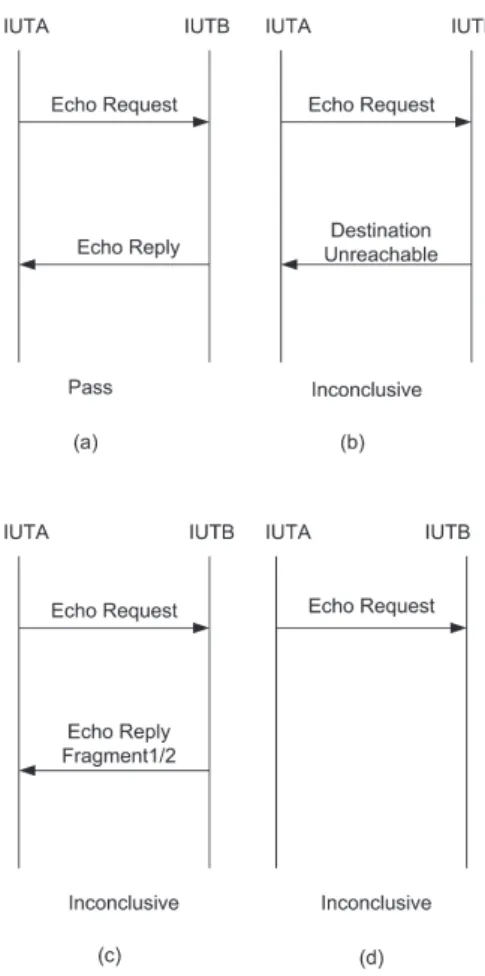
A test case contains also associated verdicts with its possible executions. In detail, verdict Pass corresponds to the case where the expected behavior to be observed which can satisfy the test purpose. Verdict Inconclusive corresponds to the case where the behavior is allowed by the specifications, but can not satisfy the test purpose. Indeed, as it is generally impossible to completely control the SUT in a testing procedure, the observed behavior can be allowed in the specifications, however does not correspond to the test purpose. All other unexpected behavior is associated with Fail verdicts.
Test cases can be either automatically computed if formal models of refer-ence specifications are available, or manually obtained by studying carefully the specifications and specifying possible interactions that allow to satisfy the ITPs. Currently, most of interoperability test cases are generated man-ually.
3. Test deployment and execution. This stage involves of compilation and execution of test cases on the system under test. The results of the execution are then reflected by assigning a verdict Pass, Fail or Inconclusive.
Figure 2.4: Interoperability Testing activities
2.3
State of the Art of Interoperability Testing
As systems used for most commercial service provisioning have evolved and in-volve today hundreds of hardware and software components, interoperability is one of the key factors to success when deploying new technologies for highly dis-tributed systems. To ensure interoperability, efforts have been made by both industrial and research fields.
Interoperability testing in industry has always been practiced in the context of testing laboratories, field trials, and acceptance testing. Manual testing is today the most dominant way to perform interoperability testing. Typical examples using manual testing are interoperability testing events, which bring together products from different vendors purely for the purpose of executing tests for a period which may last from a couple of days to a couple of weeks. These events enable developers from different (and competing) companies to get together to test their companies’ own implementations and ensure interoperability between products. Manual testing is however highly costly and leaves room for human error simply considering its repetitive nature and the number of entities and interfaces involved in the testing of these complex systems.
In research domain, many works address the problems of interoperability test-ing over the past decades, which put emphasize on test suite derivation.
No matter in industrial or research context, the two main approaches to inter-operability testing can be broadly classified into two approaches: active testing and passive testing. The difference is that active testing allows controlled er-ror generation and a more detailed observation of the communication, whereas passive testing on the other side involves observation the behavior only. In the sequel, we present the state of the art of interoperability testing, including elab-orating both active and passive testing methods, as well as their advantages and drawbacks.
2.3.1
Active Interoperability Testing
Until now, the majority of research works on interoperability testing are based on active testing. Generally, the active testing paradigm considers this activity as consisting of three elements:
• Stimulating a SUT in order to place an IUT in one of the pre-defined con-ditions (states);
• Observing the behavior of SUT as it appears under the influence of applied stimuli.
• Analyzing the relation between the stimuli and observed behavior, in order to decide if this relation is as predicted by a pre-difined reference.
2.3.1.1 Active Interoperability Testing Overview
The research work on interoperability testing can be roughly classified into three categories: experimental results, general concepts and formal framework, and systematic generation of interoperability test suites.
Most of the early work belongs to the first category. Bonnes [43] presented their interoperability testing experiences at IBM. [44] describes their experiences with interoperability testing of FTAM protocol that uses a single tester between two IUTs that can observe and control the communication between two FTAM entities. There are also studies that focus on interoperability testing of some specific protocols or specific properties of the protocols tested. For example, [9] focuses on testing the interoperability of the specific protocols TCP/IP based system. Shin and Kang [59] proposed and applied a test derivation method
suitable for testing interoperability for the class of communication protocols like the ATM signaling protocol. [11] concentrates on time constraint in real-time systems. Most of these works however, are not based on a rigorous definition of interoperability.
Another testing method is based on formal framework and general concepts of interoperability: [37] gives a comprehensive discussion of various aspects of interoperability testing. [19] proposes a formal framework for iop testing and also discussed iop test generation. One methodology is based on the fault models [18] or the research of a particular error type [15]. Test suite design and derivation is based on these typical problematic to have a clear vision of whether IUTs work properly.
Most of the recent research work in the field is related to interoperability test suite derivation. One approach is to apply conformance test generation tech-niques on composed finite state machines, which are constructed from several components systems via a reachability analysis. A finite set of test cases is then selected to test the interoperability. [35] was one of the first papers in this field. It proposes the test generation procedure and also an interoperability test ar-chitecture. [17] reuses automatic generation of conformance test suites to define an approach for automatic generation of interoperability test suites. [61] have formalized the relation of interoperability by adapting the existing conformance relations. [18] proposed a test generation technique for protocol control portion of interoperability testing. Previous works can be classified as methods based on reachability analysis, that often suffer from the well-known state space explosion problem when applied to real case studies. To avoid state space explosion, some strategies have also been proposed: Griffeth et al. [60] presented a method for au-tomatic generation of test cases to test a system interface. In order to avoid state space explosion, the method makes use of a single entity that interoperates with the rest of the integrated communication systems. [19] proved the equivalence between global and bilateral interoperability testing, and then used the feature of bilaterial interoperability architecture to generate one test case for each IUT. [62] proposed algorithms to generate a test suite that are based on stable states of their composition algorithm.
All the above work is based on an active testing approach, where the tester has the ability to stimulate the IUTs and verify whether the output obtained for each input is according to the specification.
2.3.1.2 Advantages and Drawbacks of Active Testing
As the most frequently used testing technique, active testing has several ad-vantages: First, the strength of active testing method is its ability to focus on particular aspects of SUT. Test cases can be for example a specific error type or an important state of the specification. By sending well designed inputs to the SUT, the test system is able to check whether the response to each stimulus is consistent with the test cases.
Another advantage of active testing is the capability to control SUT. The SUT can be set to an initial state to execute the test cases, and reset or brought to a stable state afterward. Therefore, controllable test cases design is more preferable in practice to avoid possible non-determinism. A controllable test case means that in any state of the specification, if the state allows both a stimulus of the test system and a message sent by the IUT, test case should always choose to send the stimulus.
Although active testing is commonly used, it has some drawbacks:
First, the active testing technique does not suit protocol testing in operational networks. In fact, the arbitrary inputs disturb inevitably the normal operations of the SUT. Moreover, in the context where the network is in use, it is desired to keep testing traffic overhead to a minimum. Therefore, active testing is rather suitable for protocol testing in isolated environment. For example, in confor-mance testing, where an IUT is tested off-line to insure that it conforms to its specification. However, for interoperability testing, where at least two IUTs inter-act with each other, it is difficult to insert arbitrary inputs without affecting their normal functioning of the tested protocol applications as well as other services.
Second, active testing needs specific test environment and APIs so that the tester can interact directly with the SUT. However, this condition may not be necessarily satisfied. For example, for the testing between protocol layers, no direct access to the embedded layer is given. Therefore, active testing may not be feasible since the test system is not able to send stimuli to the SUT.
Moreover, with active testing, the test scope, the coverage and the duration are all limited by the test suite design. Indeed, the cost and complexity of putting to-gether an entire network for testing suggests that pair-wise testing would be more cost-effective. But configuration of the network elements to obtain the required connectivity is a difficult, error-prone and time-consuming process. Moreover, to correctly draw the conclusion of interoperability, the model of the environment must be accurate, which requires both variety and depth of expertise.
network components, it can hardly cope with all these problems.
2.3.2
Passive Interoperability Testing
To cope with the limitations of active testing, passive testing has been studied with interest over the past few years. The generic passive interoperability test-ing architecture involves two interconnected IUTs. The communication between the IUTs is monitored. Contrary to active testing, in passive testing, the test system does not interact with the SUT, its role is limited to observing the be-havior of the SUT (also name as trace) without controlling its inputs. Indeed, the passive interoperability testing architecture is based on an accurate level of observation in order to issue verdicts regarding the IUTs behavior with respect to the specifications.
We now breifly survey the main concerns, approaches, and results of research conducted on passive testing. In passive testing, the test system TS has two main roles:
1. Observe and collect the information exchanged between two protocol enti-ties in the SUT.
2. Trace verification. The captured trace will be analyzed in order to determine whether the system operates correctly. Trace verification can be done either online [8] or offline. The idea of online testing is that the execution of a test pertains to behavior that the SUT genuinely exhibits during the test experiment, and the verdicts are issued during the test execution. For example, passive testing can be used to monitor the network for a long time and deal with abnormalities at any time. Else-wise it can be done offline. In offline testing, the behavior the the SUT is captured and then be assessed. i.e, the traces during the test execution are stored in a file and will be analyzed once the trace recording is finished [3], [6], [7].
2.3.2.1 Passive Testing Techniques
Currently, passive testing techniques can be broadly classified into two approaches: The first approach consists of recording the trace produced by the implemen-tation under test and trying to find a fault by comparing this trace with the specification. The other approach explores relevant properties required for a cor-rect implementation, which are named as invariants, and then check them on the traces produced by the system under test.
Trace matching approach is a passive testing technique which compares each event in the trace produced by the SUT strictly with that in its specification. The SUT is said to be faulty as soon as a deviation between the trace and the specifi-cation is detected. This method is widely used for the network fault management [2], [5], [7].
In [2], the trace matching technique was first proposed to realize the fault management of signaling system SS7. The formal model used is Finite State
Machine (FSM) [49]. Trace matching technique was initially proposed for
deter-ministic FSM, and later extended to non-deterdeter-ministic FSM [50]. In [7], trace matching is used for fault detection in system modeled by communicating finite state machine (CFSM).
The approach is composed of two stages: passive homing and fault detection :
• Passive Homing
In passive testing, no assumption is made about the moment when the recording of trace begins. Therefore, the state of the implementation at that moment it is not necessarily its initial state. Thus, the aim of passive homing is to find out the current state of the implementation. For doing this, the transitions of the observed trace are studied one after the other to narrow down the states the implementation can be in. At first, all states in the specifications are regarded as possible candidate states. Then, by checking each i/o pair in the trace. The states which accept the pair are replaced by the destination state of the corresponding transition. While the states that do not accept it are eliminated. After a number of iterations, there are two possibilities:
(i) A single state is obtained: it is in fact the current state of the
imple-mentation machine.
(ii) The set of possible states becomes empty, it means that the behavior
of IUT does not correspond to the specification, a fault is detected. • Fault Detection
Once the current state is found, the other transitions in the trace can be followed from the current state in the specification. Once a state that does accept a transition in the trace is reached, there is an error. Otherwise no error is detected.