Faculté de génie
Département de génie civil
ÉVALUATION DE LA FRAGILITÉ SISMIQUE DES
BARRAGES POIDS EN UTILISANT DES
FONCTIONS MULTIVARIÉES BASÉES SUR DES
MÉTA-MODÈLES
SEISMIC FRAGILITY ASSESSMENT OF CONCRETE
GRAVITY DAMS USING META-MODEL-BASED
MULTIVARIATE FUNCTIONS
Thèse de doctorat
Specialité: génie civil
Rocio L. SEGURA
Sherbrooke (Québec) Canada
Patrick PAULTRE
SupervisorJamie E. PADGETT
Co-supervisorJean PROULX
ExaminerGeorgios BALOMENOS
ExaminerJacky MAZARS
ExaminerLes conséquences de la rupture d’un barrage peuvent être considérables, en termes de pertes humaines, économiques et environnementales. De plus, la sécurité des barrages et des aménagements hydroélectriques est une préoccupation majeure au Québec étant donné que plus de la moitié de la population vit dans des zones potentiellement inondables. Il y a environ 933 grands barrages au Canada et 333 ou un peu plus sont situés au Québec. Parmi eux, beaucoup d’entre eux ont été construits il y a plus de 50 ans. Au cours de cette période, d’importants progrès ont été réalisés dans les méthodes d’évaluation des risques naturels. Bien que la défaillance totale d’un barrage en béton à la suite d’un tremblement de terre soit rare, les tremblements de terre sont une cause majeure de dommages à différents degrés de gravité. Par conséquent, le vieillissement et ses problèmes associés, combiné aux nouvelles méthodes d’estimation des charges sismiques ont entraîné la nécessité de revoir et d’améliorer les méthodes d’analyse sismique pour les barrages. Au cours des dernières décennies, les outils probabilistes sont devenus de plus en plus populaires pour l’évaluation sismique des barrages. Cependant, de telles méthodes nécessitent souvent un grand nombre d’analyses dynamiques non linéaires de modèles complexes par éléments finis. Par conséquent, le compromis entre l’exactitude du modèle numérique et la quantité de calcul rend ce type d’analyse non viable. Toutefois, l’évaluation sismique des barrages peut être améliorée en incluant les incertitudes liées aux paramètres sismiques et aux paramètres de modélisation et accélérée en réduisant l’importante quantité de temps de calcul avec l’utilisation de techniques d’apprentissage automatique pour développer des modèles de substitution ou des méta-modèles qui serviront prédire la réponse du barrage. L’objectif principal de la recherche est de mettre au point une méthode d’évaluation de la sécurité sismique des structures de type barrage-poids grâce à une analyse de fragilité, effectuée avec la mise en œuvre de méta-modèles et en identifiant correctement le scénario sismique susceptible d’être présent sur le site du barrage. La méthodologie est appliquée à un barrage-poids situé dans l’est du Canada, dont la fragilité est évaluée par comparaison avec les études antérieures et directives de sécurité actuelles. On observe que la procédure plus précise présentée ici pour choisir les accélérogrammes produit des estimations moins conservatrices de la fragilité pour le barrage. Nous avons trouvé que la surface de réponse polynomiale de 4ème ordre est le méta-modèle le plus performant, et elle a été utilisée pour générer des fonctions de fragilité multivariées pour tenir compte de la variation des paramètres les plus critiques du modèle influençant la fragilité sismique du barrage. A partir de l’analyse de ces modèles, des recommandations pratiques de conception ont pu être formulées et il a été observé que le paramètre de modélisation affectant le plus l’analyse de la fragilité est la cohésion entre le béton et la roche.
Mots-clés : barrages-poids, aléas sismiques, analyse de fragilité, méta-modèle, courbes de fragilité, surfaces de fragilité, paramètres de modélisation
The consequences of dam failure can be substantial, in terms of casualties, economic and environmental damage. Moreover, the safety of dams and hydroelectric developments is a major concern in Quebec given that over half the population lives in potential flood zone. There are about 933 large dams in Canada and 333 or slightly more are located in Quebec. Among them, many have been built more than 50 years ago. During that time, important advances in the methodologies for evaluating the natural hazards have been made. Although total failure of a concrete dam following an earthquake is rare, earthquakes are a major cause of damage at different degrees of severity. Consequently, the combination ageing and its associated problems with new methods for estimating seismic loads, have resulted in the need to review and upgrade the methods of seismic analysis for dams. In recent decades, probabilistic-based tools, have become increasingly popular for the seismic assessment of dams. However, such methods often require a large number of nonlinear dynamic analysis of complex finite element models. As a result the trade-off between the accuracy of the numerical model and the computational burden render unviable this type of analysis. However, the seismic assessment of dams can be enhanced by including seismic and modeling parameters uncertainties and expedited by reducing the substantial computational time with the use of machine learning techniques to develop surrogate or meta-models to predict the response of the dam.
The proposed research addresses direct gaps in the seismic performance assessment of dams, while also shedding new light on the use of machine learning to support fragility modeling of complex systems like dams. Accordingly, the main objective of this research was to develop a method for assessing the seismic safety of gravity dam-type structures through a fragility analysis, conducted with the implementation of meta-models and by properly identifying the seismic scenario likely to be present at the dam site. The method-ology is applied to a case study gravity dam located in eastern Canada, whose fragility is assessed through comparison with previous studies and current safety guidelines. It is observed that the more accurate procedure presented herein to select ground motions produces less conservative fragility estimates for the case study dam. Likewise, the 4th order polynomial response surface came up as the best performing meta-model, and it was used to generate multivariate fragility functions to account for the most critical model parameter variation influencing the dam seismic fragility. From the analysis of these models, practical design recommendations could be formulated and it was observed that the modelling parameter affecting the fragility analysis the most was the concrete–rock cohesion.
.
Keywords: gravity dams, seismic hazard, fragility analysis, meta-model, fragility curves, fragility surfaces, modeling parameters
one for all, united we stand divided we fall.-- Alexandre Dumas
I would like to begin by thanking Prof. Patrick Paultre for the opportunity to work in his research group, for the freedom to work in a research subject of my interest and for the trust placed in me throughout this research. Also, for the opportunity to travel to other institutions, working with other research professionals and taking as many technical courses as necessary to fulfill the requirements of the proposed research challenge. It facilitate me the access to new information, new and balanced interactions with my peers and provided me an exhibition that is difficult to achieve otherwise. I would have not be able to accomplish this thesis without the corrections, valuable advice and constructive comments of Prof. Ricardo Monteiro from Istituto Universitario di Studi Superiori di Pavia and Prof. Jamie E. Padgett from Rice University with whom I had the privilege to collaborate. The help from the CRGP group, even if not directly involved in the project, is also acknowledged. I would like to offer my special thanks to my friend and collegue Pedro Conde Bandini, for the uncountable discussions, advices, exchanges and specially for his support in the difficult moments.
I want to extend my thank to the Natural Sciences and Engineering Research Council of Canada (NSERC), the Fonds de recherche du Québec – Nature et technologies (FRQNT), the Centre d’études interuniversitaire des structures sous charges extrêmes (CEISCE) and the Centre de recherche en génie parasismique et en dynamique des structures (CRGP) for their financial support. In the same manner I would also like to acknowledge the contri-bution of Compute Canada and Calcul Quebec in providing the computational resources for this project.
I also wish to thank to all the valuable people that the experience of studying abroad allowed me to meet, specially: Poli, Adriana, Karina, Cristian, Luis, Luis Felipe thank you for your friendship. Without being an exhaustive list, thanks to all the flatmates from the Maison Bleue: Lou, Sam, Roxy, Clément, Jorge, Pierre, Adrien and Ehsan, you were my family in Sherbrooke and you made everything more cheerful and tolerable. To my friends from Sherbrooke University, thank you for listening, you made every lunch fun and unique: Ghilherme, Ayo, Romain, Teura, Matthieu. To my friends from Argentina: Eluney, Alejandro and Paila, thanks for making me feel that nothing has changed and that the time hasn’t passed.
Last, but most important, thanks to my family and in particular to my mother Liliana and my sister Romina, the crisis management committee. Everything is because and thanks to you two. Thank you for encouraging me to be better, for teaching me not settle, for making me believe in myself and for being there unconditionally for me.
1 INTRODUCTION 1
1.1 Context and problematic . . . 1
1.2 Project description and objectives . . . 2
1.2.1 Case study - description . . . 4
1.3 Originality and contribution . . . 4
1.4 Structure of the document . . . 6
2 STATE OF THE ART 9 2.1 Seismic performance of gravity dams . . . 10
2.1.1 Loads, failure modes and limit states . . . 11
2.1.2 Seismic analysis methods and structural modeling . . . 12
2.1.3 Modeling considerations . . . 14
2.2 Seismic risk assessment . . . 20
2.2.1 Seismic probabilistic risk assessment - SPRA . . . 20
2.2.2 Seismic hazard - Quebec . . . 21
2.2.3 Ground motion record selection method . . . 23
2.2.4 Target seismic conditional distributions . . . 24
2.3 Fragility analysis . . . 26
2.3.1 Fragility curves . . . 26
2.3.2 Fragility curves applied to dams . . . 30
2.3.3 Fragility surfaces . . . 34
2.3.4 Fragility surfaces applied to dams . . . 38
2.4 Surrogate or meta-models . . . 40
2.4.1 Regression techniques . . . 41
2.4.2 Meta-models in the structural engineering domain . . . 45
2.4.3 Surrogate models applied to dams . . . 46
3 METHODOLOGY 49 3.1 Case study dam modeling and characterization . . . 49
3.1.1 DRF Finite element model . . . 49
3.1.2 Uncertainty modeling . . . 57
3.2 Characterization of the seismic scenario . . . 58
3.2.1 Ground motion selection method . . . 59
3.2.2 Selection procedure . . . 60
3.3 Regression meta-models generation . . . 60
3.3.1 Experimental design matrix . . . 61
3.3.2 Finite element simulations . . . 62
3.3.3 Meta-model fitting . . . 62
3.4 Seismic fragility analysis . . . 64
3.4.1 Damage states . . . 65
3.4.2 Single-variate fragility functions . . . 65 xi
3.4.3 Multivariate fragility functions . . . 66
3.4.4 Seismic assessment of dams . . . 68
4 ON THE SEISMIC FRAGILITY ASSESSMENT OF CONCRETE GRAV-ITY DAMS IN EASTERN CANADA 71 4.1 Introduction . . . 72
4.2 Case study description and modeling . . . 74
4.3 Characterization of seismic hazard . . . 76
4.3.1 Probabilistic seismic hazard analysis and disaggregation . . . 76
4.3.2 Comparison of the NBCC 2010 and 2015 Hazard Models . . . 78
4.4 Ground motion records selection . . . 79
4.4.1 Generalized Conditional Intensity Measure Approach . . . 80
4.4.2 Selection algorithm . . . 82
4.5 Fragility analysis . . . 84
4.5.1 Damage limit states . . . 84
4.5.2 Modeling parameter uncertainty . . . 85
4.5.3 Fragility curves . . . 86
4.5.4 Comparison of the ground motion selection approaches . . . 87
4.6 Safety assessment . . . 89
4.6.1 Expected seismic performance under extreme limit states . . . 89
4.6.2 Unconditional Probabilities of Failure . . . 89
4.7 Conclusions . . . 91
4.8 Numerical Implementation . . . 92
4.9 Acknowledgments . . . 92
5 META-MODEL-BASED SEISMIC FRAGILITY ANALYSIS OF CON-CRETE GRAVITY DAMS 93 5.1 Introduction . . . 95
5.1.1 Literature review . . . 96
5.1.2 Originality and contribution . . . 97
5.2 Meta-model-based multivariate fragility procedure . . . 97
5.2.1 Design of experiments . . . 99
5.2.2 Meta-modeling techniques . . . 99
5.2.3 Cross-validated goodness-of-fit estimates . . . 104
5.2.4 Multivariate fragility analysis . . . 104
5.3 Case study: description and modeling . . . 107
5.3.1 Finite element model . . . 108
5.3.2 Model parameter uncertainty . . . 109
5.3.3 Damage limit states . . . 109
5.3.4 Seismic hazard and ground motion selection method . . . 110
5.3.5 Most viable meta-model for maximum relative base sliding prediction111 5.3.6 Dam sample generation and multivariate fragility functions . . . 116
5.3.7 Effect of model parameter variation in the fragility analysis . . . 120
5.4 Application to seismic assessment of dams . . . 123
5.6 Acknowledgments . . . 126
6 SEISMIC FRAGILITY ANALYSIS OF DAMS: COMPLEMENTARY RESULTS 127 6.1 Ground motion record selection methods . . . 127
6.2 Fragility curves comparison . . . 128
6.3 Fragility functions from meta-models . . . 132
6.3.1 Fragility curves . . . 132
6.3.2 Fragility surfaces: uncorrelated IMs . . . 133
7 CONCLUSION 137 7.1 Summary and conclusions . . . 137
7.2 Future work recommendations . . . 141
7.3 Sommaire et conclusions . . . 142
7.4 Recommandations pour les travaux futurs . . . 147
1.1 Research project main objective diagram . . . 3
1.2 Case study dam: (a) aerial view of the dam [1] and (b) cross section . . . 4
1.3 Structure of the document - Thesis modality . . . 7
2.1 Commonly used loads in design practice . . . 11
2.2 Linear vs. non-linear material behaviour . . . 16
2.3 Simplified seismic hazard map [2] . . . 21
2.4 Southeastern Canada earthquakes since 1700 [3] . . . 22
2.5 Conceptual fragility curve . . . 27
2.6 Conceptual 2D fragility problem . . . 29
2.7 Conceptual fragility surface . . . 35
2.8 Gaussian process model prediction: (a) training data generation, (b) predic-tion point (c) estimapredic-tion of y∗ as a Gaussian distribution and (d) prediction error bars . . . 43
3.1 Dam-reservoir-foundation LS-Dyna model . . . 50
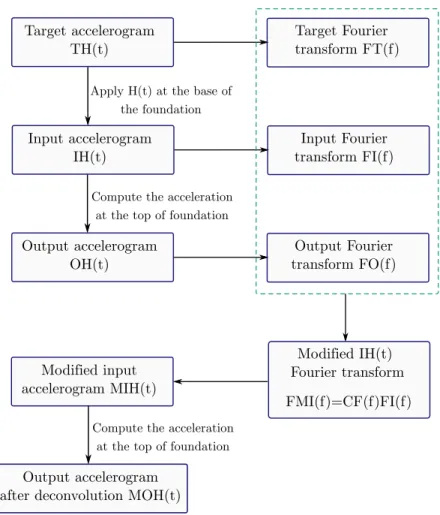
3.2 Deconvolution methodology . . . 56
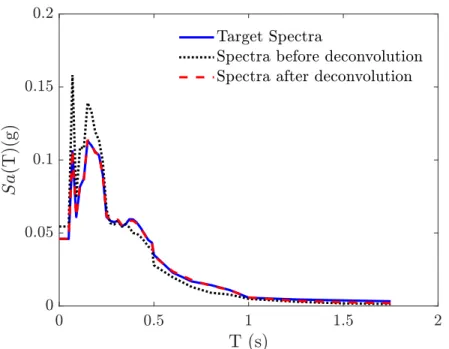
3.3 Comparison between response spectrum (before and after deconvolution) . 57 3.4 Ground motion record selection procedure . . . 61
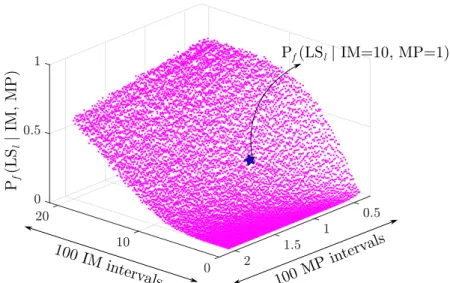
3.5 Conceptual fragility point estimates from the meta-model MSA . . . 67
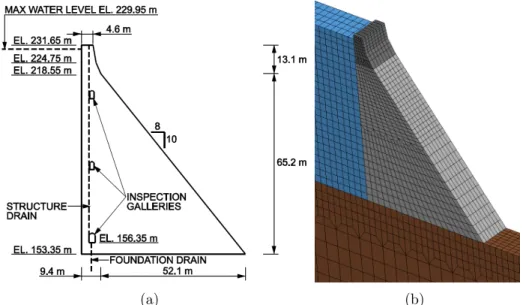
4.1 (a) Cross section and (b) Finite element model of the tallest monolith . . . 75
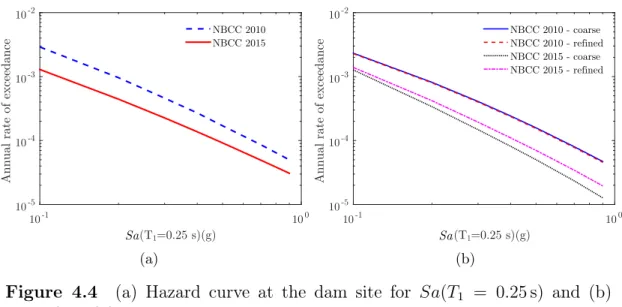
4.2 (a) Hazard curve at the dam site for Sa(T1 = 0.25 s) and (b) Hazard curves according to the different source models . . . 78
4.3 Magnitude-distance-annual probability of exceedance (POE) disaggregation at the dam site for: (a) Sa(T1 = 0.25 s) = 0.1 g; (b) Sa(T1 = 0.25 s) = 0.9 g 79 4.4 (a) Hazard curve at the dam site for Sa(T1 = 0.25 s) and (b) Hazard model - ERF sensitivity . . . 80
4.5 Comparison of the mean disaggregation values according to the NBCC 2010 and 2015 hazard models: (a) Magnitude, (b) Distance and (c) Epsilon . . . 80
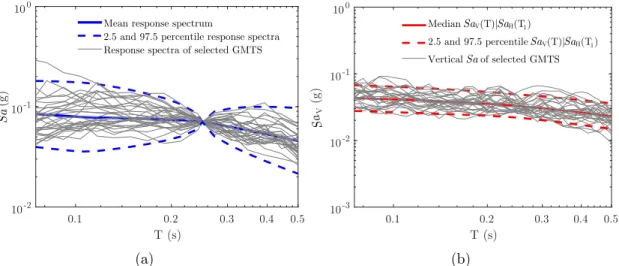
4.6 Distribution of the 30 selected ground motions at Sa(T1 = 0.25 s) = 0.1 g for: (a) horizontal spectral acceleration, (b) vertical spectral acceleration . 84 4.7 Empirical distribution function of the 30 selected GMTSs at Sa(T1 = 0.25 s) = 0.1 g: (a) SaV(T1 = 0.25 s), (b) PGV . . . 85
4.8 Fragility curves for: (a) base sliding, (b) neck sliding . . . 87
4.9 Comparison of fragility curves obtained via Method A (solid line) and Method B (dashed line) for: (a) base sliding and (b) neck sliding limit states . . . 88
5.1 Procedure for the generation of meta-models . . . 99
5.2 Multiple stripe analysis for meta-model fragility point estimate generation 106 5.3 Parametric fragility surface construction . . . 107
5.4 Finite element model of the case study dam . . . 108 5.5 Goodness of fit - Training data vs. cross-validation average: (a) RMSE, (b)
R2 and (c) RMAE . . . 114
5.6 Prediction capabilities comparison vs. size of the training set: (a) 5-CV RMSE, (b) 5-CV R2 and (c) 5-CV RMAE . . . 115 5.7 PRS O4: (a) Predicted vs. simulated values, (b) Residuals histogram and
(c) Fitted value residuals . . . 116 5.8 Linear correlation between the seismic IMs from the GMTS . . . 117 5.9 Probability distribution of seismic predictors . . . 117 5.10 Fragility surfaces: Fs(PGV,CRF) for (a) LS0, (b) LS1, (c) LS2 and (d) LS3 118
5.11 Fragility surfaces: Fs(PGV, DR) for (a) LS0, (b) LS1, (c) LS2 and (d) LS3 119
5.12 Fragility surfaces: Fs(PGV, CRC) for (a) LS0, (b) LS1, (c) LS2 and (d) LS3 119
5.13 CRF fragility curves parameters regression . . . 121 5.14 DR fragility curve parameter regression . . . 122 5.15 CRC fragility curve parameter regression . . . 123 5.16 Admissible model parameter range of values for MCE events: (a)
Concrete-rock angle of friction, (b) Drain efficiency and (c) Concrete-Concrete-rock cohesion . 124 6.1 NBCC 2010 uniform hazard spectra . . . 128 6.2 Fragility curves comparison for base sliding damage state for (a) LS0, (b)
LS1, (c) LS2 and (d) LS3 . . . 130 6.3 Fragility curves comparison for neck sliding damage state for (a) LS0, (b)
LS1, (c) LS2 and (d) LS3 . . . 131 6.4 Fragility curves from the meta-model . . . 133 6.5 Fragility curves from meta-models for base sliding and 95 % confidence
in-terval of the modeling parameters values for (a) LS0, (b) LS1, (c) LS2 and (d) LS3 . . . 134 6.6 Fragility surfaces for (a) LS0, (b) LS1, (c) LS2 and (d) LS3 . . . 135
3.1 Material properties - calibrated model . . . 54
3.2 Load conditions . . . 54
3.3 Seismic IMs considered in the experimental design matrix . . . 62
3.4 Seismic IMs range of values . . . 66
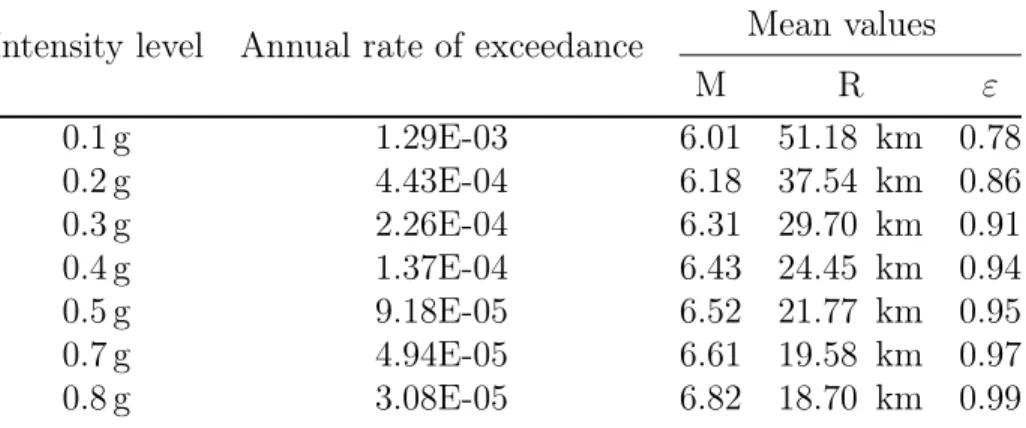
4.1 Earthquake scenarios from the GMM disaggregation at T1 = 0.25 s . . . 78
4.2 Limit states considered for the concrete gravity dam . . . 85
4.3 Modeling parameter assumed PDFs . . . 86
4.4 Probability of exceedance of the limit states set by the CDA . . . 90
4.5 Annual probability of exceedance . . . 91
5.1 Parameter distributions considered for statistical design of experiments . . 109
5.2 Limit states considered for the case study dam . . . 110
5.3 Meta-model comparison for base sliding . . . 113
5.4 Fragility surfaces’ goodness of fit . . . 118
5.5 CRF regression coefficients . . . 120
5.6 DR regression coefficients . . . 121
5.7 CRC regression coefficients . . . 122
6.1 Comparison of the fragility parameters between the records selection ap-proaches for base sliding . . . 129
6.2 Comparison of the fragility parameters between the records selection ap-proaches for neck sliding . . . 130
6.3 Comparison of the probability of exceedance of the base sliding limit states set by the CDA . . . 132
6.4 Comparison of the probability of exceedance of the neck sliding limit states set by the CDA . . . 132
6.5 PGV-Ia fragility surfaces parameters . . . 136
6.6 PGV-Ia fragility surfaces goodness-of-fit . . . 136
a = constant coefficient vector for PRS meta-model; a0 = bias constant term for RBF meta-model;
a1, . . . , am= connection weights between hidden layers for RBF meta-model;
b = NN bias parameter;
b(·) = basis functions of MARS meta-model; c = constant coefficients for MARS meta-model; D595= earthquake significant duration;
Erock = foundation modulus of elasticity;
Es= concrete modulus of elasticity;
f (·) = decision tree base models for RFR; f0 = DRF fundamental frequency;
FIM1|IM2 = theoretical CDF of seismic IM1 conditioned on IM2;
FI= input Fourier transform; FMI= modified Fourier transform;
FO= output Fourier transform; FT= target Fourier transform;
fx(x) = probability density function of a random variable;
g(·) = surrogate model function; H= block height;
H2= historical source model; HY= hybrid source model;
Ia= Arias intensity;
IH= input accelerogram; K = water bulk modulus;
k = positive definite kernel function; m = mean vector;
M= moment magnitude; M(·) = random margin;
MIH= modified input accelerogram; MOH= deconvolved output accelerogram;
N (·) = normal distribution; nf = number of FE simulations;
On= nth order of the polynomial response surface;
OH= output accelerogram; p = binary variable; p(x) = limit state function;
Pe= probability of exceedance prescribed by the CDA;
Pf = probability of an event (∈ (0, 1));
Pf,unc= unconditional probability of exceedance;
Pr= probability of exceedance for a CDA return periods;
PGAV = vertical peak ground acceleration;
PGVM CE = peak ground velocity associated with the MCE;
p1, . . . , pn= parameters characterizing a limit state;
pθ, pβ = regression coefficients;
Q= hybrid parameter; R= source-to-site distance; R2= regional source model; R2 = coefficient of determination;
SaH(T∗) = horizontal spectral acceleration at target period T∗;
SaH(T ) = horizontal spectral acceleration corresponding to period T ;
SaV(T ) = vertical spectral acceleration corresponding to period T ;
SaRotD50 = Sa 50th percentile directionality ratio;
SvH(T1) = horizontal spectral velocity corresponding to period T1;
T = period of vibration;
T∗ = target period of vibration; T1 = fundamental mode period;
TH= target accelerogram;
v = normally distributed model error vector; v = model error;
ˆ
V = estimated hazard curve; vH = horizontal ground velocity;
V S30 = shear wave velocity; ¯
V (Sa(T1)) = complementary CDF of Sa(T1);
V (Sa(T1)) = CDF of Sa(T1);
v(Sa(T1)) = PDF of Sa(T1);
vV = vertical ground velocity;
W(·) = Weibull distribution; w = NN covariates’ weights;
w(·) = radial function for RBF meta-model; wv = wave length;
X = covariate matrix;
x = row vector of the covariate matrix; y = structural response;
z = NN hidden variable; ˆ
y = predicted structural response; αα = PCE coefficients;
α0, α1, α2 = hybrid parameter’s linear correlation coefficients;
β = standard deviation of the log-normal distribution; β0, . . . , β5 = demand fragility surfaces’ regression coefficients;
βW = Weibull shape parameter;
δmax= maximum relative sliding at the base;
ε = spectral shape;
ζ = standard deviation of the damping log-normal PDF; Θ = vector of basis functions for PRS meta-model;
θ, β = parameters characterizing a cumulative density function; ϑ = logistic regression coefficients;
ˆ
κ(·) = fit-type regression function;
λ = mean of the damping log-normal PDF; λf = demand fragility surfaces’ median;
µ = mean of the log-normal distribution; µln Sa= mean response spectrum;
µln Sa(Ti)| ln Sa(T∗) = conditional mean response spectrum;
µW = Weibull scale parameter;
νrock = Poisson coefficient of the foundation;
ξ = damping ratio;
ξf = demand fragility surfaces’ standard deviation;
ρ = linear correlation coefficient between IMs; ρconcrete = concrete density;
ρrock = density of the foundation;
ρw = water density at time t;
ρw,0 = initial water density;
ρ(Ti, T∗) = correlation coefficient between a pair of ε at two periods;
Σ = covariance matrix;
σ = standard deviation of the response in the dataset; σc= shear failure stress;
σH = horizontal stress time series;
σln Sa= standard deviation of the response spectrum;
σln Sa(Ti)| ln Sa(T∗)= conditional standard deviation response spectrum;
σn= normal stress;
σs= shear stress;
σt= tensile failure stress;
σV = vertical stress time series;
σv = standard deviation of the normally distributed model error;
Φ(·) = cumulative density function;
ΦN = standard normal cumulative density function;
ΦRBFi(·) = nonlinear mapping function for RBF meta-model;
φ = concrete-rock angle of friction;
Ψα= multivariate orthonormal polynomials;
ωeqk= earthquake angular frequency.
ABFC adaptive basis function construction ASCE American society of civil engineers
BIC Bayesian information criterion BTR boosted regression trees CDA Canadian dam association CDF cumulative distribution function CRC concrete-rock cohesion
CRF concrete-rock angle of friction
CRGP Centre de recherche en génie parasismique et en dynamique des structures CS conditional spectrum
CV cross-validation DOE design of experiments
DR drain efficiency
DRF dam-reservoir-foundation DS damage state
EDF empirical distribution function EDP engineering demand parameter
ELF equivalent lateral force ENA eastern North America
EPRI Electrical Power Research Institute ERF earthquake rupture forecast
FEM finite element model
FEMA federal emergency management agency FORM first-order reliability method
FOSM first-order second-moment FSI fluid-structure interaction
GCIM generalized conditional intensity measure GMM ground motion models
GMTS ground motion time series GSC geological survey of Canada
GP Gaussian process
HCLPF high confidence low probability of failure ICOLD International Commission on Large Dams
IDA incremental dynamic analysis IM intensity measure
KS Kolmogorov-Smirnov LEM limit equilibrium method
LHS Latin hypercube simulation LS limit state
MARS multivariate adaptive regressive splines MCE maximum considered earthquake
MCS Monte Carlo simulation
MCMC Markov chain Monte Carlo ML machine learning
MLE maximum likelihood estimator MOL maximum operating level
MP model parameters MSA multiple stripe analysis
NBCC National building code of Canada
NGA Next Generation of Ground-Motion Attenuation Models NN neuronal networks
PBEE performance based earthquake engineering PCE polynomial chaos expansions
PDF probability density function
PEER Pacific Earthquake Engineering Research Center PGA peak ground acceleration
PGD peak ground displacement PGV peak ground velocity
PRS polynomial response surface
PSHA probabilistic seismic hazard analysis POE probability of exceedance
RBF radial basis function RCC roller-compacted concrete RFR random forest for regression RMAE relative maximum absolute error
RMSE root mean square error SCM seismic coefficient method
SD standard deviation
SHM structural health monitoring SHMC seismic hazard model for Canada
SI spectrum intensity
SORM second-order reliability method SPRA seismic probabilistic risk assessment
SSE sum of squared errors SSI soil-structure interaction SVM support vector machines UHS uniform hazard spectrum
USACE United States Army Corps of Engineers USBR United States Bureau of reclamation
INTRODUCTION
1.1
Context and problematic
Dams are one of the most audacious human constructions, considering the social, environ-mental and economic risks that a work of such magnitude entails. A dam is designed to impound and store water behind it safely throughout its lifetime. Thus it has to maintain its structural integrity in the face of the different hazards and loading conditions that arise during construction, normal operations, and extreme environmental events.
Several dams have experienced rupture (partially or totally) under the effect of exceptional floods, and to a lesser extent due to earthquakes. In the last years the documented damage caused by seismic events [4, 5, 6, 7] has revealed the vulnerability of these structures whose consequences are catastrophic and expensive. In addition, the Canadian Risk and Hazards Network indicates that a significant earthquake is probably Canada’s greatest potential natural disaster [8]. The safety of dams and hydroelectric developments is a major concern in Quebec given that over half the population lives in potential flood zone. Thus, there are about 333 large dams in Quebec and around 933 in Canada [9]. Among them, many have been built more than 50 years ago [6]. During that time, important advances in the methodologies for evaluating the natural hazards have been made, causing the review and modification of the design guidelines, in some cases significantly. With the increasing knowledge of seismicity, a growing number of dams fail to meet the revised safety criteria that incorporates new seismic hazard information [6]. Consequently, the combination of ageing and its associated problems with new methods for estimating seismic loads and with the increasing demands of society to ensure a high level of safety has resulted in the need to review and upgrade the methods of seismic analysis for dams.
Furthermore, in Quebec, after the dam failure produced by the flood occurred in Saguenay region in July 1996, a Dam Safety Law was promulgated which is currently being applied. The aforesaid law confers a key role to the engineer and requires from the dam owners or operators to produce documented safety analyses of their works [10]. Consequently, questions have arisen regarding the capacity of existing dams, in their current condition, to withstand extreme environmental events beyond the original design basis during a future service period with an acceptable margin of safety.
Methods for analyzing the structural response of a dam-reservoir-foundation system rely on deterministic or probabilistic approaches. Deterministic methods are often considered too conservatives, or even unsafe in some cases, because of the use of extreme load cases with very low probabilities of occurrence and because of the way of considering different sources of uncertainty [11, 12, 13]. In the deterministic analysis, the way of handling the uncertainties involved in dam performance and safety assessment is by the traditional approach through the use of safety factors. These safety factors are applied separately at different stages, and inconsistently in the processes of analysis, design and assessment, leading to an unknown and unpredictable margin of safety [14]. Procedures that provide a more rational way of assessing the safety of concrete gravity dams are required to establish priorities. Moreover, a probabilistic approach is required to manage the various sources of uncertainty that may impact the dam performance and decisions related thereto [11]. Within this probabilistic framework, a fragility analysis is a promising alternative, partic-ularly suited to study the seismic vulnerability of structures and to estimate the level of damage likely to be caused by seismic events.
Nevertheless, seismic fragility analysis and vulnerability assessment of key infrastructure elements, often requires a large number of non-linear dynamic analyses of complex finite element models (FEM). The substantial computational time may be reduced using machine learning techniques to develop surrogate or meta-models, which are an engineering method used when an outcome of interest cannot be easily directly measured, so a model of the outcome is used instead [15]. Such a challenge is particularly relevant to the case of large scale infrastructures, such as dams, subjected to seismic loads. Accordingly, the main goal of this research is to apply statistical learning techniques to develop a seismic probabilistic demand model or meta-model to predict the seismic response of the dam. The latter will be used to generate fragility functions and recommendations to expedite the safety assessment process. The proposed methodology is applied to a case study gravity dam located in north-eastern Canada. Additionally, the procedure presented herein has the added asset of properly depicting the seismic scenario likely to occur at a specific site enhancing the accuracy of the analysis.
1.2
Project description and objectives
The project is part of one of the research axes of the Centre de recherche en génie para-sismique et en dynamique des structures (CRGP) of the civil engineering department at Sherbrooke University for evaluating seismic vulnerability of structures in Canada and developing tools to do this. Several previous projects performed by CRGP allowed
studying and developing a methodology for using fragility curves, mainly in the area of bridges [16, 17, 18, 19] and more recently in the area of dams [20, 21]. Moreover, the CRGP has vast expertise in the dynamic behaviour and seismic analysis of dams and hydraulic structures.
This study aims to assess, in a probabilistic way, the seismic vulnerability of concrete gravity dams using meta-model-based single-variable and multi-variable fragility functions, including the most relevant model parameters (MP) and seismic intensity measures (IM) affecting the response of the structure.
Figure 1.1 Research project main objective diagram
The present research project and the proposed methodology focus on a particular case study gravity dam located in north-eastern Canada. Particulary, this project has the following specific objectives:
1. Implementation of a non-linear finite element model, accounting for fluid-structure interaction (FSI) and soil structure interaction (SSI) to estimate the seismic response of the dam.
2. Characterize the seismic hazard at the dam site by performing a probabilistic seismic hazard analysis and by selecting a representative suite of ground motion time series (GMTS).
3. Identification of the most relevant MPs and seismic IMs affecting the seismic response of the dam through a statistically based screening study.
4. Explore the applicability of meta-models for the seismic assessment of gravity dams and systematically compare and determine the most suitable one.
5. Generate fragility functions from the meta-model output for the dam under study and gain insight on the influence of the model parameters affecting the dam
perfor-mance by explicitly quantify their effect with the generation of multivariate fragility functions.
6. Asses the expected seismic performance of the dam, providing an overview on the importance of the parameters influencing the dam performance to formulate practical design recommendations from the analysis, e.g. appropriate model parameter range to achieve target risk.
1.2.1
Case study - description
As it was aforementioned, the present study is focused on a particular concrete gravity dam in Quebec, Canada. It is the largest gravity dam in the province, with 19 unkeyed monoliths, a maximum crest height of 78 m, and a crest length of 300 m (Figure 1.1). The dam rests on a foundation consisting mainly of anorthosite gabbro and granitic gneiss [22], which corresponds to hard rock (V S30 > 1500 m/s). The dam was chosen for its simple and almost symmetric geometry and because of the availability of forced vibration test results used to calibrate the dynamic properties of the numerical model [22]. Moreover, previous studies concerning the seismic fragility of one of the central blocks of the dam [20, 21] are also available, enabling a direct comparison with the results of the method proposed herein.
(a) (b)
Figure 1.2 Case study dam: (a) aerial view of the dam [1] and (b) cross section
1.3
Originality and contribution
Methods for analysing the structural behaviour of the dam-reservoir-foundation system rely on deterministic or probabilistic methods. Currently in Quebec the safety assessment
of hydraulic structures is mainly deterministic and limited to methods based on safety factors. At present, probabilistic assessment methods, such as fragility functions, are rarely used in the field of dams. This research project will allow the implementation of this tool and develop a methodology for its application in dam-type structures. To implement this type of design, an accurate estimate of the seismic demand of the structural systems is especially important. Such an estimate requires, in turn, a ground motion record selection technique that properly depicts the seismic scenario and adequately propagates the record-to-record variability and uncertainty related to the seismic hazard throughout the fragility analysis [23, 24]. To this end, a probabilistic seismic hazard analysis (PSHA) will be conducted, consistent with the National Building code of Canada (NBCC) 2015, to depict the seismic scenario likely to be present at the dam site. The primary advantage of PSHA over alternative representations of the earthquake threat is that PSHA integrates over all possible earthquake occurrences and ground motions to calculate a combined probability of exceedence that incorporates the relative frequencies of occurrence of different earthquakes and ground-motion characteristics. These results will be used, together with a refined ground motion selection method, the generalized conditional intensity measure (GCIM) approach, to select ground motion time series that match target seismic IMs that highly correlate with the structure’s probable damage states. This method proposes, therefore, a more realistic target distribution and its application has produced encouraging results by recent studies in different contexts [25, 26, 27]. Currently, to the best of the author’s knowledge, no previous studies have conducted seismic assessment of dams while properly considering the contribution of several IMs. Moreover, there are no studies that have used the GCIM method for this region. As such, this research aims to improve the fragility analysis for concrete gravity dams by using an enhanced procedure to select ground motion records that includes different intensity measures that are relevant to the probable damage states of such structures.
Within this framework, and to better simulate the real dynamic response of the structure, a non-linear FEM of the dam, which fully account for dam-reservoir-foundation interactions will be used. This approach will provide a more realistic simulation of the structural response and material behaviour, which are known to vary with the intensity of dynamic loading. In the same way, the effect of the modeling assumptions will be explored to decide whether this simplifications are considerable when it comes to the dynamic behaviour of the dam. The substantial computation time will be reduced using machine learning techniques to develop surrogate or meta-models, whose basic idea is to avoid the temptation to invest computational budget, but to develop fast mathematical approximations instead. This
research will also highlight the advantages and disadvantages regarding the traditional methodology.
Summarizing, most of prior studies on seismic assessment of concrete gravity dams via ma-chine learning techniques are limited to the consideration of a few meta-models at a time in the context of a single study, simplified 2D finite element models and single-variate fragility functions or engineering demand parameter-seismic intensity measure fragility functions where the methodologies and/or parameterized equations are not provided [28, 29, 30]. Therefore, they do not explore the most suitable meta-models for fragility analysis of this type of structure, nor they explore the influence of the model parameters variation in the seismic fragility analysis. Moreover in any of these studies is discussed the proper definition of the seismic scenario likely to occur at a specific site in a probabilistic manner. To address the aforementioned gaps, this project aims to identify the most viable meta-model for the seismic fragility assessment of gravity dams and to provide an overview on the importance of the parameters influencing the dam performance to be able to formulate design recom-mendations from the analyses. The major contributions of this research, can be listed as: (i) systematically compare and determine the best performing regression meta-model to predict the base sliding of gravity dams, among 14 different regression techniques, for the first time; (ii) present a methodology to fit parameterized fragility surfaces, as a function of IMs and MPs, from the meta-models; (iii) consider the correlation between the seismic IMs from a probabilistic seismic hazard analysis to generate the samples to characterize the seismic scenario where the meta-model will be evaluated; (iv) gain insight on the in-fluence of the model parameters affecting the dam performance, and explicitly quantify their effect with the generation of multivariate fragility functions and (v) formulate model parameter design recommendations from the analysis, e.g. appropriate parameters range to achieve target risk.
1.4
Structure of the document
In order to meet the objectives of the research project, the content of this thesis is di-vided into seven chapters. The second chapter presents a review of the literature that includes: (i) the seismic performance of concrete gravity dams, (ii) eastern Canada seis-mic hazard, (iii) fragility analysis and (iv) meta-models. The probabilistic seisseis-mic hazard analysis procedure, ground motion record selection methods, different types of fragility functions, meta-modeling techniques and the few examples available in the field of dams are discussed. The third chapter is dedicated to the modeling and characterization of a concrete gravity dam for fragility analysis, where a methodology for the proper
consider-ation of the uncertainties to assess the seismic vulnerability is proposed. It also presents a summary of the methodology adopted to generate the dataset with which the meta-models were trained. More specifically, this chapter includes the modeling of the case study dam, parameter uncertainties consideration, ground motion selection procedure, de-sign of experiments and meta-model training, optimal regression technique selection and parametric fragility surfaces development. The fourth chapter presents the results of the PSHA to characterize the seismic scenario at the dam site and the development of up-to-date fragility curves for the case study dam using a record selection method based on the generalized conditional intensity measure approach. These fragility functions are then combined with the aforementioned regional hazard data to evaluate the annual risk, which is measured in terms of the unconditional probability of limit state exceedance. The fifth chapter provides insight on viable meta-models for the seismic assessment of gravity dams for use in fragility analysis. A methodology to generate multivariate fragility functions from the meta-models is presented, which offers efficiency while accounting for the most critical model parameter variation influencing the dam seismic fragility. From the analysis of these functions, practical design recommendations were formulated. As it can be seen from Figure 1.3, the modality of the thesis is by articles and two scientific papers were produced in the context of this project. It should be noted that chapters 4 (Part 1) and 5 (Part 2) constitute the articles presented in scientific journals, where the samples gen-erated in Part 1 with the finite element model and the seismic scenario characterization were used in Part 2 to train the meta-model that will emulate the finite element model behaviour. Finally, the results of Part 1 and Part 2 were used to perform the seismic assessment of the dam.
Finite element
model
Seismic scenario
characterization
Univariate
fragility functions
Part 1Emulate the finite
element model
Multivariate
fragility functions
Part 2
Seismic assessment of dams
Surrogate or
meta-models
Chapter six includes complementary verifications and comparisons regarding the seismic fragility of the case study dam. These results, presented in conference papers, are in-cluded in this document for completeness. As such, this chapter presents the comparison of the fragility functions developed with the 2010 and 2015 hazard models and with several record selection methods and the estimation of the expected seismic performance under extreme seismic events to assess the impact of these factors in the fragility of the system. Also, the best performing meta-model is used to develop fragility curves and to identify the most influencing model parameter in the seismic response by developing fragility re-gions. Finally, the last chapter presents the conclusions of the research project and gives guidelines for future projects.
STATE OF THE ART
A concrete gravity dam is a massive structure with an essentially triangular profile that consists of rigid monoliths built side by side. Its longitudinal axis runs straight along the entire dam. The structural stability of a concrete gravity dam is derived mostly from its weight. The primary load affecting concrete gravity dams arises from the hydrostatic pressure.
Certainly, concrete gravity dams are designed to remain operational under normal con-ditions, to sustain minimal damage under infrequent operative conditions and to prevent total loss of reservoir under extreme events. To avoid the uncontrollable release of water during a strong seismic event, the dam must be able to withstand the ground shaking of even an extreme earthquake given the human fatalities and the economic losses that can result from. It arises then, the importance of the behaviour of the dam under seismic loads. From a deterministic point of view, large storage dams are generally considered safe if they can survive an event with a return period of 10.000 years, i.e., having a 1 % chance of being exceeded in 100 years. It is very difficult to predict what could happen during such a rare event as very few earthquakes of this size have actually affected dams. Current procedures for concrete gravity dams design are based on static, deterministic analyses. These involve rigid body analysis and static equilibrium for monolith stability and foundation stresses. Where required, seismic loads are approximated by pseudo-static forces obtained using the seismic coefficient method [31]. The governing criteria in concrete gravity dam design are that the dam must be safe from overturning, sliding and bearing failure in the dam or foundation. Under the criteria currently in use, dams are designed to withstand or resist hazards that conceivably could occur in their lifetimes. However, it is not possible to provide "absolute" safety against all hazards. Extreme events, like earthquakes, that exceed the dam’s capacity can occur, although they may have very low probabilities of occurrence. Moreover, it is not possible to determine what would happen (damage without full failure) for lower hazards.
Methods for seismic analysis of concrete dams have been improved extensively in the last few decades and growth in the processing power of computers has expedited this improve-ment. Advanced numerical models of dams have become more feasible and manageable
and constitute the basis of more adequate procedures of designing and assessing. Proce-dures that provide a more rational way of assessing safety of concrete gravity dams are required to establish priorities. Such procedures should be based on modern principles of structural/geotechnical engineering. Moreover, a probabilistic framework is required to manage the various sources of uncertainty that may impact dam performance and decisions related thereto [32]. Seismic actions have essentially stochastic characteristics, therefore they should be considered as probabilistic loads. Moreover, material properties and struc-tural dimensions have random variations in the spatial domain. Thus, a probabilistic dynamic analysis of the coupled system dam-reservoir-foundation is necessary [33, 34].
2.1
Seismic performance of gravity dams
Historically, few dams have been significantly damaged by earthquakes. On a worldwide basis, only about a dozen dams are known to have failed completely as the result of an earthquake [35, 7, 4]. These dams were primarily tailings or hydraulic fill dams, or relatively old, small, earth-fill embankments of inadequate design. Earthquakes represent multiple hazards with the following features in the case of a storage dam:
– Ground shaking causes vibrations and structural distortions in dams, appurtenant structures and equipment, and their foundations.
– Fault movements in the dam foundation or discontinuities in dam foundation near major faults can be activated, causing structural distortions.
– Fault displacement in the reservoir bottom may cause water waves in the reservoir or loss of free board.
– Rock falls and landslides may cause damage to gates, spillway piers (cracks), retain-ing walls (overturnretain-ing), surface powerhouses (crackretain-ing and puncturretain-ing and distor-tions), electro-mechanical equipment, pen stocks, masts of transmission lines, etc,. – Mass movements into the reservoir may cause impulse waves in the reservoir. – Mass movements blocking rivers and forming landslide dams and lakes whose failure
may lead to over topping of run-of-river power plants or the inundation of power-houses with equipment, and damage downstream.
– Ground movements and settlements due to liquefaction, densification of soil and rock-fill, causing distortions in dams.
– Abutment movements causing sliding and distortions in the dam.
Dams are designed to withstand construction, normal and infrequent operating condi-tions, and extreme environmental load conditions. The two primary environmental load
conditions affecting concrete gravity dams arise from the differential hydrostatic level that occurs during hydrologic events and the dynamic loads due to seismological events. Sev-eral stages (limit states) of a dam behaviour occur under progressively increasing levels of excitation. At low levels, the dam-foundation system remains essentially elastic, displace-ments are small, drains are fully effective, and full control of the reservoir is maintained. In the elastic range, there are no permanent deformations, and the traditional 2D equilib-rium analysis of the dam as a rigid body is sufficient. At the onset of non-linear behaviour, material cracking occurs, deformations may become permanent, drainage characteristics of the dam and the operation of gates begin to be affected, and 3D structural actions within the dam are initiated. At this stage, 2D rigid body analysis of a dam monolith may no longer provide a good model of structural performance, and a finite element model of the complete dam may become necessary. Excessive deformations may cause objectionable cracking and functional disruption. Finally, at ultimate conditions prior to impending failure, the drains are ineffective due to large deformations, and structural behaviour be-comes unstable and unpredictable due to sliding, flotations, or loss of foundation material bearing capacity. In extreme cases, loss of control of the reservoir may occur [32, 36].
2.1.1
Loads, failure modes and limit states
As it was mentioned, the structural stability of a concrete gravity dam is derived mostly from its weight. The loads acting on the structure can be summarized in Figure 2.1.
Hy
Two types of loads solicit a dam: static and dynamic loads. The main static loads are: the weight of the dam, the hydrostatic pressure of the reservoir, uplift-pressure at the foundation, ice thrust and the stresses generated by volumetric changes and thermal gra-dients. Attention must be focussed on the operational limit states: gravity only (including staged construction), normal reservoir only, gravity plus normal reservoir, gravity plus nor-mal reservoir plus winter/summer temperature; which are of primary importance for dam structures [37]. For their part, the dynamic loads are caused by the action of an earth-quake which induces horizontal and vertical inertia forces and reservoir hydrodynamic thrust. Loads due to seismic excitation are one of the most important actions that must be considered in concrete dam design, even in regions of low seismic activity [33, 34]. The relevant limit states of a dam, from the most expected to the least expected [14, 38, 37, 39], can be listed as:
1. Material failure - concrete crushing failure. 2. Excessive stress in the foundation.
3. Excessive deformation of the dam body inducing service limitation for equipments and installations.
4. Seismic hammering between the blocks. 5. Considerable opening of cracking and joints.
6. Sliding at the dam-foundation interface or at the construction joints. 7. Uplifting and overturning.
8. Deflection of the top of dam relative to heel.
When subjected to strong ground motions, gravity dams may be damaged in different ways. Nevertheless, in recent years, typical damage modes in dams after a seismic event have been identified. Based on that seismic damage levels can be established. This is a necessary step before seismic vulnerability analysis can be performed [40]. In their study, Zhong et al. [40] presented the expected typical gravity dams failure modes based on non-linear seismic simulation results. Strictly speaking, classification of seismic damage levels should be established based on documents survey of dams actually damaged by earthquakes in history, or on a large number of simulation of dams subjected to strong earthquakes.
2.1.2
Seismic analysis methods and structural modeling
To assess the safety of a dam, it is necessary to proceed with the analysis of the latter. Two approaches are generally used to model a dam: seismic coefficient method (SCM)
and the finite element method. The SCM method assumes that the dam is infinitely rigid, earthquake forces are treated simply as static forces and are combined with the hydrostatic pressures, uplift, backfill soil pressures, and gravity loads. The analysis is primarily concerned with the rotational and sliding stability of the structure treated as a rigid body. The inertia forces acting on the structure are computed as the product of the structural mass, added-mass of water, and the effects of dynamic soil pressures, times a seismic coefficient. The magnitude of the seismic coefficient is often taken as a fraction of the peak ground acceleration expressed as a decimal fraction of the acceleration of gravity. This method has been widely used in practice because of its simplicity and according to the United States Corps of Engineers (USACE) [41] this method may still be used in the preliminary design and stability analyses. Nevertheless, it is not applicable in the case of a three-dimensional behaviour and it neglects several phenomena which may be important such as the dynamic characteristics of the dam-reservoir-foundation system and the characteristics of the ground motion.
The finite element method is based on the finite element theory to calculate strains and stresses in the dam. This method is much more accurate and provides a better assessment of the behaviour of a dam [42]. The global response of a dam is obtained by first calculating the effect of static loads to which we add the effect of seismic loads. Analysis of seismic loads can be carried out with three methods: pseudo-static method, pseudo-dynamic method and temporal dynamic method.
Pseudo-static method
The equivalent lateral force method (ELF), which is commonly used for the seismic design of buildings, has also been developed for preliminary seismic analysis of gravity dams assuming that the structure response is predominantly in the first mode [43]. In a similar way, the ELF method presents the same limitations as the SCM.
Pseudo-dynamic method
Also called the modal response spectrum analysis procedure is the most basic and truly dynamic method of analysis. In this method, the peak responses of linear elastic structures to earthquake ground motions characterized by response spectra are determined [44]. The number of modes required varies for each analysis, however all modes with significant contribution to the total response of the structure should be included. Usually the number of modes is adequate if the total mass participation of the modes used in the analysis is at least within 90% of the total mass of the structure. Within the pseudo-dynamic methods, the time history modal analysis procedure is similar to the one described for the modal
response spectrum, except that earthquake demands are in the form of acceleration time histories, rather than response spectra. The results are in terms of displacement and stress (or force) time histories. Peak values of various response quantities are extracted from the response histories. Time history modal analysis provides valuable time dependent information that is not available in the modal response spectrum analysis procedure. Especially important is the number of excursions beyond displacement levels where the structure might experience strength degradation (strain softening). This type of analysis is preferred over the ELF method which is limited to a single mode but it is still conditioned to linear elastic responses.
Temporal dynamic method
This type of analysis involves the direct integration of the equations of motion, and there-fore is the most powerful method available for evaluating the response of structures to earthquake ground motions [41, 45]. It is a step-by-step numerical integration procedure, which determines stresses (or forces) and displacements for a series of short time increments from the initiation of loading to any desired time. The time increments are generally taken of equal length for computational convenience. The condition of dynamic equilibrium is established at the beginning and end of each time increment. The motion of the system during each time increment is evaluated on the basis of an assumed response mechanism. The advantage of this method is that it can be used for both linear and nonlinear analyses. In the case of nonlinear analyses, structure properties (including nonlinear behaviour) can be modified during each time increment to capture response behaviour appropriate to that deformed state. The application of non-linear analysis to concrete hydraulic structures is limited to cases for which experimental or observational evidence of non-linear behaviour is available and that validity of the numerical models have been demonstrated. These include certain nonlinear behaviour such as joint opening mechanisms, tensile cracking, sliding and rotational stability of blocks isolated by opened joints and cracked sections, and local yielding and cracking.
2.1.3
Modeling considerations
Structural models for dynamic analyses are developed much in the same manner as for static analyses. However, distribution of mass, stiffness and dynamic interaction between the structure and water and between the structure and foundation as well as with the backfill soil should be established accurately. The response of a structure under severe ground shaking may approach or exceed the yield/cracking state. This means that in a linear-elastic dynamic analysis the use of effective stiffness is more appropriate than the
initial elastic stiffness used in the static analysis, and that the damping should be selected consistently with the expected level of deformation and the extent of non-linear behaviour. Furthermore, concrete deterioration and cracking can reduce structural stiffness of an existing structure; thus these effects should be considered in estimation of a representative effective stiffness.
The dynamic interaction with the foundation introduces inertia and flexibility at the base of the model and could provide additional damping mechanisms through material and radiation damping [41]. One of the problems associated with this, is that the seismic signal must be modified within the foundation. Consequently the earthquake to be applied at the base of the foundation is not one from a record in the soil surface, but a modification thereof (deconvolved records). A hydraulic structure also interacts with the impounded, surrounding, or retained water through hydrodynamic pressures at the structure-water interface. This interaction is coupled in the sense that motions of the structure generate hydrodynamic pressures that affect deformations (or motions) of the structure which, in turn, influence the hydrodynamic pressures. In the same way the compressibility of the water and the radiation damping in the reservoir given the finite length in the reservoir modeling are factors that affect the dynamic response of the dam. Since foundation properties, structural properties, and boundary conditions can vary, it is advisable to systematically vary parameters that have a significant effect on structure response until the final results cover a reasonable range of possible responses the structure could experience during the design earthquake [41].
3D vs. 2D modeling
At present, two dimensional analyses of the dam geometries is still the most common approach for the design or evaluation of the gravity dams. Most of the three dimensional analysis methods in the past were developed in reference to arch dams [46]. Practising engineers almost always prefer the two dimensional analysis tools because of the practical-ity and wide experience in using these tools and evaluating the results from such models. The presence of the construction joints, which is a requirement for conventional concrete dam bodies, justifies the use of two dimensional analyses of concrete gravity dams to some extent, based on the assumption that the monoliths behave independently during seismic events. It may happen that the accuracy of 2D models is not enough and one must resort to the 3D modeling. 3D modeling involves the principle of non-linearity especially when the foundation is modeled. Yilmazturk et al. [47], pointed out the need of three dimen-sional analyses for the seismic design of dams in narrow canyons in addition to the fact
that 3D model non-linearities are particularly more apparent when the soil shear resistance curve as a function of the normal stress is considered.
Linear vs. non-linear analysis
As previously mentioned, when subjected to strong ground motions, gravity dams may be damaged in different modes. This implies that depending on the response of a structure under severe ground shaking (approach or exceed the yield/cracking state), structural and material properties must be modified accordingly. Concrete deterioration and cracking can reduce the structural stiffness of an existing structure [48]; thus these effects should be considered in the estimation of a representative effective stiffness. Inelastic material models provide more realistic results, as illustrated in Figure 2.2. In the same way, the damping characteristics should be selected consistent with the expected level of deformation and the extent of non-linear behaviour.
12 CHAPTER 2. LITERATURE REVIEW
results, as illustrated in Figure.2.3. In the same way, the damping characteristics should be selected consistent with the expected level of deformation and the extent of non-linear behaviour.
Linear elastic finite element analyses of gravity dams often show very high tensile stress at the upstream heel, especially for two-dimensional models. The reentrant corner goes into tension when the dam deforms downstream. With a fully connected dam-foundation interface, combined with linear elastic materials, the results typically show tension that would exceed that of the concrete by a large margin. Many schemes have been developed to analyse the fictitious high stresses and arrive at a reasonable dam safety decision, but each relies heavily on engineering judgement.
This was the case for the reference dam studied by Schultz et al. [86]. In their study, a reevaluation of the dam was performed using non-linear analysis which captured a more realistic model that better aligned with the past performance. Instead of unrealistic tension stress between the dam and foundation, the resulting stress distribution showed that the highest tensile stress does not occur at the reentrant corner, but rather about two-thirds height on the upstream face.
Concrete tension ε σ Linearly calculated stress Steel yield stress Concrete compression yield Concrete tensile yield Concrete compression Elastic-perfectly plastic Linear elastic material
- Constant stiffness - Infinite capacity
Non-linear material models - Softened structure
- Redistribute load
Highly non-linear stress-strain behaviour - More realistic stress (above yield) - Incorrect stress (above yield)
Figure 2.3 Linear vs. Nonlinear material behaviour. Modified from [86]
Non-linear finite element analysis is a broad term that encompasses a wide variety of numerical methods designed to capture important structural responses that can not be
Figure 2.2 Linear vs. non-linear material behaviour
Linear elastic finite element analyses of gravity dams often show very high tensile stress at the upstream heel, especially for two-dimensional models. The reentrant corner goes into tension when the dam deforms downstream. With a fully connected dam-foundation interface, combined with linear elastic materials, the results typically show tension that would exceed that of the concrete by a large margin. Many schemes have been developed to analyse the fictitious high stresses and arrive at a reasonable dam safety decision, but each relies heavily on engineering judgement. Schultz et al. [49] showed, in a reevaluation of a case study dam using non-linear analysis, a more realistic model that better aligned with the past performance. Instead of unrealistic tension stress between the dam and foundation, the resulting stress distribution showed that the highest tensile stress does
not occur at the reentrant corner, but rather about two-thirds height on the upstream face.
Depending on the type of analysis a suitable numerical method should be selected to calculate the response of the dam. Non-linear finite element analysis is a broad term that encompasses a wide variety of numerical methods designed to capture important structural responses that can not be achieved using a continuous mesh or with elements formulated on a linear stress-strain assumption. The terms "implicit" and "explicit" analyses are commonly used to distinguish between two general approaches for finite element analysis with respect to time history analysis. If the calculation at the current time step tn+1
depends only on the results at the preceding time steps (say at time tn), the method is
said to be explicit. If the calculation at time tn+1 depends on the results both at the
preceding time steps and at the current time tn+1, the method is said to be implicit [44].
Fluid-structure-interaction (FSI) modeling
Earthquake analysis of dams is further simplified if compressibility of water is ignored because then hydrodynamic effects can be modeled with an added mass frequency inde-pendent model moving with the dam [50]. When considering the compressibility of water, in addition to the static water pressure, the dam undergoes dynamic forces from the reser-voir when the system is subjected to earthquake ground motion. The magnitude of this additional hydrodynamic force is quite significant and may lead to crack initiation and propagation in the dam even under a moderately strong seismic event [51].
Three approaches can be used to represent the hydrodynamic effect of the fluid, the West-ergaard or added mass, the Eulerian and the Lagrangian method [52, 41, 51]. For the added mass approach the dynamic effect of the reservoir water is modeled as masses ap-plied at the upstream dam face. The added hydrodynamic mass influences the structure response by lengthening the period of vibration, which in turn changes the response spec-trum ordinate and thus the earthquake forces. The added hydrodynamic damping arises from the radiation of pressure waves and, for dams, also from the refraction or absorption of pressure waves at the reservoir bottom. The added damping reduces the amplitude of the structure response especially at the higher modes.
The Eulerian formulation also known as potential or pressure based formulation, allows one degree of freedom per element (pressure, potential displacement or potential velocity) and also offers a significant reduction in the number of the model degrees of freedom. However, interface elements are needed to ensure the compatibility and equilibrium conditions in the fluid-structure interface. These elements allow to connect fluid elements with adjacent
solid elements. Each node of these elements has one potential degree of freedom as well as the displacement degrees of freedom. In the Eulerian approach the displacements are the variables in the structure and the pressures are the variables in the fluid, thus a special purpose computer program is required to obtain the solution of the coupled systems [53, 51].
The Lagrangian formulation is an extension of the classical finite element displacement formulation developed for solids; that is, the degrees of freedom for the fluid are the same as for the solid: the nodal displacements. The shape functions of the solids and fluids elements are the same. However, fluid elements are characterized by a volume elasticity modulus equal to the fluid compressibility modulus and zero shear resistance to simulate an inviscid flow. Compatibility in the fluid-structure interface is done by simply imposing the same normal displacements to the fluid and solid overlapping nodes on the interface. In other words, in the Lagrangian approach, the reference configuration of the continuum, solid or fluid, is the undeformed state, the behaviour of both the fluid and structure is expressed in terms of the displacements [54]. Therefore, compatibility and equilibrium are automatically satisfied at the nodes along the interfaces between the fluid and structure. This makes the Lagrangian displacement-based fluid finite elements very attractive; they can be readily incorporated into a general purpose computer program for structural analysis, since special interface equations are not required.
Earthquake analysis of dams is greatly simplified if compressibility of water is ignored be-cause then hydrodynamic effects can be modeled by Westergaard’s concept of a frequency-independent added mass moving with the dam. The significant discrepancies observed regarding more advanced method including water-structure interaction render the sim-plistic methods inadequate for seismic safety evaluation of existing dams. To evaluate the threshold where the water compressibility can be ignored, it is necessary to consider the frequency response function of a dam. The latter, when plotted in normalized form, depends on parameters characterizing the dam-water system, such as the ratio of water depth to dam height, the hydrodynamic wave reflection coefficient at the reservoir bottom and the frequency ratio, Ωr, which is the ratio between the fundamental natural vibration
frequency of the impounded water and the fundamental natural vibration frequency of the dam alone. For a fixed cross-sectional shape, the frequency ratio Ωr , is proportional to
1/√Es, where Esis the concrete modulus of elasticity of the dam. Thus Ωrdecreases with
increasing Es, or dam stiffness, and vice versa. However, the frequency response functions
are independent of Es and Ωr if the reservoir is empty or if water is assumed to be
![Figure 2.3 Linear vs. Nonlinear material behaviour. Modified from [86]](https://thumb-eu.123doks.com/thumbv2/123doknet/5405695.126051/42.918.195.670.475.768/figure-linear-vs-nonlinear-material-behaviour-modified.webp)