HAL Id: hal-00996617
https://hal.archives-ouvertes.fr/hal-00996617
Submitted on 26 May 2014
HAL is a multi-disciplinary open access
archive for the deposit and dissemination of
sci-entific research documents, whether they are
pub-lished or not. The documents may come from
teaching and research institutions in France or
abroad, or from public or private research centers.
L’archive ouverte pluridisciplinaire HAL, est
destinée au dépôt et à la diffusion de documents
scientifiques de niveau recherche, publiés ou non,
émanant des établissements d’enseignement et de
recherche français ou étrangers, des laboratoires
publics ou privés.
Power link budget for propagating Bessel beams
Mauro Ettorre, Massimiliano Casaletti, Anthony Grbic
To cite this version:
Mauro Ettorre, Massimiliano Casaletti, Anthony Grbic. Power link budget for propagating Bessel
beams. Antennas and Propagation Society International Symposium (APSURSI), 2013, 2013,
pp.960-961. �10.1109/APS.2013.6711139�. �hal-00996617�
Power Link Budget for Propagating Bessel Beams
Mauro Ettorre, Massimiliano Casaletti
Institut d’Electronique et de T´el´ecommunications de Rennes UMR CNRS 6164, Universit´e de Rennes 1
35042 Rennes Cedex, France
mauro.ettorre, [email protected]
Anthony Grbic
Department of Electrical Engineering and Computer Science Radiation Laboratory, University of Michigan
Ann Arbor, MI 48109-2122, USA [email protected]
Abstract—The power link budget for a system that transmits
and receives propagating Bessel beams is studied. The transmitter and receiver are separated by a distance D and consist of leaky radial waveguides. Full-wave simulations are used to compute the admittance-matrix representation of the system. The resonances of the coupled transmitter and receiver are then derived using classical network theory. For comparison purposes, a second configuration with its transmitter and receiver connected by a circular waveguide is considered. In contrast to the open system, such a configuration is closed and does not radiate. It is found that within the non-diffractive range of the Bessel beam, both closed and open systems exhibit the same resonances within an error of 0.6%. Calculations show that the power efficiency of the open system can exceed 85% within the non-diffractive range. The proposed system may find application in areas such as wireless power transfer, near-field communication and non-destructive evaluation.
I. INTRODUCTION
In optics, propagating Bessel beams are defined as solutions to the scalar wave equation that remain confined and do not undergo diffractive spreading [1]. They are of the form:
E(ρ, z) = J0(kρρ)e−jkzz, where k2
ρ+k 2 z= k
2
0. The free-space
propagation constant is denoted by k0,(ρ, z) are coordinates
of the cylindrical system, and J0 is the zeroth-order Bessel
function of the first kind. The spatial spectrum of Bessel beams consists of a single ring in the spectral domain. Therefore, propagating Bessel beams are characterized by their transverse
wavenumber:0 ≤ kρ ≤k0.
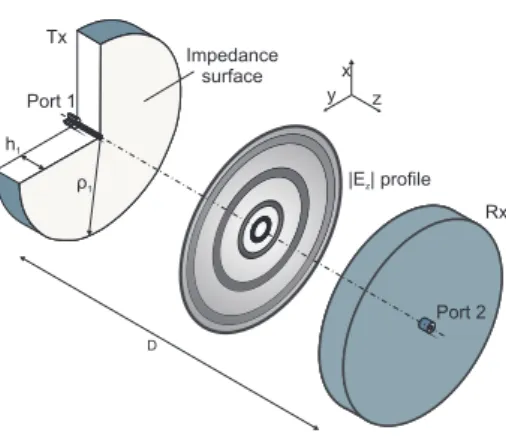
Recently, two papers by the authors [2], [3] have shown that it is possible to generate propagating Bessel beams in the mi-crowave frequency range using planar structures. In particular, propagating Bessel beams are generated using a leaky radial waveguide. The waveguide consists of an impedance sheet above a ground plane, fed by a coaxial probe (see Fig. 1). The resulting structure is simple to fabricate, planar and extremely compact in contrast to earlier structures [4]-[6].
In the present work, a system consisting of two identical leaky radial waveguides (transmitter and receiver) is consid-ered. The link budget associated with this system, capable of generating and receiving propagating Bessel beams, is found. The transmitter and receiver are axially aligned and separated by a distance D (see Fig. 1) in free space. Full-wave simu-lations are used to characterize the system in terms of two-port network parameters. This is in contrast to earlier works on Bessel beams which were based on approximate order-of-magnitude calculations [7]. For comparison purposes, a second
x y z D Port 1 Port 2 |E | profilez Tx Rx ρ1 h1 Impedance surface
Fig. 1. Schematic of the propagating Bessel beam system. The transmitter and receiver are leaky radial waveguides. The leaky radial waveguide, with a metallic rim at ρ1, consists of an impedance surface above a ground plane. The transmitter and receiver are axially aligned and separated by a distance D in free space. The Bessel profile for the Ez component is graphically shown in the figure.
configuration of identical, leaky radial waveguides is also considered. It consists of two leaky radial waveguides directly
connected by a circular waveguide (with radial dimension ρ1).
The same resonances are found for the two configurations within the non-diffractive range of the generated Bessel beam. The power efficiency of the original system is evaluated using
an accurate network approach. Efficiencies of greater than85%
at10 GHz are possible within the non-diffractive range with
a simultaneous conjugate match at receiver and transmitter, and proper Bessel beam tuning. Such high efficiencies are attributed to the focusing behavior and reduced radiation losses of propagating Bessel beams.
II. LEAKY-WAVERADIALWAVEGUIDE
The design procedure for the leaky-wave radial waveguides (transmitter and receiver) is provided in [2], [3]. As shown in these references, the zeroth-order Bessel profile is imposed on the z component of the electric field. Due to the symmetry of the structure only transverse magnetic-polarized (TM) Bessel beams (with respect to z in Fig. 1) are considered. The design parameters for the leaky radial waveguide are the frequency
of operation f0, the transverse complex wavenumber kρ =
βρ−jαρ of the desired Bessel beam and the non-diffractive
range. The value of the impedance sheet (Zs), height (h1) and
Fig. 1). In the present case, we assume: f0= 10 GHz and kρ=
(0.83 − j0.022)k0 and the non-diffractive range is z <2λ0.
Therefore, it follows that Zs= −25j Ω, h1= 1 mm and ρ1=
2.96λ0= 88.89 mm (λ0and k0are the free space wavelength
and wavenumber at f = 10 GHz, respectively). The behavior
of the radial waveguide as a Bessel beam launcher was verified
through full-wave simulations [8]. The Ez component of the
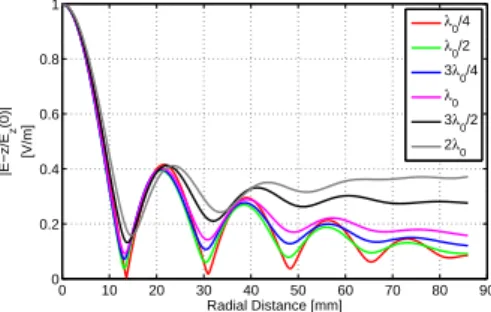
electric field was derived within the non-diffractive range of the leaky radial waveguide, as shown in Fig. 2. For small
distances (z <1.25λ0), the shape of the Bessel beam profile
remains nearly unchanged with distance, as expected for a Bessel beam. Further away from the aperture, the Bessel beam shape is preserved only in the main beam and increased side lobes appear. 0 10 20 30 40 50 60 70 80 90 0 0.2 0.4 0.6 0.8 1 Radial Distance [mm] |E−z/E z (0)| [V/m] λ0/4 λ0/2 3λ0/4 λ0 3λ0/2 2λ0
Fig. 2. Normalized Ez component at different distances above the leaky radial waveguide: z = 0.5-2λ0.
III. FREERESONANCE ANDPOWEREFFICIENCY OF THE
SYSTEM
The link budget for the system shown in Fig. 1 is evaluated. The ports of the system correspond to the coaxial feeds. Full-wave simulations are used to derive the admittance matrix (Y-matrix) of the system for different separation distances D [8] of transmitter and receiver. It should be noted that the Y-matrix representation takes into account the radiation losses associated with the system. A closed structure consisting of two leaky radial waveguides directly connected by a circu-lar waveguide is also considered for comparison purposes. The circular waveguide is chosen to have the same radial
dimension, ρ1, as the leaky radial waveguides (see Fig. 1).
This ensures that the circular waveguide wall coincides with a
zero of the Ez Bessel profile generated by the leaky-radial
waveguides. Therefore, the circular waveguide should not perturb the propagation of the Bessel beams. It is worth noting that the closed configuration eliminates radiation loss and therefore represents the most efficient power transfer possible between the two Bessel beam launchers. The equivalence be-tween the two configurations is verified by deriving their free resonances. In particular the zeros of the determinant of the Y-matrix are derived for the open structure, whereas a transverse resonance technique is adopted for the closed case. The same resonances are found for the two configurations within an
error of 0.6% for distances within the non-diffractive range
of the generated Bessel beam. This confirms that that both
configurations are equivalent thanks to the accurate generation of Bessel beams by the leaky radial waveguide. To further validate this observation, the power efficiency of the open configuration is computed from the Y-matrix using standard network theory. The power efficiency is defined as the ratio of power delivered to the load to the power available from the source [9]. A simultaneous conjugate match is imposed on the two ports for maximum power transfer [9], [10].
The efficiency can exceed 85% at the operating frequency
of 10 GHz, within the non-diffractive range of the Bessel
beam. However, proper tuning of the Bessel launcher is needed to take into account the frequency shift associated with the coupling between transmitter and receiver. This high efficiency is due to the focusing behavior and reduced radiation losses of propagating Bessel beams.
IV. CONCLUSION
The power link budget for propagating Bessel beams has been studied. The propagating Bessel beams are generated using leaky radial waveguides. Full-wave simulations and clas-sical network theory are used to evaluate the power efficiency and resonances of the system. It is found that the system is equivalent to a closed system consisting of a circular waveg-uide connecting two leaky radial wavegwaveg-uides. In addition,
an efficiency in excess of 85% is reported within the
non-diffractive range of the generated Bessel beam. The proposed system consisting of a Bessel beam transmitter and reciever may find application in areas such as wireless power transfer, near-field communication and non-destructive evaluation.
ACKNOWLEDGEMENT
M. Ettorre would like to thank the University of Rennes 1, Rennes, France, for its support and financial contribution. A. Grbic would like to acknowledge the support of the Presidential Early Career Award for Scientists and Engineers (FA9550-09-1-0696).
REFERENCES
[1] J. Durnin, “Exact Solutions for nondiffracting Beams. I. The scalar theory,” J. Opt. Soc. Am. A., vol. 4, no. 4, pp. 651-654, Apr. 1987. [2] M. Ettorre, and A. Grbic, “Generation of Propagating Bessel Beams
using Leaky-Wave Modes,” IEEE Trans. Antennas Propag., vol. 60, no. 8, pp. 3605-3613, Aug. 2012.
[3] M. Ettorre, S. M. Rudolph, and A. Grbic, “Generation of Propagating Bessel Beams using Leaky-Wave Modes: experimental validation,” IEEE
Trans. Antennas Propag., vol. 60, no. 8, pp. 2645-2653, June 2012.
[4] S. Monk, J. Arlt, D. A. Robertson, J. Courtial, and M. J. Padgett, “The Generation of Bessel beams at millimetre-wave frequencies by use of an axicon,” Opt. Commun., vol. 170, pp. 213-215, Nov. 2000. [5] Z. Li, K. B. Alici, H. Caglayan, and E. Ozbay, “Generation of an
Axially Asymmetric Bessel-Like Beam from a Metallic Subwavelength Aperture,” Phys. Rev. Lett., vol. 102, no. 14, Apr. 2009.
[6] M. A. Salem, A. H. Kamel, and E. Niver, “Microwave Bessel beams generation using guided modes,” IEEE Trans. Antennas Propag., vol. 59, no. 6, pp. 2241-2247, June 2011.
[7] J. Durnin, J. J. Miceli, Jr., and J. H. Eberly, “Comparison of Bessel and Gaussian beams,” Opt. Lett., vol. 13, no. 2, pp. 79-80, Feb. 1988. [8] Comsol Multiphysics version 4.2, 1997-2012 COMSOL AB.
[9] D. M. Pozar, Microwave Engineering, 2nd ed., John Wiley & Sons, Inc., New York, 1998.
[10] M. Ettorre, and A. Grbic, “A transponder-based, nonradiative wireless power transfer,” IEEE Antennas Wireless Propag. Lett., vol. 10, pp. 1150-1153, Dec. 2012.