HAL Id: hal-00848880
https://hal.archives-ouvertes.fr/hal-00848880
Submitted on 13 Jan 2014
HAL is a multi-disciplinary open access
archive for the deposit and dissemination of
sci-entific research documents, whether they are
pub-lished or not. The documents may come from
teaching and research institutions in France or
abroad, or from public or private research centers.
L’archive ouverte pluridisciplinaire HAL, est
destinée au dépôt et à la diffusion de documents
scientifiques de niveau recherche, publiés ou non,
émanant des établissements d’enseignement et de
recherche français ou étrangers, des laboratoires
publics ou privés.
Wavelength conversion in a highly nonlinear
chalcogenide microstructured fiber
Sy Dat Le, Mathilde Gay, Laurent Bramerie, Marcia Costa E Silva, Kevin
Lenglé, Thierry Chartier, Monique Thual, Jean-Claude Simon, Laurent
Brilland, Perrine Toupin, et al.
To cite this version:
Sy Dat Le, Mathilde Gay, Laurent Bramerie, Marcia Costa E Silva, Kevin Lenglé, et al.. Wavelength
conversion in a highly nonlinear chalcogenide microstructured fiber. Optics Letters, Optical Society
of America - OSA Publishing, 2012, 37 (22), pp.4576-4578. �10.1364/OL.37.004576�. �hal-00848880�
Wavelength conversion in a highly nonlinear chalcogenide
microstructured fiber
Sy Dat Le,1,2,∗
Mathilde Gay,1,2 Laurent Bramerie,1,2 Marcia Costa e Silva,1,2 Kevin Lengl´e,1,2
Thierry Chartier,1,2 Monique Thual,1,2 Jean-Claude Simon,1,2 Laurent Brilland,3
David M´echin,3
Perrine Toupin,1,4 and Johann Troles,1,4
1
Universit´e europenne de Bretagne, 5 Boulevard Lannec, 35000 Rennes, France
2
CNRS Foton (UMR 6082), 6 rue de Kerampont, BP 80518, 22305 Lannion cedex, France
3
PERFOS, R&D platform of Photonics Bretagne, 11 rue Louis de Broglie, 22300 Lannion, France
4
CNRS Sciences Chimiques de Rennes (UMR 6226), Universit´e de Rennes 1, 35000 Rennes, France
∗Corresponding author: [email protected]
Compiled May 23, 2013
We report on all-optical wavelength conversion of a 56 Gb/s differential quadrature phase shift keying signal and a 42.7 Gb/s on-off keying signal. Wavelength conversion is based on four-wave mixing effect in a 1 m-long highly nonlinear GeAsSe chalcogenide fiber. The high nonlinearity of the fiber allows low power penalty operation with a total average power of less than 60 mW. ⃝c 2013 Optical Society of America
OCIS codes: 060.4005, 190.4380, 070.4340.
All-optical signal processing, such as amplification, re-generation, time-domain demultiplexing or wavelength conversion, has recently drawn a lot of interests. Among these all-optical functions, wavelength conversion is ex-pected to play a useful role in the future optical network to achieve wavelength flexibility. Wavelength conversion can be performed by semiconductor optical amplifiers, saturable absorbers or other nonlinear materials. The advantage of nonlinear materials with strong Kerr effect is their fast response-time and their passive operation. This make them excellent candidates for high-bit-rate all-optical signal processing in general and wavelength conversion in particular.
Due to their high Kerr nonlinearity, chalcogenide glasses are one of the most favorite choices to fabri-cate highly-nonlinear components. The nonlinear refrac-tive index of chalcogenide glasses may be greater than that of fused silica several hundred times. Recently, a chalcogenide fiber with a suspended-core structure has been reported [1]. Its core diameter, as small as 1.13 µm, has allowed reaching a nonlinear coefficient up to 46 000 W−1km−1. However, this fiber exhibited a
mul-timode behavior.
By utilizing nonlinear components made of chalco-genide glasses, some studies have been carried out to perform all-optical wavelength conversion based on four-wave mixing (FWM). The first demonstration has been proposed by V. G. Ta’eed et al. at 10 Gb/s in a 1 m-long AsSe chalcogenide fiber [2] with a peak power of 2.1 W. L. B. Fu et al. reported a 40 Gb/s wavelength conver-sion in a tapered chalcogenide fiber with a total aver-age power of 180 mW [3]. Recently, M. D. Pelusi et al. have successfully demonstrated wavelength conversion of a 40 Gb/s differential phase shift keying (DPSK) signal in a AsS chalcogenide waveguide with a total average power of 400 mW [4].
In this letter, we present a 1 m-long chalcogenide fiber with a single-mode behavior. Its Kerr nonlinearity of about 11 000 W−1km−1 allows error-free FWM-based
wavelength conversion with a total average power of less than 60 mW. The fiber is first briefly presented. Exper-imental results on wavelength conversion of a 42.7 Gb/s on-off keying (OOK) signal and a 56 Gb/s DQPSK signal will be presented.
The fiber is fabricated according to the casting method described in Ref. [5]. The glass composition is Ge10As22Se68. To fabricate the fiber, a microstructured
preform is prepared with a structure of three rings of holes around a solid core. The GeAsSe chalcogenide mi-crostructured fiber is then drawn from the preform by applying differential pressures in the holes. The nonlin-ear refractive index n2 of the GeAsSe glass is estimated
between 400 times and 500 times greater than that of fused silica. 10 LA (cm) 3 LTF (cm) ~2.2 ~4.8 58 125 100 φCF (µm) φCA (µm) φF (µm) φFA (µm) LF (cm) LTF LF φFA φF LTF φCF φCA LAF
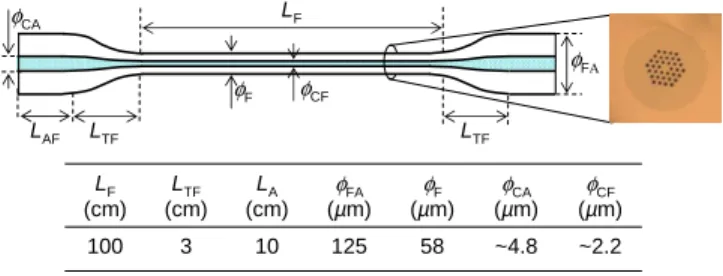
Fig. 1. Chalcogenide GeAsSe microstructured fiber.
In order to reach a high nonlinear coefficient γ, the fiber has been drawn with a core diameter as small as possible. However, small-core fibers are difficult to cou-ple with conventional fibers. For this reason, our fiber is drawn with different core diameters as shown in Fig. 1. The input and output ends of the fiber are drawn with a core diameter φCA of 4.75 µm, while the main part of
the fiber is drawn with a core diameter φCF of 2.2 µm.
Thanks to this tapering process during the drawing, the fiber offers the advantage of a highly-nonlinear part (the waist) and mode-adaptation parts at two ends to facili-tate the coupling. The length LF of the nonlinear part of
the fiber is 1 m. The length LA of the mode-adaptation
parts is 10 cm, and the length LT F of the tapers is
around 3 cm. The total length of the fiber is 1.26 m. The coupling in the microstructured fiber is realized by using a Gradhyp microlensed fiber [6] with a mode field diameter of 4.8 µm, very close to the input and output core diameters of the fiber. This allows us to limit the coupling loss. The ratio between the power at the output of the microlensed fiber and the power at the output of the chalcogenide fiber is 6.6 dB at 1550 nm. This value includes the loss due to Fresnel reflections (1 dB per facet for this glass) and the attenuation of the fiber which is 2.5 dB/m in our case. The additional losses of 1.4 dB are due to coupling loss and taper loss.
Based on self-phase modulation (SPM), the nonlinear coefficient γ and the dispersion D of the fiber have been estimated. A mode-locked laser emitting Gaussian pulses of 8 ps at 1550 nm with a repetition rate of 20 MHz was used for SPM characterization. By comparing the exper-imental and the simulated spectral broadening, we ob-tained a nonlinear coefficient γ of 11 000 W−1km−1and
a group-velocity dispersion D of −500 ps/km/nm [7]. 3 dB Coupler 5 nm VA EDFA PC EDFA Pump GeAsSe fiber Free-space Coupling PC Signal Rx 1 nm CW laser 42.7 Gb/s RZ-33%
Fig. 2. Experimental setup for wavelength conversion. Utilizing the GeAsSe fiber, we implemented the FWM-based wavelength conversion, in which the new wave at a new wavelength is generated from a signal wave and a pump wave. The experimental setup for wavelength conversion of 42.7 Gb/s signal is depicted in Fig. 2. The 42.7 Gb/s return-to-zero (RZ) transmitter generates pulses at 1553 nm with a full-width at half-maximum of 8.3 ps. The 42.7 Gb/s signal is amplified by an erbium doped fiber amplifier (EDFA). The tunable continuous wave (CW) pump is amplified by a second EDFA. After amplifiers, both signal and CW waves pass through po-larization controllers (PC) and are combined by a 3-dB coupler. Both waves are filtered by an optical flat-top band-pass filter of 5 nm to reject the amplified spon-taneous emission noise of EDFAs. To adjust the power launched into the chalcogenide fiber, a variable attenu-ator (VA) is used just after the 5 nm filter. The optical power is coupled into and out of the fiber using the mi-crolensed fibers as described previously.
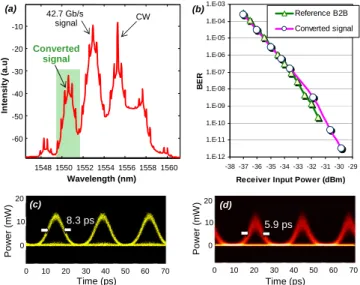
The CW pump wavelength is tuned to set the wave-length of the converted signal. Fig. 3a illustrates an
ex-ample of output spectrum for a wavelength detuning ∆λ of 2.6 nm with respect to the data signal. The spectrum clearly exhibits first-order and second-order idler waves. In this case, the total average power at the output of the microlensed fiber is 56 mW with a CW power of 26 mW. By taking into account injection loss around 2.4 dB, we estimate that the total average power launched into the nonlinear part of the GeAsSe fiber is about 32 mW.
1.E-12 1.E-11 1.E-10 1.E-09 1.E-08 1.E-07 1.E-06 1.E-05 1.E-04 1.E-03 -38 -37 -36 -35 -34 -33 -32 -31 -30 -29 Receiver Input Power (dBm)
B E R Reference B2B Converted signal Converted signal 1548 1550 1552 1554 1556 1558 1560 -60 -50 -40 -30 -20 -10 Wavelength (nm) In te n s it y (a .u ) CW 42.7 Gb/s signal (a) (b) Time (ps) P o w e r (m W ) 5.9 ps 0 10 20 30 40 50 60 70 0 10 20 (d) Time (ps) P o w e r (m W ) 8.3 ps 0 10 20 0 10 20 30 40 50 60 70 (c)
Fig. 3. (a) Spectrum at the output of GeAsSe fiber, (b) BER measurement, and eye-diagram of (c) original and (d) converted 42.7 Gb/s signal.
To assess the FWM conversion efficiency of the first-order idler wave, we have measured the ratio between the collected peak power of the idler wave at the output of the chalcogenide fiber and the signal power at 42.7 Gb/s injected in the chalcogenide fiber. The FWM conversion efficiency is found to be −27 dB with a pump power launched into the chalcogenide fiber of only 15 mW and a detuning ∆λ of 2.6 nm.
To analyse the converted signal, a 1 nm band-pass filter centered at 1550.4 nm is used after the GeAsSe fiber. The filtered signal is amplified by an EDFA before detection. Performance of the wavelength conversion is assessed by bit-error-rate (BER) measurements versus receiver input power for a 42.7 Gb/s pseudorandom bit sequence (PRBS) length of 231
−1 bits. The Fig. 3b shows the evolution of the BER for the back-to-back (B2B) case and for the converted signal. Error free wavelength con-version is achieved. A negligible power penalty of 0.4 dB is found for a BER of 10−9.
Fig. 3c and 3d show the eye-diagrams of the origi-nal and converted 42.7 Gb/s sigorigi-nals, respectively. Note in Fig. 3d that the optical signal-to-noise ratio is much lower than in Fig. 3c due to less available power for the 42.7 Gb/s converted signal. The pulse duration of the converted signal is measured to be 5.9 ps. It agrees with the theory that the converted pulses are compressed by a factor of the square root of 2 from the original pulse of duration 8.3 ps. This is due to the fact that the idler
signal is proportional, in our case, to the square of the original 42.7 Gb/s signal.
In order to determine the conversion range, we have measured FWM efficiency as a function of the wave-length detuning ∆λ. The results are presented in Fig-ure 4. They have been obtained with two CW pumps with a total power of 15.3 dBm. From this curve, we es-timate that the conversion range at 3 dB is about 2.8 nm.
Fig. 4. FWM efficiency versus wavelength detuning We now consider the 56 Gb/s DQPSK wavelength con-version. The DQPSK signal is generated by a nested Mach-Zehnder modulator with 215
− 1 bit length PRBS. The experimental setup for 56 Gb/s DQPSK wavelength conversion is the same as for the 42.7 Gb/s OOK sig-nal. The wavelength of the DQPSK signal is centered at 1556.2 nm. The wavelength of the converted signal is changed with the CW pump wavelength tuning. In the experiment, the wavelength of the CW pump is set to 1557.8 nm leading to a detuning ∆λ of 1.6 nm between the signal and the pump. Since the DQPSK spectrum is narrower than the OOK spectrum, we choose a smaller detuning in order to have more FWM efficiency.
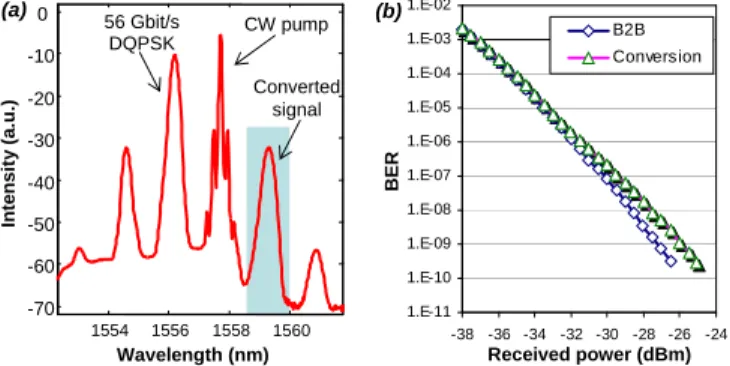
An example of optical spectrum at the output of the GeAsSe fiber is shown in Fig. 5a. It exhibits FWM waves shifted by ∆λ on both sides of the initial waves. Con-trary to OOK wavelength conversion, DQPSK wave-length conversion should preserve the phase of the signal. The converted signal must then be the one proportional to the input signal, not to the square of the input signal. In our experiment, it corresponds to the wave close to the CW pump, centered at 1559.4 nm. At the output of the GeAsSe fiber, a 1 nm band-pass filter centered at 1559.4 nm is used to extract the converted signal. The total average power at the output of the VA is set to 45 mW, including a CW pump power of 25 mW. The power of the converted signal after the 1 nm filter is measured to be −22 dBm.
The receiver uses a fiber-based delay-line interferom-eter and balanced detectors for BER analysis. Fig. 5b shows BER measurements of the converted signal as a function of the power on the receiver. The B2B case is also represented for comparison. A power penalty of about 1 dB for a BER of 10−9 is found. Error-free
wave-length conversion of a 56 Gb/s DQPSK signal has there-fore been demonstrated with a conversion shift of 3.2 nm
1554 1556 1558 1560 -70 -60 -50 -40 -30 -20 -10 0 Wavelength (nm) In te n s it y (a .u .) CW pump 56 Gbit/s DQPSK Converted signal (a) 1.E-11 1.E-10 1.E-09 1.E-08 1.E-07 1.E-06 1.E-05 1.E-04 1.E-03 1.E-02 -38 -36 -34 -32 -30 -28 -26 -24 B2B Conversion Received power (dBm) B E R (b)
Fig. 5. (a) Spectrum at the output of GeAsSe fiber, and (b) 56 Gb/s DQPSK BER measurement.
(twice the detuning ∆λ) and a total average power of 45 mW. Due to the strong value of the fiber disper-sion, the detuning ∆λ is limited to about 3 nm and may not allow to process signals with bit rates higher than 80 Gb/s.
To conclude, a new chalcogenide GeAsSe mi-crostructured fiber with a nonlinear coefficient of 11 000 W−1km−1 and attenuation loss of 2.5 dB/m is
presented. We have experimentally demonstrated, for the first time to our best knowledge, a 56 Gb/s DQPSK and a 42.7 Gb/s OOK FWM-based wavelength conver-sion in a microsctructured chalcogenide fiber. Error-free wavelength conversion has been obtained for both cases with total average powers lower than 60 mW. These re-sults show the capability of chalcogenide microstructured fibers into all-optical signal processing at high-bit-rate.
This work is supported by the Conseil R´egional de Bretagne, the Conseil G´en´eral des Cˆotes d’Armor, the European Union Feder program and the French govern-ment.
References
1. S. D. Le, D. M. Nguyen, M. Thual, L. Bramerie, M. Costa e Silva, K. Lengl´e, M. Gay, T. Chartier, L. Bril-land, D. M´echin, P. Toupin, and J. Troles, Optics Ex-press 19, B653B660 (2011).
2. V. Ta’Eed, L. Fu, M. Pelusi, M. Rochette, I. Littler, D. Moss, and B. Eggleton, Optics Express 14, 10371 (2006).
3. L. Fu, M. Pelusi, E. Magi, V. Ta’eed, and B. Eggleton, Electronics Letters 44, 44 (2008).
4. M. Pelusi, F. Luan, S. Madden, D. Choi, D. Bulla, B. Luther-Davies, and B. Eggleton, Photonics Technol-ogy Letters, IEEE 22, 3 (2010).
5. Q. Coulombier, L. Brilland, P. Houizot, T. Chartier, T. Nguyen, F. Smektala, G. Renversez, A. Monteville, D. M´echin, T. Pain, H. Orain, J.-C. Sangleboeuf, and J. Troles, Optics Express 18, 9107 (2010).
6. M. Thual, P. Rochard, P. Chanclou, and L. Quetel, Fiber and Integrated Optics 27, 532 (2008).
7. S. D. Le, D. Nguyen, M. Thual, L. Bramerie, M. Costa e Silva, K. Lengl´e, M. Gay, T. Chartier, J.-C. Simon, L. Brilland, D. M´echin, P. Toupin, and J. Troles, in OFC Conference (Optical Society of America, 2012).
Informational Fourth Page
In this section, please provide full versions of citations to assist reviewers and editors (OL publishes a short form of citations) or any other information that would aid the peer-review process.
References
1. S. D. Le, D. M. Nguyen, M. Thual, L. Bramerie, M. Costa e Silva, K. Lengle, M. Gay, T. Chartier, L. Bril-land, D. Mechin, P. Toupin, and J. Troles, “Efficient four-wave mixing in a ultra-highly nonlinear suspended-core chalcogenide As38Se62 fiber”, Optics Express 19,
B653B660 (2011).
2. V. Ta’Eed, L. Fu, M. Pelusi, M. Rochette, I. Littler, D. Moss, and B. Eggleton, “Error free all optical wave-length conversion in highly nonlinear AsSe chalcogenide glass fiber”, Optics Express 14, 10371 (2006).
3. L. Fu, M. Pelusi, E. Magi, V. Ta’eed, and B. Eggle-ton, “Broadband all-optical wavelength conversion of 40 Gbit/s signals in nonlinearity enhanced tapered chalco-genide fibre”, Electronics Letters 44, 44 (2008). 4. M. Pelusi, F. Luan, S. Madden, D. Choi, D. Bulla,
B. Luther-Davies, and B. Eggleton, “Wavelength con-version of high-speed phase and intensity modulated sig-nals using a highly nonlinear Chalcogenide glass chip”, Photonics Technology Letters, IEEE 22, 3 (2010). 5. Q. Coulombier, L. Brilland, P. Houizot, T. Chartier,
T. NGuyen, F. Smektala, G. Renversez, A. Monteville, D. M´echin, T. Pain, H. Orain, J.-C. Sangleboeuf, and J. Troles, “Casting method for producing low-loss chalcogenide micro-structured optical fibers”, Op-tics Express 18, 9107 (2010).
6. M. Thual, P. Rochard, P. Chanclou, and L. Quetel, “Contribution to research on Micro-Lensed Fibers for Modes Coupling”, Fiber and Integrated Optics 27, 532 (2008).
7. S. D. Le, D. Nguyen, M. Thual, L. Bramerie, M. Costa e Silva, K. Lengl´e, M. Gay, T. Chartier, J.-C. Simon, L. Brilland, D. M´echin, P. Toupin, and J. Troles, “42.7 Gbit/s RZ-33% wavelength conversion in a Chalcogenide microstructured fiber”, in Optical Fiber Communication Conference (Optical Society of America, 2012).