HAL Id: hal-00981219
https://hal.sorbonne-universite.fr/hal-00981219
Submitted on 21 Apr 2014HAL is a multi-disciplinary open access archive for the deposit and dissemination of sci-entific research documents, whether they are pub-lished or not. The documents may come from teaching and research institutions in France or abroad, or from public or private research centers.
L’archive ouverte pluridisciplinaire HAL, est destinée au dépôt et à la diffusion de documents scientifiques de niveau recherche, publiés ou non, émanant des établissements d’enseignement et de recherche français ou étrangers, des laboratoires publics ou privés.
A new hybrid functional including a meta-GGA
approach
Julien Toulouse, Carlo Adamo
To cite this version:
Julien Toulouse, Carlo Adamo. A new hybrid functional including a meta-GGA approach. Chemical Physics Letters, Elsevier, 2002, 362, pp.72. �10.1016/S0009-2614(02)00950-8�. �hal-00981219�
A new hybrid functional including a meta-GGA approach
Julien TOULOUSE and Carlo ADAMO*
Laboratoire d’Electrochimie et de Chimie Analytique, UMR 7575, ENSCP, 11 rue P. et M.
Curie, F-75231 Paris Cedex 05, France
May 27, 2002
Abstract
In this paper we propose a new hybrid exchange-correlation functional, in which a recently developed exchange (mPBE) and a meta-GGA correlation (KCIS) are integrated in a hybrid Hartree-Fock/Density Functional Theory scheme. In such approach only one, or two in the G2-optimized version, parameters are adjusted on experimental data, all the others being derived from purely theoretical considerations. The results obtained for a set of molecular properties, including van der Waals and H-bonded complexes, are satisfactory and not far from those delivered by the most reliable functionals including heavy parameterization. The way in which the functional is derived and the few empirical parameters used make the new exchange–correlation functional widely applicable.
1. Introduction
Density Functional Theory [1] (DFT) is nowadays a widely used tool for electronic structure calculations of atoms, molecules and solids. In the application of this theory within the Kohn-Sham formalism, the only contribution to the total energy that needs to be approximated is the exchange-correlation energy. The determination of improved exchange-correlation functionals is therefore of vital importance in chemical applications to obtain accurate numerical molecular properties [2]. As matter of fact, a large number of approximations for such a contribution have been developed, ranging from the simple local density approximation to the more complex generalized gradient approximations (GGA’s), where the gradient of the density, , is introduced [3]. More recently, the so-called meta-GGA approaches, including also a part explicitly depending upon the kinetic energy density () and/or the Laplacian(2), have been attracted much attention [4-6]. Such methods are very promising, since they introduce more non-local or semilocal information and, at the same time, they correct some faults of the parent GGA (e.g. self interaction error) [7]. Unfortunately, meta-GGA functionals have not yet reached numerical performances comparable with the GGA’s [7,8]. As matter of fact, they can be considered as a significant improvement only for some properties (e.g. thermochemistry) [7,8], while poor performances are provided for other molecular parameters (e.g. geometries) [9]. Furthermore, hybrid functionals, which mix a fraction of Hartree-Fock (HF) exchange with Kohn-Sham (KS) exchange, gained a prominent position, due to the quality of their numerical results [10,2]. While this last approach has been largely explored for GGA functionals [11], the application to meta-GGA functionals is still questionable, these latter being so far less prone to hybrid schemes [8,9].
In this context, we believe that the reliability of a functional depends on the fulfillment of the largest possible number of theoretical/physical conditions for the exact functional and, at the same time, on the presence of the minimum number of adjustable parameters. Few functionals nowadays are derived by “first principles” rules and, among others, we recall the functional of Perdew, Burke and Ernzerhof (PBE), which can be considered as a milestone among GGA’s [12]. Recently, we have proposed an exchange functional (hereafter referred to as mPBE) which is founded on the same basis of the PBE exchange, but it provides better numerical performance [13]. More involved is the situation for the correlation forms, since the respect of the physical constrains is more troublesome. Krieger, Chen, Iafrate and Savin have proposed a meta-GGA correlation functional, based on the idea of an uniform electron
gas with a gap in the excitation spectrum [14,15]. This functional is, in our opinion, particularly appealing, since it preserves many of the known properties of the exact correlation energy [7] and it has no empirical parameters. Despite its promising features, the KCIS functional has never been tested beyond small molecular (atomic) systems.
Following the idea of Becke [4], here we present a meta-GGA-based hybrid functional, which casts the mPBE exchange and the KCIS correlation contribution. Such functional is still rooted on a solid physical background, having just one free condition to be fixed in the exchange part and the percent of the HF exchange to be chosen. The results obtained with this new functional have been compared with those provided by other hybrid and meta-GGA approaches for some test cases on covalent and non-covalent bonded molecules. We will show that some of the failures of the other functionals are corrected by our proposal.
2. Computational details
All the computations were carried out within the Kohn-Sham formalism. We have implemented the KCIS correlation functional [14,15], as well as its first and second derivatives in the development version of the Gaussian code [16]. In this way all the standard features of the package are still available [17]. We refer the reader to the original papers (references 14 and 15) for the rather complex analytical expression of the KCIS. The gradient correction in the mPBE exchange functional has, instead, a simpler form:
2 2 2 2 2 2 11 1 1 ks s C ks s C FxmPBE (1)
where s = /2(32)1/34/3. In equation (1), two of the three parameters are determined by the PBE conditions and the third is adjusted on the exchange energies of the first and second row atoms [13]. The final values are: C1= 0.21951 , C2= -0.015; k=0.157.
Next, a number of hybrid functionals can be generated from the general formula
mPBEKCIS xc mPBE x HF x hyb xc a E E E E ( ) (2)
The parameter a can be fixed “a priori” to 0.25 as in the original PBE0 model [18,19] or, following the Becke procedure, fitted to experimental data (here a=0.177, see infra) [4]. Both possibilities, leading to the mPBE0KCIS and to the mPBE1KCIS functionals respectively, will be considered in the present paper.
A number of tests have been also carried out with the mPBE functional coupled to the original PBE correlation or with PBE exchange-correlation functional, either pure or mixed with 25% of HF exchange [12,13]. These models will be shortly referred to as mPBE, PBE and PBE0, respectively. The meta-GGA approach by Perdew, Kurth, Zupan and Blaha (PKZB) [6,9] will be also considered for some comparisons. We recall that this functional contains two fitted parameters [6]. Finally, the heavy parameterized meta-GGA model VSXC [25] containing no less than 21 parameters adjusted on atomization energies and ionization potentials will be compared to ours functionals.
A number of different basis sets have been used (please refer to reference 17 and references inside for standard methodologies). In particular, the 6-311G(d,p) basis set has been used to optimize all the molecular structures, since previous experience showed that a polarized valence triple- basis set generally provides nearly converged structural parameters by DFT methods [11]. An extended basis set, namely the 6-311++G(3df,3pd) one, has been next used to evaluate all the energetic parameters (atomization and dissociation energies), while a DFT optimized basis set, derived from the aug-cc-pV5Z basis, has been considered for He and Ne [20].
When necessary, interaction energies have been corrected for basis set superposition error (BSSE) [21].
3. Results and discussion.
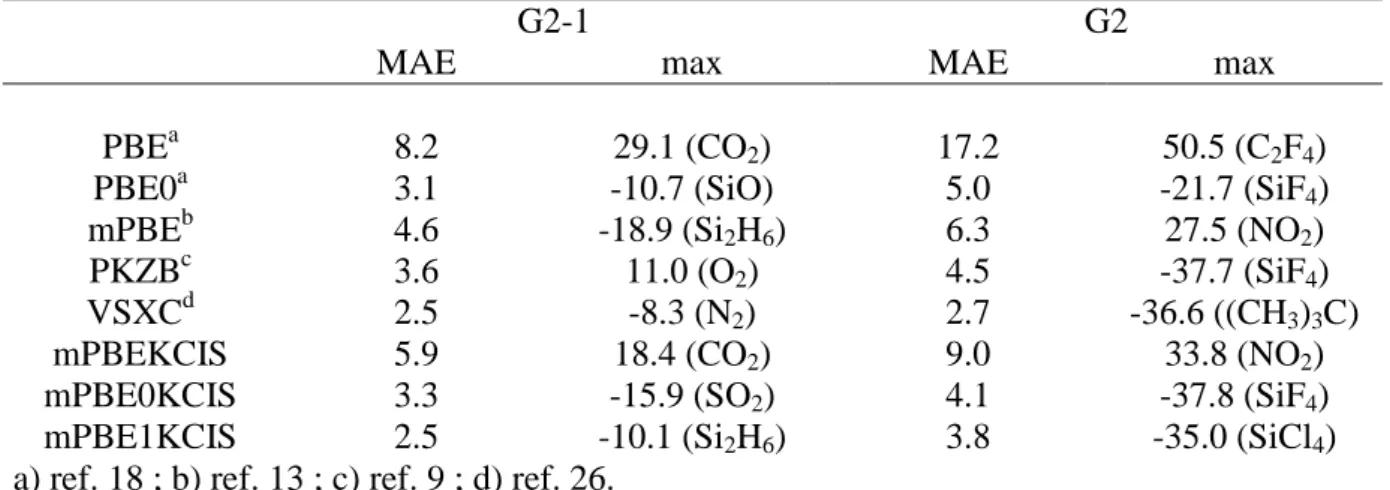
As a first test, we have considered both the standard G2-1 (55 molecules) and the extended G2 (148 molecules) sets using second-order Moller-Plesset geometries. Although the choice of the molecules included in such training sets is arbitrary, this selection allows a direct comparison of our results with previously published data [9,13,19,20]. The mean average errors (mae’s) for the atomization energies, computed using the experimental values taken from reference 22, are collected in table I. In the same table are reported the results obtained with the other functionals considered, i.e. PBE, PBE0 and PKZB. The results provided by the mPBEKCIS approach are intermediate between the PBE and the mPBE values. As for this latter approach, there is not a dramatic difference between the mae’s for the standard and the extended G2 set, as observed, instead, for PBE. This suggest that mPBEKCIS provides a balanced description both for the small covalent molecules of the standard G2 set and for the congested systems or aromatic cycles included in the extended set.
Next we have introduced the mPBEKCIS in a hybrid scheme, following the “parameter free” approach where HF/DFT exchange ratio is fixed a priori to ¼ [23], on a defined theoretical
ground [24]. Since no additional parameter is introduced in the functional, it will be referred to as mPBE0KCIS, the « 0 » in the acronym pointing out this characteristic. Here a significant improvement is found: the mae drops to 3.3 kcal/mol for the standard set and to 4.1 kcal/mol for the extended one. Similar results are obtained only by the PBE0 (3.1 and 5.0 kcal/mol, respectively) or PKZB (3.6 and 4.5 kcal/mol, respectively) approaches. It is interesting to underlining this improvement, since some meta-GGA approaches, like PKZB, do not allow for the inclusion of HF exchange [9].
An even better result can be obtained by fitting the coefficient a, ruling the HF/DFT exchange ratio (equation (2)) on the G2-1 properties. The best value for the mae is obtained for
a=0.177. The functional, denoted as mPBE1KCIS, gives a mae of 2.5 and 3.8 kcal/mol over
the G2-1 and G2 data sets, respectively. These latter values are close to those provided by a heavy parameterized meta-GGA model like VSXC, for which the mae on the small G2 set is 2.5 kcal/mol [26].
Starting from these results, we have performed a number of tests on the hybrid mPBE0KCIS and mPBE1KCIS functionals, in order to assess their reliability and field of employ. In fact, even if “first principle” functionals can correctly reproduce some specific molecular properties, they are not always suitable for general applications [9,13]. Several tests were performed but only the most important and meaningful in our opinion are here reported. As a first step, we have evaluated the total energies of some atoms, H through Ar. The results are collected in table II and are compared with accurate post-HF values (labeled as “exact” in the table) [27]. It is interesting to report these results, since total atomic energies have been recently added to a wide training set used to optimize DFT functionals [28]. In this context, it is assuring that already the pure mPBEKCIS functional provides good results, better than the original mPBE approach. Since they both use mPBE exchange, the difference between the two models points directly to the correlation contribution. Interesting, the total deviation is the same for the pure and hybrid functionals, but the mae’s are different for the first and second rows, those with HF exchange giving lower errors on the heavier atoms.
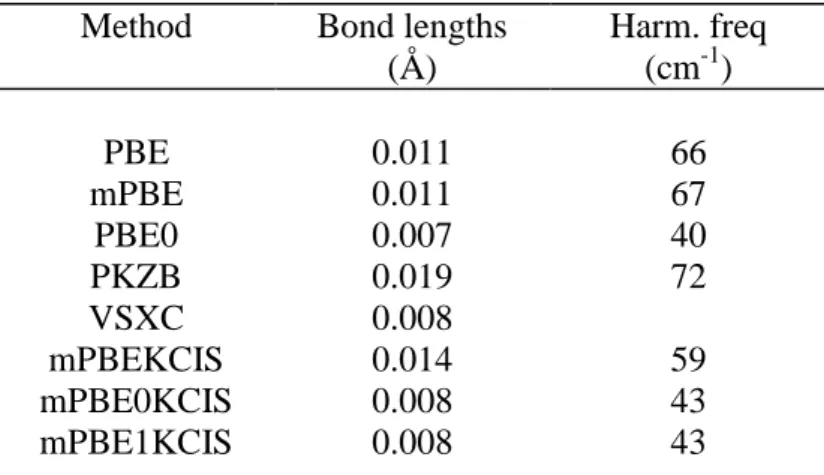
Next, the performances of our functionals on geometrical parameters have been analyzed optimizing the structure of the first 32 molecules belonging to the G2-1 set. The results obtained for bond lengths and harmonic frequencies are summarized in table III. In contrast with other theoretical meta-GGA approaches like PKZB, mPBEKCIS provides results as good as those obtained by the GGA approaches, like PBE and mPBE, or by the heavy parameterized meta-GGA model VSXC. A further improvement is then found upon the introduction of HF exchange, the data for mPBE0KCIS being close to those attained by
PBE0. The small difference in the percent of HF exchange between mPBE0KCIS and mPBE1KCIS does not induce any significant difference in the mae’s for bond lengths or harmonic frequencies.
To summarize we can conclude that the hybrid mPBE0KCIS and mPBE1KCIS functionals provide improved performances on the thermochemistry and, at the same time, retain the good features on the geometrical parameters characteristic of GGA models. Since both approaches perform better than the pure mPBEKCIS functional, we will no longer consider this latter in the following.
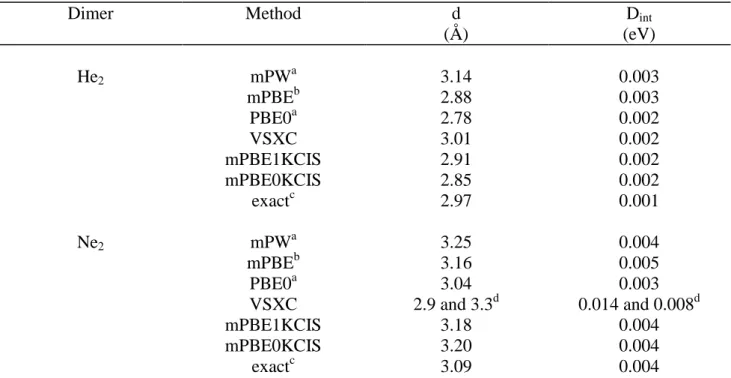
As above mentioned the choice of the molecular systems in the G2 set is arbitrary and, surely, not enough representative of the entire chemical bonding interactions beyond organic covalent molecules. So, in order to have a more complete picture of the functional performances, we have enlarged our training set to include non-covalent bonded systems. We have selected He, Ne, water, hydrogen fluoride, and hydrogen chloride dimers, since they are representative of both van der Waals (vdW) and hydrogen-bond interactions. It is well beyond the scope of this paper to make a complete review of the huge amount of results available for these systems. Therefore, we limit ourselves to discuss the results reported in table IV and V. Actually, it is well known [2] that vdW complexes are very difficult to handle in the framework of the DFT model, many functionals (as the popular B3LYP) giving a wrong estimate of the interaction strength in such systems [29, 20]. The numerical values for the energy minima of He and Ne dimers obtained with the mPBE0KCIS functional and corrected for BSSE effects are collected in table IV. From these data it is clear that such a model predicts interaction energies and equilibrium distances close to the experimental values [30]. In particular, our functional gives an equilibrium distance for the He dimer (2.85 Å) which is slightly lower than the experimental value (2.97 Å), while the interaction energies is predict to be higher (0.002 vs. 0.001 eV). Comparable small errors are found, anyway, for the mPW model [20], a functional specifically parameterized to reproduce vdW interactions. An even better agreement is next found for the Ne dimer (see table IV). The difference in the HF exchange fraction in mPBE1KCIS and mPBE0KCIS leads to a lengthening of the intra-atomic distance in the He dimer, while keeping the interaction energies. This difference is reduced in (Ne)2, the two approaches giving similar estimates.
As last test, we have consider three small H-bond dimers, namely (H2O)2, (HCl)2 and (HF)2.
For such molecules only the global energy minimum, having a Cs symmetry, has been
investigated, even if other stable rearrangements could actually exist [31]. As already well documented (see reference 2 for an almost complete bibliography), the equilibrium geometry
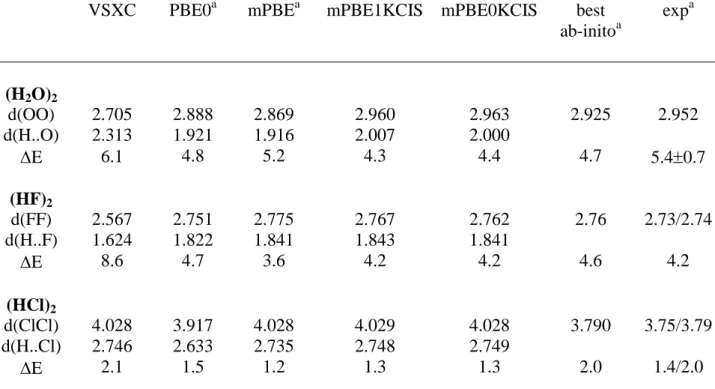
of the water dimer is quite accurately reproduced by standard DFT methods, all the predicted OO distances falling between 2.87 and 2.92 Å, i.e. close to the MP2 estimate [2]. Our results are reported in table V, and compared with experimental and post-HF data [31]. The most striking feature of these results is the mPBE0KCIS distance, which is significantly longer (2.963 Å) than other DFT values, but in excellent agreement with the experimental value. At the same time the binding energy is slightly underestimated (4.4 vs. 4.7 kcal/mol for the best
ab initio value).
In a similar manner, the intermolecular distances of all the other two complexes are slightly overestimated, will the interaction energies are well reproduced and in better agreement with the experimental data than post-HF results (see table V).
In summary, judging from both energy and geometry results, the mPBE0KCIS model seems to well perform over the difficult playground represented by non-covalent interactions. The only unsatisfactory result is obtained for the water-water interaction, whose strength is underestimated. Similar performances are obtained for the two hybrid approaches, mPBE0KCIS and mPBE1KCIS on such a class of interactions. The use of one or the another approach depends, thus, on the slightly difference found for the covalent molecules contained in the G2 data set and on a personal choice, the first one having only one parameter.
4. Conclusions
We have presented a new hybrid HF/DFT approach in which two “first principles” functionals, namely mPBE and KCIS, are coupled with some HF exchange. This functional contains only one or, in the G2-optimized version, two adjustable parameters in the exchange part and no parameters in the meta-GGA correlation. The proposed model, resting on soundly physical roots, provides fairly good results for a number of properties (geometries, thermochemistry) of covalent and non-covalent bonded systems. Despite the few parameters present in our functional, its results are comparable, if not better, with those provided by more empirical approaches, containing a higher number of fitted parameters.
More in general, we believe that our work showed that some progresses to reach the so-called “chemical accuracy” are still possible, even on the well-known ground of covalently bonded molecules. In the present DFT scenario, it seems, anyway, that hybrid metaGGA approaches can be considered as an improvement over the pure meta-GGA models, as the hybrid GGA have been an improvement over GGA’s.
Acknowledgement
Authors warmly thank Dr. A. Savin (Paris, France) and prof. V. Barone (Naples, Italy) for helpful discussions and suggestions.
References.
[1] R.G. Parr and W. Yang, Density Functional Theory of Atoms and Molecules (Oxford University Press, New York, 1989).
[2] Kock, W.;Holthausen, M.C. A Chemist’s Guide to Density Functional Theory, (Weinheim Wiley-VCH 2000).
[3] K. Burke, J.P. Perdew and Y. Wang, in Electronic density functional theory: recent
progress and new derivations, edited by J.F. Dobson, G. Vignale and M.P. Das (Plenum
Press, New York, 1997).
[4] A.D. Becke, J. Chem. Phys. 109 (1998) 5648
[5] T. van Voorhis and G.E. Scuseria, J. Chem. Phys. 109 (1998) 400.
[6] J.P. Perdew, S. Kurth, A. Zupan and P. Blaha, Phys. Rev. Lett. 82 (1999) 2544. [7] S. Kurth, J.P. Perdew and P. Blaha, Int. J. Quantum Chem. 75 (1999) 889 [8] J. Tao, J. Chem. Phys. 116 (2002) 2335.
[9] C. Adamo, M. Ernzerhof and G.E. Scuseria, J. Chem. Phys. 112 (2000) 2643. [10] A.D. Becke, J. Chem. Phys. 98 (1993) 5648.
[11] C. Adamo, A. di Matteo, and V. Barone , Adv. Quantum Chem. 36 (1999) 4. [12] J.P. Perdew, K. Burke and M. Ernzerhof, Phys. Rev. Lett. 77 (1996) 3865, ibid 78 (1997) 1396 (E).
[13] C. Adamo and V. Barone, J. Chem. Phys 116 (2002) 5933.
[14] J.B. Krieger, J. Chen, G.J. Iafrate and A. Savin in Electron Correlations and Materials Properties, A. Gonis and N. Kioussis (Eds) Plenum, New York (1999).
[15] J. Rey and A. Savin, Int. J. Quantum Chem. 69 (1998) 581.
[16] M. J. Frisch, G. W. Trucks, H. B. Schlegel, G. E. Scuseria, M. A. Robb, J. R. Cheeseman, V. G. Zakrzewski, J. A. Montgomery, Jr., R. E. Stratmann, J. C. Burant, S. Dapprich, J. M. Millam, A. D. Daniels, K. N. Kudin, M. C. Strain, O. Farkas, J. Tomasi, V. Barone, M. Cossi, R. Cammi, B. Mennucci, C. Pomelli, C. Adamo, S. Clifford, J. Ochterski, G. A. Petersson, P. Y. Ayala, Q. Cui, K. Morokuma, D. K. Malick, A. D. Rabuck, K. Raghavachari, J. B. Foresman, J. Cioslowski, J. V. Ortiz, B. B. Stefanov, G. Liu, A. Liashenko, P. Piskorz, I. Komaromi, R. Gomperts, R. L. Martin, D. J. Fox, T. Keith, M. A. Al-Laham, C. Y. Peng, A. Nanayakkara, C. Gonzalez, M. Challacombe, P. M. W. Gill, B. Johnson, W. Chen, M. W. Wong, J. L. Andres, C. Gonzalez, M. Head-Gordon, E. S. Replogle, and J. A. Pople, Gaussian 99 Development version (Revision B.05), Gaussian Inc.: Pittsburgh PA, 1999
[17] Æ. Frisch and M.J. Frisch, Gaussian 98 User's Reference (Gaussian, Inc., Pittsburgh 1998) and reference therein
[18] M. Ernzerhof and G.E. Scuseria, J. Chem. Phys., 110 (1999) 5029. [19] C. Adamo and V. Barone, J. Chem. Phys. 110 (1999) 6158.
[20] C. Adamo and V. Barone, J. Chem. Phys. 108 (1998) 664. [21] S. F. Boys and F. Bernardi, Mol. Phys.19 (1970) 553.
[22] L.A. Curtiss, K. Raghavachari, P.C. Redfern and J. A. Pople J. Chem. Phys. 106 (1997) 1063.
[23] C. Adamo and V. Barone, Chem. Phys. Lett. 272 (1997) 242.
[24] J.P. Perdew, M. Ernzerhof, A. Zupan and K. Burke, J. Chem. Phys. 108 (1998) 1522. [25] T. van Voorhis and G.E. Scuseria J. Chem. Phys. 109 (1998) 400.
[26] M. Ernzerhof and G.E. Scuseria, J. Chem. Phys., 110 (1999) 5029.
[27] S.J. Chakravorty, S.R. Gwaltney, E.R. Davidson, F.A. Parpia and C.Froese Fischer, Phys. Rev. A, 47 (1993) 3649.
[28] A.J. Cohen and N.C. Handy, Chem. Phys. Lett. 316 (2000) 160.
[29] T.A. Wesolowski, O. Parisel, Y. Ellinger and J. Weber, J. Phys. Chem. A 101 (1997) 7818.
[30] J.F. Ogilvie and F.Y.H. Wang, J. Mol. Struct. 273 (1992) 277. [31] A.K. Rappé and E.R. Bernstein, J. Phys. Chem. A, 104 (2000) 6117.
[32] C. Tuma, A.D. Boese and N.C. Handy, Phys. Chem. Chem. Phys. 1 (1999) 3939.
[33] M.J. Frisch, J.E. Del Bene, J.S. Binkley and H.F. Schaefer III, J. Chem. Phys. 84 (1986) 2279.
Table I. Mean absolute errors (MAE) and maximum errors (kcal/mol) for the atomization
energies of the G2 sets. G2-1 denotes the reduced G2 set comprising 55 molecules.
G2-1 G2
MAE max MAE max
PBEa 8.2 29.1 (CO2) 17.2 50.5 (C2F4)
PBE0a 3.1 -10.7 (SiO) 5.0 -21.7 (SiF4)
mPBEb 4.6 -18.9 (Si2H6) 6.3 27.5 (NO2)
PKZBc 3.6 11.0 (O2) 4.5 -37.7 (SiF4)
VSXCd 2.5 -8.3 (N2) 2.7 -36.6 ((CH3)3C)
mPBEKCIS 5.9 18.4 (CO2) 9.0 33.8 (NO2)
mPBE0KCIS 3.3 -15.9 (SO2) 4.1 -37.8 (SiF4)
mPBE1KCIS 2.5 -10.1 (Si2H6) 3.8 -35.0 (SiCl4)
Table II. Total atomic energies and differential SCF atomic energies (Hartrees) for the atoms
belonging to the first and second row of the periodic table. All the values have been computed using the 6-311+G(3df,3pd) basis set.
a) ref. 27.
Atoms Exacta PKZB VSXC PBE PBE0 mPBE mPBEKCIS mPBE0KCIS mPBE1KCIS
H -0.500 0.004 -0.002 0.000 -0.001 -0.004 0.002 0.002 0.002 He -2.904 0.002 -0.011 0.014 0.011 0.000 0.000 0.001 0.001 Li -7.478 0.004 -0.024 0.018 0.012 -0.005 -0.004 -0.003 -0.003 Be -14.667 0.019 -0.022 0.041 0.032 0.006 0.004 0.006 0.005 B -24.654 0.036 -0.021 0.045 0.037 0.006 0.003 0.006 0.005 C -37.845 0.056 -0.026 0.052 0.042 0.005 0.001 0.004 0.003 N -54.589 0.083 -0.036 0.060 0.049 0.008 0.003 0.006 0.005 O -75.067 0.110 -0.042 0.062 0.054 0.006 -0.004 0.004 0.002 F -99.734 0.147 -0.048 0.073 0.067 0.014 -0.003 0.007 0.004 Ne -128.938 0.198 -0.060 0.092 0.087 0.031 0.007 0.019 0.015 mae (H-Ne) -- 0.066 0.029 0.046 0.039 0.009 0.003 0.006 0.004 Na -162.255 0.230 -0.079 0.099 0.085 0.029 0.003 0.009 0.007 Mg -200.053 0.267 -0.098 0.108 0.092 0.033 0.001 0.004 0.003 Al -242.346 0.308 -0.112 0.119 0.098 0.039 0.005 0.006 0.006 Si -289.359 0.351 -0.128 0.134 0.108 0.049 0.013 0.011 0.012 P -341.259 0.401 -0.141 0.155 0.124 0.054 0.028 0.021 0.023 S -398.110 0.446 -0.156 0.170 0.135 0.075 0.035 0.026 0.029 Cl -460.148 0.495 -0.172 0.189 0.150 0.082 0.046 0.034 0.038 Ar -527.540 0.545 -0.190 0.209 0.165 0.098 0.058 0.042 0.047 mae (Na-Ar) -- 0.380 0.076 0.148 0.120 0.057 0.024 0.019 0.021 total mae -- 0.206 0.076 0.091 0.075 0.030 0.012 0.012 0.012
Table III. Absolute mean deviations obtained by different methods for some properties of
32 molecules of the G2 data set. Bond lengths and harmonic frequencies are computed using the 6-311G(d,p) basis set.
Method Bond lengths (Å) Harm. freq (cm-1) PBE 0.011 66 mPBE 0.011 67 PBE0 0.007 40 PKZB 0.019 72 VSXC 0.008 mPBEKCIS 0.014 59 mPBE0KCIS 0.008 43 mPBE1KCIS 0.008 43
Table IV. Bond lengths (Å) and interaction energies (eV) for He2 and Ne2. All values are
computed using a modified cc-pV5Z basis set and corrected for BSSE.
Dimer Method d (Å) Dint (eV) He2 mPWa 3.14 0.003 mPBEb 2.88 0.003 PBE0a 2.78 0.002 VSXC 3.01 0.002 mPBE1KCIS 2.91 0.002 mPBE0KCIS 2.85 0.002 exactc 2.97 0.001 Ne2 mPWa 3.25 0.004 mPBEb 3.16 0.005 PBE0a 3.04 0.003 VSXC 2.9 and 3.3d 0.014 and 0.008d mPBE1KCIS 3.18 0.004 mPBE0KCIS 3.20 0.004 exactc 3.09 0.004
Table V. Dissociation energies (kcal/mol) and main bond parameters (Å) for some
H-bonded dimers. The energies (corrected for BSSE) are computed at the 6-311++G(3df,3pd) level using the optimized 6-311G(d,p) geometries. Experimental values are taken form reference 13.
VSXC PBE0a mPBEa mPBE1KCIS mPBE0KCIS best ab-initoa expa (H2O)2 d(OO) 2.705 2.888 2.869 2.960 2.963 2.925 2.952 d(H..O) 2.313 1.921 1.916 2.007 2.000 E 6.1 4.8 5.2 4.3 4.4 4.7 5.40.7 (HF)2 d(FF) 2.567 2.751 2.775 2.767 2.762 2.76 2.73/2.74 d(H..F) 1.624 1.822 1.841 1.843 1.841 E 8.6 4.7 3.6 4.2 4.2 4.6 4.2 (HCl)2 d(ClCl) 4.028 3.917 4.028 4.029 4.028 3.790 3.75/3.79 d(H..Cl) 2.746 2.633 2.735 2.748 2.749 E 2.1 1.5 1.2 1.3 1.3 2.0 1.4/2.0