Active Interstellar Comet
Cordiner, M. A.
1,2, Milam, S. N.
1, Biver, N.
3, Bockel ´ee-Morvan, D.
3, Roth, N. X.
1,4, Bergin,
E. A.
5, Jehin, E.
6, Remijan, A. J.
7, Charnley, S. B.
1, Mumma, M. J.
1, Boissier, J.
8,
Crovisier, J.
3, Paganini, L.
9, Kuan, Y.-J.
10,11, Lis, D. C.
121Solar System Exploration Division, NASA Goddard Space Flight Center, 8800 Greenbelt Road, Greenbelt, MD 20771, USA. 2Department of Physics, Catholic University of America, Washington, DC 20064, USA.
3LESIA, Observatoire de Paris, Universit ´e PSL, CNRS, Sorbonne Universit ´e, Universit ´e de Paris, 5 place Jules Janssen, 92195 Meudon,
France.
4Universities Space Research Association, Columbia, MD 21046, USA.
5Department of Astronomy, University of Michigan, 311 West Hall, 1085 S. University Ave, Ann Arbor, MI 48109, USA. 6STAR Institute, Universit ´e de Li `ege, All ´ee du 6 Aout, 19C, 4000 Li `ege, Belgium.
7National Radio Astronomy Observatory, Charlottesville, VA 22903, USA. 8IRAM, 300 Rue de la Piscine, 38406 Saint Martin d’Heres, France. 9NASA Headquarters, Washington, DC, United States of America. 10National Taiwan Normal University, Taipei 116, Taiwan, ROC.
11Institute of Astronomy and Astrophysics, Academia Sinica, Taipei 106, Taiwan, ROC.
12Jet Propulsion Laboratory, California Institute of Technology, 4800 Oak Grove Drive, Pasadena, CA 91109, USA.
Accepted for publication in Nature Astronomy, March 2020
Comets spend most of their lives at large dis-tances from any star, during which time their in-terior compositions remain relatively unaltered. Cometary observations can therefore provide di-rect insight into the chemistry that occurred dur-ing their birth at the time of planet formation.1
To-date, there have been no confirmed observa-tions of parent volatiles (gases released directly from the nucleus) of a comet from any plan-etary system other than our own. Here we present high-resolution, interferometric observa-tions of 2I/Borisov, the first confirmed interstel-lar comet, obtained using the Atacama Large Mil-limeter/submillimeter Array (ALMA) on 15th-16th December 2019. Our observations reveal emis-sion from hydrogen cyanide (HCN), and carbon monoxide (CO), coincident with the expected posi-tion of 2I/Borisov’s nucleus, with producposi-tion rates
Q(HCN) = (7.0 ± 1.1) × 1023s−1 and Q(CO) =
(4.4 ± 0.7) × 1026s−1. While the HCN abundance
relative to water (0.06–0.16%) appears similar to that of typical, previously observed comets in our Solar System, the abundance of CO (35–105%) is among the highest observed in any comet within 2 au of the Sun. This shows that 2I/Borisov must have formed in a relatively CO-rich environment — probably beyond the CO ice-line in the very cold,
outer regions of a distant protoplanetary accretion disk, as part of a population of small, icy bodies analogous to our Solar System’s own proto-Kuiper Belt.
During the last few decades, remote and in situ mea-surements of volatiles and dust in comets belonging to our own Solar System have revealed a wealth of information on the chemical inventory and physical processes that occurred during the formation of our planets, 4.5 billion years ago1. The chemical
condi-tions prevalent during planet formation around other stars have become accessible for some nearby systems, thanks to advances in astronomical remote sensing methods2–4, but this work is hindered by the extreme
difficulty of observing ice and gas in the dense, opaque mid-planes of the disks where extrasolar planets form. Measurements of cometary compositions provide a unique method for probing the composition of the disk mid-plane, thus providing crucial input for theories concerning protoplanetary disk chemical evolution5, 6,
and helping to improve our understanding of the in-gredients available for forming planetary bodies and their atmospheres7, 8, 11. Observations of the
interstel-lar comet 2I/Borisov provide unique new insights into the chemistry that occurred during planet formation in another stellar system.
was detected on 2019 August 30 by amateur as-tronomer G. Borisov, and later shown to be on a hyper-bolic orbit (with eccentricity of 3.36), consistent with an interstellar origin in the direction of Cassiopeia12.
Although the apparition of interstellar objects (ISOs) was predicted for decades9, 2I/Borisov is only the
sec-ond confirmed ISO. The first — 1I/’Oumuamua — was discovered in October 2017 when it was already leaving the Solar System, making detailed studies difficult. As-tronomical observations were able to partially constrain ’Oumuamua’s shape and surface colors13, and possible
outgassing activity was implied by non-gravitational acceleration10, but a lack of gas spectroscopic
detec-tions made a cometary classification for 1I/’Oumuamua uncertain.
The presence of a gas and dust coma surrounding 2I/Borisov, on the other hand, has been confirmed by numerous observations, including the detection of cyanide (CN) and hydroxyl (OH) emission in the near-UV and optical14–16. The observations reported to-date
have revealed a CN/H2O ratio and optical dust colours
consistent with typical Solar System comets, while the C2abundance may be somewhat depleted17, 18. The OH
radical is believed to be a product of water photodis-sociation in the coma, but the origin of 2I/Borisov’s CN is less certain, as cometary CN can be produced from the photodissociation of HCN and other nitriles, and from the degradation of organic-rich dust grains19.
In contrast, observations of rotational emission in the
microwave and sub-mm part of the spectrum20 can
reveal parent volatiles — sublimating gases that have been stored (as ices) inside 2I/Borisov’s nucleus, for the duration of its interstellar journey — and therefore provide a more direct probe of its chemical composi-tion.
We used the Atacama Large
Millime-ter/submillimeter Array (ALMA) to obtain spectra and images of 2I/Borisov in the frequency range 342.9-355.6 GHz (0.84-0.87 mm), during its passage through the inner Solar System. The comet reached perihelion on 2019 December 8th, and our obser-vations were carried out over two sessions on 2019 December 15th and 16th, at a heliocentric distance rH = 2.01au and a geocentric distance ∆ = 1.96 au.
Further details of the observations and data analysis procedures are presented in the Methods section.
The targeted emission lines of HCN (J = 4 − 3) and CO (J = 3 − 2) were both detected at the center of the ALMA field of view (see Figure 1). Spectrally in-tegrated fluxes are given in Table 1, and correspond to a statistical significance of 5.2σ for HCN and 5.9σ for CO. Our HCN and CO detections are robust, but the detailed coma morphology in Figure 1 is largely hidden by noise; HCN shows a central peak, slightly ex-tended in the north-south direction, while an exex-tended flux component is detectable for CO, at distances up to 4000 km from the nucleus. Our observations also targeted CS and CH3OH, but these molecules were not
detected. 6000 4000 2000 0 2000 4000 6000 Distance (km) 6000 4000 2000 0 2000 4000 6000 Distance (km)
2I/Borisov HCN J=4-3 2019/12/15+16
0 1 2 3 4 5 6 Flu x ( m Jy km s 1 bea m 1) 6000 4000 2000 0 2000 4000 6000 Distance (km) 6000 4000 2000 0 2000 4000 6000 Distance (km) Trail Sun2I/Borisov CO J=3-2 2019/12/15+16
0 1 2 3 4 5 6 7 8 Flu x ( m Jy km s 1 bea m 1)Figure 1: Spectrally integrated flux maps of HCN (J = 4 − 3)
and CO (J = 3−2) emission from interstellar comet 2I/Borisov. Positive flux contours are shown with dashed lines, and nega-tive contours are dotted, with a contour spacing equal to 2.5 times the RMS noise. FWHM of the spatial resolution element (1.000× 0.700≈ 1500 × 1000 km) is indicated lower-left.
Sky-projected solar and orbital trail vectors are shown lower-right. Coordinate axes are aligned with the equatorial system, with the origin at the HCN peak.
Molecular production rates (Q) were obtained by performing nonlinear least-squares fits to the extracted spectra, shown in Figure 2, using a three-dimensional radiative transfer model (see Methods). This resulted
in Q(CO) = (4.4 ± 0.7) × 1026s−1 and Q(HCN) =
(7.0 ± 1.1) × 1023s−1, assuming CO and HCN were
well mixed, with a constant kinetic temperature of Tkin = 50 K. For CO, the spectral line profile (with
FWHM = 1.1±0.1 km s−1) is consistent with an
isotrop-ically expanding coma, with best-fitting outflow veloc-ity vout= 0.47 ± 0.04km s−1. HCN exhibits a narrower
spectral line shape (with FWHM = 0.57 ± 0.09 km s−1),
that could arise as a result of localised HCN outgassing in the form of a jet-like stream primarily confined to
9
6
3
0
3
6
9
12
15
Flu
x (
m
Jy
be
am
1)
HCN 4 3 observation Isotropic Model Jet Model8
6
4
2
0
2
4
6
8
Cometocentric Velocity (km/s)
9
6
3
0
3
6
9
12
Flu
x (
m
Jy
be
am
1)
CO 3 2 observation Isotropic ModelFigure 2: ALMA interferometric spectra of HCN (top) and CO
(bottom) towards 2I/Borisov, extracted at the respective emis-sion peaks of each species (see Figure 1). Best-fitting radiative transfer models are overlaid (see Methods), including isotropic outgassing (at vout= 0.47km s−1), with an alternative conical
jet model shown for HCN, for which the outflowing gas is con-fined within a 96◦cone, with its apex at the nucleus and axis
in the plane of the sky. The spectral resolution is 0.21 km s−1 (channel spacing = 0.11 km s−1).
the plane of the sky, with correspondingly narrower radial velocity dispersion. However, the signal-to-noise is too low to conclusively distinguish this scenario from isotropic outgassing. Observations of near-UV CN fluo-rescence using the TRAPPIST-South telescope on UT 2019-12-15 gave Q(CN) = (9.5±1.8)×1023s−1, which
is consistent (within uncertainties) with our derived HCN production rate.
A clearer view of the CO J = 3 − 2 emission line is shown in Figure 3, which was obtained by averaging only the autocorrelation (total power) spectra obtained from each of the individual ALMA antennas21. These
autocorrelation data are more sensitive to 2I/Borisov’s CO emission than the interferometric data (in Figures 1 and 2), because they include flux from angular scales & 1000, which was filtered out by the interferometer due to a lack of very short baselines in the telescope array. Modeling the autocorrelation data assuming isotropic outgassing from the nucleus results in a CO production rate of (5.0 ± 0.5) × 1026s−1(assuming an
amplitude calibration error of ±10%). This is consis-tent with the value obtained from the
interferomet-8
6
4
2
0
2
4
6
8
Cometocentric Velocity (km/s)
100
0
100
200
300
Flu
x (
m
Jy
be
am
1)
CO 3 2 autocorrelation spectrum Isotropic Model (vout=0.45 km/s)Hemispheric Model (vout(1)=0.49; vout(2)=0.26 km/s)
Figure 3: ALMA autocorrelation (total power) spectrum of
2I/Borisov’s CO, averaged over all 42 antennas (observed UT 2019-12-15). Two best-fitting models are overlaid, assuming isotropic outgassing (dotted blue line) and asymmetric out-gassing along the sun-comet vector (dashed red line). The integrated line intensity is 260 ± 15 mJy km s−1 beam−1
(equivalent to 9.3 ± 0.5 mK km s−1on the main beam bright-ness temperature scale).
ric data (within errors), adding confidence to our CO measurements. HCN was not detected in the autocor-relation data, which is consistent with a faster drop in HCN flux with radius, due to more rapid radiative cooling (depopulation) of the HCN J = 4 level than for the J = 3 level of CO. This is a result of HCN’s larger dipole moment, combined with a lack of thermalizing collisions in 2I/Borisov’s relatively low-density coma. Assuming 2I/Borisov’s water production rate on December 15th-16th was within the range 4.9-10.7×1026s−1observed by Xing et al.16(see Methods),
we find that the HCN abundance (relative to H2O) was
0.06%-0.16% and the CO abundance was 35%-105%. This demonstrates a relatively unusual composition for 2I/Borisov’s coma: HCN is close to the average abun-dance of 0.12% observed previously in Solar System comets20, while the CO abundance is much higher than
the average value of 4%22. Even Oort Cloud comets
pre-viously designated as CO-rich only have CO/H2O ratios
in the range 10% to 24%22(see also Supplementary
Table 1), with the exception of the recently discovered, peculiar Oort Cloud comet C/2016 R2 (PanSTARRS), which had CO/H2O = 30,800%23.
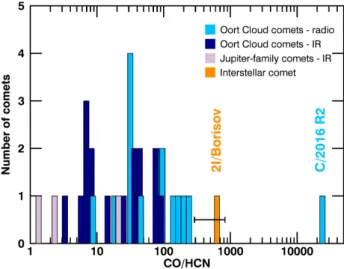
The CO/HCN mixing ratio of 2I/Borisov is shown for comparison with Solar System comets in Figure 4. Accounting for additional uncertainties in the HCN production rate due to possible variations in the coma kinetic temperature and electron abundance (see Meth-ods), we find that the maximum error margin for CO/HCN is 630+200
−340. This CO/HCN ratio is still higher
than seen before in any comet (see Supplementary Ta-ble 1), apart from C/2016 R2, which had CO/HCN = 26,400 (at rH= 2.8au)27. This provokes the idea that
Table 1: Observed Molecular Lines, Peak Fluxes (per beam) and Production Rates
Molecule Transition Frequency Flux Production Rate
(GHz) (mJy km s−1 bm−1) (mol. s−1)
CO J = 3 − 2 345.796 8.6 ± 1.5 (4.4 ± 0.7) × 1026
HCN J = 4 − 3 354.505 6.5 ± 1.2 (7.0 ± 1.1) × 1023
CS J = 7 − 6 342.883 < 5.2 < 6.5 × 10²³
CH3OH JK= 130− 121A+ 355.603 < 4.4 < 4.4 × 1026
Table Footnotes — Derived production rates from the ALMA interferometric data, assuming a kinetic temperature of 50 K (see Methods).
Figure 4: Histogram showing previously-published CO/HCN
mixing ratios observed in Solar System comets20, 26. 24 Oort Cloud comets and 3 Jupiter-family comets are shown. The unusually high CO/HCN ratio of 2I/Borisov (630+200−340) is
high-lighted, along with the chemically peculiar outlier C/2016 R2 (PanSTARRS) (which had CO/HCN = 26,400)27(horizontal
black bar indicates the uncertainty range of our analysis). An annotated version of this plot is given in Supplementary Figure 1.
the interstellar comet 2I/Borisov may be chemically distinct from those typically found in our own Solar System. An important point to consider regarding this interpretation, however, is the degree to which the apparent CO-richness of 2I/Borisov’s coma reflects its intrinsic nucleus composition, or instead, whether the differential sublimation rates as a function of tempera-ture for CO, HCN and H2O could play a role.
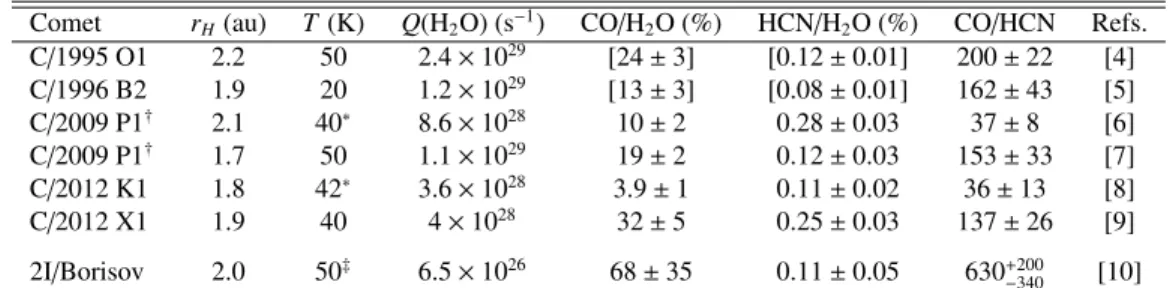
Supplementary Table 1 provides literature data for
CO and HCN in five comets observed at rH = 1.7–
2.4au, including several CO-rich comets. The spread of values for CO/H2O (0.04 ± 0.01 to 0.32 ± 0.05) and
CO/HCN (36 ± 13 to 200 ± 22) reveals a considerable diversity in the relative CO activity level across this dis-tance range, but confirms 2I/Borisov as one of the most CO-rich comets ever observed. After 2I/Borisov, the next highest CO/HCN ratio (238 ± 21) was for C/2006 W3 (Christensen), at a relatively large heliocentric dis-tance rH= 3.3au24. Cometary CO ice sublimates at a
lower temperature than H2O and HCN, so the CO/H2O
and CO/HCN production rate ratios should increase
with heliocentric distance25. Although the 95-150 K
sublimation temperatures (Tsub) of HCN and H2O are
expected to be reached on the illuminated surfaces of comets within rH ∼ 3 au28, sub-surface ices (inside
2I/Borisov’s nucleus) would be cooler, potentially al-lowing internal CO to sublimate while H2O remains
frozen. However, in a sample of 17 comets with CO2
measured by the AKARI satellite, a relative reduction in the H2O production rate was only found to occur
at distances rH > 2.5au29. Our measured CO/HCN
ratio in 2I/Borisov at 2.0 au is therefore likely to be representative of the interior ice mixing ratio.
There remains a possibility that 2I/Borisov’s
en-hanced CO/H2O ratio arises as a consequence of
thermally-insulating exterior layers, which could in-hibit heat penetration, leading to a drop in the overall water production rate without significantly affecting that of the more volatile CO. The presence of such a low-thermal-conductivity crust was theorized as a possible explanation for the complete absence of observable outgassing from 1I/’Oumuamua30, and could plausibly
result from volatile depletion in 2I/Borisov’s surface as a result of exposure to cosmic rays or other heat sources during its long interstellar journey. Surface modifications are also possible as a result of accretion of interstellar matter, or sputtering/abrasion by colli-sion with particles, as the comet passed through the interstellar medium31. A more complete investigation
of the importance of such effects is warranted. Given the (lack of) information on 2I/Borisov’s in-ternal physical structure, we now consider the implica-tions of an intrinsically elevated CO abundance. CO-rich comets form in protoplanetary disks beyond, or in the vicinity of, the CO sublimation front (ice-line)32, 33,
and these objects should have the full complement of CO and H2O supplied from their parent
interstel-lar cloud. The CO ice line in our protosointerstel-lar nebula has been estimated to be located in the outer part of the cometary formation zone, between about 17-35 au34, 35. Currently, the outer edge of the Solar System (as defined by a drop-off in the Kuiper Belt density), is close to 50 au36. In other planetary systems, the CO
ice-line has been identified at similar or greater distances from the star34, 37, 38, with a radius depending on the
luminosity of the young star. Observations of disks during the initial stages of planetary assembly find that their outer radii extend 5-200 au39. Thus, there
ex-ists a population of young planet-forming regions with proto-Kuiper belts that have extensive CO-ice domi-nated zones, in which CO-rich comets may be forming. Furthermore, ALMA has recently inferred the presence of large, Neptune to Saturnian sized objects at these distances40. These proto-planets would disturb the
natal Kuiper-belt analog population and some comets with perturbed orbits would be launched on escape trajectories into interstellar space, occasionally ending up on hyperbolic orbits passing through our inner So-lar System. Scattering events involving gravitational encounters with passing stars, or the members of a mul-tiple star system, can also be considered as plausible ejection mechanisms.
Models for the formation and composition of cometary ices suggest significant chemical evolution within the protoplanetary disk close to the ice-lines of key volatiles such as H2O, CO, and CO28, 33. It has long
been theorized that evaporated ices inside the vapor region of a given ice-line would diffuse outwards (away from the star) and potentially enhance the ice-content of materials at larger radii41. The CO-rich composition
of comet 2I/Borisov therefore hints at formation in close vicinity to the CO ice-line in its natal protoplane-tary disk.
Radiogenic heating of larger Kuiper-belt
ob-jects/small planets can enable the
sublima-tion/diffusion of interior CO ice, which may
then re-freeze in the cooler regions closer to the object’s surface, thus leading to CO-enriched layers42.
This leads to the final mechanism we envisage as plausible for the generation of CO-rich planetesi-mals — through fragmentation (and subsequent ejection) of a chemically-differentiated parent body — as was considered previously for C/2016 R2 (PanSTARRS)23, 27.
The detection of HCN and CO emission from the first confirmed, active interstellar comet represents a major breakthrough, providing unprecedented insights into the chemistry of a planetary system other than our own, and proving that simple (carbon, nitrogen and oxygen-bearing) molecular ices were abundant in 2I/Borisov’s natal environment. While it is difficult to be sure that the observed coma abundances repre-sent the bulk composition of volatiles in 2I/Borisov’s nucleus, comparison with other comets observed at similar heliocentric distances reveals an unusual, CO-rich composition for this interstellar object, showing that it probably originated from the icy, outer regions of a distant protoplanetary disk, and maintained a very low interior temperature (. 25 K) for the duration of its interstellar journey. Considering the broader popu-lation of interstellar comets, our ALMA observations show that we should be prepared for the unexpected as we pursue future studies of this new class of astro-nomical object.
Methods
Observations
ALMA observations were performed as part of program 2019.01008.T on UT 2019-12-15 8:50–12:03 and UT 2019-12-16 11:37–12:56, with a total observing time of 1:11 on-source. The correlator was configured to observe rotational transitions of CS (342.883 GHz),
CO (345.796 GHz), HCN (354.505 GHz) and CH3OH
(355.603 GHz), with spectral resolutions of 282 kHz, 244 kHz, 244 kHz, and 488 kHz, respectively. There were 42 active antennas in the array (configuration C43-1), spanning baselines 15-317 m, resulting in a spatial resolution (elliptical beam FWHM) of 1.0200×
0.7300at 355 GHz. Flux and phase calibration were per-formed using the quasar J1209-2406. The observing se-quence consisted of 30 s on the phase calibrator, 2 min on the comet, and 2 min on a sky reference position 20
North of the comet (for the purpose of calibrating the ALMA autocorrelation data), repeated until the end of the observing period. The array phase-center was up-dated in real-time to track 2I/Borisov’s position on the sky, following JPL ephemeris solution #48 (generated on 2019-12-05).
Data were flagged and calibrated with CASA ver-sion 5.643using the automated pipeline scripts
sup-plied by the Joint ALMA Observatory. Deconvolution, Doppler correction and imaging were performed using the tclean (Clark) algorithm, with natural weighting, a flux threshold of twice the RMS noise per channel (σc) in each image, and a 600-diameter circular mask
about the phase center. The resulting, combined im-age cubes are in the rest frame of the comet, with σc= 2.6mJy for CO and 2.9 mJy for HCN.
The spectral cubes were integrated over the come-tocentric velocity range −0.3 to 0.3 km s−1 for HCN
and −0.6 to 0.6 km s−1 for CO to produce the maps shown in Figure 1. Spectra for CO and HCN were then extracted at the respective flux peaks for each species (both of which were within 0.300of the phase center).
For CS and CH3OH (not detected), the spectra were
extracted at the HCN peak (0.200East of center).
Inte-grated fluxes (per beam) for each species are given in Table 1. No continuum emission was detected; the RMS noise on our combined continuum image resulted in a 3σupper limit to the dust/nucleus thermal emission of 0.11 mJy beam−1.
Autocorrelation (total power) spectra were recorded using each of the forty-two 12 m ALMA antennas, si-multaneously with the interferometric (cross correla-tion) observations. These were calibrated and com-bined following the method of Cordiner et al.21, us-ing the interleaved sky reference position to subtract thermal contributions from the sky, receiver and tele-scope optics from each scan. Median system temper-atures were 120 K at 346 GHz. The zenith sky opac-ity was 0.11 and the single-dish beam FWHM was 16.800. The data were corrected for a beam efficiency
ηMB = 0.72, which was derived from the aperture
ef-ficiency (ηA= 0.63at 345 GHz)44using the standard
relationship45ηMB= 0.8899k2ηA, with k=1.13 for the
ALMA 12-m antennas. The calibrated autocorrelation spectra were then Doppler shifted from the topocentric frame to the comet’s rest velocity. A spectral baseline offset was subtracted using low-order polynomial fits to the line-free channels. A narrow residual feature due to incomplete telluric CO cancellation (at 6.6 km s−1
in the comet’s rest frame) was removed by linear inter-polation.
Radiative Transfer Modeling
The observed spectra were modeled with a nonlinear least-squares fitting procedure, using a modified ver-sion of the LIne Modeling Engine (LIME)46, adapted
for cometary comae as described by Cordiner et al.21.
This three-dimensional, non-local-thermodynamic-equilibrium (NLTE) radiative transfer model incorpo-rates a calculation of the rotational energy level popula-tions resulting from collisions with gas-phase molecules and electrons, as well as pumping by solar radiation. Collisional rates for HCN with H2O and CO were taken
from the H2collisional rates in the Leiden Atomic and
Molecular Database47. The impact of this assumption
was tested by scaling the H2collision rates by a
fac-tor of 0.1-10, but the resulting HCN production rates changed by only 2%. Radiative pumping and pho-todissociation rates48were appropriately scaled for the
comet’s heliocentric distance (rH= 2.01au). Due to
the long (∼ 104s) lifetime of the CO J = 3 level against
radiative transitions, LTE was found to be appropriate for modeling our observations of this molecule, with the benefit of improved computational efficiency.
The comet’s H2O production rate was obtained from
UV observations of OH using the SWIFT satellite16. A linear interpolation of the observed values on De-cember 1st ((10.7 ± 1.2) × 1026 s−1) and December
21st ((4.9 ± 0.9) × 1026 s−1) results in Q(H 2O) =
(6.5 ± 1.0) × 1026s−1 at the epoch of our ALMA
ob-servations. Modeling was carried out for a range of coma kinetic temperatures Tkin= 20–70 K, based on
the temperatures previously observed at radio and in-frared wavelengths for comets in the distance range 1.7-2.4 au (Supplementary Table 1).
Flux losses due to the filtering of large-scale coma structures by the interferometer were simulated by processing the (three-dimensional) synthetic coma im-ages using the CASA simobserve task, with the same hour angle, observation duration and array configu-ration parameters used for our science observations. The resulting synthetic visibilities were cleaned and im-aged with the same parameters used for the observed cometary images.
The molecules of interest (X) were initially mod-eled assuming an isotropic, uniformly expanding coma, with outflow velocity (vout) and production rate Q(X)
allowed to vary as free parameters. The quality of
the fits was monitored using the reduced chi-squared statistic (χ2
r), resulting in χ2r = 1.03for our best fit
to the CO interferometric data (Figure 2). The best fit for HCN resulted in a surprisingly small value of vout= 0.23 ± 0.06km s−1, so this fit was re-done,
fix-ing the outflow velocity at the best-fittfix-ing value for CO (vout = 0.47km s−1; the CO autocorrelation data
also gave vout = 0.45 ± 0.03km s−1). This led to only
a minor degradation of the HCN χ2
rvalue, from 1.07
to 1.13, and is considered a more physically plausible scenario given typical coma outflow velocities ∼ 0.5-0.7 km s−1 at r
H = 2au51–53, with the assumption
that HCN and CO are well mixed. The correspond-ing CO and HCN production rates are given in Table 1. The HCN emission is optically thin, so the derived production rate scales linearly with the assumed out-flow velocity. An excellent fit to the HCN spectrum was also obtained using a conical jet model (see Figure 1), with vout= 0.47km s−1, and assuming all outgassing
was confined to a conical region emanating from the nucleus, with its axis perpendicular to the line of sight, and a best-fitting cone opening angle of 96◦. This
re-sulted in a 13% increase in the derived HCN production rate, which is within the range of our observational uncertainties.
Our nominal model assumed a standard electron density scaling factor of xne = 1.0 and kinetic
tem-perature Tkin =50 K to obtain the results given in
Table 1, but values as low as xne = 0.2have been
found to be more appropriate for some comets49–51. For
xne = 1.0, the CO and HCN production rates are
rela-tively insensitive to the assumed kinetic temperature, changing by less than 8% across the range Tkin=20–
70 K. However, in the case of xne = 0.2, the HCN
production rate is more sensitive to the value of Tkin
due to a reduction in electron collisions (and conse-quent drop in the J = 4 level population), resulting in a value of Q(HCN) = 1.2 × 1024s−1at 20 K
(com-pared with 7.0 × 10²³s−1for our standard model with
Tkin = 50K; xne = 1.0). For comparison, we found
Q(CO) = 4.6 × 1026s−1 at T
kin= 20K. Consequently,
in the regime of very low kinetic temperature and elec-tron collision rates, 2I/Borisov’s CO/HCN ratio could plausibly be as low as 370 ± 80, but this is still higher than the range of values (1.25–238) observed in pre-vious Solar System comets (excluding the chemically peculiar outlier, C/2016 R2).
The slightly blue-shifted profile of the CO autocorre-lation spectrum (Figure 3) provides evidence for asym-metric outgassing from 2I/Borisov’s nucleus. Assuming hemispheric asymmetry along the Sun-comet vector, our best-fitting radiative transfer model for the auto-correlation (single dish) data indicates an expansion velocity of vout(1) = 0.49km s−1in the sunward
hemi-sphere, and vout(2) = 0.26km s−1in the anti-sunward
hemisphere, with an asymmetry factor (ratio of sun-ward to anti-sunsun-ward production rates) of 3.3. The isotropic model has a best-ftting χ2
r= 1.21
difference between the model and observations is due to random noise), whereas the asymmetric model has χ2
r= 1.01and P = 0.45. Statistically, the 2-component,
asymmetric model is therefore favoured. Our autocor-relation data are thus consistent with an enhanced CO sublimation rate on the illuminated side of the nucleus, which can be explained as a result of the increased Solar heating there. Since the CO J = 3 − 2 emission is optically thin, the production rate for our asymmetric model is the same as that obtained using the standard, isotropic model (Q(CO) = (5.0 ± 0.5) × 1026s−1 at
Tkin= 50K).
Three-sigma upper limits were obtained for the CS and CH3OH production rates from the integrated
spec-tral noise within a cometocentric velocity range −0.8 to +0.6km s−1(based on the velocity range of detected
flux in the CO autocorrelation spectrum). These cor-respond to mixing ratios of < 0.1% for CS and < 68% for CH3OH, which are consistent with the values
pre-viously observed in other Solar System comets (with CS in the range 0.02–0.2% and CH3OH is in the range
0.6–6.2%)20.
Optical Observations of CN
2I/Borisov was observed with the 60 cm TRAPPIST-South telescope located at La Silla Observatory, Chile54
on December 15, 18 and 19 (UT). On each night a long (1500 s) exposure was obtained trough a CN (0-0) narrow-band filter55centered at 387 nm and
var-ious broad band filters (Johnson-Cousins B, V, Rc, Ic). TRAPPIST-South is equipped with a 2k×2k CCD cam-era providing a field of view of 220× 220and the plate
scale using a binning of 2 × 2 is 1.300/pixel. Data
re-duction followed standard procedures using frequently updated master bias, flat, dark frames and the flux cali-bration was performed with zero points obtained from regular standard star observations56, 57. To compute
the CN production rate from the narrow-band images, we derived median radial brightness profiles for the CN and Rc images and used the continuum filter to remove the dust contamination. We then converted the flux to column density and fitted the profile with a Haser model at 10,000 km from the nucleus, using ef-fective scale lengths from Cochran & Schleicher52and
an outflow velocity of 0.5 km s−1. The CN production
rates obtained on December 15, 18 and 19, were re-spectively (9.5 ± 1.8) × 1023s−1, (11.6 ± 1.9) × 1023s−1,
and (9.2 ± 1.7) × 1023s−1.
Acknowledgements
We thank R. Simon for setting up the ALMA scheduling blocks, and D. Cruikshank for discussions on the compo-sition of Kuiper belt objects. This work was supported by the National Science Foundation (under Grant No. AST-1614471), and by the Planetary Science Division
Internal Scientist Funding Program through the Fun-damental Laboratory Research (FLaRe) work package, as well as the NASA Astrobiology Institute through the Goddard Center for Astrobiology (proposal 13-13NAI7-0032). Part of this research was carried out at the Jet Propulsion Laboratory, California Institute of Technol-ogy, under a contract with the National Aeronautics and Space Administration. ALMA is a partnership of ESO, NSF (USA), NINS (Japan), NRC (Canada), NSC and ASIAA (Taiwan) and KASI (Republic of Korea), in cooperation with the Republic of Chile. The JAO is operated by ESO, AUI/NRAO and NAOJ. The NRAO is a facility of the National Science Foundation operated under cooperative agreement by Associated Universi-ties, Inc. TRAPPIST is a project funded by the Belgian Fonds (National) de la Recherche Scientifique (F.R.S.-FNRS) under grant FRFC 2.5.594.09.F. E.J. is a FNRS Senior Research Associate. N.X.R. was supported by the NASA Postdoctoral Program, administered by the Universities Space Research Association.
References
[1] Mumma, M.J., Charnley, S.B. The Chemical Com-position of Comets — Emerging Taxonomies and Natal Heritage, Annu. Rev. Astron. Astrophys.,49,
471-524, (2011)
[2] Cleeves, L. I. et al. Constraining Gas-phase Car-bon, Oxygen, and Nitrogen in the IM Lup Pro-toplanetary Disk, Astrophys. J., 865, 155-166,
(2018)
[3] Podio, L. et al. Organic molecules in the proto-planetary disk of DG Tauri revealed by ALMA, 2019, Astron. Astrophys.,623, L6, (2019)
[4] Bergner, J. B. et al. A Survey of C2H, HCN, and
C18O in Protoplanetary Disks, Astrophys. J.,876,
25, (2019)
[5] Walsh, C. et al. Complex organic molecules in pro-toplanetary disks, Astron. Astrophys.,563, A33,
(2014)
[6] Drozdovskaya, M. N. et al. Cometary ices in form-ing protoplanetary disc midplanes, Mon. Not. R. Astron. Soc.,462, 977-993, (2016)
[7] Lodders, K. Jupiter Formed with More Tar than Ice, Astrophys. J.,611, 587-597, (2004)
[8] Öberg, K. I., Murray-Clay, R., & Bergin, E. A. The Effects of Snowlines on C/O in Planetary Atmo-spheres, Astrophys. J. Lett.,743, L16, (2011)
[9] Torbett, M. V. Capture of Vinf = 20km s−1
Inter-stellar Comets by Three-Body Interactions in the Planetary System, 1986, Astron. J.,92, 171-175,
(1986)
[10] Micheli, M. et al. Non-gravitational acceleration in the trajectory of 1I/2017 U1 (’Oumuamua), Nat.,559, 223-226, (2018)
[11] Dodson-Robinson, S. E., Willacy, K., Boden-heimer, P., Turner, N. J., & Beichman, C. A. Ice lines, planetesimal composition and solid surface density in the solar nebula, Icarus,200, 672-693,
(2009)
[12] Bailer-Jones, C. A. L., Farnocchia, D., Ye, Q., Meech, K. J., Micheli, M. A search for the ori-gin of the interstellar comet 2I/Borisov, Astron. Astrophys.,634, A14, (2020)
[13] ’Oumuamua ISSI Team. The Natural History of ’Oumuamua, Nat. Astron.,3, 594-602, (2019)
[14] Fitzsimmons, A. et al. Detection of CN Gas in Interstellar Object 2I/Borisov, Astron. Astrophys.,
885, L9, (2019)
[15] Opitom, C. et al. 2I/Borisov: A C2-depleted
inter-stellar comet, Astron. Astrophys.,631, L8, (2019)
[16] Xing, Z., Bodewits, D., Noonan, J., Bannister, M. Water production rates and activity of interstellar comet 2I/Borisov, Astrophys. J. Lett., in press, (2020)
[17] McKay, A., Cochran, A., Dello Russo, N., DiSanti, M. Detection of a Water Tracer in Interstellar Comet 2I/Borisov, Astrophys. J. Lett.,889, L10,
(2020)
[18] Jewitt, D., Luu, J. Initial Characterization of Inter-stellar Comet 2I/2019 Q4 (Borisov), Astrophys. J. Lett.,886, L29, (2019)
[19] Fray, N., Bénilan, Y., Cottin, H., Gazeau, M.-C., Crovisier, J. The origin of the CN radical in comets: A review from observations, Planet. Space Sci.,53,
1243-1262, (2005)
[20] Bockelée-Morvan, D. & Biver, N. The composition of cometary ices, Philos. Trans. R. Soc. A,375,
20160252, (2017)
[21] Cordiner, M. A. et al. ALMA Autocorrelation
Spec-troscopy of Comets: The HCN/H13CN Ratio in
C/2012 S1 (ISON), Astrophys. J. Lett.,870, L26,
(2019)
[22] Paganini, L. et al. C/2013 R1 (Lovejoy) at IR Wavelengths and the Variability of CO Abun-dances among Oort Cloud Comets, Astrophys. J.,
791, 122, (2014)
[23] McKay, A. J. et al. The Peculiar Volatile Com-position of CO-dominated Comet C/2016 R2 (PanSTARRS), Astron. J.,158, 128-152, (2019)
[24] Bockelée-Morvan, D., Hartogh, P., Crovisier, J. et al. A study of the distant activity of comet C/2006 W3 (Christensen) with Herschel and ground-based radio telescopes, Astron. Astrophys.,518,
L149, (2010)
[25] Wierzchos, K., Womakck, M. C/2016 R2 (PANSTARRS): A Comet Rich in CO and Depleted
in HCN, Astron. J.,156, 34-40, (2018)
[26] Dello Russo, N., Kawakita, H., Vervack, R. J., Weaver, H. Emerging trends and a comet
taxon-omy based on the volatile chemistry measured in thirty comets with high-resolution infrared
spec-troscopy between 1997 and 2013, Icarus,278,
301-332, (2016)
[27] Biver, N., Bockelée-Morvan, D., Paubert, G. et al. The extraordinary composition of the blue comet C/2016 R2 (PanSTARRS), Astron. Astro-phys.,619, A127, (2018)
[28] Womack, M., Sarid, G., Wierzchos, K. CO in Dis-tantly Active Comets, Pub. Astron. Soc. Pacific,
129, 031001, (2017)
[29] Ootsubo, T. et al. AKARI Near-infrared Spectro-scopic Survey for CO2in 18 Comets, Astrophys.
J.,752, 15, (2012)
[30] Fitzsimmons, A., Snodgrass, C., Rozitis, B. et al. Spectroscopy and thermal modelling of the first interstellar object 1I/2017 U1 ’Oumuamua, Nat. Astron.,2, 133-137, (2018)
[31] Stern, S. A. ISM-induced erosion and gas-dynamical drag in the Oort Cloud, Icarus, 84,
447-466, (1990)
[32] Bergin, E., Cleeves, L. I. Handbook of Exoplanets, Springer International Publishing AG, eds. H.J. Deeg and J.A. Belmonte, id.137, (2018)
[33] Eistrup, C., Walsh, C., van Dishoeck, E. F. Molec-ular abundances and C/O ratios in chemically evolving planet-forming disk midplanes, Astron. Astrophys.,613, A14, (2018)
[34] Qi, C. et al. Imaging of the CO Snow Line in a Solar Nebula Analog, Sci.,341, 630-632, (2013)
[35] Morbidelli, A., Nesvorný, D. Kuiper belt: forma-tion and evoluforma-tion, in The Trans-Neptunian Solar System, Elsevier, Eds. D. Prialnik, M. Antoinetta Barucci, L. Young, 25-29 (2019)
[36] Gladman, B., Marsden, B. G., Vanlaerhoven, C. Nomenclature in the Outer Solar System, in The Solar System Beyond Neptune, Springer Inter-national Publishing AG, eds. M. A. Barucci, H. Boehnhardt, D. P. Cruikshank, A. Morbidelli, 43-57, (2008)
[37] Zhang, Ke, Bergin, E. A., Schwarz, K., Krijt, S., Ciesla, F. Systematic Variations of CO Gas Abun-dance with Radius in Gas-rich Protoplanetary Disks, Astrophys. J.,883, 98, (2019)
[38] Qi, C. et al. Probing CO and N2Snow Surfaces
in Protoplanetary Disks with N2H+Emission,
As-trophys. J.,882, 160, (2019)
[39] Andrews, S. Observations of Protoplanetary Disk Structures, Annu. Rev. Astron. Astrophys., in press, (2020)
[40] Zhang, S. et al. The Disk Substructures at High Angular Resolution Project (DSHARP). VII. The Planet-Disk Interactions Interpretation, Astro-phys. J. Lett.,869, L47, (2018)
Jupiter by diffusive redistribution of water vapor in the solar nebula, Icarus,75, 146-155, (1988)
[42] De Sanctis, M. C., Capria, M. T., Coradini, A. Thermal Evolution and Differentiation of Edgeworth-Kuiper Belt Objects, Astron. J.,121,
2792-2799, (2001)
[43] Jaeger, S. The Common Astronomy Software Ap-plication (CASA), in Astronomical Society of the Pacific Conference Series, Vol.394, Astronomical
Data Analysis Software and Systems XVII, ed. R. W. Argyle, P. S. Bunclark, & J. R. Lewis, 623-626, (2008)
[44] Remijan, A. et al. ALMA Technical Handbook, ALMA Doc 7.3, ver 1.1, (2019)
[45] Downes, D., Radio Telescopes: Basic Concepts, in Diffraction-Limited Imaging with Very Large Telescopes, Springer Netherlands, eds. Alloin, D. M. and Mariotti, J.-M., 53-84, (1989)
[46] Brinch, C., & Hogerheijde, M. R. LIME - a flexi-ble, non-LTE line excitation and radiation trans-fer method for millimeter and far-infrared wave-lengths, Astron. Astrophys.,523, A25, (2010)
[47] Schöier, F. L., van der Tak, F. F. S., van Dishoeck, E. F., Black, J. H. An atomic and molecular database for analysis of submillimetre line obser-vations, Astron. Astrophys.,432, 369-379, (2005)
[48] Huebner, W. F., Mukherjee, J. Photoionization and photodissociation rates in solar and black-body radiation fields, Planet. Space Sci.,106,
11-45, (2015)
[49] Biver, N. et al. Submillimetre observations of comets with Odin: 2001-2005, Planet. Space Sci.,
55, 1058-1068, (2007)
[50] Hartogh, P., et al. HIFI observations of water in the atmosphere of comet C/2008 Q3 (Garradd), Astron. Astrophys.,518, L150, (2010)
[51] Biver, N. et al. Long-term monitoring of the outgassing and composition of comet
67P/Churyumov-Gerasimenko with the
Rosetta/MIRO instrument, Astron. Astrophys.,
630, A19, (2019)
[52] Cochran, A., Schleicher, D. G. Observational Con-straints on the Lifetime of Cometary H2O, Icarus, 105, 235-253, (1993)
[53] Biver, N. et al. Spectroscopic Monitoring of Comet C/1996 B2 (Hyakutake) with the JCMT and IRAM Radio Telescopes, Astrophys. J.,118,
1850-1872, (1999)
[54] Jehin, E., Gillon, M., Queloz, D., et al.TRAPPIST: TRAnsiting Planets and PlanetesImals Small Tele-scope, The Messenger,145, 2-6, (2011)
[55] Farnham, T. L., Schleicher, D. G., & A’Hearn, M. F. The HB Narrowband Comet Filters: Stan-dard Stars and Calibrations, Icarus, 147,
180-204, (2000)
[56] Opitom, C. PhD Thesis, Université de Liège, Bel-gium, (2016)
[57] Moulane, Y. et al. Monitoring of the activity and composition of comets 41P/Tuttle-Giacobini-Kresak and 45P/Honda-Mrkos-Pajdusakova, As-tron. Astrophys.,619, A156, (2018)
Unusually High CO Abundance of the First Active Interstellar Comet
M. A. Cordiner et al.
Supplementary Figure 1: Histogram (based on Figure 4), showing previously-published CO/HCN mixing ratios observed in Solar System comets [1, 2]. This version of the Figure includes alphabet-ical labels on the histogram bins, and the comets included in each bin are listed in Supplementary Table 2. The unusually high CO/HCN ratio of 2I/Borisov (630+200−340) is highlighted, along with the chemically peculiar outlier C/2016 R2 (PanSTARRS) (which had CO/HCN = 26,400) [3] (hori-zontal black bar indicates the uncertainty range of our measurement).
Supplementary Table 1: Mixing Ratios, H2O production Rates and Temperatures of Long-Period
Cometary Comae Observed Around 2 au
Comet rH(au) T (K) Q(H2O) (s−1) CO/H2O (%) HCN/H2O (%) CO/HCN Refs.
C/1995 O1 2.2 50 2.4 × 1029 [24 ± 3] [0.12 ± 0.01] 200 ± 22 [4] C/1996 B2 1.9 20 1.2 × 1029 [13 ± 3] [0.08 ± 0.01] 162 ± 43 [5] C/2009 P1† 2.1 40∗ 8.6 × 1028 10 ± 2 0.28 ± 0.03 37 ± 8 [6] C/2009 P1† 1.7 50 1.1 × 1029 19 ± 2 0.12 ± 0.03 153 ± 33 [7] C/2012 K1 1.8 42∗ 3.6 × 1028 3.9 ± 1 0.11 ± 0.02 36 ± 13 [8] C/2012 X1 1.9 40 4 × 1028 32 ± 5 0.25 ± 0.03 137 ± 26 [9] 2I/Borisov 2.0 50‡ 6.5 × 1026 68 ± 35 0.11 ± 0.05 630+200 −340 [10] Table Footnotes —∗
Rotational temperature of H2O (true gas kinetic temperature may be slightly higher). †
C/2009 P1 was observed on two epochs (before and after perihelion), exhibiting relatively more CO post-perihelion. ‡
Assumed kinetic temperature. Mixing ratios in parentheses are uncertain due to non-contemporaneous H2O measurements.
Label Jupiter-family comets
a 103P
b 73P
c 9P
Label Oort Cloud comets - radio
a C/2007 W1 b C/2014 Q2 c C/1997 J2, C/2006 P1, C/2012 F6, C/2004 Q2 d 153P, C/1999 H1 e C/2013 R1 f C/2001 Q4, C/1998 P1 g C/1995 O1, C/2009 P1 h C/2012 X1 i C/1996 B2 j C/1999 T1 k C/2006 W3
Label Oort Cloud comets - IR
a C/2000 WM1 b 8P/Tuttle c C/1999 S4, C/1999 H1, C/2006 P1 d C/2001 A2, C/2007 W1 e C/2007 N3 f C/2012 S1 g 153P h C/2004 Q2, C/2009 P1 i C/2013 R1, C/1999 T1 j C/2010 G2, C/1995 O1 k C/1996 B2 4
[1] Dello Russo, N., Kawakita, H., Vervack, R. J., Weaver, H. Emerging trends and a comet taxon-omy based on the volatile chemistry measured in thirty comets with high-resolution infrared spectroscopy between 1997 and 2013, Icarus, 278, 301-332, (2016)
[2] Bockel´ee-Morvan, D. & Biver, N. The composition of cometary ices, Philos. Trans. R. Soc. A, 375, 20160252, (2017)
[3] Biver, N., Bockel´ee-Morvan, D., Paubert, G. et al. The extraordinary composition of the blue comet C/2016 R2 (PanSTARRS), Astron. Astrophys., 619, A127, (2018)
[4] Biver, N. et al. The 1995-2002 Long-Term Monitoring of Comet C/1995 O1 (Hale-Bopp) at Radio Wavelength, Earth, Moon, and Planets, 90, 5-14, (2002)
[5] Biver, N. et al. Spectroscopic Monitoring of Comet C/1996 B2 (Hyakutake) with the JCMT and IRAM Radio Telescopes, Astrophys. J., 118, 1850-1872, (1999)
[6] Villanueva, G. L. et al. A multi-instrument study of Comet C/2009 P1 (Garradd) at 2.1 AU (pre-perihelion) from the Sun, Icarus, 220, 291-295, (2012)
[7] Biver, N. et al. Molecular Survey of Comet C/2009P1 (Garradd) at mm to Submm Wave-lengths, in Proceedings of the Asteroids, Comets, Meteors conference, Niigata, Japan, LPI Contribution No. 1667, id.6330, (2012)
[8] Roth, N. X., Gibb, E. L., Bonev, B. P. The Composition of Comet C/2012 K1 (PanSTARRS) and the Distribution of Primary Volatile Abundances among Comets, Astron. J., 153, 168, (2017)
[9] Biver, N., Agundez, M., Milam, S. Abundance of complex organic molecules in comets, in Proceedings of the Asteroids, Comets, Meteors conferenceheld in Helsinki, Finland. Eds. by K. Muinonen et al., (2014)
[10] This work.