
Recent developments on composite connections
16
0
0
Texte intégral
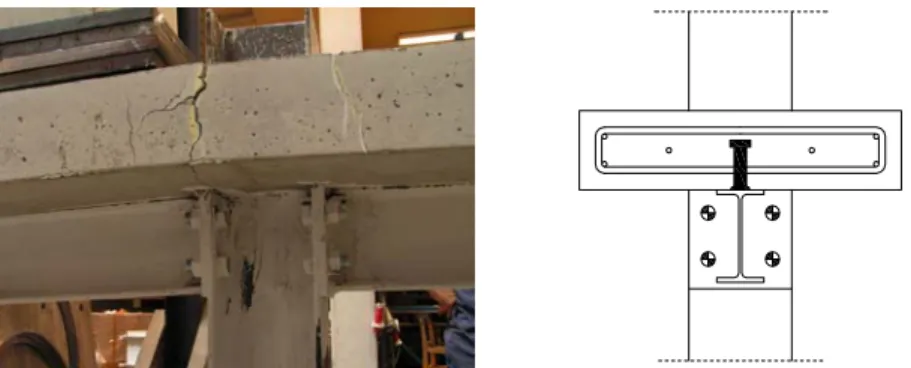
(2) 1. ANALYTICAL PREDICTION OF THE RESPONSE OF COMPOSITE JOINTS SUBJECTED TO SAGGING BENDING MOMENTS. Within the Eurocodes, the analytical procedure recommended for the design of joints is the “component method”. This one does not allow the prediction of the behaviour of composite joints subjected to sagging bending moments. Indeed, no method is available to characterise one of the active joint components, the “concrete slab in compression” (see Fig. 2).. Fig. 2. Concrete slab in compression in the vicinity of the column [3] In recent researches, methods to characterise this component, in terms of resistance, have been proposed; they aimed at defining a effective rectangular cross-section of concrete contributing to the joint resistance. The procedure which is described in this section combines two methods proposed respectively by Ferrario [4] and by Richard Liew [5]. The combination of these two methods permits to reflect in a more appropriate way how the concrete resists to the applied load in the vicinity of the joint. Also, a formula for the characterisation of this component in terms of stiffness is proposed in [2]. These methods are first described and then the validation of the latter is illustrated through comparisons with experimental test results. 1.1 Proposed analytical method In the PhD thesis of Ferrario [4], a formula is proposed to compute the width of concrete beff,conn which has to be considered for the “concrete slab in compression” joint component:.
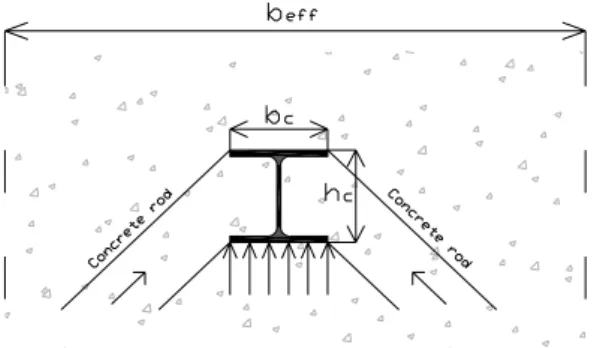
(3) beff ,conn = bc + 0, 7hc ≤ beff where bc is the width of the column flange, hc the height of the column cross-section and beff the effective width of the concrete/composite slab to be considered in the vicinity of the joint (given in Eurocode 4); bc represents the contribution of the concrete directly in contact with the column flange while 0,7hc, the contribution of the concrete rods developing in the “strutand-tie” model illustrated in Fig. 3. In the paper of Richard Liew et al, the width of the concrete is taken as equal to the width of the column flange (beff,conn = bc) and the development of the concrete rods in compression in the “strut-and-tie” model is neglected. The definition of the width given by Ferrario in [4] is used in the present study as it reflects in a more appropriate way, according to the observations made during experimental tests ([2] and [4]), the mechanism actually developing in the concrete slab.. Fig. 3. Plane view of the slab in the vicinity of the joint - development of concrete rods in compression under sagging moment Another difference between the two approaches is the definition of the height of concrete to be considered and, accordingly, the position of the centre of compression within the joint. In [4], the centre of compression is assumed to be at mid-height of the concrete slab while in [5], the following procedure is given to compute the position of this point: -. the characterisation of the components in tension is performed according to the rules recommended in the Eurocodes;.
(4) -. then, the height of the concrete/composite slab contributing to the joint behaviour is computed by expressing the equilibrium of the load developing in the concrete/composite slab in compression with the components in tension or in shear and by assuming a rectangular stress distribution in the concrete (defined as equal to 0,85 fck/γc in Eurocode 4). For instance, in the example illustrated in Fig. 4, the concrete height to be considered is equal to: z=. FRd ,1 + FRd ,2 + FRd ,3 beff ,conn .(0,85. f ck / γ c ). ≤ hconcrete. where hconcrete is the total height of the concrete slab (in case of a composite slab, hconcrete is equal to the concrete above the steel ribs); -. finally, the characterisation of the joint is performed assuming that the centre of compression is located at mid-height of the contributing part of the concrete slab (z). Z. f ck,actual. F Rd,3 F Rd,2 F Rd,1. Fig. 4. Height of the concrete to be considered in the characterisation of the new component The Liew approach is here preferred as it more closely represents the reality observed during experimental tests [2]. Finally, the resistance of the “concrete slab in compression” component is computed as follows: FRd,csc = beff,conn.z.(0,85.fck/γc) The two previously mentioned references deal with the resistance of the “concrete slab in compression” component, but no formulae are proposed as far stiffness is concerned; this property is however required to predict the initial stiffness of the joint (and later on to derive the moment-rotation curve)..
(5) In [6], a formula is proposed to predict the stiffness of a concrete block bearing against a rigid plate. In the “concrete slab in compression” component, the steel column encased in the concrete slab may in fact be considered as a rigid plate; the formula proposed in [6] may therefore be directly extended by expressing the stiffness coefficient of the studied component as: kcsc =. Ec . beff ,conn .z 1, 275.Ea. where Ec is the secant Young modulus for concrete, Ea, the elastic Young modulus for steel and kcsc, the stiffness of the component “concrete slab in compression” to be integrated into the component method. 1.2 Validation of the proposed analytical method. In [2], the analytical procedure described in §1.1 is validated through comparisons with results from experimental tests performed on composite joints in isolation. An example of such comparison is presented in Fig. 5 where the analytical prediction is compared to results of experimental tests conducted at Trento University [3] on external composite joints (see Fig. 4) within a European RFCS project called PRECIOUS in which both Liège University and ArcelorMittal Long Products were involved. In the computations, the actual material properties (without safety factors), determined through coupon tests for the steel materials and through cylinder compression tests for the concrete, are used. The resistant bending moment MRd and the initial stiffness Sj,ini are computed in full agreement with the component method recommended in the Eurocodes while the ultimate moment Mu, the post-limit stiffness Sj,post-limit and the rotation capacity φu are computed according to the method proposed in the PhD thesis of Jaspart [7] (which is in full agreement with the component method), as no methods are actually proposed in the codes to evaluate these properties..
(6) In Fig. 5, two experimental curves are reported. They differ by the slab configuration: composite slab TEST 2 and full concrete slab for TEST 3 (see Fig. 6). A very good agreement is observed between the analytical prediction and the experimental results. For TEST 2, a loss of resistance in the joint is observed at a rotation of 29 mrad. This dicontinuity is not reflected by the analytical prediction; in fact, this loss of resistance is associated to a lack of ductility of the concrete in the vicinity of the connection, phenomenon not yet covered by the proposed analytical procedure. Mom ent at the joint [kN m ]. 500 400 300. Experimental result_TEST 2. 200. Experimental result_TEST 3. 100. Component method prediction with the new component 0 0. 10. 20. 30. 40. 50. 60. 70. 80. 90. Joint rotation [mrad]. Fig. 5. Comparisons analytical prediction vs. experimental results [2]. TEST 3 2970. 150. TEST 2 IPE300 HEB260 2440. Fig. 6. Tested joint configurations at Trento University [3] 2. ANALYTICAL PREDICTION OF THE RESPONSE OF COMPOSITE JOINTS SUBJECTED TO COMBINED BENDING MOMENTS AND AXIAL LOADS. Recent events such as natural catastrophes or terrorism attacks have highlighted the necessity to ensure the structural integrity of buildings under exceptional events. According to.
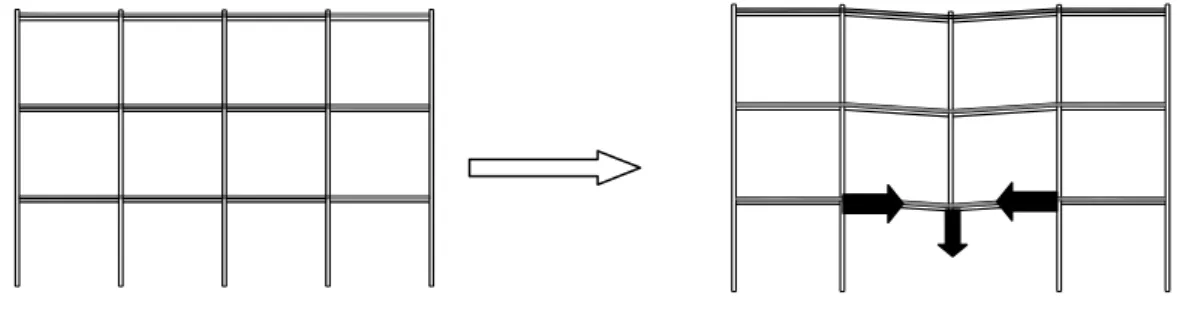
(7) Eurocodes and some different other national design codes, the structural integrity of civil engineering structures should be ensured through appropriate measures but, in most of the cases, no precise practical guidelines on how to achieve this goal are provided. A European RFCS project called “Robust structures by joint ductility” has been set up in 2004, for three years, with the aim to provide requirements and practical guidelines likely to ensure the structural integrity of steel and composite structures under exceptional events, through an appropriate robustness. The investigations performed at Liège University, as part of this European project, were mainly dedicated to the exceptional event “loss of a column in a steel or steel-concrete composite building frame” with a particular attention paid to the behaviour of the joints. The main objective was to develop a simplified analytical procedure to predict the frame response further to a column loss; this one is detailed in two PhD theses ([2] and [8]). When a structure is subjected to such an exceptional event, significant vertical deflections appears within the structure, as illustrated in Fig. 7, and membrane forces (i.e. axial loads) rapidly develop in the beams located just above the damaged or destroyed column. The joints are therefore subjected simultaneously to axial forces and bending moments.. Fig. 7. Loss of a column in a frame The membrane forces have an influence on the rotational stiffness, the moment resistance and the rotation capacity of the joints acting at beam ends, and vice-versa; but as already said, this “M-N interaction” is not presently covered by the Eurocodes where, as a direct consequence, the field of application is limited to joints in which the axial force NEd acting in the joint.
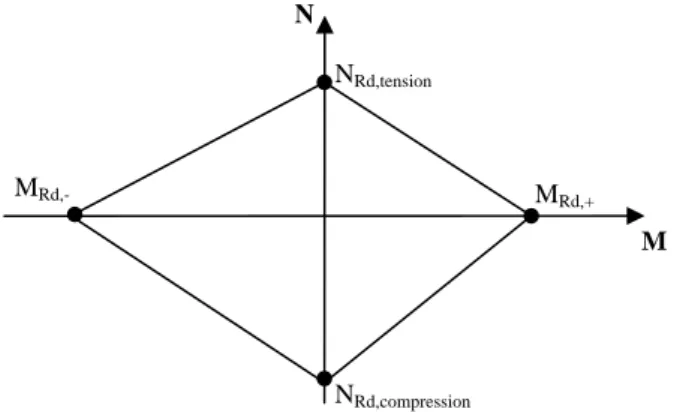
(8) remains lower than 5 % of the axial design resistance of the connected beam cross section Npl,Rd (EN 1993): N Ed ≤ 0, 05 N pl , Rd Under this limit, it is assumed that the rotational response of the joints is not significantly affected by the axial loads. This limitation is fully arbitrary one and is not at all scientifically justified. It has also to be underlined that this criterion only depends of the applied axial load NEd and of the plastic resistance of the beam Npl,Rd (and not of the joint), what is quite surprising as far as the influence of the applied axial load on the joint response is of concern. If the above-mentioned criterion is not satisfied, the Eurocodes recommend to check the resistance by referring to “M-N” interaction diagram defined by the polygon linking the four points corresponding respectively to the hogging and sagging bending resistances in absence of axial forces and to the tension and compression axial resistances in absence of bending (see Fig. 8). N NRd,tension. MRd,-. MRd,+ M. NRd,compression. Fig. 8. M-N resistant curve for a joint proposed in the Eurocodes In a previous study [9], it has been shown that the proposed method is quite questionable. So, an improved design analytical procedure, based on the component method concept, has been developed in [9] by Cerfontaine to predict the response of ductile and non-ductile steel joints subjected to combined axial loads and bending moments..
(9) The main difficulties that Cerfontaine met in developing this “M-N” design procedure relate to the three following aspects: - In the component method, the resistance of the whole joint result from an assembling of the constitutive components. When the joints are subjected to combined bending moments and axial forces, the active components at each loading step are not obvious to define, as their number depends on the relative importance of the bending moment and axial load and on their respective signs. -. In the component approach, so-called “group effects” method had also to be carefully considered. These effects are likely to occur in plate components subjected to transverse bolt forces (i.e. mainly the components end-plate and column flange in bending – see Fig. 9). Where a bolt force is applied, a yield plastic mechanism may develop in the plate component; if the bolt distances are high, separate yield lines will form in the plate component around the bolts (namely “individual bolt mechanism”), while a single yield plastic mechanism common to several bolts may develop when the distance between the latter decreases (namely “bolt group mechanism”). Group effects also affect the resistance of other components as the column web in tension and the beam web in tension. In the Eurocodes, group effects are duly considered, but only in the case of joints subjected to bending moments.. Individual bolt mechanism. Bolt group mechanism. Fig. 9. Example of possible plastic mechanism in a column flange.
(10) -. Stress interactions may influence the behaviour of some components, particularly those belonging to the column: shear stresses in the web panel, longitudinal stresses due to axial and bending forces in the column flange and column web and transverse stresses due to load-introduction (column web in tension, column web in compression and column web in shear).. In [2], the Cerfontaine method has been extended to composite joints in which two main additional components are likely to be activated compared to steel ones: the slab rebars in tension and the concrete slab in compression. Thanks to the component approach, the extension has been easily achieved by just including the behaviour of the two additional components into the procedure. The extended method has been validated through comparisons with experimental tests performed at Stuttgart University (see Fig. 10 – [10]). The comparisons are presented in Fig. 10. On the latter, it can be observed that two analytical curves are reported: one called “plastic resistance curve” which refer to the elastic resistance strengths of the materials and one called “ultimate resistance curve” which refer to the ultimate strengths of the materials.. SAGGING MOMENTS. M [kN]. HOGGING MOMENTS. 500. 70 60 50 40 30 20 10. TENSION. N [kN]. 0 -10 0. 50. 100. 150. 200. 250. 300. 350. 400. 450. 500. 550. 600. 650. 700. -20 -30 -40 -50 -60 -70 -80. Analytical prediction_plastic resistance curve Analytical prediction_ultimate resistance curve Experimental results_TEST 1 Experimental results_TEST 2 Experimental results_TEST 3 Experimental results_TEST 4 Experimental results_TEST 5. Fig. 10. Tested joint configuration [10] and comparison of the resistance interaction curves.
(11) According to Fig. 10, the computed analytical curves are in very good agreement with the experimental results. Indeed, the experimental curves are between the plastic and ultimate analytical resistance curves what is in line with the loading sequence followed during the tests. The fact that the maximum tensile load reached during the experimental tests is higher than the one analytically predicted may be explained by the development of membrane forces in some joint components (for instance end-plate in bending), forces which are not taken into account in the analytical method [2]. 3. DEVELOPED DESIGN DEDICATED SOFTWARE. 3.1 General information and scope. A user-friendly software tool has been developed in order to make the application of the Eurocode 4 design rules for composite joints easier for the designer. The software is a special edition of the new version of the well known commercial software CoP (CoP stands for Connection Program). The software is developed by Feldmann + Weynand GmbH in cooperation with Liège University. The development has been supported by ArcelorMittal and this special edition is provided free of charge [11]. The ArcelorMittal edition of CoP includes also a so-called light version of the CoP steel modules. However this light version is rather limited in scope compared to the full version of CoP. For more information, reference is made to the CoP web site [12]. The following paragraphs give a short summary of the scope of the special edition and some screen shots are shown. CoP is a standard Windows software for the design of joints in steel and steel-concrete composite building frames according to Eurocode 3 (EN 1993) and Eurocode 4 (EN 1994). The ArcelorMittal edition is an unprotected module of CoP which allows the user to design standard joints in composite constructions. A car park for example would be a typical application..
(12) Fig. 11. Example of connection types in the CoP ArcelorMittal edition CoP considers various types of connections (such as bolted end-plate connection, double web cleats, header plates, fin plates) as well as various joint configurations (such as single sided beam-to-column joint configurations, double sided beam-to-column joint configurations, single sided beam-to-beam joint configurations, double sided beam-to-beam joint configurations). Fig. 11 shows some examples of connection types for a beam-to-column joint configuration with a composite beam section. The software consists of three main modules: (a) the user interface, (b) the calculation module and (c) the output processor. These main modules are described more in detail hereafter. 3.2 User interface. An easy-to-use and simple user interface is provided in order to input all necessary data to describe the geometry and the material properties of the joints, see Fig. 12. The ArcelorMittal edition is available in English, French and German language..
(13) Fig. 12. Main screen of CoP. Fig. 13. Input screen for composite beam sections Individual joints may be specified by entering the member and connection data. A complete database containing profile and material characteristics is included in the software in order to.
(14) facilitate the data input, see for example the data input screen for a composite beam section in Fig. 13. During the data input, a data check module is observing the consistency and validity of the data and it informs the user immediately about missing or wrong data. Furthermore, scaled 2D drawings and a 3D visualisation give the user an immediate feed-back about the current data input. 3.3 Calculation modules. The CoP calculation modules are designed to work with the component method. When the user runs the calculation module, either for the active joint or for all defined joints, the structural properties are calculated and a check of the resistance against the internal forces acting at the joint is made. 3.4 Output processor. Finally, CoP will generate a calculation note containing the data input, all results of the calculation of the joint properties and the design checks which are performed if internal loads (effects) are given. The language of the calculation note may be different from that of the user interface. 4. CONCLUSIONS. The analytical procedure to characterise the behaviour of composite joints, as actually proposed within the Eurocodes, is not yet able to cover the case of composite joints subjected to sagging bending moments. Within the present paper, an analytical method to predict the response of composite joints subjected to such loadings has been first described. In addition, an analytical method to predict the behaviour of steel joints subjected to combined moments and axial loads, not accurately covered within the actual codes and.
(15) standards, has been briefly described and its extension to composite joints has been validated through comparisons to experimental test results. Furthermore, a software tool for the design of composite joints according to Eurocode 4 has been presented. The software is provided free of charge by ArcelorMittal. REFERENCES. [1] EN 1994-1-1. Eurocode 4: Design of composite steel and concrete structures – Part 1-1: General rules and rules for buildings. European committee for standardization, December 2004. [2] Demonceau, J.-F.: Steel and composite building frames: sway response under conventional loading and development of membranar effects in beams further to an exceptional action, PhD thesis presented at Liège University, 2008. [3] Trento University: Partially reinforced-concrete-encased column joints for severe seismic loadings: tests and main results, Internal report for the RFCS project RFS-CR-03034 “Prefabricated composite beam-to-column filled tube or partially reinforced-concreteencased column connections for severe seismic and fire loadings”, March 2006. [4] Ferrario, F.: Analysis and modelling of the seismic behaviour of high ductility steelconcrete composite structures, PhD thesis presented at Trento University, 2004. [5] Liew, R.J.Y., Teo, T.H. and Shanmugam, N.E.: Composite joints subject to reversal of loading – Part 2: analytical assessments, Journal of Constructional Steel Research, pp. 247-268, 2004. [6] Weynand, K.: Column bases in steel building frames. COST C1 – Semi-rigid behaviour of civil engineering structural connections, Luxembourg, 1999. [7] Jaspart, J.-P.: Study of the semi-rigidity of beam-to-column joints and its influence on the resistance and stability of steel buildings. PhD thesis, Liège University, 1991 (in French)..
(16) [8] Luu, N.N.H.: Structural response of steel and composite building frames further to an impact leading to the loss of a column, PhD thesis presented at Liège University, 2008. [9] Cerfontaine, F:. Study of the interaction between bending moment and axial force in bolted joints (in French). PhD thesis presented at Liège University, 2003. [10] Kuhlman, U., Rölle, L., Jaspart, J.-P. and Demonceau, J.-F: Robustness – robust structures by joint ductility. COST C26 action titled “Urban habitat constructions under catastrophic events”, proceedings of Workshop in Prague, March 2007. [11] Weynand, K., Klinkhammer R., Oerder R. , Jaspart J.-P.: CoP ArcelorMittal Edition, Program for the design of joints according to EN 1994, www.arcelormittal.com/sections, 2008. [12] Weynand, K., Klinkhammer R., Oerder R. , Jaspart J.-P.: CoP - The Connection Program, Program for the design of joints according to EN 1993-1-8, www.fw-ing.de/software, 2008..
(17)
Figure
![Fig. 2. Concrete slab in compression in the vicinity of the column [3]](https://thumb-eu.123doks.com/thumbv2/123doknet/6540095.176051/2.892.328.566.362.542/fig-concrete-slab-compression-vicinity-column.webp)
![Fig. 4. Height of the concrete to be considered in the characterisation of the new component The Liew approach is here preferred as it more closely represents the reality observed during experimental tests [2]](https://thumb-eu.123doks.com/thumbv2/123doknet/6540095.176051/4.892.276.618.609.722/concrete-considered-characterisation-component-approach-preferred-represents-experimental.webp)
+7
![Fig. 6. Tested joint configurations at Trento University [3]](https://thumb-eu.123doks.com/thumbv2/123doknet/6540095.176051/6.892.205.674.641.907/fig-tested-joint-configurations-trento-university.webp)

![Fig. 10. Tested joint configuration [10] and comparison of the resistance interaction curves](https://thumb-eu.123doks.com/thumbv2/123doknet/6540095.176051/10.892.246.652.748.1121/fig-tested-joint-configuration-comparison-resistance-interaction-curves.webp)

Documents relatifs
The fit was performed using smooth tensile specimens tested along the different direction for all prestrain levels.. Both stress–strain curves and Lankford coefficients
Charpy V–notch (CVN) fracture toughness transition curves of 16MND5 (A508) for T–L Charpy specimens tested at different loading rates... Loading rate effect on ductile crack length
Jackiewicz, Use of a modified Gurson model approach for the simulation of ductile fracture by growth and coalescence of microvoids under low, medium and high stress
with ˙ p >0 imposed in the radial direction, the length of the cylinder is naturally reduced (i.e. At the same time, the external radius is always increased whereas the internal
From Fig. Other material parameters, displayed in Table 1, and the stress rate, ˙ p =10MPa/ns, are those of Fig. When the initial length is large enough, e.g. l 0 =1 000µ m,
The key ingredient to specify what kind of structure should be given to sequents comes from works on focalization in logical programming: Andreoli states in [15] that a proof in
El Harfi et al., 1996, se base sur la stratigraphie du bassin de Ouarzazate pour identifier deux phases tectoniques majeures : la première à l’Eocène supérieur – Oligocène, avec
Dans ce contexte, le travail sur la citation fait d’autant plus sens que les critiques y recourent abondamment de sorte d’asseoir leur propos ; c’est pourquoi
