HAL Id: inria-00283477
https://hal.inria.fr/inria-00283477
Submitted on 30 May 2008
HAL is a multi-disciplinary open access
archive for the deposit and dissemination of
sci-entific research documents, whether they are
pub-lished or not. The documents may come from
teaching and research institutions in France or
abroad, or from public or private research centers.
L’archive ouverte pluridisciplinaire HAL, est
destinée au dépôt et à la diffusion de documents
scientifiques de niveau recherche, publiés ou non,
émanant des établissements d’enseignement et de
recherche français ou étrangers, des laboratoires
publics ou privés.
Bayesian Non Local Means-Based Speckle filtering
Pierrick Coupé, Pierre Hellier, Charles Kervrann, Christian Barillot
To cite this version:
Pierrick Coupé, Pierre Hellier, Charles Kervrann, Christian Barillot. Bayesian Non Local Means-Based
Speckle filtering. IEEE International Symposium on Biomedical Imaging: From Nano to Macro, May
2008, Paris, France. �inria-00283477�
BAYESIAN NON LOCAL MEANS-BASED SPECKLE FILTERING
Pierrick Coup´e
1,2,3, Pierre Hellier
1,2,3, Charles Kervrann
4,5and Christian Barillot
1,2,31University of Rennes I, CNRS UMR 6074, IRISA, Rennes,France 2
INRIA, VisAGeS Project, IRISA, Rennes, France
3
INSERM, U746 Unit, IRISA, Rennes, France
4
INRIA, VISTA Project, IRISA, Rennes, France
5INRA-MIA, Domaine de Vilvert, 78352 Jouy en Josas, France
ABSTRACT
In ultrasound (US) imaging, denoising is intended to im-prove quantitative image analysis techniques. In this paper, a new version of the Non Local (NL) Means filter adapted for US images is proposed. Originally developed for Gaussian noise removal, a Bayesian framework is used to adapt the NL means filter for speckle noise. Experiments were carried out on synthetic data sets with different speckle simulations. Results show that our NL means-based speckle filter outper-forms the classical implementation of the NL means filter, as well as two other speckle adapted denoising methods (SRAD and SBF filters).
Index Terms— Image restoration, Image enhancement, Acoustics, Acoustic applications
1. INTRODUCTION AND RELATED WORK
Denoising is a particularly challenging problem in ultra-sound (US) imaging since the signal-to-noise ratio is low. Contrary to the Gaussian noise model assumed in usual de-noising methods, US imaging requires specific filters due to the statistical nature of the speckle. Speckle in US images is useful for the radiologist since this signal contains informa-tion about the density and the size of scatters. Nonetheless, the speckle is often considered as noise by the image processing community, because its presence spoils medical image ana-lysis procedures. For this reason, denoising filters have been developed. The well known adaptive filters, such as Lee’s fil-ter [1], Frost’s filfil-ter [2], and Kuan’s filfil-ter [3], are based on the hypothesis that speckle noise is essentially a multiplica-tive noise. More recently, the Adapmultiplica-tive Speckle Reduction fil-ter (ASR) [4] uses local statistics of the image to estimate the areas of the image to be processed. The classical formulations of Anisotropic Diffusion filter (AD) [5] and Total Variation minimization scheme (TV) [6] have been adapted for US ima-ging as Speckle Reducing Anisotropic Diffusion (SRAD) fil-ter [7] or the Non-Linear Coherent Diffusion (NCD) filfil-ter [8]. The classical wavelet thresholding postulates that the loga-rithm compression of the US images transforms speckle noise
into additive Gaussian noise. In order to overcome this as-sumption, Pizurica et al. [9] proposed a method without prior model on the noise and signal statistics. Recently, a stochastic approach to ultrasound despeckling (SBF) has been develo-ped [10]. This method removes the local extrema, considered as outliers, by local averaging.
In this paper, we introduce a new restoration scheme in the context of US imaging : a Non Local (NL) Means-based Speckle Filter. The NL means filter was earlier introduced by Buades et al. [11] for Gaussian noise reduction. The main contribution of this paper is the adaptation of this filter to US noise model based on the Bayesian formulation of the NL means filter presented in [12] and the US noise model pro-posed in [13]. A comparison of our method with SRAD [7], SBF [10] and the classical NL means filters [11] is presented for different levels of noise and speckle simulations.
2. THE NL MEANS-BASED SPECKLE FILTER
2.1. The Non Local Means Filter
In the classical formulation of the NL means filter [11], the restored intensity N L(u)(xi) of the pixel xi, is a weighted
average of the pixels intensities u(xi) in the “search volume”
Vi. Let us denote :
N L(u)(xi) =
X
xj∈Vi
w(xi, xj)u(xj) (1)
where w(xi, xj) is the weight assigned to intensity value
u(xj) for restoration of pixel xi. For each pixel xj in Vi,
the L2-normk.k22is computed between u(Nj) (the
neighbo-rhood of xj) and u(Ni) (the neighborhood of xi). Then, these
distances are weighted by the weighting function defined as follows : w(xi, xj) = 1 Zi e−ku(Ni)−u(Nj )k 2 2 h2 (2)
where Ziis the normalization constant ensuring that
P
xj∈Viw(xi, xj) = 1, and h acts as a smoothing parameter.
This filter produces high quality denoising but it is computa-tionally expensive.
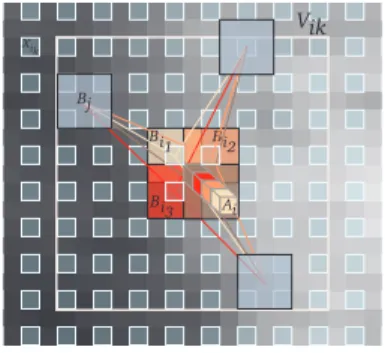
ik B x Bi2 Bi3 i1 Vik Ai Bj
Fig. 1. Blockwise NL means filter. 2.2. Blockwise Approach
To reduce the computational complexity of the algorithm, we introduce a blockwise approach. In our blockwise NL-means filter, a weighted average of patches is performed ins-tead of weighted average of pixel intensities (cf Fig. 1). The blockwise approach consists in a) dividing the volume into blocks with overlapping supports ; b) performing NL means-like restoration of these blocks ; c) restoring the pixels values based on the restored intensities of the blocks they belong to : a) A partition of the imageΩ into overlapping blocks Bik
of size P = (2α+1)d
is performed (d is the dimensionality of the image : 2 or 3), such asΩ =S
kBik, under the constraint
that the intersections between the blocks Bik are non-empty
(i.e.2α ≥ n). These blocks are centered on pixels xik which
constitute a subset ofΩ. The xik are equally distributed at
positions ik = (k1n, k2n, k3n), (k1, k2, k3) ∈ Nd where n
represents the distance between the centers of Bik.
b) the restoration of a block Bik is based on a NL means
scheme defined as follows : NL(u)(Bi k) = X Bj∈Vik w(xik, xj)u(Bj) (3) with w(xik, xj) = 1 Zik e−ku(Bik)−u(Bj )k 2 2 h2 (4)
where u(Bi) = (u(1)(Bi), ..., u(P )(Bi))T is an image patch
containing the intensities of the block Bi, Zikis a
normaliza-tion constant ensuring thatP
jw(xik, xj) = 1 and ku(Bi) − u(Bj)k22= P X p=1 (u(p)(Bi) − u(p)(Bj))2. (5)
c) For a pixel xi included in several blocks Bik, several
estimations of the same pixel xifrom different NL(u)(Bik)
are computed and stored in a vector Ai(cf Fig. 1). The final
restored intensity of pixel xiis then defined as :
N L(u)(xi) = 1 |Ai| X l∈Ai Ai(l). (6)
This approach allows to significantly reduce the complexity of the algorithm. For instance, if we set n= 2, the complexity is divided by a factor4 in 2D and 8 in 3D.
2.3. Bayesian Formulation
Based on the recent Bayesian interpretation of the NL means filter [12], the blockwise NL means can be written as :
NL(u)(Bi
k) =
1 |Vik|
P|Vik|
j=1 p(u(Bik)|u(Bj))p(u(Bj))u(Bj)
1 |Vik|
P|Vik|
j=1 p(u(Bik)|u(Bj))p(u(Bj))
(7) where p(u(Bik)|u(Bj)) and p(u(Bj)) respectively denote
the distribution of u(Bik)|u(Bj) and the prior distribution of
patches (assumed to be uniform in what follows). This new formulation has the advantage to allow the adaptation of the NL means filter to the underlying noise distribution.
2.4. Noise Model in Log-compressed US Images
Realistic modeling of noise distribution of US images is difficult to establish for various reasons : (a) local correla-tion due to periodic arrangements of scatterers [7], (b) enve-lope detection and logarithm amplification of radio-frequency signals performed on the displayed image [8], (c) additive Gaussian noise due to sensors [8] and (d) additive Gaussian noise related to A/N acquisition cards, tend to invalidate the Rayleigh model of RF signal for US Log-compressed images. In the wavelet denoising domain [8], the logarithmic opera-tion is assumed to transform speckle noise into additive Gaus-sian noise. Recent studies on US images show that the distri-bution of noise is closer to the Gamma distridistri-bution [14] or Fisher-Tippett distribution [15]. Another way to deal with the problem of noise modeling in US images is to use a more general image model defined as u(x) = v(x) + vγ(x)η(x)
where v(x) is the original image, u(x) is the observed image, η(x) is a zero-mean Gaussian noise of variance σ2and γ =
0.5. This model was first introduced for ultrasound image denoising by Loupas et al. in [13] and then has been often used [16]. Contrary to the Gaussian noise model, this noise model is image-dependent and takes into account that speckle noise amplitude is larger in regions of high intensities [14,16]. 2.5. A New Statistical Distance for Patch Comparison : the Pearson Distance
Based on the Bayesian formulation (see Eq. (7)), we introduce a new scheme to compute the distance between image patches based on the noise model : u(x) = v(x) + pv(x)η(x), η(x) ∽ N (0, σ2). We have u(x)|v(x) ∽
N (v(x), v(x)σ2), i.e. p(u(x)|v(x)) ∝ exp −(u(x)−v(x))2 2v(x)σ2 .
The likelihood can be factorized for a block as : p(u(Bi)|u(Bj)) = P Y p=1 p(u(p)(xi)|u(p)(xj)) (8) ∝ exp − P X p=1 (u(p)(xi) − u(p)(xj))2 2u(p)(x j)σ2 . (9)
The Pearson distance is then substituted to the usual L2-norm (see Eq. (5)). dP(u(Bi), u(Bj)) = P X p=1 (u(p)(Bi) − u(p)(Bj))2 u(p)(B j) . (10)
This new distance allows to smooth bright areas more than dark areas, and then to be more adapted to speckle statistics. As in [12, 17], pixel selection in the search area is applied to speed up the filter and to better preserving contrast.
w(xik, xj) = 8 < : 1 Zike −dP (u(Bik),u(Bj )) h2 if µ1< u(B ik) u(Bj) < 1 µ1 0 otherwise. (11) µ1 is an hyper-parameter controlling the pixel selection
whose the value will be fixed for all the experiments. Compa-red to the classical formulation, our Optimized Bayesian Non Local Means filter (OBNLM) includes the Pearson distance for weight computation, the pixel selection and the blockwise implementation.
3. EXPERIMENTS
To evaluate the performances of our filter, different expe-riments were carried out on synthetic images with two dif-ferent models of speckle. The speckle models used during ex-periments were different to the model used in our method in order to perform a fair comparison. In the first experiment, a synthetic image available in Matlab was corrupted with dif-ferent levels of noise. The applied simulation of the speckle was the Matlab speckle model : u(xi) = v(xi) + v(xi)ν(xi),
ν(xi) ∽ N (0, σ2). Three levels of noise were tested with
σ = [0.2, 0.4, 0.8]. To quantify the quality of the denoising obtained with the compared methods, the Signal to Noise Ra-tio (SNR) was computed between the “ground truth” and the denoised images. SN R= 10log10 P xi∈Ω(v(xi) 2+ ˜v(x i)2) P xi∈Ω(v(xi) − ˜v(xi)) 2 (12)
where v(xi) is the true value of the pixel and ˜v(xi) the
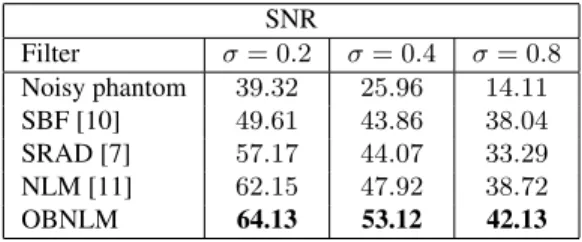
resto-red intensity of the pixel. For each method, at each noise le-vel, the optimal filter parameters were searched within a large range. Tab. 1 shows the SNR obtained during the compari-son. For all levels of noise, our OBNLM filter significantly obtained the best SNR. Fig. 2 shows the denoising results for σ = 0.4. In the second experiment, we used the validation framework proposed in [10]. In order to evaluate the compa-red denoising filters with a more realistic speckle simulation, the physical modeling of speckle presented in [18] was ap-plied on a synthetic phantom (Field II). The denoising perfor-mance of each filter is given by the ultrasound despeckling assessment index ( ˜Q) as defined in [10]. According to [10], a higher ˜Q indicates a better denoising. Fig. 3 presents the denoising results obtained for the compared methods and the corresponding ˜Q indexes. Similar values than those presen-ted in [10] were found for SRAD and SBF filters. Compared
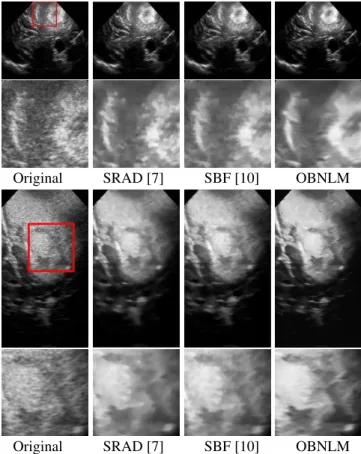
to the classical NL means filter, our method significantly im-proves the ˜Q index (around 40%). In this evaluation frame-work, our OBNLM filter obtained the highest ˜Q index. Fi-nally, examples of denoising obtained on real data acquired during neurosurgical procedure is given in Fig. 4. Our block-wise implementation processes an image of390 × 500 pixels in 6s on a Pentium M 2GHz. Visually, our filter efficiently re-moved the speckle while enhancing the edges and preserving the image structures. The SRAD and SBF filters removed spe-ckle but produced artifacts (local constant areas and artificial structures). These artifacts are also visible in the experiments on synthetic data sets, especially in Fig. 3.
SNR Filter σ= 0.2 σ= 0.4 σ= 0.8 Noisy phantom 39.32 25.96 14.11 SBF [10] 49.61 43.86 38.04 SRAD [7] 57.17 44.07 33.29 NLM [11] 62.15 47.92 38.72 OBNLM 64.13 53.12 42.13
Table 1. Quantitative results obtained with the compared fil-ters for the 2D phantom study. Our OBNLM filter obtained the highest SNR for all noise levels.
First experiment withσ= 0.4
Phantom Noisy phantom
SBF [10] SRAD [7]
NLM [11] OBNLM
Fig. 2. Denoised images obtained by the compared filters in the first experiment.
4. CONCLUSION
In this paper, we proposed a Non Local (NL) means-based filter for US images by introducing the Pearson distance as a relevant measure for patch comparison. Evaluations were performed on synthetic data with different noise levels and different speckle simulations. Experiments showed that the proposed filter outperforms the classical implementation of the NL means filter as well as the SRAD and the SBF filters.
Second experiment (Field II)
Geometry of the phantom Field II simulation
SRAD [7] ( ˜Q= 2.11) SBF [10] ( ˜Q= 2.27)
NLM [11] ( ˜Q= 1.95) OBNLM ( ˜Q =2.71)
Fig. 3. Denoised images obtained by the compared filters and the corresponding ˜Q index. Our filter obtained the highest ˜Q index.
These results show that image-redundancy assumption requi-red for NL means filter holds for ultrasound imaging. Further work will pursue on automatic tuning of filter parameters of our Optimized Bayesian NL means (OBNLM) filter. Finally, the impact of our method on post-processing tasks such as segmentation or registration will have to be studied.
5. REFERENCES
[1] J. S. Lee, “Digital image enhancement and noise filtering by use of local statistics,” IEEE PAMI, vol. 2, pp. 165–168, 1980.
[2] V.S. Frost et al., “A model for radar images and its application to adap-tive digital filtering of multiplicaadap-tive noise,” IEEE PAMI, vol. 2, pp. 157–65, 1982.
[3] D.T Kuan et al., “Adaptive noise smoothing filter for images with signal-dependent noise,” IEEE PAMI, vol. 7, no. 2, pp. 165–177, 1985. [4] A. Lopes et al., “Adaptive speckle filters and scene heterogeneity,”
IEEE Trans. geosci. remote sensing, vol. 28, pp. 992–1000, 1990. [5] P. Perona and J. Malik, “Scale-space and edge detection using
aniso-tropic diffusion,” IEEE PAMI, vol. 12, no. 7, pp. 629–639, 1990. [6] L.I. Rudin et al., “Nonlinear total variation based noise removal
algo-rithms,” Physica D, vol. 60, pp. 259–268, 1992.
[7] Y. Yu and S. T. Acton, “Speckle reducing anisotropic diffusion,” IEEE TIP, vol. 11, no. 11, pp. 1260–1270, 2002.
[8] K. Z. Abd-Elmoniem et al., “Real-time speckle reduction and cohe-rence enhancement in ultrasound imaging via nonlinear anisotropic dif-fusion.,” IEEE TBE, vol. 49, no. 9, pp. 997–1014, 2002.
Original SRAD [7] SBF [10] OBNLM
Original SRAD [7] SBF [10] OBNLM Fig. 4. Results obtained with SRAD, SBF and the proposed filters on real intraoperative brain images with zooms. Our fil-ter efficiently removes the speckle while enhancing the edges and preserving the image structures.
[9] A. Pizurica et al., “A review of wavelet denoising in mri and ultrasound brain imaging,” Current Medical Imaging Reviews, vol. 2, no. 2, pp. 247–260, 2006.
[10] P. C. Tay et al., “A stochastic approach to ultrasound despeckling,” in ISBI’06, 2006, pp. 221–224.
[11] A. Buades et al., “A review of image denoising algorithms, with a new one,” Multiscale Modeling & Simulation, vol. 4, no. 2, pp. 490–530, 2005.
[12] C. Kervrann et al., “Bayesian non-local means filter, image redundancy and adaptive dictionaries for noise removal,” in SSVM’ 07, 2007, pp. 520–532.
[13] T. Loupas et al., “An adaptative weighted median filter for speckle suppression in medical ultrasound image,” IEEE T. Circ. Syst., vol. 36, pp. 129–135, 1989.
[14] Z. Tao et al., “Evaluation of four probability distribution models for speckle in clinical cardiac ultrasound images,” IEEE TMI, vol. 25, no. 11, pp. 1483–1491, 2006.
[15] G. Slabaugh et al., “Ultrasound-specific segmentation via decorrelation and statistical region-based active contours,” in CVPR ’06, 2006, vol. 1, pp. 45–53.
[16] K. Krissian et al., “Speckle-constrained anisotropic diffusion for ultra-sound images,” in CVPR ’05, 2005, pp. 547–552.
[17] Coup´e et al., “Fast Non Local Means Denoising for 3D MR Images,” in MICCAI’06, 2006, LNCS 4191, pp. 33–40.
[18] M. S. Jensen et al., “A method to obtain reference images for evaluation of ultrasonic tissue characterization techniques,” Ultrasonics, vol. 40, no. 1-8, pp. 89–94, 2002.