To cite this version : Juarez García, Jose Manuel and Li, Zhong and
Vahlas, Constantin and Díaz de la Torre, Sebastián and Juárez López,
Fernando Spark Plasma Sintering and Characterization of
NiCoCrAlY-Ta Superalloy Powder. (2010) Journal of Materials Science and
Engineering, vol. 4 (n° 11). pp. 57-63. ISSN 1934-8959
O
pen
A
rchive
T
OULOUSE
A
rchive
O
uverte (
OATAO
)
OATAO is an open access repository that collects the work of Toulouse researchers and
makes it freely available over the web where possible.
This is an author-deposited version published in :
http://oatao.univ-toulouse.fr/
Eprints ID : 14123
Any correspondance concerning this service should be sent to the repository
administrator:
[email protected]
Spark Plasma Sintering and Characterization of
NiCoCrAlY-Ta Superalloy Powder
Jose Manuel Juarez García1, Zhong Li2, Constantin Vahlas3, Sebastián Díaz de la Torre1 and Fernando Juárez López 1
1. Instituto Politécnico Nacional -CIITEC, Cerrada de cecati s/n col. Sta. Catarina, D.F. 02250, México
2. Centre for Advanced Nanotechnology, CAN University of Toronto, 170 College Street, M5S3E4, Ontario, Canada 3. Centre CARNOT, ENSIACET, 4, allée Emile Monso - BP 44362 - 31432 Cedex 4 Toulouse Cedex, France
Abstract: In the present study, the spark plasma sintering technique is used to densify commercial alloy NiCoCrAlY-Ta. Such powder was sintered at temperatures ranging between 900 and 1050 °C to yield various microstructures. Full compaction is achieved in a short time and the overall processing duration does not exceed 30 min. Microestructural and porosity evaluation was investigated by using scanning electron microscopy and chemical analysis. Two phases, and !, were identified in sintered microstructure by XR-diffraction. Micro Vickers tests were carried out on the sintered specimens, the resultant properties at room temperature are very promising whereas major hardness resistance was obtained at 1000 °C.
Key words: Spark plasma sintering, NiCoCrAlY-Ta, powder.
1. Introduction
NiCoCrAlY-Ta alloys are subjected to extensive research efforts to develop applications in gas turbine due to their high specific young’s modulus and strength, and to their good oxidation and corrosion resistances. However, such alloys suffer from limited ductility at room temperature and creep resistance at service temperature (950-1100 °C) [1-4]. From a technological point of view, the current limitations are due to a large scattering in mechanical properties resulting from correlated chemical and structural heterogeneities, to manufacturing difficulties and high costs. In this context, the present work aimed to produce NiCoCrAlY-Ta alloys with refined and homogenous microstructure by using the spark plasma sintering process (SPS).
SPS is found to be an effective technique to compact
Corresponding author: Fernando Juárez López (1968- ), male, Ph.D., professor, research fields: nanotechnology, corrosion, materials science CVD. E-mail: [email protected].
powder through the simultaneous application of direct pulsed current and uniaxial pressure (for a recent review sees reference [5]). Assisted by applied pressure, an electric current density induces a temperature elevation within the sample through the joule’s effect, thus leading to powder sintering.
The emerging SPS theme from the large majority of investigations of current activated sintering is that it has decided advantages over conventional methods including pressureless sintering, hot-pressing, and others. These advantages include: lower sintering temperature, shorter holding time, and markedly comparative improvements on the properties of materials consolidated by this method [5, 6].
The use of the hot pressing techniques to optimize microstructure of NiCoCrAlY-Ta alloys for high temperature application has been scarcely documented [7-10]. The present study shows preliminary results of NiCoCrAlY-Ta powder sintered as to optimize the SPS parameters.
In the following, the powder characteristics are first introduced, and then the SPS sintering processing is discussed. The applied load, time (duration of experiments < 5 min) and temperature (up to 1000 °C) were set to obtain pore free samples. Scanning electron microscopy (SEM) and X-ray diffraction (XRD) were carried out to determinate the morphology and microstructure of specimens sintered. Finally micro Vickers test was carried on the sintered specimens by Micro Hardness Mitutoyo AVK-C2 indent at CIITEC Laboratory of dimensions metric.
2. Experiment
2.1 Powder Characteristic
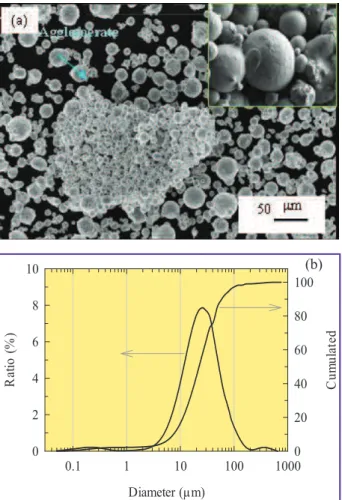
The commercial NiCoCrAlY-Ta powder is a pre-alloyed material, which is mainly composed of Ni with additions of Co (21 wt.%), Cr (19 wt.%), Al (8 wt.%), Ta (5 wt.%) and Y (1 wt.%). Fig. 1a shows a SEM micrograph of the as-received powder illustrating the spherical shape and agglomerates of the particles. Their skeleton-like shape shows a density of 7700 kg/m3, while the apparent untapped density of the powder is of 4300 kg/m3. Specific surface area was computed from the N2 adsorption isotherms (recorded
at -196 C with a Micrometrics Flowsorb II2300), using the BET method and was found to be 0.83 m2/g. This low value is characteristic of a non porous material. Size distribution was determined with a Malvern Mastersizer laser diffractometer. It was found that mean size distribution of the particles is 23 "m, with minimum 0.05 "m and maximum 556 "m. Fig. 1b presents the particle size distribution measurement of the NiCoCrAlY-Ta superalloy.
2.2 SPS Experiments
The SPS experiments were carried out on a commercial Dr Sinter Sumitomo 1050 apparatus (Sumitomo Coal Ming Co., Japan). This equipment can supply a direct current of 5000 Amp of intensity under a maximum voltage of 5 V. The powder was filled into a graphite die set with a 20 mm wall thickness, placed
Fig. 1 SEM micrograph of the as-received powder illustrating the spherical morphology and as well as a small agglomerated them (a). Particle size distribution measured of the NiCoCrAlY-Ta powder (b).
between two graphite punches of 20 mm diameter. Elements of graphite play both the role of electrodes and plates imparting the pressure. The sinter chamber is kept under vacuum (10-2 Pa) along the experiments.
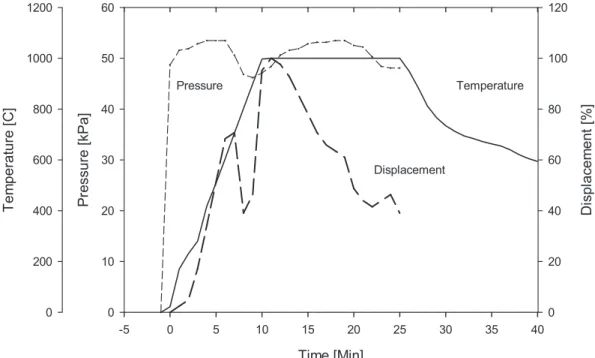
Fig. 2 shows an experimental record of the SPS-processing parameters, i.e., temperature, applied pressure and relative displacement of the punches, as a function of time. The relative displacement of the punches is expressed in percentage of the maximum displacement attainable. The temperature curve displays the variation measured by the internal pyrometer. For this illustration, the selected holding temperature was 1000 °C. The pressure and the current pulses are applied simultaneously. The set pressure was 50 KPa and was applied into the powder in about 3 min. A heating rate of 150 °C/min was programmed, in such
Diameter (µm) 0.1 1 10 100 1000 R at io ( % ) 0 2 4 6 8 10 C u m u la te d 0 20 40 60 80 100 (b)
Time [Min] -5 0 5 10 15 20 25 30 35 40 D is p la c e m e n t [% ] 0 20 40 60 80 100 120 T e m p e ra tu re [ C ] 0 200 400 600 800 1000 1200 P re s s u re [ k P a ] 0 10 20 30 40 50 60 Temperature Displacement Pressure
Fig. 2 Experimental record of a number of SPS-parameters such as: temperature, applied pressure and relative displacement of the punches as a function of time for an experiment NiCoCrAlY-Ta performed at 1000 °C.
a way that the sintering temperature was reached in about 9 minutes. After 15 minutes of holding time at the maximum temperature, the pressure and vacuum are then removed. This results in a pressure which falls quickly, whereas the temperature reduction lasts 7 min to reach 600 °C. The initial temperature drop from 1000 to 600 °C occurs at a rate of 90 °C/min. The Fig. 2 shows three main steps for the displacement variation, which should be interpreted as follows. During the initial pressure increase (2.5 min), the powder is compressed as a green body. This is followed by a plateau-like stage. Sintering occurs in the final stage as the temperature reaches about 750 °C under 50 KN. For this condition, the pressure (applied load) exceeds the yield stress at a temperature above the brittle-ductile transition. Sintering begins taking place in less than 2 min, which means that full densification is achieved at a temperature of 950 °C, namely before the holding temperature is reached. The following decrease of the relative displacement is interpreted as a result of the system dilation.
NiCoCrAlY-Ta alloy powders were consolidated at temperatures ranging from 800 °C to 1000 °C, charge
15 KN and time maxime 30 minutes. To avoid grain coarsening of the microstructure of sintered specimen, SPS was conducted below the ! prime temperature, which is about 1140 °C [11].
With the above experimental parameters set, in less than 15 minutes, the sintering of a tablet-like specimen of 20 mm diameter and 3 mm thick was accomplished. No subsequent thermal treatment was applied to the tablets, in such a way that the final microstructure was obtained by one single step.
3. Results
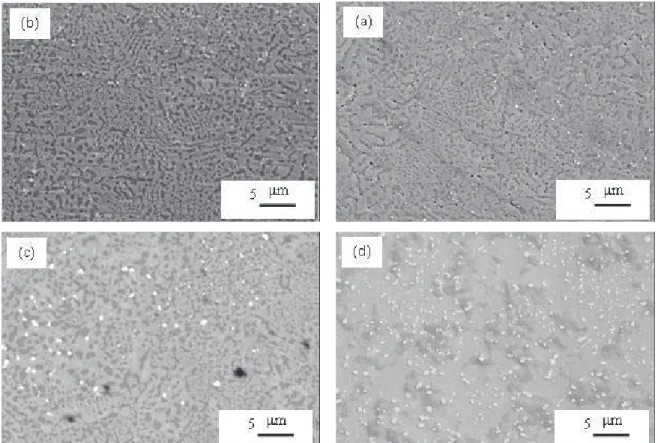
Fig. 3 displays the microstructures of the NiCoCrAlY-Ta alloys sintered at temperature of 900, 950, 1000 and 1050 °C. SEM analyses of polished surfaces do not reveal porosity for the samples sintered at 950 °C, which confirms the major compaction. Fig. 3a shows a surface of sintered samples at 900 °C. At this temperature the resulting microstructure still shows characteristics from original structure and is only observed on plastic deformation of the powders. For all temperatures, the microstructure is mainly composed of two phases, a gray and darkness. EDS
Fig. 3 Scanning electron micrographs of NiCoCrAlY-Ta powder sintered by setting SPS at (a) 900 °C, (b) 950 °C, (c) 1000 °C and (d) 1050 °C.
qualitative analysis on the samples sintered was possible to identify these areas; the dark gray area with high aluminum content would correspond to a phase (NiAl3), and the gray area rich in nickel and chromium
which would correspond to a ! phase nickel and, finally some rich precipitates in Tantalum would correspond at carbide TaC. The latter is shown in the analysis by energy dispersion spectrometry.
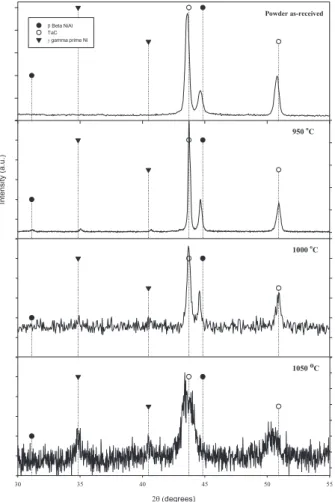
Fig. 4 shows the XRD patterns evolution of the sintered NiCoCrAlY-Ta, two phases was identified NiAl3 and ! Nickel. The set of conditions of temperature and pressure in SPS allowed to keep the same microstructure and not is appreciated grain coarsening to 1000 °C.
Fig. 5a shows the percent in porosity of samples sintered for the temperatures from 800 to 1000 °C. A significant reduction in porosity is observed when increasing sintering temperature. This figure shows a microstructural evolution and Vickers hardness increasing with temperature.
It is clearly observed a decreasing in porosity with increasing sintering treatment temperature. An analysis of the hardness in the sintered samples by SPS, shows a rise in Vickers hardness with respect to the sintering temperature. However, at temperature of 1050 °C it is observed a diminution of hardness and an increased of the porosity that could be associated with the start of the melting components.
4. Discussion
It was not possible to obtain pore-free samples with satisfactory mechanical rigidity by cold compaction. Consequently, powders were positioned in graphite dies and were sintered in a SPS system. As shown below, that (1000 °C) temperature is high enough: (1) to ensure densification of the samples; (2) to allow distribution of phase in the entire volume of each particle; and (3) to stabilize the microstructure in view of the subsequent heat treatments.
In te n s ity ( a .u .) ! Beta NiAl TaC " gamma prime Ni Powder as-received 950oC 1000 oC #$ %degrees) 30 35 40 45 50 55 1050 oC
Fig. 4 XRD patterns for corresponding NiCoCrAlY-Ta sintered specimens.
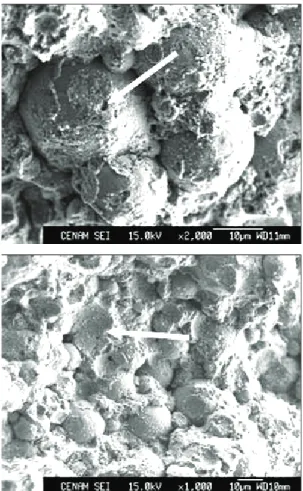
wrinkled surface of powders NiCoCrAlY-Ta. The present work clearly demonstrates that NiCoCrAlY-Ta alloys can be rapidly sintered by SPS (in less than 30 min). As illustrated by the presence of little number of porosities, a full compaction can be achieved by using SPS. From Fig. 1, larger powder particles and a relative proportion of surface area/per volume unit limits the interstitial hardening, and tends to favor elastic deformation. Moreover, the current density at contacts among larger particles should be higher because of a smaller number of connections and in other case of small particles; the F current density should be lower, where the powders sintering started early. Thus, a faster consolidation was achieved mainly due to the presence of a large size distribution of powders, allowing the small powder to fill the interstices present between the larger powder (Fig. 6). The Fig. 6 shows a surface of NiCoCrAlY-Ta sintered
Fig. 5 Analysis of NiCoCrAlY-Ta samples sintered by SPS for range of temperatures 800 to 1000 °C : (a) porosity and (b) Vickers hardness.
sample at 900 °C after a fracture procedure.
Fig. 2 shows experimental record of a number of SPS-parameters such as the densification of NiCoCrAlY-Ta powders as function of time. During this period under operating conditions used, grain boundaries were deformed and reorganized, especially due to the plastic deformation of the Al-rich ! phase. This latest phase contains a major amount of aluminum, thus plastic deformation during the SPS process is expected to be most important with respect to the presence of deformation in the ! phase that contains a major amount of nickel (Fig. 3). The measurement of the relative displacement of the punches (Fig. 2) indicates that the compaction can be completed at 900 °C. Thus, as long as a transus temperature is not reached, quite similar microstructures
Temperature (oC) 750 800 850 900 950 1000 1050 1100 P o ro s it y % 0 2 4 6 8 10 (a) Temperature ( o C) 900 950 1000 1050 H a rd n e s s ( H V ) 200 250 300 350 400 450 500 (b)
Fig. 6 Fracture surface of NiCoCrAlY-Ta sintered sample at 900 °C.
are generated. A short-time holding also help reducing the microstructural evolutions resulting of diffusion controlled by phase transformations. The transus for the NiCoCrAlY-Ta alloys have been measured at 854 °C [12], indicating that these alloys are satisfactorily described by a Ni-Al binary diagram with only a slight effect of Tantalum on the related transus temperature. For SPS temperatures ranging between 900 and 1000 °C, two mainly phases are formed in the microstructure: and !. The SPS sintering temperatures are lower than the & transus temperature and no grain coalescence is expected due to the short duration of the experiment.
Contact among surfaces is favored during SPS and the resulting product is exempt of open porosity. Fig. 3 displays the microstructures of the NiCoCrAlY-Ta alloys sintered at temperature 900 to 1000 °C. SEM analyses of polished surfaces not reveal porosity,
which confirms the major compaction. Munir et al. [5] reported not contribution of time to the process of consolidation powders, then here for both sintering time at 0 min and 15 min, the NiCoCrAlY-Ta alloy exhibits a similar microstructure with individual grains.
The XRD diffraction shows the presence of a ! phase and a phase for all temperatures, and there is neither difference in the positions of the peaks nor new peaks indicating the formation of a new phase, besides the peak shape suggests that there was not coarsening of grain in the temperature range of 950-1000 °C.
Courat et al. have mentioned that the current density conditions prevailing during the SPS process [6] do not allow mass transport, then tantalum present at the start on the surface of atomized powders, it remains during sintering within the limits of powders, and is only carried by the particle limit or grain-boundary, as is observed in Fig. 3 for all temperatures, indeed tantalum has a high melting point.
5. Conclusions
NiCoCrAlY-Ta alloys have been sintered by the using spark plasma sintering process. In less than 30 min and at 950 °C, tablet-like specimen disclosing with a good compacting and homogeneous microstructures were obtained. Two mainly phases are formed in the microstructure for SPS temperatures: and !. Such refined microstructures represent a real advantage with respect to conventional hot isostatic pressing (HIP) processing [13]. The sintering temperature was largely decreased by using SPS indeed.
This particular microstructure can be sintered at about 100 °C SPS temperature range, without any significant structural and property changes. However, the mechanical properties are still under investigation and should be further reported.
SPS process appears to be a promising route to produce NiCoCrAlY-Ta alloys for aircraft applications.
Acknowledgments
The authors are grateful for the support to conduct this work to COFAA, EDI-IPN, ICyTDF and CONACYT. And the authors are also indebted to Red de Nanotecnología of IPN, for the SPS facilities.
References
[1] N. Czech, F. Schmitz, W. Stam, Improvement of MCrAlY coatings by addition of rhenium, Surf. Coat. Tech. 68-69 (1994) 17-21.
[2] H. Nickel, D. Clemens, W.J. Quadakkers, L. Singheiser, Development of NiCoCrAlY alloys for corrosion-resistant coatings of gas turbine components, Journal of Pressure Vessel Technology 121 (1999) 384-387.
[3] D. Monceau, A. Boudot-Miquet, K. Bouhanek, R. Peraldi, A. Malie, F. Crabos, B. Pieraggi, Oxydation and protection des matériaux pour sous-couches (NiAlPd, NiAlPt, NiCoCrAlTa, CoNiCrAlY) de barriéres thermiques, J. Phys. IV France 10 (2000) 167-171. [4] T.A. Taylor, D.F. Bettridge, Development of alloyed and
dispersion-strengthened MCrAlY coatings, Surf. and Coat Technol. 86- 87 (1996) 9-14.
[5] Z.A. Munir, U. Anselmi-Tamburini, M. Ohyanagi, The effect of electric field and pressure on the synthesis and consolidation of materials: a review of the spark plasma sintering method, J. Materials Sci. 41 (2006) 763-777. [6] A. Courat, G. Molenat, J. Galy, Microstructures and
mechanical properties of TiAl alloys consolidated by
spark plasma sintering, Intermetallics 16 (2008) 1134-1141.
[7] D. Oquab, C. Estournes, D. Monceau, Isothermal study of Pt-Al-NiCoCrAlYTa multi-layered coatings prepared by spark plasma sintering, Adv. Eng. Materials 9 (2007) 413-417.
[8] R.G. Menzies, G.J. Davies, J.W. Edington, Effect of the treatment on superplastic response of powder-consolidation nickel-base superalloy IN100, Metal Science 16 (1982) 356-362.
[9] M.C. Somani, K. Muraleedharan, Y.V.R.K. Prasad, V. Sigh, Mechanical processing and microstructural control in hot working of hot isostatically pressed P/M IN-100 superalloy, Materials Science and Engineering A 245 (1998) 88-99.
[10] M.C.M. Jeandin, J.L. Koutny, Y.C. Bienvenu, Procédé d’assemblage de piéces en superalliages á base propiété industrielle, Institut National de la Propiété Industrielle, France, Accession (2610856), 1988.
[11] T.L. Prakash, M.C. Somani, E.S. Bhagiradha Rao, Structure property correlation of as- HIPped and HIP + forged P/M alloy nimonic AP-1, Powder Met. Related High Temp. Mater. (1988) 179-198.
[12] R.D. Noebe, R.R. Bowman, M.V. Nathal, Physical and mechanical properties of the B2 coumpound NiAl, Int. Met. Rev. 38 (1993) 193-232.
[13] F. Juarez, D. Monceau, D. Tetard, B. Pieraggi, C. Vahlas, Chemical vapor deposition of ruthenium on NiCoCrAlYTa powders followed by thermal oxidation of sintered coupons, Surf. Coat. Technol. 163-164 (2003) 44-49.