HAL Id: hal-02359178
https://hal.archives-ouvertes.fr/hal-02359178
Submitted on 12 Nov 2019
HAL is a multi-disciplinary open access
archive for the deposit and dissemination of
sci-entific research documents, whether they are
pub-lished or not. The documents may come from
teaching and research institutions in France or
abroad, or from public or private research centers.
L’archive ouverte pluridisciplinaire HAL, est
destinée au dépôt et à la diffusion de documents
scientifiques de niveau recherche, publiés ou non,
émanant des établissements d’enseignement et de
recherche français ou étrangers, des laboratoires
publics ou privés.
Alkyl-Modified Gold Surfaces: Characterization of the
Au–C Bond
Avni Berisha, Catherine Combellas, Fredeŕic Kanoufi, Jérôme Médard,
Philippe Decorse, Claire Mangeney, Issam Kherbouche, Mahamadou Seydou,
Francois Maurel, Jean Pinson
To cite this version:
Avni Berisha, Catherine Combellas, Fredeŕic Kanoufi, Jérôme Médard, Philippe Decorse, et al..
Alkyl-Modified Gold Surfaces: Characterization of the Au–C Bond. Langmuir, American Chemical Society,
2018, �10.1021/acs.langmuir.8b01584�. �hal-02359178�
Alkyl-Modi
fied Gold Surfaces: Characterization of the Au−C Bond
Avni Berisha,
*
,†,§Catherine Combellas,
†Frédéric Kanoufi,
†Jérôme Médard,
†Philippe Decorse,
†Claire Mangeney,
‡Issam Kherbouche,
‡Mahamadou Seydou,
†François Maurel,
†and Jean Pinson
*
,††
Sorbonne Paris Cité, Université Paris Diderot, ITODYS, UMR 7086 CNRS, 15 rue J-A de Baïf, 75013 Paris, France
‡
Sorbonne Paris Cité, Université Paris Descartes, Laboratoire de Chimie et Biochimie Pharmacologiques et Toxicologiques, UMR
8601 CNRS, 45 rue des Saints Pe
̀res, 75006 Paris, France
§
Chemistry Department of Natural Sciences Faculty, University of Prishtina, rr.
“Nëna Tereze” nr. 5, 10000 Prishtina, Kosovo
*
S Supporting InformationABSTRACT:
The surface of gold can be modi
fied with alkyl groups through a radical
crossover reaction involving alkyliodides or bromides in the presence of a sterically
hindered diazonium salt. In this paper, we characterize the Au
−C(alkyl) bond by
surface-enhanced Raman spectroscopy (SERS); the corresponding peak appears at
387 cm
−1close to the value obtained by theoretical modeling. The Au
−C(alkyl) bond
energy is also calculated, it reaches
−36.9 kcal mol
−1similar to that of an Au
−S−alkyl
bond but also of an Au
−C(aryl) bond. In agreement with the similar energies of Au−
C(alkyl) and Au
−S−(alkyl), we demonstrate experimentally that these groups can be exchanged on the surface of gold.
1. INTRODUCTION
Surface modi
fication by organic films is commonly
encoun-tered in our daily life from a painted house gate to the
sophisticated processes that prevent cars from rusting and
provide the aesthetic
finish. Among the many routes that have
been developed, some provide a chemical bond between the
surface and the organic
film. For example, self-assembled
monolayers (SAMs) of silanes,
1−3phosphonates,
4,5and
carboxylic acids
6are formed on surface oxides, while alkenes
and alkynes are bonded to hydrogenated silicon
7or carbon.
8Long alkyl chain thiols SAMs are attached to gold and some
other metals (Ag and Cu).
9Electrografting strategies have also
been investigated such as the electrografting of diazonium salts,
which provides aryl
films covalently bonded to a variety of
surfaces (carbon, metals, oxides, polymers).
10−13These
di
fferent methods provide a number of surface−(organic
film) bonds; for example, silanes are bonded through (surface
oxygen)
−silicon: O−Si bonds, carboxylates through O−C
bonds,
1thiols through Au
−S bonds,
9and diazonium
salts
10−12,14through metal
−C(aryl) or oxide O−C(aryl).
Alkyl
films bonded to various surfaces have been prepared
by (i) electrochemical oxidation of carboxylates
15on carbon
anodes and Grignard reagents
16on hydrogenated silicon and
(ii) by electrochemical reduction of iodoalkanes
17(RI) or
per
fluoroiodoalkanes (R
F−(CH
2)
2−I) on glassy carbon, Au,
Fe, and Cu cathodes. However, for the latter process, the
reduction takes place at quite negative potentials, which results
in the reduction of any reducible group in the
film. More
recently, it was found that the reaction can be accomplished
indirectly at much lower driving force
18following
Scheme 1
.
The 2,6-dimethylbenzenediazonium (DMBD) salt is
re-duced electrochemically at quite low potential [E
p=
−0.20 V/
saturated calomel electrode (SCE) to its radical [R1]];
however, because of steric hindrance this radical cannot react
with surfaces [R2], instead it abstracts a iodine atom from RI
present in the solution to give the alkyl radical R
•[R3] that
reacts with the surface (R4). In the case of RI = C
6F
13−
(CH
2)
2−I, the direct reduction takes place at E
p=
−1.9 V/
SCE and the electrografting reaction can be achieved at the
reduction potential of 2,6-DMBD with a potential gain of
ΔV
≈ 1.7 V. This indirect grafting of alkyl groups has been
extended to alkyl bromides,
19to the formation of mixed
layers,
20and to the surface modi
fication of polymers.
21The bond between the surface and an aryl group grafted by
reduction of diazonium salts has been well characterized by
Received: May 14, 2018
Revised: July 18, 2018
Published: September 1, 2018
Scheme 1. Indirect Grafting of Alkyliodides
pubs.acs.org/Langmuir
Cite This:Langmuir 2018, 34, 11264−11271
Downloaded via UNIV PARIS DIDEROT on October 22, 2019 at 13:55:44 (UTC).
theoretical calculations,
12,22−24Raman (graphene
−aryl
25),
sur-face-enhanced Raman scattering (SERS) (Au
−aryl
14), X-ray
photoelectron spectroscopy (XPS) (Fe−aryl,
26O−aryl,
27Au−
N
N−aryl
28), time-of-
flight secondary ion mass spectrometry
(C and O
−aryl),
29and Mossbauer spectroscopy (O
−aryl).
30The energies of the surface
−aryl bond vary from 24 to 30 and
70 kcal mol
−1for, respectively, Au,
23a graphene plane,
31and
Si.
23However, there are no such results for the surface
−alkyl
bonds that have never been characterized.
Herein, we examine (i) the Raman spectroscopic evidence of
an Au
−alkyl bond, (ii) the growth of the film by atomic force
microscopy (AFM), (iii) the bonding energy of alkyl groups
(Au
−C bond) on gold by theoretical methods and we compare
this energy to that of the previously investigated Au
−S−alkyl
bond, and (iv) based on the results of the simulations, we show
that alkyl and thioalkyl groups can be exchanged on the surface
of gold [the valeric groups of a Au−(CH
2)
4−COOH film,
prepared from bromovaleric acid (
Scheme 1
), are exchanged
by the HS
−(CH
2)
5−COOH and HS−(CH
2)
17CH
3thiols].
2. MATERIALS AND METHODS
2.1. Chemicals. 5-Bromovaleric acid (97%), valeric acid (99%), 2,6-dimethylaniline (99%), tetrabutylammonium tetrafluoroborate (99%), 1-octadecanethiol (99%), 6-mercaptohexanoic acid (90%), acetonitrile (ACN), and diethyl ether were purchased from Sigma-Aldrich. They were used without further purification. Milli-Q water (>18 MΩ cm) and absolute ethanol were used for rinsing the samples. 2,6-DMBD was prepared by the standard procedure in aqueous solution.32 The product was purified by dissolution in ACN and precipitation in ether. IR-ATR: −N2+: 2269 cm−1, aromatic
vibrations: 1585, 1478 cm−1, BF4−: 1036 cm−1, C−H out of plane:
806 cm−1.1H NMR (DMSO-d
6, Bruker 400 MHz)δ ppm: 8.02 (t,
1H), 7.65 (d, 2H), 2.95 (s, 6H).
2.2. Substrates. Gold-coated silicon wafers (100 nm) were obtained from Sigma-Aldrich and cut into 1× 1 cm2plates, immersed
in concentrated sulfuric acid and thoroughly rinsed in ultrapure water and then absolute alcohol. Nanostructured indium tin oxide (ITO)/ Au surfaces were obtained by depositing gold onto ITO-coated glass slides, using the vacuum sputtering method (dc Ar plasma, gas purity99.995%, gas pressure 4 Pa, discharge power 7.5 W, sputtering time 120 s, resulting thickness 5−6 nm). Targets for metal deposition were purchased from Safina.
2.3. Functionalization of Au Plates and ITO/Au-(Nanostructured) Electrodes by Alkyl Groups. Electrografting was performed by chronoamperometry (E =−0.5 V/SCE for 300 s) in ACN + 0.1 M NBu4PF6solutions containing 20 mM of 2,6-DMBD
and 100 mM of bromovaleric acid. The“thin” and “thick” films used to discuss the growth of thefilm were prepared as follows in ACN + 0.1 M NBu4PF6:“thin” film: 30 mM bromovaleric acid, 7 mM
2,6-DMBD, and six voltammetric cycles between +0.3 and−0.5 V/SCE at 0.1 V s−1; “thick” film: 100 mM bromovaleric acid, 20 mM 2,6-DMBD, and 50 voltammetric cycles between +0.3 and−0.5 V/SCE at 0.1 V s−1.
2.4. Electrochemical Measurements. Electrochemical experi-ments were performed with an Ametek, Princeton Applied Research, VersaSTAT 4 potentiostat/galvanostat and a VersaStudio electro-chemistry software 2.44.4 version software. All experiments were carried out in ACN solutions deoxygenated with argon. All potentials are referred to the SCE electrode, the counter electrode was a large platinum mesh. After grafting, the modified gold surfaces were rinsed in acetone under sonication for 8 min and then in absolute ethanol. 2.5. IR Spectra. The infrared reflection−absorption spectroscopy (IRRAS) and attenuated total reflection (ATR) spectra of modified plates were recorded using a purged (low CO2, dry air) Jasco
FT/IR-6100 Fourier transform infrared spectrometer equipped with a mercury−cadmium−telluride detector. For each spectrum, 1000 scans were accumulated with a spectral resolution of 4 cm−1. The
background recorded before each spectrum was that of a clean substrate. ATR spectra were recorded with a germanium ATR accessory (Jasco ATR PR0470-H).
2.6. Raman Spectra. The SERS spectra were recorded with a Jobin Yvon LabRam HR 800 microspectrometer in backscattering configuration, using an excitation line of 785 nm with a power of 0.6 mW. All spectra were recorded in air within the 150−2700 cm−1 spectral range. The scattered light was collected with a long working distance objective of 100-fold magnification (0.9 NA). The spectral resolution was less than 3 cm−1. The accumulation time for the SERS measurements was set to 10 s withfive repetitions.
2.7. XPS Spectra. XPS measurements were performed using a K-Alpha system (Thermo Fisher Scientific, East-Grinstead, UK) fitted with a microfocused and monochromatic Al Kα X-ray source (1486.6 eV, spot size: 400μm). The pass energy was set to 150 and 40 eV for the survey and the high resolution spectra, respectively. The spectra were calibrated against the C−C/C−H C 1s component set at 285 eV. The chemical composition was determined with version 5.977 Avantage software, by using the manufacturer sensitivity factors. The spectra were calibrated against C 1s set at 285 eV.
2.8. Ellipsometry. Thicknesses of thefilms on gold plates were measured with a mono wavelength ellipsometer Sentech SE400 with an SE400 advanced 2.20 version software. The following values were taken for gold: ns = 0.207 and ks = 3.41; they were measured on clean surfaces before using the plates for grafting. Thefilm thicknesses were determined from the same plates after modification, taking ns = 1.46 and ks = 0 for the layer.
2.9. Contact Angle Measurements. The water interaction properties were characterized with a drop shape analysis system Krüss DSA30S and a Drop Shape Analysis 1.92.1.1 version software.
2.10. AFM Images. AFM images were recorded with a NT-MDT Solver pro equipment. AFM topography was performed in the intermittent contact mode with standard silicon cantilevers. Image analysis was achieved with the free software WSxM.
2.11. Computational Methods. Calculations on Au clusters were performed using the Gaussian 09 suite of programs.33The gold Au20 cluster was used to model the grafting of both Au20−(CH2)4−
COOH and Au20−S−(CH2)5−COOH. This cluster proved to be a
reliable model for the calculation of bond energies.34The geometry optimizations (run without symmetry constrains) were performed using the density functional method (DFT) at B3LYP level. The 6-31g(d) basis sets were used to describe S, C, H, O atoms, whereas the LanL2DZ basis set was used for gold atoms. All energy minima were characterized by performing a vibrational analysis to ensure the lack of imaginary frequencies.12For the most stable structures, in addition to infrared intensities, Raman intensities were computed. The visual-ization of three-dimensional structures and the analysis of the results were done by using Chemcraft or the free version of Mercury software.
To optimize the system and calculate the binding energy of the bond between the molecule and the surface, we used periodic DFT calculations. These bond energies are defined as the difference between the energy of the complex (Au + M) and the energies of the isolated molecule (M) and the bare surface (Au). The gold surface model used was Au(111) plane with four slab layers (12 Au atoms in each layer) with the supercell (2√3 × √3)R30° (containing one valeric acid or thiohexanoic group per 12 gold surface atoms). The generalized gradient approximation was used with the Perdew− Burke−Ernzerhof (PBE) functional35 at PBE level of calculation36 under periodic boundary conditions as implemented in VASP 5.4.1 software.37 The electron−ion interactions were described by the projector augmented wave38 method, representing the valence electrons, as provided in the code libraries. The convergence of the plane-wave expansion was obtained using a cut off of 500 eV. The integration over the Brillouin zone was performed on 3× 6 × 1 k-point mesh. The convergence tolerance in the electronic self-consistency loop was 10−4 eV/cell, while convergence in the relaxation of the ionic positions was defined by all force components falling below 1 meV/Å. The slab models were constructed using Model view software.
Langmuir
ArticleDOI:10.1021/acs.langmuir.8b01584
Langmuir 2018, 34, 11264−11271
3. RESULTS AND DISCUSSION
3.1. Raman Evidence of the Au
−Alkyl Bond. To
evidence the existence of the bond between the Au surface and
the valeric acid group, the Raman SERS spectrum of Au
−
(CH
2)
4−COOH was recorded on a SERS active surface, and
the Au
−C bond was assigned by comparison with a calculated
spectrum. The experimental spectrum shows a peak at 387
cm
−1assigned to the Au
−C bond (
Figure 1
b); it is neither
observed in a blank spectrum of the surface nor in
bromovaleric acid or valeric acid (
Figure 1
e,c,d, respectively).
The position of this Raman peak is close to that previously
observed at 412 cm
−1on gold nanoparticles modi
fied with
4-nitrobenzenediazonium and assigned to the signature of the
Au
−C(aryl) bond on the basis of DFT calculations.
14To further ascertain the presence of an Au
−C (alkyl) bond,
the Raman spectrum of Au20
−(CH
2)
4−COOH was computed
and analyzed (
Figure 1
a) using potential energy distribution
(PED).
39Two Raman bands are calculated at 387 and 357
cm
−1(half width at half-maximum: 30 cm
−1): the
first one
corresponds to the Au
−C stretching and the second one to a
coupled vibration involving the Au
−C stretch and the alkyl
chain. Both vibrations are absent in the bare Au20 gold cluster,
(Figure SI1 in
Supporting Information
); the Au
−Au stretching
vibrations are located at 155 and 119 cm
−1. The 357 cm
−1Raman band does not appear in the experimental spectra,
either it is not present when the alkyl chains are closely packed
on the surface or the two 387 and 357 cm
−1bands are not
resolved (see overall Raman spectrum in
Supporting
Information
, Figure SI1B). In the calculated spectrum of
Au20
−S−(CH
2)
5−COOH, the stretching vibrations of Au−S
are observed at 269 and 241 cm
−1, in full agreement with those
previously calculated for an Au25
−thiol cluster.
40The
comparison of the experimental and simulated spectra permits
to demonstrate the existence of an Au
−C bond in the modified
gold surface (
Table 1
).
3.2. Growth of the Film. The
film grows by attack of the
first grafted group by the R
•radicals (
Scheme 1
, reaction [R4])
as observed for other radical reactions.
10,11The growth of the
film was followed by recording the AFM images of a bare gold
sample grafted with a
“thin” film (th < 1 nm) and a “thick” one
(th = 5.7
± 1.5 nm) (see Experimental Section). The length of
a (CH
2)
4−COOH group, obtained from a molecular model, is
∼0.9 nm; therefore, these two films are respectively close to a
monolayer and a multilayer; the growth of alkyl
films that
results from unselective reaction of alkyl radicals has already
been described.
20,21The commercial gold surface on silicon
wafers presents olive-shaped structures, the height of which
reaches 4 nm. On the
“thin” film the structures of gold are less
pronounced (
∼2 nm), which indicates that the valleys are filled
before the summits of the structure. With the
“thick” film,
clumps of organic matter are observed with a height that
reaches 6 nm (
Figure 2
).
3.3. Evaluation of Bonding Energies on an Au Slab.
The bonding energies between the gold surface and the
organic group were evaluated by VASP calculations for
Au(111)
−(CH
2)
4−COOH and Au(111)−S−(CH
2)
5−
COOH for di
fferent binding sites of the slab (
Table 2
,
Figures
3
, and SI2 in
Supporting Information
for the di
fferent binding
sites). For Au(111)
−(CH
2)
4−COOH, the Au−C bond is the
strongest for the TOP site:
−36.9 kcal/mol, while for the
Au(111)
−S−(CH
2)
5−COOH this occurs at the FCC site:
−45.5 kcal/mol (FCC sites are, in general, the preferred
binding sites for thiols
42). In the literature, the binding energy
of alkylthiols varies from
−25 kcal/mol for conjugated
molecules to
−44 kcal/mol depending on the length and the
chemical structure.
41,42The above values can also be compared
Figure 1.(a) Calculated Raman spectrum of Au20−(CH2)4−COOH
and (b−e) experimental SERS spectra of (b) Au−(CH2)4−COOH,
(c) Br−(CH2)4−COOH, (d) CH3−(CH2)3−COOH, and (e) bare
Au surface. (c,d) Deposited on the surface. Experimental spectra recorded under identical conditions.
Table 1. Calculated and Experimental Raman Spectra
awavenumber (cm−1) calculateda experimental Au20 νAuAu 155, 119 Au20−(CH2)4−COOH νAuC 387 387 νAuAu 165, 118 Au20−S (CH2)5−COOH νAuS 269, 241
aCalculated vibrational wavenumbers as assigned from PED analysis.
Figure 2.AFM images of (A) bare gold substrate, (B)”thin” (th < 1 nm), and (C)“thick” (th = 5.7 nm) Au(CH2)4−COOH film.
with that calculated (with two di
fferent methods) for Au−
C(aryl) bonds obtained by grafting diazonium salts on gold:
−34.4 kcal/mol (Au19−C
6H
5)
12and
−24.0 kcal/mol
[Au(111), TOP site]
−C
6H
5.
23
These calculations indicate
that the energy of Au(111)
−C(alkyl) bond is equivalent to
that of an Au
−C(aryl) bond; the Au(111)−S−alkyl bond is
more stable than the Au(111)
−C(alkyl) one by −8.6 kcal/mol.
The lengths for Au
−C(alkyl) (TOP site) and Au−S (FCC
site) bonds are, respectively, 2.30 and 2.03 Å (deduced from
Figure 4
). The geometries of the bonded molecules (periodic
calculations) are almost identical for Au(111)
−(CH
2)
4−
COOH (TOP) and Au(111)
−S−(CH
2)
5−COOH (BRD),
and there is no apparent pulling of gold atoms from the
surface. Considering the above computed bond energies that
indicate a signi
ficant difference of ∼−8.6 kcal/mol between the
two grafted molecules, one should, in principle, be able to
replace reversibly the bonded moiety. This idea of replacement
of the grafted moiety is further elaborated experimentally.
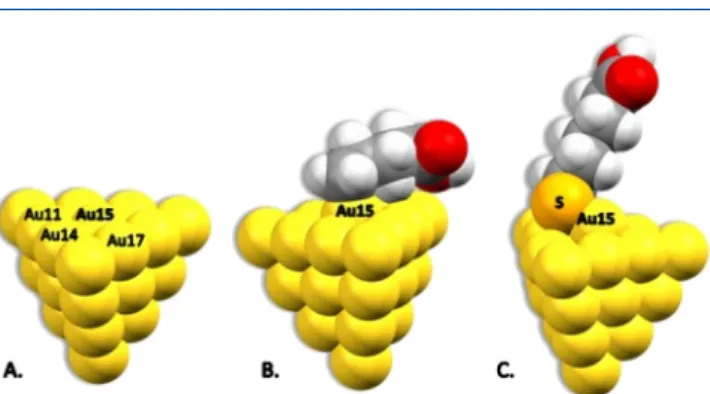
3.4. Comparison with the Au20 Gold Cluster. The
results of the above periodic calculations can be compared with
that of nonperiodic DFT calculations on an Au20 cluster. As
already observed in the grafting of aryl groups,
12binding an
alkyl group (valeric group) to the surface of Au20 changes its
geometry (
Figure 5
). The bond distances between neighboring
gold atoms change after the grafting: in the bare cluster
d(Au15
−Au17) = d(Au15−Au14) = 2.90 Å, while after
grafting to Au15 the gold atom distance changes: d(Au15−
Au17)/d(Au15
−Au14) = 3.03, indicating an effect similar to
that observed in the case of thiols and aryl radicals.
9,12The
dihedral angles are also modi
fied: (Au17−Au15−Au11−Au14)
is 3.6° for Au20 but 20.0° in Au20−(CH
2)
3−COOH. After
grafting, the gold atom is pulled out from the mean surface
plane of the Au20 cluster by about 0.86 Å (
Figure 5
). This
demonstrates that a strong interaction takes place. Such an
interaction is known for thiols through DFT calculations and
STM
43and also from the X-ray structure of a
p-mercaptobenzoic acid (p-MBA)-protected gold nanoparticle
(102 gold atoms and 44 p-MBA groups).
44Similar effects have been observed for Au20−S−(CH
2)
5−
COOH, where d(Au15
−Au17) = 2.90 Å, whereas d(Au15−
Au14) = 3.51 Å; the dihedral angle for (Au17
−Au15−Au11−
Au14) is 19.5
°, and the gold atom is pulled by 1.11 Å from the
surface.
3.5. Comparison of Au
−C and Au−S Stabilities.
Because the above calculations indicate that Au
−alkyl and
Au
−S−alkyl have similar energies, the possible exchange of the
valeric group of Au
−(CH
2)
4−COOH by an octadecylthiol
group to give Au
−S−(CH
2)
17−CH
3was tested (note that
reactions [
R5
] and [
R6
] below are not equilibrated; they are
not chemical equations, they are only used as a basis of
discussion). McDermott previously showed that it is possible
to partially replace the grafted aryl groups derived from
diazonium (Au
−C
6H
4−NO
2) by arylthiol groups (Au
−S−
C
6H
4−NO
2).
45 X Yooo − − + − − − − − + − − Au (CH ) COOH CH (CH ) SH Au S (CH ) CH CH (CH ) COOH 2 4 3 2 17 R5b R5f 2 17 3 3 2 3 (R5)To test this hypothesis, a gold plate was
first modified as
indicated in the experimental section (
film thickness: th = 2.5
± 1.0 nm, water contact angle θ = 61 ± 4°), immersed for 24 h
Table 2. Computed Bonding Energies to Periodic Surfaces
aTOP BRD FCC HCP planar
Au(111)−(CH2)4−COOH) −36.9 −34.2 −32.1 −34.1 −4.6
Au(111)−S−(CH2)5−COOH −31.6 −36.3 −45.5 −38.9 −34.0
aIn kcal/mol.
Figure 3.Computed bonding energies for (red) Au(111)−(CH2)4−
COOH and (blue) Au(111)−S−(CH2)5−COOH.
Figure 4. Optimized structures for (A) Au(111)−(CH2)4−COOH
(TOP) and (B) Au(111)−S−(CH2)5−COOH (BRD) on periodic
surfaces.
Figure 5. Optimized structures for (A) Au20 cluster, (B) Au20− (CH2)4−COOH, and (C) Au20−S−(CH2)5−COOH grafted
clus-ters.
Langmuir
ArticleDOI:10.1021/acs.langmuir.8b01584
Langmuir 2018, 34, 11264−11271
in a deoxygenated solution of octadecanethiol (CH
3−
(CH
2)
17−SH) (long-chain thiols are adsorbed preferentially
over shorter chains
46) and
finally rinsed in ethanol under
ultrasonication. The IRRAS spectrum was recorded before and
after the exchange (
Figure 6
).
The spectrum of Au
−(CH
2)
4−COOH is characterized by
the bands of the four CH
2groups: 2958, 2930, 2858 cm
−1(2963, 2937, 2877 cm
−1for valeric acid,
47CH
3−(CH
2)
3−
COOH) and the broad C
O band of the carboxylic group at
1695 cm
−1(1712 cm
−1for valeric acid) (note also the broad
shoulder at >1650 cm
−1that could correspond to some
esteri
fication of the carboxylic group during ultrasonic rinsing
in ethanol). After the exchange reaction [R5f], the CH
stretching vibrations increase and the C
O band becomes
very small. In the CH stretching region, the spectrum is similar
to that of Au
−S−(CH
2)
17−CH
3prepared by reacting a gold
surface with C
18H
37SH (Figure SI3 in
Supporting
Informa-tion
); it exhibits the vibrations of the alkyl group at 2964,
2918, 2876, and 2850 cm
−1and a very small C
O signal
corresponding to unexchanged valeric groups. Note that after
[R5f] exchange the CH stretching bands are much narrower
48and located at positions characteristic of a crystalline structure
(the symmetric and asymmetric CH
2vibrations of C
18H
37SH
are located at 2855 and 2924 cm
−1for the liquid and 2851 and
2918 cm
−1for the crystal).
48The crystallinity of the Au
−S−
(CH
2)
17−CH
3film obtained by exchange is not perturbed by
the small remaining amounts of valeric acid indicating a
segregated structure of the
film.
Ultrasonication of a
film allows testing qualitatively its
stability. All the Au
−(CH
2)
4−COOH samples examined
herein were rinsed in acetone and ethanol under
ultra-sonication. The same test was applied to Au
−S−(CH
2)
17−
CH
3. The spectra before and after sonication are similar
(Figure SI3B in
Supporting Information
), in good agreement
with the binding energies calculated above.
The water contact angle of the
film after [R5f] exchange, θ =
100
± 1°, indicates that the Au−S−(CH
2)
17−CH
3film
prepared through [R5f] presents some defects because for
the same
film prepared directly from C
18H
37SH in alcohol
49θ
= 109
± 1°.
In the XPS spectrum of Au
−(CH
2)
4−COOH, the C 1s peak
(
Figure 7
A) presents three contributions at 284.8, 286.5, and
288.8 eV assigned, respectively, to C
−C/C−H, CH
2−CO,
and O
−CO; the last two confirm the presence of the
carboxylic group on the surface. The survey spectrum of Au
−
S
−(CH
2)
17−CH
3obtained through [R5f] (
Figure 7
B) shows
the presence of Au 4f (24.1%), C 1s (67.3%), N 1s (1.2%), O
1s (5.5%), and S 2p (1.9%; S/Au = 0.08); it is similar to that of
Au
−S−(CH
2)
17−CH (Figure SI4 in
Supporting Information
)
obtained directly by dipping a gold plate in the thiol: Au 4f
(34.1%), C 1s (60.5%), N 1s (0.6%), O 1s (1.9%), and S 2p
(3.0%, S/Au = 0.09). However, the S/Au ratio is
∼10% lower
for the exchanged surface and two small contributions are
observed at 286.5 and 288.8 eV that correspond to some
remaining valeric groups on the surface. The presence of sulfur
on the surface and the strong decrease of the carboxylic signal
indicate that
∼90% of the valeric groups have been displaced
from the surface by the C
18alkyl chain thiol.
The reverse reaction [R5b] was performed on an Au
−S−
(CH
2)
17−CH
3plate that was submitted to indirect
electro-grafting by bromovaleric acid as in
Scheme 1
along the
procedure described in the Experimental Section. The IRRAS
spectra (
Figure 8
) show that starting from Au
−S−(CH
2)
17−
CH
3that does not present any band in the 1800
−1600 cm
−1range (
Figure 8
c), after [R5b], a C
O band is observed at
1695 cm
−1(
Figure 8
b) at the same position as for Au
−
(CH
2)
4−COOH (
Figure 8
a) albeit with an absorbance that is
63% lower. In the XPS spectrum, starting from Au
−S−
Figure 6.IRRAS spectra of (a) Au−(CH2)4−COOH and (b) after
[R5f] exchange of the surface film by C18H37SH to give Au−S−
(CH2)17−CH3. (A) CH stretching region, (B) carbonyl region.
Figure 7.XPS spectrum of (A) Au−(CH2)4−COOH and (B) Au−
S−(CH2)17−CH3obtained through the exchange reaction [R5] (C 1s
and S 2p contributions).
(CH
2)
17−CH
3with S/Au = 0.09, after [R5b], S/Au = 0.07 and
the C 1s peak presents two very small contributions (at 286.5
and 288.8 eV) corresponding to the carboxylic group of Au
−
(CH
2)
4−COOH. The water contact angle changes from θ =
107
± 0.8 to 96.8 ± 1.0°, indicating that thiol groups are still
present on the surface in agreement with the IR spectrum. This
experiment demonstrates that reaction [
R5
] is possible in the
two directions but the direct reaction ([R5f]) is much more
e
fficient than the reverse one ([R5b]). In addition, it is
possible that part of the CO groups observed after [R5b]
correspond to valeric groups attached to the C
18alkyl chain of
the thiol owing to a H-atom abstraction from the C
18alkyl
chain of the thiol by the valeric radical (R
•in reaction [R3])
followed by the coupling of another R
•with the CH
•radical
formed on the C
18alkyl chain.
The exchange between Au−(CH
2)
4−COOH and SH−
(CH
2)
5−COOH ([R6f]), the structures of which are closely
related, was also tested. The comparison of the IR spectra and
water contact angles of Au
−(CH
2)
4−COOH and Au−S−
(CH
2)
5−COOH (θ = 58 ± 0.8°) is not informative because
the two grafted surfaces are too similar. However, the XPS
spectrum of Au
−(CH
2)
4−COOH and that of Au−S−
(CH
2)
5−COOH present a S 2p contribution of respectively
0 and 3% (S/Au = 0.06 in the latter). The XPS spectrum
recorded after [R6f] indicates S/Au = 0.06 testifying for the
exchange reaction. Conversely starting from Au
−S−(CH
2)
5−
COOH, after electrografting of bromovaleric acid ([R6b] as in
the experimental section) S/Au = 0.04.
X Yooo − − + − − − − − + − − Au (CH ) COOH SH (CH ) COOH Au S (CH ) COOH CH (CH ) COOH 2 4 2 5 R6b R6f 2 5 3 2 3 (R6)
Exchange reactions
R5
and
R6
are possible in both
directions (with the restriction above concerning the reverse
reaction). Note that these reactions are more complex than a
simple exchange on a gold surface because a hydrogen atom is
also exchanged in the process. Concerning reactions [R5b] and
[R6b], thiols on gold are electrochemically desorbed in 0.5 M
KOH after transfer of one electron at E
≈ −1.2/−1.4 V/SCE
to give thiolates. Because we operate at much lower potentials
and in the presence of valeric radicals, the mechanism is likely
di
fferent.
4. CONCLUSIONS
Both theoretical and experimental results indicate that during
the electrografting of bromovaleric acid onto Au to give Au
−
(CH
2)
4−COOH: (i) a covalent bond is formed between the
gold surface and the organic group (observed by Raman SERS
spectroscopy at 387 cm
−1and identical to the calculated
value), (ii) the radical character of this reaction leads to
multilayered
films as previously observed with diazonium salts
and amines,
10−12(iii) the energy of the Au
−C(alkyl) bond is
∼−37 kcal/mol (less stable than that of the Au−S bond of a
thiol SAM by 8.6 kcal), and (iv) based on these similar
bonding energies, we have shown experimentally that Au
−
(CH
2)
4−COOH can be transformed reversibly into Au−S−
(CH
2)
17−CH
3or Au
−S−(CH
2)
5−COOH in the presence of
the corresponding thiol.
■
ASSOCIATED CONTENT
*
S Supporting InformationThe Supporting Information is available free of charge on the
ACS Publications website
at DOI:
10.1021/acs.lang-muir.8b01584
.
Simulated Raman spectrum of Au and Au
−CH
2−
(CH
2)
3−COOH; different binding sites onto Au(111)
surface; and comparison of Au
−S−(CH
2)
17−CH
3obtained directly and by exchange of Au
−(CH
2)
4−
COOH via IRRAS and XPS spectra (
)
■
AUTHOR INFORMATION
Corresponding Authors
*E-mail:
[email protected]
(A.B.).
*E-mail:
[email protected]
(J.P.).
ORCIDFrédéric Kanoufi:
0000-0002-9784-2380Claire Mangeney:
0000-0002-9817-3262François Maurel:
0000-0002-4768-1902Jean Pinson:
0000-0001-6176-8636 NotesThe authors declare no competing
financial interest.
■
ACKNOWLEDGMENTS
CNRS, Paris Diderot University, and ANR (Agence Nationale
de la Recherche) and CGI (Commissariat à l’Investissement
d
’Avenir) are gratefully acknowledged for their financial
support of this work through Labex SEAM (Science and
Engineering for Advanced Materials and devices) ANR 11
LABX 086, ANR 11 IDEX 05 02.
■
REFERENCES
(1) Pujari, S. P.; Scheres, L.; Marcelis, A. T. M.; Zuilhof, H. Covalent surface modification of oxide surfaces. Angew. Chem., Int. Ed. 2014, 53, 6322−6356.
(2) Zharov, I.; Khabibullin, A. Surface-Modified Silica Colloidal Crystals: Nanoporous Films and Membranes with Controlled Ionic and Molecular Transport. Acc. Chem. Res. 2014, 47, 440−449.
(3) Wasserman, S. R.; Tao, Y. T.; Whitesides, G. M. Structure and reactivity of alkylsiloxane monolayers formed by reaction of alkyltrichlorosilanes on silicon substrates. Langmuir 1989, 5, 1074− 1087.
(4) Queffélec, C.; Petit, M.; Janvier, P.; Knight, D. A.; Bujoli, B. Surface modification using phosphonic acids and esters. Chem. Rev. 2012, 112, 3777−3807.
(5) Guerrero, G.; Alauzun, J. G.; Granier, M.; Laurencin, D.; Mutin, P. H. Phosphonate coupling molecules for the control of surface/ interface properties and the synthesis of nanomaterials. Dalton Trans. 2013, 42, 12569−12585.
Figure 8. IRRAS spectra of (a) Au−(CH2)4−COOH, (b) Au−S−
(CH2)17−CH3 exchanged by −(CH2)4−COOH groups by
electro-chemistry [R5b], and (c) Au−S−(CH2)17−CH3.
Langmuir
ArticleDOI:10.1021/acs.langmuir.8b01584
Langmuir 2018, 34, 11264−11271
(6) Schwarz, M.; Mohr, S.; Xu, T.; Döpper, T.; Weiß, C.; Civale, K.; Hirsch, A.; Görling, A.; Libuda, J. Anchoring of a Carboxyl-Functionalized Norbornadiene Derivative to an Atomically Defined Cobalt Oxide Surface. J. Phys. Chem. C 2017, 121, 11508−11518.
(7) Fabre, B.; Pujari, S. P.; Scheres, L.; Zuilhof, H. Micropatterned ferrocenyl monolayers covalently bound to hydrogen-terminated silicon surfaces: effects of pattern size on the cyclic voltammetry and capacitance characteristics. Langmuir 2014, 30, 7235−7243.
(8) Fairman, C.; Chockalingam, M.; Liu, G.; Soeriyadi, A. H.; Gooding, J. J. Light-induced organic monolayer modification of iodinated carbon electrodes. Langmuir 2014, 30, 332−339.
(9) Pensa, E.; Cortés, E.; Corthey, G.; Carro, P.; Vericat, C.; Fonticelli, M. H.; Benítez, G.; Rubert, A. A.; Salvarezza, R. C. The Chemistry of the Sulfur-Gold Interface: In Search of a Unified Model. Acc. Chem. Res. 2012, 45, 1183−1192.
(10) Aryl diazonium Salts. In New Coupling Agents in Polymer and Surface Science; Chehimi, M. M., Ed.; Wiley-VCH: Weinheim, 2012. (11) Bélanger, D.; Pinson, J. Electrografting: a powerful method for surface modification. Chem. Soc. Rev. 2011, 40, 3995−4048.
(12) Berisha, A.; Combellas, C.; Kanoufi, F.; Decorse, P.; Oturan, N.; Médard, J.; Seydou, M.; Maurel, F.; Pinson, J. Some theoretical and experimental insights on the mechanistic routes leading to the spontaneous grafting of gold surfaces by diazonium salts. Langmuir 2017, 33, 8730−8738.
(13) Palacin, S.; Bureau, C.; Charlier, J.; Deniau, G.; Mouanda, B.; Viel, P. Molecule-to-metal bonds: electrografting polymers on conducting surfaces. ChemPhysChem 2004, 5, 1468−1481.
(14) Laurentius, L.; Stoyanov, S. R.; Gusarov, S.; Kovalenko, A.; Du, R.; Lopinski, G. P.; McDermott, M. T. Diazonium-Derived Aryl Films on Gold Nanoparticles: Evidence for a Carbon-Gold Covalent Bond. ACS Nano 2011, 5, 4219−4227.
(15) Galicia, M.; González-Fuentes, M. A.; Valencia, D. P.; González, F. J. The effect of substituents on the anodic oxidation of aliphatic carboxylates and the passage towards a pseudo-Kolbe reaction. J. Electroanal. Chem. 2012, 672, 28−33.
(16) Fellah, S.; Amiar, A.; Ozanam, F.; Chazalviel, J.-N.; Vigneron, J.; Etcheberry, A.; Stchakovsky, M. Grafting and Polymer Formation on Silicon from Unsaturated Grignards: II. Aliphatic Precursors. J. Phys. Chem. B 2007, 111, 1310−1317.
(17) Chehimi, M. M.; Hallais, G.; Matrab, T.; Pinson, J.; Podvorica, F. I. Electro- and Photografting of Carbon or Metal Surfaces by Alkyl Groups. J. Phys. Chem. C 2008, 112, 18559−18565.
(18) Hetemi, D.; Kanoufi, F.; Combellas, C.; Pinson, J.; Podvorica, F. I. Electrografting of Alkyl Films at Low Driving Force by Diverting the Reactivity of Aryl Radicals Derived from Diazonium Salts. Langmuir 2014, 30, 13907−13913.
(19) Hetemi, D.; Médard, J.; Decorse, P.; Combellas, C.; Kanoufi, F.; Pinson, J.; Podvorica, F. I. Surface Functionalization of Metals by Alkyl Chains through a Radical Crossover Reaction. Langmuir 2016, 32, 6335−6342.
(20) Hetemi, D.; Hazimeh, H.; Decorse, P.; Galtayries, A.; Combellas, C.; Kanoufi, F.; Pinson, J.; Podvorica, F. I. One-Step Formation of Bifunctionnal Aryl/Alkyl Grafted Films on Conducting Surfaces by the Reduction of Diazonium Salts in the Presence of Alkyl Iodides. Langmuir 2015, 31, 5406−5415.
(21) Hetemi, D.; Médard, J.; Kanoufi, F.; Combellas, C.; Pinson, J.; Podvorica, F. I. Surface Modification of Polymers by Reaction of Alkyl Radicals. Langmuir 2016, 32, 512−518.
(22) Tang, Q.; Jiang, D.-e. Computational Insight into the Covalent Organic-Inorganic Interface. Chem. Mater. 2016, 28, 5976−5988.
(23) Jiang, D.-e.; Sumpter, B. G.; Dai, S. Structure and Bonding between an Aryl Group and Metal Surfaces. J. Am. Chem. Soc. 2006, 128, 6030−6031.
(24) de la Llave, E.; Ricci, A.; Calvo, E. J.; Scherlis, D. A. Binding between Carbon and the Au(111) Surface and What Makes It Different from the S−Au(111) Bond. J. Phys. Chem. C 2008, 112, 17611−17617.
(25) Huang, P.; Jing, L.; Zhu, H.; Gao, X. Diazonium Functionalized Graphene: Microstructure, Electric, and Magnetic Properties. Acc. Chem. Res. 2012, 46, 43−52.
(26) Boukerma, K.; Chehimi, M. M.; Pinson, J.; Blomfield, C. X-ray Photoelectron Spectroscopy Evidence for the Covalent Bond between an Iron Surface and Aryl Groups Attached by the Electrochemical Reduction of Diazonium Salts. Langmuir 2003, 19, 6333−6335.
(27) Bell, K. J.; Brooksby, P. A.; Polson, M. I. J.; Downard, A. J. Evidence for covalent bonding of aryl groups to MnO2nanorods from
diazonium-based grafting. Chem. Commun. 2014, 50, 13687−13690. (28) Mesnage, A.; Esnouf, S.; Jégou, P.; Deniau, G.; Palacin, S. Understanding the redox-induced polymer grafting process: A dual surface-solution analysis. Chem. Mater. 2010, 22, 6229−6239.
(29) Combellas, C.; Kanoufi, F.; Pinson, J.; Podvorica, F. I. Time-of-Flight Secondary Ion Mass Spectroscopy Characterization of the Covalent Bonding between a Carbon Surface and Aryl Groups. Langmuir 2005, 21, 280−286.
(30) Brymora, K.; Fouineau, J.; Eddarir, A.; Chau, F.; Yaacoub, N.; Grenèche, J.-M.; Pinson, J.; Ammar, S.; Calvayrac, F. Grafting of diazonium salts on oxides surface: formation of aryl-O bonds on iron oxide nanoparticles. J. Nanopart. Res. 2015, 17, 438.
(31) Jiang, D.-e.; Sumpter, B. G.; Dai, S. How Do Aryl Groups Attach to a Graphene Sheet? J. Phys. Chem. B 2006, 110, 23628− 23632.
(32) Berisha, A.; Combellas, C.; Kanoufi, F.; Pinson, J.; Ustaze, S.; Podvorica, F. I. Indirect Grafting of Acetonitrile-Derived Films on Metallic Substrates. Chem. Mater. 2010, 22, 2962−2969.
(33) Frisch, M. J.; Trucks, G. W.; Schlegel, H. B.; Scuseria, G. E.; Robb, M. A.; Cheeseman, J. R.; Scalmani, G.; Barone, V.; Petersson, G. A.; Nakatsuji, H.; Li, X.; Caricato, M.; Marenich, A.; Bloino, J.; Janesko, B. G.; Gomperts, R.; Mennucci, B.; Hratchian, H. P.; Ortiz, J. V.; Izmaylov, A. F.; Sonnenberg, J. L.; Williams-Young, D.; Ding, F.; Lipparini, F.; Egidi, F.; Goings, J.; Peng, B.; Petrone, A.; Henderson, T.; Ranasinghe, D.; Zakrzewski, V. G.; Gao, J.; Rega, N.; Zheng, G.; Liang, W.; Hada, M.; Ehara, M.; Toyota, K.; Fukuda, R.; Hasegawa, J.; Ishida, M.; Nakajima, T.; Honda, Y.; Kitao, O.; Nakai, H.; Vreven, T.; Throssell, K.; Montgomery, J. A., Jr.; Peralta, J. E.; Ogliaro, F.; Bearpark, M.; Heyd, J. J.; Brothers, E.; Kudin, K. N.; Staroverov, V. N.; Keith, T.; Kobayashi, R.; Normand, J.; Raghavachari, K.; Rendell, A.; Burant, J. C.; Iyengar, S. S.; Tomasi, J.; Cossi, M.; Millam, J. M.; Klene, M.; Adamo, C.; Cammi, R.; Ochterski, J. W.; Martin, R. L.; Morokuma, K.; Farkas, O.; Foresman, J. B.; Fox, D. J. Gaussian 09, Revision A.02; Gaussian, Inc.: Wallingford CT, 2016.
(34) Ahmad, R.; Félidj, N.; Boubekeur-Lecaque, L.; Lau-Truong, S.; Gam-Derouich, S.; Decorse, P.; Lamouri, A.; Mangeney, C. Water-soluble plasmonic nanosensors with synthetic receptors for label-free detection of folic acid. Chem. Commun. 2015, 51, 9678−9681. and references therein
(35) Perdew, J. P.; Burke, K.; Ernzerhof, M. Generalized gradient approximation made simple. Phys. Rev. Lett. 1996, 77, 3865−3868; erratum. Phys. Rev. Lett. 1997, 78, 1396.
(36) Perdew, J. P.; Chevary, J. A.; Vosko, S. H.; Jackson, K. A.; Pederson, M. R.; Singh, D. J.; Fiolhais, C. Atoms, Molecules, Solids, and Surfaces: Applications of the Generalized Gradient Approx-imation for Exchange and Correlation. Phys. Rev. B: Condens. Matter Mater. Phys. 1992, 46, 6671−6687.
(37) Kresse, G.; Hafner, J. Ab initio molecular dynamics for liquid metals. Phys. Rev. B: Condens. Matter Mater. Phys. 1993, 47, 558−561. (38) Kresse, G.; Joubert, D. From Ultrasoft Pseudopotentials to the Projector Augmented-Wave Method. Phys. Rev. B: Condens. Matter Mater. Phys. 1999, 59, 1758−1775.
(39) Jamróz, M. H. Vibrational Energy Distribution Analysis (VEDA): Scopes and limitations. Spectrochim. Acta, Part A 2013, 114, 220−230.
(40) Varnholt, B.; Oulevey, P.; Luber, S.; Kumara, C.; Dass, A.; Bürgi, T. Structural Information on the Au-S Interface of Thiolate-Protected Gold Clusters: A Raman Spectroscopy Study. J. Phys. Chem. C 2014, 118, 9604−9611.
(41) Nassoko, D.; Seydou, M.; Goldmann, C.; Chanéac, C.; Sanchez, C.; Portehault, D.; Tielens, F. Rationalizing the formation of binary mixed thiol self-assembled monolayers. Mater Today Chem. 2017, 5, 34−42.
(42) Lassoued, K.; Seydou, M.; Raouafi, F.; Larbi, F.; Lang, P.; Diawara, B. DFT study of the adsorption and dissociation of 5-hydroxy-3-butanedithiol-1,4-naphthaquinone (Jug-C4-thiol) on Au(111) surface. Adsorption 2018, 24, 191−201.
(43) Häkkinen, H. The gold-sulfur interface at the nanoscale. Nat. Chem. 2012, 4, 443−455.
(44) Jadzinsky, P. D.; Calero, G.; Ackerson, C. J.; Bushnell, D. A.; Kornberg, R. D. Structure of a Thiol Monolayer-Protected Gold Nanoparticle at 1.1 A Resolution. Science 2007, 318, 430−433.
(45) Shewchuk, D. M.; McDermott, M. T. Comparison of Diazonium Salt Derived and Thiol Derived Nitrobenzene Layers on Gold. Langmuir 2009, 25, 4556−4563.
(46) Bain, C. D.; Whitesides, G. M. Formation of Monolayers by the Coadsorption of Thiols on Gold: Variation in the Length of the Alkyl Chain. J. Am. Chem. Soc. 1989, 111, 7164−7175.
(47) National Institute of Advanced Industrial Science and Technology.http://sdbs.db.aist.go.jplast (accessed May 2, 2017).
(48) Yeon, H.; Wang, C.; Van Lehn, R. C.; Abbott, N. L. Influence of Order within Nonpolar Monolayers on Hydrophobic Interactions. Langmuir 2017, 33, 4628−4637.
(49) Tsuneda, S.; Ishida, T.; Nishida, N.; Hara, M.; Sasabe, H.; Knoll, W. Tailoring of a smooth polycrystalline gold surface as a suitable anchoring site for a self-assembled monolayer. Thin Solid Films 1999, 339, 142−147.
Langmuir
ArticleDOI:10.1021/acs.langmuir.8b01584
Langmuir 2018, 34, 11264−11271