Publisher’s version / Version de l'éditeur:
Journal of Coatings Technology, 53, 672, pp. 85-92, 1981-01
READ THESE TERMS AND CONDITIONS CAREFULLY BEFORE USING THIS WEBSITE.
https://nrc-publications.canada.ca/eng/copyright
Vous avez des questions? Nous pouvons vous aider. Pour communiquer directement avec un auteur, consultez la
première page de la revue dans laquelle son article a été publié afin de trouver ses coordonnées. Si vous n’arrivez pas à les repérer, communiquez avec nous à [email protected].
Questions? Contact the NRC Publications Archive team at
[email protected]. If you wish to email the authors directly, please see the first page of the publication for their contact information.
NRC Publications Archive
Archives des publications du CNRC
This publication could be one of several versions: author’s original, accepted manuscript or the publisher’s version. / La version de cette publication peut être l’une des suivantes : la version prépublication de l’auteur, la version acceptée du manuscrit ou la version de l’éditeur.
Access and use of this website and the material on it are subject to the Terms and Conditions set forth at
Residual strain due to solvent loss from a crosslinked coating
Croll, S. G.
https://publications-cnrc.canada.ca/fra/droits
L’accès à ce site Web et l’utilisation de son contenu sont assujettis aux conditions présentées dans le site
LISEZ CES CONDITIONS ATTENTIVEMENT AVANT D’UTILISER CE SITE WEB.
NRC Publications Record / Notice d'Archives des publications de CNRC:
https://nrc-publications.canada.ca/eng/view/object/?id=afc7f85c-6bcb-4179-8ec1-ce31f2dce731 https://publications-cnrc.canada.ca/fra/voir/objet/?id=afc7f85c-6bcb-4179-8ec1-ce31f2dce731National Research Council of Canada
Counseil national de recherches du Canada
Ser
TH1
N21d
BLQS*
- -1
RESIDUAL STRAIN DUE TO SOLVENT LOSS
FROM A CROSSLINKED COATING
by
S. G. Croll
Reprinted from
Journal of Coatings Technology Vol. 53, No. 672, January 1981 p. 85
-
92ANALYZED
1-1
L I B R A R Y
B I B L I O T H ~ Q U E
Rech.
BBtim.DBR Paper No. 960
Division of Building Research
NRCC 19136
Des donnees dtmontrent que les revEtements d'epoxy coults a partir de solvants a Waporation tres lente manifestent une deformation residuelle interne d'autant plus importante que le revctement est epais. On presente ici une theorie qui concorde bien avec les rbultats experimentaux; elle est fondke sur l'hypothkse que cette deformation est imputable au volume de solvant qui a disparu du revktement reticule. Cette deformation depend autant des vitesses d'tvaporation et de diffusion du solvant, que de la cinematique de la reaction de reticulation et de la concentration de la solution du revktement. U n calcul, s'appuyant sur cette theorie, simule l'excellente adherence des revktements epoxy et montre que celle-ci est meilleure si on utilise un solvant a evaporation plus rapide.
Residual Strain Due to Solvent Loss
From
a
Crosslinked Coating
S.G.
Croll
National Research Council of Canada'
Data show that epoxy coatings cast from a very slow-evaporating solvent have residual internal
strain that increases with coating thickness. A
theory is presented, which agrees well with experi- mental results, based on the idea that solvent volume loss from the crosslinked coating is respon- sible for the strain. The strain depends on solvent
evaporation and diffusbn ra2es;.as well
as
thecuring reaction kinetics and coating solution con-
centration. A calculation, using this theory, models
the excellent adhesion of epoxy coatings and shows that adhesion may be improved by using a faster evaporating solvent.
INTRODUCTION
Polymeric surface coatings are frequently applied as a solution by a variety of means, such as brush or spray. The choice of solvent is often based on cost and on the appearance of the dry coating. The fact that a solvent can have a large influence on the durability of a coating may be overlooked.
Internal strain is one factor affecting the performance of a coating. Strains are produced in coatings because of shrinkage, due either to solvent evaporation or to the chemical changes of crosslinking. If the solvent evapo- rates quickly from the coating mixture, the resin is still in a thermoplastic state when it solidifies, i.e., crosslink- ing is incomplete. Such coatings dry like lacquers and the resultant residual internal strain is independent of the dried coating thickness.'
If the solvent is lost from the coating very slowly, solidification occurs because a crosslinked network is formed. In this case, it would be expected that the sub- sequent loss of solvent would produce a greater strain in thicker films because the solvent had less opportunity
Building Materials Section, Division of Building Research, Ottawa. K I A OR6. Canada.
to diffuse out before solidification. Such an increase of internal strain (or stress) has been observed.'-4
In this paper, a theory is proposed to explain the latter type of behavior and to account for the effect of solvent concentration, evaporation rate, and coating thickness on the magnitude of the internal strain. The influence of the kinetics of the crosslinking reaction on strain and adhesion is also examined.
THEORY
Definitions of the symbols used are given in Table 1.
Internal Strain
It is assumed here that the internal strain is due to the volume of solvent lost after the coating has solidified, with the shrinkage due to chemical change (crosslinking) being ignored at this stage. After a film has solidified, further loss in solvent volume cannot be accommodated by bulk flow. Therefore, internal strain arises in the plane of the coating, because it is constrained to remain at its original liquid dimensions by adhesion to a rigid sub- strate. The resultant internal strain in a dry, unpig- mented, film can readily be calculated in terms of the solvent content. After solidification, the volume of solvent lost, AV, is given by
A V = 4: V-&(V - AV) (1)
The internal bulk (volumetric) strain is given by AV/V
which is equivalent to an isotropic linear strain, E , such
AV that
-
v
= 3c.From equation (1)
The expression for the internal strain, c, is derived by
S.G. CROLL
Table 1-Definition of Symbols A V = volume of solvent lost after solidification V = volume of coating at solidification
4, = volume fraction of solvent present at solidification
@ T = volume fraction of solvent retained in free, dry,
unconstrained film
4~ = volume fraction of solvent in initial solution
c = residual internal strain D = diffusion coefficient C = concentration
C, = concentration of solvent retained in dry film C, = concentration of solvent in initial solution C, = concentration of solvent present at solidification C, = concentration of solvent just at the top of the
coating
x = position co-ordinate through film o! = rate of evaporation, volume lostlarealtime t, = coating thickness
T, = time at which coating solidified by crosslinking
p = density of solvent m = shrinkage of coating
V, = volume of resin t =time
= pre-exponential factor
U = internal strain energy per unit area
y~ = interfacial work of adhesion F = force per unit width b = width of coating E = modulus
A prime superscript, ( )', will indicate a quantity defined in a frame of reference in which coating thickness is invariant with respect to time.
This equation is the same as that used to describe
lacquers: but
4:
has to be calculated differently in thiscase.
Solidification
A coating can be considered solidified when it no
longer behaves as a viscous liquid, i.e., when large scale molecular motion ceases in the polymer.
For a lacquer, solidification is closely allied to the glass transition of the polymer.5 The solidification point can be identified as that solvent concentration at which the glass transition temperature of the coating (depressed by the solvent present) coincides with the temperature of the coating. Lacquers solidify at a particular solvent content, constant throughout the film.
This paper is concerned with coatings wherein solvent loss is slow and solidification is due to the formation of a crosslinked network, formed by chemical means. It is this network which prohibits large scale molecular motion. Calculation of internal strain in such a system still re- quires knowledge of 4I, as in a lacquer, but for a cross- linked system, the solvent content varies with position within the film according to how much was present when
it solidified. Using Fick's law of diffusion,
4:
can be cal-culated if certain assumptions are made:
(1) It has been found that the degree of conversion of an epoxy resin at the gel point is constant, irrespective of the temperature.6 The gel point must be closely related with the solidification of a crosslinked network, so it is assumed here that solidification occurs at a particular degree of conversion throughout the film.
(2) It will be assumed that the reaction between epoxy and hardener follows first order kinetics. Actual order of reaction varies in epoxies,7 but first order is a representa- tive type. The consequence of this assumption is that the proportion of the reaction completed at a particular time does not depend on the concentration of the reactants,' which is not true of any other order of reaction.
The result of these two assumptions is that the coating solidifies at a particular degree of conversion, e.g., 90%,
which occurs at a particular time,
Tx,
irrespective of thelocal concentration of epoxy, hardener, or solvent. Cal-
culation of 4: is reduced to calculating the amount of
solvent present at T,
.
Diffusion and Evaporation of Solvent
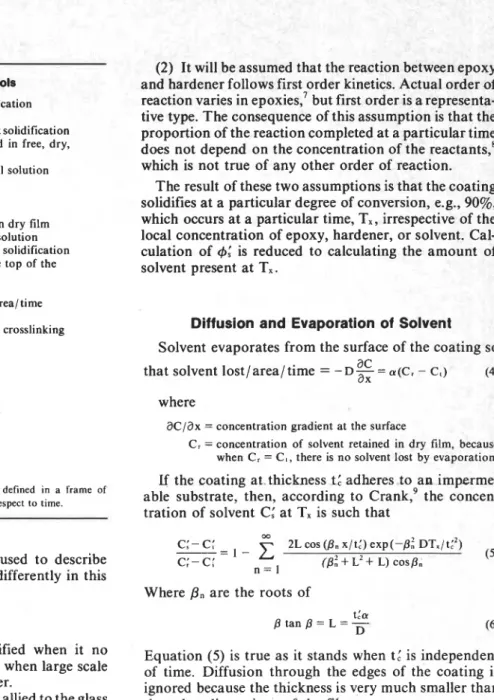
Solvent evaporates from the surface of the coating so
ac
that solvent lost/area/time = - D z = a ( C , - c , ) (4)
where
a C / a x = concentration gradient at the surface
C, = concentration of solvent retained in dry film, because when C, = C , , there is no solvent lost by evaporation.
Lf the coating at thickness tE adheres to an imperme-
able substrate, then, according to
rank,^
the concen-tration of solvent CI at T, is such that
00
-- 2L cos (P. X I ~ : ) e x ~ ( - ~ : DT./ t:')
c:-c:
( 5 )n = l
Where
fin
are the roots ofEquation (5) is true as it stands when tE is independent of time. Diffusion through the edges of the coating is ignored because the thickness is very much smaller than the other dimensions of the film.
If the very small contribution of the curing agent to the total volume of the coating solution is ignored, then
Now equation (5) can be used to substitute for
4:
inequation (3). Before attempting that, however, equation (5) can be simplified in two ways. In practice, the internal strain is measured as a function of the overall dried film thickness, so that the average value of C:(&:) with respect to depth (x) is needed t o compare the theory with
experiment. Further, L ( = tEa/D) is usually much less
than unity, which means that j3, are small and the
approximation
Pn
= tanP,
can be used. In the simpli-fied expression, only
PI
(= P ) is considered and(If no assumptions are made of the size of P,, then a more complicated final expression for the internal strain is produced, which is included later.)
Under these conditions and averaging over the thick- ness, (x), the result is
RESIDUAL STRAIN DUE TO SOLVEN'
which, when substituted into the expression for internal strain, gives
Only the first term under the summation sign of equa- tion (5) is significant under these conditions. Equation (9) does not contain any reference to the diffusion coefficient of the solvent through the film. Actually, equation (9) can also be derived by assuming that the diffusion of solvent through the film is fast enough, when compared with the evaporation, to maintain its concentration independent of position.
The thickness of the coating, t,', is most conveniently measured for the dry film when it has the most practical significance.
4:
is also measured in the dry film, but+I
can only be taken from the wet film when the thickness of the film is considerably greater. Formally, equation (5), and thus equation (9), applies only to a frame of reference wherein the t,' is assumed constant with time. Therefore, to use these equations, all the quantities must be reduced to a frame of reference where the units shrink in the same ratio as the coating (due to solvent evaporation).
volume at time, t
m(t) = o r i g k l webvolume ' since the area of the coating is constant. Concentration in frame units, C', is the number of units of solvent contained in a unit frame volume. Initially Ci(4i) is the concentration of solvent in unit volume and is calculated from the original coating solu- tion. At some other time, C: has to remain constant with respect to the shrinking frame of reference and so
This type of calculation has been presented elsewhere lo in
more detail.
t, and 4 , are measured in the dried film and are the frame units for that time also. However, Ci(4i) is calcu- lated from the initial solution and thus refers to the frame a t zero time, so it must be replaced in equation (9) by the corresponding value for the dried coating frame, Cl(+i).
Now
and
V,
= volume of resin (assuming that its density does not change with crosslinking)Thus, in terms~of parameters as they are conventionally measured, , ,
C O A T I N G T H I C K N E S S . p m
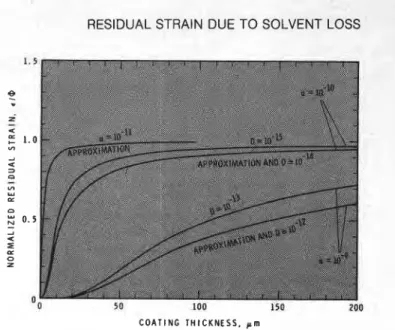
Figure 1-Examples of the predicted varlation of residual strain with coating thickness, evaporation rate, a, and diffusion coeffl-
clent, D, for a time to solidification of l o 5 s
or fully
--
2L tan (8.)
'
&(Pi+a2
+
Lj exp (- 8.2 ~ ~ , / t f ) (14b) n = lwhere D = diffusion coefficient of the solvent referred to the dried coating frame
In both equations (14a) and (14b), it is clear from the exponential terms that internal strain increases from zero with coating thickness. This is displayed in Figure 1 where equations (14a) and (14b) are compared, plotting the normalized strain, € / a , as a function of coating thick- ness using typical values for the other parameters. @ is the pre-exponential factor given by
-0 0 . 5 1.0 1.5
I N I T I A L S O L V E N T V O L U M E F R h C T I O N . +i
Flgure 2-Varlation In the pre-exponential factor with Initial solvent volume fractlon, for difterent retained solvent cancen-
S.G. CROLL
T
Z-
I
a a 3 ' n-
v, W E C O A T I N G T H I C K N E S S+
Figure 3-Schematic combination of the possible contributionsto residual strain
One can see that allowing for diffusion predicts a slightly larger strain and that the approximation is excel- lent for faster rates of diffusion. In other words, the approximation holds when the loss of solvent is governed by evaporation rate, where the diffusion coefficient is large enough to maiaain the solvent concentration uniform throughout the film. In general, the strain would be quite insensitive to changes in diffusion coefficient, which is a convenient feature of the theory since, in practice, D will vary considerably as the solution con- centration changes.
As the time of network formation, Tx, increases, the strain decreases as less solvent is present at solidification. This can be seen in both equations(l4a) and (l4b), where also fewer terms are needed in the summation as T, increases. If the crosslinking rate is very high (small T,)
and solvent loss is very slow (small a, D) then the expo-
nential factor (or C) becomes constant and equal to unity.
0 50 100 I50 200
C O A T I N G T H I C K N E S S , prn
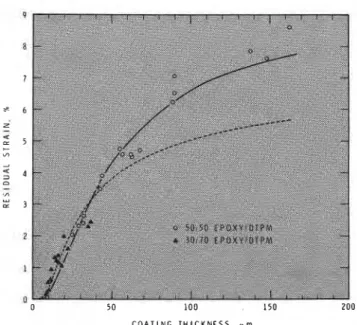
Figure 4-Variation of residual strain with coating thickness for both coating solutions employed
Thus, the strain becomes independent of thickness, but dependent on solvent concentration (via the pre- exponential term). This trend is shown by the curves in Figure 1.
The pre-exponential (pre-C) term is plotted in Figure 2
as a function of initial solvent content @ i , for various
4,.
The curves are parabolas with maxima at + i = 0.5. In
practice, the region
41
= 0 to 0.5 may be inaccessiblebecause of the extremely high viscosity of solutions in this range. As would be expected, this graph shows that the strain decreases as the retained solvent concentra- tion increases. The parabolic nature of the graph origi- nates from the necessity to allow for the change in thick- ness of the film as it dries.
The theory presented here is for films that solidify by crosslinking throughout their thickness. It is possible, however, to envisage a balance of evaporation rate and diffusion where the top part of a coating dries like a lacquer because the solvent escapes before the cross- linked network is formed. Residual strain would not then decrease to nothing at zero coating thickness, but would be given by the combination of the lacquer and cross- linked contributions (Figure 3). Any contribution to the strain from the shrinkage due to chemical change should also be independent of thickness and combined in the same way as the lacquer behavior.
Effect of Curing Kinetics
The analysis presented here assumes that the curing of the epoxy follows first order reaction kinetics, in that the degree of conversion is independent of reactant con- centrations.
In a zero order reaction, the proportion of the reaction completed is proportional to the initial concentration
of the reactant. Thus,
Tx
increases with resin concen-tration and decreases with increasing solvent content, and will tend to be larger in thicker coatings. S o the strain might be expected to increase more slowly with thick- ness than it does in the theory presented here.
For a second order reaction, the degree of conversion is inversely proportional to the initial concentration of reactants. Following a similar argument, therefore, the strain will increase faster with thickness than for a first order reaction.
Reaction kinetics for epoxies depend on the resin and curing agent, but vary from a value less than one to second order,7 so first order has been chosen as typical to represent the system studied here. Any one of these types of behavior can be combined with the lacquer-type be- havior for this coating, as in Figure 3.
EXPERIMENTAL
Ambient conditions for all tests were maintained at
23' C
(f
1) and 50% R H(k
2%).The epoxy resin used was Epon@ 1004 cured with diethylenetriamine (DETA) using 2.4 parts DETA per hundred of the resin (stoichiometric according to resin manufacturer data). Results were obtained from two solution concentrations: one made of equal weights of resin and tripropylene glycol monomethyl ether
RESIDUAL STRAIN DUE TO SOLVENT LOSS
(Dowanol T P M @ , DTPM); the other of 30 parts resin and 70 of DTPM. It proved impracticable to produce a solution containing more resin than the former.
Tin plate substrates were masked to a convenient length, 60-70 mm, and width 12 mm, and then coated using a variety of draw down blades. Drying was moni- tored by weighing to 0.1 mg and, when there was no further systematic loss in weight, the coating was con- sidered dry. A typical coating weight was 15 mg or more.
Residual Strain
The procedure was identical to that reported in other work on internal strain.' Residual strain was determined by releasing a dried coating from a tinplate substrate by mercury amalgamation of the tin, and measuring its subsequent shrinkage with a travelling microscope. The shrinkage is considered to be identical with the internal strain present in the coating when adhering to the sub- strate. Shrinkage became constant after 200 days of drying. Coating thickness was measured using a Mini- tector@ FN and found to be quite consistent along the length of any coating.
Residual strain is plotted as a function of coating thick-
ness in Figure 4, which includes data from both coating
solutions. The data of the 50/50 solution was presented previously.'
None of the coatings peeled from the tinplate substrate spontaneously," although the thicker coatings were easier to remove than the thin ones.
Retained Solvent Volume Fraction
Residual solvent was measured using a gas chromato- graph as before.' Crosslinked film cannot be redissolved, but, after standing for 18 hr in cyclohexanone, samples of the films were swollen and extremely soft. One would expect most residual solvent to leach out into the cyclo-
hexanone and be detected by the chromatograph.
4,
was found to be 4.1% for the films derived from the 50150 solution and increased slightly with coating thickness, 4.1% being typical of a 65 p m coating. The coatings derived from the 30170 solutions retained more solvent:
4,
was 10% for a 10 p m coating and 20% for a 35 p mcoating.
Evaporation Rate of DTPM
A shallow cylindrical pan (60 mm diameter, 1 mm deep) full of DTPM was weighed periodically to deter- mine the evaporation rate. As in all other tests,
conditions were maintained at 50% R H and 23 O C. After
an initial weight gain, due presumably to water absorp- tion, the weight loss rate was constant for a number of
days. The evaporation rate was 1.72 X lo-' kg/sec/m2
(equivalent to 1.78 X lo-'' m3/sec/ m2 in terms of
volume).
Epon is a registered trademark of Shell Chemical Co. Dowanol is a registered trademark of Dow Chemical Co. Minitector is a registered lrademark of Elcometer, Inc.
' a I 2 I 4 5
R E C I P R O C A L O F C O A T I N G T H I C K N E S S . lo4 m - '
Figure S(a)-Relationship between LN (reciprocal residual strain) and reciprocal coating thickness, for coatings cast from
50/50 epoxy/DTPM
Time to Solidification '
The time taken for an air bubble to move up a tube
filled with 30170 epoxy (+ DETA) solution was mea-
sured as the crosslinking reaction progressed. The pro- cedure adopted was similar to that in ASTM D1545. It was found that after 73 hr the bubble halted in its progress up the tube. This value can be used to check the value of T, derived from the theory, although it is not a strictly analogous experiment.
DISCUSSION
Internal Strain
Figure 4 shows that, over the range of thickness used, the residual strain data seem to lie on the same curve, irrespective of the original coating solution concentra- tion. The range of thickness for the coatings derived from the more dilute solution is smaller. Residuhl strain tends to zero as the theory would predict, indicating that there is no lacquer-type behavior or chemical shrinkage appar-
R E C I P R O C A L O F C O A T I N G T H I C K N E S S , lo5 m"
Figure 5(b)-Relationship between LN (reciprocal residual strain) and reciprocal coating thicknes for coatings cast from
S.G. CROLL I
Table 2-Values of Slopes and Intercepts, wlth ,
Pre-exponential Factors' I
Original
Solution Gradient Pre-qxponential
Concentration ( = - a ~ , ) intercept kctor
(a) Coefficients and data derived from regression lines in Figures S(a)and 5(b). Numbers in brackets are standard errors.
ent in very thin coatings. DTPM evaporates so slowly that all coatings solidify by crosslinking.
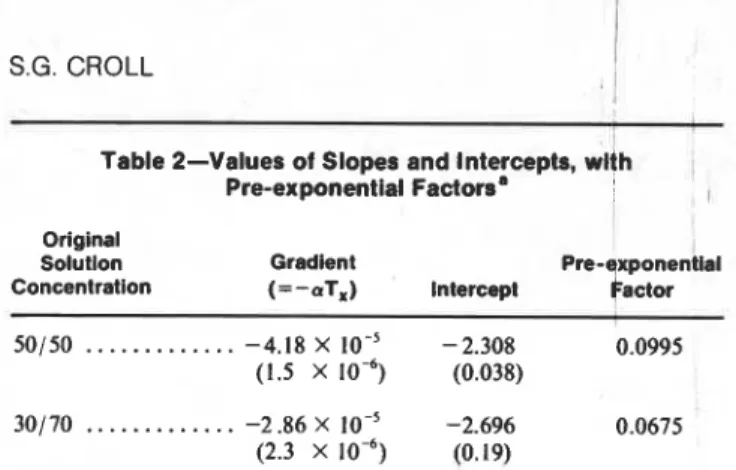
According to equation (14a), Pn (residual strain) plotted as a function of I
/
t, should be a straight line. The slope of such a line would be (- aT,) and the intercept would give the pre-exponential factor. This is shown in Figures 5(a) and 5(b), along with the regression lines obtained and the regression coefficient, R. Values of slopes and intercepts, together with the pre-exponential factors calculated from the intercepts are given in Table 2. The linear dependence formed confirms the validity of the approximation given by equation 14(a).Values of the pre-exponential factor can be calculated, knowing the composition of the original coating solu- tion and the densities of the constituents. Manufacturers' figures give the densities as 1159 kg/ m3 for the epoxy, 965 kg/m3 for the DTPM, and 954 kg/m3 for the DETA. For the 50150 solution, the pre-exponential factor should be 0.076, and for the 30170 solution, 0.043 (assuming
4,
= 10%). The agreement between the cal- culated and measured values (Table 2) is quite good, especially considering the several assumptions made in the analysis.The assumption that the reaction kinetics are first order seems to be confirmed by the straight lines of Figures 5(a) and 5(b), indicating a single value of aT,. It is always possible that a and T, vary inversely with coating thickness, but the single value of the slope in each graph must be significant.
The continuous curves in Figure 4 were calculated from the parameters derived from Figures 5(a) and (b). Choosing a low value for the diffusion coefficient and manipulating equation 14(b) could provide a better fit to the data, but as the values chosen would be arbitrary, it was not attempfed. Diffusion coefficients change con- siderably with solution concentration and the results of equation 14(b) are comparatively insensitive to varia- tions in D, so any values assigned to them would not be very significant physically.
The dashed portion of the curve in Figure 4 is an extrapolation of the results for the 30170 solution and shows that results from the two concentrations diverge at a thickness of 34 pm. This is not evident in the experi- mental results since thick coatings are difficult to make from dilute solutions.
If the a of DTPM from the 30170 solution is assumed
to be 70% of the evaporation rate of pure DTPM (1.78 X lo-'' m3/sec/ m2), then Tx has a value of 2.2 X 10' s (61 hr). This is a very approximate calculation since the coating solution must deviate considerably from the ideal behavior; the 30170 may deviate less than the 50150, however. The bubble viscosity measurement showed that the solution solidified in 73 hr, under rather different conditions than that of a coating. Neverthe- less, the agreement between the two values is good and it indicates that the theory is a good description of the phenomena in a drying coating.
Tx must be independent of solution concentration for the first order reaction kinetics assumed here; therefore, the value of a must change to account for the difference in gradients obtained from Figures 5(a) and (b). a
increases by about 50% in the 50150 solution over the 30170 solution. This is contrary to what might be expected from ideal solution behavior. One could hypothesize that the higher crosslinked epoxy content in the 50150 solution becomes incompatible with the DTPM faster than it does in the more dilute solution where there is less resin; hence, a faster evaporation rate. Theory indicates that more dilute solutions produce less residual strain (assuming that the
4,
= 0 to 0.5 region is inaccessible due to increased viscosity). Rate of diffu- sion and, consequently, changes in diffusion, d o not seem to be important as far as residual strain is concerned. Ifa increases, as T, increases, then the strain will be much diminished. However, fast evaporation (large a ) or slow crosslinking (large Tx) may result in a large strain because the coating dries like a lacquer. The order of the chemical crosslinking kinetics probably has a considerable effect also, but it is not dealt with explicitly here.
Solvent cannot escape from a bulk solution as fast as from a coating, but crosslinking progresses much the same. The practice of leaving a solution of resin and curing agent in the can for an induction period before application may result in coatings which solidify by crosslinking, thus producing a large internal strain and weakening adhesion. Depending on the relative rates of solvent evaporation and conversion, it may be better to apply films early to obtain coatings that solidify like lacquers. In this way, crosslinking would be completed very slowly, after solidification.
Complete understanding of the phenomena involved in concurrent solvent evaporation and chemical cross- linking in coatings does require more extensive research.
Adhesion
It is well known that epoxies have excellent adhesive properties, but it is also known that residual internal strain (E) can cause a drastic reduction in the adhesion of coatings." This part of the discussion deals with the effect on adhesion that these very high levels of internal strain have (which increase with t,).
An energy balance analysis"'12 has shown that adhe- sion between coating and substrate will fail spontane- ously if the internal strain energy per unit area, U, stored in that coating, exceeds the interfacial work of adhesion,
?A, i.e., U
5
Y A for adhesion.RESIDUAL STRAIN DUE TO SOLVENT LOSS
he 90' peel test where the force per unit width of coating required to peel the coating is given as'','2
F / b = y, - U (16) First, however, U must be calculated as a function of coating thickness, evaporation rate, etc., as in the Appendix.
Since all the coatings remained adhered to the sub-
strate, the thickness at which U = y~ is assumed to be
200 pm. Thus, y~ can be calculated from equation (A5) to
be 136.7 J / m 2 . This is a ver large value compared with values reported previouslyx of about 15 J / m 2 for an acrylic. It is approximate, but demonstrates the excellent adhesion that epoxy coatings possess.
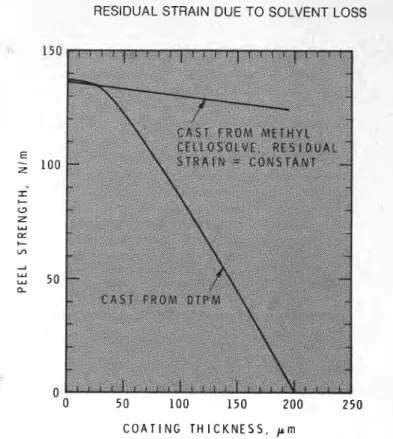
The variation of peel strength with coating thickness is plotted in Figure 6, using equations (A5) and (16).
One can see that the loss of adhesion as the coating thickness increases becomes very severe. In applying such a coating, a succession of thin coats would be preferable to one thick one. If sufficient time is allowed for the film
to solidify between applications, the internal strain and .
adhesion would be that of a thin film. If, however, another coat is applied while the previous one is still in a thermoplastic state, the solvent will redissolve the exist- ing coating and the higher strain and poorer adhesion of a thick coating will ensue.
A 30170 solution of epoxy in methyl Cellosolve@
produced coatings with a lacquer-like residual strain of 1.8196, independent of coating thickness.' In this case
U = j ~ t ~ . t ~
and the effect on the 90' peel test is also shown in Figure
6, assuming the same values for E and ? A .
It can be seen that the adhesion of the coatings using the faster drying methyl Cellosolve is far superior to that of coatings produced from DTPM. If good adhesion is required, then fast solvents that produce a lacquer-like constant value of residual strain should be used. Fast solvents are normally used in the coatings industry but this may be due more to faster drying time than to recog- nition of the effect of solvent on adhesion. The calcula- tion given here clearly shows the latter.
CONCLUSIONS
The results show that epoxy coatings cast from a very slow-evaporating solvent, DTPM, have residual strain that increases with coating thickness. A theory is pre- sented to account for this, based on the idea that the coating solidifies throughout at a particular degree of conversion and the strain results from the subsequent loss of solvent volume. Overall, the experimental data
agree very well with the predictions of the theory.
Residual strain appears to be zero for very thin coat-
ings, indicating that even these solidify by crosslinking
and that there is no lacquer-like or chemical shrinkage
contribution to the strain.
Cellosolve is a registered trademark of Union Carb~de Corp.
C O A T I N G T H I C K N E S S . pm
Figure 6-Dependence of peel strength on coating thickness for coatings cast from DTPM and methyl Cellosolve
The linear relationship between Q n (residual strain) and l / t, shows that the time to solidification is unique, which seems to confirm the choice of first order kinetics to describe the curing reaction. Time of solidification by crosslinking, T,, derived from the residual strain data, agrees well with values obtained with a bubble viscometer.
If T, or rate of evaporation, a, is increased, then the
theory predicts a reduction in residual strain. The theory also predicts, and the data confirms, that the strain decreases with increasing solvent concentration for con- centrations greater than 50% (assuming that resin con- centrations greater than 50% are impractical due to their viscosity).
Adhesion of epoxy coatings is very good, as is
indicated by the calculation of y ~ . The ever-increasing
strain with coating thickness, however, causes a great loss in adhesive strength. The approximate calculations show clearly that the lacquer-like coatings formed from fast solvents show far superior adhesion to those formed from DTPM. If the use of a very slow solvent is unavoidable, then a succession of thin coats with sufficient time to crosslink between applications is preferable, from the point of view of residual strain and adhesion.
ACKNOWLEDGMENTS
The author is grateful to Mr. R.E. Myers for performing the experimental work described here. This paper is a contribution from the Division of Building Research, National Research Council of Canada, and is published with the approval of the Director of the Division.
S.G. CROLL
References
(1) Croll, S.G., "Effect of Solvent on Residual Strain in Clear Epoxy trol in the Glass Transition Region on Critical Conversion at the Coatings," J. Oil & Colour Chemists Assoc., 63, No. 6,230(1980). Gel Point During Curing of Epoxy Resins," Polymer, 19, No. 8, (2) Prosser, J.L., "Internal Stress Studies," Mod. Paint Coat., 67, 931 (1978).
No. 7, 47 (1977). (7) Olcese, T., Spelta, O., and Vargiu, S., "Curing Kinetics of Epoxy (3) Zubov, P.I., Sukhareva, L.A., Sheverdyaeva, G.A., and Osipov, Resins," J. Polymer Sci. Symposium No. 53, 113 (1975).
E.A., "Investigation of Internal Stresses in the Formation of (8) Latham, J.L., "Elementary Reaction Kinetics," Butterworths, Films from Polyvinyl Alcohol and its Derivatives," Colloid Jnl. London, 1964.
USSR, 25, No. 4, 366 (1963). (9) Crank, J., "The Mathematics of Diffusion," 2nd ed. Clarendon, (4) Zubov, P.I., Lepilkina, L.A., and Gil'man, T.P., "The Effect of Oxford, 1975.
Lubricants and Primers on Internal Stresses and Adhesive Prop- (10) Knibbe, D.E., "Diffusion Controlled Stress-Relaxation of erties of Polyester Coatings," Colloid Jnl. USSR, 24, No. 2, 148 Swollen Rubber-Like Networks," Vol. 3 of Studies of Chem-
(1962). istry, Polymer Science. Rotterdam University Press, 1968.
(5) Croll, S.G., "The Effect of Titania Pigment on the Residual Strain, (I I) Croll, S.G., "Adhesion Loss due to Internal Strain," JOURNAL OF
Glass Transition and Mechanical Properties of a PMMA Coat- COATINGS TECHNOLOGY, 52, NO. 665, 35 (1980).
ing; Polymer, 20, No. 11, 1423 (1979). (12) Kendall, K., "Shrinkage and Peel Strength of Adhesive Joints," (6) Lunak, S., Vladyka, J., and DuSek, K., "Effect of Diffusion Con- J. Phys. D: Appl. Phys., 6 , No. 15, 1782 (1973).
APPENDIX A
INTERNAL STRAIN ENERGY
Assuming that the coating is elastic, then U is given by Substituting equation (A4) into the expression for the strain energy stored per unit area gives,
t ,
0
From the data for the 30170 solution coatings where E = modulus of the coating which, a t long times appro-
@ = 0.06745
priate t o residual strain measurements, is a fraction of the
Young's (short time) modulus. aT, = 2.86 X m
The residual strain a s a function of position in a coating is a = 1.3 X 10-lo m3/sec/m2
given by (T, = 2.2 X lo-' sec)
00
2L C O S ( ~ ~ x/tc) Assuming E = 0.4 GPa.
C ( x ) = @
'
/ ~ ~ + L ' + L ) c o s ~ . exp(-/3:DTx/t,f) (A2) For these valuesDl
is very small, irrespective of D, e.g.,n = l
if D = I X 10-12 PI = 0.139
where D = I x lo-" p l = 0.044
I @,(I -@i) D = 1 x 10⁻¹° 81 = 0.0014 f o r t , = 150 pm
@ = --- - -
,(I-6.)
[
1 - 4 . thus s i n p =P
and cosp = I. Hence, equation (A5) can beIf the same approximations are applied now as were in further simplified t o
obtaining equation 14(a), then, t, E +'
u = -
exp(-2aT,/t,)2 (A5)
cos(P1 xltc)
e ( x ) = @
.
exp(-aT./t,) (A31cos P I which, like equation 14(a), does not depend on the dif-
This publication is being distributed by the Division of Building Research of the National Research Council of Canada. It should not be reproduced in whole or in part without permission of the original publisher. The Division would be glad to be of assistance in obtaining such permission.
Publications of the Division may be obtained by mailing the appropriate remittance (a Bank, Express, or Post Office Money ~ i d e r ,
or a cheque, made payable to the Receiver General of Qnada, credit
NRC) to the National Research Council of Canada, Ottawa. KlAOR6. Stamps are not acceptable.
A list of all publications of the Division is available and may be obtained from the Publications Section, Division of Building hesearch, National Research Council of Canada, Ottawa. KIA 0R6.