Annual Review of Energy, Volume 3,
1978.
AGGREGATE ENERGY, EFFICIENCY AND
PRODUCTIVITY MEASUREMENT by
Ernst R. Berndt
Working Paper No. MIT-EL 78-005WP May 1978
-This paper was written while the author was on sabbatical leave at the Massachusetts Institute of Technology. The academic privileges graciously accorded me by the MIT Department of Economics and the MIT Energy Laboratory's Center for Energy Policy Research are gratefully acknowledged, as is financial support from the Canada Council and the University of British Columbia. I have benefited from the comments of Elias Gyftopoulos, James Griffin, Dale Jorgenson, V. Kerry Smith, G. Campbell Watkins, Macauley Whiting and David Wood., but am solely responsible for any remaining error.
Page
Introduction and Background 1
Foundations: Thermodynamics and Economics 7 Aggregate Energy Accounting and Indexing 27 Aggregate Energy Productivity Measurement 47 Average Energy Efficiency and Total Factor
Productivity: Econometric Evidence 71
Concluding Remarks 87
INTRODUCTION AND BACKGROUND
"We leave it to the Political Arithmetician to compute, how much Money will be sav'd to a Country, by its spending two thirds less of Fuel; how much Labour sav'd in Cutting and Carriage of it; how much more Land may be clear'd for Cultivation; how great the Profit by the additional Quantity of Work done, in those Trades particularly that do not
exercise the Body so much, but that the Work folks are obliged to run frequently to the Fire to warm themselves:
and to Physicians to say, how much healthier thick built Towns and Cities will be, now half suffocated with sulphury
Smoke, when so much less of that Smoke shall be made, and the Air breath'd by the Inhabitants be consequently so much purer."
Benjamin Franklin, An Account of the New Invented
Pennsylvania Fireplaces, Philadelphia, 1744, p. 32. When Benjamin Franklin offered his newly invented fireplace for sale to the public in 1744, he promoted it largely on the basis of its energy conservation potential: Franklin's fireplace saved wood and augmented the benefit of fire. Moreover, as the above quotation from the last page of his promotional material indicates, Franklin believed that the more efficient use of fire fuel had enormously beneficial social and economic implications. Franklin's statement indicates that although public concern over the efficient and productive use of energy may have been
heightened since the 1973 Organization of Petroleum Exporting Countries (OPEC) oil price increases, interest in the
implications of increases in fuel efficiency dates back for centuries.
The more narrow issue of simply measuring energy or fuel efficiency also dates back more than 100 years. Around the year 1824, an engineer named Lazar Carnot observed that for certain well-defined physical tasks (such as the raising of a mass of material from one level to a higher one in the presence of a
gravity field), there existed a maximum possible efficiency of available energy in that a minimum amount was required to perform the given task. Furthermore, this minimum amount of energy could be derived analytically, and more than the minimum amount would be required whenever any part of the physical mechanism or
process was less than perfect. Carnot's observations have led to the development of generalized laws of thermodynamics which
provide yardsticks for measuring the energy efficiency of a wide variety of physical tasks.1 Today the laws of thermodynamics form the basis of measures for the technological potential of
fuel efficiency improvements.
In the economics literature, until recently relatively little attention has been focused on specific aspects of energy efficiency measurement. The principal historical economic studies (1, 2, 3, 4, 5) measured energy efficiency simply as
energy-output ratios, where energy was measured in terms of aggregate British thermal units (Btus). In terms of other
1
For a brief history of thermodynamic measures of energy efficiency, see (6); also see (7).
discipline attention has been focused primarily on the
productivity of labor rather than on that of energy. Presumably the reason why economists have directed attention primarily to labor productivity is because of their belief that economic activity is directed to the benefit of mankind, and labor productivity (output per capita, or more recently, output per man-hour) measures the fruitfulness of human toil and labor under varying circumstances. Economists have also stressed, however, that labor is not the only scarce resource, and that it is
preferable to measure productivity in a way that compares output with the combined wise use of all scarce resources -- not just labor. Furthermore, economists have observed that measures of labor productivity depend critically on the amount of capital plant and equipment available to workers, and also that to some extent capital and labor are substitutable inputs. For these reasons the concept of total factor productivity has come into being.
The basic idea behind the total factor productivity measure is that it is more useful to measure how productively society utilizes all its scarce resources, rather than just its labor inputs. Following the pathbreaking work of Tinbergen (8), aggregate national total factor productivity indexes have typically been computed as changes over time in the ratio of
output to total capital and labor inputs. Since the early total factor productivity studies were conducted at the aggregate national level, output was measured as value added; intermediate
inputs were ingored-2 and the only inputs considered were capital (which occasionally included land) and labor.3 In particular, energy inputs were not considered.
The major exception to the exclusion of the intermediate goods from total factor productivity studies was the agricultural productivity research. Although attention in these studies often focused on yield per acre, again it was soon realized that land was not the only scarce input, and that yield per acre depended on the scarce inputs of labor, capital (such as tractors), seeds, fertilizers, and, in some cases, fuels.4 Hence in these more disaggregated productivity studies, the measure of output became gross output (total farm production) rather than vdlue added
(total farm production minus such intermediate inputs as fertilizers, seeds, and fuel). Total factor productivity was then measured as changes over time in the ratio of gross output to total capital, labor, and intermediate inputs.
2Intermediate inputs include energy, raw materials inputs, and other materials produced by one domestic sector but purchased by another domestic sector.
3
The first American study of aggregate total factor productivity appears to be that of Stigler (9); for brief
histories of economic research on productivity, see (10) and (11).
4
For a brief history of agricultural productivity research, see (12).
The above discussion might seem to indicate that unlike physics, historically economics has little to say concerning the measurement and implications of energy efficiency or energy productivity. Such a conclusion, however, would be grossly inaccurate. The approach taken in this paper is that there are persuasive reasons why most economists have tended to go beyond a myopic measure of labor productivity to a more panoramic analysis of total factor productivity, and that even in the current
excitement over energy efficiency, attention is best focused on productivity indices that compare output with the combined use of all scarce resources -- not just energy, or labor, or land.5 While measures of energy efficiency are of considerable interest, they are best analyzed in the larger context of energy and
nonenergy inputs. Economic theory together with recent
econometric evidence provides a framework in which the different factor-specific productivity measures (e.g. labor productivity, energy productivity, yield per acre, etc) can be related to one another and to total factor productivity. One of the benefits of such a framework is that it provides an analysis of how, for example, recent energy price increases are likely to affect trade-offs between energy productivity and labor productivity.
5
Unfortunately, the U.S. Department of Labor still uses labor productivity as its "official" measure; the U.S. Department of Agriculture. however, publishes total factor productivity
The purpose of this paper is to provide a framework within which alternative energy productivity measures can be analyzed and interpreted. In the following section I consider
thermodynamic and economic foundations, and discuss economic implications of Second Law efficiency measures. In the third section I consider the assumptions implicit in aggregate Btu measurement, and propose an alternative indexing procedure more consistent with economic theory. In the fourth section I provide a brief historical survey of several major aggregate average energy productivity studies and then go on to a discussion of the economic theory underlying average input and total factor
productivity. The elasticity of average productivity is shown to be the negative of the economist's traditional price elasticity of demand. In the fifth section I survey recent econometric evidence bearing on the quantitative magnitudes of factors affecting productivity movements. In the final section I conclude and summarize.
FOUNDATIONS: THERMODYNAMICS AND ECONOMICS
"The state of the matter is as follows: -- Where coal is dear, but there are other reasons for requiring motive power, elaborate engines may be profitably used, and may partly reduce the cost of the power."
"But if coal be dear in one place and cheap in another, motive power will necessarily be cheaper where coal is cheap, because there the option of using either simple or perfect engines is enjoyed. It is needless to say that any improvement of the engine which does not make it more costly will readily be adopted, especially by an enterprising and ingenious people like the Americans."
--W. Stanley Jevons6
Energy is a complex concept. The popular usage of the word energy typically refers to something that makes automobiles and airplanes move, provides heat and illumination, and enables factories to transform raw materials into finished consumer goods. In short, the popular notion of energy relates to the capacity of certain materials to perform useful tasks. Such a notion of energy is inadequate for the precise measurement of energy quantities.
The thermodynamic definition of energy is very precise and differs from popular usage of the word. Essentially, the
thermodynamic concept of energy is derived from an independent law of nature.7 The First Law of Thermodynamics is a
6See (13), Preface to the second edition (1866), pp.
xxxv-xxxvi.
7"Independent" here means that this law cannot be derived
from other laws of nature or principles of physical science. For a further clarification and enunciation of the basic laws of
statement on the existence of a property called energy which is based on the concept of work. More specifically, a property of a system is defined, called energy, such that its change of value between two states, say 1 and 2, is equal to the work involved in
a process that has 1 as the beginning state and 2 as the end state. An implication of the First Law is that the total amount of energy in the universe is constant. Energy cannot be created
or destroyed. When energy is transformed from one form into another -- say from the potential energy of a weighty object elevated above the earth's surface to the kinetic energy of the falling object, no energy is lost or gained; the friction of the falling object produces an energy equivalent amount of heat, which might however be dissipated into the atmosphere. Hence, an
implication of the First Law definition of energy s that energy conservation is assured. Moreover, energy consumption and efficiency cannot be computed on the basis of changes over time in the amount of energy, for the amount of energy is always constant.
Energy efficiency measurement attempts to provide a
numerical basis for determining how effectively energy is used. The often-used First Law efficiency measure, cl, is defined as
(2.1) _ energy transfer achieved b a device or system 1 energy input to thedevice or system
An example is provided by the conventional home oil-burning
furnace, where First Law efficiency is calculated as the ratio of the amount of heat delivered to specified rooms in a house to the
amount of heat initially provided when the fuel oil is burned in the furnace. In this case the First Law efficiency simply
measures the proportion of energy input that reaches its final destination. Because of heat loss up the smokestack and through the outside walls of the house as heat is transferred, E1
measures for home furnaces are less than 100%. According to an American Institute of Physics publication (14, p. 28), for
typical residential oil-burning furnaces supplying warm air to a home at 430C (1100F) when the outside temperature is OO°C
(32°F), e1 is about 60%. Thus, based on the First Law
efficiency measure it would appear that the maximum possible energy efficiency gain in home oil-burning furnaces is limited to less than a doubling of current efficiency levels.8
Although the First Law efficiency measure has been used extensively by heating engineers and, more recently, by energy conservation analysts, the e1 measure is not without fault. Essentially the First Law efficiency measure is based on a
definition of energy that implies constancy over time, even when certain properties or attributes of that constant energy amount vary. What is missing from the First Law efficiency measure is a recognition of changes in the quality of energy -- more
specifically, its ability to do useful work. Consider, for
8A recent detailed discussion of home furnace efficiency based on First Law principles is found in (15).
example, the air around us; it contains an enormous amount of energy and yet it has very limited ability to heat our homes or power our factories. In short, the capacity or availability of the energy-rich air around us to perform useful tasks is very low. Another example is the common battery: the ability of a charged cooled battery to perform useful work is greater than that of a discharged battery having the same energy by virtue of being hot. A final example is the following: a given amount of Btus at high temperature, say, in the steam main of a power plant, has greater capacity to do work than an equal amount at lower temperature -- say, in the circulating water of the power plant. Even though the quantity of energy is the same in either case, the transformation to a lower temperature environment involves a reduction in the quality of the Btus -- a loss in their ability to do work. Somehow a measure of "useful energy" consumed must account for the changes in the ability of energy to perform useful tasks.
The basis for this alternative measurement is provided by the Second Law of Thermodynamics, which deals with, among other things, a property of energy called availability (also available useful work or available energy) which in turn is uniquely
related to another important property called entropy (also called unavailable energy).9
9
For a rigorous definition of availability to do work, entropy, and the related concepts of enthalpy and Gibbs free energy, see (7).
A prominent feature of available energy is that although energy quantity is constant when energy is transferred from one material to another, as in the heat transfer from hot steam to
cooler water, an amount of available energy may be (and usually is) irretrievably lost. This reduction in availability is
measured by the increase in entropy. In a reversible process, the available useful work is conserved; however, an implication of the Second Law of Thermodynamics is that almost all processes are irreversible and thus involve reductions in available useful work and increases in entropy. In most cases the available useful work remaining in the material operated on is a small fraction of that available at the beginning of the task.
On the basis of the Second Law of Thermodynamics, two important relationships can be quantified. First, the maximum amount of useful work obtainable through oxidation from a given quantity of fuel can be calculated. This maximum would of course be realized only if the oxidation process were perfect. Second, for any physical task that is to be performed within an
environment that is essentially in a stable equilibrium state, a certain minimum amount of available useful work is required and can be calculated. Together these two results determine the Second Law efficiency of a specified task, hereafter denoted c2, and defined as
(2.2) = minimum work required to perform a given task
2 maximum possible ork that could be extracted from the fuel being ccnsumed in performing the
In the context again of home oil furnaces, while -1 .60, 2 = .082. Hence, according to Second Law efficiency, considerably more potential for fuel conservation exists than is implied by the 1 measure.1 0 One advantage of the
2
measure can be illustrated by noting that the Second Law
efficiency of an engine-driven heat pump with waste heat recovery for home heating purposes is estimated to be about .202, which is almost two and one-half times the Second Law efficiency of the conventional home oil-burning furnace. Such a multiple gain in efficiency would appear to be impossible using the First Law efficiency criterion, for the E1 measure of the home
oil-burning furnace is already .60.
The First and Second Law efficiency criteria differ then simply because they measure distinct phenomena and approach the measurement problem from diverse vantages. The el measure is concerned with energy, while 2 focuses on a property of energy called available useful work. The First Law approach myopically compares energy input to the actual energy transfer achieved by a given appliance, device or system, whereas the Second Law
approach compares the minimum work required to perform a given
1OThe various empirical comparisons of E1 and 2 in the American Institute of Physics (14, Chapter 2) for specified tasks all result in c2 < . Although this inequality relationship
is typical, in general it is not ensured on the basis of physical laws. Incidentally, the recent revival of interest in 2
measures is attributed in (14) to the MIT conference paper read by Keenan, Gyftopoulos & Hatsopoulos (6).
task to the more panoramic maximum possible transfer of useful work given the same fuel input. The current marked preference within the scientific community for the E2 measure over 1 is
based primarily on the reasoning that (a) available useful work rather than energy is the more relevant concept
since, unlike energy, the amount of available useful work decreases with the performance of tasks, and that (b) the E2 measure provides a basis for reckoning how efficiently the
remaining stock of available useful work is being consumed. Since the approaches and concepts underlying 1 and 2
are diverse, the two efficiency measures can yield very different implications. For example, suppose we wish to consider the
physical efficiency of n distinct tasks -- heating of a home, refrigeration, water heating, production of process steam, etc. For each of these tasks, let us compute typical First and Second
Law efficiency measures, denoting them as ll, 612, '-', Cln and 21, 22, ', 2n, respectively. Suppose now
that in searching for tasks associated with the greatest
possibilities for "energy conservation," analysts ranked the n tasks in descending order of First Law efficiency, i.e.,
11 2 1 > 12... 12 > Eln
The analyst may be tempted to conclude that certain tasks are carried out rather efficiently already, that others are typically
performed much less efficiently, and therefore that additional research or tax incentives should be focused on the currently less efficient tasks since they offer the greatest possibilities for fuel conservation. Although there is a number of errors in such reasoning, at this point it is worth noting that if the ranking of tasks were done using the Second Law efficiency measure, the e1 and £2 rankings might differ; presumably the 62 ranking would be preferred in that it relates to the
available energy concept.
This example raises the issue of what are the implications of the Second Law efficiency criterion for fuel conservation programs. Wide dissemination of the Second Law efficiency figures for various energy-using processes common in our
industrialized society identifies areas for potential substantial fuel conservation, and thereby provides a very valuable
educational function. It may also help us to reorganize and redirect technological skills toward fuel conservation and to provide target values for the fuel efficiency of particular tasks. However, it is also important to realize that the Second
(or First) Law efficiency measures are basically engineering or physical measurements rather than economic indices, and therefore
that the information content of E1 and 2 is not sufficient to answer questions such as the following: Which energy-using
industrial equipment should a plant manager replace most quickly, that with an E2 of 0.3 or that with an 2 of 0.1? Which
residential energy-conserving devices are the best investment for a homeowner? Should government or private fuel conservation research funds be allocated on a priority basis with those energy
uses with lowest 2 receiving the highest priority? What is the optimal level of 2 (alternatively, what is the optimal increase in entropy)?
To demonstrate why the Second (or First) Law efficiency criterion is not sufficient to answer these questions, we now provide a simple geometric and economic interpretation. Recall that on the basis of the Second Law one can determine the minimum amount of fuel required in an ideal or perfect equilibrium
environment to perform a specific well-defined task. Let us denote the task to be performed by T*. For example, in the residential sphere, T* could be the amount of energy transferred at a specified temperature to a home of given space dimensions in the winter months; in the industrial arena, T* could be the
amount of process steam delivered within a specified
environment. The task T* is performed using the inputs of hydrocarbon fuel (denoted F) and other inputs, principally capital structures and equipment (e.g. furnaces or boilers,
pipes, insulation, heat pumps, etc). We denote the other largely durable capital inputs by K. Using functional notation, we have
In Figure 1 below, the specific task T* = T*0 can be performed
with numerous combinations of F and K; the various fuel-capital combinations technologically capable of performing the task T* are found by plotting the coordinates of the isoquant curve along which T* = T*0. The isoquant has been drawn to be strictly
convex to the origin, which reflects the fact that to a limited extent fuel and physical capital are substitutable inputs.11 The minimum possible amount of fuel required to perform the task T* = T*0 is denoted by FOmin; notice that the line
emanating vertically from Fminn constitutes an asymptote
approached by the isoquant. Hence the asymptote represents the minimum theoretically possible fuel requirement; the actual fuel
used in performing the task T*0 will generally be considerably larger than Fn since as F falls, K increases and thus
FOi could be attained only with virtually an infinite mln
expenditure on capital plant and equipment.1 2 Naturally, if a larger amount of the same task were considered, say where T*1 > T*0, then another isoquant curve could be drawn. Figure 1 shows such an isoquant along which T* = T*1; it delineates the various combinations of F and K technologically capable of
performing T*1. Since T*1 > T*0, the T*1 isoquant
appears above and to the right of the T*0 isoquant. Moreover,
1 1Technological examples of fuel-capital substituability
are discussed in, for example, (16) and (17).
12
This discussion ignores the amount of time that may be necessary to attain Fin.
mF i: C/P C /PDI C /rk 0 FIGURE T* = T T >T* * T* F .
in
min
FIGURE 2 . 0I
F -- I _ Athe minimum possible fuel requirement associated with the larger task T*1, denoted Fin, is to the right of Fin
Figure 1 displays the various combinations of F and K technologically capable of performing specified physical tasks. It does not, however, provide us with any information on what combination of F and K will be chosen. Economists typically employ the behavioral assumption of cost minimization. In the present context, and ignoring other inputs for the moment, let us define total discounted capital-fuel costs C as C = PkK + PfF where Pk and Pf are the exogenous prices of capital services and fuels, respectively. An isocost line is now defined as a
line in F-K space which delineates the various combinations of F and K purchases that sum to the same total cost. For example,
let the constant total cost be CO. Then based on the relation CO = PfF + PkK one can easily derive the equation of the
corresponding isocost line as
CO P
(2.4) K - (p )F
k k
Such an equation is plotted in Figure 2 as isocost line I.
Notice that the intercept term of this isocost line is at CO/Pk, while the negative slope is equal to -Pf/Pk' The
isocost line corresponding to the same total cost but increased fuel prices is the steeper isocost line II. Finally, an isocost
line corresponding to the original input prices but increased total cost C1 (C1 > CO) is line III.
The economic problem facing the manager is, given the input prices Pf and Pk and the assigned task T*O, to find the
cost-minimizing combination of F and K technologically capable of
performing the task T*0. More formally, the economic
optimization problem is to minimize C = PkK + PfF subject to T* = g(F,K).
This optimization problem and its solution are represented geometrically in Figure 3. Since input prices Pf and Pk are
exogenous, all isocost lines are parallel to line'AB. The cost-minimizing manager chooses that combination of K and F corresponding to the point where the isoquant curve (along which T* = T*0) is tangent to the lowest isocost line. In Figure 3,
the minimum cost combination is at point D where AB is tangent to the isoquant curve, and thus where T* = T*0 is performed
optimally using K units of capital and F units of fuel input. The resulting derived demand for fuel at F0 is much
larger than the minimum possible amount based on the Second Law of Thermodynamics. Indeed, the ratio of line segments OFmin to OFO in Figure 3 represents the actual efficiency of the fuel
usage, and in this case it is considerably smaller than unity. It is also worth noting that since the slope of the isocost line is -Pf/Pk, increases in the price of fuel and/or
decreases in Pk (such as federal investment incentives for
energy conservation) will make the negatively sloped isocost line steeper, and thus will decrease the economically optimal amount
A K1 A FIGURE 3 0 F F min 1 E .- lm T* = T* I' IS y 0
of fuel demanded. For example in Figure 3 let the combination of
fuel price increases and investment incentives change the isocost line from the original AB to a new isocost line A'B', which may also represent a different level of total cost C. The new
cost-minimizing input combination to produce T* = T*0 is at E
where the optimal derived demands for K and F are at K1 and
F1. Hence, as a result of the fuel prices increases and/or
investment incentives, the same task T* is performed based on a demand for fuel that drops from F to F1 while demand for
capital services increases from K0 to K1; some fuel
conservation is attained, but at the cost of increased demand for capital services. Notice, however, that since F1 is still
greater than Fmin, some fuel "waste" remains economically optimal. The economic and thermodynamic optimal demands for F will coincide at Fmin only as the isocost line becomes
virtually vertical, i.e., only as -Pf/Pk approaches negative infinity.13
A number of implications of Figure 3 are worth noting. First, from an economic vantage, the optimal amount of energy conservation is that combination of capital and fuels where the present value of any additional capital expenditure is just equal
13
After writing a first draft of this paper in late 1977, the author learned from Paul A. Samuelson and V. Kerry Smith that a similar asymptotic argument has been made independently by Berry, Heal & Salamon (18). The latter paper also considers cases of more than one fuel type, but does not deal with implications of the economic-thermodynamic optima.
to the present-value of fuel savings. If present values of additional capital expenditures were less than present values of fuel savings, then (ignoring other inputs) the firm could
increase its profits (it could minimize costs further) by investing in energy conservation equipment with larger fuel savings; if present values of additional capital expenditures were larger than fuel savings, the energy conservation
investments would not be compatible with cost minimization. In this context it is useful to note that engineers such as
Gyftopoulos & Widmer (19), among others, have shown that because of recent fuel price increases, a large number of investments in energy conservation plant and equipment are now economical. Future fuel price increases will likely reinforce this trend.
Second, investment incentives will of course reduce Pk and thus bring about a substitution of capital for fuel along the
isoquant T* =T*0 . However, it is not realistic to assume that
the size of the task T* remains unchanged when investment incentives are offered. Given Pf, investment incentives which reduce Pk also reduce the total cost C of performing the task T*O; this will induce cost-minimizing firms to increase their derived demand for T* from, say T*0 to T*1 where T* >
T*O, since the cost per unit of T* relative to labor and other input prices has fallen. In such a case the outward shift in the isoquant and consequent increase in the derived demands for both F and K may more than offset the reductions in fuel demand along
the initial T* = T*0 isoquant. Thus it is not necessarily the
case that introduction of investment incentives will reduce total demand for fuels.14 In order to assess the effects of
investment incentives on overall fuel conservation, it is necessary to include consideration of interactions among the capital-fuel and other inputs, such as labor, raw materials, nonfuel intermediate materials, etc as well as changes in the composition of overall output. A further analytical and
empirical discussion of possible perverse effects of investment incentives on fuel conservation is presented in Berndt & Wood (20).
A third implication of the above framework is that the shape of the isoquant T* = T*0 may be expected to vary with the
particular task being considered. Hence it is possible that although the Second Law efficiency of task 1 is less than that of
task 2 indicating greater fuel conservation possbility for task 1, the additional fuel savings from a dollar invested in redesign of task 2 equipment could be larger than fuel savings attained
1 4A related example in the residential sphere is the
following. Suppose the federal government offered all households a 10% tax credit if they purchased a new "energy-efficient" refrigerator-freezer this year. The household finding itself with an "energy-inefficient" 16.5 cubic foot refrigerator might be induced by this tax policy to purchase a new 16.5 cubic foot refrigerator using less electricity (a movement along a given
isoquant), but might also be tempted to purchase instead a 20.0 cubic foot refrigerator with additional accessories that uses more electricity than the original "energy-inefficient" 16.5
from investing an additional dollar in redesigning task 1
equipment. This implies that the ranking of alternative tasks on the basis of the Second Law efficiency criterion does not
necessarily coincide with the ranking of most promising
investments (in terms of fuel savings) for the private or public sector.
Let me now summarize and conclude the discussion of this section. The First Law of Thermodynamics defines energy in such
a way that the total energy in the universe is constant. Since by definition conservation is assured, this energy concept is not
appropriate for the purpose of measuring and assessing policies for "energy conservation." The Second Law of Thermodynamics
considers a property of energy called available energy or
available useful work which is of critical importance since even though total energy is constant, the ability of this constant amount of energy to do useful work irreversibly declines as society performs its tasks through time. Thus the Second Law distinction between energy and available useful work is critical in focusing attention and analysis in what it is that we must conserve -- namely, available energy, not energy.
The Second Law efficiency measure provides a useful
yardstick for measuring the efficiency with which we currently utilize available energy. A number of recent empirical studies indicate that on average Second Law efficiency is very low --currently near 8%. This result is not surprising to economists,
since nonfuel inputs are also scarce and costly. Actual fuel used by firms and households is greater than the minimum possible amount implied by the laws of thermodynamics, simply because firms and households seek to minimize the sum of fuel costs and non-fuel costs. It is reasonable to expect that in the future Second Law efficiency levels will improve as long as fuel prices increase more rapidly than non-fuel prices. However, the
economic cost-minimizing derived demand for fuels and the thermodynamic optimum will coincide only as the price of fuel inputs relative to nonfuel inputs (particularly durable capital goods) approaches infinity. Because Second Law efficiency is basically a physical concept devoid of economic or social
content, its role in the formation of fuel conservation policy is circumscribed. It focuses attention on an extremely important property of energy, provides a clear and rigorous basis for measuring the efficiency with which available useful work is consumed, draws attention to enormous technological possibilities for additional fuel conservation, and if properly used serves as a target efficiency level for industry and households. However, Second Law efficiency levels and their thermodynamic foundations cannot provide the basis for determining the optimal
cost-minimizing consumption mix of available energy and other inputs; this latter resource allocation issue is clearly within the domain of joint economic-engineering analysis.
The thermodynamic distinction between energy and available work has unfortunately been largely ignored by economic
analysts. For example, numerous economic studies measure energy demand in heat units such as the Btu, and then assess
possibilities for energy conservation. Care must be taken in interpreting such studies, for Btu energy conservation is assured by definition. This raises the issue of whether it is possible to devise an economic measure of energy demand or supply that takes into account not only the quantity of energy, but also its other "quality" properties such as availability to do useful
work, weight, cleanliness, safety, and amenability to storage. Thus in the next section I consider issues in the construction of an economic measure of aggregate energy demand or supply.
AGGREGATE ENERGY ACCOUNTING AND INDEXING
Since the various fossil fuels and electricity are to some extent substitutable in supply and end-use demands, it has long been recognized that there is a need to forecast not only the demand for specific fuels, but also the demand for aggregate energy. For example, Barnett (2) states:
"The economy's functional requirements for energies could be satisfied with a variety of energy commodity combinations. These commodities could themselves be produced from a variety of domestic natural resources and imports. Therefore, as a practical matter, projections have to be made for all the energy supplies (and demands)
simultaneously, as each projection depends on the others.I15
In turn, the need to develop forecasts of total energy demand has focused attention on properties of alternative procedures to account for and index aggregate energy flows. Virtually all of the initial research in this area has utilized quantity flows of energy measured in diverse physical units (e.g., barrels of oil, tons of coal, kWh of electricity) and in a common thermal unit,
the Btu. Available energy is typically not measured.
Although the practice of measuring total energy supply in Btus has a long history, the complete national accounting of both energy demand and supply is a relatively new phenomenon, with
intellectual roots in the input-ouptut framework introduced by
1 5
Leontief.1 6 The development of a complete national supply and demand energy framework is primarily due to the early research of Barnett (2) who introduced the notion of an energy balance
table. In energy balance tables, a complete accounting is made of energy Btu flows from original supply sources through
conversion processes to end-use demands with all double counting avoided. Since all conversion losses are incorporated into the accounting framework, the energy balance table provides an exhaustive accounting framework for itemizing the sources and uses of energy.
Using energy balance tables, Barnett analyzed a great deal of United States historical data; the same energy balance
accounting framework provided the basis for his energy supply and demand forecasts. Although Barnett's approach has been refined and extended by others,1 7 it still serves as the t sic
framework around which most energy demand and supply projects are presented.
Traditionally the energy balance methodology has been used for projection purposes in the following "bottoms-up" fashion:
"Independent estimates of demand by each of the major end-use sectors for each of the detailed energy types are developed by relating demand to aggregate economic activity
1 6
See (2), p. 31 and (21).
1 7See, for example, Morrison & Readling (22) and Dupree &
West (23). A recent useful summary discussion of energy balance accounting and conversion formulae is found in Guyol (24).
and trends in energy consumption. Independent estimates of supply of major energy types are developed and compared with the demand estimates. Differences are resolved, usually in
a judgmental way, by assuming that one energy type is
available to fill any gap that may exist between supply and demand. This energy type is normally assumed to be imported petroleum, including crude oil and refined petroleum
products. "18
Based on the projected volumes of the various energy types,
researchers have typically converted to a common unit such as the Btu and then have aggregated over energy types to obtain the total Btu demand and supply forecasts. It should be noted that this total Btu figure which in some sense represents the
aggregate level of energy activity, is the outcome of the
specific energy type forecasts and in particular is not projected or forecasted initially.
One potential problem with this bottoms-up forecasting procedure is that by myopically focusing attention on the individual energy types, it is frequently difficult to incorporate the fact that energy types are to some extent
substitutable in end-use demands. Thus it is possible that when viewed in isolation each of the individual energy type forecasts might be reasonable, but when the implied total Btu figure is computed the aggregate is not as reasonable. In practice,
forecasters using the bottoms-up procedure typically examine the
1 8
Hoffman & Wood (25), p. 440.
-resulting total Btu figure to ensure compatability with prior expectations and aggregate econonomic-demographic trends; if the aggregate Btu projection is "too large" or "too small," it is changed and suitable adjustments to specific energy type
forecasts are made so that accounting identities are preserved. Of interest to us at this point is the fact that these total Btu figures in bottoms-up forecasts, although not projected
initially, typically provide a check on the overall
reasonableness of the individual forecasts. Hence the accounting framework provides a total figure which in some sense indexes the overall level of energy supply or demand. What is not clear,
however, is the economic foundations for using aggregate Btus as an index of aggregate energy demand or supply. Although the double-entry accounting framework embodied in the energy balance tables is internally consistent in delineating BtL flows, it does not necessarily follow that the total of the Btu's provides an economic index of aggregate energy demand or supply.
An alternative forecasting procedure uses the "top-down" approach. In the top-down procedure, aggregate energy demand is projected initially based on, among other things, assumptions
about future demographic-economic activity and price trends. Once total energy demand is forecasted for each end-use sector, demands for specific energy types are calculated on a "market share" basis. The advantage of this procedure is that it ensures
that total energy demand is consistent with the underlying national demographic and economic trends. The obvious problem, however, is how one initially computes the aggregate energy demand forecast. Most projections using the top-down approach
index aggregate energy demand using the total Btu index, and then calculate the corresponding energy balance tables.1 9 Again
this raises the issue of the theoretical foundations for using aggregate Btu as an index of aggregate energy demand or supply.
The above remarks suggest then that regardless of whether one uses bottoms-up, top-down, or some (not discussed)
simultaneous forecasting procedure, indexes of aggregate energy demand and supply play a central role. Traditionally, aggregate energy has been indexed using a total Btu framework measuring energy rather than available energy. Note that both energy and available energy can be measured using British thermal
units. However, the quality of the various Btus within the total energy aggregate will of course vary. Such variation in quality should affect any economic index of aggregate energy demand or
supply. Thus in the remaining pages of this section I consider theoretical and analytical foundations of alternative economic
indexes of aggregate energy demand and supply.
19
At the outset, it is useful to note that the price per Btu of the various primary and secondary energy products is not equal among energy types. Although "parity pricing" is the announced
(perverse) goal of some governments, in North America for example the price of natural gas per Btu, the price of electricity per
(thermally equivalent) Btu,2 0 and the price of fuel oil or coal
per Btu all differ from one another. Reasons for these price differentials include of course the institutional idiosyncrasies of regulation, market concentration and government policy, but also and more fundamentally the variation among energy types in such attributes as weight, cleanliness, safety, amenability to storage, relative costs of conversion and cooperating end-use technology, and capacity to do useful work. Even if there were ideal competitive markets everywhere and no government
regulation, we would expect energy prices per Btu o differ among energy types simply because
2 0
The Btu equivalent of electricity remains a somewhat
contentious issue which illustrates inherent problems of indexing aggregate energy. Based on the theoretical equivalence of heat and motive power, it is of course possible to obtain the primary energy equivalent of electricity as .86 Mcal per kWh or 3412 Btu per kWh.
Some analysts, however, have computed the heat equivalent of
electricity on an "embodied energy" basis by calculating the actual heat content of the fossil fuels burned in the generation of
electricity via steam. This latter procedure typically produces a much larger energy equivalent of electricity -- as much as five times the 3412 Btu per kWh (First Law efficiency of thermal generation was about
.19 in 1939, .2 in 1947, .3 in 1965 and is about .375 today). The economic index number approach outlined later in this section produces a basis for resolving this issue of how to weight electricity in total energy calculations.
energy forms vary in their attribute combinations.2 1
The different prices of energy forms per Btu illustrate the fact that end-users of energy are concerned not only with the Btu heat content of the various energy types, but also with other
attributes. Thus an aggregate index of energy based only on Btu heat content fails to capture the effect of the other attributes of energy -- weight, cleanliness, safety, volatility, amenability to storage, quality, etc.
Because of this variation in attributes among energy types, the various fuels and electricity are less than perfectly
substitutable -- either in production or consumption. For
example, from the point of view of the end-user, a Btu of coal is not perfectly substitutable with a Btu of electricity; since the electricity is cleaner, lighter, and of higher quality, most end-users are willing to pay a premium price per Btu for
electricity. However, coal and electricity are substitutable to a limited extent, since if the premium price for electricity were too large, a substantial number of industrial users might switch
to coal. Alternatively, if only heat content mattered and if all
energy types then were perfectly substitutable, the market would
2 1Furthermore, price differentials per Btu among energy
types would continue to exist even if all industrial and
residential users had multiple-burning capacity (i.e., if they could use any of coal, oil, natural gas, etc in their end-uses) -- simply because other characteristics such as weight,
tend to price all energy types at the same price per Btu. Since available energy can also be measured in Btus, if only available
energy mattered the market would tend to price all available energy sources at the same price per Btu, and would ignore characteristics such as cleanliness, weight, etc.
One implication of the limited and less than perfect
substitutability among energy types is that the end-use choice of a particular energy type is an economic phenomenon affected by variations in relative fuel prices, technology, income, and preferences for certain attributes. It is eminently reasonable to insist, therefore, that aggregate energy supply or demand measures should reflect the partial but imperfect
substitutability among energy types and that the weights used in constructing energy aggregates should reflect the relative value or worth of the various energy types to end-users.
The economic index number approach to this issue is, in the context of demand, to weight the various energy types using their relative (marginal) price per unit in consumption; in the context of energy supply, the weights are the relative (marginal) costs per unit in production, including costs of conversion. Under ideal market conditions, the relative prices per unit in
consumption and relative costs per unit in production are equal, and in this sense these relative prices (costs) reflect the relative worth per unit of the various energy types. It is of
course true that the actual economic marketplace is less than ideal, and that the use of actual market prices in weighting
various energy types must be viewed as an approximation to calculations based on ideal weights. In some cases it is
possible to adjust the actual market prices partially to take account of market imperfections such as utility pricing which departs from marginal cost. In general, then, while the use of prices to weight the various energy types has a solid theoretical foundation, in practice the construction of energy aggregates based on actual market prices must be viewed as an approximation to the ideal. There is some evidence that the use of actual relative prices imparts a reasonably good approximation to the ideal prices, and in particular that aggregate indices based on actual market prices are demonstrably preferable to those based on simple Btu measures.2 2 This issue of the approximation quality of actual market to perfect market prices remains, however, a topic worthy of additional research.
Although the reader may be attracted to the economic
approach for aggregate energy measurement because of its use of prices as weights, he may also have noted that I have not
discussed precisely how one incorporates prices into index number formulae. It turns out that the choice of an index number
formula implies certain assumptions on the degree of substitutability among energy types.
2 2
To illustrate this, let us first denote the quantitites of n distinct types of energy inputs at time t as Elt, E2t,...,
Ent and the corresponding input prices as Pt, P2t,.'", Pnt where each of the prices is deflated by an aggregate consumer price index, i.e. the prices are real rather than nominal. Total expenditure on the ith energy type at time t is
of course price times quantity, i.e., PitEit, and total expenditure on the n energy types is
E] PitEit
i =1
A simple aggregation procedure would involve computing aggregate energy at time t, denoted E*t, as a weighted sum of
the individual energy types, where the weights are U'noted as
hit:
(3.1) E*t = AltElt + 2tE2t + ... + ntEnt.
For example, Turvey & Nobay (27) have advocated and utilized a procedure in which one energy type, say the first, is numeraire and where the weights are computed as
Pit
(3.2) A
itPYi
it IThis yields an aggregate energy quantity index E*t in terms of the numeraire as
P2t Pnt footnote 23 (3.3) E*t = Elt + (
It 2n
t)E2t ... + (t)Ent .The corresponding aggregate energy price index in terms of the numeraire is computed as total energy expenditure divided by aggregate energy quantity, i.e.
n
(3.4) P* P /E*
Et =
Z
Pitit/E *t i=1According to equation (3.3), one unit of E2t is equivalent
to (i.e. is weighted equally as or is perfectly substitutable
with) P2t/Plt units of Elt; similarly, one unit of E3t is
equivalent to P3t/Plt units of Elt, etc. A particularly interesting special case of (3.3) occurs if the price per Btu were the same for all energy types and if each of the energy types Eit were measured in Btu equivalents. In such a special case the Xit weights would all equal unity and (3.3) would collapse to the simple Btu summation formula used in energy balance tables:
(3.5) E*t = Elt + E2t + ... +
Ent-2 3
Turvey & Nobay (27) also used a still simpler index in which it = Pit/Pi where P1 is the price of energy type 1
in the base year. Incidentally, an aggregation procedure similar to (3.3) has been used by, among others, Denison (28) and Bowles (29) to obtain an aggregate labor input index from diverse labor inputs. In the case of Denison and Bowles, the relative price weights are relative earnings or wage rates.
This demonstrates that the Btu summation formula and the economic index of aggregate energy demand or supply would be identical only if prices and unit costs per Btu were equal and if all
energy types were or available energy types perfectly
substitutable. Hence even though the Btu summation procedure is attractive in that it utilizes clearly defined physical units which are not plagued by price changes over time, the Btu index encounters formidable economic and aggregation problems; in particular, it assumes perfect substitutability among energy types and strict parity pricing per Btu.2 4
Notice that these Btu summation problems remain regardless of whether one measures energy or available energy in Btus. The basic measurement issue is not one of measurement unit Btus --but rather what it is that is being measured. From an economic point of view, one wants a composite index of all rnergy
2 4
It might be useful to note here that some researchers have measured and forecasted final demand for energy using "useful Btus" or "output Btus" which represent the "actual"
energy demanded after adjusting the "input Btus" by end-use First Law efficiency ratios. This output Btu procedure implicitly assumes parity pricing among output Btus and perfect
substitutability, and must be interpreted carefully since the relationship between input Btus and output Btus depends on the choice of conversion and end-use technology which in turn is affected by, among other things, the relative prices of energy and durable capital (see previous section). Choice of an input-output efficiency ratio therefore implies a choice along the capital-energy isoquant. Thus forecasts based on output Btus implicitly assume a forecast of investment in energy-using
attributes -- wuality, quantity, weight, cleanliness, amenability to storage, safety, volatility and relative costs of conversion and end-use technology. Thus, to the extent that relative energy prices reflect variations in quality and their other attributes, the price-weighted aggregation procedure (3.3) is preferable to the simple Btu summation formula (3.5).
Although equation (3.3) is preferable to the simple summation formula (3.5), equation (3.3) suffers from one
restrictive implication. In particular, according to (3.3), one unit of energy type 2 is completely equivalent or perfectly substitutable with P2/P1 units of E; more generally, one unit of energy type Ei is specified to be perfectly equivalent or perfectly substitutable with Pi/P1 units of E1. While some substituability among energy types is possible, I have already noted that it is unrealistic to assume that diverse
energy types are perfectly substitutable -- even by any factor of proportionality. This suggests that it would be desirable to employ an aggregate indexing procedure that weighted the constituent fuels according to their value and usefulness as reflected in relative fuel prices, that allowed for
substitutability among energy types but that did not a priori constrain the substitutability to be perfect.
One such aggregate indexing formula is known as the Cobb-Douglas index,
n w.
(3.6) E*t Eit
i=1
which can be written in linear logarithmic form as
n
(3.7) In E*t w iIn Et
i=1 it '
where the wi are constant weights which typically are positive
and sum to unity. Notice that in (3.7), the partial derivative aln E*t/aln Eit equals a constant wi. Hence if the ith
energy type were increased by, say x percent, then other things being equal, total energy E*t would be increased by wi x
percent. The advantage of the Cobb-Douglas index (3.7) is that it allows for limited substitutability among the diverse energy types.2 5 The two principal disadvantages, however, are the
following: (a) the Cobb-Douglas index assumes that possibilities for substitution among energy types are constant,2 6 and (b) it implies that expenditure shares
25In terms of the price elasticities defined in the
following section , the Cobb-Douglas index (3.7) implies that all cross-price elasticities ci.(itj) equal the constant
expenditure share of the jti input in total energy expenditures, and that all own-price elasticities £ii equal the constant cost
share of the ith energy input minus one.
n
(PitEit/
X
PitEit) i =1of the various energy types are also constant. The first feature -- constant possibilities for interfuel substitutability -- is unattractive simply because it is arbitrary and unnecessarily restrictive.2 7 The second feature -- constant expenditure shares -- is also unnecessarily restrictive and in addition is
inconsistent with the recent historical evidence. In particular, it is inconsistent with post-World War II increases in the
expenditure shares of electricity and natural gas, and
decline in the market share of coal. This suggests that a yet more general aggregate indexing formula is desirable which allows for limited substitutability but does not constrain substitution possibilities and expenditure shares to be constant.
Such general index number formulae have in fact been developed. The classic work on the economic theory of index numbers is Fisher (30) . Among other things, Fisher developed several stringent criteria for evaluating alternative index
27At first glance it might be conjectured that constancy of
substitution possibilities is inconsistent with the ultimate limits implied by the Second Law of Thermodynamics, in that after some point no further substitution against fuel inputs is
possible. This limiting possibility rules out further
substitution of available energy for non-energy inputs, but does not rule out continued interfuel substitution in which one type of available energy is substituted for another.
numbers and showed that although many commonly used index number formulae failed on at least one of his criteria, a whole class of
"ideal" index number formulae satisfied his tests. Moreover, according to Fisher, choice among the various ideal indices was not a serious problem, since on the basis of numerous empirical examples it became clear to Fisher that all members of this class of ideal index number formulae "...give results so nearly alike that it matters little or nothing, for practical purposes, which form is used. Any one of these forms is as accurate as many
instruments that are universally employed in other sciences."28 Fisher's contributions have recently been extended by Diewert (31), (32) who, among other things, has derived the substitutability implications among constituent elements (in our case, among energy types) of alternative
aggregate index number generalizations. Although Jiewert focuses attention on a number of highly general index number formulae, he
places particular emphasis on the following frequently used discrete approximation to the continuous Divisia index:29
n
(3.8) In E - In Et w(n E In E
t t-1 t it i I i t-l)
2 8
Fisher (30), p. viii. The cynical reader might interpret Fisher's enthusiasm as damning with faint praise.
29
This approximation is usually attributed to Trnqvist (33), although Theil (34) has traced its development to earlier writers.
where the wit are the nonconstant expenditure shares of the ith energy component, PitEit (3.9) w = it n
,t
~
PitEit
and(3.10) wit = (wit
+Wit-Notice that prices enter the discrete Divisia index via
expenditure shares. The heuristic interpretation of the discrete Divisia index (3.8) is as follows: the percentage (logarithmic) change in the aggregate energy quantity index is a weighted
average of the percentage (logarithmic) quantity changes of the component energy types, where the weights are the time-varying
"chained" mean expenditure or cost shares. It is noted that if expenditure shares were constant, then the discrete Divisia index
(3.8) would collapse to the more restrictive Cobb-Douglas index (3.7). The generality of this discrete Divisia index has been
delineated in greater detail by Diewert (31). In particular, Diewert has shown that the discrete Divisia index (3.8) permits variable substitution possibilities among the components, yet does not impose any a priori restrictions on the substitutability
parameters.3 0 Although other index number formulae with
comparable generality exist, the discrete Divisia index (3.8) is frequently used by economists and productivity analysts because of its convenient computational features. Moreover, Diewert (1976) finds that for practical purposes, differences among the alternative comparably general index number formulae are
typically very small.
In the above discussion I have presented an economic index number approach to aggregating over diverse energy inputs, and have shown that in this context the traditional Btu summation approach is a highly restrictive special case. Implicitly this discussion has assumed the existence of a meaningful concept such as aggregate energy; indeed, the issues I have discussed are basically how to go about indexing an aggregate assuming that such an aggregate number does in fact have meaninc Obviously, one should be aware of the possibility that an aggregate energy index may be very difficult to interpret and may not be well defined. The economic theory of aggregation provides a rigorous framework within which the notion of a consistent aggregate index
is well defined and therefore clearly interpreted. Although beyond the scope of this survey paper, it is worth mentioning that in general consistent aggregate indexes of diverse inputs
3 0
More precisely, Diewert has shown that (3.8) is an exact index number representation of the widely used linear homogeneous translog production function.
exist if and only if certain proportionality or functional separability restrictions are satisfied. A discussion of these restrictions and their relationship to aggregate indexes is found
in Leontief (35, 36, 37). Intuitively, and in the present
context of energy inputs, a consistent aggregate index of diverse energy inputs exists if and only if substitution possibilities between energy and each non-energy input are the same for every
energy input.3 1
Finally, it is worth remarking again that the focus of this section has been on how one might aggregate diverse energy inputs for purposes of measuring and modeling aggregate energy demand or supply. Although the simple Btu summation procedure has been shown to be inappropriate for this purpose, the usefulness of the Btu summation procedure and energy balance tables has not been vitiated. Obviously, the usefulness of any measurement depends on the purposes for which it is designed. Energy balance tables are extremely informative in itemizing the sources and uses of Btus. However, since energy types vary in availability and other characteristics, and since choice among energy types is an
economic phenomenon affected by technology, tastes and prices, the economic concept of aggregate energy is best measured by an
3 1
For a more rigorous and detailed discussion, see E.R. Berndt and L.R. Christensen (38).
indexing procedure consistent with basic economic theory. The index number approach discussed above is attractive in that it employs prices as weights, and is flexible in that it places no a
priori restrictions on the extent of substitutability among energy types. It can also be used in conjunction with energy balance tables, so that the valuable distinctive features of both procedures may be preserved.3 2
32An example of a model that utilizes both economic index
numbers and energy balance tables is the econometric model of the U.S. economy constructed by Jorgensen et al (39). In this model aggregate energy is computed using the discrete Divisia indexes, and all econometric modeling, optimizations and forecasts involve the Divisia index. Within the model, the aggregate energy index
is broken down into shares of coal, crude petroleum, refined petroleum products, natural gas and electricity on the basis of technological considerations and relative energy prices. At the end of all optimizations and calculations (and partly for reasons of comparability with other studies), energy balance tables and an aggregate Btu index are obtained based on the fuel share data and Btu conversion factors. For a further discussion and
AGGREGATE ENERGY PRODUCTIVITY MEASUREMENT
"Wood, our common Fewel, which within these 100 years might be had at every Man's Door, must now be fetch'd near
100 Miles to some Towns, and makes a very considerable Article in the Expense of Families.
As therefore so much of the Comfort and Conveniency of our Lives, for so great a Part of the Year, depends on the Article of Fire;--since Fewel is become so expensive, and (as the Country is more clear'd and settled) will of course grow scarcer and dearer; any new Proposal for Saving the Wood, and for lessening the Charge and augmenting the Benefit of Fire, by some particular method of Making and Managing it, may at least be thought worth Consideration."
Benjamin Franklin, An Account of the New Invented
Pennsylvania Fireplaces, Philadelphia, 1774, pp. 1-2. Having discussed alternative procedures for indexing
aggregate energy, I now turn attention to the problem of measuring how intensively economic units (firms, industries, national economies) utilize aggregate energy. I begin with some definitions and a brief historical survey, and then turn to a more theoretical analysis.
Productivity analysis derives from the observation that the production of output is possible only when inputs of capital,
labor, energy, and other materials are combined in a
technologically feasible manner. Hence in its general form, productivity analysis deals with all inputs -- not just labor, or capital, or energy. Energy productivity analysis focuses
attention more narrowly on energy inputs, and typically involves examining variations over time and space in the ratio of output
(hereafter denoted Y) to aggregate energy consumption (E).
Average energy productivity is thus defined as output per unit of energy input, i.e.
(4.1) aE = Y/E
The reciprocal of (4.1) is of course simply average energy
intensity, E/Y. Viewed in the context of production, there is no compelling reason to restrict one's attention to Y/E instead of say, average capital productivity Y/K or average labor
productivity Y/L. Indeed, classical economists paid little attention to energy. David Ricardo and Thomas Malthus, for example, are well known for their concerns regarding the
perceived decline in the average productivity of land, while Karl Marx devoted great efforts toward analyzing the value and average productivity of labor.
A complete intellectual history of energy productivity analysis is beyond the scope of this present survey. Readers
interested in pursuing such an historical investigation might begin with references cited in Jevons (13). Jevons' melancholy
"Limits to Growth" book, first published in 1865, contained a number of statistical tables but was largely an effort to
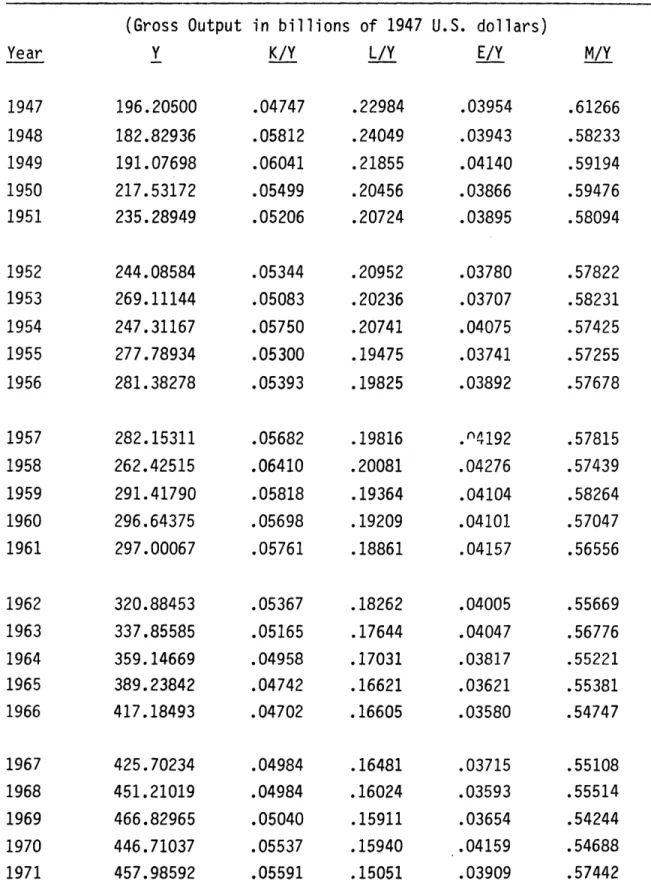
convince the suspicious British public that disastrous economic, social, intellectual and moral decay would occur within Britain since her finite coal supplies were being exhausted at an