People’s Democratic Republic of Algeria
Ministry of Higher Education and Scientific Research
University of 8 Mai 1945 / Guelma ةملاق /1945 يام 8ةعماج
Faculty of Letters & Languages
تاغللاو بادلآا ةيلك Department of Letters and English Language ةيزيلجنلإا ةغللاو بادلأا مسق
A Dissertation Submitted to the Department of Letters and English Language in Partial Fulfillment of the Requirements for the Master’s Degree in Anglophone Language,
Literatures and Civilisations
Supervised by: Presented by: Mrs. CHEKKAT Ilhem BOUAICH Salima HAFIANE Zineb
Board of Examiners
Chair Person: Miss SERHANI Rima (M.A.” A”) University of 8 Mai 1945/Guelma Supervisor: Mrs. CHEKKAT Ilhem (M.A.”A”) University of 8 Mai 1945/Guelma Examiner: Mrs. MEBARKI Katia (M.A.”B”) University of 8 Mai 1945/Guelma
September 2016
The Impact of Collaborative Writing on Developing Students’
Writing Proficiency: A Case Study of Second Year LMD
Students at the English Department -University of Guelma-
i
DEDICATION
I dedicate this dissertation to:
My lovely mother “Karima” and my father “Djamel” for their encouragement, love and understanding
My dear sister “ Imen” and all my extended family To the memory of my beloved grandfather “Houcin”
I accentuate my dedication to my supervisor “Mrs. CHEKKAT Ilhem” for her guidance
My best friend “Zineb” for her patience with me and special thanks for her family My dear “Sara” for her help and support and to all my friends especially “Fouzia”
and “Souhaila”
And all the teachers who have contributed to my learning career.
ii
DEDICATION
In the Name of God, Most Gracious, Most Mercifult All the Pries is due to God alone, the Sustainers of all the worlds I dedicate this work to:
my beloved mother “Djamila ” whose love always strengthens my will the memory of my father “Mohamed”
the one who gave me love and support, my husband “Fares” and his family all my sisters: “Dounia”, “Ahlem ”, “Firdaous” and especially my dearest one
“Khadidja”
My beloved “Malak” , “Souhieb” and “Nour Elyakin”
all my extended family, my uncle’s wife “SALMA”, and my beloved SALIMA’s family
my closet friends “Fouzia” and “Souhila”
iii
ACKNOWLEDGEMENTS
This thesis could not have been completed without the help of our teacher and
supervisor Misses CHEKKAT Ilhem to whom we would like to express our sincere thanks. We are grateful for her encouragements and insightful advice throughout the completion of this work.
We would also like to express our sincere thanks to the members of the jury who bothered reading our dissertation and providing us with valuable advice.
We would not forget, of course, to express our gratitude to all the teachers and students who filled in our questionnaires.
We would also like to give special thanks to our teachers throughout the five years of our study.
We are also thankful to all those who have always prayed for us and besought God to help us.
iv Abstract
The present research work aims at examining the impact of collaborative writing in improving students’ writing proficiency. Consequently, the research study sample was randomly chosen from second year LMD population of the English department at the University of 8 Mai 1945 –Guelma. In this respect, we hypothesize that if teachers use collaborative writing
techniques, students will be able to write more proficiently. In order to check our hypotheses; the Descriptive Statistical Method has been relied on. As a result, teachers’ and students’ questionnaires have been administered. The former has been provided to a sample group (132) of second year LMD students; whereas, the latter has been given to eighteen (18) teachers from the English Department, at Guelma University. The aim of these questionnaires was to gather significant information about the role, effectiveness and importance of
collaborative writing in EFL classrooms. The research findings have shown that collaborative writing is an effective technique that increases students’ writing proficiency. Moreover, the results of the questionnaires have confirmed the research hypotheses. Consequently, students and teachers have shown a positive attitude toward using collaborative writing techniques to develop students’ writing skill and create a good classroom learning atmosphere; where they feel more comfortable, less anxious about making mistakes and more motivated.
v
LIST OF ABBREVIATIONS CW: Collaborative Writing
Docs: Documents
DSM: Descriptive Statistical Method EFL: English foreign language LMD: License Master Doctorate MA: Magister/Master
PHD: Doctorate Q: Question
WE: Written Expression Wiki: Wikipedia
ZPD: Zone of Proximal Development %: Percentage
vi
LIST OF TABLES
Table 1. Possible Student Roles in Cooperative Learning Groups………...……..….27
Table 2. The Representation of the Students’ Questionnaire………...32
Table 2.1 Students’ Gender………...………...33
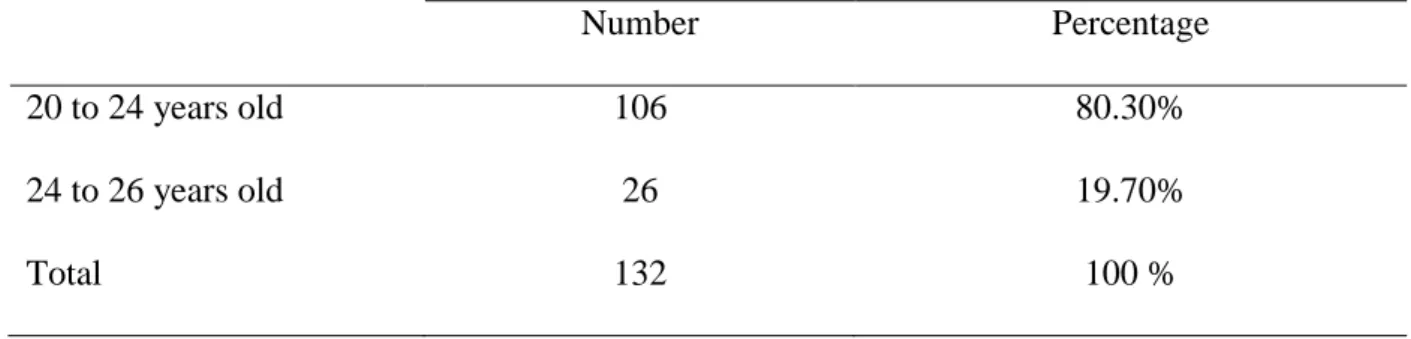
Table 2.2 Students’ Age………...…34
Table 2.3 Students’ Choice to Study English…..……….……34
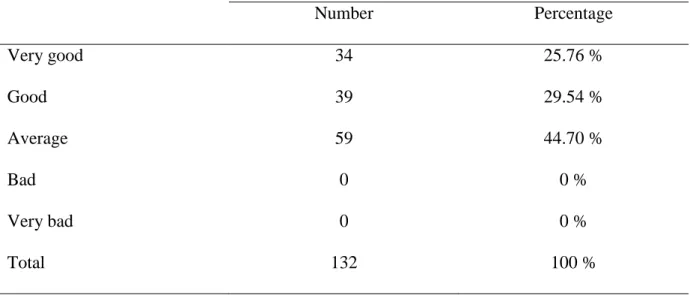
Table 2.4 Students’ Description of their English Language Mastery Level………35
Table 2.5 Students’ Writing Preferences………..35
Table 2.6 Students’ Personality……….………...………36
Table 2.7 The Influence of Students’ Personality on their Collaborative Writing…………...37
Table 2.8 Students’ Perception of their Problem when Working in Pair or in Group……….37
Table 2.9 Reasons behind Students’ Problems when Working in Groups……..………...…..38
Table 2.10 Students’ Opinions towards Working in Groups under Teachers’ Supervision....39
Table 2.11 The Amount of language learning from Group Work………...………40
Table 2.12 Advantages of Group Work……...………41
Table 2.13 Students’ Opinion about the Influence of CW on the Quality of their Work…....42
Table 2.14 Rate of Raising Students' Awareness towards Group Work Skills……..………..43
Table 2.15 Techniques of Raising Students' Awareness towards the Skills of Group Work...44
Table 2.16 Rate of Teachers' Involvement in Solving Students' Problems in CW………..…44
Table 2.17 The Degree of Improvement in Students’ Writing……….45
Table 2.18 The Contribution of Written Expression Courses in Developing Students’ Writing Proficiency……….………...46
Table 2.19 Teachers’ Graduation...………..50
Table 2.20 Informants’ Teaching Experience………...………...51
vii
Table 2.22 Difficulties that Face Teachers in Teaching Writing………..……..…….52 Table 2.23 Students’ Level of Writing Proficiency in English………52 Table 2.24 Teachers’ Organization of Students in Classroom Activities…………..………..53 Table 2.25 Teachers’ Method of Setting Students’ Groups………..………...54 Table 2.26 Teachers’ Perspectives of Students’ Problems in Group Work……….……55 Table 2.27 Group Work Problems………...………55 Table 2.28 Teachers’ Intervention in Solving Students’ Writing Problems…………...…….56 Table 2.29 Teachers’ Classroom Roles………...57 Table 2.30 Teachers’ Perspectives about Students' Motivation Level in Group Work….…..58 Table 2.31 Teachers’ Evaluation of Collaborative Work Impact on Students’ Classroom Writing Proficiency………...58 Table 2.32 Teachers’ descriptions of Students’ Attitudes toward Group Working………….59 Table 2.33 Techniques of Making Students Perceive the Advantages of Group Work……...60 Table 2.34 Teachers’ Group Monitoring Strategies……….60 Table 2.35 Teachers’ Opinions toward Group Work Impact on Students’ Language
viii
LIST OF FIGURES
Figure 1. Process of Writing...…...7
Figure 2. Procedures Involved in Producing a Written Text………..……….………….11
Figure 3. Sequential Writing………....21
ix CONTENTS DEDICATION...i ACKNOWLEDGEMENT...iii ABSTRACT………...…..….iv LIST OF ABBREVIATIONS...v LIST OF TABLES...vi LIST OF FIGURES...viii CONTENTS………..……ix GENERAL INTRODUCTION...1
1. Statement of the Problem...1
2. Aims of the Study...….2
3. Research Questions ………..………...…………..……….……....2
4. Research Hypotheses...2
5. Research Methodology and Design...2
5.1. Choice of the Research Method……….………..2
5.2. Tools of Investigation………..…………3
5.3. Population of the Study………..………..3
6. The Structure of the Dissertation………....3
Chapter One: The Impact of Collaborative Writing on Developing the Writing Proficiency Part One: The Writing Proficiency……….……4
Introduction...4
1. Writing Proficiency...4
1.1. Definition...4
x 1.2.1. Pre-writing...5 1.2.2. Composing / Drafting...6 1.2.3. Reviewing / Revising...6 1.2.4. Editing...7 1.2.5. Publishing...7
1.3. Components of the Writing Process...7
1.3.1. Organization………...8 1.3.2. Clarity………...…….8 1.3.3. Coherence………..9 1.3.4. Word Choice………...………..…9 1.3.5. Mechanics………...…10 1.4. Writing Approaches ……….……….10
1.4.1. The Product Approach………10
1.4.2. The Process Approach……….…...11
1.4.3. The Genre Approach……….………..…11
Part Two: Collaborative writing………...13
2. Collaborative Writing...13
2.1. Definition...13
2.2. Theories of Collaborative Writing……….13
2.2.1. Socio-cultural Theory……….14
2.2.2. Social Constructivist Theory……….……….14
2.2.3. Zone of Proximal Development……….15
2.3. Features of Collaborative Writing……….17
2.3.1. Mutual Interaction……….….17
xi
2.3.3. Cognitive Conflict………...…18
2.3.4. Shared Expertise………...19
2.4. Models of Collaborative Writing……….…..19
2.4.1. Writing Workshops………...19
2.4.1.1. Steps of Getting up Work Groups………....20
2.4.2. Writing Conferences………..….20
2.4.3. Sequential Writing Model………...21
2.4.4. Parallel Writing Model………....21
2.5. Patterns of collaborative writing in EFL classes………..……..23
3. The impact of Collaborative Writing………...…….25
3.1. Teacher’s Roles………..…………...……….25
3.1.1. The Teacher as an Effective Leader………25
3.1.2. The Teacher as an Assessor and Evaluator of the Cooperative Activity………26
3.2. Learner’s role……….…26 3.2.1. Affective factors………. 27 3.2.1.1. Decreasing Anxiety………..27 3.2.1.2. Increasing Motivation………..27 3.2.1.3. Self-esteem………...…28 3.2.1.4. Self-confidence………...………….28
4. Benefits of collaborative writing in EFL classes………..………28
Conclusion...30
Chapter Two: Field Investigation Introduction ………31
2.1. Students’ Questionnaire………..……..….…31
xii
2.1.2. Description of Students’ Questionnaire……….………..………...31
2.1.3. Administration of Students’ Questionnaire………..………...…32
2.2. Data Analysis and Interpretation …...……….…………...…33
2.2.1. Analysis of Results and Findings………..……….….33
2.2.2. Summary of Results and Findings from the Students’ Questionnaire……..…...…...…47
2.3. Teachers’ Questionnaire…………...……….…...….49
2.3.1. Sample Choice………...…………..……….…………..…49
2.3.2. Description of Teachers’ Questionnaire………..…49
2.3.3. Administration of Teachers’ Questionnaire………...………...…..50
2.4. Data Analysis and Interpretation ………..……….50
2.4.1. Analysis of Results and Findings……….………...54
2.4.2. Summary of Results and Findings from the Teachers’ Questionnaire……...………..62
Conclusion………..………..65
Chapter Three: Pedagogical Implications and Recommendations………66
Introduction………..….…..66 1. Pedagogical Implications………..………66 1.1. Pedagogical Tasks……….….67 1.1.1. Think /Pair/Share………...……….68 1.1.2. Jigsaw………..…68 1.1.2.1. Jigsaw II………...68
1.1.3. Roundtable / Round robin………...69
1.1.4. Group Investigation……….70
1.1.5. Buzz Groups………..……….….70
1.1.6. Write Around……….….71
xiii
1.2.1. Students Requirements………71
1.3. Effective Planning of Group Work Activities………71
1.3.1. Groups' Formation……….……..72
2. Characteristics of Collaborative Writing and its nature………...….72
2.1. Positive independence……….……..….72
2.2. Face-To-Face Interaction………..….73
2.3. Individual and group Accountability……….74
2.4. Group Processing……….……..74
3. The Role of Teachers in the Process of Collaborative Writing………74
3.1. Demonstrating………74
3.2. Motivating and Provoking………..………...75
3.3. Supporting………..75
3.4. Responding……….75
3.5. Evaluating………..75
4. The role of students in the process of collaborative writing………...………..75
4.1. Checkers……….75
4.2. Cheerleaders………...………75
5. Limitations of the Study:………...76
6. Suggestions for further research……….……..76
6.1. The use of computer technology to teach collaborative writing………...….77
6.1.1. E-mail………..77
6.1.2. Using Google Documents for Collaboration……….……….78
6.1.3. Wiki Applications………...…78
6.1.3.1. Applications of Wiki in Collaborative Writing………78
xiv
6.1.4. A process for the online collaborative writing task………81
6.1.4.1. Brainstorming/planning……….…..81
6.1.4.2. Drafting………81
6.1.4.3. Revising/ Editing………..81
6.1.4.4. Publishing……….…81
6. 2.4. Supporting collaborative writing with teaching materials……….82
6.2.4.1. Using the Board………..….82
6.2.4.2. Large sheets……….………82
6.2.4.3. Pictures……….82
7. Recommendations for both EFL teachers and learners……….82
7.1. Recommendations for teachers……….….82
7.2. Recommendation for learners………...….83
Conclusion………..……..84
General Conclusion………..………...………85 REFERENCES LIST
APPENDICES
Appendix 1: Students’ Questionnaire Appendix 2: Teachers’ Questionnaire Arabic Summary
1 General Introduction
Writing is a productive skill that helps students convey thoughts and ideas; however, EFL students need to develop it gradually; as it is a complex and process teaching skill. As a result, both teachers and students hardly find the appropriate learning techniques that allow them to practice and develop it effectively. For that, teachers of written expression think that teaching writing in cooperation may be a good way to improve students’ writing proficiency.
This study examines whether collaboration between members of a pair/group can help them compose more accurate and effective written pieces; and then, improve the overall quality of their writing productions. Thus, we are going to investigate how this teaching technique enhances students’ writing skill, language practice and general engagement in EFL classrooms.
1. Statement of the Problem
Foreign language students usually face many obstacles that hinder their learning achievements in general and writing skill in particular. Therefore, teacher- centered classes can no more solve such learning problematic situations; as they lead to individualistic and competitive learning contexts. However, teachers have vital roles in EFL classes through their implementation/ selection of the appropriate teaching methods and techniques; that can help students gain more knowledge, learning satisfaction and achieve good learning outcomes; mainly in the writing skill area. Moreover, since writing is a productive skill, it needs more guidance, correction, feedback and collaborative working of the whole class, most of the time. Thus, students can exchange ideas, practice language, benefit from using different learning styles; and then, increase self- confidence and decrease anxiety.
2 2. Aims of the Study
The aim of this study is to examine the role of collaborative writing in improving students’ writing skill. Our aim also is to use pair and small groups to maximize students’ written production.
3. Research Questions
This study addresses the following questions:
1. Can collaborative writing develop the writing skill in EFL classroom?
2. What is the impact of collaborative writing on EFL students’ writing proficiency? 3. What attitudes and opinions second year LMD students and teachers of English department, University 8 Mai 1945 -Guelma- have about collaboration as a teaching and learning writing technique?
4. Research Hypotheses
On the light of these research questions, we hypothesize that:
If teachers use collaborative writing techniques, students will be able to write more proficiently.
If students exchange their written compositions in classroom, they will be able to enhance their writing skill more than working individually.
Second year LMD students of English may have a positive attitude toward pair/ or group work in EFL writing classes.
5. Research Methodology and Design 5.1. Choice of the Research Method:
On the ground of what has been previously said, the methodology of our research runs as follows:
To fulfill our objectives, we have relied on the Descriptive Statistical Method (DSM); in order to present and describe the impact of collaborative writing on students’ writing proficiency
3
and provide a detailed and comprehensive perspective of the problems under investigation. Comments and discussions have been provided along with representing the results in tables. 5.2. Tools of Investigation:
Our data collection has been based on two questionnaires that have been given to both teachers and sample students of Letters and English Language, University of Guelma. The answers have been treated to get information about their thoughts, opinions, assumptions, attitudes and suggestions about such learning problems
5.3. Population of the Study:
This study has been carried out at the University of 8 Mai 1945-Guelma, Faculty of Letters and Languages, Department of English, for the academic year 2015/2016. The target population under study consists of Second year LMD students of English at Guelma University. The study sample composed of (132) students randomly chosen from second year population (199) to answer our questionnaire. The reasons behind choosing second year students are that: the obstacles of writing are clearly apparent at that level; since students have one year study experience of such course. Moreover, the time amount given to teaching this course is somehow sufficient and equals four hours and a half (4:30 hours) per week.
In addition, teachers’ questionnaire was administered to (18) teachers of different modules of English Department and the majority of them have a teaching writing experience.
6. The Structure of the Dissertation
Our dissertation is a whole of three basic chapters. Chapter one is purely theoretical; devoted to a literature review of the research theme. Chapter two examines the practical part of the investigation and describes data collection methodology. Chapter three gives the fruitful conclusions drawn from the whole research and states some pedagogical implications, recommendations and suggestions.
4 Chapter One
The Impact of Collaborative Writing on Developing the Writing Proficiency
Part One: Writing Proficiency Introduction
Writing is no longer an individual activity but an interactive process; through which social abilities of learners are reinforced. To promote interaction in the writing class, collaboration has been suggested to be an effective classroom strategy. This collaboration gives students opportunities to interact and challenge their language knowledge in a beneficial learning environment.
We have provided this chapter to discuss the notion of collaborative writing and its impact on developing students’ writing proficiency. Accordingly, the chapter is divided into two parts; in which the first one is provided for describing the nature of writing, its stages, components, and related approaches. Whereas, the second one is devoted to defining the term collaborative writing; hand in hand, with some related factors and theories. We have tried to highlight some features, models, and patterns of collaborative writing in EFL classes.
1. Writing Proficiency 1. 1. Definition
Writing is not as simple as it seems to be. Byrne (1979), states that " writing is clearly much than the production of graphic symbols, just as speech is more than the production of sounds" (1).
The above statement indicates that; the graphic symbols are set in particular ways to form words, and words to form sentences that are sequenced and linked together in certain manners to build up larger constructions than sentences. They form a coherent whole, what we call a ‘text’. In line with this, White and Arndt (1991:3) see that:
5
Writing is far from being a simple matter of transcribing language into written symbols: it is a thinking process in its own right. It demands conscious intellectual effort which usually has to be sustained over a considerable effort of time.
Furthermore, Widdowson (1981:26) relates the act of writing to the activity of producing correct sentences and “transmitting them through the visual medium as marks on paper”.
Writing is then viewed as a communicative tool based on correct structures and convenient vocabulary items; in order to share ideas and convey intended meanings.
1.2. Stages of the Writing Process
Writing is composed of five stages that should be carefully considered in any writing task. These are prewriting, drafting, reviewing / revising, editing, and publishing.
1.2.1. Pre-writing
Prewriting is a successful technique to explore and develop the learner’s ideas. According to Gallo (2001) there are many useful strategies included in prewriting and lead the learner to approach his writing and develop his ideas such as; brainstorming, free writing, asking questions, mapping, journaling and listing.
Thus, when learners start to write they should select their topics and it is helpful if they take a moment to think about the topic following the prewriting strategies. These latter can be practiced in groups or with the whole class.
Prewriting is an important stage as (Parson ,1985: 115) says “ Students who are encouraged to engage in an array of prewriting experiences have a greater chance for writing achievement than those enjoined to ‘get to work’ on their writing without this kind of preparation.”
6
We can say that, it is important to make students aware of the value of the prewriting stage. Before they start to write, learners should select their writing topic(s) (in cases of free writing; i.e., the topic is not given by the teacher) and it is always helpful if the learners take a moment to think about the topic via relying on some prewriting sub skills; as brainstorming, reading, drawing, talking, note-taking, and clustering. It could be practiced in groups or with the whole class.
1.2.2. Composing / Drafting
The drafting stage is described by (Galko.2004:49) as “Drafting means writing a rough, or scratch, form of your paper. It’s a time to really focus on the main ideas you want to get across in your paper.”
Drafting is then the first attempt on student’s paper to select figure out the ideas and thoughts that are really worth to be included or discussed in the final version.
In this sense, Hedge (1988: 89) defines drafting as the stage where the writer “Puts together the pieces of the text [through] developing ideas [into] sentences and paragraphs within an overall structure.”
(Murray, 1978: 87) describes this strategy as “Discovery drafts”. He calls it so because it helps learners discover what they want to say by writing down their ideas in the draft paperwithout paying attention to spelling, grammar or punctuation mistakes. They focus only on the content rather than the form.
1.2.3. Reviewing/ Revising
Reviewing or revising is the third stage after drafting; which means, revising the content, meaning, structure as well as the mechanics that include spelling, grammar, and punctuation.
The teacher’s revision is useful according to (Sommers, 1982: 150); who suggests that teachers’ role is to help students understand the purpose of revision by commenting and
7
suggesting. Consequently, after the revision, students get their feedback and decide what they change or delete.
1.2.4. Editing
Editing is the stage where the draft is polished. It is the final step before handing out the final draft. In this stage, students pay attention to correct spelling, grammar, punctuation, and other mechanical errors.
Smith (1982) claims that, “The aim of editing is not to change the text but to make what is there optimally readable” (p.145). This means that, students should not start from scratch when they edit; but just check what they have wrote to enhance their language quality and convey their intended meanings in a way that; helps the reader to receive directly their messages.
1.2.5. Publishing
Publishing is the final stage in the writing process. It involves sharing or publishing the student’s writing to the teacher (or audience in other contexts). (Harmer, 2004) describes publication as final version in how students produce their final writing. Publishing can take many forms. It may be oral by reading aloud what students write, or written by letters, reports or visual by sharing data show. Harmer summarizes the process of writing in the following steps:
Planning drafting editing final draft
Figure 1. Process of Writing. (Harmer, 2004: 5)
1.3. Components of the Writing Process
Writing in formal English for different academic purposes is not an easy task. In fact, there are some important criteria to be followed and seriously accounted for. According to
8
Starkey (2004) an effective piece of writing should include organization, coherence, clarity, language accuracy, and word choice.
1.3.1. Organization
Organization is the first component in the writing proficiency. The information should be organized in a structured format to readers. This will help and guide the writer to be direct in his writing process. According to Starkey (2004:2) the direction and purpose you get from organization helps your reader to believe what you are saying and to willingly follow your lead.”
Organization is then determined through some important techniques that show the value of the writing process. Starkey (2004) sees that the prewriting technique in organization is the planning of the work that comes after reading and gathering the information from prewriting. Galko (2002) claims that, ‘Brainstorming is to let your ideas flow without judging them’ (p.10). Thus, brainstorming is an effective technique for developing learners ‘piece of writing.
1.3.2. Clarity
Clarity is the essential part in writing. The learner’s goal in writing is how to convey information including the fact of being able to write well. In other words, the learner’s writing should be readable and clear in order to make readers understand what he/she means. Starkey (2004) mentioned four fundamental elements that have to be considered in making writing easy and accurate:
1) Eliminate ambiguity: the learner should avoid using ambiguous words or phrases that have more than one interpretation in order to help the reader understand what he means.
2) Powerful, precise adjectives and adverbs: the learner’s writing is clear when he uses adjectives and adverbs in order to convey his message accurately.
9
3) Be concise, by eliminating unnecessary words and phrases, and using the active voice whenever possible.
4) Avoid unnecessary repetition: (avoid wordiness) the learner should eliminate repetition of information and ideas.
Accordingly, the learner has to avoid all sorts of repetition and even the use of the same poor vocabulary set throughout his piece of writing.
1.3.3. Coherence
Coherence is the ability of the writer to retain meaning and to compose his writing in a manner that is understandable. “Coherence is perhaps the single most important element in any kind of writing” (Murray &Hughes 2008:45).
1.3.4. Word Choice
According to Starkey (2004) the word choice displays the learner’s style of choosing the lexical items and structures in order to convey his message. He sees that there are two aspects the learner should consider while choosing the words to be used: denotation and connotation.
Denotation is “literal meaning, of the word.”(Starkey 2004:22). However, connotation involves emotions, cultural assumptions, and suggestions. Connotative or implied meanings can be positive, negative, or neutral. Some dictionaries offer usage that help to explain connotative meanings. Keep in mind that using a word without being aware of its implied meaning can annoy your reader or make your message unclear.
Denotation and connotation must be considered when making word choice, but the learner should be aware in his words selection; because he may unconsciously confuse, insult or annoy the readers.
10 1.3.5. Mechanics
The word mechanics refers to the appearance of words, how they are spelled and arranged on paper. (Kane, 2000:15). Brooks and Penn (1970: 20) state that “For one thing, in writing, we must understand the structure of the language, what the parts of speech do, how the words relate to one another, what individual words mean, the rules of grammar and punctuation’.
1.4. Writing Approaches
There are three principal writing approaches: the product approach that is concerned with the form, the genre approach that pays attention to the reader, and the process approach that concentrates on the writer. These approaches are further described below.
1.4.1. The Product Approach
Before the development of the process approach to writing, researchers saw writing as a product, and thought that the most important component of good writing was linguistic knowledge rather than linguistic skill. Consequently, this approach had been known as the product approach.
Young (1998) defined the product or traditional approach to writing as ‘the emphasis on the composed product rather than the composing process; the analysis of discourse into words, sentences, and paragraphs; the strong concern with usage (syntax, spelling, punctuation) and with style (economy, clarity, emphasis); and so on’ (cited in Matsuda, 2003, p.70).
This means that, this approach focuses on the student’s final product and structure; where errors are avoided and correctness is stressed. The product approach is criticized for neglecting meaning and focusing more on structure.
11 1.4.2. The Process Approach
The process approach is introduced in the mid1960s. For Rohman, writing, according to this approach, is classified into three stages: 1) the pre-writing stage includes tasks that take place before writing; 2) the drafting and writing stage; and 3) the re-writing stage, in which attention is paid to any grammatical, punctuation or spelling mistakes (Rohman, 1965). In relation to this definition; we can deduce that, the process approach refers to a broad range of strategies that includes pre-writing activities, drafting, and revising. Thus, writing is viewed as a non-linear process of discovery.
The teacher is considered as a facilitator and students are given considerable freedom within the task. However, this approach is criticized for neglecting the social context.
White and Arndt identify six (6) non-linear procedures or processes when writing using this approach. Figure 2 bellow shows these procedures and how they inter-relate (White & Arndt, 1991, p. 4).
Figure 2. Procedures Involved in Producing a Written Text 1.4.3. The Genre Approach
The genre approach to writing is developed in 1980s. Swales (1990), claims that the genre approach consists of ‘a class of communicative events, the members of which share
Drafting
Structuring Reviewing Focusing
12
some set of communicative purposes’ (p. 58). In addition, this approach is defined as a ‘goal-oriented, staged social process’ (Martin, 1992).
We can then say that, the genre approach focuses more on the context and purpose for which the writing piece is produced. This approach claims that writing is a social ability; as a result, students write in order to communicate meaning in the society.
The teacher is expected to give his students a model they are familiar with its genre. Both the teacher and the student analyze the model text and the activities given are process- oriented.
Writing is then a complex skill made up of many sub skills and techniques; and the good writer should know and be aware about them to develop his writing proficiency.
13
Part two: Collaborative writing 2. Collaborative Writing
The following part is left for emphasizing the core of our research; i.e., Collaborative writing (CW). We will try to give a detailed description of this technique as an effective way for enhancing students’ writing skill.
2.1. Definition
Elbow (1973) points out, collaborative writing (CW) in the classroom is useful and important, since if someone is stuck in his or her writing, it is better to contact and talk with someone else. He claims, ‘two heads are better than one because two heads can make conflicting material inter-act better than one head usually can’ (p. 49). This means that, students’ interactions can result in better exchange of ideas and language use. Consequently, such conflicting exchange can be a reason for teachers to use collaborative writing; that helps students to develop group skills; such as, team spirit and cooperation.
Haring-Smith (1994) defines collaborative writing as involving more than one person, who contributes to the creation of a text, so that “sharing responsibility” (p. 36) becomes essential. Thus, group members put their efforts together and take part to produce one collective piece of writing. Opportunities are available for each student to contribute his/ her ideas, language knowledge, and opinions. In other words, all the members share ownership of a single document.
2.2. Theories of Collaborative Writing
A review of published articles on collaborative writing showed that two primary theoretical frameworks underline collaborative writing: socio-cultural and social constructivist theories of learning.
14 2.2.1. Socio-cultural Theory
Socio-cultural theory focuses on the social, cultural, and historical contexts that affect the learning process.
On the one hand, James P. Lantolf (2000) believes that the most basic tenet of socio-cultural theory is that the “human mind is mediated” (p.1). This belief is based on Lev S. Vygotsky’s (1978) claim that language is a meditational tool for thought development. Vygotsky posits that,
humans use cultural signs and tools (e.g. speech, literacy)to mediate their interactions
with each other and with their
surroundings…these artifacts are social in origin; they are used first to communicate with others, to mediate contact with our social worlds; later with practice, much of it occurring in schools, these artifacts come to mediate our interactions with self; to help us think, we internalize their use.(Cited in Moll, 1990, pp. 11-12)
We can say that, language is a framework through which humans experience, communicate, and understand reality. Knowledge is not simply constructed within the individual, but it is socially co-constructed and later internalized by this individual.
2.2.2. Social Constructivist Theory
On the other hand, Social constructivists (Bruffee, 1986; Vygotsky, 1978; Wertsch, 1991), emphasize social interactions as the prerequisite to cognitive development. Learning is viewed as a social activity. It takes place as a result of the internalization of ideas in the
socio-15
cultural environment. In other words, the theory emphasizes how knowledge, meaning, and understanding are socially and culturally constructed.
Another central premise of Vygotsky’s theory is that, development of higher mental abilities occurs in a social context on two planes: first, at the social level between individuals (inter-psychological) and second, at the cognitive level within the learner (intra-psychological). As learners socially interact with others, they internalize, transform the help, and use the same means of guidance for subsequent independent learning.
According to socio-cultural constructivists, learning is a process of enculturation into a community of practice (Wenger, 1998). This latter is formed through three core components: mutual engagement, joint negotiated enterprise, and shared repertoire of joint resources. Mutual engagement involves regular interactions, while joint enterprise refers to the negotiation of mutual accountability to the community of practice, and shared repertoire includes the sharing of linguistic resources or other tools. Another minor theoretical frame is the concept of private speech. Vygotsky explained that egocentric speech goes “underground” as inner speech (verbal thought) and reappears as private speech (speech to oneself). A person uses private speech to gain self-regulation when involved in difficult problem-solving tasks during the social interaction. The learner mediates his or her thinking in private speech as he or she struggles with difficult concepts and language problems (Anton and DiCamilla, 1998; Diaz and Berk, 1992). Private speech may be a signal for assistance, externalization of one’s thinking, or mediation of understanding and problem-solving (Donato, 2000).
2.2.3. Zone of Proximal Development
Vygotsky (1987) maintained that knowledge is co-constructed and learning always involves more than one person. Social interaction is a necessary precondition for engaging in self-regulation. It helps a person to move from other-regulation to self-regulation. In the former, the learner’s cognitive development is mediated with the help of the most experienced
16
person, and in self-regulation, learners gain control over their own learning after the internalization of shared socio-cognitive activity.
One of Vygotsky’s contributions to educational research is the concept of zone of proximal development (ZPD). He distinguishes two development levels. First, the level of actual development, a level in which a learner has already reached and is capable of solving problems independently. Second, the level of potential development - zone of proximal development (ZPD) – the level in which the learner is capable of reaching under the guidance or in collaboration with a teacher or peers.
Luis C. Moll (1989) proposes a different perspective of the zone by what he calls “re-creation of meaning”. The zone emphasizes, “the appropriation and mastery of meditational means, such as writing, assessed not only or necessarily through independent performance after guided practice, but the ability to participate in qualitatively new collaborative activities” (p. 60). Moll continues by suggesting that the focus of the zone is not to transfer skills from those who know more to those who know less but “to use meditational means collaboratively to create, obtain, and communicate meaning” (p. 60). By creating meaning together, learners can acquire composing skills where they become consciously aware of how they can manipulate the writing process. As well as, apply the knowledge in the future activities. More research is thus needed to explore the notion of the zone and the contribution of expertise in literacy development to add to the pool of existing knowledge.
To sum up, socio-cultural theory focuses more on culture and contexts in understanding language learning while social constructivist theory stresses the collaborative nature of learning through social interactions. Both theories suit the principles of collaborative writing; and thus, become the primary theoretical frameworks for this study.
17 2.3. Features of Collaborative Writing
Collaborative writing features that are identified explicitly in the literature include: mutual interaction, negotiation, conflicts, sharing of expertise, affective factors, and use of L1. The role of the features and the way they are combined vary according to different socio-cultural contexts.
2.3.1. Mutual Interaction
The most prominent defining feature of collaborative writing is social interaction among the members. A high level of engagement among members is a critical factor in successful collaboration (Dale, 1997). During interaction, students have ample opportunities to initiate ideas and contest them, allowing reflective and generative thinking (Daiute & Dalton, 1993). That is to say, students can construct their knowledge together through building thoughts and opinions that allow them to deeply infer the meaning.
Mutual engagement is a fundamental component in forming a coherent community of practice (Wenger, 1998). The participants in the community of practice develop a sense of identity which is defined and integrated during the engagement with one another. In addition, the engagement draws out the competence of each individual to create “complementary” contributions. Nonetheless, situations that involve sustained interpersonal engagement are likely to include strain and conflicts. This brings us to the second defining feature of collaboration.
2.3.2. Negotiation
Negotiation is closely related to interaction. This term signifies the modification and restricting of interaction when learners and their interlocutors encounter problems in comprehending messages (Pica, 1994). Some common features of negotiation include: clarification requests, confirmation checks, and comprehension checks. These features describe the process in which a listener requests message clarification and confirmation. A
18
speaker responds to the request by repeating, elaborating or simplifying the original message (Pica, 1994).
Michael P. Breen and Andrew Littlejohn (2000) distinguish three kinds of negotiation: personal, interactive, and procedural. Personal negotiation is primarily a psychological process that engages the learner’s mental processing. Interactive negotiation occurs when people use language to show their understanding or their failure to understand what has been said. They may change or restructure their language to make things clearer for others. Procedural negotiation takes place between people to reach engagement on a task issue, solve a shared problem, or establish acceptable ways of working together.
In fact, negotiation appears to promote mutual accountability and can contribute to the development of learner autonomy. Learners have the opportunity to map their own learning process and share resources. This claims that, negotiation helps learners to develop self-reliance, leadership, and decision-making. Consequently, they can exchange their own knowledge with others and easily interact in a social context.
2.3.3. Cognitive Conflict
An investable part of the process of collaborative writing is cognitive conflict. Since students must negotiate differences of opinion in order to reach consensus, conflict is bound to happen (Dale, 1994). While researchers have reported that conflict plays a positive role in the learning process (Allen et al., 1987; Dale, 1994; Ede and Lunsford, 1990; Storch, 2002; Tocalli-Beller, 2003; Yong, 1998), there seems to be a dichotomy of opinions about conflicts. On one hand, unresolved conflicts or those related to personalities and affective aspects can be detrimental to group function (Dale, 1994; Storch, 2002; Tocalli-Beller, 2003). On the other hand, conflict can help learners to be more creative and enhance writing (Allen et al., 1987; Ede and Lunsford, 1990; Tocalli-Beller, 2003).
19
Hence, conflict plays an effective role in solving problems by allowing students to understand the causes of these issues providing suitable solutions through using their mental processes.
2.3.4. Shared Expertise
As mentioned earlier, one of the benefits of collaborative writing is the sharing of expertise. Each learner is different in terms of his or her language proficiency, knowledge, and background experiences, among other things. When learners work collaboratively, they contribute their strengths to the group (Dale, 1997; Ohta, 1995, 2001).
There are many areas in which a person can be an expert. For instance, those who cannot write well can suggest good ideas or examples. Some are better at sentence structures, organization, spelling, and writing mechanics. Others may focus on purpose and sense of audience, evaluation, or even time management.
2.4. Models of Collaborative Writing
There are different models that are used to teach collaborative writing. 2.4.1. Writing Workshops
Williams (2003, p. 103) defines workshops as classes in which students “share their work with one another”. In this model, students form groups of three to five and help each otherachieve a given writing task. The teacher here is considered as a facilitator.
Like all models of CW, writing workshops are highly beneficial; in the sense that, students are busy all the time. They talk, write, think and research, and they would better see their roles as active learners. (Williams, ibid.) .Wynn & Cadet (1996) claim that workshops give students the opportunity for “generating ideas, providing feedback, responding to audience and composing papers, and thinking and writing critically.”(p. 9).
Generally said, this model is considered to be learner-centered in the sense of sharing ideas, doing activities, and responding to one another.
20 2.4.1.1. Steps of Getting up Work Groups
Setting up groups of students is not as easy as one might think. (Williams, 2003) suggests the following steps:
1. Get students acquainted to one another.
2. Evaluate their writing abilities in order to balance the groups.
The teacher can equally use questionnaires to extract information about "the smartest person in the class, who is the best leader, who is the easiest to get along with, who are good friends, and so forth."(ibid. p. 133).
In this case, teachers can control the groups through moving students from one group to another. On one hand, this change is beneficial because it gives students the opportunity to receive a greater variety of feedback. On the other hand, changing students’ groups can result in destroying the social bonds students have already established with their group mates. In these regards, Williams (ibid. p. 134) argues that “For the true cooperation that characterizes effective work groups, bonding is essential”. Students should not be allowed to choose their own groups; because if they are allowed to, they would do that on the basis of friendship, sex, age and language; which would result in discussing anything rather than the task of writing. 2.4.2. Writing Conferences
Writing conferences represent another model of CW; where they consist of teachers talking with their students about their writings. They can talk with one or more students having the same problems. In such conferences, students should be allowed to talk as much time as possible; in order to understand better what they are doing.
Another important point is that, teachers should not draw students' attention to all their errors. In this respect, Williams (ibid. p. 149) argues that “effective writing teachers commonly focus students' attention on just a couple of points, even though the paper has numerous
21
problems."(p. 149). Murray (1992) also states that teachers should not appropriate their students' writings. Rather, they should give them "little or no guidance at all"(p. 116).
2.4.3. Sequential Writing Model
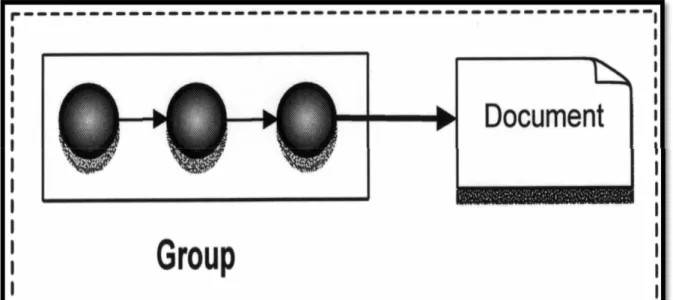
In this model of CW, group members do their work one after the other. That is to say, every single student in each group does the task at a given time and passes the document along next in the chain. This model is very helpful because it organizes and improves coordination between the students.
Lowry et al. (2004) discusses the advantages of this model stating that students may not come to a consensus on every single point, and that they can change other students' ideas.
Figure 3. Sequential Writing (Lowry et al 76) 2.4.4. Parallel Writing Model
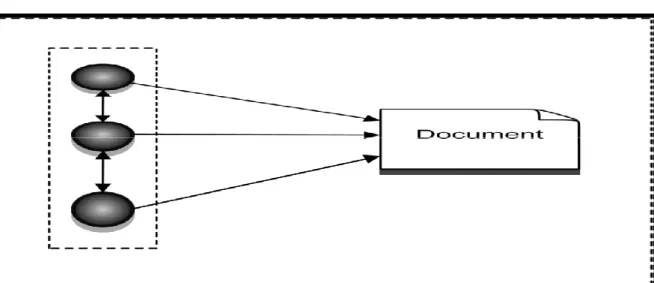
Unlike the sequential writing model, in the parallel model, every student in a team is assigned a role. Alred et al. (2003) gives a detailed description of this model:
1. Designate one person as the team coordinator.
2. Collectively identify the audience, purpose and project scope. 3. Create a working outline of the document.
22
5. Establish a schedule: due dates for drafts, revisions, and final documents. 6. Agree on a standard reference guide for style and format.
7. Research and write drafts of document segments. 8. Exchange segments for team member reviews. 9. Revise segments as needed.
10. Meet your established goals.
Figure 4.Parallel Writing (Lowry et al 76)
In this model, students are expected to perform a given role through planning an outline, drafting, revising and editing the final product. As well as; setting their goals and make efforts in order to reach the intended outcomes.
Johnson et al. (1994, cited in Richards & Rodgers, 2001, pp.200-201) suggests a procedure for a cooperative writing task. After receiving a set of instruction on how to write an essay; for example, students work cooperatively to achieve the assigned task proceeding as follows: 1. The teacher assigns students to pairs with at least one good reader in each pair.
2. Student A describes what he or she is planning to write to Student B, who listens carefully; probes with a set of questions, and outlines Student A's ideas. Student B gives the written outline to Student A.
23
3. This procedure is reversed, with Student B describing what he or she is going to write and Student A listening and completing an outline of Student B's ideas; which is then given to student B.
4. The students individually research the material they need for their compositions, keeping an eye out for the material useful to their partner.
5. The students work together to write the first paragraph of each composition to ensure that they both have a clear start to their compositions.
6. The students write their compositions individually.
7. When the students have completed their compositions, they proofread each other's compositions, making corrections in capitalization, punctuation, spelling, language usage, and other aspects of writing the teacher specifies. Students also give each other suggestions for revision.
8. The students revise their compositions.
9. The students then reread each other's compositions and sign their names to indicate that each composition is error-free.
2.5. Patterns of Collaborative Writing in EFL Classes
Reither and Vipond (1989) outline three forms of collaboration, namely, co-authoring, work shopping and knowledge making. Co-authoring means working with each other and accomplishing things together. In other words, co-authoring denotes a highly interactive style of collaborating. As for work shopping, it is used by the authors to refer to some form of extended collaboration. In terms of EFL writing, work shopping implies handing over the work in progress to classmates or colleagues for comment and feedback (spoken or written). Thanks to this feedback, the writer can then revise his/her writing. When this form of collaboration is initiated among EFL writing groups, it eventually looks like a writing workshop.
24
For Reither and Vipond (1989), knowledge making is rather an indirect form of collaboration; which implies that writing is a process of participating or collaborating in the construction and reconstruction of the already existing knowledge. In other words, when students write, they do not make their meanings alone but rather in relation to the meanings of others who have contributed to the same field of knowledge.
Other patterns of collaborative writing have been developed by Saunders (1989). In his critical review of research on collaborative writing tasks and peer interaction, he identified five collaborative writing tasks that students could indulge in; as well as, the corresponding types of learning outcomes they may help to achieve. These tasks were referred to as co-writing, co-publishing, co-responding, co-editing and writer-helping. According to Saunders (1989), co-writing happens when a group of peers share ownership of the text and collaborate, interact and contribute together throughout the planning, composing, reviewing and correcting stages of writing. Co-publishing occurs when students divide up the writing task among the group members and compose their parts of the text individually. However, group members collaborate at the planning, reviewing and correcting stages of writing to produce a final collective document. In co-publishing, there is some division of labor: Group members share ownership and responsibility for their collective document but their specific contributions are maintained. As for co-responding, participants do not share ownership of the final texts. They plan, compose individually, interact and help one another at the reviewing stage of writing. At this stage, students share their drafts with their chosen peers; who in turn respond. Thus, collaboration among co-respondents is only reflected in the way each trusted student assumes the dual role of being a writer and a critical reader for his/her peers’ writing. This form of collaborative writing is exactly similar to that of co-editors. The latter are expected to interact and help one another only at the correcting stage of writing; that is, proofreading and editing of individual drafts.
25
Finally, the writer-helpers are so called because they do not have any designated stage of collaboration during the writing processes. In other words, student writers are the sole owners of their texts but may seek help at any point of their writing activity.
Another relative new conceptualization of collaborative writing was suggested by Storch (2002). She came up with four distinct patterns of pair interactions, namely collaborative, dominant/dominant, dominant/passive, and expert/novice collaborative patterns. A collaborative interaction refers to a pair that worked together on all parts of the writing task by contributing, discussing and accepting each other’s ideas.
The dominant/dominant interaction denotes a pair that equally contributed to the writing task but whose members could not agree with each other’s contributions. This pattern of pair interaction may be assimilated to the co-publishing situation (Saunders, 1989), where there is clear division of labor among collaborating participants. In the dominant/passive interaction, one participant dominated the whole task while the other one simply remained passive. In this pattern of interaction, there is a little negotiation between the participants. In the expert/novice encounter, one participant seemed to take control of the task as an expert but also actively encouraged the other participant (the novice) to contribute.
3. The impact of Collaborative Writing 3.1. Teacher’s Roles
The teacher has in fact several roles to play inside the classroom, and mainly when organizing collaborative classroom tasks or activities.
3.1.1. The Teacher as an Effective Leader
Shindler (2010) suggests the principles that the teacher can provide while directing the cooperative group activity:
Stop the whole group when need to provide a clarification. Be sure of their complete attention when you deliver the information; testing your students’ patience.
26
Speak at low voice when you inform some students about some information necessary for them not for all the class.
Move from group to group but do not take over when you are there. To less intervene is better.
Be concrete and specific, for example say ‘great job stating with it’. Praise your students loudly.
Although groups’ success is affected by many factors, the teacher remains the main factor; since in our classrooms the teacher is most of the time the leader, and his teaching method and techniques influence directly his learners’ outcomes.
3.1.2. The Teacher as an Assessor and Evaluator of the Cooperative Activity
During a cooperative activity, both teachers and students are accountable for evaluating and assessing the work. Teachers use direct observation to judge students’ performance whether all members of the group have talked or not (Shindler, 2010). Nevertheless, self-assessment is also an important process to make students reflect and make efforts; as it could be problematic when trying to promote responsibility (Shindler, 2010). That is, when the evaluation is translated into grade, students feel hurt and angry about one another assessment.
In fact, there are many teachers who are aware of the benefits of assessment and evaluation as a strategy for recognizing and shaping the quality of student’s performance; however, other teachers do not incorporate assessment and evaluation in their teaching operation neglecting its worth.
3.2. Learner’s Role
In order to promote cooperation between students, they should have a role assigned by the teacher. The following table demonstrates some roles that students can perform in the classroom.
27
Role Description
Encourager Encourages reluctant or shy students to participate
Praiser/Cheerleader Shows appreciation of other's contribution and recognizes accomplishment
Gate keeper Equalizes participation and makes sure no one dominates Coach Helps with the academic content, explains concepts Question commander Makes sure all students' questions are asked and answered Taskmaster Keeps the group on task
Recorder Writes down ideas, decisions and plans
Reflector Keeps group aware of progress (or lack of progress) Quiet captain Monitors noise level
Materials monitor Picks up and return materials
Table 1: Possible Student Roles in Cooperative Learning Groups (Kagan, 1994; cited in Woolfolk, 2003, p. 496)
3.2.1. Affective factors 3.2.1.1. Decreasing Anxiety
According to Kagan (1994) “If people are anxious, but allowed to affiliate, their anxiety level is reduced.” (Dornyei, 2001:101) emphasizes the role of cooperation to reduce the problem of anxiety. That is to say, when students work together they feel at ease unlike when they work individually; consequently, cooperative work produces a good outcome in increasing discussion and decreasinganxiety or fear inforeign language classrooms.
3.2.1.2. Increasing Motivation
According to Crandall (1999), in cooperative groups, students receive peer support and assistance. This will encourage them and subsequently be better motivated to learn.
28
Furthermore, sharing one's work with the entire class makes students feel better about the learning process. In this sense, Williams (2003) said that motivation "strengthens the bonding in the class, and motivates students to work hard." (p.132).
3.2.1.3. Self-esteem
Most psychologists acknowledge that, high academic achievement is a matter of many factors among which self-esteem is a significant one and plays an important role. In this context, Myers (1999) states that, "Children with high self-esteem tend also to have high academic achievement." (p. 22). Thus, the more the learner is involved and the more roles he isassigned, the better self-image he would hold of himself.
3.2.1.4. Self-confidence
It is acknowledged that higher self-confidence is very essential in learning the four skills. In case of writing, Neman (1995) agreed upon the effectiveness of self-confidence in enhancing learners’ writing proficiency stating that "writing well requires both knowledge of the craft and the self-confidence to exercise this knowledge'. (p. 5)
4. Benefits of Collaborative Writing in EFL Classes
Collaborative writing plays a vital role in EFL classes and in the learning process as a whole. Its effectiveness can appear in terms of interaction, cooperation, and students’ writing development.
Woolfolk (2003) emphasizes the importance of students' interaction with the teacher or other peers, saying that: "in order to test their thinking, to be challenged, to receive feedback, and to watch how others work out problems."(p. 41). Additionally, he states that "communicating with others makes students use, test, and sometimes change their thinking abilities."(p. 42). Thus, group work helps students to communicate their thoughts, think critically, and respond to one another.
29
In the same vein, Scrivener (1994) claims that collaborative writing enables students to learn from one another through interaction and communication. He sees that, interaction designs to foster cooperation rather than competition. He provides a list of some ideas to promote interaction in class:
make use of pairs and small groups to maximize opportunities for students to speak. encourage interaction between students rather than only between student and teacher
and teacher and student. Get students to ask questions, give explanations, etc. to each other ratherthan always to you.
encourage cooperation rather than competition …we learn from others and from working through our own mistakes.
To sum up, collaborative writing promotes students’ self-confidence, self-esteem, and self-assessment; the fact that helps them to develop their writing skill inside the classroom under teacher’s eye and guidance.
30 Conclusion
As a conclusion, we can say that, writing in a foreign language is not an easy task. It needs more attention and knowledge from both teachers and learners. This chapter explores the nature of writing as a cognitive activity as well as a language skill. In addition, it focuses on collaborative writing as a powerful method that encourages cooperation, critical thinking, peer learning, and active participation to develop the writing process.
31 Chapter Two Field Investigation Introduction
In order to examine the impact of collaborative writing on developing students’ writing proficiency, two questionnaires are handed out randomly in one week to second year LMD students and teachers of different courses, in the department of English at Guelma University, for the academic year 2015/2016.
2.1. Students’ Questionnaire 2.1.1. Sample Choice
In order to fit the objectives of our study, we have worked on a representative sample that is randomly selected from a whole population (199 students). Our sample contains (132) second year LMD students randomly selected from six groups in the department of English at Guelma University. The second year students have already experienced the writing teaching methods and courses (specifically the written expression course); that is why, we have chosen them to be our sample; i.e., being able to provide us with useful data and opinions.
2.1.2. Description of Students’ Questionnaire
The Students' questionnaire is wholly made up of 19 questions classified under three sections. The first section seeks to reveal students previous background about English language. (Q1) seeks to know their gender. (Q2) looks for their age. (Q3) attempts to know if they have freely chosen to study English or not. (Q4) asks students to describe their level in English.
The second section is composed of six questions about the notion of collaborative writing (CW) (Q5-Q10). In (Q5), students are asked to say how they prefer to do writing tasks (individually, in pairs or in groups). Questions (6-7) describe student’s personality and how does it affect CW. In questions (8-9), students are asked to identify the problems encountered;