MINISTRY OF HIGHER EDUCATION AND SCIENTIFIC RESEARCH UNIVERSITY OF 8 MAI 45. GUELMA
FACULTY OF LETTERS AND LANGUAGES
DEPARTMENT OF LETTERS AND ENGLISH LANGUAGE
Dissertation Submitted to the Department of Letters And English Language in Partial Fulfillment of the Requirements of Master’s Degree in Anglophone Language,
Literature and Civilizations.
Submitted by: Supervised by:
Mrs. BENZOUGHBI souhaila Mrs. HARIDI Samiya Ms. ATTIK Faouzia
Board of Examiners
Chairperson: Mr. CHETTIBI M. Walid Maitre Assistant ‘B’ (UNIVERSITY of Guelma)
Supervisor: Mrs. HARIDI Samiya Maitre Assistante ‘B’ (UNIVERSITY of Guelma)
Examiner: Mrs. MEBARKI Katia Maitre Assistante ‘B’ (UNIVERSITY of Guelma)
September 2016
The Importance of Formative Assessment in Developing Students’
Writing proficiency.
Case Study: Third year LMD Students of English at Guelma
University.
DEDICATION
I dedicate this work to the most precious people:
My dear parents; “Mouhamed and Zineb”, for their endless love, help, and patience My dear brothers: Hamza, khaled and Oussama
To my husband “Faysal” for his encouragement and care My lovely cousin: Salma
To all my family members
My kind friends with whom I shared nice times: Fouzia, salima, Zineb,Imen
DEDICATION
I dedicate this work, to my beloved parents: Ammar and Wassila who provide me with their interest, and support in my learning path, thank you for everything you have always given me.
To my brothers: Djamel and Ilyes
To my sister: Khadidja
To my dear family without forgetting anyone
To my friend Souhaila with whom I shared this work with its best and worst moments.
To my wonderful friends Salima and Zieneb with whom whom I share good and bad times.
I love you all
ACKNOWLEDGMENTS
We would like to express our gratitude and appreciation to our supervisor: Mrs. HARIDI Samiya. We are sincerely indebted for her kindness, wisdom and insightful guidance throughout the conduction of this dissertation.
We would like to thank the examiners for their acceptance to examine this dissertation. We appreciate your awareness and careful reading of this dissertation: Mr. CHETTIBI M Walid, and Mrs. MEBARKI Katia.
Special thanks go to our secondary teachers: Mr. TEBIB Immad, Mrs. OUFELA Warda and Ms. MERABTI Abd El Basset for their help and encouragements.
Finally, our huge thanks go to all our grateful teachers who have been teaching us through the past five years, and special thanks to the teachers and students who kindly answer the questionnaires.
ABSTRACT
The current study attempts to investigate the crucial role of formative assessment in improving learners‟ writing skill in the Department of English, University of Guelma. In order to test the hypothesis that suggest the probability of developing the writing skill through using formative assessment, a descriptive method has been adopted, in which two questionnaires were administrated; the first one was directed to third year LMD students who were assigned randomly, and the second was addressed to English teachers of written expression. The gathered data have shown that formative assessment has a positive impact on developing learners‟ writing skill, as well as helping teachers to assume greater responsibility for monitoring and supporting their students learning in general and writing in particular. On the basis of these results, the hypothesis is confirmed. In the light of this, students need to be assessed formatively in order to develop their writing proficiency.
LIST OF ABBREVIATION
AERA: American Educational Research Association
CCSSO: Council of Chief State School Officers
EFL: English as Foreign Language
FA: Formative Assessment
FAST: Formative Assessment for Students and Teachers
LMD: License Master Doctorate
NRCNA: National Research Council of the National Academies
OCED: Organization for Economic Co-operation and Development
SA: Summative Assessment
SLT: Second Language Teaching
STCEAS: Standards for Teacher Competence in Educational Assessment of Students
LIST OF TABLES
Table 1: Differences between Speech and Writing………..18
Table 2: Comparison of Formative Assessment and Summative Assessment……….27
Table 3: Sex Distribution………..44
Table 4: Description of Students‟ English level………...…45
Table 5: Students` most Difficult Skill………46
Table 6: Students‟ Opinion about “Written expression” Course………..47
Table 7: The Nature of Writing Skill………..……….48
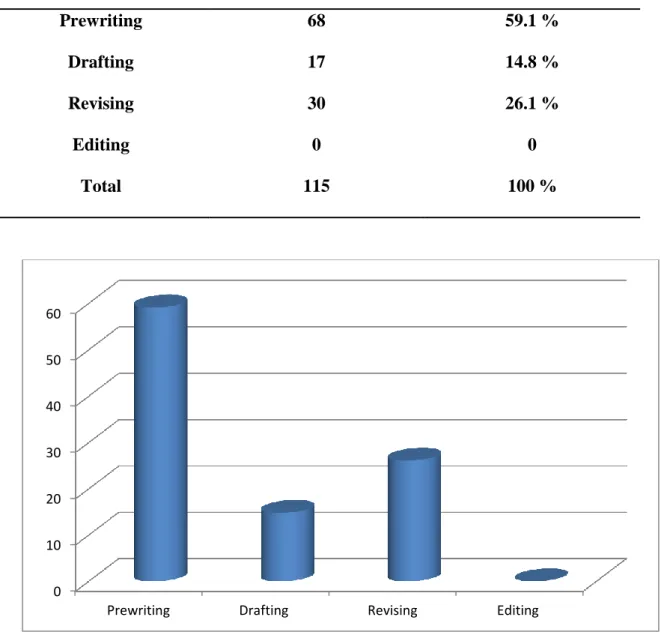
Table 8: Stages that are not Followed when Writing………....50
Table 9: Students‟ Preferences toward Teacher‟ Correction when Writing……….51
Table 10: The Type of Correction Students Prefer………...52
Table 11: The Way used while Correcting Students‟ Writings………52
Table 12: Students` Attitudes towards the Time Feedback/ Correction Should Take Place…54 Table 13: The Necessity of Developing the Writing Skill………55
Table 14: The Implementation of Formative Assessment during the Writing Course………56
Table 15: Frequency of Teachers` Formative Assessment in Writing……….58
Table 16: Teacher‟ Techniques of Assessment………..……….59
Table18: The Improvement of Students‟ Writing Proficiency through Formative
Assessment………61
Table 19: The Students‟ Opinion about the Impact of Formative Assessment on their Language Proficiency………...62
Table 20: Sex Distribution………….………...65
Table 21: Teacher Qualification………...66
Table 22: Teachers‟ Experience in Teaching……….………...67
Table 23: Approaches to Teach Writing………...…68
Table 24: The Teacher Role in the Writing Course………..………69
Table 25: Types of Difficulty……….……….………..70
Table 26: Proceeding through Writing Stages………...………...71
Table 27: Teacher‟s Feedback on Students‟ Writings………..72
Table 28: The Provision of Assessment………….…………...………73
Table 29: Types of Assessing Students Formatively in Writing……….……….74
Table 30: The Implementation of Formative Assessment……….…….………..75
Table 31: Types of Formative Assessment that Teachers use ……….76
Table 32: Strategies of Assessing Students Formatively…………...……….77
LIST OF FIGURES
Figure 1: Development of Writing………....08
Figure 2: Procedures Involved in Producing Written Text………...14
Figure 3: A Process Model of Writing Instruction………...15
Figure 4: Classroom Assessment Cycle………23
Figure 5: Planned Formative Assessment……….31
LIST OF GRAPHS
Graph 9: Students‟ Sex Distribution………...………..45
Graph 10: Description of Students‟ English level………46
Graph 11: Students` most Difficult Skill………..47
Graph 12: Students‟ Opinion about “Written Expression” Course……..……….48
Graph 13: The Nature of Writing Skill……….49
Graph 14: Stages that are not Followed when Writing………50
Graph 15: Students‟ Preferences toward Teacher‟ Correction when Writing….……….51
Graph 16: The Type of Correction Students Prefer……….………...……..52
Graph 17: The Way used while Correcting Students‟ Writings……….……..53
Figure 18: Students` Attitudes towards the feedback Time……….54
Graph 19: The Necessity of Developing the Writing Skill………...55
Graph 20: The Implementation of Formative Assessment during the Writing Course….…..57
Graph 21: Frequency of Teachers` Formative Assessment in Writing……….58
Graph 22: Teacher‟ Techniques of Assessment………59
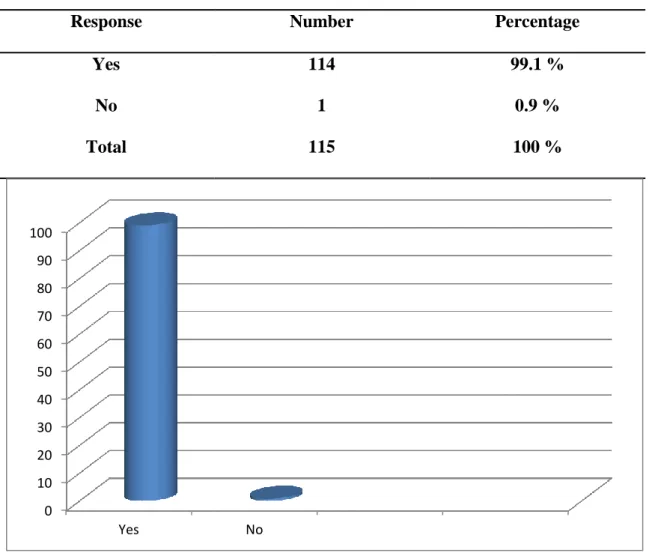
Graph 23: Usefulness of Formative Assessment………..60
Graph 24: The Improvement of Students‟ Writing Proficiency through Formative Assessment ……….. 61
Graph 25: The Students‟ Opinion about the Impact of Formative Assessment on their
Language Proficiency….……….62
Graph 26: Teachers‟ Sex Distribution……….………65
Graph 28: Teacher Qualification………..……….66
Graph 29: Teacher Experience in Teaching………..67
Graph 30: Approaches to Teach Writing………..68
Graph 31: The Teacher Role in the Writing Course………….………69
Graph 32: Types of Difficulty in Writing………..…...70
Graph 33: Proceeding through Writing Stages……….71
Graph 34: Teacher‟s Feedback on Students‟ Writings…………..………...72
Graph 35: The Provision of Assessment……...………...73
Graph 36: Types of Assessing Students Formatively in Writing………..74
Graph 37: The Implementation of Formative Assessment………...75
Graph.38: Types of Formative Assessment That Teachers Use………...76
Graph 39: Strategies of Assessing Students Formatively……..………..…….77
CONTENTS
DEDECATION………..………I ACKNOWLEDGEMNTS………..III ABSTRACT……….……….….. IV LIST OF ABBREVIATION……….………..…………....V LIST OF TABLES………...…………. VILIST OF FIGUERS………...………..…... VIII
LIST OF GRAPHS……….………IX
General Introduction………..………..1
1. Statement of the Problem……….………2
2. Aims of the Study ………...….………2
3. Research Hypothesis……….………3
4. Research Methodology and Design………..3
4.1. Choice of the Method……….3
4.2. Population of the Study………..3
4.3. Data Gathering Tool………...…3
CHAPTER ONE: WRITING SKILL
Introduction……….……….……….6
1. The Development of Writing Over Time………...………….6
2. Definition of Writing ………...8
3. The Nature of Writing ………..9
4. Teaching Writing……….….11
4.1. The Process of Writing……….……….11
4.1.1. Prewriting……….………..11
4.1.2. Drafting ………...……..….12
4.1.3. Revising………...12
4.1.4. Editing……….…….……12
4.2. Approaches to Teaching Writing……….……….…..13
4.2.1. The Product Approach………..………13
4.2.2. The Process Approach………...14
4.2.3. The Genre Approach……….………...15
5. Writing with other Skills………...16
5.1. Writing and Reading ……….……16
5.2. Writing and Speaking……….…………17
Conclusion………....20
CHAPTER TOW: FORMATIVE ASSESSMENT
Introduction……….…..22 1. Assessment………..……..22 1.1. Types of Assessment……….….24 1.1.1. Diagnostic Assessment………..……24 1.1.2. Summative Assessment………....24 1.1.3. Formative Assessment………..………...252. Formative Assessment vs. Summative Assessment……….25
3. Formative Assessment………...….…..28
3.1. Definition of Formative Assessment………...………..….28
3.2. Types of Formative Assessment………31
3.2.1. Planned Formative Assessment……….………..31
3.2.2. Interactive Formative Assessment………..…….32
4. Stages of Formative Assessment……...………33
4.1. Pre-Formative Assessment………...33
4.2. Formative Assessment during Instruction………..………33
5. The Strategies of Formative Assessment……...………..34
5.1. On –The –Fly……….………34
5.2. Planned- For Interaction……….………35
5.3. Curriculum-Embedded………...………35
6. The Role of Teachers and Students in Formative Assessment……….36
6.1. The Teachers‟ Role……….………...36
6.2. The Students‟ Role………37
7. Formative Assessment Facilitating Students‟ Writing Proficiency………..…………38
Conclusion………..….41
CHAPTER THREE: FIELD INVESTIGATION
Introduction………..431. Students‟ Questionnaire………..………43
1.1. Aim of Students‟ Questionnaire…..………..43
1.2. Sample Choice ………...43
1.3. Description of Students‟ Questionnaire………...…..43
1.4. Administration of students‟ Questionnaire………...……….…44
1.5. Analysis of Results and Findings……….……..44
2. The Teachers‟ Questionnaire……….…...64
2.1. Administration of the Teachers‟ Questionnaire ………..…64
2.2. Description of the Teachers‟ Questionnaire ………..……...64
2.3. Analysis of the questionnaire ………64
2.4. Summary of Results and Findings from the Teachers‟ Questionnaire…….…...80
Conclusion……….………...…………....……80
RECOMMENDATION………...….……...….81
GENERAL CONCLUSION………..………...….…..…..82
REFERENCES
APPENDIXES
Appendix 1: Surdents‟ Questionnaire Appendix 2: Teachers‟ Questionnaire French Abstract
General Introduction
In the last decade, teaching English as a foreign language (EFL) witnesses a radical change due to the new challenges that face both teachers and learners. In this regard, most attempts in Second Language Teaching (SLT) have been directed to minimize those challenges. These attempts are mainly associated within the enhancement of the four skills mainly these productive ones; Speaking and Writing. In academia, writing has become a central criterion for academic success. It is considered to be an important mean of communication and expression of thoughts. Therefore, it plays a fundamental role in our personal and professional lives.
Nowadays, teaching writing becomes a rich field of investigation. In EFL classrooms, teachers need to be well trained to develop student‟s writings. Teachers are requested to create a motivational atmosphere to push their learners to learn writing and enjoy it; providing different types of tasks and activities is the possible way to arise motivation among learners. Also, it is important to make sure that the adopted approach fits the students‟ needs. Thus, writing is considered as an integral part in learners‟ language development.
Formative assessment has emerged as an effective element of classroom instruction. Most definitions of formative assessment underline the idea of collecting evidence of students‟ learning, and based on this information teaching is modified to better meet students‟ needs. Teachers‟ formative assessment plays an essential role because it diagnoses students‟ weaknesses and strengths. In addition, it may create some kind of interaction between teachers and students, hence, it can play a dual effect, both enhancing students‟ writing ability and providing them the needed knowledge to write more and better. Consequently, a growing body of research has recommended the use of formative assessment to improve students‟ writing skill. The present study seeks to explore the effectiveness of teachers‟ formative assessment and to what extent it is able to enhance students‟ writing performance.
1. Statement of the Problem
Writing is a complex process which demands cognitive analysis and linguistic synthesis. Most students face many difficulties when trying to be skillful writers. They are always struggling to convey their thoughts and ideas effectively. In fact, there is a pressure on both teachers and learners because of the growing demand for better writing productions. Unlike speaking, writing is not practiced outside the class, so what is learned inside the class in not practiced inside the class and has little chance to be developed outside.
Among the successful tools which have the potential for improving students‟ writing ability, classroom-based assessment has been highly emphasized. The common assessments of writing depend on standardized assessments and high stakes assessments like summative assessment. However, summative assessment is likely to underestimate students because it provides evidence about students‟ achievement for the purpose of grading and making judgment. As a result, different solutions have been suggested to minimize students‟ challenges in writing. In this regard, many educators proved the role of formative assessment in teaching writing. It is assumed that formative assessment or assessment for learning allows teachers to adjust their instructional practices as needed due to the gathered data about students‟ performance in writing.
2. Aim of the Study
The main aim of this study is to investigate the effectiveness of formative assessment on students‟ writing skill. Throughout this study we attempt to highlight the importance of formative assessment putting much emphasis on its role in enhancing students‟ writing proficiency. Moreover, this study tries to provide teachers with insight about how formative assessment can be helpful in teaching writing.
3.
Research Hypotheses
If we assess students formatively, their writing skill would be improved.
4. Research Methodology and Design
5. Choice of the Method
To undergo this research, a descriptive method is adopted due to the fact that it is the most appropriate method that fits the stated objectives.
6. Population of the Study
This study will be conducted at Guelma University, Algeria. The target population consists of one hundred ninety eight (198) of third year LMD students. They are chosen randomly. This choice is due to many reasons: First they are the most who are supposed to receive formative assessment. Second, the goal of providing formative assessment at this level is to give students information about their progression in writing since they are supposed to write long essays and thesis in the near future.
7. Data Gathering Tools
In order to investigate the importance of formative assessment in enhancing students‟ writing proficiency, questionnaires will be administrated for both teachers and students. The students‟ questionnaire aims to gather information on how formative assessment affects their writing ability, whereas the teachers‟ questionnaire attempts to demonstrate how teachers assess their students formatively and to see if they are aware about the significance of formative assessment in teaching writing.
8. Structure of the Dissertation
The present research is basically divided into three main chapters. Chapter one and two will be devoted to literature review and the third chapter to the field work. In the first chapter, we will discuss the development of writing over time besides its definition and nature. Then
we will discuss the process of teaching writing including: prewriting, drafting, revising and editing. Moreover, we will go through the different approaches that are used in teaching writing. In addition, we will compare writing with other skill; reading and speaking. At the end of this chapter we will talk about some challenges that face students when acquiring the writing skill. Concerning the second chapter, it will deal with assessment as a key component of continuous improvement. Therefore, we will come to define the term assessment, and then we will come through its types: summative, diagnostic and formative. After that we will provide a comparison between summative assessment and formative assessment. In the second chapter, the focus will be placed on formative assessment as a motivational factor for learning. It includes formative assessment‟s types and strategies in addition to the role of both teachers and students in this process. Finally, we will report how formative assessment facilitates students‟ writing proficiency. The third chapter will deal with data analysis. This chapter contains a detailed analysis of students‟ and teachers‟ questionnaires and ultimately the results obtained in this research work, recommendations, and conclusion.
CHAPTER ONE:
Writing Skill
Introduction
Learning a foreign language requires the mastery of four skills: listening, speaking, reading and writing. This later is viewed as the most complex process that demands cognitive analysis and linguistic synthesis. For a long time, writing was a neglected area in language teaching especially when oral language took precedence in the classroom over other modalities. For such reason, writing was not emphasized in most foreign language classes. However, nowadays writing becomes an essential component in language teaching (Brookes & Grundy, 1998). In this chapter, we will talk about writing as the most sophisticated language skill. First, it includes a summarized view about the history of writing over time, its definition and nature. The chapter also comprises related theories to teach writing; the product approach, the process approach and the genre approach. In addition, we will discuss the relation between writing and speaking, as well as the connection between writing and reading skill. Finally, we will tackle the various issues and problems that learners may face in acquiring the writing skill.
1.
The Development of Writing over Time
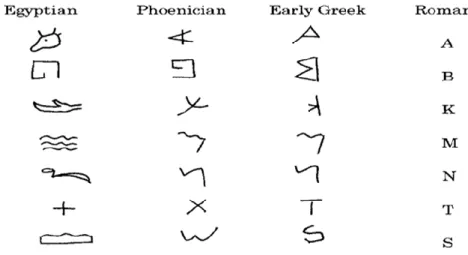
Writing as an effective mean of communication witnessed many changes and developments over time. The history of human communication dates back to the earliest era of humanity. The early writing systems were not a sudden invention; they were a development based on earlier symbol systems. Crystal (1999) stated that those representational symbols for ancient cultures are called “petroglyphs” or “pictograms”. These systems used ideographic and mnemonic signs to convey information.
The first known writing was derived from the two greatest rivers, the Nile and the Tigris. So, Egyptian and the Sumerian (Iraq) are the two civilizations responsible for this total transformation of human development. With the economic growth in Mesopotamia trade was flourished, as such the Sumerians invented cuneiform writing as a mean of communication
(Kramer, 1971). The Sumerian used to impress pictographs onto wet clay which was then dried. In this post, Yule (2010) stated that:
“…these inscriptions are more generally described as cuneiform writing. The term cuneiform means wedge-shaped and the inscription used by the Sumerians was produced by pressing a wedge- shopped implement into Soft clay tablets, resulting informs like
”.( p. 214)
Shortly after the Sumerians, the Egyptians were influenced, and they developed a new form of writing. The difference between the two characters can be viewed in the nature of the writing itself; the Egyptian characters are more pictorial than the Sumerian ones which is literatim (Sampson, 1990). However, the system of conceptualizing things and objects is the same. The Egyptian typescripts were called “hieroglyphs” by the Greeks in about 500 BC.
Yule (2010) indicated that the Phoenicians writing dates back to 3,500 years ago. Durant (1954) claimed that the Phoenicians did not invent their writing because they derive it from the Egyptian and the Crete. For instance, the Egyptian hieroglyph which means house becomes later on the following Phoenician one .The Phoenicians alphabet extended into Northern Africa to become the system used by the Arabs, and North West to Greece where they modified further the letters to become the Cyrillic Alphabet of Russia and the Balkans.
McCarter (1974) asserted that the history of the Greek alphabet started when the Greeks borrowed the Phoenician alphabet and adapted it to their own language. Greek is the source of all the modern scripts of Europe, the most widespread descendent of Greek is the Latin script. Hence, the Romans made some modifications to the nature of the letters to become the ones that we recognize and use. The Roman alphabet can be differentiated from other writing systems in that the symbols represent sounds not pictures.
Figure 1: Development of Writing (Yule, 2010, p. 217)
2. Definition of Writing
Writing is the most commonly used form of communication. This form is simply about the use of graphic symbols. For Widdowson (2001) “writing is the use of visual medium
to manifest the graphlogical and grammatical system of the language” (p.62). That is to say,
writing is the production of sentences as instances of usage. So, students need to be aware about the different aspects of language including the graphic system, the grammatical structure, and the selection of the appropriate terminology related to the subject matter. Crystal (1999) stated that “writing is not a merely mechanical task, a simple matter of putting
speech down on paper. It is an exploration in the use of the graphic potential of a language -a creative process- an act of discovery” (p.214). In the same regard, Bello (1997, p.14 cited in
Elshirbini & Elashri, 2013) pointed out that writing is a continuing process of discovering. As such Wells (1986) saw writing as a discovery of one's inner thoughts through the medium of thinking, reasoning, and communication. So, writing is considered as a tool of thinking and learning because when someone writes s/he learns new things.
From a socialist perspective, writing can be defined as a communicative activity. It enables individuals to express their thoughts, ideas and feelings (Maarek, 2009). This view has been reinforced by Boughy (1997, cited in Elshirbini & Elashri, 2013) where he believed
that writing is a social activity used for communicative objectives, this can be explained through the interactive nature of writing where people may become more close to each others.
Pincas (1992, Cited in Ghothbene, 2010) claimed that “writing is a system of graphic
symbols, i.e., letters or combinations of letters which relate to the sounds we produce while speaking” (p.125). This view was also shared by Sohel (2014) who stated that writing is the
recorded form of speech. However, these opinions cannot deny the fact that writing is much more than the production of graphic symbols, it is about arrangement of symbols according to some conventions. Brookes and Grundy (2009, Cited in Ghothbene, 2010) referred to the complexity of the writing task by reporting that “it must be worth asking precisely what is
difficult about writing and, especially, about writing in a second language” (P.11).
Accordingly, Hedge (2000) argued that most of students feel anxious when they write because most times they feel anxious since that they are prevented from conveying the desired message.
Writing is the most common tool of communication. It is based on the use of graphic symbols that are usually prescribed according to particular conventions. In fact writing is more than producing visible marks; it is a creative process. Writing is considered to be one of the productive skills that help individuals to convey their thoughts and ideas for the sake of communication. It is a complex process in terms of handling four stages: planning, drafting, reviewing and revising. Therefore, learners who are acquiring this skill experience some difficulties for such raison writing should be emphasized in the academic setting.
3. The Nature of Writing
Writing is a mean of communication between people. It should follow some conventions to have a coherent whole called “text” (Bader, 2007). Actually, this skill is neither innate nor natural; it must be practiced a lot to be learnt. However, comparing with the natural and spontaneous act of speaking, writing is a difficult activity in both first and second
language learning. Its difficulty descends from many factors classified by Byrne (1988) into three categories, psychological, linguistics and cognitive which overlap to some extent.
The psychological factors are related to the lack of interaction and feedback between the writer and the reader. Concerning the linguistic factors, writing lacks paralinguistic devices such as stress, intonation, gestures, and facial expressions. This imposes a great necessity for careful and precise completion, organization and connection of sentences. Whereas, the cognitive factors are about the formality of the writing instruction i.e., it is important to master the written form of language and learn certain structures (Mekki, 2012).
Writing is a complex skill because it includes more elaborated linguistic systems (morphology, syntax, semantics, pragmatics and discourse). As writing is message-oriented, the writer needs to interact with the readers through expressing ideas explicitly and conveying information accurately. Collins and Genther (1980, Cited in Ouskourt, 2008) stated that:
Much of the difficulty of writing stems from the large number of constraints that must be satisfied at the same time. In expressing an idea the writer must consider at least four structural levels : Overall text structure, paragraph structure, sentence structure (syntax), and word structure …clearly the attempt to coordinate all these requirements is a staggering job .(p.62).
According to Al-Mutawa and Taisser (1989), writing is a complex cognitive activity which requires different elements. It requires a complete acquisition of alphabet, understanding how letters are combined to form words and the relationship between the word and its meaning, knowledge of the mechanics of writing like speaking, capitalization, punctuation and other writing conventions, mastery of rules that govern sentences, the ability of combining sentences to build an effective paragraph and then essays and finally the formalization with transitions to achieve coherence. In this context, Bell and Burnaby (1984, as cited in Nunan, 1989,) explain:
Writing is an extremely complex cognitive activity in which the writer is required to demonstrate control of content, format, sentence structure, vocabulary, punctuation, spelling and letter formation. Beyond this sentence, the writer must be able to structure and integrate information into cohesive and coherent paragraphs and texts. (p.36)
Hyland (2003) pointed out that writing is not an individual activity; it is a social act that fulfills a set of communicative needs and accomplishes particular purpose, he said:
While every act of writing is in a sense both personal and individual, it is also international and social, expressing a culturally recognized purpose, reflecting particular kind of relationship and acknowledging an engagement in a given community. (p.27)
4. Teaching Writing
4.1. Process of Writing
The process of teaching writing consists of four basic stages: prewriting, drafting, revising, and editing. They are described as follows:
4.1.1. Prewriting
Prewriting is the getting ready to write, it sets the stage for what the writer wants to write about. It aims to encourage and stimulate students to write. During this stage they can use various strategies such as brainstorming, making notes, organizing ides and making an outline (Elbow, 1973). According to Hewings and Curry (2003), brainstorming and student discussions are helpful strategies that may be used to collect ideas effectively. Brainstorming means recording thoughts and ideas about a particular topic or problem. It can be done in small groups, whole class or individually. Making notes is another prewriting strategy; it helps learners to organize and write successfully. According to Williams (2003), writing down the important ideas in outline form is a useful pre-writing strategy.
4.1.2. Drafting
According to Harris (1993) and Hedge (2000), drafting is one of the difficult stages in writing since it requires a great deal of attention, application and focus. After the completion of pre-writing activities, the drafting stage is the next step (Williams, 2003 &Tribble, 2003). Drafting is a series of stages during which the student put on ideas on paper in reference to the notes and the plans which are drawn in the prewriting stage. During this stage writers should focus on the actual writing and leave checking both grammatical and spelling mistakes later on (Williams, 2003 &Tribble, 2003).
4.1.3. Revising
Hedge (1988) stated that “good writers tend to concentrate on getting the content right
first and leave details like correcting spelling, punctuation and grammar until later” (p. 23).
So, during the revising stage writers should focus on the meaning or the message. Revising can be through adding details, substituting words and phrases, deleting and rearranging. Similarly, Tribble (2003) argued that the main concern of this stage is to complete the content correctly, whereas correcting grammatical and spelling mistakes can be done during the editing stage.
4.1.4. Editing
The last stage in writing is editing. During this stage writers need to check grammar, punctuation, capitalization, spelling, citation and document format. Hewings and Curry (2003) stated that the editing stage involves checking references and formatting the students‟ writing. In this stage students may employ various strategies to correct their mistakes such as working in pairs or in groups, and use any available resources such as textbooks, dictionaries or computers (King & Chapman, 2003; Hewings& Curry, 2003).
4.2. Approaches to Teaching Writing
There are different approaches to teach writing. The major ones that have been extensively applied in classrooms: The genre approach, the product approach and the process approach. Nunan (1999 cited in Tangkiengsirisn, 2006) assumed that “One of the most
controversial aspects of writing pedagogy has been the tension between process and product approaches to the teaching of writing” (p.1).
4.2.1. The Product Approach
Young (1978) stated that the main focus of this approach is the final written product saying that within this approach “the emphasis on the composed product rather than the
composing process…” (Cited in Matsuda, 2003, p.70).In this approach, Controlled compositions are the main used methods. Therefore, Reid (1993) claimed that “students are
taught incrementally, errors are prevented and fluency is expected to arise out of practice with structure.”(Cited in Tangkiengsirisn, 2006, p.3).Nemouchi (2008) claimed that the
product approach is based on the imitation of the model texts that are given by the teacher. The model text is always viewed as the starting point. It is used to make the student familiar with the conventions of writing before s/he gets his/her final draft.
In brief, the production of grammatically correct pieces of writing is the central element in the product approach (Mahon, 1992; cited in Nemouchi, 2008). However, Nunan argued (1991) that the main inadequacy of this model- based approach is the fact of disregarding communication and focusing on the evaluation of language accuracy. Hence this approach did not take into account the numerous stages the writer goes through while producing a piece of writing. It gives less interest to the writing purpose due to the emphasis on grammar, syntax, and mechanics. In addition, Learners will be demotivated and anxious when they write because instructors usually focus on the accuracy of the language structures.
So, it is necessary to know that writing is not merely about producing texts for grading, it is a process through which students need to brainstorm, generate ideas and negotiate meaning.
4.2.2. The Process Approach
The Process approach comes as a reaction to the traditional product approach. It started to gain ground in the mid of 1970s. O‟Brien (2004, cited in Thanatkun, 2008) defined this approach as an activity in which teachers encourage learners to see writing not as grammar exercises, but as the discovery of meaning and ideas. This approach focuses on the cognitive aspects of writing. Relatively, Arndt (1991, cited in Tangkiengsirisn, 2006,) regarded writing as “a complex cognitive process that requires sustained intellectual efforts.” (p.12)
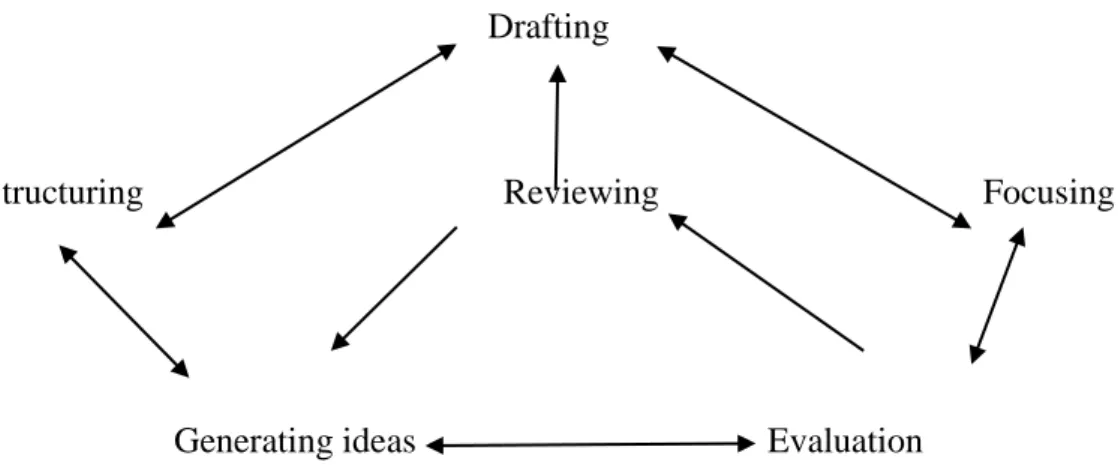
In the process-oriented approach, the emphasis is placed on writing as a process rather than as a final product. This approach views writing as a recursive and a non-linearprocess (Emig&Zamel, 1983). At this level students tend to revise their productions many times based on their teacher feedback (Raimes, 1991). The following figure demonstrates six recursive procedures that are involved in the production of a text:
Drafting
Structuring Reviewing Focusing
Generating ideas Evaluation
Figure .1 Procedures involved in producing written text From Process Writing (p.4) by
White, R. & Arendt. V.1991, Harlow, United Kingdom: Longman.
In this context, the process approach seeks to improve student‟s writing proficiency through change in teacher‟ role, s/he no longer act as an examiner but rather as a facilitator.
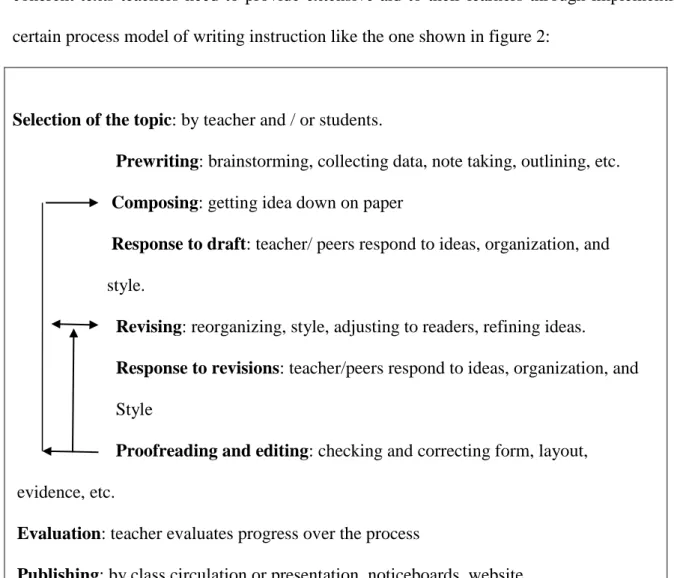
Further, s/he is expected to provide total different forms of feedback including written feedback, teacher–students conferencing and peer feedback. Additionally, in order to compose coherent texts teachers need to provide extensive aid to their learners through implementing certain process model of writing instruction like the one shown in figure 2:
Selection of the topic: by teacher and / or students.
Prewriting: brainstorming, collecting data, note taking, outlining, etc. Composing: getting idea down on paper
Response to draft: teacher/ peers respond to ideas, organization, and
style.
Revising: reorganizing, style, adjusting to readers, refining ideas.
Response to revisions: teacher/peers respond to ideas, organization, and
Style
Proofreading and editing: checking and correcting form, layout,
evidence, etc.
Evaluation: teacher evaluates progress over the process
Publishing: by class circulation or presentation, noticeboards, website. Follow-up tasks: to address weaknesses.
Figure 2: A Process model of writing instruction. Hyland, K. (2003, p.11)
4.2.3. The Genre Approach
It is irrational to discuss what the genre approach stands for without dealing with the term genre. Swales (1990 cited in Tribble, 1996) defined genre as: "a class of communicative
words, the writers follow certain conventions to organize their messages so that readers can recognize their purposes.
In the mid of 1980s, the genre approach gained considerable attention. It is assumed that it is an extension to the product approach. The focus of this approach is to integrate the knowledge of a particular genre and its communicative purpose, these help learners to produce texts to communicate with others in the same discourse community successfully.
According to Badger and White (2000), genre writing reflects a particular purpose of a social situation and allows students to acquire writing skills consciously by imitation and analysis of each writing genre. Accordingly, Hyland (2003) claimed that there are two fundamental issues developed here; first, language is functional, i.e. it is used to achieve certain goals. Second, language is situational, i.e. it occurs in a particular social context, and thus cannot be understood outside its context. So, when adopting such approach, students should not only focus on the text, but also on the context in which this text is produced.
The genre approach has a great contribution in teaching writing, however it was highly criticized. In this regard, Kamler (1995) highlighted the narrow emphasis on language and text, and its lack of attention to the instructional and disciplinary context in which texts are constructed. Hence, the genre approach undervalues the learners‟ skills to produce texts and makes them passive.
5. Writing with Others Skills
5.1. Writing and Reading
Writing is not an isolated skill; it requires the presence of other skills. Reading is one of these skills where it goes hand in hand with writing. Writing and reading complement each other; we cannot deal with the first without manipulating the second. Thus, the more someone reads; s/he enhances his/her writing ability in terms of enriching the background knowledge including vocabulary, grammatical structure and rhetorical features of texts. Accordingly,
Stosky ( cited in Bader, 2007) stated that “Better writers tend to be better readers…and better
readers tend to produce more systematically mature writing than poorer readers‟‟(p. 9).
According to Harris (1993) there is a mutual relationship between reading and writing. This connection can be explained in that the two skills are social activities that have the same purpose which is communication. Moreover, both of them give-and-take i.e., writers can learn much about writing by reading, and readers can learn much about reading by writing. In other words readers cannot read if writers do not write. Likewise, writers cannot write if readers do not read.
Despite the fact that writing and reading are mutually dependent, they are different because writing is a productive skill whereas reading is a receptive one. This means that writing is a process of putting meaning on the written page, however; reading is a process of getting meaning from the written page.
5.2. Writing and Speaking
Speaking skill can be defined as “The process of building and sharing meaning
through the use of verbal and non-verbal symbols, in a variety of contexts.” (Chaney & Burk
,1998, p.13). Writing and Speaking is said to be productive skills, but in fact they are different in various aspects. O‟Grady et al. (1996) argued that speaking and writing are two different language modes, he said:
Speaking and writing are different in both origin and practice spoken language is acquired without specific formal instruction, whereas writing must be taught and learnt through deliberate effort . . . (p.591)
Likewise, Essberger (2001) assumed that when we learn our own (native) language, learning to speak comes before learning to write i.e., the act of speaking is automatically learned whereas writing is not that natural task. Raimes (1994) shared the same viewpoint and affirmed that we learn to speak our first language without any instruction, while most people
are taught how to write in their L1. Moreover, he indicated that the difference between writing and speaking can be stated in the formality of these two skills, he said “writing is more formal
and compact, while speaking is more informal” (p.35).
Byrne (1988) highlighted the main differences between writing and speaking in the following table:
Table 1: Differences between speech and writing Byrne (1988, p. 3).
SPEECH WRITING
• Takes place in a context ,which often
makes references clear( e.g. 'that thing over there')
• Speaker and listener (sin) contact. Interact
and exchange roles.
• Usually person addressed is Specific • Immediate feedback givenand Expected (a) verbal: a question, comments...murmurs, grunts. (b) Non-verbal: facial Expressions.
• Creates its own context and therefore has to be fully explicit. • The reader does not present and no interaction possible.
• Reader is not necessarily known to writer.
• No immediate feedback possible. Writer may try to anticipate reader‟s reactions and incorporate them into text.
6. Problems and Challenges with Writing Skill
Writing is a challenging task. For such reason the ability to write is not possessed by all the speakers of a language, it requires special talents. Levine (2008) in his book:
Developmental Variation and Learning Disorders, identifies some neurodevelopmental
problems and their potential impacts on writing. He classified them into attention problems, Spatial ordering problems, sequential ordering problems and memory problems. These problems can be summarized in the inability to organize ideas, mastery of vocabulary, and
also mastery of grammar. Nevertheless, there are other difficulties which are related to stylistic and mechanical skill. The former is linked to the ability to manipulate sentences and use language, whereas the latter is associated with the ability to use language conventions correctly such as punctuation and spelling.
Writing problems can be also connected to other factors such as school setting.In schools, students are expected to write well, but they are not taught to do so. Teachers do not try to develop students' writing so that students are obliged to use whatever strategies they have. Cerbin (2001) pointed out that students often have to write about topics that are unfamiliar to them. Consequently, students are more likely to be interested in their work when they have some control over the selection of the topic. Moreover, some of the problems are teacher-centered rather than student-teacher-centered. Here, writing often becomes a low priority for most teachers because of timing. In this respect, Cerbin (2001) noted that students perceive writing as a routine rather than as a meaningful learning experience.
The problem within student underachievement in writing can be attributed to many factors:
1) Students have a poor attitude towards writing because of the previous failed writing experiences(Cumberworth& Hunt, 1998).
2) Students are not motivated to use the writing process and they lack a cognitive awareness about the purpose of writing (Cumberworth& Hunt, 1998).
3) Students encounter difficulties due to many factors like spelling and hand writing problems, poor mechanical skills, a fear of exposing their feelings.
4) Inadequate teacher training and reliance on ineffective past practices, daily time constraints, as well as a lack of immediate and positive feedback (Adams and others, 1996).
5) An insistence by many teachers that writing be accomplished in a silent, non-interactive environment (Accomando and others, 1996).
Conclusion
This chapter is a general overview of writing. It opened with a brief history of writing. Then it explored the nature of writing as a complex cognitive activity, social act, and as a language skill. This chapter outlined the numerous approaches to teaching writing. Besides, it highlighted the relationship between writing and reading as well as writing and speaking. At the end, the chapter concluded with some challenges learnersmeet while writing.
CHAPTER TWO: FORMATIVE
ASSESSMENT
Introduction
The traditional view of classroom assessment provides no means for growth or improvement. Therefore, it is potentially argued that assessment can play a significant role particularly when the teacher adopts formative assessment. In the present chapter, we will provide a general overview about assessment and its types; diagnostic, summative and formative. At this level we will distinguish between summative and formative assessment. Then, we will review the most basic elements of formative assessment including its definition, types, stages and strategies. In addition, we will investigate both teachers‟ and students‟ role in this process. This chapter will end with how formative assessment facilitates learning and teaching writing.
1.
Assessment
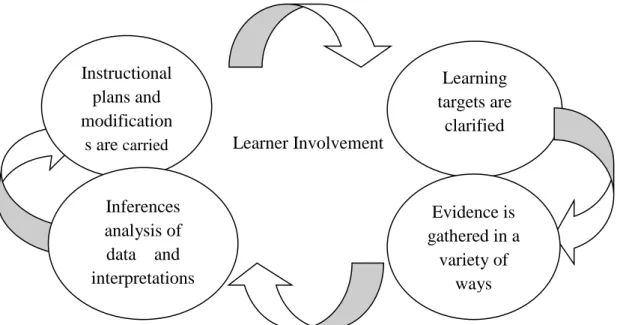
Assessment is a tool of gathering qualitative and quantitative evidence for how well students are progressing i.e., it seeks to find out the students‟ strengths and weaknesses that help them to determine their personal goals and progress. Black & William (1998) linked assessment to all activities that teachers and learners carry out to get information that can be used to diagnose learners‟ progress and adjust teaching. This idea can be demonstrated through the following figure:
Learner Involvement
Figure 1: Classroom Assessment Cycle McMunn (2011)
Assessing students is an integral part in education. In fact there are various reasons behind the use of assessment. According to Popham (2011) the application of assessment motivates learners in terms of using tests as motivational devices to do their best. For teachers, it helps them to monitor learners‟ progress; relatively, they can determine whether learners make adequate improvement or not. However, in case of failure teachers need to adjust their lessons and perhaps modify their instructional approach. Stiggins & Conklin (1992) considered assessment as a means of conveying information to learners and teachers in order to make decisions that include:
Diagnoses of the strengths and weaknesses of individual learners.
Diagnoses of class and group needs.
Grouping learners for instruction within or across classes.
Identifying and selecting learners who are in need of special services.
Assigning grades on report cards.
Evaluating the effectiveness of their instructional effort.
Communicating instructional objectives or achievement expectations. Learning targets are clarified Instructional plans and modification s are carried Evidence is gathered in a variety of ways Inferences analysis of data and interpretations
Communicating social or inter- personal expectations.
Controlling learner behaviors and motivation.
Enhancing test-taking skills.(p.179)
1.2. Types of Assessment
1.2.1. Diagnostic Assessment
Diagnostic assessment takes place at the beginning of a unit. Swearing (2002) assumed that it is adopted to determine prior knowledge about learner‟s current knowledge of a subject in terms of strengths, misconception, and skills. Based on this assumption the instructor can remediate learners and adjust curriculum (what to teach and how to teach) in order to meet each student‟s unique needs. Diagnostic assessments can be performed through many forms. It involves formal measurements (e.g. IQ/aptitude tests) that are used to establish a starting point for evaluation, or informal measurements such as observation, discussions, questioning, interviews…etc.
1.2.2. Summative Assessment
Summative Assessment (hereafter SA) is set at a particular time (at the end of the instructional unit or at the end of the semester) to determine what students know and do not know. In this context, the Organization for Economic Co-operation and Development [OECD] (2005) maintained that:
Summative assessments are used to measure what students have learnt at the end of a unit, to promote students, to ensure they have met required standards on the way to earning certification for school completion or to enter certain occupations. (p.21)
SA takes place after the learning has been completed. It provides information that sums up the teaching and the learning process. It is used by teachers to measure students‟ performance in learning. This type of assessment involves standardized tests that are
infrequent and isolated. SA can be used as part of the grading process where grades are usually seen as an outcome that indicate whether the student has an acceptable level of knowledge or no. It uses formal measurement like unit or chapter tests and end-of-term or semester exams, labs, assignments, projects and presentations to evaluate the learning outcomes.
1.2.3.Formative Assessment
Formative Assessment (hereafter FA) is part of the instructional process. When it incorporates into classroom practice; it provides the needed information to adjust teaching and learning while they are happening. FA usually takes place during the learning experiences; it aims to build a cumulative summary of student achievement. It is used to monitor students‟ ongoing progress and to provide immediate and meaningful feedback. In the following discussion we will stretch the meaning of FA besides its basic elements.
2. Formative Assessment Vs. Summative Assessment
Assessment is a key element in the educational process;
it
can be used to achieve a variety of purposes; therefore, there are many forms of assessment in teaching. The most common ones are SA and FA. Regarding SA, it measures what students have learnt through testing and examination. However, FA refers to frequent and interactive assessments of student progress and understanding. The differences between summative and formative assessment are precised effectively with Knight (2001), he indicated that SA is used for judgment and FA for improvement.Torrance and Pryor (2002) suggested that „summative assessment is generally
considered to be undertaken at the end of a course or programme of study in order to measure and communicate pupil performance and (latterly) accountability‟ (p.8).Brown
(1999) reinforced Torrance and Pryor‟s suggestion; he argued that SA “tends to be endpoint,
Consequently, SA refers to any activity that takes place at the end of a course or program, it ends by attributing scores or grades on students‟ performance for the purpose of measurements rather than improvement
.
In contrast, FA or assessment for learning occurs during the course. It enables students to improve their learning in general. Formative tests are not graded , they are used as an on-going diagnostic tool, hence, the teacher employs the results of FA to modify and adjust his/her practices, in order to reflect the needs and the progress of learners (Swearing, 2002). In this regard, Harlen (2008) illustrated that the key aspects of FA are as follows:
Evidence is gathered about ongoing learning activities that can be used to make decisions about further learning.
The evidence is judged in terms of progress toward the detailed lesson goals. These goals may vary for different individual pupils or for groups and so comparison between pupils is not sensible or justified.
Pupils are aware of their lesson goals and can help in deciding their next steps toward the goals.
The process is cyclical and ongoing; information gathered is used as an integral part of teaching and learning.
No judgment of grade or level is involved, only the judgment of how to help a learner take the next steps in learning. Information gathered frequently by the teacher will be able to feedback to correct any mistake judgment (p.139).
FA is an ongoing process; it focuses on students‟ progression rather than giving grades. The gathered information is usually used to adjust teaching procedures. Black et al (2003) stated that classroom based formative assessment
…can occur many times in every lesson .It involves several different methods for encouraging learners to express what they are thinking and several ways of acting on such evidence. It has to be within the control of the individual teacher and for this reason; change in formative assessment is an integral and intimate part of the teacher‟s daily work. (p.2)
Black et al. (2003) clarified that FA is an essential component during teaching. It can be used frequently through using various methods. These later help the learners to reflect their thinking concerning particular task. For further clarification, Douglas and Nancy (2007) stated the main differences between FA and SA in the following table:
Table 2: Comparison of formative assessment and summative assessment (P.4)
Table 2 Comparison of formative and summative assessments
Formative assessments summative assessments
Purpose To improve instruction
and provide student feedback
To measure student competency
When administered Ongoing throughout unit End of unit or course
How students use results To self-monitor understanding
To gauge their progress toward course or grade-level goals and benchmarks
How teachers use results To check for understanding
For grades, Promotion
In the light of the previous table, FA is an ongoing assessment, reviews, and observations in a classroom. They are used to improve instructional methods and provide student feedback. However, SA is used to assess students at the end of unit or at the end of the year. The goal of SA is to decide about the student level meanwhile FA is used to improve student level.
Taras (2005) explored the relationship between FA and SA. She criticized Black and William (1998) for putting too much emphasis for not investigating the connection between SA and FA. According to Taras (2005) assessment cannot be formative if summative judgment has not preceded it. In other words, SA serves as a starting point or foundation for FA; if a learner uses the judgments to make a change, FA takes place i.e., there must be judgment of a product. Thus, based on Taras (2005) regard FA is a combination of SA and feedback. In this context, Sadler (1989 cited in Taras 2005, p.471) declared that “Feedback requires knowledge of the standard or goal, skill in making multi criterion comparisons, and the development of ways and means for reducing the discrepancy between what is produced and what is aimed for”. Relatively, feedback implies that there is a gap between the learners‟ current status and the required standard. Here the teacher needs to provide SA as a first step, and then the next step is to implement methods to reduce the gap between where the learner is and where he needs to be.
3. Formative Assessment
3.1. Definition of Formative Assessment
Throughout history FA gained gradual attention in teaching and learning. It became a particular focus of educators and researchers during the 1980s. Socrates is the early operator of FA, he used to provide his students with questions and use their responses to evaluate their learning. In the article of the American educational research association [AERA], Scriven (1967) used the term FA and clarified its efficiency in the educational setting.
The issue of solidifying a unique definition of the term FA was problematic. It is argued that it used to gather information that can contribute to adjust the teaching program (Andraide & Cizek, 2010). Likewise, Black and Wiliam (1998 a cited in in Irons 2008) pointed out that FA is “All those activities undertaken by teachers and by their students in
assessing themselves, which provide formative feedback to shape and develop the teaching and learning activities in which both teachers and students are engaged…” (p.8).The basic principle of FA is the provision of information about learners‟ performance (Pellegrino, Chudowsky, & Glaser, 2001).
Additionally, FA is viewed as a tool of improvement rather than grading. Torrance and Pryor (2002) support the assertion that FA can make a considerable difference to the quality of student learning. Black and William (1998) claimed that FA provides evidences that can be used to change teacher‟s method in order to improve learning. Therefore, FA refers to frequent and interactive practices that aim to identify learning needs and adjust teaching appropriately.
The common view is that FA takes place during instruction. It is defined by FA for Students and Teachers [FAST], a department of the Council of Chief State School Officers [CCSSO] as “a process used during instruction to provide feedback for the adjustment of
ongoing teaching and learning, it is used for the purposes of improving student achievement related to instructional objectives” (James, 2008). Popham (2008) claimed that FA is a
planned process during which the teacher or students use assessment-based evidence to adjust ongoing learning and instruction. Sadler (1989) shared the same view describing formative assessment as a systematic process to continuously gather information and provide feedback about learning while instruction is underway.
Formative assessment is concerned with how judgments about the quality of student responses (performances, pieces, or works) can be used to shape and improve student´s competence by short-circuiting the randomness and inefficiency of trial-and-error learning (p.120)
We can conclude that FA is a process of gathering information during the instruction in order to adjust teaching and improve learning. This idea can be summarized in Cowie and Bell‟s definition (1999) of FA where it is defined as “the process used by teachers and
students to recognize and respond to student learning in order to enhance that learning, during the learning” (p.537). This definition was illustrated with Heritage (2008) argument:
The purpose of formative assessment is to provide feedback to teachers and students during the course of learning about the gap between students‟ current and desired performance so that action can be taken to close the gap. (Cited in Filsecker & Kerres, 2012 p.4)
Feedback is a central element in FA. Hattie and Timperley (2007) suggested that feedback must answer three major questions asked by a teacher and/or by a student:
• Where am I going? (What are the goals?)
• How am I going? (What progress is being made toward the goal?) • Where to next? (What activities need to be undertaken to make better progress?) (p. 86)
Feedback is about reducing the gap between the present state and the target state. Hattie and Timperley (2007) acknowledged the importance of providing feedback within the learning and teaching context. However, feedback is ineffective when it is provided in a vacuum (Hattie and Timperley, 2007), because it is mostly efficient when it is related to a specific assignment and goal.
3.2. Types of Formative Assessment
3.2.1.Planned formative assessment
Cowie and Bell (1999) stated that planned formative assessment is semi-formal. It happens at the beginning or at the end of the topic. It is set for the purpose of providing information about students‟ thinking that will be later on used to improve learning. These gathered evidences are interpreted so that the teacher and/or learners act on this information with reference to the topic itself, with reference to the learners‟ previous performance and with reference to how the learner and the teacher are ready about the next step of learning. Similarly, Hall and Burke (2004) shared the same idea of improving learning through planned formative assessment.
As it is demonstrated in the figure 3, the teacher gains the information from the activity which is given to students, those information are interpreted either by the teacher or by the learner, and finally the learner acts to get the information on the topic itself
Eliciting
Acting Purpose Interpreting
(To improve learning)
Figure3: Planned Formative Assessment (Adapted from Cowie and Bell, 1999, p.103).
FA is a continuous process integrated into instruction. The main target of this cycle process is to “close the gap.” This is because FA aims to close the gap between where the learner currently is and the intended learning goal. Starting by eliciting evidence of learning; the teacher can use a variety of strategies while teaching to knowhow students‟ learning is evolving towards a goal. After that, the teacher examines the evidence to determine the status of student learning: what the students understand, what their misconceptions are, what
knowledge they have or do not have, and what skills they are or are not acquiring. At this level, the teacher responds to the evidence through descriptive feedback; s/he gives cues to the students about what they can do to progress in order to close the gap. However, providing feedback is not only attributed to teachers but also to peers because they can also provide feedback that helps their classmates to improve learning. In addition to external feedback from teachers and peers, students get feed-back about their own learning through self-assessment. As a result of feedback teachers decide about the action they will take, so they will make adjustments through selecting appropriate strategies to move forward.
3.2.2.Interactive Formative Assessment
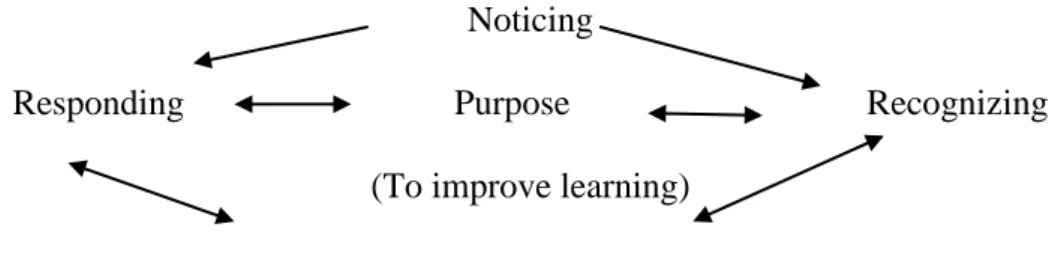
Interactive formative assessment occurs during teacher–pupil interaction (Cowie &Bell, 1999). The major actions that happen in this form of assessment are noticing, recognizing, and responding. For instance, a teacher may organize a group work. Then he notices the learners‟ thinking and acting on the base of prior knowledge or prior subject mainly through comments and questions i.e., s/he notices how learners did the activity or how they interacted with each other. Finally, the teacher recognizes the significance of the information for the sake of improving learning. Unlike planned formative assessment teacher response is immediate. Interactive formative assessment can be explained in the following figure of Cowie and Bell (1999):
Noticing
Responding Purpose Recognizing (To improve learning)