PEOPLE’S DEMOCRATIC REPUBLIC OF ALGERIA
MINISTRY OF HIGER EDUCATION AND SCIENTIFIC RESEARCH AbdElhafidBoussouf University - Mila
Institute of Literature and Languages
Department of Foreign Languages
Branch: English
A Dissertation Submitted in Partial Fulfillment for the Requirement of the Master Degree in Didactics of Foreign Languages
Presented by:
Supervisor:
1) Ms.Kenza CHARMAT
2) Ms.Nardjess ZAID
Ms. Lemya BOUGHOUAS
Board of Examiners:
Chairwoman: Dr. Layla ZOUREZ
Supervisor: Ms. Lemya BOUGHOUAS
Examiner: Ms. Sabah BOUGERN
Academic year: 2019 - 2020
Investigating the Influence of Strategic
Reading on Advancing Students’ Writing Skill
“Good readers tend to produce more syntactically mature writing than poorer readers”
I
Dedications
In the Name of ALLAH, the most Gracious, the most Merciful
I, Ms. Nardjess ZAID, dedicate this humble work to all my family, friends and relatives.
To the source of my happiness, success and encouragement, my dear parents Abdalsalam and NOUARA Samia.
To my beloved sisters: Nessrine, Lina, Malak and Nada
Thank you for being wonderful sisters.
To my precious brothers: Imad and Mohammed Wassim.
To the extraordinary person and my future husband who encourages me in my hardest situations and back me up all the way. To Oualid DEBBAH.
To my partner, friend and sister Kenza CHARMAT. Thank you dear for being a wonderful person. I Love you Stanza.
To my true and special friends: Katy BOUTERAA, Fouzia OUALTACH, Youssra AZOUZ, Nadin ZEGAD, Asma MILOUDI, Youssra KHELLAF, Mimi MASOUDANE, Aida
BOUHBILA, Hayet and Afaf.
Special gratitude to: Chaima DEBBAH, Selma DEBBAH, Mohammed, Ayoub ,Oussama and Lolo
At the end I want to say thank you all for the kind words, the constant support, and I believe in you texts.
II
Ⅰ, Ms. Kenza CHARMAT, dedicate this work to my source of inspiration, wisdom,
knowledge and strength throughout this period of attachment, my family.
A special thought to my beloved lovely women ‘Khoudjia’ and ‘Hayat’ I will always value their encouragements words and understanding, without their love, none of this would
matter.
To my uncles: ‘Rabia’, ‘Said’, ‘Fateh’ and ‘Ismail’ who believe in me, I always appreciate their patience, support and love during my studies.
To my brothers: “Raouf’, ‘Amin’, ‘Maroine’ and “Khaled’ Thank you for being by my side in every single step.
To the coolest brother ever ‘Hamza’ for his support morally and financially. To my sisters: ‘Yousra’, ‘Roma’, ‘Malek’, ‘Manel’, ‘Zina’ and ‘Hadjer’ for their eternal
love.
To my pretty little girl ‘Israa’. To my dear ‘Nardjess’.
To corona virus ‘COVID-19’ without it, this work would have been completed two months earlier.
To whoever taught me a word.
III
Acknowledgment
Praise to Allah, the Almighty for His great help and blessing.
Carrying out this dissertation would not have been achievable without the aid and the support of numerous individuals
First and foremost, we would like to express our heartfelt gratitude and gratefulness to our supervisor Ms. Lemya BOUGHOUAS who provided us with insightful feedback,
encouragements and contributed to the completion of this research.
Our thanks are, in particular; extended to the members of the jury, Dr. Layla. ZOUREZ and Ms. Sabah.BOUGUERN for their precious time to study and scrutinize this work. We are deeply grateful to all teachers and students who accepted to fill in the questionnaires
and take part in the current study.
Last but not least, we owe special love, appreciation and sincere gratitude to our parents, sisters, brothers and friends.
IV
Abstract
The role of strategic reading in improving learners writing skill has been a center of attention in language learning/teaching field. The present study intends to investigate the effect of strategic reading on advancing foreign language (FL) learners’ writing skills. First and foremost, the investigation aims at highlighting the impact of reading strategies on ameliorating students’ productive skill with a special focus on writing skill. Furthermore, this query focuses on raising both teachers and students’ awareness about the existing tie between reading strategies and writing advancements. In order to confirm or disconfirm the research hypothesis which indicates that if Master one LMD (License, Master and Doctorate) use reading strategies appropriately, they would improve their writing skill consequently, two questionnaires are opted for in this study. The first questionnaire is addressed to sixty (60) Master one students of English from different universities and the second questionnaire is designed for ten (10) EFL teachers at the department of foreign languages at Mila University. The results indicate that there is a great awareness among learners and teachers concerning the beneficial influence of strategic reading and it also reveals a strong link between the use of reading strategies and the improvement of students’ writing proficiencies. On this basis, few recommendations are provided for both students and teachers for the sake of integrating reading strategies as a key factor to advance writing skills in the future.
V
List of Abbreviations and Symbols
EFL: English as a Foreign Language ESL: English as a Second Language
ESL: English as a Second Language ESP: English for Specific Purposes
FL: Foreign Language FRS: Free Response Strategy LMD: License, Master, Doctorate
L2: Second Language Q: Question
SBI: Strategy Based Instruction SL: Second Language
VI
List of Tables
13 …… ... … …. Beliefs about Reading Down, Interactive -up, Top -: Defining Bottom Table 01 22 ……… ... ……… …… …. … Metacognitive Behaviours of Good and Poor Readers : Table 02 39 ……… … ……… : The Stages of the Product ApproachTable 03 56 …… ………...……… ……… … …… Students’ Age : 4 Table0 57 … . ……… …
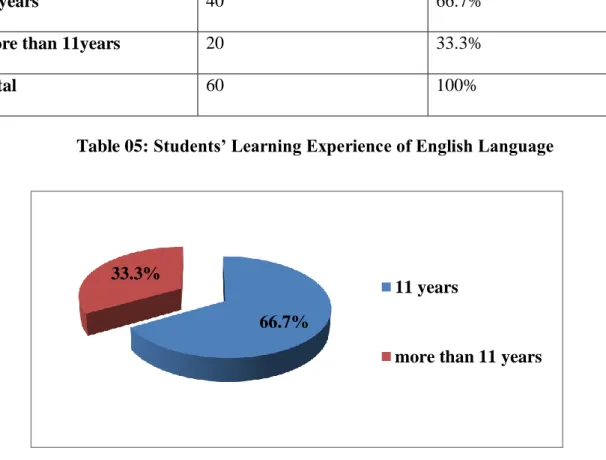
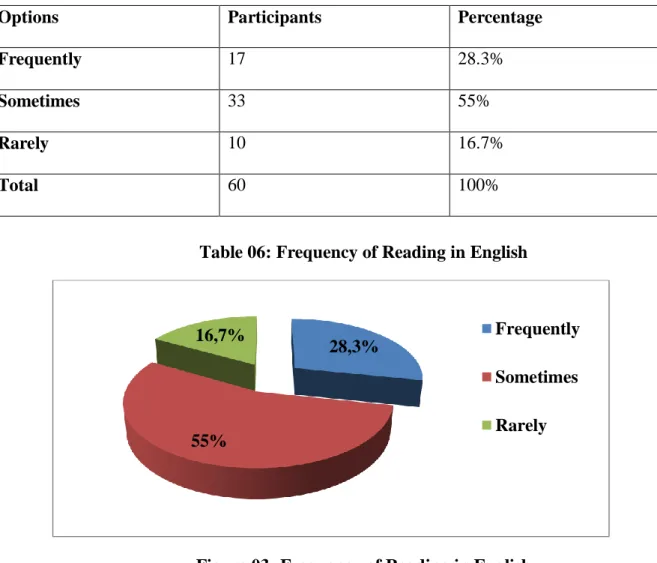
: Students’ Learning Experience of English Language… 5 Table 0 57 ……… ……… …. Reading in English……… : Frequency of 6 Table 0 58 … ……… ……… ….. vorable Types of Genres……… Students’ Fa : 7 Table 0 59 ………. ….. … stery of Reading Skill…… about their Ma Beliefs : Students’ 8 Table 0 60 ………….. … ing Deficiencies……… Causes of Students’ Read
: 9 Table 0 62 …………. … Reading Strategies……… : Students’ Application of Some
0 Table 1 63 …… . …… .. : Reading Strategies that Students Use……… 1
Table 1
64 . . : Making Reference to Some Reading Strategies to Interpret the Text Differently 2
Table 1
65 ………… ..
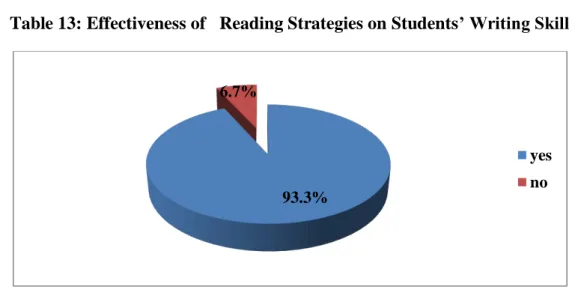
: Effectiveness of Reading Strategies on Students’ Writing Skill……… 3 Table 1 66 .... .. … ……… Students’ Perceptions about the Value of Reading
: 4 Table 1 68 …… ... : Effectiveness of Reading Strategies in Developing Writing Strategies…… 5
Table 1
68 ……. .. : Students’ Preferred Type of Reading……… 6
Table 1
70 …… … : Students’ level in Writing……… 7
VII
71 … … .. : Time Allocated to Writing parts……… 8
Table 1
72 …… .. : Frequency of Using Academic Forms……… 19
Table
73 …… .. : Students’ Difficulties in Writing……… 0 Table 2 74 … .. … … Demand on the application of writing steps ………… : Rate of Teachers’ 1 Table 2 75 ……… …
: Teaching Materials that Develop Writing Proficiency……… 2 Table 2 76 ……… ... in Writing... : Modules that Require Appling Strategies of Reading
3 Table 2 78 ... ………… …
: Acquiring a New Perspective through Reading……… 4 Table 2 78 … . ………… …
: Frequency of Offering the Selection of Reading Materials……… 5
Table 2
80 ……… …
: Gathering Information from the Previous Readings……… 6 Table 2 81 ………. .. : Teachers’ Degrees……… 7 Table 2 82 …… … …… . riences……… : Teachers’ Expe 8 Table 2 83 …… …… … . ……… Teaching Modules……… : The 29 Table 84 … …. : The Importance of Reading Strategies Skill for EFL Learner……… 0
Table 3
85 .... … the LMD System Realm……… under
: Marginalization of reading Skill 1 Table 3 87 ……… . ………… ...
: Coaching Learners some/any Reading Strategies……… 2
Table 3
88 : The Most Effective Reading Strategies that can Develop Learners’ Writing Skill. 3 Table 3 89 … … ……… .
: Integrating Reading Strategies with Writing Tasks……… 4 Table 3 91 ……… . … ………… ten Expression”……… Teaching “Writ : Years of 5 Table 3 92 ………….. . … : Teachers’ Outlook in Regard to the Written Expression Program… 6
VIII 93 ……… ... … …. in Writing……… : Teachers’ Help 7 Table 3 94 ……… ….. in Writing……… : Students’ Difficulties 8 Table 3 96 …… …... hers in Writing……… : Approaches Used by Teac
39 Table 97 …… ….. Writing Stages……… Following all the
: Students 0 Table 4 98 …… …. ……… ... Processed through……… : The Stages that Students
1 Table 4
IX
List of Figures
Figure01: Students’ Age………..……...……….56
Figure 02: Students’ Learning Experience of English Language ………...…….57
Figure 03: Frequency of Reading in English………...………58
Figure 04: Students’ Favorable Types of Genres………...59
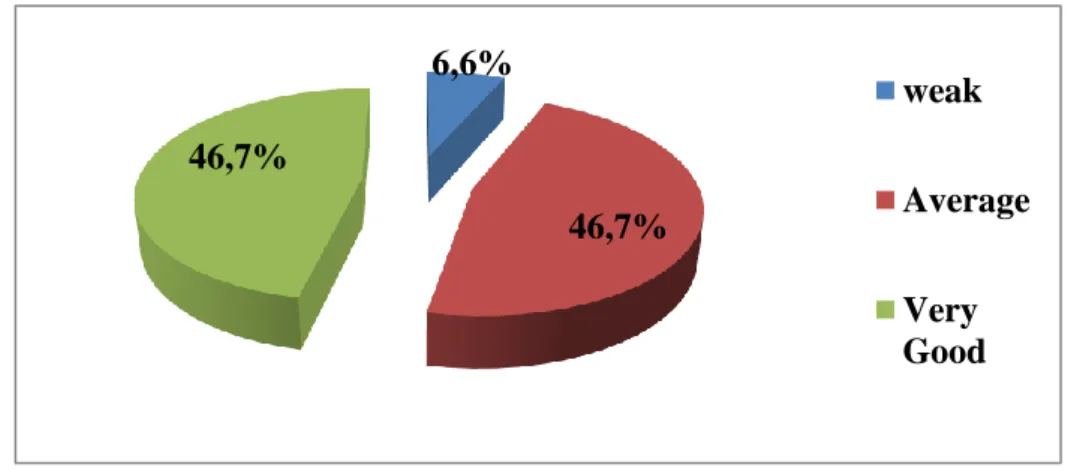
Figure 05: Students’ Perception about their Mastery of Reading Skill…...………60
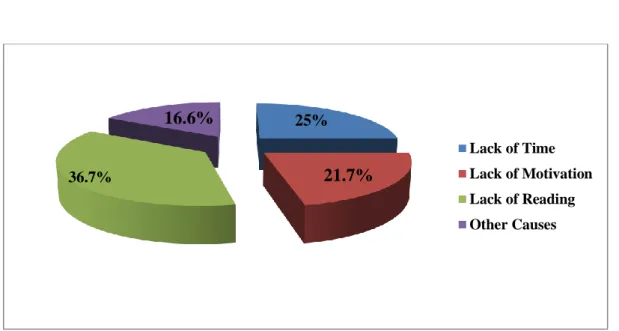
Figure 06: Causes of Students Reading Deficiencies ……….61
Figure 07: Students’ Application of Some Reading Strategies………62
Figure 08: Reading Strategies that Students Use……….63
Figure 09: Making Reference to Some Reading Strategies to Interpret the Text Differently.64 Figure 10: Effectiveness of Reading Strategies on Students’ Writing Skill………65
Figure11: Students’ Beliefs about the Value of Reading ………..……….…67
Figure12: Effectiveness of Reading Strategies in Developing Writing Strategies…………..68
Figure 13: Students’ Preferred Type of Reading……….69
Figure 14: Students’ level in Writing………...…70
Figure 15: Time Allocated to Writing parts……….71
Figure 16: Frequency of Using Academic Forms………72
Figure 17: Students’ Difficulties in Writing………73
X
Figure 19: Teaching Materials that Develop Writing Proficiency………...76
Figure 20: Modules that Require Appling Strategies of Reading in Writing…..………77
Figure 21: Acquiring a New Perspective through Reading ………78
Figure 22: Frequency of Offering the Selection of Reading Materials………79
Figure 23: Gathering Information from the Previous Readings……...………80
Figure 24: Teachers’ Degrees……….81
Figure 25: Teachers’ Experiences………82
Figure 26: The Teaching Modules………...………83
Figure 27: The Importance of Reading Strategies Skill for EFL Learner………84
Figure 28: Marginalization of reading Skill under the LMD System Realm…..……….86
Figure 29: Coaching Learners some/any Reading Strategies……..……….87
Figure 30: The Most Effective Reading Strategies that can Develop Learners’ Writing Skill88 Figure 31: Integrating Reading Strategies with Writing Tasks………90
Figure 32: Years of Teaching “Written Expression”……...………....91
Figure 33: Teachers’ Outlook in Regard to the Written Expression Program…….……..…..92
Figure 34: Teachers’ Help in Writing………..…93
Figure 35: Students’ Difficulties in Writing………....94
Figure 36: Approaches Used by Teachers in Writing………..96
XI
XII
Table of Contents
I . click here . ……… … …… ……..……… … .. ……… Dedications… III . click here ……… ……..………… … … ………… Acknowledgement IV . click here ……… …… ……… …… …….. … …. … … ……… Abstract V . click here ……… ………… ……… ……. …… ……. ……… Abbreviations List of VI . click here ………… ………… ……… …….. …… ………. ………… bles List of Ta IX . click here ………… … ……….. ……… …….. … ……… ……… of Figures List XII . here click ……… ………. ………… …….. ….. ……… Table of Content . General Introduction………..……...…...011. Background to the study……….02
2. Statement of the Problem ………...………02
3. Aims of the Study ………..……02
4. Research Questions ………03
5. Research Hypothesis ………..……03
6. Research Methodology ………..……04
6.1 Research Methods ………...04
6.2 Data Gathering Tools ………...04
6.3 Sample of the Study ………..04
XIII
Chapter One: An Overview of Strategic Reading
Introduction ………..06
1.1 Views and Assumptions about Reading Skill……….……… 08
1.2 Reading comprehension (One Reading Application)………...………..………….... 09
1.3 Significance of Reading ……….………10
1.4 Models of Reading ………...…10
1.4.1 The bottom up Model ………..….….10
1.4.2 The Top-down Model ……….….….11
1.4.3 The Interactive Model ………..……….12
1.5 Types of Reading .……….…….………..14
1.5.1 Intensive Reading ………..16
1.5.2 Extensive Reading ……….17
1.6 Definition of Reading Strategies………...………18
1.6.1 Skilled VS. Less-skilled Readers……….19
1.6.2 Strategy-Based Instruction (theoretical perspective) ………..20
1.7 Some Reading Strategies……….……….21
1.7.1 Skimming ………..………..…..22
1.7.2 Scanning……….……....23
1.7.3 Summarizing……….…….25
1.7.4 Predicting………...26
1.7.5 Paraphrasing……….………..27
1.8 Relation between Reading Ability and Writing Quality………...…………28
XIV CHAPTER TWO: An Overview of Writing Skill
Introduction ……….30
1. Definition of Writing………31
2. General Perspectives on the Importance of Writing Skills..……….32
3. What are the Different Types in English Writing ………...……….34
1.3.1 Descriptive………...………35
1. 3.2 Expository…….………..35
1.3.3 Persuasive……….36
1.3.4Narrative ………...37
4. Approaches to Teaching Writing………..39
1.4.1 The Product Approach..…...40
1.4.2 The Process Approach………40
1.4.3 The Genre Approach………...42
5. Forms of Academic Writing…….……….…..42
1.5.1. The Paragraph………..………...42
1.5.2. The Essay…….………...……43
1.5.3. The Dissertation………..43
1.5.4. The Report………….……….43
6. The Properties of a well-written text……….44
1.6.1. Organization……….45
1.6.2. Coherence and Cohesion………..45
1.6.3. Language Use……...………46
XV
1.6.4.1. Weights and Measures of Punctuation………...…46
1.6.4.2. Capitalization……….47
1.6.4.3. Spelling………..47
1.6.4.4. Grammar………48
7. The Process of Academic Writing………..48
1.7.1. Pre-writing Stage………..48
1.7.2. The First Draft………..…50
1.7.3. Editing………..50
1.7.5. Writing the Final Draft and Submitted the Work………51
8. Writing Difficulties ……….………..51 1.8.1. Grammatical Difficulties…...………..52 1.8.2. Vocabulary………52 1.8.3. Spelling……….53 1.8.4. Punctuation………53 1.8.5. Sentence Structure……….………53 Conclusion………....…....…53
XVI
Chapter Three: Field Work
Introduction………...………54
1. Description of the Students’ Questionnaire ……….………54
1.1. Aim of the Students’ Questionnaire………...55
2. Description of the Teachers’ Questionnaire………...55
2.1. Aim of the Teachers’ Questionnaire………..55
3. Analysis of the Students’ Questionnaire………..……….56
4. Analysis of the Teachers’ Questionnaire ………...82
5. Discussion of the Main Findings………...……….101
6. Pedagogical Implementations……….102
7. Limitations of the Study………..103
Conclusion………104 General Conclusion………...…………105 References……….107 Appendices………116 صخلملا………129 Résumé………..130
1
General Introduction
In the field of foreign language (FL), reading, writing, speaking and listening are the four basic skills that learners need to develop in order to reach the aspired language proficiency. Throughout years, researchers wrote books, articles and reports about the relation between the four skills and their positive effect on the learners’ outcomes such as Eisterhold (1990), Harmer (2001) and others.
Apparently, reading strategies are crucial in the reading realm that learners use in order to overcome certain reading difficulties or to facilitate reading tasks. Nowadays, reading strategies are used as a tool to boost writing skills since most reading strategies are deeply based on the off products of some writing tasks.
In fact, a great deal of studies shows the positive relation between strategic reading and the development of learners writing skills. In his work, Harmer declares that: “Productive work need not always to be imitative. But students are greatly helped by being exposed to examples of writing and speaking which show certain conversation for them to draw upon” (2001, p. 251). This shows the extent to which reading is useful for learners on different language layers (grammar rules, structures, vocabulary and expressions) as well as in the improvement of other skills.
In a nutshell, this dissertation sheds light on investigating the effect of strategic reading on advancing foreign/second language learners’ writing skills. In addition, it focuses on raising learners/teachers awareness toward the use of reading strategies and strategy-based instruction as being the key to developing learners' abilities and skills.
2
1. ` Background to the Study
Reading skill is seen as a fundamental ability that is needed to achieve academic learning progress. Learners of English as a foreign language (EFL) are required to have analytical and critical abilities to sculpt their language, overcome reading comprehension difficulties. However, not all university learners are able to comprehend all types of academic texts.
Numbers of studies (Rumelhart, 1977; Cook, 1990; Mikulecky& Jeffries, 1996; Snow, 2002; Grabe&Stoller, 2002; Nuttal, 2005; Hudson, 2007; National Reading Panel, 2008) have maintained that reading strategies have positive and strong effect on students’ reading comprehension. This means that over years reading strategies become an essential tool for developing and improving learners reading skills.
On the other side, reading strategies have also been related to the development of other skills such as writing. Some researchers conducted some studies on the relation between reading abilities and writing qualities (Eisterhold, 1990; Manzo & Manzo, 1995) and presented many aspects of this relation and its effect on learners’ language acquisition. Those studies have launched several of researches including this research that might be a starting point of incoming inquiries.
2. Statement of the Problem
Reading is one of the four macro skills that enable learners to explore a great amount of knowledge; linguistic or cultural. Reading strategies are one of the tools that can facilitate comprehension of the text and improve learners’ writing skills. The absence of the reading module has prevented Algerian students of English as foreign language at, Mila university center, from appreciating the reading strategies and its importance in enhancing learners’ writing skills.
3
A great number of students seem to be handicapped by their reading lacunas especially ways of adapting to the text exigencies which might influence their full comprehension potential. At later stages, this deficiency might result in a lack of understanding what is being read, a lack of orchestrating the cognitive treatment of the text and notably a lack in proffering a critical transfer to the related skills. When FL students are well trained to read properly, they will transfer this to their writing style simply because reading ameliorates writing just as listening enhances speaking.
3. Aims of the Study
This study aims at: Highlighting the importance of strategic reading on learners’ writing quality. Raising learners’ awareness toward the relation between reading and writing.
4. Research Questions
This study raises the following questions:
Are students aware of the importance of strategic reading?
Do teachers apply some reading strategies to improve their learners’ writing skills?
5. Research Hypothesis
In conducting the present study, it is hypothesized that if Master one LMD students of English learn more about strategic reading, they would improve their writing skills.
4
6. Research Methodology
6.1Research Methods
In order for the above hypothesis to be confirmed, the study relies on the use of the quantitative research method.
6.2Research Tools
This study relies on following tool to gather the needed data: A semi-Structured Questionnaire
The questionnaire is a research tool that consists of series of questions that are asked to the selected sample in order to gather information to support this study. It was directed to both students and teachers.
6.3Research Sample
T
he target population of this study consists of both; first year master LMD students of English at many universities, and teachers from the department of English, at (Mila university). The selection of first year master LMD students was decided for two main reasons. The first reason is that master one LMD students are competent enough than the other levels and they have a good background concerning learning English language. The second reason is that they have been exposed to many reading materials and they have long experience in reading.7. Structure of the Dissertation
This dissertation consists of three main chapters; two theoretical chapters that deal with literature review and some perspectives related to both reading and writing skills. The third chapter presents the obtained data from both students and teachers questionnaires with a discussion of the main findings.
5
The first chapter is devoted to the reading skill. This chapter presents different definitions concerning both reading and reading comprehension. It also accounts for reading models and reading types as different ways that go in harmony with learners’ individual differences to learn reading and benefit from it as much as they can. Besides, it defines the term “reading strategies”, skilled vs. less-skilled learners, strategy based instruction and introduces some reading strategies such as; skimming, scanning, summarizing, predicting and paraphrasing. Finally, it presents a relationship between reading abilities and writing qualities which highlights the effect of reading and its shade on writing and vice-versa.
The second chapter sheds light on the writing skills; it examines the most important perspectives to develop students’ writing production. Furthermore, the chapter highlights the theoretical background of writing skills, starting with some definitions, its importance as a language skill, the different writing types, approaches and forms. Furthermore, this chapter discusses the properties of a well written text and the process of academic writing. To end up with the major difficulties that faced by the population through this study.
The third chapter focuses on students and teachers’ questionnaires, its descriptions, aims, and analysis to end up with a discussion of the main findings and recommendations for both teachers and students.
6
Chapter One: An Overview of Strategic Reading
Introduction
Reading is one of the four skills in which students must develop proficiency and consider throughout their academic path. It is considered as a constructive process that can help learners to broaden their scope of knowledge and deepen their thinking skills, ideas, and thoughts.Reading is very important in learning English as a Foreign Language (EFL) because it enables students to obtain a large amount of input. At the university level, learners are required to read a great deal of materials in different domains. Researchers agree that reading strategies facilitate comprehension and improve the learners’ writing qualities. This chapter highlights various insights and definitions of reading, its importance as well as the definition of reading comprehension. It also accounts for some models of reading, its types and some reading strategies. The last part of this chapter will be devoted to the relation between reading abilities and writing qualities.
1.1 Views and Assumptions about Reading Skill
It is obvious that the concept of reading is still an evolutionary one in the field of academia just as all other educational concepts. Basically learners do not share the same aims of reading. While some learners read to receive information about second/foreign language SL/FL, others may read for pleasure. Reading specialists give multiple explanations and definitions of reading. According to Day and Bamford reading is: “The construction of meaning from a printed or written message” (1998, p.12). This means that reading is the ability to understand the message that the writer tries to transmit to the readers. A first trial on the part of the reader is to simply fathom the printed manuscript in view of shaping a first image of its content.
7
Oxford Dictionary (2008) defines reading as: “A way in which something is understood”. That is, reading is a matter of understanding sentences, paragraphs, or essays. It can also mean the process of looking at a printed text and getting information or meaning from it.
Some researchers in the field consider the reader as one of the most important elements in reading process. Rumelhart claims that: “Reading involves the reader, the text” (1977, p. 5). That is to say, the reader has to combine his background knowledge and new receptive knowledge in order to decode the written passage and interact with the text effectively. Furthermore, the reader’s engagement with the process of reading is based on his previous experiences, environment, family, sociocultural grounding and other factors. In addition to the reader, the selected text is as important as the reader; learners must read different types of texts because each type has its own characteristics, and its own linguistic features. Also, reading enables us to imagine and experience what it is like to be in a different world, place, culture or even gender. Reading also enables us to explore other cultures, religions and the life styles of other people.
More importantly, while reading, the focus is shifted towards the interaction between the reader and the text. Aebersold and Field mention that: “The interaction between the text and the reader that constitutes actual reading” (1997, p. 15). In other words, the function of the reader is not only to decode the printed text, but there has to be interaction between the reader and the meaning the author of the text wished to convey. For instance, the meaning that one reader receives from a text might be different from that of other readers due to multiple variations in the example of the existing sociocultural discrepancies, and the religious affiliations.
Conversely, some researchers consider reading as a psycholinguistic process. Vecca et al. assert that: “Reading is not a passive activity it is an active thinking process that takes
8
place behind the eyes” (2000, p.265). This definition shows that reading is a mental and imaginative process; it is an active process that requires concentration in order for the reader to understand and comprehend the text and extract the meaning.
1.2 Reading Comprehension (One Reading Application)
Reading comprehension requires a great deal of attention to the printed text. Some researchers consider reading comprehension as the main step to become an active reader. Roe states that: “Reading comprehension is to make meaning of what we read” (2014, p. 24). In other words, reading comprehension is a mixture of processes of both reading and figuring out
the meaning of a written text.
Grellet declares that: “Understanding the written text means extracting the required information from it as efficiently as possible” (1981, p. 3). That is to say, reading comprehension is more about obtaining the essential information from a certain text by using the appropriate strategies. In the same line, Smith states that: “Comprehension and learning are fundamentally the same, relating the new to the already known” (2004, p. 13). That is to say, comprehension is a learning tool in which the learners link their previous knowledge with the new one in order to create a successful reading process.
Moreover, snow (2002) says that reading comprehension consists of three important elements; the reader who is monitoring the comprehension process, the text that is to be comprehended, and the activity in which comprehension takes place. He also considers reading comprehension as a multi-dimensional process that demands both extraction and construction to highlight the importance and the insufficiency of the text as a determinant of the reading comprehension. The reader usually tries to develop his cognitive abilities through challenging texts. Those challenging texts will make him increase his experiences.
The reader generally “Constructs different representations of the text that are important for comprehension” (Snow, 2002, p. 14). According to Snow’s definition, reading
9
comprehension requires not only the ability to decode the text, but it relies on other aspects such as ; cognitive abilities, mental abilities and motivational factors.
1.3 Significance of Reading
One of the basic reasons why reading is important is that it helps the reader to improve his mental, emotional and cultural state. In addition, reading has a crucial role in learning English as a foreign language (EFL) because it increases the learners’ vocabulary, sharpens their minds, strengthens their writing abilities and enhances their imaginations.
Wallace states that: “An important feature which reading also shares with other modes of language use is its role in social interaction” (1992, p. 6). That is to say, reading can also improve and strengthen the learners’ relation with their environment because reading will enable them to be patient and focused; they will be able to give their full attention and be active while having a conversation.
Vacca et al. (2000) assert that good language readers are usually considered good writers as well. In the same line, Harmer states that: “The benefits of reading are echoed by the benefits of the listening” (2001, p. 204). That is to say, learners who read will build analytical thinking skills in addition to other skills such as: writing, listening and speaking. Reading is a multi-beneficial skill that teachers ought to resort often to advance their students’ overall proficiency.
1.4 Models of Reading
Reading models are explanations of reading that depict what is going on in the reader’s mind and how he receives the printed words. According to Davies, the term model is defined as a: “Systematic set of guesses or predictions about the hidden process” (1995, p. 17). That is to say, models of reading processes are meant to explain and predict the readers’ reading behaviour.
10
Many specialists in the field have tried to explain the mechanism of reading. For that, understanding the reading process was the main concern of researchers. In order to understand this process, scholars have proposed three basic models of how reading occurs and show how readers process the printed text to construct meaning.
1.4.1 The Bottom-up Model
The bottom-up model is also called the data-driven model (reading is driven by a process that results in meaning or in other words reading is driven by text). In this model, the reader decodes the printed text word by word and transforms it into sounds in order to get the literal meaning across.
Furthermore, according to Alderson the bottom-up model approaches are: “Serial models where the reader begins with the printed word, recognizes graphic stimuli, decodes them to sound, recognizes sounds and decodes meaning” (2000, p. 16). Therefore, the reader must realize the graphic symbols to be able to produce the sounds and decipher the meaning of words, phrases and sentences.
In this model the reader can reach the appropriate meaning of each text through decoding its graphemes. Nuttal states that:
In bottom-up processing, the reader builds up a meaning from the blacks marks on the page: recognizing letters and words, working out sentence structure. We can make conscious use of it when an initial reading leaves us confused. Perhaps we cannot believe that the apparent message was really what the writer intended. (2005, p. 17)
In brief words, the reader’s vision and background can be an obstacle throughout the way of understanding the intended message of the writer. Therefore, the reader must figure out the vocabulary and the syntax to be sure of the correctness and the exact meaning of a particular text.
11
Till recently, reading scholars have been studying the connection between reading and its accompanying processes (what goes on in the brain and how to teach reading). Depending on their interpretation of reading process, they have developed a model of reading called the top-down model.
Richard defines the top-down model as: “The use of background knowledge in understanding the meaning of a given text that means readers make connection between their previous knowledge about a topic, situational or contextual knowledge, or knowledge stored in long term memory in the form of “schemata” and “script”(1990, pp. 50-51). Moreover, the schema is a mental structure that organizes and categorizes information and the obtained knowledge in the reader’s minds. The processed information helps readers to interpret the texts according to their situations and contexts. As a result, this process relies on the interpretation of assumptions and implied suppositions.
However, this top-down model focuses on linguistics clues and builds a rather literal comprehension of the text, in order to guess the meaning of what is heard or read the reader must be aware of the target language functions, aspects and characteristic. He also needs to make a link of what he already knows about that language and his thoughts and ideas. Goodman looks at reading as: “Psycholinguistic guessing game” (cited in Alderson 2000, p. 17). This is to say, readers can guess and predict the meaning with reference to their linguistic competence that they have acquired before in a first attempt.
In top-down model Nuttal claims that: “We draw on our own intelligence and experiences the predictions we can make, based on the schemata we have acquired to understand the text” (2005, p. 16). Probably, understanding the meaning helps in interpreting the different parts of the text; hence, the reader tries to make sense of the text in terms of his own schemata. In order to get a well-reasoned prediction, the reader must interpret the writer’s own perspective and argument.
12
1.4.3 The Interactive Model
In fact, neither the bottom-up nor top-down model is sufficient to characterize the reading process. The interactive model comes as a connection that links both models, the top-down model to interpret the appropriate meaning, whereas, the bottom-up model is meant to check if that is really what the writer partly intends.
Concerning the interactive model Rumelhart(1977) proposes the first nonlinear representation of the reading process in which four cognitive processors (orthographic, semantic, syntactic and lexical) are used to cover the most likely interpretations of text. Rumelhart explains those processors as: “The simultaneous processing of syntactic information (referring to word order within sentences), semantic information (related to message construction), orthographic information (related to visual input), and lexical information (referring to word knowledge)” (Cited in Tracey & Morrow 2006, pp138-139). In other words, the interactive model consists of three main parts: the word order, the message construction and relates those words to the visual input. The main purpose of this model is to provide learners with some strategies that help them become more fluent and independent to control their thoughts while reading.
In brief, all the three models have different views concerning reading and the following table shows the characteristics of each model:
Bottom-up Beliefs About Reading
Top-down Beliefs About Reading
Interactive Beliefs About Reading
Relationship of word recognition to
comprehension
Believe students must recognize each word in a selection to be able to
comprehend the selection.
Believe students can comprehend a selection even when they are not able to identify each word.
Believe students can comprehend by identifying words quickly and
accurately.
13
cues should use word and
letter-sound cues exclusively to identify
unrecognized words.
should use meaning and grammatical cues in addition to letter-sound cues to identify unrecognized words.
letter-sound and meaning cues simultaneously to identify unrecognized words.
Views of reading Believe reading requires mastering and integrating a series of word identification skills.
Believe students learn to read through meaningful and authentic activities in which they read, write, speak, and listen.
Believe students learn to read by developing skills and strategies in meaningful contexts. Units of language emphasized instructionally Emphasize letters, letter-sound relationships, and words. Emphasize sentences, paragraphs, and text selection.
Emphasize letters, letter-sound relationships, words sentences, paragraphs and text selection. Where importance is placed instructionally View accuracy in identifying words as important.
View reading for meaning as important.
View accurate and word identification as
contributing to meaningful reading.
Assessment Think students need to be assessed on discrete skills.
Think students need to be assessed on the kind of knowledge constructed through reading.
Think students need to be assessed on the basis of their performance in meaningful context. Assessment informs instruction.
Table1.1: Defining Bottom-up, Top-down and Interactive Beliefs about Reading (Vacca et al, 2006, p. 39)
The table above summarizes the three models and shows how each model considers the process of reading. There is a clear comparison between the models concerning the relationship of word recognition to comprehension. It also accounts for the use of information
14
cues and view of reading. To summarize, units of language emphasized instructionally in the three models and some assessment.
1.5 Types of Reading
1.5.1 Intensive Reading
Intensive reading involves learners to read for specific learning aims. They might be preparing for a test or a given task that involve some types of information that is derived from a meticulous text reading. It generally focuses on the grammar forms, pronunciation and vocabulary items. This type of reading is usually done inside the classroom with the teacher and in an academic environment.
According to brown “Intensive reading calls attention to grammatical forms, discourse markers, and other surface structure details for the purpose of understanding literature implication” (2000, p. 312). From this explanation, it is clear that intensive reading engages learners in the details of the text, including both grammatical forms and literal meaning. Furthermore, intensive reading “Reflects teacher authority, which tends to make learners passive followers and take no responsibility for their own learning” (Pan, 2009, p. 116). That is to say, the teacher plays an important role in this process, because he is supposed to choose short passages to his learners in order for them to analyze them carefully by using syntactic, semantic and even translation tips from and to the mother tongue where necessary.
Some researchers give a great importance to intensive reading because this type of reading “will provide a basis for explaining difficulties of structure and for expanding the knowledge of vocabulary and idioms. It will also, provide material for developing greater control of the language in speech and writing” (Rivers, 1981, p .278). That is, intensive reading helps learners to improve their knowledge about language and enables them to control it. Since intensive reading focuses more on the structure, learners will acquire more
15
vocabulary, they will be fluent in their communication, and they will strengthen their writing abilities as well.
While reading intensively, learners concentrate and put their full attention on the text or the passage. The main aim of this process is to make the learner able to analyze and examine the passage proposed by the teacher. For Mmikulecky and Jeffries “Intensive reading is an activity in which students (usually in class group, led by the teacher carefully read and examine together a reading passage assigned by the teacher) many times” (2004, p. 257). That is to say, intensive reading is usually located inside the classroom, guided by the teacher and assessed in the end
On the other hand, some scholars claim that intensive reading is not sufficient for university learners since they are required to polish their communicative abilities, word-by-word processing prevents the learners to be able to understand the relation between ideas and the intended meaning of the text. In Gliner and Morales’ words: “Word-by-word processing inhibits the ability to see the conditions between and across ideas, to understand how the information is organized, to grasp the intention of the author” (2010, p. 14). This means, learners must digest ideas not only with minor focus on the meaning of each word in order to reach the author’s intended message.
1.5.2 Extensive reading
Extensive reading involves learners to read a huge amount of reading materials mostly outside the classroom and without guidance. It is meant to consolidate classroom competences and ascribed as extra curricula reading. Unlike intensive reading, extensive reading does not require neither a full attention nor a dictionary to detect every difficult word.
Extensive reading is the process of dealing with long passages, anywhere, and at any time in order to understand the text as a whole without getting into details, as Richards and
16
Schmidt states: “Extensive reading means reading in quantity and in order to gain a general understanding of what is read” (2002, p.193).
Moreover, some specialists in the field emphasize the benefits of extensive reading, and consider it as a way of improving the learners’ knowledge of a foreign language. For instance, Nuttall says that: “The best way to improve your knowledge of a foreign language is to go and live among its speakers. The next best way is to read extensively in it” (1982, p. 168). It is clear from this definition that extensive reading is one of the great tools or ways of learning foreign language.
Improving reading skill is one of the most important objectives for EFL learners. During extensive reading, learners will benefit more in advancing their reading abilities rather than studying the aspects of the language. According to Grellet “Reading longer texts, usually for one’s own pleasure. This is a fluency activity, mainly involving global understanding” (1981, p. 04). Long texts enable readers to perfect their reading abilities and reading comprehension. In the same line, Harmer (2007) states that extensive reading is an activity that learners practice often outside the classroom in their free time for the sake of pleasure. However, the amount of reading in this type remains unknown due to the conflicts between the researchers’ views. Bright and McGregor (1970) for example, suggest that the learner should read sixty books a year. Krashen (1981) states that five hours per day are enough for the reader. By contrast, the quantity of reading materials was not the prime concern of other researchers. For instance, Day and Bamford (2002, pp. 13-14) suggest ten principles for teaching extensive reading professionally as follows:
1- The reading material should be more or less easy to process.
2- A variety of reading materials on a wide range of topics must be available. 3- Learners choose what they want to read.
17
5- Reading for pleasure, information and general understanding. 6- Reading is its own reward.
7- Reading speed is usually faster than slower. 8- Reading is individual and silent.
9- Teachers orient and guide their students. 10- The teacher is a role model of a reader.
To cut it short, extensive reading enhances learners’ proficiency, enriches their vocabulary, improves their writing skills, and at the same time makes them autonomous. Extensive reading is an important factor in education because it facilitates language acquisition, helps in acquiring vocabulary and increases motivational factors.
1.6 Definition of Reading strategies
Strategies of reading are defined according to the national reading panel as the set of: “International actions that a reader can take to increase the chances of understanding the information in the text” (2008, pp. 28). Reading strategies are ways that the readers tend to use for a better understanding and comprehending of the text that they try to decode. Grabe and stoller (2002) state that reading strategies are a group of abilities that the reader can control in order to facilitate the comprehension of the text. Those strategies provide both the ability to tackle some reading problems, and the ability to improve learners’ comprehension of the written texts.
Many researchers claim that each strategy has its own importance because readers are in need to use different reading strategies to achieve reading goals and they need to possess the ability to interpret the text as a whole.
Reading strategies help the reader to get the meaning and to achieve the main goals of reading process. Every reader should use the strategy that suits him. The teacher as a primal
18
source of information should introduce and give instructions concerning reading strategies to help his learners to become strategic and effective readers. For instance, active readers should determine which strategy to use according to their reading purpose (survival, pleasure, or learning).
In the same line, Snow states that: “…Students are unlikely to learn the strategies fully, may not perceive the strategies as valuable tools, and are less likely to use them in new learning situations with new text” (2002, p. 39). That is to say, the comprehension of the term ‘strategy’ and its importance is as necessary as the teacher’s instructions for the learners to appreciate and apply those strategies with different types of text.
1.6.1 Reading Strategies of skilled Vs. Less-Skilled Readers
Reading researchers made some investigations concerning the use of different reading strategies among SL learners and its influence on good and poor readers. They also want to know how readers can alter the whole reading process by using reading strategies.
Anderson states that the question is: “Not simply a matter of knowing what strategy to use, but the reader must also know how to use it successfully and knows how to orchestrate its use with other strategies. It is not sufficient to know about strategies, but a reader must also be able to apply them strategically” (1991, p. 19). That is to say, it is not sufficient for the reader to know different reading strategies, but they must be able to apply them successfully in their reading process. Full comprehension can be achieved through strategic use of those strategies and vice-versa. Other researchers consider reading strategies very important to achieve language goals. For Hudson: “Procedures used in learning, thinking which serve as a way of reaching goal in learning language, learning strategies and communication strategies” (2007, p. 105). That is to say, reading strategies are plans that learners use to solve their reading difficulties and to facilitate their comprehension. In addition, reading strategies regulate learning since they are considered as learning tools.
19
The difference between skilled and less-skilled readers can be due to the lack of teachers’ instructions. Those instructions must be taught explicitly in order to attract learners’ attention towards the importance of reading strategies. Learners’ awareness and consciousness about the strategies cannot be enough for learners for a full appropriate application. So, there should be practice on how to use those strategies and when in order to perfect learners’ performance in reading.
Metacognitive predispositions can also be one of the differences between successful and unsuccessful readers. The table below reveals and summarizes cook’s (1990) beliefs:
Good or Mature Readers Poor or Immature Readers
Before Reading
Activate prior knowledge.
Understand task and set purpose.
Choose appropriate strategies.
Start reading without preparation.
Reading without knowing why.
Read without considering how to approach the material.
During Reading
Focus attention.
Anticipate and predict.
Use fix-up strategies when lack of understanding occurs.
Use contextual analysis to understand new terms.
Use text structure to assist.
Organize and integrate new information.
Self-monitor comprehension by:
Knowing comprehension is occurring.
Knowing what is being
Are easily distracted.
Read to get done.
Do not know what to do when lack of understanding occurs.
Do not recognize important vocabulary.
Do not see any organization.
Add on, rather than integrate new information.
20 understood.
After Reading
Reflect on what was read.
Feel success is a result of efforts.
Summarize major ideas.
Seek additional information outside sources.
Stop reading and thinking.
Feel success is a result of luck.
The table above shows some differences between good and poor readers concerning
metacognitive behaviours. Before reading, good readers determine their purpose and they The The table above shows some differences between good and poor readers concerning
metacognitive behaviours. Before reading, good readers determine their purpose and they choose the appropriate strategies. Whereas, poor readers start reading without any reading goal or preparation (they do not select any strategy).
During reading, good readers are considered good organizers, they give their full attention to reading process, integrate information and whenever they face reading difficulties they use fix-up strategies. As well, poor readers lack concentration and they do not recognize relevant from irrelevant ideas.
After reading, good readers feel successful, summarize the most important ideas and they seek additional information from other sources. Quitting the reading act, failure is what poor readers gain at the end of reading process.
1.6.2 Strategy-Based Instruction (Theoretical Perspective)
Strategy-based instruction (SBI) is a very effective method that enables learners to learn reading strategies explicitly and to help those becoming strategic readers. Usually when ESL/ EFL learners read, they face some reading difficulties since reading is a complex process that requires a great amount of focus and guidance. The role of the teacher in this Table.2 Metacognitive Behaviours of Good and Poor Readers (Cook, 1990, P. 116)
21
situation is to teach his learners how to use reading strategies in order to facilitate the comprehension process.
Furthermore, lack of instructions is the main problem of less successful students; teachers must use SBI activities in order to make ESL/EFL learners use those strategies more tactically. For instance, some scholars like Williams suggest “three phase” procedure which consists of three stages; pre-, while-, and post stages (Cited in Hedge 2000, p. 209):
The pre-reading stage leads the learners to activate what they know about a topic and anticipate what they will read.
The while-reading stage aims at encouraging learners to be active as they read.
The post-reading stage aims at checking the learners’ comprehension as well as developing their metacognitive awareness.
That is to say, the three phases are very important stages that both teachers and students must take it into consideration. The first stage enables learners to recheck their previous information about a certain topic in order to link it with the text in hand. The second stage intends to motivate readers to be active enough and to use different strategies. The third stage is kind of final evaluation; the teacher tries to check his learner’ level of comprehension. In a nutshell, the effectiveness of reading strategies is relies on the appropriate guidance of the teacher and the strategic application of those strategies by learners.
1.7 Some reading strategies
1.7.1 Skimming
Skimming is a speed-reading strategy that enables the learners to get the general picture or to get the gist without getting into details. Richard and Weverka state that: “Skimming is taking the most important information from the page without reading all the
22
words” (2002, p. 167). That is to say, in order for the readers to skim faster, they should precise their purpose of reading. In the same quote, the researchers explain that the reader should be selective in what he reads; the reader should know where to concentrate or to skip. Furthermore, Grellet explains skimming as: “A more thorough activity which requires an overall view of the text and implies a definite reading competence” (1981, p. 19). It is clear in this definition that skimming is an inclusive process that students should master in order to achieve reading purpose (understanding the general picture) without reading unnecessary sentences or ideas.
Harmer confirms that: “Whether readers scan or skim depends on what kind of text they are reading and what they want or need to go out of it” (2007, p. 101). In other words, both scanning and skimming are effective and beneficial strategies for the learners especially in their studies. For this reason Harmer advises learners in the previous definition to use one of the strategies to achieve better results. In the same regard, Jeffries and Mikulecky claim that skimming: “Allow you to look quickly through lots of materials to get a general idea of the content and to decide if it is relevant for your purpose” (2007, p. 174). That is to say, skimming does not rely only on quick reading, but it requires great amount of concentration to decide whether the idea is related to what the reader is looking for or not. The same researchers declare that readers: “Should usually read the last paragraph more carefully. The author often summarizes the main idea at the end” (1996, p. 132). Besides the title and the subtitles, the conclusion is another source of knowledge in the skimming process since the writer always restates the main idea of the whole text.
1.7.2 Scanning
Unlike skimming, scanning is the process of reading texts or passages quickly and searching for specific information. Usually learners when they scan a certain text, they have a
23
question in their minds which they try to find answers to. It is necessary for the learners to choose the appropriate strategy that serves their reading purpose.
According to Grellet scanning is the process where “We simply let our eyes wander over the text until we find what we are looking for, whether it be a name, a date, or a less specific piece of information” (1986, p. 19). Scanning simply means the attempt to find out a specific piece of information without reading word-by-word. It is also considered a very beneficial strategy especially for the learners who rely on the net while trying to do their researches or dissertations.
Richard and Weverka argue that: “Scanning is a quick scouring of the text for specific information…scanning involves moving your eyes quickly down the page seeking to find specific words or phrases” (2009, p. 166). From this definition, it is clear that when learners scan a text or a passage, they are trying to find key words, names, or ideas. Also, scanning requires a great amount of attention and cognitive abilities since the reader is going to search for specific details. In the same regard, Mikulecky and Jeffries state that scanning: “Is a skill that you often use in daily life. For example, you might scan the list of names in a telephone directory in order to find a phone number” (1996, p. 16). In other words, scanning is a strategy that readers can master not only inside the classroom but in daily life as well.
Moreover, EFL learners are expected to learn and master at least two strategies because they will help them in different aspects. First, learners will be able to comprehend the text in less time and less efforts. Second, most of learners tend to use “scanning” in order to improve their reading abilities. Richards and Schmidt, for example; declare that the learner during the scanning process “May read through a chapter of a book as rapidly as possible in order to find out information about a particular date, such as when someone was born” (2010, p. 508). Usually, when EFL learners read any text, they may face some difficulties at comprehension level. The role of the teacher here is to help his learners by introducing and
24
presenting some reading comprehension strategies that can facilitate the process of reading. And since scanning is one of the most known strategies to EFL learners, teachers must emphasize on its importance and motivate the learner to use them more.
1.7.3 Summarizing
Summarizing is defined as one of the most effective strategies that the learners should use in order to see whether they have comprehended the text or not. The most known definition of the term summarizing is the ability to compress a large amount of information into fewer sentences; by omitting the sub ideas and keeping the most essential ones.
According to Mikulecky and Jeffries “Summarizing is the retelling of the important parts of a passage in much shorter forms” (1996, p. 167). That is to say, summarizing is the process of rewriting the passage in smaller versions using one’s own style and writing scheme without losing the meaning of the text. Learners should summarize by taking out the unnecessary words and use other words that can replace group of word in order to achieve successful summarizing.
Dole et al. give clear definition to the term summarizing by stating that it is: “The ability to summarize information requires readers to sift through large units of text differentiate important from unimportant ideas, and then synthesize those ideas and create a new coherent text that stands for, by substantives criteria, the original.” (1999, p. 244). That is to say, summarizing is no easy strategy for all readers because it is somehow complicated; it requires a thorough reading, demands selection of the main ideas and generates into restating the text.
So, in order for the poor readers to facilitate the summarizing process, teachers should offer more instructions on what concerns this strategy. Also, readers must practice more for the sake of improving their summarizing. For instance, Mikulecky and Jeffries (1996, p. 175)
25
suggest adhere to the following instructions to achieve successful summarizing when reading long passages:
1. Read the passage all the way through.
2. Go back to the beginning and number the paragraphs in the text.
3. Divide the text into parts. Notice which paragraphs focus on the same idea. 4. For each part, write a sentence which summarizes all the paragraphs in it.
5. Tie all those sentences together to form a summary, using signal words and other function words.
Furthermore, summarizing is considered as an after reading strategy that learners use to examine their comprehension of the whole text. This strategy is beneficial for learners because it enables them to rate their understanding skills and strengthen their writing abilities. It also teaches them to differentiate between relevant and irrelevant information, activates their memories and enables them to manipulate words.
1.7.4 Predicting
Predicting or smart guessing, this term is used to describe an important reading strategy. Predicting allows learners to anticipate what will happen in the text by using sources of information such as: the title, the writer’s name, or the cover of the book. This strategy is mostly used by good readers because their reading experiences will enable them to predict the text’s events. According to some researchers, readers must attach predicting with another strategy which is previewing because: “When you gather information about a book by examining its cover, you are previewing. The aim of previewing is to help you to predict or make some “educated guesses” about what is in the book. You should develop the habit of applying these skills whenever you read” (Mikulecky& Jeffries, 1996, p. 35).
26
Indeed, the use of previewing along with predicting raises the chances of making accurate guesses. The researchers emphasize on the importance of prediction and advise learners to use these skills more in their reading process.
Just like the other strategies, making predictions is a crucial strategy for EFL learners because it activates their minds by making them think and link previous events with their predictions. Also, the learner should focus on the text in order to follow the logical sequence of the ideas in the text.
The teachers’ instructions are very important for learners in order to master the use of this strategy on their reading skills. And since the reading skill is very essential for EFL learners, there should be more practice and activities about reading strategies because predicting in general engages the learners and connects them with the text which leads to a better understanding.
1.7.5 Paraphrasing
Paraphrasing is one of the strategies that help learners to enhance their reading comprehension and writing qualities. Paraphrasing, in general; is the process of restating a passage or a text in the learners’ own words while keeping both the meaning and the quantity of the text (the same length as the original). This strategy is commonly used among EFL learners in their reports, researches and dissertations, especially university students who normally are aware of this strategy.
Bullock and Weinberg discuss how learners can paraphrase correctly:
When you paraphrase, you restate information from a source in your own words, using your sentence structures. Paraphrase when the source material is important but the original wording is not. Because it includes all the main points of the source, a paraphrase is usually about the same length as the original. (2009, p. 413)