READ THESE TERMS AND CONDITIONS CAREFULLY BEFORE USING THIS WEBSITE. https://nrc-publications.canada.ca/eng/copyright
Vous avez des questions? Nous pouvons vous aider. Pour communiquer directement avec un auteur, consultez la première page de la revue dans laquelle son article a été publié afin de trouver ses coordonnées. Si vous n’arrivez pas à les repérer, communiquez avec nous à [email protected].
Questions? Contact the NRC Publications Archive team at
[email protected]. If you wish to email the authors directly, please see the first page of the publication for their contact information.
NRC Publications Archive
Archives des publications du CNRC
This publication could be one of several versions: author’s original, accepted manuscript or the publisher’s version. / La version de cette publication peut être l’une des suivantes : la version prépublication de l’auteur, la version acceptée du manuscrit ou la version de l’éditeur.
Access and use of this website and the material on it are subject to the Terms and Conditions set forth at
Moisture problems during winter construction operations
Crocker, C. R.
https://publications-cnrc.canada.ca/fra/droits
L’accès à ce site Web et l’utilisation de son contenu sont assujettis aux conditions présentées dans le site LISEZ CES CONDITIONS ATTENTIVEMENT AVANT D’UTILISER CE SITE WEB.
NRC Publications Record / Notice d'Archives des publications de CNRC:
https://nrc-publications.canada.ca/eng/view/object/?id=d2bca507-2059-4d4a-a537-ea7db0f552f5
https://publications-cnrc.canada.ca/fra/voir/objet/?id=d2bca507-2059-4d4a-a537-ea7db0f552f5
Ser
THl
N21t2
n o . 2 2 \
c . 2
BI,DG
N A T I O N A L R E S E A R C H COUNCIL CANADACONSEIL NATIONAL DE RECHERCHES
'-LL$g-MOISTURE PROBLEMS DURING WINTER CONSTRUCTION OPERATIONS b y C , R . C r o c k e r
A I ' . t A I . Y Z E D
R I L E M / C I B S y m p o s i u m , Helsinki, 1965 r r M o i s t u r e Problerns in Buildingstt PREPRINT 2 - 5 T e c h n i c a l P a p e r N o . 2 2 4 of the D i v i s i o n o f B u i l d i n g R e s e a r c h O T T A W A J u l y 1 9 6 6 N R C 9 r 2 8 P r i c e I 0 c e n t s3722732
o f B u i l d i n g R e s e a r c h o f t h e N a t i o n a l R e s e a r c h C o u n c i l . I t s h o u l d n o t b e r e p r o d u c e d i n w h o l e o r i n p a r t , w i t h o u t p e r m i s -s i o n o f t h e o r i g i n a l p u b l i s h e r . T h e D i v i s i o n w o u l d b e g l a d t o b e o f a s s i s t a n c e i n o b t a i n i n g s u c h p e r r n i s s i o n . P u b l i c a t i o n s o f t h e D i v i s i o n o f B u i l d i n g R e s e a r c h r n a y b e o b t a i n e d b y r n a i l i n g t h e a p p r o p r i a t e r e r n i t t a n c e , ( a B a n k , E x p r e s s , o r P o s t O f f i c e N { o n e y O r d e r o r a c h e q u e r n a d e p a y -a b l e -a t p -a r i n O t t -a w -a , t o t h e R e c e i v e r G e n e r a l o f C a n a d a , c r e d i t N a t i o n a l R e s e a r c h C o u n c i l ) t o t h e N a t i o n a l R e s e a r c h C o u n c i l , O t t a w a . S t a r n p s a r e n o t a c c e p t a b l e . A c o u p o n s y s t e r n h a s b e e n i n t r o d u c e d t o r n a k e p a y -r n e n t s f o -r p u b l i c a t i o n s r e l a t i v e l y s i . r n p l e . C c u p o n s a r e a v a i l -a b l e i n d e n o r n i n -a t i o n s o { 5 , 2 5 a n d 5 0 c e n t s , a n d r n a y b e o b -t a i n e d b y r n a k i n g a r e r n i t t a n c e a s i n d i c a t e d a b o v e . T h e s e c o u p o n s r n a y b e u s e d f o r t h e p u r c h a s e o f a l l N a t i o n a l R e s e a r c h C o u n c i l p u b l i c a t i o n s , A l i s t o f a l I p u b l i c a t i o n s o f t h e D i v i s i o n o f B u i l d i n g R e s e a r c h i s a v a i l a b l e a n d r n a y b e o b -t a i n e d f r o r n -t h e P u b l i c a -t i o n s S e c t i o n , D i v i s i o n o f B u i l d i n g R e s e a r c h , N a t i o n a l R e s e a r c h C o u n c i l , O t t a w a , C a n a d a .
2 - 5
MOISTURE PROBLEMS DURING WINTER CONSTRUCTION OPEMTIONS C.R CROCKER')
N a t i o n a l R e s e a r c h C o u n c i l
D i v i s i o n o f B u i l d i n g R e s e a r c h , C o n s t r u c t i o n S e c t i o n , O t t a w a C a n a d a
Winter constructionr even under severe conditions, is no longer considered un-usual and most conuactors are well aware of the procedures to be followed to preve[t damage to materials such as concrete and masonry. It is not enough, however, only to provide protection for frost-susceptible materials - there are other less obvious hazards which, if not controlled, can cause extensive damage to a building. The designer and builder may not even be aware of some of the problems and do not always relate the failures to events under their control. The failures can be prevented, but to do so requires an understanding of the mechanisms of heat, air, and moisture flow under the conditions prevailing during the winter consuuction period.
Many difficulties arise because of the high humidity conditions that exist within buildings under construction due to the curing and drying of concrete, masonry, and plaster. Unvented heaters and evaporation from uncovered ground surfaces in crawl spaces or basements add to the moisture load. High humidity in cold weather is always a potential source of trouble in any building but it is particularly serious during construction because, in many cases, the heat, vapour and air barriers have not been installed.
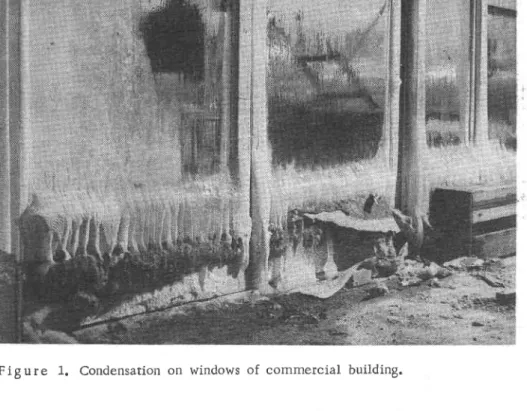
Interior surface condensation, particularly on windows, is one indication of excessive humidity (Figure 1). Damage from condensation to painted or plastered surfaces under windows is not uncommon but such damage is quite evident and can be repaired. More serious trouble often occurs unseen within the walls when water vapour condenses at some plane where temPeratures are at or below the dewpoint temperature. This water vapour gets into the wall, either by diffusion tfuough the wall materials or more often by outward air movement through cracks
') Head, Construction Section, Division of Building Research, National Research Council, Ottawa, Canada.
2 - 5
or joints in the wal1 [1]. At a stage of construction when.the highest humidities exist, the vapour and air barriers may not be in place, thus subjecting the un-protected wall to the full and destrrrctive effect of excessive moisture. This is particularly true in high-rise buildings where the concrete finishing and plastering operations proceed from the ground floor upward. The walls of the upper storeys, still incomplete at this stage, offer little resistance to the outward movement of water vapour. Owing to the normal "chimney" action in the building, higher humidities often exist at the higher levels, adding to the severity of the pqoblem.
Masonry walls are particularly susceptible to damage during construcdon. Severe efflorescence [2] is one serious and very obvious sign of distress (Figure 2). Spalling or cracking of masonry units due to the action of frost on saturated materials is another indication of trouble [3] (Figure 3). Displacement of exterior facing materials due to the formation of ice lenses in mortar back-up has also been reported and this mechanism can be very destructive [3] (Figure 4).
Damage to metal curtain walls is less likely to occur and is usually confined to the effects of condensation on heat bridges, glass surfaces, or in the joints between panels. One result of air leakage through unsealed joints is the formation of icicles, usually near the top of the building. The icicles may be blown off or will fall to the idewalk or roadway below when the outside surface temperature rises above the freezing point.
Where it is irnpractical to install vapour and air control measures during the critical high humidity period of construction, ventilation must be provided to reduce the relative humidity to a level where the materials in a wall can be expected to perform satisfactorily. A humidity level that results in little or no condensation on single-glazed window units located on the upper storey should not be exceeded. The maintenance of such a low humidity level may require a high ventilation rate and the addition of heat inside the structure to maintain a suitable temperature. Even when ventilation is provided, there is no assurance that trouble will not occur. Although the rate of diffusion of water vapour may be low, air leakage outward may sailrate porous materials if the temperature af, any plane in the wall is at or below the dewpoint temperature. Low humidity conditions ate not desirable during the early life of concrete and plaster. If these materials dry out too rapidly, cracking often occurs before sufficient strength to resist the shrinkage stresses has been developed.
Structures in which high humidity during construction is inevitable and which have wall or roof constructions that will be damaged under such conditions may have to be constructed inside an enclosure (Figure 7). The temperature and vapour pressure differences would occur across the walls of the enclosure rather than across the incomplete walls of the building. The stnrcture is thus relieved of the damaging effects of frost action and, at the same time, better conditions can be provided-inside the structure to promote the proper curing of cementitious materials.
Another winter construction hazard is the heaving of foundations located on frost-susceptible soits. Since no special precautions are taken in an occupied
of masonry of high moisture content. sonry due to ice lensing.
building to prevent fteezing of the underlying soil, it is sometimes forgotten that it is the heat loss through the foundations of the building that prevents damage. A building under construction, even when almost completed, may not have any heat in the basement areas. Air leakage inward at the lower levels will reduce the temperature in these areas to below freezing values during severe weather.
An office building placed on a concrete mat foundation was lifted 2 in. (5 cm) by the formation of ice lenses in the clay under the mat. The foundations were completed during the summer and by January, when the heaving was discovered, the reinforced concrete frame building had reached a height of 8 storeys. Borings taken through the mat showed that the soil under the concrete was frozen to a depth of between 6 and L0 in. (15 cm and 25 cm). Measurements of the thickness of the ice lens in the frozen soil correlated with the observed upward movement of the building (Figure 5). The crawl spaces under the ground floor slab of this building were not heated and were vented to the outside.
The foundation of a school building consisted of conventional footings under concrete basement walls and columns. The footings were protected by a thick laver of straw and the walls and columns bv insulated wood forms. After two
Figure 5. Ice lenses in frozen soil under mat foundation.
F i g u r e 6 . I c e l e n s e s footings due to cooling
2 - 5
CE LENS under insulated fin effeat of wall.
weeks the forms were removed but the straw was left in place to prevent the penetration of frost under the footings. After several days it was noted that the walls and columns had been lifted about 2'in. (5 cm) above their original level. Examination showed that, in spite of the precautions taken, f.rcezing of the soil had taken place directly under the wall and the columns (Figure 6). Freezing had occuned because of the cooling effect of the projecting concrete elements - the ground under the edge of the footings was unfrozen.
In both cases the foundations were restored approximarcly to their original positions by conuolled thawing of the frozen soil. Great care was taken to avoid rapid thawing since this could have led to serious differential settlement. In the case of a mat foundation, differential thawing could cause severe erosion due to the lateral movement of water under pressure. While only superficial damage resulted in the cases mentioned, frost heaving can have very destructive effects. The number.of cases that have been investigated suggests that frost heaving is quite prevalent although the resulting damage may be attributed by the builder to other causes.
F O O T I N G I N S U L A T I O N
Frazer Photography, Toronto.
CONCLUSION
Many'buildings constructed in winter are permanently damaged due to the action of frost on saturated building materials. This problem is due not only to the high humidities in the building but also to the incomplete state of construction. Where conditions are such that the fabric of the building may be damaged, the use of a complete enclosure should be considered. Frost heaving of fine-grained soils is another possibility that must be guarded against during consnuction. A better under-standing of the mechanisms that operate under the conditions prevailing during cold weather is necessary in order to devise ways to prevent damage either from frost heaving or the freezing of saturated materials.
This paper is a contribution from the Division of Building Research, National Research Council of Canada, and is published with the apProval of the Director of the Division.
2 - 5
REFERENCESL . W i l s o n , A . G . a n d G . K . G a r d e n , W a t e r a n d f r o s t d a m a g e in m a s o n r y construcrion due to air leakage, To be presented at RILEM/CIB Symposium, "Moisture Problems in Buildings", Helsinki, 16-19 August 1965.
2. Ritchie, T., Efflorescence on rnasonry. To be presented at RILEM/CIB Symposium" "Moisture Problems in Buildings", Helsirtki, 16-19 August 1965. 3. Garden, G.K., Damage to masonry construction by air leakage mechanism.
To be presented at RILEM/CIB Symposium, "Moisture Problems in Buildings", Helsinki, 16-19 August 1965.