HAL Id: hal-01790002
https://hal-upec-upem.archives-ouvertes.fr/hal-01790002
Submitted on 11 May 2018
HAL is a multi-disciplinary open access
archive for the deposit and dissemination of
sci-entific research documents, whether they are
pub-lished or not. The documents may come from
L’archive ouverte pluridisciplinaire HAL, est
destinée au dépôt et à la diffusion de documents
scientifiques de niveau recherche, publiés ou non,
émanant des établissements d’enseignement et de
Shifts of k-nested sequences
Marie-Pierre Béal, Pavel Heller
To cite this version:
Marie-Pierre Béal, Pavel Heller. Shifts of k-nested sequences . Theoretical Computer Science, Elsevier,
2017, 658 (A), pp.18-26. �10.1016/j.tcs.2016.06.041�. �hal-01790002�
Shifts of k-nested sequences
IMarie-Pierre B´eal
Universit´e Paris-Est, Laboratoire d’informatique Gaspard-Monge, UMR 8049 CNRS
Pavel Heller
Universit´e Paris-Est, Laboratoire d’informatique Gaspard-Monge, UMR 8049 CNRS
Abstract
We introduce a new class of subshifts of sequences, called k-graph shifts, which expresses nested constraints on k symbols instead of on two symbols like for Dyck shifts. These shifts share many properties with Markov-Dyck shifts but are generally not conjugate to them. We prove that they are conjugate to sofic-Dyck shifts. We give a computation of the multivariate zeta function for this class of shifts.
Keywords: Dyck shifts, Markov-Dyck shifts, sofic-Dyck shifts, sofic shifts, symbolic dynamics, visibly-pushdown languages, zeta function.
1. Introduction
Dyck shifts were introduced by Krieger in [12]. They are sets of bi-infinite sequences over symbols of opening and closing parentheses where no mismatch-ing appears, i.e. where each finite factor is a factor of a well-parenthesized word. These shifts are examples of coded systems defined by Blanchard and Hansel [8]. Dyck shifts were generalized to Markov-Dyck shifts by Matsumoto [15] and Krieger and Matsumoto [13] (see also [16], [10]), and to sofic-Dyck shifts (see [2], [3]) which are exactly the sets of sequences avoiding a visibly pushdown language (or a regular language of nested-words) [1]. All these shifts express nesting constraints of arity 2.
In this paper we consider nesting constraints of higher arity. We consider expressions of the form(a; (b; c)), where the symbol ; is a middle tag separating two parts enclosed by parentheses, a generalization of Dyck-like expressions
IThis work is supported by the French National Agency (ANR) through “Programme
d’Investissements d’Avenir” (Project ACRONYME no. ANR-10-LABX-58), through the ANR EQINOCS (Project ACRONYME no. ANR-11-BS02-004), and by the region of ˆIle-de-France through the DIM RDM-IdF.
Email addresses: [email protected] (Marie-Pierre B´eal), [email protected] (Pavel Heller)
of the form (a(b)). We define a class of shifts of sequences called shifts of k-nested sequences, where k is the nesting arity, and subshifts called k-graph shifts defined by structures called k-graphs. The sets of forbidden factors of such shifts are clearly deterministic context-free languages and Markov-Dyck shifts form a subclass of k-graph shifts.
We prove that k-graph shifts are not conjugate to Markov-Dyck shifts but are conjugate to sofic-Dyck shifts. Two conjugate shifts are considered to be essentially the same after some recoding but it is not known whether conjugacy is decidable or not even for shifts of finite type.
We investigate the computation of the zeta function of k-graph shifts. The zeta function of a shift is a formal series allowing to count its periodic sequences. It is a powerful invariant of conjugacy.
The zeta function has been computed for Dyck shifts by Keller in [11] and for Markov-Dyck shifts by Krieger and Matsumoto in [13]. A formula for the zeta function of sofic-Dyck shifts is given in [3]. All computations are based on an encoding of the periodic patterns of the shift. It was proved by Reutenauer in [17] that the multivariate and ordinary zeta functions of a sofic shift are N-rational series. The multivariate and ordinary zeta functions of sofic-Dyck shifts (and thus Markov-Dyck shifts) are N-algebraic series [4].
Since k-graph shifts are conjugate to sofic-Dyck shifts, a formula of their zeta function can be obtained from [3]. Nevertheless, as a consequence of the recoding into sofic-Dyck shifts, the formula would involve(m × m)-matrices where m is exponential in the number of states of the k-graph. We give here a computation of the multivariate and ordinary zeta functions of a k-graph shift based directly on the k-graph structure, the size of the computed matrices staying equal to n× n where n is the number of states of the k-graph. The proof is obtained using Keller’s results and an encoding of periodic patterns similar to one used for sofic-Dyck shifts in [4].
In Section 2 we give a quick background on shifts of sequences. We define the class of shifts of k-nested sequences in Section 3 and the k-graph shifts in Section 4. Section 5 contains the computation of the zeta functions. In Section 6 we generalize the k-graph to v-graph shifts to express constraints mixing several nesting arities.
2. Background on shifts
We refer to [14] for basic notions in symbolic dynamics. Let A be a finite alphabet. A shift of sequences X is defined as the set of bi-infinite sequences of symbols of A avoiding some set F of finite words (i.e. having no finite factor in F ). The set F is called a set of forbidden factors of X. The shift X is denoted X= XF. The set of finite factors of a shift X of bi-infinite sequences is denoted
byB(X). It is also called the set of blocks of the shift. The set of blocks of X of length l is denoted byBl(X). A shift X is irreducible if whenever u, v ∈ B(X)
When F can be chosen finite (resp. regular, visibly pushdown), X is called a shift of finite type (resp. a sofic shift, a sofic-Dyck shift ). The full shift over A is the set AZ.
Shifts of sequences may be defined as closed subsets of AZ invariant by the
shift transformation σ, where σ((xi)i∈Z) = (xi+1)i∈Z. Sets of bi-infinite sequences
which are invariant by the shift transformation without being necessarily closed subsets of AZare called σ-invariant sets. The orbit of a sequence x∈ AZis the
set of all σi(x) for i ∈ Z. A period of a sequence x ∈ AZ is a positive integer p
such that σp(x) = x.
Let A, B be two finite alphabets and X a shift over A. A sliding block code is a map Φ∶ X Ð→ BZ for which there is a positive integer R= 2r + 1 and a map
φ∶ BR(X) Ð→ B such that Φ(x)i= φ(xi−r⋯xi⋯xi+r). Such a map is called an
R-block code.
A (topological) conjugacy from X⊆ AZ to Y ⊆ BZis a bijective sliding block
code from X onto Y . It is known that its inverse is also a sliding block code [14]. Observe that a conjugacy preserves the periods of a sequence.
3. Shifts of k-nested sequences
In this section we define shifts of sequences of symbols satisfying some nesting constraints of arity greater than 2. We will denote by k a positive integer representing a nesting arity as explained below.
Let A be a finite set of symbols of size n. We consider the alphabets A(i)for 1≤ i ≤ k defined by A(i)= {e(i) ∣ e ∈ A}. We set A
k = ⊔1≤i≤kA(i). We consider
the free monoid generated by Ak with a zero 0 quotiented by the following
relations
e(i)f(j)= 0, if i ≠ k, j ≠ 1, e ≠ f e(i)e(j)= 0, if i ≠ k, j ≠ 1, j ≠ i + 1 e(1)e(2)⋯e(k)= 1,
where e, f∈ A and 1 is the unity of the monoid. The third relation expresses a nesting relation of arity k on the symbols e(1), e(2), . . . , e(k). The symbols e(1) may be seen as opening parentheses, the symbols e(k) as closing parenthesis, and the other symbols e(i) as middle tags.
For a word w= w0⋯wn−1 over Ak, we denote byw̃∈ A∗k∪ {0, 1} its reduced
form which is the unique word obtained by applying the above relations. We denote by F the set of finite words over the alphabet Ak whose reduced
form is 0. We set XAk = XF, which is the shift avoiding all words in F . The
shift XAk is called the shift of k-nested sequences over Ak.
Note that two such shifts XAk and XBk are conjugate if and only if A and
B have the same cardinal. This justifies the notation of X(k,n)standing for the
shift XAk up to renaming of the symbols of the alphabet A of size n.
We denote by Dyck(Ak) the set of finite words whose reduced form is 1 and
we call these words the Dyck words over Ak. Finite and infinite words avoiding
Example 1. Let A= {e, f} and k = 1. The shift XA1 is the full shift over A1,
that is, the set AZ 1.
Example 2. Let A = {e, f} and k = 2. The shift XA2 is the Dyck shift with
two types of parentheses introduced by Krieger in [12] where e(1), f(1)represent the opening parentheses(, [, and e(2), f(2)represent the closing parentheses), ].
The Dyck shift is the set of bi-infinite sequences of symbols in{(, [, ), ]} where each finite factor is a factor of some well-parenthesized word, i.e. contains no mismatching. For instance the bi-infinite sequence⋯( ( ) [ [ ]( ( ( ⋯ belongs to the Dyck shift while⋯( [ [ ] ) ( ( ⋯ does not since it contains a mismatching. Example 3. Let A= {e, f} and k = 3. The nontrivial monoid relations are the following:
e(i)f(j)= f(i)e(j)= 0, if i ≠ 3, j ≠ 1 e(1)e(3)= e(2)e(2)= f(1)f(3)= f(2)f(2)= 0, e(1)e(2)e(3)= f(1)f(2)f(3)= 1,
Imagine that e(1), e(2), e(3) correspond to the parenthesis symbols(1,∣1,)1 and
f(1), f(2), f(3) correspond to the parenthesis symbols (2,∣2,)2. The monoid
relations express a natural constraint on composition of parentheses representing two kinds of pairs of objects which have to be separated by some symbol in the middle.
Let G = (V, E) be the directed multigraph where V is the set of vertices containing a unique vertex 1 and E= {e(1), e(2), e(3), f(1), f(2), f(3)} is the set
of edges from 1 to 1. The shift XA3 may be seen as the set of bi-infinite paths
in G avoiding factors whose reduced form is 0, the alphabet being the set of edges E. 1 e(3) e(2) e(1) f(3) f(2) f(1)
Figure 1: The graph G defining the shift XA3.
For instance, the reduced form of w= e(1)e(2)f(1)f(2)f(3)e(3)e(1)e(2)e(3) is 1. The word w is thus a Dyck word over A3. The reduced form of the word
z= e(1)f(1)f(2)f(3)e(3) is 0. The word z is hence a forbidden factor of the shift XA3.
The reduced form of a finite word has always the form 0, 1, u, v, or u⋅ v with u= (e(j1) 1 ⋯e (k) 1 )⋯(e (jn) n ⋯e (k) n ) v= (f1(1)⋯f(i1) 1 )⋯(f (1) m ⋯f (im) m ),
where er, fr′∈ A, for 1 ≤ r ≤ n, 1 ≤ r′≤ m and 1 < jr≤ k and 1 ≤ ir′< k. A word
whose reduced form is v only or 1 is said to be matched-return. A word whose reduced form is u only or 1 is said to be matched-call. The set of matched-return (resp. matched-call) words is denoted by MR(Ak) (resp. MC(Ak)). The set of
matched-return (resp. matched-call) blocks of a subshift X of XAk is denoted
by MR(X) (resp. MC(X)).
The following lemma shows that any block of XAk can be extended on the
right to get some matched-call block. Similarly any block can be extended on the left to get some matched-return block.
Lemma 1. Let X= XAk and u a block of X. There is a block v such that uv is
a matched-call block of X.
Proof. Without loss of generality we may assume that u∈ MR(X). Let us show that there is a word v such that uv∈ Dyck(X). Let ˜u be the reduced form of u in S. If u is not already in Dyck(X) we have ˜u = we(1)⋯e(i) where 1≤ i < k and w∈ MR(X). Then ue(i+1)⋯e(k) reduces to w shorter than ˜u. The claim is obtained by iterating this process.
Observe that the shift XAk is irreducible. Indeed, let X = XAk and u, v ∈
B(X). By Lemma 1 there is a word w such that uw ∈ MC(X). Similarly there is a word z such that zv∈ MR(X). As a consequence uwzv ∈ B(X).
4. Shifts defined by k-graphs
In this section we define a class of shifts of nested sequences defined by finite directed multigraphs equipped with a special structure.
Let A be a finite set of symbols and k a positive integer. We denote by[k] the integer interval{1, 2, . . . , k}.
We consider structures called k-graphs denoted by G = (V, E, A, k), where (V, E) is a multigraph (called simply graph) with a finite set of vertices V and a finite set of edges E, and where A is a finite set of symbols. For each edge e we denote by s(e) its starting state and by t(e) its target state.
Further it is required that the set of edges is partitioned into k parts of equal size E(i)= {e(i)∣ e ∈ A} such that for each e ∈ A, each 0 ≤ i < k, t(e(i)) = s(e(i+1)) and t(e(k)) = s(e(0)). Hence each path e(1)e(2)⋯e(k) is a cyclic path inG.
The set of bi-infinite paths inG belonging to XAk is a shift denoted by XG
and is called a k-graph shift. A Dyck path ofG is a finite path of G belonging to Dyck(Ak). Observe that by construction each Dyck path of G is a cyclic path
ofG.
Example 4. The k-nested shifts defined in Section 3 are k-graph shifts defined by graphs containing a single state.
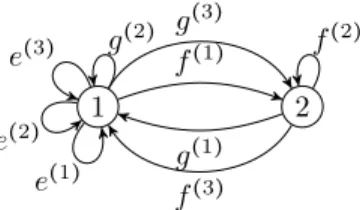
Example 5. LetG = (V, E, A, k) be the 3-graph defined by A = {e, f, g}, k = 3 and the edges described in Figure 2. The word e(3)e(1)e(2)f(1)f(2)f(3)e(3)f(1)
1 2 e(3) e(2) e(1) g(2) f(2) f(1) g(1) g(3) f(3)
Figure 2: A 3-graphG defining the shift XGwith A= {e, f, g}.
In this setting, the Markov-Dyck shifts introduced by Matsumoto [15] and Krieger and Matsumoto [13] (see also [16], [10]) may be seen as 2-graph shifts as follows. The Markov-Dyck shift defined by some directed graph H= (V, E) is the 2-graph shift XG with G = (V, F, E, 2) where F = F
(1)⊔ F(2), F(1) being
a set of copies of the edges of H, and F(2) being a set of copies of the edges of H in the reverse sense. Each edge e(2) in F(2) is thus a backward edge of the e(1) in F(1) as in Markov-Dyck shifts.
The class of k-graph shifts is very close to the class of Markov-Dyck shifts but it is a strictly larger class as is shown in the following proposition.
Proposition 1. The 3-graph shift X(3,n) is not conjugate to a Markov-Dyck
shift.
Proof. Assume that there is a 2-graphG = (V, E, B, 2) defining a Markov-Dyck shift XG which is conjugate to XA3. Let Φ∶ XG → XA3 be a conjugacy from XG
onto XA3. Let us assume that Φ is an R-block code. Since XA3 is an irreducible
shift and irreducibility is invariant by conjugacy, XG is irreducible. The graph
ofG is thus strongly connected.
If a is a symbol, we denote by ωa (resp. aω) the left (resp. right) infinite sequence⋯aaa (resp. aaa⋯ ), and byωaωthe bi-infinite sequenceωa.aω.
Since XA3 has sequences of period 1, XG also and thus G has at least one
loop edge. Hence there is at least one symbol e∈ B such that e(1) and e(2) are loop edges ofG. Let B′be the subset of symbols e in B such that e(1)(and thus
e(2)) are loop edges. Let e∈ B′. Sinceωe(1)ω has period 1 we have Φ(ωe(1)ω)
has period 1. Hence, as a(2)a(2) is forbidden in X
A3 for any a∈ A,
Φ(ωe(1)ω) =ωa(1)ω or Φ(ωe(1)ω) =ωa(3)ωfor some a∈ A, Φ(ωe(2)ω) =ωb(1)ω or Φ(ωe(2)ω) =ωb(3)ωfor some b∈ A.
If Φ(ωe(1)ω) =ωa(1)ω and Φ(ωe(2)ω) =ωb(3)ωfor some a, b∈ A, then, since Φ
is a sliding block code,
Φ(ωe(1).e(2)ω) =ωa(1)w.w′
b(3)ω,
where w, w′ are finite words, a contradiction since this ωa(1)w.w′b(3)ω is not
in XA3 even if a= b, as ww
If Φ(ωe(1)ω) =ωa(3)ω and Φ(ωe(2)ω) =ωb(1)ωfor some a, b∈ A, then, since Φ is a sliding block code,
Φ(ωe(2).e(1)ω) =ωb(1)w.w′
a(3)ω,
where w, w′ are finite words, a contradiction since this ωb(1)w.w′a(3)ω is not
in XA3 even if a= b.
It follows that
Φ(ωe(1)ω) =ωa(1)ω and Φ(ωe(2)ω) =ωb(1)ω for some a, b∈ A, (1) or
Φ(ωe(1)ω) =ωa(3)ω and Φ(ωe(2)ω) =ωb(3)ω for some a, b∈ A. (2) Let us denote by B′
1 the subset of symbols e in B′ satisfying Equations 1,
and by B′
3 the subset of symbols e in B
′satisfying Equations 2. Let e∈ B′ 1and
f∈ B′
3. Since XG is irreducible, there is a finite path w⋅w
′such that e(2)ww′f(1)
is a block of XG. Then
Φ(ωe(2)w.w′
f(1)ω) =ωa(1)w1.w2b(3)ω,
where a, b ∈ A and where w1, w2 are finite words. This gives a contradiction
sinceωa(1)w1.w2b(3)ω is not in XA3 even if a= b.
As a consequence B′ = B′ 1 or B
′ = B′
3. In the former case
ωa(3)ω has no
pre-image by Φ for a∈ A. In the latter case ωa(1)ω has no pre-image by Φ for a∈ A, which ends the proof.
The proof can be generalized to show that X(k,n) is not conjugate to a
Markov-Dyck shift when k> 2.
We now show that k-graph shifts can be seen as sofic-Dyck shifts. This result is obtained by expressing the nesting constraints of arity k as another regular nesting constraints of arity 2.
Sofic-Dyck shifts may be defined as follows. We consider an alphabet B which is a disjoint union of three finite sets of letters, the set Bcof call letters, the
set Brof return letters, and the set Biof internal letters. The set B= Bc⊔Br⊔Bi
is called a pushdown alphabet. A Dyck word over B is a word w generated by the grammar D→ ε ∣ iD ∣ cDrD, where D is a variable and c ∈ Bc, r∈ Br, i∈ Bi
are terminal symbols of the grammar. We denote by Dyck(B) the set of Dyck words over B.
A (finite) Dyck automaton A over B is a pair (G, M) of a directed labeled graph G= (V, E) over B where V is the finite set of states, E ⊆ V × B × V is the set of edges, and of a set M of pairs of edges((p, a, q), (r, b, s)) such that a ∈ Bc
and b∈ Br. The set M is called the set of matched edges.
A finite path π ofA is said to be an admissible path if for any factor (p, a, q)⋅ π1⋅ (r, b, s) of π with a ∈ Bc, b ∈ Br and the label of π1 being a Dyck word
admissible and factors of finite admissible paths are admissible. A bi-infinite path is admissible if all its finite factors are admissible.
A sofic-Dyck shift over B is the set labels of bi-infinite admissible paths of a Dyck automaton over B.
Proposition 2. Every k-graph shift is conjugate to a sofic-Dyck shift over some pushdown alphabet.
Proof. Let X⊆ EZbe a k-graph shift defined by a k-graphG = (V, E, A, k). We
define the pushdown alphabet B= Bc⊔ Bi⊔ Br with
Bc= {e(1)∣ e ∈ A},
Bi= {e(i)∣ e ∈ A, 1 < i < k},
Br= {e(k)∣ e ∈ A}.
We define a Dyck automatonA = (G′, M) over B where G′= (V′, E′) as follows.
The set V′is the set{q
e(i) ∣ e ∈ A, i ∈ [k]}. For any e, f ∈ A, i ∈ [k], 1 ≤ j < k, we
set
qe(i)
f(1)
ÐÐ→ qf(1) ∈ E ′
if and only if e(i)f(1) is a path inG qe(j) e (j+1) ÐÐÐ→ qe(j+1)∈ E ′ (as e(j)e(j+1) is a path inG) qe(k−1) e(k) ÐÐ→ qf(i)∈ E ′
if and only if e(k)f(i) is a path inG Each edge(q, e(1), qe(1)) is matched with (qe(k−1), e(k), q) for each q ∈ V′.
Let Y be the sofic-Dyck shift defined by A. It may be checked that the construction implies X= Y .
5. Zeta function of shifts defined by k-graphs 5.1. Multivariate zeta functions
Recall the notion of multivariate zeta function introduced by Berstel and Reutenauer in [7].
For K= Z or K = N we denote by K⟪A⟫ the set of noncommutative formal power series over the alphabet A with coefficients in K. For each language L of finite words over a finite alphabet A we define the characteristic series of L as the series L= ∑u∈Lu in N⟪A⟫.
Let K[[A]] be the usual commutative algebra of formal power series in the variables of A and π∶ K⟪A⟫ → K[[A]] be the natural homomorphism. Let S be a commutative or noncommutative series. One can write S= ∑n≥0[S]n where
each[S]n is the homogeneous part of S of degree n. The notation extends to
matrices H with coefficients in K⟪A⟫ or K[[A]] with ([H]n)pq= [Hpq]n, where
p, q are indices of H.
Call periodic pattern of a shift X a word u such that the bi-infinite concate-nation of u belongs to X and denote P(X) the set of periodic patterns of X.
These definitions are extended to σ-invariant sets of bi-infinite sequences which may not be shifts.
The multivariate zeta function Z(X) of a σ-invariant set X is the commu-tative series in Z[[A]]
Z(X) = exp ∑
n≥1
[P(X)]n
n . The (ordinary) zeta function of a language X is
ζX(z) = exp ∑ n≥1
pn
zn
n,
where pn is the number of sequences of X of period n, i.e. of sequences x such
that σn(x) = x.
Let θ∶ Z[[A]] → Z[[z]] be the homomorphism such that θ(a) = z for any letter a ∈ A. If S ∈ Z[[A]], θ(S) will also be denoted by S(z). Note that ζX(z) = θ(Z(X)).
It is known that the multivariate zeta function of a shift has nonnegative in-teger coefficients. The entropy of a language L is h(L) = lim supn→∞1/n log ∣L∩ An∣. The entropy of a shift X is h(B(X)). The entropy h(P(X)) of the set of periodic patterns of a shift X is log(1/ρ) where ρ is the radius of convergence of ζX(z).
5.2. Encoding of periodic sequences of a k-graph shift
Let A be a finite alphabet and A(i)= {e(i)∣ e ∈ A} for 1 ≤ i ≤ k.
We say that a Dyck word w over Ak is prime if it cannot be decomposed into
a product of strictly shorter nonempty Dyck words. Note that the empty word is a Dyck word but not prime. We denote by Prime(Ak) the set of prime Dyck
words over Ak and by Prime(X) the set of prime Dyck factors of a shift X.
LetG = (V, E, A, k) be a k-graph defining X = XG. The paths in Prime(X)
are called prime Dyck paths ofG. For each p ∈ V , let us denote by Dp the set
of Dyck paths ofG going from p to p. Note that there are no Dyck paths going from p to q if p≠ q. We define the two languages of finite paths of G
Lc= ⊔ e∈A,1≤i<k
e(1)Dt(e(1))⋯e(i−1)Dt(e(i−1))e(i),
Lr= ⊔ e∈A,1<i≤k
e(i)Dt(e(i))e(i+1)⋯Dt(e(k−1))e(k),
and the following(V × V )-matrices
• C = (Cpq), where Cpq is the set of prime Dyck paths going from p to q
inG. Note that Cpq= ∅ if p ≠ q. We set Cp= Cpp.
• C∗ = (C∗
pq), where C ∗
pq is the set of paths going from p to q in G being
concatenation of prime Dyck paths (i.e. being Dyck paths).
• Mc= (Mc,pq), (resp. Mr) where Mc,pq is the set of paths in Lc (resp. in
Let H be one of the matrices C, C∗M
c, Mr+ C. We call an H-path of G a path
(ei)i∈IofG, where I is an interval or Z, which can be factorized into segments in
a way that each segment ej⋯ej′∈ Hs(ej)t(ej′). We denote by XHthe σ-invariant
set containing all orbits of bi-infinite H-paths ofG.
We say that two finite words x, y are conjugate if x= uv and y = vu for some words u, v.
The following proposition gives an encoding of the periodic patterns of a shift defined by a k-graph. The formula is similar to the one obtained for sofic-Dyck shifts in [4].
Proposition 3. Let X be the shift defined by a k-graphG. The set of periodic patternsP(X) of X is
P(X) = P(XC∗Mc) ⊔ P(XMr+C).
Proof. Let z be a periodic pattern. Then x= ⋯zz.zz⋯ is a periodic sequence of X. If z is not already in MC(X) or in MR(X), then its reduced form is
˜ z= u ⋅ v = (e(j1) 1 ⋯e (k) 1 )⋯(e (jn) n ⋯e (k) n ) ⋅ (f (1) 1 ⋯f (i1) 1 )⋯(f (1) m ⋯f (im) m ),
where er, fr ∈ A, 1 < jr ≤ k and 1 ≤ ir < k. In that case z has a conjugate z′
whose reduced form is the reduced form of v⋅ u where v⋅ u = (f1(1)⋯f(i1) 1 )⋯(f (1) m ⋯f (im) m ) ⋅ (e (j1) 1 ⋯e (k) 1 )⋯(e (jn) n ⋯e (k) n ).
This product is either in MC(X) or in MR(X) since ⋯z′z′.z′z′⋯ ∈ X. So z
always has a conjugate z′in MC(X) or in MR(X).
If z′is matched-call, then it is a product of words in Prime(X) or of words
in Lr. In that case z is conjugate to an(Mr+ C)-path of G.
If z′ is matched-return and not matched-call, i.e. z′∉ Prime(X)∗, we can
assume that it does not end with a Dyck word (if z′= uw with w Dyck, we could
consider wu instead). In that case it is a product of words in Prime(X)∗L cand
z is conjugate to an(C∗M
c)-path of G. As a consequence P(X) = P(XC∗Mc) ∪
P(XMr+C).
Let us finally show thatP(XC∗Mc) ∩ P(XMr+C) = ∅. Assume the contrary.
Then there are nonempty conjugate words w, w′such that w is an(C∗M c)-path
ofG and w′ is an(M
r+ C)-path of G. This implies that the number of letters
in A(k)minus the number of letters in A(1) is positive in w and nonpositive in w′, contradicting the conjugacy of w and w′.
5.3. Computation of the zeta function
As before, let X be a k-graph shift defined by the k-graphG = (V, E, A, k). We recall below the notion of circular codes (see for instance [6]). We say that a subset S of nonempty words over Ak is a circular code if for all n, m≥ 1
and x1, x2, . . . , xn ∈ S, y1, y2, . . . , ym∈ S and p ∈ A∗k and s∈ A +
k, the equalities
sx2x3⋯xnp= y1y2⋯ym and x1 = ps imply n = m, p = ε and xi = yi for each
This following notion of circular-Markov matrix extends the classical notion of circular codes. It corresponds to the notion of circular Markov codes of Keller [11].
We say that the matrix (Hpq)p,q∈V, where each Hpq is a set of nonempty
words over Ak, is circular-Markov if for all n, m≥ 1 and xi∈ Hpi−1,pifor 1≤ i < n,
xn∈ Hpn−1p0, yi∈ Hqi−1,qi for 1≤ i < m, ym∈ Hqm−1q0 and p∈ A
∗
k and s∈ A + k, the
equalities sx2x3⋯xnp= y1y2⋯ym and x1 = ps imply n = m, p = ε, xi = yi and
pi= qi for each 1≤ i ≤ n.
Proposition 4. The sets Prime(Ak)∗Lc and Lr⊔Prime(Ak) are circular codes.
Proof. We first show that Lr⊔ Prime(Ak) is circular. Keeping the notation of
the definition, let x1, x2, . . . , xn ∈ S, y1, y2, . . . , ym∈ S, p ∈ A∗k and s∈ A + k. We
prove the claim by induction on n+ m. Suppose that sx2x3⋯xnp= y1y2⋯ym
and x1 = ps imply n = m and xi = yi when n+ m < N. Assume now that
sx2x3⋯xnp= y1y2⋯ymand x1= ps for some n, m with n + m = N.
If p were nonempty, then, since x1= ps where s ≠ ε, p would have some word
e(i)w with i< k and w ∈ Dyck(Ak) as a suffix. This would contradict p being
a suffix of y1y2⋯ym, which is clearly matched-return, hence we get p = ε. It
follows that x1 is a prefix of y1 or the converse, implying x1= y1. By induction
hypothesis we obtain that n= m and xi= yi.
We now show that Prime(Ak)∗Lc is circular. Let us assume that s ≠ x1.
Since s is a prefix of y1y2⋯ym and is a suffix of x1, we have s∈ Prime(Ak)∗Lc
and p∈ Prime(Ak)∗. As p ≠ ε, p ∈ Prime(Ak)+ and thus p ∉ (Ak)∗Lc. This
contradicts the fact that p is a suffix of y1⋯ym. Hence s= x1 and p= ε. Now
x1⋯xn = y1y2⋯ym implies x1 = y1 since xi, yi ∈ Prime(Ak)∗Lc. By induction
hypothesis we get n= m and xi= yi.
Corollary 1. Let G = (V, E, A, k) be a k-graph defining a shift X. Let C, Mc, Mr be the matrices defined fromG as above. The matrices C, C∗Mc and
(Mr+ C) are circular-Markov.
Proof. Let H= C∗M
c or (Mr+ C). Let xi∈ Hpi−1,pi for 1≤ i < n, xn∈ Hpn−1p0,
yi ∈ Hqi−1,qi for 1 ≤ i < m, ym ∈ Hqm−1q0 and p ∈ A
∗
k and s ∈ A +
k. Since
Prime(Ak)∗Lcand Lr⊔Prime(Ak) are circular codes, the equalities sx2x3⋯xnp=
y1y2⋯ym and x1 = ps imply n = m, p = ε, xi = yi for 1 ≤ i ≤ n. This implies
pi = qi for 1≤ i ≤ n since pi is the target of the path xi and qi is the target of
the path yi. The matrices C∗Mc and(Mr+ C) are thus circular-Markov. Since
Mc+ C is circular-Markov C is also circular-Markov.
Let H be a circular-Markov matrix whose coefficients are sets of words over Ak. Then for any positive integer n we have (H)n = Hn and (H)∗ = H∗ =
1/(1 − H) (see for instance [6]).
The following proposition is a consequence of Keller’s formula of the zeta for circular Markov-codes [11].
Proposition 5. Let G = (V, E, A, k) be a k-graph defining a shift X. The multivariate zeta function of X has the following expression.
Z(X) = 1
det(I − π(C∗M
c)) det(I − π(Mr+ C))
.
Proof. From Proposition 3 we get that the multivariate zeta function of X is Z(X) = Z(XC∗Mc)Z(XMr+C). Since C
∗M
c and (Mr+ C) are circular-Markov
matrices we get from [11, Theorem 1] Z(XC∗Mc) = 1 det(I − π(C∗M c)) , Z(XC+Mr) = 1 det(I − π(Mr+ C)) ,
hence the proposition.
Example 6. Let X= X(k,n)be the shift of k-nested sequences over Ak of size n.
Hence D1 the set of Dyck paths going from 1 to 1 in the unique-vertex graph
defining XAk. We get C= [C1], Mr= [Mr,11] = [∑ e∈A e(2)D1e(3)D1⋯D1e(k)+ ⋯ + e(k−1)D1e(k)+ e(k)], Mc= [Mc,11] = [∑ e∈A e(1)+ e(1)D1e(2)+ ⋯ + e(1)D1e(2)D1e(3)⋯D1e(k−1)], with C1= ∑ e∈A e(1)D1e(2)D1e(3)⋯D1e(k), D1= ∑ e∈A e(1)D1e(2)D1e(3)⋯D1e(k)D1+ ε Hence Z(X) = (C∗ 1Mc)∗(Mr+ C1)∗. We get ζX(z) = 1 (1 − D1(z)Mc(z))(1 − (Mr(z) + C1(z))) = 1 (1 −nzD1(z)+1−D1(z) D1(z)(1−zD1(z))) (1 − z (n+1)−D1(z) (1−zD1(z)) ) ,
where D1(z) is the N-algebraic series defined by the above equations.
Let ρ be the radius of convergence of ζX(z). We have h(P(X)) = log(1/ρ).
It can be shown that h(P(X)) = h(B(X)) and the entropy of X is thus equal to log(1/ρ). The positive real value ρ satisfies D1(ρ)Mc(ρ) = 1 implying ρ =
1/(n + 1). It follows that the entropy of X is log(n + 1) which is independent of k. We recover the entropy of the Markov-Dyck shift with n types of parentheses (see [13]).
Example 7. Let X= XGbe the shift defined by the 3-graphG of Figure 2. With
the above notation we get
C1= e(1)D1e(2)D1e(3)+ f(1)D2f(2)D2f(3) C2= g(1)D1g(2)D1g(3) D1= 1 + e(1)D1e(2)D1e(3)D1+ f(1)D2f(2)D2f(3)D1 D2= 1 + g(1)D1g(2)D1g(3)D2 Mc= [ e(1)+ e(1)D1e(2) f(1)+ f(1)D2f(2) g(1)+ g(1)D1g(2) 0 ] Mr= [ e(2)D1e(3)+ e(3) g(2)D1g(3)+ g(3) f(2)D2f(3)+ f(3) 0 ]
Thus ζX(z) = det(I − DMc(z))−1det(I − (Mr+ C)(z))−1, where
det(I − DMc(z)) = (1 − A1(1 + A1) − A1A2(1 + A2)(1 + A1))(z), det(I − (Mr+ C)(z)) = (1 − z(1 + A1+ A21+ A 2 2)(z))(1 − zA 2 1(z)) − z2((1 + A 1)(1 + A2)(z)),
and A1(z) = zD1(z), A2(z) = zD2(z). Since D1(z) and D2(z) are defined by
the system of equations
D1(z) = 1 + z3D1(z)(D21(z) + D 2 2(z))
D2(z) = 1 + z3D12(z)D2(z)
There is indeed a unique pair of series D1(z), D2(z) with nonnegative integer
coefficients solution of the above system (see for instance [9] or [5]).
6. Shifts defined by v-graphs
In this section we generalize the notion of k-graphs by allowing different symbols from the alphabet to have different arities of the associated nesting constraints. We define v-graphs where v is a finite vector giving the number of symbols with any given arity of nesting constraint. We define shifts presented by these structures.
Let I= [m] where m is a positive integer. Let Gi= (V, Ei, Ai, ki) be ki-graphs
on the same set of vertices V for i∈ I with ∣Ai∣ = ni. Note that the notation
differs slightly from the previous sections. Ai here corresponds to what was
typically called A before (not Ak). We set G = (V, E, A, v) where E = ⊔i∈IEi,
A= ⊔i∈IAi, v= ((ki, ni))i∈I.
We consider the free monoid S generated by E with a zero 0 quotiented by the following relations
• For e∈ Ai, f∈ Ai′ and e≠ f, e(j)f(j ′ )= 0 if j < k i and j′≠ 1. • For e∈ Ai, e(j)e(j ′ )= 0 if j < k i, j′≠ j + 1 and j′≠ 1. • For e∈ Ai, e(1)e(2)⋯e(ki)= 1.
In the last relation 1 stands for the unity of the monoid.
A forbidden finite path ofG is a finite path which is zero in S. A Dyck path ofG is a finite path which reduces to 1. The set of bi-infinite paths in G avoiding finite forbidden paths as factors is a shift denoted by XG and is called a v-graph
shift. The multigraphG defines XG. If v= ((ki, ni))i∈I, we denote by Xv the
v-graph shift defined by a graph having a unique state 1 and edges e(j)from 1 to 1 for each j∈ [ki] and each e ∈ Ai.
The computation of zeta functions of v-graph shifts is similar to the com-putation of zeta functions of k-graph shifts. The topological entropy of Xv is
log(N + 1) where N = ∑i∈Ini.
Example 8. The shift Xvwith v= ((2, 1), (3, 1)) is defined by the graph G of
Fig-ure 3. For instance if we denote A1= {e} and A2= {f} then e(1)f(1)f(2)f(3)e(2)
is Dyck path of Xv. 1 e(2) e(1) f(3) f(2) f(1)
Figure 3: The v-graph shift graph Xvwhere v= ((2, 1), (3, 1)).
7. Conclusion
We have defined a class of shifts of sequences which satisfies nesting con-straints of arity greater than 2 and is close to the class of Markov-Dyck shifts. Since these shifts are conjugate to sofic-Dyck shifts they may also be charac-terized by a forbidden regular set of nested words with a nesting arity equal to 2. We have shown how to compute the zeta function for this class of shifts avoiding the increase of complexity due to their sofic-Dyck nature.
Acknowledgements
The authors thank Wolfgang Krieger and anonymous reviewers for very help-ful comments.
References
[1] Alur, R., Madhusudan, P., 2009. Adding nesting structure to words. J. ACM 56 (3).
[2] B´eal, M.-P., Blockelet, M., Dima, C., 2014. Sofic-Dyck shifts. In: 39th In-ternational Symposium on Mathematical Foundations of Computer Science MFCS 2014, (MFCS 2014). Lecture Notes in Computer Science. Springer-Verlag.
[3] B´eal, M.-P., Blockelet, M., Dima, C., 2016. Sofic-Dyck shifts. Theor. Com-put. Sci. 609, 226–244.
[4] B´eal, M.-P., Dima, C., Heller, P., 2015. N-algebraicity of zeta functions of sofic-Dyck shifts. CoRR http://arxiv.org/1501.05843.
[5] Bell, J. P., Burris, S., Yeats, K. A., 2010. Characteristic points of recursive systems. Electr. J. Comb. 17 (1).
[6] Berstel, J., Perrin, D., Reutenauer, C., 2010. Codes and Automata. Vol. 129 of Encyclopedia of Mathematics and its Applications. Cambridge Uni-versity Press, Cambridge.
[7] Berstel, J., Reutenauer, C., 1990. Zeta functions of formal languages. Trans. Amer. Math. Soc. 321, 533–546.
[8] Blanchard, F., Hansel, G., 1986. Syst`emes cod´es. Theor. Comput. Sci. 44, 17–49.
[9] Flajolet, P., Sedgewick, R., 2009. Analytic Combinatorics. Cambridge Uni-versity Press, Cambridge.
[10] Inoue, K., Krieger, W., 2010. Subshifts from sofic shifts and Dyck shifts, zeta functions and topological entropy. CoRRAbs/1001.1839.
[11] Keller, G., 1991. Circular codes, loop counting, and zeta-functions. J. Com-bin. Theory Ser. A 56 (1), 75–83.
[12] Krieger, W., 1974/75. On the uniqueness of the equilibrium state. Math. Systems Theory 8 (2), 97–104.
[13] Krieger, W., Matsumoto, K., 2011. Zeta functions and topological entropy of the Markov-Dyck shifts. M¨unster J. Math. 4, 171–183.
[14] Lind, D., Marcus, B., 1995. An Introduction to Symbolic Dynamics and Coding. Cambridge University Press, Cambridge.
[15] Matsumoto, K., 2007. On the simple C∗-algebras arising from Dyck
sys-tems. J. Operator Theory 58 (1), 205–226.
[16] Matsumoto, K., 2016. On the Markov-Dyck shifts of vertex type. Discrete Contin. Dyn. Syst. 36 (1), 403–422.
[17] Reutenauer, C., 1997. N-rationality of zeta functions. Adv. in Appl. Math. 18 (1), 1–17.