HAL Id: cea-02431813
https://hal-cea.archives-ouvertes.fr/cea-02431813
Submitted on 8 Jan 2020HAL is a multi-disciplinary open access
archive for the deposit and dissemination of sci-entific research documents, whether they are pub-lished or not. The documents may come from
L’archive ouverte pluridisciplinaire HAL, est destinée au dépôt et à la diffusion de documents scientifiques de niveau recherche, publiés ou non, émanant des établissements d’enseignement et de
OECD/NEA intercomparison of deterministic and
monte carlo cross-section sensitivity codes using sneak-7
benchmarks
I Kodeli, V. Mastrangelo, E. Ivanov, A. Aures, W. Zwermann, M. Aufiero, Y.
Peneliau, K. Ivanov, E. Sartori
To cite this version:
I Kodeli, V. Mastrangelo, E. Ivanov, A. Aures, W. Zwermann, et al.. OECD/NEA intercomparison of deterministic and monte carlo cross-section sensitivity codes using sneak-7 benchmarks. PHYSOR 2016: Unifying Theory and Experiments in the 21st Century, May 2016, Sun Valley, United States. pp.ISBN: 978-0-89448-726-2. �cea-02431813�
PHYSOR 2016 – Unifying Theory and Experiments in the 21st Century
Sun Valley Resort, Sun Valley, Idaho, USA, May 1 – 5, 2016, on CD-ROM (2016)
OECD/NEA INTERCOMPARISON OF DETERMINISTIC AND MONTE
CARLO CROSS-SECTION SENSITIVITY CODES USING SNEAK-7
BENCHMARKS
Ivan A. Kodeli1, Victor Mastrangelo2, Evgeny Ivanov3, Alexander Aures4, Winfried Zwermann4, Manuele Aufiero5, Yannick Peneliau6, Kostadin Ivanov7, Enrico Sartori8
1
Jožef Stefan Institute, Ljubljana, Slovenia, [email protected] 2retired from IPN-Orsay and CNAM-Paris, France, [email protected]
3
IRSN, 92262 Fontenay-aux-Roses, France, [email protected] 4GRS, Garching, Germany, [email protected], [email protected]
5
University of California, Berkeley, USA, [email protected] 6
CEA Cadarache, F-13108 Saint Paul-Lez-Durance, France, [email protected] 7North Carolina State University, Raleigh, NC 27695, USA, [email protected] 8
retired from OECD/NEA Data Bank, Issy-les-Moulineaux, France, [email protected]
ABSTRACT
A sensitivity benchmark exercise was organized within the scope of the Uncertainty Analysis in Modeling (UAM) project of the OECD/Nuclear Energy Agency (NEA) to develop and compare methods for the sensitivity and uncertainty computations of the effective multiplication factor (keff) and the effective delayed neutron fraction (eff). Several solutions
were received using different codes, both deterministic (SUSD3D, SNATCH) and Monte Carlo (TSUNAMI-3D, XSUSA, SERPENT2, MCNP6). In this paper the performances of several codes and methods for the keff sensitivity and uncertainty computations are
inter-compared. The sensitivity and uncertainty codes were applied to the SNEAK-7A and -7B fast neutron benchmark experiments from the IRPhE database. Good general agreement between the sensitivities, both for integral values and sensitivity profiles, was observed.
Key Words: sensitivity-uncertainty analysis, nuclear data, benchmark experiments.
1. INTRODUCTION
Responding to an increasing demand from nuclear research, industry, safety and regulation for best estimate predictions to be provided with their confidence bounds OECD/NEA launched in 2006 the Light Water Reactor (LWR) Uncertainty Analysis in Modelling (UAM) benchmark activities [1] with the overall objective to develop the uncertainty analysis methodologies for multi-physics (coupled) and multi-scale simulations. The effort undertaken within the framework of a program of international co-operation contributes to establishing a unified framework to estimate safety margins, which would provide more realistic, complete and logical measures of reactor safety, and integrates the expertise in reactor physics, thermal-hydraulics and reactor system modelling as well as uncertainty and sensitivity analysis. Two high quality fast reactor physics benchmark experiments, SNEAK-7A and 7B (Karlsruhe Fast Critical Facility) were added to test problems for the Phase I (neutronics) since these were suitable for an inter-comparison exercise involving cross section sensitivity and uncertainty codes [2,3]. The two benchmark experiments are part of the International Reactor Physics
Benchmark Experiments (IRPhE) database [4]. The objectives of adding the SNEAK sensitivity/uncertainty test problem are as follows:
- Fast reactor benchmarks are proposed to test and compare the state-of-the-art of the cross section sensitivity and uncertainty codes;
- Concentrate on codes using different methods and compare the consistency of sensitivity and uncertainty estimations;
- The Benchmark provides a unique set of experimental data on the delayed neutrons effective fraction; it could be useful in analysis of components of a βeff uncertainty;
- The analysis of the experimental set could lead to a better comprehension on validity of covariance matrices to be applied.
2. SNEAK-7A BENCHMARK ANALYSIS 3.1. SNEAK-7A and -7B Test Problems
SNEAK-7A and -7B (Karlsruhe Fast Critical Facility) are fast critical experiments with PuO2 –UO2
fuel and reflected by metallic depleted uranium. The SNEAK facility is a fixed vertical assembly with fuel elements suspended from a grid plate. The fuel element (lattice) pitch is 5.44 cm. Platelets of various thicknesses are stacked horizontally within square fuel element tubes. The cross-section of the platelets is 5.077 x 5.077 cm2. In SNEAK-7A, the core unit cell consists of one PuO
2-UO2 platelet
(26.6% PuO2 and 73.4% UO2) and one graphite platelet, the thicknesses of which are 0.626 cm and
0.3126 cm, respectively. Radial and axial blankets are loaded with depleted UO2 plates. In
SNEAK-7B the graphite platelet in the cell of 7A is replaced by a 0.6256 cm thick UnatO2 platelet resulting in
an average Pu-enrichment of about 13%. The description of the benchmark is available in the International Reactor Physics Benchmark Experiments (IRPhE) handbook as the SNEAK-LMFR-EXP-001 evaluation.
The criticality of SNEAK-7A and 7B were determined with all control rods in their most reactive position, i.e. with the fuelled portion of the rod in the core. The measurements were performed on critical eigenvalue (keff), material buckling, reaction rate ratios, material worth, fission rate and capture
rate distributions as well as effective delayed neutron fraction effwere measured.
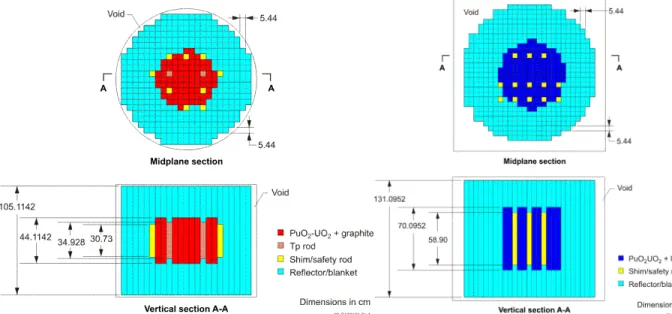
There are T (shim) and S (safety) rods with heights different from the core size. The 3D models (Figure 1) with tubes and cans were simplified by homogenizing fuel elements radially and axially, and heights of T, S and TP rods were revised to be equal to the heights of their cores. The R-Z models are kept as benchmark models for coarse approximate studying of main critical parameters and integral functions. The R-Z model for SNEAK 7A contains three physical zones: inner core, outer core with the homogenized shim and safety rods, and the blanket. The R-Z model for SNEAK 7B contains two physical zones: core with the homogenized shim and safety rods and the blanket. Both models are symmetric around the cylinder axis and across the horizontal mid plane. R-Z models are presented below in Figure 2.
Two- and three-dimensional models for the TWODANT/THREEDANT and MCNP codes are included in the IRPhE evaluation. In the cylindrical 2D R-Z model of the assembly, the control rods were homogenized into the core zone. The effective core radii of SNEAK-7A and 7B are 28.63 cm and 37.84 cm, respectively.
OECD/NEA Intercomparison of Deterministic and Monte Carlo Cross-Section Sensitivity Codes Using SNEAK-7 Benchmarks
PHYSOR 2016 – Unifying Theory and Experiments in the 21st Century
Sun Valley, Idaho, USA, May 1 – 5, 2016 3 / 10
Figure 1. Cross cuts of detailed and simplified 3D benchmark models of the SNEAK 7A (left) and SNEAK-7B (right) fast reactor assemblies.
Figure 2. Cross cuts of the simplified 2D R-Z models of the SNEAK 7A (above) and SNEAK-7B (below) fast reactor configurations.
3. COMPUTER CODES AND MODELS USED Several solutions were received up to now from the following participants:
- Victor Mastrangelo : TSUNAMI-3D code package, simplified 3D model, 238-group ENDF/B-VII.0 (v7-238) cross sections, P3, CPU time: 0.5 days on Intel Xeon 2.67GHz,
- Winfried Zwermann, XSUSA/TWODANT, 2d model, ENDF/B-VII.0 (v7-238) cross sections,
CPU time: 0.5 days (SNEAK7A)/1 day (SNEAK7B) on Intel Xeon, 2.8 GHz,
- Manuele Aufiero: SERPENT2 with extended GPT option, 2D model with pointwise JEFF 3.1.1 and ENDF/B-VII cross sections, CPU time: 28 hours on 4 nodes of a 20 cores Intel(R) Xeon(R) CPU E5-2670 v2 @ machine
- Evgeny Ivanov: MCNP-6 code with ENDF/B-VII.1 cross sections, detailed 3D model, CPU time: 150 hrs,
- Yannick Peneliau, SNATCH code, using 2D model, S16/P1 approximations and 33-group
ENDF/B-VII.0 and JEFF 3.1.1 cross sections, CPU time: 27min. for 7A / 43 min. for 7B using Intel(R) Xeon(R) CPU E5-2620 0 @ 2.00GHz,
- Ivo Kodeli: SUSD3D generalised perturbation code and PARTISN SN solver (XSUN-2015
package), using 2D and 3D models, S8/P3 up to S16/P5 approximations, and 33-group
ENDF/B-VII.0 and -VII.1 cross sections, CPU time: few minutes (2D)/~2.5 hrs. (3D)/case on Intel Core i7 2.4 GHz,
- Alexander Aures: TSUNAMI-3D code package, detailed 3D model, 238-group ENDF/B-VII.0 (v7-238) cross sections, P1, CPU time: 1.5 days/case on Intel Xeon, 2.8 GHz.
3.1. SUSD3D
The SUSD3D [5] code is based on the generalised perturbation theory. The sensitivity profiles for the SNEAK-7A and -7B benchmarks were calculated from the direct and adjoint flux moments produced by the 1-, 2- and 3-dimensional discrete ordinates (SN) transport code packages PARTISN [6].
SUSD3D can calculate also the secondary angular and energy distribution (SAD/SED) sensitivities, such as those to the prompt and delayed fission neutron spectra (PFNS/DFNS), evaluated using either classical or constrained methods [7]. The SN computational models were taken mostly from the IRPhE
evaluation with few modifications. Both 2D RZ model and the simplified 3D models were studied using S8 angular quadrature. P3 and P5 Legendre polynomials have been used in the 2D and 3D
PARTISN/DANTSYS calculation, respectively. The partial cross-sections were taken from the ENDF/B-VII.0 and -VII.1 evaluations and processed by the NJOY/GROUPR code [8] using the (thermal-1/E-fission+fusion) weighting. The data were calculated at several self-shielding factors, permitting thus to use in the SUSD3D sensitivity calculations the self-shielded cross-sections close to those actually used in the transport calculation as calculated by the TRANSX-2 [9] code. The calculations were done in 33 neutron energy groups.
3.2. TSUNAMI-3D
TSUNAMI-3D [10] is a code sequence for sensitivity and uncertainty analysis contained in the SCALE 6.1 code system. It uses the multi-group version of the Monte Carlo code KENO to describe the neutron transport; sensitivities are determined by first-order perturbation theory. In the present paper, 238-group ENDF/B-VII.0 based cross-sections were used with Legendre orders of P1 (detailed
3D model) and P3 (simplified 3D model).
3.3. XSUSA
The sampling based GRS uncertainty and sensitivity software XSUSA (“Cross Section Uncertainty and Sensitivity Analysis”) [11] applies cross-section variations, normally obtained from cross-section covariance data, to nuclear data in AMPX format, processed within the SCALE code system. These varied cross sections are normally used with transport codes from the SCALE 6.1 system; for the SNEAK assemblies in simplified 3D representation; however, the THREEDANT module in x-y-z geometry from the PARTISN package has been used. Problem-dependent cross sections were generated with the resonance self-shielding sequence of the SCALE 6.1 system with ENDF/B-VII.0 based data in 102 energy groups. These cross sections were generated through pre-collapsing the
238-OECD/NEA Intercomparison of Deterministic and Monte Carlo Cross-Section Sensitivity Codes Using SNEAK-7 Benchmarks
PHYSOR 2016 – Unifying Theory and Experiments in the 21st Century
Sun Valley, Idaho, USA, May 1 – 5, 2016 5 / 10
group SCALE 6.1 library with a representative spectrum from a SNEAK-7 calculation in 1-D representation. The group structure has been chosen such that in the fast region (above ~0.5 keV), the 238-group structure is retained, while in the region below ~0.5 keV, the cross sections are collapsed to the structure of the 44-group SCALE 6.1 covariance data. Sensitivity profiles were obtained through direct perturbation, i.e. through varying individual reactions of individual isotopes group by group, based on the 44-group structure of the SCALE 6.1 system, by small amounts (here: ±5%), and determining changes of keff with respect to these perturbations.
3.4. SERPENT-2
The Serpent-2 GPT extension [12] is based on the collection of the particle's collisions over several neutron generations. The adjoint weighting required to perform Generalized Perturbation Theory calculations is obtained in standard (forward) Monte Carlo criticality source calculations via the Iterated Fission Probability method. The effect of fission source perturbation is implicitly taken into account by following particle's histories over multiple generations.
The benchmark analysis was performed using pointwise JEFF 3.1.1 and ENDF/B-VII.0 Cross sections with probability tables. The SNEAK-7A benchmark was modeled in 2D geometry, adopting 10 latent generations for the sensitivities calculations. The SNEAK-7B benchmark was modeled adopting the 3D geometry presented in Figure 1.
3.5. MCNP-6
The computations were performed using the MCNP-6 code [13]. They were carried out using pointwise ENDF/B-VII.1 data taken at room temperature. In the code 106 particles per generation
within 1500 generations were used. Sensitivity coefficients were computed using importance weighted technique and by grouping the energy spectra to match the SCALE 238 energy intervals. Sensitivity coefficients were computed for major actinides and for major nuclear data including total and delayed neutrons multiplicity. The sensitivities to PFNS were constrained [7]. It should be noted that the precise (i.e. the most heterogeneous) geometrical model has been taken for the MCNP computations in order to obtain the reference values. This is why the results may differ from those of other participants.
3.6. ERANOS/SNATCH
SNATCH [14] is a recent, multi-threaded, 3D SN code developed at CEA. It is used in nuclear data validation exclusively. Its capability to calculate an accurate angular flux allows the user to perform uncertainty and sensitivity analyses within the standard perturbation theory.
The self-shielded, collapsed and homogenized cross sections have been generated by the legacy ECCO code [15]. The latter is part of the ERANOS code system [16] dedicated to SFR analyses. ENDF/B-VII.0 evaluation cross sections have been used. They first have been processed for the ERANOS system using NJOY and CALENDF processing tools.
SNEAK-7 calculations have been performed using R-Z model for spatial description, the order 1 in Legendre expansion for cross section anisotropy and the S16 option for quadrature order to describe angular flux. A single thread was used for these simulations.
4. INTER-COMPARISON OF THE RESULTS
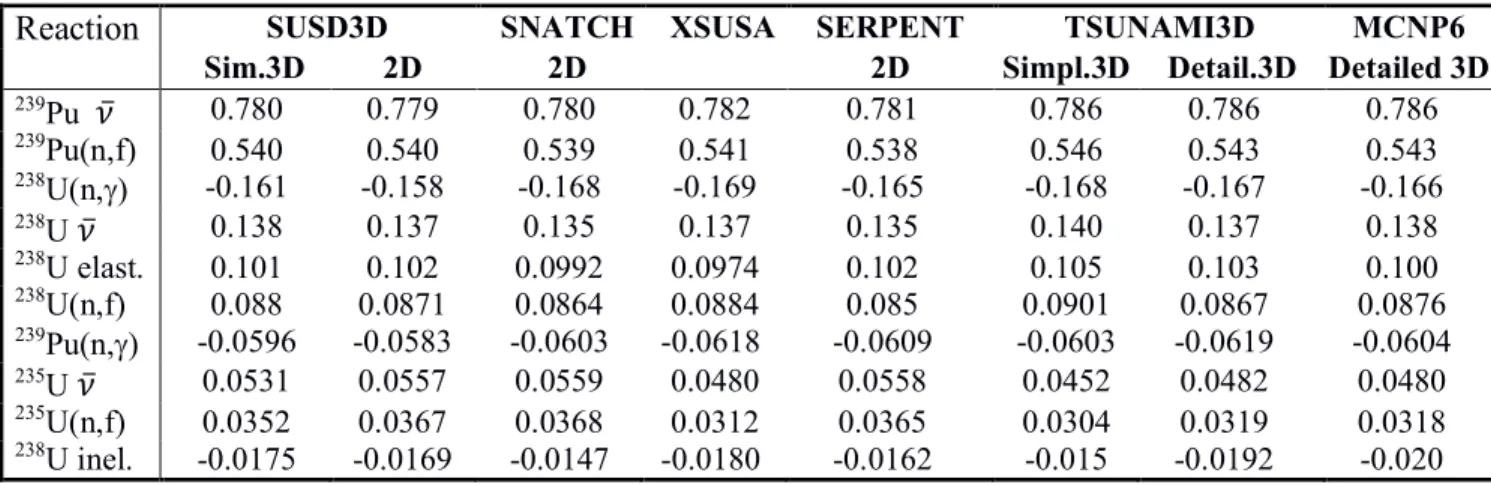
The results obtained using the above mentioned codes are presented in Tables 1 to 3. Differences of up to ~500 pcm can be observed among the calculated keff values in Table 2 which could be explained
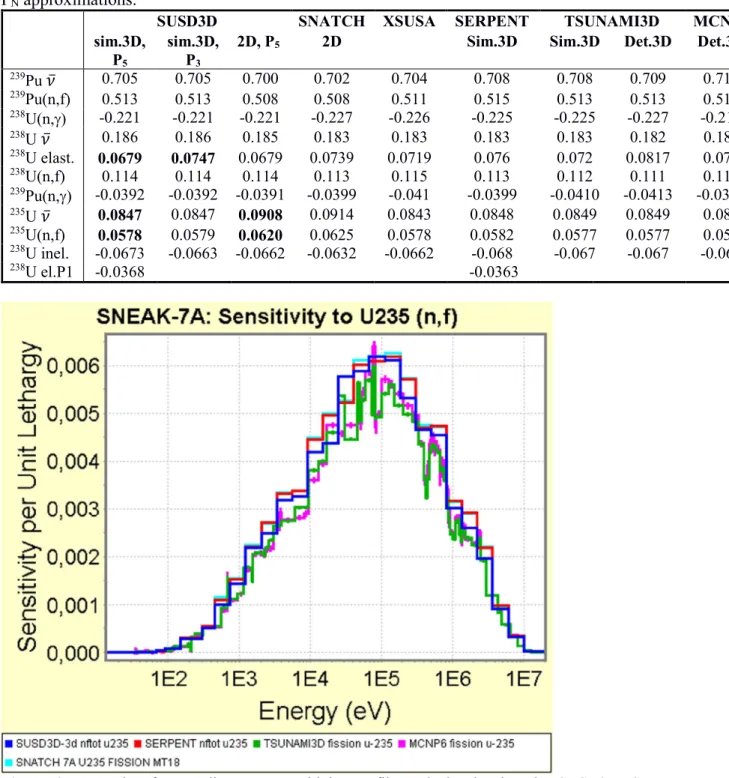
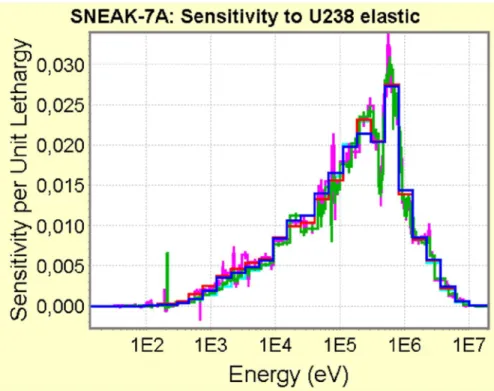
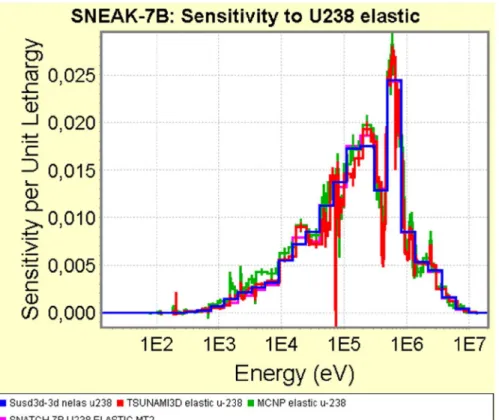
by some differences in the geometrical models used (2D vs. 3D), computational approximations, cross section treatment etc. However, the sensitivities, both the energy integrated values (Tabs. 2, 3) and energy profiles (Figures) show (surprisingly) excellent agreement. This is obviously the consequence of sensitivities being relative quantities. Note that the sensitivity profiles compared in Figs. 3-6 correspond to those where largest differences were observed (see Tab. 3, 4), mostly with respect to the elastic and inelastic scattering. Also the differences between the sensitivity calculated using 2D and 3D models are very small, except for the 235U ̅ and (n,f) sensitivities, relatively low in magnitude,
where the differences are ~5-10%, . PN Legendre order used in the SN transport calculations was on
the other hand found to have impact on the sensitivity to the elastic cross sections, which can probably explain some dispersion of results among codes for these reactions.
Table 1. Calculated values of keff
Model SNEAK 7A SNEAK 7B
keff - direct keff - adjoint keff - direct keff - adjoint
SUSD3D (3D simplified model,
ENDF/BVII.0,P3/ P5) 1.00659 1.00659 1.00261 1.00261 SUSD3D (2D model, P5) 1.00691 1.00690 1.00630 1.00628 TSUNAMI-3D (simplified 3D) ENDF/B-VII.0 1.00848±8pcm 1.0120±400pcm 1.00697±6pcm 1.0035±420pcm TSUNAMI-3D (detailed 3D) ENDF/B-VII.0 1.00862±7pcm 1.0085±390pcm 1.00596±7pcm 0.9949±460pcm
SERPENT (7A: 2D model, 7B:
3D simplified) ENDF/B-VII.0 1.00724±3pcm not needed 1.00172±4pcm not needed
XSUSA 1.00749 not needed 1.00648 not needed
SNATCH (2D, ENDF/BVII.0) 1.00517 1.00175
MCNP6 (detailed 3D) 1.00237±2pcm not needed 1.00330±1pcm not needed
Measured 1.0010±290pcm 1.0016±350pcm
Table 2. Energy integrated sensitivities for SNEAK-7A calculated using different codes.
Reaction SUSD3D SNATCH XSUSA SERPENT TSUNAMI3D MCNP6
Sim.3D 2D 2D 2D Simpl.3D Detail.3D Detailed 3D
239Pu ̅ 0.780 0.779 0.780 0.782 0.781 0.786 0.786 0.786 239 Pu(n,f) 0.540 0.540 0.539 0.541 0.538 0.546 0.543 0.543 238U(n,) -0.161 -0.158 -0.168 -0.169 -0.165 -0.168 -0.167 -0.166 238 U ̅ 0.138 0.137 0.135 0.137 0.135 0.140 0.137 0.138 238U elast. 0.101 0.102 0.0992 0.0974 0.102 0.105 0.103 0.100 238 U(n,f) 0.088 0.0871 0.0864 0.0884 0.085 0.0901 0.0867 0.0876 239Pu(n,) -0.0596 -0.0583 -0.0603 -0.0618 -0.0609 -0.0603 -0.0619 -0.0604 235 U ̅ 0.0531 0.0557 0.0559 0.0480 0.0558 0.0452 0.0482 0.0480 235U(n,f) 0.0352 0.0367 0.0368 0.0312 0.0365 0.0304 0.0319 0.0318 238 U inel. -0.0175 -0.0169 -0.0147 -0.0180 -0.0162 -0.015 -0.0192 -0.020
OECD/NEA Intercomparison of Deterministic and Monte Carlo Cross-Section Sensitivity Codes Using SNEAK-7 Benchmarks
PHYSOR 2016 – Unifying Theory and Experiments in the 21st Century
Sun Valley, Idaho, USA, May 1 – 5, 2016 7 / 10
Table 3. Energy integrated sensitivities for SNEAK-7B calculated using different codes, models and PN approximations.
SUSD3D SNATCH XSUSA SERPENT TSUNAMI3D MCNP6
sim.3D, P5
sim.3D, P3
2D, P5 2D Sim.3D Sim.3D Det.3D Det.3D
239 Pu ̅ 0.705 0.705 0.700 0.702 0.704 0.708 0.708 0.709 0.713 239Pu(n,f) 0.513 0.513 0.508 0.508 0.511 0.515 0.513 0.513 0.516 238 U(n,) -0.221 -0.221 -0.221 -0.227 -0.226 -0.225 -0.225 -0.227 -0.217 238U ̅ 0.186 0.186 0.185 0.183 0.183 0.183 0.183 0.182 0.181 238 U elast. 0.0679 0.0747 0.0679 0.0739 0.0719 0.076 0.072 0.0817 0.077 238U(n,f) 0.114 0.114 0.114 0.113 0.115 0.113 0.112 0.111 0.111 239 Pu(n,) -0.0392 -0.0392 -0.0391 -0.0399 -0.041 -0.0399 -0.0410 -0.0413 -0.0399 235U ̅ 0.0847 0.0847 0.0908 0.0914 0.0843 0.0848 0.0849 0.0849 0.083 235 U(n,f) 0.0578 0.0579 0.0620 0.0625 0.0578 0.0582 0.0577 0.0577 0.057 238U inel. -0.0673 -0.0663 -0.0662 -0.0632 -0.0662 -0.068 -0.067 -0.067 -0.065 238 U el.P1 -0.0368 -0.0363
Figure 3. Example of most discrepant sensitivity profiles calculated using the SUSD3D, SERPENT, TSUNAMI3D, MCNP6 and SNATCH codes.
Figure 4. Example of most discrepant sensitivity profiles calculated by different codes.
Figure 5. Most discrepant sensitivity profiles calculated using the SUSD3D, SERPENT, TSUNAMI3D, MCNP6 and SNATCH codes.
OECD/NEA Intercomparison of Deterministic and Monte Carlo Cross-Section Sensitivity Codes Using SNEAK-7 Benchmarks
PHYSOR 2016 – Unifying Theory and Experiments in the 21st Century
Sun Valley, Idaho, USA, May 1 – 5, 2016 9 / 10
Figure 6. Most discrepant sensitivity profiles calculated using different codes.
5. CONCLUSIONS
SNEAK-7A and -7B fast reactor benchmark experiments were proposed for an inter-comparison exercise involving cross section sensitivity and uncertainty codes. Several solutions for the keff
sensitivities were received up to now using different, both deterministic and stochastic computer codes, different nuclear data libraries, energy group structures (pointwise vs. multigroup cross sections, provided in as few as 33 and up to 238 energy groups), and modelisations of the geometry. In spite of differences in the calculated keff (up to 500 pcm), very different codes and approximations
used, an excellent general agreement was observed between the sensitivities, for both integral values and sensitivity profiles. For most of the important reactions the integral sensitivities agree within 1-2%. Differences between sensitivity calculated using the 2D and 3D models were found to be very small. Larger differences of around 10% were observed for the elastic and inelastic scattering. (In)elastic scattering terms are evaluated as a difference between two large (gain and loss) components causing numerical instabilities. Additionally, they are sensitive to the treatment of anisotropy, e.g. number of Legendre moments taken into account in the calculation. The differences in 235U ̅ and (n,f) sensitivities are likely to be caused by differences in the models (2D/3D) used.
Solutions from additional participants are most welcome. ACKNOWLEDGMENTS
REFERENCES
[1] K. Ivanov, M. Avramova, S. Kamerow, I. Kodeli, E. Sartori, E. Ivanov, O. Cabellos, “Benchmark for Uncertainty Analysis in Modelling (UAM) for Design, Operation and Safety Analysis of LWRs, Volume I: Specification and Support Data for the Neutronics Cases (Phase I)”, Version 2.1, NEA/NSC/DOC(2013)7 (2013) OECD Nuclear Energy Agency
[2] Summary Record of the "Workshop on Uncertainty Analysis in Modelling - UAM-2006", 28-29 April 2006, Pisa, Italy NEA/NSC/DOC(2006)15
[3] V. Mastrangelo, I. Kodeli, E. Sartori, “Proposal of a Benchmark for Stochastic and Deterministic Analyses of Nuclear Data Sensitivities and Uncertainties”, Proc. Workshop on Uncertainty
Analysis in Modelling, Coupled Multi-physics and Multi-scale LWR analysis (UAM-2006), Pisa,
28/29 April 2006, Package NEA-1769: ZZ-UAM-LWR (30-JUN-2006)
http://www.nea.fr/abs/html/nea-1769.html
[4] E. Ivanov, “SNEAK 7A and 7B Pu-Fuelled Fast Critical Assemblies in the Karlsruhe Fast Critical Facility”, Internal Reviewers V. Mastrangelo, I. Kodeli, NEA/NSC/DOC(2006)1, LMFR, SNEAK-LMFR-EXP-001, CRIT-SPEC-COEF-KIN-RRATE-MISC (March 2008).
[5] I. Kodeli, "Multidimensional Deterministic Nuclear Data Sensitivity and Uncertainty Code System, Method and Application", Nucl. Sci. Eng., 138, 45-66 (2001)
[6] R. E. Alcouffe, R. S. Baker, J. A. Dahl, S.A. Turner, R. Ward: PARTISN “A Time-Dependent, Parallel Neutral Particle Transport Code System”, LA-UR-08-07258 (Revised Nov. 2008) [7] I. Kodeli, A. Trkov, R. Capote, Y. Nagaya, V. Maslov, “Evaluation and Use of the Prompt Fission
Neutron Spectrum and Spectra Covariance Matrices in Criticality and Shielding”, Nucl. Instr.
Methods in Phys. Res. A 610 (2009) 540-552
[8] R.E. MacFarlane & D.W. Muir "The NJOY Nuclear Data Processing System", Version 91. LA-12740-M (October 1994)
[9] R.E. MacFarlane "TRANSX2: A Code for Interfacing MATXS Cross-Section Libraries to Nuclear Transport Codes" LA-12312-MS (July 1992)
[10] B.T. Rearden, D.E. Mueller, “Uncertainty Quantification Techniques of SCALE/TSUNAMI”,
Trans. Am. Nucl. Soc., 104, pp. 371-373 (2011).
[11] F. Bostelmann, W. Zwermann, B. Krzykacz-Hausmann, L. Gallner, A. Aures, K. Velkov. "Sampling-Based Nuclear Data Uncertainty Analysis in Criticality and Depletion Calculations”, ANS MC2015, Nashville, TN, USA, 19-23 April 2015.
[12] M. Aufiero, A. Bidaud, M. Hursin, J. Leppänen, G. Palmiotti, S. Pelloni, P. Rubiolo, “A collision history-based approach to sensitivity/perturbation calculations in the continuous energy Monte Carlo code SERPENT”, Annals of Nuclear Energy, 85, Nov. 2015, Pages 245-258.
[13] MCNP6 Users Manual - Code Version 6.1.1beta, LA-CP-14-00745 (June 2014)
[14] R. Letellier, C. Suteau, D. Fournier, J.M. Ruggieri, "High-Order Discrete Ordinate Transport in Hexagonal Geometry: a New Capability in ERANOS", Il Nuovo Cimento, 33C (2010).
[15] G. Rimpault, "Algorithmic features of the ECCO cell code for treating heterogeneous fast reactor assemblies", M&C95, Portland, USA (1995)
[16] J.M. Ruggieri, J. Tommasi, J.F. Lebrat, C. Suteau, D. Plisson-Rieunier, C. De Saint Jean, G. Rimpault, J.C. Sublet, "ERANOS 2.1 : International Code System for GEN IV Fast Reactor Analysis", ICAPP’06, Reno, USA (2006)